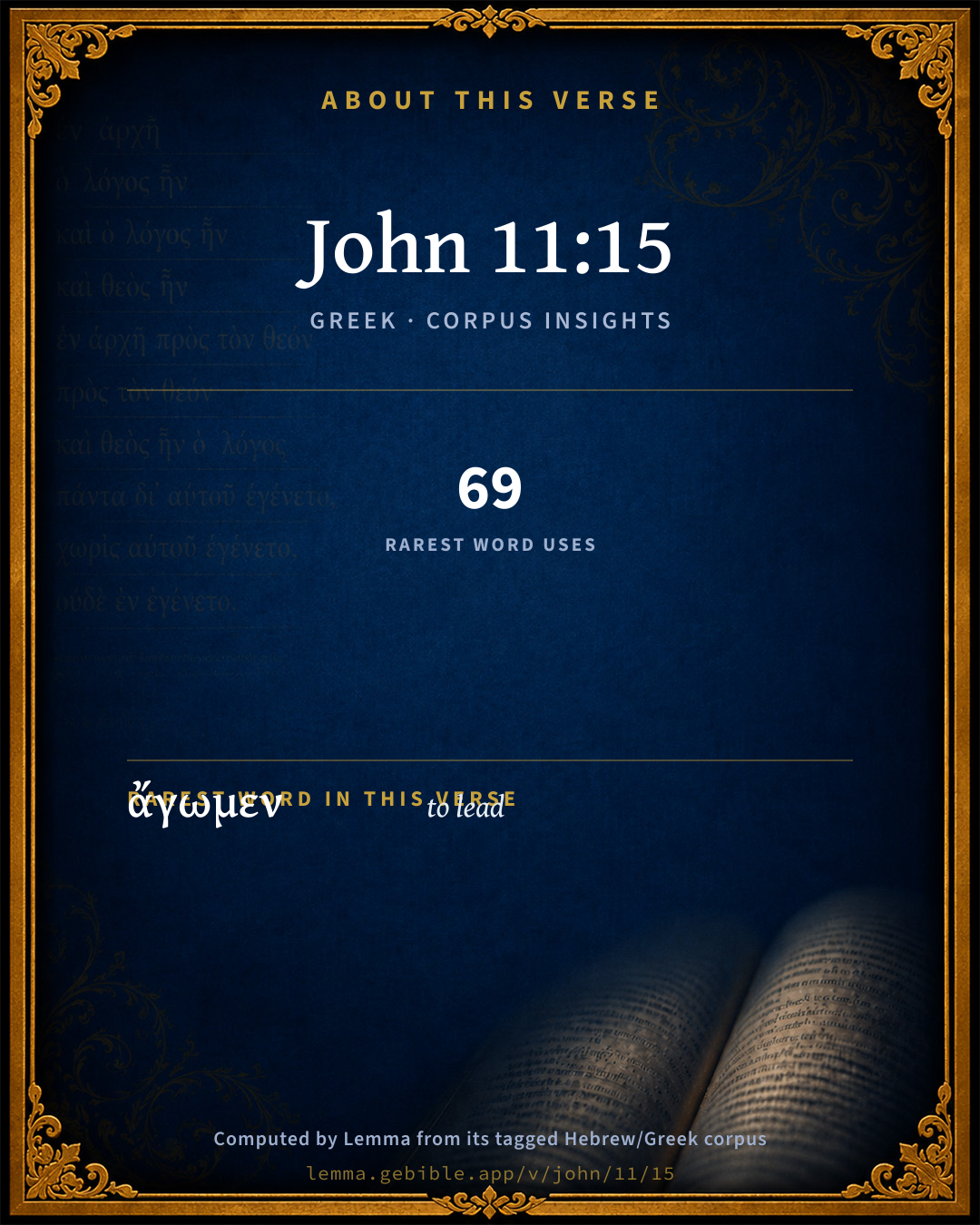
John 11:15

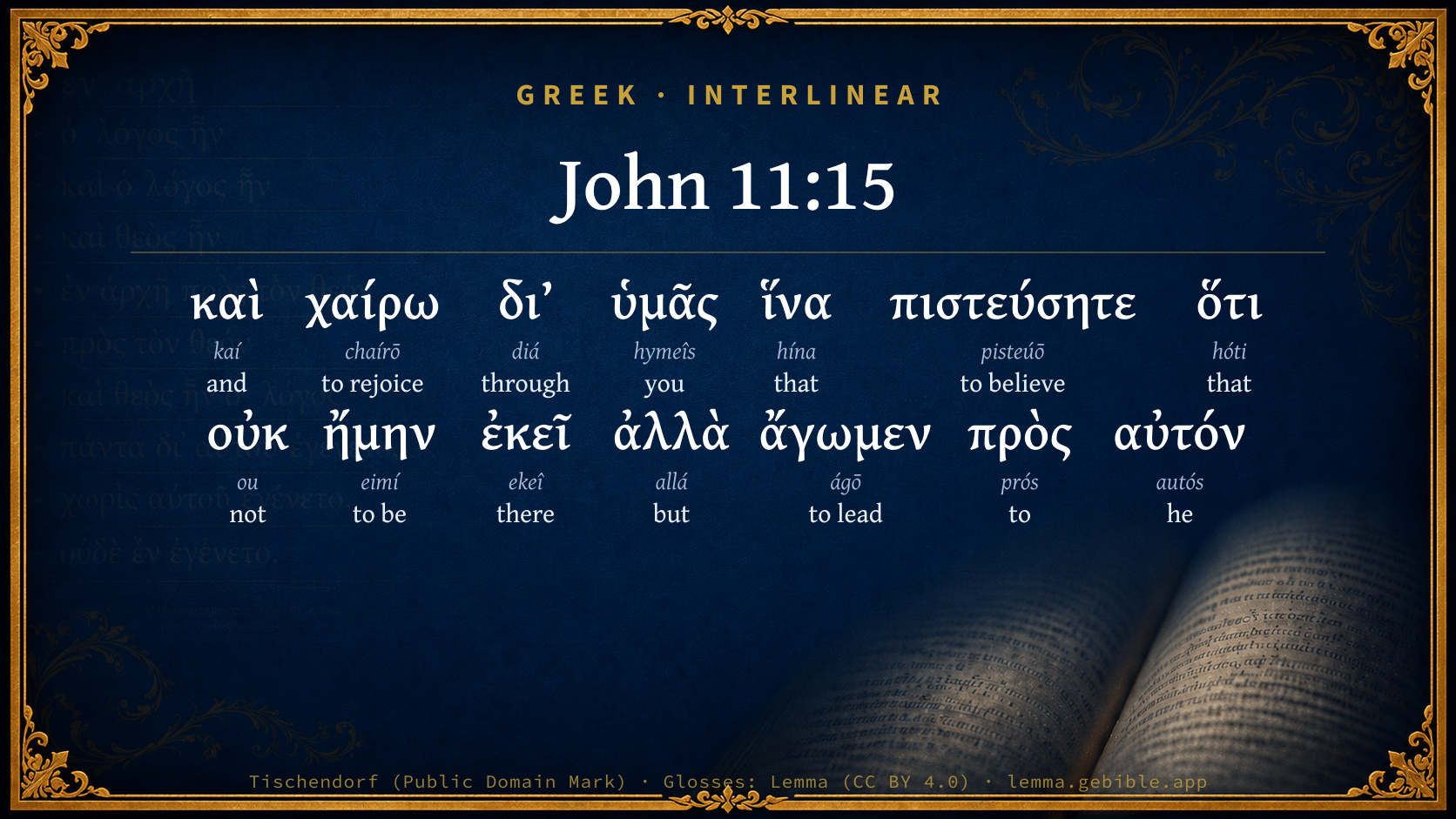
Greek (Tischendorf 8th ed.) John 11:15 appears in the Greek New Testament. The text above is from the Tischendorf 8th edition. Each word links to its Strong’s number and a concise gloss. Click any word for its full Thayer’s Greek Lexicon entry.
Download image
Cite this verse

John 11:15 (World English Bible). Public Domain. Lemma interlinear Bible study tool, https://lemma.gebible.app/v/john/11/15.

Show BibTeX & RIS
BibTeX
RIS
English Translation
I am glad for your sakes that I was not there, so that you may believe. Nevertheless, let's go to him."
World English Bible · Public Domain
Download a study sheet

One document with this verse’s original text, its word-by-word gloss line, the meaning frame, cross-references with their text, attributed commentary, and full source and license credits — printable, and it pastes into notes with its structure intact.

This verse Autodidact and up

Study sheet (.html) Plain text (.txt)

A passage Seminary Student

Up to 50 verses in one chapter. A passage sheet keeps up to 6 commentary sources and 12 cross-references per verse, in the order this page ranks them, and says so on the sheet whenever that leaves anything out. Ask for a single verse and you get the Autodidact verse sheet above.

Everything on this page stays free to read, with no account — the sheet is a download of what is already on screen, not access to it.

Want to remove ads? Support Godless Engineer
Compare translations 3

The same verse in 3 English versions, stacked beneath the original-language interlinear above. Click any original word for its lexicon entry.

Each is an independent rendering of the whole verse — the interlinear is not word-aligned to these translations.

Highlighted words mark where these versions differ — a whole-verse word diff, not a word-by-word alignment.

  • World English Bible Public Domain
    I am glad for your sakes that I was not there, so that you may believe. Nevertheless, let's go to him."
  • King James Version Public Domain
    And I am glad for your sakes that I was not there, to the intent ye may believe; nevertheless let us go unto him.
  • unfoldingWord Literal Text CC BY-SA 4.0
    And I am glad for your sakes that I was not there, so that you may believe. But let us go to him.”

unfoldingWord Literal Text — © unfoldingWord, licensed CC BY-SA 4.0. Word-aligned USFM3 via Door43 (git.door43.org/unfoldingWord/en_ult).

Versions to compare (up to 4)

3 of 4 selected

Show all 19 translations

Every available English version of this verse, each an independent rendering of the whole verse.

  • World English Bible Public Domain
    I am glad for your sakes that I was not there, so that you may believe. Nevertheless, let's go to him."
  • Berean Standard Bible Public Domain
    and for your sake I am glad I was not there, so that you may believe. But let us go to him.”
  • Majority Standard Bible Public Domain
    and for your sake I am glad I was not there, so that you may believe. But let us go to him.”
  • King James Version Public Domain
    And I am glad for your sakes that I was not there, to the intent ye may believe; nevertheless let us go unto him.
  • American Standard Version (1901) Public Domain
    And I am glad for your sakes that I was not there, to the intent ye may believe; nevertheless let us go unto him.
  • Revised Version (1885) Public Domain
    And I am glad for your sakes that I was not there, to the intent ye may believe; nevertheless let us go unto him.
  • Geneva Bible (1599) Public Domain
    And I am glad for your sakes, that I was not there, that ye may beleeue: but let vs go vnto him.
  • Douay-Rheims (1899) Public Domain
    And I am glad, for your sakes, that I was not there, that you may believe: but let us go to him.
  • Young's Literal Translation Public Domain
    and I rejoice, for your sake, (that ye may believe,) that I was not there; but we may go to him;'
  • Literal Standard Version CC BY-SA 4.0
    and I rejoice, for your sake (that you may believe), that I was not there; but we may go to him”;
  • Unlocked Literal Bible CC BY-SA 4.0
    I am glad, for your sakes, that I was not there so that you may believe. Let us go to him.”
  • unfoldingWord Literal Text CC BY-SA 4.0
    And I am glad for your sakes that I was not there, so that you may believe. But let us go to him.”
  • Darby Bible Public Domain
    And I rejoice on your account that I was not there, in order that ye may believe. But let us go to him.
  • World Messianic Bible Public Domain
    I am glad for your sakes that I was not there, so that you may believe. Nevertheless, let’s go to him.”
  • Webster's Bible Public Domain
    And I am glad for your sakes that I was not there, to the intent ye may believe; nevertheless, let us go to him.
  • Free Bible Version CC BY-SA 4.0
    For your sake I'm glad I wasn't there, because now you will be able to trust in me. Let's go and see him.”
  • Bible in Basic English Public Domain
    And because of you I am glad I was not there, so that you may have faith; but let us go to him.
  • Text-Critical English NT CC BY 4.0
    and I rejoice for your sake that I was not there, so that you may believe. But let us go to him.”
  • Tyndale New Testament (1534) Public Domain
    and I am glad for youre sakes that I was not there because ye maye beleve. Neverthelesse let vs go vnto him.

Literal Standard Version (2020), Covenant Press — licensed CC BY-SA 4.0. Text via the HelloAO Bible API (eBible.org). Unlocked Literal Bible (unfoldingWord) — licensed CC BY-SA 4.0. Text via the HelloAO Bible API (eBible.org). unfoldingWord Literal Text — © unfoldingWord, licensed CC BY-SA 4.0. Word-aligned USFM3 via Door43 (git.door43.org/unfoldingWord/en_ult). Free Bible Version, Dr. Jonathan Gallagher — licensed CC BY-SA 4.0. Text via the HelloAO Bible API (eBible.org).

Word by word

More ways to search: Search by grammar → Find every occurrence → Compare this word →

Practice this passage: Drill this verse → Learn its vocabulary →

ἄγωμεν
ágō
G71
“to lead”
Verb, Present, Active, Subjunctive, 1st person, Plural
Part of Speech
Verb
Tense
Present
Voice
Active
Mood
Subjunctive
Person
1st person
Number
Plural
Full Thayer's Definition

Origin: a primary word

TDNT: None

1. to lead, take with one a. to lead by laying hold of, and this way to bring to the point of destination: of an animal b. to lead by accompanying to (into) a place c. to lead with one's self, attach to one's self as an attendant d. to conduct, bring e. to lead away, to a court of justice, magistrate, etc. 2. to lead, a. to lead, guide, direct b. to lead through, conduct to: to something c. to move, impel: of forces and influences on the mind 3. to pass a day, keep or celebrate a feast, etc. 4. to go, depart
  1. καὶ kaí G2532 “and” Conjunction
  2. χαίρω chaírō G5463 “to rejoice” Verb, Present, Active, Indicative, 1st person, Singular
  3. δι’ diá G1223 “through” Preposition
  4. ὑμᾶς hymeîs G5210 “you” Personal pronoun, 2nd person, Accusative, Plural
  5. ἵνα hína G2443 “that” Conjunction
  6. πιστεύσητε pisteúō G4100 “to believe” Verb, Aorist, Active, Subjunctive, 2nd person, Plural
  7. ὅτι hóti G3754 “that” Conjunction
  8. οὐκ ou G3756 “not” Particle, Negative
  9. ἤμην eimí G1510 “to be” Verb, Imperfect, Middle, Indicative, 1st person, Singular
  10. ἐκεῖ ekeî G1563 “there” Adverb
  11. ἀλλὰ allá G235 “but” Conjunction
  12. πρὸς prós G4314 “to” Preposition
  13. αὐτόν autós G846 “he” Personal pronoun, Accusative, Singular, Masculine

About this verse

These counts appear in no published source. They are computed here, from the morphology-tagged text and Lemma’s own curated glosses. What Lemma adds →

14
words
14
distinct lemmas
Gospels
section

Cross-references

14

Topical passages linked to John 11:15 in the Treasury of Scripture Knowledge — connected by theme and wording, ordered by reader-vote popularity; previews shown in the World English Bible.

  • 2 Timothy 2:10 Therefore I endure all things for the chosen ones' sake, that they also may obtain the salvation which is in Christ Jesus with eternal glory.
  • John 14:10–11 Don't you believe that I am in the Father, and the Father in me? The words that I tell you, I speak not from myself; but the Father who lives in me does his works.
  • Isaiah 54:15 Behold, they may gather together, but not by me: whoever shall gather together against you shall fall because of you.
  • John 11:4 But when Jesus heard it, he said, "This sickness is not to death, but for the glory of God, that God's Son may be glorified by it."
  • John 11:35–36 Jesus wept.
  • 1 John 5:13 These things I have written to you who believe in the name of the Son of God, that you may know that you have eternal life, and that you may continue to believe in the name of the Son of God.
  • Isaiah 65:8 Thus says Yahweh, As the new wine is found in the cluster, and one says, Don't destroy it, for a blessing is in it: so will I do for my servants' sake, that I may not destroy them all.
  • John 2:11 This beginning of his signs Jesus did in Cana of Galilee, and revealed his glory; and his disciples believed in him.
  • John 12:30 Jesus answered, "This voice hasn't come for my sake, but for your sakes.
  • John 17:19 For their sakes I sanctify myself, that they themselves also may be sanctified in truth.
  • 2 Corinthians 4:15 For all things are for your sakes, that the grace, being multiplied through the many, may cause the thanksgiving to abound to the glory of God.
  • Genesis 26:24 Yahweh appeared to him the same night, and said, "I am the God of Abraham your father. Don't be afraid, for I am with you, and will bless you, and multiply your seed for my servant Abraham's sake."
  • Genesis 39:5 It happened from the time that he made him overseer in his house, and over all that he had, that Yahweh blessed the Egyptian's house for Joseph's sake; and the blessing of Yahweh was on all that he had, in the house and in the field.
  • Psalms 105:14 He allowed no one to do them wrong. Yes, he reproved kings for their sakes,

Cross-references courtesy of OpenBible.info (CC BY 4.0).

Commentary

Notes on John 11:15 from classic Christian and Jewish commentators (each source and its license shown beneath its notes). The classic Christian expositions comment on the surrounding passage and are grouped to its opening verse, so a note may address several verses; the Jewish commentaries on the Tanakh (Rashi and others) are per-verse, so they appear only where the commentator wrote on this verse.

Lemma curates 59 commentaries, every one of them public domain or Creative Commons licensed, each selected and text-cleaned for this edition rather than reprinted as found. About our sources →

Bengel's Gnomon

Johann Albrecht Bengel

Joh 11:15. Ὅτι οὐκ ἤμην ἐκεῖ, that I was not there) It is beautifully consonant with Divine propriety, that no one is ever read of as having died whilst the Prince of life was present. If you suppose that death could not, in the presence of Jesus, have assailed Lazarus, the language of the two sisters, Joh 11:21; Joh 11:32, attains thereby a more sublime conception, “Lord, if Thou hadst been here, my brother had not died:” and thereby also the joy of the Lord at His own absence is illustrated.—πρὸς αὐτόν, unto him) to the place where he lies dead.

Bengel's Gnomon of the New Testament — English translation (T&T Clark, Edinburgh, 1860) — public domain. Text from a community e-Sword module.

Jamieson, Fausset & Brown

Robert Jamieson, A. R. Fausset & David Brown

I am glad for your sakes I was not there--This certainly implies that if He had been present, Lazarus would not have died; not because He could not have resisted the importunities of the sisters, but because, in presence of the personal Life, death could not have reached His friend [LUTHARDT]. "It is beautifully congruous to the divine decorum that in presence of the Prince of Life no one is ever said to have died" [BENGEL].

that ye may believe--This is added to explain His "gladness" at not having been present. His friend's death, as such, could not have been to Him "joyous"; the sequel shows it was "grievous"; but for them it was safe (Phi 3:1).

Jamieson, Fausset & Brown — Commentary Critical and Explanatory on the Whole Bible (1871) — public domain (CC PDM 1.0). Text via the HelloAO Bible API.

Adam Clarke's Commentary

Verse 15. I am glad for your sakes that I was not there] "I tell you plainly, Lazarus is dead: and I am glad I was not there - if I had been, I should have been prevailed on to have healed him almost as soon as he fell sick, and I should not have had so striking an occasion to manifest the glory of God to you, and to establish you in the faith." It was a miracle to discover that Lazarus was dead, as no person had come to announce it. It was a greater miracle to raise a dead man than to cure a sick man. And it was a still greater miracle, to raise one that was three or four days buried, and in whose body putrefaction might have begun to take place, than to raise one that was but newly dead. See Joh 11:39.

Adam Clarke's Commentary on the Bible (1810–1826) — public domain. Text from a community e-Sword/MySword module.

John Calvin's Commentaries

15. And I rejoice, on your account, that I was not there. He means that his absence was profitable to them, because his power would have been less illustriously displayed, if he had instantly given assistance to Lazarus. For the more nearly the works of God approach to the ordinary course of nature, the less highly are they valued, and the less illustriously is their glory displayed. This is what we experience daily; for if God immediately stretches out his hand, we do not perceive his assistance. That the resurrection of Lazarus, therefore, might be acknowledged by the disciples to be truly a Divine work, it must be delayed, that it might be very widely removed from a human remedy.

We ought to remember, however, what I formerly observed, that the fatherly kindness of God towards us is here represented in the person of Christ. When God permits us to be overwhelmed with distresses, and to languish long under them, let us know that, in this manner, he promotes our salvation. At such a time, no doubt, we groan and are perplexed and sorrowful, but the Lord rejoices on account of our benefit, and gives a twofold display of his kindness to us in this respect, that he not only pardons our sins, but gladly finds means of correcting them.

That you may believe. He does not mean that this was the first feeble commencement of faith in them, but that it was a confirmation of faith already begun, though it was still exceedingly small and weak. Yet he indirectly suggests that, if the hand of God had not been openly displayed, they would not have believed.

John Calvin's Commentaries (1540-1563) — public domain. Text from the Calvin Translation Society English edition (1840s-50s) via the Christian Classics Ethereal Library (ccel.org). Calvin's coverage is partial (roughly two-thirds of the Bible); uncommented books and verses are honest gaps, never fabricated. The 19th-century editor's footnotes and remarks are omitted so the notes are faithfully Calvin's own voice.

Ellicott's Commentary for English Readers

(15) And I am glad for your sakes that I was not there.—The words are at first sound startling, as following immediately upon the plain statement, “Lazarus is dead.” The utterance is not of sorrow, but of joy; but the joy is not at the fact of death, but at the fact that He was not there. Had He been there, Lazarus would not have died (Joh_11:21; Joh_11:32), and his recovery would have added to the work of healing. There is the assured consciousness of power over death itself, which sees as present all that is to follow, and sees in the strengthening of their faith ground for joy.

To the intent ye may believe.—They were already disciples, but this sign would be to them the vehicle of a higher spiritual truth, and the growth of their spiritual life would be such that it may be regarded as a new act of faith. (Comp. Note on Joh_2:11.)

Nevertheless let us go unto him.—The thought of the final issue of the sleep brings the whole future before the mind. But for this, His presence is needed at Bethany, and He abruptly breaks off this conversation about it, by what is at once a resolution and a summons to go there.

A Bible Commentary for English Readers, edited by Charles John Ellicott (1878–1897) — public domain. Text from a community e-Sword module.

The Cambridge Bible for Schools and Colleges

gen. ed. J. J. S. Perowne

15. I am glad] Christ rejoices, not at his friend’s death, but at His own absence from the scene, for the disciples’ sake. Had He been there, Lazarus would not have died, and the disciples would have lost this great sign of His Messiahship.

to the intent ye may believe] S. John’s favourite construction, indicating the Divine purpose: see on Joh_9:2-3. Would any forger have written this? Would it not seem utterly improbable that at the close of His ministry Christ should still be working in order that Apostles might believe? Yet S. John, who heard the words, records them, and he knew from sad experience (Mar_14:50; Mar_16:11; Luk_24:11; Luk_24:21) that this work was not superfluous. Just before the trial of faith which His Passion and Death would bring to them, His disciples had need of all the help and strength that He could give. See on Joh_2:11.

nevertheless let us go] He breaks off suddenly.

The Cambridge Bible for Schools and Colleges (gen. ed. J. J. S. Perowne; Cambridge University Press, 1878–1918) — public domain. Text from a community e-Sword module.

John Gill's Exposition

And I am glad for your sakes that I was not there,.... At Bethany, before he died, or when he died; because he might have been prevailed upon through the solicitations of his dear friends, Mary and Martha, and through tender affection to Lazarus, to have prevented his death, by rebuking the distemper, and restoring him to health, or to have raised him immediately as soon as he was dead; and in either case the miracle would not have been so illustrious, nor have been such a means of confirming the faith of his disciples, as now it would be:

to the intent ye may believe; more strongly, that he was the Son of God, and true Messiah:

nevertheless, let us go unto him; to Lazarus, to the grave where he lies: the Syriac version reads, "let us go there"; to Bethany, where he lived, and died, and now lay interred.

John Gill's Exposition of the Whole Bible (1746–1763) — public domain (CC PDM 1.0). Text via the HelloAO Bible API.

Trapp's Complete Commentary

John Trapp

15 And I am glad for your sakes that I was not there, to the intent ye may believe; nevertheless let us go unto him.

Ver. 15. I am glad for your sakes] If the confirmation and increase of faith in his be so great a joy to Christ, how acceptable must it needs be unto him, that we believe at first on his name! we cannot do him a greater honour, a more pleasing service. None greater in the father’s house than the prodigal returned. And what a high price did our Saviour set on the centurion’s faith.

John Trapp, A Commentary or Exposition upon All the Books of the Old and New Testament (1647–1656) — public domain. Text from a community e-Sword module.

Albert Barnes' Notes on the Bible

I am glad ... - The meaning of this verse may be thus expressed: “If I had been there during his sickness, the entreaties of his sisters and friends would have prevailed with me to restore him to health. I could not have refused them without appearing to be unkind. Though a restoration to health would have been a miracle, and sufficient to convince you, yet the miracle of raising him after being four days dead will be far more impressive, and on that account I rejoice that an opportunity is thus given so strikingly to confirm your faith.”

To the intent - To furnish you evidence on which you might be established in the belief that I am the Messiah.

Albert Barnes' Notes on the Bible (1834–1885) — public domain. Text from a community e-Sword/MySword module.

Haydock's Catholic Bible Commentary

When Christ says, that you may believe, we must not suppose he means, that they might begin than for the first time to believe, but that their faith, already begun, might be increased; for the faith of the disciples still stood in need of miracles, to make it grow more strong and rooted. (St. Augustine, as above.)

George Leo Haydock (1774–1849), Haydock's Catholic Family Bible and Commentary, 1859 edition — public domain. Excludes Psalms (Douay-Rheims chapter numbering differs from Protestant) and Deuterocanonical books (Catholic canon only).

Matthew Poole's English Annotations

Had I been upon the place, my kindness to his sisters, and pity, would have prevailed far with me to have prevented his death; but it is better, for your sakes at least, and I am glad. I was not there. For by this means I shalt have an advantage, by putting forth my Divine power in raising him from the dead, to confirm your faith in me as the Son of God, and the true Messias; therefore, though he be dead,

let us go unto him.

Matthew Poole's English Annotations on the Holy Bible (1683–1685) — public domain. Text from a community e-Sword/MySword module.

Whedon's Commentary on the Bible

Daniel D. Whedon

15. I am glad—Jesus, here, seems to rejoice at the opportunity for the miracle. But was not miracle always in his power? Doubtless in his power always; but not always accordantly with the divine will. He who moved by the Father’s will, and timed his steps by the divine clock, (see notes on Joh_11:7; Joh_11:9-10,) rejoiced when the hour struck for some great work confirmatory of his mission.

Ye may believe—John uses the word believe for the various degrees and stages of faith. See note on Joh_2:11. This great work would stand in memory and on record, one of the pillars for faith to repose upon.

Daniel D. Whedon (gen. ed.), Commentary on the Old and New Testaments (1874–1909) — public domain. Text from a community e-Sword module.

The Pulpit Commentary

And I rejoice that I was not there. Death could not have occurred in his presence; at least, as Bengel says, we never read of any one dying in the presence of the Prince of life. Whenever he came into contact with death, he conquered the great enemy. Still, this was not the absolute reason for his gladness. The gladness was conditioned by the need of the disciples, not merely for the comfort of the sisters, or for his own greater glory, but for your sakes, to the end that ye might believe. The word pisteuw is often used absolutely. (Joh_1:7, 50 4:41, 42 5:44 6:36; and many other places) The disciples had believed something of Christ"s power before; (see Joh_2:11, etc.) but every act of faith prepares the way for another. Every fresh exercise of faith makes all previous efforts in the same direction appear elementary. (cf. 1Jn_5:13) The joy of Jesus in the augmenting faith of his disciples is one of the most pathetic and instructive features of this Gospel. (see Joh_16:31, and notes) The kingdom of God among men was, so far as we can see, dependent on the amount of faith that the apostles could be induced to cherish in the fact of the Incarnation during the brief period of this ministry. The Church has not yet come to a full understanding of all that he was. But if the disciples had not known his power over death, they would have been destitute of the alphabet of this new language, of the foundations of the spiritual city they had to build. Jesus rejoiced when disciples believed. So he does still. Nevertheless, let us go to him to Lazarus, who still lives with God. (cf. Mat_22:32, and parallel passages) This is very remarkable. Even the dead body is in this case still. (cf. Joh_14:31)

Good in apparent evil.

Notice

I THAT ALL THE MOVEMENTS OF CHRIST ON EARTH HAD AN IMMEDIATE REGARD TO OTHERS.

1. His life on earth was purely vicarious. "For your sakes." Not only his death was vicarious, but his life was equally so. Not only he died for others, but he lived for them as well. His vicarious death was only the natural outcome of his vicarious life. All his movements, his actions, his miracles, his teaching and utterances, the fact and sum of his life, were for others for mankind generally and for his disciples particularly. "For your sakes.

2. His life on earth was purely self-sacrificing. "For your sakes." He sacrificed every personal feeling, convenience, and consideration for the advantage of others. Had he consulted his own personal feelings feelings of the tenderest affection and the sincerest friendship friendship for the dying and the living nothing would have kept him away from the death-bed of his beloved friend at Bethany; but these tenderest feelings of personal friendship he sacrificed for the sake of others. For their sakes he was not there. This was the great and grand principle of his whole life.

3. The vicariousness and self-sacrifice of his life were to him the sources of the greatest pleasure. "I am glad," etc. He found his highest joy in doing good to his fellow-men, and the greatest delight of his life was spending it for the advantage of others. In benefiting them even his own pain was turned into pleasure, his sorrow into joy, and the greatest self-sacrifice afforded him the greatest satisfaction.

4. His life on earth was one of untiring activity. Nevertheless, let us go unto him. His time for sorrow and joy was very limited. His was to act.

(1) His activity was ever timely. He would ever act in his own time; but his time was always right. Some thought he was too late; but if he went, even to a grave, it was not too late.

(2) His activity was often wonderful in its aim, but ever successful. "Let us go unto him." Lazarus was dead, and his soul in the spirit world; but he was not too far for Jesus to reach him he was at home there. To human view Lazarus was a prisoner of death, and it was a bold march to go to him through the territories of the king of terrors; but, bold as it was, Jesus undertook it successfully.

(3) His activity was ever inviting and inspiring. "Let us go." The disciples could not go as far as the Master, but let them go as far as they are able. If they can only see, weep, and witness, let them do what they can; he will do the rest. They were inspired to go.

(4) His activity was ever helpful, in consoling, teaching, and quickening.

II THAT ALL THE MOVEMENTS OF CHRIST ON EARTH HAD A SPECIAL REGARD TO THE GREATEST GOOD OF OTHERS. "To the intent that ye may believe.

1. Whatever he did was done with a definite purpose. "To the intent." He had one great and special aim through life. In every movement and act and utterance of his there was a definite purpose, and he kept this ever in view. It was the inspiration and guide of his movements. In all his various and busy activities there was not a single random shot; but he ever took a definite aim, on which his whole being centered. This is one of the secrets of his ultimate success.

2. Whatever he did was done for the best and highest purpose. In relation to his own mission and the salvation of the world. "That ye may believe." This implies:

(1) That although his disciples had faith, yet it was weak. It was incomplete. This was only to be expected. They were as yet but babes in Christ, and their faith was young and tender. Their wings had net fully grown, and could not soar very high not high enough as yet to reach and fully rest on the Savior.

(2) That it was capable of, and required growth and confirmation. Genuine faith, however weak and small, will grow by trial, by experience, by a fuller manifestation of its object, and cries out for this. Its growth is certain but gradual.

(3) That the growth and confirmation of their faith involved their greatest good. This alone could bring them into closer union with Christ and with the Father, and open to them the door of the spiritual kingdom, and fully present to their view the grand but real visions of the spiritual empire, and Jesus as the King in his beauty. This was the only true foundation of their character, and the only hope and sure means of its future perfection.

3. Whatever he did was done in the best way to effect the highest purpose. His absence from Bethany served the interest of faith far better than his presence would have done. This implies:

(1) That the death of Lazarus could scarcely take place in the immediate presence of Jesus. This is implied in what Jesus said to his disciples, and in what the sisters said to Jesus. We have no account that death ever took place in his presence. Even at a distance the prayer of faith was sufficient to call forth his triumphant power against it. When he met the king of terrors" on the highway with a lad, a stranger to Jesus, in his prison-van, he had to give him back to his mother at once: how much more would this be the case with regard to a sick friend! Death could hardly perform his work in the very presence of life. However, Jesus could hardly trust himself, and was glad that he was not there.

(2) That the restoration of Lazarus from death was more beneficial to faith than his preservation from it would have been.

(3) That it was the highest aim of Christ to serve the interest of faith in the most efficient way. He did not expect it to live and thrive on nothing, but furnished it with the strongest proofs, and with the most nourishing diet.

He not only produces faith, but supports it. His general aim was to produce faith where it was not, but especially to perfect it where it was. His aim was concentration of influence the perfection of the few faithful ones, and through them the perfection of the many. "That ye may believe.

4. The confirmation of faith in the disciples produced in Jesus the greatest joy.

(1) This was the joy of a favorable opportunity of doing the greatest good. Such opportunities are rare. Jesus availed himself of it with delight. Faith was struggling in the gloom of a friend"s death. But this furnished Jesus with a special opportunity to display his Divine power in the grand miracle of life.

(2) The joy of foreseen success. He foresaw the success of his last great miracle, which involved the success of his life, and through the wail of grief rolled the sweetest strains of music to his soul. What joy is like that of the joy of success in the chief aim of life?

III WHAT PRODUCES REGRET AND SORROW IN US OFTEN PRODUCES GLADNESS IN JESUS. His absence caused sorrow to the sisters, but joy to him. The same event producing different feelings in different persons, as illustrated in Jesus and the sisters, and why?

1. Jesus could see the intention of his absence; the sisters could not,

2. Jesus could see the ultimate result of his absence; they could not. Jesus could see the restoration of his friend, the display of Divine power, the triumph of faith, and the glory of God. This produced in him gladness. The sisters could not see this, and they were sad.

3. Jesus could see the gain of faith by the death of Lazarus to be immeasurably greater than the loss of the family. They could not see this as yet.

(1) Their loss was only personal, limited to a few. The gain of faith was universal.

(2) Their loss was only physical and social. The gain of faith was spiritual and Divine. Social feelings are nothing to the ecstasies of faith.

(3) Their loss was only temporary, for a short time. The gain of faith was eternal.

(4) Their loss was made up with interest; but the loss of faith for the want of the miracle, who could repair? He was the prepared object of the miracle, and the only one of the family not to begrudge the sacrifice. His death was the occasion of life to faith, and doubtless shared the joy of Jesus at its triumph, and was the willing sacrifice to its life.

LESSONS.

1. When the claims of personal feelings come in collision with those of public good, the former are to give way at any cost, and give way with joy.

2. In the strange dealings of Providence we should try to learn the Divine intention; that is our good.

3. This is difficult, if not impossible, often to realize. Therefore let us trust and wall.

4. In the light of results all will be plain and joyful. Jesus was glad in Peraea, while the sisters were sad in Bethany; but at the resurrection they could join with Jesus in the song of triumph and the anthem of life. "All is well that ends well. B.T.

The Pulpit Commentary (1880–1919), ed. H.D.M. Spence-Jones & Joseph S. Exell — public domain. Text from a community e-Sword module.

unfoldingWord translationNotes

Door43 World Missions Community

Connecting Statement:

Jesus continues speaking to his disciples.

for your sakes

"for your benefit"

that I was not there so that you may believe

"that I was not there. Because of this you will learn to trust me more."

who was called Didymus

You can translate this in an active form. AT: "whom they called Didymus" (See: Active or Passive)

Didymus

This is a male name that means "twin." (See: How to Translate Names)

translationWords

believe

Thomas

disciple

die

unfoldingWord translationNotes — © Distant Shores Media and the Door43 World Missions Community, licensed CC BY-SA 4.0. Source: git.door43.org/Door43/en_tn.

Cambridge Greek Testament for Schools and Colleges

15. χαίρω. Christ rejoices, not at His friend’s death, but at His own absence from the scene, for the disciples’ sake. Had He been there, Lazarus would not have died, and the disciples would have lost this great sign of His Messiahship.

ἴνα πιστεύσητε. S. John’s favourite construction, indicating the Divine purpose: see on Joh 9:2-3. Would any forger have written this? Would it not seem utterly improbable that at the close of His ministry Christ should still be working in order that Apostles might believe? Yet S. John, who heard the words, records them, and he knew from sad experience (Mar 14:50; Mar 16:11; Luk 24:11; Luk 24:21) that this work was not superfluous. Just before the trial of faith which His Passion and Death would bring to them, His disciples had need of all the help and strength that He could give. see on Joh 2:11.

ἀλλὰ ἄγωμεν. He breaks off suddenly. Πρὸς αὐτόν is significant; not to the mourning sisters, but to the sleeping friend.

Cambridge Greek Testament for Schools and Colleges (Cambridge University Press, 1896; 21 vols, various authors incl. Carr, Maclear, Plummer, Farrar, Lumby, Moule, M. R. James, Simcox) — public domain. Text from a community e-Sword module.

Alford’s Greek Testament

Henry Alford

15.] “Notice that Jesus rejoices not over the sad event itself, but that He was not there, which might prove salutary to the disciples’ faith.” Meyer. The ἵνα πιστ. is not to be taken as the great end of the miracle (expressed in ver. 4), but the end as regarded them. Beware of the imaginary ecbatic ἵνα, which does not exist.

ἀλλά breaks off: “indicat, satis argumentorum allatum esse.” Herm. ad Viger. p. 811.

Henry Alford, The Greek Testament (1849–1861) — public domain. Text from a community e-Sword module.

International Critical Commentary

15. καὶ χαίρω διʼ ὑμᾶς, ἵνα πιστεύσητε, ὅτι οὐκ ἤμην ἐκεῖ, “And I rejoice for your sakes that I was not there, so that you may believe.” The implication is that the recovery of Lazarus from death would be a more remarkable “sign” than his recovery from a sick-bed would have been. The disciples were already “believers,” or they would not have been “disciples”; but faith is always growing, if it be alive, and the Twelve knew that theirs was susceptible of increase (cf. Luk 17:5). Although His friend has died and the sisters are in grief, Jesus rejoices because of His confidence not only that Lazarus will be called back to life, but because this sign of power will increase the faith of His disciples, and promote the glory of God (v. 4).

Abbott (Diat. 2099) translates, “I am glad on account of you, that ye may believe, because I was not there,” which is, indeed, a possible rendering, but unnecessarily subtle.

ἵνα πιστεύσητε is, as it were, in parenthesis, explaining why Jesus was glad that He was not present when Lazarus was still alive. For πιστεύειν used absolutely, as here, the object of belief being left unexpressed, see on 1:7.

Bengel notes that no one is said to have died in the presence of Jesus, and suggests that perhaps death was impossible where He was: “Cum decoro divino pulchre congruit, quod praesente uitae duce nemo unquam legitur mortuus.” But we cannot infer from the narrative that Jn. means to hint at this.

χαίρω is not elsewhere placed in the lips of Jesus, but He speaks of His joy (ἡ χαρὰ ἡ ἐμή) at 15:11, 17:13; and at 4:36 we have ἵνα ὁ σπείρων ὁμοῦ χαίρῃ καὶ ὁ θερίζων, where He refers to Himself as the Sower. In all these passages, it will be noticed that His rejoicing is connected with the fulfilment of His mission. So also at Luk 10:21 it is said of Him ἠγαλλιάσατο τῷ Πνεύματι τῷ Ἁγίῳ, because of the acceptance of His message by the Seventy, and of their success. And the rejoicing of the shepherd, when the lost sheep is found (Mat 18:13, Luk 15:6), is, in like manner, drawn out by the happy issue of his labours.

ἀλλὰ ἄγωμεν πρὸς αὐτόν, “but, anyway, let us go to him,” as He had said before ἄγωμεν εἰς τὴν Ἰουδαίαν (v. 7, where see note on ἄγωμεν). The repetition of this invitation, even though Lazarus was now dead and a visit to his bedside for the purpose of healing him was now impossible, seems to have convinced the hesitating disciples that Jesus had some great purpose in view when He proposed to return to a place where He and they would be in danger. At all events, no further objection is raised, and the loyal outburst of Thomas, “Let us also go, that we may die with Him,” is acted on by all.

International Critical Commentary — older volumes (1896–1929), various authors — public domain. Text from a community e-Sword module.

Vincent's Word Studies in the New Testament

Marvin R. Vincent

For your sakes - to the intent ye may believe. These two clauses, which are separated in the A. V. and Rev., are, in the Greek order, placed together : for your sakes, to the intent ye may believe; the latter clause being explanatory of the former.

That I was not there. Bengel's comment is beautiful and characteristic. "It accords beautifully with divine propriety that we read of no one having died while the Prince of life was present. If you suppose that death could not, in the presence of Jesus, have assailed Lazarus, the language of the two sisters, vv. 21, 32, attains loftier meaning; and the Lord 's joy at His own absence is explained."

Unto him [προς αυτον] . Most touching. To him, as though he were yet living. Death has not broken the personal relation of the Lord with His friend.

Marvin R. Vincent, Word Studies in the New Testament (1887–1900) — public domain. Text from a community e-Sword/MySword module.

Lesson kit

Teaching starters — assembled from the data on this page, not authored interpretation. Every prompt links to the verse data it draws on. Edit before teaching.

John, in the Gospels, opens this verse with 14 words (14 distinct Greek lemmas). Its most distinctive word is ágō (“to lead”). A historical commentator’s framing appears above. Read the whole chapter for the surrounding context.

Discussion questions

  1. What does “to lead” (ágō) contribute to the verse as a whole?
  2. How does 2 Timothy 2:10, which shares this passage’s theme, read alongside this verse?
  3. These translations render this verse differently. What is at stake in choosing one wording over another?
  4. Compare how Bengel's Gnomon and Jamieson, Fausset & Brown read this verse. Where do they agree or differ?

Things to notice

Reading settings

Reading text

Shown beneath each verse's original-language words.

Old Testament
Old Testament edition

Read the OT as the Masoretic Hebrew (MT) or the Greek Septuagint (LXX).

English shown for the Greek Septuagint (in the Hebrew ↔ Greek comparison).

Comparing translations? Open the Compare panel on any verse page to stack up to four side by side.