John 19:35

Greek (Tischendorf 8th ed.) John 19:35 appears in the Greek New Testament. The text above is from the Tischendorf 8th edition. Each word links to its Strong’s number and a concise gloss. Click any word for its full Thayer’s Greek Lexicon entry.
Download image
Cite this verse

John 19:35 (World English Bible). Public Domain. Lemma interlinear Bible study tool, https://lemma.gebible.app/v/john/19/35.

Show BibTeX & RIS
BibTeX
RIS
English Translation
He who has seen has testified, and his testimony is true. He knows that he tells the truth, that you may believe.
World English Bible · Public Domain
Download a study sheet

One document with this verse’s original text, its word-by-word gloss line, the meaning frame, cross-references with their text, attributed commentary, and full source and license credits — printable, and it pastes into notes with its structure intact.

This verse Autodidact and up

Study sheet (.html) Plain text (.txt)

A passage Seminary Student

Up to 50 verses in one chapter. A passage sheet keeps up to 6 commentary sources and 12 cross-references per verse, in the order this page ranks them, and says so on the sheet whenever that leaves anything out. Ask for a single verse and you get the Autodidact verse sheet above.

Everything on this page stays free to read, with no account — the sheet is a download of what is already on screen, not access to it.

Want to remove ads? Support Godless Engineer
Compare translations 3

The same verse in 3 English versions, stacked beneath the original-language interlinear above. Click any original word for its lexicon entry.

Each is an independent rendering of the whole verse — the interlinear is not word-aligned to these translations.

Highlighted words mark where these versions differ — a whole-verse word diff, not a word-by-word alignment.

  • World English Bible Public Domain
    He who has seen has testified, and his testimony is true. He knows that he tells the truth, that you may believe.
  • King James Version Public Domain
    And he that saw it bare record, and his record is true: and he knoweth that he saith true, that ye might believe.
  • unfoldingWord Literal Text CC BY-SA 4.0
    And the one that had seen this has testified, and his testimony is true. And that one knows that he speaks the truth so that you would also believe.

unfoldingWord Literal Text — © unfoldingWord, licensed CC BY-SA 4.0. Word-aligned USFM3 via Door43 (git.door43.org/unfoldingWord/en_ult).

Versions to compare (up to 4)

3 of 4 selected

Show all 19 translations

Every available English version of this verse, each an independent rendering of the whole verse.

  • World English Bible Public Domain
    He who has seen has testified, and his testimony is true. He knows that he tells the truth, that you may believe.
  • Berean Standard Bible Public Domain
    The one who saw it has testified to this, and his testimony is true. He knows that he is telling the truth, so that you also may believe.
  • Majority Standard Bible Public Domain
    The one who saw it has testified to this, and his testimony is true. He knows that he is telling the truth, so that you may believe.
  • King James Version Public Domain
    And he that saw it bare record, and his record is true: and he knoweth that he saith true, that ye might believe.
  • American Standard Version (1901) Public Domain
    And he that hath seen hath borne witness, and his witness is true: and he knoweth that he saith true, that ye also may believe.
  • Revised Version (1885) Public Domain
    And he that hath seen hath borne witness, and his witness is true: and he knoweth that he saith true, that ye also may believe.
  • Geneva Bible (1599) Public Domain
    And he that sawe it, bare recorde, and his record is true: and he knoweth that he saith true, that ye might beleeue it.
  • Douay-Rheims (1899) Public Domain
    And he that saw it, hath given testimony, and his testimony is true. And he knoweth that he saith true; that you also may believe.
  • Young's Literal Translation Public Domain
    and he who hath seen hath testified, and his testimony is true, and that one hath known that true things he speaketh, that ye also may believe.
  • Literal Standard Version CC BY-SA 4.0
    and he who has seen has testified, and his testimony is true, and that one has known that he speaks true things, that you also may believe.
  • Unlocked Literal Bible CC BY-SA 4.0
    The one who saw this has testified, and his testimony is true. He knows that what he said is true so that you would also believe.
  • unfoldingWord Literal Text CC BY-SA 4.0
    And the one that had seen this has testified, and his testimony is true. And that one knows that he speaks the truth so that you would also believe.
  • Darby Bible Public Domain
    And he who saw it bears witness, and his witness is true, and he knows that he says true that ye also may believe.
  • World Messianic Bible Public Domain
    He who has seen has testified, and his testimony is true. He knows that he tells the truth, that you may believe.
  • Webster's Bible Public Domain
    And he that saw it, testified, and his testimony is true: and he knoweth that he speaketh truth, that ye may believe.
  • Free Bible Version CC BY-SA 4.0
    The one who saw this has given this evidence, and his evidence is true. He's certain that what he says is true so you can believe it too.
  • Bible in Basic English Public Domain
    And he who saw it has given witness (and his witness is true; he is certain that what he says is true) so that you may have belief.
  • Text-Critical English NT CC BY 4.0
    He who saw this has testified, and his testimony is true, and he knows that he speaks what is true, so that you may believe.
  • Tyndale New Testament (1534) Public Domain
    And he that sawe it bare recorde and his recorde is true. And he knoweth that he sayth true that ye myght beleve also.

Literal Standard Version (2020), Covenant Press — licensed CC BY-SA 4.0. Text via the HelloAO Bible API (eBible.org). Unlocked Literal Bible (unfoldingWord) — licensed CC BY-SA 4.0. Text via the HelloAO Bible API (eBible.org). unfoldingWord Literal Text — © unfoldingWord, licensed CC BY-SA 4.0. Word-aligned USFM3 via Door43 (git.door43.org/unfoldingWord/en_ult). Free Bible Version, Dr. Jonathan Gallagher — licensed CC BY-SA 4.0. Text via the HelloAO Bible API (eBible.org).

Word by word

More ways to search: Search by grammar → Find every occurrence → Compare this word →

Practice this passage: Drill this verse → Learn its vocabulary →

κἀκεῖνος
kakeînos
G2548
“and he”
Demonstrative pronoun, Nominative, Singular, Masculine, Aramaic form
Part of Speech
Demonstrative pronoun
Case
Nominative
Number
Singular
Gender
Masculine
Degree
Aramaic form
Full Thayer's Definition

Origin: from G2532 and G1565

TDNT: None

1. and he, he also
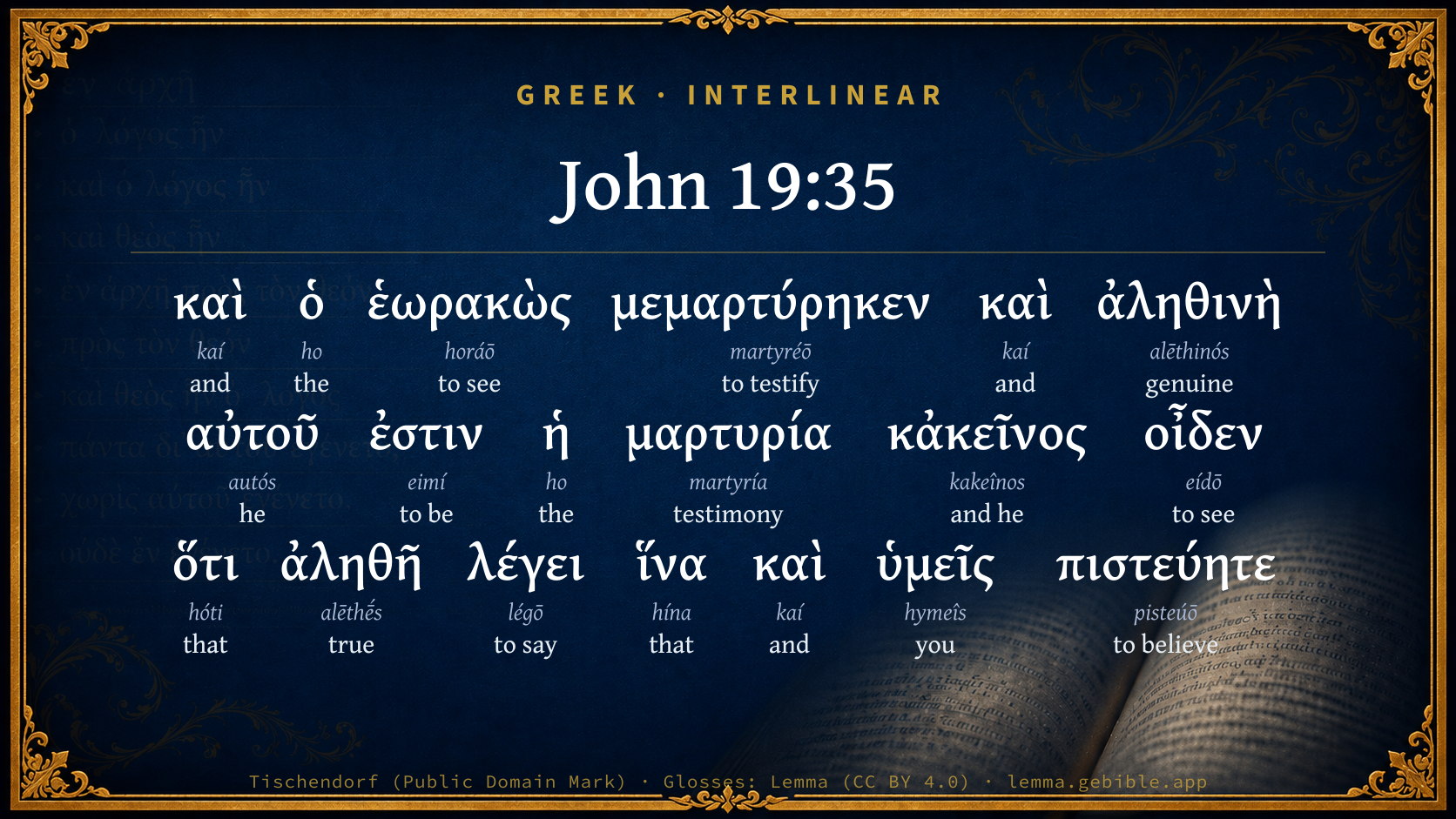
  1. καὶ kaí G2532 “and” Conjunction
  2. ὁ ho G3588 “the” Article, Nominative, Singular, Masculine
  3. ἑωρακὼς horáō G3708 “to see” Verb, Perfect, Active, Participle, Nominative, Singular, Masculine, Attic form
  4. μεμαρτύρηκεν martyréō G3140 “to testify” Verb, Perfect, Active, Indicative, 3rd person, Singular
  5. καὶ kaí G2532 “and” Conjunction
  6. ἀληθινὴ alēthinós G228 “genuine” Adjective, Nominative, Singular, Feminine
  7. αὐτοῦ autós G846 “he” Personal pronoun, Genitive, Singular, Masculine
  8. ἐστιν eimí G1510 “to be” Verb, Present, Active, Indicative, 3rd person, Singular
  9. ἡ ho G3588 “the” Article, Nominative, Singular, Feminine
  10. μαρτυρία martyría G3141 “testimony” Noun, Nominative, Singular, Feminine
  11. οἶδεν eídō G1492 “to see” Verb, Perfect, Active, Indicative, 3rd person, Singular
  12. ὅτι hóti G3754 “that” Conjunction
  13. ἀληθῆ alēthḗs G227 “true” Adjective, Accusative, Plural, Neuter
  14. λέγει légō G3004 “to say” Verb, Present, Active, Indicative, 3rd person, Singular
  15. ἵνα hína G2443 “that” Conjunction
  16. καὶ kaí G2532 “and” Conjunction
  17. ὑμεῖς hymeîs G5210 “you” Personal pronoun, 2nd person, Nominative, Plural
  18. πιστεύητε pisteúō G4100 “to believe” Verb, Present, Active, Subjunctive, 2nd person, Plural

About this verse

These counts appear in no published source. They are computed here, from the morphology-tagged text and Lemma’s own curated glosses. What Lemma adds →

19
words
16
distinct lemmas
Gospels
section

Notable vocabulary

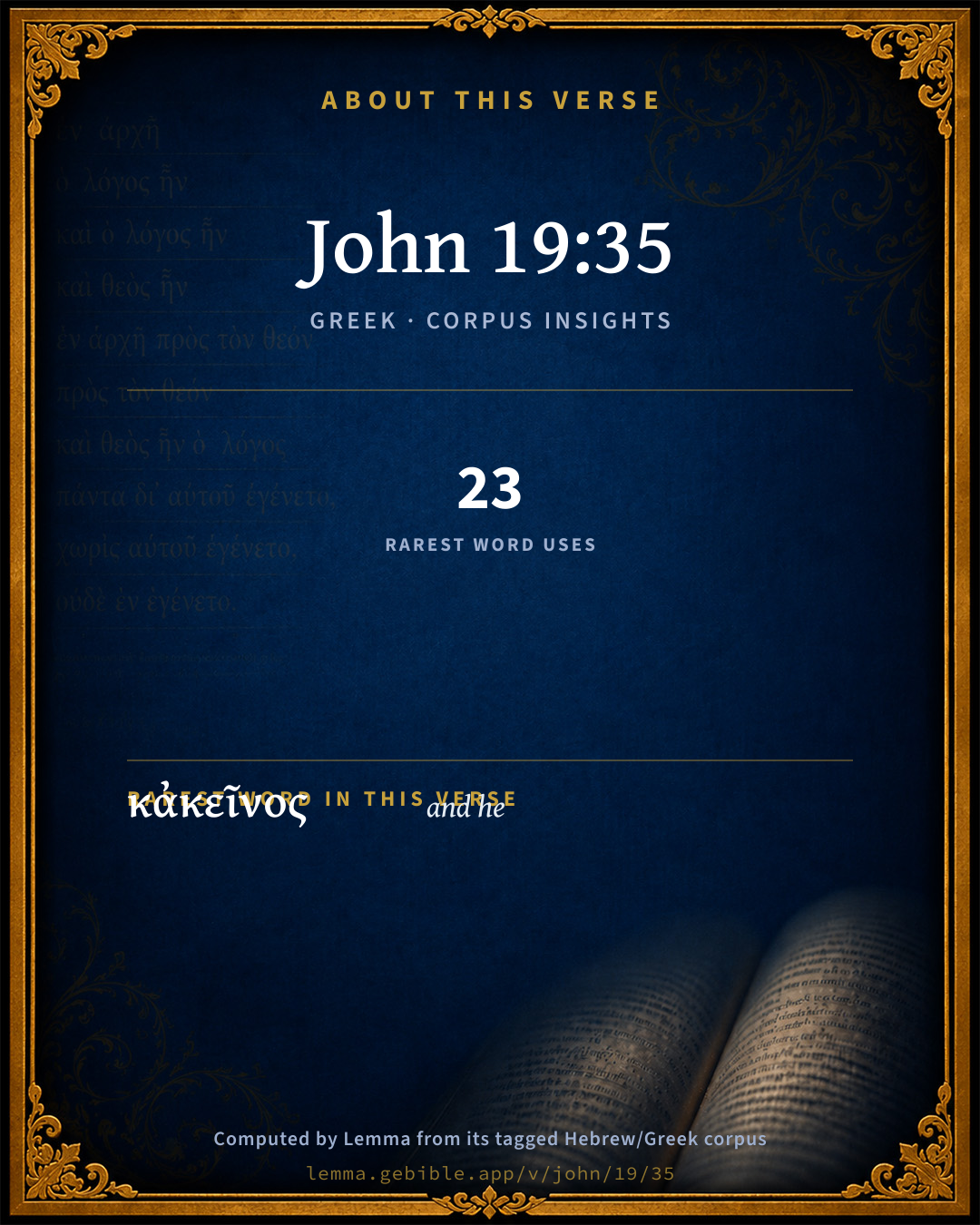
The rarest word here is κἀκεῖνος and he G2548 — appearing just 23 times in the whole Greek New Testament.

Shared distinctive vocabulary

κἀκεῖνος and he G2548 occurs in 23 verses of the Greek New Testament. Also found in:

Repetition

Words recur within this verse:

Cross-references

14

Topical passages linked to John 19:35 in the Treasury of Scripture Knowledge — connected by theme and wording, ordered by reader-vote popularity; previews shown in the World English Bible.

  • John 21:24 This is the disciple who testifies about these things, and wrote these things. We know that his witness is true.
  • John 15:27 You will also testify, because you have been with me from the beginning.
  • Hebrews 2:3–4 how will we escape if we neglect so great a salvation-- which at the first having been spoken through the Lord, was confirmed to us by those who heard;
  • 1 John 1:1–3 That which was from the beginning, that which we have heard, that which we have seen with our eyes, that which we saw, and our hands touched, concerning the Word of life
  • John 20:31 but these are written, that you may believe that Jesus is the Christ, the Son of God, and that believing you may have life in his name.
  • Acts 10:39 We are witnesses of everything he did both in the country of the Jews, and in Jerusalem; whom they also killed, hanging him on a tree.
  • Romans 15:4 For whatever things were written before were written for our learning, that through patience and through encouragement of the Scriptures we might have hope.
  • 1 Peter 5:1 I exhort the elders among you, as a fellow elder, and a witness of the sufferings of Christ, and who will also share in the glory that will be revealed.
  • John 11:15 I am glad for your sakes that I was not there, so that you may believe. Nevertheless, let's go to him."
  • John 11:42 I know that you always listen to me, but because of the multitude that stands around I said this, that they may believe that you sent me."
  • John 14:29 Now I have told you before it happens so that, when it happens, you may believe.
  • John 17:20–21 Not for these only do I pray, but for those also who believe in me through their word,
  • John 19:26 Therefore when Jesus saw his mother, and the disciple whom he loved standing there, he said to his mother, "Woman, behold your son!"
  • 1 John 5:13 These things I have written to you who believe in the name of the Son of God, that you may know that you have eternal life, and that you may continue to believe in the name of the Son of God.

Cross-references courtesy of OpenBible.info (CC BY 4.0).

Commentary

Notes on John 19:35 from classic Christian and Jewish commentators (each source and its license shown beneath its notes). The classic Christian expositions comment on the surrounding passage and are grouped to its opening verse, so a note may address several verses; the Jewish commentaries on the Tanakh (Rashi and others) are per-verse, so they appear only where the commentator wrote on this verse.

Lemma curates 59 commentaries, every one of them public domain or Creative Commons licensed, each selected and text-cleaned for this edition rather than reprinted as found. About our sources →

The Biblical Illustrator

Joseph S. Exell

Joh_19:35

And he that saw it bare record, and his record is true

The Gospel witness

I.

THE SIGHT--the whole crucifixion, but especially what constituted its essence as an evangelical fact, viz., the issue of blood and water, an emphatic testimony to the Redeemers death. This is one of the most important texts of the Bible. If no one saw Christ die, how can we be sure that He did die; and unless we are sure of His death we are left in uncertainty as to His atonement and resurrection, and consequently as to our salvation and futurity. John saw a sight

1. Most wonderful. Great is the mystery of godliness all through--nowhere more than here. That God should become incarnate is inexplicable, no less so that being incarnate He should die. Learn here

(1) The limits of human reason.

(2) The very manhood of Christ.

2. Most painful--to all whose feelings are not utterly brutalized. The death-bed of an ordinary friend, or even a stranger, under the best circumstances, is sufficiently painful; but what must such a man as John have felt as he saw such a Friend nailed to the cruel tree? Learn here

(1) The inhumanity of man.

(2) The feelings with which we should contemplate Christ crucified.

3. Most beneficent. Such a mysterious scene enacted, and such dreadful sufferings endured voluntarily, must have been for some adequate purpose. Martyrdom for truth falls far short of it. The only adequate motive is Joh_3:16; 1Jn_2:2. God incarnate was crucified to save a world.

II. THE TRUE RECORD.

1. Such an event actually took place.

(1) John could not have been mistaken; if the senses were deceptive here, when all was so striking, then they are trustworthy nowhere.

(2) John was not a madman--his Gospel and Epistles are a sufficient proof of that.

(3) John was not a deceiver; he suffered the loss of all things, and imperilled his life for the sheer sake of recording what he saw.

2. What took place John was bound to record.

(1) Not simply as an important historical fact, although he had responsibilities here.

(2) But as a display of Divine mercy, and the sole means of human salvation. Woe is me, he might have said, if I write not the gospel.

3. This record he knew to be true. Because

(1) He saw what he recorded.

(2) He knew that he was a truthful man.

(3) Reading what he had written he was sure that it was in accordance with the whole of the facts. Nothing essential was omitted; nothing false or superfluous was included.

III. THE EVANGELICAL PURPOSE.

1. Not personal display. John was a deep thinker and a graphic writer; but it was the furthest from his intention to pose as a philosopher, or to excite admiration as a rhetorician.

2. Not to excite emotion. How different the narrative from the scenic and heart-harrowing descriptions in books of devotion and pulpit declamations.

3. But to create belief. Hence the record is clear, earnest, tender, and full of subtle spiritual influence.

Learn the qualifications of a true Gospel witness.

1. He must have actually seen what he endeavours to describe. Theory and hearsay are worthless here. There must be clear, positive experience of Christ crucified.

2. Fidelity. He must confine himself to what he has seen--not his fancies or speculations, but what he knows of Christs love and salvation.

3. A sense of responsibility. He has a medicine that has cured him, and can cure every one. He is wicked therefore to keep it to himself.

4. A sincere and self-abnegating motive--not to court admirers but to win believers. (J. W. Burn.)

The evidences of truth

The truth we receive from another may either derive its authority from the teacher, or reflect on him the authority it contains. As the receiver of money may argue, either that money is good because it is an honest man who pays it, or that the man is honest because he pays good money, so in the communication of truth, it may be a valid inference, either that the doctrine is true because it is a trustworthy man who teaches it, or that the man who teaches it is a veracious and trustworthy because his doctrine is true. (J. Caird, D. D.)

Testimony dependent on the character of the witness

Dr. Weyland was once lecturing on the weight of evidence furnished by human testimony, and was illustrating its sufficiency for establishing the truth of miracles. But, said one of his students, what would you say, doctor, if I stated that as I was coming up College Street, I saw the lamp-post at the corner dance? I should ask you where you had been, my son, was the quiet reply.

The Biblical Illustrator, edited by Joseph S. Exell (c. 1880s–1900s) — public domain. Text from a community e-Sword module.

Tyndale Open Study Notes

Tyndale Open Resources

19:35 John was at the foot of the cross (19:26). He was not simply a collector of traditions about Jesus, but an eyewitness giving an accurate account of the events of Jesus’ life (cp. 21:24). This same confidence can be seen in the opening of John’s first letter (1 Jn 1:1-4).

Tyndale Open Study Notes — © Tyndale Open Resources, licensed CC BY-SA 4.0. Text via the HelloAO Bible API.

Bengel's Gnomon

Johann Albrecht Bengel

Joh 19:35. Ὁ ἑωρακὼς, he that saw it) viz. John, in his character as an apostle.[395]—ΜΕΜΑΡΤΎΡΗΚΕ, hath testified it) viz. John, in his character as an evangelist. He saw it, whilst it was being done: therefore, after that he had quickly taken and received the mother of Jesus into his own house, John had returned to the cross, thereby obtaining the benefit of this remarkable spectacle.—καὶ, and) and so, and therefore.—ἀληθινὴ, true) irrefragable among all men.—κἀκεῖνος, and he) He who saw it, knows that he is speaking the truth.—οἶδεν, knows) being sure, even in the Spirit too, not merely in sense.[396]—ΛΈΓΕΙ) he saith, by word of mouth, and in writing. Comp. ch. Joh 21:24, “This is the disciple which testifieth of these things, and wrote these things.”—ἵνα, that) This sets forth the end for which the strong affirmation is made: ἵνα, that, depends on μεμαρτύρηκε, hath testified.—ὑμεῖς) ye, to whom this book is read: ch. Joh 20:31, “These are written, that ye might believe that Jesus is the Christ,” etc.—πιστεύσητε, ye might believe) not merely, that these things are true; but that Jesus is the Christ. The correlatives are, testified and true: knows and believe. He knows that he saith true, and declares that he saith truth, that ye also may believe.

[395] Whose peculiar office was to be witness of the death and resurrection of Jesus: Act 1:21-22.—E. and T.

[396] By the teaching of the infallible Spirit, as well as by the evidence of sense.—E. and T.

Bengel's Gnomon of the New Testament — English translation (T&T Clark, Edinburgh, 1860) — public domain. Text from a community e-Sword module.

Meyer's Critical & Exegetical Commentary

Heinrich August Wilhelm Meyer

Joh_19:35. After μαρτυρία a comma only should be placed, and nothing should be put within a parenthesis, neither καὶ ἀληθινὴ … λέγει (van Hengel), nor κ. ἀληθινὴ … οἶδεν (Schulz), since the discourse progresses simply and without interruption by καί.

ὁ ἑωρακ.] placed first with great emphasis; the correlate κἀκεῖνος has subsequently the like emphasis. He who has seen it, not heard only from others, but himself has been an eye-witness, has testified it (herewith, Joh_19:34), namely, this outflow of blood and water. This was indeed the apparently so incredible thing, not also the omission of the leg-breaking. When in the third person, in which John here speaks of himself while passing over His name, commentators have found the diversity of the writer and the witness betrayed (Weisse, Schweizer, Köstlin, Hilgenfeld, Tobler, Weizsäcker), this was simply a misapprehension, running counter to κἀκεῖνος οἶδεν, κ.τ.λ., of the circumstantially solemn style which fully corresponds to the quite extraordinary importance which John attributes to the phenomenon. The ἐκεῖνος, that is to say, is the speaking subject himself presented objectively, identical therefore with the ἑωρακώς, which clearly appears from the context by the pres. λέγει, and the final clause ἵνα κ. ὑμ. πιστ., especially also by the correlation of καὶ ὑμεῖς with the subject. Comp. on Joh_9:37. Hence we are by no means to assume that the secretary of the apostle speaks of him by ἐκεῖνος as of a third person (Ewald, Jahrb. 10, p. 88), but the apostle himself presents himself objectively as the ille, like a third person; he may at the same time have employed another as amanuensis (which does not follow even from chap. 21) or not; comp. Joh_21:24.

ἀληθνή] placed with emphasis at the head of the clause (αὐτοῦ has then the next emphasis); not, however, equivalent to ἀληθής, as is usually assumed, contrary to the constant usage of John (and the moment of ἀλήθεια first follows afterwards), but: a true testimony is his witness, which corresponds in reality to the idea of a μαρτυρίαnamely, for the very reason that he himself has seen what he testifies. Comp. on Joh_8:16.

ἵνα] Neither to be taken as dependent on ὁ ἑωρ. μεμαρτ. (Lücke), nor as independently: and therefore should, etc. (De Wette), but, as the position of the words requires, stating the purpose of λέγει: he knows that he says true, says that you also (his readers) may believe, as he himself has believed through means of that miraculous appearance, namely, on Jesus the Son of God. As frequently in John (comp. on Joh_2:11), πιστεύειν is also here not first the entrance into faith, but a higher and stronger degree of faith, which one experiences, the πιστεύειν in a new and exalted potency. Comp. Joh_21:2. Others, as Baeumlein, still have incorrectly referred πιστ. merely to what was last mentioned as object, whereby in truth the comparison with John himself, which lies in καὶ ὑμεῖς, would not be at all appropriate, because John has seen (not merely believed) what took place. The solemn absolute πιστεύειν, with its destination of purpose, makes the assumption of special designs in view, which have been ascribed to John in his testimony of the outflow of blood and water, appear unwarranted, namely, that he desired to prove the actual death of Jesus (Beza, Grotius, and many others), especially in opposition to docetic error, Hammond, Paulus, Olshausen, Ammonius, Maier, and several others. Doubts of a naturalistic and docetic kind might rather have derived support than have been precluded by the enigmatic outflow, which excited the derision of Celsus, in Or. 2:36. The Valentinians maintained: ἐξεκέντησαν δὲ τὸ φαινόμενον, ὃ ἦν σὰρξ τοῦ ψυχικοῦ, Exc. ex Theod. 62.

Meyer — Critical and Exegetical Commentary on the New Testament — English translation by Peter Christie, edited by Frederick Crombie (T&T Clark, 1880) — public domain. Text from a community e-Sword module.

Expositor's Greek Testament

ed. W. Robertson Nicoll

Joh 19:35 . When he goes on to testify, ὁ ἑμρακὼς … it is not the phenomenon of the blood and water he so emphatically certifies, but the veritable death of Christ. To one who was about to relate a resurrection it was a necessary preliminary to establish the bona-fide death. That John here speaks of himself in the third person is quite in his manner. Here, as in chap. 20, he shows that he understood the value of an eye-witness’s testimony. It is that which constitutes his μαρτυρία as ἀληθινή , it is adequate. Besides being adequate, its contents are true, ἀληθῆ . “Testimony may be sufficient ( e.g. , of a competent eye-witness) but false; or it may be insufficient ( e.g. , of half-witted child) but true. St. John declares that his testimony is both sufficient and true.” Plummer. The reason of his utterance, or record of these facts, is ἵνα ὑμεῖς πιστεύσητε , “that ye might believe,” first, this record, and through it in Jesus and His revelation.

The Expositor's Greek Testament, edited by W. Robertson Nicoll (1897–1910) — public domain. Text from a community e-Sword module.

International Critical Commentary

35. This verse is omitted in e (Cod. Palatinus of the fifth century), nor does it appear in the rearrangement of the Gospel texts called fu (Cod. Fuldensis of the sixth century). From this slender evidence Blass1 concluded that the verse was of doubtful genuineness, and must be treated as a later gloss. But such a conclusion is perverse in the face of the overwhelming mass of MSS and vss. which contain the passage, not to speak of its characteristically Johannine style.

ὁ ἑωρακὼς μεμαρτύρηκεν. Jn. lays much stress on “witness” (see Introd., pp. xc-xciii); and here the witness of the incident that has just been recorded is John the Beloved Disciple, who has been mentioned in v. 26 as having been present at the Cross. This is strictly parallel to 21:24, οὗτός ἐστιν ὁ μαθητὴς ὁ μαρτυρῶν περὶ τούτων, where also the Beloved Disciple is the witness to whom appeal is made.

καὶ ἀληθινὴ αὐτοῦ ἐστὶν ἡ μαρτυρία. This is (as again at 21:24) the attestation of Jn. that the evidence of the Beloved Disciple is genuine and trustworthy (see on 1:10 for ἀληθινός).

καὶ ἐκεῖνος οἶδεν ὅτι ἀληθῆ λέγει. Here, once more, we have a parallel at 21:24, οἴδαμεν ὅτι ἀληθῆς αὐτοῦ ἡ μαρτυρία ἐστίν. Nonnus is so certain of the parallelism that he alters οἶδεν into ἴδμεν, i.e. οἶδαμεν as at 21:24. But the reference of ἐκεῖνος must be more closely examined.

It has been thought that ἐκεῖνος here designates the actual writer of the Gospel,2 including this verse. ἐκεῖνος is used at Joh 9:37 by the Speaker of Himself. A closer parallel is provided by Josephus. He writes of his doings in the third person, and says that once he had thoughts of escaping from the city, but that the people begged him to remain: οὐ φθόνῳ τῆς ἐκείνου σωτηρίας, ἔμοιγε δοκεῖν, ἀλλʼ ἐλπίδι τῆς ἐαυτῶν· οὐδὲν γὰρ ἠξιοῦν πείσεσθαι δεινὸν Ἰωσήπου μένοντος (Bell. Jud. iii. 7, 16). Here ἐκεῖνος is the author; and to those who accept the view that the Beloved Disciple was the writer of the Fourth Gospel as well as the witness to whom he appeals, the language of Josephus helps to justify the use of ἐκεῖνος in Joh 19:35, although in Josephus it is markedly contrasted with ἐαυτῶν. Nevertheless, such a way of speaking would be curiously indirect here. If the writer is the eye-witness, he has already said of himself that his witness is trustworthy, and he does not strengthen his affirmation by repeating it in so awkward a fashion.

Grammatically, ἐκεῖνος is, indeed, resumptive of αὐτοῦ in the the preceding clause, being used for the sake of emphasis; cf. 7:29 ἐγὼ οἶδα αὐτόν, ὅτι παρʼ αὐτοῦ εἰμι, κἀκεῖνός με ἀπέστειλεν (see also 10:1, 6). As we take the words καὶ ἐκεῖνος οἶδεν ὅτι ἀληθῆ λέγει, they are the words of the evangelist, but not of the witness; and the repetition is not meaningless. “He,” sc. the Beloved Disciple himself, “knows,” for he is yet alive, “that he is telling true things.” The evangelist’s tribute is his own, and so is not exactly like the certificate of 21:24 which is that of the elders of the Church. Jn. assures his readers that the aged apostle knows exactly what he is saying: ἐκεῖνος οἶδεν. The alteration by Nonnus of οἶδεν into ἴδμεν is a paraphrase which alters the sense.

A quite different explanation of ἐκεῖνος has been held by some critics1 since the days of Erasmus. It is said to apply to Christ Himself, who may be appealed to as the Witness here, ἐκεῖνος being used absolutely of Him as it is in 1Jn 3:5, 1Jn 3:16, where He has not been named in the immediate context. In 19:35, on this showing, ἐκεῖνος οἶδεν ὅτι ἀληθῆ λέγει is a parenthetical observation, claiming the support of Christ for the testimony borne by the Beloved Disciple: “Jesus knows that he is telling the truth.” This is very unlike the manner of the author of the Fourth Gospel (although Paul has a similar asseveration, 2Co 11:31). The same may be said of the attempt to refer ἐκεῖνος here to God the Father, as at 1:33, 5:19, 37, 6:29, 8:42, where ἐκεῖνος is undoubtedly used of Him. It might be thought more plausible to hold that ἐκεῖνος οἶδεν was an allusion here to the witness of the Paraclete (of whom ἐκεῖνος is used 14:26, 15:26, 16:13, 14); the words ἀλήθεια, μαρτυρεῖν, ὔδωρ, αἷμα being associated with the witness of the Spirit in 1Jn 5:6, 1Jn 5:7. But we have seen already that the exegesis which refers 1Jn 5:6, 1Jn 5:7 to Joh 19:34 is improbable.

The fact is that there is nothing distinctive of Deity in the use of ἐκεῖνος by Jn. (see on 1:8). In the Fourth Gospel ἐκεῖνος stands in the same way for John the Baptist (5:35), or Moses (5:46), or the blind man (9:10), or Mary of Bethany (11:29, 20:15, 16), or Peter (18:17, 25), or the Beloved Disciple himself (13:25, 21:7, 23). The pronoun is a favourite one with Jn., and he uses it to express emphasis or for clearness irrespectively of the person to whom it is applied. Here we hold it to refer emphatically to the Beloved Disciple, whom we identify with the son of Zebedee.

ἵνα καὶ ὑμεῖς πιστεύητε. The rec. omits καί, but ins. אABDsuppLNWΘ Again the rec., with אaADsuppNWΘ, has ἴνα … πιστεύητε, but א*B have ἵνα … πιστεύητε as at 20:31. The witness has borne his testimony about the blood and water, “in order that you also,” sc. the readers of the Gospel, “may believe,” not being misled by Docetic mysticism.

International Critical Commentary — older volumes (1896–1929), various authors — public domain. Text from a community e-Sword module.

Godet's Commentaries

Frédéric Louis Godet

Vv. 35-37. “And he who saw it has borne witness, and his testimony is true, and he knows that he says true, that you also may believe. 36. For these things came to pass that the Scripture might be fulfilled: No one of his bones shall be broken. 37. And another word also says: They shall look on him whom they pierced.”

Some (Weisse, Schweizer, Hilgenfeld, Weizsacker, Keim, Baumlein, Reuss, Sabatier) claim that in these words of Joh 19:35 the author of the Gospel expressly distinguishes himself from the apostle, and that he professes to be only the reporter of the oral testimony of the latter. He declares to the readers of the Gospel that John the apostle saw this, that he bore witness of it, and that he had the inward consciousness of saying a true thing in relating this fact. Thus these words, which have always been regarded as one of the strongest proofs of the Johannean composition of our Gospel, are transformed into a formal denial of its apostolic origin. We have already examined this question in theIntroduction, Vol. I., pp. 193-197. We will also present here the following observations:

1. As to the school of Baur, which asserts that the author all along wishes to pass himself off as the apostle, it should evidently have been on its guard against accepting this explanation. It has not been able, however, to refrain from catching at the bait; but it has clearly perceived the contradiction into which it is brought thereby; see the embarrassment of Hilgenfeld with respect to this question, Einl., p. 731. In fact, if the author wishes throughout his entire work to pass himself off as the apostle John, how should he here openly declare the contrary? The reply of Hilgenfeld is this: “He forgets (falls out of) his part” (p. 732). A singular inadvertence, surely, in the case of a falsarius of such consummate skill as the one to whom these critics ascribe the composition of our Gospel!

Other critics, such as Reuss, find themselves no less embarrassed by the apparent advantage which they yet try to derive from these words. In fact, there exists in ch. Joh 21:24 an analogous passage in which the depositaries of our Gospel—those who received the commission to publish it—expressly attest the identity of the redactor of this work with the apostle-witness of the facts, with the disciple whom Jesus loved. How can we explain such a declaration on the part of the depositaries of the work, if the author had in our passage himself attested his non-identity with the apostle, the eye-witness? Do they knowingly falsify? Reuss does not dare to affirm this. Are they mistaken? It would be necessary to conclude from this that those who published the book had themselves never read the work to which they give the attestation in opposition to his. Still more, if they received from the author his book to be published, they must have known him personally; moreover, it is from the personal knowledge which they have of him and his character that they come forward as vouchers for his veracity. How, then, could they be deceived with respect to him?

2. And on what reasons are suppositions so impossible made to rest? Above all, the pronoun ἐκεῖνος is alleged, by which the author designates the apostle, distinguishing him from himself. But throughout the whole course of our Gospel we have seen this pronoun employed, not to oppose a nearer subject to a more remote subject, but in an exclusive or strongly affirmative sense, with the design of emphasizing somewhat the subject to which it refers; comp. Joh 1:18, Joh 5:39, Joh 7:20, John 9:51, Joh 19:37, etc., and very particularly Joh 9:37, where we see that when the one who speaks does so by presenting himself objectively and speaking of himself in the third person, he can very properly use this pronoun. Being forced to speak of himself in this case, John uses this pronoun, because he had alone been witness of the special fact which he relates.

3. Keim no longer insists on this philological question; he makes appeal to “rational logic,” which does not allow us to hold that a writer describes himself objectively at such length. But comp. St. Paul, 2Co 12:3! And it is precisely “rational logic” which does not allow us to ascribe to another writer, different from John, the affirmation: And his testimony is true. A disciple of John declaring to the Church that the apostle, his master, did not falsify or was not the dupe of an illusion! The first of these attestations would be an insult to his master himself; the second, an absurdity; for has he the right of affirming anything respecting a fact which he has not seen and which he knows only by the testimony of John himself?

4. Reuss rests upon the perfect μεμαρτύρηκε, has borne witness. The narrative of the witness, according to this, is presented as a fact which was long since past. But comp. Joh 1:34, where the: I have borne witness, applies to the declaration which John the Baptist has just uttered at the very moment. The same is the case here; this verb applies to the declaration which the author has just made in the preceding lines respecting the fact related: “It is said; the testimony is given and it continues henceforth;” such is the sense of the perfect.

5. It seems to me that we must, above all, take account of the expression: “He knows that he says true.” Here is the meaning which we are forced to give to these words: “The witness from whom I have the fact knows that he says true.” But by what right can the writer bear testimony of the consciousness which this witness has of the truth of what he says? One testifies as to one’s own consciousness, not that of another.

6. Hilgenfeld, Keim, Baumlein, Reuss, Sabatier, cite as analogous Joh 21:24. “This is the disciple (the beloved disciple) who testifies these things and wrote these things; and we know that his testimony is true.” But the very similarity in the expressions makes us perceive so much more clearly the difference between them. The attestants say, not as in our passage: “he knows (οἰδε) that he says true,” but: “we know (οἴδαμεν) that he says true;” they do what the evangelist should have done in our passage, if he had, like them, wished to distinguish himself from the apostle; they use the first person: we know.

The adjective ἀληθινή does not here, any more than elsewhere, mean true (ἀληθής); the meaning is: a real testimony, which truly deserves the name, as announcing a fact truly seen. Καὶ ὑμεῖς, you also: “you who read, as well as I who have seen and testified.” The question is not of belief in the fact reported, but of faith in the absolute sense of the word, of their faith in Christ, which is to derive its confirmation from this fact and from those which are mentioned afterwards, as it was these facts which had already confirmed the faith of the author himself. It is not only from the fact of the outflowing of the blood and water that this result is expected. The for of Joh 19:36 proves that the question is of the way in which the two prophecies recalled to mind in Joh 19:36-37 were fulfilled by the three facts related in Joh 19:33-34.

The first prophecy is taken from Exo 12:46 and Num 9:12; not from Psa 34:21, as Baumleinand Weiss think; for this last passage refers to the preservation of the life of the righteous one, not to that of the integrity of His body. The application which the evangelist makes of the words implies as admitted the typical significance of the Paschal lamb; comp. Joh 13:18, a similar typical application.

The Paschal lamb belonged to God and was the figure of the Lamb of God. This is the reason why the law so expressly protected it against all violent and brutal treatment. It is also the reason why the remains of its flesh were to be burned immediately after the supper.

As the prophecy was fulfilled by what did not take place with reference to Jesus (the breaking of the legs), it was also fulfilled at the same time by what did take place in relation to Him (the thrust of the lance), Joh 19:37. Zechariah (Joh 12:10) had represented Jehovah as pierced by His people, in the person of the Messiah. The action of the Jews in delivering Jesus up to the punishment of the cross had fully realized this prophecy. But this fulfilment must take a still more literal character (see on Joh 12:15, Joh 18:9, Joh 19:24). The meaning of the Hebrew term דָָּקרוּ, they have pierced, was considerably weakened by the LXX, who undoubtedly deemed this expression too strong as applied to Jehovah, and rendered it by κατωρχήσαντο, they insulted, outraged God by idolatry. The evangelist goes back to the Hebrew text; comp. also Rev 1:7. The term they shall look on, ὄψονται, refers to that which will take place at the time of the conversion of the Jews, when in this Jesus, rejected by them, they shall recognize their Messiah. The look in question is that of repentance, of supplication, of faith, which they will then cast upon Him (εἰς ὄν); a striking scene magnificently described in the same prophetic picture, Zec 12:8-14.

In order to understand clearly what John felt at the moment which he here describes, let us imagine a believing Jew, thoroughly acquainted with the Old Testament, seeing the soldiers approaching who were to break the legs of the three condemned persons. What is to take place with regard to the body of the Messiah, more sacred even than that of the Paschal lamb? And lo, by a series of unexpected circumstances, he sees this body rescued from any brutal operation! The same spear-thrust which spares it the treatment with which it was threatened realizes to the letter that which the prophet had foretold! Were not such signs fitted to strengthen his faith and that of the Church? This is what John had experienced as an eye-witness and what he meant to say in this passage, Joh 19:31-37.

The entombment of Jesus: Joh 19:38-42. Here, as in the preceding passage, John completes the narrative of his predecessors. He makes prominent the part which was taken by Nicodemus in the funeral honors paid to Jesus, and sets forth clearly the relation between the advanced hour of the day and the place of the sepulchre where the body was laid. He thus accounts for facts whose relation the Synoptics do not indicate.

Frédéric Louis Godet — Commentaries on Luke, John, Romans, and 1 Corinthians — English translation (T&T Clark, Edinburgh, 1870s–1890s) — public domain. Text from a community e-Sword module.

Jamieson, Fausset & Brown

Robert Jamieson, A. R. Fausset & David Brown

And he that saw it bare record--hath borne witness.

and his witness is true, and he knoweth that he saith true, that ye might believe--This solemn way of referring to his own testimony in this matter has no reference to what he says in his Epistle about Christ's "coming by water and blood" (see on Jo1 5:6), but is intended to call attention both to the fulfilment of Scripture in these particulars, and to the undeniable evidence he was thus furnishing of the reality of Christ's death, and consequently of His resurrection; perhaps also to meet the growing tendency, in the Asiatic churches, to deny the reality of our Lord's body, or that "Jesus Christ is come in the flesh" (Jo1 4:1-3).

Jamieson, Fausset & Brown — Commentary Critical and Explanatory on the Whole Bible (1871) — public domain (CC PDM 1.0). Text via the HelloAO Bible API.

Adam Clarke's Commentary

Verse 35. He that saw it] Most probably John himself, who must have been pretty near the cross to have been able to distinguish between the blood and the water, as they issued from the side of our blessed Lord.

And he knoweth] This appears to be an appeal to the Lord Jesus, for the truth of the testimony which he had now delivered. But why such a solemn appeal, unless there was something miraculous in this matter? It might appear to him necessary:

1. Because the other evangelists had not noticed it.

2. Because it contained the most decisive proof of the death of Christ: as a wound such as this was could not have been inflicted, (though other causes had been wanting,) without occasioning the death of the person; and on his dying for men depended the salvation of the world. And,

3. Because two important prophecies were fulfilled by this very circumstance, both of which designated more particularly the person of the Messiah. A bone of him shall not be broken, Ex 12:46; Nu 9:12; Ps 34:20. They shall look upon him whom they pierced, Zec 12:10; Ps 22:16.

Adam Clarke's Commentary on the Bible (1810–1826) — public domain. Text from a community e-Sword/MySword module.

Ellicott's Commentary for English Readers

(35) And he that saw it bare record, and his record is true.—Comp. Joh_1:7. It may be better to render the word here, as elsewhere, by “witness,” in order that we may get the full force of its frequent recurrence. The writer speaks of himself in the third person (comp. Introduction, p. 375), laying stress upon the specially important fact that it was an eye-witness—“he that saw it”—who testified to the fact, and one who therefore knew it to be true. The word rendered “true” in this clause is the emphatic word for “ideally true,” which is familiar to the readers of this Gospel. (Comp. Note on Joh_1:9.) It answers to the idea of what evidence should be, because it is the evidence of one who himself saw what he witnesses.

And he knoweth that he saith true, that ye might believe.—The witness was ideally true, and therefore the things witnessed were actually true. He cannot doubt this, and he testifies it in order that others may find in these truths ground for, and the confirmation of, their faith.

A Bible Commentary for English Readers, edited by Charles John Ellicott (1878–1897) — public domain. Text from a community e-Sword module.

The Cambridge Bible for Schools and Colleges

gen. ed. J. J. S. Perowne

35. And he … is true] Rather, He that hath seen hath borne witness and his witness is true (comp. Joh_1:19; Joh_1:32; Joh_1:34, Joh_8:13-14, Joh_12:17). Besides the change from ‘record’ to witness, for the sake of marking by uniform translation S. John’s fondness for this verb and substantive, the correction from ‘saw’ to hath seen must be noted. The use of the perfect rather than the aorist is evidence that the writer himself is the person who saw. If he were appealing to the witness of another person he would almost certainly have written, as the A. V., ‘he that saw.’ The inference that the author is the person who saw becomes still more clear if we omit the centre of the verse, which is somewhat parenthetical: ‘He that hath seen hath borne witness, in order that ye all also may believe.’ The natural sense of this statement is that the narrator is appealing to his own experience. Thus the Apostolic authorship of the Gospel is again confirmed. (See Westcott, Introduction, p. xxvii.)

is true] Not simply truthful, but genuine, perfect: it fulfils the conditions of sufficient evidence. (See on Joh_1:9 and comp. Joh_8:16, Joh_7:28)

saith true] Better, saith things that are true. There is no tautology, as in the A. V. S. John first says that his evidence is adequate; he then adds that the contents of it are true. Testimony may be sufficient (e.g. of a competent eyewitness) but false: or it may be insufficient (e.g. of half-witted child) but true. S. John declares that his testimony is both sufficient and true; both alêthinos and alêthês.

that ye might] Better, that ye also may; ye as well as the witness who saw for himself.

Why does S. John attest thus earnestly the trustworthiness of his narrative at this particular point? Four reasons may be assigned. This incident proved (1) the reality of Christ’s humanity against Docetic views; and these verses therefore are conclusive evidence against the theory that the Fourth Gospel is the work of a Docetic Gnostic (see on Joh_4:22): (2) the reality of Christ’s Divinity, against Ebionite views; while His human form was no mere phantom, but flesh and blood, yet He was not therefore a mere man, but the Son of God: (3) the reality of Christ’s death, and therefore of His Resurrection, against Jewish insinuations of trickery (comp. Mat_28:13-15): (4) the clear and unexpected fulfilment of two Messianic prophecies.

The Cambridge Bible for Schools and Colleges (gen. ed. J. J. S. Perowne; Cambridge University Press, 1878–1918) — public domain. Text from a community e-Sword module.

John Gill's Exposition

And he that saw it, bare record,.... Meaning himself, John the evangelist, the writer of this Gospel, who, in his great modesty, frequently conceals himself, under one circumlocution or another; he was an eyewitness of this fact, not only of the piercing of his side with a spear, but of the blood and water flowing out of it; which he saw with his eyes, and bore record of to others, and by this writing; and was ready to attest it in any form it should be desired:

and his record is true; though it is not mentioned by any of the other evangelists, none of them but himself being present at that time:

and he knoweth that he saith true; meaning either God or Christ, who knew all things; and so it is a sort of appeal to God or Christ, for the truth of what he affirmed, as some think; or rather himself, who was fully assured that he was under no deception, and was far from telling an untruth; having seen the thing done with his eyes, and being led into the mystery of it by the Divine Spirit; see Jo1 5:6 wherefore he could, and did declare it with the strongest asseverations:

that ye might believe; the truth of the fact, and in Christ, both for the expiation of the guilt of sin, and cleansing from the filth of it; both for sanctifying and justifying grace, which the water and the blood were an emblem of.

John Gill's Exposition of the Whole Bible (1746–1763) — public domain (CC PDM 1.0). Text via the HelloAO Bible API.

Trapp's Complete Commentary

John Trapp

35 And he that saw it bare record, and his record is true: and he knoweth that he saith true, that ye might believe.

Ver. 35. And he that saw it, &c.] Nothing so sure as sight. One eyewitness is more than ten ear-witnesses. {a} It is probable that the apostles that were so conversant with our Saviour had their dairies, wherein they recorded his daily oracles, and other occurrences, and out of which they compiled the Gospels.

His record is true] The gospel is called the testimony, Isa 8:20, because it beareth witness to itself. The law is called light ( lex, lux), because by itself it is seen to be of God, as the sun is seen by its own light.

{a} Plus valet oculatus testis unus quam auriti decem. Ex quibus postea Historia Evangelica est contexta. Scult. Annal.

John Trapp, A Commentary or Exposition upon All the Books of the Old and New Testament (1647–1656) — public domain. Text from a community e-Sword module.

Albert Barnes' Notes on the Bible

He that saw it - John himself. He is accustomed to speak of himself in the third person.

His record is true - His testimony is true. Such was the known character of this writer, such his sacred regard for truth, that he could appeal to that with full assurance that all would put confidence in him. He often appeals thus to the fact that his testimony was known to be true. It would be well if all Christians had such a character that their word would be assuredly believed.

Albert Barnes' Notes on the Bible (1834–1885) — public domain. Text from a community e-Sword/MySword module.

Matthew Poole's English Annotations

Nor was this a fable, for John saw it, and bare record, and knew it to be true; and published it, that men might believe that it was him in whom all the legal types and figures had their completion.

Matthew Poole's English Annotations on the Holy Bible (1683–1685) — public domain. Text from a community e-Sword/MySword module.

Whedon's Commentary on the Bible

Daniel D. Whedon

35. He that saw—The apostle, speaking of himself in the third person, and solemnly asseverating his own truth and accuracy. But what is the point which the Evangelist here designs so strongly to attest? Plainly the double fact by which the predictions in Joh_19:36-37 are fulfilled: namely, the fact that no bone was broken, but that the side was pierced.

Daniel D. Whedon (gen. ed.), Commentary on the Old and New Testaments (1874–1909) — public domain. Text from a community e-Sword module.

The Pulpit Commentary

He that hath seen hath borne, and is now bearing, herein and hereby, witness, and his witness is veritable the highest and surest kind of witness, that of direct observation, staggering, confounding the ordinary sense, but proving that the Son of God died in his human bodyand he knoweth, by his own inward experience, that he saith true things, that ye also may believe. A vehement effort has been made to sever this testimony from the evangelist, and refer it to a third person ekeinov , and suppose that it took place during John"s absence from the cross (so Weisse, Schweizer, Hilgenfeld, and others); but, as Meyer, Godet, etc., affirm there is no necessity whatever for such an interpretation. Ekeinov is used of the subject of the sentence when it is clear from the context that the speaker himself is that subject. (see Joh_9:37) Concerning a third person, the writer could not have written, "He knoweth that he saith true things, that ye may believe," but rather, "We know that he saith true things, that we may believe." But John here speaks strongly of his own invincible conviction, and, as in Joh_21:24, it is here given to induce a stronger faith on the part of his readers not of himself and his readers in the supernatural death, in the signs that accompanied it, adapted to convince the bystanders of its marvel, and to fill up the prophetic picture, Hilgenfeld, with strange perversity, urges that the clever forger of the narrative "falls out of his part" and forgets himself (see Luthardt on "Authorship of the Fourth Gospel," p. 180). The symbolical and allegorical explanations are numerous. E.g. Toplady"s well-known hymn, "Rock of Ages," contains the words"Let the water and the blood, From thy riven side which flowed, Be of sin the double cure, Cleanse me from its guilt and power.

The Pulpit Commentary (1880–1919), ed. H.D.M. Spence-Jones & Joseph S. Exell — public domain. Text from a community e-Sword module.

John Wesley's Explanatory Notes

His testimony is true - Valid, unexceptionable. And he knoweth - And his conscience beareth him witness, that he testifieth this for no other end, than that ye may believe.

John Wesley, Explanatory Notes Upon the Whole Bible (1754–1765) — public domain. Text via the GEBible commentary corpus.

Cambridge Greek Testament for Schools and Colleges

35. ὁ ἑωρακὼς κ.τ.λ He that hath seen hath borne witness and his witness is true (comp. Joh 1:19; Joh 1:32; Joh 1:34, Joh 8:13-14, Joh 12:17). The use of the perfect participle rather than the aorist is evidence that the writer himself is the person who saw. If he were appealing to the witness of another person he would almost certainly have written, as the A. V., ‘he that saw.’ The inference that the author is the person who saw becomes still more clear if we omit the centre of the verse, which is somewhat parenthetical: ‘He that hath seen hath borne witness, in order that ye also may believe.’ The natural sense of this statement is that the narrator is appealing to his own experience. Thus the Apostolic authorship of the Gospel is again confirmed. (See Westcott, Introduction, p. xxvii.) Ἀληθινή means not simply truthful, but genuine, perfect: it fulfils the conditions of sufficient evidence. (See on Joh 1:9 and comp. Joh 8:16, Joh 7:28.) On the other hand ἀληθῆ means things that are true. There is no tautology, as in the A. V. S. John first says that his evidence is adequate; he then adds that the contents of it are true. Testimony may be sufficient (e.g. of a competent eyewitness) but false: or it may be insufficient (e.g. of half-witted child) but true. S. John declares that his testimony is both sufficient and true.

ἵνα καὶ ὑμεῖς π. That ye also may believe; as well as the witness who saw for himself.

Why does S. John attest thus earnestly the trustworthiness of his narrative at this particular point? Four reasons may be assigned. This incident tended to shew (1) the reality of Christ’s humanity against Docetic views; and these verses therefore are evidence against the theory that the Fourth Gospel is the work of a Docetic Gnostic (see on Joh 1:14, Joh 6:21, Joh 7:10): (2) the reality of Christ’s Divinity, against Ebionite views; while His human form was no mere phantom, but flesh and blood, yet He was not therefore a mere man, but the Son of God: (3) the reality of Christ’s death, and therefore of His Resurrection, against Jewish insinuations of trickery (comp. Mat 28:13-15); (4) the clear and unexpected fulfilment of two Messianic prophecies.

Cambridge Greek Testament for Schools and Colleges (Cambridge University Press, 1896; 21 vols, various authors incl. Carr, Maclear, Plummer, Farrar, Lumby, Moule, M. R. James, Simcox) — public domain. Text from a community e-Sword module.

Alford’s Greek Testament

Henry Alford

35.] This emphatic affirmation of the fact seems to regard rather the whole incident than the mere outflowing of the blood and water. It was the object of John to shew that the Lord’s Body was a real body, and underwent real death. And both these were shewn by what took place: not so much by the phænomenon of the water and blood, as by the infliction of such a wound,—after which, even had not death taken place before, there could not by any possibility be life remaining. So Lücke: except that he seems to refer ἑωρακώς more to the whole circumstances of the death of Jesus.

The third person gives solemnity. [It is, besides, in accordance with St. John’s way of speaking of himself throughout the Gospel.]

Meyer is for keeping ἀληθινή here to its strict sense, not true, but genuine, real. Perhaps the best account to be given of the word is to be found in the use of ἀληθῆ immediately afterwards of the matter of the testimony. The things related are ἀληθῆ: the narrative of them is ἀληθινή, a narrative of truth.

Some have fancied that by the use of ἐκεῖνος here, the narrator necessarily signifies not himself, but some third person. But it has been shewn above (see note on ch. 7:29) that St. John constantly uses ἐκεῖνος merely as emphatically taking up again the main subject of the sentence. The use of πιστεύειν in John makes it probable that he lays the weight on the proof of the reality of the death, as above. The ἵνα depends on the three preceding clauses, without any parenthesis, as the final aim of what has gone before: in order that; not, ‘so that.’

Henry Alford, The Greek Testament (1849–1861) — public domain. Text from a community e-Sword module.

Vincent's Word Studies in the New Testament

Marvin R. Vincent

He that saw it bare record [ο εωρακως μεμαρτυρηκεν] . Rev., rendering the perfect tense in both verbs, he that hath seen hath born witness. This can refer only to the writer of this Gospel. Compare 1Jo 1:1.

True [αληθινη] . Genuine, according to the true ideal of what testimony should be. See on 1 9.

And he [κακεινος] . This pronoun is urged by some as a reason for regarding the witness as some other than John, because it is the pronoun of remote reference. But Joh 9:37 shows clearly that a speaker can use this pronoun of himself; and it is, further, employed in this Gospel to indicate a person "as possessing the quality which is the point in question in an eminent or even exclusive degree" (Godet). See Joh 1:18; Joh 5:39.

True [αληθη] . Literally, true things. As distinguished from false. Thus, by the use of the two words for true, there are brought out, as Westcott remarks, "the two conditions which testimony ought to satisfy; the first, that he who gives it should be competent to speak with authority; and the second, that the account of his experience should be exact."

Marvin R. Vincent, Word Studies in the New Testament (1887–1900) — public domain. Text from a community e-Sword/MySword module.

Lesson kit

Teaching starters — assembled from the data on this page, not authored interpretation. Every prompt links to the verse data it draws on. Edit before teaching.

John, in the Gospels, opens this verse with 19 words (16 distinct Greek lemmas). Its most distinctive word is kakeînos (“and he”). A historical commentator’s framing appears above. Read the whole chapter for the surrounding context.

Discussion questions

  1. The word kakeînos carries the sense “and he.” How does it shape the verse?
  2. How does Matthew 15:18, which shares the word «and he», read alongside this verse?
  3. What does the repetition of “and” (3× in this one verse) do in this verse?
  4. These translations render this verse differently. What is at stake in choosing one wording over another?
  5. Compare how The Biblical Illustrator and Tyndale Open Study Notes read this verse. Where do they agree or differ?

Things to notice

Reading settings

Reading text

Shown beneath each verse's original-language words.

Old Testament
Old Testament edition

Read the OT as the Masoretic Hebrew (MT) or the Greek Septuagint (LXX).

English shown for the Greek Septuagint (in the Hebrew ↔ Greek comparison).

Comparing translations? Open the Compare panel on any verse page to stack up to four side by side.