John 18:40

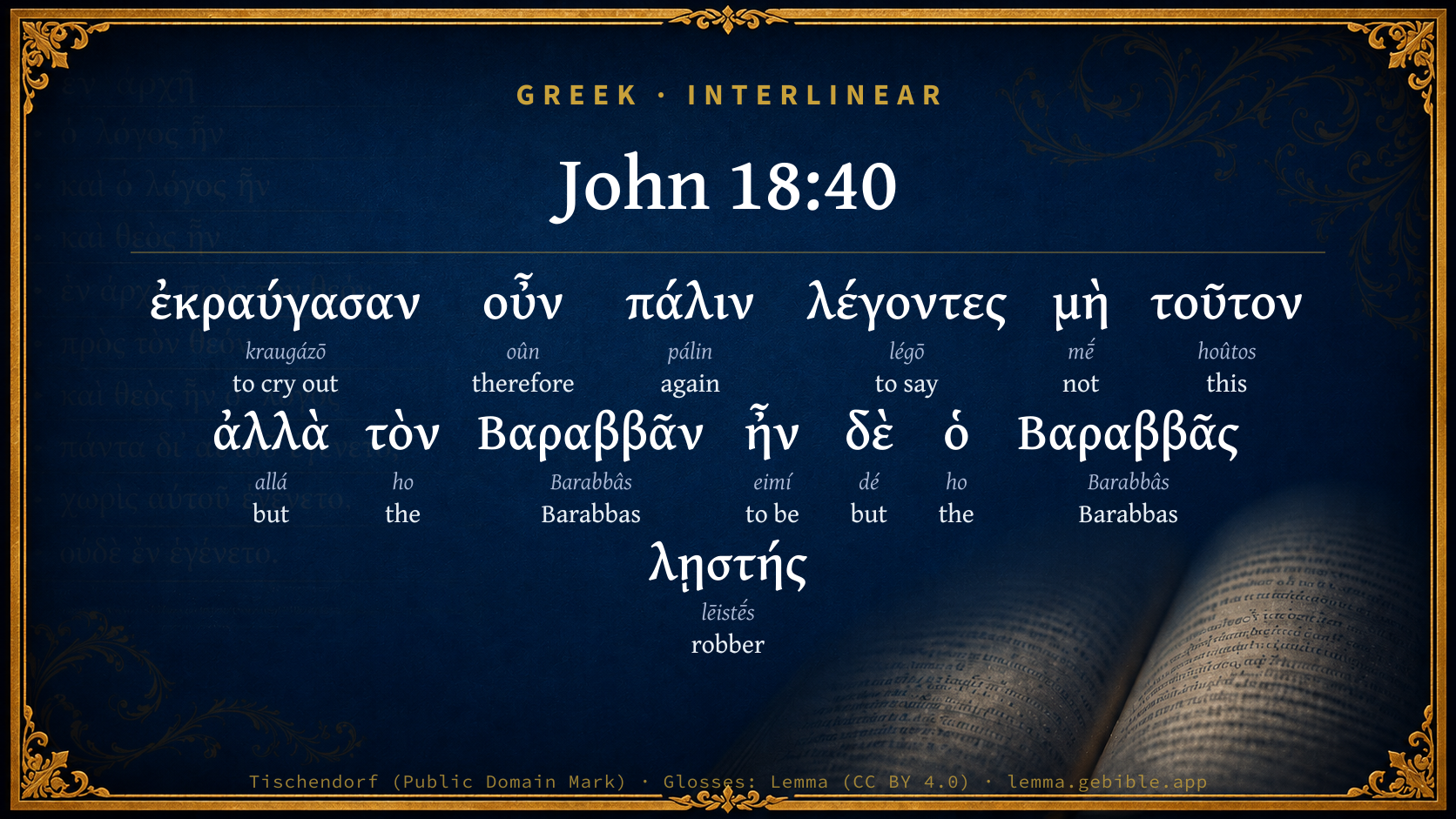
Greek (Tischendorf 8th ed.) John 18:40 appears in the Greek New Testament. The text above is from the Tischendorf 8th edition. Each word links to its Strong’s number and a concise gloss. Click any word for its full Thayer’s Greek Lexicon entry.
Download image
Cite this verse

John 18:40 (World English Bible). Public Domain. Lemma interlinear Bible study tool, https://lemma.gebible.app/v/john/18/40.

Show BibTeX & RIS
BibTeX
RIS
English Translation
Then they all shouted again, saying, "Not this man, but Barabbas!" Now Barabbas was a robber.
World English Bible · Public Domain
Download a study sheet

One document with this verse’s original text, its word-by-word gloss line, the meaning frame, cross-references with their text, attributed commentary, and full source and license credits — printable, and it pastes into notes with its structure intact.

This verse Autodidact and up

Study sheet (.html) Plain text (.txt)

A passage Seminary Student

Up to 50 verses in one chapter. A passage sheet keeps up to 6 commentary sources and 12 cross-references per verse, in the order this page ranks them, and says so on the sheet whenever that leaves anything out. Ask for a single verse and you get the Autodidact verse sheet above.

Everything on this page stays free to read, with no account — the sheet is a download of what is already on screen, not access to it.

Want to remove ads? Support Godless Engineer
Compare translations 3

The same verse in 3 English versions, stacked beneath the original-language interlinear above. Click any original word for its lexicon entry.

Each is an independent rendering of the whole verse — the interlinear is not word-aligned to these translations.

Highlighted words mark where these versions differ — a whole-verse word diff, not a word-by-word alignment.

  • World English Bible Public Domain
    Then they all shouted again, saying, "Not this man, but Barabbas!" Now Barabbas was a robber.
  • King James Version Public Domain
    Then cried they all again, saying, Not this man, but Barabbas. Now Barabbas was a robber.
  • unfoldingWord Literal Text CC BY-SA 4.0
    Then they cried out again, saying, “Not this one, but Barabbas.” (Now Barabbas was a robber.)

unfoldingWord Literal Text — © unfoldingWord, licensed CC BY-SA 4.0. Word-aligned USFM3 via Door43 (git.door43.org/unfoldingWord/en_ult).

Versions to compare (up to 4)

3 of 4 selected

Show all 19 translations

Every available English version of this verse, each an independent rendering of the whole verse.

  • World English Bible Public Domain
    Then they all shouted again, saying, "Not this man, but Barabbas!" Now Barabbas was a robber.
  • Berean Standard Bible Public Domain
    “Not this man,” they shouted, “but Barabbas!” (Now Barabbas was an insurrectionist.)
  • Majority Standard Bible Public Domain
    “Not this man,” they all shouted, “but Barabbas!” (Now Barabbas was an insurrectionist.)
  • King James Version Public Domain
    Then cried they all again, saying, Not this man, but Barabbas. Now Barabbas was a robber.
  • American Standard Version (1901) Public Domain
    They cried out therefore again, saying, Not this man, but Barabbas. Now Barabbas was a robber.)
  • Revised Version (1885) Public Domain
    They cried out therefore again, saying, Not this man, but Barabbas. Now Barabbas was a robber.
  • Geneva Bible (1599) Public Domain
    Then cried they all againe, saying, Not him, but Barabbas: nowe this Barabbas was a murtherer.
  • Douay-Rheims (1899) Public Domain
    Then cried they all again, saying: Not this man, but Barabbas. Now Barabbas was a robber.
  • Young's Literal Translation Public Domain
    therefore they all cried out again, saying, `Not this one -- but Barabbas;' and Barabbas was a robber.
  • Literal Standard Version CC BY-SA 4.0
    Therefore they all cried out again, saying, “Not this One—but Barabbas”; and Barabbas was a robber.
  • Unlocked Literal Bible CC BY-SA 4.0
    Then they cried out again and said, “Not this man, but Barabbas.” Now Barabbas was a robber.
  • unfoldingWord Literal Text CC BY-SA 4.0
    Then they cried out again, saying, “Not this one, but Barabbas.” (Now Barabbas was a robber.)
  • Darby Bible Public Domain
    They cried therefore again all, saying, Not this [man], but Barabbas. Now Barabbas was a robber.
  • World Messianic Bible Public Domain
    Then they all shouted again, saying, “Not this man, but Barabbas!” Now Barabbas was a robber.
  • Webster's Bible Public Domain
    Then they all cried again, saying, Not this man, but Barabbas. Now Barabbas was a robber.
  • Free Bible Version CC BY-SA 4.0
    “No, not him! We want Barabbas instead!” they shouted back. Barabbas was a rebel.
  • Bible in Basic English Public Domain
    Then again they gave a loud cry, Not this man, but Barabbas. Now Barabbas was an outlaw.
  • Text-Critical English NT CC BY 4.0
    They all cried out again, “Not this man, but Barabbas!” (Now Barabbas was an insurrectionist.)
  • Tyndale New Testament (1534) Public Domain
    Then cryed they all agayne sayinge: Not him but Barrabas that Barrabas was a robber.

Literal Standard Version (2020), Covenant Press — licensed CC BY-SA 4.0. Text via the HelloAO Bible API (eBible.org). Unlocked Literal Bible (unfoldingWord) — licensed CC BY-SA 4.0. Text via the HelloAO Bible API (eBible.org). unfoldingWord Literal Text — © unfoldingWord, licensed CC BY-SA 4.0. Word-aligned USFM3 via Door43 (git.door43.org/unfoldingWord/en_ult). Free Bible Version, Dr. Jonathan Gallagher — licensed CC BY-SA 4.0. Text via the HelloAO Bible API (eBible.org).

Word by word

More ways to search: Search by grammar → Find every occurrence → Compare this word →

Practice this passage: Drill this verse → Learn its vocabulary →

ἐκραύγασαν
kraugázō
G2905
“to cry out”
Verb, Aorist, Active, Indicative, 3rd person, Plural
Part of Speech
Verb
Tense
Aorist
Voice
Active
Mood
Indicative
Person
3rd person
Number
Plural
Full Thayer's Definition

Origin: from G2906

TDNT: 17:58,5

1. to cry out, cry aloud, to shout, to cry out to one
  1. οὖν oûn G3767 “therefore” Conjunction
  2. πάλιν pálin G3825 “again” Adverb
  3. λέγοντες légō G3004 “to say” Verb, Present, Active, Participle, Nominative, Plural, Masculine
  4. μὴ mḗ G3361 “not” Particle, Negative
  5. τοῦτον hoûtos G3778 “this” Demonstrative pronoun, Accusative, Singular, Masculine
  6. ἀλλὰ allá G235 “but” Conjunction
  7. τὸν ho G3588 “the” Article, Accusative, Singular, Masculine
  8. Βαραββᾶν Barabbâs G912 “Barabbas” Noun, Accusative, Singular, Masculine
  9. ἦν eimí G1510 “to be” Verb, Imperfect, Active, Indicative, 3rd person, Singular
  10. δὲ dé G1161 “but” Conjunction
  11. ὁ ho G3588 “the” Article, Nominative, Singular, Masculine
  12. Βαραββᾶς Barabbâs G912 “Barabbas” Noun, Nominative, Singular, Masculine
  13. λῃστής lēistḗs G3027 “robber” Noun, Nominative, Singular, Masculine

About this verse

These counts appear in no published source. They are computed here, from the morphology-tagged text and Lemma’s own curated glosses. What Lemma adds →

14
words
12
distinct lemmas
Gospels
section

Notable vocabulary

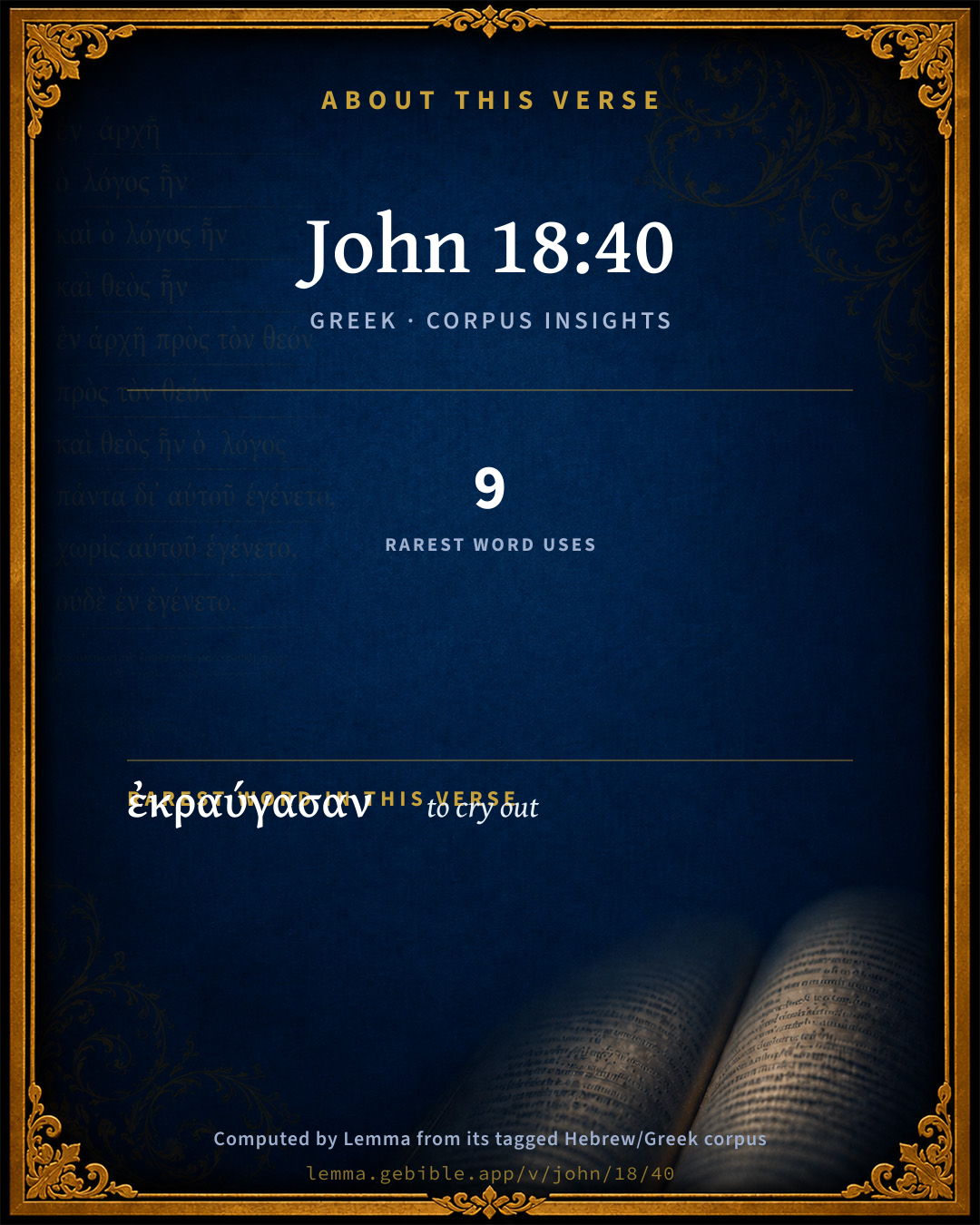
The rarest word here is ἐκραύγασαν to cry out G2905 — appearing just 9 times in the whole Greek New Testament.

Shared distinctive vocabulary

ἐκραύγασαν to cry out G2905 occurs in 9 verses of the Greek New Testament. Also found in:

Repetition

Words recur within this verse:

  • Βαραββᾶν Barabbas G912 ×2
  • τὸν the G3588 ×2

Cross-references

7

Topical passages linked to John 18:40 in the Treasury of Scripture Knowledge — connected by theme and wording, ordered by reader-vote popularity; previews shown in the World English Bible.

  • Matthew 27:16 They had then a notable prisoner, called Barabbas.
  • Matthew 27:26 Then he released to them Barabbas, but Jesus he flogged and delivered to be crucified.
  • Mark 15:7 There was one called Barabbas, bound with those who had made insurrection, men who in the insurrection had committed murder.
  • Mark 15:15 Pilate, wishing to please the multitude, released Barabbas to them, and handed over Jesus, when he had flogged him, to be crucified.
  • Luke 23:18–19 But they all cried out together, saying, "Away with this man! Release to us Barabbas!" --
  • Luke 23:25 He released him who had been thrown into prison for insurrection and murder, for whom they asked, but he delivered Jesus up to their will.
  • Acts 3:13–14 The God of Abraham, Isaac, and Jacob, the God of our fathers, has glorified his Servant Jesus, whom you delivered up, and denied in the presence of Pilate, when he had determined to release him.

Cross-references courtesy of OpenBible.info (CC BY 4.0).

Commentary

Notes on John 18:40 from classic Christian and Jewish commentators (each source and its license shown beneath its notes). The classic Christian expositions comment on the surrounding passage and are grouped to its opening verse, so a note may address several verses; the Jewish commentaries on the Tanakh (Rashi and others) are per-verse, so they appear only where the commentator wrote on this verse.

Lemma curates 59 commentaries, every one of them public domain or Creative Commons licensed, each selected and text-cleaned for this edition rather than reprinted as found. About our sources →

Tyndale Open Study Notes

Tyndale Open Resources

18:40 Jesus was no threat to Rome, but Barabbas was a revolutionary, a violent man who took part in political uprisings (see Luke 23:19), with a proven capacity to challenge the Roman military occupation of Israel.

Tyndale Open Study Notes — © Tyndale Open Resources, licensed CC BY-SA 4.0. Text via the HelloAO Bible API.

Geneva Bible (1599)

Geneva Bible translators

Word for word, made a great and foul voice.

Geneva Bible (1599) marginal notes — public domain. Text via Bolls.life.

Adam Clarke's Commentary

Verse 40. Barabbas was a robber] See Mt 27:16.

The later Syriac has in the margin, αρχιληστης, a chief robber, a captain of banditti, and it is probable that this was the case. He was not only a person who lived by plunder, but shed the blood of many of those whom he and his gang robbed, and rose up against the Roman government, as we learn from Lu 23:19. There never existed a more perfidious, cruel, and murderous people than these Jews; and no wonder they preferred a murderer to the Prince of peace. Christ himself had said, If ye were of the world, the world would love its own. Like cleaves to like: hence we need not be surprised to find the vilest things still preferred to Christ, his kingdom, and his salvation.

1. IT is not easy to give the character of Pilate. From the manner of his conduct, we scarcely can tell when he is in jest or in earnest. He appears to have been fully convinced of the innocence of Christ; and that the Jews, through envy and malice, desired his destruction. On this ground he should have released him; but he was afraid to offend the Jews. He knew they were an uneasy, factious, and seditious people; and he was afraid to irritate them. Fiat justitia, ruat caelum! was no motto of his. For fear of the clamours of this bad people, he permitted all the forms and requisitions of justice to be outraged, and abandoned the most innocent Jesus to their rage and malice. In this case he knew what was truth, but did not follow its dictates; and he as hastily abandoned the author of it as he did the question he had asked concerning it. Pilate, it is true, was disposed to pity-the Jews were full of malice and cruelty. They both, however, joined in the murder of our Lord. The most that we can say for Pilate is, that he was disposed to justice, but was not inclined to hazard his comfort or safety in doing it. He was an easy, pliable man, who had no objection to do a right thing if it should cost him no trouble; but he felt no disposition to make any sacrifice, even in behalf of innocence, righteousness, and truth. In all the business Pilate showed that he was not a good man; and the Jews proved that they were of their father, the devil. See Joh 19:8.

2. As Dr. Lightfoot has entered into a regular examination of when and how the Jews lost the power of life and death in criminal cases, it may be necessary to lay before the reader a copious abstract of his researches on this subject, founded on Joh 18:31.

"It cannot be denied that all capital judgment, or sentence upon life, had been taken from the Jews for above forty years before the destruction of Jerusalem, as they oftentimes themselves confess. But how came this to pass? It is commonly received that the Romans, at this time the Jews' lords and masters, had taken from all their courts a power and capacity of judging the capital matters. Let us superadd a few things here. Rabh Cahna saith, When R. Ismael bar Jose lay sick, they sent to him, saying, Pray, sir, tell us two or three things which thou didst once tell us in the name of thy Father. He saith to them, A hundred and fourscore years before the destruction of the temple, the wicked kingdom (the Roman empire) reigned over Israel, fourscore years before the destruction of the temple, they (the fathers of the Sanhedrin) determined about the uncleanness of the heathen land, and about glass vessels. Forty years before the destruction of the temple, the Sanhedrin removed and sat in the Taberne. What is the meaning of this tradition? Rabbi Isaac bar Abdimi saith, They did not judge judgments of mulcts. The gloss is, Those are the judgments about fining any that offered violence, that entice a maid, and the price of a servant. When, therefore, they did not sit in the room Gazith, they did not judge about these things, and so those judgments about mulcts or fines ceased. Avodoh Zarah. fol. 82. Here we have one part of their judiciary power lost; not taken away from them by the Romans, but falling of itself, as it were, out of the hands of the Sanhedrin. Nor did the Romans indeed take away their power of judging in capital matters; but they, by their own oscitancy, supine and unreasonable lenity, lost it themselves, for so the Gemara goes on: Rabh Hachman bar Isaac saith, Let him not say that they did not judge judgments of mulcts, for they did not judge capital judgments either. And whence comes this? When they saw that so many murders and homicides multiplied upon them that they could not well judge and call them to account, they said, It is better for us that we remove from place to place; for how can we otherwise (sitting here and not punishing them) not contract guilt upon ourselves?

"They thought themselves obliged to punish murderers while they sat in the room Gazith, for the place itself engaged them to it. They are the words of the Gemarists, upon which the gloss. The room Gazith was half of it within, and half of it without, the holy place. The reason of which was, that it was requisite that the council should sit near the Divine Majesty. Hence it is that they say, Whoever constitutes an unfit judge is as if he planted a grove by the altar of the Lord, as it is written, Judges and officers shalt thou make thee; and it follows presently after, Thou shalt not plant thee a grove near the altar of the Lord thy God, De 16:18; De 16:21. They removed therefore from Gazith, and sat in the Taberne; now though the Taberne were upon the mountain of the temple, yet they did not sit so near the Divine Majesty there as they did when they sat in the room Gazith.

"Let us now in order put the whole matter together.

"I. The Sanhedrin were most stupidly and unreasonably remiss in their punishment of capital offenders; going upon this reason especially, that they counted it so horrible a thing to put an Israelite to death. Forsooth, he is of the seed of Abraham, of the blood and stock of Israel, and you must have a care how you touch such a one!

"R. Eliezer bar Simeon had laid hold on some thieves. R. Joshua bar Korchah sent to him, saying, O thou vinegar, the son of good wine! (i.e. O thou wicked son of a good father!) how long wilt thou deliver the people of God to the slaughter! He answered and said, I root the thorns out of the vineyard. To whom the other: Let the Lord of the vineyard come and root them out himself. Bava Meziah, fol. 83, 2. It is worth noting, that the very thieves of Israel are the people of God; and they must not be touched by any man, but referred to the judgment of God himself!

"When R. Ismael bar R. Jose was constituted a magistrate by the king, there happened some such thing to him; for Elias himself rebuked him, saying, How long wilt thou deliver over the people of God to slaughter! Ibid. fol. 64, 1. Hence that which we alleged elsewhere: The Sanhedrin that happens to sentence any one to death within the space of seven years, is termed a destroyer. R. Eliezer ben Azariah saith it is so, if they should but condemn one within seventy years. Maccoth, fol. 7, 1.

"II. It is obvious to any one how this foolish remissness, and letting loose the reins of judgment, would soon increase the numbers of robbers, murderers, and all kinds of wickedness; and indeed they did so abundantly multiply that the Sanhedrin neither could nor durst, as it ought, call the criminals to account. The law slept, while wickedness was in the height of its revels; and punitive justice was so out of countenance that as to uncertain murders they made no search, and against certain ones they framed no judgement. Since the time that homicides multiplied, the beheading the heifer ceased. Sotoh, fol. 47, 1. And in the place before quoted in Avodah: When they saw the numbers of murderers so greatly increase that they could not sit in judgment upon them, they said, Let us remove, c., fol. 8, 2. So in the case of adultery, which we also observed in our notes on Joh 8:3-11. Since the time that adultery so openly advanced, under the second temple, they left off trying the adultress by the bitter water, c. Mainaon. in Sotoh, cap. 3.

"So that, we see, the liberty of judging in capital matters was no more taken from the Jews by the Romans than the beheading of the heifer, or the trial of the suspected wife by the bitter waters, was taken away by them, which no one will affirm. It is a tradition of R. Chaia, from the day wherein the temple was destroyed, though the Sanhedrin ceased, yet the four kinds of death (which were wont to be inflicted by the Sanhedrin) did not cease. For he that had deserved to be stoned to death, either fell off from some house, or some wild beast tore and devoured him. He that had deserved burning, either fell into some fire, or some serpent bit him. He that had deserved to be slain (i.e. with the sword) was either delivered into the hands of some heathen king, or was murdered by robbers. He that had deserved strangling, was either drowned in some river, or choked by a squinancy.

"This must be observed from the evangelists, that when they had Christ in examination in the palace of the high priest all night, in the morning the whole Sanhedrin met that they might pass sentence of death upon him. Where then was this that they met? Questionless in the room Gazith-at least if they adhered to their own rules and constitutions: Thither they betook themselves sometimes upon urgent necessity. The gloss before quoted excepts only the case of murder, with which, amongst all their false accusations, they never charged Christ.

"But, however, suppose it were granted that the great council met either in the Taberne, or some other place, (which yet agreed by no means with their own tradition,) did they deal truly, and as the matter really and indeed was, with Pilate, when they tell him, It is not lawful for us to put any man to death? He had said to them, Take ye him and judge him according to your laws. We have indeed judged and condemned him, but we cannot put any one to death. Was this that they said in fact true? How came they then to stone the proto-martyr Stephen? How came they to stone Ben Sarda at Lydda? Hieros. Sanhed. fol. 25, 4. How came they to burn the priest's daughter alive that was taken in adultery? Bab. Sanhed. fol. 52, 1, and 51, 1. It is probable that they had not put any one to death as yet, since the time that they had removed out of Gazith, and so might the easier persuade Pilate in that case. But their great design was to throw off the odium of Christ's death from themselves at least among the vulgar crowd fearing them, if the council should have decreed his execution. They seek this evasion, therefore, which did not altogether want some colour and pretext of truth; and it succeeded according to what they desired. Divine Providence so ordering it as the evangelist intimates, Joh 18:32, That the saying of Jesus might be fulfilled, which he spake signifying what death he should die: that is, be crucified according to the custom of the Romans. While I am upon this thought, I cannot but reflect upon that passage, than which nothing is more worthy observation in the whole description of the Roman beast in the Revelation, Re 13:4. The dragon which gave power to the beast. We cannot say this of the Assyrian, Babylonish, or any other monarchy; for the Holy Scriptures do not say it. But reason dictates, and the event itself tells us, that there was something acted by the Roman empire in behalf of the dragon, which was not compatible with any other, that is, the putting of the Son of God to death. Which thing we must remember as often as we recite that article of our creed, 'He suffered under Pontius Pilate,' that is, was put to death by the Roman empire,"

Adam Clarke's Commentary on the Bible (1810–1826) — public domain. Text from a community e-Sword/MySword module.

Ellicott's Commentary for English Readers

(40) Then cried they all again.—St. John has not recorded any clamour before, but implies that of Mar_15:8, and Luk_23:5-10.

Now Barabbas was a robber.—Comp. Note on Joh_10:1. The word includes the meaning of unrestrained violence, which often leads to bloodshed (Mar_15:7; Luk_23:19), and is thus used in a striking parallel in Sophocles:—

“And him, so rumour runs, a robber band

Of aliens slew.”—

(Œdipus Rex., 724. Plumptre’s Translation.)

There is a solemn emphasis given to the context by the abrupt brevity of the sentence. (Comp. Joh_11:35; Joh_13:30; see also Act_3:14.)

A Bible Commentary for English Readers, edited by Charles John Ellicott (1878–1897) — public domain. Text from a community e-Sword module.

The Cambridge Bible for Schools and Colleges

gen. ed. J. J. S. Perowne

40. Then cried they all again] Better, They cried out therefore (Joh_18:3) again all of them. S. John has not mentioned any previous shout of the multitude; he once more assumes that his readers know the chief facts. See on Joh_19:6.

Barabbas] Or, Bar-Abbas, son of Abba (father). The innocent Son of the Father is rejected for the blood-stained son of a father. In Mat_27:16-17 some inferior authorities read ‘Jesus Barabbas’ as his name, and Pilate asks ‘Which do ye wish that I release to you, Jesus Barabbas, or Jesus Who is called Christ?’ The reading is remarkable, but it is supported by no good MS.

Now Barabbas was a robber] There is a tragic impressiveness in this brief remark. Comp. ‘Jesus wept’ (Joh_11:35), and ‘And it was night’ (Joh_13:30). It is to be regretted that ‘robber’ has not always been given as the translation of the Greek word used here (ληστής not κλέπτης). Thus we should have ‘den of robbers’ or ‘robbers’ cave’ (Mat_21:13); ‘as against a robber’ (Mat_26:55); ‘two robbers’ (Mat_27:38; Mat_27:44). The ‘robber’ is the bandit or brigand, who is more dangerous to persons than to property, and sometimes combines something of chivalry with his violence. In the case of Barabbas we know from S. Mark and S. Luke that he had been guilty of insurrection and consequent bloodshed rather than of stealing; and this was very likely the case also with the two robbers crucified with Jesus. Thus by a strange irony of fate the hierarchy obtain the release of a man guilty of the very political crime with which they charged Christ,—sedition. The people no doubt had some sympathy with the insurrectionary movement of Barabbas, and on this the priests worked. Barabbas had done, just what Jesus had refused to do, take the lead against the Romans. “They laid information against Jesus before the Roman government as a dangerous character; their real complaint against Him was precisely this, that He was not dangerous. Pilate executed Him on the ground that His kingdom was of this world; the Jews procured His execution precisely because it was not.” Ecce Homo, p. 27.

The Cambridge Bible for Schools and Colleges (gen. ed. J. J. S. Perowne; Cambridge University Press, 1878–1918) — public domain. Text from a community e-Sword module.

John Gill's Exposition

Then cried they all again,.... For it seems that Pilate had made this proposal once before, and that this was the second time, though not mentioned; yet some copies, and the Syriac, Arabic, Persic, and Ethiopic versions, leave out the word "again": they all, priests and people, in a very clamorous manner, cried out as one man, with one united voice, all at once;

saying, not this man, but Barabbas; now Barabbas was a robber; who was an emblem of God's elect in a state of nature, released and set free when Christ was condemned. These, as he, many of them at least, are notorious sinners, the chief of sinners, robbers and murderers; who have robbed God of his glory, and destroyed themselves; are prisoners, concluded in sin and unbelief, and shut up in the law, and in a pit, wherein is no water, in their natural state; and were, as this man, worthy of death, and by nature children of wrath; and yet children of God by adopting grace, as his name Bar Abba signifies, "the son of the father": these, though such criminals, and so deserving of punishment, were let go free, when Christ was taken, condemned, and died; and which was according to the wise and secret counsel of Jehovah, and is a large discovery of divine grace; and what lays those who are released under the greatest obligations to live to him, who suffered for them, in their room and stead.

Next: John Chapter 19

John Gill's Exposition of the Whole Bible (1746–1763) — public domain (CC PDM 1.0). Text via the HelloAO Bible API.

Trapp's Complete Commentary

John Trapp

40 Then cried they all again, saying, Not this man, but Barabbas. Now Barabbas was a robber.

Ver. 40. Now Barabbas was a robber] And a murderer too, Act 3:14, yet preferred before Christ, who was also crucified in the midst of two thieves, as the worst of the three. Thus he was peccatorum maximus, greatest of sinners, both by imputation, for he bore our sins, which were all made to meet upon him, Isa 53:6, and by reputation, for he was "numbered with the transgressors," Isa 53:12, and made "his grave with the wicked," Isa 53:9.

John Trapp, A Commentary or Exposition upon All the Books of the Old and New Testament (1647–1656) — public domain. Text from a community e-Sword module.

Matthew Poole's English Annotations

But such was the malice of his adversaries, that though Barabbas was one that had committed murder in an insurrection, yet they choose him rather than Christ.

See Poole on "Mat 27:15", and following verses to Mat 27:18.

Matthew Poole's English Annotations on the Holy Bible (1683–1685) — public domain. Text from a community e-Sword/MySword module.

Cambridge Greek Testament for Schools and Colleges

40. ἐκραύγασαν. They cried out therefore again: πάντες is of very doubtful authority. S. John has mentioned no previous shout, but, as usual, assumes that his readers know the main facts. Pilate declared Jesus innocent both before and after sending Him to Herod, and in both cases this provoked an outcry (Luk 23:4-7; Luk 23:14-21): S. John in narrating the later clamour implies the earlier. Κραυγάζω expresses a loud cry, and (excepting Mat 12:19; Act 22:23) occurs only in S. John (Joh 11:43, Joh 12:13, Joh 19:6; Joh 19:12; Joh 19:15).

τ. Βαραββᾶν. Bar-Abbas, son of Abba (father): the derivation Barrabban, son of a Rabbi, seems fanciful. The innocent Son of the Father is rejected for the blood-stained son of a father. The name has the article, although S. John has not mentioned him before. The Jews who speak had mentioned him before. In Mat 27:16-17 some inferior authorities give ‘Jesus Barabbas’ as his name, and Pilate asks ‘Which do ye wish that I release to you, Jesus Barabbas, or Jesus Who is called Christ?’ The reading is remarkable, but it is supported by no good MS.

ἦν δὲ ὁ Β. λῃστής. For the tragic brevity of this remark comp. ἐδάκρυσεν ὁ Ἰησοῦς (Joh 11:35) and ἧν δὲ νῦξ (Joh 13:30). The λῃστής as distinct from the κλέπτης (Joh 10:1) is the man of violence, the bandit or brigand, more dangerous to persons than to property. In the case of Barabbas we know from S. Mark and S. Luke that he had been guilty of insurrection and consequent bloodshed rather than of stealing; and this was very likely the case also with the two robbers crucified with Jesus. Thus by a strange irony of fate the hierarchy obtain the release of a man guilty of the very political crime with which they charged Christ,—sedition. The people no doubt had some sympathy with the insurrectionary movement of Barabbas, and on this the priests worked. Barabbas had done, just what Jesus had refused to do, take the lead against the Romans. “They laid information against Jesus before the Roman government as a dangerous character; their real complaint against him was precisely this, that He was not dangerous. Pilate executed Him on the ground that His kingdom was of this world; the Jews procured His execution precisely because it was not.” Ecce Homo, p. 27.

Cambridge Greek Testament for Schools and Colleges (Cambridge University Press, 1896; 21 vols, various authors incl. Carr, Maclear, Plummer, Farrar, Lumby, Moule, M. R. James, Simcox) — public domain. Text from a community e-Sword module.

Alford’s Greek Testament

Henry Alford

40.] They have not before cried out in this narrative: so that some circumstances must be pre-supposed which are not here related: unless vv. 30 and 31 be referred to.

ἦν δὲ ὁ Β. λ.,—in Mar 15:7 and Luk 23:19, a rioter;—but doubtless also a robber, as such men are frequently found foremost in civil uproar. There is a solemn irony in these words of the Apostle—a Robber! See the contrast strongly brought out, Act 3:14. Luthardt (after Krafft) remarks on the parallelism with Lev 16:5-10. Thus was Jesus “the goat upon which the Lord’s lot fell, to be offered for a sin-offering.” See the same idea expanded by Mr. Wratislaw, in the first of the sermons in his volume.

Henry Alford, The Greek Testament (1849–1861) — public domain. Text from a community e-Sword module.

International Critical Commentary

40. ἐκραύγασαν (see on 11:43 for this verb) οὖν πάλιν κτλ., “Then they yelled again, etc.” Jn. condenses the story; he has not told before of the wild shouts of the crowd. After πάλιν, the rec. inserts πάντες, but om. אBLW. For πάλιν, N substitutes πάντες.

Μὴ τοῦτον, ἀλλὰ τὸν Βαραββᾶν. Mar 15:11 (followed by Mat 27:20) tells that the priests had suggested this to the mob. Mt. alone says that Pilate had offered the alternative “Jesus, or Barabbas” (Mat 27:17, where a famous variant gives Jesus as the name also of the robber, whose patronymic was Barabbas). Luk 23:19, Luk 23:25 says that Barabbas was an insurgent and a murderer (cf. Act 3:14); Mar 15:7 saying that he was an associate of such. Mat 27:16 only says that he was a “notable” prisoner (δέσμιον ἐπίσημον), and the article here, τὸν Βαρ., would agree with this, “the well-known Barabbas.”

ἦν δὲ ὁ Βαραββᾶς λῃστής. Jn.’s description of him is powerful in its brevity, and provides a good illustration of his “irony” (see on 1:45). For λῃστής, cf. 10:1, 8.

The release of Barabbas, which must have followed here, is not explicitly related. Probably Pilate ascended his βῆμα (cf. 19:13) to pronounce the formal sentence which would free the prisoner.

1 See G. A. Smith, Jerusalem, i. 80 f.

אԠSinaiticus (δ 2). Leningrad. iv.

B Vaticanus (δ 1). Rome. Cent. iv.

C Ephræmi (δ 3). Paris. v. Palimpsest. Contains considerable fragments of Jn.

L Regius (ε 56). Paris. viii. Cc. 15:2-20 21:15-25 are missing.

N Purpureus Petropolitanus (ε 19). Dispersed through the libraries of Leningrad, Patmos, Rome, Vienna, and British Museum. vi. Some pages are missing. Edited by H. S. Cronin in Cambridge Texts and Studies (1899).

Θ̠Koridethi (ε 050). Tiflis. vii-ix. Discovered at Koridethi, in Russian territory, and edited by Beermann & Gregory (Leipzig, 1913). The text is akin to that of fam. 13, fam. 1, and the cursives 28, 565, 700 See Lake and Blake in Harvard Theol. Review (July 1923) and Streeter, The Four Gospels. Cf. also J.T.S. Oct. 1915, April and July 1925.

D Bezæ (δ 5). Cambridge. v-vi. Græco-Latin. Cc. 18:14-20:13 are missing in the Greek text, and the gap has been filled by a ninth-century scribe (Dsupp).

W Freer (ε 014). Washington. iv-vi. Discovered in Egypt in 1906. The Gospels are in the order Mt., Jn., Lk., Mk. Collation in The Washington MS. of the Four Gospels, by H. A. Sanders (1912).

A Alexandrinus (δ 4). British Museum. v. Cc. 6:50-8:52 are missing.

Δ̠Sangallensis (ε 76). St. Gall. ix-x. Græco-Latin.

2 Cf. Lightfoot (Bibl. Essays, p. 173), Westcott in loc., and Abbott (Diat. 2671-4).

3 Probably נַּת שְׁמָנִים = “oil press” at the foot of the Mount of Olives.

1 Quoted by Wetstein; cf. Trench, Synonyms of N.T., p. 162, for the meaning of λαμπάς in the N.T.

1 For a curious speculation as to a possible corruption of the text here, see Abbott (Diat. 1365).

Diat. E. A. Abbott’s Diatessarica, including his Johannine Vocabulary and Johannine Grammar, Parts I.-X. (1900-1915).

Γ̠(ε 70) Oxford and Leningrad. ix-x. Contains Son 1:1-13 8:3-15:24 19:6 to end.

1 The title ἀρχιερεῖς included all ex-high priests (see Schürer, Hist. of Jewish People, Eng. Tr., II. i. p. 203).

1 See, for careful discussions, Schmiedel in E.B. 4580 f., and Moffatt in D.C.G. ii. 750 f.

1 Criticism of Fourth Gospel, p. 101.

2 It was taken by Chrysostom and Jerome (Epist. cxxvii. 5), both of whom regard John the son of Zebedee as the Beloved Disciple.

3 Nonnus, in his paraphrase, explains the phrase by saying that it was because of John’s fishing business, ἰχθυοβόλου παρὰ τέχνης, which apparently means that the high priest bought fish from him; but this is not convincing.

1 So Stanton, The Gospels as Historical Documents, iii. p. 143.

2 Studien und Kritiken, 1892, p. 83; cf. Sanday, Criticism of Fourth Gospel, p. 100.

1 The word is used in Proteuangelium 5 as if it meant the λογεῖον or oracle of the Urim and Thummim, from which it was clearly distinguished.

2 Bingham (Antt. II. ix. 5) and Routh (Reliquice Sacrœ, ii. 27) give the facts. A special treatise, De lamina pontificali apostolorum Ioannis Iacobi et Marci (Tübingen, 1755), was written by J. F. Cotta—a scarce book, as to which I am indebted to Dr. Wieland, the University Library at Tübingen, for information. It does not seem to add anything to what was known before.

3 Eusebiana, pp. 10-14, 99.

4 The priests wore linen only (Exo 28:42, Exo 28:40:13, Exo 28:14); but according to Josephus (Antt. xx. ix. 6), the Levites in the time of Agrippa obtained permission to do the same.

5 The Passional from which Valois derived this is not known.

6 See Wordsworth and White, Nou. Test. Lat., p. 171.

1 The legend is that Mark was κολοβοδάκτυλος, which would have made him ineligible as a Jewish priest, being blemished; but the Vulgate Preface says that he mutilated his thumb after he became a Christian, precisely that he might be counted sacerdotio reprobus.

2 The title ἱερεύς (sacerdos) for a Christian minister is used by Tertullian, Cyprian, and Origen (see my essay on Cyprian in Early Hist. of Church and Ministry, pp. 223, 228). It might therefore have been used by Polycrates; but the context makes it improbable that he did use it thus.

3 So Routh (Rel. Sacr. ii. 28), Stanley (Apostolic Age, p. 275); and cf. Lightfoot (Galatians, p. 362).

1 Epiphanius (Hœr. xxix. 4) applies the word ἡγιασμένος to James.

2 Barnabas had been too warm a supporter of Paul to be free from suspicion in Jewish circles (Act 9:27).

Moulton-Milligan Vocabulary of the Greek Testament, illustrated from the papyri, by J. H. Moulton and G.Milligan (1914-). This is being completed by Dr. Milligan; it is indispensable.

1 Aphrahat finds here a fulfilment of Zec 14:6, “There shall be cold and frost” (in the LXX and Peshitta). (Select. Dom. xvii. 10.)

1 Cf. Introd., p. xcviii.

1 See Schürer, Hist. of Jewish People, 11. i. p. 190 f. Schürer holds, however, that on this occasion the Sanhedrim did meet in Caiaphas’ house, referring to Mat 26:57.

1 Human Element in the Gospels, p. 509.

2 J.T.S., July 1921, p. 367.

1 See G. A. Smith, Jerusalem, ii. 573 f.; G. T. Purves in D.B., s.v. “Prætorium”; Sanday, Sacred Sites, p. 52 f. Westcott and Swete favour Antonia.

1 The language in which the conversation with Pilate was carried on was probably Greek; but it is, of course, possible that Pilate was able to speak the vernacular Aramaic sufficiently for the purposes of a judicial inquiry.

1 Cf. Dalman, Words of Jesus, Eng. Tr., pp. 309-312.

1 The phrase is reproduced by Justin of Christ: εἰς τοῦτο γεννηθεντα (Apol. i. 13).

1 See E.B. 476 for these passages.

International Critical Commentary — older volumes (1896–1929), various authors — public domain. Text from a community e-Sword module.

Vincent's Word Studies in the New Testament

Marvin R. Vincent

Cried [εκραυγασαν] . Peculiarly of a loud, importunate cry; a shout. Plato uses it of the howling of a dog : "The yelping hound, howling [κραυγαζουσα] at her Lord" (" Republic, " 607). Others, of the cries of spectators in the theaters and of the croak of a raven. See on Mt 14:22.

Again. Assuming John's recollection of a previous "crying out," which he has not recorded.

Robber [ληστης] . See on Mt 26:55; Mr 11:17; Luk 10:30. Matt. calls him a "notable prisoner" (xxvii. 16). Mark states that he had made insurrection, and had committed murder (xv. 7), speaking of the insurrection as a well - known event. Luke says, "for some insurrection (stasin tina) that had arisen in the city, and for murder" (xxiii. 19). Writing for Gentiles, Luke would not refer to the event as something familiar. Bandits of this kind were numerous in the neighborhood of Jerusalem under the Roman dominion. Their leaders were well known. Josephus describes them by the same word which Matthew uses, ejpishmoi, notable. Their depredations were often committed under patriotic pretenses, so that Barabas might have had influential friends among the people. ===Joh19

CHAPTER XIX

1 - 3. Compare Mt 27:26 - 30; Mr 14:15 - 19.

Marvin R. Vincent, Word Studies in the New Testament (1887–1900) — public domain. Text from a community e-Sword/MySword module.

Lesson kit

Teaching starters — assembled from the data on this page, not authored interpretation. Every prompt links to the verse data it draws on. Edit before teaching.

John, in the Gospels, opens this verse with 14 words (12 distinct Greek lemmas). Its most distinctive word is kraugázō (“to cry out”). A historical commentator’s framing appears above. Read the whole chapter for the surrounding context.

Discussion questions

  1. What does “to cry out” (kraugázō) contribute to the verse as a whole?
  2. Matthew 12:19 shares the word «to cry out» with this verse. How do the two illuminate each other?
  3. “Barabbas” occurs 2× in this one verse. What is the effect of the repetition?
  4. The translations on this page render this verse differently — a whole-verse word diff, not a word-by-word alignment. What might account for the different wordings?
  5. Reading how Tyndale Open Study Notes and Geneva Bible (1599) read this verse, where do the two commentators agree and where do they part?

Things to notice

  • These translations choose different wording for 6 words in this verse.
  • “Barabbas” occurs 2× in this single verse.
  • 12 distinct Greek lemmas span 14 words in this verse.

Reading settings

Reading text

Shown beneath each verse's original-language words.

Old Testament
Old Testament edition

Read the OT as the Masoretic Hebrew (MT) or the Greek Septuagint (LXX).

English shown for the Greek Septuagint (in the Hebrew ↔ Greek comparison).

Comparing translations? Open the Compare panel on any verse page to stack up to four side by side.