
John 17:14

Greek (Tischendorf 8th ed.) John 17:14 appears in the Greek New Testament. The text above is from the Tischendorf 8th edition. Each word links to its Strong’s number and a concise gloss. Click any word for its full Thayer’s Greek Lexicon entry.
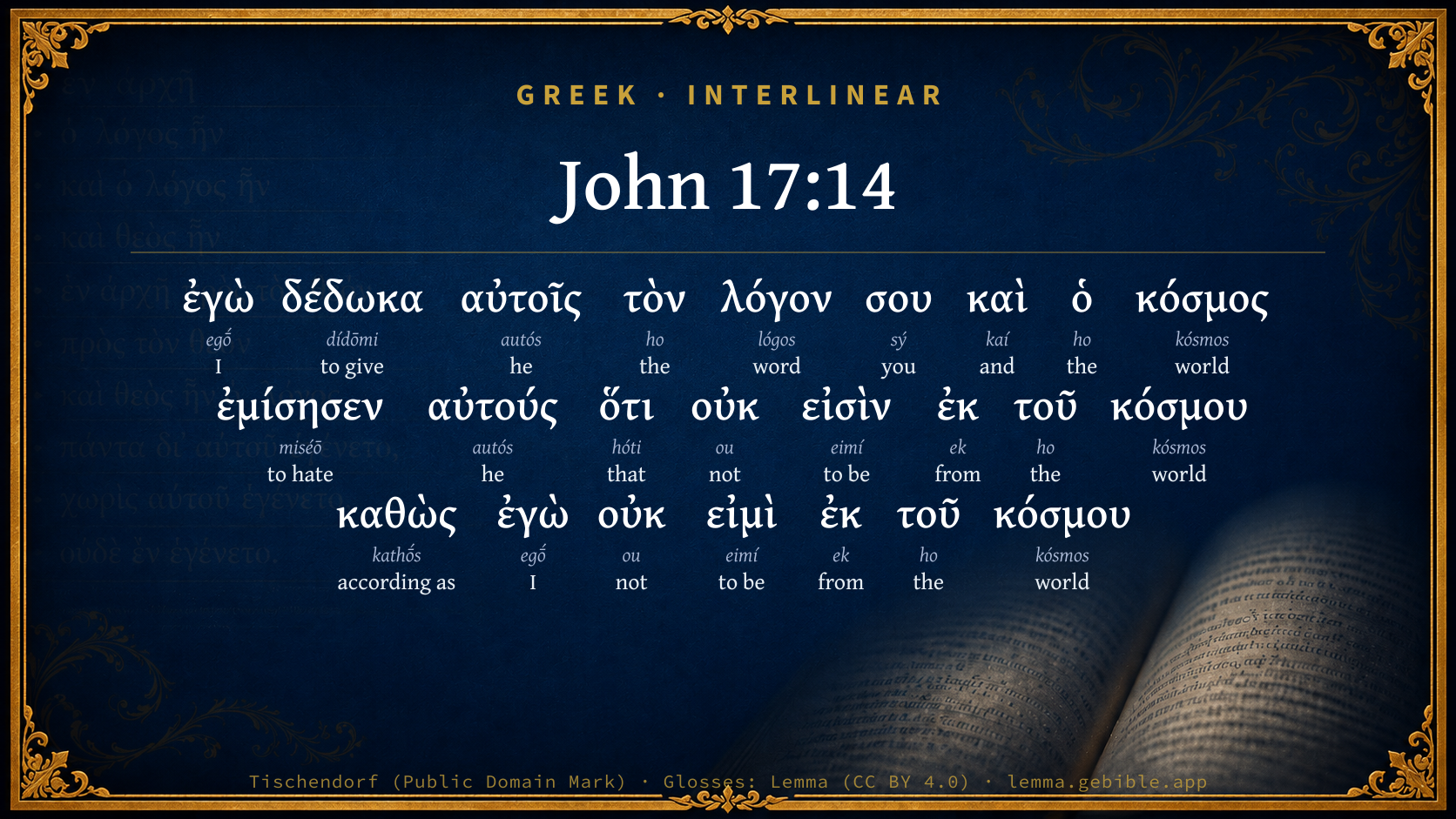
Download image
Cite this verse

John 17:14 (World English Bible). Public Domain. Lemma interlinear Bible study tool, https://lemma.gebible.app/v/john/17/14.

Show BibTeX & RIS
BibTeX
RIS
English Translation
I have given them your word. The world hated them, because they are not of the world, even as I am not of the world.
World English Bible · Public Domain
Download a study sheet

One document with this verse’s original text, its word-by-word gloss line, the meaning frame, cross-references with their text, attributed commentary, and full source and license credits — printable, and it pastes into notes with its structure intact.

This verse Autodidact and up

Study sheet (.html) Plain text (.txt)

A passage Seminary Student

Up to 50 verses in one chapter. A passage sheet keeps up to 6 commentary sources and 12 cross-references per verse, in the order this page ranks them, and says so on the sheet whenever that leaves anything out. Ask for a single verse and you get the Autodidact verse sheet above.

Everything on this page stays free to read, with no account — the sheet is a download of what is already on screen, not access to it.

Want to remove ads? Support Godless Engineer
Compare translations 3

The same verse in 3 English versions, stacked beneath the original-language interlinear above. Click any original word for its lexicon entry.

Each is an independent rendering of the whole verse — the interlinear is not word-aligned to these translations.

Highlighted words mark where these versions differ — a whole-verse word diff, not a word-by-word alignment.

  • World English Bible Public Domain
    I have given them your word. The world hated them, because they are not of the world, even as I am not of the world.
  • King James Version Public Domain
    I have given them thy word; and the world hath hated them, because they are not of the world, even as I am not of the world.
  • unfoldingWord Literal Text CC BY-SA 4.0
    I have given them your word, and the world has hated them because they are not from the world, just as I am not from the world.

unfoldingWord Literal Text — © unfoldingWord, licensed CC BY-SA 4.0. Word-aligned USFM3 via Door43 (git.door43.org/unfoldingWord/en_ult).

Versions to compare (up to 4)

3 of 4 selected

Show all 19 translations

Every available English version of this verse, each an independent rendering of the whole verse.

  • World English Bible Public Domain
    I have given them your word. The world hated them, because they are not of the world, even as I am not of the world.
  • Berean Standard Bible Public Domain
    I have given them Your word and the world has hated them; for they are not of the world, just as I am not of the world.
  • Majority Standard Bible Public Domain
    I have given them Your word and the world has hated them. For they are not of the world, just as I am not of the world.
  • King James Version Public Domain
    I have given them thy word; and the world hath hated them, because they are not of the world, even as I am not of the world.
  • American Standard Version (1901) Public Domain
    I have given them thy word; and the world hated them, because they are not of the world, even as I am not of the world.
  • Revised Version (1885) Public Domain
    I have given them thy word; and the world hated them, because they are not of the world, even as I am not of the world.
  • Geneva Bible (1599) Public Domain
    I haue giuen them thy word, and the world hath hated them, because they are not of the world, as I am not of the world.
  • Douay-Rheims (1899) Public Domain
    I have given them thy word, and the world hath hated them, because they are not of the world; as I also am not of the world.
  • Young's Literal Translation Public Domain
    I have given to them Thy word, and the world did hate them, because they are not of the world, as I am not of the world;
  • Literal Standard Version CC BY-SA 4.0
    I have given Your word to them, and the world hated them, because they are not of the world, as I am not of the world;
  • Unlocked Literal Bible CC BY-SA 4.0
    I have given them your word, and the world has hated them because they are not of the world, just as I am not of the world.
  • unfoldingWord Literal Text CC BY-SA 4.0
    I have given them your word, and the world has hated them because they are not from the world, just as I am not from the world.
  • Darby Bible Public Domain
    I have given them thy word, and the world has hated them, because they are not of the world, as I am not of the world.
  • World Messianic Bible Public Domain
    I have given them your word. The world hated them because they are not of the world, even as I am not of the world.
  • Webster's Bible Public Domain
    I have given to them thy word; and the world hath hated them, because they are not of the world, even as I am not of the world.
  • Free Bible Version CC BY-SA 4.0
    I gave them your message, and the world hated them because they are not of the world, just as I'm not of the world.
  • Bible in Basic English Public Domain
    I have given your word to them; and they are hated by the world, because they are not of the world, even as I am not of the world.
  • Text-Critical English NT CC BY 4.0
    I have given them yoʋr word, and the world has hated them because they are not of the world, just as I am not of the world.
  • Tyndale New Testament (1534) Public Domain
    I have geven them thy wordes and the worlde hath hated them because they are not of the worlde even as I am not of the worlde.

Literal Standard Version (2020), Covenant Press — licensed CC BY-SA 4.0. Text via the HelloAO Bible API (eBible.org). Unlocked Literal Bible (unfoldingWord) — licensed CC BY-SA 4.0. Text via the HelloAO Bible API (eBible.org). unfoldingWord Literal Text — © unfoldingWord, licensed CC BY-SA 4.0. Word-aligned USFM3 via Door43 (git.door43.org/unfoldingWord/en_ult). Free Bible Version, Dr. Jonathan Gallagher — licensed CC BY-SA 4.0. Text via the HelloAO Bible API (eBible.org).

Word by word

More ways to search: Search by grammar → Find every occurrence → Compare this word →

Practice this passage: Drill this verse → Learn its vocabulary →

ἐμίσησεν
miséō
G3404
“to hate”
Verb, Aorist, Active, Indicative, 3rd person, Singular
Part of Speech
Verb
Tense
Aorist
Voice
Active
Mood
Indicative
Person
3rd person
Number
Singular
Full Thayer's Definition

Origin: from a primary misos (hatred)

TDNT: 15:23,6

1. to hate, pursue with hatred, detest 2. to be hated, detested
  1. ἐγὼ egṓ G1473 “I” Personal pronoun, 1st person, Nominative, Singular
  2. δέδωκα dídōmi G1325 “to give” Verb, Perfect, Active, Indicative, 1st person, Singular
  3. αὐτοῖς autós G846 “he” Personal pronoun, Dative, Plural, Masculine
  4. τὸν ho G3588 “the” Article, Accusative, Singular, Masculine
  5. λόγον lógos G3056 “word” Noun, Accusative, Singular, Masculine
  6. σου sý G4771 “you” Personal pronoun, 2nd person, Genitive, Singular
  7. καὶ kaí G2532 “and” Conjunction
  8. ὁ ho G3588 “the” Article, Nominative, Singular, Masculine
  9. κόσμος kósmos G2889 “world” Noun, Nominative, Singular, Masculine
  10. αὐτούς autós G846 “he” Personal pronoun, Accusative, Plural, Masculine
  11. ὅτι hóti G3754 “that” Conjunction
  12. οὐκ ou G3756 “not” Particle, Negative
  13. εἰσὶν eimí G1510 “to be” Verb, Present, Active, Indicative, 3rd person, Plural
  14. ἐκ ek G1537 “from” Preposition
  15. τοῦ ho G3588 “the” Article, Genitive, Singular, Masculine
  16. κόσμου kósmos G2889 “world” Noun, Genitive, Singular, Masculine
  17. καθὼς kathṓs G2531 “according as” Adverb
  18. ἐγὼ egṓ G1473 “I” Personal pronoun, 1st person, Nominative, Singular
  19. οὐκ ou G3756 “not” Particle, Negative
  20. εἰμὶ eimí G1510 “to be” Verb, Present, Active, Indicative, 1st person, Singular
  21. ἐκ ek G1537 “from” Preposition
  22. τοῦ ho G3588 “the” Article, Genitive, Singular, Masculine
  23. κόσμου kósmos G2889 “world” Noun, Genitive, Singular, Masculine

About this verse

These counts appear in no published source. They are computed here, from the morphology-tagged text and Lemma’s own curated glosses. What Lemma adds →

24
words
14
distinct lemmas
Gospels
section

Shared distinctive vocabulary

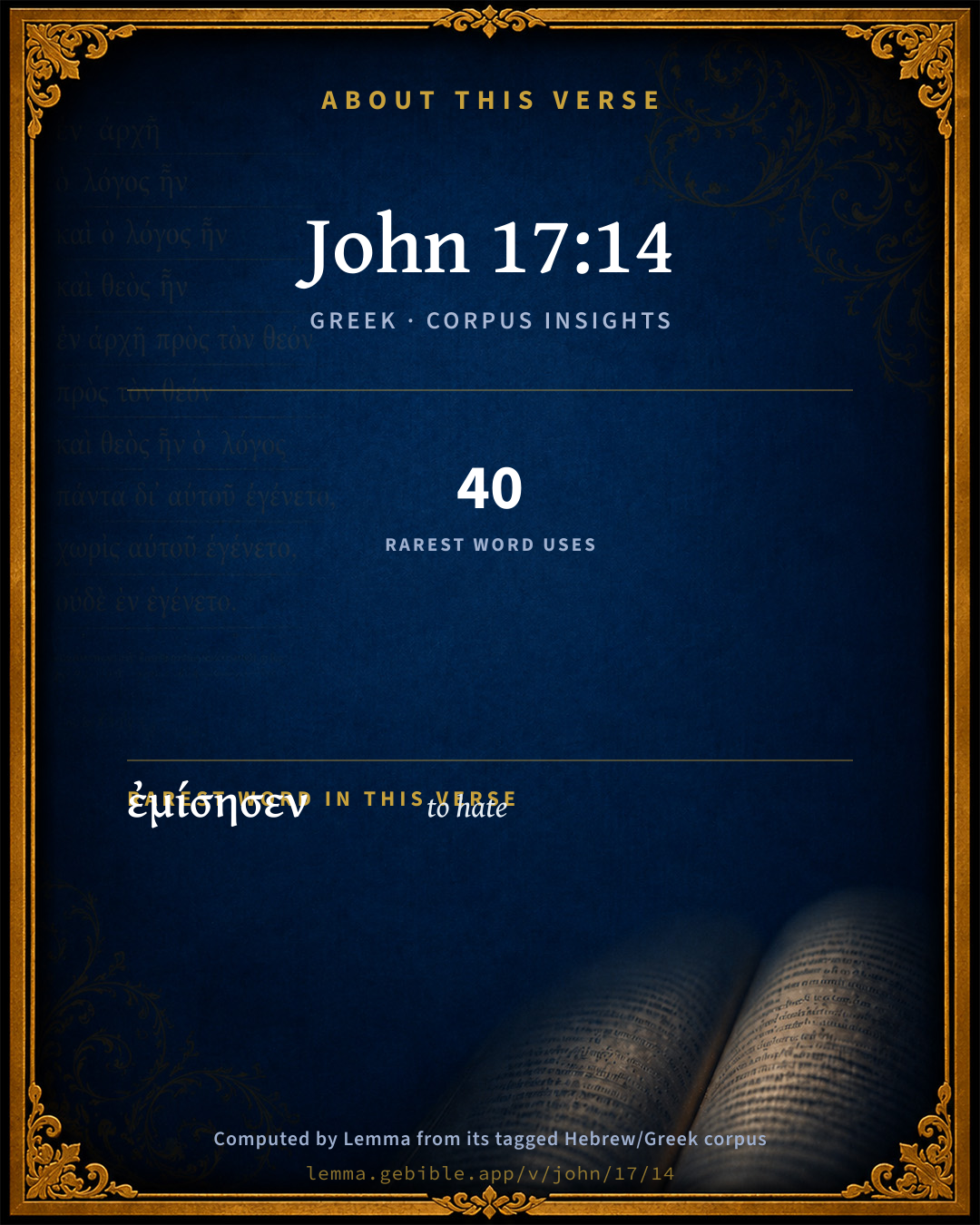
ἐμίσησεν to hate G3404 occurs in 36 verses of the Greek New Testament. Also found in:
Repetition

Words recur within this verse:

  • κόσμος world G2889 ×3
  • εἰσὶν to be G1510 ×2
  • τὸν the G3588 ×4
  • ἐγὼ I G1473 ×2
  • αὐτοῖς he G846 ×2
  • οὐκ not G3756 ×2
  • ἐκ from G1537 ×2

Cross-references

12

Topical passages linked to John 17:14 in the Treasury of Scripture Knowledge — connected by theme and wording, ordered by reader-vote popularity; previews shown in the World English Bible.

  • John 17:16 They are not of the world even as I am not of the world.
  • John 15:18–21 If the world hates you, you know that it has hated me before it hated you.
  • 1 John 5:19–20 We know that we are of God, and the whole world lies in the power of the evil one.
  • John 8:23 He said to them, "You are from beneath. I am from above. You are of this world. I am not of this world.
  • 1 John 4:5–6 They are of the world. Therefore they speak of the world, and the world hears them.
  • John 7:7 The world can't hate you, but it hates me, because I testify about it, that its works are evil.
  • Proverbs 29:27 A dishonest man detests the righteous, And the upright in their ways detest the wicked.
  • Genesis 3:15 I will put enmity between you and the woman, and between your offspring and her offspring. He will bruise your head, and you will bruise his heel."
  • Zechariah 11:8 I cut off the three shepherds in one month; for my soul was weary of them, and their soul also loathed me.
  • Matthew 10:24–25 "A disciple is not above his teacher, nor a servant above his lord.
  • 1 Peter 4:4–5 They think it is strange that you don't run with them into the same excess of riot, blaspheming:
  • 1 John 3:12 unlike Cain, who was of the evil one, and killed his brother. Why did he kill him? Because his works were evil, and his brother's righteous.

Cross-references courtesy of OpenBible.info (CC BY 4.0).

Commentary

Notes on John 17:14 from classic Christian and Jewish commentators (each source and its license shown beneath its notes). The classic Christian expositions comment on the surrounding passage and are grouped to its opening verse, so a note may address several verses; the Jewish commentaries on the Tanakh (Rashi and others) are per-verse, so they appear only where the commentator wrote on this verse.

Lemma curates 59 commentaries, every one of them public domain or Creative Commons licensed, each selected and text-cleaned for this edition rather than reprinted as found. About our sources →

The Biblical Illustrator

Joseph S. Exell

Joh_17:14

I hath given them Thy Word, and the world hath hated them.

The believers position in the world

It was one distinguished by

I. SPIRITUAL PRIVILEGE. I hath given them Thy Word.

1. These terms are comprehensive of the revelation of Divine grace and truth as a whole, which Christ Jesus taught as they were able to bear it. Who at this time, in the whole world, knew the Word of God as did these Galilean fishermen?

2. To receive the Word of God

(1) As a personal possession;

(2) as a sacred deposit in trust for the whole world; and

(3) from Him who was the Revealer of God and the Redeemer of men was the highest privilege.

3. And since with every privilege responsibility is involved, these disciples were invested with a trust which required them to be kept with Divine power. All disciples now, in a sense, share in this privilege and responsibility.

II. MORAL SEPARATION.

1. They were not of the world

(1) In their character, for the world is ever presented as having a character opposed to God. Self, not God, is its foundation; it seeks the present rather than the future, walks by sight rather than by faith, glories in the human rather than in the Divine, holds by the carnal rather than the spiritual. In this respect the disciples were no longer of the world.

(2) In their condition. The world, as such, was lying in wickedness and under condemnation. The children of disobedience are declared to be the children of wrath, and the friendship of the world is enmity with God.

2. This separation exposed them to social persecution--The world hath hated them, &c. The only world of which they knew anything by experience as yet was their own country, and it hated them. And if this was their experience up to now how signally in a wider sphere did it come to be so afterwards (1Co_4:13). The Saviours spotless purity rebuked the looseness of the age, His benevolence its selfishness, His piety its worldliness. Therefore it hated Him, and the disciples shared in the hostility which was heaped upon the Master.

3. Christ was the model of this separation. Even as I am not of the world. Jesus had not come out of the world as His disciples had done, for He was never of it, as they were. He was not of the world, although He came to the world, lived in the world, mixed with the men of the world, and in the scenes of the world, He was holy, harmless, undefiled, and separate from sinners, and His disciples accepted His principles, and gradually became assimilated to His character. To be like Christ, and to be unspotted from the world is the only true and abiding glory of human character. What does the world care for saints? It has not a good opinion of them, nor a good word for them; its spirit is entirely opposed to them, and it is not slow to call them fools. (J. Spence, D. D.)

Christians not of the world

Let us

I. EXPLAIN AND ESTABLISH THE TRUTH OF THE ASSERTION. Christians are not of the world

1. Because they are not attached to its party.

(1) In many cases it is lawful to associate with the people of the world. Such are cases of necessity--when we are compelled by our situations to live among them; cases of business, charity, and piety, civility, and affinity.

(2) But further than this a Christian will not go. He cannot choose and affinity.

(2) But further than this a Christian will not go. He cannot choose the people of the world as his companions and friends.

(a) The authority of God forbids it. Come out from among them and ye separate, &c.

(b) The peace of his fellow Christians. Such bold intimacies with the world would grieve the strong, and throw a stumbling-block in the way of the weak.

(c) The welfare of his own soul. Can a man take fire in his bosom and not be burned? My young friends, beware of wicked company! Cultivate no friendships that will end in everlasting ruin.

2. They are not actuated by the spirit of the world. Everything else is vain without this. Your forsaking the world in profession, your leaving it in appearance, by your apparel, your discourse, your manner of life, is nothing unless it be animated by internal principle. And when the heart is detached from the world, these two advantages flow from it:

(1) Even in the midst of all your secular concerns you will maintain your distinction. Though in the world, you will not be of it, because the heart is elsewhere, and God looketh to the heart.

(2) When the heart is withdrawn from the world, everything else will follow of course.

(a) Then you will not be governed by the maxims and opinions of the world. You will not ask what are the sentiments of the multitude, but what says the Scripture?

(b) You will not be attached to its amusements and dissipations. The sun arising conceals the stars--not by spreading gloom, but by diffusing lustre. It is a poor thing to be dragged out of the dissipations of the world, against inclination, while we still look back with Lots wife. But it is a glorious thing to leave these diversions from the discovery and possession of superior entertainment and sublimer joys.

(c) You will not be led by the conversation of the world; for speech is governed by affection; and out of the abundance of the heart the mouth speaketh.

3. They are not natives of the world. Our Lord said to the Jews, Ye are from beneath, I am from above; ye are of this world, I am not of this world. Now the believer may adopt the same language. He is here only as a stranger, and a foreigner, not a native; he derives his being from heaven. And as he is born from above, no wonder that he seeks those things which are above.

4. They do not choose their portion here. Hence the Christian learns in whatsoever state he is, therewith to be content. This never can be the case with the man who makes the world his portion. A Christian feels worldly trials, but he is not miserable. He is thankful for temporal indulgencies, but he is not exalted above measure.

II. WHAT DOES THIS TRUTH TEACH US?

1. It enables us easily to account for the worlds persecution of real Christians. They are not willing indeed to acknowledge what our Lord alleges as the cause of their hatred. It is not for your holiness we condemn you, but for your pride, your censoriousness, your hypocrisy. But how is it that the most holy and zealous Christians have been the most obnoxious to the men of the world? And a much stronger case: how was it that the Lord was more abhorred than His followers? Was He proud, censorious, false? And what our Saviour said to the Jews will apply to many Christians--falsely so called now--The world cannot hate you--you are somuch like it--but Me--Me it hateth because I testify of it that the works thereof are evil. Bear the same decisive testimony by your words and actions, and be assured a portion of the same rancour will follow. The case is plain. Resemblance is a ground of affection; but unsuitableness, of dislike. Hence, say the Apostle, all that will live godly in Christ Jesus shall suffer persecution of one kind or another. It began early. Cain slew his brother Abel; and wherefore slew he him? It prevailed also in the family of Abraham; and as it was then, so it is now; he that was born after the flesh persecuted Him that was born after the Spirit. Marvel not therefore, says our Saviour, if the world hate you. Do not murmur; you suffer in the noblest company, and your enemies can neither hinder your present peace, nor destroy your future happiness.

2. If the distinguishing badge of a Christian is this--that he is not of the world--then are there few real Christians to be found. Judge yourselves by this test. Ask yourselves wherein you differ from the men of the world.

3. See how little we should be affected with the charge of preciseness and singularity. You would not be afraid of being peculiarly wise, or beautiful, or wealthy. Why then wish to escape the praise of being singular in religion? What wisdom, what beauty, what riches can be compared to this?

4. If Christians are not of the world, no wonder they are more than reconciled to a withdrawment from it. No wonder they love solitude and enter their closets. There they exchange the world for God. No wonder they prize the Sabbath--it is a day of retreat, it is an emblem of heavenly rest. No wonder if death be no longer formidable--it is leaving a vain, vexing, defiling world. (W. Jay.)

The Biblical Illustrator, edited by Joseph S. Exell (c. 1880s–1900s) — public domain. Text from a community e-Sword module.

MacLaren's Expositions of Holy Scripture

Alexander MacLaren

John

THE INTERCESSOR

‘THE LORD THEE KEEPS’

Joh 17:14 - Joh 17:16.

We have here a petition imbedded in a reiterated statement of the disciples’ isolated position when left in a hostile world without Christ’s sheltering presence. We cannot fathom the depth of the mystery of the praying Christ, but we may be sure of this, that His prayers were always in harmony with the Father’s will, were, in fact, the expression of that will, and were therefore promises and prophecies. What He prays the Father for His disciples He gives to His disciples. Once only had He to say, ‘If it be possible’; at all other times He prayed as sure that ‘Thou hearest Me always,’ and in this very prayer He speaks in a tone of strange authority, when He prays for all believers in future ages, and says: ‘I will that, where I am, they also may be with Me.’ In this High-priestly prayer, offered when Gethsemane was almost in sight, and the Judgment Hall and Calvary were near, our Lord’s tender interest in His disciples fills His mind, and even in its earlier portion, which is in form a series of petitions for Himself, it is in essence a prayer for them, whilst this central section which concerns the Apostles, and the closing section which casts the mantle of His love and care over all who hereafter shall ‘believe on Me through their word,’ witnesses to the sublime completeness of His self-oblivion. Gethsemane heard His prayer for Himself; here He prays for His people, and the calm serenity and confident assurance of this prayer, set against the agitation of that other, receives and gives emphasis by the contrast.

Our text falls into two parts, the enclosing circle of the repeated statement of the disciples’ isolation in an alien world, and the enclosed jewel of the all-sufficient prayer which guarantees their protection. We shall best make its comfort and cheer our own by dealing with these two successively.

I. The disciples’ isolation.

Of course we are to interpret the ‘world’ here in accordance with the ethical usage of that term in this Gospel, according to which it means the aggregate of mankind considered as apart from and alien to God. It is roughly equivalent to the modern phrase, ‘society.’

With that order of things Christ’s real followers are not in accord.

That want of accord depends upon their accord with Jesus.

Every Christian has the ‘mind of Christ’ in him, in the measure of his Christianity. ‘It is enough for the disciple that he be as his Master’ But Christian discipleship has a better guarantee for the assimilation of the disciple to his Lord than the ordinary forms of the relation of teacher and taught ever present. There is a participation in the Master’s life, an implantation in the scholar’s spirit of the Teacher’s Spirit. ‘Christ in us’ is not only ‘the hope of glory,’ but the power which makes possible and actual the present possession of a life kindred with, because derived from, and essentially one with, His life.

They whose spirits are touched by the indwelling Christ to the ‘fine issues’ of sympathy with the law of His earthly life cannot but live in the world as aliens, and wander amid its pitfalls with ‘blank misgivings’ and a chill sense that this is not their rest. They are knit to One whose ‘meat and drink’ was to do the will of the Father in heaven, who ‘pleased not Himself,’ whose life was all one long service and sacrifice for men, whose joys were not fed by earthly possessions or delights. How should they have a sense of community of aims with grovelling hearts that cling to wealth or ambition, that are not at peace with God, and have no holdfasts beyond this ‘bank and shoal of time’? A man who has drunk into the spirit of Christ’s life is thereby necessarily thrown out of gear with the world.

Happy is he if his union with Jesus is so deep and close that it is but deepened by his experience of the lack of sympathy between the world and himself! Happy if his consciousness of not being ‘of the world’ but quickens his desire to help the world and glorify his Lord, by bringing His all-sufficiency into its emptiness, and leading it, too, to discern His sweetness and beauty!

But how little the life of the average Christian corresponds to this reiterated utterance of our Lord! Who of us dare venture to take it on our lips and to say that we are ‘not of the world even as He is not of the world’? Is not our relation to that world of which Jesus here speaks a contrast rather than a parallel to His? The ‘prince of this world’ had nothing in Christ, as He himself declared, but He has much in each of us. There are stored up heaps of combustibles in every one of us which catch fire only too swiftly, and burn but too fiercely, when the ‘fiery darts of the wicked’ fall among them. Instead of an instinctive recoil from the view of life characteristic of ‘the world,’ we must confess, if we are honest, that it draws us strongly, and many of us are quite at home with it. Why is this but because we do not habitually live near enough to our Lord to drink in His Spirit? The measure of our discord with the world is the measure of our accord with our Saviour. It is in the degree in which we possess His life that we come to be aliens here, and it is in the degree in which we keep in touch with Jesus, and keep our hearts wide open for the entrance of His Spirit, that we possess His life. A worldly Christian-no uncommon character-is a Christian who has all but shut himself off from the life which Christ breathes into the expectant soul.

II. The disciples’ guarded security.

Jesus encloses His prayer between the two parts of that repeated statement of the disciples’ isolation. It is like some lovely, peaceful plain circled by grim mountains. The isolation is a necessary consequence of the disciples’ previous union with Him. It involves much that is painful to the unrenewed part of their natures, but their Lord’s prayer is more than enough for their security and peace.

‘I pray not that Thou shouldest take them out of the world.’ They are in it by God’s appointment for great purposes, affecting their own characters and affecting the world, with which Christ will not interfere. It is their training ground, their school. The sense of belonging to another order is to be intensified by their experiences in it, and these are to make more vivid the hopes that yearn towards the true home, and to develop the ‘wrestling thews that throw the world.’ The discipline of life is too precious to be tampered with even by a Saviour’s prayer, and He loves His people too wisely to seek to shelter them from its roughness, and to procure for them exemption which would impoverish their characters.

So let us learn the lesson and shape our desires after the pattern of our Lord’s prayer for us, nor blindly seek for that ease which He would not ask for us. False asceticism that shrinks from contact with an alien world, weak running from trials and temptations, selfish desires for exemption from sorrows, are all rebuked by this prayer. Christ’s relation to the world is our pattern, and we are not to seek for pillows in an order of things where He ‘had not where to lay His head.’

But He does ask for His people that they may be kept ‘from evil,’ or from ‘the evil One.’ That prayer is, as we have said, a promise and a prophecy. But the fulfilment of it in each individual disciple hinges on the disciple’s keeping himself in touch with Jesus, whereby the ‘much virtue’ of His prayer will encompass him and keep him safe. We do not discuss the alternative renderings, according to one of which ‘the evil’ is impersonal, and according to the other of which it is concentrated in the personal ‘prince of this world.’ In either case, it is ‘the evil’ against which the disciples are to be guarded, whether it has a personal source or not.

Here, in Christ’s intercession, is the firm ground of our confidence that we may be ‘more than conquerors’ in the life-long fight which we have to wage. The sweet strong old psalm is valid in its assurances to-day for every soul which puts itself under the shadow of Christ’s protecting intercession: ‘The Lord shall keep thee from all evil, He shall keep thy soul.’ We have not ‘to lift up our eyes unto the hills,’ for ‘vainly is help hoped for from the multitude of the mountains,’ but ‘Our help cometh from the Lord which made heaven and earth.’ Therefore we may dwell at peace in the midst of an alien world, having the Father for our Keeper, and the Son, who overcame the world, for our Intercessor, our Pattern and our Hope.

The parallel between Christ and His people applies to their relations to the present order of things: ‘They are not of the world, even as I am not of the world.’ It applies to their mission here: ‘As Thou didst send Me into the world, even so sent I them into the world.’ It applies to the future: ‘I am no more in the world, but these are in the world, and I come to Thee,’ and in that ‘coming’ lies the guarantee that His servants will, each in his due time, come out from this alien world and pass into the state which is home, because He is there. The prayer that they might be kept from the evil, while remaining in the scene where evil is rampant, is crowned by the prayer: ‘I will that, where I am, they also may be with Me, that they may behold My glory.’

Alexander MacLaren, Expositions of Holy Scripture (1904–1910) — public domain. Text from a community e-Sword module.

Tyndale Open Study Notes

Tyndale Open Resources

17:14 God’s word, which Jesus had given his disciples, also provides a defense against the world. The Spirit would preserve and recall God’s word in the church (14:26), equipping the church for its encounter with the world.

Tyndale Open Study Notes — © Tyndale Open Resources, licensed CC BY-SA 4.0. Text via the HelloAO Bible API.

Bengel's Gnomon

Johann Albrecht Bengel

Joh 17:14. Καὶ, and) The things connected are, to receive the word of God, and, to be hated by the world.

Bengel's Gnomon of the New Testament — English translation (T&T Clark, Edinburgh, 1860) — public domain. Text from a community e-Sword module.

Meyer's Critical & Exegetical Commentary

Heinrich August Wilhelm Meyer

Joh_17:14-15. The intercession addresses itself to a particular, definite point of the τήρησις prayed for, namely, ἐκ τοῦ πονηροῦ, Joh_17:15, and this is introduced, Joh_17:14, from the side of their necessities.

ἐγώ] antithesis: ὁ κόσμος.

ἐμίσ. αὐτούς] has conceived a hatred against them (Aor., see Lobeck, ad Phryn. p. 197; Kühner, ad Xen. Mem. i. 1. 18). This hatred Luther terms the true court colours of Christians that they bear on earth. Further, see on Joh_15:18-19.

The more precise definition of τήρησις follows in Joh_17:15 negatively and positively. They are not (for I have still more to accomplish by their means, Luther) to be taken out of the unbelieving world which hates them (which would take place by death, as now in the case of Jesus Himself, Joh_17:11), but they are to be kept by God, so that they ever come forth, morally uninjured, from the power of Satan surrounding them, the power of the prince of the world. ἐ κ τ. πονηροῦ is not, with Luther, Calvin, and many others, including Olshausen, B. Crusius, Hengstenberg, Godet, to be taken as neuter, but comp. 1Jn_2:13 ff; 1Jn_3:12; 1Jn_5:18-19; 1Jn_4:4; Mat_6:13; 2Th_3:3; comp. on τηρεῖν ἐκ, Rev_3:10, also φυλάσσειν ἐξ ἐπιβουλῆς in Themist. 181. 19 (Dindorf). Nonnus: δαίμονος ἀρχεκάκοιο δυσαντήτων ἀπὸ θεσμῶν.

Meyer — Critical and Exegetical Commentary on the New Testament — English translation by Peter Christie, edited by Frederick Crombie (T&T Clark, 1880) — public domain. Text from a community e-Sword module.

Expositor's Greek Testament

ed. W. Robertson Nicoll

Joh 17:14 . ἐγὼ δέδωκα … κὸσμου . Additional reason for soliciting in behalf of the disciples the protection of the Father consists in this, that the world hates them because they have received the revelation of God in Christ, and are thereby separated from the world as their Teacher was not of the world. Cf. Joh 17:6 .

The Expositor's Greek Testament, edited by W. Robertson Nicoll (1897–1910) — public domain. Text from a community e-Sword module.

Adam Clarke's Commentary

Verse 14. I have given them thy word] Or, thy doctrine - του λογον σου. In this sense the word λογος is often used by St. John.

And the world hath hated them] The Jewish rulers, &c., have hated them. - Why? Because they received the doctrine of God, the science of salvation, and taught it to others. They knew Jesus to be the Messiah, and as such they proclaimed him: our Lord speaks prophetically of what was about to take place. How terrible is the perversion of human nature! Men despise that which they should esteem, and endeavour to destroy that without which they must be destroyed themselves!

Adam Clarke's Commentary on the Bible (1810–1826) — public domain. Text from a community e-Sword/MySword module.

John Calvin's Commentaries

14. I have given them thy word. He employs a different argument in pleading with the Father on behalf of the disciples. It is, because they need his assistance on account of the hatred of the world. He likewise declares the cause of that hatred to be, that they have embraced the word of God, which the world cannot receive; as if he had said, “It belongs to thee to protect those who, on account of thy word, are hated by the world.” We must now keep in remembrance what we have lately heard, that the end of this prayer is, that Christ’s joy may be fulflled in us As often, therefore, as the rage of the world is kindled against us to such an extent that we think we are very near destruction, let us learn suddenly to ward it off by this shield, that God will never forsake those who labor in defense of the Gospel.

Because they are not of the world. He says that his disciples are not of the world, because all those whom he regenerates by his Spirit are separated from the world God will not suffer his sheep to wander among wolves, without showing himself to be their shepherd.

John Calvin's Commentaries (1540-1563) — public domain. Text from the Calvin Translation Society English edition (1840s-50s) via the Christian Classics Ethereal Library (ccel.org). Calvin's coverage is partial (roughly two-thirds of the Bible); uncommented books and verses are honest gaps, never fabricated. The 19th-century editor's footnotes and remarks are omitted so the notes are faithfully Calvin's own voice.

Ellicott's Commentary for English Readers

(14) I have given them thy word; and the world hath hated them.—The terms “I” and ‘“the world” are opposed to each other. The world’s hatred followed necessarily from the fact that Christ had given them God’s word, and that by it they had been separated from the world. (Comp. Note on Joh_17:6.)

Because they are not of the world.—Comp. Note on Joh_15:18.

A Bible Commentary for English Readers, edited by Charles John Ellicott (1878–1897) — public domain. Text from a community e-Sword module.

The Cambridge Bible for Schools and Colleges

gen. ed. J. J. S. Perowne

14. I have given] ‘I’ in emphatic opposition to the world.

thy word] The revelation of God as a whole (see on Joh_17:16 and Joh_5:47).

hath hated] Rather, hated; the aorist expresses the single act of hate in contrast to the perfect, ‘I have given’ a gift which they continue to possess. These are the two results of discipleship; on the one side, Christ’s protection (Joh_17:12) and the gift of God’s word; on the other, the hatred of the world.

The Cambridge Bible for Schools and Colleges (gen. ed. J. J. S. Perowne; Cambridge University Press, 1878–1918) — public domain. Text from a community e-Sword module.

John Gill's Exposition

I have given them thy word,.... The Gospel, and a commission and abilities to preach it, and which is a reason of what follows, namely, the world's hatred of them; because this word is not of men, nor agreeably to carnal reason; it magnifies the grace of God, and destroys boasting in men; it is against the carnal interest, worldly views and lusts of men:

and the world hath hated them; the inhabitants of the world, worldly men, such as are what they were when they first came into the world; are under the influence of the god of the world, and led by the spirit of it, and are wholly taken up with the things thereof: the unbelieving Jews are chiefly designed, who bore an implacable hatred to Christ and his apostles; and the same fate do the faithful ministers of Christ and his members share, in all ages and places, more or less: the men of the world gnash their teeth at them, secretly plot against them, and inwardly curse them; rejoice at any evil that befalls them; greedily catch at anything to reproach them; stick not to say all manner of evil of them, and to do all manner of evil to them:

because they are not of the world; they were of the world by their natural birth, and had their conversation with the men of it, whilst in a state of unregeneracy; but now they were called out of it, and were guided and led by another spirit; and were separate from the world in their lives and conversations, and which brought the hatred of the world upon them; inasmuch as they had been of them, but now had left them, and professed they did not belong to them; and because their religious lives put a distinguishing mark on them, and reproved and condemned them:

even as I am not of the world; not that Christ and his people are alike in their original; they are of the earth earthly, he is the Lord from heaven; nor are they so perfect in their walk and conversation in the world, and separation from it as he; yet there is some likeness between him and them, and some conformity in them to him, which makes the world hate them.

John Gill's Exposition of the Whole Bible (1746–1763) — public domain (CC PDM 1.0). Text via the HelloAO Bible API.

Trapp's Complete Commentary

John Trapp

14 I have given them thy word; and the world hath hated them, because they are not of the world, even as I am not of the world.

Ver. 14. I have given them thy word, &c.] I have put my word into their mouth, therefore the world hateth them; Persecution being the black angel (as Calvin said) that dogs the gospel. When our Saviour preached at Nazareth, so long as he was opening his text, they admired him; but when he came to apply it close to their consciences, they pulled him out of the pulpit, and would have broken his neck down the hill, Luk 4:29. The book that the angel gave John to eat "was sweet in his mouth, but bitter in his belly," Rev 10:9; to note that the knowledge of divine truths is pleasant, but the publishing of them, whereby the fruit thereof might come to the rest of the members (like the concoction and distribution of meat digested in the stomach), is full of trouble.

John Trapp, A Commentary or Exposition upon All the Books of the Old and New Testament (1647–1656) — public domain. Text from a community e-Sword module.

Albert Barnes' Notes on the Bible

I have given them ... - See Joh 17:8.

The world hath hated them ... - Joh 15:18-21.

Albert Barnes' Notes on the Bible (1834–1885) — public domain. Text from a community e-Sword/MySword module.

Haydock's Catholic Bible Commentary

He tells his Father the reason why the world hated them, because they were not of the world. By generation, indeed, they were of the world; but by regeneration, they were not of the world. Thus they became like to himself, being born again of that Holy Spirit, by whose all powerful operation, he took upon himself the form of a servant. But although they were not of the world, still was it necessary that they should remain in the world; therefore he continues, I ask not that thou wouldst take them out of the world. (St. Augustine, tract. 107. in Joan.)

George Leo Haydock (1774–1849), Haydock's Catholic Family Bible and Commentary, 1859 edition — public domain. Excludes Psalms (Douay-Rheims chapter numbering differs from Protestant) and Deuterocanonical books (Catholic canon only).

Matthew Poole's English Annotations

I take more to be understood here, by Christ’s giving his word unto his disciples, than his preaching the gospel in their ears: otherwise Christ had no more given these his disciples his word, than he had given it to many thousands of others who were yet in the world, and whom the world hated not. The sense therefore is, I have not only preached thy word in their ears, but I have opened their hearts to receive and believe it and bowed their wills to a compliance with it; so as the word dwelleth in their hearts, is ingrafted in them, and they are turned into the likeness of it. And here it is observable, that when any soul is given to Christ by his Father, Christ will most certainly, first or last, give unto that soul his word in that sense; that is, so as it shall receive, believe it, and be turned into the likeness of it. And for this

the world hath hated them, for thy word hath made them to be of another spirit from carnal, loose, and worldly men; they have other affections, other inclinations, other designs and studies;

they are not of the world in that respect

as I am not of the world: though in other respects not so; for Christ, as to his original, was not of the world, which they were, of the earth, earthy.

Matthew Poole's English Annotations on the Holy Bible (1683–1685) — public domain. Text from a community e-Sword/MySword module.

Whedon's Commentary on the Bible

Daniel D. Whedon

14. The world hath hated them—See notes on Joh_15:18-25.

Daniel D. Whedon (gen. ed.), Commentary on the Old and New Testaments (1874–1909) — public domain. Text from a community e-Sword module.

The Pulpit Commentary

I have given them thy word (dedwka , a permanent endowment); and the implication is that they have received it (Ver. 8). The phrase is rather more condensed than before, and carries all the consequences previously mentioned, and others as well to which the Lord had referred. (Joh_16:1-5) As a matter of fact, the world hated them, because they are not of the world, even as I am not of the world. This constant contrast between the mind of Christ and the spirit of the world pervades the New Testament. Christ had exposed its hypocrisies, and denounced its idols, and inverted its standards, and repudiated its smile, and condemned its prince, and was now indifferent to its curse. His disciples, as far as they shared his sentiments, came in also for its malediction and hatred (cf. the conflict with the Pharisees in the synoptic narrative).

Vers. 14-19. The world"s hatred and Christ"s prayer for the disciples" safe keeping against it.

I IT WAS CHRIST"S WORD IN THE DISCIPLES THAT EXCITED THE WORLD"S HATRED. "I have given them thy Word." They who receive the Word cross the world"s path

(1) in their true judgment of things,

(2) in their God-like wills,

(3) in their holy lives.

II THE OPERATION OF THE WORLD"S HATRED. "The world hath hated them, because they are not of the world, even as I am not of the world.

1. It is the honor of believers that they are linked with Christ as the objects of the worlds hatred.

2. This hatred is seen in

a. persecution,

b. in calumny,

c. in the misconstruction of things doubtful,

d. in the blasphemy of God and religion.

3. The hatred of the world is no hindrance to the believers blessedness.

III CHRIST"S PRAYER IS NOT FOR THE TRANSLATION OF BELIEVERS TO HEAVEN, BUT FOR THEIR PRESERVATION ON EARTH. "I pray not that thou shouldest take them out of the world, but that thou shouldest keep them from the evil.

1. The desire of death is unlawful in the saints,

(1) because Christ has his work to do by us in the world;

(2) because the victory is to be gained through conflict;

(3) because God can be more honored by our steadfast endurance than by our escape from duty.

2. There is provision made for the preservation of the saints from evil.

(1) It is better for us to be kept from sin in our afflictions than from the afflictions themselves.

(2) Divine aid is needed for our safe keeping.

(3) Such as devote themselves to Christ"s service are sure, not only of his prayers, but of his Divine support.

(4) The evil that surrounds the believer in the world will

(a) awaken him to a true sense of his danger,

(b) humble him,

(c) and lead him to a nearer dependence upon the Lord.

IV THE TRUE METHOD OF PRESERVATION. "Sanctify them through thy truth: thy Word is truth.

1. There must be a complete consecration to the task the disciples have to fulfill in the world.

(1) This consecration implies a prior consecration of heart and life to God, in the ways of practical holiness.

(2) This consecration was necessary to the faithful discharge of the apostleship.

2. The Word of God is the great instrument in Gods hand for his peoples sanctification.

(1) It is here implied that the Word of God is the truth of God truth at once

(a) infallible,

(b) eternal,

(c) and holy.

(2) It is to be read with diligence, preparation, and prayer.

(3) It is to be maintained

(a) by our arguments,

(b) by our obedience,

(c) by our sufferings.

3. Jesus presents two motives in support of this petition.

(1) One was taken from the mission he had entrusted to his disciples. "As thou hast sent me into the world, even so have I also sent them into the world.

(a) The apostles went not unsent upon their mission.

(b) They looked to Christ, not only for authority, but for equipment.

(c) They carried his message.

(d) They kept in view his end in preaching the gospel.

(2) The other motive was taken from the work which he had effected in himself. "And for their sakes I sanctify myself, that they also may be sanctified in truth.

(a) Christ consecrated himself wholly to his work. His human life received in an ever-increasing degree the seal of consecration till the entire and final sacrifice of death.

(b) The end of his consecration was the consecration of his members. The union of Christ and believers is the abiding source of this continuous consecration.

The Pulpit Commentary (1880–1919), ed. H.D.M. Spence-Jones & Joseph S. Exell — public domain. Text from a community e-Sword module.

Scofield Reference Notes

C. I. Scofield

world

kosmos = world-system. Joh 18:36; Joh 7:7, (See Scofield "Rev 13:8").

The Scofield Reference Bible (1917 edition), notes by C. I. Scofield — public domain. Text from a community e-Sword module.

Kretzmann's Popular Commentary

Paul E. Kretzmann

The Word keeps in faith:

v. 14. I have given them Thy Word; and the world hath hated them because they are not of the world, even as I am not of the world.

v. 15. I pray not that Thou shouldest take them out of the world, but that Thou shouldest keep them from the evil.

v. 16. They are not of the world, even as I am not of the world.

v. 17. Sanctify them through Thy truth; thy Word is truth.

v. 18. As Thou hast sent Me into the world, even so have I also sent them into the world.

v. 19. And for their sakes I sanctify Myself, that they also might be sanctified through the truth.

Only one means Jesus knows of, both for working faith and for keeping in the faith, and that means He has given to the disciples: the Word of the Father. There is no need of following the lead of enthusiasts that prate of new revelations, the inner light, and keys to the Scriptures. The Word of the Gospel as we have it in Scriptures is all-sufficient for all needs. But the Word thus becomes a distinguishing factor, since the Christians accept it, and the world, the unbelievers, refuses to recognize its worth and power. The result is that the unbelieving world hates the Christians. Their acceptance of the Gospel is a constant accusation of the world’s rejection of Christ; it emphasizes the essential difference between believers and unbelievers. The former have nothing in common with the world, with the nature and manner of the children of the world. The attitude toward the Word of the Gospel is the deciding factor; the Word is the touchstone by which men decide their fate. The Word therefore is the rock-foundation of a Christian’s faith. "There I have the Word of Christ, my Lord, yea, of the almighty Father in heaven; that I know and am certain, if I cling to that, then no power on earth nor the gates of hell can harm me, for He loves His Word and will hold His hand over it, and therefore also protect and defend all that cling to it. " The Christians, then, are perfectly willing and satisfied to occupy the position in which the world places them by its hatred, since thereby they are identified more fully with Christ. Purposely, therefore, Jesus does not ask that the believers be taken out of the world, that they be removed from the proximity of harm and danger and hatred, but only that the Father would keep them, shield them against the wiles of the devil. That is the one side of the Christians’ preservation in faith, which is the work of God. God guards and protects them from their enemies, the world and the devil, by not permitting these enemies to seduce them, nor lead them into misbelief, despair, or other great shame and vice. That danger is always present, and many a believer has been overcome, since he did not trust in the power of God alone. What Jesus here prays should be remembered by all Christians at all times: They do not belong to the world, as I am not of the world. Christ and the unbelieving world have nothing in common; and so the followers of Christ and the unbelieving world can have nothing in common. Their interests, their objects, lie in opposite directions and can never be reconciled. To attempt a compromise with the unbelieving world is to make peace with the devil. And therefore the prayer of Jesus takes this factor into account. He asks that God complete the separation between the believers and the world, sanctify the disciples wholly by consecrating them to God alone, through the power of the Word. The Christians are sanctified, separated from the world, as soon as faith has been wrought in their hearts. But it is the power of God in the Word which must continue to keep them separated and consecrated. And this sanctification and these fruits of faith are not our work and ability, but God’s mercy and divine power. The believers being thus set apart through the power of the Word, they are ready for their great ministry. Even as God sent the Son into the world to preach and bring salvation, so the Son, in turn, sends the believers out into the world to preach the redemption that has been earned by Jesus. They should be witnesses for the truth, they should confess Christ. They are His witnesses to the world, for all men are included both under sin and under grace, Joh 3:16. In the midst of the unbelieving world Christ wanted to build His Church. And in order that this might be accomplished, in order that the work of the disciples might be done with the feeling of free and full consecration, Jesus consecrates Himself, gives Himself as a sacrifice for the whole world. He is about to enter upon His Passion now to work a perfect redemption. And every believer that accepts this deliverance, this redemption, thereby is separated from the hostile, unbelieving world and consecrated in and for the truth of the Gospel. Thus the disciples are sanctified and remain sanctified; they remain in the Word of Truth, in and through which the sin which persists in troubling them is forgiven, and they receive strength both to combat the evil and to carry out the will of the Lord for the proclamation of the Word to others.

Paul E. Kretzmann, Popular Commentary of the Bible (1921–1924) — public domain. Text from a community e-Sword module.

Burkitt's Expository Notes on the New Testament

William Burkitt

I have given them thy word, partly by external revelation, and partly by internal illumination; and for thy word’s sake the world hates them, as also because they are not of the world.

Learn, 1. That Christians, especially ministers to whom Christ has given his word, must expect the world’s hatred. Few of the prophets or apostles died a natural death: as their calling is eminent, so must their sufferings be exemplary. The best ministers, and the best men, are usually most hated. There is an antipathy against the power of godliness; or a cruel, causeless, implacable, and irreconcilable hatred against the saints, because of their strictness in religion, and contrariety to the world.

2. That it is to the honour of believers that they are like unto Christ, in being the object of the world’s hatred: The world hates them, because they are not of the world, as I am not of the world.

This Christ adds both for information and consolation; for information, that they should look for such hatred, misery, and trouble, as they saw him grapple with; and for consolation, to think that the world can never hate us so bad as it hated Christ.

William Burkitt's Expository Notes on the New Testament (1700–1703) — public domain. Text from a community e-Sword module.

Cambridge Greek Testament for Schools and Colleges

14. ἐγὼ δέδ. I, in emphatic opposition to the world, have given them the revelation of Thee; and the world hated them. The aorist expresses the single act of hate in contrast to the gift which they continue to possess. These are the two results of discipleship; Christ’s protection with the gift of God’s word and the world’s hate.

Cambridge Greek Testament for Schools and Colleges (Cambridge University Press, 1896; 21 vols, various authors incl. Carr, Maclear, Plummer, Farrar, Lumby, Moule, M. R. James, Simcox) — public domain. Text from a community e-Sword module.

Alford’s Greek Testament

Henry Alford

14-16.] See ver. 8.

Ver. 14 contains the manner in which He ἐφύλαξεν αὐτούς, by giving them the Divine Word;—and the reason of the τήρησις prayed for, viz., because they would be objects of hatred to the world: ἐγώ and ὁ κόσμος being opposed.

καθὼς ἐγώ] See ch. 15:18.

Henry Alford, The Greek Testament (1849–1861) — public domain. Text from a community e-Sword module.

International Critical Commentary

14. ἐγὼ δέδωκα αὐτοῖς τὸν λόγον σου, repeated from v. 8, τὸν λόγον being substituted for τὰ ῥήματα (see on 5:38), the perfect δέδωκα in both cases implying that Jesus had continued to give to the disciples the revelation of the Father, and was still giving it.

καὶ ὁ κόσμος ἐμίσησεν αὐτούς. This was the badge of a disciple (15:18, 19, where the verb is in the present tense, μισεῖ, which D substitutes here for the harder ἐμίσησεν). We should expect the perf. μεμίσηκεν as in 15:24, if not μισεῖ; this is one of the cases in which Jn. uses the aorist as if it were a perfect (cf. 12:28, 13:34, 15:15; and see Abbott, Diat. 2441).

ὅτι οὐκ εἰσὶν ἐκ τοῦ κόσμου. A fine and eloquent exposition of the thought that Christian disciples generally, and not the apostles only, are in the world but not of the world is given in the second-century Ep. to Diognetus (vi. 3), with a probable allusion to vv. 11, 14. See on 3:16.

καθὼς ἐγὼ οὐκ εἰμὶ ἐκ τοῦ κόσμου. So He had said at 8:23, where see note.

International Critical Commentary — older volumes (1896–1929), various authors — public domain. Text from a community e-Sword module.

Godet's Commentaries

Frédéric Louis Godet

Vv. 14, 15. “I have given them thy word; and the world has hated them, because they are not of the world, as I am not of the world. 15. I ask not that thou shouldest take them out of the world, but that thou shouldest keep them from the evil.”

The word of Jesus, which they have faithfully received, has made them strangers in the world, as Jesus Himself was. They are become thereby, like Him, beings antipathetic to purely earthly humanity. Jesus might therefore easily allow Himself to ask of God to withdraw them from the world with Himself. But no; for He has separated them from the world for the precise purpose of preparing them to fulfil a mission to the world. It is necessary that they should remain here to fulfil this task; only it must not be that the line of demarcation which He has succeeded in drawing between the world and them, by placing His word in them, should be effaced.

While remaining in the world, they must be kept from the evilwhich reigns therein. Jesus thus closes this passage by presenting again the petition which was its text. The limiting word τοῦ πονηροῦ, it seems to me, must be taken here in the neuter sense: from the evil, and not: from the evil one; for the preposition ἐκ, out of, refers rather to a domain, from the midst of which one is taken, than to a person from whose power one escapes. It is otherwise in the Lord’s Prayer, where the preposition ἀπό and the verb ῥύεσθαι are used, two expressions which rather refer to a personal enemy (Mat 6:13). It is wrong, therefore, for Reuss, Weiss, etc., to explain here: “from the power of the devil.” Hengstenberg observes that the form τηρεῖν ἐκ does not appear again except in the Apoc. (Joh 3:10).

From the prayer: Keep them, which has rather a negative aim (to prevent their return to the world), and which especially refers to their own salvation, Jesus passes to the second petition, which has a positive end in view, and which refers rather to their mission: Sanctify them. It is prepared for in Joh 17:16, stated in Joh 17:17, then justified and developed in Joh 17:18-19.

Frédéric Louis Godet — Commentaries on Luke, John, Romans, and 1 Corinthians — English translation (T&T Clark, Edinburgh, 1870s–1890s) — public domain. Text from a community e-Sword module.

Lesson kit

Teaching starters — assembled from the data on this page, not authored interpretation. Every prompt links to the verse data it draws on. Edit before teaching.

John, in the Gospels, opens this verse with 24 words (14 distinct Greek lemmas). Its most distinctive word is miséō (“to hate”). A historical commentator’s framing appears above. Read the whole chapter for the surrounding context.

Discussion questions

  1. What does “to hate” (miséō) contribute to the verse as a whole?
  2. Matthew 5:43 shares the word «to hate» with this verse. How do the two illuminate each other?
  3. “world” occurs 3× in this one verse. What is the effect of the repetition?
  4. These translations render this verse differently; the difference is in the English rendering, not the original. What questions does that raise?
  5. Reading how The Biblical Illustrator and MacLaren's Expositions of Holy Scripture read this verse, where do the two commentators agree and where do they part?

Things to notice

  • These translations choose different wording for 3 words in this verse.
  • “world” occurs 3× in this single verse.
  • 14 distinct Greek lemmas span 24 words in this verse.

Reading settings

Reading text

Shown beneath each verse's original-language words.

Old Testament
Old Testament edition

Read the OT as the Masoretic Hebrew (MT) or the Greek Septuagint (LXX).

English shown for the Greek Septuagint (in the Hebrew ↔ Greek comparison).

Comparing translations? Open the Compare panel on any verse page to stack up to four side by side.