John 19:9

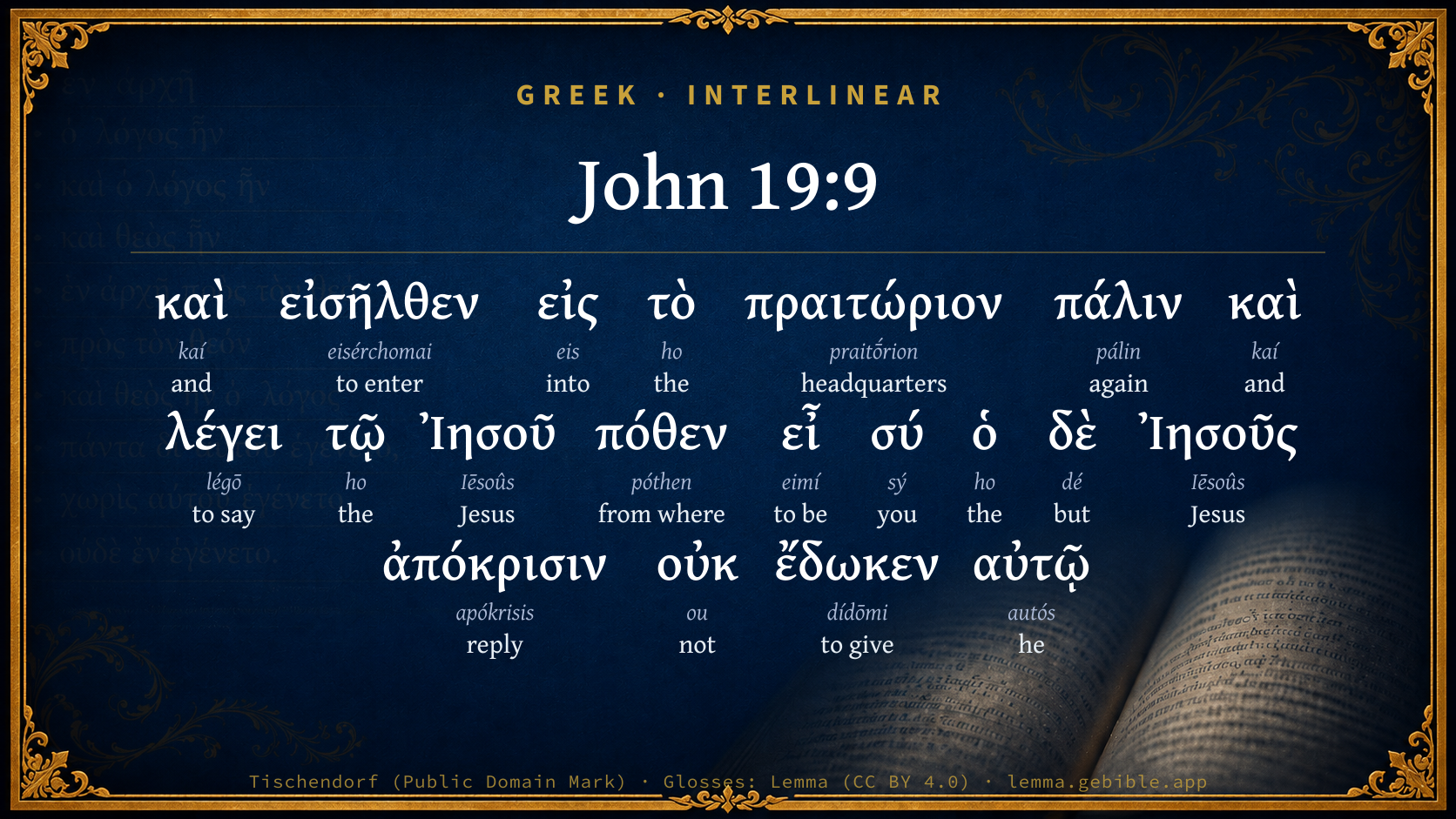
Greek (Tischendorf 8th ed.) John 19:9 appears in the Greek New Testament. The text above is from the Tischendorf 8th edition. Each word links to its Strong’s number and a concise gloss. Click any word for its full Thayer’s Greek Lexicon entry.
Download image
Cite this verse

John 19:9 (World English Bible). Public Domain. Lemma interlinear Bible study tool, https://lemma.gebible.app/v/john/19/9.

Show BibTeX & RIS
BibTeX
RIS
English Translation
He entered into the Praetorium again, and said to Jesus, "Where are you from?" But Jesus gave him no answer.
World English Bible · Public Domain
Download a study sheet

One document with this verse’s original text, its word-by-word gloss line, the meaning frame, cross-references with their text, attributed commentary, and full source and license credits — printable, and it pastes into notes with its structure intact.

This verse Autodidact and up

Study sheet (.html) Plain text (.txt)

A passage Seminary Student

Up to 50 verses in one chapter. A passage sheet keeps up to 6 commentary sources and 12 cross-references per verse, in the order this page ranks them, and says so on the sheet whenever that leaves anything out. Ask for a single verse and you get the Autodidact verse sheet above.

Everything on this page stays free to read, with no account — the sheet is a download of what is already on screen, not access to it.

Want to remove ads? Support Godless Engineer
Compare translations 3

The same verse in 3 English versions, stacked beneath the original-language interlinear above. Click any original word for its lexicon entry.

Each is an independent rendering of the whole verse — the interlinear is not word-aligned to these translations.

Highlighted words mark where these versions differ — a whole-verse word diff, not a word-by-word alignment.

  • World English Bible Public Domain
    He entered into the Praetorium again, and said to Jesus, "Where are you from?" But Jesus gave him no answer.
  • King James Version Public Domain
    And went again into the judgment hall, and saith unto Jesus, Whence art thou? But Jesus gave him no answer.
  • unfoldingWord Literal Text CC BY-SA 4.0
    and he entered into the governor’s palace again and says to Jesus, “Where are you from?” But Jesus gave him no answer.

unfoldingWord Literal Text — © unfoldingWord, licensed CC BY-SA 4.0. Word-aligned USFM3 via Door43 (git.door43.org/unfoldingWord/en_ult).

Versions to compare (up to 4)

3 of 4 selected

Show all 19 translations

Every available English version of this verse, each an independent rendering of the whole verse.

  • World English Bible Public Domain
    He entered into the Praetorium again, and said to Jesus, "Where are you from?" But Jesus gave him no answer.
  • Berean Standard Bible Public Domain
    and he went back into the Praetorium. “Where are You from?” he asked. But Jesus gave no answer.
  • Majority Standard Bible Public Domain
    and he went back into the Praetorium. “Where are You from?” he asked. But Jesus gave no answer.
  • King James Version Public Domain
    And went again into the judgment hall, and saith unto Jesus, Whence art thou? But Jesus gave him no answer.
  • American Standard Version (1901) Public Domain
    and he entered into the Praetorium again, and saith unto Jesus, Whence art thou? But Jesus gave him no answer.
  • Revised Version (1885) Public Domain
    and he entered into the palace again, and saith unto Jesus, Whence art thou? But Jesus gave him no answer.
  • Geneva Bible (1599) Public Domain
    And went againe into the common hall, and saide vnto Iesus, Whence art thou? But Iesus gaue him none answere.
  • Douay-Rheims (1899) Public Domain
    And he entered into the hall again, and he said to Jesus: Whence art thou? But Jesus gave him no answer.
  • Young's Literal Translation Public Domain
    and entered again to the praetorium, and saith to Jesus, `Whence art thou?' and Jesus gave him no answer.
  • Literal Standard Version CC BY-SA 4.0
    and entered again into the Praetorium and says to Jesus, “Where are You from?” And Jesus gave him no answer.
  • Unlocked Literal Bible CC BY-SA 4.0
    and he entered the government headquarters again and said to Jesus, “Where do you come from?” But Jesus gave him no answer.
  • unfoldingWord Literal Text CC BY-SA 4.0
    and he entered into the governor’s palace again and says to Jesus, “Where are you from?” But Jesus gave him no answer.
  • Darby Bible Public Domain
    and went into the praetorium again and says to Jesus, Whence art thou? But Jesus gave him no answer.
  • World Messianic Bible Public Domain
    He entered into the Praetorium again, and said to Yeshua, “Where are you from?” But Yeshua gave him no answer.
  • Webster's Bible Public Domain
    And went again into the judgment-hall, and saith to Jesus, Whence art thou? But Jesus gave him no answer.
  • Free Bible Version CC BY-SA 4.0
    and he went back into the governor's palace. He asked Jesus, “Where do you come from?” But Jesus didn't respond.
  • Bible in Basic English Public Domain
    And he went again into the Praetorium and said to Jesus, Where do you come from? But Jesus gave him no answer.
  • Text-Critical English NT CC BY 4.0
    He went back into his headquarters and said to Jesus, “Where are yoʋ from?” But Jesus gave him no answer.
  • Tyndale New Testament (1534) Public Domain
    and went agayne into the iudgment hall and sayde vnto Iesus: whence arte thou? But Iesus gave him none answere.

Literal Standard Version (2020), Covenant Press — licensed CC BY-SA 4.0. Text via the HelloAO Bible API (eBible.org). Unlocked Literal Bible (unfoldingWord) — licensed CC BY-SA 4.0. Text via the HelloAO Bible API (eBible.org). unfoldingWord Literal Text — © unfoldingWord, licensed CC BY-SA 4.0. Word-aligned USFM3 via Door43 (git.door43.org/unfoldingWord/en_ult). Free Bible Version, Dr. Jonathan Gallagher — licensed CC BY-SA 4.0. Text via the HelloAO Bible API (eBible.org).

Word by word

More ways to search: Search by grammar → Find every occurrence → Compare this word →

Practice this passage: Drill this verse → Learn its vocabulary →

ἀπόκρισιν
apókrisis
G612
“reply”
Noun, Accusative, Singular, Feminine
Part of Speech
Noun
Case
Accusative
Number
Singular
Gender
Feminine
Full Thayer's Definition

Origin: from G611

TDNT: 18:46,5

1. a replying, an answer
  1. καὶ kaí G2532 “and” Conjunction
  2. εἰσῆλθεν eisérchomai G1525 “to enter” Verb, Aorist, Active, Indicative, 3rd person, Singular
  3. εἰς eis G1519 “into” Preposition
  4. τὸ ho G3588 “the” Article, Accusative, Singular, Neuter
  5. πραιτώριον praitṓrion G4232 “headquarters” Noun, Accusative, Singular, Neuter
  6. πάλιν pálin G3825 “again” Adverb
  7. καὶ kaí G2532 “and” Conjunction
  8. λέγει légō G3004 “to say” Verb, Present, Active, Indicative, 3rd person, Singular
  9. τῷ ho G3588 “the” Article, Dative, Singular, Masculine
  10. Ἰησοῦ Iēsoûs G2424 “Jesus” Noun, Dative, Singular, Masculine
  11. πόθεν póthen G4159 “from where” Adverb, Interrogative
  12. εἶ eimí G1510 “to be” Verb, Present, Active, Indicative, 2nd person, Singular
  13. σύ sý G4771 “you” Personal pronoun, 2nd person, Nominative, Singular
  14. ὁ ho G3588 “the” Article, Nominative, Singular, Masculine
  15. δὲ dé G1161 “but” Conjunction
  16. Ἰησοῦς Iēsoûs G2424 “Jesus” Noun, Nominative, Singular, Masculine
  17. οὐκ ou G3756 “not” Particle, Negative
  18. ἔδωκεν dídōmi G1325 “to give” Verb, Aorist, Active, Indicative, 3rd person, Singular
  19. αὐτῷ autós G846 “he” Personal pronoun, Dative, Singular, Masculine

About this verse

These counts appear in no published source. They are computed here, from the morphology-tagged text and Lemma’s own curated glosses. What Lemma adds →

20
words
16
distinct lemmas
Gospels
section

Notable vocabulary

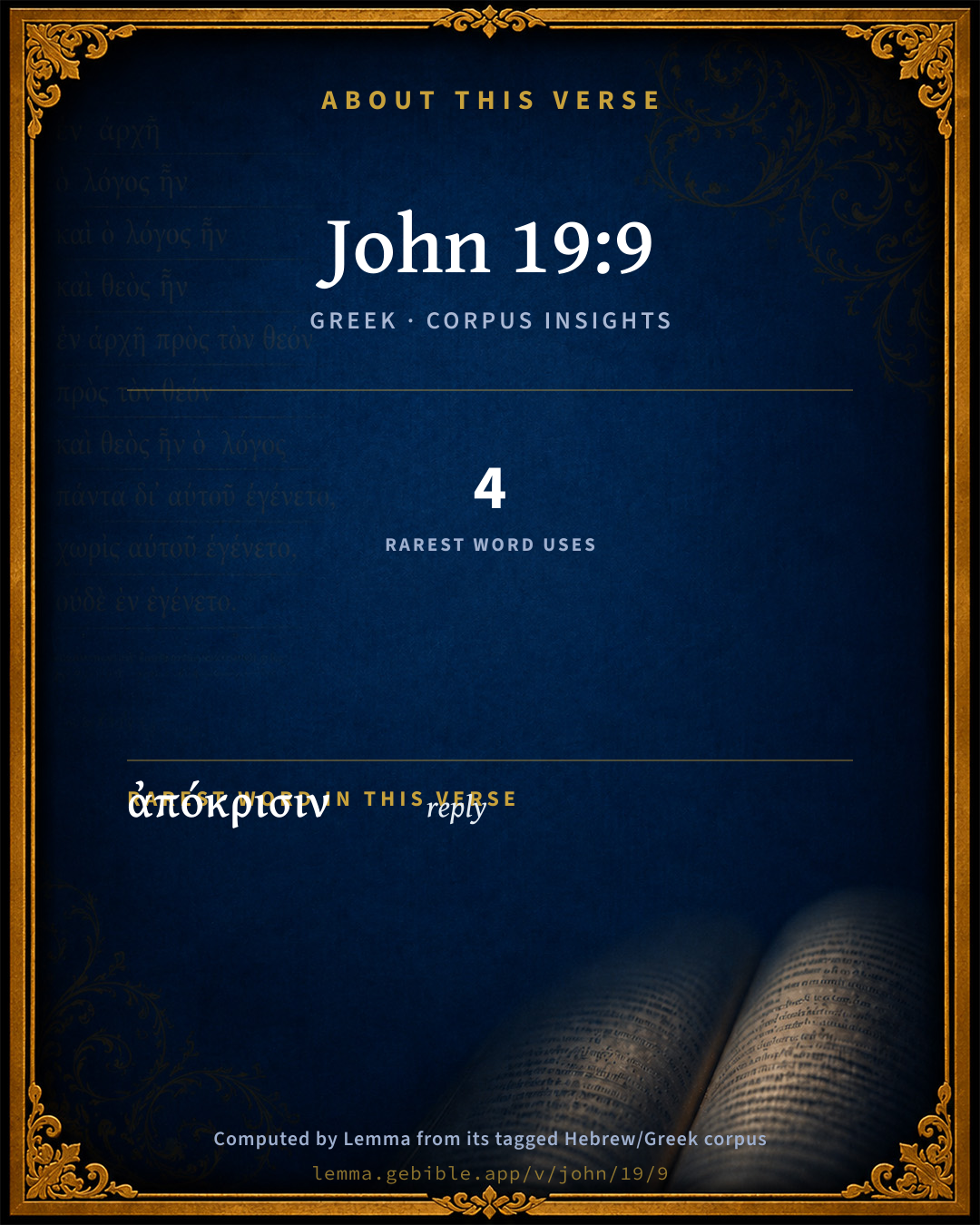
The rarest word here is ἀπόκρισιν reply G612 — appearing just 4 times in the whole Greek New Testament.

Shared distinctive vocabulary

ἀπόκρισιν reply G612 occurs in 4 verses of the Greek New Testament. Also found in:

Repetition

Words recur within this verse:

Cross-references

12

Topical passages linked to John 19:9 in the Treasury of Scripture Knowledge — connected by theme and wording, ordered by reader-vote popularity; previews shown in the World English Bible.

  • John 18:33 Pilate therefore entered again into the Praetorium, called Jesus, and said to him, "Are you the King of the Jews?"
  • Judges 13:6 Then the woman came and told her husband, saying, A man of God came to me, and his face was like the face of the angel of God, very awesome; and I didn't ask him whence he was, neither did he tell me his name:
  • Psalms 38:13–15 But I, as a deaf man, don't hear. I am as a mute man who doesn't open his mouth.
  • Isaiah 53:7 He was oppressed, yet when he was afflicted he didn't open his mouth; as a lamb that is led to the slaughter, and as a sheep that before its shearers is mute, so he didn't open his mouth.
  • Matthew 26:63 But Jesus held his peace. The high priest answered him, "I adjure you by the living God, that you tell us whether you are the Christ, the Son of God."
  • Matthew 27:12–14 When he was accused by the chief priests and elders, he answered nothing.
  • Mark 15:3–5 The chief priests accused him of many things.
  • John 8:14 Jesus answered them, "Even if I testify about myself, my testimony is true, for I know where I came from, and where I am going; but you don't know where I came from, or where I am going.
  • John 9:29–30 We know that God has spoken to Moses. But as for this man, we don't know where he comes from."
  • Acts 8:32–33 Now the passage of the Scripture which he was reading was this, "He was led as a sheep to the slaughter. As a lamb before his shearer is silent, So he doesn't open his mouth.
  • Philippians 1:28 and in nothing frightened by the adversaries, which is for them a proof of destruction, but to you of salvation, and that from God.
  • John 18:37 Pilate therefore said to him, "Are you a king then?" Jesus answered, "You say that I am a king. For this reason I have been born, and for this reason I have come into the world, that I should testify to the truth. Everyone who is of the truth listens to my voice."

Cross-references courtesy of OpenBible.info (CC BY 4.0).

Commentary

Notes on John 19:9 from classic Christian and Jewish commentators (each source and its license shown beneath its notes). The classic Christian expositions comment on the surrounding passage and are grouped to its opening verse, so a note may address several verses; the Jewish commentaries on the Tanakh (Rashi and others) are per-verse, so they appear only where the commentator wrote on this verse.

Lemma curates 59 commentaries, every one of them public domain or Creative Commons licensed, each selected and text-cleaned for this edition rather than reprinted as found. About our sources →

The Biblical Illustrator

Joseph S. Exell

Joh_19:9

Whence art Thou?

But Jesus gave him no answer

The silences of Christ

I. CHRIST PRESERVES SILENCE IS THE PRESENCE OF FALSE AND MALIGNANT ACCUSATIONS (Mat_27:12-14). But why? Not simply because He was sublimely conscious of innocence, for there may come times when it is the duty of the innocent to defend their reputation by every lawful means. But there was no necessity for answer. Neither the men who made the statements nor the people who heard them put any faith in them--nay, they knew them to be manufactured lies. The echo of their own voices, not His voice, should condemn them--the most powerful condemnation of all. The memory of that Prisoners calmness and quiet dignity would haunt the false accusers night and day like a perpetual shadow until death stilled the throbbing of their tortured brains and hearts. Does not something of the same kind mark the history of the past and Christs dealings with men? Since the days of His earthly life false charges have been made against Him and His gospel without number. His character has been maligned, His words perverted, His claims despised. Men who hate the grandeur and purity of His teachings, who fear lest their own pretensions should be despised, have sought, by every false and selfish means, to slander Christ and Christianity. Eager, impatient Christians have even prayed for some mighty display of power to put an end to the wicked accusations, though it might involve swift judgment on the enemies of the faith. But the heavens have been dumb, Christ has been silent, and His disciples have wondered why it should be so. But such silence has been best for the Church and for the foes of the faith, while it is most in harmony with the dignity and majesty of the Divine nature. Christ cannot answer every false accuser. There is the truth; let that be His vindication. And this silence has justified itself; for where to-day are the many charges that have been urged against our Lord? Have they not disappeared, or confuted one another? We have only to set one class of opponents of Christianity over against another, and their statements become mutually destructive.

II. CHRIST PRESERVES SILENCE IN THE PRESENCE OF UNWORTHY CURIOSITY. The scene which illustrates this point is recorded for us by Luke alone (Luk_23:9). Let any man treat religion as a thing to be speculated about, as a matter for purely intellectual pleasure, as a question for exciting controversy, as only one of many strange phenomena abounding in the world, and therefore to be accounted for, and there will be no response from the heavens. Christ will be silent to that man; he will never discover the truth. Religion belongs to our moral and spiritual nature; it has to do with our hearts sad their profoundest needs. Cur desire to ascertain its truth and its meaning must be accompanied by a resolve that if we discover it to be true we will apply it to our individual necessities, a resolve to reverence it with our whole natures, to obey its every command, to cling to it with an enthusiasm and love strong as life itself. Then Christ will speak, and testify to mind and heart concerning Himself. To other motives Christ will not deign a reply. His deathlike silence will be our greatest reproach.

III. CHRIST PRESERVES SILENCE IN THE PRESENCE OF RESISTED CONVICTION. Perhaps history does not present a more saddening picture than that of Pilate, the governor, in his judicial dealings with Jesus Christ. Whence art Thou? But Jesus gave him no answer. The mans nature evidently quivers with anxiety--yet his question is met with absolute silence. Why is this? Here is a truly anxious inquirer. At first sight the conduct of Christ seems strange. But we must remember two things.

1. The mans previous conduct. He had been convinced of Christs innocence, and yet had given way to the clamours of a mob. When men have despised the voices that have appealed to them, what right have they to expect further revelations?

2. Jesus Christ knew the man, knew his weakness, knew he would ask but with no desire to do, and the King of Truth was not to be trifled with. There are men who have trifled with truth and conscience, with all the interests of their souls, with every influence given to draw them heavenward, and yet they wonder they are not saved, that Christ does not answer their first prayer. Why, so far as right is concerned, they have forfeited it all by their contemptuous treatment of Divine influences. More than that, they have thus rendered themselves, in a measure, incapable of receiving further revelations from heaven. (W. Braden.)

The silences of Jesus

I. BEFORE CAIAPHAS AND FALSE WITNESSES (Mat_26:63; Mar_14:61). The Faithful and True Witness before liars and hypocrites.

II. BEFORE HEROD (Luk_23:9). The Holy One of God before the idle curiosity of a flagitious prince.

III. BEFORE THE ACCUSATIONS OF THE CHIEF PRIESTS AT PILATES BAR Mat_27:14). The Sinless One before charges the speakers knew were lies.

IV. BEFORE PILATE (Joh_19:9). The King of Truth before an insincereinquirer.

V. BEFORE THE SYRO-PHOENICIAN WOMAN (Mat_15:23). Incarnate love before a humble and earnest petitioner. (T. Whitelaw, D. D.)

Christs silence

He was acting according to His own precept Mat_7:6).

Christs silence

This is very strange. Hitherto He had spoken freely and replied to questions; now He refused to speak any more.

I. THE REASON MUST BE SOUGHT IN THE STATE OF PILATES SOUL. He deserved no answer, and therefore got none. He had forfeited his title to any further revelation about his prisoner. He had been told plainly the nature of our Lords kingdom, and the purpose of His coming, and been obliged to confess publicly His innocence. And yet he had treated Him with flagrant injustice. He had, in short, sinned away his opportunities, forsaken his own mercies, and turned a deaf ear to the cries of his own conscience. Hence our Lord would have nothing more to do with him.

II. Here, as in many other cases, WE LEARN THAT GOD WILL NOT FORCE CONVICTION ON MEN, and will not compel obstinate unbelievers to believe, and will not always strive with mens consciences. Most men, like Pilate, have a day of grace, and an open door put before them. If they refuse to enter in, and choose their own sinful way, the door is often shut, and never opened again. There is such a thing as a day of visitation, when Christ speaks to men. If they will not hear His voice they are often left to reap the fruit of their own sins. It was so with Pharaoh, Saul, and Ahab, and Pilates case was like theirs.

III. We must not forget that PILATES WICKED REFUSAL TO LISTEN to his own conscience, AND OUR LORDS consequent REFUSAL TO SPEAK TO HIM ANY MORE, WERE ALL OVERRULED BY THE ETERNAL COUNSELS OF GOD to the carrying out of His purpose of redemption. If our Lord had revealed who He was, and forced Pilate to see it, the crucifixion might perhaps never have taken place, and the great sacrifice for a worlds sins might never have been offered. Our Lords silence was just and well merited. But it was also part of Gods counsels about mans salvation.

IV. Note that THERE IS A TIME TO BE SILENT, as well as a time to speak. This is a matter in the social intercourse of daily life, about which we all need to pray for wisdom. To be always saying to everybody everything we know, is not the line of a wise follower of Christ.

V. Note that IF WE DO NOT MAKE A GOOD USE OF LIGHT AND OPPORTUNITIES,--and if we resist Christ speaking to our conscience,--A TIME MAY COME WHEN, LIKE PILATE, WE MAY SPEAK TO CHRIST, and ask things of Him, AND HE MAY GIVE US NO ANSWER (Pro_1:24-32). (Bp. Ryle.)

The tribute of Christs silence to His Deity

This silence was the most emphatic answer to all who had ears to hear it, was a reference to what He had said before (chap. 18:37), and so a witness to His Divine origin. Would any mere man, of true and upright character, have refused an answer to a question so put? Let the modern rationalist consider this. (Dean Alford.)

The situation

I. SILENT DIGNITY.

II. UNCOMPLAINING SUBMISSION.

III. HELPLESS TYRANNY. (S. S. Times.)

The Biblical Illustrator, edited by Joseph S. Exell (c. 1880s–1900s) — public domain. Text from a community e-Sword module.

Bengel's Gnomon

Johann Albrecht Bengel

Joh 19:9. Πόθεν whence) Dost thou ask, Pilate? He was of God and from above, as He Himself implies in Joh 19:11, whilst seeming to give no answer to this question. Comp. ch. Joh 18:36-37, [where He states only from whence His kingdom is not, viz. “not of this world;” but not from whence it is, viz. from heaven; but He implies this in saying, “I came into the world.”]

Bengel's Gnomon of the New Testament — English translation (T&T Clark, Edinburgh, 1860) — public domain. Text from a community e-Sword module.

Meyer's Critical & Exegetical Commentary

Heinrich August Wilhelm Meyer

Joh_19:9-10. He therefore took Jesus again away with him into the praetorium for a private audience.

πόθεν] asks after His origin, but not in the sense of the place of birth (Paulus), but in the sense occasioned by υἱὸν θεοῦ, Joh_19:7, in order to obtain a declaration from Jesus on this point, whether He were of human or divine origin. Comp. on Joh_8:14; Mat_21:25.

ἀπόκρ. οὐκ ἔδωκ. αὐτῷ] Both this observation, as well as the peculiarity of Pilates question, betraying a certain timidity, πόθεν εἶ σύ (how entirely different is his question, Joh_18:33; while here he shrinks from asking directly), has the stamp of originality. Jesus is silent; for what He would have had to say would only have been misunderstood by Pilate, or not understood at all (Joh_17:25; Mat_7:6). Moreover, He had already in truth sufficiently indicated His heavenly origin, Joh_18:36-37, had Pilate only possessed susceptibility for the truth. But as it was, he was unworthy of further discussion, and in the silence of Jesus it is precisely the self-assurance and greatness of the Son of God which are implied. Luthardt explains it from the assumption that Jesus will not give Pilate occasion to release Him from motives of fear, and thereby to interfere with the will of God. But on that supposition He must also have withheld the great and bold words, Joh_19:11. A resolute opposition on the part of the sceptical man of the world to the desire of the Jews, Jesus assuredly neither hoped nor feared.

Joh_19:10. Καὶ φοβεῖται καὶ φοβεῖ, Euth. Zigabenus.

ἐμοὶ οὐ λαλεῖς;] ἐμοί bears the emphasis of mortified power, which then also attempts alike to terrify and to entice. To mention at first the σταυρῶσαί σε, and then, not before, the ἀπολῦσαί σε, corresponded to the state of the procedure. But A. B. E. א. Lachm. Tisch. have the converse order, which would, however, more readily suggest itself to the mechanical copyist. The repetition of ἐξουσ. ἔχω is solemn.

Meyer — Critical and Exegetical Commentary on the New Testament — English translation by Peter Christie, edited by Frederick Crombie (T&T Clark, 1880) — public domain. Text from a community e-Sword module.

Jamieson, Fausset & Brown

Robert Jamieson, A. R. Fausset & David Brown

and went again into the judgment hall, and saith to Jesus, Whence art thou?--beyond all doubt a question relating not to His mission but to His personal origin.

Jesus gave him no answer--He had said enough; the time for answering such a question was past; the weak and wavering governor is already on the point of giving way.

Jamieson, Fausset & Brown — Commentary Critical and Explanatory on the Whole Bible (1871) — public domain (CC PDM 1.0). Text via the HelloAO Bible API.

Adam Clarke's Commentary

Verse 9. Whence art thou?] This certainly does not mean, From what country art thou? for Pilate knew this well enough; but it appears he made this inquiry to know who were the parents of Christ; what were his pretensions, and whether he really were a demigod, such as the heathens believed in. To this question ve find our Lord gave no answer. He had already told him that his kingdom was not of this world; and that he came to erect a spiritual kingdom, not a temporal one: Joh 18:36-37. This answer he deemed sufficient; and he did not choose to satisfy a criminal curiosity, nor to enter then into any debate concerning the absurdity of the heathen worship.

Adam Clarke's Commentary on the Bible (1810–1826) — public domain. Text from a community e-Sword/MySword module.

John Calvin's Commentaries

9. And he entered again into the hall, and said to Jesus; Whence Art Thou? It is evident from this that he was in a state of perplexity and anguish, because he was afraid that he would be punished for sacrilege, if he laid his hand on the Son of God It ought to be observed that, when he asks whence Christ is, he does not inquire about his country, but the meaning is, as if he had said, “Art thou a man born on the earth, or art thou some god?” The interpretation which I give to this passage, therefore, is, that Pilate, struck with the fear of God, was in perplexity and doubt as to what he ought to do; for he saw, on the one hand, the excitement of a mutiny, and, on the other hand, conscience held him bound not to offend God for the sake of avoiding danger.

This example is highly worthy of observation. Though the countenance of Christ was so disfigured, yet, as soon as Pilate hears the name of God, he is seized with the fear of violating the majesty of God in a man who was utterly mean and despicable. If reverence for God had so much influence on an irreligious man, must not they be worse than reprobate, who now judge of divine things in sport and jest, carelessly, and without any fear? for, indeed, Pilate is a proof that men have naturally a sentiment of religion, which does not suffer them to rush fearlessly in any direction they choose, when the question relates to divine things. This is the reason why I said that those who, in handling the doctrine of Scripture, are not more impressed with the majesty of God, than if they had been disputing about the shadow of an ass, are given up to a reprobate mind, (Romans 1:28.) Yet they will one day feel to their destruction, what veneration is due to the name of God, which they now treat with such disdainful and outrageous mockery. It is shocking to relate how haughtily the Papists condemn the plain and ascertained truth of God, and with what cruelty they shed innocent blood. Whence, I beseech you, comes that drunken stupidity, but because they do not recollect that they have anything to do with God?

And Jesus gave him no answer. We ought not to think it strange that Jesus makes no reply; at least, if we keep in mind what I have formerly mentioned, that he did not stand before Pilate to plead his own cause, — as is customary with persons accused who are desirous to be acquitted, — but rather to suffer condemnation; for it was proper that he should be condemned, when he appeared in our room. This is the reason why he makes no defense; and yet Christ’s silence is not inconsistent with what Paul says,

Remember that Christ, before Pilate, made a good confession, (1 Timothy 6:13;)

for there he maintained the faith of the Gospel, as far as was necessary, and his death was nothing else than the sealing of the doctrine delivered by him. Christ left nothing undone of what was necessary to make a lawful confession, but he kept silence as to asking an acquittal. Besides, there was some danger that Pilate would acquit Christ as one of the pretended gods, as Tiberius wished to rank him among the gods of the Romans. Justly, therefore, does Christ, by his silence, frown on this foolish superstition.

John Calvin's Commentaries (1540-1563) — public domain. Text from the Calvin Translation Society English edition (1840s-50s) via the Christian Classics Ethereal Library (ccel.org). Calvin's coverage is partial (roughly two-thirds of the Bible); uncommented books and verses are honest gaps, never fabricated. The 19th-century editor's footnotes and remarks are omitted so the notes are faithfully Calvin's own voice.

Ellicott's Commentary for English Readers

(9) And went again into the judgment hall, and saith unto Jesus.—He had brought Jesus out to the people. He now led Him back to the palace in order to inquire further of Him in private.

Whence art thou?—The question is based upon the claim to be Son of God, of which he had heard. He knew that Jesus was a Galilean before sending Him to Herod (Luk_23:6). It is not of His earthly habitation, therefore, that he inquires, but of His origin and nature. (Comp. the same word, and in the same sense, in Joh_8:14, and Mat_21:25.)

But Jesus gave him no answer.—This silence of our Lord has seemed hard to understand, and very many and very different have been the explanations suggested. An explanation can only be suggested; it cannot be given with any degree of certainty; but that which seems most in harmony with the position is that Pilate’s question was one which to him could not be answered in reality, and therefore was not answered in appearance. The answer had, indeed, already been given (Joh_18:37), but he had treated it with the impatience which showed he could not receive it now. Not of the truth, he could not hear the voice of the Son of God, and therefore that voice did not speak.

A Bible Commentary for English Readers, edited by Charles John Ellicott (1878–1897) — public domain. Text from a community e-Sword module.

The Cambridge Bible for Schools and Colleges

gen. ed. J. J. S. Perowne

9. judgment-hall] See on Joh_18:28.

Whence art thou?] Pilate tries a vague question which might apply to Christ’s dwelling-place, which he already knew (Luk_23:6), hoping for an answer as to His origin. Would the prisoner assert his mysterious claim to him, or explain it?

no answer] Pilate could not have understood the answer; and what had it to do with the merits of the case? Comp. Mat_27:12-14 and Christ’s own precept, Mat_7:6.

The Cambridge Bible for Schools and Colleges (gen. ed. J. J. S. Perowne; Cambridge University Press, 1878–1918) — public domain. Text from a community e-Sword module.

John Gill's Exposition

And went again into the judgment hall,.... From whence he came out, taking Jesus along with him, in order to interrogate him alone upon this head:

and saith unto Jesus, whence art thou? meaning not of what country he was, for he knew he was of the nation of the Jews; nor in what place he was born, whether at Bethlehem or at Nazareth, for this was no concern of his; but from whence he sprung, who were his ancestors, and whether his descent was from the gods, or from men; and if from the former, from which of them; for as Pilate was an Heathen, he must be supposed to speak as such:

but Jesus gave him no answer; for his question was frivolous, and deserved none; and besides, he was not worthy of one, who had used him so ill, when he knew, in his own conscience, that he was innocent; nor was he capable of taking in an answer, or able to judge whether it was right or wrong; and since Christ was come to die for the salvation of his people, it was not proper he should say anything that might be a means of hindering it.

John Gill's Exposition of the Whole Bible (1746–1763) — public domain (CC PDM 1.0). Text via the HelloAO Bible API.

Trapp's Complete Commentary

John Trapp

9 And went again into the judgment hall, and saith unto Jesus, Whence art thou? But Jesus gave him no answer.

Ver. 9. Whence art thou?] He questioneth not Christ of his country, but of his condition, q.d. Art thou a man or a God? Such a dunghill deity, he meant, as the heathens worshipped. And therefore our Saviour would not once answer him. Especially since if he should have asserted his Deity, Pilate likely would have acquitted and dismissed him; whereas Christ knew that he was now and here to be condemned. There are those who think that Pilate’s wife’s dream was from the devil, who sought thereby to have hindered the work of our redemption, which could not be wrought but by the death of Christ.

John Trapp, A Commentary or Exposition upon All the Books of the Old and New Testament (1647–1656) — public domain. Text from a community e-Sword module.

Albert Barnes' Notes on the Bible

Whence art thou? - See the notes at Joh 7:27. Pilate knew that he was a Galilean, but this question was asked to ascertain whether he claimed to be the Son of God - whether a mere man, or whether divine.

Jesus gave him no answer - Probably for the following reasons:

Jesus had already told Pilate Jesus’ design, and the nature of his kingdom, Joh 18:36-37. Jesus had said enough to satisfy Pilate of Jesus’ innocence. Of that Pilate was convinced. Pilate’s duty was clear, and if he had had firmness to do it, he would not have asked this. Jesus, by his silence, therefore rebuked Pilate for his lack of firmness, and his unwillingness to do what his conscience told him was right. It is not probable that Pilate would have understood Jesus if Jesus had declared to Pilate the truth about Jesus’ origin, and about his being the Son of God. After what had been done - after he had satisfied Pilate of his innocence, and then had been beaten and mocked by his permission he had no reason to expect justice at his hands, and therefore properly declined to make any further defense. By this the prophecy Isa 53:7 was remarkably fulfilled.

Albert Barnes' Notes on the Bible (1834–1885) — public domain. Text from a community e-Sword/MySword module.

Matthew Poole's English Annotations

Our Lord, who knew the secrets of all men’s hearts, very well knew, that though Pilate had for some time withstood his temptations, yet he would at last yield: he also was ready to lay down his life, as he knew was determined for him; having therefore made a reasonable defence, he thinks fit to add no more of that nature.

Matthew Poole's English Annotations on the Holy Bible (1683–1685) — public domain. Text from a community e-Sword/MySword module.

Whedon's Commentary on the Bible

Daniel D. Whedon

9. Whence art thou?—A most significant question. The sceptical and inquiring world has been asking it ever since. O most supernatural man, reveal thy origin! “Who shall declare his generation?” Isa_53:8.

No answer—Alas! to none but the true inquirer comes there any response but absolute silence. No explanation proper for Jesus to give could the mind of Pilate have properly received. Wounded pride now mingles with his fear. He will test this superhuman personage with a threat.

Daniel D. Whedon (gen. ed.), Commentary on the Old and New Testaments (1874–1909) — public domain. Text from a community e-Sword module.

The Pulpit Commentary

And he entered the Praetorium again (Jesus following him), and he saith to Jesus, Whence art thou? but Jesus gave him no answer. Almost all commentators reject the old explanation of the question of Pilate given by Paulus, that he simply asked Jesus of his birthplace or his home. The governor was disturbed, and ready to suspect that he had on his hands some supernatural Being whom no cross could destroy some mysterious half-human, half-Divine creature, such as filled the popular literature; and, without any spiritual insight on his own side, he enticed Jesus to give him his confidence, and entrust to his keeping some of the secret of his origin, and the source of the bitter antagonism to his claims. There was fear, curiosity, and great desire for his own sake to save the suffering Man from the clutches of his enemies. "Whence art thou? Hast thou indeed made this claim? Best thou call thyself Son of God? that God is thy proper Father; that thou art coming in the glory of heaven; that thou, in thy purple robe and bleeding form, art already seated on thy throne of judgment?" Surely all this was really conveyed by the question, for we cannot suppose that "the Jews" confined themselves to the laconic recital of the charge as here recorded. The silence of Jesus is very impressive, and we, in our ignorance, can only vaguely say what it meant. Very numerous explanations are offered. Luthardt"s idea, that Christ would not give an answer which would have the effect of preventing Pilate, in his agitated state, from giving the order for his crucifixion, is stagey and unreal. Moreover, it is bound up with very questionable ethic, and suggests that Jesus is answerable for the awful sin of Pilate, from which, by a word, he might have saved him. We admit that at any moment the Lord could, if he had chosen, have smitten his foes with blindness, or delivered himself from their malice by passing through them. (cf. Joh_12:5-9) They would all have fallen to the earth if he had glanced at them as he had done upon the Roman guard in Gethsemane upon that very band of men who were now so busy in wiping out the stain of their momentary panic. On other occasions, when his hour of self-deliverance and self-devotion to the Father"s will had not arrived, he discomfited his enemies; but now his hour had come, and he did not shrink. All this is true, but it does not account for the refusal to answer a question like this. Doubtless the silence was as expressive as speech, and even less likely to be misunderstood. He could not have denied that he was "Son of God." He could not have affirmed it without leading Pilate to put human and heathen notions into it. But could not he, who is infinite wisdom incarnate, have given an answer which would have avoided both dangers? That, however, is practically what he did effect. The prophetic picture had foretold of him, that "like a sheep before its shearers is dumb, so he opened not his mouth;" and the previous silences of Jesus before Annas, and before the false witnesses, before Caiaphas, and Pilate himself, and before Herod, are all governed by the same rule a refusal to save himself from malignant falsity, or tricky design, or conspicuously lying charges; but when challenged to say whether he was the Christ, whether he was the Son of God, whether he was a King, he gave the answers needed. There was some likeness between the spirit of Herod, Caiaphas, and the false witnesses, and of Pilate"s "Whence art thou?" which did not deserve an affirmative answer. The governor, who had scourged and insulted an apparently defenseless man, at the very moment when he was proclaimed innocent, and now was afraid of what he had done, came into the category of the slayers of the silent Lamb. But to the next inquiry, which went down to the depths of his heart, and revealed the utter unspirituality and self-ignorance which needed response, a wondrous reply was given.

"Whence art thou?

This question, put by Pilate to the Lord Jesus, was not so much intended to guide the questioner in his judicial capacity, as to satisfy his own curiosity. It is clear that Pilate was satisfied of the Accused"s innocence of any political offense. But it is also clear that he was perplexed in mind, and unable to satisfy himself as to the real character and origin of the mysterious Being who stood before him. There is no reason to suppose that the Roman procurator felt any very deep or lasting interest in the Prophet of Nazareth. Still he had his misgivings as to whether Jesus was not possessed of some superhuman claims. Hence the question, "Whence art thou?

I THE INQUIRY.

1. There is much in Christ himself which prompts the question. His character, his wonderful works, his still more wonderful language, the whole ministry which he fulfilled upon earth, and especially the sacrifice and the victory in which that ministry culminated, all are fitted to suggest and urge inquiry into his origin and nature.

2. There is much in man which induces him to seek the truth upon this most interesting question. It concerns every one to whom the gospel comes to know with what authority Jesus spoke, and what value attaches to his redemption. And in order to this it is necessary to know whence he is, from whom he comes, and in whose name he makes his claim upon men.

II THE REPLY. Why Jesus did not answer Pilate is not hard to understand. He had already, both by his language and by his demeanor, given abundant evidence for the formation of a judgment. And Jesus intended Pilate to understand what were their relative positions. The governor deemed himself in this case omnipotent; Jesus gave him to understand that in reality his power was very limited, whilst the power of the accused and apparently helpless One was in reality that of God himself. But we should make a mistake if we supposed that the Lord Jesus was or is unwilling to give reason for men to acknowledge his claims and to render honor to the Son.

1. Christ"s origin is Divine: he came forth from God, and was one with the Father.

2. Christ"s authority is Divine: he spake, wrought, and suffered in the name of God.

3. Christ"s Divine origin and authority render him in all his offices fit to fulfill his gracious purposes towards mankind. Is he our Prophet, Priest, and King? It makes all the difference to his sufficiency whether or not he fulfils these offices with Divine authority. Men are right in asking of Jesus, "Whence art thou?" But they are wrong if, receiving his own answer, they refuse him the faith of their heart, the allegiance of their life. T.

The Pulpit Commentary (1880–1919), ed. H.D.M. Spence-Jones & Joseph S. Exell — public domain. Text from a community e-Sword module.

John Wesley's Explanatory Notes

Whence art thou? - That is, whose son art thou?

John Wesley, Explanatory Notes Upon the Whole Bible (1754–1765) — public domain. Text via the GEBible commentary corpus.

Cambridge Greek Testament for Schools and Colleges

9. πραιτώριον. See on Joh 18:28. Πόθεν εἶ σύ. is a vague question which might apply to Christ’s dwelling-place, already known to Pilate (Luk 23:6); he hoped for an answer as to His origin. Would the Prisoner repeat this mysterious claim, or explain it? But Pilate could not have understood the answer; and what had it to do with the merits of the case? No answer is given. Comp. Mat 27:12-14 and Christ’s own precept, Mat 7:6.

Cambridge Greek Testament for Schools and Colleges (Cambridge University Press, 1896; 21 vols, various authors incl. Carr, Maclear, Plummer, Farrar, Lumby, Moule, M. R. James, Simcox) — public domain. Text from a community e-Sword module.

Alford’s Greek Testament

Henry Alford

9.] He entered, taking Jesus with him.

πόθεν—i.e. not ‘from what province?’—for he knew this, Luk 23:6, Luk 23:7: nor, ‘of what parents?’—but whence? in reference to υἱὸς θεοῦ: cf. πόθεν γένος εὔχεται εἶναι, Hom. Od. ρ. 373. Observe that the fear of Pilate is not mere superstition, nor does it enter into the Jewish meaning of υἱὸς θ.: but arises from an indefinite impression made on him by the Person and bearing of our Lord. We must not therefore imagine any fear of Him as being a ‘son of the gods,’ in Pilate’s mind (so even Luthardt): this gives a wrong direction to his conduct, and misses the fine psychological truth of the narrative.

Our Lord, in His silence, was acting according to His own precept, Mat 7:6. Notwithstanding Pilate’s fear of Him, he was not in earnest;—not determined to be led by his conscience, but had already given way to the unjust demands of the people; and He who saw his heart, knew how unworthy he was of an answer to so momentous a question. Besides, this silence was the most emphatic answer to all who had ears to hear it;—was a reference to what He had said before, ch. 18:37, and so a witness to His divine origin. Would any mere man, of true and upright character, have refused an answer to such a question, so put? Let the modern rationalist consider this.

Henry Alford, The Greek Testament (1849–1861) — public domain. Text from a community e-Sword module.

International Critical Commentary

9. The first questioning of Jesus by Pilate has been described, 18:33-38.

καὶ εἰσῆλθεν εἰς τὸ πραιτώριον πάλιν: cf. 18:33.

Pilate’s question, Πόθεν εἶ σύ; is no formal interrogatory as to the birthplace or domicile of Jesus. He had learnt already that He was of Galilee (Luk 23:6, Luk 23:7). But Pilate has been moved by the dignified bearing of the prisoner, and is uneasy because of the strange claim which He was said to have made for Himself, that He was υἱὸς θεοῦ (v. 7). The question recalls the similar question Σὺ τίς εἶ; which was put by the Jews who were impressed, despite their incredulity, by His words (8:25).

ὁ δὲ Ἰη. ἀπόκρισιν (cf. 1:22, Luk 2:47, Luk 20:26) οὐκ ἔδωκεν αὐτῷ. The silence of Jesus under cross-examination is mentioned in all the Gospels. Mar 14:61, Mat 26:63 note His silence before the high priest; Luk 23:9 says that He did not answer Herod at all; Mar 15:5, Mat 27:14 state that He would not reply to the accusations which the Sanhedrim put before Pilate; and in the present passage His silence is irritating to the dignity of Pilate, who in this repeated inquiry was trying to elicit something that would save Him. Salmon suggested1 that the silence of Jesus is sufficiently explained by bodily fatigue and exhaustion; and so far as this last examination by Pilate is concerned, it may well be that His exhaustion after being scourged was such that speech was difficult for Him. After the scourging Jn. ascribes only one sentence to Jesus (v. 11) before He was crucified. But bodily fatigue would not, by itself, explain His silence when cross-examined by the high priest (Mar 14:61) or before Herod (Luk 23:9); and His refusal to answer questions which were not asked in sincerity, but out of mere curiosity or with intent to betray Him into some dangerous admission, is explicable on moral grounds. Indeed, the dignity of His silence before His accusers does not need exposition. He was moving to a predestined end, and He knew it.

Many commentators, following Chrysostom and Augustine, find in the silence of Jesus before His judges a fulfilment of Isa 53:7.

International Critical Commentary — older volumes (1896–1929), various authors — public domain. Text from a community e-Sword module.

Lesson kit

Teaching starters — assembled from the data on this page, not authored interpretation. Every prompt links to the verse data it draws on. Edit before teaching.

John, in the Gospels, opens this verse with 20 words (16 distinct Greek lemmas). Its most distinctive word is apókrisis (“reply”). A historical commentator’s framing appears above. Read the whole chapter for the surrounding context.

Discussion questions

  1. What does “reply” (apókrisis) contribute to the verse as a whole?
  2. Luke 2:47 shares the word «reply» with this verse. How do the two illuminate each other?
  3. “Jesus” occurs 2× in this one verse. What is the effect of the repetition?
  4. The translations on this page render this verse differently — a whole-verse word diff, not a word-by-word alignment. What might account for the different wordings?
  5. Reading how The Biblical Illustrator and Bengel's Gnomon read this verse, where do the two commentators agree and where do they part?

Things to notice

Reading settings

Reading text

Shown beneath each verse's original-language words.

Old Testament
Old Testament edition

Read the OT as the Masoretic Hebrew (MT) or the Greek Septuagint (LXX).

English shown for the Greek Septuagint (in the Hebrew ↔ Greek comparison).

Comparing translations? Open the Compare panel on any verse page to stack up to four side by side.