John 19:14

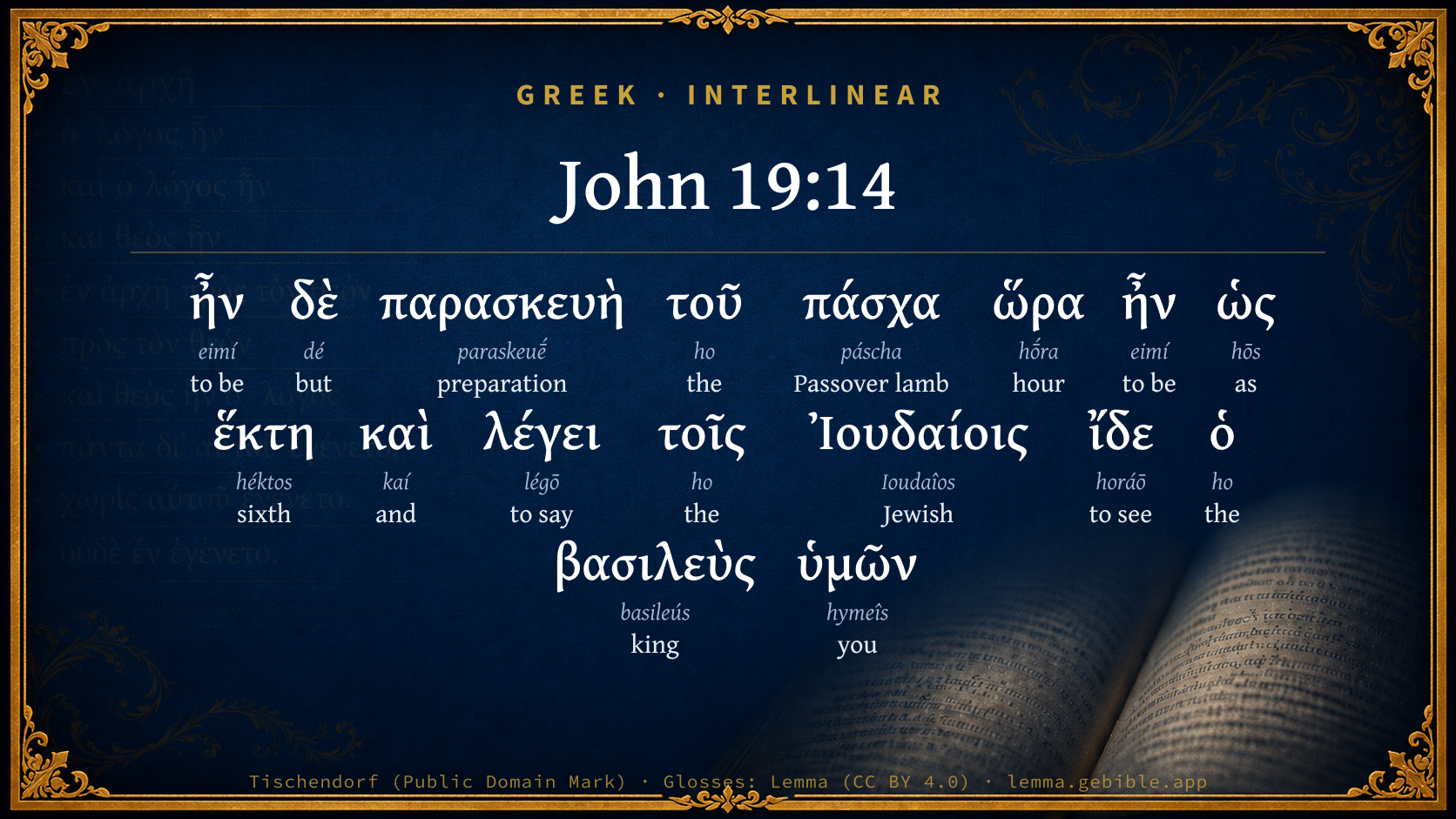
Greek (Tischendorf 8th ed.) John 19:14 appears in the Greek New Testament. The text above is from the Tischendorf 8th edition. Each word links to its Strong’s number and a concise gloss. Click any word for its full Thayer’s Greek Lexicon entry.
Download image
Cite this verse

John 19:14 (World English Bible). Public Domain. Lemma interlinear Bible study tool, https://lemma.gebible.app/v/john/19/14.

Show BibTeX & RIS
BibTeX
RIS
English Translation
Now it was the Preparation Day of the Passover, at about the sixth hour. He said to the Jews, "Behold, your King!"
World English Bible · Public Domain
Download a study sheet

One document with this verse’s original text, its word-by-word gloss line, the meaning frame, cross-references with their text, attributed commentary, and full source and license credits — printable, and it pastes into notes with its structure intact.

This verse Autodidact and up

Study sheet (.html) Plain text (.txt)

A passage Seminary Student

Up to 50 verses in one chapter. A passage sheet keeps up to 6 commentary sources and 12 cross-references per verse, in the order this page ranks them, and says so on the sheet whenever that leaves anything out. Ask for a single verse and you get the Autodidact verse sheet above.

Everything on this page stays free to read, with no account — the sheet is a download of what is already on screen, not access to it.

Want to remove ads? Support Godless Engineer
Compare translations 3

The same verse in 3 English versions, stacked beneath the original-language interlinear above. Click any original word for its lexicon entry.

Each is an independent rendering of the whole verse — the interlinear is not word-aligned to these translations.

Highlighted words mark where these versions differ — a whole-verse word diff, not a word-by-word alignment.

  • World English Bible Public Domain
    Now it was the Preparation Day of the Passover, at about the sixth hour. He said to the Jews, "Behold, your King!"
  • King James Version Public Domain
    And it was the preparation of the passover, and about the sixth hour: and he saith unto the Jews, Behold your King!
  • unfoldingWord Literal Text CC BY-SA 4.0
    (Now it was a day of preparation of the Passover. It was about the sixth hour.) And he says to the Jews, “Behold your king!”

unfoldingWord Literal Text — © unfoldingWord, licensed CC BY-SA 4.0. Word-aligned USFM3 via Door43 (git.door43.org/unfoldingWord/en_ult).

Versions to compare (up to 4)

3 of 4 selected

Show all 19 translations

Every available English version of this verse, each an independent rendering of the whole verse.

  • World English Bible Public Domain
    Now it was the Preparation Day of the Passover, at about the sixth hour. He said to the Jews, "Behold, your King!"
  • Berean Standard Bible Public Domain
    It was the day of Preparation for the Passover, about the sixth hour. And Pilate said to the Jews, “Here is your King!”
  • Majority Standard Bible Public Domain
    It was the day of Preparation for the Passover, about the sixth hour. And Pilate said to the Jews, “Here is your King!”
  • King James Version Public Domain
    And it was the preparation of the passover, and about the sixth hour: and he saith unto the Jews, Behold your King!
  • American Standard Version (1901) Public Domain
    Now it was the Preparation of the passover: it was about the sixth hour. And he saith unto the Jews, Behold, your King!
  • Revised Version (1885) Public Domain
    Now it was the Preparation of the passover: it was about the sixth hour. And he saith unto the Jews, Behold, your King!
  • Geneva Bible (1599) Public Domain
    And it was the Preparation of the Passeouer, and about the sixt houre: and hee sayde vnto the Iewes, Beholde your King.
  • Douay-Rheims (1899) Public Domain
    And it was the parasceve of the pasch, about the sixth hour, and he saith to the Jews: Behold your king.
  • Young's Literal Translation Public Domain
    and it was the preparation of the passover, and as it were the sixth hour, and he saith to the Jews, `Lo, your king!'
  • Literal Standard Version CC BY-SA 4.0
    and it was the Preparation of the Passover, and as it were the sixth hour, and he says to the Jews, “Behold, your King!”
  • Unlocked Literal Bible CC BY-SA 4.0
    Now it was the day of preparation for the Passover, at about the sixth hour. Pilate said to the Jews, “See, here is your king!”
  • unfoldingWord Literal Text CC BY-SA 4.0
    (Now it was a day of preparation of the Passover. It was about the sixth hour.) And he says to the Jews, “Behold your king!”
  • Darby Bible Public Domain
    (now it was [the] preparation of the passover; it was about the sixth hour;) and he says to the Jews, Behold your king!
  • World Messianic Bible Public Domain
    Now it was the Preparation Day of the Passover, at about the sixth hour. He said to the Judeans, “Behold, your King!”
  • Webster's Bible Public Domain
    And it was the preparation of the passover, and about the sixth hour: and he saith to the Jews, Behold your King!
  • Free Bible Version CC BY-SA 4.0
    It was around noon on the preparation day before the Passover. “Look, here is your king,” he said to the Jews.
  • Bible in Basic English Public Domain
    (It was the day when they made ready for the Passover; and it was about the sixth hour.) And he said to the Jews, There is your King!
  • Text-Critical English NT CC BY 4.0
    It was about the sixth hour on the day of Preparation for the Passover, and he said to the Jews, “Behold, your king!”
  • Tyndale New Testament (1534) Public Domain
    It was the Saboth even which falleth in the ester fest and aboute the sixte houre. And he sayde vnto the Iewes: beholde youre kynge.

Literal Standard Version (2020), Covenant Press — licensed CC BY-SA 4.0. Text via the HelloAO Bible API (eBible.org). Unlocked Literal Bible (unfoldingWord) — licensed CC BY-SA 4.0. Text via the HelloAO Bible API (eBible.org). unfoldingWord Literal Text — © unfoldingWord, licensed CC BY-SA 4.0. Word-aligned USFM3 via Door43 (git.door43.org/unfoldingWord/en_ult). Free Bible Version, Dr. Jonathan Gallagher — licensed CC BY-SA 4.0. Text via the HelloAO Bible API (eBible.org).

Word by word

More ways to search: Search by grammar → Find every occurrence → Compare this word →

Practice this passage: Drill this verse → Learn its vocabulary →

παρασκευὴ
paraskeuḗ
G3904
“preparation”
Noun, Nominative, Singular, Feminine
Part of Speech
Noun
Case
Nominative
Number
Singular
Gender
Feminine
Full Thayer's Definition

Origin: as if from G3903

TDNT: 07:02,0

1. a making ready, preparation, equipping 2. that which is prepared, equipment 3. in the NT in a Jewish sense, the day of preparation a. the day on which the Jews made necessary preparation to celebrate a sabbath or a feast
  1. ἦν eimí G1510 “to be” Verb, Imperfect, Active, Indicative, 3rd person, Singular
  2. δὲ dé G1161 “but” Conjunction
  3. τοῦ ho G3588 “the” Article, Genitive, Singular, Masculine
  4. πάσχα páscha G3957 “Passover lamb” Aramaic transliteration
  5. ὥρα hṓra G5610 “hour” Noun, Nominative, Singular, Feminine
  6. ἦν eimí G1510 “to be” Verb, Imperfect, Active, Indicative, 3rd person, Singular
  7. ὡς hōs G5613 “as” Adverb
  8. ἕκτη héktos G1623 “sixth” Adjective, Nominative, Singular, Feminine
  9. καὶ kaí G2532 “and” Conjunction
  10. λέγει légō G3004 “to say” Verb, Present, Active, Indicative, 3rd person, Singular
  11. τοῖς ho G3588 “the” Article, Dative, Plural, Masculine
  12. Ἰουδαίοις Ioudaîos G2453 “Jewish” Adjective, Dative, Plural, Masculine
  13. ἴδε horáō G3708 “to see” Verb, Aorist, Active, Imperative, 2nd person, Singular
  14. ὁ ho G3588 “the” Article, Nominative, Singular, Masculine
  15. βασιλεὺς basileús G935 “king” Noun, Nominative, Singular, Masculine
  16. ὑμῶν hymeîs G5210 “you” Personal pronoun, 2nd person, Genitive, Plural

About this verse

These counts appear in no published source. They are computed here, from the morphology-tagged text and Lemma’s own curated glosses. What Lemma adds →

17
words
14
distinct lemmas
Gospels
section

Notable vocabulary

The rarest word here is παρασκευὴ preparation G3904 — appearing just 6 times in the whole Greek New Testament.

Shared distinctive vocabulary

παρασκευὴ preparation G3904 occurs in 6 verses of the Greek New Testament. Also found in:

Repetition

Words recur within this verse:

Cross-references

10

Topical passages linked to John 19:14 in the Treasury of Scripture Knowledge — connected by theme and wording, ordered by reader-vote popularity; previews shown in the World English Bible.

  • Matthew 27:62 Now on the next day, which was the day after the Preparation Day, the chief priests and the Pharisees were gathered together to Pilate,
  • John 19:5 Jesus therefore came out, wearing the crown of thorns and the purple garment. Pilate said to them, "Behold, the man!"
  • Mark 15:25 It was the third hour, and they crucified him.
  • John 19:42 Then because of the Jews' Preparation Day (for the tomb was near at hand) they laid Jesus there.
  • Mark 15:33–34 When the sixth hour had come, there was darkness over the whole land until the ninth hour.
  • Mark 15:42 When evening had now come, because it was the Preparation Day, that is, the day before the Sabbath,
  • Luke 23:54 It was the day of the Preparation, and the Sabbath was drawing near.
  • John 19:3 They kept saying, "Hail, King of the Jews!" and they kept slapping him.
  • John 19:19–22 Pilate wrote a title also, and put it on the cross. There was written, "JESUS OF NAZARETH, THE KING OF THE JEWS."
  • John 19:31–32 Therefore the Jews, because it was the Preparation Day, so that the bodies wouldn't remain on the cross on the Sabbath (for that Sabbath was a special one), asked of Pilate that their legs might be broken, and that they might be taken away.

Cross-references courtesy of OpenBible.info (CC BY 4.0).

Commentary

Notes on John 19:14 from classic Christian and Jewish commentators (each source and its license shown beneath its notes). The classic Christian expositions comment on the surrounding passage and are grouped to its opening verse, so a note may address several verses; the Jewish commentaries on the Tanakh (Rashi and others) are per-verse, so they appear only where the commentator wrote on this verse.

Lemma curates 59 commentaries, every one of them public domain or Creative Commons licensed, each selected and text-cleaned for this edition rather than reprinted as found. About our sources →

The Biblical Illustrator

Joseph S. Exell

Joh_19:14

It was the preparation of the passover.

--The name Paraskeue? was given to the day of the week, our Friday, the day before the Sabbath, and had absolutely nothing to do with any preparation for the passover. The Gospels show this beyond a doubt (Mar_15:42; Mt Luk_23:54). If any confirmation were wanted it may be found in the fact that the name is applied in a Greece-Roman decree quoted by Josephus (Ant. 16.6, sec. 2) to the week day which answers to our Friday. Even the phrase which seems most to suggest a different view, the preparation of the passover, here in John, does not mean more than Passover Friday; the Friday in Passover week, and coming, therefore, before a Sabbath more solemn than others (verse 31). It may be noted further that the term Paraskeue? was adopted by the Church, Western as well as Eastern, as a synonym for the Dies Veneris, or Friday. (Archdeacon Watkins.)

And about the sixth hour.--It is difficult to harmonize this statement with Matthews narrative, according to which, at mid-day, Jesus had been for some time on the cross, and still more with Mar_15:25, where it is said that it was the third hour, i.e., nine oclock, when Jesus was crucified. But let it be remembered

1. That the day as a whole was divided, like the night, into four parts of three hours each. This explains why mention is scarcely ever made in the New Testament of any hours except the third, sixth and ninth (cf. Mat_20:1-5)

, and why also the expressions almost or about are so frequent (Mat_27:46; Luk_23:44; Joh_4:6; Act_10:3-9). The ὡς, about, is expressly added here. It is therefore certainly allowable to take the mean here, both in Mark and John, especially if it be remembered that the apostles had not watch in hand. As Marks third hour may extend from eight to ten oclock, Johns sixth certainly includes from eleven to twelve.

2. But above all account must be taken of an important circumstance that Matthew and Mark have given to the scourging of Jesus, the meaning which it ordinarily had, and have regarded it as the beginning of the whole punishment. They have consequently identified the two judicial acts which are strictly distinguished by John, that whereby Pilate condemned Jesus to scourging, and that whereby He delivered Him over to the last penalty of death. It is easily conceivable that Mark, having lost sight of the entire interval between the two condemnations, has dated the pronouncing of the sentence of death at the time which was properly that of the sentence of scourging. (F. Godet, D. D.)

He saith unto the Jews, Behold your King

The two kingdoms

The words are words of scorn, at once angry and bitter. Pilate is exasperated by the obstinate determination of the Jews to have the blood of Jesus. He has an infidels contempt for the bigotry and fanaticism of these fierce zealots. He has the contempt of a Roman soldier for conquered provincials, writhing in vain under the heel of the conquerer. And yet, for the moment, these fierce fanatics are too strong for him. They know their own mind, and he does not know his. Thus, in this supreme moment, which (humanly speaking) sealed the fate of Jesus, there come into clear view two distinct kingdoms--two absolutely antagonistic forms of royal power: one, represented by the crown of thorns the other, by the imperial sceptre of Rome; one, impersonated, then and ever since, in Jesus the crucified--the other, for the moment, in a Tiberius. And the question--not then only, but at all times and for all men--is: To which of these two diverse and antagonistic kingdoms shall we yield the homage of our hearts--the indivisible loyalty of soul and will? There is a power which addresses itself to the eye--which dazzles, and by dazzling attracts. And, again, there is a power which addresses itself, not to the eye of sense, but to the spirit within; and which attracts, not by any external dazzling, but by an interior subjugation, to which conscience and heart yield themselves freely and joyfully. The empire of Borne was of the former kind; the empire of Jesus Christ was, and is, of the latter. Power of the former kind is essentially local and fleeting and transient; power of the latter kind may be universal and eternal. The kingdom of Christ has upon it the marks, which indicate, to say the very least, the possibility of such universal and everlasting empire. The ruins and debris of the Roman empire are all that survives to show where and what it once was. Christs kingdom grows stronger and stronger, larger and larger, with every passing century. Even now it is only in its infancy. What will it be? Now this kingdom is founded upon service and sacrifice. He stoops to conquer. He stoops to the likeness of men, in order to conquer humanity for God. The cross is His passport to the throne of our hearts. In our best moments we all acknowledge His right to reign over us. But ever and again, side by side with that kingdom of His, which is not of this world, there comes into view a kingdom which is of this world; the allurements of wealth, or pleasure, or interest, or power--the life lived to self, and not to God. This is our Caesar, brethren. It is of this, that we find ourselves, again and again, tempted to cry, We have no king but Caesar. More than this. According as we yield ourselves to the sway of the one kingdom or of the other--the kingdom which is of this world, or the kingdom which is not of this world--accordingly do we exercise, in nut own small place and day, the powersof that kingdom. They transmit themselves through us as their agents, and we become workers for the one kingdom or the other, as the case may be. Will we offer ourselves to Christ, our rightful king, in a truly loyal allegiance? Forthwith, behold, we become, as it were, a medium of communication between Him and the world around us. He works through us. He seats us, if we may say so, on the lowest step of His own throne. We share His present power, even now; as we shall share His future, final triumph, hereafter. If, on the other hand, we yield ourselves to the Caesar of this world, and allow him practically, in any one or more of his many forms, to rule over us; we do so, not for ourselves only and to the peril of our own souls, but for others also and to the peril of theirs. No man liveth to himself. No man can so isolate himself from his fellows, that no influence, either for evil or for good, shall pass through him to them. No man can either ruin or save his own soul, without doing something, it may be much, to ruin or to save the souls of others. The picture may seem to some overdrawn. True: it is an ideal picture. In actual experience, no life is wholly surrendered to the sway, either of the kingdom of Christ, or of the kingdom of this world. Motives, actions, characters--all, in real life, are, more or less, mixed. The worst have traits of goodness. The best bear at least the scars of conquered evil. Yet still, the weight of every human soul--the momentum of every human life--is flung distinctly andunmistakably, in its net result, either on Christs side or on Caesars. Brethren, which of these two alternatives do we embrace? (D. J.Vaughan, M. A.)

Ecce Rex

1. Pilate spake far more than he understood, and therefore we shall not confine ourselves to his meaning.

2. Everything concerning our Lord was more than ever full of meaning just then; the saying of Caiaphas, the fleeing of the disciples, the dividing of His garments, the soldier piercing His side, &c.

3. It was to the Jews that Jesus was brought forth, and by them He was rejected; yet was He distinctly declared to be their King.

4. The same is repeated at this day among those favoured with special privileges; but whether they accept Him or not, He is assuredly in some sense or other their King.

5. To the summons of the text the answer was mockery.

6. We would with deepest reverence draw near and behold our King. Behold Him

I. PREPARING HIS THRONE.

1. He lays the foundation of it in His suffering nature.

2. He makes it a throne of grace by His atoning griefs.

3. He prepares access to it through His ability to have compassion on those who come to Him, by partaking in all their sorrows.

4. He canopies and glorifies it by the shame to which He willingly and unreservedly yields Himself. Believe in the perpetuity of a throne thus founded.

II. CLAIMING OUR HOMAGE. By the right of

1. Supreme love.

2. Complete purchase.

3. Grateful consecration, which we heartily accord to Him under a sense of loving gratitude. Glory in rendering homage thus made due.

III. SUBDUING HIS DOMINIONS.

1. Jews and Gentiles are won to obedience by beholding His sufferings for them.

2. This brings in His own elect everywhere.

3. This restores backsliders. They look to Him whom they have pierced, and return to their allegiance.

4. This holds all His true servants captive; they glory in yielding their all to Him who was thus put to shame for them.

5. This subdues all things unto Him. By His Cross and Passion He reigns in heaven, earth, and hell. Bow low before the sceptre of His Cross.

IV. SETTING FORTH THE PATTERN OF HIS KINGDOM. He stands there the Prophet and the Type of His own dominion.

1. It is no earthly kingdom: the difference is palpable to all.

2. It is associated with shame and suffering, both on the part of the King and of His loyal subjects.

3. It is based on His love and self-sacrifice: this is His right of sovereignty, this His force of arms, this the source of His revenue.

4. It is made resplendent by His woes: these are the insignia and ornaments of His court; His glory even in heaven. Glory only in the Cross.

V. PROVING THE CERTAINTY OF HIS KINGDOM

1. Is He King there in His shame? Then, assuredly, He is King now that He has risen from the dead, and gone into the glory.

2. Is He King amid shame and pain? Then He is able to help us if we are in like case.

3. Is He King while paying the price of our redemption? Then, certainly, He is King now that it is paid, and He has become the Author of eternal salvation.

4. Is He King at Pilates bar? Then truly He will be so when Pilate stands at His bar to be judged. Conclusion:

1. Come hither, saints, and pay your accustomed worship!

2. Come hither, sinners, and adore for the first time! (C. H.Spureon.)

The Biblical Illustrator, edited by Joseph S. Exell (c. 1880s–1900s) — public domain. Text from a community e-Sword module.

Tyndale Open Study Notes

Tyndale Open Resources

19:14 the day of preparation for the Passover (or the day of preparation during the Passover): Here, Passover does not refer to the Jewish Passover meal, which had taken place the night before, but to the whole Festival of Unleavened Bread. It was now Friday, the day of preparation for the Passover Sabbath, which would begin at sundown (cp. Mark 15:42; Luke 23:54).

Tyndale Open Study Notes — © Tyndale Open Resources, licensed CC BY-SA 4.0. Text via the HelloAO Bible API.

Bengel's Gnomon

Johann Albrecht Bengel

Joh 19:14. Ἦν δὲ, now it was) This assigns the reason why both the Jews and Pilate were anxious that the proceeding should be brought to an issue. The Preparation was close at hand. So ἦν, “it was a feast,” in ch. Joh 5:1. Every Friday or sixth day of the week is called “the Preparation” [Mar 15:42; Luk 23:54: whence with the Rabbins, the whole day which is succeeded by the Sabbath is called the evening (of the Sabbath): Harm., p. 557]; and as often soever as the Passover fell on the seventh day, it was “the Preparation of the Passover.” [But in this passage, when the Passover fell on the Friday (sixth day) itself, the παρασκευὴ, or Preparation, was not a preparation for the Passover, or before the Passover, but rather on the Passover, a preparation for the Sabbath (as Luther rightly renders it). Mark and Luke, in the passages quoted above, carefully guard against our understanding it of the Preparation for the Passover; and even John himself, expressly mentions the παρασκευή, Preparation for the Sabbath, Joh 19:41-42 (with which comp. Joh 19:31). The Passover fell at one time on this, at another time on that day of the week; but then, just as in the exodus from Egypt, according to the testimony of the most ancient of the Hebrews, the Passover fell upon the beginning of the Friday (the sixth day, which began on Thursday evening), so, as often soever as the Passover claimed to itself this day of the week (the sixth day), the fact was considered worthy of note. Christ is our Passover: the first Passover in Egypt, and the Passover of the Passion of Christ, have such a correspondence with one another (in falling on the same day of the week, the sixth), as was worthy to be marked by John by means of this very phrase. Comp. Ord. Temp., p. 266 (ed. ii., p. 230).—Harm., p. 557, et seqq].—τρίτη, third) Most copies read ἓκτη, the sixth, which is unquestionably an error; that it is an error, is acknowledged by that most learned person, Charl. Gottlob Hofmann in his “Introductio Pritiana N. T.,” pp. 370, 377. The Evangelists everywhere mention hours of the same kind, and so also John; and in this passage especially, where he is treating of the παρασκευή, the Jewish kind of hour must be meant. Now the Jews did not use or apply the name to any other hours than those of which the first was in the early morning, the twelfth in the evening; so Joh 11:9, “Are there not twelve hours in the day?” whence the sixth, seventh, and tenth occur, Joh 4:6; Joh 4:52; Joh 1:39. The third hour was decidedly the hour in which our Lord was crucified; and afterwards, from the sixth to the ninth hour, darkness prevailed; Mar 15:25; Mar 15:33.[388] We acknowledge with pious and grateful feelings, O Lord Jesu, the lengthened continuance of the time that Thou didst drink the cup of suffering to the dregs, hanging on the cross!—καὶ λέγει, and he saith) Pilate did not say this in derision, and yet at the same time he did not believe; but in every way tried to move the Jews to pity.

[388] LX and second-rate authorities alone support τρίτη. The Chron. Alex. alleges that “the accurate copies contain it, as also the autograph of the Evangelist himself preserved at Ephesus.” Nonnus (fifth cent.), Severus of Antioch (sixth cent.), Ammonius of Alexandria (third cent.), and Theophylact (eleventh cent.), support τρίτη; the last three say that transcribers confounded the numeral ς (or ἕκτη) with γ (or τρίτη). But AB Vulg. and all the Versions have ἕκτη, which sets aside the notion of ἕκτη coming from transcribers. Besides, the very difficulty of the reading, according to Bengel’s own canon, proves it is not an interpolation. The sixth hour in John is no doubt six o’clock in the morning. St John begins the day as the Romans did, at midnight; but counted the hours, as the Asiaties about Ephesus, where he was Bishop, did, after the Macedonian method, which came into use there through Alexander’s conquests. See Townson’s Harm., viii. § 1, 2, 3, where he shows the probability that the hours are so to be understood in ch. Joh 1:39, Joh 4:6-7, Joh 4:52-53, in opposition to Bengel.—E. and T.

Bengel's Gnomon of the New Testament — English translation (T&T Clark, Edinburgh, 1860) — public domain. Text from a community e-Sword module.

Meyer's Critical & Exegetical Commentary

Heinrich August Wilhelm Meyer

Joh_19:14. Day and hour of the decisive moment, after which the narrative then proceeds with καὶ λέγει, κ.τ.λ., without the necessity of placing ἦν δὲ … ἔκτη in a parenthesis (rather, with Lachm. and Tisch., between two points).

παρασκ. τοῦ πάσχα] That the παρασκευή may not be understood of the weekly one, referable to the Sabbath (Joh_19:31; Joh_19:42; Luk_23:54; Mar_15:42; Mat_27:62; Josephus, Antt. xvi. 6. 2, et al.), but may be referred to the Passover feast-day, of which it was the preparation-day, John expressly subjoins τοῦ πάσχα. It was certainly a Friday, consequently also a preparation-day before the Sabbath; but it is not this reference which is here to be remarked, but the reference to the paschal feast beginning on the evening of the day, the first feast-day of which fell, according to John, on the Sabbath. The expression corresponds to the Hebr. עֶרֶב הַפֶּסַח, not indeed verbally (for παρασκευή = ערובתא), but as to the thing. Those expositors who do not recognise the deviation of John from the Synoptics in respect of the day of Jesus death (see on Joh_18:28), explain it as: the Friday in the Passover week (see especially Wieseler, p. 336 f.; Wichelhaus, p. 209 f., and Hengstenberg in loc., also Riggenbach). But it is in the later ecclesiastical language that παρασκ. first denotes directly Friday (see Suicer, Thesaur.), as frequently also in the Constitt. ap., and that in virtue of the reference to be therewith supplied to the Sabbath; which, however, cannot be here supplied, since another genitival reference is expressly given. An appeal is erroneously made to the analogy of Ignat. Phil. 13. interpol., where it is said that one should not fast on the Sunday or Sabbath, πλὴν ἑνὸς σαββάτου τοῦ πάσχα; for (1) σάββατου in and of itself is a complete designation of a day; (2) σάββ. τοῦ πάσχα here denotes by no means the Sabbath in the Easter-tide, but the Sabbath of the Easter-day, i.e. the Saturday which precedes Easter-day, Easter Saturday. All the more decidedly, however, is this harmonistic and forced solution to be rejected, since, further, all the remaining statements of time in John place the death of Jesus before the first feast-day (see on Joh_13:1, Joh_18:28); and since John, if he had had the first feast-day before him as the day of death, would not have designated the latter (subtle evasions in Hengstenberg), with such a want of distinctness and definiteness, as the Friday in Passover (which in truth might have also been any other of the seven feast-days), especially here, where he wishes to proceed with such precision that he states even the hour. Comp. further Bleek, Beitr. p. 114 f.; Rückert, Abendm. p. 31 ff.; Hilgenfeld, Paschastr. p. 149 f., and in his Zeitschr. 1867, p. 190. Against Schneckenburger, Beitr. p. 1 ff., who, by referring παρασκ. to the feast of harvest, likewise brings out the 15th Nisan as the day of death, but makes it a Wednesday, see Wieseler, p. 338 f.

ἕκτη] According to the Jewish reckoning of hours, therefore twelve oclock at noon,again a deviation from the Synoptics, according to whom (see Mar_15:25, with which also Mat_27:45, Luk_23:44 agree) Jesus is crucified as early as nine oclock in the morning, which variation in the determination of this great point of time includes much too large a space of time to allow us to resolve it into a mere indefiniteness in the statement of the hour, and, with Godet, following Lange, to say lightly: the apostles had no watch in hand, especially as according to Matt. and Luke the darkening of the earth is already expressly ascribed to the sixth hour. Since, however, with Hofmann,[239] with whom Lichtenstein agrees, we cannot divide the words: ἦν δὲ παρασκευή, τοῦ πάσχα ὥρα ἦν ὡς ἕκτη, but it was preparation-day, it was about the sixth hour of the paschal feast (reckoned, namely, from midnight forwards), which forced and artificial explanation would absolutely set aside παρασκευή, in spite of τοῦ πάσχα therewith expressed, and would yield an unexampled mode of computation of hours, namely, of the feast, not of the day (against Joh_1:40, Joh_4:6; Joh_4:52); since, further, the reading in our present passage is, both externally and internally, certain, and the already ancient assumption of a copyists mistake (Eusebius, Beza, ed. 5, Bengel; according to Ammonius, Severinus, τινὲς in Theophylact, Petavius: an interchange of the numeral signs γ and ς) is purely arbitrary; since, further, as generally in John (comp. on Joh_1:40, Joh_4:6; Joh_4:52), the assumption is groundless,[240] that he is reckoning according to the Roman enumeration of hours (Rettig, Tholuck, Olshausen, Krabbe, Hug, Maier, Ewald, Isenberg; substantially so Wieseler, p. 414, who calls to his aid the first feast-day, Exo_12:29, which begins precisely at midnight); since, finally, the quarter of a day beginning with this hour cannot be made out of the third hour of Mark (Calvin, Grotius, Jansen, Wetstein, and others, comp. Krafft, p. 147; see in opposition, Mar_15:33-34), and just as little (Hengstenberg, comp. Godet) can the sixth hour of John (comp. Joh_4:6) be taken into consideration only as the time of day in question;[241]the variation must thus be left as it is, and the preference must be given to the disciple who stood under the cross. The Johannean statement of the hour is not, however, in itself improbable, since the various proceedings in and near the praetorium, in which also the sending to Herod, Luk_23:7 ff., is to be included (see on Joh_18:38), may probably have extended from πρωΐ, Joh_18:28, until noon (in answer to Brückner); while the execution, on the adjacent place of execution, quickly followed the judicial sentence, and without any intermediate occurrence, and the death of Jesus must have taken place unusually early, not to take into account the space which ὡσεί leaves open. Comp. Marcus Gnost. in Irenaeus, Haer. i. 14. 6 : τὴν ἕκτην ὥραν, ἐν ᾗ προσηλώθη τῷ ξύλῳ. For the way, however, in which even this statement of time is deduced from the representation of the paschal lamb (the writer desired to bring out the בין הערבים, Exo_12:6; Lev_23:5; Num_9:3), see in Weisse, Evangelienfrage, p. 131.

ἼΔΕ Ὁ ΒΑΣΙΛ. ὙΜῶΝ!] Pilate is indeed determined, on ascending his judicial seat, to overcome his sentiment of right; but, notwithstanding, in this decisive moment, with his moral weakness between the twofold fear of the Son of God and of the Caesar, he still, before actually yielding, makes the bitter remark against the Jews: see, there is your king! imprudently, without effect, but at least satisfying in some degree the irony of the situation, into the pinch of which he sees himself brought.

[239] In the Zeitschr. f. Prot. u. Kirche, 1853, Oct. p. 260 ff., and Schriftbew. II. 2, p. 204 f.

[240] In fact, it is precisely in the present passage that the inadmissibility of the Roman enumeration of hours is shown. For if Jesus was brought πρωΐ, Joh_18:28, to the praetorium, it is impossible that after all the transactions which here took place, including the scourging, mocking, and also the sending to Herod (who questioned Him ἐν λόγοις ἱκανοῖς, Luk_23:9, and derided Him), the case can have been matured for sentence as early as six oclock in the morning, that is, at the end of about two, or at most three hours.

[241] On this theory Hengstenberg forms the certainly very simple example: the combination of the statements of Mark and John yields the result, that the sentence of condemnation and the leading away falls in the middle, between the third and sixth hour, therefore about 10.30 oclock. Were this correct, the statements of both evangelists would be incorrect, and we should avoid Scylla to fall into Charybdis.Godet only renews the idle subterfuge that in Mar_15:25 the crucifixion is reckoned from the scourging forwards.

Meyer — Critical and Exegetical Commentary on the New Testament — English translation by Peter Christie, edited by Frederick Crombie (T&T Clark, 1880) — public domain. Text from a community e-Sword module.

Expositor's Greek Testament

ed. W. Robertson Nicoll

Joh 19:14 . ἦν δὲ παρασκευὴ τοῦ πάσχα , “now it was the preparation of the Passover”. παρασκευή was the usual appellation of Friday, the day of preparation for the weekly Sabbath. Here the addition τοῦ πάσχα shows that it is used of the day preceding the Passover. This day was, as it happened, a Friday, but it is the relation to the feast, not to the ordinary Sabbath, that is here indicated. Cf. Joh 19:42 . ὥρα δὲ ὡσεὶ ἕκτη . “It was about the sixth hour,” i.e. , about 12 o’clock. But Mark (Mar 15:25 ) says: “It was the third hour and they crucified Him”. The various methods of reconciling the statements are given in Andrew’s Life of Our Lord , p. 545 ff. Meyer leaves it unsolved “and the preference must be given to the disciple who stood under the cross”. But if the crucifixion took place midway between nine and twelve o’clock, it was quite natural that one observer should refer it to the former, while another referred it to the latter hour. The height of the sun in the sky was the index of the time of day; and while it was easy to know whether it was before or after midday, or whether the sun was more or less than half-way between the zenith and the horizon, finer distinctions of time were not recognisable without consulting the sun-dials, which were not everywhere at hand. Cf. the interesting passages from rabbinical literature in Wetstein, and Professor Ramsay’s article in the Expositor , 1893, vol. vii., p. 216. The latter writer found the same conditions in Turkish villages, and “cannot feel anything serious” in the discrepancy between John and Mark. “The Apostles had no means of avoiding the difficulty as to whether it was the third or the sixth hour when the sun was near mid-heaven, and they cared very little about the point.” καὶ λέγει … ὑμῶν , “and he says to the Jews: Behold your king!” words uttered apparently in sarcasm and rage. If he still wished to free Jesus, his bitterness was impolitic.

The Expositor's Greek Testament, edited by W. Robertson Nicoll (1897–1910) — public domain. Text from a community e-Sword module.

Jamieson, Fausset & Brown

Robert Jamieson, A. R. Fausset & David Brown

It was the preparation--that is, the day before the Jewish sabbath.

and about the sixth hour--The true reading here is probably, "the third hour"--or nine A.M.--which agrees best with the whole series of events, as well as with the other Evangelists.

he saith to the Jews, Behold your King!--Having now made up his mind to yield to them, he takes a sort of quiet revenge on them by this irony, which he knew would sting them. This only reawakens their cry to despatch Him.

Jamieson, Fausset & Brown — Commentary Critical and Explanatory on the Whole Bible (1871) — public domain (CC PDM 1.0). Text via the HelloAO Bible API.

Adam Clarke's Commentary

Verse 14. It was the preparation of the Passover] That is, the time in which they were just preparing to kill the paschal lamb. Critics differ widely concerning the time of our Lord's crucifixion; and this verse is variously understood. Some think it signifies merely the preparation of the Sabbath; and that it is called the preparation of the passover, because the preparation of the Sabbath happened that year on the eve of the Passover. Others think that the preparation of the Sabbath is distinctly spoken of in Joh 19:31, and was different from what is here mentioned. Contending nations may be more easily reconciled than contending critics.

The sixth hour] Mark says, Mr 15:25, that it was the third hour. τριτη, the third, is the reading of DL, four others, the Chron. Alex., Seuerus Antiochen., Ammonius, with others mentioned by Theophylact. Nonnus, who wrote in the fifth century, reads τριτη, the third. As in ancient times all the numbers were written in the manuscripts not at large but in numeral letters, it was easy for γ three, to be mistaken for ς six. The Codex Bezae has generally numeral letters instead of words. Bengel observes that he has found the letter γ gamma, THREE, exceedingly like the ς episemon, SIX, in some MSS. Episemon = greek 'st' combined, similar appearance to final form sigma with a nearly flat top. Similar appearance to upper case gamma. The major part of the best critics think that τριτη, the third, is the genuine reading. See Clarke on Mr 15:25.

Behold your king!] This was probably intended as an irony; and, by thus turning their pretended serious apprehensions into ridicule, he hoped still to release him.

Adam Clarke's Commentary on the Bible (1810–1826) — public domain. Text from a community e-Sword/MySword module.

John Calvin's Commentaries

14. About the sixth hour. The Evangelists appear to differ, and even to contradict each other, in the computation of time. The other three Evangelists say that the darkness came on about the sixth hour, while Christ was hanging on the cross, (Matthew 27:45; Mark 15:33; Luke 23:44.) Mark, too says expressly that it was the third hour when the sentence was pronounced on him, (Mark 15:25.) But this may be easily explained. It is plain enough from other passages that the day was at that time divided into four parts, as the night also contained four watches; in consequence of which, the Evangelists sometimes allot not more than four hours to each day, and extend each hour to three, and, at the same time, reckon the space of an hour, which was drawing to a close, as belonging to the next part. According to this calculation, John relates that Christ was condemned about the sixth hour, because the time of the day was drawing towards the sixth hour, or towards the second part of the day. Hence we infer that Christ was crucified at or about the sixth hour; for, as the Evangelist afterwards mentions, (John 19:20,) the place was near to the city. The darkness began between the sixth and ninth hour, and lasted till the ninth hour, at which time Christ died.

John Calvin's Commentaries (1540-1563) — public domain. Text from the Calvin Translation Society English edition (1840s-50s) via the Christian Classics Ethereal Library (ccel.org). Calvin's coverage is partial (roughly two-thirds of the Bible); uncommented books and verses are honest gaps, never fabricated. The 19th-century editor's footnotes and remarks are omitted so the notes are faithfully Calvin's own voice.

Ellicott's Commentary for English Readers

(14) And it was the preparation of the passover.—Comp. Note on Mat_26:17, and Excursus F: The Day of the Crucifixion of our Lord.

And about the sixth hour.—Comp. Notes on Mat_27:45; Mar_15:25; Luk_23:44. St. John’s statement of time (twelve o’clock) seems opposed to that of St. Mark, who states that the Crucifixion took place at “the third hour” (nine o’clock); and no solution of the discrepancy is wholly satisfactory.

There are, as we may have expected, some variations of MSS., and as early as the time of Eusebius we find a suggestion that “third” should be here read for “sixth.” No competent critic would, however, for a moment admit that either in the parallel in St. Mark, or in this passage, there is even a strong presumption in favour of any reading except that of the Received text.

The common supposition that St. John adopted the Roman division of hours, and that by “sixth hour” he meant six o’clock is equally unsatisfactory. (Comp. Notes on Joh_1:39; Joh_4:6; Joh_4:52; Joh_11:9.) Even if it could be proved that this method was in use at the time, the fact would not help us; for if we read this text as meaning six o’clock, it is as much too early for the harmony as twelve o’clock is too late.

It is better, therefore, simply to admit that there is a difficulty arising from our ignorance of the exact order of events, or, it may be, of the exact words which the Evangelists wrote.

Candidly admitting this, and not attempting to explain it away, we may still note:—

(14) Behold your King!—The words are spoken in bitter irony towards the Jews, as those in the following verse and those written over the cross (Joh_19:19). (Comp. Note on Mat_27:37.)

A Bible Commentary for English Readers, edited by Charles John Ellicott (1878–1897) — public domain. Text from a community e-Sword module.

The Cambridge Bible for Schools and Colleges

gen. ed. J. J. S. Perowne

14. the preparation] i.e. the day before the Passover, the ‘eve,’ See Appendix A.

and about the sixth hour] The best MSS. have ‘it was’ for ‘and;’ it was about the sixth hour. In two abrupt sentences S. John calls special attention to the day and hour; now it was the eve of the Passover: it was about the sixth hour. It is difficult to believe that he can be utterly mistaken about both. The question of the day is discussed elsewhere (Appendix A); the question as to the hour remains.

We have seen already (Joh_1:39, Joh_4:6; Joh_4:52, Joh_11:9), that whatever view we may take of the balance of probability in each case, there is nothing thus far which is conclusively in favour of the antecedently improbable view, that S. John reckons the hours of the day as we do, from midnight to noon and noon to midnight.

The modern method is sometimes spoken of as the Roman method. This is misleading, as it seems to imply that the Romans counted their hours as we do. If this were so, it would not surprise us so much to find that S. John, living away from Palestine and in the capital of a Roman province, had adopted the Roman reckoning. But the Romans and Greeks, as well as the Jews, counted their hours froth sunrise. Martial, who goes through the day hour by hour (iv. viii.), places the Roman method beyond a doubt. The difference between the Romans and the Jews was not as to the mode of counting the hours, but as to the limits of each individual day. The Jews placed the boundary at sunset, the Romans (as we do) at midnight. (Comp. Pliny Nat. Hist. ii. lxxvii.) The ‘this day’ of Pilate’s wife (Mat_27:19) proves nothing; it would fit either the Roman or the Jewish method; and some suppose her to have been a proselyte. In this particular S. John does seem to have adopted the Roman method; for (Joh_20:19) he speaks of the evening of Easter Day as ‘the same day at evening’ (comp. Luk_24:29; Luk_24:33). This must be admitted as against the explanation that ‘yesterday’ in Joh_4:54 was spoken before midnight and refers to the time before sunset: but the servants may have met their master after midnight.

But there is some evidence of a custom of reckoning the hours from midnight in Asia Minor. Polycarp was martyred ‘at the eighth hour’ (Mart. Pol. xxi.), Pionius at ‘the tenth hour’ (Acta Mart. p. 137); both at Smyrna. Such exhibitions commonly took place in the morning (Philo, ii. 529); so that 8.0 and 10.0 a.m. are more probable than 2.0 and 4.0 p.m.

McClellan adds another argument. “The phraseology of our present passage is unique in the Gospels. The hour is mentioned in conjunction with the day. To cite the words of St Augustine, but with the correct rendering of Paraskeuê, ‘S. John does not say, It was about the sixth hour of the day, nor merely, It was about the sixth hour, but It was the Friday of the Passover; it was about the Sixth hour.’ Hence in the straightforward sense of the words, the sixth hour that he means is the sixth hour of the Friday; and so it is rendered in the Thebaic Version. But Friday in S. John is the name of the whole Roman civil day, and the Roman civil days are reckoned from midnight.” New Test. i. p. 742.

This solution may therefore be adopted, not as certain, but as less unsatisfactory than the conjecture of a false reading either here or in Mar_15:25, or the various forced interpretations which have been given of S. John’s words. If, however, the mode of reckoning in both Gospels be the same, the preference in point of accuracy must be given to the Evangelist who stood by the cross.

Behold your King.] Like the title on the cross and unlike the “Ecce Homo,” these words are spoken in bitter irony. This man in His mock insignia is a fit sovereign for the miserable Jews. Perhaps Pilate would also taunt them with their own glorification of Him on Palm Sunday.

The Cambridge Bible for Schools and Colleges (gen. ed. J. J. S. Perowne; Cambridge University Press, 1878–1918) — public domain. Text from a community e-Sword module.

John Gill's Exposition

And it was the preparation of the passover,.... So the Jews (x) say, that Jesus suffered on the eve of the passover; and the author of the blasphemous account of his life says (y), it was the eve both of the passover and the sabbath; which account so far agrees with the evangelic history; but then this preparation of the passover was not of the passover lamb, for that had been prepared and eaten the night before. Nor do I find that there was any particular day which was called "the preparation of the passover" in such sense, and much less that this day was the day before the eating of the passover. According to the law in Exo 12:3 the lamb for the passover was to be separated from the rest of the flock on the tenth day of the month, and to be kept up till the fourteenth; but this is never called the preparation of the passover; and was it so called, it cannot be intended here; the preparing and making ready the passover the evangelists speak of, were on the same day it was eaten, and design the getting ready a place to eat it in, and things convenient for that purpose, and the killing the lamb, and dressing it, and the like, Mat 26:17 there is what the Jews call , which was a space of fifteen days before the passover, and began at the middle of the thirty days before the feast, in which they used to ask questions, and explain the traditions concerning the passover (z): but this is never called the preparation of the passover: and on the night of the fourteenth month they sought diligently, in every hole and corner of their houses, for leavened bread, in order to remove it (a); but this also never went by any such name: wherefore, if any respect is had to the preparation for the passover, it must either design the preparation of the "Chagigah", which was a grand festival, commonly kept on the fifteenth day, and which was sometimes called the passover; or else the preparation for the whole feast all the remaining days of it; See Gill on Joh 18:28 but it seems best of all to understand it only of the preparation for the sabbath, which, because it was in the passover week, is called the passover preparation day: and it may be observed, that it is sometimes only called "the day of the preparation", and "the preparation", Mat 27:62 and sometimes the "Jews' preparation day", Joh 19:42 and it is explained by the Evangelist Mar 15:42. "It was the preparation, that is, the day before the sabbath"; on which they both prepared themselves for the sabbath, and food to eat on that day; and this being the time of the passover likewise, the preparation was the greater: and therefore to distinguish this preparation day for the sabbath, from others, it is called the passover preparation; nor have I observed that any other day is called the preparation but that before the sabbath: the Jews dispute about preparing food for the sabbath on a feast day, as this was; they seem to forbid it, but afterwards soften their words, and allow it with some provisos: their canon runs thus (b);

"a feast day which falls on the eve of the sabbath, a man may not boil (anything) at the beginning of the feast day for the sabbath; but he may boil for the feast day; and if there is any left, it may be left for the sabbath; and he may make a boiling on the eve of a feast day, and depend on it for the sabbath: the house of Shamtoni say two boilings; and the house of Hillell say one boiling.''

Bartenora on the passage observes, that some say the reason of this boiling on the evening of a feast day, is for the honour of the sabbath; for because from the evening of the feast day, the sabbath is remembered, that which is best is chosen for the sabbath, that the sabbath may not be forgotten through the business of the feast day. The account Maimonides (c) gives of this matter is,

"on a common day they "prepare" for the sabbath, and on a common day they prepare for a feast day; but they do not prepare on a feast day for the sabbath, nor is the sabbath, "a preparation" for a feast day.''

This seems to be contrary to the practice of the Jews in the time of Christ, as related by the evangelists, understanding by the preparation they speak of, a preparation of food for the sabbath; but what he afterwards says (d) makes some allowance for it:

"a feast day, which happens to be on the eve of the sabbath, (Friday,) they neither bake nor boil, on a feast day what is eaten on the morrow, on the sabbath; and this prohibition is from the words of the Scribes, (not from the word of God,) that a man should not boil any thing on a feast day for a common day, and much less for the sabbath; but if he makes a boiling (or prepares food) on the evening of a feast day on which he depends and boils and bakes on a feast day for the sabbath, lo, this is lawful; and that on which he depends is called the mingling of food.''

And this food, so called, was a small portion of food prepared on a feast for the sabbath, though not less than the quantity of an olive, whether for one man or a thousand (e); by virtue of which, they depending on it for the sabbath, they might prepare whatever they would, after having asked a blessing over it, and saying (f),

"by this mixture it is free for me to bake and boil on a feast day what is for the morrow, the sabbath; and if a man prepares for others, he must say for me, and for such an one, and such an one; or for the men of the city, and then all of them may bake and boil on a feast day for the sabbath.''

And about the sixth hour; to which agrees the account in Mat 27:45, Luk 23:44 but Mar 15:25 says that "it was the third hour, and they crucified him"; and Beza says, he found it so written in one copy; and so read Peter of Alexandria, Beza's ancient copy, and some others, and Nonnus: but the copies in general agree in, and confirm the common reading, and which is differently accounted for; some by the different computations of the Jews and Romans; others by observing that the day was divided into four parts, each part containing three hours, and were called the third, the sixth, the ninth, and the twelfth hours; and not only that time, when one of these hours came, was called by that name, but also from that all the space of the three hours, till the next came, was called by the name of the former: for instance, all the space from nine o'clock till twelve was called "the third hour"; and all from twelve till three in the afternoon "the sixth hour": hence the time of Christ's crucifixion being supposed to be somewhat before, but yet near our twelve of the clock, it may be truly here said that it was about the sixth hour; and as truly by Mark the third hour; that space, which was called by the name of the third hour, being not yet passed, though it drew toward an end. This way go Godwin and Hammond, whose words I have expressed, and bids fair for the true solution of the difficulty: though it should be observed, that Mark agrees with the other evangelists about the darkness which was at the sixth hour, the time of Christ's crucifixion, Mar 15:33 and it is to be remarked, that he does not say that it was the third hour "when" they crucified him, or that they crucified him at the third hour; but it was the third hour, "and" they crucified him, as Dr. Lightfoot observes. It was the time of day when they should have been at the daily sacrifice, and preparing for the solemnity of that day particularly, which was their Chagigah, or grand feast; but instead of this they were prosecuting his crucifixion, which they brought about by the sixth hour. And about this time Pilate said, and did the following things:

and he saith unto the Jews, behold your king; whom some of your people, it seems, have owned for their king, and you charge as setting up himself as one; see what a figure he makes; does he look like a king? this he said, in order to move upon their affections, that, if possible, they might agree to release him, and to shame them out of putting such a poor despicable creature to death; and as upbraiding them for their folly, in fearing anything from so mean and contemptible a man.

(x) T. Bab. Sanhedrin, fol. 43. 1. & 67. 1. (y) Toldos Jesu, p. 18. (z) Misn. Shekalim, c. 3. sect. 1. & Bartenora in ib. T. Bab. Pesachim, fol. 6. 1. (a) Misn. Pesachim, c. 1. sect. 1, 2, 3. (b) Misn. Betza, c. 2. sect. 1. (c) Hilchot Yom Tob. c. 1. sect. 19. (d) Ib. c. 6. sect. 1. (e) Maimon. & Bartenora in Misn. Betza, c. 2. sect. 1. (f) Maimon. Hilchot Yom Tob, c. 6. sect. 8.

John Gill's Exposition of the Whole Bible (1746–1763) — public domain (CC PDM 1.0). Text via the HelloAO Bible API.

Trapp's Complete Commentary

John Trapp

14 And it was the preparation of the passover, and about the sixth hour: and he saith unto the Jews, Behold your King!

Ver. 14. Behold your King] q.d. A likely matter that this poor man should affect the kingdom; and not rather that he is like to lose his life, by forged cavillation. Christ himself was misreported and falsely accused, saith Father Latimer, both as touching his words and meaning also. Korah and his complices object to the meekest of men with one breath, pride, ambition, usurpation of authority, Invenies apud Tacitum frequentatas accusationes maiestatis: unicum crimen eorum qui crimine vacabant. (Lips. in Tacit.)

John Trapp, A Commentary or Exposition upon All the Books of the Old and New Testament (1647–1656) — public domain. Text from a community e-Sword module.

Albert Barnes' Notes on the Bible

The preparation of the passover - See the notes at Mar 15:42.

The sixth hour - Twelve o’clock noon. Mark says Mar 15:25 that it was the third hour. See the difficulty explained in the notes at that place.

Albert Barnes' Notes on the Bible (1834–1885) — public domain. Text from a community e-Sword/MySword module.

Haydock's Catholic Bible Commentary

The Parasceve of the Pasch; that is, the day before the paschal sabbath. The eve of every sabbath was called the Parasceve, or day of preparation. But this was the eve of a high sabbath, viz. that which fell in the paschal week. (Challoner) --- It was about the sixth hour when they crucified him. St. Mark, in his gospel, says, it was at the third hour that Jesus was crucified. These two evangelists are easily reconciled, if we consider that according to the custom of the Jews, all that took place between the third hour and the sixth hour of their day, was said to have happened in the third hour: their days being divided into four parts of three hours each, in the same manner as the nights were into four watches, of three hours each. St. Mark, therefore, might say very well, that the crucifixion of our Saviour took place in the third hour: though it might have been towards the conclusion of this general division of the day: whilst St. John, with a reason equally as good, says that it happened about the sixth hour. (John Nicolaus, in his marginal notes on St. Thomas Aquinas’ Aurea Catena.)

George Leo Haydock (1774–1849), Haydock's Catholic Family Bible and Commentary, 1859 edition — public domain. Excludes Psalms (Douay-Rheims chapter numbering differs from Protestant) and Deuterocanonical books (Catholic canon only).

Matthew Poole's English Annotations

The preparation to any feast signifies the day before it, because on that day they prepared whatsoever according to the law was necessary for the solemnization. Some much doubt whether in this place the passover signifies strictly the paschal supper, which it could not do if the Jews strictly this year kept to the law; for the fourteenth day of the month Nisan at evening was the time when most certainly Christ kept it, who ate it the night before. It is therefore more probably thought, that by the passover here is meant their great festival, which was upon the fifteenth day. See Poole on "Joh 18:28". John tells us it was

about the sixth hour; that is, in the latter part of the interval between nine o’clock in the morning and twelve at noon: for the division of the day according to the Jews was in four parts; the first was from the rising of the sun till our nine in the morning, and was called the third hour; the other was from the third hour to the sixth, that is, twelve o’clock at noon; the third division was from their sixth hour to the ninth, that is, three o’clock with us in the afternoon; the fourth division was from the ninth hour to sunset, that is, with us six o’clock in the evening, when the sun is in the equinox. Now, not only the time when any of these hours came was called either the third or sixth hour, but the space of three hours allotted to each division was so called, when the next division began: so the time of our Saviour’s crucifixion is recorded by Mark to be the third hour; that is, the whole space from nine o’clock to twelve was not quite gone, though it was near at an end; and by the evangelist here it is said, that it was about the sixth hour, that is, near our twelve o’clock. And thus the different relations are clearly reconciled.

Matthew Poole's English Annotations on the Holy Bible (1683–1685) — public domain. Text from a community e-Sword/MySword module.

Whedon's Commentary on the Bible

Daniel D. Whedon

14. It was the preparation—The day before the Jewish (Saturday) Sabbath, that is, Friday, the day of crucifixion. As the Jewish Sabbath commenced on the evening of the preceding Friday, so the latter part of Friday was originally devoted to a preparation for the Sabbath. But, gradually, the time of preparation was extended, and, finally, the whole day became the preparation.

Of the passover—That is, it was the Sabbath-preparation in the Passover week.

About the sixth hour—That is, toward noon. But Mar_15:25, says it was the third hour when they crucified him. Attempts have been made to show this to be a contradiction. The third hour would be nine o’clock. But Mark does not say precisely that he was crucified at nine o’clock. He truly says that the preceding events brought it to nine o’clock, and after that they crucified him. The process resulting in his crucifixion commenced about nine o’clock, and John says the crucifixion took place not exactly at twelve, but about that time. Precise measurement of time, brought about by modern science and accurate timepieces, was unknown to antiquity.

Behold your King!—One of the sarcastic expressions of the indignant Pilate against the Jews.

Daniel D. Whedon (gen. ed.), Commentary on the Old and New Testaments (1874–1909) — public domain. Text from a community e-Sword module.

The Pulpit Commentary

Now it was the preparation of the Passover. Once more the question of the discrepancy between the Johannine and synoptic implication of the day of our Lord"s death reappears. This statement is claimed eagerly by both classes of critics. Hengstenberg, M"Clellan, Lange, Schaff, etc., all urge that the word "preparation" is simply the "Friday" before the sabbath eve of the sabbath," and that tou Pasca is added in the broad Johannine sense of the entire Paschal festival, and means the "Friday" of the Passover week, and that thus John only confirms the synoptic narrative that the Passover had been sacrificed on the previous evening. To this it is replied, by Meyer, Godet, Westcott, Farrar, etc., that this use of paraskeuh belongs to a much later period, and here it is used in the sense of the "preparation" for the Paschal meal, without interfering with the fact afterwards mentioned, that it was the pro-sabbaton, the day before the sabbath; the first day of unleavened bread coinciding with the ordinary weekly sabbath. The tou pasca here would have no meaning for a reader, who had not learned this technical and later patristic usage. Why should not John, on that understanding, have simply used the word in the sense which the synoptists give to it, as equivalent to the prosabbaton ? There is another difficulty in the former interpretation: if our Lord was crucified on the first day of unleavened bread and after the Paschal meal, there would be a second preparation of the Passover on that day week, so that John could not have spoken of it with the precision which he used. (see notes on Joh_13:1 Joh_18:28) The balance of argument, so far as John is concerned, is in favor of the Passover meat being still in prospect, and the statement is made to call attention to the fact that, as St. Paul said, "Christ our Passover is sacrificed for us." Thus doubtless the blindness of the Jews is aggravated, and the typical and symbolic meaning of the correspondence between the ritual and its antitype emphasized. Another serious perplexity occurs. It was about the sixth hour. This is in manifest opposition with Mark"s statement (Mar_15:25) that the Crucifixion took place at the third hour, and with all three of the synoptists, that the supernatural darkness overspread Jerusalem from the sixth to the ninth hour. This is represented as taking place after our Lord had been hanging for some time upon the cross. Some relief to this great difficulty of horology is found in the slight modification of the text from wra de wsei ekth of T.R. to wra hn wv ekth , which may suffer the reading of Lange ("es war gegen die"), "it was going on towards the sixth hour the third hour, 9 a.m., was passed, and it was moving on to midday. Westcott, in an elaborate note on John"s measurement of time, endeavors to prove that he always uses the Roman system of measure from midnight to midday, instead of the Oriental method of measurement from sunrise to sunset, and that he meant by the sixth hour 6 a.m., not 12 midday. But if this is possible, the perplexity is rather increased than diminished. It is difficult to imagine that this stage of the proceedings could have been reached by six o"clock a.m., and that three hours still followed before the Lord was crucified. M"Clellan hotly espouses this interpretation, and, against Farrar, maintains that the Romans did adopt this computation, by quotations from Censorinus ("De Die Nat.," 23.), Pithy ("Nat. Hist.," 2:77), Aulus Gellius, and Maerobius; and he reminds his readers that John wrote in Ephesus, and proves that there was an Asiatic computation of time which corresponded with the Roman, and that there is abundant time before 6 a.m. for all that is needed to have taken place. This is the interpretation of Townson ("Discourses on the Four Gospels"), and it is espoused by Cresswell, Wieseler, Ewald, Westcott, Moulton. Coder, however, gives strong proof, on Joh_1:39, that the Greeks of Asia Minor were familiar with the Jewish reckoning from sunrise to sunset. (see notes on Joh_1:39 Joh_4:6 Joh_11:9) Eusebius supposed an alteration of the text of John, converting G=3 into v=6. It is strange that no manuscripts have revealed the fact, though the third correcter of a and the supplement to D suggest this early solution of the difficulty. Eusebius was followed by Ammonius and Severus of Antioch.

Beza, Bengel, and Alford with hesitation accept this conclusion. Luthardt, Farrar, and Schaff seem inclined to think that this may be the explanation, unless the wv be used with great latitude of meaning, and that what is really intended was that it was moving on to midday. The nine o"clock had been passed. Luthardt is dissatisfied with every explanation, not simply because it is inconsistent with the synoptic narrative, but because it is incompatible with John"s own reckoning. Hengstenberg thought that the division of the day into four periods of three hours each is far older than either the Talmud or Maimonides, (cf. Mar_13:35 Luk_12:38 Mat_20:3, Mat_20:4) and that the synoptic narrative reckoned by the terminus a quo, which, taken literally, would be too early for the act of crucifixion, and that John"s reckoning points to the terminus ad quem, which, taken literally, would be too late. M"Clellan thinks this "outrageous!" though Andrewes, Lewin, Ellicott, and Lange practically adopt it. Augustine says, "At the third hour (Mark) he was crucified by the tongues of the Jews, at the sixth hour (John) by the hands of the soldiers." Da Costa suggested that the sixth hour was reckoned backward from 3 p.m., the commencement of the preparation. Mark, by using the aorist, cannot have intended to convey that the whole process of crucifixion, commencing with the scourging, including the procession to Golgotha, and the last scene of all, was included in the verb. (Hesychius argued this view at length, saying that Mark refers to the verdict of Pilate, and John to the nailing to the cross.) At the hour, thus indicated by a term which cannot be finally interpreted, Pilate, trembling with rage and impotent fury, endeavored to fling at the head of the haughty priesthood another maddening taunt, and yet with a flash of inward conviction which, after all, staggered him: he pointed once more to the sublime Sufferer, bleeding from his wounds and crowned with thorns, having every mark upon him of their insulting cruelty and insensate hate, wearing the mock and cruel habiliments of royalty, and he saith unto the Jews, Behold your King! There is the King whom you have crowned, and whose claim lies altogether beyond your ken. Wavering between the favor of Tiberius and the claims of justice, remembering that Sejanus, to whom he had personally owed his own appointment, had already been a victim to the jealousy of their common master, he yet cannot suppress the bitter taunt involved in Ide o Basileu .

"Behold your King!

It is not easy to decide in what spirit these words were spoken by Pilate. Certainly the Roman governor was not deceived into believing that Jesus made a claim to a temporal sovereignty which might conflict with the Roman dominion. Certainly he could not expect to move the Jews to pity by representing Jesus as One who had in some way authority among them, a claim to their regard; for they had delivered him up on the charge of assuming royalty. It would seem as if Pilate took a pleasure in angering and insulting the priests and Pharisees, whom he hated and despised as he did the nation whom they headed and guided. He had no motive for ridiculing Jesus; he had a motive for scoffing at the Jews. He could not but recognize the superiority of the august and patient Sufferer before him over the hypocritical priests and the fanatical mob who demanded that Sufferer"s death. And even when yielding, for his own safety"s sake, to the unjust and clamorous request of Jesus" enemies, he gratified his own scorn of the Jewish rulers and people, first by summoning them to behold their King, and then by causing the inscription to be placed upon his cross, "Jesus of Nazareth, the King of the Jews." The language which Pilate uttered in derision, and which the Jews rejected in their wrath, is nevertheless language which contains precious and glorious truth.

I THE GROUND OF CHRIST"S KINGSHIP. Earthly sovereigns come to the throne sometimes by right of conquest, sometimes in virtue of inheritance, sometimes by means of election. Now, Jesus is King:

1. By Divine appointment and native right. "Yet," ran the prophecy, "have I set my King upon my holy hill of Zion." He is Christ, i.e. the Anointed, and he is anointed Monarch of mankind. Men"s recognition or rejection of him makes no difference as to the fact. In the very nature of things, because he is Son of God, he is the rightful Ruler.

2. By mediatorial acquisition. He is Prophet and Priest, and therefore King. In order that his rightful sovereignty might become an actual sovereignty, the Lord Jesus was obedient unto death, and purchased his own inheritance. The cross was the means by which he won the throne.

II THE REALM OVER WHICH CHRIST EXERCISES HIS SWAY.

1. His kingdom is differenced from the kingdoms of this world in that it is not over the outward actions, the life merely, of men. He does not reign by the scepter and the sword. He has no palace, no army, none of the paraphernalia of earthly royalty.

2. Our Lord"s kingdom is spiritual; it is first and chiefly a dominion over the hearts, the convictions, and the affections of men. He sets up his throne in the inner being and nature of his subjects; and if he rules over their speech and actions, it is because he first rules over their thoughts and desires. All his true subjects, therefore, are such willingly, and not by constraint.

III THE CHARACTER OF CHRIST"S ROYAL DOMINION. Our Lord Jesus combines in himself the two supreme attributes of government.

1. He is the Legislator King. He promulgates the laws which his subjects are bound to study, to respect, and to obey. The laws of earthly kingdoms are sometimes unjust. But Christ"s laws are supremely righteous; they are commandments of God himself; only the authority which properly belongs to them is penetrated with a spirit of grace and kindness.

2. He is the judicial King. He enforces his own edicts. He is the Judge alike of the Church and of the world. He demands submission and obedience. And from the sanctions of his rule none can escape. His friends shall be exalted, and foes and rebels shall be placed beneath his feet.

IV THE EXTENT AND DURATION OF CHRIST"S KINGSHIP.

1. His kingdom is universal. When Jesus, in his parables, spoke of the kingdom of God as destined to include all nations, nothing could have seemed to ordinary listeners less likely of fulfillment than such a prediction. And when he himself was crucified, what prospect there was of dominion to be exercised by him must, in the view of most men, have vanished utterly. Yet our Savior"s dominion has been constantly extending, and is still taking in new provinces. And faith realizes the approach of the time when "the kingdoms of this world shall become the kingdoms of our Lord, and of his Christ.

2. His kingdom is immortal. Of states and empires historians have written the decline and fall; no earthly kingdom can resist the law of decay to which all things human appear subject. Of Christ"s kingdom, however, "there is no end;" it is "from everlasting to everlasting.

PRACTICAL CONCLUSION.

1. Let attention be given to this Divine Monarch. "Behold your King!" Of all beings he first claims the regard of men.

2. Let his dignity and authority be recognized. When Pilate pointed the gaze of the multitude to Jesus, his was a disguised royalty, for Jesus was "a Man of sorrows, and acquainted with grief;" and his was a derided, insulted royalty, for he had been clothed in mockery with a purple robe, and a crown of thorns had pierced his head.

3. Let homage, reverence, loyalty, devotion, be rendered to him to whom they are justly due. Truly to behold Christ is to discern his just claim to all that our heart, our life, can offer. His sovereignty is absolute, and our obligation to him is unlimited. T.

The Pulpit Commentary (1880–1919), ed. H.D.M. Spence-Jones & Joseph S. Exell — public domain. Text from a community e-Sword module.

John Wesley's Explanatory Notes

It was the preparation of the passover - For this reason both the Jews and Pilate were desirous to bring the matter to a conclusion. Every Friday was called the preparation, (namely, for the Sabbath.) And as often as the passover fell on a Friday, that day was called the preparation of the passover.

John Wesley, Explanatory Notes Upon the Whole Bible (1754–1765) — public domain. Text via the GEBible commentary corpus.

Scofield Reference Notes

C. I. Scofield

sixth hour

(See Scofield "Mar 15:25").

The Scofield Reference Bible (1917 edition), notes by C. I. Scofield — public domain. Text from a community e-Sword module.

Burkitt's Expository Notes on the New Testament

William Burkitt

Observe here, how careful the Holy Ghost is to record and set down the time when Pilate gave sentence against Christ.

In general, it was on the day of the preparation for the passover; that is, the day immediately before it, when they prepared everything needful for the solemnization: and, in particular, it was about the sixth hour of that day.

St. Mark calls it the third hour, St. John the sixth; but this is easily reconciled thus: the Jews divided the day into four quarters, which they called hours; the first was called the third hour, which answers to our ninth; the second, called the sixth hour, answering to our twelfth: the third, called the ninth hour, answering our three in the afternoon: the fourth, called the twelfth hour, which was the time of their retirement from labour, and beginning of the first night watch.

Now the whole time from the third hour to the sixth, that is, from nine to twelve, was called the third hour; and the whole intervening time from the sixth to the ninth, that is from twelve to three, is called the sixth hour; and so of the rest.

Now when St. John says, it was about the sixth hour when Christ was condemned by Pilate, and led away to be crucified, and St. Mark says it was the third hour, we are to understand, that St. Mark takes in the whole time of the third hour, from nine to twelve: and St. John saying it was about the sixth hour, implies that it was near twelve; so that between the hours of nine and twelve our Lord was sentenced, and led away to his cross; about twelve, fastened to his cross, upon which he hung till the ninth hour, that is, till about three in the afternoon; during which time there was such an eclipse of the sun, as did occasion darkness over all the earth.

Learn hence, the great love and condescension of Christ, in stooping so low, to have his sufferings lengthened out upon our accounts, to expiate our guilt, which deserveth eternal sufferings: that he might, by his example, warn us to prepare for trials of long continuance, and sanctify a state of continual affliction to us. Behold the Son of God harassed all night before he suffered, hurried from place to place, posted backward and forward, from Pilate to Herod, and from Herod to Pilate, wearied, scourged, buffeted, crowned with thorns, at last nailed to his cross, and hanging thereupon from about twelve to three, in exquisite torture of body, and under the sense of his Father’s wrath in his soul.

O Lord! thy kindness towards us in matchless an inimitable; never was love like thine.

William Burkitt's Expository Notes on the New Testament (1700–1703) — public domain. Text from a community e-Sword module.

unfoldingWord translationNotes

Door43 World Missions Community

Connecting Statement:

Some time has passed and it is now the sixth hour, as Pilate orders his soldiers to crucify Jesus.

Now

This word marks a break in the story line so that John can provide information about the upcoming Passover and the time of day. (See: Background Information)

the sixth hour

"about noontime"

Pilate said to the Jews

Here "Jews" is a synecdoche that refers to the Jewish leaders who opposed Jesus. AT: "Pilate said to the Jewish leaders" (See: Synecdoche)

Should I crucify your King?

Here "I" is a synecdoche that refers to Pilate's soldiers who will actually perform the crucifixion. AT: "Do you really want me to tell my soldiers to nail your king to a cross?" (See: Synecdoche)

Then Pilate gave Jesus over to them to be crucified

Here Pilate gives the order for his soldiers to crucify Jesus. You can translate this in an active form. AT: "So Pilate ordered his soldiers to crucify Jesus" (See: Assumed Knowledge and Implicit Information and Active or Passive)

translationWords

Passover

Pilate

Jew

king

crucify

chief priests

Jesus

Caesar

unfoldingWord translationNotes — © Distant Shores Media and the Door43 World Missions Community, licensed CC BY-SA 4.0. Source: git.door43.org/Door43/en_tn.

Cambridge Greek Testament for Schools and Colleges

14. ἦν δὲ π. τ. π., ὥρα ἦν ὡς ἕκτη. In two abrupt sentences S. John calls special attention to the day and hour; now it was the eve of the Passover: it was about the sixth hour. It is difficult to believe that he can be utterly mistaken about both. The question of the day is discussed in Appendix A; the question as to the hour remains.

We have seen already (Joh 1:39, Joh 4:6; Joh 4:52, Joh 11:9), that whatever view we may take of the balance of probability in each case, there is nothing thus far which is conclusively in favour of the antecedently improbable view, that S. John reckons the hours of the day as we do, from midnight to noon and noon to midnight.

The modern method is sometimes spoken of as the Roman method. This is misleading, as it seems to imply that the Romans counted their hours as we do. If this were so, it would not surprise us so much to find that S. John, living away from Palestine and in the capital of a Roman province, had adopted the Roman reckoning. But the Romans and Greeks, as well as the Jews, counted their hours from sunrise. Martial, who goes through the day hour by hour (Joh 4:8), places the Roman method beyond a doubt. The difference between the Romans and the Jews was not as to the mode of counting the hours, but as to the limits of each individual day. The Jews placed the boundary at sunset, the Romans (as we do) at midnight. (Pliny, Nat. Hist. II. 77.) The ‘this day’ of Pilate’s wife (Mat 27:19) proves nothing; it would fit either the Roman or the Jewish method; and some suppose her to have been a proselyte. In this particular S. John does seem to have adopted the Roman method; for (Joh 20:19) he speaks of the evening of Easter Day as ‘the same day at evening’ (comp. Luk 24:29; Luk 24:33). This must be admitted as against the explanation that ‘yesterday’ in Joh 4:54 was spoken before midnight and refers to the time before sunset: but the servants may have met their master after midnight.

Yet there is some evidence of a custom of reckoning from midnight in Asia Minor. Polycarp was martyred ‘at the eighth hour’ (Mart. Pol. 21.), Pionius at ‘the tenth hour’ (Acta Mart. p. 137); both at Smyrna. Such exhibitions commonly took place in the morning (Philo ii. 529); so that 8.0 and 10.0 A.M. are more probable than 2.0 and 4.0 P.M.

McClellan adds another argument. “The phraseology of our present passage is unique in the Gospels. The hour is mentioned in conjunction with the day. To cite the words of St Augustine, but with the correct rendering of Paraskeuê, ‘S. John does not say, It was about the sixth hour of the day, nor merely, It was about the sixth hour, but It was the FRIDAY of the Passover; it was about the SIXTH hour.’ Hence in the straightforward sense of the words, the sixth hour that he means is the sixth hour of the Friday; and so it is rendered in the Thebaic Version. But Friday in S. John is the name of the whole Roman civil day, and the Roman civil days are reckoned from midnight.” New Test. I. p. 742.

This solution may therefore be adopted, not as certain, but as less unsatisfactory than the conjecture of a false reading either here or in Mar 15:25, or the various forced interpretations which have been given of S. John’s words. The reading τρίτη in some MSS. here is evidently a harmonizing correction. If, however, the mode of reckoning in both Gospels be the same, the preference in point of accuracy must be given to the Evangelist who stood by the cross.

ἴδε ὁ βας. ὑμῶν. Like the title on the cross, these words are spoken in bitter irony. This Man in His mock insignia is a fit sovereign for the miserable Jews. Perhaps Pilate would also taunt them with their own glorification of Him on Palm Sunday. To the Christian the words are another unconscious prophecy.

Cambridge Greek Testament for Schools and Colleges (Cambridge University Press, 1896; 21 vols, various authors incl. Carr, Maclear, Plummer, Farrar, Lumby, Moule, M. R. James, Simcox) — public domain. Text from a community e-Sword module.

Alford’s Greek Testament

Henry Alford

14. παρασκευὴ τοῦ π.] The signification, ‘Friday in the Passover week’ (using παρασκευή for ‘day before the sabbath,’ as reff. Matt., Luke, and τοῦ π. as in σάββατον τοῦ π. Ps.-Ign. ad Philip. c. 13, p. 937, ed. Migne), has found many and some recent defenders: see especially Wieseler, Chron. Synops. i. 335 ff. But this is not its natural meaning, nor would it ever have been thought of in this place, but for the difficulty arising from the whole Passover question, which I have discussed on Mat 26:17-19, and on ch. 18:28.

παρ. τοῦ π. answers to עֶרֶב הפֶּסַח, and is ‘the vigil of the Passover,’ i.e. the day preceding the evening when the passover was killed. And so it must be understood here, especially when connected with ch. 18:28. See on the whole matter the notes above referred to.

ὥρα ὡς ἕκτη] There is an insuperable difficulty as the text now stands. For Mark relates, ch. 15:25, that the crucifixion took place at the third hour: and that it certainly was so, the whole arrangement of the day testifies. For on the one hand, the judgement could hardly have taken the whole day till noon: and on the other, there will not thus be time left for the rest of the events of the day, before the sabbath began. We must certainly suppose, as did Eusebius, Theophylact, and Severus (in the Catena, Lücke, ii. 756), that there has been some very early erratum in our copies; whether the interchange of Γʹ (3) and ϛʹ (6), or some other, cannot now be determined. Lücke and Friedlieb defend the sixth hour: but the above difficulties seem to me decisive against it.

We certainly may approximate the two accounts by recollecting that as the crucifixion itself certainly did not (as in Mark) take place exactly at the third hour, and as here it is ὥρα ὡς ἕκτη, some intermediate time may be described by both Evangelists. But this is not satisfactory: see note on Mar 15:25. The solution given by Bp. Wordsworth after Townson and others, that St. John’s reckoning of the hours is different, and like our own, so that the sixth hour = 6 a.m., besides being unsupported by any authority (see ch. 1:39; 4:6, 52; 11:9, and notes), would leave here the difficulty that there must thus elapse three hours between the hearing before Pilate and the Crucifixion. Besides which, we may ask, is it possible to imagine St. John, with the other Gospels before him as these expositors believe him to have had, adopting without notice an independent reckoning of his own which would introduce utter confusion into that history which (again on their hypothesis) he wrote his Gospel to complete and clear up?

The words ἴδε ὁ βασ. ὑμ. seem to have been spoken in irony to the Jews—in the same spirit in which afterwards the title was written over the cross:—partly perhaps also, as in that case, in consequence of the saying in ver. 12,—to sever himself altogether from the suspicion there cast on him.

Henry Alford, The Greek Testament (1849–1861) — public domain. Text from a community e-Sword module.

International Critical Commentary

14. ἦν δὲ Παρασκευὴ τοῦ πάσχα, i.e. “Friday of the Passover week.” Elsewhere (Mar 15:42, Luk 23:54, Mat 27:62, and Joh 19:31) παρασκευή means the day of preparation for the Sabbath, as here (see on 19:42 for a possible exception). Thus Josephus has ἐν σάββασιν ἤ τῇ πρὸ αὐτῆς παρασκευῇ (Antt. xvi. 6. 2); and in the Didache (§ 8) παρασκευή again means Friday (cf. Clem. Alex. Strom., § 75).

In the year of the Passion, the Passover, i.e. Nisan 14, fell on a Friday (v. 31). Had the meaning of παρασκευὴ τοῦ πάσχα here meant “It was the Preparation day of the Passover, ” i.e. the day before the Passover, we should have had ἡ παρασκευή with the def. article. See on v. 42.

ὥρα ἦν ὡς ἓκτη. So אABNW and vss. For ἓκτη, אcDsuppLΔ read τρίτη, thus harmonising the text with Mar 15:25. Eusebius (as quoted by Severus) explains the variant by ascribing it to the confusion between Γ (3) and F (6).1 But the textual evidence for ἕκτη is overwhelming.

In Mar 15:25 Jesus is said to have been crucified at “the third hour,” the darkness beginning at “the sixth hour” and continuing until “the ninth hour,” when He died. This is corrected by Jn.,2 who tells that the Crucifixion did not begin until after “the sixth hour,” i.e. after noon. The hypothesis that Jn.’s method of reckoning time was different from that of the Synoptists is inadmissible (see on 1:39). That a discrepancy should exist as to the actual hour will not surprise any one who reflects on the loose way in which time intervals are often reported by quite honest witnesses.3 Jn. is specially careful to fix the time at which things happened, and he is here followed by the Acts of John (§ 97), in which it is distinctly said “at the sixth hour.” Indeed it is difficult to believe that all that happened on the day of the Passion before Jesus was actually crucified was over by 9 a.m., as Mk.’s report indicates.

For ἴδε “behold,” a favourite word with Jn., see on 1:29; and cf. v. 14 above for the derisive Ἴδε, ὁ βασιλεὺς ὑμῶν. The sarcasm of Pilate is directed against the Jews, not against Jesus.

International Critical Commentary — older volumes (1896–1929), various authors — public domain. Text from a community e-Sword module.

Vincent's Word Studies in the New Testament

Marvin R. Vincent

Sixth hour. See on 1 39.

Marvin R. Vincent, Word Studies in the New Testament (1887–1900) — public domain. Text from a community e-Sword/MySword module.

Lesson kit

Teaching starters — assembled from the data on this page, not authored interpretation. Every prompt links to the verse data it draws on. Edit before teaching.

John, in the Gospels, opens this verse with 17 words (14 distinct Greek lemmas). Its most distinctive word is paraskeuḗ (“preparation”). A historical commentator’s framing appears above. Read the whole chapter for the surrounding context.

Discussion questions

  1. The word paraskeuḗ carries the sense “preparation.” How does it shape the verse?
  2. Matthew 27:62 shares the word «preparation» with this verse. How do the two illuminate each other?
  3. “to be” occurs 2× in this one verse. What is the effect of the repetition?
  4. These translations render this verse differently. What is at stake in choosing one wording over another?
  5. Reading how The Biblical Illustrator and Tyndale Open Study Notes read this verse, where do the two commentators agree and where do they part?

Things to notice

  • These translations choose different wording for 4 words in this verse.
  • “to be” occurs 2× in this single verse.
  • 14 distinct Greek lemmas span 17 words in this verse.

Reading settings

Reading text

Shown beneath each verse's original-language words.

Old Testament
Old Testament edition

Read the OT as the Masoretic Hebrew (MT) or the Greek Septuagint (LXX).

English shown for the Greek Septuagint (in the Hebrew ↔ Greek comparison).

Comparing translations? Open the Compare panel on any verse page to stack up to four side by side.