John 18:6

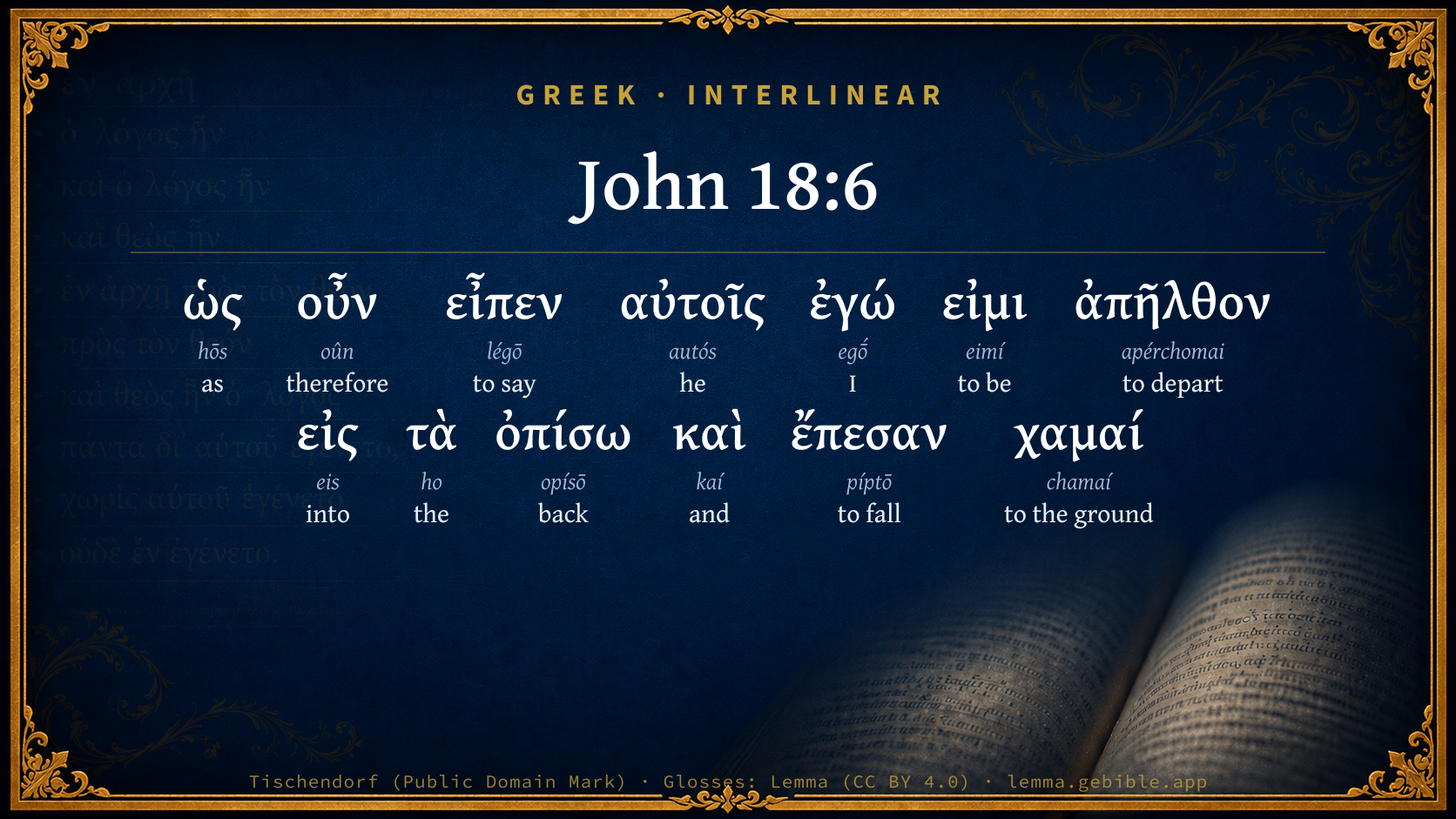
Greek (Tischendorf 8th ed.) John 18:6 appears in the Greek New Testament. The text above is from the Tischendorf 8th edition. Each word links to its Strong’s number and a concise gloss. Click any word for its full Thayer’s Greek Lexicon entry.
Download image
Cite this verse

John 18:6 (World English Bible). Public Domain. Lemma interlinear Bible study tool, https://lemma.gebible.app/v/john/18/6.

Show BibTeX & RIS
BibTeX
RIS
English Translation
When therefore he said to them, "I AM," they went backward, and fell to the ground.
World English Bible · Public Domain
Download a study sheet

One document with this verse’s original text, its word-by-word gloss line, the meaning frame, cross-references with their text, attributed commentary, and full source and license credits — printable, and it pastes into notes with its structure intact.

This verse Autodidact and up

Study sheet (.html) Plain text (.txt)

A passage Seminary Student

Up to 50 verses in one chapter. A passage sheet keeps up to 6 commentary sources and 12 cross-references per verse, in the order this page ranks them, and says so on the sheet whenever that leaves anything out. Ask for a single verse and you get the Autodidact verse sheet above.

Everything on this page stays free to read, with no account — the sheet is a download of what is already on screen, not access to it.

Want to remove ads? Support Godless Engineer
Compare translations 3

The same verse in 3 English versions, stacked beneath the original-language interlinear above. Click any original word for its lexicon entry.

Each is an independent rendering of the whole verse — the interlinear is not word-aligned to these translations.

Highlighted words mark where these versions differ — a whole-verse word diff, not a word-by-word alignment.

  • World English Bible Public Domain
    When therefore he said to them, "I AM," they went backward, and fell to the ground.
  • King James Version Public Domain
    As soon then as he had said unto them, I am he, they went backward, and fell to the ground.
  • unfoldingWord Literal Text CC BY-SA 4.0
    So when he said to them, “I am,” they went backward and fell to the ground.

unfoldingWord Literal Text — © unfoldingWord, licensed CC BY-SA 4.0. Word-aligned USFM3 via Door43 (git.door43.org/unfoldingWord/en_ult).

Versions to compare (up to 4)

3 of 4 selected

Show all 19 translations

Every available English version of this verse, each an independent rendering of the whole verse.

  • World English Bible Public Domain
    When therefore he said to them, "I AM," they went backward, and fell to the ground.
  • Berean Standard Bible Public Domain
    When Jesus said, “I am He,” they drew back and fell to the ground.
  • Majority Standard Bible Public Domain
    When Jesus said, “I am He,” they drew back and fell to the ground.
  • King James Version Public Domain
    As soon then as he had said unto them, I am he, they went backward, and fell to the ground.
  • American Standard Version (1901) Public Domain
    When therefore he said unto them, I am `he', they went backward, and fell to the ground.
  • Revised Version (1885) Public Domain
    When therefore he said unto them, I am he, they went backward, and fell to the ground.
  • Geneva Bible (1599) Public Domain
    Assoone then as hee had saide vnto them, I am hee, they went away backewardes, and fell to the grounde.
  • Douay-Rheims (1899) Public Domain
    As soon therefore as he had said to them: I am he; they went backward, and fell to the ground.
  • Young's Literal Translation Public Domain
    when, therefore, he said to them -- `I am `he',' they went away backward, and fell to the ground.
  • Literal Standard Version CC BY-SA 4.0
    When, therefore, He said to them, “I AM,” they went away backward, and fell to the ground.
  • Unlocked Literal Bible CC BY-SA 4.0
    So when he said to them, “I am,” they went backward and fell to the ground.
  • unfoldingWord Literal Text CC BY-SA 4.0
    So when he said to them, “I am,” they went backward and fell to the ground.
  • Darby Bible Public Domain
    When therefore he said to them, I am [he], they went away backward and fell to the ground.
  • World Messianic Bible Public Domain
    When therefore he said to them, “I am he,” they went backward and fell to the ground.
  • Webster's Bible Public Domain
    As soon then as he had said to them, I am he, they went backward, and fell to the ground.
  • Free Bible Version CC BY-SA 4.0
    When Jesus said “I am,” they fell back and dropped to the ground.
  • Bible in Basic English Public Domain
    And when he said to them, I am he, they went back, falling to the earth.
  • Text-Critical English NT CC BY 4.0
    When Jesus said to them, “I am he,” they drew back and fell to the ground.
  • Tyndale New Testament (1534) Public Domain
    Iudas also which betrayed him stode with them.

Literal Standard Version (2020), Covenant Press — licensed CC BY-SA 4.0. Text via the HelloAO Bible API (eBible.org). Unlocked Literal Bible (unfoldingWord) — licensed CC BY-SA 4.0. Text via the HelloAO Bible API (eBible.org). unfoldingWord Literal Text — © unfoldingWord, licensed CC BY-SA 4.0. Word-aligned USFM3 via Door43 (git.door43.org/unfoldingWord/en_ult). Free Bible Version, Dr. Jonathan Gallagher — licensed CC BY-SA 4.0. Text via the HelloAO Bible API (eBible.org).

Word by word

More ways to search: Search by grammar → Find every occurrence → Compare this word →

Practice this passage: Drill this verse → Learn its vocabulary →

About this verse

These counts appear in no published source. They are computed here, from the morphology-tagged text and Lemma’s own curated glosses. What Lemma adds →

13
words
13
distinct lemmas
Gospels
section

Notable vocabulary

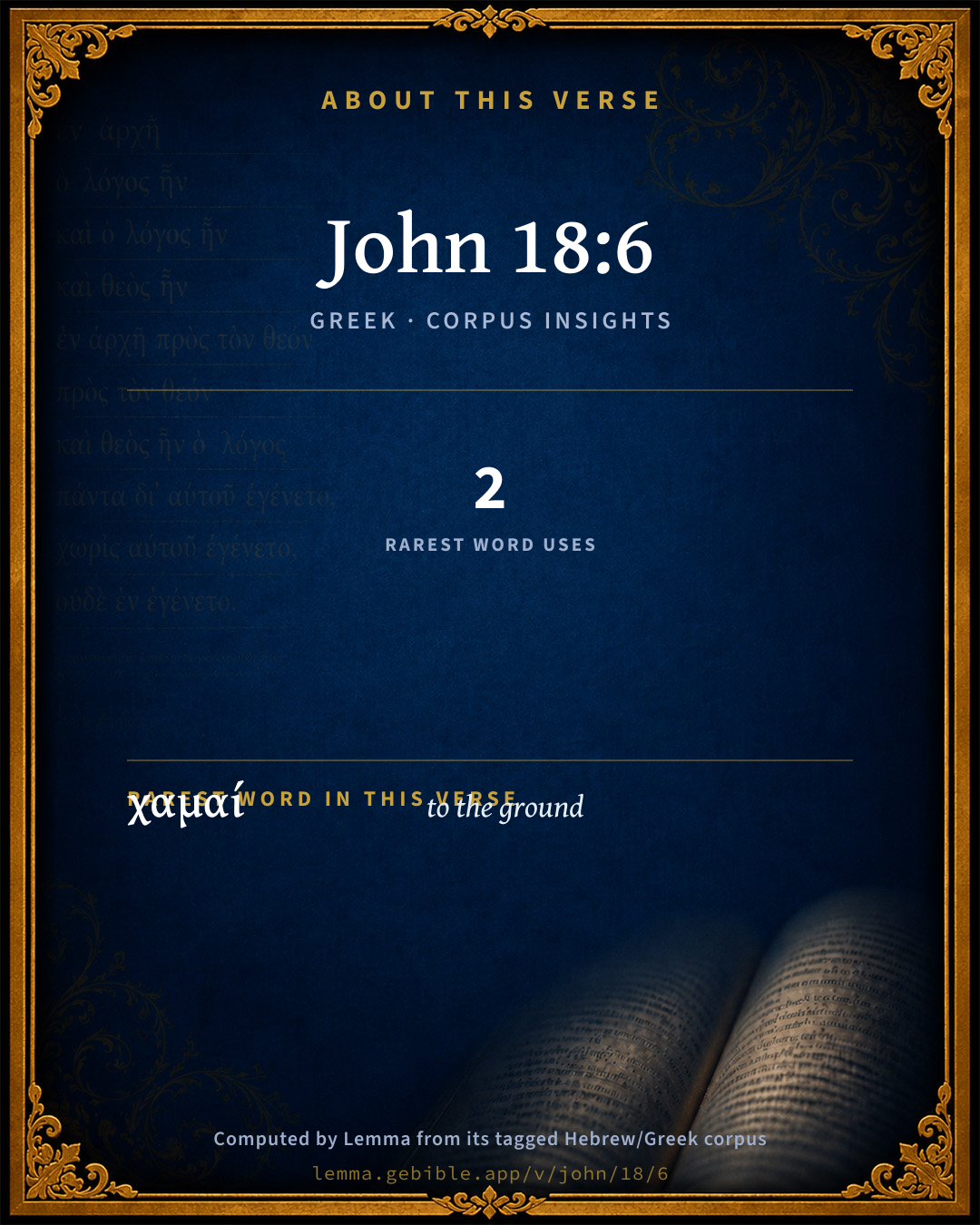
The rarest word here is χαμαί to the ground G5476 — appearing just 2 times in the whole Greek New Testament.

Shared distinctive vocabulary

χαμαί to the ground G5476 occurs in 2 verses of the Greek New Testament. Also found in:

Cross-references

7

Topical passages linked to John 18:6 in the Treasury of Scripture Knowledge — connected by theme and wording, ordered by reader-vote popularity; previews shown in the World English Bible.

  • Psalms 27:2 When evil-doers came at me to eat up my flesh, Even my adversaries and my foes, they stumbled and fell.
  • Psalms 70:2–3 Let them be disappointed and confounded who seek my soul. Let those who desire my ruin be turned back in disgrace.
  • 2 Kings 1:9–15 Then [the king] sent to him a captain of fifty with his fifty. He went up to him: and, behold, he was sitting on the top of the hill. He spoke to him, man of God, the king has said, Come down.
  • Acts 4:29–30 Now, Lord, look at their threats, and grant to your servants to speak your word with all boldness,
  • Luke 9:54–56 When his disciples, James and John, saw this, they said, "Lord, do you want us to command fire to come down from the sky, and destroy them, just as Elijah did?"
  • Psalms 40:14 Let them be disappointed and confounded together who seek after my soul to destroy it. Let them be turned backward and brought to dishonor who delight in my hurt.
  • Psalms 129:5 Let them be disappointed and turned backward, All those who hate Zion.

Cross-references courtesy of OpenBible.info (CC BY 4.0).

Commentary

Notes on John 18:6 from classic Christian and Jewish commentators (each source and its license shown beneath its notes). The classic Christian expositions comment on the surrounding passage and are grouped to its opening verse, so a note may address several verses; the Jewish commentaries on the Tanakh (Rashi and others) are per-verse, so they appear only where the commentator wrote on this verse.

Lemma curates 59 commentaries, every one of them public domain or Creative Commons licensed, each selected and text-cleaned for this edition rather than reprinted as found. About our sources →

MacLaren's Expositions of Holy Scripture

Alexander MacLaren

John

CHRIST AND HIS CAPTORS

Joh 18:6 - Joh 18:9.

This remarkable incident is narrated by John only. It fits in with the purpose which he himself tells us governed his selection of the incidents which he records. ‘These things are written,’ says he, near the end of the Gospel, ‘that ye might believe that Jesus is the Son of God, and that, believing, ye might have life in His name.’ The whole of the peculiarities of the substance of John’s Gospel are to be explained on the two grounds that he was writing a supplement to, and not a substitute for, or a correction of, the Gospels already in existence; and that his special business was to narrate such facts and words as set forth the glory of Christ as ‘the Only Begotten of the Father.’

The incident before us is, as I think, one of these. The Evangelist would have us see in it, as I gather from his manner of narrating it, mainly three things. He emphasises that strange recoil of the would-be captors before Christ’s majestic, calm ‘I am He’; that was a manifestation of Christ’s glory. He emphasises our Lord’s patient standing there, in the midst of the awe-struck crowd, and even inciting them, as it would seem, to do the work for which they had come out; that was a manifestation of the voluntariness of Christ’s sufferings. And He emphasises the self-forgetting care with which at that supreme moment He steps between His faithless, weak friends and danger, with the wonderful words, ‘If ye seek Me, let these go their way’; to the Evangelist that little incident is an illustration, on a very low level, and in regard to a comparatively trivial matter, of the very same principle by which salvation from all evil in time and in eternity, is guaranteed to all that believe on Him:-

I. First, then, consider this remarkable, momentary manifestation of our Lord’s glory.

‘I am He!’ When the Band were thus doubly assured by the traitor’s kiss and by His own confession, why did they not lay hands upon Him? There He stood in the midst of them, alone, defenceless; there was nothing to hinder their binding Him on the spot. Instead of that they recoil, and fall in a huddled heap before Him. Some strange awe and terror, of which they themselves could have given no account, was upon their spirits. How came it about? Many things may have conspired to produce it. I am by no means anxious to insist that this was a miracle. Things of the same sort, though much less in degree, have been often enough seen; when some innocent and illustrious victim has for a moment paralysed the hands of his would-be captors and made them feel, though it were but transiently, ‘how awful goodness is.’ There must have been many in that band who had heard Him, though, in the uncertain light of quivering moonbeams and smoking torches, they failed to recognise Him till He spoke. There must have been many more who had heard of Him, and many who suspected that they were about to lay hands on a holy man, perhaps on a prophet. There must have been reluctant tools among the inferiors, and no doubt some among the leaders whoso consciences needed but a touch to be roused to action. To all, His calmness and dignity would appeal, and the manifest freedom from fear or desire to flee would tend to deepen the strange thoughts which began to stir in their hearts.

But the impression which the narrative seems intended to leave, appears to me to be of something more than this. It looks as if there were something more than human in Christ’s look and tone. It may have been the same in kind as the ascendency which a pure and calm nature has over rude and inferior ones. It may have been the same in kind as has sometimes made the headsman on the scaffold pause before he struck, and has bowed rude gaolers into converts before some grey-haired saint or virgin martyr; yet the difference is so great in degree as practically to become quite another thing. Though I do not want to insist upon any ‘miraculous’ explanation of the cause of this incident, yet I would ask, May it not be that here we see, perhaps apart from Christ’s will altogether, rising up for one moment to the surface, the indwelling majesty which was always there?

We do not know the laws that regulated the dwelling of the Godhead, bodily, within that human frame, but we do know that at one other time there came upon His features a transfiguration, and over His very garments a lustre which was not thrown upon them from without, but rose up from within. And I am inclined to think that here, as there, though under such widely different circumstances and to such various issues, there was for a moment a little rending of the veil of His flesh, and an emission of some flash of the brightness that always tabernacled within Him; and that, therefore, just as Isaiah, when He saw the King in His glory, said, ‘Woe is me, for I am undone!’ and just as Moses could not look upon the Face, but could only see the back parts, so here the one stray beam of manifest divinity that shot through the crevice, as it were, for an instant, was enough to prostrate with a strange awe even those rude and insensitive men. When He had said ‘I am He,’ there was something that made them feel, ‘This is One before whom violence cowers abashed, and in whose presence impurity has to hide its face.’ I do not assert that this is the explanation of that panic terror. I only ask, May it not be?

But whatever we may think was the reason, at all events the incident brings out very strikingly the elevation and dignity of Christ, and the powerful impressions made by His personality, even at such a time of humiliation. This Evangelist is always careful to bring out the glory of Christ, especially when that glory lies side by side with His lowliness. The blending of these two is one of the remarkable features in the New Testament portraiture of Jesus Christ. Wherever in our Lord’s life any incident indicates more emphatically than usual the lowliness of His humiliation, there, by the side of it, you get something that indicates the majesty of His glory. For instance, He is born a weak infant, but angels herald His birth; He lies in a manger, but a star hangs trembling above it, and leads sages from afar, with their myrrh, and incense, and gold. He submits Himself to the baptism of repentance, but the heavens open and a voice proclaims, ‘This is My beloved Son!’ He sits wearied, on the stone coping of the well, and craves for water from a peasant woman; but He gives her the Water of Life. He lies down and sleeps, from pure exhaustion, in the stern of the little fishing-boat, but He wakes to command the storm, and it is still. He weeps beside the grave, but He flings His voice into its inmost recesses, and the sheeted dead comes forth. He well-nigh faints under the agony in the garden, but an angel from Heaven strengthens Him. He stands a prisoner at a human bar, but He judges and condemns His judges. He dies, and that hour of defeat is His hour of triumph, and the union of shame and glory is most conspicuous in that hour when on the Cross the ‘Son of Man is glorified, and God is glorified in Him.’

This strange blending of opposites-the glory in the lowliness, and the abasement in the glory-is the keynote of this singular event. He will be ‘delivered into the hands of men.’ Yes; but ere He is delivered He pauses for an instant, and in that instant comes a flash ‘above the brightness of the noonday sun’ to tell of the hidden glory.

Do not forget that we may well look upon that incident as a prophecy of what shall be. As one of the suggestive, old commentators on this verse says: ‘He will say “I am He,” again, a third time. What will He do coming to reign, when He did this coming to die? And what will His manifestation be as a Judge when this was the effect of the manifestation as He went to be judged?’ ‘Every eye shall see Him’; and they that loved not His appearing shall fall before Him when He cometh to be our Judge; and shall call on the rocks and the hills to cover them.

II. There is here, secondly, a manifestation of the voluntariness of our Lord’s suffering.

When that terrified mob recoiled from Him, why did He stand there so patiently? The time was propitious for flight, if He had cared to flee. He might have ‘passed through the midst of them and gone His way.’ as He did once before, if He had chosen. He comes from the garden; there shall be no difficulty in finding Him. He tells who He is; there shall be no need for the traitor’s kiss. He lays them low for a moment, but He will not flee. When Peter draws his sword He rebukes his ill-advised appeal to force, and then He holds out His hands and lets them bind Him. It was not their fetters, but the ‘cords of love’ which held Him prisoner. It was not their power, but His own pity which drew Him to the judgment hall and the Cross.

Let us dwell upon that thought for a moment. The whole story of the Gospels is constructed upon the principle, and illustrates the fact, that our Lord’s life, as our Lord’s death, was a voluntary surrender of Himself for man’s sin, and that nothing led Him to, and fastened Him on, the Cross but His own will. He willed to be born. He ‘came into the world’ by His own choice. He ‘took upon Him the form of a servant.’ He ‘took part’ of the children’s ‘flesh and blood.’ His birth was His own act, the first of the long series of the acts, by which for the sake of the love which He bore us, He ‘humbled Himself.’ Step by step He voluntarily journeyed towards the Cross, which stood clear before Him from the very beginning as the necessary end, made necessary by His love.

As we get nearer and nearer to the close of the history, we see more and more distinctly that He willingly went towards the Cross, Take; for instance, the account of the last portion of our Lord’s life, and you see in the whole of it a deliberate intention to precipitate the final conflict. Hence the last journey to Jerusalem when ‘His face was set,’ and His disciples followed Him amazed. Hence the studied publicity of His triumphal entry into Jerusalem. Hence the studied, growing severity of His rebukes to the priests and rulers. The same impression is given, though in a somewhat different way, by His momentary retreat from the city and by the precautions taken against premature arrest, that He might not die before the Passover. In both the hastening toward the city and in the retreating from it, there is apparent the same design: that He Himself shall lay down His life, and shall determine the how, and the when, and the where as seems good to Him.

If we look at the act of death itself, Jesus did not die because He must. It was not the nails of the Cross, the physical exhaustion, the nervous shock of crucifixion that killed Him. He died because He would. ‘I have power to lay down My life,’ He said, ‘and I have power’-of course-’to take it again.’ At that last moment, He was Lord and Master of death when He bowed His head to death, and, if I might so say, He summoned that grim servant with a ‘Come!’ and he came, and He set him his task with a ‘Do this!’ and he did it. He was manifested as the Lord of death, having its ‘keys’ in His hands, when He died upon the Cross.

Now I pray you to ask yourselves the question, if it be true that Christ died because He would, why was it that He would die? If because He chose, what was it that determined His choice? And there are but two answers, which two are one. The divine motive that ruled His life is doubly expressed: ‘I must do the will of My Father,’ and ‘I must save the world.’

The taunt that those Jewish rulers threw at Him had a deeper truth than they dreamed, and was an encomium, and not a taunt. ‘He saved others’-yes, and therefore, ‘Himself He cannot save.’ He cannot, because His choice and will to die are determined by His free love to us and to all the world. His fixed will ‘bore His body to the tree,’ and His love was the strong spring which kept His will fixed.

You and I have our share in these voluntary sufferings, and our place in that loving heart which underwent them for us. Oh! should not that thought speak to all our hearts, and bind us in grateful service and lifelong surrender to Him who gave Himself for us; and must die because He loved us all so much that He could not leave us unsaved?

III. We have, lastly, here, a symbol, or, perhaps, more accurately, an instance, on a small scale, of Christ’s self-sacrificing care for us.

His words: ‘If ye seek Me, let these go their way,’ sound more like the command of a prince than the intercession of a prisoner. The calm dignity of them strikes one just as much as the perfect self-forgetfulness of them.

It was a very small matter which He was securing thereby. The Apostles would have to die for Him some day, but they were not ready for it yet, and so He casts the shield of His protection round them for a moment, and interposes Himself between them and the band of soldiers in order that their weakness may have a little more time to grow strong. And though it was wrong and cowardly for them to forsake Him and flee, yet these words of my text more than half gave them permission and warrant for their departure: ‘Let these go their way.’

Now John did not think that this small deliverance was all that Christ meant by these great words: ‘Of them which Thou gavest Me have I lost none!’ He saw that it was one case, a very trifling one, a merely transitory one, yet ruled by the same principles which are at work in the immensely higher region to which the words properly refer. Of course they have their proper fulfilment in the spiritual realm, and are not fulfilled, in the highest sense, till all who have loved and followed Christ are presented faultless before the Father in the home above. But the little incident may be a result of the same cause as the final deliverance is. A dew-drop is shaped by the same laws which mould the mightiest of the planets. The old divines used to say that God was greatest in the smallest things, and the self-sacrificing care of Jesus Christ, as He gives Himself a prisoner that His disciples may go free, comes from the same deep heart of pitying love, which led Him to die, the ‘just for the unjust.’ It may then well stand for a partial fulfilment of His mighty words, even though these wait for their complete accomplishment till the hour when all the sheep are gathered into the one fold, and no evil beasts, nor weary journeys, nor barren pastures can harass them any more.

This trivial incident, then, becomes an exposition of highest truth. Let us learn from such an use of such an event to look upon all common and transitory circumstances as governed by the same loving hands, and working to the same ends, as the most purely spiritual. The visible is the veil which drapes the invisible, and clings so closely to it as to reveal its outline. The common events of life are all parables to the devout heart, which is the wise heart. They speak mystic meanings to ears that can hear. The redeeming love of Jesus is proclaimed by every mercy which perishes in the using; and all things should tell us of His self-forgetting, self-sacrificing care.

Thus, then, we may see in that picture of our Lord’s surrendering Himself that His trembling disciples might go free, an emblem of what He does for us, in regard to all our foes. He stands between us and them, receives their arrows into His own bosom, and says, ‘Let these go their way.’ God’s law comes with its terrors, with its penalties, to us who have broken it a thousand times. The consciousness of guilt and sin threatens us all more or less, and with varying intensity in different minds. The weariness of the world, ‘the ills that flesh is heir to,’ the last grim enemy, Death, and that which lies beyond them all, ring you round. My friends! what are you going to do in order to escape from them? You are a sinful man, you have broken God’s law. That law goes on crashing its way and crushing down all that is opposed to it. You have a weary life before you, however joyful it may sometimes be. Cares, and troubles, and sorrows, and tears, and losses, and disappointments, and hard duties that you will not be able to perform, and dark days in which you will be able to see but very little light, are all certain to come sooner or later; and the last moment will draw near when the King of Terrors will be at your side; and beyond death there is a life of retribution in which men reap the things that they have sown here. All that is true, much of it is true about you at this moment, and it will all be true some day. In view of that, what are you going to do?

I preach to you a Saviour who has endured all for us. As a mother might fling herself out of the sledge that her child might escape the wolves in full chase, here is One that comes and fronts all your foes, and says to them, ‘Let these go their way. Take Me.’ ‘By His stripes we are healed.’ ‘On Him was laid the iniquity of us all.’

He died because He chose; He chose because He loved. His love had to die in order that His death might be our life, and that in it we should find our forgiveness and peace. He stands between our foes and us. No evil can strike us unless it strike Him first. He takes into His own heart the sharpest of all the darts which can pierce ours. He has borne the guilt and punishment of a world’s sin. These solemn penalties have fallen upon Him that we, trusting in Him, ‘may go our way,’ and that there may be ‘no condemnation’ to us if we are in Christ Jesus. And if there be no condemnation, we can stand whatever other blows may fall upon us. They are easier to bear, and their whole character is different, when we know that Christ has borne them already. Two of the three whom Christ protected in the garden died a martyr’s death; but do you not think that James bowed his neck to Herod’s sword, and Peter let them gird him and lead him to his cross, more joyfully and with a different heart, when they thought of Him that had died before them? The darkest prison cell will not be so very dark if we remember that Christ has been there before us, and death itself will be softened into sleep because our Lord has died. ‘If therefore,’ says He, to the whole pack of evils baying round us, with their cruel eyes and their hungry mouths, ‘ye seek Me, let these go their way.’ So, brother, if you will fix your trust, as a poor, sinful soul, on that dear Christ, and get behind Him, and put Him between you and your enemies, then, in time and in eternity, that saying will be fulfilled in you which He spake, ‘Of them which Thou gavest Me, have I lost none.’

Alexander MacLaren, Expositions of Holy Scripture (1904–1910) — public domain. Text from a community e-Sword module.

Tyndale Open Study Notes

Tyndale Open Resources

18:6 The soldiers and guards all drew back before the Lord (cp. Isa 6:5; Ezek 1:28; Dan 10:9; Acts 9:4; Rev 1:17). Even Roman soldiers, who were trained not to fall, fell to the ground before Christ. Although they took this posture of submission, they didn’t really understand what had occurred and proceeded with the arrest.

Tyndale Open Study Notes — © Tyndale Open Resources, licensed CC BY-SA 4.0. Text via the HelloAO Bible API.

Bengel's Gnomon

Johann Albrecht Bengel

Joh 18:6. Ἔπεσον, fell) They ought not after that to have continued to kick against the pricks, especially Judas.

Bengel's Gnomon of the New Testament — English translation (T&T Clark, Edinburgh, 1860) — public domain. Text from a community e-Sword module.

Meyer's Critical & Exegetical Commentary

Heinrich August Wilhelm Meyer

Joh_18:6. They gave way,drew back (see on Joh_6:66), and fell to the earth (χαμαί = χαμᾶζε, very frequently in the classics also); this was regarded, first by Oeder in his Miscell. sacr. p. 503 ff., and recently by most expositors (including Lücke, Tholuck, Olshausen, De Wette, B. Crusius, Ewald, Baeumlein), as a natural consequence of terror and of sudden awe, in support of which reference is made to the (weaker) analogies from the history of M. Antonius (Val. Max. viii. 9. 2), and of Marius (Velleius Paterc. ii. 19. 3), even of Coligny; whilst Brückner would conceive of the effect at least as scarcely as purely human. Lange, however, likewise deduces it from terror of conscience, and finds the miracle only in the fact that it was not unexpected by the Lord, and not undesigned by Him. But, presumptively, the falling to the ground of itself, and the circumstance that the text designates those who fell down generally and without an exception, so that even the Roman soldiers are to be understood along with the rest, justifies the view of the ancient commentators, also adopted by Strauss (who, however, as also Scholten, views the matter as unhistorical), Ebrard, Maier, Luthardt, Hengstenberg, Godet, that it was a miraculous result of the power of Christ (Nonnus: οἰστρηθέντες ἀτευχέϊ λαίλαπι φωνῆς). Christ wished, before His surrender, to make known His might over His foes, and thus to show the voluntariness of His surrender. He could remain free, but He is willing to surrender Himself, because He knows His hour is come, Joh_17:1.

Meyer — Critical and Exegetical Commentary on the New Testament — English translation by Peter Christie, edited by Frederick Crombie (T&T Clark, 1880) — public domain. Text from a community e-Sword module.

Expositor's Greek Testament

ed. W. Robertson Nicoll

Joh 18:6 . The immediate effect of His calm declaration was: ἀπῆλθον εἰς τὰ ὀπίσω καὶ ἔπεσον χαμαί , “they went backwards and fell to the ground”. Job 1:20 , πεσὼν χαμαί ; similarly used by Homer, etc., as = χαμᾶζε . This might have been considered a fulfilment of Psa 27:2 , οἱ θλίβοντές με … ἔπεσαν . The recoil, which necessarily causes stumbling and falling in a crowd, was natural, especially if the servants here employed were the same as those who had been sent to take Him on a former occasion, Joh 7:46 . No one wished to be the first to lay hands on Him. Similar effects were produced by Mohammed (when Durthur stood over him with drawn sword), Mark Antony, Marius, Coligny. But the object in narrating the circumstance may have been to illustrate the voluntariness of Christ’s surrender.

The Expositor's Greek Testament, edited by W. Robertson Nicoll (1897–1910) — public domain. Text from a community e-Sword module.

International Critical Commentary

6. The words which follow, “they retired and fell to the ground,” then, imply no more than that the men who came to make the arrest (some of whom at least did not previously know Jesus even by sight) were so overcome by His moral ascendancy that they recoiled in fear. (For the Johannine ὡς οὖν, see on 4:40.) On a previous occasion (7:44), when some wished to arrest Him, they had faltered and failed to do so. It may have been a similar shrinking which caused some now to recoil from their distasteful task, and in the confusion they, or some of the crowd, stumbled and fell. Indeed, ἔπεσαν χαμαί might be taken figuratively, as expressing discomfiture only. Thus in Psa 27:2, Isa 8:15, Jer 46:6, “stumbled and fell” means no more than that enemies were “overthrown”; and ἔπεσαν χαμαί might be rendered in colloquial English “were floored.”

There is no hint in the Synoptists of any hesitancy on the part of those sent to make the arrest. The phrases ἀπῆλθαν εἰς τὰ ὀπίσω (cf. 6:66) and ἔπεσαν χαμαί (χαμαί is only found again in the N.T. at 9:6) are peculiar to Jn. And it has been suggested (e.g. by W. Bauer) that Jn. means us to understand that ἐγώ εἰμι, as used by Jesus on this occasion, is the equivalent of the mysterious אֲנִי־הוּא, I (am) He, which is the self- designation of Yahweh in the prophetical books (cf. 8:58, 13:19 above, and Introd., pp. cxxvii ff.); and that so awful a claim overwhelmed with terror those who heard it made (cf. Dan 10:9, Rev 1:17). But this is too subtle a rendering of the Johannine narrative of the arrest. Cf. Rev 1:17.

In the Gospel of Peter, § 5, where the darkness at the Crucifixion is described, we have περιήρχοντο δὲ πολλοὶ μετὰ λύχνων, νομίζοντες ὅτι νῦξ ἐστιν. [τινὲς δὲ] ἐπέσαντο. This seems to be a reminiscence of Joh 18:3, Joh 18:6; cf. also Acta Thomœ, § 157.

International Critical Commentary — older volumes (1896–1929), various authors — public domain. Text from a community e-Sword module.

Jamieson, Fausset & Brown

Robert Jamieson, A. R. Fausset & David Brown

As soon then as he said unto them, I am He, they went backward--recoiled.

and fell to the ground--struck down by a power such as that which smote Saul of Tarsus and his companions to the earth (Act 26:14). It was the glorious effulgence of the majesty of Christ which overpowered them. "This, occurring before His surrender, would show His power over His enemies, and so the freedom with which He gave Himself up" [MEYER].

Jamieson, Fausset & Brown — Commentary Critical and Explanatory on the Whole Bible (1871) — public domain (CC PDM 1.0). Text via the HelloAO Bible API.

Adam Clarke's Commentary

Verse 6. They went backward, and fell to the ground.] None of the other evangelists mentions this very important circumstance. Our Lord chose to give them this proof of his infinite power, that they might know that their power could not prevail against him if he chose to exert his might, seeing that the very breath of his mouth confounded, drove back, and struck them down to the earth. Thus by the blast of God they might have perished, and by the breath of his nostrils they might have been consumed: Job 4:9.

Adam Clarke's Commentary on the Bible (1810–1826) — public domain. Text from a community e-Sword/MySword module.

Ellicott's Commentary for English Readers

(6) They went backward, and fell to the ground.—There is nothing in the narrative to suggest that our Lord put forth miraculous power to cause this terror. The impression is rather that it was produced by the majesty of His person, and by the answer which to Jewish ears conveyed the unutterable name, “Jehovah” (I AM). (Comp. Note on Joh_8:24-25.) Guilt trembled before the calmness of innocence. Man fell to the ground before the presence of God. To Judas the term must have been familiar, and have brought back a past which may well have made him tremble at the present. To the officers the voice came from Him of whom they had been convinced before that “Never man spake like this man” (Joh_7:46). They have come to take Him by force, but conscience paralyses all their intentions, and they lay helpless before Him. He will surrender Himself because His hour is come (Joh_17:1); but His life no one taketh from Him. For this sense of awe in the presence of Christ, comp. the account of the cleansing of the Temple in Joh_2:14 et seq.

A Bible Commentary for English Readers, edited by Charles John Ellicott (1878–1897) — public domain. Text from a community e-Sword module.

The Cambridge Bible for Schools and Colleges

gen. ed. J. J. S. Perowne

6. As soon then as he had said] Better, when therefore (see on Joh_18:3) He said. The Evangelist intimates that what followed was the immediate consequence of Christ’s words.

went backward, and fell] Whether this was the natural effect of guilt meeting with absolute innocence, or a supernatural effect wrought by Christ’s will, is a question which we have not the means of determining. Moreover, the distinction may be an unreal one. Is it not His will that guilt should quail before innocence? The result in this case proved both to the disciples and to His foes that His surrender was entirely voluntary (Joh_10:18). Once before, the majesty of His words had overwhelmed those who had come to arrest Him (Joh_7:46); and it would have been so now, had not He willed to be taken. Comp. Mat_26:53, where the expression ‘legions of angels’ may have reference to the fragment of a legion that had come to superintend His capture.

The Cambridge Bible for Schools and Colleges (gen. ed. J. J. S. Perowne; Cambridge University Press, 1878–1918) — public domain. Text from a community e-Sword module.

John Gill's Exposition

As soon then as he had said unto them I am he,.... Immediately upon his speaking these words, which were delivered with so much majesty and authority, and were attended with such a divine power:

they went backward, and fell to the ground; they were confounded, surprised, and intimidated, and seemed as if they would have chose rather to have fled from him, than to have apprehended him; and as they retired and went backward, they fainted away, as it were, either at the majesty of his looks, or at the power of his words, or both, so that they became like ad men, falling to the ground. Sometimes the majesty of a man's person, or his fame for some remarkable things done by him, or the innocence and uprightness of his cause, have had such an influence upon his enemies, that they have not been able to execute upon him what they intended. It is reported of Caius Maxius that being reduced to the utmost misery, and shut up in a private house at Minturnae, (a town in Italy,) an executioner was sent to kill him; and though he was an old man, and unarmed, and in the most miserable condition, yet the executioner having drawn his sword, could not attempt to use it; but, as the historian (y) says, being struck with blindness at the glory of the man, ran away astonished and trembling. Now, besides the above things, in their highest perfection, there was in our Lord something more than human; he was God as well as man, and he displayed his divine majesty, glory, and power. This was done, not to make his escape from them; but to give proof of his deity, and a specimen of his power at the great day; and to let them know, that if he had not thought fit to have surrendered himself voluntarily to them, though he was an unarmed person, they, with all their men and arms, could never have laid hold on him; and to show them, that he could as easily have struck them dead, as to cause them to fall to the ground: and sometimes striking a person dead immediately, is expressed by this phrase of striking to the ground; and is ascribed to God, who does it by the ministry of angels: says R. Simeon ben Shetach (z), to some persons at variance,

"let the master of thoughts come, (i.e. the blessed God,) and take vengeance on you; immediately Gabriel came, , "and smote them to the ground"; and they died immediately.''

The like is elsewhere said (a),

"if thou transgresseth thy father's command, immediately comes Gabriel, and "smites to the ground".''

(y) Valerius Maxim. l. 2. c. 5. (z) F. Bab. Sanhedrin, fol. 19. 2. (a) Shemot Rabba, sect. 1. fol. 91. 2.

John Gill's Exposition of the Whole Bible (1746–1763) — public domain (CC PDM 1.0). Text via the HelloAO Bible API.

Trapp's Complete Commentary

John Trapp

6 As soon then as he had said unto them, I am he, they went backward, and fell to the ground.

Ver. 6. As soon then as he had said, &c.] Here our Saviour let out a little beam of the majesty of his Deity, and 500 men fell before him. Quid autem iudicaturus faciet, qui iudicandus hae fecit? saith Augustine. "The wicked shall not stand in judgment," saith David, Psa 1:5. Christ shall "smite the earth with the rod of his mouth," saith Isaiah; and with "the breath of his lips shall he slay the wicked," Isa 11:4. Godly men (who have but a drop of Christ’s ocean, a spark of his flame) have a daunting presence. When Valens the persecuting emperor came to St Basil, while he was in holy exercises, it struck such a terror into him, that he reeled, and had fallen, had he not been upheld by those that were with him. And another time, when he should have subscribed an order for St Basil’s banishment, such a sudden trembling took his right hand, that he could write never a good letter, whereupon he tore the order for anger, and there was an end of the business. When an officer was sent to apprehend a godly deacon at Miltenberg (a town in the territory of Mentz), the deacon, embracing him, said, Salve, frater, frater enim veto meus es, en adsum, transfode me, suffoca me, Here I am, brother, stab me, hang me, do what you will with me. The officer, as if changed from heaven, answered, Sir, you shall receive no hurt from me. Domine, a me quidem nihil mali expectes. (Scultet. Annal.) And when the boars ran in to kill the deacon, he delivered him, and set him safe out of danger. Judas dealt not so by Jesus, but as he fell with the rest, so rose with the rest, who desperately went on with their devilish design, nothing daunted by their recent disaster.

John Trapp, A Commentary or Exposition upon All the Books of the Old and New Testament (1647–1656) — public domain. Text from a community e-Sword module.

Albert Barnes' Notes on the Bible

They went backward ... - The cause of their retiring in this manner is not mentioned. Various things might have produced it. The frank, open, and fearless manner in which Jesus addressed them may have convinced them of his innocence, and deterred them from prosecuting their wicked attempt. His disclosure of himself was sudden and unexpected; and while they perhaps anticipated that he would make an effort to escape, they were amazed at his open and bold profession. Their consciences reproved them for their crimes, and probably the firm, decided, and yet mild manner in which Jesus addressed them, the expression of his unequalled power in knowing how to find the way to the consciences of men, made them feel that they were in the presence of more than mortal man. There is no proof that there was here any miraculous power, any mere physical force, and to suppose that there was greatly detracts from the moral sublimity of the scene.

Albert Barnes' Notes on the Bible (1834–1885) — public domain. Text from a community e-Sword/MySword module.

Haydock's Catholic Bible Commentary

Jesus again shews the Jews his power, and works another miracle before them, to give them another opportunity of being converted; but they would not: they still persevere in their hardness of heart; he therefore now delivers himself up to them, as now they can have no excuse for their incredulity. (St. John Chrysostom)

George Leo Haydock (1774–1849), Haydock's Catholic Family Bible and Commentary, 1859 edition — public domain. Excludes Psalms (Douay-Rheims chapter numbering differs from Protestant) and Deuterocanonical books (Catholic canon only).

Matthew Poole's English Annotations

For a further evidence to the world that Christ was the Son of the Everlasting Father, it pleased God in all the periods of his life to show forth by him some acts of the Divine power. What had Christ said or done here to prostrate his armed adversaries? He had only asked them whom they looked for; and hearing that it was for him, told them he was the man: they are struck with a terror, and instead of apprehending him, start from him, and fall down to the ground. If there were so much majesty in and such an effect of the voice of Christ in one of the lowest acts of his humiliation, what will the voice of a glorified Christ be to sinners, when he shall return as a Judge to condemn the world! And what will the effect of that be upon his enemies! How easily might our Saviour have escaped, now that his enemies were fallen to the ground! But he suffered them to rise up again, to take him, and to carry him away, to show that he had laid down his life freely.

Matthew Poole's English Annotations on the Holy Bible (1683–1685) — public domain. Text from a community e-Sword/MySword module.

Whedon's Commentary on the Bible

Daniel D. Whedon

6. Backward, and fell—Commentators, such as Stier, who explain this fall as merely a natural accident, resulting from the personal majesty of Jesus, (as the lictor was overawed who attempted to apprehend Caius Marius,) overlook the plain evidences of a purpose and will by Jesus to give this proof that his surrender is voluntary. He first prostrates them by a stroke of unseen power; then deliberately triumphs over their impotence; then secures the escape of his disciples; then yields his person to their hands. By this miracle he sustains his declaration to Peter, Mat_26:53; and his avowal that he himself lays down his life, Joh_10:17-18.

Daniel D. Whedon (gen. ed.), Commentary on the Old and New Testaments (1874–1909) — public domain. Text from a community e-Sword module.

John Wesley's Explanatory Notes

As soon as he said, I am he, they went backward and fell to the ground - How amazing is it, that they should renew the assault, after so sensible an experience both of his power and mercy! But probably the priests among them might persuade themselves and their attendants, that this also was done by Beelzebub; and that it was through the providence of God, not the indulgence of Jesus, that they received no further damage.

John Wesley, Explanatory Notes Upon the Whole Bible (1754–1765) — public domain. Text via the GEBible commentary corpus.

unfoldingWord translationNotes

Door43 World Missions Community

I am

Here the word "he" is not present in the original text, but it is implied. AT: "I am he" (See: Assumed Knowledge and Implicit Information)

fell to the ground

The men fell to the ground because of Jesus' power. AT: "fell down because of Jesus' power" (See: Assumed Knowledge and Implicit Information)

Jesus of Nazareth

"Jesus, the man from Nazareth"

translationWords

Nazareth

unfoldingWord translationNotes — © Distant Shores Media and the Door43 World Missions Community, licensed CC BY-SA 4.0. Source: git.door43.org/Door43/en_tn.

Cambridge Greek Testament for Schools and Colleges

6. ὡς οὖν εἶπεν. When therefore He said; intimating that what followed was the immediate consequence of His words. They fell backwards, recoiling from the majesty of goodness, not forwards in adoration of it. Whether their falling was the natural effect of guilt meeting with absolute innocence, or a supernatural effect wrought by Christ’s will, is a question which we have not the means of determining. Moreover, the distinction may be an unreal one. Is it not His will that guilt should quail before innocence? The result in this case proved both to the disciples and to His foes that His surrender was entirely voluntary (Joh 10:18). Once before, the majesty of His words had overwhelmed those who had come to arrest Him (Joh 7:46); and it would have been so now, had not He willed to be taken. Comp. Mat 26:53, where the expression ‘legions of angels’ may have reference to the fragment of a legion that had come to superintend His capture.

Cambridge Greek Testament for Schools and Colleges (Cambridge University Press, 1896; 21 vols, various authors incl. Carr, Maclear, Plummer, Farrar, Lumby, Moule, M. R. James, Simcox) — public domain. Text from a community e-Sword module.

Alford’s Greek Testament

Henry Alford

6.] The question on the miraculous nature of this incident is not whether it were a miracle at all (for it is evident that it must be regarded as one), but whether it were an act specially intended by our Lord, or a result of the superhuman dignity of His person and the majestic calmness of His reply. I believe the latter alternative to be the right one. Commentators cite various instances of the confusion of the enemies of innocent men before the calmness and dignity of their victims, how much more was this likely to be the case when He in whom was no sin, and who spake as never man spake, came forth to meet His implacable foes as the self-sacrificing Lamb of God. So that I regard it rather as a miracle consequent upon that which Christ said and did, and the state of mind in which His enemies were,—than as one, in the strict sense, wrought by Him: bearing however always in mind, that to Him nothing was unexpected, or a mere result, but every thing foreknown. With this view what follows is also consistent, rather than with the other.

The distinction is an important one, as the view which we take of our Lord’s mind towards His captors must enter, as an element, into our understanding of the whole of this scene, and indeed of the solemn occurrences which follow. Such incidents as this are not related by the Evangelists, and least of all by St. John, as mere astounding facts, but as grounds on which we are to enquire, and determine for ourselves, as to the “glory, full of grace and truth,” which was in Him, whom, not having seen, we love.

Henry Alford, The Greek Testament (1849–1861) — public domain. Text from a community e-Sword module.

Lesson kit

Teaching starters — assembled from the data on this page, not authored interpretation. Every prompt links to the verse data it draws on. Edit before teaching.

John, in the Gospels, opens this verse with 13 words (13 distinct Greek lemmas). Its most distinctive word is chamaí (“to the ground”). A historical commentator’s framing appears above. Read the whole chapter for the surrounding context.

Discussion questions

  1. The word chamaí carries the sense “to the ground.” How does it shape the verse?
  2. John 9:6 shares the word «to the ground» with this verse. How do the two illuminate each other?
  3. These translations render this verse differently; the difference is in the English rendering, not the original. What questions does that raise?
  4. Reading how MacLaren's Expositions of Holy Scripture and Tyndale Open Study Notes read this verse, where do the two commentators agree and where do they part?

Things to notice

Reading settings

Reading text

Shown beneath each verse's original-language words.

Old Testament
Old Testament edition

Read the OT as the Masoretic Hebrew (MT) or the Greek Septuagint (LXX).

English shown for the Greek Septuagint (in the Hebrew ↔ Greek comparison).

Comparing translations? Open the Compare panel on any verse page to stack up to four side by side.