John 18:33

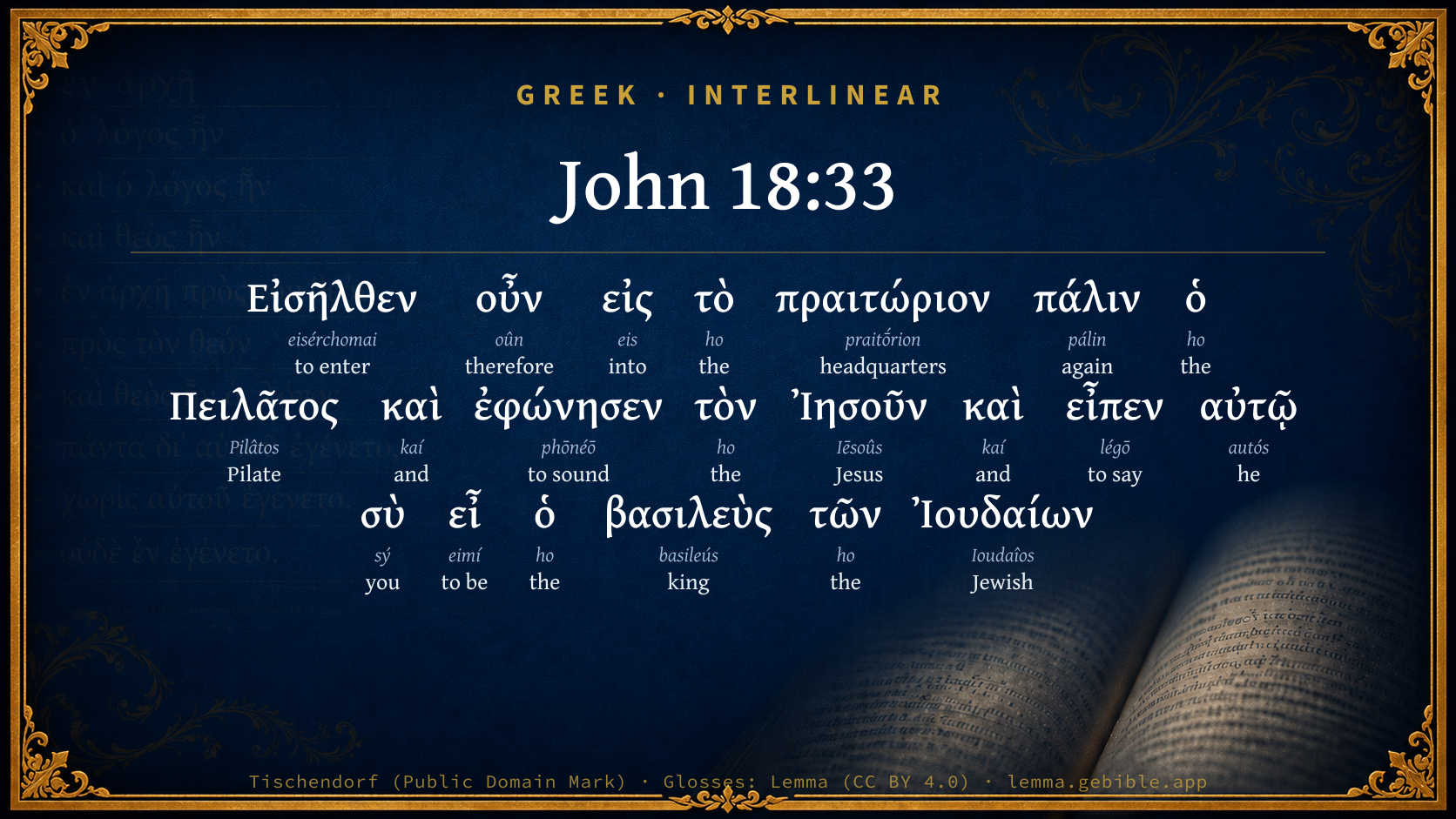
Greek (Tischendorf 8th ed.) John 18:33 appears in the Greek New Testament. The text above is from the Tischendorf 8th edition. Each word links to its Strong’s number and a concise gloss. Click any word for its full Thayer’s Greek Lexicon entry.
Download image
Cite this verse

John 18:33 (World English Bible). Public Domain. Lemma interlinear Bible study tool, https://lemma.gebible.app/v/john/18/33.

Show BibTeX & RIS
BibTeX
RIS
English Translation
Pilate therefore entered again into the Praetorium, called Jesus, and said to him, "Are you the King of the Jews?"
World English Bible · Public Domain
Download a study sheet

One document with this verse’s original text, its word-by-word gloss line, the meaning frame, cross-references with their text, attributed commentary, and full source and license credits — printable, and it pastes into notes with its structure intact.

This verse Autodidact and up

Study sheet (.html) Plain text (.txt)

A passage Seminary Student

Up to 50 verses in one chapter. A passage sheet keeps up to 6 commentary sources and 12 cross-references per verse, in the order this page ranks them, and says so on the sheet whenever that leaves anything out. Ask for a single verse and you get the Autodidact verse sheet above.

Everything on this page stays free to read, with no account — the sheet is a download of what is already on screen, not access to it.

Want to remove ads? Support Godless Engineer
Compare translations 3

The same verse in 3 English versions, stacked beneath the original-language interlinear above. Click any original word for its lexicon entry.

Each is an independent rendering of the whole verse — the interlinear is not word-aligned to these translations.

Highlighted words mark where these versions differ — a whole-verse word diff, not a word-by-word alignment.

  • World English Bible Public Domain
    Pilate therefore entered again into the Praetorium, called Jesus, and said to him, "Are you the King of the Jews?"
  • King James Version Public Domain
    Then Pilate entered into the judgment hall again, and called Jesus, and said unto him, Art thou the King of the Jews?
  • unfoldingWord Literal Text CC BY-SA 4.0
    Then Pilate entered into the governor’s palace again and summoned Jesus and said to him, “Are you the King of the Jews?”

unfoldingWord Literal Text — © unfoldingWord, licensed CC BY-SA 4.0. Word-aligned USFM3 via Door43 (git.door43.org/unfoldingWord/en_ult).

Versions to compare (up to 4)

3 of 4 selected

Show all 19 translations

Every available English version of this verse, each an independent rendering of the whole verse.

  • World English Bible Public Domain
    Pilate therefore entered again into the Praetorium, called Jesus, and said to him, "Are you the King of the Jews?"
  • Berean Standard Bible Public Domain
    Pilate went back into the Praetorium, summoned Jesus, and asked Him, “Are You the King of the Jews?”
  • Majority Standard Bible Public Domain
    Pilate went back into the Praetorium, summoned Jesus, and asked Him, “Are You the King of the Jews?”
  • King James Version Public Domain
    Then Pilate entered into the judgment hall again, and called Jesus, and said unto him, Art thou the King of the Jews?
  • American Standard Version (1901) Public Domain
    Pilate therefore entered again into the Praetorium, and called Jesus, and said unto him, Art thou the King of the Jews?
  • Revised Version (1885) Public Domain
    Pilate therefore entered again into the palace, and called Jesus, and said unto him, Art thou the King of the Jews?
  • Geneva Bible (1599) Public Domain
    So Pilate entred into the common hall againe, and called Iesus, and sayde vnto him, Art thou the king of the Iewes?
  • Douay-Rheims (1899) Public Domain
    Pilate therefore went into the hall again, and called Jesus, and said to him: Art thou the king of the Jews?
  • Young's Literal Translation Public Domain
    Pilate, therefore, entered into the praetorium again, and called Jesus, and said to him, `Thou art the King of the Jews?'
  • Literal Standard Version CC BY-SA 4.0
    Pilate, therefore, entered into the Praetorium again, and called Jesus, and said to Him, “You are the King of the Jews?”
  • Unlocked Literal Bible CC BY-SA 4.0
    Then Pilate entered the government headquarters again and called Jesus and he said to him, “Are you the King of the Jews?”
  • unfoldingWord Literal Text CC BY-SA 4.0
    Then Pilate entered into the governor’s palace again and summoned Jesus and said to him, “Are you the King of the Jews?”
  • Darby Bible Public Domain
    Pilate therefore entered again into the praetorium and called Jesus, and said to him, Thou art the king of the Jews?
  • World Messianic Bible Public Domain
    Pilate therefore entered again into the Praetorium, called Yeshua, and said to him, “Are you the King of the Jews?”
  • Webster's Bible Public Domain
    Then Pilate entered into the judgment-hall again, and called Jesus, and said to him, Art thou the King of the Jews?
  • Free Bible Version CC BY-SA 4.0
    Pilate went back into the governor's palace. He summoned Jesus, and asked him, “Are you the King of the Jews?”
  • Bible in Basic English Public Domain
    Then Pilate went back into the Praetorium and sent for Jesus and said to him, Are you the King of the Jews?
  • Text-Critical English NT CC BY 4.0
    Then Pilate went into his headquarters again, called Jesus over, and said to him, “Are yoʋ the king of the Jews?”
  • Tyndale New Testament (1534) Public Domain
    That the wordes of Iesus myght be fulfilled which he spake signifyinge what deeth he shuld dye.

Literal Standard Version (2020), Covenant Press — licensed CC BY-SA 4.0. Text via the HelloAO Bible API (eBible.org). Unlocked Literal Bible (unfoldingWord) — licensed CC BY-SA 4.0. Text via the HelloAO Bible API (eBible.org). unfoldingWord Literal Text — © unfoldingWord, licensed CC BY-SA 4.0. Word-aligned USFM3 via Door43 (git.door43.org/unfoldingWord/en_ult). Free Bible Version, Dr. Jonathan Gallagher — licensed CC BY-SA 4.0. Text via the HelloAO Bible API (eBible.org).

Word by word

More ways to search: Search by grammar → Find every occurrence → Compare this word →

Practice this passage: Drill this verse → Learn its vocabulary →

πραιτώριον
praitṓrion
G4232
“headquarters”
Noun, Accusative, Singular, Neuter
Part of Speech
Noun
Case
Accusative
Number
Singular
Gender
Neuter
Full Thayer's Definition

Origin: of Latin origin

TDNT: None

1. "head-quarters" in a Roman camp, the tent of the commander-in-chief 2. the palace in which the governor or procurator of a province resided, to which use the Romans were accustomed to appropriate the palaces already existing, and formerly dwelt in by kings or princes; at Jerusalem it was a magnificent palace which Herod the Great had built for himself, and which the Roman procurators seemed to have occupied whenever they came from Caesarea to Jerusalem to transact public business 3. the camp of the Praetorian soldiers established by Tiberius
  1. Εἰσῆλθεν eisérchomai G1525 “to enter” Verb, Aorist, Active, Indicative, 3rd person, Singular
  2. οὖν oûn G3767 “therefore” Conjunction
  3. εἰς eis G1519 “into” Preposition
  4. τὸ ho G3588 “the” Article, Accusative, Singular, Neuter
  5. πάλιν pálin G3825 “again” Adverb
  6. ὁ ho G3588 “the” Article, Nominative, Singular, Masculine
  7. Πειλᾶτος Pilâtos G4091 “Pilate” Noun, Nominative, Singular, Masculine
  8. καὶ kaí G2532 “and” Conjunction
  9. ἐφώνησεν phōnéō G5455 “to sound” Verb, Aorist, Active, Indicative, 3rd person, Singular
  10. τὸν ho G3588 “the” Article, Accusative, Singular, Masculine
  11. Ἰησοῦν Iēsoûs G2424 “Jesus” Noun, Accusative, Singular, Masculine
  12. καὶ kaí G2532 “and” Conjunction
  13. εἶπεν légō G3004 “to say” Verb, Aorist, Active, Indicative, 3rd person, Singular
  14. αὐτῷ autós G846 “he” Personal pronoun, Dative, Singular, Masculine
  15. σὺ sý G4771 “you” Personal pronoun, 2nd person, Nominative, Singular
  16. εἶ eimí G1510 “to be” Verb, Present, Active, Indicative, 2nd person, Singular
  17. ὁ ho G3588 “the” Article, Nominative, Singular, Masculine
  18. βασιλεὺς basileús G935 “king” Noun, Nominative, Singular, Masculine
  19. τῶν ho G3588 “the” Article, Genitive, Plural, Masculine
  20. Ἰουδαίων Ioudaîos G2453 “Jewish” Adjective, Genitive, Plural, Masculine

About this verse

These counts appear in no published source. They are computed here, from the morphology-tagged text and Lemma’s own curated glosses. What Lemma adds →

21
words
16
distinct lemmas
Gospels
section

Notable vocabulary

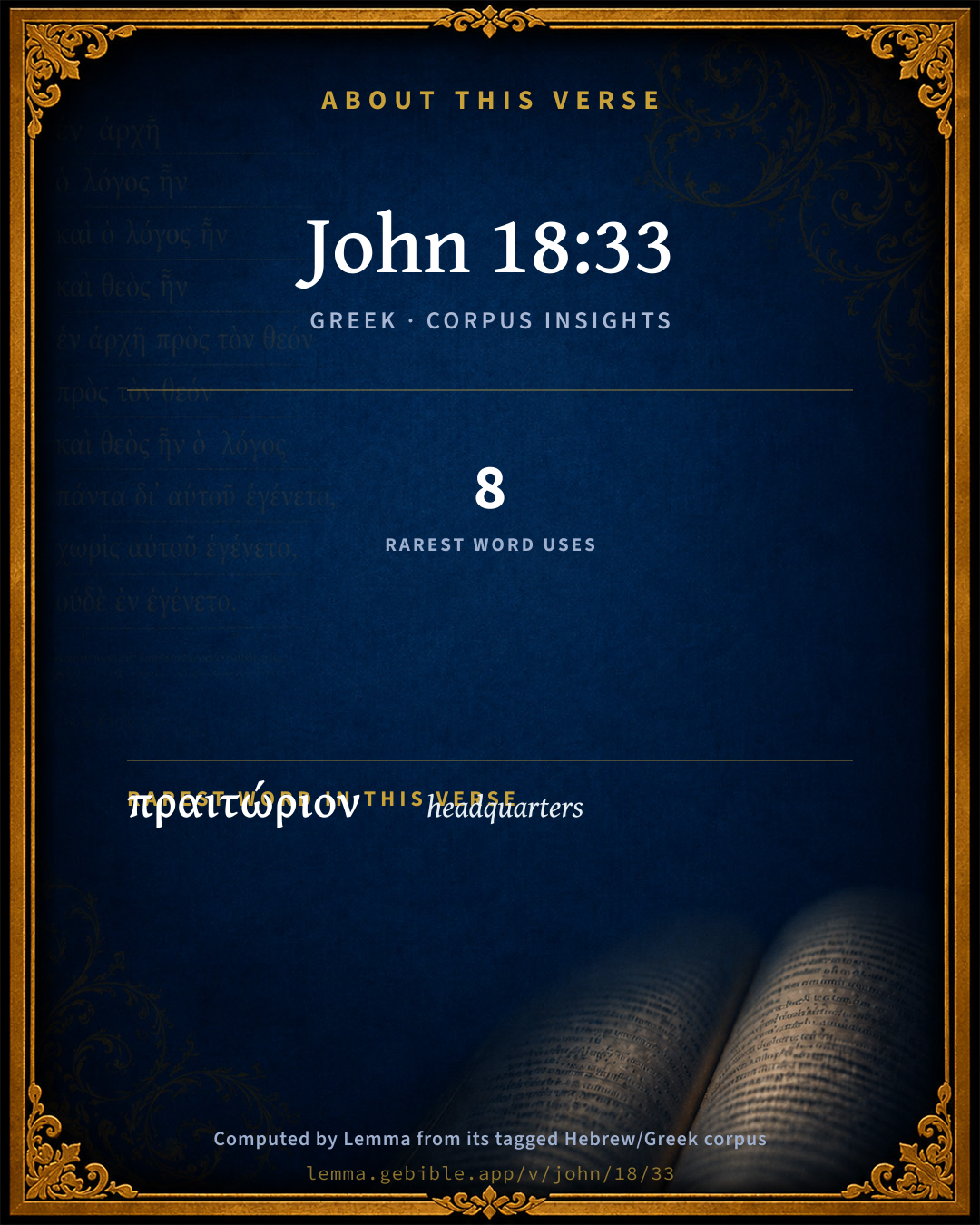
The rarest word here is πραιτώριον headquarters G4232 — appearing just 8 times in the whole Greek New Testament.

Shared distinctive vocabulary

πραιτώριον headquarters G4232 occurs in 7 verses of the Greek New Testament. Also found in:

Repetition

Words recur within this verse:

Cross-references

20

Topical passages linked to John 18:33 in the Treasury of Scripture Knowledge — connected by theme and wording, ordered by reader-vote popularity; previews shown in the World English Bible.

  • Luke 23:3–4 Pilate asked him, "Are you the King of the Jews?" He answered him, "So you say."
  • Zechariah 9:9 Rejoice greatly, daughter of Zion! Shout, daughter of Jerusalem! Behold, your king comes to you! He is righteous, and having salvation; Lowly, and riding on a donkey, Even on a colt, the foal of a donkey.
  • Matthew 27:11 Now Jesus stood before the governor: and the governor asked him, saying, "Are you the King of the Jews?" Jesus said to him, "So you say."
  • Mark 15:2 Pilate asked him, "Are you the King of the Jews?" He answered, "So you say."
  • Luke 19:38–40 saying, "Blessed is the King who comes in the name of the Lord! Peace in heaven, and glory in the highest!"
  • John 12:13 they took the branches of the palm trees, and went out to meet him, and cried out, "Hosanna! Blessed is he who comes in the name of the Lord, the King of Israel!"
  • John 18:37 Pilate therefore said to him, "Are you a king then?" Jesus answered, "You say that I am a king. For this reason I have been born, and for this reason I have come into the world, that I should testify to the truth. Everyone who is of the truth listens to my voice."
  • John 19:3 They kept saying, "Hail, King of the Jews!" and they kept slapping him.
  • John 19:12 At this, Pilate was seeking to release him, but the Jews cried out, saying, "If you release this man, you aren't Caesar's friend! Everyone who makes himself a king speaks against Caesar!"
  • Acts 2:34–36 For David didn't ascend into the heavens, but he says himself, 'The Lord said to my Lord, "Sit by my right hand,
  • Psalms 2:6–12 "Yet I have set my king on my holy hill of Zion."
  • Isaiah 9:6–7 For to us a child is born, to us a son is given; and the government shall be on his shoulder: and his name shall be called Wonderful, Counselor, Mighty God, Everlasting Father, Prince of Peace.
  • Jeremiah 23:5 Behold, the days come, says Yahweh, that I will raise to David a righteous Branch, and he shall reign as king and deal wisely, and shall execute justice and righteousness in the land.
  • Zephaniah 3:15 Yahweh has taken away your judgments. He has thrown out your enemy. The King of Israel, Yahweh, is in the midst of you. You will not be afraid of evil any more.
  • John 1:49 Nathanael answered him, "Rabbi, you are the Son of God! You are King of Israel!"
  • John 12:15 "Don't be afraid, daughter of Zion. Behold, your King comes, sitting on a donkey's colt."
  • John 18:28–29 They led Jesus therefore from Caiaphas into the Praetorium. It was early, and they themselves didn't enter into the Praetorium, that they might not be defiled, but might eat the Passover.
  • John 19:9 He entered into the Praetorium again, and said to Jesus, "Where are you from?" But Jesus gave him no answer.
  • John 19:19–22 Pilate wrote a title also, and put it on the cross. There was written, "JESUS OF NAZARETH, THE KING OF THE JEWS."
  • 1 Timothy 6:13 I charge you before God, who gives life to all things, and before Christ Jesus, who before Pontius Pilate testified the good confession,

Cross-references courtesy of OpenBible.info (CC BY 4.0).

Commentary

Notes on John 18:33 from classic Christian and Jewish commentators (each source and its license shown beneath its notes). The classic Christian expositions comment on the surrounding passage and are grouped to its opening verse, so a note may address several verses; the Jewish commentaries on the Tanakh (Rashi and others) are per-verse, so they appear only where the commentator wrote on this verse.

Lemma curates 59 commentaries, every one of them public domain or Creative Commons licensed, each selected and text-cleaned for this edition rather than reprinted as found. About our sources →

Joseph Benson's Commentary

Joh 18:33-40. Then Pilate entered into the judgment-hall again — See the note on Mat 27:11. It seems, as the governor had heard an honourable report of Jesus, and observed in his silence, under the accusations brought against him, an air of meek majesty and greatness of spirit, rather than any consciousness of guilt, or any indication of a fierce contempt, he was willing to discourse with him more privately before he proceeded further. He therefore called Jesus, and said, Art thou the king of the Jews? — Dost thou really pretend to any right to govern them? Jesus answered, Sayest thou this thing of thyself? — Dost thou ask this question of thy own accord, because thou thinkest that I have affected regal power? or did others tell it thee of me? — Or dost thou ask it according to the information of the priests, affirming that I have acknowledged myself to be a king? No doubt Jesus knew what had happened; but he spake to the governor after this manner, because, being in the palace when the priests accused him, he had not heard what they said. Pilate answered, Am I a Jew? — Dost thou think that I am acquainted with the religious opinions, expectations, and disputes of the Jews? Thine own nation, &c., have delivered thee unto me — As a seditious person, one that assumes the title of a king: What hast thou done — To merit the charge of sedition? Jesus answered, My kingdom is not of this world — Not a temporal, but a spiritual kingdom, which does not at all interfere with the dominion of Cesar, or of which any prince has reason to be jealous. If my kingdom were of this world — Were of an external or temporal nature; then would my servants fight — Or rather, would have fought, would have endeavoured to establish me on the throne by force of arms, and would have fought against the Jews when they came to apprehend me. But as I have done nothing of this, but readily put myself into their hands, it is evident my kingdom is not from hence — Nor to be erected here; and therefore I have been so far from arming my followers with secular weapons, that the guard who came to apprehend me know I forbade their making use of those they had. Pilate said, Art thou a king then? — Art thou a king, notwithstanding thy kingdom is not of this world? Jesus answered, Thou sayest I am a king — That is, according to the Hebrew idiom, It is as thou sayest: I am a king, but not of this world: even the appointed Head and Governor of the whole Israel of God; nor will I ever basely seek my safety by renouncing my claim to the most excellent majesty and extensive dominion. To this end was I born, &c. — Our Lord speaks of his human origin; his divine was above Pilate’s comprehension: yet it is intimated in the following words: For this cause came I into the world — Namely, from heaven; that I should bear witness unto the truth — That by explaining and proving the truth, I might impress it upon men’s consciences, and make them obedient to its laws. In this consisteth my kingdom, and all the lovers of truth obey me, and are my subjects. This is what Paul calls the good confession, which he tells Timothy, (1Ti 6:13,) Jesus witnessed before Pontius Pilate. And justly does the apostle term it so. For our Lord did not deny the truth to save his own life, but gave all his followers an example highly worthy of imitation. It is remarkable, that Christ’s assuming the title of king did not offend the governor in the least, though it was the principal crime laid to his charge. Probably the account which he gave of his kingdom and subjects, led Pilate to take him for some Stoic philosopher, who pleased himself with the chimerical royalty attributed by his sect to those they termed wise men. See Horace, Lib. I. Sat. 3. Accordingly he desired him to explain what he meant by truth. Pilate saith, What is truth? — That is, the truth to which thou referrest, and speakest of as thy business to attest. Or perhaps he meant, What signifies truth? Is that a thing worth hazarding thy life for? So he left him presently, to plead with the Jews for him; looking upon him, it is probable, as an innocent but weak man. He went out again unto the Jews, and saith — To those that were assembled about the judgment-hall, namely, chief priests and others: I find in him no fault at all — No opinion inconsistent with the good of society, neither any action or pretension criminal in the least degree. But ye have a custom that I should release unto you one at the passover — And I am ready now to oblige you in this affair. This, it seems, was said in consequence of the multitude desiring him to do as he had been wont to do at preceding passovers. See Mar 15:8-10. Will ye that I release unto you the King of the Jews? — It seems he hoped by this proposal to preserve the life of Jesus, of whose innocence he was fully convinced; and accordingly, that he might induce them to choose him, he proposed no other alternative than Barabbas, a robber and murderer. See note on Mat 27:15-18; Mat 27:20-22. Then cried they all again — Or, all at once, as some translate παλιν here, because it does not appear that the people had refused Jesus and asked Barabbas before this time. But indeed “that word is wanting in a considerable number of manuscripts, in the Complutensian edition, the Syriac, Coptic, Saxon, Arabic, Armenian, and Ethiopic versions. In many Latin manuscripts it is not found. Besides, it does not suit the preceding part of our Lord’s trial, as related by this evangelist, who makes no mention of their crying in this manner before.” — Campbell. Not this man — We will not have this man released; but Barabbas — A robber and murderer. And thus, when Pilate would have let him go, they denied the Holy One and the Just, and desired a murderer to be granted unto them, Act 3:14. See note on Luk 23:18-25.

Joseph Benson's Commentary on the Old and New Testaments (1811–1818) — public domain. Text from a community e-Sword module.

Tyndale Open Study Notes

Tyndale Open Resources

18:33 Pilate was personally responsible for capital crimes in which the interests and security of the Roman Empire were at stake, so he began his formal legal inquiry. • Are you the king of the Jews? To get the governor’s attention, Caiaphas had charged that Jesus had urged people not to pay their taxes to the Roman government and had claimed to be a king (Luke 23:2). To Pilate, Jesus might have been just another Jewish terrorist–revolutionary (see Luke 23:18-19; Acts 5:36-37) with a head full of messianic notions and a band of well-armed followers.

Tyndale Open Study Notes — © Tyndale Open Resources, licensed CC BY-SA 4.0. Text via the HelloAO Bible API.

Bengel's Gnomon

Johann Albrecht Bengel

Joh 18:33. Σὺ εἶ ὁ βασιλεὺς τῶν Ἰουδαίων; art Thou the King of the Jews?) John brings before us Pilate, with changeable mind, always pressing upon this point.

Bengel's Gnomon of the New Testament — English translation (T&T Clark, Edinburgh, 1860) — public domain. Text from a community e-Sword module.

Meyer's Critical & Exegetical Commentary

Heinrich August Wilhelm Meyer

Joh_18:33-34. Pilate does not, indeed, enter at present into further discussion with the Jews, but, because he quite perceived that they had set their minds on the punishment of death, he returns into the praetorium, into which Jesus, Joh_18:28, was led, and causes Him to be summoned before him, in order personally to examine him; taking a sufficiently inconsistent course, instead of simply persisting in his refusal on account of the want of a definite ground of accusation, and waiting first for some further step on the part of the Jews. His question: Thou art the king of the Jews? which, moreover, carries with it a contemptuous sound of unbelief (he does not ask, for example, σὺ λέγεις, κ.τ.λ., or the like), is explained, even without a κατηγορία on the part of the Jews, from the fact that the arrest, because made with the help of the σπεῖρα, Joh_18:3, could not have taken place without previous intimation to and approval by Pilate, who therefore must also have been acquainted with its reason,hence all the less, with Ewald, is the presentment of a written accusation to be presumed, or, as is ordinarily done, need it be suggested that the Jews, even after Joh_18:31, had come forward with the κατηγορία. This agrees with Luk_23:2, but is not indicated by a single word in John, who could not have passed over so essential a point as a matter of course, and how easily and briefly could he have done so! By his counter-question, Joh_18:34, Jesus does not desire, as Olshausen, Meander, Godet, Ewald, and several others suppose, to gather the more exact sense of the question,whether, namely, it is intended in a Jewish and theocratic or in a Roman and political sense (for such a separation of the ideas concerning the Nessiah was neither to be presumed in Pilate, nor to be suggested by this question of Jesus),but He simply claims the right to know the author of the accusation, which was contained in the words of Pilate; to know, therefore, whether Pilate put to Him the above question at his own instance, and without foreign prompting; or, on the other hand, at the prompting of others. That the latter was the case, He indeed knew; the ἄλλοι stood, in fact, before the door; but Pilate ought to speak out and set forth clearly the status causae. It was that which Jesus could demand, and with all the intrepidity of innocence did demand, without exactly intending to evoke a movement of conscience (Hengstenberg), which He could not at this point expect in the cold man of the world; or to call his attention to the suspicious source of the accusation (Luthardt, Tholuck, Brückner), to which the ἄλλοι, which is altogether without bias, is not appropriate.

Meyer — Critical and Exegetical Commentary on the New Testament — English translation by Peter Christie, edited by Frederick Crombie (T&T Clark, 1880) — public domain. Text from a community e-Sword module.

Expositor's Greek Testament

ed. W. Robertson Nicoll

Joh 18:33-37 . Jesus examined by Pilate in private .

Joh 18:33 . Pilate, being thus compelled to undertake the case, withdraws within the Praetorium to conduct it apart from their prejudices and clamours. He calls Jesus and says to Him, Σὺ εἶ ὁ βασιλεὺς τῶν Ἰουδαίων ; How did Pilate know that this was the κατηγορία against Jesus? John omits the information given in Luk 23:2 that the Sanhedrists definitely laid this accusation. And the answer of Jesus implies that He had not heard this accusation made in Pilate’s presence. The probability therefore is that Pilate had privately obtained information regarding the prisoner. There is some contempt as well as surprise in Pilate’s Σύ . “Art Thou,” whose appearance so belies it, “the king of the Jews?”

The Expositor's Greek Testament, edited by W. Robertson Nicoll (1897–1910) — public domain. Text from a community e-Sword module.

Jamieson, Fausset & Brown

Robert Jamieson, A. R. Fausset & David Brown

Pilate . . . called Jesus, and said . . . Art thou the King of the Jews?--In Luk 23:2 they charge our Lord before Pilate with "perverting the nation, and forbidding to give tribute to Cæsar, saying that He Himself is Christ a king." Perhaps this was what occasioned Pilate's question.

Jamieson, Fausset & Brown — Commentary Critical and Explanatory on the Whole Bible (1871) — public domain (CC PDM 1.0). Text via the HelloAO Bible API.

Adam Clarke's Commentary

Verse 33. Art thou the king of the Jews?] St. Luke says, expressly, Lu 23:2, that when the Jews brought him to Pilate they began to accuse him as a rebel, who said he was king of the Jews, and forbade the people to pay tribute to Caesar. It was in consequence of this accusation that Pilate asked the question mentioned in the text.

Adam Clarke's Commentary on the Bible (1810–1826) — public domain. Text from a community e-Sword/MySword module.

John Calvin's Commentaries

33. Then Pilate went again into the hall. It is probable that many things were said on both sides, which the Evangelist passes over; and this conclusion might be readily drawn from the other Evangelists. But John dwells chiefly on a single point, that Pilate made a laborious inquiry whether Christ was justly or unjustly accused. In the presence of the people, who were inflamed with sedition, nothing could be done but in a riotous manner. He therefore goes again into the hall; and, indeed, his intention is to acquit Christ, but Christ himself, in order that he may obey his Father, presents himself to be condemned; and this is the reason why he is so sparing in his replies. Having a judge who was favorable, and who would willingly have lent an ear to him, it was not difficult for him to plead his cause; but he considers for what purpose he came down into the world, and to what he is now called by the Father. Of his own accord, therefore, he refrains from speaking, that he may not escape from death.

Art thou the King of the Jews? It would never have struck Pilate’s mind to put this question about the kingdom, if this charge had not been brought against Christ by the Jews. Now, Pilate takes up what was more offensive than all the rest, that, having disposed of it, he may acquit the prisoner. The tendency of Christ’s answer is to show that there is no ground for that accusation; and thus it contains an indirect refutation; as if he had said, “It is absurd to bring that charge against me, for not even the slightest suspicion of it can fall upon me.”

Pilate appears to have taken amiss that Christ asked him why he suspected him of such a crime; and, therefore, he angrily reproaches him, that all the evil comes from his own nation. “I sit here as a judge,” says he; “it is not foreigners, but your own countrymen, who accuse you. There is no reason, therefore, why you should involve me in your quarrels. You would be allowed by me and by the Romans to live at peace; but you raise disturbances among yourselves, and I am reluctantly compelled to bear a part in them.”

John Calvin's Commentaries (1540-1563) — public domain. Text from the Calvin Translation Society English edition (1840s-50s) via the Christian Classics Ethereal Library (ccel.org). Calvin's coverage is partial (roughly two-thirds of the Bible); uncommented books and verses are honest gaps, never fabricated. The 19th-century editor's footnotes and remarks are omitted so the notes are faithfully Calvin's own voice.

Ellicott's Commentary for English Readers

(33) Then Pilate entered into the judgment hall again, and called Jesus.—Better, Pilate therefore entered into the Prœtorium (or palace) again, and called Jesus. (Comp. Joh_18:28.) This was practically a private investigation, for the Jews could not enter the palace (Joh_18:28). (Comp. Joh_19:13.)

Art thou the King of the Jews?—Comp. Note on Mat_27:11; Luk_23:2-3. Pilate, of course, knew of the charge brought against Him when he gave permission for the Roman cohort to apprehend Him.

A Bible Commentary for English Readers, edited by Charles John Ellicott (1878–1897) — public domain. Text from a community e-Sword module.

The Cambridge Bible for Schools and Colleges

gen. ed. J. J. S. Perowne

33. Then Pilate] Pilate therefore (Joh_18:3). Because of the importunity of the Jews Pilate is obliged to investigate further; and being only Procurator, although cum potestate, has no Quaestor, but conducts the examination himself.

called Jesus] Probably the Roman guards had already brought Him inside the Praetorium: Pilate now calls Him before the judgment-seat. The conversation implies that Jesus had not heard the previous conversation with the Jews.

Art thou the King of the Jews?] In all four Gospels these are the first words of Pilate to Jesus, and in all four there is an emphasis on ‘Thou.’ The pitiable appearance of Jesus was in such contrast to the royal title that Pilate speaks with a tone of surprise (comp. Joh_4:12). The question may mean either ‘Dost Thou claim to be King?’ or, ‘Art Thou the so-called King?’ The royal title first appears in the mouth of the wise men, Mat_2:1, next in the mouth of Pilate.

33–37. Inside the Praetorium; Jesus is privately examined by Pilate and makes ‘a good confession’ (1Ti_6:13).

The Cambridge Bible for Schools and Colleges (gen. ed. J. J. S. Perowne; Cambridge University Press, 1878–1918) — public domain. Text from a community e-Sword module.

John Gill's Exposition

Then Pilate entered into the judgment hall again,.... Where he went at first, but the Jews refusing to come in thither to him, he came out to them; and now they speaking out more plainly, that he was guilty of a crime deserving of death; as that he set up himself as a king, in opposition to Caesar, and taught the people not to pay tribute to him; he goes into the "praetorium" again, and called Jesus; beckoned, or sent for him; or ordered him to come in thither to him, that he might alone, and the more freely, converse with him; which Jesus did, paying no regard to the superstitious observances of the Jews:

and said unto him, art thou the king of the Jews? This he might say, from a rumour that was generally spread, that there was such a person to come, and was born; and by many it was thought, that Jesus was he; and particularly from the charge of the Jews against him, which though not here expressed, is elsewhere; see Luk 23:2. Wherefore Pilate was the more solicitous about the matter, on account of Caesar, and lest he should be charged with dilatoriness and negligence in this affair: some read these words not by way of question, but affirmation, "thou art the king of the Jews"; which method he might make use of, the more easily to get it out of him, whether he was or not: and to this reading, Christ's answer in the next verse seems best to agree.

John Gill's Exposition of the Whole Bible (1746–1763) — public domain (CC PDM 1.0). Text via the HelloAO Bible API.

Trapp's Complete Commentary

John Trapp

33 Then Pilate entered into the judgment hall again, and called Jesus, and said unto him, Art thou the King of the Jews?

Ver. 33. Entered into the judgment hall again] For without, among the people, there was nothing but clamour and confusion; much like to that regnum Cyclopum, ubi ουδεις ουδεν ουδενος ακουει. Pilate therefore retires himself into the palace, that he might more sedately set himself to sift the business.

John Trapp, A Commentary or Exposition upon All the Books of the Old and New Testament (1647–1656) — public domain. Text from a community e-Sword module.

Albert Barnes' Notes on the Bible

Art thou the King of the Jews? - This was after they had accused him of perverting the nation, and forbidding to give tribute to Caesar, Luk 23:2-3.

Albert Barnes' Notes on the Bible (1834–1885) — public domain. Text from a community e-Sword/MySword module.

Matthew Poole's English Annotations

Then Pilate entered into the judgment hall again, the ordinary place of judicature, from whence we read before he went out, in civility to the Jews, whose superstition (as we before heard) kept them from going there during the festival. He called Jesus to him privately, and asks him, if he owned himself to be the

King of the Jews? The confessing of which (for without doubt they had suggested some such thing to Pilate, and could not prove it) had brought Christ under Pilate’s power, he being governor for the Romans, and so concerned to inquire upon any that pretended to any regal power over that conquered people.

Matthew Poole's English Annotations on the Holy Bible (1683–1685) — public domain. Text from a community e-Sword/MySword module.

Whedon's Commentary on the Bible

Daniel D. Whedon

33. Entered into the judgment hall—While the multitude is in the front area, facing Pilate at his threshold, Jesus has been sent into the hall. Pilate was, therefore, alternately with Jesus within, and with the multitude without.

Art thou—This question presupposes, as the other Evangelists state that Jesus had treasonably claimed to be a king. It is to be noted that Luke makes Jesus declare himself a king without explanation, and yet makes Pilate clear him of fault. His account alone would be liable to the charge brought by rationalistic commentators against it, of being mysterious. John, in the present chapter, interposes the explanation, by which it is shown that Jesus so defined his royalty as to exculpate him from all fault in the eyes of Pilate. Pilate asks the present question in a tone of the utmost seriousness, as if to learn both what Jesus claimed to be, and what he was.

Daniel D. Whedon (gen. ed.), Commentary on the Old and New Testaments (1874–1909) — public domain. Text from a community e-Sword module.

The Pulpit Commentary

Vers. 33-38. (b) Within the Praetorium. Christs admission that he was a.King, but that his kingdom was not of this world.

Vers. 33, 34. Pilate therefore entered again into the Praetorium, out of direct hearing of the vociferous crowd, where Jesus and John himself had remained under supervision of the officers of the court, and called summoned -Jesus to his side, and said to him that of which the mob outside formed an imperfect idea. The account of John throws much light on the inference which Pilate drew from the reply of Jesus, as given in Ver. 38 and in Luk_23:4. To the loud accusations and bitter charges of "the chief priests and elders" (Mat_27:11, 12 Mar_15:3, 4) brought in the presence of Pilate, Christ answered nothing. His solemn and accusing silence caused the governor to marvel greatly. (see both Mat_27:14 and Mar_15:5) He marveled not only at the silence of the Lord, but at that silence after he, Pilate, had received from him so explicit a statement as to the nature of his own kingdom. An explanation of the motive of Pilate, and of his entire manner upon this occasion, is to be found in the private interview between our Lord and the Roman governor within the Praetorium. It is unnecessary (with many) to see in Pilate an "almost persuaded" believer in the claims of Jesus, who yet was warring with his better judgment, and apostatizing from a nascent faith. He appears rather as the Roman man of the world, who has never learned to rule his policy by any notions of righteousness and truth, and is utterly unable to appreciate the spiritual claims of this Nazarene; yet he was shrewd enough to see that, so far as Roman authority was concerned, this Prisoner was utterly harmless. His question was, Art thou the King of the Jews? Of course, he expected at first a negative reply. Should this abused and rejected, this bound and bleeding Sufferer, with no apparent followers around him, actually betrayed by one of his intimate friends, deserted by the rest, and hounded to death by the fierce cries of Pharisee and Sadducee, chief priest and elder, answer in the affirmative, it might easily suggest itself to Pilate that he must be under some futile hallucination. It has been said that the question might have been answered right off in the affirmative or in the negative, according as the term "King of the Jews" was understood. If what Pilate meant was a popular titular leader, imperator of Jewish levies, one prepared for the career of Judas of Galilee, or Herod the Idumaean, or for that of Barchochab in after times, nothing could seem to be less likely or more patently repudiated by the facts; moreover, from our Lord himself, who had always refused a quasi-royal dignity, (Joh_6:15) it would have required an emphatic negative. Pilate knew no other way of interpreting the phrase. If the term meant the true "King of Israel," the Messiah anticipated by prophecy and psalm, the King of all kings and Lord of lords, the Ruler of hearts, who would draw all men to him, and east out and vanquish the prince of this world, then the "crown" was his, and he could not deny it; but before this assertion was made in the hearing of the multitude, our Lord would draw from Pilate the sense in which he used the words. He does not say to him, Su legeiv , "Thou sayest a reply given verbatim by all the synoptists, and referring to a second demand made in the presence of the multitude but he put a counter-question, Sayest thou this thing, askest thou this question, from thyself? from thy knowledge of the hopes kindled by the ancient books, or from comparing my words with my appearance, or from any judgments thou hast formed a priori? (so Godet, Neander, Olshausen, and Ewald). Thus Jesus was not so much informing Pilate of the distinction between the two kingships, as claiming qua Prisoner at the bar the source of the accusation. "Have I put forth any claim of this kind, which thou as the chief magistrate of this Roman province hast any legal cognizance of?" It was not, as Hengstenberg and Westcott suggest, an appeal to the man rather than to the governor, to the conscience of Pilate rather than to the forms of the tribunal; but (Meyer), with the intrepid consciousness of perfect innocence of the political crime, our Lord asks for the formal declaration of the charge brought against him. Or did others tell it thee concerning me? Alford, Lange, Schaff, etc., all agree with Godet in supposing that Christ was discriminating between the theocratic and the political use of the great phrase. It is obvious that he did rise from the latter to the former in the following verses, but it is difficult to find the distinction in this alternative question. "Did others (not thine own police or observation) did the Jews, in fact, bring thee this charge against me? Nay, did they not? Is it not entirely due to this outbreak of hostility to my teaching that they have chosen thus to impeach me before thee to deliver me to thee?" Therefore, first of all, Christ repudiated the charge, in the only sense in which it could have conveyed any colorable idea to the mind of Pilate.

The Pulpit Commentary (1880–1919), ed. H.D.M. Spence-Jones & Joseph S. Exell — public domain. Text from a community e-Sword module.

Kretzmann's Popular Commentary

Paul E. Kretzmann

Pilate begins the examination of Jesus

v. 33. Then Pilate entered into the judgment-hall again, and called Jesus, and said unto Him, Art Thou the King of the Jews?

v. 34. Jesus answered him, Sayest thou this thing of thyself, or did others tell it thee of Me?

v. 35. Pilate answered, Am I, a Jew? Thine own nation and the chief priests have delivered Thee unto me; what hast Thou done?

Having received no definite charges, but only vague intimations from the Jews, Pilate now resolved to give the prisoner a hearing. He took up the case, although he was convinced that Christ was no political criminal. That in itself was an injustice on the part of the governor, to make a case where he did not believe there was a case. But one of the statements of the Jewish rulers had been that Jesus had said that He was the King of the Jews. So Pilate takes up this matter, as one that might lead to some solution. But Jesus asks a very pertinent question in turn: Of thyself sayest thou this, or have others spoken to thee concerning Me? "Do you make this inquiry from any serious personal interest and with any keen apprehension of the blessings attached to the kingdom of God, or are you merely echoing a formal charge brought against Me by others?" "In the first place He excuses Himself thus: Sayest thou this thing of thyself, or did others tell it thee of Me? This seems again as though it were answered in pride; however, it is not a proud answer, but a very necessary defense. For if someone is accused falsely, he should not let the accusation rest upon him nor say: This I will gladly suffer and let remain upon me for God’s sake, but should openly protest his innocence. Therefore the Lord throws the guilt and false accusation which the Jews put upon Him far from Himself and says: Thou, Pilate, askest whether I am the King of the Jews, that is to say, whether I am a rebel against the emperor? I call upon thine own conscience as a witness whether thou accusest Me of this of thyself or not. Surely, of thyself thou wouldst not say such things of Me. Let thy conscience answer, yea, let thine own eyes answer. Thou seest Me stand before thee, captured and bound; I was taken in no tumult, and there is no crowd of people about Me that uses weapons, but I have altogether the aspect of a captured and bound person. Therefore I cannot be accused of insurrection against the emperor. Thus the Lord presents His innocence over against the false accusation of the Jews, calling upon both the conscience and the eyes of the judge for a witness. " The very implication that he might have had the idea which he broached himself, Pilate rejects with a show almost of loathing: I surely am no Jew! But the people to whom Jesus belonged by birth, the Jews and the chief priests, had delivered Him. And with some asperity Pilate wanted to know what the whole trouble was about, what Jesus had committed to be brought before Him in this manner. The idea that he should take any stock in a Jewish Messiah, Pilate scouts with sneering mockery.

Paul E. Kretzmann, Popular Commentary of the Bible (1921–1924) — public domain. Text from a community e-Sword module.

Burkitt's Expository Notes on the New Testament

William Burkitt

Observe here, 1. Pilate’s ensnaring question, Art thou the King of the Jews? How jealous are great men of Jesus Christ, and how afraid are they of his kingdom, power, and authority, as if it would be prejudicial to their authority and power in the world; which was far enough from Christ’s thoughts!

Observe, 2. The wisdom and caution of our Saviour’s answer: he neither affirms nor denies. Though whenever we speak, we are bound to speak the truth, yet we are not bound at all times to speak the whole truth.

Christ tells him therefore, that, upon the supposition that he was a king, yet his kingdom was no earthly, but a spiritual kingdom; he was no temporal king, to rule over his subjects with temporal power and worldly pomp; but a spiritual king, in and over his church only, to order the affairs and look after the government thereof.

Learn hence, that Christ as God hath an universal kingdom of power and providence even over the highest of men, and as a Mediator hath a spritual kingdom in and over his church.

2. That it is a clear evidence that Christ’s kingdom is spiritual inasmuch as it is not carried on by violence and force of arms, as worldly kingdoms are, but by spiritual means and methods: If my kingdom were of this world, my servants would fight for me: but now is my kingdom not from hence.

William Burkitt's Expository Notes on the New Testament (1700–1703) — public domain. Text from a community e-Sword module.

unfoldingWord translationNotes

Door43 World Missions Community

I am not a Jew, am I?

This remark appears in the form of a question so Pilate can emphasize his complete lack of interest in the cultural affairs of the Jewish people. AT: "Well I am certainly not a Jew, and I have no interest in these matters!" (See: Rhetorical Question)

Your own people

"Your fellow Jews"

translationWords

palace

govern

Pilate

King of the Jews

Jew

people group

chief priests

unfoldingWord translationNotes — © Distant Shores Media and the Door43 World Missions Community, licensed CC BY-SA 4.0. Source: git.door43.org/Door43/en_tn.

Cambridge Greek Testament for Schools and Colleges

33–37. Inside the Praetorium; Jesus is privately examined by Pilate, and makes τὴν καλὴν ὁμολογίαν (1Ti 6:13).

33. Because of the importunity of the Jews (οὗν) Pilate is obliged to investigate further; and being only Procurator, although cum potestate, has no Quaestor, but conducts the examination himself. Probably the Roman guards had already brought Jesus inside the Praetorium: Pilate now calls Him before the judgment-seat. What follows implies that He had not heard the previous conversation with the Jews.

σὺ εἶ ὁ β. τ. Ἰ. In all four Gospels these are Pilate’s first words to Jesus, and S. Luke (Luk 23:2) gives the Jewish accusation which suggested them; ‘saying that He Himself is Christ a king.’ In all four Σύ is emphatic. The appearance of Jesus is in such contrast to royalty that Pilate speaks with surprise (comp. Joh 4:12, Joh 8:53): his meaning is either ‘Dost Thou claim to be King?’ or, ‘Art Thou the so-called King?’ The civil title, ‘the King of the Jews,’ first appears in the mouth of the wise men (Mat 2:1), next in the mouth of Pilate: contrast the theocratic title, ‘the K. or Israel’ (Joh 1:50).

Cambridge Greek Testament for Schools and Colleges (Cambridge University Press, 1896; 21 vols, various authors incl. Carr, Maclear, Plummer, Farrar, Lumby, Moule, M. R. James, Simcox) — public domain. Text from a community e-Sword module.

Alford’s Greek Testament

Henry Alford

33.] This question probably arose out of what Pilate had previously heard, not from any charge to this effect being made between our vv. 31 and 34. Had such a charge been made, our Lord’s question ver. 34 would be unnatural.

Pilate summoned Jesus in, who had been as yet outside with the Jews. This was the formal reception of the case before him;—as the Roman soldiers must now have formally taken charge of Jesus, as servants of the Roman authorities: having previously, when granted by Pilate to the Chief Priests, acted as their police.

The judgments of the Romans were always public and sub dio, see ch. 19:13;—but the enquiries and examinations might be private. In this case Pilate appears to have wished to obtain an account from Jesus apart from the clamours of the chief priests and the mob.

Henry Alford, The Greek Testament (1849–1861) — public domain. Text from a community e-Sword module.

International Critical Commentary

33. The Roman soldiers, at this point, took charge of Jesus. Pilate retired from the open court, where he had met the Jewish leaders, and went back into his palace, summoning Jesus to come before him for private examination.

εἰσῆλθεν οὖν εἰς τό πραιτώριον πάλιν. So אAΓΔΘ (cf. 19:9), but BC*DsuppLW support πάλιν εἰς τὸ πραιτ. For πάλιν, which here signifies “back” to the place where Pilate was before, see on 1:35.

For ἐφώνησεν, see on 1:48. The disciple who seems to have been present at the examination of Jesus by Annas (see on v. 15) may also have been a witness of the scene in Pilate`s palace which is here told so vividly. The priestly accusers of Jesus could not follow Him inside the house, because of their scruples about ceremonial uncleanness (v. 28); but it is not likely that admission to the chamber of inquiry was forbidden to others duly introduced who wished to hear what was going on.

Σὺ εἶ ὁ βασιλεὺς τῶν Ἰουδαίων; This question was immediately put to Jesus by Pilate,1 as all the evangelists tell (Mar 15:2, Mat 27:1, Luk 23:3); but it is only Lk. who explains that Jesus had first been accused to Pilate of claiming to be a King (Luk 23:2). Pilate fixes upon this point as one which it was necessary for him as procurator to examine, and he puts his question in a form which suggests that he expected a negative answer. “Thou! (σύ is emphatic) art Thou the King of the Jews?” Evidently, Pilate did not believe that Jesus was a revolutionary leader, as he had been informed (Luk 23:2). There was nothing in His appearance or His demeanour to make such a charge plausible.

International Critical Commentary — older volumes (1896–1929), various authors — public domain. Text from a community e-Sword module.

Vincent's Word Studies in the New Testament

Marvin R. Vincent

Art thou [συ ει] . Thou is emphatic. Thou, the despised malefactor. King of the Jews. The civil title. The theocratic title, king of Israel (i. 49; Joh 12:13) is addressed to Jesus on the cross (Mt 27:42; Mr 14:32) in mockery.

Marvin R. Vincent, Word Studies in the New Testament (1887–1900) — public domain. Text from a community e-Sword/MySword module.

Godet's Commentaries

Frédéric Louis Godet

Vv. 33-35. “Pilate entered again therefore into the Praetorium, and he called Jesus and said to him, Art thou the king of the Jews? 34. Jesus answered him:Sayest thou this of thyself, or did others tell it thee of me? 35. Pilate answered: Am I a Jew? Thine own nation and the chief priests have delivered thee to me; what hast thou done?”

John’s narrative evidently presents a gap here. There is nothing in what precedes to give a reason for the question of Pilate to Jesus: Art thou the king of the Jews? Such an inquiry implies, therefore, an expression on the part of the accusers which gives occasion for it. This supposition is changed into certainty when we compare the narrative of the Synoptics, particularly that of Luke. “We found him,” say the Jews on approaching Pilate, “troubling the nation, forbidding to pay tribute to Caesar, saying that he is the Christ, the King” (Luk 23:2). Luke, as well as Mark and Matthew, has omitted the whole first phase of the accusation, which has just been related by John. The Synoptics begin their narrative at the moment when the Jews come down again to their more humble part as accusers, and concede to Pilate his position as judge. Hence it follows that John, after having supplied in what precedes that which the Synoptics had omitted, now implies as known to his readers the political accusation mentioned by them. We see how intimate and constant is the relation between his narrative and theirs. Keil concludes from the words he called Jesus, that up to this moment Jesus had remained outside. But see above. He called Him aside in the Praetorium itself, to a place where he could speak with Him alone.

To his question, Pilate certainly expected a frank negative answer. But the position was not as simple as he imagined. There was a distinction to be made here, not to the thought of Pilate, but to that of Jesus. In the political sense of the term king of the Jews, the only one known to Pilate, Jesus might reject this title; but in the religious sense which every believing Jew gave to it and in which it was equivalent to Messiah, Jesus must accept it, whatever the consequences of this avowal might be. Jesus must know, then, whether this title, with regard to which Pilate was interrogating Him, was put forward by Pilate himself, or whether it had been put forward by the Jews in the conversation which he had just had with them. The objections of Meyer and Weiss (in his Commentary) against this explanation do not seem to me sufficient to shake it. According to Meyer, Jesus asks of Pilate simply an explanation which He had the right to ask. But He nevertheless did it with some purpose. According to Weiss, Jesus wished to know whether He must now give an explanation respecting the Messianic idea! Finally, according to Tholuck, Luthardt, Keil, etc., He thereby called Pilate’s attention to the suspicious source of this accusation (others, the Jews). It would, in that case, have been more simple to answer by a No only; but, after this, the really affirmative answer of Jesus in Joh 18:36-37 would become an absurdity. These two verses are compatible with the question of Jesus only on our explanation, which is that of Olshausen, Neander, Ewald, and at present, it seems to me, ofWeiss himself (Life of Jesus, II. p. 563). We must conclude from these words that Jesus had not Himself heard the accusation of the rulers, and consequently that He was already, as we have stated, Joh 18:28, in the Praetorium at the time when it was brought forward by them.

Pilate, not understanding clearly what is the aim of this distinction, answers abruptly: “What have I to do with your Jewish subtleties?” There is profound contempt in the antithesis: ἐγώ...᾿Ιουδαῖος (I...a Jew?). Then, abandoning the Jewish jargon which he had allowed his accusers to impose on him for the moment, he interrogates Him as a frank and simple Roman: “Now then, to the point! By what fault hast thou brought upon thyself all that which is taking place at this moment?”

Frédéric Louis Godet — Commentaries on Luke, John, Romans, and 1 Corinthians — English translation (T&T Clark, Edinburgh, 1870s–1890s) — public domain. Text from a community e-Sword module.

Lesson kit

Teaching starters — assembled from the data on this page, not authored interpretation. Every prompt links to the verse data it draws on. Edit before teaching.

John, in the Gospels, opens this verse with 21 words (16 distinct Greek lemmas). Its most distinctive word is praitṓrion (“headquarters”). A historical commentator’s framing appears above. Read the whole chapter for the surrounding context.

Discussion questions

  1. What does “headquarters” (praitṓrion) contribute to the verse as a whole?
  2. Matthew 27:27 shares the word «headquarters» with this verse. How do the two illuminate each other?
  3. “the” occurs 5× in this one verse. What is the effect of the repetition?
  4. These translations render this verse differently; the difference is in the English rendering, not the original. What questions does that raise?
  5. Reading how Joseph Benson's Commentary and Tyndale Open Study Notes read this verse, where do the two commentators agree and where do they part?

Things to notice

Reading settings

Reading text

Shown beneath each verse's original-language words.

Old Testament
Old Testament edition

Read the OT as the Masoretic Hebrew (MT) or the Greek Septuagint (LXX).

English shown for the Greek Septuagint (in the Hebrew ↔ Greek comparison).

Comparing translations? Open the Compare panel on any verse page to stack up to four side by side.