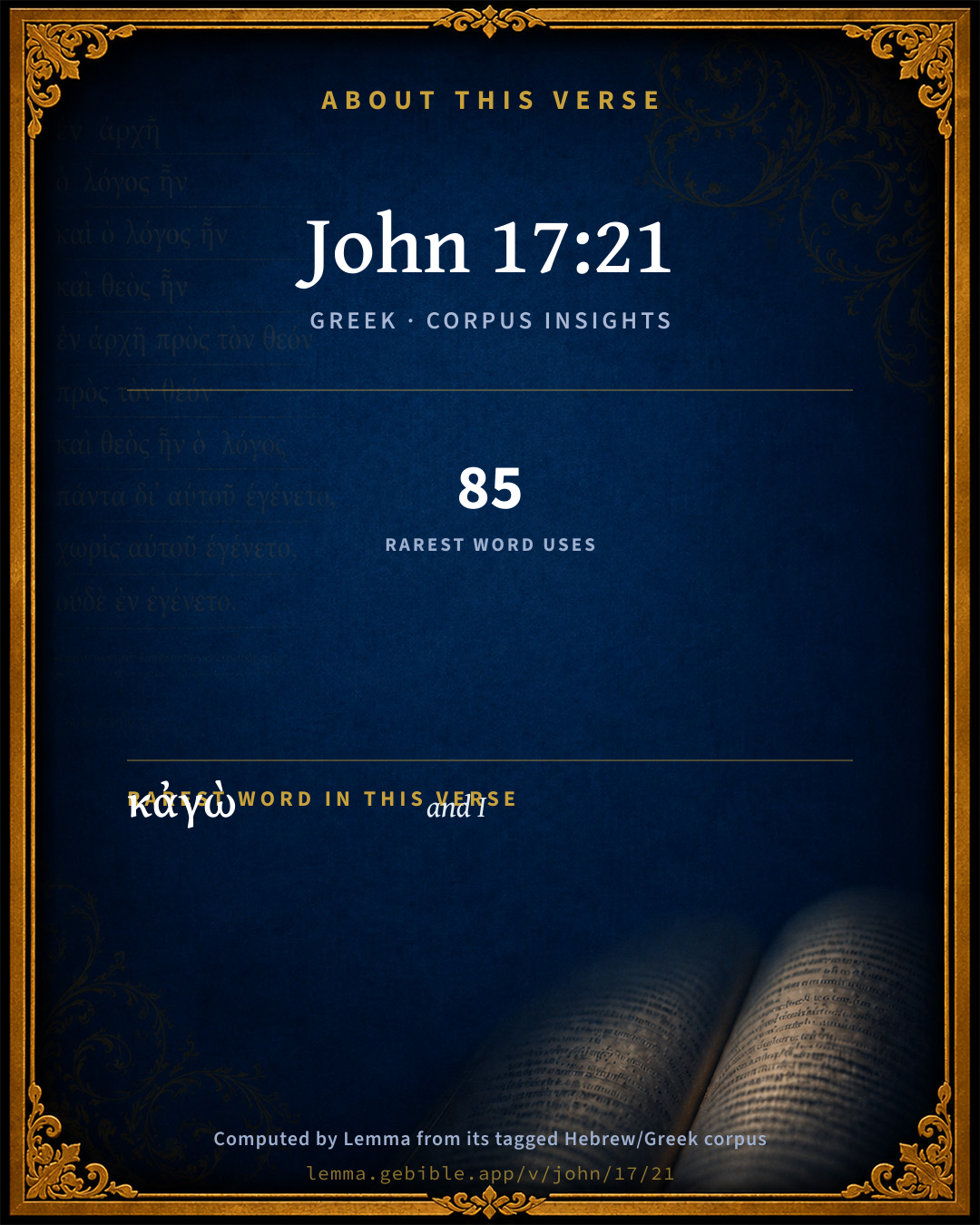
John 17:21

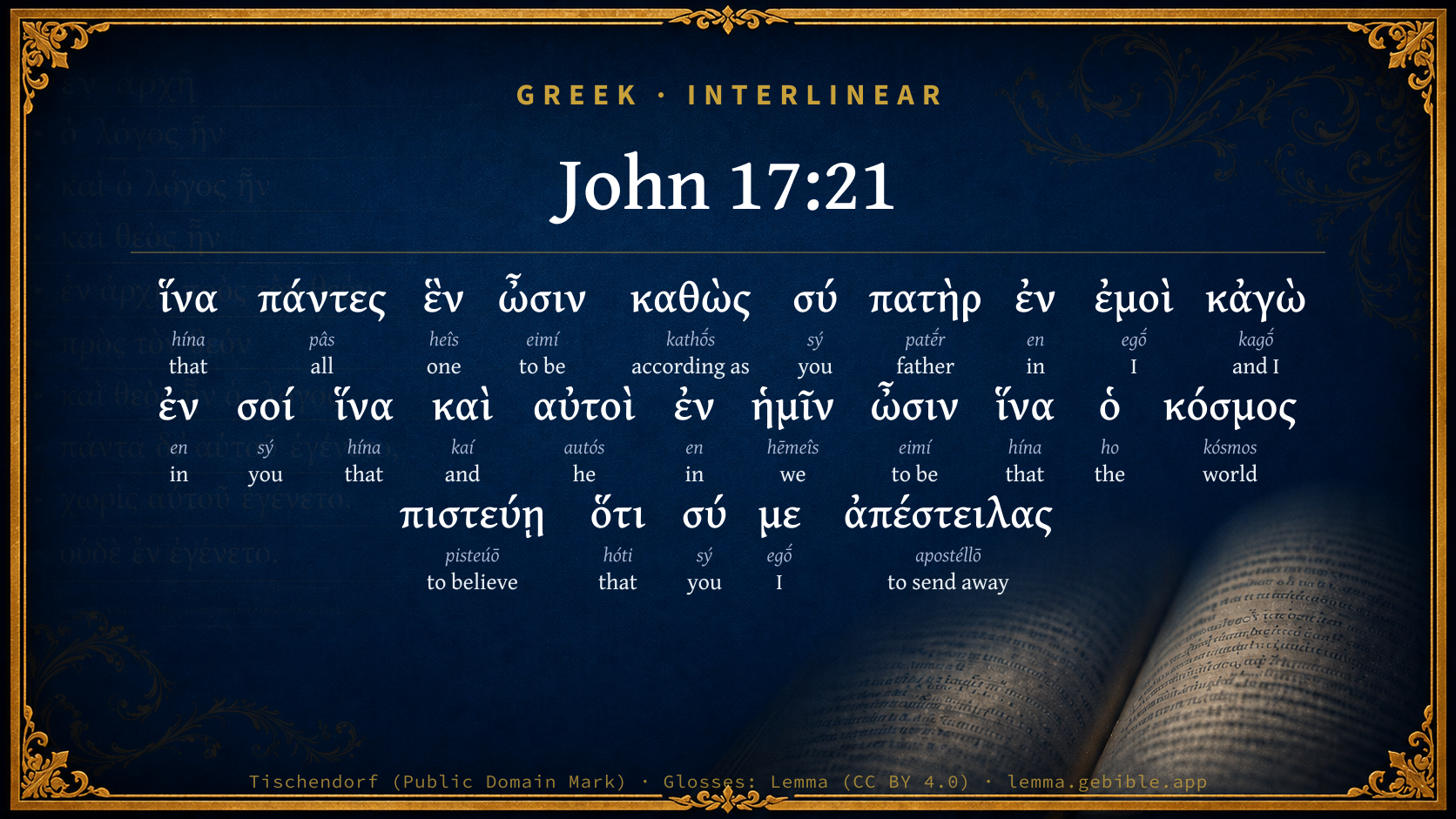
Greek (Tischendorf 8th ed.) John 17:21 appears in the Greek New Testament. The text above is from the Tischendorf 8th edition. Each word links to its Strong’s number and a concise gloss. Click any word for its full Thayer’s Greek Lexicon entry.
Download image
Cite this verse

John 17:21 (World English Bible). Public Domain. Lemma interlinear Bible study tool, https://lemma.gebible.app/v/john/17/21.

Show BibTeX & RIS
BibTeX
RIS
English Translation
that they may all be one; even as you, Father, are in me, and I in you, that they also may be one in us; that the world may believe that you sent me.
World English Bible · Public Domain
Download a study sheet

One document with this verse’s original text, its word-by-word gloss line, the meaning frame, cross-references with their text, attributed commentary, and full source and license credits — printable, and it pastes into notes with its structure intact.

This verse Autodidact and up

Study sheet (.html) Plain text (.txt)

A passage Seminary Student

Up to 50 verses in one chapter. A passage sheet keeps up to 6 commentary sources and 12 cross-references per verse, in the order this page ranks them, and says so on the sheet whenever that leaves anything out. Ask for a single verse and you get the Autodidact verse sheet above.

Everything on this page stays free to read, with no account — the sheet is a download of what is already on screen, not access to it.

Want to remove ads? Support Godless Engineer
Compare translations 3

The same verse in 3 English versions, stacked beneath the original-language interlinear above. Click any original word for its lexicon entry.

Each is an independent rendering of the whole verse — the interlinear is not word-aligned to these translations.

Highlighted words mark where these versions differ — a whole-verse word diff, not a word-by-word alignment.

  • World English Bible Public Domain
    that they may all be one; even as you, Father, are in me, and I in you, that they also may be one in us; that the world may believe that you sent me.
  • King James Version Public Domain
    That they all may be one; as thou, Father, art in me, and I in thee, that they also may be one in us: that the world may believe that thou hast sent me.
  • unfoldingWord Literal Text CC BY-SA 4.0
    that they would all be one, just as you, Father, in me, and I in you, that they also would be in us so that the world would believe that you have sent me.

unfoldingWord Literal Text — © unfoldingWord, licensed CC BY-SA 4.0. Word-aligned USFM3 via Door43 (git.door43.org/unfoldingWord/en_ult).

Versions to compare (up to 4)

3 of 4 selected

Show all 19 translations

Every available English version of this verse, each an independent rendering of the whole verse.

  • World English Bible Public Domain
    that they may all be one; even as you, Father, are in me, and I in you, that they also may be one in us; that the world may believe that you sent me.
  • Berean Standard Bible Public Domain
    that all of them may be one, as You, Father, are in Me, and I am in You. May they also be in Us, so that the world may believe that You sent Me.
  • Majority Standard Bible Public Domain
    that all of them may be one, as You, Father, are in Me, and I am in You. May they also be one in Us, so that the world may believe that You sent Me.
  • King James Version Public Domain
    That they all may be one; as thou, Father, art in me, and I in thee, that they also may be one in us: that the world may believe that thou hast sent me.
  • American Standard Version (1901) Public Domain
    that they may all be one; even as thou, Father, `art' in me, and I in thee, that they also may be in us: that the world may believe that thou didst send me.
  • Revised Version (1885) Public Domain
    that they may all be one; even as thou, Father, art in me, and I in thee, that they also may be in us: that the world may believe that thou didst send me.
  • Geneva Bible (1599) Public Domain
    That they all may bee one, as thou, O Father, art in me, and I in thee: euen that they may be also one in vs, that the worlde may beleeue that thou hast sent me.
  • Douay-Rheims (1899) Public Domain
    That they all may be one, as thou, Father, in me, and I in thee; that they also may be one in us; that the world may believe that thou hast sent me.
  • Young's Literal Translation Public Domain
    that they all may be one, as Thou Father `art' in me, and I in Thee; that they also in us may be one, that the world may believe that Thou didst send me.
  • Literal Standard Version CC BY-SA 4.0
    that they all may be one, as You Father [are] in Me, and I in You, that they also may be one in Us, that the world may believe that You sent Me.
  • Unlocked Literal Bible CC BY-SA 4.0
    so that they will all be one, just as you, Father, are in me, and I am in you. May they also be in us so that the world will believe that you have sent me.
  • unfoldingWord Literal Text CC BY-SA 4.0
    that they would all be one, just as you, Father, in me, and I in you, that they also would be in us so that the world would believe that you have sent me.
  • Darby Bible Public Domain
    that they may be all one, as thou, Father, [art] in me, and I in thee, that they also may be one in us, that the world may believe that thou hast sent me.
  • World Messianic Bible Public Domain
    that they may all be one; even as you, Father, are in me, and I in you, that they also may be one in us; that the world may believe that you sent me.
  • Webster's Bible Public Domain
    That they all may be one; as thou, Father, art in me, and I in thee, that they also may be one in us: that the world may believe that thou hast sent me.
  • Free Bible Version CC BY-SA 4.0
    I pray that they all may be one, just as you, Father, live in me, and I live in you, so that they too may live in us so that the world will believe you did send me.
  • Bible in Basic English Public Domain
    May they all be one! Even as you, Father, are in me and I am in you, so let them be in us, so that all men may come to have faith that you sent me.
  • Text-Critical English NT CC BY 4.0
    that they may all be one, just as yoʋ, Father, are in me, and I am in yoʋ, that they also may be one in us, so that the world may believe that yoʋ sent me.
  • Tyndale New Testament (1534) Public Domain
    that they all maye be one as thou father arte in me and I in the that they maye be also one in vs that the worlde maye beleve that thou hast sent me.

Literal Standard Version (2020), Covenant Press — licensed CC BY-SA 4.0. Text via the HelloAO Bible API (eBible.org). Unlocked Literal Bible (unfoldingWord) — licensed CC BY-SA 4.0. Text via the HelloAO Bible API (eBible.org). unfoldingWord Literal Text — © unfoldingWord, licensed CC BY-SA 4.0. Word-aligned USFM3 via Door43 (git.door43.org/unfoldingWord/en_ult). Free Bible Version, Dr. Jonathan Gallagher — licensed CC BY-SA 4.0. Text via the HelloAO Bible API (eBible.org).

Word by word

More ways to search: Search by grammar → Find every occurrence → Compare this word →

Practice this passage: Drill this verse → Learn its vocabulary →

κἀγὼ
kagṓ
G2504
“and I”
Personal pronoun, 1st person, Nominative, Singular, Aramaic form
Part of Speech
Personal pronoun
Person
1st person
Case
Nominative
Number
Singular
Degree
Aramaic form
Full Thayer's Definition

Origin: from G2532 and G1473 (so also the dative case kamoi kam-oy', and accusative case kame kam-eh'

TDNT: None

1. and I 2. I also, I as well, I likewise, in like manner I 3. even I, this selfsame I
  1. ἵνα hína G2443 “that” Conjunction
  2. πάντες pâs G3956 “all” Adjective, Nominative, Plural, Masculine
  3. ἓν heîs G1520 “one” Adjective, Nominative, Singular, Neuter
  4. ὦσιν eimí G1510 “to be” Verb, Present, Active, Subjunctive, 3rd person, Plural
  5. καθὼς kathṓs G2531 “according as” Adverb
  6. σύ sý G4771 “you” Personal pronoun, 2nd person, Nominative, Singular
  7. πατὴρ patḗr G3962 “father” Noun, Nominative, Singular, Masculine
  8. ἐν en G1722 “in” Preposition
  9. ἐμοὶ egṓ G1473 “I” Personal pronoun, 1st person, Dative, Singular
  10. ἐν en G1722 “in” Preposition
  11. σοί sý G4771 “you” Personal pronoun, 2nd person, Dative, Singular
  12. ἵνα hína G2443 “that” Conjunction
  13. καὶ kaí G2532 “and” Conjunction
  14. αὐτοὶ autós G846 “he” Personal pronoun, Nominative, Plural, Masculine
  15. ἐν en G1722 “in” Preposition
  16. ἡμῖν hēmeîs G2249 “we” Personal pronoun, 1st person, Dative, Plural
  17. ὦσιν eimí G1510 “to be” Verb, Present, Active, Subjunctive, 3rd person, Plural
  18. ἵνα hína G2443 “that” Conjunction
  19. ὁ ho G3588 “the” Article, Nominative, Singular, Masculine
  20. κόσμος kósmos G2889 “world” Noun, Nominative, Singular, Masculine
  21. πιστεύῃ pisteúō G4100 “to believe” Verb, Present, Active, Subjunctive, 3rd person, Singular
  22. ὅτι hóti G3754 “that” Conjunction
  23. σύ sý G4771 “you” Personal pronoun, 2nd person, Nominative, Singular
  24. με egṓ G1473 “I” Personal pronoun, 1st person, Accusative, Singular
  25. ἀπέστειλας apostéllō G649 “to send away” Verb, Aorist, Active, Indicative, 2nd person, Singular

About this verse

These counts appear in no published source. They are computed here, from the morphology-tagged text and Lemma’s own curated glosses. What Lemma adds →

26
words
18
distinct lemmas
Gospels
section

Repetition

Words recur within this verse:

Cross-references

31

Topical passages linked to John 17:21 in the Treasury of Scripture Knowledge — connected by theme and wording, ordered by reader-vote popularity; previews shown in the World English Bible.

  • 1 Corinthians 12:12 For as the body is one, and has many members, and all the members of the body, being many, are one body; so also is Christ.
  • Colossians 3:11–14 where there can't be Greek and Jew, circumcision and uncircumcision, barbarian, Scythian, bondservant, freeman; but Christ is all, and in all.
  • John 17:11 I am no more in the world, but these are in the world, and I am coming to you. Holy Father, keep them through your name which you have given me, that they may be one, even as we are.
  • 1 Corinthians 12:25–27 that there should be no division in the body, but that the members should have the same care for one another.
  • Philippians 1:27 Only let your manner of life be worthy of the Gospel of Christ, that, whether I come and see you or am absent, I may hear of your state, that you stand firm in one spirit, with one soul striving for the faith of the Gospel;
  • John 13:35 By this everyone will know that you are my disciples, if you have love for one another."
  • John 10:30 I and the Father are one."
  • John 17:22–23 The glory which you have given me, I have given to them; that they may be one, even as we are one;
  • Acts 4:32 The multitude of those who believed were of one heart and soul. Not one of them claimed that anything of the things which he possessed was his own, but they had all things in common.
  • Romans 12:5 so we, who are many, are one body in Christ, and individually members one of another.
  • Zechariah 14:9 Yahweh will be King over all the earth. In that day Yahweh will be one, and his name one.
  • Ephesians 4:3–6 being eager to keep the unity of the Spirit in the bond of peace.
  • Philippians 2:1–6 If there is therefore any exhortation in Christ, if any consolation of love, if any fellowship of the Spirit, if any tender mercies and compassion,
  • John 10:38 But if I do them, though you don't believe me, believe the works; that you may know and believe that the Father is in me, and I in the Father."
  • John 17:8 for the words which you have given me I have given to them, and they received them, and knew for sure that I came forth from you, and they have believed that you sent me.
  • Galatians 3:28 There is neither Jew nor Greek, there is neither slave nor free man, there is neither male nor female; for you are all one in Christ Jesus.
  • 1 Corinthians 1:10 Now I beg you, brothers, through the name of our Lord, Jesus Christ, that you all speak the same thing and that there be no divisions among you, but that you be perfected together in the same mind and in the same judgment.
  • 1 Peter 3:8–9 Finally, be all like-minded, compassionate, loving as brothers, tenderhearted, courteous,
  • Jeremiah 32:39 and I will give them one heart and one way, that they may fear me forever, for the good of them, and of their children after them:
  • Ezekiel 37:16–19 You, son of man, take one stick, and write on it, For Judah, and for the children of Israel his companions: then take another stick, and write on it, For Joseph, the stick of Ephraim, and [for] all the house of Israel his companions:
  • John 14:9–11 Jesus said to him, "Have I been with you such a long time, and do you not know me, Philip? He who has seen me has seen the Father. How do you say, 'Show us the Father?'
  • Ezekiel 37:22–25 and I will make them one nation in the land, on the mountains of Israel; and one king shall be king to them all; and they shall be no more two nations, neither shall they be divided into two kingdoms any more at all;
  • Zephaniah 3:9 For then I will purify the lips of the peoples, that they may all call on the name of Yahweh, to serve him shoulder to shoulder.
  • John 10:16 I have other sheep, which are not of this fold. I must bring them also, and they will hear my voice. They will become one flock with one shepherd.
  • John 17:25 Righteous Father, the world hasn't known you, but I knew you; and these knew that you sent me.
  • Acts 2:46 Day by day, continuing steadfastly with one accord in the temple, and breaking bread at home, they took their food with gladness and singleness of heart,
  • 1 John 5:7 For there are three who testify:
  • John 3:17 For God didn't send his Son into the world to judge the world, but that the world should be saved through him.
  • John 5:23 that all may honor the Son, even as they honor the Father. He who doesn't honor the Son doesn't honor the Father who sent him.
  • John 17:3 This is eternal life, that they should know you, the only true God, and him whom you sent, Jesus Christ.
  • John 17:18 As you sent me into the world, even so I have sent them into the world.

Cross-references courtesy of OpenBible.info (CC BY 4.0).

Where the printed editions differ

1 variant

Places in this verse where the major printed Greek editions disagree on the wording in a way that affects the translation — a comparison of editions, not a manuscript-by-manuscript collation. The editions are the modern critical texts (Nestlé-Aland 28/27, SBL, Westcott-Hort, Tregelles, Tyndale House) and the traditional texts behind the KJV (the Textus Receptus and the Byzantine/Majority text). It is not a claim about which reading is original.

  1. Extra text
    ἓν

    “one”

    In TynTRByz Not in NA28NA27SBLWHTreg

    ἓν (hen) 'one' is only in traditional manuscripts (Tyn+TR+Byz)

Textual data: Translators Amalgamated Greek New Testament (STEPBible TAGNT) · CC BY 4.0.

Commentary

Notes on John 17:21 from classic Christian and Jewish commentators (each source and its license shown beneath its notes). The classic Christian expositions comment on the surrounding passage and are grouped to its opening verse, so a note may address several verses; the Jewish commentaries on the Tanakh (Rashi and others) are per-verse, so they appear only where the commentator wrote on this verse.

Lemma curates 59 commentaries, every one of them public domain or Creative Commons licensed, each selected and text-cleaned for this edition rather than reprinted as found. About our sources →

Tyndale Open Study Notes

Tyndale Open Resources

17:21 For believers, becoming one with one another is an outgrowth of the union they enjoy with Jesus himself, a union modeled on the oneness of the Father and the Son. • may they be in us: Through the power of the Spirit, believers would experience a profound spiritual intimacy with the Father and the Son and be transformed (14:20, 23; 1 Jn 4:13). • Disciples of Jesus represent him, so their conduct and relationships with each other reflect the credibility of Christ in the world. When there is disunity, infighting, and intolerance, their testimony to the world is unconvincing. When people observe the community of believers, they know that it represents Jesus; a unified, loving community convinces the world to believe (John 13:35; 1 Jn 3:11).

Tyndale Open Study Notes — © Tyndale Open Resources, licensed CC BY-SA 4.0. Text via the HelloAO Bible API.

Bengel's Gnomon

Johann Albrecht Bengel

Joh 17:21. Ἵνα πάντες, that they all) So, ἵνα ὦσιν, that they may be, in Joh 17:22-23.—πάντες, all) who believe through the word of the apostles. [Those being included in the meaning, who were led to the faith not by the ministry of those Twelve; for instance, Paul, and the multitude won over by him.—V. g.] The same blessedness is obtained for all believers as was for the apostles.—ἵνα καὶ, that also) ἵνα, that, is here repeated, as if after a parenthesis, from the beginning of the verse.—ἐν ἡμῖν ἕν, one in us) The words ἐν ἡμῖν, in us, add emphasis to that ἕν, one, repeated: and those words, ἐν ἡμῖν, in us, are deduced from καθὼς, even as, etc.—ὁ κόσμος) the whole world at last.—πιστεύσῃ, may believe) when it shall see believers full of us [filled with the abiding Spirit of the Father and the Son]. There follows by gradation, γινώσκῃ may know, in Joh 17:23. Comp. Joh 17:8, “They have known surely that I came out from Thee, and they have believed.” With the world, the first stamina (groundwork) of faith precede the further and fuller knowledge, which follow. With actual believers, full faith follows close upon solid knowledge.

Bengel's Gnomon of the New Testament — English translation (T&T Clark, Edinburgh, 1860) — public domain. Text from a community e-Sword module.

Expositor's Greek Testament

ed. W. Robertson Nicoll

Joh 17:21 . For those who through their preaching believe on Him He prays that they may be one. Naturally the extension of the Church imperils its unity, the ἑνότης τοῦ πνεύματος , Eph 4:3 . “This unity is infinitely more than mere unanimity, since it rests upon unity of spirit and life.” Tholuck. This unity of all believers finds its ideal in the unity of the Father and the Son: καθὼς σὺ , πάτερ κ . τ . λ ., and not only its ideal but its unifying principle and element, ἐν ἡμῖν . This unity of all believers is to result in the universal belief in Christ’s mission, ἵνα ὁ κόσμος … ἀπέστειλας .

The Expositor's Greek Testament, edited by W. Robertson Nicoll (1897–1910) — public domain. Text from a community e-Sword module.

Jamieson, Fausset & Brown

Robert Jamieson, A. R. Fausset & David Brown

that they all may be one, as thou, Father, art in me, and I in thee, that they may be one in us--The indwelling Spirit of the Father and the Son is the one perfect bond of union, knitting up into a living unity, first all believers amongst themselves; next, this unity into one still higher, with the Father and the Son. (Observe, that Christ never mixes Himself up with His disciples as He associates Himself with the Father, but says I in THEM and THEY in US).

that the world may believe that thou hast sent me--sentest me. So the grand impression upon the world at large, that the mission of Christ is divine, is to be made by the unity of His disciples. Of course, then, it must be something that shall be visible or perceptible to the world. What is it, then? Not certainly a merely formal, mechanical unity of ecclesiastical machinery. For as that may, and to a large extent does, exist in both the Western and Eastern churches, with little of the Spirit of Christ, yea much, much with which the Spirit of Christ cannot dwell so instead of convincing the world beyond its own pale of the divinity of the Gospel, it generates infidelity to a large extent within its own bosom. But the Spirit of Christ, illuminating, transforming, and reigning in the hearts of the genuine disciples of Christ, drawing them to each other as members of one family, and prompting them to loving co-operation for the good of the world--this is what, when sufficiently glowing and extended, shall force conviction upon the world that Christianity is divine. Doubtless, the more that differences among Christians disappear--the more they can agree even in minor matters--the impression upon the world may be expected to be greater. But it is not dependent upon this; for living and loving oneness in Christ is sometimes more touchingly seen even amidst and in spite of minor differences, than where no such differences exist to try the strength of their deeper unity. Yet till this living brotherhood in Christ shall show itself strong enough to destroy the sectarianism, selfishness, carnality, and apathy that eat out the heart of Christianity in all the visible sections of it, in vain shall we expect the world to be overawed by it. It is when "the Spirit shall be poured upon us from on high," as a Spirit of truth and love, and upon all parts of the Christian territory alike, melting down differences and heart burnings, kindling astonishment and shame at past unfruitfulness, drawing forth longings of catholic affection, and yearnings over a world lying in wickedness, embodying themselves in palpable forms and active measures--it is then that we may expect the effect here announced to be produced, and then it will be irresistible. Should not Christians ponder these things? Should not the same mind be in them which was also in Christ Jesus about this matter? Should not His prayer be theirs?

Jamieson, Fausset & Brown — Commentary Critical and Explanatory on the Whole Bible (1871) — public domain (CC PDM 1.0). Text via the HelloAO Bible API.

Adam Clarke's Commentary

Verse 21. That they all may be one] This prayer was literally answered to the first believers, who were all of one heart and of one soul: Ac 4:32. And why is it that believers are not in the same spirit now? Because they neither attend to the example nor to the truth of Christ.

That the world may believe] are have already seen that the word, κοσμος, world, is used in several parts of this last discourse of our Lord to signify the Jewish people only.

Christ will have all his members to be one in spirit-one in rights and privileges, and one in the blessedness of the future world.

Adam Clarke's Commentary on the Bible (1810–1826) — public domain. Text from a community e-Sword/MySword module.

John Calvin's Commentaries

21. That all may be one. He again lays down the end of our happiness as consisting in unity, and justly; for the ruin of the human race is, that, having been alienated from God, it is also broken and scattered in itself. The restoration of it, therefore, on the contrary, consists in its being properly united in one body, as Paul declares the perfection of the Church to consist in

believers being joined together in one spirit and says that apostles, prophets, evangelists, and pastors, were given, that they might edify and restore the body of Christ, till it came to the unity of faith; and therefore he exhorts believers to grow into Christ, who is the Head, from whom the whole body joined together, and connected by every bond of supply, according to the operation in the measure of every part, maketh increase of it to edifcation, (Ephesians 4:3, 11-16.)

Wherefore, whenever Christ speaks about unity, let us remember how basely and shockingly, when separated from him, the world is scattered; and, next, let us learn that the commencement of a blessed life is, that we be all governed, and that we all live, by the Spirit of Christ alone.

Again, it ought to be understood, that, in every instance in which Christ declares, in this chapter, that he is one with the Father, he does not speak simply of his Divine essence, but that he is called one as regards his mediatorial office, and in so far as he is our Head. Many of the fathers, no doubt, interpreted these words as meaning, absolutely, that Christ is one with the Father, because he is the eternal God. But their dispute with the Arians led them to seize on detached passages, and to torture them out of their natural meaning, in order to employ them against their antagonists. Now, Christ’s design was widely different from that of raising our minds to a mere speculation about his hidden Divinity; for he reasons from the end, by showing that we ought to be one, otherwise the unity which he has with the Father would be fruitless and unavailing. To comprehend aright what was intended by saying, that Christ and the Father are one, we must take care not to deprive Christ of his office as Mediator, but must rather view him as he is the Head of the Church, and unite him with his members. Thus will the chain of thought be preserved, that, in order to prevent the unity of the Son with the Father from being fruitless and unavailing, the power of that unity must be diffused through the whole body of believers. Hence, too, we infer that we are one with the Son of God; not because he conveys his substance to us, but because, by the power of his Spirit, he imparts to us his life and all the blessings which he has received from the Father.

That the world may believe. Some explain the word world to mean the elect, who, at that time, were still dispersed; but since the word world, throughout the whole of this chapter, denotes the reprobate, I am more inclined to adopt a different opinion. It happens that, immediately afterwards, he draws a distinction between all his people and the same world which he now mentions.

The verb, to believe, has been inaccurately used by the Evangelist for the verb, to know; that is, when unbelievers, convinced by their own experience, perceive the heavenly and Divine glory of Christ. The consequence is, that, believing, they do not believe, because this conviction does not penetrate into the inward feeling of the heart. And it is a just vengeance of God, that the splendor of Divine glory dazzles the eyes of the reprobate because they do not deserve to have a clear and pure view of it. He afterwards uses the verb, to know in the same sense.

John Calvin's Commentaries (1540-1563) — public domain. Text from the Calvin Translation Society English edition (1840s-50s) via the Christian Classics Ethereal Library (ccel.org). Calvin's coverage is partial (roughly two-thirds of the Bible); uncommented books and verses are honest gaps, never fabricated. The 19th-century editor's footnotes and remarks are omitted so the notes are faithfully Calvin's own voice.

Ellicott's Commentary for English Readers

(21) That they all may be one—i.e., both “these” (the Apostles) and “them also which shall believe on Me through their word” (the whole body of believers in all times and places). He expresses in this grand thought of the unity of the whole Church the fulness of the purpose of His prayer.

As thou, Father, art in me, and I in thee, that they also may be one in us.—The insertion of “art,” which, as the italics show, is not in the original text, weakens the sense. It is better, therefore, to omit it. The word “one,” in the second clause, is of doubtful authority, and has the appearance of a gloss. The probable reading, therefore, is, That they all may be one; as Thou, Father, in Me, and I in Thee, that they also may be in Us; and the meaning is that the union of the Church may be of the same essential nature as that between the Father and the Son; yea, that the union of the Church may result from the union of individual members with the Father through the Son. (Comp. Joh_14:23; Joh_15:4-10, et al.) The Father in the Son and the Son in the Father; both Father and Son taking up their abode in the believer, and the believer, therefore, in the Father and the Son. This is the ideal of the unity of the Church of Christ; and if this union with God is realised by each individual, it necessarily follows that all the individuals will be one with each other. (Comp. Notes on Eph_4:4 et seq.)

That the world may believe that thou hast sent me.—The result of the union of believers with God, and therefore with each other, will be that the world will see in it a proof of the divine origin of Christianity, and will believe that the Father sent the Son into the world. As this will be the result, it is thought of as the purpose of the prayer for the whole body of believers. Instances of this result crowd involuntarily upon the mind. The brotherhood of Christians has ever been the witness to their common Fatherhood in God. The divisions of Christendom have ever been the weakness of the Church and the proof to the world that, in that they are divided, they cannot be of God. (Comp. Note on Joh_13:35.)

A Bible Commentary for English Readers, edited by Charles John Ellicott (1878–1897) — public domain. Text from a community e-Sword module.

The Cambridge Bible for Schools and Colleges

gen. ed. J. J. S. Perowne

21. That they all may be one] This is the purpose rather than the purport of the prayer: Christ prays for blessings for His Church with this end in view,—that all may be one.

as] Or, even as. The unity of believers is like the unity of the Father with the Son (Joh_10:30), not a merely moral unity of disposition and purpose, but a vital unity, in which the members share the life of one and the same organism (see on Rom_12:4-5). A mere agreement in opinion and aim would not convince the world. See on Joh_17:11. Omit ‘art,’ which is an insertion of our translators.

may be one in us] The balance of authority is against ‘one,’ which may be an explanatory gloss. In Joh_6:56 and Joh_15:4-5 Christ’s followers are said to abide in Him: this is to abide in His Father also.

hast sent] Better, didst send (comp. Joh_17:18). The eternal unity of believers with one another will produce such external results (‘see how these Christians love one another’), that the world will be induced to believe. Christian unity and love (Mat_7:12; Luk_6:31; 1 Corinthians 13) is a moral miracle, a conquest of the resisting will of man, and therefore more convincing than a physical miracle, which is a conquest of unresisting nature. Hence the divisions and animosities of Christians are a perpetual stumbling-block to the world.

The Cambridge Bible for Schools and Colleges (gen. ed. J. J. S. Perowne; Cambridge University Press, 1878–1918) — public domain. Text from a community e-Sword module.

John Gill's Exposition

And the glory which thou gavest me,.... Not the glory of his deity; this is the same with his Father, what he has in right of nature, and not by gift; nor can it be communicated to creatures; this would be to make them one in the Godhead, as the three are one, which is not the design of the expression in the close of the verse: nor his mediatorial glory, which he had with the Father before the world began; this indeed was given him by the Father, but is not given to the saints: nor the glory, of working miracles; which glory Christ had, and which, as man, he had from the Father, and in which his own glory was manifested; this he gave to his disciples; but all that are his have not had it, and some have had it who are none of his: rather the Gospel is meant, which is glorious in its author, matter and subject, in its doctrines, in the blessing: grace it reveals, and promises it contains, and in the efficacy and usefulness of it to the souls of men. This was given to Christ, and he gave it to his disciples:

I have given them; as he did the words that were given to him, Joh 17:8,

that they may be one, even as we are one; for the Gospel was given to the apostles, and still is to the ministers of it, to bring men to the unity of the faith, for the perfecting of the saints, and the edifying of the body of Christ: or else the fulness both of grace and glory, which is in Christ's hands for his people, is here designed. This is one considerable branch of the glory of Christ, as Mediator, to be full of grace and truth; this was given him by the Father, and is what he communicates to his; even the Spirit, and all sorts of grace, and every supply of it; and which greatly contributes to the union of the saints among themselves: yea, eternal happiness is often signified by glory; and this is given to Christ; he has it in his hands to give to others; and he does give it, a view of it, a right unto it, a meetness for it, a pledge of it, some foretastes of it, and a kind of a possession of it; for the saints have it already, at least in him; and he will give them the actual enjoyment of it, and this in order to their consummate and perfect union together, as a glorious church without spot or wrinkle, or any such thing.

John Gill's Exposition of the Whole Bible (1746–1763) — public domain (CC PDM 1.0). Text via the HelloAO Bible API.

Trapp's Complete Commentary

John Trapp

21 That they all may be one; as thou, Father, art in me, and I in thee, that they also may be one in us: that the world may believe that thou hast sent me.

Ver. 21. That they all may be one] Though not by the same kind of union whereby the Father and the Son are one, yet by a union every way as real and indissoluble; such as whereby the world may be convinced that Christ is the very Messiah, and the faithful the true Church. So it was acknowledged in the primitive times, Act 4:32. But what a sad thing was it, that a heathen should soon after have cause to say, Nullae infestae hominibus bestiae, ut sunt sibi ferales plerique Christiani; No beasts are so mischievous to men, as Christians are one to another. (Am. Marcellinus, ii. 2.) Tristissima illa persecutio sub Diocletiano, potissime orta est a petulantia, superbia et rixis sacerdotum. (Euseb.) They had not so learned Christ. Love and humility are his cognizances. Why then should the Turk have occasion to say, that he should sooner see his fingers all of a length, than Christian princes all of a mind? Why should the Jew stumble at our dissensions, which is one of the main scandals they take from Protestants?

John Trapp, A Commentary or Exposition upon All the Books of the Old and New Testament (1647–1656) — public domain. Text from a community e-Sword module.

Haydock's Catholic Bible Commentary

Christ does pray that his disciples may be one, as he and his heavenly Father are one; not that the unity may resemble the unity of persons in the divinity, by a perfect and exact likeness; but only as far as it is possible for men to imitate the perfections of God, as when he says, "Be ye merciful as your heavenly Father is merciful." (St. John Chrysostom, hom. lxxxi. in Joan.)

George Leo Haydock (1774–1849), Haydock's Catholic Family Bible and Commentary, 1859 edition — public domain. Excludes Psalms (Douay-Rheims chapter numbering differs from Protestant) and Deuterocanonical books (Catholic canon only).

Matthew Poole's English Annotations

Our Saviour here prays on the behalf of such as should believe on him, that they might be one in faith, and one in brotherly love. Whoso considereth this as a piece of Christ’s prayer for believers, and that St. Paul hardly wrote one epistle to the primitive apostolical churches in which he did not press this by most potent argument, cannot but nourish some hopes, (how improbable soever it appears at present), that all the sincere disciples of Christ shall one day arrive at the keeping of the unity of the Spirit in the bond of peace, and likewise look upon themselves in point of duty obliged to endeavour it. To which pitch of perfection possibly Christians might soon arrive, if superiors would, after the example of the apostle, Act 15:28, lay upon their inferiors no more than necessary things; and equals would learn to contend for truth in love, and to walk with their brethren so far as they have attained; and as to other things, to forbear one another in love; and wherein any of their brethren are otherwise minded, then they are to wait till God shall reveal it to them, Phi 3:15. But this is not all the union which Christ prays for; he also prays that they might be one in the Father and the Son; that is, that they might believe; for faith is that grace by which we are united to, and made one with, God and Christ; though others interpret it of obedience, or such things wherein God the Father and Christ are one, &c. For although so many as are ordained to life shall believe, yet that they might believe is matter of prayer: this our Saviour prays for, for the further glory of God, which is that which he meaneth by the world’s believing that God had sent him; there being no greater evidence that Christ is the true Messiah, than the general acceptance of the doctrine of the gospel, which he brought throughout the world; for who can imagine, that a new doctrine brought into the world by one of no greater reputation than Christ had in the world, and propagated by persons of no greater quality than the apostles were, should obtain in the greatest part of the world, if he that first introduced it had not been first sent by God into the world, and the apostles had not been extraordinarily influenced and assisted by God as to the propagation of it, after Christ was ascended into heaven?

Matthew Poole's English Annotations on the Holy Bible (1683–1685) — public domain. Text from a community e-Sword/MySword module.

Whedon's Commentary on the Bible

Daniel D. Whedon

21. May be one—Amid every diversity there is among true Christians a true unity. So amid many varieties, external and striking, the human race has a unity internal and absolute. One touch of feeling makes the whole world akin. Universal man, and man alone, has the moral emotion, the religious susceptibility, the power to possess an idea of the infinite God.

The European, the Chinaman, the Hottentot, can be brought to worship the Omnipotent; but not the dog, the elephant, or the gorilla. So, amid every outward diversity, there is in the Christian body the true unity of the Spirit. The attempt has been made to bring that body under one human head, the Pope, and what has been the result? The head became ambitious, corrupt, despotic, infidel, and bloody. This was substituting for God’s unity of the Spirit man’s unity of temporal power.

As thou… and I—The opposer of the doctrine of the Trinity very vainly attempts to prove that the Logos, or Word, can be no more one with God, than one Christian man can be one with another. But the as here indicates not equality in degree, but similarity in nature according to the human likeness and proportion to the Divine. As of Christian perfection the ideal is God, so of Christian unity the model is the ever-blessed Trinity. (See note on Mat_5:48. Also, Joh_14:9-10.) For man was made in the image of God. Of the Church, as of the Trinity, the unity is spiritual.

That… that… that—There are three thats in this verse. The first two are parallel to each other, the latter enlarging the other, and both depend on pray in the previous verse. Christ directly prays that his followers may be one; and that they may be one in us. The third that depends upon these two. May they be one in us, that the world may be inspired, by that unity, with faith.

The world—Stands in a double aspect: as the embodied enemy of Christ, and, as such, no object of prayer; and as the raw material from which the future Church must be won and shaped, and, as such, the object of this extension of prayer. And in the following verses Christ prays that the Church may be perfect in one, both for its own blessed sake and for the winning the world to faith. No limits are assigned to the diffusion of faith through the world; but the Saviour, justifying a holy ambition in his Church to win the whole, prays that the world may believe, and nothing less.

Daniel D. Whedon (gen. ed.), Commentary on the Old and New Testaments (1874–1909) — public domain. Text from a community e-Sword module.

The Pulpit Commentary

That they all may be one. My prayer is that the many may become one, form one living glorious unity; every part of which spiritual organism, while living a separate and differentiated life, is yet a part of a whole. In the natural sphere, as the parts of a whole organism are mere and more developed, and increasingly resemble individualities in their separation, they are in the same proportion dependent on the whole for the life that is in them. Even in a highly organized community, as the separate individuals have more and more personal consciousness of special function, they become the more dependent on the whole, and in one sense lost in the unity to which they belong. The branches in the vine form together one vine; the members of a body, being many, are one body and members of one another. It is open to discussion whether the kayw clause, which here follows, characterizes the above statement, as Meyer and many others urge, or whether, with Godet, the sentence, "That they all may be one," should not be taken as a general statement, to be followed by the kaywv clause, which characterizes the following words. The first method is a more rational interpretation, nor does the sentence drag. According as thou, Father, (art) in me, and I (am) in thee; i.e. the relation between the Father and Son, the manner in which the Father lives in the Son, as in his organ or instrument of manifestation and object of supreme affection, and as the Son is in the Father, abiding ever in the light of his glory, in the power of his Name, and as these two are thus One in being, so, or similarly, the believers are to live in and for each other, becoming a unity, just as the Father and Son are unity. In order that they themselves also may be one in us. This ina does not offer a parallel sentence in apposition with the former, nor is the "that" to be inverted, with Godet, who translates, "that according as thou.., they also may be one in us;" but it is the climax of the whole unifying process, after the likeness of the union between the Father and the Son, viz. that they themselves may be included in this unity. Though they are thus to be lost in God, yet they do not lose their own individuality. Nay, in proportion to their organic relation to the fullness of the Godhead and the completeness of their own spiritual fellowship with one another, will this personal consciousness of theirs become more and more pronounced. There is yet a further process contemplated, viz. in order that the world may believe (pisteuh , as in the next verse; ginwskh , in the present subjunctive, rather than the aorist) that thou didst send me. The spiritual life and unity of the Church will produce an impression on the world which now rejects the Christ and does not appreciate his Divine commission. The union which springs from the blended life of the various and even contradictory elements in the Church will prove the reality of its origin. The world will believe, this is the final purpose of the intercession concerning the disciples; so though above he did not pray for the world as the then immediate object of his intercession, the poor world is in his heart, and the saving of the world the end of his incarnation. If the union between the Father and the Son is the sublime type of the union between those who shall believe, it is not the union of a great society in accordance with certain invincible rules of affiliation and government. The union between the Father and Son is not a visible manifestation, but a spiritual inference. The common indwelling in the Father and Son, the identity of the spiritual emotion and purpose in all who have one Lord, one faith, one baptism, will convince the world by producing a similar inference. Alford: "This unity is not mere outward uniformity, nor can such uniformity produce it. At the same time, its effects are to be real and visible, such that the world may see them." A prayer for unity.

I LOOK AT THIS PRAYER IN THE LIGHT OF PENTECOST. Within two months from the utterance of the prayer, the apostles, through their spokesman Peter, uttered forth their first great word concerning their glorified and ascended Master, and in that same day there was added to the apostles about three thousand souls. Thus within this short time the first company of them believing in Jesus through the word of his apostles made its appearance. Jesus was not turning a bare possibility into a certainty when he referred so confidently to those who would believe in him through the word of his servants. What faith he had in humanity! Some who have watched and, as they would say, studied mankind, speak of them as a physician might speak of some one very ill, when he says the sick person cannot possibly get better. Jesus, on the other hand, is the Physician, who, while he allows that things are indeed very bad, magnifying our natural misery and helplessness to the utmost, yet at the same time proclaims in trumpet-tones a real cure, though the only one. Three thousand were added to the apostles. They all became one company, not only in spirit, not only in ultimate aim and hope, but in the most literal meaning of the word.

Thus at Pentecost there came an outward unity such as the world had never seen before.

II LOOK AT THE DISCORDS AND BREACHES THAT SOON MADE THEIR APPEARANCE. The unity of Pentecost did not and could not last; it was but the outcome of a fervid, first love, and as time rolled on those who had been thus united lapsed into their old separation and contrariety. The old man, full grown and vigorous, is not to be dispossessed by the new creature in Christ Jesus without a serious struggle. Even in the first days a Meat deal happened that might almost make one think the disciples of Jesus set no store at all by their Master"s prayers, and never troubled to recollect the desires on which he had set his heart. No proper means was taken to nourish and cherish the power of the Holy Ghost in the hearts of all the believers. Thus it is little wonder the widows had to complain that they were neglected in the daily ministrations. Little wonder, too, that Peter, the very leader on the Day of Pentecost, proved unfaithful to the principle of Christian unity. He either forgot or had never properly comprehended that in Jesus there is neither Jew nor Gentile; and so he wanted Gentiles to become Jews before he would allow them to be Christians.

III WHAT WE INDIVIDUALLY MUST DO FOR UNITY. Jesus wants the world to believe that the Father has sent him sent him out of another world where all is harmony, into a world where, apart from him, all is discord. And the world will only believe when it sees beautiful, lovable things done under its very eyes. We must each of us be a real unity, entirely in accord with Jesus our Master, even as he was in entire accord with his Father. As the Father was seen in Jesus, so the Christ should be seen in us. The spirit of the loving, laboring, life-giving Jesus should be worked into the very foundation of our nature; then that small part of the world which has to do with us may indeed believe that One has been sent from heaven to make men into a happy and united family. Y.

The Pulpit Commentary (1880–1919), ed. H.D.M. Spence-Jones & Joseph S. Exell — public domain. Text from a community e-Sword module.

John Wesley's Explanatory Notes

As thou art in me - This also is to be understood in a way of similitude, and not of sameness or equality. That the world may believe - Here Christ prays for the world. Observe the sum of his whole prayer,

1. Receive me into thy own and my glory;

2. Let my apostles share therein;

3. And all other believers:

4. And let all the world believe.

John Wesley, Explanatory Notes Upon the Whole Bible (1754–1765) — public domain. Text via the GEBible commentary corpus.

Scofield Reference Notes

C. I. Scofield

world

kosmos = mankind. (See Scofield "Mat 4:8").

The Scofield Reference Bible (1917 edition), notes by C. I. Scofield — public domain. Text from a community e-Sword module.

Burkitt's Expository Notes on the New Testament

William Burkitt

The special mercy, and particular blessing which Christ prays for on behalf of believers, is a close and intimate union betwixt the Father, himself, and them, and also betwixt one another; such an union as doth in some sort resemble that union which is betwixt God and Christ; not an unity of essence and nature, but of wills and affections.

Hence note, 1. That the mystical union betwixt Christ and his members carrieth some resemblance with that union which is betwixt the Father and the Son.

2. That the union amongst the ministers and members of Jesus Christ, is of so great importance, necessity, and consequence, that he did in their behalf principally and chiefly pray for it. An unity of love and affection, of faith and profession, an unity of practice and conversation, are mercies which Christ earnestly prayed for, and has dearly paid for; and nothing is more desired by him now in heaven than that his disciples should be one among themselves here on earth: Father, may they be one, as we are one: that the world may believe that thou hast sent me.

Here Christ intimates one special advantage that would redound to the world by this desirable union betwixt the ministers and members of Christ; it will, if not convert, yet at least convince the world, that I and my doctrine came from God.

Thence note, that union amongst Christ’s disciples is one special mean to enlarge the kingdom of Christ, and to cause the world to have better thoughts of him and his doctrine: By their being one, as we are one, the world will believe that thou hast sent me.

William Burkitt's Expository Notes on the New Testament (1700–1703) — public domain. Text from a community e-Sword module.

The People's New Testament

B. W. Johnson

21. That they all may be one; … that they may be one in us. This is a prayer for the unity of the saints. The Lord all through this discourse has shown the intimate union between the Father and himself. The Father is in him and he in the Father, all that is the Father's is his, and his is the Father's. They have no separate will, kingdom, or interests. Such a union is demanded among the disciples of Christ. Such union is impossible while they are divided into various denominations, with separate work, property and interests, separate churches, colleges, papers and missions. Denominationalism is utterly opposed to this prayer, and every apologist for it is disloyal to the spirit of the prayer. Nor is it fulfilled in any church where there are factions, where “all are not perfectly joined together, of the same mind and the same judgment.” If Christ abides in the heart, the one life will draw all who have Christ formed within them into one family. This unity is needful, and for it the Lord prays, That the world may believe that thou hast sent me. It must be a union that the world can see and recognize. It is therefore an organic union, one Body as there is one Lord. There is no other source of skepticism so fruitful as church quarrels and sectarian divisions.

B. W. Johnson's The People's New Testament with Notes (1889–1891) — public domain. Electronic text from the Christian Classics Ethereal Library (CCEL) ThML edition.

Cambridge Greek Testament for Schools and Colleges

21. After ἐν ἡμῖν omit ἕν (an insertion from the first clause: comp. Joh 17:11; Joh 17:22). Confusion between the clauses makes several patristic quotations ambiguous; but the insertion is strongly supported.

21. ἓν ὦσιν. This is the purpose rather than the purport of the prayer: Christ prays for blessings for His Church with this end in view—that all may be one.

καθώς depends on the second ἵνα, not on the first (comp. Joh 13:34): the unity of believers is even as the unity of the Father with the Son (Joh 10:30); not a mere moral unity of disposition, but a vital unity, in which the members share the life of one and the same organism (Rom 12:4-5). Mere agreement in opinion and aim would not convert the world; whereas the eternal unity of believers will produce such external results (‘see how these Christians love one another’), that the world will believe that God sent their Master. Christian unity and love (Mat 7:12; Luk 6:31; 1 Corinthians 13) is a moral miracle, a conquest of the resisting will of man, and therefore more convincing than a physical miracle, which is a conquest of unresisting matter. Hence the quarrels of Christians are a perpetual stumbling-block to the world.

The parallel between this verse and 1Jn 1:3 is remarkable. If ἀπαγγέλλομεν refers to the Gospel and not to the Epistle, as is probable, then S. John wrote his Gospel in order that this prayer of Christ might be fulfilled.

Cambridge Greek Testament for Schools and Colleges (Cambridge University Press, 1896; 21 vols, various authors incl. Carr, Maclear, Plummer, Farrar, Lumby, Moule, M. R. James, Simcox) — public domain. Text from a community e-Sword module.

Alford’s Greek Testament

Henry Alford

21.] The ἵνα here hardly can regard the subject-matter of the ἐρωτῶ, ver. 20, but rather we should supply after that word ταῦτα, and understand this ἵνα as expressing the object of the prayer respecting both. The subject-matter of the prayer is, that they may be kept in God’s name and sanctified in God’s truth; and if this be so, their unity with the Son and the Father follows, 1Jn 1:3. But here it is not merely ‘with,’ but in, the Son and the Father;—because the Spirit proceeds from the Father and the Son, and ‘He that is joined to the Lord, is one Spirit:’ see ver. 11. This unity has its true and only ground in faith in Christ through the Word of God as delivered by the Apostles; and is therefore not mere outward uniformity, nor can such uniformity produce it. At the same time its effects are to be real and visible, such that the world may see them.

ἵνα πιστ.] Not parallel with the former ἵνα, as if πιστ. ὁ κόσμος meant the same as πάντες ἓν ὦσι, that all may be brought to believe. Nor again can the words mean that the unbelieving and condemned world, at the end, may be persuaded ‘that Thou hast sent Me.’ Such a rendering would surely be repugnant to the spirit of the prayer, and the use of the word πιστεύω in our Gospel. Rather is it,—‘that this their testimony, being borne by them all, and in all ages, may continue to convince the world, so that many in the world may believe,’ &c.

The ὅτι σύ με ἀπέστειλας implies belief in the whole Work and Office of Christ. Here our Lord certainly prays for the world,—see above on ver. 9.

See a remarkable parallel, Rev 3:9, where, as Stier truly remarks, the persons spoken of are penitents.

22,

Henry Alford, The Greek Testament (1849–1861) — public domain. Text from a community e-Sword module.

International Critical Commentary

21. As the Church grew, so would the risk of disunion among its members be intensified. Jesus had already prayed that His apostles might be united in will and purpose even as the Father and the Son are united (v. 11, ἵνα ὦσιν ἓν καθὼς ἡμεῖς). He now repeats this petition for all future disciples, ἵνα πάντες ἓν ὦσιν, stating more fully what the nature of this ideal unity was to be.

There is no suggestion of a unity of organisation, such as that which appears in Paul’s conception of the Church as one body with many members, each performing its appropriate function (Rom 12:4f., 1Co 12:12f.). No biological analogy is offered here to assist us in comprehending the sense in which Christians are intended to be one. Jesus had said already that His sheep would ultimately be One Flock, even as they had One Shepherd (10:16). But the mystical phrases used in this passage transcend even that thought. For He prays that the unity of His disciples may be realised in the spiritual life, after the pattern of that highest form of unity, in which the Father is “in” the Son and the Son “in” the Father. This unity, however, as appertaining to Christian discipleship, is not invisible; it is to be such as will convince the world of the Divine mission of the common Master of Christians. And He has already explained that the badge of this unity is love, the love of Christian for Christian which all men may see (13:35).

ἵνα πάντες ἓν ὦσιν. For the use of the neuter singular here, see on 10:30; and cf. ἵνα τὰ τέκνα τοῦ θεοῦ … συναγάγῃ εἰς ἕν (11:52).

καθὼς σύ, Πάτερ, ἐν ἐμοὶ (cf. 14:10, 20) κἀγὼ ἐν σοί (cf. 14:11). That men might come to acknowledge this central assertion of His claim had been the immediate object of His mission (see on 10:38).

Jn. always expresses the voc. by πάτερ. In this passage πατήρ is read by BDW, and by AB at vv. 24, 25. See Abbott, Diat. 2052, and cf. note on [8]:10.

ἵνα καὶ αὐτοὶ ἐν ἡμῖν ὦσιν. Before ὦσιν the rec. text inserts ἕν, with אAC3LNΘ, but BC*DW a b c e om. ἕν. It has probably come in from the earlier clause ἵνα πάντες ἓν ὦσιν.

The ideal is that all Christians may be ἐν ἡμῖν. “Abide in me” was the counsel of 15:4 (cf. 1Jn 3:24, 1Jn 5:20), but rightly obeyed this implies abiding in God; the use of the plural ἡμῖν here, recalling the plural verbs at 14:23. Cf. 1Jn 1:3, ἡ κοινωνία ἡ ἡμετέρα μετὰ τοῦ πατρὸς καὶ μετὰ τοῦ υἱοῦ αὐτοῦ Ἰησοῦ Χριστοῦ. To be “in Christ” is to be “in God.” Those who are thus “in God” share the Divine life in common, and are therefore one, ἓν καθὼς ἡμεῖς (v. 11); it being always remembered that καθώς in such passages is only suggestive of a partial, not a complete, analogy (see on v. 18 above, and cf. 6:57).

Ignatius has some sentences reminiscent of these thoughts, where he approves the Ephesian Christians for being closely joined with the bishop: “as the Church is with Jesus Christ, and as Jesus Christ is with the Father, that all things may be harmonious in unity (ἵνα πάντα ἐν ἑνότητι σύμφωνα ᾖ, Eph_5).

ἵνα ὁ κόσμος πιστεύῃ ὅτι σύ με ἀπέστειλας. The consequence of the spiritual unity of Christians, as indicated by their common love for each other, is that the world will be at last convinced (cf. 16:8) that the mission of Jesus was divine, and that He is “the Saviour of the world” (4:42). For such forecasts of universal homage, cf. Rev 3:9 and 1Co 15:28. See v. 23 below.

πιστεύῃ. So א*B*W, but the rec., with אcADLNΘ, has the inferior reading πιστεύσῃ. πιστεύῃ indicates the gradual growth of faith, “may come to believe.”

International Critical Commentary — older volumes (1896–1929), various authors — public domain. Text from a community e-Sword module.

Vincent's Word Studies in the New Testament

Marvin R. Vincent

One. Omit.

Marvin R. Vincent, Word Studies in the New Testament (1887–1900) — public domain. Text from a community e-Sword/MySword module.

Lesson kit

Teaching starters — assembled from the data on this page, not authored interpretation. Every prompt links to the verse data it draws on. Edit before teaching.

John, in the Gospels, opens this verse with 26 words (18 distinct Greek lemmas). Its most distinctive word is kagṓ (“and I”). A historical commentator’s framing appears above. Read the whole chapter for the surrounding context.

Discussion questions

  1. The word kagṓ carries the sense “and I.” How does it shape the verse?
  2. 1 Corinthians 12:12 shares this passage’s theme. How do the two illuminate each other?
  3. “to be” occurs 2× in this one verse. What is the effect of the repetition?
  4. These translations render this verse differently. What is at stake in choosing one wording over another?
  5. Reading how Tyndale Open Study Notes and Bengel's Gnomon read this verse, where do the two commentators agree and where do they part?

Things to notice

  • These translations choose different wording for 6 words in this verse.
  • “to be” occurs 2× in this single verse.
  • 18 distinct Greek lemmas span 26 words in this verse.

Reading settings

Reading text

Shown beneath each verse's original-language words.

Old Testament
Old Testament edition

Read the OT as the Masoretic Hebrew (MT) or the Greek Septuagint (LXX).

English shown for the Greek Septuagint (in the Hebrew ↔ Greek comparison).

Comparing translations? Open the Compare panel on any verse page to stack up to four side by side.