

John 18:28
Greek (Tischendorf 8th ed.) John 18:28 appears in the Greek New Testament. The text above is from the Tischendorf 8th edition. Each word links to its Strong’s number and a concise gloss. Click any word for its full Thayer’s Greek Lexicon entry.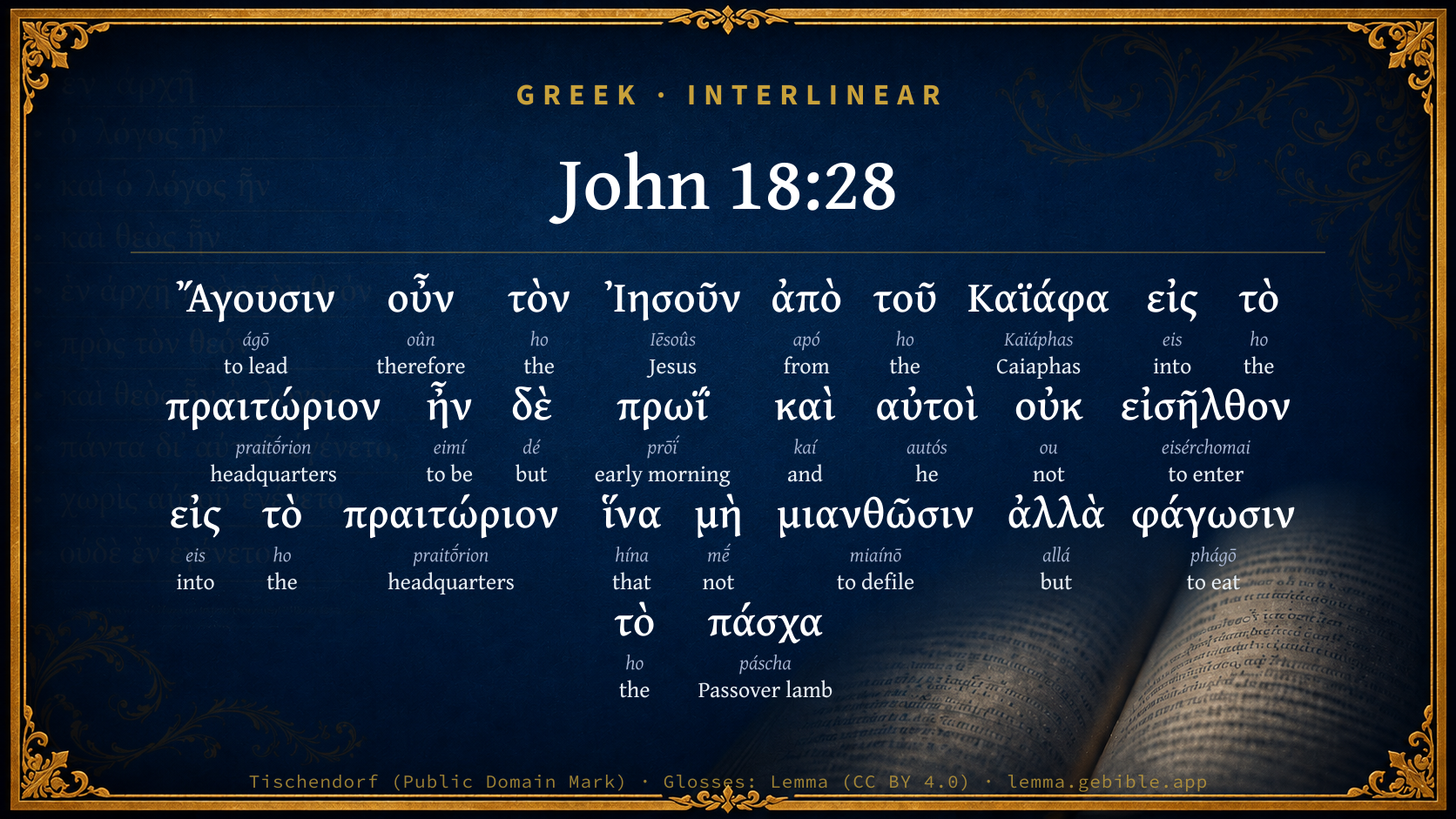
They led Jesus therefore from Caiaphas into the Praetorium. It was early, and they themselves didn't enter into the Praetorium, that they might not be defiled, but might eat the Passover.
Download a study sheet
One document with this verse’s original text, its word-by-word gloss line, the meaning frame, cross-references with their text, attributed commentary, and full source and license credits — printable, and it pastes into notes with its structure intact.
This verse Autodidact and up
A passage Seminary Student
Up to 50 verses in one chapter. A passage sheet keeps up to 6 commentary sources and 12 cross-references per verse, in the order this page ranks them, and says so on the sheet whenever that leaves anything out. Ask for a single verse and you get the Autodidact verse sheet above.
Everything on this page stays free to read, with no account — the sheet is a download of what is already on screen, not access to it.
Compare translations 3
The same verse in 3 English versions, stacked beneath the original-language interlinear above. Click any original word for its lexicon entry.
Each is an independent rendering of the whole verse — the interlinear is not word-aligned to these translations.
Highlighted words mark where these versions differ — a whole-verse word diff, not a word-by-word alignment.
-
World English Bible Public Domain
They led Jesus therefore from Caiaphas into the Praetorium. It was early, and they themselves didn't enter into the Praetorium, that they might not be defiled, but might eat the Passover.
-
King James Version Public Domain
Then led they Jesus from Caiaphas unto the hall of judgment: and it was early; and they themselves went not into the judgment hall, lest they should be defiled; but that they might eat the passover.
-
unfoldingWord Literal Text CC BY-SA 4.0
Then they led Jesus from Caiaphas to the governor’s palace. (Now it was early in the morning, and they did not enter into the governor’s palace so that they would not be defiled, but might eat the Passover.)
unfoldingWord Literal Text — © unfoldingWord, licensed CC BY-SA 4.0. Word-aligned USFM3 via Door43 (git.door43.org/unfoldingWord/en_ult).
Show all 19 translations
Every available English version of this verse, each an independent rendering of the whole verse.
-
World English Bible Public Domain
They led Jesus therefore from Caiaphas into the Praetorium. It was early, and they themselves didn't enter into the Praetorium, that they might not be defiled, but might eat the Passover.
-
Berean Standard Bible Public Domain
Then they led Jesus away from Caiaphas into the Praetorium. By now it was early morning, and the Jews did not enter the Praetorium, to avoid being defiled and unable to eat the Passover.
-
Majority Standard Bible Public Domain
Then they led Jesus away from Caiaphas into the Praetorium. By now it was early morning, and the Jews did not enter the Praetorium, to avoid being defiled and unable to eat the Passover.
-
King James Version Public Domain
Then led they Jesus from Caiaphas unto the hall of judgment: and it was early; and they themselves went not into the judgment hall, lest they should be defiled; but that they might eat the passover.
-
American Standard Version (1901) Public Domain
They lead Jesus therefore from Caiaphas into the Praetorium: and it was early; and they themselves entered not into the Praetorium, that they might not be defiled, but might eat the passover.
-
Revised Version (1885) Public Domain
They lead Jesus therefore from Caiaphas into the palace: and it was early; and they themselves entered not into the palace, that they might not be defiled, but might eat the passover.
-
Geneva Bible (1599) Public Domain
Then led they Iesus from Caiaphas into the common hall. Nowe it was morning, and they themselues went not into the common hall, least they should be defiled, but that they might eate the Passeouer.
-
Douay-Rheims (1899) Public Domain
Then they led Jesus from Caiphas to the governor's hall. And it was morning; and they went not into the hall, that they might not be defiled, but that they might eat the pasch.
-
Young's Literal Translation Public Domain
They led, therefore, Jesus from Caiaphas to the praetorium, and it was early, and they themselves did not enter into the praetorium, that they might not be defiled, but that they might eat the passover;
-
Literal Standard Version CC BY-SA 4.0
They led, therefore, Jesus from Caiaphas into the Praetorium, and it was early, and they themselves did not enter into the Praetorium, that they might not be defiled, but that they might eat the Passover;
-
Unlocked Literal Bible CC BY-SA 4.0
Then they led Jesus from Caiaphas to the government headquarters. It was early in the morning, and they did not enter the government headquarters so that they would not be defiled but would eat the Passover.
-
unfoldingWord Literal Text CC BY-SA 4.0
Then they led Jesus from Caiaphas to the governor’s palace. (Now it was early in the morning, and they did not enter into the governor’s palace so that they would not be defiled, but might eat the Passover.)
-
Darby Bible Public Domain
They lead therefore Jesus from Caiaphas to the praetorium; and it was early morn. And *they* entered not into the praetorium, that they might not be defiled, but eat the passover.
-
World Messianic Bible Public Domain
They led Yeshua therefore from Caiaphas into the Praetorium. It was early, and they themselves didn’t enter into the Praetorium, that they might not be defiled, but might eat the Passover.
-
Webster's Bible Public Domain
Then they led Jesus from Caiaphas to the hall of judgment: and it was early; and they themselves went not into the judgment-hall, lest they should be defiled; but that they might eat the passover.
-
Free Bible Version CC BY-SA 4.0
Early in the morning they took Jesus from Caiaphas to the palace of the Roman governor. The Jewish leaders didn't enter the palace because if they did they would become ceremonially unclean and they wanted to be able to eat the Passover meal.
-
Bible in Basic English Public Domain
So they took Jesus from the house of Caiaphas to the Praetorium. It was early. They themselves did not go into the Praetorium, so that they might not become unclean, but might take the Passover.
-
Text-Critical English NT CC BY 4.0
Then the Jews led Jesus away from Caiaphas to the governor's headquarters. It was now early in the morning. They themselves did not go into the governor's headquarters so that they would not be defiled, but could eat the Passover.
-
Tyndale New Testament (1534) Public Domain
Peter denyed it agayne: and immediatly the cocke crewe.
Literal Standard Version (2020), Covenant Press — licensed CC BY-SA 4.0. Text via the HelloAO Bible API (eBible.org). Unlocked Literal Bible (unfoldingWord) — licensed CC BY-SA 4.0. Text via the HelloAO Bible API (eBible.org). unfoldingWord Literal Text — © unfoldingWord, licensed CC BY-SA 4.0. Word-aligned USFM3 via Door43 (git.door43.org/unfoldingWord/en_ult). Free Bible Version, Dr. Jonathan Gallagher — licensed CC BY-SA 4.0. Text via the HelloAO Bible API (eBible.org).
Word by word
More ways to search: Search by grammar → Find every occurrence → Compare this word →
Practice this passage: Drill this verse → Learn its vocabulary →
- Appears 5× in the Greek New Testament
- First appears here
- Part of Speech
- Verb
- Tense
- Aorist
- Voice
- Passive
- Mood
- Subjunctive
- Person
- 3rd person
- Number
- Plural
Full Thayer's Definition
- Ἄγουσιν ágō G71 “to lead” Verb, Present, Active, Indicative, 3rd person, Plural
- οὖν oûn G3767 “therefore” Conjunction
- τὸν ho G3588 “the” Article, Accusative, Singular, Masculine
- Ἰησοῦν Iēsoûs G2424 “Jesus” Noun, Accusative, Singular, Masculine
- ἀπὸ apó G575 “from” Preposition
- τοῦ ho G3588 “the” Article, Genitive, Singular, Masculine
- Καϊάφα Kaïáphas G2533 “Caiaphas” Noun, Genitive, Singular, Masculine
- εἰς eis G1519 “into” Preposition
- τὸ ho G3588 “the” Article, Accusative, Singular, Neuter
- πραιτώριον praitṓrion G4232 “headquarters” Noun, Accusative, Singular, Neuter
- ἦν eimí G1510 “to be” Verb, Imperfect, Active, Indicative, 3rd person, Singular
- δὲ dé G1161 “but” Conjunction
- πρωΐ prōḯ G4404 “early morning” Adverb
- καὶ kaí G2532 “and” Conjunction
- αὐτοὶ autós G846 “he” Personal pronoun, Nominative, Plural, Masculine
- οὐκ ou G3756 “not” Particle, Negative
- εἰσῆλθον eisérchomai G1525 “to enter” Verb, Aorist, Active, Indicative, 3rd person, Plural
- εἰς eis G1519 “into” Preposition
- τὸ ho G3588 “the” Article, Accusative, Singular, Neuter
- πραιτώριον praitṓrion G4232 “headquarters” Noun, Accusative, Singular, Neuter
- ἵνα hína G2443 “that” Conjunction
- μὴ mḗ G3361 “not” Particle, Negative
- μιανθῶσιν miaínō G3392 “to defile” Verb, Aorist, Passive, Subjunctive, 3rd person, Plural
- ἀλλὰ allá G235 “but” Conjunction
- φάγωσιν phágō G5315 “to eat” Verb, Aorist, Active, Subjunctive, 3rd person, Plural
- τὸ ho G3588 “the” Article, Accusative, Singular, Neuter
- πάσχα páscha G3957 “Passover lamb” Aramaic transliteration
About this verse
These counts appear in no published source. They are computed here, from the morphology-tagged text and Lemma’s own curated glosses. What Lemma adds →
- 27
- words
- 21
- distinct lemmas
- Gospels
- section
Notable vocabulary
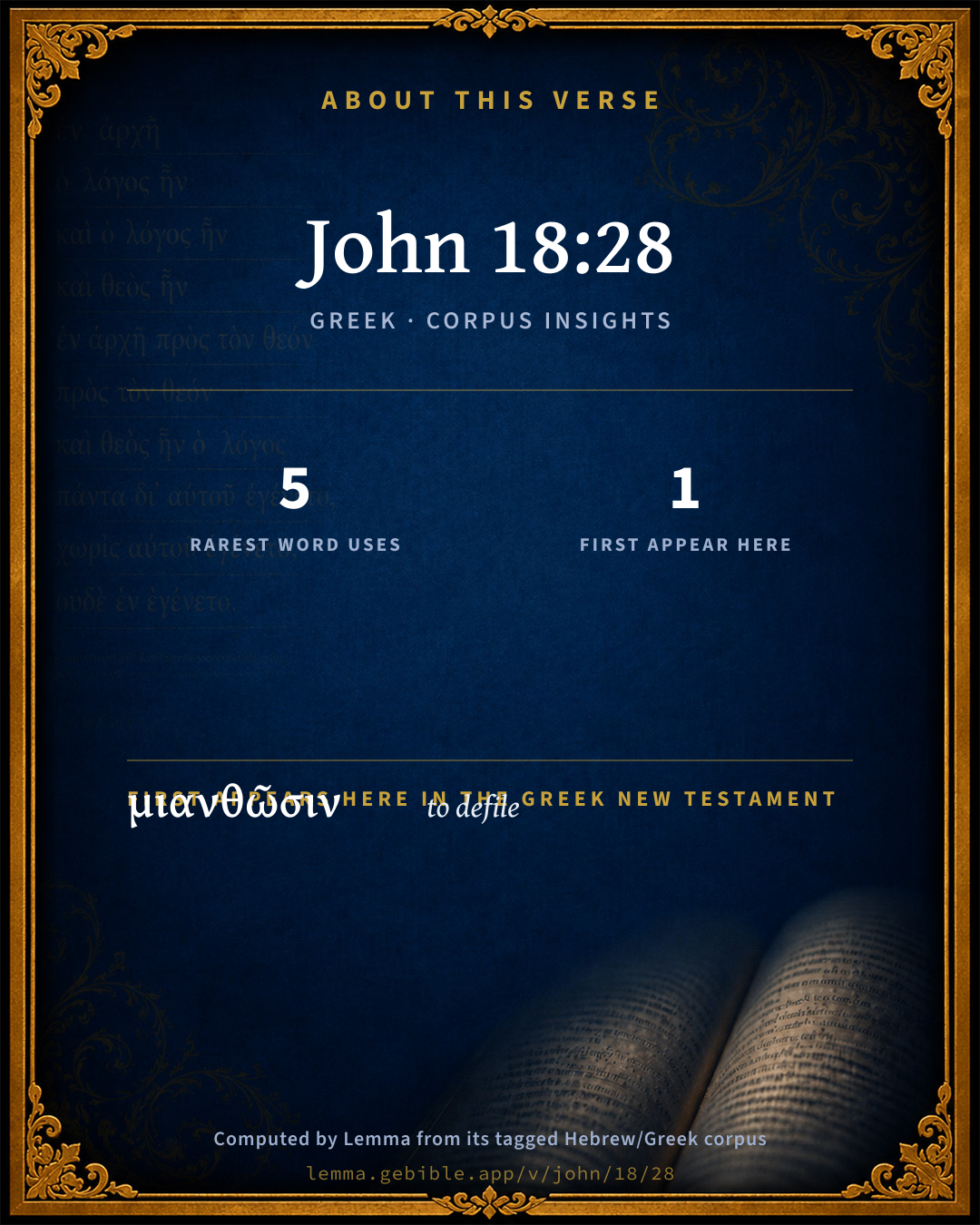
The rarest word here is μιανθῶσιν to defile G3392 — appearing just 5 times in the whole Greek New Testament.
First appearance in Scripture
This word makes its first canonical appearance in the Greek New Testament here:
- μιανθῶσιν to defile G3392
Shared distinctive vocabulary
μιανθῶσιν to defile G3392 occurs in 4 verses of the Greek New Testament. Also found in:
Cross-references
28Topical passages linked to John 18:28 in the Treasury of Scripture Knowledge — connected by theme and wording, ordered by reader-vote popularity; previews shown in the World English Bible.
- John 18:33 Pilate therefore entered again into the Praetorium, called Jesus, and said to him, "Are you the King of the Jews?"
- John 19:9 He entered into the Praetorium again, and said to Jesus, "Where are you from?" But Jesus gave him no answer.
- Matthew 27:27 Then the governor's soldiers took Jesus into the Praetorium, and gathered the whole garrison together against him.
- Mark 15:1–5 Immediately in the morning the chief priests, with the elders and scribes, and the whole council, held a consultation, and bound Jesus, and carried him away, and delivered him up to Pilate.
- John 19:14 Now it was the Preparation Day of the Passover, at about the sixth hour. He said to the Jews, "Behold, your King!"
- Isaiah 1:10–15 Hear the word of Yahweh, you rulers of Sodom! Listen to the law of our God, you people of Gomorrah!
- Matthew 27:1–10 Now when morning had come, all the chief priests and the elders of the people took counsel against Jesus to put him to death:
- Luke 23:1–5 The whole company of them rose up and brought him before Pilate.
- John 11:55 Now the Passover of the Jews was at hand. Many went up from the country to Jerusalem before the Passover, to purify themselves.
- Acts 3:13 The God of Abraham, Isaac, and Jacob, the God of our fathers, has glorified his Servant Jesus, whom you delivered up, and denied in the presence of Pilate, when he had determined to release him.
- Deuteronomy 16:2 You shall sacrifice the Passover to Yahweh your God, of the flock and the herd, in the place which Yahweh shall choose, to cause his name to dwell there.
- Jeremiah 7:8–11 Behold, you trust in lying words, that can't profit.
- Amos 5:21–23 I hate, I despise your feasts, And I can't stand your solemn assemblies.
- Micah 2:1 Woe to those who devise iniquity And work evil on their beds! When the morning is light, they practice it, Because it is in the power of their hand.
- John 18:39 But you have a custom, that I should release someone to you at the Passover. Therefore do you want me to release to you the King of the Jews?"
- Acts 10:28 He said to them, "You yourselves know how it is an unlawful thing for a man who is a Jew to join himself or come to one of another nation, but God has shown me that I shouldn't call any man unholy or unclean.
- Acts 11:3 saying, "You went in to uncircumcised men, and ate with them!"
- 2 Chronicles 30:21–24 The children of Israel who were present at Jerusalem kept the feast of unleavened bread seven days with great gladness; and the Levites and the priests praised Yahweh day by day, [singing] with loud instruments to Yahweh.
- 2 Chronicles 35:8–14 His princes gave for a freewill-offering to the people, to the priests, and to the Levites. Hilkiah and Zechariah and Jehiel, the rulers of the house of God, gave to the priests for the Passover offerings two thousand and six hundred [small cattle], and three hundred oxen.
- 2 Chronicles 35:17–18 The children of Israel who were present kept the Passover at that time, and the feast of unleavened bread seven days.
- Psalms 35:16 Like the profane mockers in feasts, They gnashed their teeth at me.
- Proverbs 1:16 For their feet run to evil. They hurry to shed blood.
- Proverbs 4:16 For they don't sleep, unless they do evil. Their sleep is taken away, unless they make someone fall.
- Ezekiel 45:21 In the first [month], in the fourteenth day of the month, you shall have the Passover, a feast of seven days; unleavened bread shall be eaten.
- Micah 3:10–12 They build up Zion with blood, And Jerusalem with iniquity.
- Matthew 23:23–28 "Woe to you, scribes and Pharisees, hypocrites! For you tithe mint, dill, and cumin, and have left undone the weightier matters of the law: justice, mercy, and faith. But you ought to have done these, and not to have left the other undone.
- Mark 15:16 The soldiers led him away within the court, which is the Praetorium; and they called together the whole cohort.
- Luke 22:66 As soon as it was day, the assembly of the elders of the people was gathered together, both chief priests and scribes, and they led him away into their council, saying,
Cross-references courtesy of OpenBible.info (CC BY 4.0).
Where the printed editions differ
1 variantPlaces in this verse where the major printed Greek editions disagree on the wording in a way that affects the translation — a comparison of editions, not a manuscript-by-manuscript collation. The editions are the modern critical texts (Nestlé-Aland 28/27, SBL, Westcott-Hort, Tregelles, Tyndale House) and the traditional texts behind the KJV (the Textus Receptus and the Byzantine/Majority text). It is not a claim about which reading is original.
-
Extra text
ἵνα
“so that”
In TRByz Not in NA28NA27TynSBLWHTregἵνα (ina) 'so that' is only in traditional manuscripts (TR+Byz)
Textual data: Translators Amalgamated Greek New Testament (STEPBible TAGNT) · CC BY 4.0.
Lesson kit
Teaching starters — assembled from the data on this page, not authored interpretation. Every prompt links to the verse data it draws on. Edit before teaching.
John, in the Gospels, opens this verse with 27 words (21 distinct Greek lemmas). Its most distinctive word is miaínō (“to defile”). A historical commentator’s framing appears above. Read the whole chapter for the surrounding context.
Discussion questions
- What does “to defile” (miaínō) contribute to the verse as a whole?
- The word “to defile” first appears here in Scripture. What is being introduced at this debut?
- Titus 1:15 shares the word «to defile» with this verse. How do the two illuminate each other?
- “into” occurs 2× in this one verse. What is the effect of the repetition?
- The translations on this page render this verse differently — a whole-verse word diff, not a word-by-word alignment. What might account for the different wordings?
- Reading how Jamieson, Fausset & Brown and Ellicott's Commentary for English Readers read this verse, where do the two commentators agree and where do they part?
Things to notice
- 1 word makes its first canonical appearance in Scripture here.
- These translations choose different wording for 16 words in this verse.
- “into” occurs 2× in this single verse.
- 21 distinct Greek lemmas span 27 words in this verse.
Commentary
Notes on John 18:28 from classic Christian and Jewish commentators (each source and its license shown beneath its notes). The classic Christian expositions comment on the surrounding passage and are grouped to its opening verse, so a note may address several verses; the Jewish commentaries on the Tanakh (Rashi and others) are per-verse, so they appear only where the commentator wrote on this verse.
Lemma curates 59 commentaries, every one of them public domain or Creative Commons licensed, each selected and text-cleaned for this edition rather than reprinted as found. About our sources →
Jamieson, Fausset & Brown
Robert Jamieson, A. R. Fausset & David Brown
Jamieson, Fausset & Brown — Commentary Critical and Explanatory on the Whole Bible (1871) — public domain (CC PDM 1.0). Text via the HelloAO Bible API.
Ellicott's Commentary for English Readers
A Bible Commentary for English Readers, edited by Charles John Ellicott (1878–1897) — public domain. Text from a community e-Sword module.
The Cambridge Bible for Schools and Colleges
gen. ed. J. J. S. Perowne
The Cambridge Bible for Schools and Colleges (gen. ed. J. J. S. Perowne; Cambridge University Press, 1878–1918) — public domain. Text from a community e-Sword module.
Joseph Benson's Commentary
Joseph Benson's Commentary on the Old and New Testaments (1811–1818) — public domain. Text from a community e-Sword module.
The Preacher's Complete Homiletical Commentary
Joseph S. Exell (gen. ed.)
The Preacher's Complete Homiletical Commentary (gen. ed. Joseph S. Exell; Funk & Wagnalls, c. 1892) — public domain (pre-1929). A full-Bible homiletical/sermon-outline anthology covering 65 of 66 books (2 John is absent from the source module). Text from a community e-Sword module.
MacLaren's Expositions of Holy Scripture
Alexander MacLaren
Alexander MacLaren, Expositions of Holy Scripture (1904–1910) — public domain. Text from a community e-Sword module.
Godbey's Commentary on the New Testament
William B. Godbey
William B. Godbey, Commentary on the New Testament (1896–1900) — public domain. Text from a community e-Sword module.
F. W. Grant's Numerical Bible
F. W. Grant, The Numerical Bible (4th ed., 1903) — public domain. Text from a community e-Sword module.
Tyndale Open Study Notes
Tyndale Open Resources
Tyndale Open Study Notes — © Tyndale Open Resources, licensed CC BY-SA 4.0. Text via the HelloAO Bible API.
Bengel's Gnomon
Johann Albrecht Bengel
Bengel's Gnomon of the New Testament — English translation (T&T Clark, Edinburgh, 1860) — public domain. Text from a community e-Sword module.
Meyer's Critical & Exegetical Commentary
Heinrich August Wilhelm Meyer
Meyer — Critical and Exegetical Commentary on the New Testament — English translation by Peter Christie, edited by Frederick Crombie (T&T Clark, 1880) — public domain. Text from a community e-Sword module.
Expositor's Greek Testament
ed. W. Robertson Nicoll
The Expositor's Greek Testament, edited by W. Robertson Nicoll (1897–1910) — public domain. Text from a community e-Sword module.
Cambridge Greek Testament for Schools and Colleges
Cambridge Greek Testament for Schools and Colleges (Cambridge University Press, 1896; 21 vols, various authors incl. Carr, Maclear, Plummer, Farrar, Lumby, Moule, M. R. James, Simcox) — public domain. Text from a community e-Sword module.
Godet's Commentaries
Frédéric Louis Godet
Frédéric Louis Godet — Commentaries on Luke, John, Romans, and 1 Corinthians — English translation (T&T Clark, Edinburgh, 1870s–1890s) — public domain. Text from a community e-Sword module.
Geneva Bible (1599)
Geneva Bible translators
Geneva Bible (1599) marginal notes — public domain. Text via Bolls.life.
Matthew Henry's Commentary
Matthew Henry's Commentary on the Whole Bible (1708–1710) — public domain (CC PDM 1.0). Text via the HelloAO Bible API.
Adam Clarke's Commentary
Adam Clarke's Commentary on the Bible (1810–1826) — public domain. Text from a community e-Sword/MySword module.
John Calvin's Commentaries
John Calvin's Commentaries (1540-1563) — public domain. Text from the Calvin Translation Society English edition (1840s-50s) via the Christian Classics Ethereal Library (ccel.org). Calvin's coverage is partial (roughly two-thirds of the Bible); uncommented books and verses are honest gaps, never fabricated. The 19th-century editor's footnotes and remarks are omitted so the notes are faithfully Calvin's own voice.
John Gill's Exposition
John Gill's Exposition of the Whole Bible (1746–1763) — public domain (CC PDM 1.0). Text via the HelloAO Bible API.
Trapp's Complete Commentary
John Trapp
John Trapp, A Commentary or Exposition upon All the Books of the Old and New Testament (1647–1656) — public domain. Text from a community e-Sword module.
Albert Barnes' Notes on the Bible
Albert Barnes' Notes on the Bible (1834–1885) — public domain. Text from a community e-Sword/MySword module.
Haydock's Catholic Bible Commentary
George Leo Haydock (1774–1849), Haydock's Catholic Family Bible and Commentary, 1859 edition — public domain. Excludes Psalms (Douay-Rheims chapter numbering differs from Protestant) and Deuterocanonical books (Catholic canon only).
Matthew Poole's English Annotations
Matthew Poole's English Annotations on the Holy Bible (1683–1685) — public domain. Text from a community e-Sword/MySword module.
Whedon's Commentary on the Bible
Daniel D. Whedon
Daniel D. Whedon (gen. ed.), Commentary on the Old and New Testaments (1874–1909) — public domain. Text from a community e-Sword module.
The Pulpit Commentary
The Pulpit Commentary (1880–1919), ed. H.D.M. Spence-Jones & Joseph S. Exell — public domain. Text from a community e-Sword module.
John Wesley's Explanatory Notes
John Wesley, Explanatory Notes Upon the Whole Bible (1754–1765) — public domain. Text via the GEBible commentary corpus.
Kretzmann's Popular Commentary
Paul E. Kretzmann
Paul E. Kretzmann, Popular Commentary of the Bible (1921–1924) — public domain. Text from a community e-Sword module.
Burkitt's Expository Notes on the New Testament
William Burkitt
William Burkitt's Expository Notes on the New Testament (1700–1703) — public domain. Text from a community e-Sword module.
McGarvey & Pendleton's Commentaries
J. W. McGarvey
J. W. McGarvey (with Philip Y. Pendleton), Commentaries on the New Testament (The Fourfold Gospel, 1914; Acts; and the epistles) — public domain. Text from a community e-Sword/MySword module.
The People's New Testament
B. W. Johnson
B. W. Johnson's The People's New Testament with Notes (1889–1891) — public domain. Electronic text from the Christian Classics Ethereal Library (CCEL) ThML edition.
unfoldingWord translationNotes
Door43 World Missions Community
unfoldingWord translationNotes — © Distant Shores Media and the Door43 World Missions Community, licensed CC BY-SA 4.0. Source: git.door43.org/Door43/en_tn.
Alford’s Greek Testament
Henry Alford
Henry Alford, The Greek Testament (1849–1861) — public domain. Text from a community e-Sword module.
International Critical Commentary
International Critical Commentary — older volumes (1896–1929), various authors — public domain. Text from a community e-Sword module.
Vincent's Word Studies in the New Testament
Marvin R. Vincent
Marvin R. Vincent, Word Studies in the New Testament (1887–1900) — public domain. Text from a community e-Sword/MySword module.