John 11:38

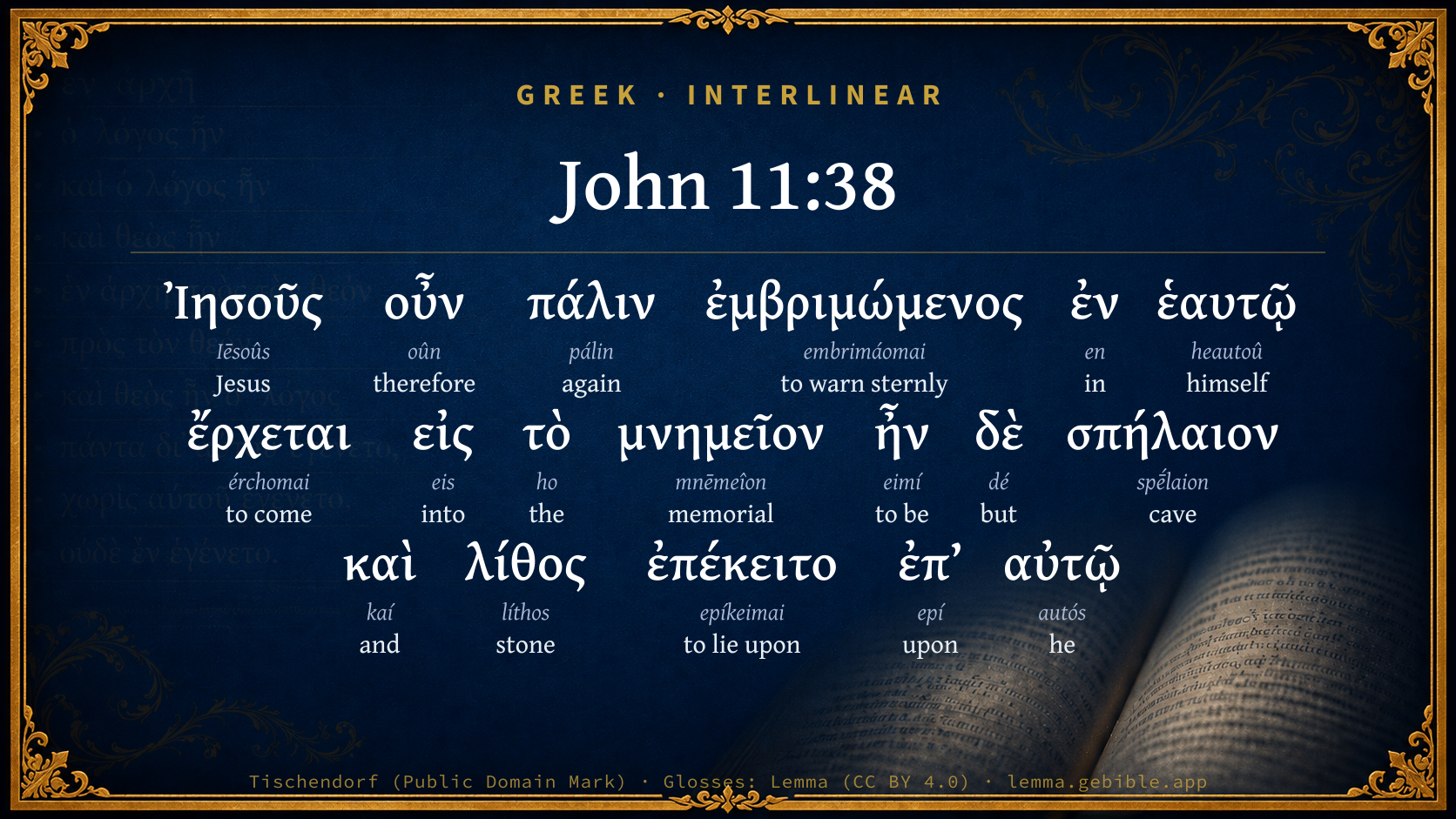
Greek (Tischendorf 8th ed.) John 11:38 appears in the Greek New Testament. The text above is from the Tischendorf 8th edition. Each word links to its Strong’s number and a concise gloss. Click any word for its full Thayer’s Greek Lexicon entry.
Download image
Cite this verse

John 11:38 (World English Bible). Public Domain. Lemma interlinear Bible study tool, https://lemma.gebible.app/v/john/11/38.

Show BibTeX & RIS
BibTeX
RIS
English Translation
Jesus therefore, again groaning in himself, came to the tomb. Now it was a cave, and a stone lay against it.
World English Bible · Public Domain
Download a study sheet

One document with this verse’s original text, its word-by-word gloss line, the meaning frame, cross-references with their text, attributed commentary, and full source and license credits — printable, and it pastes into notes with its structure intact.

This verse Autodidact and up

Study sheet (.html) Plain text (.txt)

A passage Seminary Student

Up to 50 verses in one chapter. A passage sheet keeps up to 6 commentary sources and 12 cross-references per verse, in the order this page ranks them, and says so on the sheet whenever that leaves anything out. Ask for a single verse and you get the Autodidact verse sheet above.

Everything on this page stays free to read, with no account — the sheet is a download of what is already on screen, not access to it.

Want to remove ads? Support Godless Engineer
Compare translations 3

The same verse in 3 English versions, stacked beneath the original-language interlinear above. Click any original word for its lexicon entry.

Each is an independent rendering of the whole verse — the interlinear is not word-aligned to these translations.

Highlighted words mark where these versions differ — a whole-verse word diff, not a word-by-word alignment.

  • World English Bible Public Domain
    Jesus therefore, again groaning in himself, came to the tomb. Now it was a cave, and a stone lay against it.
  • King James Version Public Domain
    Jesus therefore again groaning in himself cometh to the grave. It was a cave, and a stone lay upon it.
  • unfoldingWord Literal Text CC BY-SA 4.0
    Therefore, Jesus again, being deeply disturbed in himself, went to the tomb. Now it was a cave, and a stone lay against it.

unfoldingWord Literal Text — © unfoldingWord, licensed CC BY-SA 4.0. Word-aligned USFM3 via Door43 (git.door43.org/unfoldingWord/en_ult).

Versions to compare (up to 4)

3 of 4 selected

Show all 19 translations

Every available English version of this verse, each an independent rendering of the whole verse.

  • World English Bible Public Domain
    Jesus therefore, again groaning in himself, came to the tomb. Now it was a cave, and a stone lay against it.
  • Berean Standard Bible Public Domain
    Jesus, once again deeply moved, came to the tomb. It was a cave with a stone laid across the entrance.
  • Majority Standard Bible Public Domain
    Jesus, once again deeply moved, came to the tomb. It was a cave with a stone laid across the entrance.
  • King James Version Public Domain
    Jesus therefore again groaning in himself cometh to the grave. It was a cave, and a stone lay upon it.
  • American Standard Version (1901) Public Domain
    Jesus therefore again groaning in himself cometh to the tomb. Now it was a cave, and a stone lay against it.
  • Revised Version (1885) Public Domain
    Jesus therefore again groaning in himself cometh to the tomb. Now it was a cave, and a stone lay against it.
  • Geneva Bible (1599) Public Domain
    Iesus therefore againe groned in himselfe, and came to the graue. And it was a caue, and a stone was layde vpon it.
  • Douay-Rheims (1899) Public Domain
    Jesus therefore again groaning in himself, cometh to the sepulchre. Now it was a cave; and a stone was laid over it.
  • Young's Literal Translation Public Domain
    Jesus, therefore, again groaning in himself, cometh to the tomb, and it was a cave, and a stone was lying upon it,
  • Literal Standard Version CC BY-SA 4.0
    Jesus, therefore, again groaning in Himself, comes to the tomb, and it was a cave, and a stone was lying on it,
  • Unlocked Literal Bible CC BY-SA 4.0
    Then Jesus again, being deeply moved in himself, went to the tomb. Now it was a cave, and a stone lay against it.
  • unfoldingWord Literal Text CC BY-SA 4.0
    Therefore, Jesus again, being deeply disturbed in himself, went to the tomb. Now it was a cave, and a stone lay against it.
  • Darby Bible Public Domain
    Jesus therefore, again deeply moved in himself, comes to the tomb. Now it was a cave, and a stone lay upon it.
  • World Messianic Bible Public Domain
    Yeshua therefore, again groaning in himself, came to the tomb. Now it was a cave, and a stone lay against it.
  • Webster's Bible Public Domain
    Jesus therefore again groaning in himself, cometh to the grave. It was a cave, and a stone lay upon it.
  • Free Bible Version CC BY-SA 4.0
    Very troubled, Jesus went to the tomb. It was a cave with a large stone placed at the entrance.
  • Bible in Basic English Public Domain
    So Jesus, deeply troubled in heart, came to the place of the dead. It was a hole in the rock, and a stone was over the opening.
  • Text-Critical English NT CC BY 4.0
    Deeply moved once more, Jesus came to the tomb. (It was a cave, and a stone was lying against it.)
  • Tyndale New Testament (1534) Public Domain
    Iesus agayne groned in him selfe and came to the grave. It was a caue and a stone layde on it.

Literal Standard Version (2020), Covenant Press — licensed CC BY-SA 4.0. Text via the HelloAO Bible API (eBible.org). Unlocked Literal Bible (unfoldingWord) — licensed CC BY-SA 4.0. Text via the HelloAO Bible API (eBible.org). unfoldingWord Literal Text — © unfoldingWord, licensed CC BY-SA 4.0. Word-aligned USFM3 via Door43 (git.door43.org/unfoldingWord/en_ult). Free Bible Version, Dr. Jonathan Gallagher — licensed CC BY-SA 4.0. Text via the HelloAO Bible API (eBible.org).

Word by word

More ways to search: Search by grammar → Find every occurrence → Compare this word →

Practice this passage: Drill this verse → Learn its vocabulary →

ἐμβριμώμενος
embrimáomai
G1690
“to warn sternly”
Verb, Present, Middle or Passive deponent, Participle, Nominative, Singular, Masculine
Part of Speech
Verb
Tense
Present
Voice
Middle or Passive deponent
Mood
Participle
Case
Nominative
Number
Singular
Gender
Masculine
Full Thayer's Definition

Origin: from G1722 and brimaomai (to snort with anger)

TDNT: None

1. to charge with earnest admonition, sternly to charge, threatened to enjoin
  1. Ἰησοῦς Iēsoûs G2424 “Jesus” Noun, Nominative, Singular, Masculine
  2. οὖν oûn G3767 “therefore” Conjunction
  3. πάλιν pálin G3825 “again” Adverb
  4. ἐν en G1722 “in” Preposition
  5. ἑαυτῷ heautoû G1438 “himself” Reflexive pronoun, 3rd person, Dative, Singular, Masculine
  6. ἔρχεται érchomai G2064 “to come” Verb, Present, Middle or Passive deponent, Indicative, 3rd person, Singular
  7. εἰς eis G1519 “into” Preposition
  8. τὸ ho G3588 “the” Article, Accusative, Singular, Neuter
  9. μνημεῖον mnēmeîon G3419 “memorial” Noun, Accusative, Singular, Neuter
  10. ἦν eimí G1510 “to be” Verb, Imperfect, Active, Indicative, 3rd person, Singular
  11. δὲ dé G1161 “but” Conjunction
  12. σπήλαιον spḗlaion G4693 “cave” Noun, Nominative, Singular, Neuter
  13. καὶ kaí G2532 “and” Conjunction
  14. λίθος líthos G3037 “stone” Noun, Nominative, Singular, Masculine
  15. ἐπέκειτο epíkeimai G1945 “to lie upon” Verb, Imperfect, Middle or Passive deponent, Indicative, 3rd person, Singular
  16. ἐπ’ epí G1909 “upon” Preposition
  17. αὐτῷ autós G846 “he” Personal pronoun, Dative, Singular, Neuter

About this verse

These counts appear in no published source. They are computed here, from the morphology-tagged text and Lemma’s own curated glosses. What Lemma adds →

18
words
18
distinct lemmas
Gospels
section

Notable vocabulary

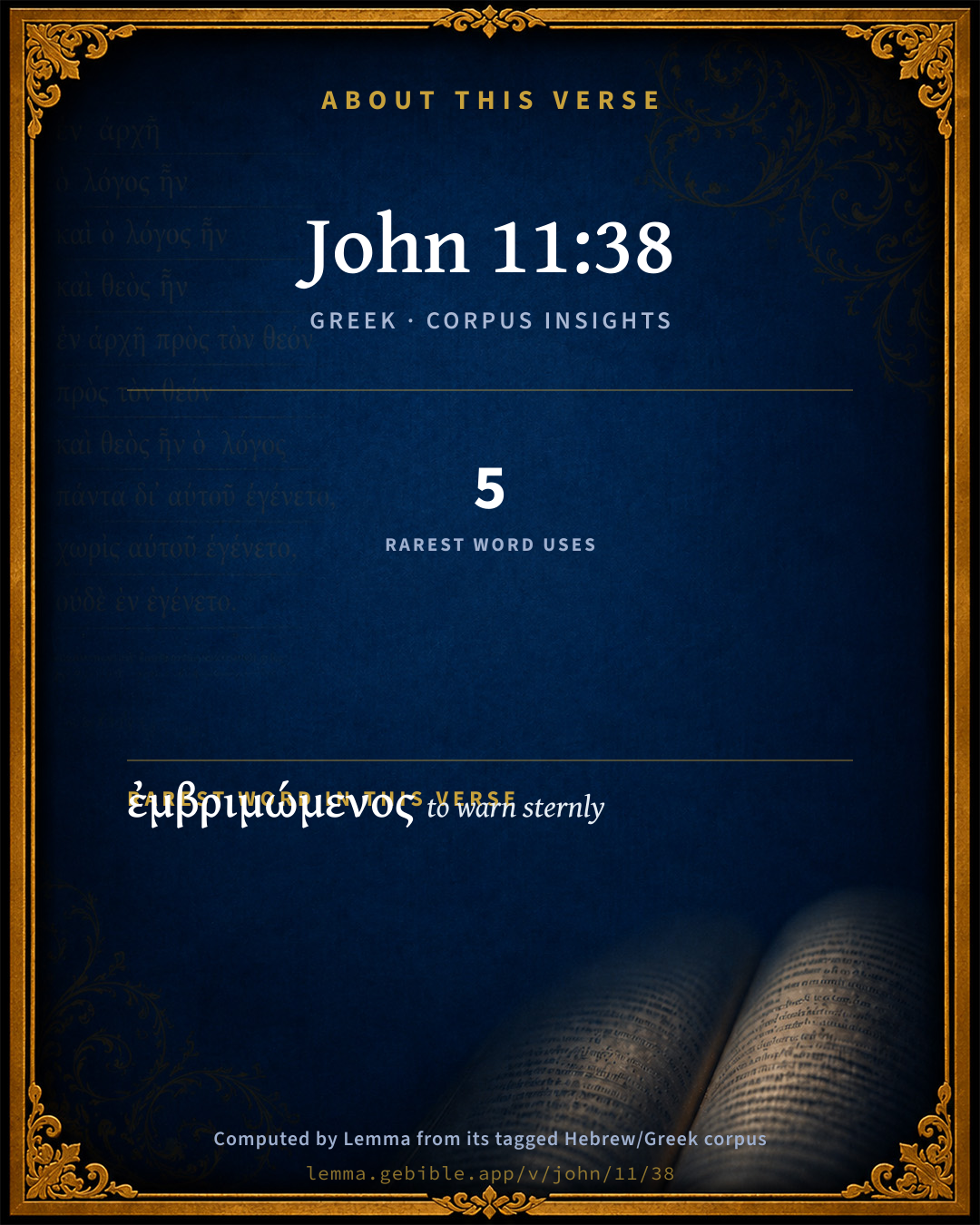
The rarest word here is ἐμβριμώμενος to warn sternly G1690 — appearing just 5 times in the whole Greek New Testament.

Shared distinctive vocabulary

ἐμβριμώμενος to warn sternly G1690 occurs in 5 verses of the Greek New Testament. Also found in:

Cross-references

12

Topical passages linked to John 11:38 in the Treasury of Scripture Knowledge — connected by theme and wording, ordered by reader-vote popularity; previews shown in the World English Bible.

  • John 11:33 When Jesus therefore saw her weeping, and the Jews weeping who came with her, he groaned in the spirit, and was troubled,
  • Matthew 27:60 and laid it in his own new tomb, which he had hewn out in the rock, and he rolled a great stone to the door of the tomb, and departed.
  • Luke 24:2 They found the stone rolled away from the tomb.
  • Genesis 23:19 After this, Abraham buried Sarah his wife in the cave of the field of Machpelah before Mamre (the same is Hebron), in the land of Canaan.
  • Isaiah 22:16 "What are you doing here? and who has you here, that you have hewed out a tomb here? Cutting him out a tomb on high, chiseling a habitation for himself in the rock!"
  • Mark 8:12 He sighed deeply in his spirit, and said, "Why does this generation seek a sign? Most assuredly I tell you, no sign will be given to this generation."
  • Mark 15:46 He bought a linen cloth, and taking him down, wound him in the linen cloth, and laid him in a tomb which had been cut out of a rock. He rolled a stone against the door of the tomb.
  • John 20:1 Now on the first day of the week, Mary Magdalene went early, while it was still dark, to the tomb, and saw the stone taken away from the tomb.
  • Genesis 49:29–31 He charged them, and said to them, "I am to be gathered to my people. Bury me with my fathers in the cave that is in the field of Ephron the Hittite,
  • Ezekiel 9:4 Yahweh said to him, Go through the midst of the city, through the midst of Jerusalem, and set a mark on the foreheads of the men that sigh and that cry over all the abominations that are done in the midst of it.
  • Ezekiel 21:6 Sigh therefore, you son of man; with the breaking of your loins and with bitterness shall you sigh before their eyes.
  • Matthew 27:66 So they went with the guard and made the tomb secure, sealing the stone.

Cross-references courtesy of OpenBible.info (CC BY 4.0).

Commentary

Notes on John 11:38 from classic Christian and Jewish commentators (each source and its license shown beneath its notes). The classic Christian expositions comment on the surrounding passage and are grouped to its opening verse, so a note may address several verses; the Jewish commentaries on the Tanakh (Rashi and others) are per-verse, so they appear only where the commentator wrote on this verse.

Lemma curates 59 commentaries, every one of them public domain or Creative Commons licensed, each selected and text-cleaned for this edition rather than reprinted as found. About our sources →

The Biblical Illustrator

Joseph S. Exell

Joh_11:38

Jesus therefore again groaning in Himself cometh to the grave

The burial of Lazarus

It was a cave, such as that rocky neighbourhood abounds with, and a stone lay upon it.

Among some nations the bodies of the dead were burned, and the ashes consigned to urns. This was never a Jewish custom, though there were exceptional cases in which it was practised (Saul and his sons, and Amo_6:10), which seems to have been owing to pestilence. The Jews buried. When a person died, after the affecting solemnity of the last kiss and closing the eyes, the body was washed in lukewarm water, and perfumed, and then swathed in numerous folds of linen, with spices in the folds. Thus, e.g., Joseph and Nicodemus and the women showed their affection for the Lord. The limbs were bound in linen bands, not together, but separately; and in many cases the very fingers; while the head was wrapped in a linen cloth (the sudarium or napkin), which also veiled the face, thrown loosely over it. The necessary preparations being completed, burial took place within twenty-four hours after death. By a wise arrangement, absolutely necessary in the East, the burial places were always situated without the cities, though seldom if ever at any great distance. In case poverty permitted nothing more, the dead was laid in a grave as with us, and a little plain mason work was placed above; at the least a simple slab of the white rock of the country. For the most part, however, the burial places were caves, either natural or hewn out of the solid rock. In such a cave a number of persons could stand upright: and all around its sides there were cells (no coffins being used) for the dead, of such a size as to contain each a single body. In such a cave, in the rocky side of Olivet, amid the luxuriant vegetation of the district, where birds sang, and flowers blossomed, and feathery palm branches waved, and the soft golden sunshine fell from the skies of morn on the spangled turf, and evening threw its grateful shadows, there the body of dead Lazarus was laid; and, for protection against the ravages of beasts of prey, the caves mouth was closed by a large closely-fitting stone, which it required the strength of many men to move. (J. Culross, D. D.)

The story of the grave

I. THE GRAVE VICTORIOUS.

1. In the first family (Gen_4:8; Gen_5:5).

2. Among the patriarchs (Gen_23:2-4; Gen_23:19-20; Gen_35:19-20).

3. Over kings (1Sa_31:4-6; 1Ki_2:10; Dan_5:30).

4. Over conquerors (Jos_24:29-30; 2Sa_3:27).

5. Over prophets (Deu_34:5-6; 2Ki_13:20,

21).

6. Over all men (Psa_89:48; Psa_90:3; Heb_9:27).

7. Over Jesus (Isa_53:9; Mat_27:60; Mar_15:45-46).

8. Ends all service (Psa_6:5; Psa_88:11; Ecc_9:10).

9. Destroys the body (Psa_49:14; Mat_23:27).

10. Opens suddenly to some (Job_21:13; Act_5:5; Act_5:10).

II. THE GRAVE VANQUISHED.

1. Redemption therefrom assured (Psa_49:15).

2. Ransom therefrom provided (Hos_13:14).

3. Deliverance typified (Jon_2:1-2; Mat_12:40).

4. Lazarus brought from the grave (Joh_11:43-44).

5. Other saints came forth (Mat_27:52-53).

6. Christ came forth (Mat_28:2-6; 1Co_15:3,

4).

7. All shall come forth (Dan_12:2; Joh_5:28-29).

8. The song of victory (1Co_15:55). (S. S. Times.)

Christ at a grave

I. THE GROANS OF JESUS.

1. Over mortal man. He felt as with an electric shock that He was in a world of pain and infirmity.

2. Over sorrowing man. Jesus sympathized with sorrow as sorrow. He was moved by the mere contagiousness of grief.

3. Over unbelieving man. The sisters and the Jews alike lacked faith, and lack of faith always troubled Him. There might be more than one feeling here.

(1) an oppressive sense of loneliness.

(2) A deep conviction of the guilt of unbelief.

(3) A distressing feeling of the miseries of unbelief.

II. THE WORDS OF JESUS.

1. He spoke to God (Joh_11:41)--a thanksgiving for an answer not yet vouchsafed to an unrecorded prayer.

2. He spoke to men--Take ye away the stone. This was the work of man, and therefore not included in the scope of the miracle. And in religion we have a part to play as well as God. He gives the grace, we must use it. Work out your own salvation.

III. THE WORK OF JESUS.

1. Direct resurrection: here physical; in us moral.

2. Indirect.

(1) Faith; as an effect of the miracle (Joh_11:45).

(2) Unbelief and animosity (Joh_11:46). (Caleb Morris.)

The raising of Lazarus

I. THE LITERARY RECORD OF THE MIRACLE.

1. The preparatory order (Joh_11:39). Christ never sought to accomplish by supernatural means what could be done by natural (chap. 2:7, 8; 6:10-11).

2. The encouraging remonstrance (Joh_11:40).

3. The solemn thanksgiving (Joh_11:41); expressive of

(1) Gratitude for the assurance of power to accomplish the miracle.

(2) Confidence that as the Son He always stood within the Fathers favour.

(3) Care for the multitude that they might be prepared to believe when they beheld the stupendous sign.

4. The awakening summons (Joh_11:43).

(1) Affectionate.

(2) Authoritative.

(3) Efficacious.

5. The concluding charge (Joh_11:44). Issued

(1) For the sake of Lazarus, to complete his restoration to the world.

(2) For the sake of the sisters that they might withdraw with and rejoice over their brother.

(3) For the sake of the spectators, to convince them of the reality of the miracle.

II. ITS HISTORIC CREDIBILITY.

1. Objections.

(1) The silence of the synoptists. Answer

(a) This is not more strange than their other omissions (Joh_2:1-11; Joh_2:13-22; Joh_9:1-41).

(b) This less strange than the omission of the raising at Nain by Matthew and Mark, or that of the five hundred witnesses mentioned only by Paul (1Co_15:6).

(c) This not at all strange if we consider that the narrative would compromise the safety of the family, that it and the earlier miracles at Jerusalem did not enter into the scope of the Synoptists who dealt with the Galilean ministry.

(d) This is required to account for the popular outburst of enthusiasm which all record (Mat_21:8-11; Mar_11:1 - Luk_19:29-40).

(2) The so-called improbabilities of the narrative.

(a) Christs representation (Joh_11:4).

(b) Christs delay(Joh_11:6).

(c) The disciples misunderstanding of the figure already employed in the house of Jarius (Joh_11:12-13).

(d) Christs grief in prospect of resurrection (Joh_11:35).

(e) Christs prayer for sake of bystanders.

(3) The non-mention of the miracle at the trial of Jesus. But

(a) Christ offered no defence at all, nor did He call any witnesses on His behalf.

(b) The Sanhedrim were naturally silent (Joh_11:47). It would have destroyed their plot.

2. Considerations in support of authenticity.

(1) It is evidently the report of an eyewitness.

(a) In what it includes (Joh_11:28; Joh_11:32-33; Joh_11:38; Joh_11:44, etc.).

(b) In what it omits--the return of messengers, call to Mary, etc.

(2) It was performed publicly, and in the presence of enemies.

(3) The Sanhedrim believed it (Joh_11:46; Joh_11:53).

(4) The insufficiency of other offered explanations that the mirable was a myth, that Lazarus was not really dead.

III. ITS DOCTRINAL SIGNIFICANCE. Its bearing on

1. The question of the Divinity of Jesus. He proclaimed Himself the Son of God, and appealed in vindication of that to the miracle He was about to perform.

2. The doctrines of the spirituality and separate existence of the soul; which are abundantly demonstrated.

3. The truth of a future resurrection.

(1) It shows its possibility.

(2) It is a type of it. There will be the same loving call, authoritative summons, efficacious word.

(3) It presents contrasts. Lazarus was raised to this world of sorrows to die again. (T. Whitelaw, D. D.)

The Biblical Illustrator, edited by Joseph S. Exell (c. 1880s–1900s) — public domain. Text from a community e-Sword module.

Joseph Benson's Commentary

Joh 11:38-40. It was a cave, and a stone lay upon it — Or, as Dr. Campbell reads, shut up with a stone. The graves of the common people probably were digged like ours, but persons of distinction were, as with us, interred in vaults. So Lazarus was; and such was the sepulchre in which Christ was buried. See note on Mat 27:60. Probably this custom was kept up among the Jews in imitation of the patriarchs, Abraham, Isaac, and Jacob, and their wives, except Rachel, being buried in the cave of Machpelah, Gen 49:29-31. These caves were commonly in rocks, which abounded in that country, either hollowed by nature, or hewn by art. And the entrance was shut up with a great stone, which sometimes had a monumental inscription. Jesus said, Take ye away the stone — Our Lord, says Bishop Hall, “could with infinite ease have commanded the stone to roll away of itself, without employing any to remove it; but he judiciously avoided all unnecessary pomp and parade, and mingled all the majesty of this astonishing miracle with the most amiable modesty and simplicity.” Besides, he thus removed the minutest suspicion of fraud, for they who removed the stone would, from the putrefied state of the body, have sufficient evidence that it was there, dead; while all who were present might, and no doubt did, see it lying in the sepulchre when the stone was removed, before Jesus gave the commanding word, Come forth. Martha said, Lord, by this time he stinketh — Thus did reason and faith struggle together; for he hath been dead four days — The word dead is not in the original, which is only, τεταρταιος γαρ εστι, for he hath been four days, namely, in the grave, and not four days dead only. That this was Martha’s meaning is evident from Joh 11:17, where it is said, that when Jesus came, he found that Lazarus had laid in the grave four days already; and therefore he must have been dead at least five or six, for a day or two must have been spent in making preparation for the burial. “Providence directed Martha to mention this circumstance before Lazarus was raised, that the greatness of the miracle might be manifest to all who were present. It is beautiful to observe the gradation that was in the resurrections of the dead effected by our Lord. The first person whom he raised, namely, Jairus’s daughter, had been in the state of the dead only a few hours; the second, the widow of Nain’s son, was raised as his friends were carrying him out to burial. But when Jesus recalled Lazarus to life, he had been in the grave no less than four days; and therefore, according to our way of apprehending things, his resurrection was the greatest miracle of the three. As Peter Chrysologus observes, ‘the whole power of death was accomplished upon him; the whole power of the resurrection showed forth in him.’” — Macknight. Jesus saith, Said I not unto thee — It appears by this that Christ had said more to Martha than is before recorded; if thou wouldest believe, thou shouldest see the glory of God — Remarkably displayed in a work of signal mercy and power.

Joseph Benson's Commentary on the Old and New Testaments (1811–1818) — public domain. Text from a community e-Sword module.

Bengel's Gnomon

Johann Albrecht Bengel

Joh 11:38. Πάλιν ἐμβριμώμενος, again groaning) By this groan Jesus also repelled the Jews’ gainsaying, lest it should tempt His own mind to give up the raising of Lazarus, etc. He refutes them by deed, not by words. Comp. Joh 11:33, notes.

Bengel's Gnomon of the New Testament — English translation (T&T Clark, Edinburgh, 1860) — public domain. Text from a community e-Sword module.

Meyer's Critical & Exegetical Commentary

Heinrich August Wilhelm Meyer

Joh_11:38. This πονηρία (Chrysostom) of the τινές stirred afresh, in the midst of His pain, His deep, though quiet, indignation; in this case, however, it was less noticeable, not being attended with the ταράσσειν ἑαυτόν of Joh_11:33.

εἰς τὸ μνηεῖον] to the grave (not into, see what follows; comp. Joh_11:31). The sepulchral vaults were entered either by a perpendicular opening with steps, or by an horizontal one; they were closed either by a large stone, or by a door. They exist in great numbers, down to the present day; Robinson, II. p. 175 ff., and his more recent Researches, p. 327 ff.; Tobler, Golgotha, p. 251 ff. The grave of Lazarus would have been of the first kind if ἐπέκεντο ἐπʼ αὐτῷ be rendered: it lay upon it; the one at present shown as the grave of Lazarus, though probably without sufficient reason (see Robinson, II. p. 310), is such. But ἐπέκ. ἐπʼ αὐτ. may also mean: it lay against it, before it (comp. Hom. Od. 6. 19 : θύραι δʼ ἐπέκειντο); and then the reference would be to a grave with an horizontal entrance. No decision can be arrived at. The description of the grave would seem to imply that Lazarus was a man of some position.

Meyer — Critical and Exegetical Commentary on the New Testament — English translation by Peter Christie, edited by Frederick Crombie (T&T Clark, 1880) — public domain. Text from a community e-Sword module.

Expositor's Greek Testament

ed. W. Robertson Nicoll

Joh 11:38 . Ἰησοῦς οὖν πάλιν ἐμβριμώμενος . “Jesus, then, being again deeply moved.” “Quia non accedit Christus ad sepulcrum tanquam otiosus spectator, sed athleta qui se ad certamen instruit, non mirum est si iterum fremat.” Calvin. To refer the renewed emotion to the sayings of the Jews just reported is to take for granted that Jesus heard them, which is most unlikely. The tomb ἦν σπήλαιον … αὐτῷ , “was a cave,” either natural, as that which Abraham bought, Gen 23:9 , or artificial, hewn out of the rock, as our Lord’s, Mat 27:60 . λίθος ἐπέκειτο ἐπʼ αὐτῷ , “a stone lay upon it,” i.e. , on its mouth to prevent wild animals from entering. The supposed tomb of Lazarus is still shown and is described by several travellers.

The Expositor's Greek Testament, edited by W. Robertson Nicoll (1897–1910) — public domain. Text from a community e-Sword module.

Cambridge Greek Testament for Schools and Colleges

38. ἐμβριμ. ἐν ἑαυτῷ. This shews that ‘in His spirit,’ not ‘at His spirit,’ is right in Joh 11:33, to which πάλιν refers. Their sneering scepticism rouses His indignation afresh.

It is remarkable that this chapter, which narrates the greatest exhibition of Divine power in the ministry of Christ, contains peculiarly abundant evidence of His perfect humanity. We have His special affection for His friends (Joh 11:5), His sympathy and sorrow (Joh 11:35), His indignation (Joh 11:33; Joh 11:38). In the rest of this Gospel, which is so full of the Divinity of Jesus, we have His humanity plainly set forth also; His weariness (Joh 4:6), His thirst (Joh 4:7, Joh 19:28), His love for His disciples (Joh 20:2), His special affection for ‘His own’ and for S. John (Joh 13:2; Joh 13:23, Joh 19:26, Joh 21:7; Joh 21:20).

μνημεῖον. See on Joh 11:17. The having a private burying-place, like the large attendance of mourners and the very precious ointment (Joh 12:3), indicates that the family is well off. Εἰς is unto, not into.

ἐπ’ αὐτῷ. Upon it, or against it. An excavation in the side of a mound or rock may be meant. What is now shewn as Lazarus’ grave is an excavation in the ground with steps down to it. The modern name of Bethany, El-Azariyeh or Lazarieh, is derived from Lazarus.

Cambridge Greek Testament for Schools and Colleges (Cambridge University Press, 1896; 21 vols, various authors incl. Carr, Maclear, Plummer, Farrar, Lumby, Moule, M. R. James, Simcox) — public domain. Text from a community e-Sword module.

Godet's Commentaries

Frédéric Louis Godet

Vv. 38, 39. “Jesus therefore, shuddering in himself again, comes to the sepulchre; it was a cave and a stone was placed before it. 39. Jesus says, Take away the stone. The sister of the dead man Martha, says to him, Lord, by this time he stinketh; for he has been dead four days.”

The new inward disturbance which Jesus feels is evidently called forth by the malevolent remark of the Jews (Joh 11:37); John himself gives us to understand this by the therefore(Joh 11:38). But this agitation seems to have been less profound than the first, and more readily overcome. This very natural detail is a new proof of the fidelity of the narrative.

The sepulchre was a cave dug in the rock, either horizontally or vertically. The verb ἐπέκειτο signifies, in the first case, that the stone was placed before the entrance of the cave; in the second, that it was placed on its opening. Numerous tombs are seen around Jerusalem both of the one form and the other. If the tomb which is shown at the present day as that of Lazarus, was really such, it was of the second sort. It is a cave hollowed out in the rock into which one descends by a narrow staircase of twenty-six steps. Robinson has proved the non-authenticity of the tradition on this point, as on many others. The stones by which these caves were closed might easily be removed; they were designed only to keep off wild beasts. There is between the second movement of indignation in Jesus and the decisive command: Take away the stone, a relation analogous to that which we have noticed between the first emotion of this kind and the question: Where have you laid him? We can easily imagine the state of expectation into which this question threw the whole company.

Did the remark of Martha (Joh 11:39), proceed, as some interpreters think, from a feeling of incredulity. But could she who hoped for the return of her brother to life before the promise of Jesus (Joh 11:22-23), have doubted after such a declaration? This is impossible. By this remark she does not by any means wish to prevent the opening of the sepulchre; she simply expresses the anxiety which is caused in her mind by the painful sensation about to be experienced by Jesus and the spectators because of one who was so near and dear to her. As the dead man’s sister, she feels a kind of embarrassment and confusion. We must recall to mind how closely the idea of defilement was connected, among the Jews, with that of death and corruption. Here, therefore, is an exclamation dictated by a feeling of respect for Him to whom she is speaking: “Lord,” and by a sort of delicacy for the person of him who is in question: the sister of the dead man. It has been thought (Weiss, Keil) that the affirmation of Martha: by this time he stinketh, was on her part only a supposition, since she justifies it logically by adding: For he is there four days already. But we must rather see in these words the declaration of a fact which she has herself ascertained by visiting the sepulchre; comp. Joh 11:31.

The words: For he is there...already, indicate the cause, not the proof, of the fact which the care of the two sisters had not been able to prevent. This reflection, far from proving, as Weiss thinks, that Lazarus had not been embalmed, implies, on the contrary, that he had been, with all possible care, but only after the manner of the Jews. Among the Egyptians the entrails and everything which readily decays were removed, while among the Jews the embalming was limited to wrapping the body in perfumes, which could not long arrest corruption. The expectation of Jesus’ arrival had certainly not prevented them, as some have supposed, from performing this ceremony. Does not Joh 11:44 show that Lazarus had his limbs enveloped with bandages like other dead persons (comp. Joh 19:40)? But even if Martha’s remark did not arise from a feeling of incredulity, the fact indicated might nevertheless occasion in her a failing of faith at this decisive moment; so Jesus exhorts her to raise her faith to the whole height of the promise which He has made to her.

Frédéric Louis Godet — Commentaries on Luke, John, Romans, and 1 Corinthians — English translation (T&T Clark, Edinburgh, 1870s–1890s) — public domain. Text from a community e-Sword module.

Jamieson, Fausset & Brown

Robert Jamieson, A. R. Fausset & David Brown

Jesus again groaning in himself--that is, as at Joh 11:33, checked or repressed His rising feelings, in the former instance, of sorrow, here of righteous indignation at their unreasonable unbelief; (compare Mar 3:5) [WEBSTER and WILKINSON]. But here, too, struggling emotion was deeper, now that His eye was about to rest on the spot where lay, in the still horrors of death, His "friend."

a cave--the cavity, natural or artificial, of a rock. This, with the number of condoling visitors from Jerusalem, and the costly ointment with which Mary afterwards anointed Jesus at Bethany, all go to show that the family was in good circumstances.

Jamieson, Fausset & Brown — Commentary Critical and Explanatory on the Whole Bible (1871) — public domain (CC PDM 1.0). Text via the HelloAO Bible API.

Adam Clarke's Commentary

Verse 38. It was a cave, c.] It is likely that several of the Jewish burying-places were made in the sides of rocks some were probably dug down like a well from the upper surface, and then hollowed under into niches, and a flat stone, laid down upon the top, would serve for a door. Yet, from what the evangelist says, there seems to have been something peculiar in the formation of this tomb. It might have been a natural grotto, or dug in the side of a rock or hill, and the lower part of the door level with the ground, or how could Lazarus have come forth, as he is said to have done, Joh 11:44?

Adam Clarke's Commentary on the Bible (1810–1826) — public domain. Text from a community e-Sword/MySword module.

John Calvin's Commentaries

38. Jesus therefore again groaning within himself. Christ does not approach the sepulcher as an idle spectator, but as a champion who prepares for a contest; and therefore we need not wonder that he again groans; for the violent tyranny of death, which he had to conquer, is placed before his eyes. Some explain this groan to have arisen from indignation, because he was offended at that unbelief of which we have spoken. But another reason appears to me far more appropriate, namely, that he contemplated the transaction itself rather than the men. Next follow various circumstances, which tend to display more fully the power of Christ in raising Lazarus. I refer to the time of four days, during which the tomb had been secured by a stone, which Christ commands to be removed in presence of all.

John Calvin's Commentaries (1540-1563) — public domain. Text from the Calvin Translation Society English edition (1840s-50s) via the Christian Classics Ethereal Library (ccel.org). Calvin's coverage is partial (roughly two-thirds of the Bible); uncommented books and verses are honest gaps, never fabricated. The 19th-century editor's footnotes and remarks are omitted so the notes are faithfully Calvin's own voice.

Ellicott's Commentary for English Readers

(38) Jesus therefore again groaning in himself.—See Note on Joh_11:33. Their evil thoughts, expressed in Joh_11:37, are the cause of this new emotion of anger.

Cometh to the grave.—Comp. Joh_11:31. Here, as there, it would be better to render it sepulchre. The same word occurs again in Joh_12:17; Joh_19:41-42; Joh_20:1-11.

It was a cave, and a stone lay upon it.—The sepulchres were dug in the rock, either vertically, with an entrance from above (comp. Note on Luk_11:44), or horizontally, with an entrance from the side, and were frequently adaptations of natural caves. (Comp. Note on Mat_27:60.) Such sepulchres remain to the present day, and travellers are shown one which is said to be that of Lazarus. The entrance is from above it by twenty-six steps; and this must have been so, if we press the words “lay upon it.” The original words, however, may certainly apply to the horizontal slab which closes the entrance to the sepulchre; and the identification of this particular sepulchre is to be received with caution. The tact of the body being laid in a sepulchre agrees with the general tone of the narrative that the family was one of substance.

A Bible Commentary for English Readers, edited by Charles John Ellicott (1878–1897) — public domain. Text from a community e-Sword module.

The Cambridge Bible for Schools and Colleges

gen. ed. J. J. S. Perowne

38. groaning in himself] See on Joh_11:33. This shews that ‘in His spirit’ not ‘at His spirit’ is the right translation there. Their sneering scepticism rouses His indignation afresh.

to the grave] See on Joh_11:17. Insert now before ‘it was a cave.’ The having a private burying-place indicates that the family was well off. The large attendance of mourners and the very precious ointment (Joh_12:3) point to the same fact.

upon it] The Greek may mean ‘against it,’ so that an excavation in the side of a rock or mound is not excluded. What is now shewn as the sepulchre of Lazarus is an excavation in the ground with steps down to it. The stone would keep out beasts of prey.

The Cambridge Bible for Schools and Colleges (gen. ed. J. J. S. Perowne; Cambridge University Press, 1878–1918) — public domain. Text from a community e-Sword module.

John Gill's Exposition

Jesus therefore groaning in himself,.... Not only through grief, just coming up to the grave, where his dear friend lay, but through an holy anger and indignation at the malice and wickedness of the Jews;

cometh to the grave of Lazarus,

it was a cave; either a natural one, such as were in rocks and mountains, of which sort there were many in Judea, and near Jerusalem being a rocky and mountainous country, of which Josephus (x) makes mention; where thieves and robbers sheltered themselves, and could not easily be come at and where persons in danger fled to for safety, and hid themselves; and the reason why such places were chose to bury in, was because here the bodies were safe from beasts of prey: or this was an artificial cave made out of a rock, in form of one, as was the tomb of Joseph of Arimathea; and it was the common custom of the Jews to make caves and bury in; yea, they were obliged to it by their traditions: thus says Maimonides (y),

"he that sells a place to his friend to make in it a grave or that receives from his friend a place to make in it a grave, , "must make a cave", and open in it eight graves, three on one side and three on another, and two over against the entrance "into the cave": the measure of "the cave" is four cubits by six, and every grave is four cubits long, and six hands broad, and seven high; and there is a space between every grave, on the sides a cubit and a half, and between the two in the middle two cubits.''

And elsewhere (z) he observes, that

"they dig "caves" in the earth, and make a grave in the side "of the cave", and bury him (the dead) in it.''

And such caves for burying the dead, were at and near the Mount of Olives; and near the same must be this cave where Lazarus was buried; for Bethany was not far from thence: so in the Cippi Hebraici we read (a), that at the bottom of the Mount (of Olives) is a very great "cave", said to be Haggai the prophet's; and in it are many caves.--And near it is the grave of Zachariah the prophet, in a "cave" shut up; and frequent mention is made there of caves in which persons were buried; See Gill on Mat 23:29; perhaps the custom of burying in them might take its rise from the cave of Machpelah, which Abraham, their father, bought for a buryingplace for his dead. The sepulchre of Lazarus is pretended (b) to be shown to travellers to this day, over which is built a chapel of marble, very decent, and comely, and stands close by a church built in honour of Martha and Mary, the two sisters of Lazarus, in the place where their house stood; but certain it is, that the grave of Lazarus was out of the town:

and a stone lay upon it. Our version is not so accurate, nor so agreeable to the form of graves with the Jews, nor to this of Lazarus's; their graves were not as ours, dug in the earth and open above, so as to have a stone laid over them, for they often were, as this, caves in rocks, either natural, or hewn out of them by art; and there was a door at the side of them, by which there was an entrance into them; and at this door a stone was laid it would be better rendered here, and "a stone was laid to it"; not "upon it", for it had no opening above, but to it, at the side of it; and accordingly the Syriac and Persic versions read, "a stone was laid at the door of it"; and the Arabic version, "and there was a great stone at the door of it", as was at the door of Christ's sepulchre. In the Jewish sepulchres there was "a court" (c) which was before the entrance into the cave; this was four square; it was six cubits long, and six broad; and here the bearers put down the corpse, and from hence it was carried into the cave, at which there was an entrance, sometimes called , "the mouth of the cave" (d); and sometimes, , "the door of the grave" (e); of its form, measure, and place, there is no express mention in the Jewish writings: it is thought to be about a cubit's breadth, and was on the side of the cave; so that at it, it might be looked into; and at the mouth of the cave was a stone put to stop it up, which was called from its being rolled there; though that with which the mouth of the cave was shut up, was not always a stone, nor made of stone; Maimonides (f) says, it was made of stone, or wood, or the like matter; and so in the Misna (g) it is said,

, "the covering for a grave", (or that with which it is stopped up,) if it be made of a piece of timber, whether it stands, or whether it inclines to the side, does not defile, but over against the door only;''

See Gill on Mat 27:60.

(x) Antiqu. l. 14. c. 15. sect. 5. (y) Hilchot Mecira, c. 21. sect. 6. (z) Hilchot Ebel, c. 4. sect. 4. (a) P. 27, 29. Ed. Hottinger. (b) ltinerar. Bunting. p. 364. (c) Misn. Bava Bathra, c. 6. sect. 8. (d) Misn. ib. (e) Maimon. R. Samson, & Bartenora in Misn. Ohalot, c. 15. sect. 8. (f) In Misn. Ohalot, c. 2. sect. 4. (g) Ib c. 15, sect. 8.

John Gill's Exposition of the Whole Bible (1746–1763) — public domain (CC PDM 1.0). Text via the HelloAO Bible API.

Trapp's Complete Commentary

John Trapp

38 Jesus therefore again groaning in himself cometh to the grave. It was a cave, and a stone lay upon it.

Ver. 38. Groaning in himself] To consider, belike, the woeful effects of sin that brought death into the world, even on the best; and makes them a ghastly and loathsome spectacle, so that Abraham desires to bury his beloved Sarah out of his sight. Believe me who have made trial of it, saith Augustine, open a grave, and in the head of the dead man ye shall find toads leaping that are begotten of his brain; serpents crawling on his loins, that are bred out of his kidneys; worms creeping in his belly, that grow out of his bowels. Mihi experto credite, quod apertis sepulchris in capitibus invenielis bufones saltantes generatos ex cerebro. (Serm. 48.) Ecce quid sumus, et quid iam erimus: Ecce in quod resolvimur: En peccati originem et foeditatem! saith that father.

John Trapp, A Commentary or Exposition upon All the Books of the Old and New Testament (1647–1656) — public domain. Text from a community e-Sword module.

Albert Barnes' Notes on the Bible

It was a cave - This was a common mode of burial. See the notes at Mat 8:28.

A stone lay upon it - Over the mouth of the cave. See Mat 27:60.

Albert Barnes' Notes on the Bible (1834–1885) — public domain. Text from a community e-Sword/MySword module.

Matthew Poole's English Annotations

Groaning in himself as before, Joh 11:33, so showing himself yet further to be truly man, and not without human affections. He cometh to the place where Lazarus’s dead body was laid, which, the evangelist telleth us, was

a cave, or a hollow place in the earth, or some rock. And they were wont to roll some great stones to the mouth of those graves, as we see in the burial of our Saviour, Mat 27:66.

Matthew Poole's English Annotations on the Holy Bible (1683–1685) — public domain. Text from a community e-Sword/MySword module.

Whedon's Commentary on the Bible

Daniel D. Whedon

38. A cave… a stone—Probably a square subterranean room, artificially excavated, and entered by a horizontal opening. A stone lying against the entrance, to guard the interior from intruders, had to be rolled away. Descending steps brought the visitor to its floor. Recesses, cut into the side walls, contained each a corpse, which was placed, the head going in first, and the feet pointing into the room. Sometimes the corpse lay parallel to the wall as upon a shelf, and so was visible from head to foot. The body was wound in linen strips, around each separate limb, and a loose sheet around the whole. A napkin or kerchief enveloped the face and neck.

Daniel D. Whedon (gen. ed.), Commentary on the Old and New Testaments (1874–1909) — public domain. Text from a community e-Sword module.

The Pulpit Commentary

Jesus therefore again moved with indignation within himself. The (en eautw) "in himself" is not so forcible an expression as "shuddering in his spirit (ver. 33), but it implies a continuity of grand, holy indignation against the anomaly of death, from which the human family and he as its Representative were suffering (cf. ver. 33). He cometh to the grave. The (mnhmeion or) tomb is forthwith described as (sphlaion) a den, cavern, or cave, from speov , spelunca, of which, partly natural, partly artificial, abundant use was made in the East. A stone lay (ep autw) against it; or, over it; i.e. either closing it up as a pit, or closing the mouth of it, by being rolled along a ledge horizontal with the base of the excavation. The former kind of cave is shown at Bethany, but no dependence can be placed on the tradition. (Cf. the account of our Lord"s own tomb, to which a stone was roiled, Mat_27:60 Mat_28:2 Mar_16:3, 4 Luk_24:2; cf. also Thomson, "The Land and the Book," pp. 101-108; and art. "Burial," in Smith"s "Dictionary.") The tomb of Joseph was that of a rich man, and all these circumstances show opulence, rather than the beggary and rags of the Lazarus of the parable.

Vers. 38-44. The miracle.

There is a fresh struggle in the soul of Jesus, perhaps caused by the malicious observations of the Jews.

I JESUS COMMANDS THE STONE TO BE ROLLED AWAY FROM THE SEPULCHER. "Take ye away the stone.

1. This command suggests that where human power is sufficient, Divine power will not be put forth. A word from Jesus could have taken away the stone as easily as a word raised Lazarus to life. The action of Jesus suggests the economy of miracle so observable in Scripture history.

2. The command was evidently given to convince the spectators that Lazarus was, indeed, a dead man. The pent-up odors of putrefaction would in such a hot climate convince the spectators that there could be no.imposture or collusion in the case. It was evidently the thought of this disagreeable circumstance that led Martha to say, "Lord, by this time he stinketh; he hath been there four days.

3. The incident suggests that there is a sphere for human agency in connection with the salvation of men. The miracle is symbolic, like all Christ"s miracles. It is possible for man to bring man within the knowledge of salvation. Jesus seems to say to the Christian Church, "Roll away the stone of ignorance and superstition from the hapless heathen by imparting Bible knowledge." He says, even, to professing Christians, "Roll away the stone that lies as an obstacle in your own family to the salvation of your children." Many an obstacle may stand in Christian households in the way of youthful conversions.

II THE PRAYER OF JESUS AS A PREFACE TO THE MIRACLE. "Father, I thank thee because thou hast heard me.

1. It is more a thanksgiving than a prayer.

(1) It implies that the prayer for rower to do the miracle had been already offered up and already heard.

(2) It implies that there was at all times the most perfect conformity between the will of Christ and the will of his Father.

2. His design in this miracle was to dispose the Jews to see in it the glory of God. "I said it because of the people who surround me, that they may believe that thou hast sent me." They attributed his cure of the blind man to the work of a demon or to deception. By his prayer Jesus makes his Father a Participator in the miracle.

III THE MIRACLE. And when he had thus spoken, he cried with a loud voice, Lazarus, come forth!

1. The loud voice contrasts with the retired incantations of sorcerers, and is the expression of an authoritative Divine will.

2. The voice does not say, "Lazarus, come to life!" but "come forth!" "They may be alive to Christ who are dead to us.

3. That voice of power suggests

(1) that it is the voice of Jesus that pierces the hearts of sinners and quickens them to spiritual life;

(2) that it is the same voice that will be heard in the end of the world, saying, "Arise, ye dead, and come to judgment.

4. The immediate effect of the voice. "And he that was dead came forth, his feet and hands bound with bandages, and his face wrapped in a napkin.

(1) It must have been a strange awaking to Lazarus after four days" experience of death. But Scripture gives us no record of his death-experiences.

(2) His first movements would be restricted by the grave-clothes. His appearance at the mouth of the sepulcher in that strange guise suggests, in the spiritual sphere, that:

(a) Christian men, especially those converted late in life, find themselves hindered by the "grave-clothes" of old habits.

(b) The grave-clothes ought soon to be laid aside that believers may walk free and unimpeded in the vigor of their new life.

(c) Our Lord"s command, "Loose him, and let him go," suggests

(i) the propriety of the new powers being freed from restriction;

(ii) the influence of Christian men in helping to unbind the burdens that habit may have fastened upon the individual life.

The Pulpit Commentary (1880–1919), ed. H.D.M. Spence-Jones & Joseph S. Exell — public domain. Text from a community e-Sword module.

John Wesley's Explanatory Notes

It was a cave - So Abraham, Isaac, and Jacob, and their wives, except Rachel, were buried in the cave of Machpelah, Gen. xlix, 29-31. These caves were commonly in rocks, which abounded in that country, either hollowed by nature or hewn by art. And the entrance was shut up with a great stone, which sometimes had a monumental inscription.

John Wesley, Explanatory Notes Upon the Whole Bible (1754–1765) — public domain. Text via the GEBible commentary corpus.

Kretzmann's Popular Commentary

Paul E. Kretzmann

The arrival at the grave:

v. 38. Jesus, therefore, again groaning in Himself, cometh to the grave. It was a cave, and a stone lay upon it.

v. 39. Jesus said, Take ye away the stone. Martha, the sister of him that was dead, saith unto Him, Lord, by this time he stinketh; for he hath been dead four days.

v. 40. Jesus saith unto her, Said I not unto thee, that, if thou wouldest believe, thou shouldest see the glory of God?

v. 41. Then they took away the stone from the place where the dead was laid. And Jesus lifted up His eyes and said, Father, I thank Thee that Thou hast heard Me.

v. 42. And I knew that Thou hearest Me always; but because of the people which stand by I said it, that they may believe that Thou hast sent Me.

When Jesus was aware of the bitter mockery which His enemies were trying to heap upon Him even at this time, He was again strongly agitated, filled with indignation, but this time over their unreasonableness and blindness. That is the height of hypocrisy, when people assume a pious behavior, but incidentally are full of enmity and hatred toward Christ. Meanwhile they had come to the grave, which was an opening hewn into the rock, upon which a large stone had been laid. When Jesus told some of the men present to lift off the stone, Martha interposed. The body was now, literally, one of four days; it had lain in the grave for four days, and therefore she knew that decay had progressed to such an extent as to make the odor extremely unpleasant. In the greatness of her grief Martha was not using her spiritual mind. She probably thought that Jesus merely wanted to take a last look at the face of His friend. Thus the believers, in the bitter hour, when they see the evidences of death and decay before their eyes, are so absorbed in the contemplation of their terrors that they no longer lift up their minds to the King of Life. The Lord reproved Martha for the smallness of her faith, for He had held out to her the certainty of seeing the glory of God before her eyes. In the resurrection of the dead the glory of God is revealed. If we but believe with all our hearts in Christ, who is the Resurrection and the Life, we shall see the glory of God, when He raises the dead from their graves. When the stone had then been lifted off, Jesus raised His eyes to heaven and spoke a prayer of thanksgiving, indicating the intimacy of the union between the Father and Himself. The Lord had repeatedly said that He had been sent by the Father to perform certain works and miracles, and that He did nothing without the Father, and this prayer again gave evidence to that effect. He spoke with full confidence as though the soul of Lazarus had even then returned to his dead body. He thanked His Father for hearing Him; He expressed the certainty of His knowledge that He would always be heard in the same way; and He stated that He made His prayer for the sake of the people present, that they might see the intimacy obtaining between them, and that they might believe in His mission from the Father. Jesus here appears as true man, who, before undertaking a difficult task, looks up to God and pleads for His help. And the Lord’s prayer is a model also in this respect, that true faith thanks God for the receipt of His gifts and mercies even in advance, knowing that the granting of the petition is certain.

Paul E. Kretzmann, Popular Commentary of the Bible (1921–1924) — public domain. Text from a community e-Sword module.

Burkitt's Expository Notes on the New Testament

William Burkitt

In these verses we find our Lord addressing himself to the miracle of raising Lazarus from the grave.

First, he commands them to take away the stone. But could not that voice which raised the dead, remove the stone? Yes, no doubt; but it is always the will of Christ that we put forth our utmost endeavours, and do what we can in order to our own deliverance. To remove the stone, and untie the napkin, was in their power; this therefore they must do; but to raise the dead was out of their power; this therefore Christ will do alone. Our hands must do their utmost, before Christ will put forth his help.

The stone being thus removed, his eyes begin; they are lifted up to heaven, his Father’s throne, from whence he expects to derive his power: his tongue seconds his eyes, and prays unto his Father. Christ, as God, wrought this miracle by his own power. Consider him as a Mediator, and so he looks up to his Father by prayer, yet we hear of no prayer, but a thanksgiving only. Christ’s will was his prayer; whatever Christ willed, God granted Christ and his Father having one essence, one nature, and one will. Neither was it fit for Christ to pray vocally and audibly, lest the unbelieving Jews should say, he did all by entreaty, nothing by power.

Observe farther, That as Christ, when he spake to his Father, lifted up his eyes; so, when he spake to dead Lazarus, he lifted up his voice, and cried aloud. This Christ did, that the strength of the voice might answer the strength of the affection, since we vehemently utter what we earnestly desire; also that the greatness of the voice might answer to the greatness of the work; but especially that the hearers might be witnesses, this mighty work was performed, not by any magical enchantments, which are commonly mumbled forth with a low voice, but by an authoritative and divine command.

In a word, might not Christ utter a loud voice at the raising of Lazarus, that it might be a representation of that shrill and loud voice of the last trumpet at the general resurrection; which shall sound into all graves, and raise all flesh from the bed of dust?

Observe next, At the manner of our Lord’s speaking with a loud voice, so the words spoken by him: Lazarus, come forth.

Mark, Christ doth not say, Lazarus, revive: but, as if he supposed him already alive, he says, Lazarus come forth; to let us know that they are alive to him, who are dead to us.

Mark also, What a commanding word this was, Come forth. Not that it was in the power of these loud commanding words to raise Lazarus, but in the quickening power of Christ which attended these words.

O blessed Saviour! it is thy voice which we shall ere long hear sounding into the bottom of the grave, and raising us from our bed of dust. It is thy voice that shall pierce the rocks, divide the mountains, and echo forth throughout the universe saying, Arise, ye dead, and come to judgment.

Observe lastly, How readily obedient Lazarus was to the call and command of Christ: He that was dead came forth: and if Lazarus did thus instantly start up at the voice of Christ in the day of his humiliation, how shall the dead be roused up out of their graves by that voice which will shake the powers of heaven, and move the foundations of the earth, in the day of his glorification!

Question, But where was Lazarus’s soul all that while that he was dead? If in heaven, was it not wrong to him to come from thence? if not, doth it not prove that the soul sleeps as well as the body.

Answer, Souls go not to heaven by necessitation, as the fire naturally and necessarily ascends upwards; but are disposed of by God as the supreme Governor; those that hath served him to go to heaven, and those that have served the devil go to hell, and those that are not adjudged to either place, but are to live presently again upon earth, as Lazarus was, are reserved by God accordingly: whether shut up in the body as in a swoon, or whether kept in the custody and hands of an angel not far form the body, waiting his pleasure either to restore it to the body, or to return it to its proper place of bliss or misery, the scripture has not told us whether; and it would be too great curiosity to inquire, and greater presumption to determine.

William Burkitt's Expository Notes on the New Testament (1700–1703) — public domain. Text from a community e-Sword module.

The People's New Testament

B. W. Johnson

38. Jesus … cometh to the grave. Graves in Palestine were caves in the rock, either natural or cut, and the mouth was closed by a great stone. Such graves are still seen there. For references to graves, see Gen. 23:9 and 35:8; 1 Kings 2:34; Isa. 14:15 and 22:16; Matt. 27:60; John 19:41.

B. W. Johnson's The People's New Testament with Notes (1889–1891) — public domain. Electronic text from the Christian Classics Ethereal Library (CCEL) ThML edition.

unfoldingWord translationNotes

Door43 World Missions Community

Now it was a cave, and a stone lay against it

John pauses the story briefly to describe the tomb where the people had buried Lazarus. (See: Background Information)

Martha, the sister of Lazarus

Martha and Mary were older sisters of Lazarus. AT: "Martha, the older sister of Lazarus" (See: Assumed Knowledge and Implicit Information)

by this time the body will be decaying

"by this time there will be a bad smell" or "the body is already stinking"

Did I not say to you that, if you believed, you would see the glory of God?

This remark appears in the form of a question to add emphasis to the point that God is about to do something wonderful. AT: "I told you that if you trusted me, you would see what God can do!" (See: Rhetorical Question)

translationWords

grave

Martha

Lazarus

Jesus

die

believe

glory

unfoldingWord translationNotes — © Distant Shores Media and the Door43 World Missions Community, licensed CC BY-SA 4.0. Source: git.door43.org/Door43/en_tn.

International Critical Commentary

38. That the article ὁ is omitted before Ἰησοῦς in all the MSS. except Θ and 33 (which, however, preserves some good readings in this chapter; cf. v. 20) is contrary to the general usage of Jn. (see on 1:29).

Again (πάλιν) the agitation of Jesus was noticeable (ἐμβριμώμενος ἐν ἑαυτῷ, see on v. 33), as He was approaching the tomb of Lazarus. It was a cave, such as was often used as a burial-place (cf. Gen 23:19, Isa 22:16, 2Ch 16:14), the cavern being sometimes natural, sometimes artificial. The body was either let down through a horizontal opening, as is the European practice, or placed in a tomb cut in the face of the rock. In either case the opening was closed by a stone, which had to be a heavy one to keep wild animals out. Cf. 20:1, Mar 15:46, Mat 27:60, Luk 24:2. If the cave were a subterranean one, then λίθος ἐπέκειτο ἐπʼ αὐτῷ must be rendered “a stone lay upon it”; if it were cut in the face of the rock, then the stone lay against the opening.

The Raising of Lazarus (vv. 39-44)

International Critical Commentary — older volumes (1896–1929), various authors — public domain. Text from a community e-Sword module.

Vincent's Word Studies in the New Testament

Marvin R. Vincent

Lay upon [επεκειτο] . This would be the meaning if the tomb were a vertical pit; but if hollowed horizontally into the rock, it may mean lay against. The traditional tomb of Lazarus is of the former kind, being descended into by a ladder.

Take ye away. The stone was placed over the entrance mainly to guard against wild beasts, and could easily be removed.

The sister of him that was dead. An apparently superfluous detail, but added in order to give point to her remonstrance at the removal of the stone, by emphasizing the natural reluctance of a sister to have the corrupted body of her brother exposed.

Stinketh [οζει] . Only here in the New Testament. Not indicating an experience of her sense, which has been maintained by some expositors, and sometimes expressed in the pictorial treatment of the subject, 38 but merely her inference from the fact that he had been dead four days. He hath been dead four days [τεταρταιος εστιν] . A peculiar Greek idiom. He is a fourth - day man. So Act 28:13, after one day : literally, being second - day men, The common Jewish idea was that the soul hovered about the body until the third day, when corruption began, and it took its flight.

Marvin R. Vincent, Word Studies in the New Testament (1887–1900) — public domain. Text from a community e-Sword/MySword module.

Lesson kit

Teaching starters — assembled from the data on this page, not authored interpretation. Every prompt links to the verse data it draws on. Edit before teaching.

John, in the Gospels, opens this verse with 18 words (18 distinct Greek lemmas). Its most distinctive word is embrimáomai (“to warn sternly”). A historical commentator’s framing appears above. Read the whole chapter for the surrounding context.

Discussion questions

  1. How does “to warn sternly” (embrimáomai) shape what this verse is saying?
  2. Matthew 9:30 shares the word «to warn sternly» with this verse. How do the two illuminate each other?
  3. These translations render this verse differently. What is at stake in choosing one wording over another?
  4. Reading how The Biblical Illustrator and Joseph Benson's Commentary read this verse, where do the two commentators agree and where do they part?

Things to notice

Reading settings

Reading text

Shown beneath each verse's original-language words.

Old Testament
Old Testament edition

Read the OT as the Masoretic Hebrew (MT) or the Greek Septuagint (LXX).

English shown for the Greek Septuagint (in the Hebrew ↔ Greek comparison).

Comparing translations? Open the Compare panel on any verse page to stack up to four side by side.