
John 17:19

Greek (Tischendorf 8th ed.) John 17:19 appears in the Greek New Testament. The text above is from the Tischendorf 8th edition. Each word links to its Strong’s number and a concise gloss. Click any word for its full Thayer’s Greek Lexicon entry.
Download image
Cite this verse

John 17:19 (World English Bible). Public Domain. Lemma interlinear Bible study tool, https://lemma.gebible.app/v/john/17/19.

Show BibTeX & RIS
BibTeX
RIS
English Translation
For their sakes I sanctify myself, that they themselves also may be sanctified in truth.
World English Bible · Public Domain
Download a study sheet

One document with this verse’s original text, its word-by-word gloss line, the meaning frame, cross-references with their text, attributed commentary, and full source and license credits — printable, and it pastes into notes with its structure intact.

This verse Autodidact and up

Study sheet (.html) Plain text (.txt)

A passage Seminary Student

Up to 50 verses in one chapter. A passage sheet keeps up to 6 commentary sources and 12 cross-references per verse, in the order this page ranks them, and says so on the sheet whenever that leaves anything out. Ask for a single verse and you get the Autodidact verse sheet above.

Everything on this page stays free to read, with no account — the sheet is a download of what is already on screen, not access to it.

Want to remove ads? Support Godless Engineer
Compare translations 3

The same verse in 3 English versions, stacked beneath the original-language interlinear above. Click any original word for its lexicon entry.

Each is an independent rendering of the whole verse — the interlinear is not word-aligned to these translations.

Highlighted words mark where these versions differ — a whole-verse word diff, not a word-by-word alignment.

  • World English Bible Public Domain
    For their sakes I sanctify myself, that they themselves also may be sanctified in truth.
  • King James Version Public Domain
    And for their sakes I sanctify myself, that they also might be sanctified through the truth.
  • unfoldingWord Literal Text CC BY-SA 4.0
    And for their sakes I have sanctified myself, so that they themselves may also be sanctified in truth.

unfoldingWord Literal Text — © unfoldingWord, licensed CC BY-SA 4.0. Word-aligned USFM3 via Door43 (git.door43.org/unfoldingWord/en_ult).

Versions to compare (up to 4)

3 of 4 selected

Show all 19 translations

Every available English version of this verse, each an independent rendering of the whole verse.

  • World English Bible Public Domain
    For their sakes I sanctify myself, that they themselves also may be sanctified in truth.
  • Berean Standard Bible Public Domain
    For them I sanctify Myself, so that they too may be sanctified by the truth.
  • Majority Standard Bible Public Domain
    For them I sanctify Myself, so that they too may be sanctified by the truth.
  • King James Version Public Domain
    And for their sakes I sanctify myself, that they also might be sanctified through the truth.
  • American Standard Version (1901) Public Domain
    And for their sakes I sanctify myself, that they themselves also may be sanctified in truth.
  • Revised Version (1885) Public Domain
    And for their sakes I sanctify myself, that they themselves also may be sanctified in truth.
  • Geneva Bible (1599) Public Domain
    And for their sakes sanctifie I my selfe, that they also may bee sanctified through the trueth.
  • Douay-Rheims (1899) Public Domain
    And for them do I sanctify myself, that they also may be sanctified in truth.
  • Young's Literal Translation Public Domain
    and for them do I sanctify myself, that they also themselves may be sanctified in truth.
  • Literal Standard Version CC BY-SA 4.0
    and I sanctify Myself for them, that they also may be sanctified in truth themselves.
  • Unlocked Literal Bible CC BY-SA 4.0
    For their sakes I have set myself apart, so that they themselves may also be set apart in truth.
  • unfoldingWord Literal Text CC BY-SA 4.0
    And for their sakes I have sanctified myself, so that they themselves may also be sanctified in truth.
  • Darby Bible Public Domain
    and I sanctify myself for them, that they also may be sanctified by truth.
  • World Messianic Bible Public Domain
    For their sakes I sanctify myself, that they themselves also may be sanctified in truth.
  • Webster's Bible Public Domain
    And for their sakes I sanctify myself, that they also may be sanctified through the truth.
  • Free Bible Version CC BY-SA 4.0
    I dedicate myself for them so that they may also be truly holy.
  • Bible in Basic English Public Domain
    And for them I make myself holy, so that they may be made truly holy.
  • Text-Critical English NT CC BY 4.0
    For their sakes I sanctify myself, so that they too may be sanctified by the truth.
  • Tyndale New Testament (1534) Public Domain
    and for their sakes sanctify I my selfe that they also myght be sanctified thorowe the trueth.

Literal Standard Version (2020), Covenant Press — licensed CC BY-SA 4.0. Text via the HelloAO Bible API (eBible.org). Unlocked Literal Bible (unfoldingWord) — licensed CC BY-SA 4.0. Text via the HelloAO Bible API (eBible.org). unfoldingWord Literal Text — © unfoldingWord, licensed CC BY-SA 4.0. Word-aligned USFM3 via Door43 (git.door43.org/unfoldingWord/en_ult). Free Bible Version, Dr. Jonathan Gallagher — licensed CC BY-SA 4.0. Text via the HelloAO Bible API (eBible.org).

Word by word

More ways to search: Search by grammar → Find every occurrence → Compare this word →

Practice this passage: Drill this verse → Learn its vocabulary →

ἁγιάζω
hagiázō
G37
“to hallow”
Verb, Present, Active, Indicative, 1st person, Singular
Part of Speech
Verb
Tense
Present
Voice
Active
Mood
Indicative
Person
1st person
Number
Singular
Full Thayer's Definition

Origin: from G40

TDNT: 02:51,1

1. to render or acknowledge, or to be venerable or hallow 2. to separate from profane things and dedicate to God a. consecrate things to God b. dedicate people to God 3. to purify a. to cleanse externally b. to purify by expiation: free from the guilt of sin c. to purify internally by renewing of the soul
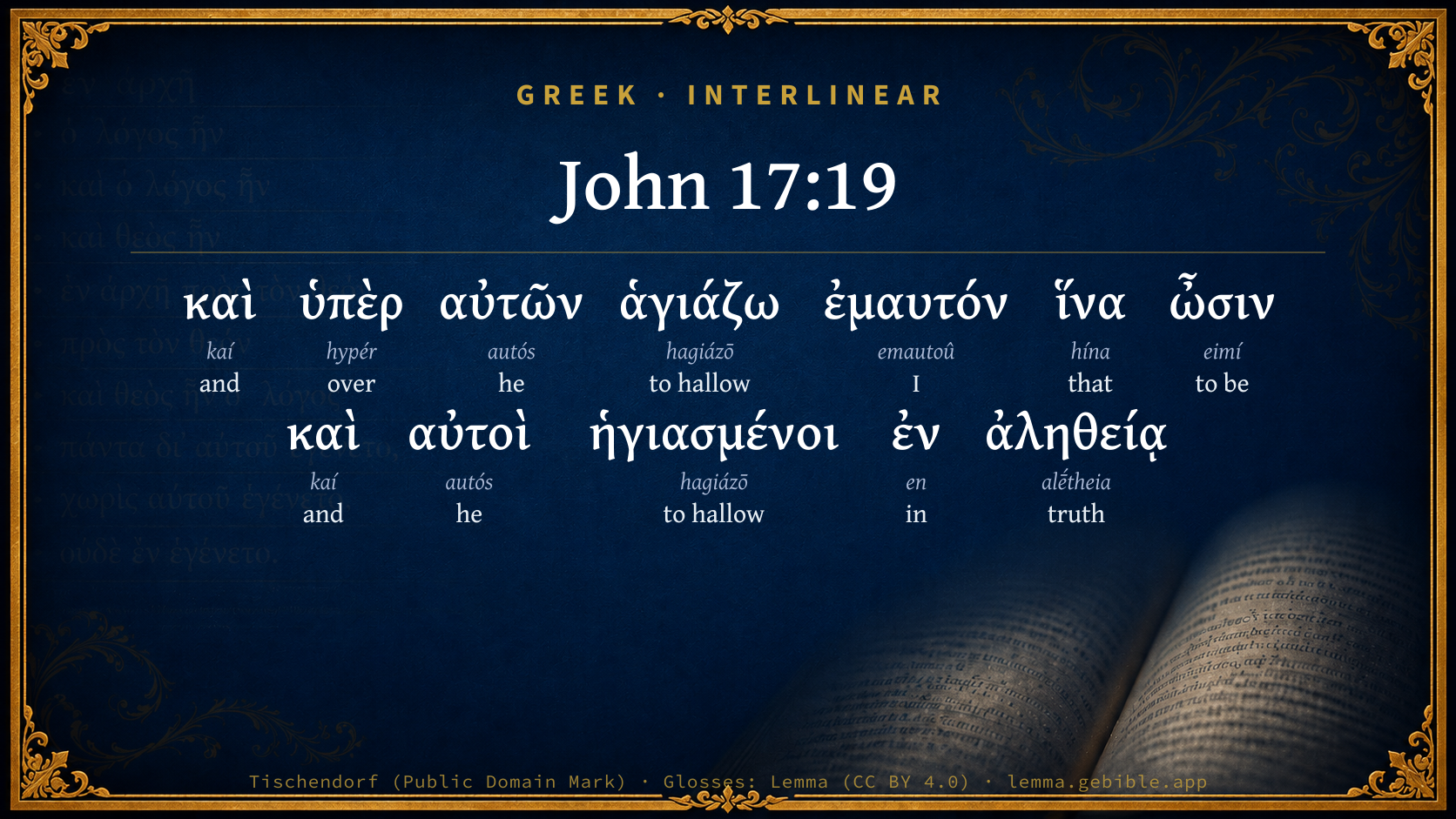
  1. καὶ kaí G2532 “and” Conjunction
  2. ὑπὲρ hypér G5228 “over” Preposition
  3. αὐτῶν autós G846 “he” Personal pronoun, Genitive, Plural, Masculine
  4. ἐμαυτόν emautoû G1683 “I” Reflexive pronoun, 1st person, Accusative, Singular, Masculine
  5. ἵνα hína G2443 “that” Conjunction
  6. ὦσιν eimí G1510 “to be” Verb, Present, Active, Subjunctive, 3rd person, Plural
  7. καὶ kaí G2532 “and” Conjunction
  8. αὐτοὶ autós G846 “he” Personal pronoun, Nominative, Plural, Masculine
  9. ἡγιασμένοι hagiázō G37 “to hallow” Verb, Perfect, Passive, Participle, Nominative, Plural, Masculine
  10. ἐν en G1722 “in” Preposition
  11. ἀληθείᾳ alḗtheia G225 “truth” Noun, Dative, Singular, Feminine

About this verse

These counts appear in no published source. They are computed here, from the morphology-tagged text and Lemma’s own curated glosses. What Lemma adds →

12
words
9
distinct lemmas
Gospels
section

Shared distinctive vocabulary

ἁγιάζω to hallow G37 occurs in 25 verses of the Greek New Testament. Also found in:
Repetition

Words recur within this verse:

  • ἁγιάζω to hallow G37 ×2
  • καὶ and G2532 ×2
  • αὐτῶν he G846 ×2

Cross-references

16

Topical passages linked to John 17:19 in the Treasury of Scripture Knowledge — connected by theme and wording, ordered by reader-vote popularity; previews shown in the World English Bible.

  • Titus 2:14 who gave himself for us, that he might redeem us from all iniquity, and purify for himself a people for his own possession, zealous for good works.
  • Hebrews 2:11 For both he who sanctifies and those who are sanctified are all from one, for which cause he is not ashamed to call them brothers,
  • John 17:17 Sanctify them in your truth. Your word is truth.
  • 1 Corinthians 1:2 to the assembly of God which is at Corinth; those who are sanctified in Christ Jesus, called to be saints, with all who call on the name of our Lord Jesus Christ in every place, both theirs and ours:
  • Hebrews 10:5–10 Therefore when he comes into the world, he says, "Sacrifice and offering you didn't desire, But a body did you prepare for me;
  • 2 Corinthians 4:15 For all things are for your sakes, that the grace, being multiplied through the many, may cause the thanksgiving to abound to the glory of God.
  • 2 Corinthians 8:9 For you know the grace of our Lord Jesus Christ, that, though he was rich, yet for your sakes he became poor, that you through his poverty might become rich.
  • 1 Thessalonians 4:7 For God called us not for uncleanness, but in sanctification.
  • 2 Timothy 2:10 Therefore I endure all things for the chosen ones' sake, that they also may obtain the salvation which is in Christ Jesus with eternal glory.
  • Hebrews 9:26 or else he must have suffered often since the foundation of the world. But now once at the end of the ages, he has been revealed to put away sin by the sacrifice of himself.
  • Hebrews 10:29 How much worse punishment, do you think, will he be judged worthy of, who has trodden under foot the Son of God, and has counted the blood of the covenant with which he was sanctified an unholy thing, and has insulted the Spirit of grace?
  • Isaiah 62:1 For Zion's sake will I not hold my peace, and for Jerusalem's sake I will not rest, until her righteousness go forth as brightness, and her salvation as a lamp that burns.
  • Hebrews 9:13 For if the blood of goats and bulls, and the ashes of a heifer sprinkling those who have been defiled, sanctify to the cleanness of the flesh:
  • Jeremiah 1:5 Before I formed you in the belly I knew you, and before you came forth out of the womb I sanctified you; I have appointed you a prophet to the nations.
  • John 10:36 Do you say of him whom the Father sanctified and sent into the world, 'You blaspheme,' because I said, 'I am the Son of God?'
  • Hebrews 9:18 Therefore even the first covenant has not been dedicated without blood.

Cross-references courtesy of OpenBible.info (CC BY 4.0).

Commentary

Notes on John 17:19 from classic Christian and Jewish commentators (each source and its license shown beneath its notes). The classic Christian expositions comment on the surrounding passage and are grouped to its opening verse, so a note may address several verses; the Jewish commentaries on the Tanakh (Rashi and others) are per-verse, so they appear only where the commentator wrote on this verse.

Lemma curates 59 commentaries, every one of them public domain or Creative Commons licensed, each selected and text-cleaned for this edition rather than reprinted as found. About our sources →

John Gill's Exposition

Neither pray I for these alone,.... Meaning his immediate apostles and disciples, for whose preservation and sanctification he had been particularly praying in Joh 17:19; and now, that it might not be thought that these were his only favourites, and the only persons he had a regard for, and to whom his intercession and sacrifice were confined; he adds,

but for them also which shall believe in me through their word: Christ is the object of true faith; which faith is not a mere assent of the mind to any truth concerning Christ, as that he is the Son of God, the Messiah and Saviour of the world; but it is a spiritual sight of him, of the necessity, fitness, and suitableness of him as a Saviour, a going forth unto him, laying hold on him, and depending upon him for life and salvation; of which the preaching of the Gospel is the instrumental means: it is indeed a gift of God, and a fruit of electing grace, and which is secured by it; hence our Lord knew that there would be a number, in all successive generations, that would believe in him, through the ministry of the word; and for these persons, and their conversion, and the success of the Gospel, to the good of their souls, he prays.

John Gill's Exposition of the Whole Bible (1746–1763) — public domain (CC PDM 1.0). Text via the HelloAO Bible API.

Tyndale Open Study Notes

Tyndale Open Resources

17:19 I give myself as a holy sacrifice (literally I sanctify myself): Priests and prophets were similarly set apart for service to God (Lev 8:30; Jer 1:5). Jesus recommitted himself to his mission, acknowledging that he was set apart for the purpose of the cross. The disciples would benefit because his death would enable them to experience new holiness in a deep attachment to God.

Tyndale Open Study Notes — © Tyndale Open Resources, licensed CC BY-SA 4.0. Text via the HelloAO Bible API.

Bengel's Gnomon

Johann Albrecht Bengel

Joh 17:19. Ἐγὼ ἁγιάζω ἐμαυτὸν, I sanctify Myself) I dedicate and consecrate Myself wholly to Thee. They are going out into the world for My sake; I, moreover, am going to Thee, also for their good. An Euphemism, appropriate to the love of Christ: I sanctify Myself, in enduring death, and that the death of the cross.—ἡγιασμένοι, sanctified) It is of such as these, and of them only, that the Canonisation is truly being made by the Lord Himself: 1Pe 3:18, “Christ hath once suffered for sins, the Just for the unjust, to bring us to God;” 2Co 5:15, “He died for all, that they who live should not henceforth live unto themselves, but unto Him who died for them and rose again.”—ἐν ἀληθείᾳ, in [through] the truth) even though it may not appear externally. This is contrasted with ceremonial sanctimony.

Bengel's Gnomon of the New Testament — English translation (T&T Clark, Edinburgh, 1860) — public domain. Text from a community e-Sword module.

Expositor's Greek Testament

ed. W. Robertson Nicoll

Joh 17:19 . The crowning plea is that it was for this end, their consecration, Jesus consecrated Himself: καὶ ὑπὲρ αὐτῶν , “and in their behalf, that they may be consecrated in truth, do I consecrate myself”. “ Ἁγιάζω in the present with ὑπέρ can only be understood of Christ’s self-consecration to His sacrificial death.” Tholuck. ἐγὼ ἑκουσίως θυσιάζω ἐμαυτόν , Euthymius; so Meyer, Reynolds and others. This however is needlessly to limit the reference and to introduce an idea somewhat alien to this context and to Joh 10:36 . Calvin is right: “Porro sanctificatio haec quamvis ad totam Christi vitam pertineat, in sacrificio tamen mortis ejus maxime illustris fuit”. ἵνα … The object of Christ’s consecration to His work was the severance of His disciples from the world and their inspiration with the same spirit of self-sacrifice and devotedness to sacred uses. ἐν ἀλήθειᾳ , understood by the Greek commentators as “real” in contrast to what is symbolic, cf. Joh 4:23 . Thus Euthymius, ἵνα καὶ αὐτοὶ ὦσι τεθυμένοι ἐν ἀληθινῇ θυσίᾳ , ἡ γὰρ νομικὴ θυσία τύπος ἦν , οὐκ ἀλήθεια . “Discernit a sanctificationibus legis.” Melanchthon Similarly Godet. Meyer renders “truly” and remarks: “As contrasted with every other ἁγιότης in human relations, that wrought through the Paraclete is the true consecration”. But is it possible to neglect the reference to ἀληθείᾳ , Joh 17:17 ? As Lücke points out, John (3Jn 1:3-4 ) does not always distinguish between ἀλήθεια and ἡ ἀλήθεια . The object to Christ’s consecration was to bring the truth by and in which the disciples might be consecrated.

The Expositor's Greek Testament, edited by W. Robertson Nicoll (1897–1910) — public domain. Text from a community e-Sword module.

Geneva Bible (1599)

Geneva Bible translators

The true and substantial sanctification of Christ, is set against the outward purifyings.

Geneva Bible (1599) marginal notes — public domain. Text via Bolls.life.

Jamieson, Fausset & Brown

Robert Jamieson, A. R. Fausset & David Brown

And for their sakes I sanctify--consecrate.

myself that they also might--may.

be sanctified--consecrated. The only difference between the application of the same term to Christ and the disciples is, as applied to Christ, that it means only to "consecrate"; whereas, in application to the disciples, it means to consecrate with the additional idea of previous sanctification, since nothing but what is holy can be presented as an offering. The whole self-sacrificing work of the disciples appears here as a mere result of the offering of Christ [OLSHAUSEN].

through--in.

the truth--Though the article is wanting in the original here, we are not to translate, as in the Margin, "truly sanctified"; for the reference seems plainly to be "the truth" mentioned in Joh 17:17. (See on Joh 17:17).

Jamieson, Fausset & Brown — Commentary Critical and Explanatory on the Whole Bible (1871) — public domain (CC PDM 1.0). Text via the HelloAO Bible API.

Adam Clarke's Commentary

Verse 19. I sanctify myself] I consecrate and devote myself to death-that I may thereby purchase eternal salvation for them. There seems to be here an allusion to the entering of the high priest into the holy of holies, when, having offered the sacrifice, he sprinkled the blood before the ark of the covenant. So Jesus entered into the holiest of all by his own blood, in order to obtain everlasting redemption for men: see Heb 9:11-13. The word, αγιαζω, to consecrate or sanctify, is used in the sense of devoting to death, in Jer 12:3, both in the Hebrew and in the Septuagint: the Hebrew קדש signifies also to sacrifice.

Adam Clarke's Commentary on the Bible (1810–1826) — public domain. Text from a community e-Sword/MySword module.

John Calvin's Commentaries

19. And for their sales I sanctify myself. By these words he explains more clearly from what source that sanctification flows, which is completed in us by the doctrine of the Gospel. It is, because he consecrated himself to the Father, that his holiness might come to us; for as the blessing on the first-fruits is spread over the whole harvest, so the Spirit of God cleanses us by the holiness of Christ and makes us partakers of it. Nor is this done by imputation only, for in that respect he is said to have been made to us righteousness; but he is likewise said to have been made to us sanctification, (1 Corinthians 1:30,) because he has, so to speak, presented us to his Father in his own person, that we may be renewed to true holiness by his Spirit. Besides, though this sanctification belongs to the whole life of Christ, yet the highest illustration of it was given in the sacrifice of his death; for then he showed himself to be the true High Priest, by consecrating the temple, the altar, all the vessels, and the people, by the power of his Spirit.

John Calvin's Commentaries (1540-1563) — public domain. Text from the Calvin Translation Society English edition (1840s-50s) via the Christian Classics Ethereal Library (ccel.org). Calvin's coverage is partial (roughly two-thirds of the Bible); uncommented books and verses are honest gaps, never fabricated. The 19th-century editor's footnotes and remarks are omitted so the notes are faithfully Calvin's own voice.

Ellicott's Commentary for English Readers

(19) And for their sakes I sanctify myself.—Comp. Note on Joh_17:17. The consecration here thought of is that to the work which was immediately before Him—the offering Himself as a sacrifice. The word was in frequent use in the special sense of an offering or sacrifice set apart to God. As a New Testament example of this, comp. Rom_15:16. By this consecration of Himself—which in a wider sense is for all men, but in the special sense is “for their sakes”—He will, as both Priest and Sacrifice, enter into the Holy of Holies of the heavenly temple, and will send the Holy Ghost, who will consecrate them.

That they also might be sanctified through the truth.—Better, as in the margin, . . . . might be truly sanctified. The words “they also” are emphatic, answering to “their sakes” and “myself” in the preceding clause.

A Bible Commentary for English Readers, edited by Charles John Ellicott (1878–1897) — public domain. Text from a community e-Sword module.

The Cambridge Bible for Schools and Colleges

gen. ed. J. J. S. Perowne

19. sanctify] Or, consecrate, as in Joh_17:17. Christ does for Himself that which He prays the Father to do for His disciples. In Joh_10:36 He speaks of Himself as consecrated by the Father; set apart for a sacred purpose. But only thus far is the consecration of Christ and of His disciples the same. In them it also implied redemption and cleansing from sin; and in this sense the word is frequently connected with ‘purify’ (2Co_7:1; Eph_5:26; 2Ti_2:21; Heb_9:13). The radical meaning of the word is not separation, as is sometimes stated, but holiness, which involves separation, viz. the being set apart for God.

might be sanctified through the truth] Rather, may be sanctified or consecrated in truth. ‘In truth’ = in reality and not merely in name or appearance; the expression is quite distinct from ‘in the truth’ in Joh_17:17. As a Priest consecrated by the Father (Joh_10:36) He consecrates Himself as a Sacrifice (Eph_5:2), and thereby obtains a real internal consecration for them through the Paraclete (Joh_16:7).

The Cambridge Bible for Schools and Colleges (gen. ed. J. J. S. Perowne; Cambridge University Press, 1878–1918) — public domain. Text from a community e-Sword module.

Trapp's Complete Commentary

John Trapp

19 And for their sakes I sanctify myself, that they also might be sanctified through the truth.

Ver. 19. And for their sakes do I sanctify] As both priest, altar, and sacrifice; and this Christ did from the womb to the tomb; at his death especially, when this Paschal Lamb was roasted in the fire of his Father’s wrath, that his people might be made partakers of his holiness, Heb 10:10. Here also it is worth the noting, that these petitions in our Saviour’s prayer do so sweetly depend one upon another, that if you take away one, you deface the other. Phavorinus in Gellius, comparing between the style of Lysias and Plato, observes this difference; Quod si ex Platonis oratione aliquid demas mutesque de elegantia tantum detraxeris; si ex Lysiae, de sententia.

John Trapp, A Commentary or Exposition upon All the Books of the Old and New Testament (1647–1656) — public domain. Text from a community e-Sword module.

Albert Barnes' Notes on the Bible

I sanctify myself - I consecrate myself exclusively to the service of God. The word “sanctify” does not refer here to personal sanctification, for he had no sin, but to setting himself apart entirely to the work of redemption.

That they also ... -

1. That they might have an example of the proper manner of laboring in the ministry, and might learn of me how to discharge its duties. Ministers will understand their work best when they most faithfully study the example of their great model, the Son of God.

2. That they might be made pure by the effect of my sanctifying myself - that is, that they might be made pure by the shedding of that blood which cleanses from all sin. By this only can men be made holy; and it was because the Saviour so sanctified himself, or set himself to this work so unreservedly as to shed his own blood, that any soul can be made pure and fit for the kingdom of God.

Albert Barnes' Notes on the Bible (1834–1885) — public domain. Text from a community e-Sword/MySword module.

Haydock's Catholic Bible Commentary

And for them do I sanctify myself[6]. St. Augustine expounds it, I sanctify them, who are my members, in myself. The interpretation of St. John Chrysostom and St. Cyril, seems preferable, that to sanctify in the style of Scriptures, is oftentimes the same as to offer up a sacrifice: so the sense here is, I sacrifice, and offer up myself on the cross for them and all mankind. (Witham) --- By this Christ shews, that he sanctified the apostles, by sanctifying himself; because they are the members of his body. (St. Augustine, tract. 107. in Joan.) --- Or, according to St. John Chrysostom, I offer myself up to be the victim in their behalf. For victims, and whatever is dedicated to God, are called holy. He, their head, was offered up, and they also are immolated, according to that of the apostle, Romans xii. Exhibit your members a living sacrifice, holy, &c. (St. John Chrysostom, hom. lxxxi. in Joan.)

===============================

[BIBLIOGRAPHY]

Sanctifico meipsum. Quid est hoc, says St. Augustine, (tract. 108.) nisi eos in meipso Sanctifico, quoniam membra ejus sunt? St. John Chrysostom, (hom. Greek: pb. p. 484) Offero tibi Sacrificium, Greek: prosphero soi thusian. St. Cyril says the same, lib. xi. in Joan. p. 989.

====================

George Leo Haydock (1774–1849), Haydock's Catholic Family Bible and Commentary, 1859 edition — public domain. Excludes Psalms (Douay-Rheims chapter numbering differs from Protestant) and Deuterocanonical books (Catholic canon only).

Matthew Poole's English Annotations

I sanctify myself, here, is no more than, I set myself apart, as a sacrifice acceptable and well pleasing in the sight of God: and indeed sanctifying, in the ancient notion of it under the law, did ordinarily signify the setting of persons and things apart to the special service of God; which was done legally by certain ritual performances and ceremonies, and is still done inwardly and spiritually by regeneration, and renewing of the hearts of men and women by the efficacious working of the Holy Ghost. Christ saith, that for his disciples sake he sanctified himself, being both the Priest and the sacrifice.

Christ set apart himself as a sacrifice for his people,

that they might be sanctified: not only our eternal life and happiness, but all the means to it, fell within the counsel of God; hence we are said to be chosen of Christ, that we should be holy and without blame before him in love, Eph 1:4; and within the purchase of Christ: hence the apostle saith, Eph 5:25,26, that he gave himself for his church, that he might sanctify and cleanse it with the washing of water: and our Saviour here saith, that he set apart himself for a sacrifice for our sins, that his people might be sanctified through the truth; that is, by receiving the truth, not in their ears only, but in their hearts, in the love of it, and bringing forth the fruits of it in all holiness of life and conversation.

Matthew Poole's English Annotations on the Holy Bible (1683–1685) — public domain. Text from a community e-Sword/MySword module.

Whedon's Commentary on the Bible

Daniel D. Whedon

19. Sanctify myself—The great conditional sanctification or consecration of himself, by which Christ entitled himself to redeem a glorious Church from out the world, and present it pure and perfect before the Father, was the suffering of death. Thus as a redeemer he was made perfect through suffering.

For their sakes—This consecrating agony was undergone for the sake of his apostles, constituting and representing his entire glorious Church.

Daniel D. Whedon (gen. ed.), Commentary on the Old and New Testaments (1874–1909) — public domain. Text from a community e-Sword module.

The Pulpit Commentary

And for their sakes on their behalfI sanctify, consecrate, myself. The Father had consecrated him and sent him into the world, but over and above all this there were special and sacrificial acts of love and devotion which he made on behalf of his own. He went up voluntarily into the wilderness to be tempted for them; he wrought for them while it was yet day. He now was ready to commend himself to the supreme will of the Father, and to offer himself through the Spirit in his perfected humanity without spot of sin to God. Agiazw is equivalent prosferw soi yusian , as Chrysostom says, and it is used for vyDiqhi. (Exo_13:2 Deu_15:19) Christ is the Priest and the Victim, and the dedication of himself to this climax of his consecrated life is for the sake of the disciples (so Lange, Meyer, Godet, and Westcott). That they also may be sanctified indeed truly or veritably.

(1) We have to notice that the passive form of the second clause shows that that which the Lord, in its highest form, effects for himself, they receive as a work wrought in them by another.

(2) Using the word agiazein in the same sense in both clauses, the consecration effected in the disciples must correspond with Christ"s consecration in self-sacrificial love, in abandonment to the power of the Word which has revolutionized their whole being, in entire equipment for their calling, even to the point of hatred and antagonism from the world, and death for his sake. They are indeed to drink of his cup, and be baptized with his baptism. They must be crucified with him and buried with him, and rise again with him, in the activity of their faith.

(3) En alhyeia , without the article, has the sense of "verily and indeed". (Mat_22:16 2Co_7:14 1Jn_3:18, etc.) It is not certain that 2Jn_1:1 or 3Jn_1:1 can be thus translated, but the classical usage of this phrase, and also of ep alhyeiav , leaves little doubt about its use here.

The Pulpit Commentary (1880–1919), ed. H.D.M. Spence-Jones & Joseph S. Exell — public domain. Text from a community e-Sword module.

John Wesley's Explanatory Notes

I sanctify myself - I devote myself as a victim, to be sacrificed.

John Wesley, Explanatory Notes Upon the Whole Bible (1754–1765) — public domain. Text via the GEBible commentary corpus.

Burkitt's Expository Notes on the New Testament

William Burkitt

The word sanctify here, is not to be taken for the cleansing, purifying, or making holy, that which before was unclean; but Christ’s sanctifying himself imports,

1. His separation of setting himself apart to be a sacrifice for sin.

2. His consecration or dedication of himself to this holy use and service.

Hence learn, that Jesus Christ did dedicate and solemnly set himself apart to the great work and office of a Mediator.

Learn, 2. That the great end for which Christ did thus sanctify himself, was, that he might sanctify his members; therefore did he consecrate and set himself apart for us, that we should be consecrated to, and wholly set apart for, him.

William Burkitt's Expository Notes on the New Testament (1700–1703) — public domain. Text from a community e-Sword module.

The People's New Testament

B. W. Johnson

19. For their sakes I sanctify myself. He did this when he came into the world, when he made it his meat to do the Father's will, and when he gave himself to death. We sanctify ourselves when we “present our bodies as living sacrifices.”

B. W. Johnson's The People's New Testament with Notes (1889–1891) — public domain. Electronic text from the Christian Classics Ethereal Library (CCEL) ThML edition.

Cambridge Greek Testament for Schools and Colleges

19. ὧσιν before καὶ αὐτοί: comp. Joh 17:16.

19. Christ does for Himself that which He prays the Father to do for His disciples. In Joh 10:36 He speaks of Himself as consecrated by the Father; set apart for a sacred purpose. But only thus far is the consecration of Christ and of His disciples the same. In them it also implied redemption and cleansing from sin; and in this sense ἁγιάζω is frequently connected with καθαρίζω (2Co 7:1; Eph 5:26; 2Ti 2:21; Heb 9:13). The radical meaning of the word is not separation, as is sometimes stated, but holiness, which involves separation, viz. the being set apart for God. In O. T. consecration is a ritual act; in N.T. a spiritual act, the consecration of the heart and will to God. Ἐν ἀληθείᾳ, in truth and reality, not in mere name, is different from ἐν τῇ ἀληθείᾳ, in the Truth (see on Joh 17:17). As a Priest consecrated by the Father (Joh 10:36) He consecrates Himself as a Sacrifice (Eph 5:2), and thereby obtains a real internal consecration for them through the Paraclete (Joh 16:7).

Cambridge Greek Testament for Schools and Colleges (Cambridge University Press, 1896; 21 vols, various authors incl. Carr, Maclear, Plummer, Farrar, Lumby, Moule, M. R. James, Simcox) — public domain. Text from a community e-Sword module.

Alford’s Greek Testament

Henry Alford

19.] See above on ver. 17. Notice, says Meyer, the emphatic correlation of αὐτῶν—ἐγὼ ἐμαυτόν—καὶ αὐτοί.

It is clear against all Socinian inferences from this verse, that all that part of ἁγιάζειν implied in ch. 10:36 is here excluded: and only that intended which is expressed Heb 2:10 by διὰ παθημάτων τελειῶσαι. Of this, His death was the crowning act, and was also the one to which the ὑπὲρ αὐτῶν most directly applies; but the whole is included. The confining the meaning to His sacrifice (Chrys., Euthym.), and the ἵνα καὶ αὐτοὶ.… to their martyrdom, or their spiritual self-offering, Rom 12:1 (Euthym.), is insufficient for the depth of the words.

ἐν ἀληθ.] in truth: what truth, is evident from ver. 17, where, in the repetition, ὁ λόγ. ὁ σὸς ἀλήθειά ἐστιν, the article is also wanting: see also ch. 1:14; 4:24: 3Jn 1:3,—for ἀλήθ, without the article. But the distinction is perhaps somewhat obscured after a preposition.

Henry Alford, The Greek Testament (1849–1861) — public domain. Text from a community e-Sword module.

International Critical Commentary

19. καὶ ὑπὲρ αὐτῶν ἐγὼ ἁγιάζω ἐμαυτόν. ἐγώ is om. by אW, but ins. BCDLNΘ rightly: it is here emphatic.

ὑπέρ is a favourite prep. with Jn., who always uses it as meaning “on behalf of.” See on 1:30, and cf. 6:51.

ἐγὼ ἁγιάζω ἐμαυτόν. At 10:36 He had spoken of Himself as One ὃν ὁ πατὴρ ἡγίασεν. But there is no inconsistency. The Father “consecrated” Jesus for His mission to the world; and now that His mission is about to be consummated in death, Jesus “consecrates” Himself, as He enters upon the Passion. So He had said before of His life, “I lay it down of myself” (10:18). In His death He was both Priest and Victim.

The two petitions for the disciples were for their deliverance from the Evil One (v. 15), and for their consecration (v. 17). These are the two purposes of the Atonement, as set out Tit 2:14, “Who gave Himself for us, in order that He might (1) redeem us from all iniquity, and (2) purify to Himself a peculiar people zealous of good works.” So here the “consecration ” of Himself to the Cross by Jesus was not only that (ἵνα) His chosen apostles might in their turn be guarded and consecrated, but that the same consecration might be the portion of all future disciples (v. 20). There is a special emphasis on ἐγώ. No one else could say, “I consecrate myself.” It is only through His consecration that His disciples can be consecrated; and so in Heb 10:10 we find the confession, “We have been consecrated through the offering of the Body of Jesus Christ.” In a sense, He is the consecrator of all such: “He that consecrates and they that are being consecrated are all of one” (ἐξ ἑνός, Heb 2:11), a thoroughly Johannine statement, although it does not appear in Jn.

ἵνα ὦσιν καὶ αὐτοὶ ἡγιασμένοι ἐν ἀληθείᾳ. Cf. v. 17 for truth, the Divine λόγος, the full revelation of the Father, as the medium of consecration to the Christian life.

The Prayer of Jesus for All Future Disciples (vv. 20-26)

International Critical Commentary — older volumes (1896–1929), various authors — public domain. Text from a community e-Sword module.

Lesson kit

Teaching starters — assembled from the data on this page, not authored interpretation. Every prompt links to the verse data it draws on. Edit before teaching.

John, in the Gospels, opens this verse with 12 words (9 distinct Greek lemmas). Its most distinctive word is hagiázō (“to hallow”). A historical commentator’s framing appears above. Read the whole chapter for the surrounding context.

Discussion questions

  1. What does “to hallow” (hagiázō) contribute to the verse as a whole?
  2. How does Matthew 6:9, which shares the word «to hallow», read alongside this verse?
  3. What does the repetition of “to hallow” (2× in this one verse) do in this verse?
  4. These translations render this verse differently. What is at stake in choosing one wording over another?
  5. Compare how John Gill's Exposition and Tyndale Open Study Notes read this verse. Where do they agree or differ?

Things to notice

  • These translations choose different wording for 6 words in this verse.
  • “to hallow” occurs 2× in this single verse.
  • 9 distinct Greek lemmas span 12 words in this verse.

Reading settings

Reading text

Shown beneath each verse's original-language words.

Old Testament
Old Testament edition

Read the OT as the Masoretic Hebrew (MT) or the Greek Septuagint (LXX).

English shown for the Greek Septuagint (in the Hebrew ↔ Greek comparison).

Comparing translations? Open the Compare panel on any verse page to stack up to four side by side.