John 16:32

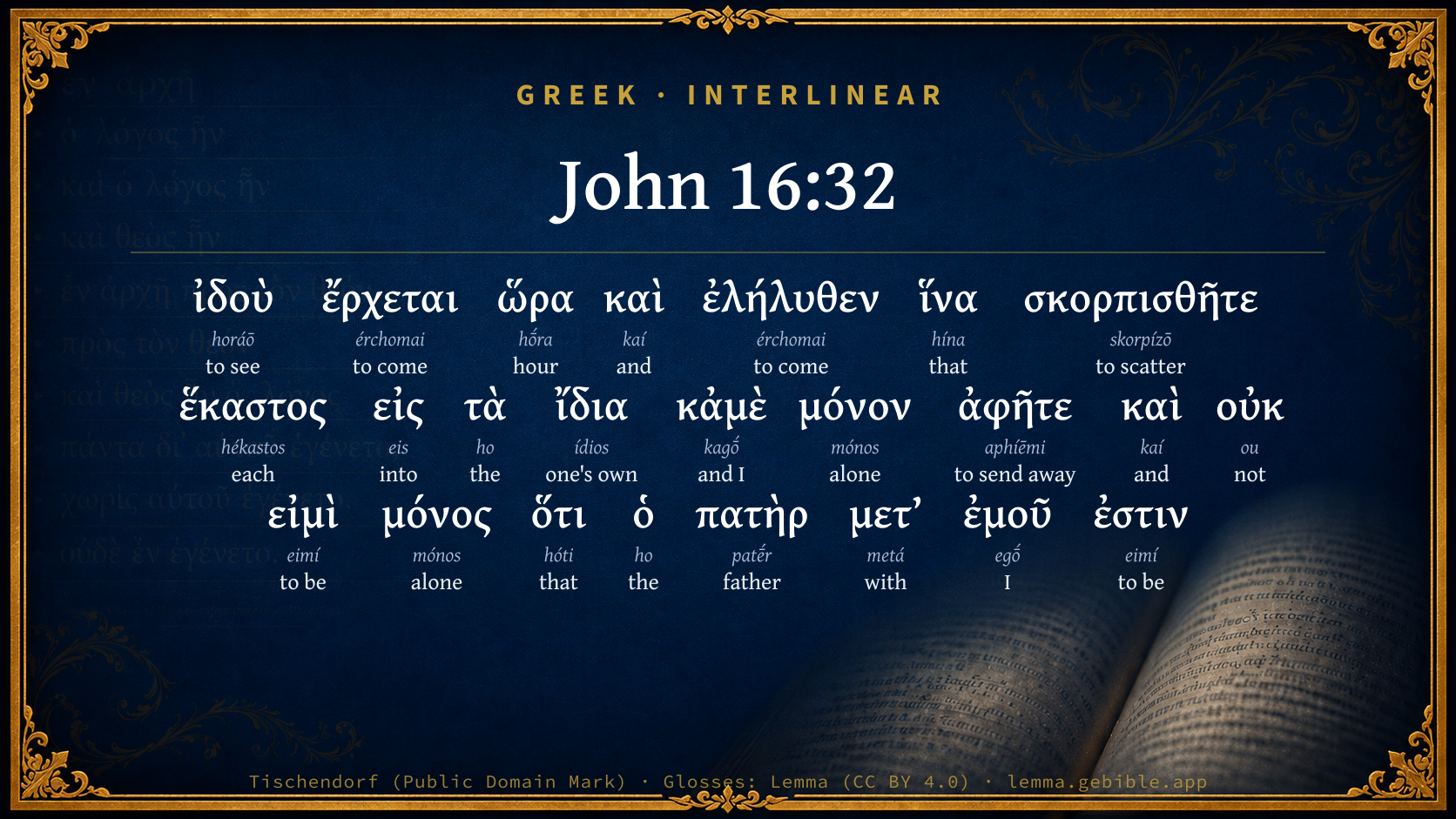
Greek (Tischendorf 8th ed.) John 16:32 appears in the Greek New Testament. The text above is from the Tischendorf 8th edition. Each word links to its Strong’s number and a concise gloss. Click any word for its full Thayer’s Greek Lexicon entry.
Download image
Cite this verse

John 16:32 (World English Bible). Public Domain. Lemma interlinear Bible study tool, https://lemma.gebible.app/v/john/16/32.

Show BibTeX & RIS
BibTeX
RIS
English Translation
Behold, the time is coming, yes, and has now come, that you will be scattered, everyone to his own place, and you will leave me alone. Yet I am not alone, because the Father is with me.
World English Bible · Public Domain
Download a study sheet

One document with this verse’s original text, its word-by-word gloss line, the meaning frame, cross-references with their text, attributed commentary, and full source and license credits — printable, and it pastes into notes with its structure intact.

This verse Autodidact and up

Study sheet (.html) Plain text (.txt)

A passage Seminary Student

Up to 50 verses in one chapter. A passage sheet keeps up to 6 commentary sources and 12 cross-references per verse, in the order this page ranks them, and says so on the sheet whenever that leaves anything out. Ask for a single verse and you get the Autodidact verse sheet above.

Everything on this page stays free to read, with no account — the sheet is a download of what is already on screen, not access to it.

Want to remove ads? Support Godless Engineer
Compare translations 3

The same verse in 3 English versions, stacked beneath the original-language interlinear above. Click any original word for its lexicon entry.

Each is an independent rendering of the whole verse — the interlinear is not word-aligned to these translations.

Highlighted words mark where these versions differ — a whole-verse word diff, not a word-by-word alignment.

  • World English Bible Public Domain
    Behold, the time is coming, yes, and has now come, that you will be scattered, everyone to his own place, and you will leave me alone. Yet I am not alone, because the Father is with me.
  • King James Version Public Domain
    Behold, the hour cometh, yea, is now come, that ye shall be scattered, every man to his own, and shall leave me alone: and yet I am not alone, because the Father is with me.
  • unfoldingWord Literal Text CC BY-SA 4.0
    Behold, an hour is coming—and has come—that you might be scattered, each one to his own, and you might leave me alone. Yet I am not alone, because the Father is with me.

unfoldingWord Literal Text — © unfoldingWord, licensed CC BY-SA 4.0. Word-aligned USFM3 via Door43 (git.door43.org/unfoldingWord/en_ult).

Versions to compare (up to 4)

3 of 4 selected

Show all 19 translations

Every available English version of this verse, each an independent rendering of the whole verse.

  • World English Bible Public Domain
    Behold, the time is coming, yes, and has now come, that you will be scattered, everyone to his own place, and you will leave me alone. Yet I am not alone, because the Father is with me.
  • Berean Standard Bible Public Domain
    “Look, an hour is coming and has already come when you will be scattered, each to his own home, and you will leave Me all alone. Yet I am not alone, because the Father is with Me.
  • Majority Standard Bible Public Domain
    “Look, an hour is coming and has already come when you will be scattered, each to his own home, and you will leave Me all alone. Yet I am not alone, because the Father is with Me.
  • King James Version Public Domain
    Behold, the hour cometh, yea, is now come, that ye shall be scattered, every man to his own, and shall leave me alone: and yet I am not alone, because the Father is with me.
  • American Standard Version (1901) Public Domain
    Behold, the hour cometh, yea, is come, that ye shall be scattered, every man to his own, and shall leave me alone: and `yet' I am not alone, because the Father is with me.
  • Revised Version (1885) Public Domain
    Behold, the hour cometh, yea, is come, that ye shall be scattered, every man to his own, and shall leave me alone: and yet I am not alone, because the Father is with me.
  • Geneva Bible (1599) Public Domain
    Beholde, the houre commeth, and is already come, that ye shalbe scattered euery man into his owne, and shall leaue me alone: but I am not alone: for the Father is with me.
  • Douay-Rheims (1899) Public Domain
    Behold, the hour cometh, and it is now come, that you shall be scattered every man to his own, and shall leave me alone; and yet I am not alone, because the Father is with me.
  • Young's Literal Translation Public Domain
    and now it hath come, that ye may be scattered, each to his own things, and me ye may leave alone, and I am not alone, because the Father is with me;
  • Literal Standard Version CC BY-SA 4.0
    and now it has come, that you may be scattered, each to his own things, and you may leave Me alone, and I am not alone, because the Father is with Me;
  • Unlocked Literal Bible CC BY-SA 4.0
    See, the hour is coming, yes, and has indeed come, when you will be scattered, everyone to his own home, and you will leave me alone. Yet I am not alone because the Father is with me.
  • unfoldingWord Literal Text CC BY-SA 4.0
    Behold, an hour is coming—and has come—that you might be scattered, each one to his own, and you might leave me alone. Yet I am not alone, because the Father is with me.
  • Darby Bible Public Domain
    Behold, [the] hour is coming, and has come, that ye shall be scattered, each to his own, and shall leave me alone; and [yet] I am not alone, for the Father is with me.
  • World Messianic Bible Public Domain
    Behold, the time is coming, yes, and has now come, that you will be scattered, everyone to his own place, and you will leave me alone. Yet I am not alone, because the Father is with me.
  • Webster's Bible Public Domain
    Behold, the hour cometh, and is even now come, that ye shall be scattered every man to his own, and shall leave me alone: and yet I am not alone, because the Father is with me.
  • Free Bible Version CC BY-SA 4.0
    “The time is coming—in fact it's just about to happen—when you will be scattered, each of you to your own homes, leaving me all alone. But I'm not really alone, for the Father is with me.
  • Bible in Basic English Public Domain
    See, a time is coming, yes, it is now here, when you will go away in all directions, every man to his house, and I will be by myself: but I am not by myself, because the Father is with me.
  • Text-Critical English NT CC BY 4.0
    Behold, an hour is coming, and has now come, when you will be scattered, each to yoʋr own home, and will leave me all alone. Yet I am not alone, for the Father is with me.
  • Tyndale New Testament (1534) Public Domain
    Beholde the houre draweth nye and is already come that ye shalbe scatered every man his wayes and shall leave me alone. And yet am I not alone. For the father is with me.

Literal Standard Version (2020), Covenant Press — licensed CC BY-SA 4.0. Text via the HelloAO Bible API (eBible.org). Unlocked Literal Bible (unfoldingWord) — licensed CC BY-SA 4.0. Text via the HelloAO Bible API (eBible.org). unfoldingWord Literal Text — © unfoldingWord, licensed CC BY-SA 4.0. Word-aligned USFM3 via Door43 (git.door43.org/unfoldingWord/en_ult). Free Bible Version, Dr. Jonathan Gallagher — licensed CC BY-SA 4.0. Text via the HelloAO Bible API (eBible.org).

Word by word

More ways to search: Search by grammar → Find every occurrence → Compare this word →

Practice this passage: Drill this verse → Learn its vocabulary →

σκορπισθῆτε
skorpízō
G4650
“to scatter”
Verb, Aorist, Passive, Subjunctive, 2nd person, Plural
Part of Speech
Verb
Tense
Aorist
Voice
Passive
Mood
Subjunctive
Person
2nd person
Number
Plural
Full Thayer's Definition

Origin: apparently from the same as G4651 (through the idea of penetrating)

TDNT: 13:58,1

1. to scatter a. of those who, routed or terror stricken or driven by some other impulses, fly in every direction b. to scatter abroad (what others may collect for themselves), or one dispensing blessings literally
  1. ἰδοὺ horáō G3708 “to see” Verb, Aorist, Middle, Imperative, 2nd person, Singular
  2. ἔρχεται érchomai G2064 “to come” Verb, Present, Middle or Passive deponent, Indicative, 3rd person, Singular
  3. ὥρα hṓra G5610 “hour” Noun, Nominative, Singular, Feminine
  4. καὶ kaí G2532 “and” Conjunction
  5. ἐλήλυθεν érchomai G2064 “to come” Verb, Perfect, Active, Indicative, 3rd person, Singular
  6. ἵνα hína G2443 “that” Conjunction
  7. ἕκαστος hékastos G1538 “each” Adjective, Nominative, Singular, Masculine
  8. εἰς eis G1519 “into” Preposition
  9. τὰ ho G3588 “the” Article, Accusative, Plural, Neuter
  10. ἴδια ídios G2398 “one's own” Adjective, Accusative, Plural, Neuter
  11. κἀμὲ kagṓ G2504 “and I” Personal pronoun, 1st person, Accusative, Singular, Aramaic form
  12. μόνον mónos G3441 “alone” Adjective, Accusative, Singular, Masculine
  13. ἀφῆτε aphíēmi G863 “to send away” Verb, Aorist, Active, Subjunctive, 2nd person, Plural
  14. καὶ kaí G2532 “and” Conjunction
  15. οὐκ ou G3756 “not” Particle, Negative
  16. εἰμὶ eimí G1510 “to be” Verb, Present, Active, Indicative, 1st person, Singular
  17. μόνος mónos G3441 “alone” Adjective, Nominative, Singular, Masculine
  18. ὅτι hóti G3754 “that” Conjunction
  19. ὁ ho G3588 “the” Article, Nominative, Singular, Masculine
  20. πατὴρ patḗr G3962 “father” Noun, Nominative, Singular, Masculine
  21. μετ’ metá G3326 “with” Preposition
  22. ἐμοῦ egṓ G1473 “I” Personal pronoun, 1st person, Genitive, Singular
  23. ἐστιν eimí G1510 “to be” Verb, Present, Active, Indicative, 3rd person, Singular

About this verse

These counts appear in no published source. They are computed here, from the morphology-tagged text and Lemma’s own curated glosses. What Lemma adds →

24
words
19
distinct lemmas
Gospels
section

Notable vocabulary

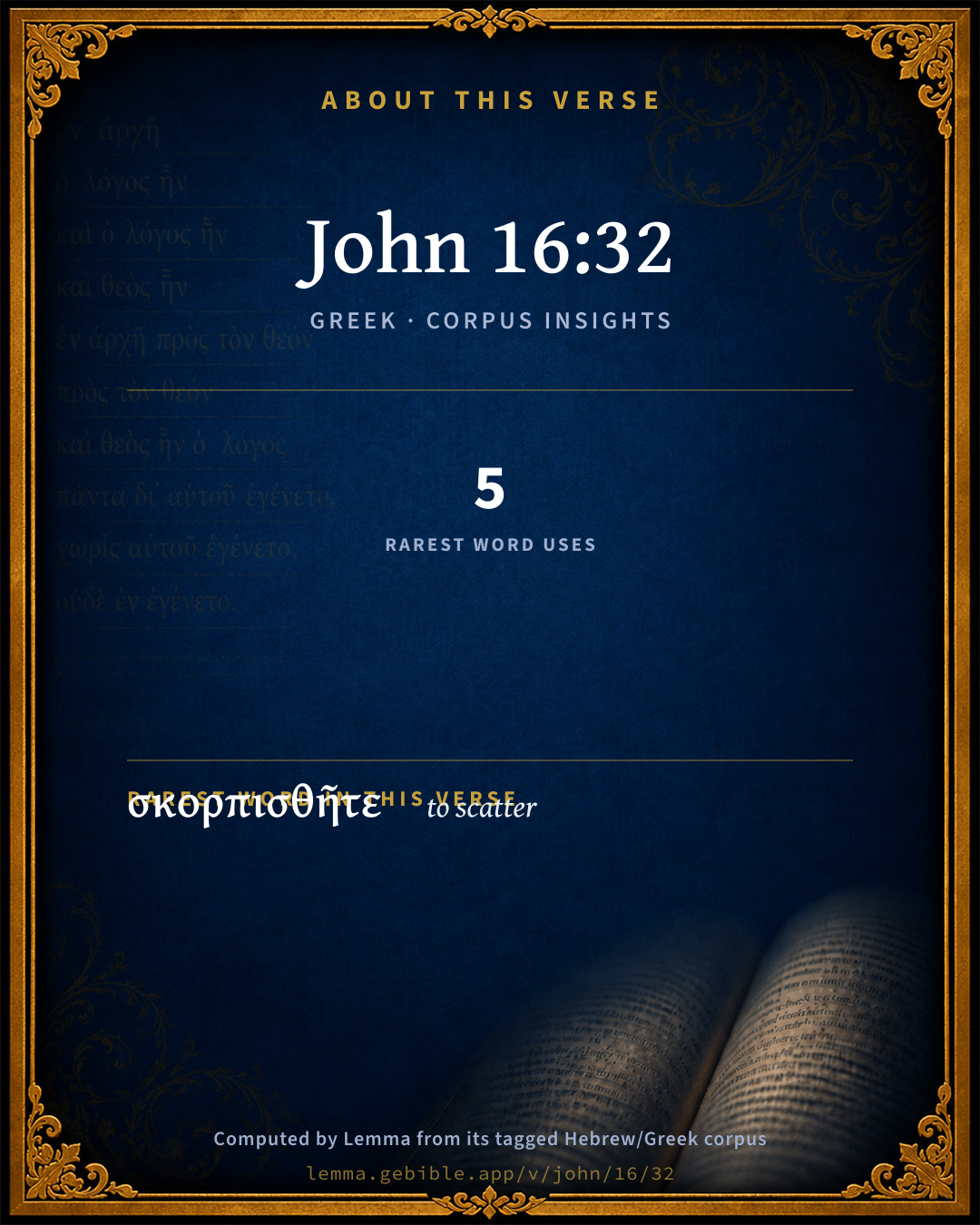
The rarest word here is σκορπισθῆτε to scatter G4650 — appearing just 5 times in the whole Greek New Testament.

Shared distinctive vocabulary

σκορπισθῆτε to scatter G4650 occurs in 5 verses of the Greek New Testament. Also found in:

Repetition

Words recur within this verse:

  • ἔρχεται to come G2064 ×2
  • μόνον alone G3441 ×2
  • εἰμὶ to be G1510 ×2
  • καὶ and G2532 ×2
  • τὰ the G3588 ×2

Cross-references

19

Topical passages linked to John 16:32 in the Treasury of Scripture Knowledge — connected by theme and wording, ordered by reader-vote popularity; previews shown in the World English Bible.

  • Zechariah 13:7 "Awake, sword, against my shepherd, And against the man who is close to me," says Yahweh of Hosts. Strike the shepherd, and the sheep will be scattered; And I will turn my hand against the little ones.
  • Matthew 26:31 Then Jesus said to them, "All of you will be made to stumble because of me tonight, for it is written, 'I will strike the shepherd, and the sheep of the flock will be scattered.'
  • John 8:29 He who sent me is with me. The Father hasn't left me alone, for I always do the things that are pleasing to him."
  • Mark 14:27 Jesus said to them, "All of you will be made to stumble because of me tonight, for it is written, 'I will strike the shepherd, and the sheep will be scattered.'
  • John 8:16 Even if I do judge, my judgment is true, for I am not alone, but I am with the Father who sent me.
  • Matthew 26:56 But all this has happened, that the Scriptures of the prophets might be fulfilled." Then all the disciples left him, and fled.
  • Isaiah 50:6–9 I gave my back to the strikers, and my cheeks to those who plucked off the hair; I didn't hide my face from shame and spitting.
  • Mark 14:50 They all left him, and fled.
  • John 4:21 Jesus said to her, "Woman, believe me, the hour comes, when neither in this mountain, nor in Jerusalem, will you worship the Father.
  • John 4:23 But the hour comes, and now is, when the true worshippers will worship the Father in spirit and truth, for the Father seeks such to be his worshippers.
  • John 16:2 They will put you out of the synagogues. Yes, the time comes that whoever kills you will think that he offers service to God.
  • John 16:25 I have spoken these things to you in figures of speech. But the time is coming when I will no more speak to you in figures of speech, but will tell you plainly about the Father.
  • John 20:10 So the disciples went away again to their own homes.
  • John 5:25 Most assuredly, I tell you, the hour comes, and now is, when the dead will hear the Son of God's voice; and those who hear will live.
  • John 5:28 Don't marvel at this, for the hour comes, in which all that are in the tombs will hear his voice,
  • John 12:23 Jesus answered them, "The time has come for the Son of Man to be glorified.
  • John 14:10–11 Don't you believe that I am in the Father, and the Father in me? The words that I tell you, I speak not from myself; but the Father who lives in me does his works.
  • Acts 8:1 Saul was consenting to his death. A great persecution arose against the assembly which was in Jerusalem in that day. They were all scattered abroad throughout the regions of Judea and Samaria, except for the apostles.
  • 2 Timothy 4:16–17 At my first defense, no one came to help me, but all left me. May it not be held against them.

Cross-references courtesy of OpenBible.info (CC BY 4.0).

Commentary

Notes on John 16:32 from classic Christian and Jewish commentators (each source and its license shown beneath its notes). The classic Christian expositions comment on the surrounding passage and are grouped to its opening verse, so a note may address several verses; the Jewish commentaries on the Tanakh (Rashi and others) are per-verse, so they appear only where the commentator wrote on this verse.

Lemma curates 59 commentaries, every one of them public domain or Creative Commons licensed, each selected and text-cleaned for this edition rather than reprinted as found. About our sources →

The Biblical Illustrator

Joseph S. Exell

Joh_16:32

Ye shall leave Me alone: and yet I am not alone, because the Father is with Me

Solitude

1.

There are two kinds of solitude--visible and inward. When we are not seen, we say that we are alone; however, it is not always a true isolation. The fisherman does not feel himself alone when he passes his nights on the immense ocean; he thinks of his family quietly sheltered; it is for them he is working, their love fills his heart. The watching soldier, in the lonely picket, does not feel himself alone; for he feels that on him rests the honour of the flag and the safety of his fellow-soldiers. The workwoman, in her garret, is not alone, for the work which she will finish before dawn will procure for those she loves the next days bread.

2. One can, on the contrary, be surrounded by the busiest crowd, and feel more isolated than in a desert. There are persons whose contact causes no sympathetic cord to vibrate in the soul. There have been days in which, coming back from the cemetery where you have buried a part of your heart and your life, the noise, the movement of the world seemed empty, cold and derisive.

3. Of these two solitudes I need not say which is the hardest to bear. To feel oneself lost in this vast universe, knowing that there is no one to whom we are dear, is there a more miserable condition? Nevertheless, it must be acknowledged there is a class of men who would willingly take their part in it. To have nothing in common with others, to climb a summit inaccessible, to sit there in pride, is a destiny which attracts them. Such is the greatness of selfishness, of Satan! But the gospel offers us in Christ a greatness of another nature. It does not tread sympathy under foot; it lays claim to it, it needs it. Look at Gethsemane; the Son of Man going three times to His disciples and asking them to watch with Him. How small the solitary pride of the egoist is beside that greatness!

I. WHAT THE CAUSES OF CHRISTS SOLITUDE ARE.

1. When a man wishes to serve truth or righteousness, he must expect sooner or later to be lonely. Every truth has begun by being misunderstood; it has been a subject of reproach to those who have been its first apostles. This is above all realized in religious truth, which, by its very holiness, humiliates and bruises our pride, and consequently all human passions are leagued against it. The witnesses of eternal righteousness here below have all been at times lonely, misconstrued, slighted. Moses, Elijah, Isaiah, John the Baptist, and St. Paul. Imagine, then, the holy and the just One and you may well divine that He will be lonely amongst men. He is alone when seeking the glory of God amid people who are forgetting Him; when preaching His spiritual law in the midst of a nation attached to forms; when denouncing iniquity and hypocrisy amid a crowd whom the Pharisees dominate; amongst His disciples who do not understand His sublime mission; and in the last hour. Now, what happens to the Leader must happen to all His disciples.

2. Now, this inevitable solitude brings with it

(1) Temptations from doubt: to be alone in believing a truth, and in proclaiming it, is a formidable trial. When we feel ourselves lost in the midst of that crowd whose thronging waves environ us, there are moments when a secret voice says to us: Art thou certain of having the truth thyself?

(2) To that temptation add a temptation of barrenness for the heart. The heart lives by sympathy. But to be alone in loving an absent God, to appeal to a sympathy which is wanting, what a subject for sadness! There is a risk then of the heart being thrown back on itself, and of being consumed in melancholy.

(3) How should not this double trial of the intellect and of the heart, exercise a baleful influence on life! We must be understood in order to act. The idea of having spectators or witnesses doubles our natural energy. The most impossible works have been accomplished by united men.

(4) What will it be then if to this general trial are added still more special trials, if sickness and death come and make a void around us and render that solitude more complete.

II. HIS CONSOLATION. I am not alone, &c. There is what made the strength of Jesus. What are all the desertions of earth in presence of communion with God? He might well feel that precious communion, for He only wanted, loved, accomplished the Fathers will; but can we forget that there was a mysterious, dreadful day when the Father Himself failed Him? But if Jesus has known that terrible forsaking, it was that we should never know it. When faith united us to Him we obtained the right to come to God, and to call Him our Father; then in our turn we could repeat those words. That is what constitutes the Christians strength and consolation.

1. You are alone, and perhaps are doubting. Who are you to oppose your thought to the thoughts of the crowd, to believe what others deny? In that sorrowful anxiety, I know of only one refuge; it is this thought: The Father is with me. If it was your thought only the waves of doubt would soon carry you away; but when you have God for you nothing should stop you. It was that which made all Gods prophets strong, when they had to protest against some dominant iniquity? Neither Moses, nor Elijah, nor St. Paul have drawn from their own character that superhuman energy which made them giants in the moral order; they themselves tell us that it is God who calls them and sends them. So Luther. To divine the secret of his strength, he should be seen on his knees before going to the Diet of Worms, saying: My God, Thou dost know well that I do not wish to resist such great lords, but it is Thy cause not mine. And behold, he, the son of a peasant, overthrew in his weakness the secular yoke of Rome which philosophy had not been able to move!

2. There is that barrenness which isolation produces. Ah! if the affection of men fail us, do you not believe that the love of God is infinite enough to fill our heart? Is not God the very source of love? Do you believe that God would leave empty, arid, and barren, a heart which the world forsakes?

3. As opposed to discouragement nothing is more powerful than the thought that the Father is with us. My right is with the Lord, and my work is with my God; yes, his work, small, hidden, obscure as it may be, if that work is only a prayer, a sigh, a tear, which seems lost. What immense encouragement such a thought is! If I am alone, that work will not perish with me, I have brought my stone to an eternal building which is continued along the centuries; for it is Gods work. (E. Bersier, D. D.)

Loneliness

Many a one is cast down and weary because he feels alone; nought so dispirits as loneliness; add yet one may be more alone in a crowd than anywhere when all unknown and uncured for. All must feel it in some shape: the old who sit and gaze in the fire, and see many a cherished scheme lying in the dull white ash; old friends, loved ones, gone, one by one; new faces and new ways, belonging to a new generation, cluster round, and loneliness pours in upon the soul--a loneliness too deep for human words to describe. When you have a sorrow, you feel that he that hath known a little sorrow will give the warmest sympathy. The memory of the trial, illumined by the after-knowledge of its blessing, will give a loving, tender power to the counsel of the friend. Whose sorrow like that sorrow! Whose loneliness as that of Jesus, when His bitter cry startled the assembled throng! He knows it all. Bring, then, thy care here, and gather comfort. Not very long ago one of our English officers, when riding full speed across the sand after the enemy, saw one of his men laid on the ground with his side torn open by a shell, and fast sinking. Reining up his horse he said, My lad, you must not think me unkind if I leave you alone in your agony; but you know I must ride on, Duty commands me! I shall never forget, said that officer, the answer I got. Sir, said he, I am not alone. I have with me the Friend that sticketh closer than a brother! That brave English soldier knew the glorious truth of the ever-present Jesus, who, by the memory of that bitter cry, would never leave a child of His to be alone in the hour of need. Oh, Jesus, let me glean and keep that precious thought. I am not left as an orphan alone to fight and struggle in the great battle of life. The fierceness of the pain full often makes men long for something to lull the pain; the heart gives way before the long future that seems to stretch on and on without a ray of hope. Face it, says the doctor, the pain may be for a time the fiercer, but the operation will relieve. Or if it be a soul-agony, and sin to crucify, nails to be driven through our tenderest places. Face it, cries the Great Physician, suffer, but win! Deluded souls fly to the giddy throng, and try by pleasures to drown thought, or by the fatal wine cup to forget in a momentary false excitement, the hard facts of every-day life. Let us at least meet our trials awake. Meet them in the power of the Crucified and His example. A great Italian bishop was noted for his calm resignation, and when asked how it was, replied, I look around and think how many are worse off than I am; I look down and think how soon it will all be over; I look up and think how happy it will be there! (W. H. Jones.)

Charms of solitude

Charles the Fifth, after a life spent in military exploits and the active and energetic prosecution of ambitious projects, resigned, as is well known, his crown, sated with its enjoyment. He left these words, as a testimony behind him: I have tasted more satisfaction in my solitude in one day than in all the triumphs of my former reign. The sincere study, profession, and practice of the Christian religion have in them such joy as is seldom found in courts and grandeur.

The loneliness of Christ

1. There are two kinds of solitude: that of insulation in space, and that of isolation of spirit.

(1) The first is simply separation by distance. This is not real solitude: for sympathy can people that with a crowd. The traveller is not alone when the faces which will greet him on his arrival seem to beam upon him as he trudges on--the solitary student is not alone when he feels that human hearts will respond to the truths which he is preparing to address to them.

(2) The other is loneliness of soul. There are times when hands touch ours, but only send an icy chill of unsympathizing indifference to the heart: when words pass from our lips, but only come back as an echo without reply: when the multitude throng and press us, and we cannot say, as Christ said, Somebody hath touched Me.

2. And there are two kinds of men who feel this last solitude.

(1) The men of self-reliance: who can go sternly through duty, and scarcely shrink let what will be crushed in them such men are invaluable in all those professions in which sensitive feeling would be a superfluity; they make iron commanders and surgeons, and statesmen who do not flinch for the dread of unpopularity. But mere self-dependence is weakness: and the conflict is terrible when a human sense of weakness is felt by such men. Jacob was alone when he slept in his way to Padan Aram, and Elijah in the wilderness. But the loneliness of the tender Jacob was very different from that of the stern Elijah. To Jacob the sympathy he yearned for was realized. A ladder raised from earth to heaven figured the possibility of communion between the spirit of man and the Spirit of God. In Elijahs case, the storm, the earthquake, and the fire did their convulsing work in the soul, before a still, small voice told him that he was not alone.

(2) The men who live in sympathy. These tremble at the thought of being alone, not from want of courage but from the intensity of their affections. They want not aid, nor even countenance: but only sympathy. And the trial comes to them when they are called upon to perform a duty on which the world looks coldly. It is to this latter class that we must look if we would understand the spirit of the text. The deep humanity of the soul of Christ was gifted with those finer sensibilities of affectionate nature which stand in need of sympathy. He who selected the gentle John to be His friend--who found solace in female society--who in the trial hour could not bear even to pray without the human presence, had nothing in Him of the hard, merely self-dependent character. Note, then

I. THE LONELINESS OF CHRIST.

1. This loneliness was caused by the Divine elevation of His character.

(1) There is a second-rate greatness which the world can comprehend. Contrast the Son of Man and John the Baptist. Johns life had a rude, rugged goodness, on which was written, in characters which required no magnifying-glass to read, spiritual excellence. The world on the whole accepted him, and if he had not crossed the path of a weak prince and a revengeful woman, John might have finished his course with joy, recognized as irreproachable. Why did the world accept John and reject Christ? In physical nature, the naturalist finds no difficulty in comprehending the simple structure of the lowest organizations of animal life. But when he comes to study the complex anatomy of man, he has the labour of a lifetime before him. It is not difficult to master the constitution of a single country; but when you try to understand the universe, you find infinite appearances of contradiction. That which the structure of man is to the structure of the limpet: that which the universe is to a single country, the complex and boundless soul of Christ was to the souls of other men. Therefore, to the superficial observer, His life was a mass of inconsistencies and contradictions. And hence that acceptance which had marked the earlier stage of His career melted away. First the Pharisees took the alarm: then the Sadducees: then the Herodians: then the people. That was the most terrible of all: for the enmity of the upper classes is impotent; but when that cry of brute force is stirred from the deeps of society, the heart of mere earthly oak quails before it. The apostles, at all events, did quail. One denied: another betrayed: all deserted. They were scattered each to his own: and the Truth Himself was left alone in Pilates judgment-hall.

(2):Now learn from this a very important distinction. To feel solitary is no uncommon thing. In every place victims of diseased sensibility are to be found, and they might find a weakening satisfaction in observing a parallel between their own feelings and those of Jesus. But before that, be sure that it is the elevation of your character which severs you from your species. The world has small sympathy for Divine goodness: but it also has little for a great many other qualities which are disagreeable to it. You find yourself unpopular. Well? Is that because you are above the world offending it by your purity and unworldliness? Or is it that you are wrapped up in self--cold, disobliging, sentimental?

(3) The first time Christ felt this loneliness was when He was but twelve years old, amongst the doctors and asking them questions. High thoughts were in the Childs soul: larger views of duty and destiny. There is a moment in every true life--to some it comes very early--when the old routine of duty is not large enough--when the parental roof seems too low, because the Infinite above is arching over the soul--when the old formulas seem to be narrow, and they must either be thrown aside or else transformed into living and breathing realities--when the earthly fathers authority is being superseded by the claims of a Father in heaven.

2. That solitude was felt by Christ in trial. In the desert, in Pilates judgment-hall, in the garden, He was alone--and alone must every son of man meet his trial-hour. The individuality of the soul necessitates that. Each mans temptations are made up of a host of peculiarities which no other mind can measure. You are tried alone--alone you pass into the desert--alone you must bear and conquer in the agony--alone you must be sifted by the world. And there are trials more terrible. A temptation, in which the lower nature struggles for mastery, can be met by the whole united force of the spirit. But it is when obedience to a heavenly Father can be only paid by disobedience to an earthly one: or fidelity to duty can be only kept by infidelity to some entangling engagement: or the straight path must be taken over the misery of others: or the counsel of the affectionate friend must be met with a Get thee behind Me, Satan. It is then, when human advice is unavailable, that the soul feels what it is to be alone.

3. The Redeemers soul was alone in dying. The hour had come--they were all gone, and He was, as He predicted, left alone. All that is human drops from us in that hour. I shall die alone--yes, and alone you live. No atom in creation touches another--they only approach within a certain distance; then the attraction ceases, and an invisible something repels--they only seem to touch. No soul touches another soul except at one or two points; and those chiefly external. Death only realizes that which has been the fact all along. In the central deeps of our being we are alone.

II. THE SPIRIT OR TEMPER OF THAT SOLITUDE.

1. Observe its grandeur. I am alone, yet not alone. There is a feeble and sentimental way in which we speak of the Man of sorrows. We turn to the cross and the loneliness to arouse compassion. You degrade that loneliness. Compassion for Him! Adore if you will; but no pity: let it draw out the firmer and manlier graces of the soul. Even in human things, the strength that is in a man can be only learnt when he is thrown upon his own resources and left alone. It is one thing to defend the truth when you know that your audience are already prepossessed, and another to hold it when met by unsympathizing suspicion, It is one thing to rush on to danger with the shouts of numbers, and another when the lonely captain of the sinking ship sees the last boatful disengage itself, and folds his arms to go down into the majesty of darkness, crushed, but not subdued. Such and greater far was the strength and majesty of the Saviours solitariness. It was not the trial of the lonely hermit. There is a certain pleasing melancholy in his life. But there are the forms of nature to speak to him, and he has not the positive opposition of mankind if he has the absence of actual sympathy. But the solitude of Christ was the solitude of a crowd. In that single human bosom dwelt the thought which was to be the germ of the worlds life: a thought unshared, misunderstood, or rejected.

2. Learn from these words self-reliance. Alone the Son of Man was content to be. He threw Himself on His own solitary thought: did not go down to meet the world; but waited, though it might be for ages, till the world should come round to Him. This is self-reliance--to believe that what is truest in you is true for all: to abide by that, and not be over-anxious to be understood, or sympathized with, certain that at last all must acknowledge the same, and that while you stand firm, the world will come round to you. There is a cowardice in this age which is not Christian. We shrink from the consequences of truth. We ask what men will think--what others will say. He who is calculating that will accomplish nothing. The Father--the Father who is with us and in us--what does He think?

3. Remark the humility of this loneliness. Had the Son of Man simply said, I can be alone, He would have said no more than any proud man can say. But when he added, because the Father is with Me, that independence assumed another character, and self-reliance became only another form of reliance upon God. Distinguish between genuine and spurious humility. There is a false humility which says, It is my own poor thought, and I must not trust it. Is not trust in self the great fault of our fallen nature? Very well. Now remember something else. There is a Spirit which beareth witness with our spirits--there is a Light which lighteth every man that cometh into the world. The thought of your mind perchance is the thought of God. To refuse to follow that may be to disown God. To take the judgment and conscience of other men to live by--where is the humility of that? From whence did their conscience and judgment come? Was the fountain from which they drew exhausted for you? (F. W. Robertson, M. A.)

Cure of loneliness

A poor woman living alone in a small cottage in the forest was asked if she did not feel the loneliness of the place. Oh no, was her reply, for Faith closes the door at night, and Mercy opens it in the morning. (Sunday at Home.)

Alone, yet not alone

I. WE HAVE NO REASON TO SAY THAT IT IS WRONG TO RECOIL FROM BEING ALONE.

1. Adam was unfallen when God saw that it was not good for him to be alone. Sin has always a tendency to isolate--grace to draw out the social affections. Whoever thinks of solitude in heaven?

2. Therefore, it is nothing strange that Christ should place solitude among His sorrows. The desire which brought Him down here was a longing to have a people with Him. He could not be that grain of wheat which abideth alone. No wonder, then, that the first act of His public life was to secure companionship. And there is not a more touching trait of His whole life than that yearning after human sympathy, in the agony of Gethsemane. And, plainly, it was not for His disciples sake that He loved to take them about with Him everywhere. Even the transfiguration would have been incomplete without the three. And after the resurrection, the only thought on which we know that He dwelt with pleasure is, I will meet you in Galilee. And do you think that it was only for us He said it, I go to prepare a place for you, that where I am, there ye may be also? We can quite understand, therefore, that in the enumeration of His sorrows, such stress was laid upon the fact that He trod the wine-press alone;--and how that desertion of His friends struck so cold and so painfully, that He at once looked out for a refuge, Ye shall leave Me alone, and yet I am not alone, for the Father is with Me. And then, you remember, presently came that passage which was the most tremendous of all solitude My God, My God, why hast Thou forsaken Me? I say, then, that we have the highest warrant to affirm that solitude is to be deprecated, and that one great end of our religion is to provide the exemption.

II. THE GREATEST PART OF HIS LIFE EVERY MAN IS ALONE.

1. Count up the hours of life, and most of them are passed alone. Besides, there is a moral solitude far greater than physical. Who has not felt the deep solitude of a crowd?

2. The most dangerous, because the most subtle, temptations come to us when we are alone. An unoccupied state is sure to foster what is bad in us, and our lonely hours are generally our most unoccupied ones. It was in a solitude that even our Lord had His fiercest attacks. See how it is.

(1) You are by yourself--you look into yourself, and you get morbid. Things unreal take possession of your mind.

you become dreamy, unpractical--an easy prey to cankerous thought, delusion, doubt, and all unhealthy things

(2) Or, the mind, alone, having no present, goes back into the past--you re-live it--old sorrows, which were healed, open again--old sins, which were forgiven, rise up--you doubt whether you have ever been pardoned--and you are most unprofitably and injuriously wretched.

(3) Or, some future, which, when it really comes, will come minute by minute, now swells before you all in one black mass, casting its big, dark shadow upon the path, and you feel quite overwhelmed by it, simply because you are merely passive. As soon as you only become active the passive pain will be almost gone.

III. IT IS OF IMMENSE IMPORTANCE TO HAVE A REMEDY FOR SOLITUDE. If Jesus Himself, in His perfect innocence, felt it--how much we? What shall we do?

1. Occupy solitude. Never allow sheer solitude for solitudes sake. Let there, for instance, be a distinct subject of thought. Solitude should always be preparatory to something which is to follow it--never an end, always a means. Jesus solitudes appear to have been always preparatory to work.

2. People your solitudes with realized presences; bring in the communion of saints. It is not necessary that they be actually there. And that will make solitude more than safe--holy, helpful.

3. Far more than both, feel the close presence of a living Saviour. Christians do not attach sufficient weight to the actual presence of Christ as a brother. Most minds are occupied with the death of Christ, but it is the few who think as they ought of the actual, living, present Christ. Then, where is solitude? What the Father was to Jesus, that, Jesus, or rather the Father in Jesus, is to you.

IV. LIFE WILL BE A VERY DIFFERENT THING TO YOU FROM THE TIME THAT YOU HAVE LEARNT THIS SECURITY OF SOLITUDE.

1. Your own room will then be another place to you. To go up there will not be to go up to be alone. Rather, no other place upon this whole earth so sweetly full--no company so good, no fellowship so rich. It will not be dull, it will not be unwholesome, it will not be perilous, to be there. And it will be a very poor thing, in comparison, to go down from angels, and from saints, and from Jesus, to the common-places, the presences of life.

2. And yet, even in these common-places, the presences will be there.

3. And in things more testing still. If there be a desolating moment, it is when you are first called to do alone something which you have been wont to do with one with whom you can never do that thing again. The pleasant part is gone, for that dear one is gone. But those spirits are not gone--Jesus is not gone. It is a true word--you are alone; but it is truer still, not alone.

4. And presently you will have to die. And it is a very solitary thing to die. Those who love you may go with you to the brink, but they cannot cross with you. I shudder to think of the solitariness of the feeling of the death of the man of the world. But you will not be alone--never so tended, never so encompassed with the loving, the lovely, and the true--Alone, yet not alone, for the Father is with you. (J. Vaughan, M. A.)

Alone, yet not alone

I. THE LONELINESS OF JESUS.

1. In the mystery of His person.

2. In the elevation of His Spirit.

3. In the intensity of His suffering.

4. In the character of His work.

5. In the extent of His influence.

II. THE SOCIETY OF JESUS. The Father was with Christ

1. In personal union with His Godhead.

2. In active co-operation with His Divine manhood.

3. In the exercise of spiritual communion.

4. In the manifestation of paternal sympathy. (T. Whitelaw, D. D.)

The Biblical Illustrator, edited by Joseph S. Exell (c. 1880s–1900s) — public domain. Text from a community e-Sword module.

Bengel's Gnomon

Johann Albrecht Bengel

Joh 16:32. Ἰδοὺ, behold) The Saviour fortifies the faith of the disciples against the impending storm.—εἰς τὰ ἴδια, to His own) which previously ye have left for My sake. The treachery of Judas, who had carried the purse, was added to the other greater causes of their being scattered.

Bengel's Gnomon of the New Testament — English translation (T&T Clark, Edinburgh, 1860) — public domain. Text from a community e-Sword module.

Geneva Bible (1599)

Geneva Bible translators

Neither the wickedness of the world, neither the weakness of his own can diminish anything of the virtue of Christ.

Geneva Bible (1599) marginal notes — public domain. Text via Bolls.life.

Adam Clarke's Commentary

Verse 32. The hour cometh] Ye shall shortly have need of all the faith ye profess: ye now believe me to be the Omniscient; but ye will find difficulty to maintain this faith when ye see me seized, condemned, and crucified as a malefactor. Yea, your faith will be then so shaken that ye shall run away, each striving to save himself at his own home, or among his kindred.

Adam Clarke's Commentary on the Bible (1810–1826) — public domain. Text from a community e-Sword/MySword module.

John Calvin's Commentaries

32. Yet I am not alone. This correction is added, in order to inform us that, when Christ is forsaken by men, he loses nothing of his dignity. For since his truth and his glory are founded on himself, and. do not depend on what the world believes, if it happen that he is forsaken by the whole world, still he is in no degree impaired, because he is God, and needs not any assistance from another.

Because my Father is with me. When he says that the Father will be with me, the meaning is, that God will be on his side, so that he will have no need to borrow anything from men. Whoever shall meditate on this in a proper manner will remain firm, though the whole world should be shaken, and the revolt of all men will not overturn his faith; for we do not render to God the honor which is due to him, if we are not satisfied with having God alone.

John Calvin's Commentaries (1540-1563) — public domain. Text from the Calvin Translation Society English edition (1840s-50s) via the Christian Classics Ethereal Library (ccel.org). Calvin's coverage is partial (roughly two-thirds of the Bible); uncommented books and verses are honest gaps, never fabricated. The 19th-century editor's footnotes and remarks are omitted so the notes are faithfully Calvin's own voice.

Ellicott's Commentary for English Readers

(32) Behold, the hour cometh, yea, is now come.—Comp. Notes on Mat_26:31; Mat_26:56.

Every man to his own.—Or, his own lodging in Jerusalem, which must be here intended. That is, as the margin renders it, “to his own home.” (Comp. Note on Joh_1:11.)

And yet I am not alone, because the Father is with me.—They would each flee to his own place of sojourn. He, too, though apparently left alone, had His own home in the presence of the Father, which was ever with Him. The fact of their leaving Him could not in truth have added to His sense of loneliness. He must, even when surrounded by them, have always been alone. The thoughts of His mind were so infinitely beyond them, that the true sympathy which binds souls in companionship could never have had place. And yet He was never alone, for His life was one of constant communion with the Father. (Comp. the consciousness of this in Joh_8:29.) Once only do we find the vision of the Father’s presence eclipsed for a moment by the thick darkness of the world’s sin; but the wail of agony, “My God, My God, why hast Thou forsaken Me?” (Mat_27:46) is straightway followed by the assurance of His presence, “Father, into Thy hands I commend My spirit” (Luk_23:46.)

Alone and not alone. It was so in the human life of our Lord; it is so in the life of His followers. There is a sense in which each one is alone; and there is a depth of being into which no human friend can ever enter. There is a loneliness which of itself would lead to despair, were it not that its very existence tells of and leads to the never-failing communion with God:—

“Who hath the Father and the Son

May be left—but not alone.”

A Bible Commentary for English Readers, edited by Charles John Ellicott (1878–1897) — public domain. Text from a community e-Sword module.

The Cambridge Bible for Schools and Colleges

gen. ed. J. J. S. Perowne

32. the hour cometh] Better (as in Joh_16:25), there cometh an hour.

yea, is now come] Omit ‘now;’ the expression is not the same as Joh_4:23.

that ye shall be scattered] Rather, that ye may be scattered. ‘That’ = ‘in order that,’ expressing the Divine purpose (comp. Joh_16:2). This part of the allegory of the sheep-fold is to be illustrated even in the shepherds themselves (Joh_10:12).

to his own] ‘To his own home,’ as the margin has it here and the text of Joh_19:27; or more generally ‘to his own property and pursuits,’ his belongings and surroundings. Comp. Joh_1:11. The Greek in all three passages is the same, ‘his own’ being neuter plural.

shall leave] Rather, may leave, depending upon ‘in order that.’

and yet] The ‘yet’ is not expressed in the Greek, but implied, as often in S. John, in the collocation of the sentences. Comp. Joh_1:10-11, Joh_3:19; Joh_3:32, Joh_6:70, Joh_7:4; Joh_7:26, Joh_8:20, Joh_9:30. Our translators have as a rule wisely omitted the ‘yet,’ leaving S. John’s simple constructions to tell their own meaning. Here the ‘yet’ is almost necessary.

the Father is with me] The Divine background (as it seems to us) of Christ’s life was to Him a Presence of which He was always conscious (Joh_8:29), with the awful exception in Mat_27:46.

The Cambridge Bible for Schools and Colleges (gen. ed. J. J. S. Perowne; Cambridge University Press, 1878–1918) — public domain. Text from a community e-Sword module.

Trapp's Complete Commentary

John Trapp

32 Behold, the hour cometh, yea, is now come, that ye shall be scattered, every man to his own, and shall leave me alone: and yet I am not alone, because the Father is with me.

Ver. 32. Behold, the hour cometh, &c.] So bladder-like is the soul, that filled with earthly vanities, though but wind, it grows great and swells in pride; but if pricked with the least pin of piercing grief, it shriveleth to nothing.

John Trapp, A Commentary or Exposition upon All the Books of the Old and New Testament (1647–1656) — public domain. Text from a community e-Sword module.

Albert Barnes' Notes on the Bible

The hour cometh - To wit, on the next day, when he was crucified.

Ye shall be scattered - See Mat 26:31.

Every man to his own - That is, as in the margin, to his own home. You shall see me die, and suppose that my work is defeated, and return to your own dwellings. It is probable that the two disciples going to Emmaus were on their way to their dwellings, Luke 24. After his death all the disciples retired into Galilee, and were engaged in their common employment of fishing, Joh 21:1-14; Mat 28:7.

Leave me alone - Leave me to die without human sympathy or compassion. See the notes at Mat 26:31, Mat 26:56.

Because the Father is with me - His Father was his friend. He had all along trusted in God. In the prospect of his sufferings he could still look to him for support. And though in his dying moments he suffered so much as to use the language, “Why hast thou forsaken me?” yet it was language addressed to him still as his God - “My God, my God.” Even then he had confidence in God - confidence so strong and unwavering that he could say, “Into thy hands I commend my spirit,” Luk 23:46. In all these sufferings he had the assurance that God was his friend, that he was doing his will, that he was promoting his glory, and that he looked on him with approbation. It matters little who else forsakes us if God be with us in the hour of pain and of death; and though poor, forsaken, or despised, yet, if we have the consciousness of his presence and his favor, then we may fear no evil. His rod and his staff, they will comfort us. Without his favor then, death will be full of horrors, though we be surrounded by weeping relatives, and by all the honor, and splendor, and wealth which the world can bestow. The Christian can die saying, I am not alone, because the Father is with me. The sinner dies without a friend that can alleviate his sufferings - without one source of real joy.

Albert Barnes' Notes on the Bible (1834–1885) — public domain. Text from a community e-Sword/MySword module.

Matthew Poole's English Annotations

Though you profess that now you do believe, you had need look to your faith; there is yet a trying time coming upon you, when your faith will waver, and you, who have been so long my followers, will leave me to shift for myself, and every one of you shift for yourselves: this came to pass presently after, Mat 26:56. Those who think they stand, had need take heed lest they fall; those who think their faith strongest, ought to be thinking with themselves, what they shall do, how they shall be able to stand, in a day of sharp trial. Many in a calm time appear to be professors and believers, who, when affliction and persecution ariseth for the gospel’s sake, will fall away, and leave Christ alone.

Yet (saith our Saviour) I am not alone, because the Father is with me. No man is alone who hath the presence of God with him. Christ knew that in all his sufferings he should have the presence and assistance of his heavenly Father.

Matthew Poole's English Annotations on the Holy Bible (1683–1685) — public domain. Text from a community e-Sword/MySword module.

Whedon's Commentary on the Bible

Daniel D. Whedon

32. The hour cometh—The hour of high faith is the proper time to prepare for danger. Jesus therefore seizes the present moment to warn them of their coming peril. Yet he assures them that abandonment by man is not abandonment by God—the Father is with me.

Daniel D. Whedon (gen. ed.), Commentary on the Old and New Testaments (1874–1909) — public domain. Text from a community e-Sword module.

The Pulpit Commentary

Behold, the hour cometh, yea is come, that (see Ver. 2. The effort made by some to preserve the relic force of ina here breaks down. It has very little mere than the power of "when," and the bringing in of the notion of a purpose or Divine counsel encumbers the sense) you shall be scattered (i.e. the fact is as good as already enacted) every man to his own, and shall leave me alone. The skorkisyhte points back to Zec_13:7, and reminds us of our Lord"s recent quotation of this very prophecy, and his application of it to the disciples. (Mat_26:31, Mat_26:32) This falling away from Jesus as he rises more and more into the greatness of his work is one of the witnesses of his Divine mission into such a world as this First the Galilaean hosts and the multitudes who shouted "Hosanna!" then his own brethren, then all except the twelve, then all the authorities, are openly hostile. Even Joseph and Nicodemus and Lazarus are silent, Judas is treacherous; but the eleven still cling to him. Soon Christ selects from the faithful few the faithfullest for the watch over his last agony, but one of these denies him, and they all forsake him and flee. John and his mother, who follow within earshot of the cross, are sent to their own home, and there is a moment when he is absolutely alone. He even says, "My God, my God, why hast thou forsaken me?" But as in this agony he can still say, "Father, into thy hands," so here he anticipates the Divine overshadowing presence, and adds, Yet I am not alone, because the Father is with me. The sublimest word of all, charged with consolation.

The loneliness of Jesus.

I A PREMATURE BOAST. Faith is necessary, faith is possible; but a deep-rooted faith that shall itself be trustworthy is not easy. Jesus knew that in due time he would have full power over the devotion of his disciples, but their hearts had yet to be won from that fear of the world which bringeth a snare. A faith that shall be superior to all conceivable temptations must be the result of much humble and patient watchfulness. It is for Jesus rather than for us to say when true faith is attained. Faith must show itself by its fruits. Not he that commendeth himself is commended, but whom Jesus commends.

II HOW THE LONELINESS OF JESUS COMES ABOUT. By the departure of those who professed to be his own. It is plain that as yet there had been no real koinwnia . There had been outward companionship; service of a certain sort; generous intentions; but the disciples had not yet entered into the aims of Jesus; and directly their lives seemed to be in peril, they showed how fragile was the bond that united them to him. They showed that they could not believe in Jesus whatever happened. As long as Jesus bade a calm defiance to the worst plots of the Jews, as long as he escaped out of their hands, as long as he went on adding one wondrous deed to another, they seemed to believe. But when the hour and power of darkness came they lost at once what little presence of mind they ever had. Hence we see that the loneliness of Jesus did not begin with that hour when his disciples forsook him and fled. No one ever knew more of what it is to be alone in a crowd than Jesus did. With regard to many, the solitude is simply that of the stranger; in proportion as they become acquainted with others, the solitude passes away. But the more Jesus mingled with men, the lonelier in a certain sense he became. The nearer they drew to him, the plainer it became what an immense change must take place in them before they could look on all things just as he looked at them. He said he was like the seed, abiding alone till it is planted in the ground. But the seed cannot feel, and Jesus had to know the loneliness that comes from having higher aims than all round about him. Moses and Elijah had the same feeling.

III THE LONELINESS WAS ONLY RELATIVE. In one sense Jesus did not know near so much of loneliness as John the Baptist. He was a great deal in society; he, the loneliest of beings, was also, after a fashion, the least lonely. Jesus always had One with him whom the world knew not, whom his own disciples knew not. Jesus continually carried about with him the essentials of heaven. When men showed themselves furthest from him, God was nearest. The wide gulf that separated Jesus from even his closest companions was well made manifest, for so it was also made manifest that he had resources far beyond any that human intercourse could supply. Jesus meant his disciples not to reflect too hardly on themselves when they came to look back on their leaving him alone. They were but showing the weakness Jesus expected them to show. It is well for us that, so far as human support was concerned, we should see Jesus alone; for so it becomes clearer and clearer to us that through those hours of seeming solitude a presence gloriously superhuman, and full of all possible strength and comfort, must have been with him. Y.

The Pulpit Commentary (1880–1919), ed. H.D.M. Spence-Jones & Joseph S. Exell — public domain. Text from a community e-Sword module.

unfoldingWord translationNotes

Door43 World Missions Community

Connecting Statement:

Jesus continues speaking to his disciples.

you will be scattered

You can translate this in an active form. AT: "others will scatter you" (See: Active or Passive)

the Father is with me

This is an important title for God. (See: Translating Son and Father)

so that you will have peace in me

Here "peace" refers to inner peace. AT: "so that you may have inner peace because of your relationship with me" (See: Assumed Knowledge and Implicit Information)

I have conquered the world

Here "the world" refers to the troubles and persecution that believers will endure from those who oppose God. AT: "I have conquered the troubles of this world" (See: Metonymy)

translationWords

hour, hours

God the Father

peace

world

unfoldingWord translationNotes — © Distant Shores Media and the Door43 World Missions Community, licensed CC BY-SA 4.0. Source: git.door43.org/Door43/en_tn.

Cambridge Greek Testament for Schools and Colleges

32. Before ἐλήλυθεν omit νῦν (inserted from Joh 4:23, Joh 5:25).

We are still in the first part of the second main division of the Gospel, THE INNER GLORIFICATION OF CHRIST IN HIS LAST DISCOURSES (13–17). We now enter upon the third division of this first part (see introductory note to chap. 13).

THE PROMISE OF THE PARACLETE AND OF CHRIST’S RETURN

As has been remarked already, the subjects are not kept distinct; they cross and interlace, like the strands in a rope. But the following divisions may conduce to clearness; 1. The World and the Paraclete (1–11); 2. The Disciples and the Paraclete (12–15); 3. The Sorrow of Christ’s Departure turned into Joy by His Return (16–24); 4. Summary and Conclusion of the Discourses (25–33).

32. ἵνα σκορπ. See on Joh 16:2. This part of the allegory of the sheep-fold will be illustrated even in the shepherds themselves (Joh 10:12). Comp. Πατάξω τ. ποιμένα, καὶ διασκορπισθήσονται τ. πρόβατα (Mat 26:31). With εἰς τ. ἴδια comp. Joh 1:11, Joh 19:27: ‘to his own home, property, or pursuits.’ Ἀφῆτε depends upon ἵνα; may be scattered and may leave: all this is part of the Divine plan. They must be taught their weakness, and this foretelling of it is, as it were, pardon granted by anticipation.

καὶ οὐκ εἰμί. And yet I am not. The ‘yet’ is implied, as so often in S. John, in the collocation of the sentences: Joh 1:10-11, Joh 3:19; Joh 3:32, Joh 6:70, Joh 7:4; Joh 7:26, Joh 8:20, Joh 9:20. As a rule it is best to leave S. John’s simple conjunctions to tell their own meaning.

ὁ πατὴρ μετ’ ἐμοῦ. The Divine background (as it seems to us) of Christ’s life was to Him a Presence of which He was always conscious (Joh 8:29), with the awful exception of Mat 27:46.

Cambridge Greek Testament for Schools and Colleges (Cambridge University Press, 1896; 21 vols, various authors incl. Carr, Maclear, Plummer, Farrar, Lumby, Moule, M. R. James, Simcox) — public domain. Text from a community e-Sword module.

Alford’s Greek Testament

Henry Alford

32.] See Mat 26:31, to which same prophecy the reference here is.

εἰς τὰ ἴδ., “quæ antea propter Me reliquistis.” Bengel: see Luk 18:28.

καὶ οὐκ εἰμὶ μ.] and (not but: it is a pathetic use of the copulative, and a favourite one with St. John: cf., besides ref., ch. 3:11, 32; 6:70; 7:19; 8:38, 49; 10:25; 13:33; 14:30; 17:11, 14, 25) I am not alone: the Father can never leave the Son, even in the darkest hour of His human suffering:—the apparent desertion implied in the cry “Why hast Thou forsaken me?” being perfectly consistent with this, see note, Mat 27:46.

Henry Alford, The Greek Testament (1849–1861) — public domain. Text from a community e-Sword module.

International Critical Commentary

32. For ἰδού, see on 4:35; it has an adversative force: “At this moment you believe, it is true, but an hour is imminent when you will all abandon me.”

ἔρχεται ὥρα, “an hour is coming.” See on 4:23 and on vv. 2, 25. It is not ἡ ὥρα, which would indicate the inevitableness of the predestined hour, and this thought is not prominent yet.

καὶ ἐλήλυθεν. The time for His arrest was at hand; cf. ἐλήλυθεν ἡ ὥρα (12:23), and cf. 4:23, 5:25.

After καὶ the rec. text has νῦν (with NΘ), but om. אABC*D*L.

ἵνα σκορπισθῆτε. The ἵνα marks the predestined sequence of events. σκορπίζειν occurs again at 10:12, and we find διασκορπίζειν at 11:52.

The prophecy Zec 13:7, which (in the A text) runs as follows, πατάξον τὸν ποιμένα καὶ διασκορπισθήσονται τὰ πρόβατα. is cited as a prediction of the arrest of Jesus by Mar 14:27 (followed by Mat 26:31), as well as by Barnabas (v. 12) and Justin (Tryph. 53). Jn. does not mention Zechariah, but he places in the mouth of Jesus a prediction which reproduces the significant word σκορπισθῆτε.

Cf. the verbal parallel ἐσκορπίσθησαν ἕκαστος εἰς τὸν τόπον αὐτοῦ (1 Macc. 6:54).

For εἰς τὰ ἴδια, “to his own home,” see note on 19:27 below. Cf. Appian, 6:23 (quoted by Field), ἀπέλυε τοὺς αἰχμαλώτους εἰς τὰ ἴδια.

κἀμὲ μόνον ἀφῆτε, “and shall leave me alone.” This is the only word of reproach, and it is softened by the next words, “yet not alone, because, etc.”

καί, “and yet.” Jn. never uses καίτοι: see on 1:10.

οὐκ εἰμὶ μόνος, ὅτι ὁ πατὴρ μετʼ ἐμοῦ ἐστίν. So Jesus had said before, and in almost identical terms. See 8:16, 29 and the notes there.

Jn. does not tell of the disciples’ abandonment of Jesus after His arrest, as in Mar 14:50, except by implication (see on 18:15).

Jesus Bids His Disciples to Be Courageous, for He Has Overcome the World (V. 33), In the Passion, Which is His Glorification (13:31B, 32)

International Critical Commentary — older volumes (1896–1929), various authors — public domain. Text from a community e-Sword module.

Vincent's Word Studies in the New Testament

Marvin R. Vincent

That [ινα] . See on ver. 2, and Joh 14:12. In the divine counsel the hour cometh that ye may be scattered, and may leave, etc.

To his own [εις τα ιδια] . To his own home. See on 1 11.

Marvin R. Vincent, Word Studies in the New Testament (1887–1900) — public domain. Text from a community e-Sword/MySword module.

Godet's Commentaries

Frédéric Louis Godet

Vv. 32 reassures the disciples as to the person of their Master; Joh 16:33 tranquillizes them for themselves. Everything that Jesus has said to them on this last evening should breathe into them a complete quietness, resting upon the foundation of the faith which they have in Him (Joh 14:1). No doubt, He could not conceal from them that they would have to sustain a struggle with the world (Joh 15:18 to Joh 16:4). But in the presence of the tribulations which this struggle will bring, it is necessary that their peace should take the character of assurance and become courage,θάρσος .

There is an opposition between the two limiting terms: in me and in the world; the first designates the sphere from which peace is drawn; the other, the domain whence anguish arises. ᾿Εγώ, I, brings out with force the unique personality of Him who, having already overcome for Himself, makes His victory that of His followers. — Thevictory which Jesus has already gained is, above all, internal; He has resisted the attractions of the world and surmounted its terrors. But there is more: this moral victory is about to be realized externally in the consummation of the redemptive work, on the cross accepted in advance, which will be henceforth the cause and the monument of the world’s defeat. This victory will be continued by means of the Eleven, who will be the bearers of it here on earth.

Frédéric Louis Godet — Commentaries on Luke, John, Romans, and 1 Corinthians — English translation (T&T Clark, Edinburgh, 1870s–1890s) — public domain. Text from a community e-Sword module.

Lesson kit

Teaching starters — assembled from the data on this page, not authored interpretation. Every prompt links to the verse data it draws on. Edit before teaching.

John, in the Gospels, opens this verse with 24 words (19 distinct Greek lemmas). Its most distinctive word is skorpízō (“to scatter”). A historical commentator’s framing appears above. Read the whole chapter for the surrounding context.

Discussion questions

  1. How does “to scatter” (skorpízō) shape what this verse is saying?
  2. How does Matthew 12:30, which shares the word «to scatter», read alongside this verse?
  3. What does the repetition of “to come” (2× in this one verse) do in this verse?
  4. The translations on this page render this verse differently — a whole-verse word diff, not a word-by-word alignment. What might account for the different wordings?
  5. Compare how The Biblical Illustrator and Bengel's Gnomon read this verse. Where do they agree or differ?

Things to notice

Reading settings

Reading text

Shown beneath each verse's original-language words.

Old Testament
Old Testament edition

Read the OT as the Masoretic Hebrew (MT) or the Greek Septuagint (LXX).

English shown for the Greek Septuagint (in the Hebrew ↔ Greek comparison).

Comparing translations? Open the Compare panel on any verse page to stack up to four side by side.