
John 14:3

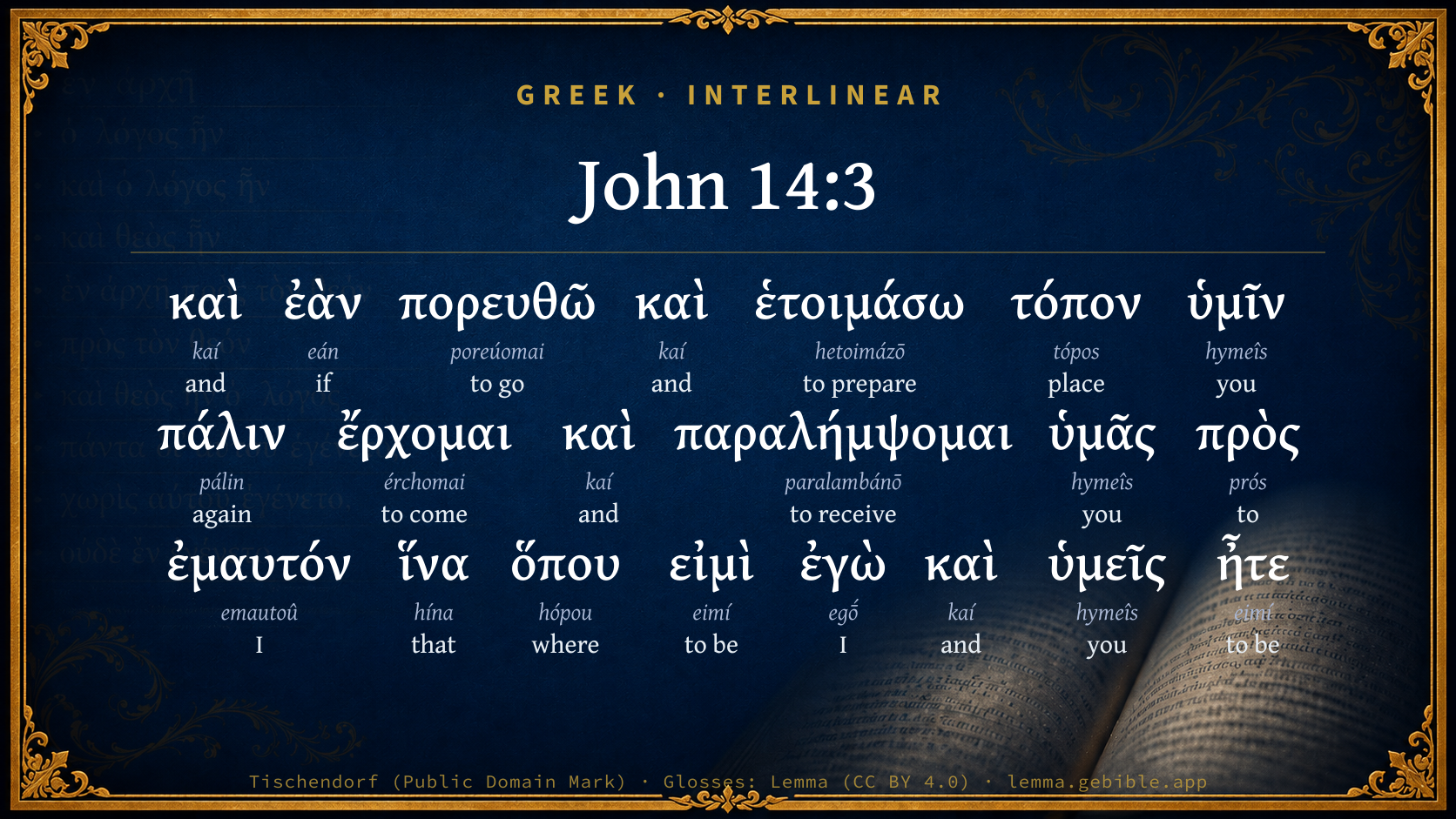
Greek (Tischendorf 8th ed.) John 14:3 appears in the Greek New Testament. The text above is from the Tischendorf 8th edition. Each word links to its Strong’s number and a concise gloss. Click any word for its full Thayer’s Greek Lexicon entry.
Download image
Cite this verse

John 14:3 (World English Bible). Public Domain. Lemma interlinear Bible study tool, https://lemma.gebible.app/v/john/14/3.

Show BibTeX & RIS
BibTeX
RIS
English Translation
If I go and prepare a place for you, I will come again, and will receive you to myself; that where I am, you may be there also.
World English Bible · Public Domain
Download a study sheet

One document with this verse’s original text, its word-by-word gloss line, the meaning frame, cross-references with their text, attributed commentary, and full source and license credits — printable, and it pastes into notes with its structure intact.

This verse Autodidact and up

Study sheet (.html) Plain text (.txt)

A passage Seminary Student

Up to 50 verses in one chapter. A passage sheet keeps up to 6 commentary sources and 12 cross-references per verse, in the order this page ranks them, and says so on the sheet whenever that leaves anything out. Ask for a single verse and you get the Autodidact verse sheet above.

Everything on this page stays free to read, with no account — the sheet is a download of what is already on screen, not access to it.

Want to remove ads? Support Godless Engineer
Compare translations 3

The same verse in 3 English versions, stacked beneath the original-language interlinear above. Click any original word for its lexicon entry.

Each is an independent rendering of the whole verse — the interlinear is not word-aligned to these translations.

Highlighted words mark where these versions differ — a whole-verse word diff, not a word-by-word alignment.

  • World English Bible Public Domain
    If I go and prepare a place for you, I will come again, and will receive you to myself; that where I am, you may be there also.
  • King James Version Public Domain
    And if I go and prepare a place for you, I will come again, and receive you unto myself; that where I am, there ye may be also.
  • unfoldingWord Literal Text CC BY-SA 4.0
    And if I go and prepare a place for you, I will come again and receive you to myself, so that where I am you also may be.

unfoldingWord Literal Text — © unfoldingWord, licensed CC BY-SA 4.0. Word-aligned USFM3 via Door43 (git.door43.org/unfoldingWord/en_ult).

Versions to compare (up to 4)

3 of 4 selected

Show all 19 translations

Every available English version of this verse, each an independent rendering of the whole verse.

  • World English Bible Public Domain
    If I go and prepare a place for you, I will come again, and will receive you to myself; that where I am, you may be there also.
  • Berean Standard Bible Public Domain
    And if I go and prepare a place for you, I will come back and welcome you into My presence, so that you also may be where I am.
  • Majority Standard Bible Public Domain
    And if I go, I will prepare a place for you. I will come back and welcome you into My presence, so that you also may be where I am.
  • King James Version Public Domain
    And if I go and prepare a place for you, I will come again, and receive you unto myself; that where I am, there ye may be also.
  • American Standard Version (1901) Public Domain
    And if I go and prepare a place for you, I come again, and will receive you unto myself; that where I am, `there' ye may be also.
  • Revised Version (1885) Public Domain
    And if I go and prepare a place for you, I come again, and will receive you unto myself; that where I am, there ye may be also.
  • Geneva Bible (1599) Public Domain
    And if I go to prepare a place for you, I wil come againe, and receiue you vnto my selfe, that where I am, there may ye be also.
  • Douay-Rheims (1899) Public Domain
    And if I shall go, and prepare a place for you, I will come again, and will take you to myself; that where I am, you also may be.
  • Young's Literal Translation Public Domain
    and if I go on and prepare for you a place, again do I come, and will receive you unto myself, that where I am ye also may be;
  • Literal Standard Version CC BY-SA 4.0
    and if I go on and prepare a place for you, I come again, and will receive you to Myself, that where I am you also may be;
  • Unlocked Literal Bible CC BY-SA 4.0
    If I go and prepare a place for you, I will come again and receive you to myself, so that where I am you will also be.
  • unfoldingWord Literal Text CC BY-SA 4.0
    And if I go and prepare a place for you, I will come again and receive you to myself, so that where I am you also may be.
  • Darby Bible Public Domain
    and if I go and shall prepare you a place, I am coming again and shall receive you to myself, that where I am ye also may be.
  • World Messianic Bible Public Domain
    If I go and prepare a place for you, I will come again and will receive you to myself; that where I am, you may be there also.
  • Webster's Bible Public Domain
    And if I go and prepare a place for you, I will come again and receive you to myself; that where I am, there ye may be also.
  • Free Bible Version CC BY-SA 4.0
    Once I've gone and prepared a place for you, I will come again and take you back with me, so that you can be there with me too.
  • Bible in Basic English Public Domain
    And if I go and make ready a place for you, I will come back again and will take you to be with me, so that you may be where I am.
  • Text-Critical English NT CC BY 4.0
    So when I go, it is to prepare a place for you. I will come again and receive you to myself, so that where I am you also may be.
  • Tyndale New Testament (1534) Public Domain
    And yf I go to prepare a place for you I will come agayne and receave you even vnto my selfe that where I am there maye ye be also.

Literal Standard Version (2020), Covenant Press — licensed CC BY-SA 4.0. Text via the HelloAO Bible API (eBible.org). Unlocked Literal Bible (unfoldingWord) — licensed CC BY-SA 4.0. Text via the HelloAO Bible API (eBible.org). unfoldingWord Literal Text — © unfoldingWord, licensed CC BY-SA 4.0. Word-aligned USFM3 via Door43 (git.door43.org/unfoldingWord/en_ult). Free Bible Version, Dr. Jonathan Gallagher — licensed CC BY-SA 4.0. Text via the HelloAO Bible API (eBible.org).

Word by word

More ways to search: Search by grammar → Find every occurrence → Compare this word →

Practice this passage: Drill this verse → Learn its vocabulary →

ἐμαυτόν
emautoû
G1683
“I”
Reflexive pronoun, 1st person, Accusative, Singular, Masculine
Part of Speech
Reflexive pronoun
Person
1st person
Case
Accusative
Number
Singular
Gender
Masculine
Full Thayer's Definition

Origin: genitive case compound of G1700 and G846

TDNT: None

1. I, me, myself etc.
  1. καὶ kaí G2532 “and” Conjunction
  2. ἐὰν eán G1437 “if” Conditional
  3. πορευθῶ poreúomai G4198 “to go” Verb, Aorist, Passive deponent, Subjunctive, 1st person, Singular
  4. καὶ kaí G2532 “and” Conjunction
  5. ἑτοιμάσω hetoimázō G2090 “to prepare” Verb, Aorist, Active, Subjunctive, 1st person, Singular
  6. τόπον tópos G5117 “place” Noun, Accusative, Singular, Masculine
  7. ὑμῖν hymeîs G5210 “you” Personal pronoun, 2nd person, Dative, Plural
  8. πάλιν pálin G3825 “again” Adverb
  9. ἔρχομαι érchomai G2064 “to come” Verb, Present, Middle or Passive deponent, Indicative, 1st person, Singular
  10. καὶ kaí G2532 “and” Conjunction
  11. παραλήμψομαι paralambánō G3880 “to receive” Verb, Future, Middle deponent, Indicative, 1st person, Singular
  12. ὑμᾶς hymeîs G5210 “you” Personal pronoun, 2nd person, Accusative, Plural
  13. πρὸς prós G4314 “to” Preposition
  14. ἵνα hína G2443 “that” Conjunction
  15. ὅπου hópou G3699 “where” Adverb
  16. εἰμὶ eimí G1510 “to be” Verb, Present, Active, Indicative, 1st person, Singular
  17. ἐγὼ egṓ G1473 “I” Personal pronoun, 1st person, Nominative, Singular
  18. καὶ kaí G2532 “and” Conjunction
  19. ὑμεῖς hymeîs G5210 “you” Personal pronoun, 2nd person, Nominative, Plural
  20. ἦτε eimí G1510 “to be” Verb, Present, Active, Subjunctive, 2nd person, Plural

About this verse

These counts appear in no published source. They are computed here, from the morphology-tagged text and Lemma’s own curated glosses. What Lemma adds →

21
words
15
distinct lemmas
Gospels
section

Shared distinctive vocabulary

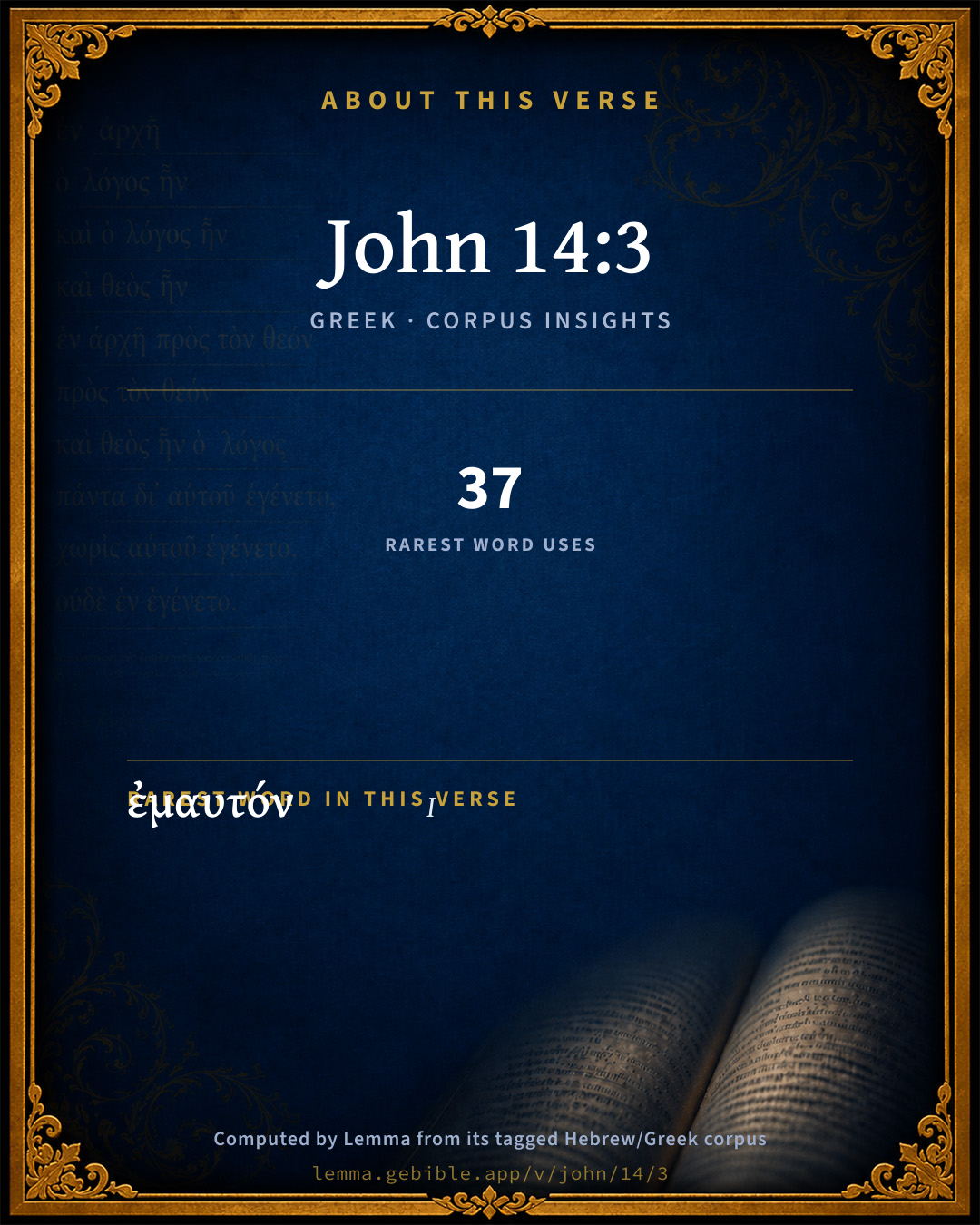
ἐμαυτόν I G1683 occurs in 37 verses of the Greek New Testament. Also found in:
Repetition

Words recur within this verse:

  • εἰμὶ to be G1510 ×2
  • καὶ and G2532 ×4
  • ὑμῖν you G5210 ×3

Cross-references

18

Topical passages linked to John 14:3 in the Treasury of Scripture Knowledge — connected by theme and wording, ordered by reader-vote popularity; previews shown in the World English Bible.

  • 1 Thessalonians 4:16–17 For the Lord himself will descend from heaven with a shout, with the voice of the archangel, and with God's trumpet. The dead in Christ will rise first,
  • 2 Timothy 2:12 If we endure, We will also reign with him. If we deny him, He also will deny us.
  • John 12:26 If anyone serves me, let him follow me. Where I am, there will my servant also be. If anyone serves me, the Father will honor him.
  • Acts 1:11 who also said, "You men of Galilee, why do you stand looking into the sky? This Jesus, who was received up from you into the sky will come back in the same way as you saw him going into the sky."
  • Hebrews 9:28 so Christ also, having been once offered to bear the sins of many, will appear a second time, without sin, to those who are eagerly waiting for him for salvation.
  • Romans 8:17 and if children, then heirs; heirs of God, and joint-heirs with Christ; if indeed we suffer with him, that we may also be glorified with him.
  • John 14:18–23 I will not leave you orphans. I will come to you.
  • John 14:28 You heard how I told you, 'I go away, and I come to you.' If you loved me, you would have rejoiced, because I said 'I am going to my Father;' for the Father is greater than I.
  • John 17:24 Father, I desire that they also whom you have given me be with me where I am, that they may see my glory, which you have given me, for you loved me before the foundation of the world.
  • 2 Corinthians 5:6–8 Being therefore always of good courage, and knowing that, while we are at home in the body, we are absent from the Lord;
  • Matthew 25:32–34 Before him all the nations will be gathered, and he will separate them one from another, as a shepherd separates the sheep from the goats.
  • Philippians 1:23 But I am in a dilemma between the two, having the desire to depart and be with Christ, which is far better.
  • 2 Thessalonians 1:12–2:1 that the name of our Lord Jesus may be glorified in you, and you in him, according to the grace of our God and the Lord Jesus Christ.
  • 1 John 3:2–3 Beloved, now we are children of God, and it is not yet revealed what we will be. But we know that, when he is revealed, we will be like him; for we will see him just as he is.
  • Revelation 3:21 He who overcomes, I will give to him to sit down with me on my throne, as I also overcame, and sat down with my Father on his throne.
  • Revelation 21:22–23 I saw no temple in it, for the Lord God, the Almighty, and the Lamb, are its temple.
  • Revelation 22:3–5 There will be no curse any more. The throne of God and of the Lamb will be in it, and his servants serve him.
  • Acts 7:59–60 They stoned Stephen as he called out, saying, "Lord Jesus, receive my Spirit!"

Cross-references courtesy of OpenBible.info (CC BY 4.0).

Commentary

Notes on John 14:3 from classic Christian and Jewish commentators (each source and its license shown beneath its notes). The classic Christian expositions comment on the surrounding passage and are grouped to its opening verse, so a note may address several verses; the Jewish commentaries on the Tanakh (Rashi and others) are per-verse, so they appear only where the commentator wrote on this verse.

Lemma curates 59 commentaries, every one of them public domain or Creative Commons licensed, each selected and text-cleaned for this edition rather than reprinted as found. About our sources →

MacLaren's Expositions of Holy Scripture

Alexander MacLaren

John

THE FORERUNNER

Joh 14:2 - Joh 14:3.

What divine simplicity and depth are in these words! They carry us up into the unseen world, and beyond time; and yet a little child can lay hold on them, and mourning hearts and dying men find peace and sweetness in them. A very familiar image underlies them. It was customary for travellers in those old days to send some of their party on in advance, to find lodging and make arrangements for them in some great city. Many a time one or other of the disciples had been ‘sent before His face into every place where He Himself should come.’ On that very morning two of them had gone in, at His bidding, from Bethany to make ready the table at which they were sitting. Christ here takes that office upon Himself. The emblem is homely, the thing meant is transcendent.

Not less wonderful is the blending of majesty and lowliness. The office which He takes upon Himself is that of an inferior and a servant. And yet the discharge of it, in the present case, implies His authority over every corner of the universe, His immortal life, and the sufficiency of His presence to make a heaven. Nor can we fail to notice the blending of another pair of opposites: His certainty of His impending death, and His certainty, notwithstanding and thereby, of His continual work and His final return, are inseparably interlaced here. How comes it that, in all His premonitions of His death, Jesus Christ never spoke about it as failure or as the interruption or end of His activity, but always as the transition to, and the condition of, His wider work? ‘I go, and if I go I return, and take you to Myself.’

So, then, there are three things here, the departure with its purpose, the return, and the perfected union.

I. The Departure.

Our Lord’s going away from that little group was a journey in two stages. Calvary was the first; Olivet was the second. He means by the phrase the whole continuous process which begins with His death and ends in His ascension. Both are embraced in His words, and each co-operates to the attainment of the great purpose.

He prepares a place for us by His death. The High Priest, in the ancient ritual, once a year was privileged to lift the heavy veil and pass into the darkened chamber, where only the light between the cherubim was visible, because he bore in his hand the blood of the sacrifice. But in our New Testament system the path into ‘the holiest of all,’ the realisation of the most intimate fellowship with heavenly things and communion with God Himself, are made possible, and the way patent for every foot, because Jesus has died. And as the communion upon earth, so the perfecting of the communion in the heavens. Who of us could step within those awful sanctities, or stand serene amidst the region of eternal light and stainless purity, unless, in His death, He had borne the sins of the world, and, having ‘overcome’ its ‘sharpness’ by enduring its blow, had ‘opened the Kingdom of Heaven to all believers’?

Old legends tell us of magic gates that resisted all attempts to force them, but upon which, if one drop of a certain blood fell, they flew open. And so, by His death, Christ has opened the gates and made the heaven of perfect purity a dwelling-place for sinful men.

But the second stage of His departure is that which more eminently is in Christ’s mind here. He prepares a place for us by His entrance into and His dwelling in the heavenly places. The words are obscure because we have but few others with which to compare them, and no experience by which to interpret them. We know so little about the matter that it is not wise to say much; but though there be vast tracts of darkness round the little spot of light, this should only make the spot of light more vivid and more precious. We know little, but we know enough for mind and heart to rest upon. Our ignorance of the ways in which Christ by His ascension prepares a heaven for His followers should neither breed doubt nor disregard of His assurance that He does.

If Christ had not ascended, would there have been ‘a place’ at all? He has gone with a human body, which, glorified as it is, still has relations to space, and must be somewhere. And we may even say that His ascending up on high has made a place where His servants are. But apart from that suggestion, which, perhaps, is going beyond our limits, we may see that Christ’s presence in heaven is needful to make it a heaven for poor human souls. There, as here {Scripture assures us}, and throughout eternity as to-day, Jesus Christ is the Mediator of all human knowledge and possession of God. It is from Him and through Him that there come to men, whether they be men on earth or men in the heavens, all that they know, all that they hope, all that they enjoy, of the wisdom, love, beauty, peace, power, which flow from God. Take away from the heaven of the Christian expectation that which comes to the spirit through Jesus Christ, and you have nothing left. He and His mediation and ministration alone make the brightness and the blessedness of that high state. The very glories of all that lies beyond the veil would have an aspect appalling and bewildering to us, unless our Brother were there. Like some poor savages brought into a great city, or rustics into the presence of a king and his court, we should be ill at ease amidst the glories and solemnities of that future life unless we saw standing there our Kinsman, to whom we can turn, and who makes it possible for us to feel that it is home. Christ’s presence makes heaven the home of our hearts.

Not only did He go to prepare a place, but He is continuously preparing it for us all through the ages. We have to think of a double form of the work of Christ, His past work in His earthly life, and His present in His exaltation. We have to think of a double form of His present activity-His work with and in us here on earth, and His work for us there in the heavens. We have to think of a double form of His work in the heavens-that which the Scripture represents in a metaphor, the full comprehension of which surpasses our present powers and experiences, as being His priestly intercession; and that which my text represents in a metaphor, perhaps a little more level to our apprehension, as being His preparing a place for us. Behind the veil there is a working Christ, who, in the heavens, is preparing a place for all that love Him.

II. In the next place, note the Return.

The purpose of our Lord’s departure, as set forth by Himself here, guarantees for us His coming back again. That is the force of the simple argumentation of my text, and of the pathetic and soothing repetition of the sweet words, ‘I go to prepare a place for you; and if I go to prepare a place for you, I will come again and receive you unto Myself.’ Because the departure had for its purpose the preparing of the place, therefore it is necessarily followed by a return. He who went away as the Forerunner has not done His work until He comes back, and, as Guide, leads those for whom He had prepared the place to the place which He had prepared for them.

Now that return of our Lord, like His departure, may be considered as having two stages. Unquestionably the main meaning and application of the words is to that final and personal coming which stands at the end of history, and to which the hopes of every Christian soul ought to be steadfastly directed. He will ‘so come in like manner as’ He has gone. We are not to water down such words as these into anything short of a return precisely corresponding in its method to the departure; and as the departure was visible, corporeal, literal, personal, and local, so the return is to be visible, corporeal, literal, personal, local too. He is to come as He went, a visible Manhood, only throned amongst the clouds of heaven with power and great glory. This is the aim that He sets before Him in His departure. He leaves in order that He may come back again.

And, oh, dear friends! remember-and let us live in the strength of the remembrance-that this return ought to be the prominent subject of Christian aspiration and desire. There is much about the conception of that solemn return, with all the convulsions that attend it, and the judgment of which it is preliminary, that may well make men’s hearts chill within them. But for you and me, if we have any love in our hearts and loyalty in our spirits to that King, ‘His coming’ should be ‘prepared as the morning,’ and we should join in the great burst of rapture of many a psalm, which calls upon rocks and hills to break forth into singing, and trees of the field to clap their hands, because He cometh as the King to judge the earth. His own parable tells us how we ought to regard His coming. When the fig-tree’s branch begins to supple, and the little leaves to push their way through the polished stem, then we know that summer is at hand. His coming should be as the approach of that glorious, fervid time, in which the sunshine has tenfold brilliancy and power, the time of ripened harvests and matured fruits, the time of joy for all creatures that love the sun. It should be the glad hope of all His servants.

We have a double witness to bear in the midst of this as of every generation. One half of the witness stretches backwards to the Cross, and proclaims ‘Christ has come’; the other reaches onwards to the Throne, and proclaims ‘Christ will come.’ Between these two high uplifted piers swings the chain of the world’s history, which closes with the return, to judge and to save, of the Lord who came to die and has gone to prepare a place for us.

But do not let us forget that we may well take another point of view than this. Scripture knows of many comings of the Lord preliminary to, and in principle one with, His last coming. For nations all great crises of their history are ‘comings of the Lord,’ the Judge, and we are strictly in the line of Scripture analogy when, in reference to individuals, we see in each single death a true coming of the Lord.

That is the point of view in which we ought to look upon a Christian’s death-bed. ‘The Master is come, and calleth for thee.’ Beyond all secondary causes, deeper than disease or accident, lies the loving will of Him who is the Lord of life and of death. Death is Christ’s minister, ‘mighty and beauteous, though his face be dark,’ and he, too, stands amidst the ranks of the ‘ministering spirits sent forth to minister to them that shall be heirs of salvation.’ It is Christ that says of one, ‘I will that this man tarry,’ and to another, ‘Go!’ and he goeth. But whensoever a Christian man lies down to die, Christ says, ‘Come!’ and he comes. How that thought should hallow the death-chamber as with the print of the Master’s feet! How it should quiet our hearts and dry our tears! How it should change the whole aspect of that ‘shadow feared of man’! With Him for our companion, the lonely road will not be dreary; and though in its anticipation, our timid hearts may often be ready to say, ‘Surely the darkness shall cover me,’ if we have Him by our sides, ‘even the night shall be light about us.’ The dying martyr beneath the city wall lifted up his face to the heavens, and said, ‘Lord Jesus, receive my spirit!’ It was the echo of the Master’s promise, ‘I will come again, and receive you to Myself.’

III. Lastly, notice the Perfected Union.

The departure for such a purpose necessarily involved the return again. Both are stages in the process, which is perfected by complete union-’That where I am there ye may be also.’

Christ, as I have been saying, is Heaven. His presence is all that we need for peace, for joy, for purity, for rest, for love, for growth. To be ‘with Him,’ as He tells us in another part of these wonderful last words in the upper chamber, is to ‘behold His glory.’ And to behold His glory, as John tells us in his Epistle, is to be like Him. So Christ’s presence means the communication to us of all the lustre of His radiance, of all the whiteness of His purity, of all the depth of His blessedness, and of a share in His wondrous dominion. His glorified manhood will pass into ours, and they that are with Him where He is will rest as in the centre and home of their spirits, and find Him all-sufficient. His presence is my Heaven.

That is almost all we know. Oh! it is more than all we need to know. The curtain is the picture. It is because what is there transcends in glory all our present experience that Scripture can only hint at it and describe it by negations-such as ‘no night,’ ‘no sorrow,’ ‘no tears,’ ‘former things passed away’; and by symbols of glory and lustre gathered from all that is loftiest and noblest in human buildings and society. But all these are but secondary and poor. The living heart of the hope, and the lambent centre of the brightness, is, ‘So shall we ever be with the Lord.’

And it is enough. It is enough to make the bond of union between us in the outer court and them in the holy place. Parted friends will fix to look at the same star at the same moment of the night and feel some union; and if we from amidst the clouds of earth, and they from amidst the pure radiance of their heaven, turn our eyes to the same Christ, we are not far apart. If He be the companion of each of us, He reaches a hand to each, and, clasping it, the parted ones are united; and ‘whether we wake or sleep we live together,’ because we both live with Him.

Brother! Is Jesus Christ so much to you that a heaven which consists in nearness and likeness to Him has any attraction for you? Let Him be your Saviour, your Sacrifice, your Helper, your Companion. Obey Him as your King, love Him as your Friend, trust Him as your All. And be sure that then the darkness will be but the shadow of His hand, and instead of dreading death as that which separates you from life and love and action and joy, you will be able to meet it peacefully, as that which rends the thin veil, and unites you with Him who is the Heaven of heavens.

He has gone to prepare a place for us. And if we will let Him, He will prepare us for the place, and then come and lead us thither. ‘Thou wilt show me the path of life’ which leads through death. ‘In Thy presence is fullness of joy, and at Thy right hand there are pleasures for evermore.’

Alexander MacLaren, Expositions of Holy Scripture (1904–1910) — public domain. Text from a community e-Sword module.

Tyndale Open Study Notes

Tyndale Open Resources

14:3 Some scholars believe that Jesus meant he would come and get his followers after the resurrection (14:18). Others think these words refer to Jesus’ second coming. For the disciples, the more important coming was Jesus’ return from the grave (ch 16).

Tyndale Open Study Notes — © Tyndale Open Resources, licensed CC BY-SA 4.0. Text via the HelloAO Bible API.

Bengel's Gnomon

Johann Albrecht Bengel

Joh 14:3. Ἐάν, if) A mild particle, used for ὅταν, when.—ἔρχομαι, I come [am coming]) The Present, as concerning His speedy coming: Joh 14:18, “I will not leave you comfortless; I come to you.” It is a peculiar idiom of speech, that the Lord is not wont to say, I will come, but I come, even when another verb in the future tense is added. Comp., however, also Mat 17:11 concerning the forerunner [Ἡλίας ἔρχεται, καὶ ἀποκαταστήσει πάντα], and the LXX., 2Sa 5:3 [ἔρχονται—οἱ πρεσβύτεροι—καὶ διέθετο αὐτοῖς ὁ βασιλεύς].—καί, and) The end of My departure infers [carries with it] this very consequence, that I am to come again.—πρὸς ἐμαυτόν, to Myself) An expression full of majesty. The house of the Father is the house of the Son: ch. Joh 16:15, “All things that the Father hath are Mine;”

Bengel's Gnomon of the New Testament — English translation (T&T Clark, Edinburgh, 1860) — public domain. Text from a community e-Sword module.

Expositor's Greek Testament

ed. W. Robertson Nicoll

Joh 14:3 . Neither will He prepare a place and leave them to find their own way to it. καὶ ἐὰν πορευθῶ … ἦτε . “ If I go”; that is, the commencement of this work as their forerunner was the pledge of its completion. And its completion is effected by His coming again and receiving them to Himself, or “to His own home,” πρὸς ἐμαυτόν . Cf. Joh 20:10 . πάλιν ἔρχομαι καὶ παραλήμψομαι , “I come again and will receive”. The present is used in ἔρχομαι as if the coming were so certain as to be already begun, cf. Joh 5:25 . For παραλήμψομαι see Son 8:2 . The promise is fulfilled in the death of the Christian, and it has changed the aspect of death. The personal second coming of Christ is not a frequent theme in this Gospel. The ultimate object of His departure and return is ἵνα ὅπου εἰμὶ ἐγώ , καὶ ὑμεῖς ἧτε . Cf. 1Th 4:17 , 2Co 5:8 , Phi 1:23 . The object of Christ’s departure is permanent reunion and the blessedness of the Christian.

The Expositor's Greek Testament, edited by W. Robertson Nicoll (1897–1910) — public domain. Text from a community e-Sword module.

Vincent's Word Studies in the New Testament

Marvin R. Vincent

If I go [εαν πορευθω] . Poreuomai, go, of going with a definite object. See on 8 21.

I will come again [παλιν ερχομαι] . The present tense; I come, so Rev. Not to be limited to the Lord 's second and glorious coming at the last day, nor to any special coming, such as Pentecost, though these are all included in the expression; rather to be taken of His continual coming and presence by the Holy Spirit. "Christ is, in fact, from the moment of His resurrection, ever coming into the world and to the Church, and to men as the risen Lord" (Westcott).

And receive [παραληψομαι] . Here the future tense, will receive. Rev., therefore, much better : I come again and will receive you. The change of tense is intentional, the future pointing to the future personal reception of the believer through death. Christ is with the disciple alway, continually "coming" to him, unto the end of the world. Then He will receive him into that immediate fellowship, where he "shall see Him as He is." The verb paralambanw is used in the New Testament of taking along with (Mt 4:5; Mt 17:1; Act 16:33, on all which see notes) : of taking to (Mt 1:20; Joh 14:3) : of taking from, receiving by transmission; so mostly in Paul (Gal 1:12; Colossians. Gal 2:6; Gal 4:17; 1Th 2:13, etc. See also Mt 24:40, 41). It is scarcely fanciful to see the first two meanings blended in the use of the verb in this passage. Jesus, by the Spirit, takes His own along with Him through life, and then takes them to His side at death. He himself conducts them to Himself.

I am. See on 7 34.

Marvin R. Vincent, Word Studies in the New Testament (1887–1900) — public domain. Text from a community e-Sword/MySword module.

Geneva Bible (1599)

Geneva Bible translators

These words are to be referred to the whole Church, and therefore the Angels said to the disciples when they were astonished, What stand you gazing up into heaven? This Jesus shall so come as you saw him go up, Acts 1:11, and in all places of the Scripture, the full comfort of the Church is referred to that day when God shall be all in all, and is therefore called the day of redemption.

Christ went not away from us: to the end to forsake us, but rather that he might at length take us up with him into heaven.

Geneva Bible (1599) marginal notes — public domain. Text via Bolls.life.

Jamieson, Fausset & Brown

Robert Jamieson, A. R. Fausset & David Brown

I will come again and receive you unto myself--strictly, at His Personal appearing; but in a secondary and comforting sense, to each individually. Mark again the claim made:--to come again to receive His people to Himself, that where He is there they may be also. He thinks it ought to be enough to be assured that they shall be where He is and in His keeping.

Jamieson, Fausset & Brown — Commentary Critical and Explanatory on the Whole Bible (1871) — public domain (CC PDM 1.0). Text via the HelloAO Bible API.

Adam Clarke's Commentary

Verse 3. And if I go] And when I shall have gone and prepared a place for you - opened the kingdom of an eternal glory for your reception, and for the reception of all that shall die in the faith, I will come again, after my resurrection, and give you the fullest assurances of this state of blessedness; and confirm you in the faith, by my grace and the effusion of my Spirit. Dr. Lightfoot thinks, and with great probability too, that there is an allusion here to Nu 10:33: And the ark of the Lord went before therm to search out a resting place for them.

Adam Clarke's Commentary on the Bible (1810–1826) — public domain. Text from a community e-Sword/MySword module.

John Calvin's Commentaries

3. And if I go away. The conditional term, if, ought to be interpreted as an adverb of time; as if it had been said, “After that I have gone away, I will return to you again.” This return must not be understood as referring to the Holy Spirit, as if Christ had manifested to the disciples some new presence of himself by the Spirit. It is unquestionably true, that Christ dwells with us and in us by his Spirit; but here he speaks of the last day of judgment, when he will, at length, come to assemble his followers. And, indeed, if we consider the whole body of the Church, he every day prepares a place for us; whence it follows, that the proper time for our entrance into heaven is not yet come.

John Calvin's Commentaries (1540-1563) — public domain. Text from the Calvin Translation Society English edition (1840s-50s) via the Christian Classics Ethereal Library (ccel.org). Calvin's coverage is partial (roughly two-thirds of the Bible); uncommented books and verses are honest gaps, never fabricated. The 19th-century editor's footnotes and remarks are omitted so the notes are faithfully Calvin's own voice.

Ellicott's Commentary for English Readers

(3) And if I go and prepare . . .—For the form of the expression, comp. Notes on Joh_12:32, and 1Jn_2:28. It does not imply uncertainty, but expresses that the fact is in the region of the future, which is clear to Him, and will unfold itself to them.

I will come again, and receive you unto myself.—This clause has been variously explained of the resurrection; of the death of individual disciples; of the spiritual presence of our Lord in the Church; of the coming again of the Lord in the Parousia of the last day, when all who believe in Him shall be received unto Himself. The difficulty has arisen from taking the words “I will come again,” as necessarily referring to the same time as those which follow—“I will receive you unto Myself,” whereas they are in the present tense, and should be literally rendered, I am coming again. They refer rather, as the same words refer when used in Joh_14:18, to His constant spiritual presence in their midst; whereas the reception of them to Himself is to be understood of the complete union which will accompany that spiritual presence; a union which will be commenced in this life, advanced by the death of individuals, and completed in the final coming again. (Comp. Joh_17:24.)

A Bible Commentary for English Readers, edited by Charles John Ellicott (1878–1897) — public domain. Text from a community e-Sword module.

The Cambridge Bible for Schools and Colleges

gen. ed. J. J. S. Perowne

3. And if I go] The ‘if’ does not here imply doubt any more than ‘when’ would have done: but we have ‘if’ and not ‘when’ because it is the result of the departure and not the date of it that is emphasized (see on Joh_12:32).

I will come again, and receive] Literally, I am coming again and I will receive (see on Joh_1:11 and Joh_19:16). There is no doubt about the meaning of the going away; but the coming again may have various meanings, and apparently not always the same one throughout this discourse; either the Resurrection, or the gift of the Paraclete, or the death of individuals, or the presence of Christ in his Church, or the Second Advent at the last day. The last seems to be the meaning here (comp. Joh_6:39-40).

The Cambridge Bible for Schools and Colleges (gen. ed. J. J. S. Perowne; Cambridge University Press, 1878–1918) — public domain. Text from a community e-Sword module.

John Gill's Exposition

And if I go and prepare a place for you,.... Seeing I am going to prepare, and will prepare a place for you, of the truth of which you may be fully assured:

I will come again; either by death or in person a second time, here on earth:

and receive you unto myself; I will take you up with me to heaven; I will receive you into glory;

that where I am there you may be also: and behold my glory, and be for ever with me, and never part more.

John Gill's Exposition of the Whole Bible (1746–1763) — public domain (CC PDM 1.0). Text via the HelloAO Bible API.

Trapp's Complete Commentary

John Trapp

3 And if I go and prepare a place for you, I will come again, and receive you unto myself; that where I am, there ye may be also.

Ver. 3. I will come again, &c.] Oh, look up and long for this "consolation of Israel;" say as Sisera’s mother, "Why are his chariots" (those clouds) "so long in coming?"

" Heu pietas ubi prisca? profana o tempora! Mundi

Fax! Vesper! prope Nox! o mora! Christe veni."

There may ye be also] Christ counts not himself full till he have all his members about him: hence the Church is called "the fulness of him that filleth all things," Eph 1:23.

John Trapp, A Commentary or Exposition upon All the Books of the Old and New Testament (1647–1656) — public domain. Text from a community e-Sword module.

Haydock's Catholic Bible Commentary

I will come again: not only by rising the third day, but at your death, and at the day of judgment: that where I am, you also may be, and may receive the reward of eternal happiness in my kingdom.

George Leo Haydock (1774–1849), Haydock's Catholic Family Bible and Commentary, 1859 edition — public domain. Excludes Psalms (Douay-Rheims chapter numbering differs from Protestant) and Deuterocanonical books (Catholic canon only).

Matthew Poole's English Annotations

The particle if in this place denotes no uncertainty of the thing whereof he had before assured them; but in this place hath either the force of although, or after that: When, or after that, I have died, ascended, and by all these acts, as also by my intercession, shall have made places in Heaven fully ready for you, I will in the last day return again, as Judge of the quick and the dead, and take you up into heaven, 1Th 4:16,17; that you may be made partakers of my glory, Joh 17:22. This is called, Rom 8:17, a being glorified together with him; and elsewhere, a reigning with him. So as this is a third argument by which our Lord comforteth his disciples as to their trouble conceived for the want of His bodily presence with them, from the certainty of his return to them, and the end and consequent of his return: the end was to receive them to himself; the consequent, their eternal abiding with Christ where he was.

Matthew Poole's English Annotations on the Holy Bible (1683–1685) — public domain. Text from a community e-Sword/MySword module.

Whedon's Commentary on the Bible

Daniel D. Whedon

3. Go and prepare a place—Through his death he would open a new and living way (Heb_10:20) into the heaven which his merit had purchased.

I will come again—According to the law of prophetic perspective, to which we have so often referred, the Second Advent of our Lord is beheld with clear distinctness in the near distance. For this reason we reject here, as elsewhere, all reference of the coming of the Son of man to the period of death. Nor does the Saviour here refer, as many commentators imagine, to a general spiritual coming, extending along the entire interval to the end of time. The day in which Christ shall come again to take believers home is the day of judgment described in Matthew 24, 25.

Unto myself… where I am… ye… also—Emphatically does our Lord in these terms indicate that the happiness of heaven, both of Christ and his redeemed, will consist in their reunion in love.

Daniel D. Whedon (gen. ed.), Commentary on the Old and New Testaments (1874–1909) — public domain. Text from a community e-Sword module.

The Pulpit Commentary

And if I go and if I prepare a place for you a simple condition, soon to be realized by the eventI come again; I am ever coming, as I am now about to explain to you,

(1) in my resurrection; (Joh_16:16, Joh_16:17)

(2) in the bestowment of the Comforter; (Vers. 17, 25, 26 Joh_16:7, etc.)

(3) in the intimate relations which, through the power of the Spirit (Vers. 18, 23), shall prevail between us. I am coming to you, in my glory and power, and in my victory in you as well as for you over death and Hades, to receive you unto myself; that where I am, there ye may be also. The full perspective of the Lord"s approach to faithful souls is given in the extraordinary pregnancy of the "I am coming." Not until he comes m all his glory will the words be perfectly fulfilled; but the early Church, on the basis of communion with Christ himself in the power of his Spirit, expected that Christ had come and taken to himself one by one those who died in Jesus. (1Th_4:14) Thus Stephen expected the Lord to receive his spirit; (Act_7:59) and the dying thief was to be with him, in Paradise; and Paul knew that to be from home, so far as body is concerned, was to be "at home or present with the Lord". (2Co_5:8) "To be with Christ" was "far better" than to labor on in the flesh. (Php_1:23) The highest thought of peace and love was to the apostles union and presence with Christ. Our Lord asserts here that by his very nearness to them he will make their heaven for them. How soon this wonderful idea spread among men! Within twenty years, Thessalonians were comforted about their pious dead, with the thought that they slept in Jesus, and would together with them be "forever with the Lord."

The Pulpit Commentary (1880–1919), ed. H.D.M. Spence-Jones & Joseph S. Exell — public domain. Text from a community e-Sword module.

Scofield Reference Notes

C. I. Scofield

receive you unto myself

This promise of a second advent of Christ is to be distinguished from His return in glory to the earth; it is the first intimation in Scripture of "the day of Christ". (See Scofield "1Co 1:8"). Here He comes for His saints 1Th 4:14-17 there Mat 24:29; Mat 24:30. He come to judge the nations, etc.

The Scofield Reference Bible (1917 edition), notes by C. I. Scofield — public domain. Text from a community e-Sword module.

The People's New Testament

B. W. Johnson

3. I will come again, and receive you unto myself. The reference is not to Christ's return from the grave, but to a return from heaven, the second coming of the Lord, which is a part of the Christian faith. Compare 1 Thess. 4:17; Phil. 1:23.

B. W. Johnson's The People's New Testament with Notes (1889–1891) — public domain. Electronic text from the Christian Classics Ethereal Library (CCEL) ThML edition.

Cambridge Greek Testament for Schools and Colleges

3. ἐὰν πορευθῶ. The ἐάν does not imply a doubt; but, as in Joh 12:32, it is the result rather than the date of the action that is emphasized; hence ‘if,’ not ‘when.’ see on Joh 12:26.

ἔρχομαι κ. παραλήμψομαι. The late form λήμψομαι occurs again Act 1:8; we have λαμψομαι Hdt. IX. 108. The change from present to future is important: Christ is ever coming in various ways to His Church; but His receiving of each individual will take place once for all at death and at the last day (see on Joh 19:16). Christ’s coming again may have various meanings and apparently not always the same one throughout these discourses; the Resurrection, or the gift of the Paraclete, or the presence of Christ in His Church, or the death of individuals, or the Second Advent at the last day. Comp. Joh 6:39-40.

Cambridge Greek Testament for Schools and Colleges (Cambridge University Press, 1896; 21 vols, various authors incl. Carr, Maclear, Plummer, Farrar, Lumby, Moule, M. R. James, Simcox) — public domain. Text from a community e-Sword module.

Alford’s Greek Testament

Henry Alford

3.] On ἐάν (not ‘when,’ here or any where), see note, ch. 12:32. Here there is no translation of feeling: only in the extract from Hermann there, we may read ‘experientiâ (vestrâ) cognoscetur.’

In order to understand this, we must bear in mind what Stier well calls the ‘perspective’ of prophecy. The coming again of the Lord is not one single act,—as His resurrection, or the descent of the Spirit, or His second personal advent, or the final coming to judgment; but the great complex of all these, the result of which shall be, His taking His people to Himself to be where He is. This ἔρχομαι, is begun (ver. 18) in His Resurrection—carried on (ver. 23) in the spiritual life (see also ch. 16:22 f.), the making them ready for the place prepared;—-further advanced when each by death is fetched away to be with Him (Php 1:23); fully completed at His coming in glory, when they shall for ever be with Him (1Th 4:17) in the perfected resurrection state.

Henry Alford, The Greek Testament (1849–1861) — public domain. Text from a community e-Sword module.

International Critical Commentary

3. καὶ ἐὰν πορευθῶ, repeated in substance from 16:7.

τόπον ὑμῖν is the order of words in אBDLN; but the rec. has ὑμῖν τόπον, with WΘ.

πάλιν ἔρχομαι. The present tense expresses the certainty of the future return: “I am coming back.” This is an explicit announcement of the Parousia, or Second Advent. Not as much is said about this in Jn. as in the Synoptists; but it is nevertheless an integral element in Johannine doctrine, more emphatic in the First Epistle than in the Gospel (cf. 21:22, 23 and 1Jn 2:28).1

καὶ παραλήμψομαι κτλ. Perhaps παραλαμβάνειν has here, as at 1:11, the meaning of receiving with welcome (cf. Son 8:2); but at 19:17 it is equivalent to “seize.” For this meeting of Master and disciples, cf. 1Th 4:17.

ἵνα ὅπου εἰμὶ ἐγὼ καὶ ὑμεῖς ἦτε. This is, in a sense, true of earthly discipleship (12:26), but it is to be fulfilled more perfectly hereafter (17:24).

International Critical Commentary — older volumes (1896–1929), various authors — public domain. Text from a community e-Sword module.

Godet's Commentaries

Frédéric Louis Godet

Ver. 3. “And if I shall have gone and prepared a place for you, I will come again and take you to myself, that where I am, there you may be also.”

The place being once assured and prepared for them, they must be brought to reach it. It is He who will also charge Himself with this office. The rejection of καί, and, before ἑτοιμάσω in some MSS. (“and when I shall have gone, I will prepare”) would introduce an unnatural and even absurd asyndetonbetween the idea of preparing and that of returning which follows, and would at the same time lead to a complete tautology with the preceding sentence. The reading ἑτοιμᾶσαι, to prepare, is a further correction which was rendered almost indispensable by the rejection of the καί .

To the two verbs: “when I shall have gone and shall have prepared,” correspond the two verbs of the principal clause: I will come again (literally, I come again) and I will take you to myself. The present I come again indicates imminence. Notwithstanding this, Origen and other Fathers, Calvin, Lampe, and, among the moderns, Hofmann, Luthardt, Meyer, Weiss, and Keil, refer this term to the final and glorious coming of the Lord. Undoubtedly this promise is addressed to believers in general, but it has in view, nevertheless, first of all, the disciples personally, whom Jesus wishes to strengthen in their present disheartenment; and He consoles them, it is said, by means of an event which no one of them has seen and which is still future at this hour! In thus explaining the word I come, it is forgotten that Jesus never affirmed the nearness of His Parousia, and that, indeed, He rather gave an indication of the opposite: “As the bridegroom delays his coming” (Mat 25:5); “If the master comes in the second watch, or if he comes in the third” (Luk 12:38); “At evening or at midnight or at the cock-crowing or in the morning” (Mar 13:35); comp. also the parables of the leaven and the grain of mustard seed. Moreover, we have the authentic explanation of this word come in Joh 14:18, where, as Weiss acknowledges, it cannot be applied to the Parousia.

Ebrard thinks that the point in question is theresurrection of Jesus. But the true reunion, after the separation caused by the death of Jesus, did not yet take place at the resurrection. The appearances of the Lord were transient; their design was simply, through faith in the resurrection, to prepare for the coming of the Spirit. Grotius, Reuss, Lange, Hengstenberg, and Keil refer the wordcome to the return of Jesus at the death of each believer; comp. the vision of Stephen. But in Joh 14:18 this sense is altogether impossible, and no example can be cited, not even Joh 21:23, where it would lead to an intolerable tautology. This coming refers, therefore, as has been recognized by Lucke, Olshausen, Neander, to the return of Jesus through the Holy Spirit, to the close and indissoluble union formed thereby between the disciple and the glorified person of Jesus; comp. all that follows in Joh 14:17; Joh 14:19-21; Joh 14:23; especially Joh 14:18, which is the explanation of our: I come again. Weiss alleges against our view that the question here is of a personal return. We defer this to Joh 14:18.—The following verb: I will take you to myself, indicates another fact, which will be the result of this spiritual preparation.

This is the introduction of the believer into the Father’s house, at the end of his earthly career, either at the moment of his death, or at that of the Parousia, if he lives until that time. Καί, and, has the sense of and consesequently, or of, and afterwards, as is indicated by the contrast between the present (I come) and the future (I will take). This will be the entrance of the believer, prepared by spiritual communion with Jesus, into the abode secured for him by the mediation of this same Jesus. Πρὸς ἐμαυτόν, to myself (Joh 12:32); He presses him to His heart, so to speak, while bearing him away. There is an infinite tenderness in these last words. It is for Himself that He seems to rejoice in and look to this moment which will put an end to all separation: “That where I am, there you may be also;” comp. Joh 17:24. The community of place (“there where”) implies that of state.Otherwise the return of Jesus in spirit would not be necessary in order to prepare in each particular case this reunion. What touching simplicity and what dramatic vivacity in the expression of these ideas, so profound and so new! The Father’s house, the preparation of the dwelling-place, the coming to find, finally the taking to Himself, this familiar and almost childlike language resembles sweet music by which Jesus seeks to alleviate the agony of separation in the minds of the apostles. Thus ends the first conversation, called forth by the question of Peter: “Why cannot I follow thee?” Answer: “Even thy martyrdom would not be sufficient to this end; my return in the Spirit into thy heart: this is the condition of thy entrance into my heavenly glory.” Comp. Joh 3:5.

But Jesus observes that many questions were still rising in their minds, that their hearts were a prey to many doubts, and, in order to incite them to ask Him, He throws out to their ignorance a sort of challenge, by saying to them:

Frédéric Louis Godet — Commentaries on Luke, John, Romans, and 1 Corinthians — English translation (T&T Clark, Edinburgh, 1870s–1890s) — public domain. Text from a community e-Sword module.

Lesson kit

Teaching starters — assembled from the data on this page, not authored interpretation. Every prompt links to the verse data it draws on. Edit before teaching.

John, in the Gospels, opens this verse with 21 words (15 distinct Greek lemmas). Its most distinctive word is emautoû (“I”). A historical commentator’s framing appears above. Read the whole chapter for the surrounding context.

Discussion questions

  1. How does “I” (emautoû) shape what this verse is saying?
  2. How does Matthew 8:9, which shares the word «I», read alongside this verse?
  3. What does the repetition of “to be” (2× in this one verse) do in this verse?
  4. These translations render this verse differently. What is at stake in choosing one wording over another?
  5. Compare how MacLaren's Expositions of Holy Scripture and Tyndale Open Study Notes read this verse. Where do they agree or differ?

Things to notice

  • These translations choose different wording for 1 word in this verse.
  • “to be” occurs 2× in this single verse.
  • 15 distinct Greek lemmas span 21 words in this verse.

Reading settings

Reading text

Shown beneath each verse's original-language words.

Old Testament
Old Testament edition

Read the OT as the Masoretic Hebrew (MT) or the Greek Septuagint (LXX).

English shown for the Greek Septuagint (in the Hebrew ↔ Greek comparison).

Comparing translations? Open the Compare panel on any verse page to stack up to four side by side.