
John 15:27

Greek (Tischendorf 8th ed.) John 15:27 appears in the Greek New Testament. The text above is from the Tischendorf 8th edition. Each word links to its Strong’s number and a concise gloss. Click any word for its full Thayer’s Greek Lexicon entry.
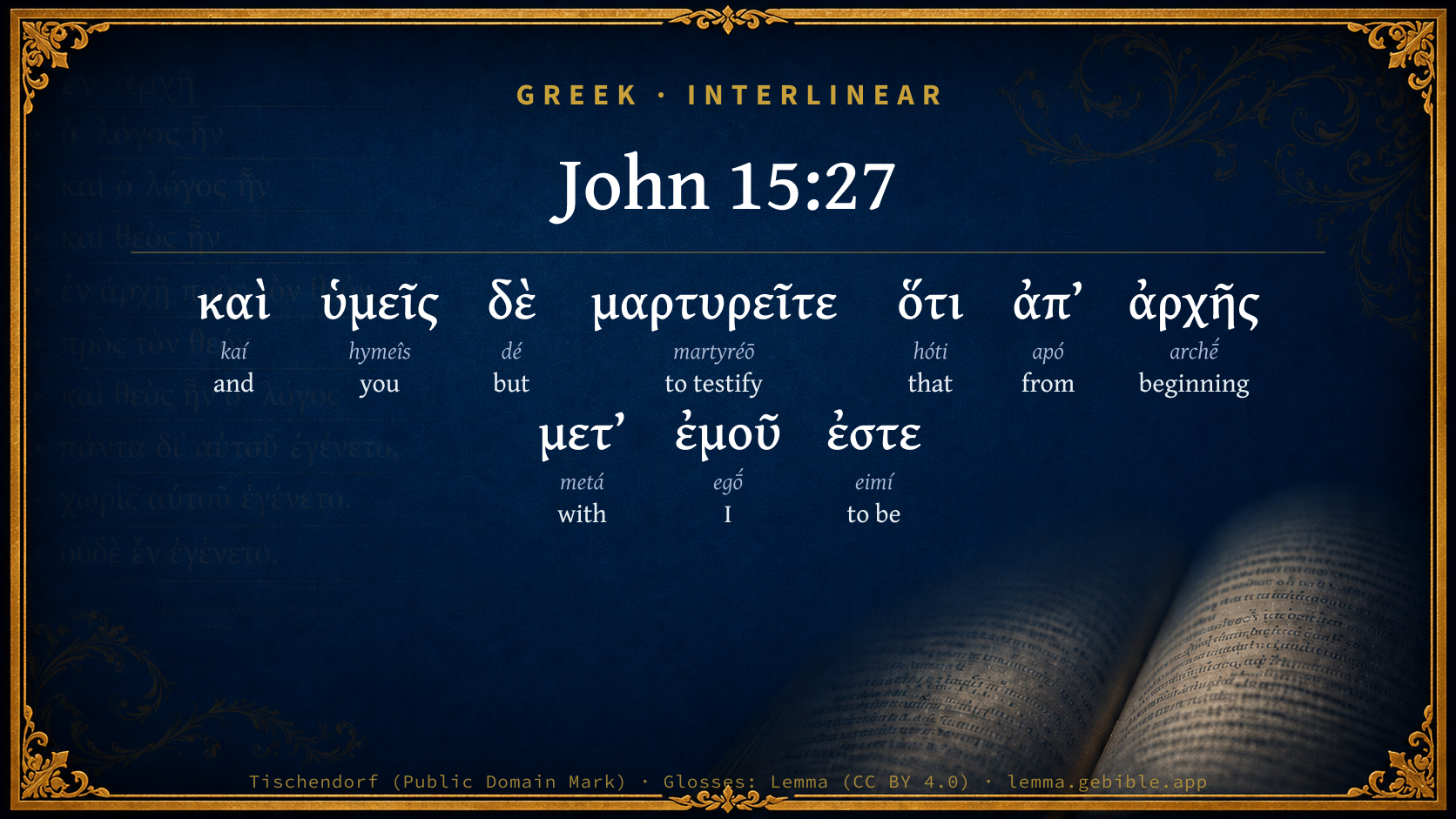
Download image
Cite this verse

John 15:27 (World English Bible). Public Domain. Lemma interlinear Bible study tool, https://lemma.gebible.app/v/john/15/27.

Show BibTeX & RIS
BibTeX
RIS
English Translation
You will also testify, because you have been with me from the beginning.
World English Bible · Public Domain
Download a study sheet

One document with this verse’s original text, its word-by-word gloss line, the meaning frame, cross-references with their text, attributed commentary, and full source and license credits — printable, and it pastes into notes with its structure intact.

This verse Autodidact and up

Study sheet (.html) Plain text (.txt)

A passage Seminary Student

Up to 50 verses in one chapter. A passage sheet keeps up to 6 commentary sources and 12 cross-references per verse, in the order this page ranks them, and says so on the sheet whenever that leaves anything out. Ask for a single verse and you get the Autodidact verse sheet above.

Everything on this page stays free to read, with no account — the sheet is a download of what is already on screen, not access to it.

Want to remove ads? Support Godless Engineer
Compare translations 3

The same verse in 3 English versions, stacked beneath the original-language interlinear above. Click any original word for its lexicon entry.

Each is an independent rendering of the whole verse — the interlinear is not word-aligned to these translations.

Highlighted words mark where these versions differ — a whole-verse word diff, not a word-by-word alignment.

  • World English Bible Public Domain
    You will also testify, because you have been with me from the beginning.
  • King James Version Public Domain
    And ye also shall bear witness, because ye have been with me from the beginning.
  • unfoldingWord Literal Text CC BY-SA 4.0
    But you also testify because you are with me from the beginning.”

unfoldingWord Literal Text — © unfoldingWord, licensed CC BY-SA 4.0. Word-aligned USFM3 via Door43 (git.door43.org/unfoldingWord/en_ult).

Versions to compare (up to 4)

3 of 4 selected

Show all 19 translations

Every available English version of this verse, each an independent rendering of the whole verse.

  • World English Bible Public Domain
    You will also testify, because you have been with me from the beginning.
  • Berean Standard Bible Public Domain
    And you also must testify, because you have been with Me from the beginning.
  • Majority Standard Bible Public Domain
    And you also must testify, because you have been with Me from the beginning.
  • King James Version Public Domain
    And ye also shall bear witness, because ye have been with me from the beginning.
  • American Standard Version (1901) Public Domain
    and ye also bear witness, because ye have been with me from the beginning.
  • Revised Version (1885) Public Domain
    and ye also bear witness, because ye have been with me from the beginning.
  • Geneva Bible (1599) Public Domain
    And ye shall witnesse also, because ye haue bene with me from the beginning.
  • Douay-Rheims (1899) Public Domain
    And you shall give testimony, because you are with me from the beginning.
  • Young's Literal Translation Public Domain
    and ye also do testify, because from the beginning ye are with me.
  • Literal Standard Version CC BY-SA 4.0
    and you also testify, because you are with Me from the beginning.”
  • Unlocked Literal Bible CC BY-SA 4.0
    You are also testifying because you have been with me from the beginning.
  • unfoldingWord Literal Text CC BY-SA 4.0
    But you also testify because you are with me from the beginning.”
  • Darby Bible Public Domain
    and ye too bear witness, because ye are with me from [the] beginning.
  • World Messianic Bible Public Domain
    You will also testify, because you have been with me from the beginning.
  • Webster's Bible Public Domain
    And ye also shall bear testimony, because ye have been with me from the beginning.
  • Free Bible Version CC BY-SA 4.0
    You will also give evidence about me because you were with me from the beginning.”
  • Bible in Basic English Public Domain
    And you, in addition, will give witness because you have been with me from the first.
  • Text-Critical English NT CC BY 4.0
    You must also testify, because you have been with me from the beginning.
  • Tyndale New Testament (1534) Public Domain
    And ye shall beare witnes also because ye have bene with me from the begynninge.

Literal Standard Version (2020), Covenant Press — licensed CC BY-SA 4.0. Text via the HelloAO Bible API (eBible.org). Unlocked Literal Bible (unfoldingWord) — licensed CC BY-SA 4.0. Text via the HelloAO Bible API (eBible.org). unfoldingWord Literal Text — © unfoldingWord, licensed CC BY-SA 4.0. Word-aligned USFM3 via Door43 (git.door43.org/unfoldingWord/en_ult). Free Bible Version, Dr. Jonathan Gallagher — licensed CC BY-SA 4.0. Text via the HelloAO Bible API (eBible.org).

Word by word

More ways to search: Search by grammar → Find every occurrence → Compare this word →

Practice this passage: Drill this verse → Learn its vocabulary →

About this verse

These counts appear in no published source. They are computed here, from the morphology-tagged text and Lemma’s own curated glosses. What Lemma adds →

10
words
10
distinct lemmas
Gospels
section

Shared distinctive vocabulary

ἀρχῆς beginning G746 occurs in 55 verses of the Greek New Testament. Also found in:
Cross-references

21

Topical passages linked to John 15:27 in the Treasury of Scripture Knowledge — connected by theme and wording, ordered by reader-vote popularity; previews shown in the World English Bible.

  • 1 John 4:14 We have seen and testify that the Father has sent the Son as the Savior of the world.
  • John 21:24 This is the disciple who testifies about these things, and wrote these things. We know that his witness is true.
  • Acts 10:39–42 We are witnesses of everything he did both in the country of the Jews, and in Jerusalem; whom they also killed, hanging him on a tree.
  • Luke 24:48 You are witnesses of these things.
  • Luke 1:2–3 even as those who from the beginning were eyewitnesses and ministers of the word delivered them to us,
  • Acts 23:11 The following night, the Lord stood by him, and said, "Cheer up, Paul, for as you have testified about me at Jerusalem, so you must testify also at Rome."
  • 1 John 1:1–2 That which was from the beginning, that which we have heard, that which we have seen with our eyes, that which we saw, and our hands touched, concerning the Word of life
  • Acts 1:8 But you will receive power when the Holy Spirit has come upon you. You will be witnesses to me in Jerusalem, in all Judea and Samaria, and to the uttermost parts of the earth."
  • Acts 4:20 for we can't help telling the things which we saw and heard."
  • 1 Peter 5:1 I exhort the elders among you, as a fellow elder, and a witness of the sufferings of Christ, and who will also share in the glory that will be revealed.
  • 1 Peter 5:12 Through Silvanus, our faithful brother, as I consider him, I have written to you briefly, exhorting, and testifying that this is the true grace of God in which you stand.
  • John 19:35 He who has seen has testified, and his testimony is true. He knows that he tells the truth, that you may believe.
  • Acts 1:21–22 Of the men therefore who have accompanied us all the time that the Lord Jesus went in and out among us,
  • Acts 4:33 With great power, the apostles gave their testimony of the resurrection of the Lord Jesus. Great grace was on them all.
  • Acts 13:31 and he was seen for many days by those who came up with him from Galilee to Jerusalem, who are his witnesses to the people.
  • Acts 18:5 But when Silas and Timothy came down from Macedonia, Paul was compelled by the Spirit, testifying to the Jews that Jesus was the Christ.
  • 2 Peter 1:16–18 For we did not follow cunningly devised fables, when we made known to you the power and coming of our Lord Jesus Christ, but we were eyewitnesses of his majesty.
  • Revelation 1:2 who testified to God's word, and of the testimony of Jesus Christ, about everything that he saw.
  • Revelation 1:9 I John, your brother and partner with you in oppression, Kingdom, and perseverance in Christ Jesus, was on the isle that is called Patmos because of God's Word and the testimony of Jesus Christ.
  • Mark 1:1 The beginning of the Gospel of Jesus Christ, the Son of God.
  • Acts 3:15 and killed the Prince of life, whom God raised from the dead, to which we are witnesses.

Cross-references courtesy of OpenBible.info (CC BY 4.0).

Commentary

Notes on John 15:27 from classic Christian and Jewish commentators (each source and its license shown beneath its notes). The classic Christian expositions comment on the surrounding passage and are grouped to its opening verse, so a note may address several verses; the Jewish commentaries on the Tanakh (Rashi and others) are per-verse, so they appear only where the commentator wrote on this verse.

Lemma curates 59 commentaries, every one of them public domain or Creative Commons licensed, each selected and text-cleaned for this edition rather than reprinted as found. About our sources →

The Biblical Illustrator

Joseph S. Exell

Joh_15:27

And ye also shall bear witness

True Christian testimony

(text in conjunction with Joh_16:1-4):--In this we see

I.

THE SPIRIT OF GODLY HUMILITY. It comes only from the Lord, and serves the Lord only (Joh_15:26). Do not trust your own talents and power, but implore heavens blessing. Otherwise you will be in the case of Gehazi with the prophets stick. The witnessing must be concerning Him, not concerning us, our zeal, wisdom, or success.

II. SINCERE TRUTH. It comes from the heart and goes to the heart (Joh_15:27).

III. FEARLESS COURAGE (Joh_16:2). Stephen and the martyrs of everyage had this. If an unfriendly world has persecuted the Master, His followers must not expect to escape, although it may only take the form of a smile or a sneer.

IV. HOLY LOVE--a love for men that says, They do not know the Lord (Joh_15:3). He prayed for His enemies because they knew not what they did. It is not all malignity which meets us in the shape of evil at the hands of our fellow creatures--much of it is folly, blindness, and infirmity. (C. Gerok, D. D.)

Witness bearing for Christ

I. ITS NATURE. To witness is to give testimony: and testimony is a statement of facts within the knowledge of the witness.

1. The facts. Christ risen; alive; living in the witness; saving the witness now. The facts relate to a present experience, and not to what may have been realized years ago.

2. A knowledge of the facts. No court will admit a desire, hope, belief, as evidence. So the Christian witness must know that Christ is able to save.

3. A statement of the facts known. A holy life is necessary not only to salvation, but to give credibility to testimony; but it cannot of itself bear testimony. We must declare Christ as the source of our excellencies and joys, and confirm our statement by a consistent life.

II. ITS OBLIGATIONS. The text is imperative. It is not a matter of option whether we bear witness or not.

1. It is demanded by the constitution of things. Science, art, and enterprize, etc., are largely dependent on testimony for success. And so the gospel is spread by the testimony of those who enjoy it as a living power in the soul.

2. It is one of the ordained weapons for the conquest of the world. Our Lord did not burden His soldiers. One coat, a pair of shoes, and two weapons--the Word and the testimony--made up their outfit. They preached Christ from the prophecies and then charged upon the enemy by their testimony. They testified and preached. Paul was made a minister and a witness. The secret of many failures is a want of true and deep experience which enables the preacher to join clear and definite testimony to the Word.

3. Its power to stir and overcome the wicked one. Witness the success of evangelists of very limited ability. (S. Baker.)

The witness of the Church to Christ

It is in truth one of the most serious things in life to be called upon solemnly to bear witness before our fellow men and with the invocation of the presence and help of God, even to ones own observation, experience, conviction. To speak out simply and fully, without regard to consequences, the whole truth and nothing but the truth of those matters on which our testimony may be required, involves a simplicity of mind, a straightforwardness, and a courage which are probably less common than we are apt to suppose. How much more awful the duty of bearing witness for God, of representing to the world His thoughts, His words, His life! And yet this is the duty of all who know Him. It was the work to which He called that ancient people whom He separated from the idolatrous nations of the earth, and recorded His incommunicable Name among them. But even He, the Holy Ghost, is not alone in the work of testifying of Jesus; for He adds, And ye also shall bear witness, because ye have been with Me from the beginning. The members of His mystical body are to be fellow workers with God, and organs of the Divine Spirit. And what is the nature of the witness which they were to carry to the world.

1. They were to testify to His Person. Bear witness--not merely of My doctrine, not merely of My works but--of Me. It is the one most marked peculiarity of our blessed Lords teaching. Other teachers and leaders had been contented to have followers who would receive and disseminate their doctrines. And the true witness must also direct men to Him, as the God man, the Redeemer, the Prophet, Priest, and King of humanity.

2. They were to testify to His work. They had been with Him from the beginning, and had heard His words and seen His deeds of truth and love and power. The testimony to His work is the completion of the witness to His Person. What He has done for us must explain what He is to us.

3. But they were also to testify to His life. It was in His life that the nature of His person and the character of His work were most fully disclosed. His

Divine greatness, His moral sublimity, His redeeming power all shone out in the unequalled, unapproachable grandeur of His life. It declared itself to be unearthly, superhuman, from God. This, then, is the very core of our witness for Christ--not merely a better life than the life of the world: it will of course be in all respects a better life, but that is not all: it must be another life, drawing its origin from a higher source, animated by a higher principle, directed towards a higher end. It is not difficult to account for the profound impression produced upon men of all ages and lands, and of the most various culture, by the grandeur and sublimity of the character of Jesus Christ. Men could not help being struck with the absolute self-renunciation, the entire spirit of self-sacrifice which pervaded, like an atmosphere, His every thought, and word, and deed. It was a thing, a thought so absolutely new to the world. Obedience more or less ready and willing to the command of a superior they were not unacquainted with. But the complete, voluntary, and a cheerful surrender of a will to God, so complete and entire that there was no hesitancy, no momentary effort at self-assertion, was a phenomenon unexpected and startling, which revealed a kind of spiritual force which they had never seen in operation. Can we wonder that, when men have seen the disciples of Jesus fond of worldly display, greedy of honour, ambitious of place and of power, craving for earthly distinction, they should have found us false witnesses for God, and laughed us to scorn? Can we wonder that some, not caring to mark the startling contrast between the Master and the scholar, should have blasphemed the Holy Name by which we are called? Mark another element in the superhuman life of Christ: His ardent and unquenchable love of souls. They who would be witnesses for our Lord must first be deeply convinced of the unworldliness of the life of Christ, they must have heard and received His testimony to Himself and to them: Ye are not of the world, but I have chosen you out of the world. They are not of the world, even as I am not of the world. And yet again, we do not learn from the example of our Lord that ours need not be, ought not to be, an unsympathetic unworldliness? The light of Christ was not the clear cold, hard moonlight of a winters night; but the bright, soft, warm sunshine of a summers day. The unworldliness of the Son of God was not that of a stern asceticism which refused to own relationship with those who could not rise to its level. It was on the contrary gentle, tolerant, winning. The life of unworldliness of which we have spoken, as the true witness for Christ, is beset with great and peculiar difficulties in our own day. (W. R. Clark, M. A.)

.

The Biblical Illustrator, edited by Joseph S. Exell (c. 1880s–1900s) — public domain. Text from a community e-Sword module.

Tyndale Open Study Notes

Tyndale Open Resources

15:27 Disciples are not alone when they testify about Christ (Matt 28:20). The Spirit accompanies them, providing the words to say (Matt 10:19-20).

Tyndale Open Study Notes — © Tyndale Open Resources, licensed CC BY-SA 4.0. Text via the HelloAO Bible API.

Bengel's Gnomon

Johann Albrecht Bengel

Joh 15:27. Δὲ, but, moreover) The Antithesis is between the future μαρτυρήσει, He shall testify, Joh 15:26, and the Present, μαρτυρεῖτε, ye bear witness.[362])—μαρτυρεῖτε, ye bear witness) viz., of Me.—ἀπʼ ἀρχῆς, from the beginning) ch. Joh 16:4, “These things I said not unto you at the beginning (ἐξ ἀρχῆς), because I was with you.” Ye are (ἐστε) from the beginning, i.e., Ye have been from the beginning, and still are with Me. A similar phrase occurs, 1Jn 3:8, where see the note, “The devil sinneth from the beginning,” an abbreviated expression for [He hath sinned from the beginning and still sinneth.]

[362] But Engl. Vers. makes it future, “Ye also shall bear witness.” So b and some MSS. of Vulg. “testimonium perhibebitis.” But the best MSS. of the Vulg., viz. Fuldensis and Amiatinus, have the present perhibets.—E. and T.

Bengel's Gnomon of the New Testament — English translation (T&T Clark, Edinburgh, 1860) — public domain. Text from a community e-Sword module.

Expositor's Greek Testament

ed. W. Robertson Nicoll

Joh 15:27 . καὶ ὑμεῖς δὲ μαρτυρεῖτε , “and do ye also witness,” or, if indicative, “and ye also witness”. Most prefer the indicative. “The disciples were already the witnesses which they were to be in the future.” Meyer. This agrees with the ἐστε following. They were able to act as witnesses ὅτι ἀπʼ ἀρχῆς μετʼ ἐμοῦ ἐστε , “because from the beginning,” of the Messianic activity, “ye are with me”. The present, ἐστε , is natural as Jesus is looking at their entire fellowship with Him, and that was still continuing. Cf. Mar 3:14 , ἐποίησε δώδεκα , ἵνα ὦσι μετʼ αὐτοῦ ; also Act 1:21 ; Act 4:13 .

The Expositor's Greek Testament, edited by W. Robertson Nicoll (1897–1910) — public domain. Text from a community e-Sword module.

Jamieson, Fausset & Brown

Robert Jamieson, A. R. Fausset & David Brown

ye also shall bear witness--rather, "are witnesses"; with reference indeed to their future witness-bearing, but putting the emphasis upon their present ample opportunities for acquiring their qualifications for that great office, inasmuch as they had been "with Him from the beginning." (See on Luk 1:2).

Next: John Chapter 16

Jamieson, Fausset & Brown — Commentary Critical and Explanatory on the Whole Bible (1871) — public domain (CC PDM 1.0). Text via the HelloAO Bible API.

John Calvin's Commentaries

27. And you also bear testimony. Christ means that the testimony of the Spirit will not be of such a nature that the apostles shall have it for their private advantage, or that they alone shall enjoy it, but that by them it will be widely diffused, because they will be organs of the Holy Spirit, as indeed, he spoke by their mouth. We now see in what way faith is by hearing, (Romans 10:17,) and yet it derives its certainty from the seal and earnest of the Spirit, (Ephesians 1:13, 14.) Those who do not sufficiently know the darkness of the human mind imagine that faith is formed naturally by hearing and preaching alone; and there are many fanatics who disdain the outward preaching, and talk in lofty terms about secret revelations and inspirations, (ἐνθουσιασμοὺς) But we see how Christ joins these two things together; and, therefore, though there is no faith till the Spirit of God seal our minds and hearts, still we must not go to seek visions or oracles in the clouds; but the word,

which is near us, in our mouth and heart, (Romans 10:8,)

must keep all our senses bound and fixed on itself, as Isaiah says beautifully:

My Spirit that is upon thee, and my words which I have put in thy mouth, shall not depart out of thy mouth, nor out of the mouth of thy seed, nor out of the mouth of thy seed’s seed saith the Lord, from henceforth and for ever, (Isaiah 59:21.)

Because you are with me from the beginning. This clause was added in order to inform us that so much the greater credit is due to the apostles on this ground, that they were eye-witnesses of what they relate; as John says,

what we have heard, what we have seen, what our hands have handled, we declare to you; (1 John 1:1)

for thus the Lord intended to provide for our welfare in every possible way, that nothing might be wanting for a full confirmation of the Gospel.

John Calvin's Commentaries (1540-1563) — public domain. Text from the Calvin Translation Society English edition (1840s-50s) via the Christian Classics Ethereal Library (ccel.org). Calvin's coverage is partial (roughly two-thirds of the Bible); uncommented books and verses are honest gaps, never fabricated. The 19th-century editor's footnotes and remarks are omitted so the notes are faithfully Calvin's own voice.

Ellicott's Commentary for English Readers

(27) And ye also shall bear witness.—The tense is present, and ye also bear witness; or, and ye also are witnesses. (Comp. Notes on Luk_24:48-49.) The Apostles themselves distinguished between their own witness of things which had come within their own experience and the witness borne by the power of the Holy Spirit, of which the Day of Pentecost was the first great instance. (Comp. Act_5:32.)

Because ye have been with me from the beginning.—Comp. Joh_1:7; and Notes on Act_1:21-22. The “beginning” of course means the beginning of the Messianic teaching and works of which they were to be witnesses.

A Bible Commentary for English Readers, edited by Charles John Ellicott (1878–1897) — public domain. Text from a community e-Sword module.

The Cambridge Bible for Schools and Colleges

gen. ed. J. J. S. Perowne

27. And ye also shall bear witness] Better, Nay, ye also bear witness: the verb is present, not future. It is also possible to take the verb as an imperative (comp. Joh_15:18 and Joh_14:1), but the conjunctions used are against this. The testimony of the disciples is partly one and the same with the testimony of the Spirit, partly not. It is partly the same, so far as it depends on the illumination of the Spirit, who was to bring all things to their remembrance and lead them into all truth. This would not be true in its fulness until Pentecost. It is partly not the same, so far as it depends upon the Apostles’ own personal experience of Christ and His work. This is the case at once; the experience is already there; and hence the present tense. Comp. Act_5:32, where the Apostles clearly set forth the twofold nature of their testimony, and Act_15:28, where there is a parallel distinction of the two factors.

have been with me] Literally, are with Me; i.e. have been and still are.

from the beginning] As usual the context decides the meaning of ‘beginning’ (see on Joh_1:1). Here plainly the meaning is from the beginning of Christ’s ministry. They could bear witness as to what they themselves had seen and heard. Comp. Act_1:22; Luk_1:2.

The Cambridge Bible for Schools and Colleges (gen. ed. J. J. S. Perowne; Cambridge University Press, 1878–1918) — public domain. Text from a community e-Sword module.

Trapp's Complete Commentary

John Trapp

27 And ye also shall bear witness, because ye have been with me from the beginning.

Ver. 27. And ye also shall bear witness] Thus Word and Spirit go together, according to the promise, Isa 59:21. The manna of the Spirit comes down from heaven in the dews of the ministry of the gospel, Num 11:2; 1Pe 1:22.

John Trapp, A Commentary or Exposition upon All the Books of the Old and New Testament (1647–1656) — public domain. Text from a community e-Sword module.

Albert Barnes' Notes on the Bible

Ye also shall bear witness - You shall be witnesses to the world to urge on them the evidences that the Lord Jesus is the Messiah.

Have been with me - They had for more than three years seen his works, and were therefore qualified to bear witness of his character and doctrines.

From the beginning - From his entrance on the public work of the ministry, Mat 4:17-22. Compare Act 1:21-22.

Albert Barnes' Notes on the Bible (1834–1885) — public domain. Text from a community e-Sword/MySword module.

Haydock's Catholic Bible Commentary

You shall give. He vouchsafes to join together the testimony of the Holy Ghost, and of the apostles; that we many see the testimony of truth, jointly to consist in the Holy Ghost, and in the prelates of the Catholic Church. See Acts xv. 28.

====================

George Leo Haydock (1774–1849), Haydock's Catholic Family Bible and Commentary, 1859 edition — public domain. Excludes Psalms (Douay-Rheims chapter numbering differs from Protestant) and Deuterocanonical books (Catholic canon only).

Matthew Poole's English Annotations

He adds also, they should testify, &c.: the apostles, and their successors, by the preaching of the gospel; but particularly the apostles, Act 10:39; 1Jo 1:2,3, being chosen witnesses, Act 10:41. And they were competent witnesses, because they had been with Christ from the beginning of his public ministry. We shall find the testimony of his apostles and of the Holy Ghost both joined together, Act 5:32.

Matthew Poole's English Annotations on the Holy Bible (1683–1685) — public domain. Text from a community e-Sword/MySword module.

Whedon's Commentary on the Bible

Daniel D. Whedon

27. Ye… witness—Indescribable glory and honour! Ye are permitted to cooperate with the Spirit of truth to the lordship and headship of Jesus the Christ, for yours has been the indescribable honour to have been with me from the beginning. Kings and princes are honored. They have a conspicuous place in history. But far above kings, emperors, or czars, is the dignity to have been an original witness to Christ, a co-worker with the Spirit of truth, an apostle of the indestructible Church.

Daniel D. Whedon (gen. ed.), Commentary on the Old and New Testaments (1874–1909) — public domain. Text from a community e-Sword module.

The People's New Testament

B. W. Johnson

27. Ye also shall bear witness. The apostles had been “with him from the beginning,” and knew all the facts. If he was true, they knew it; if he stilled the waves and raised the dead, they knew it; if he rose from the tomb, they knew it. They bore witness to him by word and left their words to us. They bore witness by life, gave up all for him and died for their testimony. Such testimony is the strongest human testimony ever offered to any fact.

B. W. Johnson's The People's New Testament with Notes (1889–1891) — public domain. Electronic text from the Christian Classics Ethereal Library (CCEL) ThML edition.

Cambridge Greek Testament for Schools and Colleges

27. καὶ ὑμ. δὲ μ. Nay, ye also bear witness, or Nay, bear ye also witness (Winer, p. 53): but the conjunctions are against μαρτυρεῖτε being imperative; comp. 3Jn 1:12 and see on Joh 15:18 and Joh 8:16. The testimony of the disciples is partly the same as that of the Spirit, partly not. It is the same, so far as it depends on the illumination of the Spirit, who was to bring all things to their remembrance and lead them into all truth. This would not be true in its fulness until Pentecost. It is not the same, so far as it depends upon the Apostles’ own personal experience of Christ and His work; and this is marked by the emphatic ὑμεῖς. This is the case at once; the experience is already there; and hence the present tense. Comp. Act 5:32, where the Apostles clearly set forth the twofold nature of their testimony, and Act 15:28, where there is a parallel distinction of the two factors.

ἀπ’ ἀρχῆς. Comp. 1Jn 2:7; 1Jn 2:24; 1Jn 3:11 and especially Joh 3:8, where as here we have the present: Winer, p. 334. The context must decide the meaning (see on Joh 1:1, Joh 6:64): here the beginning of Christ’s ministry is clearly meant. They could bear witness as to what they themselves had seen and heard (Luk 1:2; Act 1:22). see on Joh 16:4.

Cambridge Greek Testament for Schools and Colleges (Cambridge University Press, 1896; 21 vols, various authors incl. Carr, Maclear, Plummer, Farrar, Lumby, Moule, M. R. James, Simcox) — public domain. Text from a community e-Sword module.

Alford’s Greek Testament

Henry Alford

27.] The disciples are not, as some have supposed, here mentioned as witnesses separate from and working with the Holy Spirit. The witness is one and the same—the Spirit will witness in and by them; the ὃταν ἔλθῃ ὁ παρ. belongs to the whole: see Luk 24:48, Luk 24:49, where this is strongly expressed. This verse alludes to the historical witness which the Holy Ghost in the ministers and eye-witnesses of the word, Luk 1:2, should enable them to give,—which forms the human side (καὶ ὑμ. δέ, “quin et vos,” Erasm.) of this great testimony of the Spirit of truth, and of which our inspired Gospels are the summary: the divine side being, His own indwelling testimony in the life and heart of every believer in all time. But both the one and the other are given by the self-same Spirit;—neither of them inconsistent with, or superseding the other.

Beware of taking μαρτυρεῖτε imperative as Hofmann, Schriftb. ii. 2, p. 15. It would thus be very abrupt and unnatural. The καὶ … δέ, and the reason, ὅτι κ.τ.λ., seem decisive against it.

ἀπʼ ἀρχῆς, as in reff., and in the sense of Act 1:21:—‘from the beginning of the Lord’s ministry.’

The present tenses set forth the connexion between the being (continuing to be) witnesses, and the being (having been throughout) companions of the Lord in His ministry. Cf. ἀπʼ ἀρχῆς ὁ διάβολος ἀμαρτάνει, 1Jn 3:8.

Henry Alford, The Greek Testament (1849–1861) — public domain. Text from a community e-Sword module.

International Critical Commentary

27. The Spirit was to be a Witness concerning Jesus in the future: the disciples’ ministry of witness had already begun.

καὶ ὑμεῖς δὲ μαρτυρεῖτε, “ye also bear witness” (a statement of fact, not an imperative); cf. Luk 24:48. The twofold witness of the Spirit and of the disciples is indicated Act 5:32; but Jn. specially dwells on this witness of the first disciples (cf. 3:11, 1Jn 1:2, 1Jn 1:4:14, 3Jn 1:12; and see Introd., p. xci).

The qualification for “witness” is personal intimacy, ὅτι ἀπʼ ἀρχῆς μετʼ ἐμοῦ ἐστέ: cf. Luk 1:2, Act 1:21.

ἀπʼ ἀρχῆς occurs again 8:44 only, but is frequent in the Johannine Epistles, sometimes (e.g. 1Jn 2:7, 1Jn 2:24, 1Jn 2:3:11, 2Jn 1:5, 2Jn 1:6) referring to the beginning of Jesus’ ministry, as here, but sometimes also to the beginning of all things (e.g. 1Jn 1:1, 1Jn 1:2:13, 14, 1Jn 1:3:8, as always in the Synoptists). See 8:44, 16:4.

ἐστέ, “ye are with me from the beginning.” So Jesus said τοσοῦτον χρόνον μεθʼ ὑμῶν εἰμί (14:9), using the present tense as here. The Twelve had been chosen ἵνα ὦσιν μετʼ αὐτοῦ (Mar 3:14), and they continued to be in close fellowship with Him.

1 See Introd., p. xxi.

2 Ev. da Mepharr., ii. 143, 151.

Moulton-Milligan Vocabulary of the Greek Testament, illustrated from the papyri, by J. H. Moulton and G.Milligan (1914-). This is being completed by Dr. Milligan; it is indispensable.

אԠSinaiticus (δ 2). Leningrad. iv.

B Vaticanus (δ 1). Rome. Cent. iv.

L Regius (ε 56). Paris. viii. Cc. 15:2-20 21:15-25 are missing.

A Alexandrinus (δ 4). British Museum. v. Cc. 6:50-8:52 are missing.

D Bezæ (δ 5). Cambridge. v-vi. Græco-Latin. Cc. 18:14-20:13 are missing in the Greek text, and the gap has been filled by a ninth-century scribe (Dsupp).

Diat. E. A. Abbott’s Diatessarica, including his Johannine Vocabulary and Johannine Grammar, Parts I.-X. (1900-1915).

Δ̠Sangallensis (ε 76). St. Gall. ix-x. Græco-Latin.

Γ̠(ε 70) Oxford and Leningrad. ix-x. Contains Son 1:1-13 8:3-15:24 19:6 to end.

Θ̠Koridethi (ε 050). Tiflis. vii-ix. Discovered at Koridethi, in Russian territory, and edited by Beermann & Gregory (Leipzig, 1913). The text is akin to that of fam. 13, fam. 1, and the cursives 28, 565, 700 See Lake and Blake in Harvard Theol. Review (July 1923) and Streeter, The Four Gospels. Cf. also J.T.S. Oct. 1915, April and July 1925.

1 Swete, The Last Discourse, etc., p. 81.

1 Cf. Introd., p. lxvi.

2 St. John, i. p. cxxx.

1 Cf. Introd., p. cxiv.

2 Cf. Introd., p. lxxxix.

1 The words καὶ ἔθηκα ὑμᾶς are omitted (because of homoioteleuton, έξελεξάμην ὑμᾶς immediately preceding) by Δ 13 250, suggesting that the exemplars of these MSS. were written in lines of twelve letters (cf. Introd., p. xxix).

N Purpureus Petropolitanus (ε 19). Dispersed through the libraries of Leningrad, Patmos, Rome, Vienna, and British Museum. vi. Some pages are missing. Edited by H. S. Cronin in Cambridge Texts and Studies (1899).

1 Cf. Introd., p. cxxxvii.

1 See, for this contrast, Hobhouse, The Church and the World; cf. Westcott, Epp. of St. John, p. 250 f., and Gore, Epp. of St. John, p. 154 f.

1 See Lightfoot, Revision of N.T., p. 50 f.

2 This “son” is not the Logos (as has been erroneously stated), but the Cosmos (cf. Drummond, Philo Judœus, ii. 238; Sanday, Criticism of Fourth Gospel, 197; and Bacon, Fourth Gospel, 298). Philo’s use of παράκλητος does not relate the term to his Logos.

1 See Hort, Two Dissertations, p. 86.

International Critical Commentary — older volumes (1896–1929), various authors — public domain. Text from a community e-Sword module.

Vincent's Word Studies in the New Testament

Marvin R. Vincent

Shall bear witness [μαρτυρειτε] . Present tense, bear witness. So Rev. Or, it may be taken as imperative : bear ye witness.

Marvin R. Vincent, Word Studies in the New Testament (1887–1900) — public domain. Text from a community e-Sword/MySword module.

Lesson kit

Teaching starters — assembled from the data on this page, not authored interpretation. Every prompt links to the verse data it draws on. Edit before teaching.

John, in the Gospels, opens this verse with 10 words (10 distinct Greek lemmas). Its most distinctive word is archḗ (“beginning”). A historical commentator’s framing appears above. Read the whole chapter for the surrounding context.

Discussion questions

  1. What does “beginning” (archḗ) contribute to the verse as a whole?
  2. Matthew 19:4 shares the word «beginning» with this verse. How do the two illuminate each other?
  3. These translations render this verse differently; the difference is in the English rendering, not the original. What questions does that raise?
  4. Reading how The Biblical Illustrator and Tyndale Open Study Notes read this verse, where do the two commentators agree and where do they part?

Things to notice

Reading settings

Reading text

Shown beneath each verse's original-language words.

Old Testament
Old Testament edition

Read the OT as the Masoretic Hebrew (MT) or the Greek Septuagint (LXX).

English shown for the Greek Septuagint (in the Hebrew ↔ Greek comparison).

Comparing translations? Open the Compare panel on any verse page to stack up to four side by side.