John 19:12

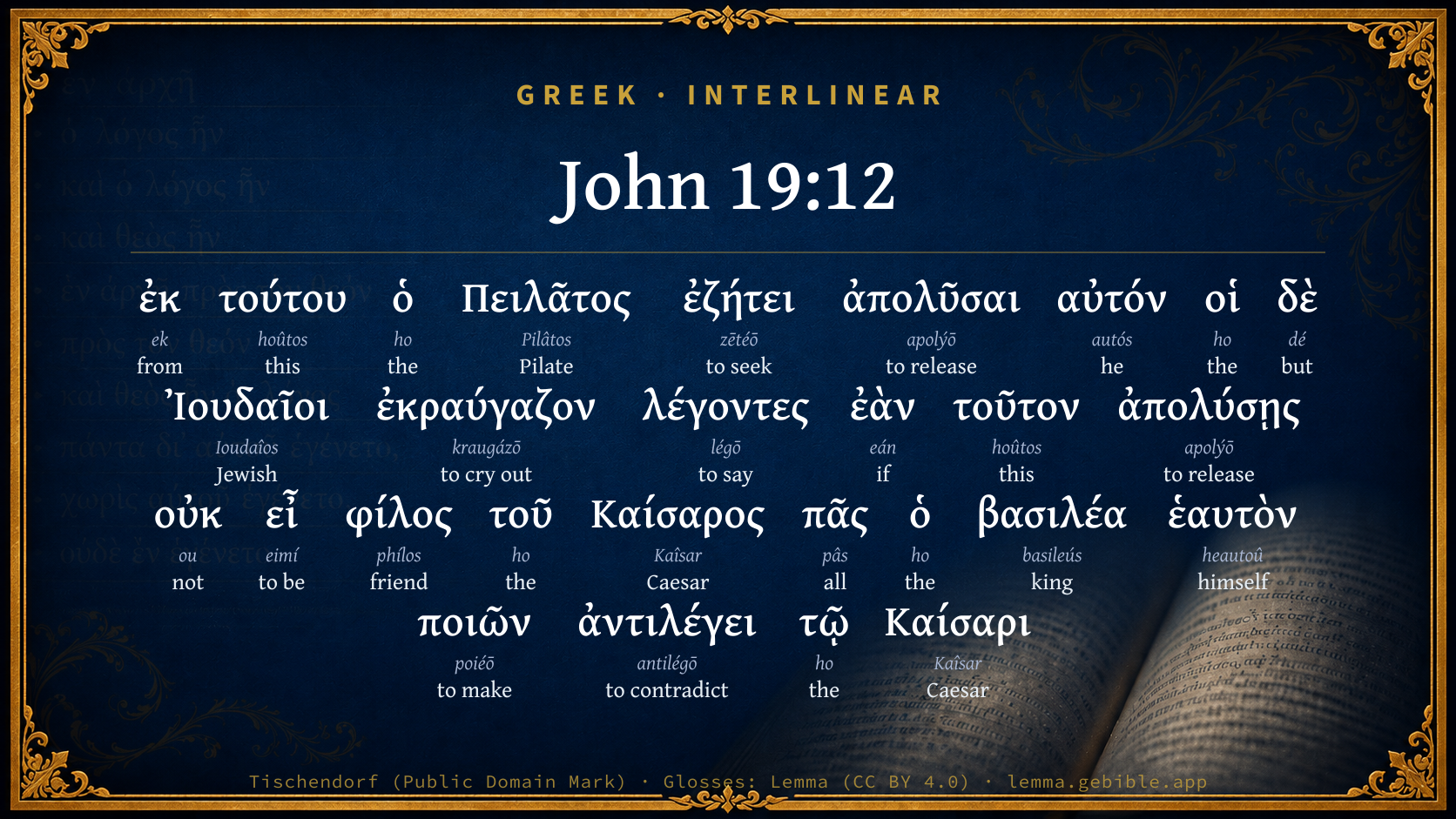
Greek (Tischendorf 8th ed.) John 19:12 appears in the Greek New Testament. The text above is from the Tischendorf 8th edition. Each word links to its Strong’s number and a concise gloss. Click any word for its full Thayer’s Greek Lexicon entry.
Download image
Cite this verse

John 19:12 (World English Bible). Public Domain. Lemma interlinear Bible study tool, https://lemma.gebible.app/v/john/19/12.

Show BibTeX & RIS
BibTeX
RIS
English Translation
At this, Pilate was seeking to release him, but the Jews cried out, saying, "If you release this man, you aren't Caesar's friend! Everyone who makes himself a king speaks against Caesar!"
World English Bible · Public Domain
Download a study sheet

One document with this verse’s original text, its word-by-word gloss line, the meaning frame, cross-references with their text, attributed commentary, and full source and license credits — printable, and it pastes into notes with its structure intact.

This verse Autodidact and up

Study sheet (.html) Plain text (.txt)

A passage Seminary Student

Up to 50 verses in one chapter. A passage sheet keeps up to 6 commentary sources and 12 cross-references per verse, in the order this page ranks them, and says so on the sheet whenever that leaves anything out. Ask for a single verse and you get the Autodidact verse sheet above.

Everything on this page stays free to read, with no account — the sheet is a download of what is already on screen, not access to it.

Want to remove ads? Support Godless Engineer
Compare translations 3

The same verse in 3 English versions, stacked beneath the original-language interlinear above. Click any original word for its lexicon entry.

Each is an independent rendering of the whole verse — the interlinear is not word-aligned to these translations.

Highlighted words mark where these versions differ — a whole-verse word diff, not a word-by-word alignment.

  • World English Bible Public Domain
    At this, Pilate was seeking to release him, but the Jews cried out, saying, "If you release this man, you aren't Caesar's friend! Everyone who makes himself a king speaks against Caesar!"
  • King James Version Public Domain
    And from thenceforth Pilate sought to release him: but the Jews cried out, saying, If thou let this man go, thou art not Caesar's friend: whosoever maketh himself a king speaketh against Caesar.
  • unfoldingWord Literal Text CC BY-SA 4.0
    At this, Pilate was seeking to release him, but the Jews cried out, saying, “If you release this one, you are not a friend of Caesar. Everyone making himself a king speaks against Caesar.”

unfoldingWord Literal Text — © unfoldingWord, licensed CC BY-SA 4.0. Word-aligned USFM3 via Door43 (git.door43.org/unfoldingWord/en_ult).

Versions to compare (up to 4)

3 of 4 selected

Show all 19 translations

Every available English version of this verse, each an independent rendering of the whole verse.

  • World English Bible Public Domain
    At this, Pilate was seeking to release him, but the Jews cried out, saying, "If you release this man, you aren't Caesar's friend! Everyone who makes himself a king speaks against Caesar!"
  • Berean Standard Bible Public Domain
    From then on, Pilate tried to release Him, but the Jews kept shouting, “If you release this man, you are no friend of Caesar. Anyone who declares himself a king is defying Caesar.”
  • Majority Standard Bible Public Domain
    From then on, Pilate tried to release Him, but the Jews kept crying out, “If you release this man, you are no friend of Caesar. Anyone who declares himself a king is defying Caesar.”
  • King James Version Public Domain
    And from thenceforth Pilate sought to release him: but the Jews cried out, saying, If thou let this man go, thou art not Caesar's friend: whosoever maketh himself a king speaketh against Caesar.
  • American Standard Version (1901) Public Domain
    Upon this Pilate sought to release him: but the Jews cried out, saying, If thou release this man, thou art not Caesar's friend: every one that maketh himself a king speaketh against Caesar.
  • Revised Version (1885) Public Domain
    Upon this Pilate sought to release him: but the Jews cried out, saying, If thou release this man, thou art not Caesar’s friend: every one that maketh himself a king speaketh against Caesar.
  • Geneva Bible (1599) Public Domain
    From thence foorth Pilate sought to loose him, but the Iewes cried, saying, If thou deliuer him, thou art not Cesars friende: for whosoeuer maketh himselfe a King, speaketh against Cesar.
  • Douay-Rheims (1899) Public Domain
    And from henceforth Pilate sought to release him. But the Jews cried out, saying: If thou release this man, thou art not Caesar's friend. For whosoever maketh himself a king, speaketh against Caesar.
  • Young's Literal Translation Public Domain
    From this `time' was Pilate seeking to release him, and the Jews were crying out, saying, `If this one thou mayest release, thou art not a friend of Caesar; every one making himself a king, doth speak against Caesar.'
  • Literal Standard Version CC BY-SA 4.0
    From this [time] Pilate was seeking to release Him, and the Jews were crying out, saying, “If you may release this One, you are not a friend of Caesar; everyone making himself a king speaks against Caesar.”
  • Unlocked Literal Bible CC BY-SA 4.0
    At this answer, Pilate tried to release him, but the Jews cried out, saying, “If you release this man, you are not a friend of Caesar. Everyone who makes himself a king speaks against Caesar.”
  • unfoldingWord Literal Text CC BY-SA 4.0
    At this, Pilate was seeking to release him, but the Jews cried out, saying, “If you release this one, you are not a friend of Caesar. Everyone making himself a king speaks against Caesar.”
  • Darby Bible Public Domain
    From this time Pilate sought to release him; but the Jews cried out saying, If thou releasest this [man], thou art not a friend to Caesar. Every one making himself a king speaks against Caesar.
  • World Messianic Bible Public Domain
    At this, Pilate was seeking to release him, but the Judeans cried out, saying, “If you release this man, you aren’t Caesar’s friend! Everyone who makes himself a king speaks against Caesar!”
  • Webster's Bible Public Domain
    And from thenceforth Pilate sought to release him: but the Jews cried out, saying, If thou let this man go, thou art not Cesar's friend. Whoever maketh himself a king, speaketh against Cesar.
  • Free Bible Version CC BY-SA 4.0
    Because of this statement Pilate tried to set Jesus free, but the Jewish leaders shouted, “If you set this man free you're not Caesar's friend. Anyone who sets himself up as a king is rebelling against Caesar.”
  • Bible in Basic English Public Domain
    Hearing this, Pilate had a desire to let him go free, but the Jews said in a loud voice, If you let this man go, you are not Caesar's friend: everyone who makes himself a king goes against Caesar.
  • Text-Critical English NT CC BY 4.0
    From that point forward Pilate was seeking to release him, but the Jews cried out, “If yoʋ release this man, yoʋ are not a friend of Caesar; everyone who makes himself out to be a king opposes Caesar.”
  • Tyndale New Testament (1534) Public Domain
    And from thence forthe sought Pylate meanes to lowse him: but the Iewes cryed sayinge: yf thou let him goo thou arte not Cesars frende. For whosoever maketh hi selfe a kynge is agaynst Cesar

Literal Standard Version (2020), Covenant Press — licensed CC BY-SA 4.0. Text via the HelloAO Bible API (eBible.org). Unlocked Literal Bible (unfoldingWord) — licensed CC BY-SA 4.0. Text via the HelloAO Bible API (eBible.org). unfoldingWord Literal Text — © unfoldingWord, licensed CC BY-SA 4.0. Word-aligned USFM3 via Door43 (git.door43.org/unfoldingWord/en_ult). Free Bible Version, Dr. Jonathan Gallagher — licensed CC BY-SA 4.0. Text via the HelloAO Bible API (eBible.org).

Word by word

More ways to search: Search by grammar → Find every occurrence → Compare this word →

Practice this passage: Drill this verse → Learn its vocabulary →

ἐκραύγαζον
kraugázō
G2905
“to cry out”
Verb, Imperfect, Active, Indicative, 3rd person, Plural
Part of Speech
Verb
Tense
Imperfect
Voice
Active
Mood
Indicative
Person
3rd person
Number
Plural
Full Thayer's Definition

Origin: from G2906

TDNT: 17:58,5

1. to cry out, cry aloud, to shout, to cry out to one
  1. ἐκ ek G1537 “from” Preposition
  2. τούτου hoûtos G3778 “this” Demonstrative pronoun, Genitive, Singular, Neuter
  3. ὁ ho G3588 “the” Article, Nominative, Singular, Masculine
  4. Πειλᾶτος Pilâtos G4091 “Pilate” Noun, Nominative, Singular, Masculine
  5. ἐζήτει zētéō G2212 “to seek” Verb, Imperfect, Active, Indicative, 3rd person, Singular
  6. ἀπολῦσαι apolýō G630 “to release” Verb, Aorist, Active, Infinitive
  7. αὐτόν autós G846 “he” Personal pronoun, Accusative, Singular, Masculine
  8. οἱ ho G3588 “the” Article, Nominative, Plural, Masculine
  9. δὲ dé G1161 “but” Conjunction
  10. Ἰουδαῖοι Ioudaîos G2453 “Jewish” Adjective, Nominative, Plural, Masculine
  11. λέγοντες légō G3004 “to say” Verb, Present, Active, Participle, Nominative, Plural, Masculine
  12. ἐὰν eán G1437 “if” Conditional
  13. τοῦτον hoûtos G3778 “this” Demonstrative pronoun, Accusative, Singular, Masculine
  14. ἀπολύσῃς apolýō G630 “to release” Verb, Aorist, Active, Subjunctive, 2nd person, Singular
  15. οὐκ ou G3756 “not” Particle, Negative
  16. εἶ eimí G1510 “to be” Verb, Present, Active, Indicative, 2nd person, Singular
  17. φίλος phílos G5384 “friend” Adjective, Nominative, Singular, Masculine
  18. τοῦ ho G3588 “the” Article, Genitive, Singular, Masculine
  19. Καίσαρος Kaîsar G2541 “Caesar” Noun, Genitive, Singular, Masculine
  20. πᾶς pâs G3956 “all” Adjective, Nominative, Singular, Masculine
  21. ὁ ho G3588 “the” Article, Nominative, Singular, Masculine
  22. βασιλέα basileús G935 “king” Noun, Accusative, Singular, Masculine
  23. ἑαυτὸν heautoû G1438 “himself” Reflexive pronoun, 3rd person, Accusative, Singular, Masculine
  24. ποιῶν poiéō G4160 “to make” Verb, Present, Active, Participle, Nominative, Singular, Masculine
  25. ἀντιλέγει antilégō G483 “to contradict” Verb, Present, Active, Indicative, 3rd person, Singular
  26. τῷ ho G3588 “the” Article, Dative, Singular, Masculine
  27. Καίσαρι Kaîsar G2541 “Caesar” Noun, Dative, Singular, Masculine

About this verse

These counts appear in no published source. They are computed here, from the morphology-tagged text and Lemma’s own curated glosses. What Lemma adds →

28
words
21
distinct lemmas
Gospels
section

Notable vocabulary

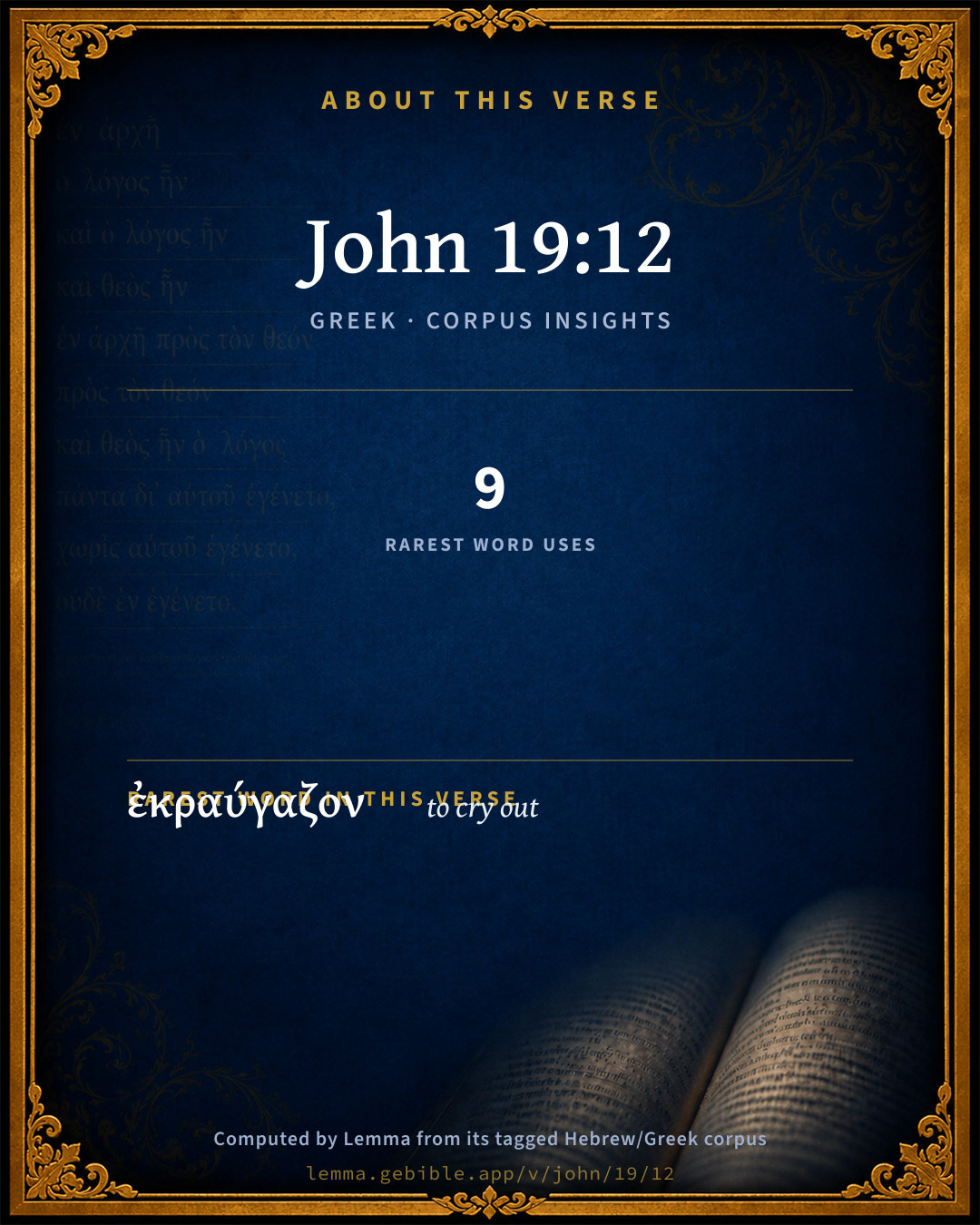
The rarest word here is ἐκραύγαζον to cry out G2905 — appearing just 9 times in the whole Greek New Testament.

Shared distinctive vocabulary

ἐκραύγαζον to cry out G2905 occurs in 9 verses of the Greek New Testament. Also found in:

Repetition

Words recur within this verse:

  • ἀπολῦσαι to release G630 ×2
  • Καίσαρος Caesar G2541 ×2
  • ὁ the G3588 ×5
  • τούτου this G3778 ×2

Cross-references

5

Topical passages linked to John 19:12 in the Treasury of Scripture Knowledge — connected by theme and wording, ordered by reader-vote popularity; previews shown in the World English Bible.

  • John 18:33–36 Pilate therefore entered again into the Praetorium, called Jesus, and said to him, "Are you the King of the Jews?"
  • Acts 17:6–7 When they didn't find them, they dragged Jason and certain brothers before the rulers of the city, crying, "These who have turned the world upside down have come here also,
  • Mark 6:16–26 But Herod, when he heard this, said, "This is John, whom I beheaded. He has risen from the dead."
  • Luke 23:2–5 They began to accuse him, saying, "We found this man perverting the nation, forbidding paying taxes to Caesar, and saying that he himself is Christ, a king."
  • Acts 24:24–27 But after some days, Felix came with Drusilla, his wife, who was a Jewess, and sent for Paul, and heard him concerning the faith in Christ Jesus.

Cross-references courtesy of OpenBible.info (CC BY 4.0).

Commentary

Notes on John 19:12 from classic Christian and Jewish commentators (each source and its license shown beneath its notes). The classic Christian expositions comment on the surrounding passage and are grouped to its opening verse, so a note may address several verses; the Jewish commentaries on the Tanakh (Rashi and others) are per-verse, so they appear only where the commentator wrote on this verse.

Lemma curates 59 commentaries, every one of them public domain or Creative Commons licensed, each selected and text-cleaned for this edition rather than reprinted as found. About our sources →

Adam Clarke's Commentary

Verse 12. Pilate sought to release him] Pilate made five several attempts to release our Lord; as we may learn from Lu 23:4; Lu 23:15; Lu 23:20; Lu 23:22; Joh 19:4; Joh 19:12-13.

Thou art not Caesar's friend] Thou dost not act like a person who has the interest of the emperor at heart. Ambassadors, prefects, counsellors, c., were generally termed the friends of the emperor. This insinuation determined Pilate to make no longer resistance: he was afraid of being accused, and he knew Tiberius was one of the most jealous and distrustful princes in the world. During his reign, accusations of conspiracies were much in fashion they were founded on the silliest pretenses, and punished with excessive rigour. See Calmet, Tacit. An. l. i. c. 72, 73, 74. Sueton. in Tiber. c. 58.

Adam Clarke's Commentary on the Bible (1810–1826) — public domain. Text from a community e-Sword/MySword module.

The Biblical Illustrator

Joseph S. Exell

Joh_19:12-16

From thenceforth Pilate sought to release Him

Pilates last attempt to rescue Christ

I.

DESPAIRING STRUGGLES BY A FEEBLE SOUL (Joh_19:12).

1. The earnestness of this attempt. Already he had endcavoured to rescue Christ

(1) By refusing to proceed without an accusation (Joh_18:29).

(2) By offering a choice between Barabbas and Jesus (Joh_18:39;Mat_27:17).

(3) By scourging Christ and thus appealing to their sympathy (Joh_19:5). These stratagems were defeated, perhaps largely because Pilate had not been in earnest. Now he bends himself with energy and determination to the task.

2. The reason of this attempt.

(1) The inward conviction of fear that Christ was a supernatural being.

(2) The deepening impression made by Christs person and character.

(3) The secret apprehension that it would not be safe to proceed farther against Christ.

(4) The gentleness Christ had displayed in palliating his offence.

II. DEXTEROUS MANOEUVRING BY A CRAFTY FOE. But the Jews cried out, &c. The last arrow that the Jews had in their quiver, was

1. Sharply pointed. It was a return to the original indictment of sedition which Pilate an hour before had waved aside as absurd. Now they show the governor how adroitly it may be turned against himself. Tiberius would hardly regard as a loyal act the liberation of one who had professed to be a king.

2. Correctly aimed. The shaft found the open joint in Pilates harness and went straight to his heart. There was nothing that Pilate had more reason to dread than deletion to the emperor.

3. Powerfully driven home. Like men bent on having their way, they cried out with one simultaneous yell. And they had it! The procurator reeled as one shot.

III. IGNOMINIOUS SURRENDER BY AN UNJUST JUDGE (Joh_19:13). The capitulation was

1. Cowardly. These accused hierarchs had proved better players than himself for Jesus life. With truth, justice, conscience, heaven, Christ and God on his side he had lost the game because he was a coward. The one thing he could not contemplate without a shudder was being reported to the emperor.

2. Complete. The struggle so long and at one time so gallantly and to appearance so hopefully, maintained was ended. There was no mistaking the import of Pilates next actions, the fetching out of Jesus, the sitting down upon the judges chair, and perhaps the handwashing.

3. Contemptuous. Behold your King! as if intimating with fierce disdain and stinging mockery of the people that had conquered him, that the thorn-crowned prisoner was indeed their King.

4. Conclusive. The deed was irrevocable (Joh_19:16). If for a moment there was hesitation while for the last time he asked, Shall I crucify your King? it was only for a moment, it was swept away before the awful shout, We have no king but Caesar.

Lessons:

1. The difficulty of doing right when self-interest stands in the way, If self the wavering balance shake, its rarely right adjusted (Robert Burns).

2. The feebleness of every soul that hesitates to follow conscience. Had Pilate listened only to the still small voice within he had been invincible.

3. The guilt incurred by openly defying conscience. Christ palliated Pilates sin before the preceding interview: it is not clear that He would have done so after that interview closed.

4. The degeneracy into which a soul may fall by turning away from Christ. Priests and people elected Caesar for their king rather than have Gods Son for their Messiah! (T. Whitelaw, D. D.)

Pilate; or, worldly policy

We have here an illustration of

I. WORLDLY POLICY. The main motive that led to Pilates final decision was a regard to his safety and his ease. He felt that to take a determined stand on the innocence of our Lord would involve peril to his position; and he was not prepared to incur that danger. It is by such considerations that men are moved and confronted in doing wrong. We live in a time of expediency, in the sense of not doing right lest it should be unprofitable. A high civilization and a large development of the commercial spirit is always in danger of fostering this. In public affairs, the favourite point of view is the economic; the popular inquiries are, what will it cost? Dishonesty is practised in business because it is lucrative, and conscientious conviction is suppressed lest it should lead to social disrepute. Oh! beware of Pilates sin; learn the grand lesson that we have nothing to do with consequences when truth and right are involved. It will often happen that sincerity and righteousness will entail loss and suffering; and he who would keep a good conscience must lay his account with these. If we be not prepared for them, if we will only cleave to godliness when it is gain, and to honesty when it is the best policy, there is nothing for us but to go in Pilates steps, and abandon Christ, though convinced that there is no fault in Him at all.

II. WORLDLY POLICY RESISTING AND EFFECTUALLY SUBDUING THE STRONGEST CONVICTIONS OF DUTY. Pilate wished and tried to deliver Christ, without sacrificing himself, for that purpose. He did not choose to do wrong; he did much to avoid doing it. And this may be the case with us: it often is. We do not fall at once. We set ourselves manfully against the besetting suggestions of interest, pleasure and good opinion. We enter the contest with a sincere desire to be right. It is long, perhaps, before we are prepared to give up; we strive to subordinate circumstances to our convictions; we go on, now under one pretence and now under another, until all pretences are exhausted: but at last an election must be made, Christ must be sacrificed or sin must be resigned, and, like the young man we feel the pressure of his demands to be too strong for us, and depart from him though sorrowful. And there are times when the case assumes an especially solemn form; that, e.g., of deep spiritual conviction, and that of decision as to the general way and course of life. Then is Christ before us, arraigned and accused by the Sanhedrim of passion, interest, and sophistry, before the Pilate of reason, conscience, and true affection; the conflict may be long and painful; ingenious devices may be used to terminate or to postpone it: but escape and delay are both impossible; a decision must be made; and the soul reluctantly, and with a tearful eye, resigns the Saviour, and gives itself up to sin, and to a lie. And often this decision is final; it cannot be reversed. If we sin wilfully, &c.

III. WORLDLY POLICY BRINGING A MAN INTO BONDAGE TO THOSE HE SHOULD GOVERN. Pilate was afraid of being accused by the Jews of unfaithfulness to the Roman emperor. He was the governor, and was deterred from doing right by the malice of the people over whom he presided. He was subject to those who were subject to him. Worldly policy often makes us abdicate our proper functions, and serve when we should reign. We are in the world, and in the Church, to do good, and to maintain righteousness. Whatever our superiority over others, and our means of affecting them, it is a faculty intended to resist their evil and advance their welfare; but if we give heed to the suggestions of selfishness; we not only do wrong, but do wrong to those whom we allow thus to influence us. Pilate, the governor, is the instrument of the Jews.

IV. WORLDLY POLICY DERIVING STRENGTH FROM. A MANS OWN MISDEEDS. Pilates rule in Judaea was very far from what it should have been. He could not therefore afford to provoke the nation. He must do wrong again, because he had done wrong already. And how often do we see sin working in this way! We have put ourselves in the power of the world by our transgressions and inconsistencies. Could we bring an unsullied character, human esteem and honour, with us to the task, we might hope to make some impression, but now there will be the mocking surprise, the bitter retort, the hot wrath; and the will to do good, as in Pilates case, is chained by the memory of past evil. And if past sins may make us subject to men, they are still more likely to make us slaves to ourselves, When we would do good, evil is present with us. How many are there who, like Pilate, would let Christ go, aye and welcome Him as the Son of God, but for the oppressions of former iniquities! could they but blot them out, what would they not do! but the tyranny of lust and worldliness is strong upon them; and he is sacrificed, and they are sacrificed, to old sins. (A. J. Morris.)

Pilates weakness

Was Pilate exceptionally weak in this thing? He wanted to be of service to Jesus, but he was not quite ready to be ruined for Him. There are corresponding tests of fidelity to the right in every mans experience all the way along in life. A public official or representative has to decide whether he will yield to some unjust popular clamour in behalf of a special interest, or against an obnoxious class, or lose all his hopes of promotion and even all fair prospect of well doing in the public service. A business man must meet the question whether he will conform to some established method of wrong-doing in the line of his business, or abandon his prospects of success in life. An employe finds himself face to face with the problem, how he can do the work that is required of him, at the times when it is called for, consistently with his conscience and the law of God; and whether he is willing to accept the consequences of standing out against the necessities of his employment as it is. The position of Pilate was, after all, no more trying than is the position of almost every man who faces Christ and Christs cause to-day; and now, as always, only he who is ready to lose his life, and to lose a great deal more than life, for the sake of Christ, can fairly be called a true and faithful servant of Christ. Pilate was weak under such a pressure as this. Would to God he had been the last weak one in such an emergency! (H. C.Trumbull, D. D.)

If thou let this man go thou art not Caesars friend

Caesar or Christ

I. CAESARS FRIEND.

1. An enemy of Christ.

2. A lover of self.

3. A slave of man. Such Pilate was!

II. CHRISTS FRIEND.

1. A lover of the truth.

2. A doer of the right.

3. A champion of the wronged.

4. A sympathizer with the suffering.

5. A servant of conscience.

6. A denier of self. Such Pilate might have been. (T. Whitelaw, D. D.)

The Biblical Illustrator, edited by Joseph S. Exell (c. 1880s–1900s) — public domain. Text from a community e-Sword module.

Tyndale Open Study Notes

Tyndale Open Resources

19:12 Each time he had a conversation with Jesus, Pilate tried to release him: He kept trying, but his repeated efforts were fruitless. • “Friend of Caesar” was an official title given to individuals such as senators who showed exceptional loyalty and service to the emperor. The Jewish leaders were implying that they would ruin Pilate’s career by reporting that he was not working in Rome’s interests. They probably knew that Pilate was also having a personal crisis. His patron in Rome, Sejanus (the chief administrator of the empire under Tiberius Caesar), had fallen from favor and was executed in AD 31. Pilate had every reason to be afraid.

Tyndale Open Study Notes — © Tyndale Open Resources, licensed CC BY-SA 4.0. Text via the HelloAO Bible API.

Bengel's Gnomon

Johann Albrecht Bengel

Joh 19:12. [Ἔκραζον, continued crying out) They called loud enough to reach the ears of Pilate within, they being in the open air, and he in the judgment-hall; Joh 19:9; Joh 19:13.—V. g.]—πᾶς, every one) By not adding for, they add or impart ἀποτομίαν, abrupt sternness and force to their language.—[ἀντιλέγει, speaketh against) The world frequently attempts to harass the kingdom of Christ under a political pretext.—V. g.]

Bengel's Gnomon of the New Testament — English translation (T&T Clark, Edinburgh, 1860) — public domain. Text from a community e-Sword module.

Meyer's Critical & Exegetical Commentary

Heinrich August Wilhelm Meyer

Joh_19:12. ʼΕκ τούτου] Not: from this time forward (so usually); for ἐζήτει, κ.τ.λ., is a particular act, which is immediately answered by the Jews with loud outcries; but: on this ground, as Joh_6:66, occasioned by this speech of Jesus (so also Luthardt and Lange).

ἐξήτει, κ.τ.λ., he sought to release Him (Joh_10:30; Luk_5:18; Luk_13:24; Luk_19:3; Act_27:30, et al.). In what this attempt, which, though made, yet remained unaccomplished (hence imperf.), may more definitely have consisted, John does not say, and therefore it was, probably, only in renewed representations which he made. That which is usually supplied, as though μᾶλλον, as in Joh_15:18, were expressed therewith: he sought still more, he sought most earnestly (previously he appears to John rather to have played with the matter, Lücke), and the like, is capriciously imported, as also the rendering: now he demanded peremptorily, etc. (Steinmeyer).

With ἐὰν τοῦτον, κ.τ.λ., the Jews cunningly enough again return to and fasten upon the political side of the accusation, ὡς οὐ παροπτέον τῷ Πιλάτῳ διὰ τὸν ἀπὸ τοῦ Καίσαρος φόβον, Euth. Zigabenus. How greatly must he, who in so many features of his administration had anything but clean hands (Josephus, Antt. xviii. 3. 1 ff.; Philo, de legat. ad Caj. p. 1033), have desired to see avoided an accusation before Tiberius, so suspicious and jealous of his authority! (Suetonius, Tib. 58; Tacitus, Ann. iii. 38.) Comp. Hausrath, Christl. Zeitgesch. I. p. 312 ff.

φίλος τοῦ Καίσ.] Not in the titular sense of amicus Cacsaris, as high officials bore this title (see Wetstein; Grimm on 1Ma_2:18), in which, however, the sense of confidant (counsellor) of Caesar exists; but faithful to the emperor, friendly to him, and readily devoted to his interests (Xen. Anab. iii. 2. 5).

He who makes himself a king, by the fact, that is, of declaring himself to be such (comp. Joh_10:33), thereby declares himself (ἀντιλέγει) against the emperor. Accordingly, ἀντιλέγει is not generally: he opposes (Grotius, De Wette, Maier); but the emphasis lies upon the correlates βασιλέα and Καίσαρι.

Meyer — Critical and Exegetical Commentary on the New Testament — English translation by Peter Christie, edited by Frederick Crombie (T&T Clark, 1880) — public domain. Text from a community e-Sword module.

Expositor's Greek Testament

ed. W. Robertson Nicoll

Joh 19:12-16 . Fresh assault upon Pilate and his final surrender .

Joh 19:12 . In consequence of this and from this point, ἐκ τούτου , as in Joh 6:66 , “upon this,” with a causal as well as a temporal reference, ἐζήτει ὁ Πιλάτος ἀπολῦσαι αὐτόν , Pilate sought (ineffectually, imperfect) to set Him free.

Joh 19:12 . οἱ δὲ Ἰουδαῖοι , “but the Jews,” a new turn was at this point given to the case by the cunning of the Sanhedrists, who cried out, ἔκραζον λέγοντες Ἐὰν … Καίσαρι . φίλος τοῦ Καίσαρος . Wetstein says: “Legati, praesides, praefecti, consiliarii, amici Caesaris dicebantur,” but it is not in this titular sense the expression is here used. The meaning is: Thou dost not show thyself friendly to Caesar. The reason being that every one who makes himself a king, ἀντιλέγει τῷ Καίσαρι , “speaks against Caesar”. Euthymius, Field, Thayer, etc., prefer “setteth himself against Caesar,” “resisteth his authority”. And as Jesus made Himself a king, Pilate would aid and abet Him by pronouncing Him innocent. This was a threat Pilate could not despise. Tiberius was suspicious and jealous. [“Judicia majestatis … atrocissime exercuit.” Suetonius, Tib. , 58. Treason was the makeweight in all accusations. Tacitus, Annals , iii. 38.]

The Expositor's Greek Testament, edited by W. Robertson Nicoll (1897–1910) — public domain. Text from a community e-Sword module.

Jamieson, Fausset & Brown

Robert Jamieson, A. R. Fausset & David Brown

And from thenceforth--particularly this speech, which seems to have filled him with awe, and redoubled his anxiety.

Pilate sought to release him--that is, to gain their consent to it, for he could have done it at once on his authority.

but the Jews cried--seeing their advantage, and not slow to profit by it. If thou let this man go, thou art not Cæsar's friend, &c.--"This was equivalent to a threat of impeachment, which we know was much dreaded by such officers as the procurators, especially of the character of Pilate or Felix. It also consummates the treachery and disgrace of the Jewish rulers, who were willing, for the purpose of destroying Jesus, to affect a zeal for the supremacy of a foreign prince" [WEBSTER and WILKINSON]. (See Joh 19:15).

When Pilate . . . heard that, . . . he brought Jesus forth, and sat down in--"upon"

the judgment seat--that he might pronounce sentence against the Prisoner, on this charge, the more solemnly.

in a place called the Pavement--a tesselated pavement, much used by the Romans.

in the Hebrew, Gabbatha--from its being raised.

Jamieson, Fausset & Brown — Commentary Critical and Explanatory on the Whole Bible (1871) — public domain (CC PDM 1.0). Text via the HelloAO Bible API.

John Calvin's Commentaries

12. From that time Pilate sought to release him. Though Pilate does not conduct himself conscientiously, and is actuated more by ambition than by a regard to justice, and, on that account, is wretchedly irresolute, yet his modesty is commendable on this ground, that, when he is severely reproved by Christ, he does not fly into a passion, but, on the contrary, is still more disposed to release him. He is a judge, and yet he meekly permits the accused person to be his reprover; and, indeed, scarcely one person in a hundred will be found, who so mildly suffers a reproof, even from one who is his equal.

Thou art not Caesar’s friend. By threats they prevail on Pilate to condemn Christ; for they could do nothing that was more hateful, or more fitted to produce terror, than to hold him suspected of disloyalty to Caesar. “Thou showest,” say they, “that thou dost not care about Caesar’s authority, if thou acquit him who has endeavored to throw every thing into confusion.” This wickedness at length broke down the resolution of Pilate, who, till now, had only been shaken by their furious clamours. Nor is it without a good reason that the Evangelist so laboriously examines and details those circumstances; for it is of great importance to us to know, that Pilate did not condemn Christ, before he had several times acquitted him with his own mouth, in order that we may learn from it, that it was for our sins that he was condemned, and not on his own account. We may also learn from it, how voluntarily he offered himself to die, when he disdained to avail himself of the favorable disposition of the judge towards him; and, indeed, it was this obedience that caused his death to be a sacrifice of sweet savour, (Ephesians 5:2,) for blotting out all sins.

John Calvin's Commentaries (1540-1563) — public domain. Text from the Calvin Translation Society English edition (1840s-50s) via the Christian Classics Ethereal Library (ccel.org). Calvin's coverage is partial (roughly two-thirds of the Bible); uncommented books and verses are honest gaps, never fabricated. The 19th-century editor's footnotes and remarks are omitted so the notes are faithfully Calvin's own voice.

Ellicott's Commentary for English Readers

(12) And from thenceforth Pilate sought to release him.—The words may be interpreted of time, as in the Authorised version, or of cause—“For this reason Pilate sought to release Him.” The latter is more probable, as the reference seems to be to the attempt which he made at once. (Comp. Note on Joh_6:66.)

If thou let this man go, thou art not Cæsar’s friend. . . .—There was another weapon left in the armoury of their devices, against which no Roman governor was proof. The jealous fear of Tiberius had made “treason” a crime, of which the accusation was practically the proof, and the proof was death. The pages of Tacitus and Suetonius abound with examples of ruin wreaked on families in the name of the “law of treason.” (Comp. Merivale: History of the Romans under the Empire, vol. v., p. 143 et seq.) Here was One who had claimed to be a king, and Pilate was seeking to release Him. They knew, indeed, that it was a claim to be “king” in a sense widely different from any which would have affected the empire of Cæsar; but Pilate has refused to condemn Him on the political charge without formal trial, and he has refused to accept their own condemnation of Jesus on the charge of blasphemy. He dare not refuse the force of an appeal which says that he is not Cæsar’s friend, and suggests an accusation against himself at Rome. See Note on Mat_27:2 for the special reasons which would lead Pilate to dread such an accusation.

A Bible Commentary for English Readers, edited by Charles John Ellicott (1878–1897) — public domain. Text from a community e-Sword module.

The Cambridge Bible for Schools and Colleges

gen. ed. J. J. S. Perowne

12. And from thenceforth] Or (as in Joh_6:66), Hereupon. Result rather than time seems to be meant; but the Greek (here and Joh_6:66 only in N.T.) may mean either. Omit ‘and.’

sought] Imperfect tense, of continued efforts. Indirect means, such as the release in honour of the Feast, the appeal to compassion, and taunts having proved unsuccessful, Pilate now makes more direct efforts to release Jesus. What these were the Evangelist does not tell us.

If thou let this man go] Better, If thou release this man; it is the same verb as in the first clause. The Jews once more shift their tactics and from the ecclesiastical charge (Joh_19:7) go back to the political, which they now back up by an appeal to Pilate’s own political interests. They know their man: it is not a love of justice, but personal feeling which moves him to seek to release Jesus; and they will overcome one personal feeling by another still stronger. Pilate’s unexplained interest in Jesus and supercilious contempt for His accusers must give way before a fear for his own position and possibly even his life.

Cesar’s friend] Whether or no there was any such title of honour as amicus Cesaris, like our ‘Queen’s Counsel,’ there is no need to suppose that any formal official distinction is intended here. The words probably mean no more than ‘loyal to Cesar.’

whosoever] Literally, every one who.

maketh himself] Comp. Joh_19:7, Joh_10:33. The phrase perhaps implies action as well as words.

speaketh against Caesar] ipso facto declares himself a rebel; and for a Roman governor to countenance and even protect such a person would be high treason (majestas). The Jews perhaps scarcely knew how powerful their weapon was. Pilate’s patron Sejanus (executed a.d. 31) was losing his hold over Tiberius, even if he had not already fallen. Pilate had already thrice nearly driven the Jews to revolt, and his character therefore would not stand high with an Emperor who justly prided himself on the good government of the provinces. Above all, the terrible Lex Majestatis was by this time worked in such a way that prosecution under it was almost certain death.

12–16. Outside the Praetorium; the power from above controlled from below pronounces public sentence against the Innocent.

The Cambridge Bible for Schools and Colleges (gen. ed. J. J. S. Perowne; Cambridge University Press, 1878–1918) — public domain. Text from a community e-Sword module.

John Gill's Exposition

And from thenceforth Pilate sought to release him,.... From the time that Christ spoke the above words; or, as the Syriac version renders it, , "because of this", or on account of the words he had spoken; to which agree the Arabic and Ethiopic versions: he sought by all means, and studied every way to bring the Jews to agree to his release: his reasons were, because of the consciousness of guilt, and the danger of contracting more; the sense he might have of a Divine Being, to whom he was accountable for the exercise of his power; his suspicion that Jesus was the Son of God, or that he was more than a man; for he perceived that power went along with his words, by the effect they had on him: but though he sought to release him, he did not do it, nor use the power he boasted he had; the reason in himself was, he was desirous, that the Jews would concur with him; the secret one in providence was, God would not have it so; and yet things must be carried to this pitch, that it might appear that Christ suffered not for his own sins, but ours, and that he suffered willingly:

but the Jews cried out, saying, if thou let this man go, thou art not Caesar's friend. These were the chief priests, Scribes, and elders of the people, more especially, and by whom, the common people were stirred up to request his crucifixion: these still made a greater outcry, and in a more clamorous way urged, that should he be released, Pilate would show but little regard to Caesar, by whom he was raised to this dignity; who had put him into this trust; whom he represented, and in whose name he acted. This was a piece of craftiness in them, for nothing could more nearly affect Pilate, than an insinuation of want of friendship and fidelity to Tiberius, who was then Caesar, or emperor; and also, it was an instance of great hypocrisy in them, to pretend a regard to Caesar, when they scrupled paying tribute to him, and would have been glad, at any rate, to have been free from his yoke and government; and is a very spiteful hint, and carries in it a sort of threatening to Pilate, as if they would bring a charge against him to Caesar, should he let Jesus go with his life, whom they in a contemptuous manner call "this man": adding,

whosoever maketh himself a king, speaketh against Caesar; returning to their former charge of sedition, finding that that of blasphemy had not its effect: their reasoning is very fallacious, and mere sophistry; for though it might be allowed that whoever set up himself as a temporal king in any of Caesar's dominions, must be an enemy of his, a rebel against him; and such a declaration might be truly interpreted as high treason; yet Christ did not give out that he was such a king, but, on the contrary, that his kingdom was not of this world, and therefore did not assume to himself any part of Caesar's dominions and government; and though the Jews would have took him by force, and made him a king, he refused it, and got out of their hands.

John Gill's Exposition of the Whole Bible (1746–1763) — public domain (CC PDM 1.0). Text via the HelloAO Bible API.

Trapp's Complete Commentary

John Trapp

12 And from thenceforth Pilate sought to release him: but the Jews cried out, saying, If thou let this man go, thou art not Caesar’s friend: whosoever maketh himself a king speaketh against Caesar.

Ver. 12. But the Jews cried out, saying, &c.] They returned again to their former accusation, and enforced it. One way or other they are bent to have his blood. In King Edward VI’s days, when the Duke of Somerset was cleared of the treason laid to his charge, yet he must suffer (so his potent enemies would have it) for I know not what slight suspicions of felony. At which time also, Sir Thomas Arundel was, among others, with some difficulty condemned. Unhappy man (saith the historian) who found the doing of anything, or of nothing, dangerous alike.

John Trapp, A Commentary or Exposition upon All the Books of the Old and New Testament (1647–1656) — public domain. Text from a community e-Sword module.

Albert Barnes' Notes on the Bible

Sought to release him - He was more and more convinced of his innocence, and more unwilling to yield him to mere malice and envy in the face of justice.

But the Jews cried out ... - This moved Pilate to deliver Jesus into their hands. He feared that he would be accused of unfaithfulness to the interests of the Roman emperor if he did not condemn a man whom his own nation had accused of sedition. The Roman emperor then on the throne was exceedingly jealous and tyrannical, and the fear of losing his favor induced Pilate to deliver Jesus into their hands.

Caesar’s friend - The friend of the Roman emperor. The name of the reigning emperor was Tiberius. After the time of Julius Caesar all the emperors were called Caesar, as all the kings of Egypt were called Pharaoh. This emperor was, during the latter part of his reign, the most cruel, jealous, and wicked that ever sat on the Roman throne.

Albert Barnes' Notes on the Bible (1834–1885) — public domain. Text from a community e-Sword/MySword module.

Matthew Poole's English Annotations

He sought all fair and plausible means to release him, being convinced in his own conscience that he was an innocent man: but the Jews double their clamours, and (according to the usual acts of sycophants) quit their charge as to religion, though that was the true and real cause of all their malice, and pursue only the charge which was proper for the cognizance of the Roman governor, of sedition or rebellion; and tacitly accuse Pilate as a traitor, and being false to his trust, if he should let our Saviour go; for no man could set up himself as a king, but he must proclaim himself a traitor to the Roman emperor.

Matthew Poole's English Annotations on the Holy Bible (1683–1685) — public domain. Text from a community e-Sword/MySword module.

Whedon's Commentary on the Bible

Daniel D. Whedon

12. From thenceforth—Rather from that reason. That is, because he felt the impress of Jesus’s supernatural character. Nothing now, apparently, would have prevented Pilate from releasing Jesus by a peremptory exertion of power; but the Jews, with surprising art, had reserved their master-stroke for this final period. Spare this man and you are yourself an undone man.

Not Cesar’s friend—The present Cesar, or Emperor of Rome, was the jealous, capricious, cruel Tiberius. Let him for a moment be made to suspect that a viceroy of his tolerates even the shadow of a rebel king, and that viceroy is a dead man. As we have elsewhere noted, Pilate in fact, three years after, committed suicide to escape punishment under charge of maladministration.

Daniel D. Whedon (gen. ed.), Commentary on the Old and New Testaments (1874–1909) — public domain. Text from a community e-Sword module.

The Pulpit Commentary

Vers. 12-16. (g) Pilate vanquished by his selfish fears, and judgment given.

Upon this Revised Version (ek toutou); not from this moment, or "henceforth," as in the English Version, but in consequence of this statement and apportionment of blame, and not from any appreciation on Pilate"s part of the Divine Sonship which Jesus had admitted without further definition upon this Pilate sought (imperfect tense, suggesting repetition and incompleteness in the act) to release him. We are not told by what means, and we have no right to introduce the additional notion of "peremptorily," or "the more," but that he made some further steps in the direction of resistance to the will of "the Jews." Baur and others think that the author is, from doctrinal grounds by mere fabrication, emphasizing the hostility of the Jews, and prolonging the agony of a vain attempt. Every one of these vivid touches impresses us with the unintentional indication of the eye-witness. Probably the governor proceeded to give the order of release; beckoned his body-guard to remove our Lord to a place of safety, and took some obvious steps to screen him from the malice and envy of his tormentors. But the Jews, catching sight of the process, and imagining some maneuver to baulk them of their prey, revealed a spirit that has sometimes, but rarely, disgraced humanity: they dropped their religious plea, they smothered their affected loyalty for their ancient Law, and, having no further charge to bring against Jesus, hid their most intense hatred of Roman rule by assuming the mask of loyal subjection to Tiberius and to the majesty of the Caesar. They endeavored to work upon the fears of Pilate, who knew perfectly well that his position and life were at jeopardy if the matter stood as they pretended. With unscrupulous abandonment of all their patriotic boasts, the men who hated Rome and were perpetually plotting against the imperial power, exclaimed (ekraugasan , shouted with harsh loud yells of bitter hate, that kraugh rang for half a century in the ears of the loved and faithful disciple), If thou release this Man, thou art not Caesar"s friend. The friendship and confidence of Caesar was the title in their hearts to an unresting hatred and loathing; yet they are cunning enough to know that Tiberius was jealous of his own authority, and no charge was so fatal to a Roman procurator as crimen majestatis (Tacitus, "Ann.," 3:38). Amiens Caesaris was a title of honor given to provincial governors, and sometimes to allies of the Caesar; but (as Alford, Meyer, and Westcott think) on this occasion it was used in wider sense, and was capable of a mere deadly emphasis. Every one who maketh himselfa king speaketh against (declares himself opposed to, rebels against) Caesar. As if that was likely to distress these maddened fanatics; and as if the very charge had not been already deliberately laughed to scorn by both Herod and Pilate. There was a Man who said he was a King, and Pilate was guilty of misprision of treason. Pilate"s political history aggravated his fears. His relations with the emperor were not satisfactory, (Josephus, "Ant.," 18:3. 1, 2; "Bell. Jud:," 2:9:2-4; cf. Luk_13:1) and his knowledge of the power of these Jews to renew partisan and patriotic charges against him was now a very serious danger.

The Pulpit Commentary (1880–1919), ed. H.D.M. Spence-Jones & Joseph S. Exell — public domain. Text from a community e-Sword module.

Kretzmann's Popular Commentary

Paul E. Kretzmann

The condemnation:

v. 12. But the Jews cried out, saying, If thou let this Man go, thou art not Caesar’s friend; whosoever maketh himself a king speaketh against Caesar.

v. 13. When Pilate therefore heard that saying, he brought Jesus forth, and sat down in the judgment-seat in a place that is called the Pavement, but in the Hebrew, Gabbatha.

v. 14. And it was the preparation of the Passover and about the sixth hour; and he saith unto the Jews, Behold your King!

v. 15. But they cried out, Away with Him, away with Him, crucify Him! Pilate saith unto them, Shall I crucify your King? The chief priests answered, We have no king but Caesar.

v. 16. Then delivered he Him therefore unto them to be crucified.

While Pilate was considering ways and means to effect the release of Jesus, the leaders of the Jews had not been idle. They now gave a new turn to the case by having the mob cry out to Pilate: If thou releasest this man, thou art not friendly to Caesar. Their argument ran along these lines: Jesus had declared Himself to be a king; that implied a rebellious disposition, if not actual insurrection, rebellion against the Roman emperor, against the constituted authority. If Pilate now took the part of the prisoner, he would aid and abet, or at least strongly encourage, a rebel, affiliate himself with him, at least morally. This fact, however, would put him under suspicion, if not under accusation, as himself unfriendly to Caesar and the Roman government. The implication of the Jews was, though they did not threaten outright, that they would make a complaint, and effect the loss of his position. Such a veiled threat was bound to have great influence upon a man of Pilate’s character, dependent, as he was, upon the mercy of the emperor. And it was the argument which practically decided the day for the Jews. For Pilate now formally led Jesus forth from the judgment-hall and himself sat down upon the judgment-seat, which was situated on an elevated floor or platform of stones, tessellated, or laid out in mosaics, known, on account of this feature, as the Pavement, or, in Hebrew, as Sabbath, the Elevated Place. It was a strikingly dramatic scene which was here presented, and undoubtedly intentionally so on the part of Pilate. His entire attitude proclaimed that he was ready to administer justice, that he wanted to pronounce his final judgment. The evangelist carefully notes the time when this took place: it was the preparation of the Sabbath, that is, it was Friday, and it was going toward the sixth hour, it was between nine and twelve o’clock, by the general way of reckoning time which was then in vogue. See Mar 15:25. On this day and at this hour the judgment was spoken upon Christ, whereby the world has been absolved from all guilt and transgression. Pilate appears in this entire matter as an unjust, unwise, weak judge, that plays havoc with justice and attempts to please men, ’that is not influenced solely by the facts of the case, but is swayed by personal, selfish interests. And his case illustrates also the course of sin. If a person accedes and yields to even the smallest sin against better knowledge, he will soon become the slave of sin and unable to withstand even a small temptation. Of the class of Pilate are those that finally give up all semblance of decent moral living, openly reject Christ and God, and become the willing tools of Satan. The Jews, on the other hand, appear in this story as the determined enemies of Christ. They had hardened their hearts against all influence for good; deliberate, ruthless murder was their avowed intention. And Christ was silent; He endured the horrible outrages without a word of complaint or protest. Pilate vented his bitterness and his baffled rage in the sarcastic, stinging remark: Behold your King! The words were intended to convey all his hatred and contempt for the Jews. That was their own accusation, this was included in their own threat, for this they wanted execution: "He arrogated to Himself the title King." A fine picture of a king He made in His present plight! But the sarcasm of Pilate was wasted, if he had intended it in the interest of Christ. For the lust for blood had so inflamed the Jews that they were beyond any rational appeal. Their cry, in maddened fury, broke forth: Away! Away! Crucify Him! Pilate’s reply was another feeble attempt at sarcasm: Your king shall I crucify? And the chief priests answered, in a statement of mere form and hypocrisy, to force Pilate into concession: We have no king but Caesar. As a matter of fact, both the Sadducees and the Pharisees, the leaders of the Jews, hoped for the speedy delivery of the Jews from the sovereignty of the Romans. But they here profess a loyalty which they were far from feeling, in order to force the issue, since their faithfulness to the emperor would stand out in comparison with the hesitation of Pilate, which they would denounce as a wavering in fidelity and devotion to his sovereign. And so Pilate finally permitted the farce to reach its climax, in the condemnation of Christ: he pronounced judgment whereby Jesus was delivered to them, to the leaders of the Jews, not into their hands, but according to their will and desire, to be crucified.

Paul E. Kretzmann, Popular Commentary of the Bible (1921–1924) — public domain. Text from a community e-Sword module.

Burkitt's Expository Notes on the New Testament

William Burkitt

Still observe, how unwilling Pilate was to put Christ to death; conscience bids him spare, popularity bids him kill: how frequently and how fervently did he contend with the Jews, till they make it a state case, and tacitly accuse him for a traitor to the Roman emperor, if he released him: If thou let this man go, thou art not Cesar’s friend. When Pilate heard that, he delivers up the innocent Jesus to be crucified.

Hence learn, that the natural consciences of men, and the innate notions of good and evil, may carry men on a great way in opposing that which is bare-faced iniquity; but at last, either fear or shame will overrule, if there be not a superior and more noble principle. Though Pilate’s conscience acquitted Christ, and his mouth had declared that he had found no fault at all in him, yet fear of Cesar’s displeasure causes him to deliver to death the holiest and best of men, against his judgment and his conscience: When Pilate heard that, he brought Jesus forth unto them.

William Burkitt's Expository Notes on the New Testament (1700–1703) — public domain. Text from a community e-Sword module.

unfoldingWord translationNotes

Door43 World Missions Community

At this answer

Here "this answer" refers to Jesus' answer. AT: "When Pilate heard Jesus' answer" (See: Assumed Knowledge and Implicit Information)

Pilate tried to release him

The form of "tried" in the original indicates that Pilate tried "hard" or "repeatedly" to release Jesus. AT: "he tried hard to release Jesus" or "he tried again and again to release Jesus" (See: Assumed Knowledge and Implicit Information)

but the Jews cried out

Here "Jews" is a synecdoche that refers to the Jewish leaders that opposed Jesus. In the original, the form of "cried out" indicates that they cried out or shouted repeatedly. AT: "but the Jewish leaders kept shouting" (See: Synecdoche and Assumed Knowledge and Implicit Information)

you are not a friend of Caesar

"you are opposing Caesar" or "you are opposing the emperor"

makes himself a king

"claims that he is a king"

he brought Jesus out

Here "he" refers to Pilate and is a synecdoche for "Pilate ordered the soldiers." AT: "he ordered the soldiers to bring Jesus out" (See: Synecdoche)

sat down

Important people like Pilate sat down when they performed an official duty, while people who were not so important stood up.

in the judgment seat

This is the special chair that an important person like Pilate sat in when he was making an official judgment. If your language has a special way to describe this action, you can use it here.

in a place called "The Pavement," but

This is a special stone platform where only the important people were allowed to go. You can translate this in an active form. AT: "in a place the people called The Pavement, but" (See: Active or Passive)

Hebrew

This refers to the language that the people of Israel spoke.

translationWords

Pilate

Jew

Caesar

king

judge

Hebrew

unfoldingWord translationNotes — © Distant Shores Media and the Door43 World Missions Community, licensed CC BY-SA 4.0. Source: git.door43.org/Door43/en_tn.

Cambridge Greek Testament for Schools and Colleges

12–16. Outside the Praetorium. The power from above controlled from below pronounces public sentence of death on the Innocent.

12. Authorities vary much between ἐκραύγαζον, ἐκραύγασαν, and ἔκραζον.

12. ἐκ τούτου. Upon this; see on Joh 6:66. The imperfect expresses continued efforts. Indirect means, as the release in honour of the Feast, the appeal to compassion, and taunts, have failed; Pilate now makes more direct efforts. We are not told what they were; but the Evangelist shews by the unwillingness of Pilate how great was the guilt of ‘the Jews.’

ἐὰν τ. ἀπολύσῃς. If thou release this man: ἀπολῦσαι and ἀπολύσῃς must be translated alike. The Jews once more shift their tactics and from the ecclesiastical charge (Joh 19:7) go back to the political, which they now back up by an appeal to Pilate’s own political interests. They know their man: it is not a love of justice, but personal feeling which moves him to seek to release Jesus; and they will overcome one personal feeling by another still stronger. Pilate’s unexplained interest in Jesus and supercilious contempt for His accusers must give way before a fear for his own position and possibly even his life. Whether or no there was any such honorary title as Amicus Caesaris, like our ‘Queen’s Counsel,’ it is unlikely that the Jews allude to it here: they simply mean ‘loyal to Caesar.’ For ἑαυτὸν ποιῶν see on Joh 8:53.

ἀντιλέγει τ. Κ. Setteth himself against Caesar; ipso facto declares himself a rebel: thus the rebellion of Korah is called ἀντιλογία (Jud 1:11). For a Roman governor to protect such a person would be high treason (majestas). The Jews scarcely knew how powerful their weapon was. Pilate’s patron Sejanus (executed A.D. 31) was losing his hold over Tiberius, even if he had not already fallen. Pilate had already thrice nearly driven the Jews to revolt, and his character therefore would not stand high with an Emperor who justly prided himself on the good government of the provinces. Above all, the terrible Lex Majestatis was by this time worked in such a way that prosecution under it was almost certain death. Atrocissime exercebat leges majestatis (Suetonius).

Cambridge Greek Testament for Schools and Colleges (Cambridge University Press, 1896; 21 vols, various authors incl. Carr, Maclear, Plummer, Farrar, Lumby, Moule, M. R. James, Simcox) — public domain. Text from a community e-Sword module.

Alford’s Greek Testament

Henry Alford

12.] ἐκ τ., from this time; so De W., Lücke, &c.: Meyer, Stier, and Luthardt render it “on this account;” arguing that Pilate had before been endeavouring to deliver Him: but the words imply that from this time, he entirely set himself to deliver Him.

Pilate himself was deeply struck by these words of majesty and mildness, and almost sympathy for his [own] weakness, and made a last, and, as ἐκ τ. seems to imply, a somewhat longer attempt than before, to deliver Him.

φίλος τ. Κ.] There does not seem to be any allusion to a title of honour, amicus Cæsaris; indeed, to judge from the citations in Wetstein, a good deal of fancy has been employed in making out the fact of such a title having been in use, any further than that the appellation would naturally arise and be accounted honourable.

φίλ. τ. Κ. here is ‘well affected to Cæsar.’

This was a terrible saying, especially under Tiberius, with whom (Tacit. Ann. iii. 38) “majestatis crimen omnium accusationum complementum erat.”

πᾶς ὁ β.…] This was true: their application of it to Christ a lie. But words, not facts, are taken into account by tyrants, and this Pilate knew.

Henry Alford, The Greek Testament (1849–1861) — public domain. Text from a community e-Sword module.

International Critical Commentary

12. ἐκ τούτου, “thenceforth.” See on 6:66.

οἱ δὲ Ἰουδαῖοι ἐκραύγασαν λέγοντες κτλ. ἐκραύγασαν (BDsupp) represents the yell of fury with which the Jews received Pilate’s last attempt to set Jesus free. The rec., with אc, has ἔκραζον, and ALNΘ have ἐκραύγαζον, but the impf. does not represent the meaning so well as the aor. does. Mat 27:24f. relates that after Pilate’s failure to persuade the Jews he ostentatiously washed his hands, thereby endeavouring to shift his responsibility.

The last argument which the chief priests used, and which was effective, although their former overtures to Pilate (18:30, 19:7) had failed, was an appeal to his fears. “If you release Him, you are no friend of Cæsar.” There is no need to limit the term φίλος τοῦ Καίσαρος, as if it were an official title (cf. 15:15); the expression is used generally. The official title is probably not found before Vespasian.

πᾶς ὁ βασιλέα ἑαυτὸν ποιῶν κτλ., “every one who makes himself a king,” which was the charge brought in the first instance against Jesus (see on 18:33), ἀντιλέγει (only here in Jn.), “opposes Cæsar.” Here was a veiled threat. If Pilate were reported at Rome to have set free a man making pretension to the title “King of the Jews,” it might go badly with him. Treason to the emperor was the cardinal offence for a viceroy or procurator.

International Critical Commentary — older volumes (1896–1929), various authors — public domain. Text from a community e-Sword module.

Vincent's Word Studies in the New Testament

Marvin R. Vincent

From thenceforth [εκ τουτου] . Incorrect. Rev., rightly, upon this. Sought [εζητει] . Imperfect tense. Made repeated attempts.

Caesar's friend. A title conferred, since the time of Augustus, upon provincial governors. Probably, however, not used by the Jews in this technical sense, but merely as a way of saying "Thou art not true to the emperor."

Caesar [τω καισαρι] . Literally, the Caesar. The term, which was at first a proper name, the surname of Julius Caesar, adopted by Augustus and his successors, became an appellative, appropriated by all the emperors as a title. Thus the emperor at this time was Tiberius Caesar. A distinction was, however, introduced between this title and that of Augustus, which was first given to Octavianus the first emperor. The title "Augustus" was always reserved for the monarch, while "Caesar" was more freely communicated to his relations; and from the reign of Hadrian at least (A. D. 117 - 138) was appropriated to the second person in the state, who was considered as the presumptive heir of the empire.

Marvin R. Vincent, Word Studies in the New Testament (1887–1900) — public domain. Text from a community e-Sword/MySword module.

Godet's Commentaries

Frédéric Louis Godet

Ver. 12. “From this time Pilate sought to release him; but the Jews cried out, saying, If thou releasest this man, thou art not Caesar’s friend; for whoever makes himself a king, opposes Caesar.”

᾿Εκ τούτου: from and by reason of this word uttered by Jesus; comp. Joh 6:66. John seems to say that all the efforts which had been previously made by Pilate with the aim of releasing Jesus had been nothing in comparison with those which he made from now on, under the impression of this last saying which he had just heard. Weiss rejects this meaning, and sees in the he sought only this idea: he was proposing to end the matter by releasing Him, when the words of the Jews prevented him from doing so. But the imperfect: he was seeking, implies a series of efforts and of new attempts with the Jews.

Only the latter had prepared a weapon which they had resolved not to use except in the last extremity; so ignoble was it in their view both for him who was its object and for those who employed it. It was that of personal intimidation.

The reigning emperor, Tiberius, was the most suspicious of despots. The accusation of high treason was always well received by this tyrant. Qui atrocissime exercebat leges majestatis, says Suetonius. The most unpardonable offence was that of having suffered his authority to be imperilled. Such is the danger which the Jews call up before the dismayed view of Pilate. This equivocal term King of the Jews, with the political coloring which it could not fail to have in the eyes of Tiberius, would infallibly make Pilate appear as an unfaithful administrator, who had attempted to screen from punishment an enemy of the imperial authority; and his trial would be a short matter; this Pilate knew well. It is true that the trial of this last expedient was, on the part of the Jews, a renouncing of their great national hope, the very idea of the Messiah, and a making themselves vassals of the empire. Such a victory was a suicide. In this regard also it is easy to understand how, in their plan of battle, they should have reserved this manoeuvre for the last; it was the stroke of desperation. The effect of it was immediate:

Frédéric Louis Godet — Commentaries on Luke, John, Romans, and 1 Corinthians — English translation (T&T Clark, Edinburgh, 1870s–1890s) — public domain. Text from a community e-Sword module.

Lesson kit

Teaching starters — assembled from the data on this page, not authored interpretation. Every prompt links to the verse data it draws on. Edit before teaching.

John, in the Gospels, opens this verse with 28 words (21 distinct Greek lemmas). Its most distinctive word is kraugázō (“to cry out”). A historical commentator’s framing appears above. Read the whole chapter for the surrounding context.

Discussion questions

  1. What does “to cry out” (kraugázō) contribute to the verse as a whole?
  2. Matthew 12:19 shares the word «to cry out» with this verse. How do the two illuminate each other?
  3. “to release” occurs 2× in this one verse. What is the effect of the repetition?
  4. The translations on this page render this verse differently — a whole-verse word diff, not a word-by-word alignment. What might account for the different wordings?
  5. Reading how Adam Clarke's Commentary and The Biblical Illustrator read this verse, where do the two commentators agree and where do they part?

Things to notice

  • These translations choose different wording for 18 words in this verse.
  • “to release” occurs 2× in this single verse.
  • 21 distinct Greek lemmas span 28 words in this verse.

Reading settings

Reading text

Shown beneath each verse's original-language words.

Old Testament
Old Testament edition

Read the OT as the Masoretic Hebrew (MT) or the Greek Septuagint (LXX).

English shown for the Greek Septuagint (in the Hebrew ↔ Greek comparison).

Comparing translations? Open the Compare panel on any verse page to stack up to four side by side.