John 19:40

Greek (Tischendorf 8th ed.) John 19:40 appears in the Greek New Testament. The text above is from the Tischendorf 8th edition. Each word links to its Strong’s number and a concise gloss. Click any word for its full Thayer’s Greek Lexicon entry.
Download image
Cite this verse

John 19:40 (World English Bible). Public Domain. Lemma interlinear Bible study tool, https://lemma.gebible.app/v/john/19/40.

Show BibTeX & RIS
BibTeX
RIS
English Translation
So they took Jesus' body, and bound it in linen cloths with the spices, as the custom of the Jews is to bury.
World English Bible · Public Domain
Highlights
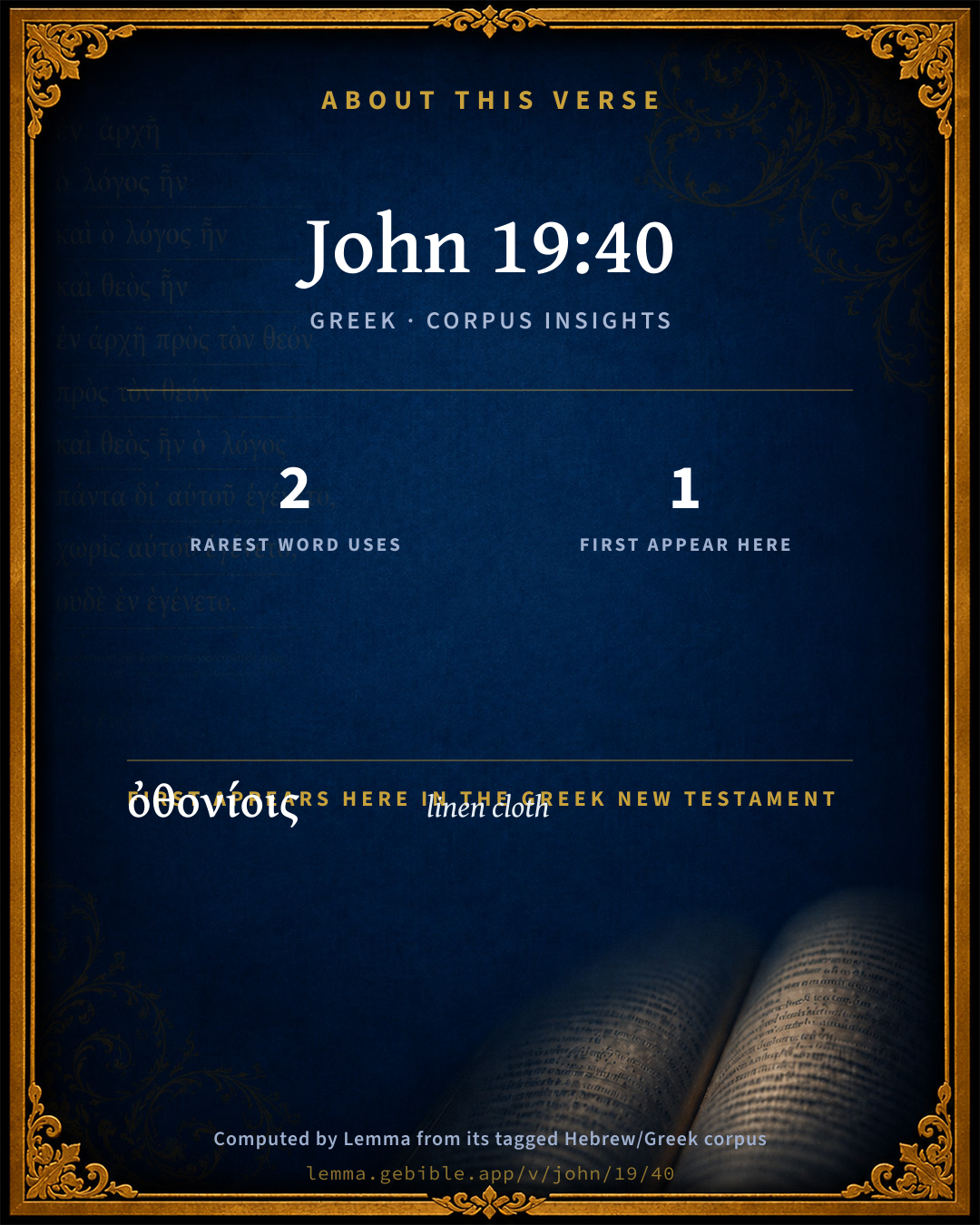
  • 1 first appearance in the Greek New Testament
Full analysis ↓
Download a study sheet

One document with this verse’s original text, its word-by-word gloss line, the meaning frame, cross-references with their text, attributed commentary, and full source and license credits — printable, and it pastes into notes with its structure intact.

This verse Autodidact and up

Study sheet (.html) Plain text (.txt)

A passage Seminary Student

Up to 50 verses in one chapter. A passage sheet keeps up to 6 commentary sources and 12 cross-references per verse, in the order this page ranks them, and says so on the sheet whenever that leaves anything out. Ask for a single verse and you get the Autodidact verse sheet above.

Everything on this page stays free to read, with no account — the sheet is a download of what is already on screen, not access to it.

Want to remove ads? Support Godless Engineer
Compare translations 3

The same verse in 3 English versions, stacked beneath the original-language interlinear above. Click any original word for its lexicon entry.

Each is an independent rendering of the whole verse — the interlinear is not word-aligned to these translations.

Highlighted words mark where these versions differ — a whole-verse word diff, not a word-by-word alignment.

  • World English Bible Public Domain
    So they took Jesus' body, and bound it in linen cloths with the spices, as the custom of the Jews is to bury.
  • King James Version Public Domain
    Then took they the body of Jesus, and wound it in linen clothes with the spices, as the manner of the Jews is to bury.
  • unfoldingWord Literal Text CC BY-SA 4.0
    So they took the body of Jesus and wrapped it in linen cloths with the spices, just as was the custom of the Jews to prepare for burial.

unfoldingWord Literal Text — © unfoldingWord, licensed CC BY-SA 4.0. Word-aligned USFM3 via Door43 (git.door43.org/unfoldingWord/en_ult).

Versions to compare (up to 4)

3 of 4 selected

Show all 19 translations

Every available English version of this verse, each an independent rendering of the whole verse.

  • World English Bible Public Domain
    So they took Jesus' body, and bound it in linen cloths with the spices, as the custom of the Jews is to bury.
  • Berean Standard Bible Public Domain
    So they took the body of Jesus and wrapped it in linen cloths with the spices, according to the Jewish burial custom.
  • Majority Standard Bible Public Domain
    So they took the body of Jesus and wrapped it in linen cloths with the spices, according to the Jewish burial custom.
  • King James Version Public Domain
    Then took they the body of Jesus, and wound it in linen clothes with the spices, as the manner of the Jews is to bury.
  • American Standard Version (1901) Public Domain
    So they took the body of Jesus, and bound it in linen cloths with the spices, as the custom of the Jews is to bury.
  • Revised Version (1885) Public Domain
    So they took the body of Jesus, and bound it in linen cloths with the spices, as the custom of the Jews is to bury.
  • Geneva Bible (1599) Public Domain
    Then tooke they the body of Iesus, and wrapped it in linnen clothes with the odours, as the maner of the Iewes is to burie.
  • Douay-Rheims (1899) Public Domain
    They took therefore the body of Jesus, and bound it in linen cloths, with the spices, as the manner of the Jews is to bury.
  • Young's Literal Translation Public Domain
    They took, therefore, the body of Jesus, and bound it with linen clothes with the spices, according as it was the custom of the Jews to prepare for burial;
  • Literal Standard Version CC BY-SA 4.0
    Therefore they took the body of Jesus, and bound it with linen clothes with the spices, according as it was the custom of the Jews to prepare for burial;
  • Unlocked Literal Bible CC BY-SA 4.0
    So they took the body of Jesus and wrapped it in linen cloths with the spices, as was the custom of the Jews to bury bodies.
  • unfoldingWord Literal Text CC BY-SA 4.0
    So they took the body of Jesus and wrapped it in linen cloths with the spices, just as was the custom of the Jews to prepare for burial.
  • Darby Bible Public Domain
    They took therefore the body of Jesus and bound it up in linen with the spices, as it is the custom with the Jews to prepare for burial.
  • World Messianic Bible Public Domain
    So they took Yeshua’s body, and bound it in linen cloths with the spices, as the custom of the Judeans is to bury.
  • Webster's Bible Public Domain
    Then they took the body of Jesus, and wound it in linen cloths, with the spices, as the manner of the Jews is to bury.
  • Free Bible Version CC BY-SA 4.0
    They took Jesus' body and wrapped it in linen cloth together with the mixture of spices, in accordance with Jewish burial customs.
  • Bible in Basic English Public Domain
    Then they took the body of Jesus, folding linen about it with the spices, as is the way of the Jews when they put the dead to rest.
  • Text-Critical English NT CC BY 4.0
    So they took Jesus' body and wrapped it in linen cloths with the spices, as is the custom of the Jews in preparing a body for burial.
  • Tyndale New Testament (1534) Public Domain
    Then toke they the body of Iesu and wounde it in lynnen clothes with the odoures as the maner of the Iewes is to bury.

Literal Standard Version (2020), Covenant Press — licensed CC BY-SA 4.0. Text via the HelloAO Bible API (eBible.org). Unlocked Literal Bible (unfoldingWord) — licensed CC BY-SA 4.0. Text via the HelloAO Bible API (eBible.org). unfoldingWord Literal Text — © unfoldingWord, licensed CC BY-SA 4.0. Word-aligned USFM3 via Door43 (git.door43.org/unfoldingWord/en_ult). Free Bible Version, Dr. Jonathan Gallagher — licensed CC BY-SA 4.0. Text via the HelloAO Bible API (eBible.org).

Word by word

More ways to search: Search by grammar → Find every occurrence → Compare this word →

Practice this passage: Drill this verse → Learn its vocabulary →

ἐνταφιάζειν
entaphiázō
G1779
“to prepare for burial”
Verb, Present, Active, Infinitive
Part of Speech
Verb
Tense
Present
Voice
Active
Mood
Infinitive
Full Thayer's Definition

Origin: from a compound of G1722 and G5028

TDNT: None

1. to prepare a body for burial, by the use of every requisite provision and funeral adornment, that is, baths, vestments, flowers, wreathes, perfumes, libations, etc. 2. to lay out a corpse
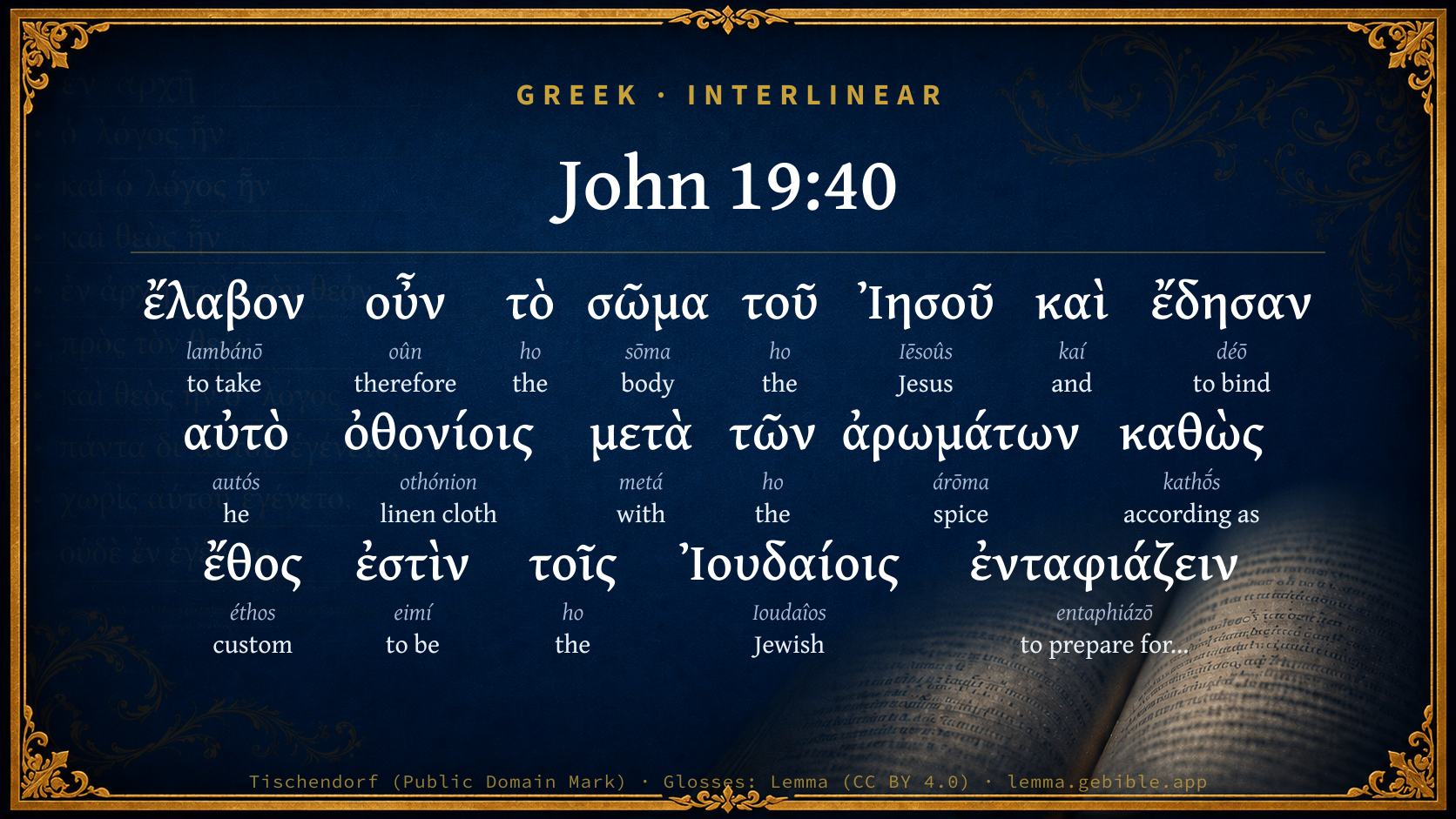
  1. ἔλαβον lambánō G2983 “to take” Verb, Aorist, Active, Indicative, 3rd person, Plural
  2. οὖν oûn G3767 “therefore” Conjunction
  3. τὸ ho G3588 “the” Article, Accusative, Singular, Neuter
  4. σῶμα sōma G4983 “body” Noun, Accusative, Singular, Neuter
  5. τοῦ ho G3588 “the” Article, Genitive, Singular, Masculine
  6. Ἰησοῦ Iēsoûs G2424 “Jesus” Noun, Genitive, Singular, Masculine
  7. καὶ kaí G2532 “and” Conjunction
  8. ἔδησαν déō G1210 “to bind” Verb, Aorist, Active, Indicative, 3rd person, Plural
  9. αὐτὸ autós G846 “he” Personal pronoun, Accusative, Singular, Neuter
  10. ὀθονίοις othónion G3608 “linen cloth” Noun, Dative, Plural, Neuter
  11. μετὰ metá G3326 “with” Preposition
  12. τῶν ho G3588 “the” Article, Genitive, Plural, Neuter
  13. ἀρωμάτων árōma G759 “spice” Noun, Genitive, Plural, Neuter
  14. καθὼς kathṓs G2531 “according as” Adverb
  15. ἔθος éthos G1485 “custom” Noun, Nominative, Singular, Neuter
  16. ἐστὶν eimí G1510 “to be” Verb, Present, Active, Indicative, 3rd person, Singular
  17. τοῖς ho G3588 “the” Article, Dative, Plural, Masculine
  18. Ἰουδαίοις Ioudaîos G2453 “Jewish” Adjective, Dative, Plural, Masculine

About this verse

These counts appear in no published source. They are computed here, from the morphology-tagged text and Lemma’s own curated glosses. What Lemma adds →

19
words
16
distinct lemmas
Gospels
section

Notable vocabulary

The rarest word here is ἐνταφιάζειν to prepare for burial G1779 — appearing just 2 times in the whole Greek New Testament.

First appearance in Scripture

This word makes its first canonical appearance in the Greek New Testament here:

  • ὀθονίοις linen cloth G3608

Shared distinctive vocabulary

ἐνταφιάζειν to prepare for burial G1779 occurs in 2 verses of the Greek New Testament. Also found in:

Repetition

A word recurs within this verse:

Cross-references

5

Topical passages linked to John 19:40 in the Treasury of Scripture Knowledge — connected by theme and wording, ordered by reader-vote popularity; previews shown in the World English Bible.

  • John 11:44 He who was dead came out, bound hand and foot with wrappings, and his face was wrapped around with a cloth. Jesus said to them, "Free him, and let him go."
  • John 20:5–7 Stooping and looking in, he saw the linen cloths lying, yet he didn't enter in.
  • Acts 5:6 The young men arose and wrapped him up, and they carried him out and buried him.
  • Matthew 26:12 For in pouring this ointment on my body, she did it to prepare me for burial.
  • Luke 24:12 But Peter got up and ran to the tomb. Stooping and looking in, he saw the strips of linen lying by themselves, and he departed to his home, wondering what had happened.

Cross-references courtesy of OpenBible.info (CC BY 4.0).

Commentary

Notes on John 19:40 from classic Christian and Jewish commentators (each source and its license shown beneath its notes). The classic Christian expositions comment on the surrounding passage and are grouped to its opening verse, so a note may address several verses; the Jewish commentaries on the Tanakh (Rashi and others) are per-verse, so they appear only where the commentator wrote on this verse.

Lemma curates 59 commentaries, every one of them public domain or Creative Commons licensed, each selected and text-cleaned for this edition rather than reprinted as found. About our sources →

Joseph Benson's Commentary

Joh 19:40. Then — To prepare for his interment; they took the body of Jesus — Without regarding the reproach to which it might expose them; and wound it in linen clothes — Wrapped it in a great many folds of linen; with the spices, as the manner of the Jews is to bury — Or rather, to embalm, for the proper meaning of the verb ενταφιαζειν, here used, is not to bury, but to embalm, as Dr. Campbell proves in a note on the words; showing that the verb ενταφιαζειν, and the noun ενταφιασμος, are used in the New Testament only in relation to the embalming of the body of our Lord; the word used for to bury, being invariably θαπτειν, which accords perfectly with the use made of the same words by the LXX. See Gen 50:2; Gen 50:5, where the import of both words, and the distinction between them, is exemplified. It seems Joseph and Nicodemus intended to embalm our Lord’s body in a more exact manner as soon as the sabbath was over; hoping that, in the mean time, the spices lying near the body might preserve it from all taint of corruption. “Those who have written upon the manners and customs of the Jews tell us, that they sometimes embalmed their dead with an aromatic mixture of myrrh, aloes, and other gums or spices, which they rubbed on the body, more or less profusely, according to their circumstances and their regard for the dead. After anointing the body, they covered it with a shroud, or winding-sheet, then wrapped a napkin round its head and face, others say, round the forehead only; because the Egyptian mummies are observed to have it so; last of all, they swathed the shroud round the body as tightly as possible, with proper bandages made of linen. At other times, they covered the whole body in a heap of spices, as is said of Asa, 2Ch 16:14. From the quantity of myrrh and aloes made use of by Joseph and Nicodemus, it would appear that the office performed by them to their Master was of this latter kind; for they had not time to embalm him properly.” They seem, however, to have done all that was usual in such circumstances to persons of wealth and distinction, which, as well as the sepulchre itself, agreed to Isaiah’s prophecy, Isa 53:9.

Joseph Benson's Commentary on the Old and New Testaments (1811–1818) — public domain. Text from a community e-Sword module.

Meyer's Critical & Exegetical Commentary

Heinrich August Wilhelm Meyer

Joh_19:40-42. ʼΕν ὀθονίοις] In bandages, so that He was enveloped therein, Plato, Legg. ix. p. 882 B; Pol. viii. p. 567 C; Jdt_16:8.

καθὼς ἔθος, κ.τ.λ.] The custom of the Egyptians (Herod. ii. 86 ff.), e.g., was different; amongst them the practice was to take out the brain and the intestines, or at least to deposit the body in nitre for seventy days.

ἐν τῷ τόπῳ] in the district, in the place. On ἐτέθη, used of the interment of bodies, comp. Stallbaum, ad Plat. Rep. p. 469 B.

The garden with the new grave, which as yet had been used for no other burial (and thereby worthy of the Messiah, comp. Luk_23:53; Luk_19:30; Mar_11:2), must have belonged to a proprietor, who permitted, or himself put it to this use. According to Mat_27:60, it belonged to Joseph himself; but see in loc.

διὰ τὴν παρασκ.] On account of the haste, then, which the nearness of the commencing Sabbath enjoined. Retrospect of Joh_19:31.

On the relation of the Johannean account of the ἐνταφιασμός of Jesus to Mat_27:59, and parallel[258] passages, see on Matt.

[258] According to Krenkel, in Hilgenfeld, ZeitsChr. 1865, p. 438 ff., implying a denial of the apostolical origin of our Gospel, Nicodemus is said to be identical with Joseph of Arimathaea, and the ἐνταφιασμός in the present passage to be unhistorical.

Meyer — Critical and Exegetical Commentary on the New Testament — English translation by Peter Christie, edited by Frederick Crombie (T&T Clark, 1880) — public domain. Text from a community e-Sword module.

Expositor's Greek Testament

ed. W. Robertson Nicoll

Joh 19:40 . ἔλαβον … ἐνταφιάζειν . They wrapped the body in strips of linen along with the aromatic preparations (2Ch 16:14 , ἀρωμάτων ), as is the custom ( ὡς ἔθος ἐστί , 1Ma 10:89 ) with the Jews (other peoples having other customs) to prepare for burial.

The Expositor's Greek Testament, edited by W. Robertson Nicoll (1897–1910) — public domain. Text from a community e-Sword module.

Jamieson, Fausset & Brown

Robert Jamieson, A. R. Fausset & David Brown

Then took they the body of Jesus, and wound it in linen clothes with the spices, as the manner of the Jews is to bury--the mixed and pulverized myrrh and aloes shaken into the folds, and the entire body, thus swathed, wrapt in an outer covering of "clean linen cloth" (Mat 27:59). Had the Lord's own friends had the least reason to think that the spark of life was still in Him, would they have done this? But even if one could conceive them mistaken, could anyone have lain thus enveloped for the period during which He was in the grave, and life still remained? Impossible. When, therefore, He walked forth from the tomb, we can say with the most absolute certainty, "Now is Christ risen from the dead, and become the first-fruits of them that slept" (Co1 15:20). No wonder that the learned and the barbarians alike were prepared to die for the name of the Lord Jesus; for such evidence was to the unsophisticated resistless. (No mention is made of anointing in this operation. No doubt it was a hurried proceeding, for fear of interruption, and because it was close on the sabbath, the women seem to have set this as their proper task "as soon as the sabbath should be past" [Mar 16:1]. But as the Lord graciously held it as undesignedly anticipated by Mary at Bethany [Mar 14:8], so this was probably all the anointing, in the strict sense of it, which He received.)

Jamieson, Fausset & Brown — Commentary Critical and Explanatory on the Whole Bible (1871) — public domain (CC PDM 1.0). Text via the HelloAO Bible API.

Adam Clarke's Commentary

Verse 40. Wound it in linen] See Clarke on Joh 11:34.

Adam Clarke's Commentary on the Bible (1810–1826) — public domain. Text from a community e-Sword/MySword module.

John Calvin's Commentaries

40. As the custom of the Jews is to bury. When Christ had endured extreme ignominy on the cross, God determined that his burial should be honourable, that it might serve as a preparation for the glory of his resurrection. The money expended on it by Nicodemus and Joseph is very great, and may be thought by some to be superfluous; but we ought to consider the design of God, who even led them, by his Spirit, to render this honor to his own Son, that, by the sweet savor of his grave he might take away our dread of the cross. But those things which are cut of the ordinary course ought not to be regarded as an example.

Besides, the Evangelist expressly states that he was buried according to the custom of the Jews. By these words he informs us that this was one of the ceremonies of the Law; for the ancient people, who did not receive so clear a statement of the resurrection, and who had not such a demonstration and pledge of it as we have in Christ, needed such aids to support them, that they might firmly believe and expect the coming of the Mediator We ought, therefore, to attend to the distinction between us, who have been enlightened by the brightness of the Gospel, and the rather, to whom the figures supplied the absence of Christ. This is the reason why allowance could then be made for a greater pomp of ceremonies, which, at the present day, would not be free from blame; for those who now bury the dead at so great an expense do not, strictly speaking, bury dead men, but rather, as far as lies in their power, draw down from heaven Christ himself, the King of life, and lay him in the tomb, for his glorious resurrection abolished those ancient ceremonies.

Among the heathen, too, there was great anxiety and ceremony in burying the dead, which unquestionably derived its origin from the ancient Fathers of the Jews, in the same manner as sacrifices; but, as no hope of the resurrection existed along them, they were not imitators of the Fathers, but apes of them; for the promise and word of God is, as it were, the soul, which gives life to ceremonies. Take away the word, and all the ceremonies which men observe, though outwardly they may resemble the worship of godly persons, is nothing else than foolish or mad superstition. For our part, as we have said, we ought now to maintain sobriety and moderation in this matter, for immoderate expense quenches the sweet savour of Christ’s resurrection.

John Calvin's Commentaries (1540-1563) — public domain. Text from the Calvin Translation Society English edition (1840s-50s) via the Christian Classics Ethereal Library (ccel.org). Calvin's coverage is partial (roughly two-thirds of the Bible); uncommented books and verses are honest gaps, never fabricated. The 19th-century editor's footnotes and remarks are omitted so the notes are faithfully Calvin's own voice.

Ellicott's Commentary for English Readers

(40) And wound it in linen clothes with the spices.—Comp. Notes on Luk_24:12. The same word does not occur, but the manner of the Jews to bury has been also illustrated in the Note on Joh_11:44.

A Bible Commentary for English Readers, edited by Charles John Ellicott (1878–1897) — public domain. Text from a community e-Sword module.

The Cambridge Bible for Schools and Colleges

gen. ed. J. J. S. Perowne

40. Then took they] They took therefore.

wound it, &c.] Or, bound it in linen cloths. The ‘cloths’ seem to refer to the bandages which kept the whole together rather than the large ‘linen sheet’ mentioned by the other Evangelists, which Joseph had bought on purpose (Mar_15:46). The word here used for ‘linen cloths’ occurs also in Luk_24:12 : see note there.

the manner of the Jews] As distinct from the manner of the Egyptians, whose three methods of embalming are elaborately described by Herodotus (ii. 86 ff.). The Egyptians in all cases removed part of the intestines and steeped the body in nitre.

to bury] The Greek verb is rare in Scripture; in N.T. only Mat_26:12. The cognate substantive occurs Joh_12:7; Mar_14:8. In Gen_50:2 it is used by the LXX. for the embalming of Jacob.

The Cambridge Bible for Schools and Colleges (gen. ed. J. J. S. Perowne; Cambridge University Press, 1878–1918) — public domain. Text from a community e-Sword module.

John Gill's Exposition

Then took they the body of Jesus,.... It being taken down from the cross, and carried to the designed place of interment; they, Joseph and Nicodemus, either themselves, or by their servants, took the body;

and wound it in linen clothes; or "swathed", or "wrapped it in linen"; rolled it about the body many times, as was the custom of the eastern nations to do; this was what Joseph prepared:

with the spices; which they either wrapped up with the linen, or strowed over the body when it was wound up; these Nicodemus brought;

as the manner of the Jews is to bury; both was usual with them; both to wind up the dead in linen; hence R. Jonathan, alluding to this custom, when R. Isai was taken, and others would have delivered him, said, , "let the dead be wrapped in his own linen (d)"; and also to bury them with spices; hence we read of "the spices of the dead" in a Jewish canon (e):

"they do not say a blessing over a lamp, nor over the spices of idolaters; nor over a lamp, nor over , "the spices of the dead":''

the use of which, Bartenora on the place says, was to drive away an ungrateful smell. The wrapping up the body of Christ in a fine linen cloth, was a token of his purity and innocence; and significative of that pure and spotless righteousness he had now brought in: the strewing it with spices may denote the fragrancy of Christ's death to Jehovah the Father, in whose sight it was precious, and whose sacrifice to him is of a sweet smelling savour; and also to all sensible sinners, to whom a crucified Christ is precious; since by his death sin is expiated, the law fulfilled, justice satisfied, reconciliation made, security from condemnation obtained, and death is abolished.

(d) T. Hieros. Ternmot, fol. 46. 2. (e) Misn. Beracot. c. 8. sect. 6.

John Gill's Exposition of the Whole Bible (1746–1763) — public domain (CC PDM 1.0). Text via the HelloAO Bible API.

Trapp's Complete Commentary

John Trapp

40 Then took they the body of Jesus, and wound it in linen clothes with the spices, as the manner of the Jews is to bury.

Ver. 40. With the spices, as the manner of the Jews] To testify their hope of a resurrection. In an apish imitation of whom, the Gentiles also, though they had no such hope, kept a great stir, and made much ado about the decent burial of their dead. Habent et vespae favos, et simiae imitantur homines, saith Cyprian.

John Trapp, A Commentary or Exposition upon All the Books of the Old and New Testament (1647–1656) — public domain. Text from a community e-Sword module.

Matthew Poole's English Annotations

That is, persons of fashion.

Matthew Poole's English Annotations on the Holy Bible (1683–1685) — public domain. Text from a community e-Sword/MySword module.

Whedon's Commentary on the Bible

Daniel D. Whedon

40. Then took they—In the last two verses John has mentioned Joseph and Nicodemus each in the singular, and then adds the part which each performed: the former secured the body, the latter furnished the embalmment for it. Now in the plural they both cooperate in the same work. Heretofore they may have been strangers; ever after doubtless they were brethren.

Daniel D. Whedon (gen. ed.), Commentary on the Old and New Testaments (1874–1909) — public domain. Text from a community e-Sword module.

The Pulpit Commentary

They took thereforei.e. Nicodemus and Josephthe body of Jesus, and bound it in linen clothes with the spices, as is the manner of the Jews to bury. The synoptists specially mention a linen cloth ( sindwn), which they wound around it. It would seem probable, from what is afterwards said, that John wished to discriminate and affirm both processes. (see Joh_20:7) The Jews" method differed from the Egyptians" embalming process. The latter removed all the viscera; and, by long baking and other processes, rendered the remaining shell of the corpse incorruptible and almost imperishable. The Jews" process of sepulture differed from the Roman cremation, and is emphasized. Importance was attached to a splendid funeral; (Luk_16:22) and this costly interment was not without its deep significance.

The Pulpit Commentary (1880–1919), ed. H.D.M. Spence-Jones & Joseph S. Exell — public domain. Text from a community e-Sword module.

unfoldingWord translationNotes

Door43 World Missions Community

Now in the place where he was crucified there was a garden ... had yet been buried

Here John marks a break in the story line in order to provide background information about the location of the tomb where they would bury Jesus. (See: Background Information)

Now in the place where he was crucified there was a garden

You can translate this in an active form. AT: "Now in the place where they crucified Jesus there was a garden" (See: Active or Passive)

in which no person had yet been buried

You can translate this in an active form. AT: "in which people had buried no one" (See: Active or Passive)

Because it was the day of preparation for the Jews

According to Jewish law, no one could work after sundown on Friday. It was the beginning of the Sabbath and Passover. AT: "The Passover was about to begin that evening" (See: Assumed Knowledge and Implicit Information)

translationWords

Jesus

crucify

grave

unfoldingWord translationNotes — © Distant Shores Media and the Door43 World Missions Community, licensed CC BY-SA 4.0. Source: git.door43.org/Door43/en_tn.

Cambridge Greek Testament for Schools and Colleges

40. ἔδησαν αὐτὸ ὀθ. Bound it in linen cloths. The ὀθόνια (see on Luk 24:12) seem to be the bandages, whereas the σινδών (Mat 27:59; Mar 15:46; Luk 23:53) is a large sheet (Mar 14:51) to envelope the whole. Καθὼς ἔθος ἐ. τ. Ἰ. distinguishes Jewish from other modes of embalming. The Egyptians had three methods, but in all cases removed part of the intestines and steeped the body in nitre (Herod II. 86 ff.) Ἐνταφιάζειν occurs elsewhere only Mat 26:12: ἐνταφιασμός occurs Joh 12:7; Mar 14:8: in LXX. (Gen 50:2) it is used for the embalming of Jacob.

Cambridge Greek Testament for Schools and Colleges (Cambridge University Press, 1896; 21 vols, various authors incl. Carr, Maclear, Plummer, Farrar, Lumby, Moule, M. R. James, Simcox) — public domain. Text from a community e-Sword module.

Alford’s Greek Testament

Henry Alford

40.] See ch. 11:44. Little is known with any certainty, except from these passages, of the Jews’ ordinary manner of burying. Winer, Friedlieb.

Henry Alford, The Greek Testament (1849–1861) — public domain. Text from a community e-Sword module.

International Critical Commentary

40. ἐλαβον οὖν κτλ. “Then they took the body of Jesus,” i.e. Joseph and Nicodemus. Mk., followed by Mt., tells that Mary Magdalene and Mary the wife of Clopas were present at the burial; they had been at the Cross (as Jn. has told already, v. 25), and they waited until the end. Salome was also at the Cross (see on v. 25), but she may have accompanied her sister Mary the Mother of Jesus when she left the scene (v. 27); at any rate, she is not mentioned by name as having been at the burial (cf. Luk 23:55).

ἔδησαν αὐτὸ ὀθονίοις μετὰ τῶν ἀρωμάτων, “they bound it with strips of cloth, with the spices”; apparently the spices were scattered freely between the folds of the cloths, and the body was embedded in them.1 It was the custom of the Jews (as distinct from that of the Egyptians) to bury (ἐνταφιάζειν; cf. Gen 50:2 where this word is used of the embalming of Jacob) in this way. Cf. Joh 11:44 for the “swathes” (κειρίαι) with which Lazarus had been bound.

The word ὀθόνιον “linen cloth,” occurs again only 20:5, 6, 7 and Luk 24:12 (cf. Jdg 14:13). The Synoptists in their accounts of the burial have the word σινδών. Milligan (s.v.) cites the use of ὀθόνιον in papyri for burial linen, or for the wrappings of a mummy.

International Critical Commentary — older volumes (1896–1929), various authors — public domain. Text from a community e-Sword module.

Vincent's Word Studies in the New Testament

Marvin R. Vincent

Linen cloths [οθονιοις] . Used only by John, if Luk 24:12 is rejected, as by some editors. The Synoptists all have sindwn, linen cloth. See on Mr 14:51. Matthew and Luke have ejntulixen, rolled or wrapped, and Mark ejneilhsen, wound, instead of John's edhsan bound. With the spices. Spread over the sheet or bandages in which the body was wrapped.

The manner of the Jews. As contrasted with that of the Egyptians, for instance, which is thus described by Herodotus : "They take first a crooked piece of iron, and with it draw out the brains through the nostrils, thus getting rid of a portion, while the skull is cleared of the rest by rinsing with drugs; next they make a cut along the flank with a sharp Ethiopian stone, and take out the whole contents of the abdomen, which they then cleanse, washing it thoroughly with palm - wine, and again, frequently with an infusion of pounded aromatics. After this they fill the cavity with the purest bruised myrrh, with cassia, and every other sort of spicery except frankincense, and sew up the opening. Then the body is placed in natrum (subcarbonate of soda) for seventy days, and covered entirely over. After the expiration of that space of time, which must not be exceeded, the body is washed, and wrapped round, from head to foot, with bandages of fine linen cloth, smeared over with gum" (ii. 86). Or, possibly, a contrast may be implied with the Roman custom of burning the bodies of the dead. Tacitus says of the Jews : "The bodies of the deceased they choose rather to bury than burn, following in this the Egyptian custom; with whom also they agree in their attention to the dead" (" History, " 5 5).

To bury [ενταφιαζειν] . Properly, to prepare for burial. See on 12 7. Compare Septuagint, Gen 1:2, where the same word is used for embalming the body of Joseph.

Marvin R. Vincent, Word Studies in the New Testament (1887–1900) — public domain. Text from a community e-Sword/MySword module.

Lesson kit

Teaching starters — assembled from the data on this page, not authored interpretation. Every prompt links to the verse data it draws on. Edit before teaching.

John, in the Gospels, opens this verse with 19 words (16 distinct Greek lemmas). Its most distinctive word is entaphiázō (“to prepare for burial”). A historical commentator’s framing appears above. Read the whole chapter for the surrounding context.

Discussion questions

  1. The word entaphiázō carries the sense “to prepare for burial.” How does it shape the verse?
  2. This is the first place “linen cloth” appears in Scripture (first appears here). What does its debut here establish?
  3. How does Matthew 26:12, which shares the word «to prepare for burial», read alongside this verse?
  4. What does the repetition of “the” (4× in this one verse) do in this verse?
  5. These translations render this verse differently. What is at stake in choosing one wording over another?
  6. Compare how Joseph Benson's Commentary and Meyer's Critical & Exegetical Commentary read this verse. Where do they agree or differ?

Things to notice

  • 1 word makes its first canonical appearance in Scripture here.
  • These translations choose different wording for 11 words in this verse.
  • “the” occurs 4× in this single verse.
  • 16 distinct Greek lemmas span 19 words in this verse.

Reading settings

Reading text

Shown beneath each verse's original-language words.

Old Testament
Old Testament edition

Read the OT as the Masoretic Hebrew (MT) or the Greek Septuagint (LXX).

English shown for the Greek Septuagint (in the Hebrew ↔ Greek comparison).

Comparing translations? Open the Compare panel on any verse page to stack up to four side by side.