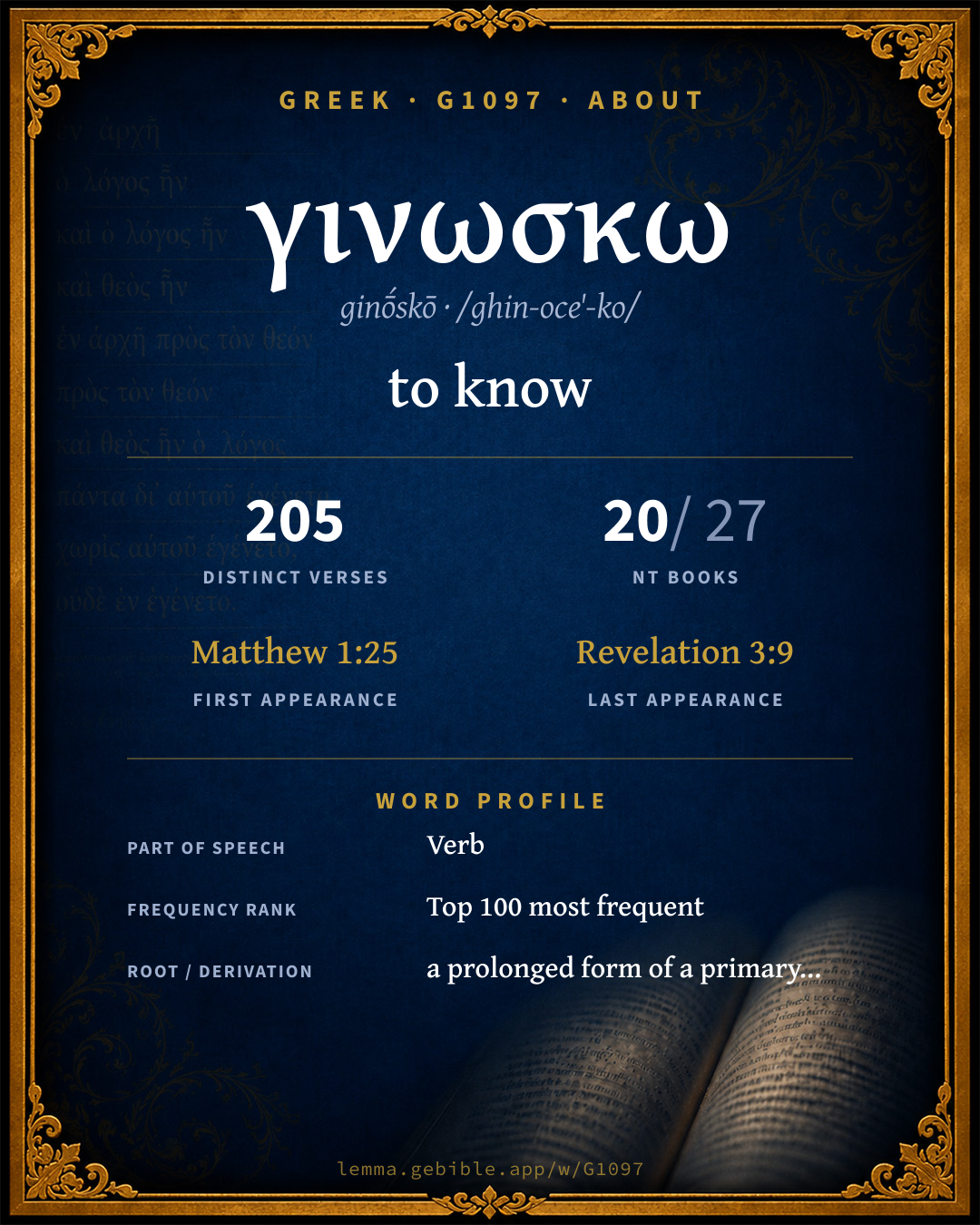
γινώσκω
to know
‘to know’ is one of 4 main senses fuller range ↓
Full lexicon entry — Thayer's Greek Lexicon
From Thayer's Greek Lexicon
Where this word appears
See every Aorist-tense verb in the Greek New Testament →
Grammar key — what these labels mean
Part of speech
- Verb
- An action or state-of-being word.
Tense
- Aorist
- Action viewed as a simple whole, without regard to duration — often past (perfective aspect).
- Present
- Ongoing or general action in present time (imperfective aspect).
- Future
- Action expected in future time.
- Perfect
- A completed past action with continuing present results.
- Imperfect
- Continuous or repeated action in past time (“was writing”).
- Pluperfect
- A past action completed before another past point (“had written”).
Voice
- Active
- The subject performs the action.
- Middle deponent
- Middle in form but active in meaning.
- Passive
- The subject receives the action.
Mood
- Indicative
- States a fact or asks a factual question (the mood of reality).
- Infinitive
- A verbal noun (“to write”), unmarked for person or number.
- Participle
- A verbal adjective (“writing,” “having written”).
- Subjunctive
- Expresses probability, purpose, or possibility (the mood of contingency).
- Imperative
- Expresses a command or request.
Case
- Nominative
- The case of the subject (and the predicate nominative).
- Accusative
- The case of the direct object and of extent.
- Dative
- The case of the indirect object, means, or location — “to / for / with / in.”
Person
- 3rd person
- The one spoken about (“he / she / it / they”).
- 2nd person
- The one addressed (“you”).
- 1st person
- The speaker (“I / we”).
Gender
- Masculine
- Grammatically masculine.
- Feminine
- Grammatically feminine.
Number
- Plural
- More than one.
- Singular
- One.
Grammatical forms 56 distinct
- Verb, Aorist, Active, Indicative, 3rd person, Plural 17 times (8%)
- Verb, Aorist, Active, Indicative, 3rd person, Singular 16 times (7%)
- Verb, Present, Active, Indicative, 2nd person, Plural 16 times (7%)
- Verb, Aorist, Active, Infinitive 15 times (7%)
- Verb, Aorist, Active, Participle, Nominative, Singular, Masculine 12 times (5%)
- Verb, Present, Active, Indicative, 3rd person, Singular 12 times (5%)
- Verb, Present, Active, Indicative, 1st person, Plural 10 times (5%)
- Verb, Present, Active, Indicative, 1st person, Singular 7 times (3%)
+48 more forms (117 occurrences)
Parsed forms decoded from the imported morphology (Robinson–Tischendorf, public domain), counted across 222 parsed occurrences — not distinct verses.
Page 1 of 2 — showing verses 1–200 of 205 distinct verses where G1097 appears, across 20 books. Click any verse to open its interlinear word-by-word view. Verse text shown in the World English Bible for context — . Each verse’s Greek form is shown with its reference; the English is not keyword-highlighted, since the data carries no word-level English alignment. Use “Compare translations” on any verse to read it across multiple English versions. This concordance covers the Greek New Testament; Septuagint (Greek Old Testament) occurrences of this word are not indexed here.
Matthew 20 verses
- Matthew 1:25 ἐγίνωσκεν impf act ind 3sg and didn't know her sexually until she had brought forth her firstborn son. He named him Jesus.
- Matthew 6:3 γνώτω aor act impv 3sg But when you do merciful deeds, don't let your left hand know what your right hand does,
- Matthew 7:23 ἔγνων aor act ind 1sg Then I will tell them, 'I never knew you. Depart from me, you who work iniquity.'
- Matthew 9:30 γινωσκέτω pres act impv 3sg Their eyes were opened. Jesus strictly charged them, saying, "See that no one knows about this."
- Matthew 10:26 γνωσθήσεται fut pass ind 3sg Therefore don't be afraid of them, for there is nothing covered that will not be revealed; and hidden that will not be known.
- Matthew 12:7 ἐγνώκειτε plup act ind 2pl But if you had known what this means, 'I desire mercy, and not sacrifice,' you would not have condemned the guiltless.
- Matthew 12:15 γνοὺς aor act ptcp nom sg masc Jesus, perceiving that, withdrew from there. Great multitudes followed him; and he healed them all,
- Matthew 12:33 γινώσκεται pres pass ind 3sg "Either make the tree good, and its fruit good, or make the tree corrupt, and its fruit corrupt; for the tree is known by its fruit.
- Matthew 13:11 γνῶναι aor act inf He answered them, "To you it is given to know the mysteries of the Kingdom of Heaven, but it is not given to them.
- Matthew 16:3 γινώσκετε pres act ind 2pl In the morning, 'It will be foul weather today, for the sky is red and threatening.' Hypocrites! You know how to discern the appearance of the sky, but you can't discern the signs of the times!
- Matthew 16:8 γνοὺς aor act ptcp nom sg masc Jesus, perceiving it, said, "Why do you reason among yourselves, you of little faith, 'because you have brought no bread?'
- Matthew 21:45 ἔγνωσαν aor act ind 3pl When the chief priests and the Pharisees heard his parables, they perceived that he spoke about them.
- Matthew 22:18 γνοὺς aor act ptcp nom sg masc But Jesus perceived their wickedness, and said, "Why do you test me, you hypocrites?
- Matthew 24:32 γινώσκετε pres act ind 2pl "Now from the fig tree learn this parable. When its branch has now become tender, and puts forth its leaves, you know that the summer is near.
- Matthew 24:33 γινώσκετε pres act impv 2pl Even so you also, when you see all these things, know that it is near, even at the doors.
- Matthew 24:39 ἔγνωσαν aor act ind 3pl and they didn't know until the flood came, and took them all away, so will be the coming of the Son of Man.
- Matthew 24:43 γινώσκετε pres act impv 2pl But know this, that if the master of the house had known in what watch of the night the thief was coming, he would have watched, and would not have allowed his house to be broken into.
- Matthew 24:50 γινώσκει pres act ind 3sg the lord of that servant will come in a day when he doesn't expect it, and in an hour when he doesn't know it,
- Matthew 25:24 ἔγνων aor act ind 1sg "He also who had received the one talent came and said, 'Lord, I knew you that you are a hard man, reaping where you did not sow, and gathering where you did not scatter.
- Matthew 26:10 γνοὺς aor act ptcp nom sg masc But Jesus, knowing this, said to them, "Why do you trouble the woman? Because she has done a good work for me.
Mark 12 verses
- Mark 4:13 γνώσεσθε fut mid.dep ind 2pl He said to them, "Don't you understand this parable? How will you understand all of the parables?
- Mark 5:29 ἔγνω aor act ind 3sg Immediately the flow of her blood was dried up, and she felt in her body that she was healed of her affliction.
- Mark 5:43 γνοῖ aor act subj 3sg He strictly ordered them that no one should know this, and commanded that something should be given to her to eat.
- Mark 6:38 γνόντες aor act ptcp nom pl masc He said to them, "How many loaves do you have? Go see." When they knew, they said, "Five, and two fish."
- Mark 7:24 γνῶναι aor act inf From there he arose, and went away into the borders of Tyre and Sidon. He entered into a house, and didn't want anyone to know it, but he couldn't escape notice.
- Mark 8:17 γνοὺς aor act ptcp nom sg masc Jesus, perceiving it, said to them, "Why do you reason that it's because you have no bread? Don't you perceive yet, neither understand? Is your heart still hardened?
- Mark 9:30 γνοῖ aor act subj 3sg They went out from there, and passed through Galilee. He didn't want anyone to know it.
- Mark 12:12 ἔγνωσαν aor act ind 3pl They tried to seize him, but they feared the multitude; for they perceived that he spoke the parable against them. They left him, and went away.
- Mark 13:28 γινώσκετε pres act ind 2pl "Now from the fig tree, learn this parable. When the branch has now become tender, and puts forth its leaves, you know that the summer is near;
- Mark 13:29 γινώσκετε pres act impv 2pl even so you also, when you see these things coming to pass, know that it is near, at the doors.
- Mark 15:10 ἐγίνωσκεν impf act ind 3sg For he perceived that for envy the chief priests had delivered him up.
- Mark 15:45 γνοὺς aor act ptcp nom sg masc When he found out from the centurion, he granted the body to Joseph.
Luke 28 verses
- Luke 1:18 γνώσομαι fut mid.dep ind 1sg Zacharias said to the angel, "How can I be sure of this? For I am an old man, and my wife is well advanced in years."
- Luke 1:34 γινώσκω pres act ind 1sg Mary said to the angel, "How can this be, seeing I am a virgin?"
- Luke 2:43 ἔγνωσαν aor act ind 3pl and when they had fulfilled the days, as they were returning, the boy Jesus stayed behind in Jerusalem. Joseph and his mother didn't know it,
- Luke 6:44 γινώσκεται pres pass ind 3sg For each tree is known by its own fruit. For people don't gather figs from thorns, nor do they gather grapes from a bramble bush.
- Luke 7:39 ἐγίνωσκεν impf act ind 3sg Now when the Pharisee who had invited him saw it, he said to himself, "This man, if he were a prophet, would have perceived who and what kind of woman this is who touches him, that she is a sinner."
- Luke 8:10 γνῶναι aor act inf He said, "To you it is given to know the mysteries of the Kingdom of God, but to the rest in parables; that 'seeing they may not see, and hearing they may not understand.'
- Luke 8:17 γνωσθῇ aor pass subj 3sg For nothing is hidden, that will not be revealed; nor anything secret, that will not be known and come to light.
- Luke 8:46 ἔγνων aor act ind 1sg But Jesus said, "Someone did touch me, for I perceived that power has gone out of me."
- Luke 9:11 γνόντες aor act ptcp nom pl masc But the multitudes, perceiving it, followed him. He welcomed them, and spoke to them of the Kingdom of God, and he cured those who needed healing.
- Luke 10:11 γινώσκετε pres act impv 2pl 'Even the dust from your city that clings to us, we wipe off against you. Nevertheless know this, that the Kingdom of God has come near to you.'
- Luke 10:22 γινώσκει pres act ind 3sg Turning to the disciples, he said, "All things have been delivered to me by my Father. No one knows who the Son is, except the Father, and who the Father is, except the Son, and he to whomever the Son desires to reveal him."
- Luke 12:2 γνωσθήσεται fut pass ind 3sg But there is nothing covered up, that will not be revealed, nor hidden, that will not be known.
- Luke 12:39 γινώσκετε pres act impv 2pl But know this, that if the master of the house had known in what hour the thief was coming, he would have watched, and not allowed his house to be broken into.
- Luke 12:46 γινώσκει pres act ind 3sg then the lord of that servant will come in a day when he isn't expecting him, and in an hour that he doesn't know, and will cut him in two, and place his portion with the unfaithful.
- Luke 12:47 γνοὺς aor act ptcp nom sg masc That servant, who knew his lord's will, and didn't prepare, nor do what he wanted, will be beaten with many stripes,
- Luke 12:48 γνούς aor act ptcp nom sg masc but he who didn't know, and did things worthy of stripes, will be beaten with few stripes. To whoever much is given, of him will much be required; and to whom much was entrusted, of him more will be asked.
- Luke 16:4 ἔγνων aor act ind 1sg I know what I will do, so that when I am removed from management, they may receive me into their houses.'
- Luke 16:15 γινώσκει pres act ind 3sg He said to them, "You are those who justify yourselves in the sight of men, but God knows your hearts. For that which is exalted among men is an abomination in the sight of God.
- Luke 18:34 ἐγίνωσκον impf act ind 3pl They understood none of these things. This saying was hidden from them, and they didn't understand the things that were said.
- Luke 19:15 γνοῖ aor act subj 3sg "It happened when he had come back again, having received the kingdom, that he commanded these servants, to whom he had given the money, to be called to him, that he might know what they had gained by conducting business.
- Luke 19:42 ἔγνως aor act ind 2sg saying, "If you, even you, had known today the things which belong to your peace! But now, they are hidden from your eyes.
- Luke 19:44 ἔγνως aor act ind 2sg and will dash you and your children within you to the ground. They will not leave in you one stone on another, because you didn't know the time of your visitation."
- Luke 20:19 ἔγνωσαν aor act ind 3pl The chief priests and the scribes sought to lay hands on Him that very hour, but they feared the people--for they knew He had spoken this parable against them.
- Luke 21:20 γνῶτε aor act impv 2pl "But when you see Jerusalem surrounded by armies, then know that its desolation is at hand.
- Luke 21:30 γινώσκετε pres act ind 2pl When they are already budding, you see it and know by your own selves that the summer is already near.
- Luke 21:31 γινώσκετε pres act impv 2pl Even so you also, when you see these things happening, know that the Kingdom of God is near.
- Luke 24:18 ἔγνως aor act ind 2sg One of them, named Cleopas, answered him, "Are you the only stranger in Jerusalem who doesn't know the things which have happened there in these days?"
- Luke 24:35 ἐγνώσθη aor pass ind 3sg They related the things that happened along the way, and how he was recognized by them in the breaking of the bread.
John 49 verses
- John 1:10 ἔγνω aor act ind 3sg He was in the world, and the world was made through him, and the world didn't recognize him.
- John 1:49 γινώσκεις pres act ind 2sg Nathanael answered him, "Rabbi, you are the Son of God! You are King of Israel!"
- John 2:24 γινώσκειν pres act inf But Jesus didn't trust himself to them, because he knew everyone,
- John 2:25 ἐγίνωσκεν impf act ind 3sg and because he didn't need for anyone to testify concerning man; for he himself knew what was in man.
- John 3:10 γινώσκεις pres act ind 2sg Jesus answered him, "Are you the teacher of Israel, and don't understand these things?
- John 4:1 ἔγνω aor act ind 3sg Therefore when the Lord knew that the Pharisees had heard that Jesus was making and baptizing more disciples than John
- John 4:53 ἔγνω aor act ind 3sg So the father knew that it was at that hour in which Jesus said to him, "Your son lives." He believed, as did his whole house.
- John 5:6 γνοὺς aor act ptcp nom sg masc When Jesus saw him lying there, and knew that he had been sick for a long time, he asked him, "Do you want to be made well?"
- John 5:42 ἔγνωκα perf act ind 1sg But I know you, that you don't have God's love in yourselves.
- John 6:15 γνοὺς aor act ptcp nom sg masc Jesus therefore, perceiving that they were about to come and take him by force, to make him king, withdrew again to the mountain by himself.
- John 6:69 ἐγνώκαμεν perf act ind 1pl We have come to believe and know that you are the Christ, the Son of the living God."
- John 7:17 γνώσεται fut mid.dep ind 3sg If anyone desires to do his will, he will know about the teaching, whether it is from God, or if I am speaking from myself.
- John 7:26 ἔγνωσαν aor act ind 3pl Behold, he speaks openly, and they say nothing to him. Can it be that the rulers indeed know that this is truly the Christ?
- John 7:27 γινώσκει pres act ind 3sg However we know where this man comes from, but when the Christ comes, no one will know where he comes from."
- John 7:49 γινώσκων pres act ptcp nom sg masc But this multitude that doesn't know the law is accursed."
- John 7:51 γνῷ aor act subj 3sg "Does our law judge a man, unless it first hears from him personally and knows what he does?"
- John 8:27 ἔγνωσαν aor act ind 3pl They didn't understand that he spoke to them about the Father.
- John 8:28 γνώσεσθε fut mid.dep ind 2pl Jesus therefore said to them, "When you have lifted up the Son of Man, then you will know that I am he, and I do nothing of myself, but as my Father taught me, I say these things.
- John 8:32 γνώσεσθε fut mid.dep ind 2pl You will know the truth, and the truth will make you free."
- John 8:43 γινώσκετε pres act ind 2pl Why don't you understand my speech? Because you can't hear my word.
- John 8:52 ἐγνώκαμεν perf act ind 1pl Then the Jews said to him, "Now we know that you have a demon. Abraham died, and the prophets; and you say, 'If a man keeps my word, he will never taste of death.'
- John 8:55 ἐγνώκατε perf act ind 2pl You have not known him, but I know him. If I said, 'I don't know him,' I would be like you, a liar. But I know him, and keep his word.
- John 10:6 ἔγνωσαν aor act ind 3pl Jesus spoke this parable to them, but they didn't understand what he was telling them.
- John 10:14 γινώσκω γινώσκουσί pres act ind 1sg pres act ind 3pl I am the good shepherd. I know my own, and I'm known by my own;
- John 10:15 γινώσκει γινώσκω pres act ind 3sg pres act ind 1sg even as the Father knows me, and I know the Father. I lay down my life for the sheep.
- John 10:27 γινώσκω pres act ind 1sg My sheep hear my voice, and I know them, and they follow me.
- John 10:38 γνῶτε γινώσκητε aor act subj 2pl pres act subj 2pl But if I do them, though you don't believe me, believe the works; that you may know and believe that the Father is in me, and I in the Father."
- John 11:57 γνῷ aor act subj 3sg Now the chief priests and the Pharisees had commanded that if anyone knew where he was, he should report it, that they might seize him.
- John 12:9 Ἔγνω aor act ind 3sg A large crowd therefore of the Jews learned that he was there, and they came, not for Jesus' sake only, but that they might see Lazarus also, whom he had raised from the dead.
- John 12:16 ἔγνωσαν aor act ind 3pl His disciples didn't understand these things at first, but when Jesus was glorified, then they remembered that these things were written about him, and that they had done these things to him.
- John 13:7 γνώσῃ fut mid.dep ind 2sg Jesus answered him, "You don't know what I am doing now, but you will understand later."
- John 13:12 γινώσκετε pres act ind 2pl So when he had washed their feet, put his outer garment back on, and sat down again, he said to them, "Do you know what I have done to you?
- John 13:28 ἔγνω aor act ind 3sg Now no man at the table knew why he said this to him.
- John 13:35 γνώσονται fut mid.dep ind 3pl By this everyone will know that you are my disciples, if you have love for one another."
- John 14:7 ἐγνώκατέ γνώσεσθε γινώσκετε perf act ind 2pl fut mid.dep ind 2pl pres act ind 2pl If you had known me, you would have known my Father also. From now on, you know him, and have seen him."
- John 14:9 ἔγνωκάς perf act ind 2sg Jesus said to him, "Have I been with you such a long time, and do you not know me, Philip? He who has seen me has seen the Father. How do you say, 'Show us the Father?'
- John 14:17 γινώσκει γινώσκετε pres act ind 3sg pres act ind 2pl the Spirit of truth, whom the world can't receive; for it doesn't see him, neither knows him. You know him, for he lives with you, and will be in you.
- John 14:20 γνώσεσθε fut mid.dep ind 2pl In that day you will know that I am in my Father, and you in me, and I in you.
- John 14:31 γνῷ aor act subj 3sg But that the world may know that I love the Father, and as the Father commanded me, even so I do. Arise, let us go from here.
- John 15:18 γινώσκετε pres act ind 2pl If the world hates you, you know that it has hated me before it hated you.
- John 16:3 ἔγνωσαν aor act ind 3pl They will do these things because they have not known the Father, nor me.
- John 16:19 ἔγνω aor act ind 3sg Therefore Jesus perceived that they wanted to ask him, and he said to them, "Do you inquire among yourselves concerning this, that I said, 'A little while, and you won't see me, and again a little while, and you will see me?'
- John 17:3 γινώσκωσιν pres act subj 3pl This is eternal life, that they should know you, the only true God, and him whom you sent, Jesus Christ.
- John 17:7 ἔγνωκαν perf act ind 3pl Now they have known that all things whatever you have given me are from you,
- John 17:8 ἔγνωσαν aor act ind 3pl for the words which you have given me I have given to them, and they received them, and knew for sure that I came forth from you, and they have believed that you sent me.
- John 17:23 γινώσκῃ pres act subj 3sg I in them, and you in me, that they may be perfected into one; that the world may know that you sent me, and loved them, even as you loved me.
- John 17:25 ἔγνω ἔγνων ἔγνωσαν aor act ind 3sg aor act ind 1sg aor act ind 3pl Righteous Father, the world hasn't known you, but I knew you; and these knew that you sent me.
- John 19:4 γνῶτε aor act subj 2pl Then Pilate went out again, and said to them, "Behold, I bring him out to you, that you may know that I find no basis for a charge against him."
- John 21:17 γινώσκεις pres act ind 2sg He said to him the third time, "Simon, son of Jonah, do you have affection for me?" Peter was grieved because he asked him the third time, "Do you have affection for me?" He said to him, "Lord, you know everything. You know that I have affection for you." Jesus said to him, "Feed my sheep.
Acts 16 verses
- Acts 1:7 γνῶναι aor act inf He said to them, "It isn't for you to know times or seasons which the Father has set within His own authority.
- Acts 2:36 γινωσκέτω pres act impv 3sg "Let all the house of Israel therefore know assuredly that God has made him both Lord and Christ, this Jesus whom you crucified."
- Acts 8:30 γινώσκεις pres act ind 2sg Philip ran to him, and heard him reading Isaiah the prophet, and said, "Do you understand what you are reading?"
- Acts 9:24 ἐγνώσθη aor pass ind 3sg but their plot became known to Saul. They watched the gates both day and night that they might kill him,
- Acts 17:13 ἔγνωσαν aor act ind 3pl But when the Jews of Thessalonica had knowledge that the word of God was proclaimed by Paul at Beroea also, they came there likewise, agitating the multitudes.
- Acts 17:19 γνῶναι aor act inf They took hold of him, and brought him to the Areopagus, saying, "May we know what this new teaching is, which is spoken by you?
- Acts 17:20 γνῶναι aor act inf For you bring certain strange things to our ears. We want to know therefore what these things mean."
- Acts 19:15 γινώσκω pres act ind 1sg The evil spirit answered, "Jesus I know, and Paul I know, but who are you?"
- Acts 19:35 γινώσκει pres act ind 3sg When the town clerk had quieted the multitude, he said, "You men of Ephesus, what man is there who doesn't know that the city of the Ephesians is temple-keeper of the great goddess Artemis, and of the image which fell down from Zeus?
- Acts 20:34 γινώσκετε pres act ind 2pl You yourselves know that these hands ministered to my necessities, and to those who were with me.
- Acts 21:24 γνώσονται fut mid.dep ind 3pl Take them, and purify yourself with them, and pay their expenses for them, that they may shave their heads. Then all will know that there is no truth in the things that they have been informed about you, but that you yourself also walk keeping the law.
- Acts 21:34 γνῶναι aor act inf Some shouted one thing, and some another, among the crowd. When he couldn't find out the truth because of the noise, he commanded him to be brought into the barracks.
- Acts 21:37 γινώσκεις pres act ind 2sg As Paul was about to be brought into the barracks, he asked the commanding officer, "May I speak to you?" He said, "Do you know Greek?
- Acts 22:14 γνῶναι aor act inf He said, 'The God of our fathers has appointed you to know his will, and to see the Righteous One, and to hear a voice from his mouth.
- Acts 22:30 γνῶναι aor act inf But on the next day, desiring to know the truth about why he was accused by the Jews, he freed him from the bonds, and commanded the chief priests and all the council to come together, and brought Paul down and set him before them.
- Acts 23:6 γνοὺς aor act ptcp nom sg masc But when Paul perceived that the one part were Sadducees and the other Pharisees, he cried out in the council, "Men and brothers, I am a Pharisee, a son of Pharisees. Concerning the hope and resurrection of the dead I am being judged!"
Romans 9 verses
- Romans 1:21 γνόντες aor act ptcp nom pl masc Because, knowing God, they didn't glorify him as God, neither gave thanks, but became vain in their reasoning, and their senseless heart was darkened.
- Romans 2:18 γινώσκεις pres act ind 2sg and know his will, and approve the things that are excellent, being instructed out of the law,
- Romans 3:17 ἔγνωσαν aor act ind 3pl The way of peace, they haven't known."
- Romans 6:6 γινώσκοντες pres act ptcp nom pl masc knowing this, that our old man was crucified with him, that the body of sin might be done away with, so that we would no longer be in bondage to sin.
- Romans 7:1 γινώσκουσιν pres act ptcp dat pl masc Or don't you know, brothers (for I speak to men who know the law), that the law has dominion over a man for as long as he lives?
- Romans 7:7 ἔγνων aor act ind 1sg What shall we say then? Is the law sin? May it never be! However, I wouldn't have known sin, except through the law. For I wouldn't have known coveting, unless the law had said, "You shall not covet."
- Romans 7:15 γινώσκω pres act ind 1sg For I don't know what I am doing. For I don't practice what I desire to do; but what I hate, that I do.
- Romans 10:19 ἔγνω aor act ind 3sg But I ask, didn't Israel know? First Moses says, "I will provoke you to jealousy with that which is no nation, With a nation void of understanding I will make you angry."
- Romans 11:34 ἔγνω aor act ind 3sg "For who has known the mind of the Lord? Or who has been his counselor?"
1 Corinthians 13 verses
- 1 Corinthians 1:21 ἔγνω aor act ind 3sg For seeing that in the wisdom of God, the world through its wisdom didn't know God, it was God's good pleasure through the foolishness of the preaching to save those who believe.
- 1 Corinthians 2:8 ἔγνωκεν ἔγνωσαν perf act ind 3sg aor act ind 3pl which none of the rulers of this world has known. For had they known it, they wouldn't have crucified the Lord of glory.
- 1 Corinthians 2:11 ἔγνωκεν perf act ind 3sg For who among men knows the things of a man, except the spirit of the man, which is in him? Even so, no one knows the things of God, except God's Spirit.
- 1 Corinthians 2:14 γνῶναι aor act inf Now the natural man doesn't receive the things of God's Spirit, for they are foolishness to him, and he can't know them, because they are spiritually discerned.
- 1 Corinthians 2:16 ἔγνω aor act ind 3sg "For who has known the mind of the Lord, that he should instruct him?" But we have Christ's mind.
- 1 Corinthians 3:20 γινώσκει pres act ind 3sg And again, "The Lord knows the reasoning of the wise, that it is worthless."
- 1 Corinthians 4:19 γνώσομαι fut mid.dep ind 1sg But I will come to you shortly, if the Lord is willing. And I will know, not the word of those who are puffed up, but the power.
- 1 Corinthians 8:2 ἐγνωκέναι ἔγνω γνῶναι perf act inf aor act ind 3sg aor act inf But if anyone thinks that he knows anything, he doesn't yet know as he ought to know.
- 1 Corinthians 8:3 ἔγνωσται perf pass ind 3sg But if anyone loves God, the same is known by him.
- 1 Corinthians 13:9 γινώσκομεν pres act ind 1pl For we know in part, and we prophesy in part;
- 1 Corinthians 13:12 γινώσκω pres act ind 1sg For now we see in a mirror, dimly, but then face to face. Now I know in part, but then I will know fully, even as I was also fully known.
- 1 Corinthians 14:7 γνωσθήσεται fut pass ind 3sg Even things without life, giving a voice, whether pipe or harp, if they didn't give a distinction in the sounds, how would it be known what is piped or harped?
- 1 Corinthians 14:9 γνωσθήσεται fut pass ind 3sg So also you, unless you uttered by the tongue words easy to understand, how would it be known what is spoken? For you would be speaking into the air.
2 Corinthians 7 verses
- 2 Corinthians 2:4 γνῶτε aor act subj 2pl For out of much affliction and anguish of heart I wrote to you with many tears, not that you should be made sorry, but that you might know the love that I have so abundantly for you.
- 2 Corinthians 2:9 γνῶ aor act subj 1sg For to this end I also wrote, that I might know the proof of you, whether you are obedient in all things.
- 2 Corinthians 3:2 γινωσκομένη pres pass ptcp nom sg fem You are our letter, written in our hearts, known and read by all men;
- 2 Corinthians 5:16 ἐγνώκαμεν γινώσκομεν perf act ind 1pl pres act ind 1pl Therefore we know no one after the flesh from now on. Even though we have known Christ after the flesh, yet now we know him so no more.
- 2 Corinthians 5:21 γνόντα aor act ptcp acc sg masc For him who knew no sin he made to be sin on our behalf; so that in him we might become the righteousness of God.
- 2 Corinthians 8:9 γινώσκετε pres act ind 2pl For you know the grace of our Lord Jesus Christ, that, though he was rich, yet for your sakes he became poor, that you through his poverty might become rich.
- 2 Corinthians 13:6 γνώσεσθε fut mid.dep ind 2pl But I hope that you will know that we aren't disqualified.
Galatians 3 verses
- Galatians 2:9 γνόντες aor act ptcp nom pl masc and when they perceived the grace that was given to me, James and Cephas and John, they who were reputed to be pillars, gave to me and Barnabas the right hand of fellowship, that we should go to the Gentiles, and they to the circumcision.
- Galatians 3:7 γινώσκετε pres act ind 2pl Know therefore that those who are of faith, the same are children of Abraham.
- Galatians 4:9 γνόντες γνωσθέντες aor act ptcp nom pl masc aor pass ptcp nom pl masc But now that you have come to know God, or rather to be known by God, why do you turn back again to the weak and miserable elements, to which you desire to be in bondage all over again?
Ephesians 3 verses
- Ephesians 3:19 γνῶναί aor act inf and to know Christ's love which surpasses knowledge, that you may be filled with all the fullness of God.
- Ephesians 5:5 γινώσκοντες pres act ptcp nom pl masc Know this for sure, that no sexually immoral person, nor unclean person, nor covetous man, who is an idolater, has any inheritance in the Kingdom of Christ and God.
- Ephesians 6:22 γνῶτε aor act subj 2pl whom I have sent to you for this very purpose, that you may know our state, and that he may comfort your hearts.
Philippians 5 verses
- Philippians 1:12 Γινώσκειν pres act inf Now I desire to have you know, brothers, that the things which happened to me have turned out rather to the progress of the Gospel;
- Philippians 2:19 γνοὺς aor act ptcp nom sg masc But I hope in the Lord Jesus to send Timothy to you soon, that I also may be cheered up when I know how you are doing.
- Philippians 2:22 γινώσκετε pres act ind 2pl But you know the proof of him, that, as a child serves a father, so he served with me in furtherance of the Gospel.
- Philippians 3:10 γνῶναι aor act inf that I may know him, and the power of his resurrection, and the fellowship of his sufferings, becoming conformed to his death;
- Philippians 4:5 γνωσθήτω aor pass impv 3sg Let your gentleness be known to all men. The Lord is at hand.
Colossians 1 verse
1 Thessalonians 1 verse
2 Timothy 3 verses
- 2 Timothy 1:18 γινώσκεις pres act ind 2sg (the Lord grant to him to find the Lord's mercy in that day); and in how many things he served at Ephesus, you know very well.
- 2 Timothy 2:19 ἔγνω aor act ind 3sg However God's firm foundation stands, having this seal, "The Lord knows those who are his," and, "Let every one who names the name of the Lord depart from unrighteousness."
- 2 Timothy 3:1 γίνωσκε pres act impv 2sg But know this, that in the last days, grievous times will come.
Hebrews 4 verses
- Hebrews 3:10 ἔγνωσαν aor act ind 3pl Therefore I was displeased with that generation, And said, 'They always err in their heart, But they didn't know my ways;'
- Hebrews 8:11 γνῶθι aor act impv 2sg They will not teach every man his fellow citizen, Every man his brother, saying, 'Know the Lord,' For all will know me, From the least of them to the greatest of them.
- Hebrews 10:34 γινώσκοντες pres act ptcp nom pl masc For you both had compassion on me in my chains, and joyfully accepted the plundering of your possessions, knowing that you have for yourselves a better possession and an enduring one in the heavens.
- Hebrews 13:23 γινώσκετε pres act ind 2pl Know that our brother Timothy has been freed, with whom, if he comes shortly, I will see you.
James 3 verses
- James 1:3 γινώσκοντες pres act ptcp nom pl masc knowing that the testing of your faith produces endurance.
- James 2:20 γνῶναι aor act inf But do you want to know, vain man, that faith apart from works is dead?
- James 5:20 γινωσκέτω pres act impv 3sg let him know that he who turns a sinner from the error of his way will save a soul from death, and will cover a multitude of sins.
2 Peter 2 verses
1 John 21 verses
- 1 John 2:3 γινώσκομεν ἐγνώκαμεν pres act ind 1pl perf act ind 1pl This is how we know that we know him: if we keep his commandments.
- 1 John 2:4 ἔγνωκα perf act ind 1sg One who says, "I know him," and doesn't keep his commandments, is a liar, and the truth isn't in him.
- 1 John 2:5 γινώσκομεν pres act ind 1pl But whoever keeps his word, God's love has most assuredly been perfected in him. This is how we know that we are in him:
- 1 John 2:13 ἐγνώκατε ἐγνώκατε perf act ind 2pl perf act ind 2pl I write to you, fathers, because you know him who is from the beginning. I write to you, young men, because you have overcome the evil one. I write to you, little children, because you know the Father.
- 1 John 2:14 ἐγνώκατε perf act ind 2pl I have written to you, fathers, because you know him who is from the beginning. I have written to you, young men, because you are strong, and the word of God remains in you, and you have overcome the evil one.
- 1 John 2:18 γινώσκομεν pres act ind 1pl Little children, these are the end times, and as you heard that the Antichrist is coming, even now many antichrists have arisen. By this we know that it is the end times.
- 1 John 2:29 γινώσκετε pres act ind 2pl If you know that he is righteous, you know that everyone who practices righteousness is born of him.
- 1 John 3:1 γινώσκει ἔγνω pres act ind 3sg aor act ind 3sg Behold, how great a love the Father has bestowed on us, that we should be called children of God! For this cause the world doesn't know us, because it didn't know him.
- 1 John 3:6 ἔγνωκεν perf act ind 3sg Whoever remains in him doesn't sin. Whoever sins hasn't seen him, neither knows him.
- 1 John 3:16 ἐγνώκαμεν perf act ind 1pl By this we know love, because he laid down his life for us. And we ought to lay down our lives for the brothers.
- 1 John 3:19 γνωσόμεθα fut mid.dep ind 1pl And by this we know that we are of the truth, and persuade our hearts before him,
- 1 John 3:20 γινώσκει pres act ind 3sg because if our heart condemns us, God is greater than our heart, and knows all things.
- 1 John 3:24 γινώσκομεν pres act ind 1pl He who keeps his commandments remains in him, and he in him. By this we know that he remains in us, by the Spirit which he gave us.
- 1 John 4:2 γινώσκετε pres act ind 2pl By this you know the Spirit of God: every spirit who confesses that Jesus Christ has come in the flesh is of God,
- 1 John 4:6 γινώσκων γινώσκομεν pres act ptcp nom sg masc pres act ind 1pl We are of God. He who knows God listens to us. He who is not of God doesn't listen to us. By this we know the spirit of truth, and the spirit of error.
- 1 John 4:7 γινώσκει pres act ind 3sg Beloved, let us love one another, for love is of God; and everyone who loves is born of God, and knows God.
- 1 John 4:8 ἔγνω aor act ind 3sg He who doesn't love doesn't know God, for God is love.
- 1 John 4:13 γινώσκομεν pres act ind 1pl By this we know that we remain in him and he in us, because he has given us of his Spirit.
- 1 John 4:16 ἐγνώκαμεν perf act ind 1pl We know and have believed the love which God has for us. God is love, and he who remains in love remains in God, and God remains in him.
- 1 John 5:2 γινώσκομεν pres act ind 1pl By this we know that we love the children of God, when we love God and keep his commandments.
- 1 John 5:20 γινώσκομεν pres act ind 1pl We know that the Son of God has come, and has given us an understanding, that we know him who is true, and we are in him who is true, in his Son Jesus Christ. This is the true God, and eternal life.
About this entry
At a glance — auto-summarized from this page’s data, not written by a person. Every figure links to its source below. This summary describes the numbers; it doesn’t interpret them.
The Greek verb γινωσκω centers on the idea of “to know.” One archaism survives in the King James Version — “knoweth” — where modern Bibles read “know”; see the renderings breakdown. The Greek New Testament uses it across 205 verses — common. First canonically at Matthew 1:25, it enters the text early. Lexicons map it across 4 senses. Dig into 205-verse concordance and the renderings breakdown below.
Gloss history
Strong's 1890 vs modern scholarship

About this word
Strong's G1097 catalogs a Greek word from the Greek New Testament.
These counts are not copied from any lexicon or concordance. They are computed here, from the morphology-tagged Greek New Testament. What Lemma adds →
- 205
- distinct verses
- The word appears in 205 distinct verses.
- 20 / 27
- NT books
- The word appears in 20 of 27 New Testament books.
- #72
- by frequency
- Top 100 most frequent Greek words (rank 72 of 5,347 Greek words by occurrence).
View all 205 occurrences in the concordance →
By section of the New Testament
By traditional corpus
Conventional, traditional groupings — biblical authorship is debated, so this is a traditional corpus grouping, not an authorship claim. Some books belong to more than one corpus (Luke is in both the Gospels and the Lukan corpus, and so on), so these shares overlap and need not total 100%. Each figure is a share of the word’s 205 distinct verses.
- Gospels 109 verses · 53%
- Johannine 75 verses · 37%
- Pauline corpus 45 verses · 22%
- Lukan (Luke–Acts) 44 verses · 21%
- General (Catholic) Epistles 27 verses · 13%
- Hebrews 4 verses · 2%
- Revelation 4 verses · 2%
How translations render this word
Counts come from each version’s own published word-to-Strong’s tagging or interlinear alignment — an approximate guide to how each version renders this word, not a word-level alignment the data otherwise carries. Because each total is that version’s own tagged count, the per-version totals vary from one another and need not match the appearance or distinct-verse counts above. These counts may also differ from a printed concordance because Lemma counts each distinctly tagged rendering and does not collapse phrase taggings into a single head-word total. This is a fixed set of word-tagged versions (KJV, ASV, BSB, ULT) and does not change with the reading translation you choose elsewhere. Each version’s license is shown beside its name below (and on Sources).
- King James Version: Know 33×, Knew 21×, Knoweth 14×
- American Standard Version: Know 40×, Knew 16×, Knoweth 16×
- Berean Standard Bible: Know 31×, Knows 10×, Understand 10×
- unfoldingWord Literal Text: Know 59×, You know 11×, Knew 9×
King James Version Public Domain
Renders G1097 across 244 tagged occurrences — most commonly:
Plus other, less common renderings. Plus 58 renderings that appear only once — usually multi-word phrases or single function words the recovered tagging swept in, not distinct renderings. Not rendered by a distinct English word in 2 further occurrences.
American Standard Version Public Domain
Renders G1097 across 242 tagged occurrences — most commonly:
Plus other, less common renderings. Plus 63 renderings that appear only once — usually multi-word phrases or single function words the recovered tagging swept in, not distinct renderings.
Berean Standard Bible Public Domain
Renders G1097 across 220 tagged occurrences — most commonly:
Plus other, less common renderings. Plus 76 renderings that appear only once — usually multi-word phrases or single function words the recovered tagging swept in, not distinct renderings. Not rendered by a distinct English word in 1 further occurrence.
unfoldingWord Literal Text CC BY-SA 4.0
Renders G1097 across 277 tagged occurrences — most commonly:
Plus other, less common renderings. Plus 65 renderings that appear only once — usually multi-word phrases or single function words the recovered tagging swept in, not distinct renderings.
Senses in Thayer's
The 4 senses Thayer's distinguishes for this word, in lexicon order (not ranked by frequency or importance). The full entry — with sub-senses — is in the Lexicon Entry tab.
- to learn to know, come to know, get a knowledge of perceive, feel
- to know, understand, perceive, have knowledge of
- Jewish idiom for sexual intercourse between a man and a woman
- to become acquainted with, to know
Word origin
Origin: a prolonged form of a primary verb
A prolonged form of a primary verb; to know (absolutely) in a great variety of applications and with many implications (as shown at left with others not thus clearly expressed): - allow be aware (of) feel (have) known (-ledge) perceive be resolved can speak be sure understand.
— Strong’s Exhaustive Concordance (1890), public domain.
Forms in the corpus
The 60 distinct written forms G1097 takes in the Greek New Testament, most frequent first — each parse links to that tense’s occurrences in the concordance.
Same root — word family
Other Thayer's entries built from the same root as G1097, grouped by Strong’s listed origin. These share a root / origin per the lexicon — not necessarily a shared meaning. Each links to that word’s own entry.
Derived from this word
- γνωμη gnṓmē G1106 mind
- γνωριζω gnōrízō G1107 to make known
- γνωσις gnōsis G1108 knowledge
- γνωστης gnṓstēs G1109 expert
- γνωστος gnōstós G1110 known
- νους noûs G3563 mind
- ονομα ónoma G3686 name
Compare all same-root words → Showing 4 of 8 — not the complete family. They share a root, not necessarily a meaning.
Septuagint usage
The same Greek word γινωσκω appears 579 times in the Greek Old Testament (Septuagint), across 541 verses in 33 books.
- 579
- LXX occurrences
- Tagged occurrences of this Greek word in the Septuagint.
- 541
- verses
- Distinct Septuagint verses containing this word.
- 33 / 39
- OT books
- The word appears in 33 of the 39 Old Testament books.
Sample Septuagint occurrences
- Genesis 2:17 γιγνώσκω
- Exodus 2:25 γιγνώσκω
- Leviticus 4:14 γιγνώσκω
- Numbers 11:23 γιγνώσκω
- Deuteronomy 4:39 γιγνώσκω
- Joshua 3:7 γιγνώσκω
- Judges 2:7 γιγνώσκω
- Ruth 3:4 γιγνώσκω
- 1 Samuel 1:19 γιγνώσκω
- 2 Samuel 3:25 γιγνώσκω
- 1 Kings 1:4 γιγνώσκω
- 2 Kings 2:3 γιγνώσκω
Septuagint occurrences (same lexeme)
Every verse where the same Strong’s number (G1097) appears in the Greek Septuagint — showing the first 50 of 541. Verse text shown in the World English Bible for context; the Greek form is the matched word — the English is not keyword-highlighted.
- Genesis 2:17 γιγνώσκω but of the tree of the knowledge of good and evil, you shall not eat of it: for in the day that you eat of it you will surely die."
- Genesis 3:5 γιγνώσκω for God knows that in the day you eat it, your eyes will be opened, and you will be like God, knowing good and evil."
- Genesis 3:7 γιγνώσκω Both of their eyes were opened, and they knew that they were naked. They sewed fig leaves together, and made themselves aprons.
- Genesis 3:22 γιγνώσκω Yahweh God said, "Behold, the man has become like one of us, knowing good and evil. Now, lest he put forth his hand, and also take of the tree of life, and eat, and live forever..."
- Genesis 4:1 γιγνώσκω The man knew Eve his wife. She conceived, and gave birth to Cain, and said, "I have gotten a man with Yahweh's help."
- Genesis 4:9 γιγνώσκω Yahweh said to Cain, "Where is Abel, your brother?" He said, "I don't know. Am I my brother's keeper?"
- Genesis 4:17 γιγνώσκω Cain knew his wife. She conceived, and gave birth to Enoch. He built a city, and called the name of the city, after the name of his son, Enoch.
- Genesis 4:25 γιγνώσκω Adam knew his wife again. She gave birth to a son, and named him Seth. For, she said, "God has appointed me another child instead of Abel, for Cain killed him."
- Genesis 8:11 γιγνώσκω The dove came back to him at evening, and, behold, in her mouth was an olive leaf plucked off. So Noah knew that the waters were abated from off the earth.
- Genesis 9:24 γιγνώσκω Noah awoke from his wine, and knew what his youngest son had done to him.
- Genesis 12:11 γιγνώσκω It happened, when he was come near to enter into Egypt, that he said to Sarai his wife, "See now, I know that you are a beautiful woman to look on.
- Genesis 15:8 γιγνώσκω He said, "Lord Yahweh, how will I know that I will inherit it?"
- Genesis 15:13 γιγνώσκω He said to Abram, "Know for sure that your seed will live as foreigners in a land that is not theirs, and will serve them. They will afflict them four hundred years.
- Genesis 18:21 γιγνώσκω I will go down now, and see whether they have done altogether according to the cry of it, which is come to me. If not, I will know."
- Genesis 19:8 γιγνώσκω See now, I have two virgin daughters. Please let me bring them out to you, and do you to them as is good in your eyes. Only don't do anything to these men, because they have come under the shadow of my roof."
- Genesis 20:6 γιγνώσκω God said to him in the dream, "Yes, I know that in the integrity of your heart you have done this, and I also withheld you from sinning against me. Therefore I didn't allow you to touch her.
- Genesis 20:7 γιγνώσκω Now therefore, restore the man's wife. For he is a prophet, and he will pray for you, and you will live. If you don't restore her, know for sure that you will die, you, and all who are yours."
- Genesis 21:26 γιγνώσκω Abimelech said, "I don't know who has done this thing. Neither did you tell me, neither did I hear of it, until today."
- Genesis 22:12 γιγνώσκω He said, "Don't lay your hand on the boy, neither do anything to him. For now I know that you fear God, seeing you have not withheld your son, your only son, from me."
- Genesis 24:14 γιγνώσκω Let it happen, that the young lady to whom I will say, 'Please let down your pitcher, that I may drink.' She will say, 'Drink, and I will also give your camels a drink.' Let the same be she who you have appointed for your servant Isaac. Thereby will I know that you have shown kindness to my master."
- Genesis 24:16 γιγνώσκω The young lady was very beautiful to look at, a virgin, neither had any man known her. She went down to the spring, filled her pitcher, and came up.
- Genesis 24:21 γιγνώσκω The man looked steadfastly at her, holding his peace, to know whether Yahweh had made his journey prosperous or not.
- Genesis 24:44 γιγνώσκω She will tell me, "Drink, and I will also draw for your camels." Let the same be the woman whom Yahweh has appointed for my master's son.'
- Genesis 27:2 γιγνώσκω He said, "See now, I am old. I don't know the day of my death.
- Genesis 29:5 γιγνώσκω He said to them, "Do you know Laban, the son of Nahor?" They said, "We know him."
- Genesis 30:26 γιγνώσκω Give me my wives and my children for whom I have served you, and let me go: for you know my service with which I have served you."
- Genesis 30:29 γιγνώσκω He said to him, "You know how I have served you, and how your cattle have fared with me.
- Genesis 33:13 γιγνώσκω Jacob said to him, "My lord knows that the children are tender, and that the flocks and herds with me have their young, and if they overdrive them one day, all the flocks will die.
- Genesis 38:9 γιγνώσκω Onan knew that the seed wouldn't be his; and it happened, when he went in to his brother's wife, that he spilled it on the ground, lest he should give seed to his brother.
- Genesis 38:16 γιγνώσκω He turned to her by the way, and said, "Please come, let me come in to you:" for he didn't know that she was his daughter-in-law. She said, "What will you give me, that you may come in to me?"
- Genesis 38:26 γιγνώσκω Judah acknowledged them, and said, "She is more righteous than I, because I didn't give her to Shelah, my son." He knew her again no more.
- Genesis 39:8 γιγνώσκω But he refused, and said to his master's wife, "Behold, my master doesn't know what is with me in the house, and he has put all that he has into my hand.
- Genesis 39:23 γιγνώσκω The keeper of the prison didn't look after anything that was under his hand, because Yahweh was with him; and that which he did, Yahweh made it prosper.
- Genesis 42:33 γιγνώσκω The man, the lord of the land, said to us, 'Hereby will I know that you are honest men. Leave one of your brothers with me, and take grain for the famine of your houses, and go your way.
- Genesis 42:34 γιγνώσκω Bring your youngest brother to me. Then I will know that you are not spies, but that you are honest men. So I will deliver your brother to you, and you shall trade in the land.'"
- Genesis 44:27 γιγνώσκω Your servant, my father, said to us, 'You know that my wife bore me two sons:
- Exodus 2:25 γιγνώσκω God saw the children of Israel, and God was concerned about them.
- Exodus 6:7 γιγνώσκω and I will take you to me for a people, and I will be to you a God; and you shall know that I am Yahweh your God, who brings you out from under the burdens of the Egyptians.
- Exodus 7:5 γιγνώσκω The Egyptians shall know that I am Yahweh, when I stretch forth my hand on Egypt, and bring out the children of Israel from among them."
- Exodus 7:17 γιγνώσκω Thus says Yahweh, "In this you shall know that I am Yahweh. Behold, I will strike with the rod that is in my hand on the waters which are in the river, and they shall be turned to blood.
- Exodus 9:29 γιγνώσκω Moses said to him, "As soon as I have gone out of the city, I will spread abroad my hands to Yahweh. The thunders shall cease, neither shall there be any more hail; that you may know that the earth is Yahweh's.
- Exodus 10:2 γιγνώσκω and that you may tell in the hearing of your son, and of your son's son, what things I have done to Egypt, and my signs which I have done among them; that you may know that I am Yahweh."
- Exodus 14:4 γιγνώσκω I will harden Pharaoh's heart, and he will follow after them; and I will get honor over Pharaoh, and over all his host; and the Egyptians shall know that I am Yahweh." They did so.
- Exodus 14:18 γιγνώσκω The Egyptians shall know that I am Yahweh, when I have gotten myself honor over Pharaoh, over his chariots, and over his horsemen."
- Exodus 16:6 γιγνώσκω Moses and Aaron said to all the children of Israel, "At evening, then you shall know that Yahweh has brought you out from the land of Egypt;
- Exodus 16:12 γιγνώσκω "I have heard the murmurings of the children of Israel. Speak to them, saying, 'At evening you shall eat meat, and in the morning you shall be filled with bread: and you shall know that I am Yahweh your God.'"
- Exodus 18:11 γιγνώσκω Now I know that Yahweh is greater than all gods because of the thing in which they dealt arrogantly against them."
- Exodus 22:9 γιγνώσκω For every matter of trespass, whether it be for ox, for donkey, for sheep, for clothing, or for any kind of lost thing, about which one says, 'This is mine,' the cause of both parties shall come before God. He whom God condemns shall pay double to his neighbor.
- Exodus 25:22 γιγνώσκω There I will meet with you, and I will tell you from above the mercy seat, from between the two cherubim which are on the ark of the testimony, all that I command you for the children of Israel.
- Exodus 29:42 γιγνώσκω It shall be a continual burnt offering throughout your generations at the door of the tent of meeting before Yahweh, where I will meet with you, to speak there to you.
These are occurrences of the same Greek lexeme (G1097) in the Septuagint — not a translation of any one Hebrew word. The store carries no word-level Hebrew↔Greek alignment, so no Hebrew original is asserted here. Counts come from the recovered LXX Strong's tagging — high-frequency vocabulary is well covered, while rare or late forms may be untagged — so they reflect tagged occurrences and may slightly undercount.