
Galatians 2:9

Greek (Tischendorf 8th ed.) Galatians 2:9 appears in the Greek New Testament. The text above is from the Tischendorf 8th edition. Each word links to its Strong’s number and a concise gloss. Click any word for its full Thayer’s Greek Lexicon entry.
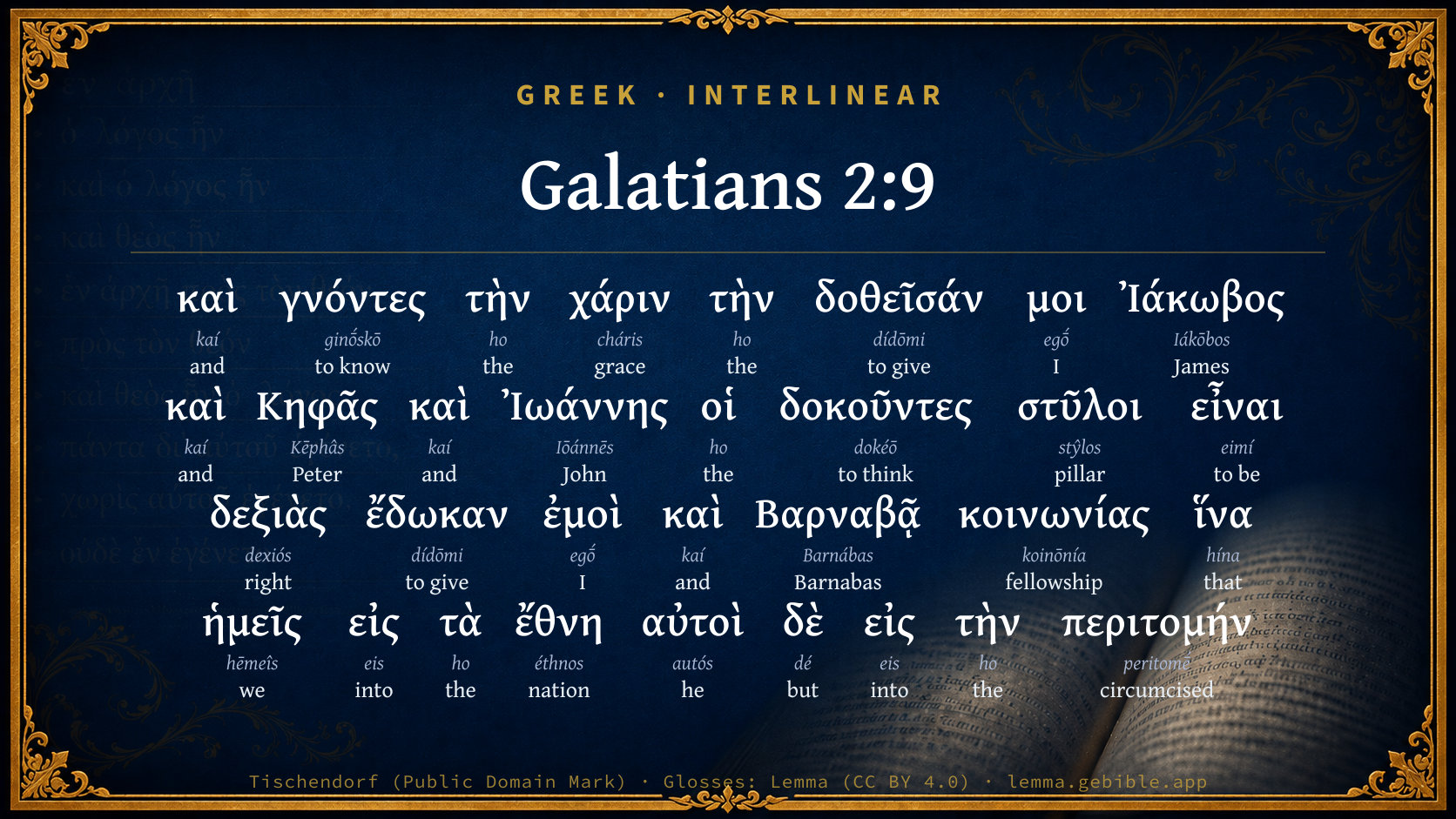
Download image
Cite this verse

Galatians 2:9 (World English Bible). Public Domain. Lemma interlinear Bible study tool, https://lemma.gebible.app/v/galatians/2/9.

Show BibTeX & RIS
BibTeX
RIS
English Translation
and when they perceived the grace that was given to me, James and Cephas and John, they who were reputed to be pillars, gave to me and Barnabas the right hand of fellowship, that we should go to the Gentiles, and they to the circumcision.
World English Bible · Public Domain
Highlights
  • 1 first appearance in the Greek New Testament
Full analysis ↓
Download a study sheet

One document with this verse’s original text, its word-by-word gloss line, the meaning frame, cross-references with their text, attributed commentary, and full source and license credits — printable, and it pastes into notes with its structure intact.

This verse Autodidact and up

Study sheet (.html) Plain text (.txt)

A passage Seminary Student

Up to 50 verses in one chapter. A passage sheet keeps up to 6 commentary sources and 12 cross-references per verse, in the order this page ranks them, and says so on the sheet whenever that leaves anything out. Ask for a single verse and you get the Autodidact verse sheet above.

Everything on this page stays free to read, with no account — the sheet is a download of what is already on screen, not access to it.

Want to remove ads? Support Godless Engineer
Compare translations 3

The same verse in 3 English versions, stacked beneath the original-language interlinear above. Click any original word for its lexicon entry.

Each is an independent rendering of the whole verse — the interlinear is not word-aligned to these translations.

Highlighted words mark where these versions differ — a whole-verse word diff, not a word-by-word alignment.

  • World English Bible Public Domain
    and when they perceived the grace that was given to me, James and Cephas and John, they who were reputed to be pillars, gave to me and Barnabas the right hand of fellowship, that we should go to the Gentiles, and they to the circumcision.
  • King James Version Public Domain
    And when James, Cephas, and John, who seemed to be pillars, perceived the grace that was given unto me, they gave to me and Barnabas the right hands of fellowship; that we should go unto the heathen, and they unto the circumcision.
  • unfoldingWord Literal Text CC BY-SA 4.0
    and having understood the grace having been given to me, James and Cephas and John, the ones seeming to be pillars, gave the right hand of fellowship to Barnabas and me, so that we to the Gentiles, and they to the circumcision,

unfoldingWord Literal Text — © unfoldingWord, licensed CC BY-SA 4.0. Word-aligned USFM3 via Door43 (git.door43.org/unfoldingWord/en_ult).

Versions to compare (up to 4)

3 of 4 selected

Show all 19 translations

Every available English version of this verse, each an independent rendering of the whole verse.

  • World English Bible Public Domain
    and when they perceived the grace that was given to me, James and Cephas and John, they who were reputed to be pillars, gave to me and Barnabas the right hand of fellowship, that we should go to the Gentiles, and they to the circumcision.
  • Berean Standard Bible Public Domain
    And recognizing the grace that I had been given, James, Cephas, and John—those reputed to be pillars—gave me and Barnabas the right hand of fellowship, so that we should go to the Gentiles, and they to the circumcised.
  • Majority Standard Bible Public Domain
    And recognizing the grace that I had been given, James, Cephas, and John—those reputed to be pillars—gave me and Barnabas the right hand of fellowship, so that we should go to the Gentiles, and they to the circumcised.
  • King James Version Public Domain
    And when James, Cephas, and John, who seemed to be pillars, perceived the grace that was given unto me, they gave to me and Barnabas the right hands of fellowship; that we should go unto the heathen, and they unto the circumcision.
  • American Standard Version (1901) Public Domain
    and when they perceived the grace that was given unto me, James and Cephas and John, they who were reputed to be pillars, gave to me and Barnabas the right hands of fellowship, that we should go unto the Gentiles, and they unto the circumcision;
  • Revised Version (1885) Public Domain
    and when they perceived the grace that was given unto me, James and Cephas and John, they who were reputed to be pillars, gave to me and Barnabas the right hands of fellowship, that we should go unto the Gentiles, and they unto the circumcision;
  • Geneva Bible (1599) Public Domain
    And when Iames, and Cephas, and Iohn, knew of the grace that was giuen vnto me, which are counted to be pillars, they gaue to me and to Barnabas the right hands of fellowship, that we should preach vnto the Gentiles, and they vnto the Circumcision,
  • Douay-Rheims (1899) Public Domain
    And when they had known the grace that was given to me, James and Cephas and John, who seemed to be pillars, gave to me and Barnabas the right hands of fellowship: that we should go unto the Gentiles, and they unto the circumcision:
  • Young's Literal Translation Public Domain
    and having known the grace that was given to me, James, and Cephas, and John, who were esteemed to be pillars, a right hand of fellowship they did give to me, and to Barnabas, that we to the nations, and they to the circumcision `may go',
  • Literal Standard Version CC BY-SA 4.0
    and having known the grace that was given to me, James, and Cephas, and John, who were esteemed to be pillars, they gave to me a right hand of fellowship, and to Barnabas, that we may go to the nations, and they to the circumcision,
  • Unlocked Literal Bible CC BY-SA 4.0
    When James, Cephas, and John, who were recognized as those who built up the church, understood the grace that had been given to me, they gave the right hand of fellowship to Barnabas and me. They did this so that we should go to the Gentiles, and so that they should go to those who are circumcised.
  • unfoldingWord Literal Text CC BY-SA 4.0
    and having understood the grace having been given to me, James and Cephas and John, the ones seeming to be pillars, gave the right hand of fellowship to Barnabas and me, so that we to the Gentiles, and they to the circumcision,
  • Darby Bible Public Domain
    and recognising the grace given to me, James and Cephas and John, who were conspicuous as being pillars, gave to me and Barnabas [the] right hands of fellowship, that *we* [should go] to the nations, and *they* to the circumcision;
  • World Messianic Bible Public Domain
    and when they perceived the grace that was given to me, Jacob and Kefa and Yochanan, those who were reputed to be pillars, gave to Barnabas and me the right hand of fellowship, that we should go to the Gentiles, and they to the circumcision.
  • Webster's Bible Public Domain
    And when James, Cephas, and John, who seemed to be pillars, perceived the grace that was given to me, they gave to me and Barnabas the right hands of fellowship; that we should go to the heathen, and they to the circumcision.
  • Free Bible Version CC BY-SA 4.0
    and once they recognized the grace that had been given to me, then James, Peter, and John, who bore the responsibility of church leadership, shook Barnabas and me by the hand as their fellow-workers.
  • Bible in Basic English Public Domain
    When they saw the grace which was given to me, James and Cephas and John, who had the name of being pillars, gave to me and Barnabas their right hands as friends so that we might go to the Gentiles, and they to the circumcision;
  • Text-Critical English NT CC BY 4.0
    When James, Cephas, and John, who were esteemed as pillars of the church, recognized the grace given to me, they gave the right hand of fellowship to Barnabas and me, agreeing that we should go to the Gentiles and that they should go to the circumcised.
  • Tyndale New Testament (1534) Public Domain
    and therfore when they perceaved the grace that was geve vnto me then Iames Cephas and Iohn which semed to be pilers gave to me and Barnabas the ryght hondes and agreed with vs that we shuld preache amonge the Hethen and they amonge the Iewes:

Literal Standard Version (2020), Covenant Press — licensed CC BY-SA 4.0. Text via the HelloAO Bible API (eBible.org). Unlocked Literal Bible (unfoldingWord) — licensed CC BY-SA 4.0. Text via the HelloAO Bible API (eBible.org). unfoldingWord Literal Text — © unfoldingWord, licensed CC BY-SA 4.0. Word-aligned USFM3 via Door43 (git.door43.org/unfoldingWord/en_ult). Free Bible Version, Dr. Jonathan Gallagher — licensed CC BY-SA 4.0. Text via the HelloAO Bible API (eBible.org).

Word by word

More ways to search: Search by grammar → Find every occurrence → Compare this word →

Practice this passage: Drill this verse → Learn its vocabulary →

στῦλοι
stŷlos
G4769
“pillar”
Noun, Nominative, Plural, Masculine
Part of Speech
Noun
Case
Nominative
Number
Plural
Gender
Masculine
Full Thayer's Definition

Origin: from stuo (to stiffen, properly akin to the base of G2476 )

TDNT: 19:12,1

1. a pillar 2. a column a. pillars of fire i.e. flames rising like pillars 3. a prop or support
  1. καὶ kaí G2532 “and” Conjunction
  2. γνόντες ginṓskō G1097 “to know” Verb, Aorist, Active, Participle, Nominative, Plural, Masculine
  3. τὴν ho G3588 “the” Article, Accusative, Singular, Feminine
  4. χάριν cháris G5485 “grace” Noun, Accusative, Singular, Feminine
  5. τὴν ho G3588 “the” Article, Accusative, Singular, Feminine
  6. δοθεῖσάν dídōmi G1325 “to give” Verb, Aorist, Passive, Participle, Accusative, Singular, Feminine
  7. μοι egṓ G1473 “I” Personal pronoun, 1st person, Dative, Singular
  8. Ἰάκωβος Iákōbos G2385 “James” Noun, Nominative, Singular, Masculine
  9. καὶ kaí G2532 “and” Conjunction
  10. Κηφᾶς Kēphâs G2786 “Peter” Noun, Nominative, Singular, Masculine
  11. καὶ kaí G2532 “and” Conjunction
  12. Ἰωάννης Iōánnēs G2491 “John” Noun, Nominative, Singular, Masculine
  13. οἱ ho G3588 “the” Article, Nominative, Plural, Masculine
  14. δοκοῦντες dokéō G1380 “to think” Verb, Present, Active, Participle, Nominative, Plural, Masculine
  15. εἶναι eimí G1510 “to be” Verb, Present, Active, Infinitive
  16. δεξιὰς dexiós G1188 “right” Adjective, Accusative, Plural, Feminine
  17. ἔδωκαν dídōmi G1325 “to give” Verb, Aorist, Active, Indicative, 3rd person, Plural
  18. ἐμοὶ egṓ G1473 “I” Personal pronoun, 1st person, Dative, Singular
  19. καὶ kaí G2532 “and” Conjunction
  20. Βαρναβᾷ Barnábas G921 “Barnabas” Noun, Dative, Singular, Masculine
  21. κοινωνίας koinōnía G2842 “fellowship” Noun, Genitive, Singular, Feminine
  22. ἵνα hína G2443 “that” Conjunction
  23. ἡμεῖς hēmeîs G2249 “we” Personal pronoun, 1st person, Nominative, Plural
  24. εἰς eis G1519 “into” Preposition
  25. τὰ ho G3588 “the” Article, Accusative, Plural, Neuter
  26. ἔθνη éthnos G1484 “nation” Noun, Accusative, Plural, Neuter
  27. αὐτοὶ autós G846 “he” Personal pronoun, Nominative, Plural, Masculine
  28. δὲ dé G1161 “but” Conjunction
  29. εἰς eis G1519 “into” Preposition
  30. τὴν ho G3588 “the” Article, Accusative, Singular, Feminine
  31. περιτομήν peritomḗ G4061 “circumcised” Noun, Accusative, Singular, Feminine

About this verse

These counts appear in no published source. They are computed here, from the morphology-tagged text and Lemma’s own curated glosses. What Lemma adds →

32
words
22
distinct lemmas
Pauline Epistles
section

Notable vocabulary

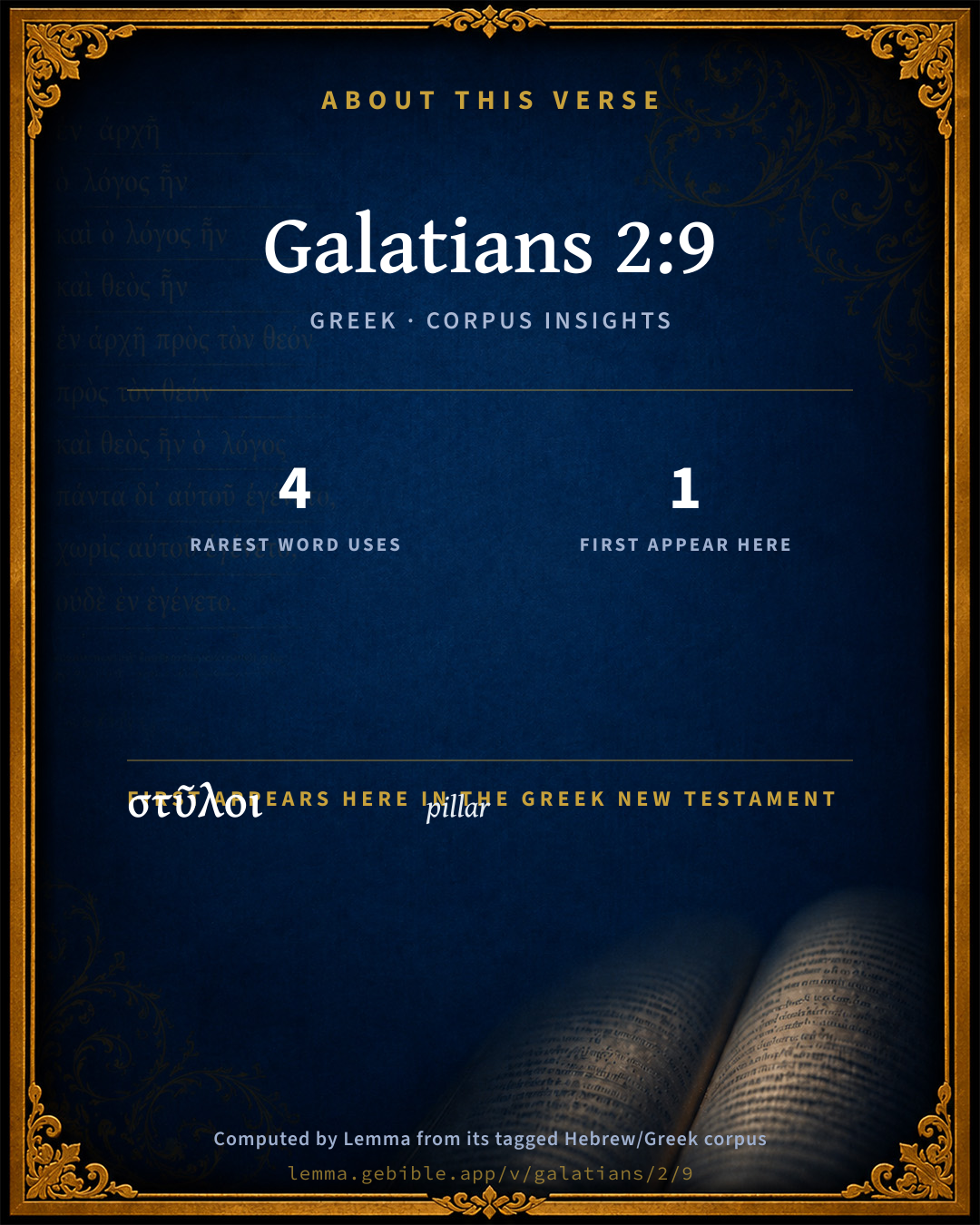
The rarest word here is στῦλοι pillar G4769 — appearing just 4 times in the whole Greek New Testament.

First appearance in Scripture

This word makes its first canonical appearance in the Greek New Testament here:

  • στῦλοι pillar G4769

Shared distinctive vocabulary

στῦλοι pillar G4769 occurs in 4 verses of the Greek New Testament. Also found in:
Repetition

Words recur within this verse:

Cross-references

22

Topical passages linked to Galatians 2:9 in the Treasury of Scripture Knowledge — connected by theme and wording, ordered by reader-vote popularity; previews shown in the World English Bible.

  • Romans 12:3 For I say, through the grace that was given me, to every man who is among you, not to think of himself more highly than he ought to think; but to think reasonably, as God has apportioned to each person a measure of faith.
  • Revelation 3:12 He who overcomes, I will make him a pillar in the temple of my God, and he will go out from there no more. I will write on him the name of my God, and the name of the city of my God, the new Jerusalem, which comes down out of heaven from my God, and my own new name.
  • Ephesians 3:8 To me, the very least of all saints, was this grace given, to preach to the Gentiles the unsearchable riches of Christ,
  • Galatians 2:2 I went up by revelation, and I laid before them the Gospel which I preach among the Gentiles, but privately before those who were respected, for fear that I might be running, or had run, in vain.
  • Acts 15:22–30 Then it seemed good to the apostles and the elders, with the whole assembly, to choose men out of their company, and send them to Antioch with Paul and Barnabas: Judas called Barsabbas, and Silas, chief men among the brothers.
  • Romans 1:5 through whom we received grace and apostleship, for obedience of faith among all the nations, for his name's sake;
  • Galatians 2:6–7 But from those who were reputed to be important (whatever they were, it makes no difference to me; God doesn't show partiality to man)--they, I say, who were respected imparted nothing to me,
  • 1 John 1:3 that which we have seen and heard we declare to you, that you also may have fellowship with us. Yes, and our fellowship is with the Father, and with his Son, Jesus Christ.
  • Revelation 21:14–20 The wall of the city had twelve foundations, and on them twelve names of the twelve Apostles of the Lamb.
  • Matthew 16:18 I also tell you that you are Peter, and on this rock I will build my assembly, and the gates of Hades will not prevail against it.
  • Acts 4:36 Joses, who by the apostles was surnamed Barnabas (which is, being interpreted, Son of Encouragement), a Levite, a man of Cyprus by race,
  • Acts 15:7 When there had been much discussion, Peter rose up and said to them, "Brothers, you know that a good while ago God made choice among you, that by my mouth the Gentiles should hear the word of the Gospel, and believe.
  • Acts 15:13 After they were silent, James answered, "Brothers, listen to me.
  • Romans 12:5–6 so we, who are many, are one body in Christ, and individually members one of another.
  • Romans 15:15 But I write the more boldly to you in part, as reminding you, because of the grace that was given to me by God,
  • 1 Corinthians 15:10 But by the grace of God I am what I am. His grace which was bestowed on me was not futile, but I worked more than all of them; yet not I, but the grace of God which was with me.
  • 2 Corinthians 8:4 begging us with much entreaty to receive this grace and the fellowship in the service to the saints.
  • Galatians 2:11–14 But when Peter came to Antioch, I resisted him to the face, because he stood condemned.
  • Ephesians 2:20 being built on the foundation of the apostles and prophets, Christ Jesus himself being the chief cornerstone;
  • Colossians 1:29 for which I also labor, striving according to his working, which works in me mightily.
  • 1 Timothy 3:15 but if I wait long, that you may know how men ought to behave themselves in the house of God, which is the assembly of the living God, the pillar and ground of the truth.
  • 1 Peter 4:10–11 According as each has received a gift, be ministering it among yourselves, as good stewards of the grace of God in its various forms.

Cross-references courtesy of OpenBible.info (CC BY 4.0).

Commentary

Notes on Galatians 2:9 from classic Christian and Jewish commentators (each source and its license shown beneath its notes). The classic Christian expositions comment on the surrounding passage and are grouped to its opening verse, so a note may address several verses; the Jewish commentaries on the Tanakh (Rashi and others) are per-verse, so they appear only where the commentator wrote on this verse.

Lemma curates 59 commentaries, every one of them public domain or Creative Commons licensed, each selected and text-cleaned for this edition rather than reprinted as found. About our sources →

The Biblical Illustrator

Joseph S. Exell

Gal_2:9

And when James, Cephas, and John, who seemed to be pillars.

Ministers, pillars

I. As founded on Christ.

II. As supporting believers by--

1. Sympathy.

2. Prayer.

3. Preaching.

III. As presenting an example of stability.

IV. As Adorning The Edifice Of The Church.

John and Paul

This is the only meeting between the two recorded in Scripture. It is, moreover, the last notice that we find there of St. John, until the time of the Apocalypse. For both these reasons the mind seizes on this incident. Like other casual Scriptural notices it is Very suggestive. St. John had been silent during the discussion, but at the close he expressed his cordial union with St. Paul. That union has been made visible to all the ages by the juxtaposition of their Epistles in the same sacred volume. They stand among the pillars of the Holy Temple; and the Church of God is thankful to learn how contemplation may be united with action, and faith with love in the spiritual life. (Conybeare and Howson.)

The unity of apostolic doctrine

It might seem to these Galatians, as it seems to some acute critics now, that several gospels were being preached. But Paul shows that this could not be. Of course Christian truth is presented in different phases by Paul, James, Cephas, and John respectively, but only as each facet of a diamond differs from the rest, each displaying its own brilliance, reflecting the light in its own way, but all belonging to one jewel. (S. Pearson, M. A.)

The significance of the apostolic decision

Henceforward the Church and the world become coextensive; other evils may hinder the diffusion of Christianity, but not the limits of a local and national worship; other restrictions may be imposed on the freedom of the human race, but the yoke of Judaism never; other forms may be assumed by the spirit of bigotry and superstition, but from its earlier province it is utterly expelled; the most exclusive zealot will never again venture to confine the privileges of the true religion to a single nation; the most ardent admirer of ancient usages and external forms will never again dare to insist on the necessity of circumcision. (Dean Stanley.)

The division of apostolic labour

The apostles were to continue to devote themselves to evangelization with the understanding that Paul and Barnabas should go to the Gentiles, and Peter and John to the Jews. This arrangement, however, was not made on geographical considerations (see Jam_1:1; 1Pe_1:1; Rev_1:9). The one party were to evangelize the Gentiles, the other the Jews, without distinction of place (see verse 11, etc.). (E. Reuss, D. D.)

Not indeed that Paul would object to any association with the special ministry of Peter--on the contrary, he frequently addressed the Jews--but, the rule was a general one, and in effect most important, because it was a formal acknowledgment of Pauls mission, and of its total independence. Henceforth the two Churches were to be one in faith and mutual goodwill, but different in their ritual, ceremonies, and government. The Church which Peter was to construct was national, that which was put under Pauls guidance was oecumenical. The story that Peter ruled the Church of Rome for a quarter of a century is of course contradicted by the facts stated in this Epistle, and is plainly a baseless, though ancient, fable, which has been maintained and amplified in order to serve particular ends, and to justify ecclesiastical caesarism. (Paul of Tarsus.)

Pauls common-sense

He knew that the best way to obviate quarrels was to recognize differences. He was well aware that men may work for a common purpose, even though their several methods of procedure may be so various as to seem incongruous, and that, provided the means be just and honourable, identity of end is a sufficient bond of unity. The wisdom of the statesman consists in effecting a harmony of interests, that of a religious reformer in enlisting all action on behalf of one grand purpose. Both wreck their reputation when they ally themselves to party cries and narrow rules. (Paul of Tarsus.)

Christian unity consistent with diversity

Ours is not a unity like that of the waters of a stagnant pool, over which the purifying breath of heaven sweeps in vain. Ours is not the unity of darkness, like the cloud-covered midnight sky, where neither moon nor star appears. Ours is not the unity of a forced conformity, such as is found in polar seas, where eternal winter has locked up the waves; but rather like the fountain flowing ever fresh and free; like the rainbow that combines the seven prismatic colours into one glorious arch of promise; like old oceans unfettered flow as its waves rush in all their majesty and might, distinct as the billows, but one as a sea. (S. Weir.)

Four pillars of the Church

These four pillars of the Church stand before us for our contemplation.

1. For example, we see that the widest diversity of gifts can be employed to advantage in winning souls to Christ. It would hardly be possible to sketch four characters differing more in essential particulars than these apostles. Paul was the theologian of the early Church. Peter had an undeniable headship in organization. But James brought his cool temperament into service in decisions involving difficult points of casuistry, while John was of all the best calculated to labour for spiritual eminence in the converts. Now when results are before us, no one could venture to pronounce which was the most useful in the grand work Christ gave them all to do. Each was the best for his own work.

2. So this would suggest a second lesson: failure in one particular field or sphere of action does not preclude great after-success in another for the same man. As a home missionary he was a failure. The Lord had other work for him to do.

3. Then once more: we might learn that the individualities of personal character are in no wise destroyed by the new life under the gospel. Paul, after his conversion, was just as earnest and driving as before. James carried his carefulness as a Pharisee into his demeanour as a Christian. Peter left his boats and tackle to become a skilful fisher of men, with the same adroitness and patient business absorption put into his fresh profession. So John was affectionate to Jesus mother, because he had grown up affectionate to his own. Naturalness is one of the best evidences of grace, for it excludes assumption and hypocrisy. No one will ever succeed in making himself better by making himself over into another mans likeness.

4. In the fourth place, we see that true religion in the heart is a powerful helper in intellectual advancement. The history of all these four men affords an illustration of the Scripture text: The entrance of Thy words giveth light; it giveth understanding unto the simple. We all know how Simon Peter was reared. How is it possible that he could reach literary attainments sufficient to enable him to write two such Epistles as those which bear his name?

5. Again, we can learn from these mens biographies and writings that the very best Christian excellences may be, unfortunately, marred by personal weaknesses. For every one of them was faulty enough to make some notable mistake, which has been handed down to us in the imperishable record. Paul quarrelled sadly with Barnabas about Mark. James refused to welcome Paul at Jerusalem.

6. Just a suggestion now, which may or may not be called a lesson. Perhaps the ideal Christian might be made up of the best excellences in all. Put Pauls orthodoxy in doctrine alongside of Jamess morality in behaviour; put Peters activity in impulse with Johns extensive experience; join all these into one man.

7. Finally, we cannot fail to learn, as the sweetest and best lesson of all, that the truest Christians are those who are most like their Leader, and most loyal to Him as supreme. (C. S. Robinson, D. D.)

Pillars in the Church

Christians are frequently called Gods building, and the temple of the Holy Ghost; and said to be built up.a spiritual house: and as some occupy more important places in this spiritual house than others, so they may properly be called pillars, or the main supports of the building in comparison with others. But it is one thing to seem to be pillars, and another to be really such, as were James, Cephas, and John.

1. Pillars should be formed of solid materials. In modern architecture, it is too common to decorate the front of buildings, with what seem to be pillars, and are not. The form of a large pillar is often built up with broken tiles, cement, and stucco: it seems to bear a great pressure of responsibility, which is deceptive like the whited sepulchres of old, for, in fact, the burden is borne by some modern supports, that are concealed from view. Now, Gods building does not need the help of such pillars. Those who would seem to be pillars, merely for show, who have no solidity, and can bear no burden, had better take a mote humble position. These imitation pillars are good for nothing but show. They are always porous, and absorb the rain; often retain the damp, generate dry rot, and disgrace what they were intended to adorn.

2. Pillars should be upright. Pillars that incline to one side are painful to 1ook at, and dangerous to the building. When the pillars in the church lose their erect position, the whole building is on the point of falling.

3. Pillars that are designed for use arid ornament should be straight, and not crooked. A bending pillar can bear but little pressure, and is very offensive to the eye. Crooked materials can be used to greater advantage in almost any other position in the building.

4. Pillars should be placed under, and not on the top of the building. They should bear the building, and not compel the building to bear them.

5. Pillars are fixtures, and must always be found in the same position. A weathercock at the top of the edifice may turn with the wind, but a pillar that supports it should remain unmoved by wind and storm. A window or a blind may be adjusted here or there, to the season or the weather, but the pillar can never shift its position without danger to the edifice of which it forms a part.

6. The pillars need a sure foundation, or they will yield to the pressure that is upon them. The Rock of Ages is recommended as their best support.

Inferences:

1. We infer, that it requires at least ordinary qualities of Christian character, to fit a man to be a pillar. He must have solidity, uprightness, humility, steadfastness, and true faith. These are indispensable.

2. Many, who seem to be pillars in these days, are far from what they seem; they show a painted surface and a florid capital, but they are of little use, and easily marred and broken.

3. Many whose unassuming dispositions will not allow them to be pillars, have, notwithstanding, the best qualifications for it.

4. Let all who aspire to be pillars, seek to combine those qualities which will fit them for the station they would occupy, and the burden they will have to bear. (Essex Remembrancer.)

The apostles recognition by the Church in Jerusalem

I. The recognition which Paul received from the Church was discerning.

1. They saw that to him was entrusted the gospel which was to be preached to the Gentiles. The gospel of the uncircumcision was committed to Paul. The gospel is a Divine deposit or treasure.

2. The Church saw that the power which contributed to the success of the one apostle was effectual also in the other. In Paul as well as Peter God had wrought effectually. They discerned the triumphs of the gospel in both instances.

3. The Church recognized the religion of Paul to be a religion of love. They perceived the grace given unto him.

II. The recognition Paul received was given in spite of certain differences that had separated him from the Church in Jeruselem in the past.

1. Many of them had been familiar with the Lord Jesus Christ when He was on earth. Paul had not. Yet they now saw that God was no respecter of persons, but in every nation, he that feareth Him and worketh righteousness, is accepted of Him.

2. There was a difference between them in respect to gifts.

3. There was also a difference as to position. Many of them were of acknowledged reputation. Paul was not regarded as an authority in the Churches of Judaea. Yet in spite of these differences there was a full recognition of his apostolic character and office.

III. The recognition was complete and hearty.

1. There was no reservation as to its extent. They admitted the whole truth Paul declared. They addressed no communication to him, but fully embraced the doctrines he enunciated.

2. It was cordial. They gave to Paul and Barnabas the right hands of fellowship. What a moment must that have been! What a blessed working of the Holy Ghost!

IV. In receiving this recognition, Paul was anxious to manifest his high estimate of their brotherly kindness. They had nothing new to communicate concerning doctrine, but they desired him to remember the poor, and this request he gladly complied with. He here shows his fraternal co-operation with the other apostles, and his love for Jewish Christians. He could not comply with the demands of the false brethren, but it was from no lack of charity. Immediately after writing this Epistle, he made a tour, gathering the alms of the Greek Churches for the saints at Jerusalem. Lessons:

1. Unity in the Christian Church has its foundation in Christ.

2. Christian unity is the product of the Holy Spirit.

3. Its genuineness is manifest by acts of beneficence. (R. Nicholls.)

The right hands of fellowship.

St. Paul and the elder apostles

The three apostles here referred to, whatever their prepossessions, yield to the force of Pauls statements. Peter also at the council called the imposition of the law on Gentile converts an intolerable yoke, for the Gentile was saved by the same grace as the Jew. Peter appealed only to the great facts which had met him unexpectedly in his own experience; but James, in the old theocratic spirit, connected the outburst of Christianity with ancient prophecy as its fulfilment. In his thought, God takes out of the Gentiles a people for His name, and by an election as real as when He separated Israel of old from all the nations. The prophecy quoted by him describes the rebuilding of the tabernacle of David, not by restoring his throne in Jerusalem over Jews, and over heathen who, as a test of their loyalty, became proselytes, but by the reconstitution of the theocracy in a more spiritual form, and over myriads of new subjects--all the Gentiles--without a hint of their conformity to any element of the Mosaic ritual. This expansion of the old economy had been foreseen; it was no outgrowth unexpected or unprovided for. Believers were not to be surprised at it, or to grudge that their national supremacy should disappear amidst the Gentile crowds, who in doing homage to Davids son, their Messiah, should raise the tabernacle of David to a grandeur which it had never attained, and could never attain so long as it was confined to the territory of Judaea. The Jewish mind must have been impressed by this reasoning- this application of their own oracles to the present crisis. So far from being perplexed by it, they ought to have been prepared for it; so far from being repelled by it, they ought to have anticipated it, prayed for it, and welcomed its faintest foregleams, as in the preaching of Philip in Samaria, and of Peter to Cornelius. Paul and Barnabas, in addressing the multitude--the Church, the apostles, and elders--did not launch into a discussion of the general question, or attempt to demonstrate abstract principles. First, in passing through Phoenice and Samaria, they declared the conversion of the Gentiles; and secondly, at the convention, theirs was a simple tale which they allowed to work its own impression--they declared what miracles and wonders God had wrought among the Gentiles by them. The logic of their facts was irresistible, for they could not be gainsaid. Let their audience account for it as they chose, and endeavour to square it with their own opinions and beliefs as best they might, God was working numerous and undeniable conversions among the Gentiles as visibly and gloriously as among themselves. The haughty exclusiveness of the later Judaism made it impossible for the Church to extend without some rupture and misunderstanding of this nature. That exclusiveness was nursed by many associations. For them, and them alone, was the temple built, the hierarchy consecrated, and the victim slain. Their history had enshrined the legislation of Moses, the priesthood of Aaron, the throne of David, and the glory of Solomon. The manna had been rained upon their fathers, and the bright Presence had led them. Waters had been divided and enemies subdued. Sinai had been lighted up, and had trembled under the majesty and voice of Jehovah. Their land was hallowed by the only Church of God on earth, and each of them was a member of it by birth. His one temple was on Mount Moriah, and they gloried in the pride of being its sole possessors. The archives of their nation were at the same time the records of their faith. Nothing was so opposed to their daily prepossessions as the idea of a universal religion. Or if the boundaries of the covenanted territory were to be widened, Zion was still to be the centre. Foreign peoples were to have no separate and independent worship; all nations were to flow to the mountain of the Lords house, established in the top of the mountains, and exalted above the hills. It is impossible for us to realize the intensity of Jewish feeling on these points, as it was ever influencing Hebrew believers to relapse into their former creed, and leading others into the self-deceptive and pernicious middle course of Judaizers. In such circumstances, the work of St. Paul naturally excited uneasiness and suspicion in the best of them, for it was so unlike their own sphere of service. But the elder apostles were at this period brought to acquiesce in it, and they virtually sanctioned it, though there might not be entire appreciation of it in all its extent and certain consequences There is no ground, therefore, for supposing that there was any hostility between Paul and these eider apostles, or any decided theological difference, as many strenuously contend for. They all held the same cardinal truths, as is manifest from the Gospel and Epistles of John, and from the Epistles of Peter. There are varying types of thought arising from mental peculiarity and spiritual temperament--accidental differences showing more strongly the close inner unity. Nor is the Epistle of James in conflict with the Pauline theology. It was in all probability written before these Judaistic disputes arose; for, though addressed to Jews, it makes no mention of them. Its object among other things was to prove that a justifying faith must be in its nature a sanctifying faith; that a dead faith is no faith, and is without all power to save; and that from this point of view a man is justified by works--the products of faith being identified with itself, their one living source. Nor can we say that there were, even after the convention, no misunderstandings between Paul and the other apostles. While they were at one with him in thought, they seem not to have had the same freedom to act out their convictions. There was no opposition on any points of vital doctrine; but though they held that his success justified him, they did not feel at liberty, or had not sufficient intrepidity, to follow his example. Though their earlier exclusiveness was broken, their nationality still remained--their conservatism had become an instinct--they to the circumcision. The mere separation of sphere might not give rise to division, but these pharisaic Judaists, who were nat so enlightened and considerate as their leaders, were the forefathers of that Ebionitism which grew and fought so soon after that period, having its extreme antagonism in Marcion and his adherents. How the other, apostles who had left Jerusalem at the Herodian persecution, and may have been in different parts of the world, acted as to these debated matters, we know not. It is storied, indeed, that John, living amidst the Hellenic population of Ephesus, kept the paschal feast on the fourteenth day of the month, in accordance with the Jewish reckoning; and that he wore in his older years one special badge of a priest … The power of early association, which grows with ones growth, is very difficult to subdue; for it may suddenly reassert its supremacy at some unguarded moment, and expose inherent weakness and indecision. (John Eadie, D. D.)

Grace seen in Gods choice of workmen

God would build for Himself a palace in heaven of living stones. Where did He get them? Did He go to the quarries of Paros? Hath He brought forth the richest and the purest marble from the quarries of perfection? No, ye saints: look to the hole of the pit whence ye were digged, and to the rock whence ye were hewn! Ye were full of sin: so far from being stones that were white with purity, ye were black with defilement, seemingly utterly unfit to be stones in the spiritual temple, which should be the dwelling-place of the Most High. Goldsmiths make exquisite forms from precious material; they fashion the bracelet and the ring from gold: God maketh His precious things out of base material; and from the black pebbles of the defiling brooks he hath taken up stones, which He hath set in the golden ring of His immutable love, to make them gems to sparkle on His finger for ever. He hath not selected the best, but apparently the worst of men to be the monuments of His grace; and, when He would have a choir in heaven, He sent Mercy to earth to find out the dumb, and teach them to sing. (C. H. Spurgeon.)

The right hand of fellowship

I. To whom should we give it--to all who hold the truth--to all by whom God is pleased to work--to all in whom God exhibits His grace.

II. How must we give it--not by forsaking our own position or encouraging them to leave theirs--but by the maintenance of brotherly esteem and love, by provoking them to love and good works. (J. Lyth.)

The right hand of fellowship should be given

I. To all to whom God has given grace.

II. By the pillars of the Church, as an example to others.

III. Heartily, without reserve. (J. Lyth.)

Division of labour in the Church is

I. Expedient--it prevents collision--economises labour.

II. Advantageous--it provokes emulation--develops effort--accomplishes more.

III. Necessary--there is room--and need for all. (J. Lyth.)

Pillars

I. Some seem to be pillars and are not.

II. Some are pillars and do not seem to be.

III. Some both seem to be and are really such. (J. Lyth.)

Unity in the gospel

I. One gospel yet different views.

II. One Master yet different spheres of labour.

III. One source of power yet different instrumentalities.

IV. One heart yet different modes of procedure. (J. Lyth.)

The Biblical Illustrator, edited by Joseph S. Exell (c. 1880s–1900s) — public domain. Text from a community e-Sword module.

Joseph Benson's Commentary

Gal 2:9-10. And when James — Probably named first because he. was bishop of the church in Jerusalem; and Cephas — Speaking of him at Jerusalem, he calls him by his Hebrew name; and John — Hence it appears that he also was at the council, though he be not particularly named in the Acts. Who seemed to be — Or, as in Gal 2:6, who undoubtedly were; pillars — The principal supporters and defenders of the gospel; perceived — After they had heard the account I gave them; the grace of apostleship which was given to me, they in the name of all, gave me and Barnabas — My fellow-labourer; the right hands of fellowship — They gave us their hands, in token of receiving us as their fellow-labourers, mutually agreeing that I and those in union with me should go to the heathen chiefly — “Barnabas, equally with Paul, had preached salvation to the idolatrous Gentiles, without requiring them to obey the law of Moses: wherefore, by giving them the right hands of fellowship, the three apostles acknowledged them to be true ministers of the gospel, each according to the nature of his particular commission. Paul they acknowledged to be an apostle of equal authority with themselves; and Barnabas they acknowledged to be a minister sent forth by the Holy Ghost to preach the gospel to the Gentiles. This distinction it is necessary to make, because it doth not appear that Barnabas was an apostle, in the proper sense of the word. The candour which the apostles at Jerusalem showed on this occasion, in acknowledging Paul as a brother apostle, is remarkable, and deserves the imitation of all the ministers of the gospel in their behaviour toward one another.” And they — With those that were in union with them; chiefly to the circumcision — The Jews. “In pursuance of this agreement, the three apostles abode, for the most part, in Judea, till Jerusalem was destroyed. After which, Peter, as tradition informs us, went to Babylon, and other parts in the East, and John into the Lesser Asia, where he was confined some years in Patmos, for the testimony of Jesus, Rev 1:9. But James was put to death at Jerusalem, in a popular tumult, before that city was destroyed.” — Macknight. Only desiring that we would remember the poor Christians in Judea — So as to make collections for them as we proceeded in our progress through the churches of the Gentiles; the same which I also was forward to do — Greek, ο και εσπουδασα αυτο τουτο ποιησαι, which very thing I was eager, or in haste to do. It is probable, that in so readily acceding to the proposal made by the apostles at Jerusalem, to collect money for the destitute saints in Judea, St. Paul was influenced by a more generous principle than that of merely relieving the necessities of the poor. For as the Jewish believers were extremely unwilling to associate with the converted Gentiles, Paul might hope that the kindness, which he doubted not the Gentiles would show in relieving their Jewish brethren, would have a happy influence in uniting the two into one harmonious body or church.

Joseph Benson's Commentary on the Old and New Testaments (1811–1818) — public domain. Text from a community e-Sword module.

The Pulpit Commentary

And when James, Cephas, and John, who seemed to be pillars, perceived the grace that was given unto me (kaintev thrin thn moi jIakwbov kai Khfav kainnhv oiJ dokountev stuloi einai); and perceiving of a certainty the grace that was given unto me, James and Cephas and John, those reputed to be pillars (gave). This is the order in which the words stand in the Greek, in which the participle gnontev ("perceiving of a certainty") stands coordinate with the participle ijdontev ("when they saw") of ver. 7, so that this latter participle has "James, Cephas, and John" for its subject equally with the former, and vers. 7 and 9 appear as forming one sentence. The expression, "the grace that was given unto me," occurs also 1Co_3:10; Rom_12:3 Rom_15:15; in which passages, as well as here, it is used with a definite reference to the office of apostle having been conferred upon him together with the qualification and aid for its efficient discharge. This definite reference to a heavenly gift connected with his official character is prominent in the apostle"s use of the word "grace," also Rom_1:5; 1Co_15:10; ntev 2Co_12:9. The "grace that was given unto him," therefore, sums up the facts of his having been put in trust of the gospel of the uncircumcision, and of God"s having wrought on his behalf in his discharge of that trust, which are presented in the two preceding verses. There is not much difference in the meaning of the participle gno) in this verse as compared with the participle ijdontev in ver. 7; for as we find the verb "seeing" used with reference to objects not discernible by the bodily sense but perceived only through the medium of evidencing facts, as in ver. 14 of this chapter, and in Luk_9:47 Luk_17:14; Mat_9:2; gnwn Act_11:23 Act_14:9 Act_16:19; so also the verb e is sometimes used of perceiving, becoming apprised of, some fact, Mar_6:38 8:17; Luk_9:11; Joh_12:9, when there is no clear intention of emphasizing the idea of certain knowledge. Sometimes, however, it seems as if the writer had such intention, as in Mar_8:17; Luk_8:46; Php_2:19; and probably it was in this more emphatic sense that the apostle here substituted "knowing" for the foregoing "seeing." "James, and Cephas, and John." This James is, no doubt, the same James as appears in Acts 15. holding so prominent and apparently presidential a position in the great meeting of vers. 6-21. The "James" of the old triumvirate of the Gospels, "Peter, James, and John," was now no more. This James, whose personality has been discussed above in note on Gal_1:19, is named first, before even Cephas and John, though not an apostle, as being the leading "elder" (bishop, as such a functionary soon got to be designated) of the Church of Jerusalem; for in the classification of the component members of that meeting in Act_15:6, "the apostles and the elders," James must be assigned to the latter category. The twelve had no distinctive official connection with this particular Church more than with other Churches; and, therefore, in meetings held at Jerusalem, the presidential position would naturally be conceded, not to any one of the apostles, but to the man who was statedly recognized as the superior "elder" of this particular community. St. John"s name is not mentioned in Acts 15.; but in other places in St. Luke"s history "Peter and John" are found acting in conjunction, and this in such a manner as to betoken their holding a very prominent place among the apostles. (Act_3:1 Act_4:13 Act_8:14) The reason why these three are named, and none but these, is probably that on the occasion referred to these three alone James as on behalf of the Church of Jerusalem, and Peter and John as on behalf of the twelve stepped forward at the general request before the meeting, and formally all three clasped hands with Paul and Barnabas in token of their recognizing and ratifying their doctrine and ministry. In reference to the name "Cephas," it may be observed that St. Paul finds occasion to name this apostle nine times; in seven of these he writes, according to the best manuscripts, "Cephas" (1Co_1:12 1Co_3:22 1Co_9:5 1Co_15:5; Gal_1:18 Gal_2:9, Gal_2:14) in two, "Peter". (Gal_2:7, Gal_2:8) The Judaizers in the Church, whether at Corinth or in Galatia, in their morbid hankering after whatever was distinctively Jewish, were sure to affect the use of the Hebraic form; on which account, probably, St. Paul, in dealing with these men, is seen so frequently using this form himself. Those reputed to be pillars. The apostle"s object in adding this clause is apparently, to indicate why these three, rather than any others, represented the rest in this act of formal proceeding, and at the same time to intimate to his Galatian readers the supreme character of the attestation thus afforded, both to that gospel of his which certain among the Galatians were now tampering with, and to his official character which those same persons were beginning to disparage. "Pillars." The apostle, years after, in writing to Timothy, speaks of its being the proper function of "the Church of the living God" that she should be "a pillar and settled basis (eJdraiwma) of the truth," i.e. upholding the truth. (1Ti_3:15) This suggests to us his meaning in using the same figure here. Those three men were by general consent looked up to as especially steadfast upholders of the truth of the gospel or of the Christian cause. in Rev_3:12 the "pillar" seems thought of, not so much as upholding a superstructure as of something itself stationary, and also, perhaps, beautiful and glorious. Clement of Rome, in his Epistle to the Corinthians (borrows the phrase with a more extensive application. The idea couched in the word "Cephas," rock, is so nearly identical with that of "settled basis," that the like affinity of ideas as led the apostle to connect "pillar" with the latter term inav 1Ti_3:15 may be supposed to have led him now to connect "pillar" with "Cephas" and his two illustrious brethren. They gave to me and Barnabas the right hands of fellowship (dexi) edwkan ejmoi kaiba koinwniav); they each of them clasped each of us by the right hand, in token that they both did then, and would thereafter continue to, regard us, and we also them, as partners with one another in a common work. We meet with the phrases, "give right hands," "receive right hands," in RAPC 1Ma 11:50, 52 13:50, with reference, apparently, to the victor conceding, and the vanquished accepting, terms of peace to be ratified by the mutual clasp of right hands. This, however, is not precisely what is meant in the present case; there is no room here for the notion of reconciliation. Neither seems there intended a signification of love, such as the "kiss of love" would have afforded. This hand-clasp simply ratified by a palpable gesture the formal assurance between the two parties that they regarded each other as friendly partners in a common undertaking. That the use of this gesture in ratifying compact has been very common in all ages, is shown by the instances in Liddell and Scott"s "Lexicon" (Dexia), and in Facciolati ("Dextra"), as well as by Bishop Light feet"s note on the present passage. Its use among the Jews is attested, not only by the very phrase employed here and in the Maccabees, but by the phrases, "strike hands" and "give one"s hand," in Job_17:3; Pro_6:1; Eze_17:18. Josephus"s remark in "Ant.," 18. 9:3, on the unique inviolability which the Persians, Parthians, and other Oriental nations felt to attach to engagements thus ratified, by no means precludes the supposition that Jews used this gesture of guarantee, but only shows that it was not with them the most sacred of all forms of covenanting: they would, of course, regard an oath by the Name of God as affording a higher sanction. In the case now under consideration there was no "strife" between James, Cephas, and John, and Paul and Barnabas, which needed to be "ended" by "an oath:" the solemn and cordial mutual pressure of the right hand seems just the kind and measure of form appropriate to the circumstances. That we should go unto the heathen, and they unto the circumcision (ina hJmeiv eijv ta eqnh aujtoi de eijv thn); literally, that we unto (or, for) the Gentiles, and themselves unto (or, for) the circumcision, without any verb. We have a very similar ellipsis of the verb in a carefully balanced antithesis, and before the same preposition eijv. (Rom_5:16 comp. also 2Co_8:14) We may read it either thus, "should go unto," as in both the Authorized and the Revised Versions; or, "should be ministers for," taking the eijv with the like shade of meaning, as in ver. 8. This distribution of the several provinces of work is shown by the subsequent practice on both sides (see note on ver. 7, subfin. ) to have been intended to be geographical rather than national; which understanding is also indicated by the mention in the next verse of "the poor" whom Paul and Barnabas were, notwithstanding this distribution, to bear in mind; they were the poor in Judaea, the province of James, Cephas, and John.

The Pulpit Commentary (1880–1919), ed. H.D.M. Spence-Jones & Joseph S. Exell — public domain. Text from a community e-Sword module.

Tyndale Open Study Notes

Tyndale Open Resources

2:9 James: See “James, Brother of Jesus” Profile. • they accepted Barnabas and me as their co-workers (literally they gave me and Barnabas a right hand of fellowship): This symbolic handshake showed full acceptance for Paul and Barnabas, their ministry, and their message.

Tyndale Open Study Notes — © Tyndale Open Resources, licensed CC BY-SA 4.0. Text via the HelloAO Bible API.

Bengel's Gnomon

Johann Albrecht Bengel

Gal 2:9. Γνόντες, when James, etc., perceived) After having heard and seen me.—δοθεῖσαν, given) comp. respecting Paul, 2Pe 3:15.—Ἰακωβος[9]) James. He is put here first, because he mostly remained at Jerusalem, or even because he took the principal lead in this matter, and Paul might have seemed to differ more from James than from Peter, more from Peter than from John. For many circumstances would lead us to conclude, that James and Paul, as well as Peter and Paul, etc., had that in their nature and in the feelings of their soul, which would demand that the one should exercise love and forbearance, along with self-denial, towards the other, without, however, any compromise of the truth recognized by all. Hence it happens, that one and the same man, or one and the same assembly cannot with equal facility comprehend both James and Paul. This is proved in the failure of Luther, who called the epistle of James “an epistle of straw;” but let those who violently arraign him on this account, look at the monstrous feelings which they themselves cherish against Paul. Christ is the only Head, the only Sun; the greatest apostles were only members; nor did these, as individuals, all equally receive the rays of that Sun, but the whole together represented Christ in the apostleship; comp. on their variety, Rev 21:14; Rev 21:19-20. And the affairs of the Church were so directed by its Divine Head, that James, who was more tenacious of the law, preached to the Jews; Paul, who did not copy others, and was more eager for faith and liberty, preached to the Gentiles; and that thus every one might bring a character and endowments as much adapted as possible to the province assigned to him.—Κηφᾶς, Cephas) In some way or other, I know not how, this word has the sound of greater veneration than Peter. If Peter had held that supremacy, which men afterwards attributed to him, Paul would have had the strongest reason for mentioning that supremacy on the present occasion, or at least of naming him as in an exalted position.—στύλοι) This word corresponds to the Hebrew term עמוד Pro 9:1, and wherever it occurs.—δεξιὰς ἔδωκαν) so, δῶμεν δεξιὰν, let us make peace, 1Ma 6:58, etc.—ΚΟΙΝΩΝΊΑς) fellowship, which refers to colleagues.—ἵνα, that) viz. we might go, viz. with the Gospel.—ΕἸς ΤᾺ ἜΘΝΗ, to the Gentiles) especially. For Paul also taught the Jews, Peter and John the Gentiles, but the former followed out his career beyond Judea, the latter had continued in Judea, so long as it continued to exist as a nation. If Peter came to Rome, he certainly had no fixed abode there.

[9] Πέτρος καὶ Ἰάκωβος, the marginal reading in this verse is equal in both Ed. to the reading Ἰάκωβος καὶ Κηφᾶς adopted both in the Germ. Vers. and in the Gnom: Gal 2:11, the name Κηφᾶς, which had been left doubtful in the larger Ed., is openly preferred in 2d Ed. and Germ. Ver. to the other; finally, Gal 2:14, the reading Κηφᾷ added to the genuine readings on the margin of the larger Ed. on the margin of the 2d Ed. is placed among those that are less certain, and in the Germ. Ver. is exchanged for the reading πέτρῳ.—E. B.

Ἰάκωβος καὶ Κηφᾶς is read by BC Orig. and Cod. Amiat. of Vulg. Πέτρος κ, Ἰάκωβος is read by D(Δ)Gfg Vulg. (Fuld. MS., etc.) Iren. A omits καὶ Κηφᾶς. In Gal 2:11 ABCH Vulg. read Κηφᾶς. But D(Δ)Gfg Vulg. and Rec. Text have Πέτρος. In Gal 2:14 ABC have Κηφᾷ. D(Δ)Gfg Vulg. and Rec. Text have Πέτρῳ.—ED.

Bengel's Gnomon of the New Testament — English translation (T&T Clark, Edinburgh, 1860) — public domain. Text from a community e-Sword module.

Meyer's Critical & Exegetical Commentary

Heinrich August Wilhelm Meyer

Gal_2:9. Καὶ γνόντες] is connected, after the parenthesis, with ἰδόντες κ.τ.λ. in Gal_2:7.[79]

τὴν χάριν τὴν δοθεῖσάν μοι] is not arbitrarily to be limited either to the apostolic office (Piscator, Estius, and others; also Hofmann), or to the prosperos successus of the same (Morus, Koppe, Winer, Fritzsche; de Wette, both); but is to be left quite general: the grace which had been given me. They recognised that Paul was highly gifted with grace, and wasby the fact that God had so distinguished him by means of His grace and thereby legitimized him as His apostlefully fitted and worthy to enter into the bond of collegiate fellowship with them. His apostolic mission, his apostolic endowments, the blessed results of his labour, are all included in the χάρις which they recognised,a general term which embraces everything that presented itself in him as divinely-bestowed grace and working on behalf of his office.

ἸΆΚΩΒΟς] the same as in Gal_1:19; not the brother of John (Augustine), who at that time had been long dead (Act_12:2); also not the son of Alphaeus (Wieseler on Gal_1:19, and in the Stud. u. Krit. 1842, p. 95 f.); but the brother of the Lord, as is obvious of itself after what has been remarked on Gal_1:19. Comp. on Act_12:17. See also Hilgenfeld, p. 158 ff.; and Ewald, Gesch. d. apost. Zeit. p. 221 ff. The mention of his name here before the other two is not in compliance with the view of the false teachers (Windischmann), but is quite in due form, as the apostle is relating an official act done in Jerusalem, where James stood at the head of the church (comp. Credner, Einl. I. 2, p. 571 ff). There is a certain decorum in thisthe tact of a respectful consideration towards the mother-church and its highly-esteemed representative, who, as the Lords actual brother, sustained a more peculiar and unique relation to Him than any of the twelve. The higher rank possessed by Peter and the apostles proper generally as such, is surely enough established by Gal_1:18 f. But James, just as the brother of the Lord, had already attained a certain archiepiscopal position in the Jewish-Christian mother-church, and consequently for Jewish Christianity generally, agreeably to the monarchic principle which was involved in the latter. If James had been precisely one of the twelve, Paul would not (comp. Gal_1:18) have given him precedence over Peter; for, as mouthpiece of the twelve, Peter was the first for Jerusalem also and for the whole of the Jewish Christians (Gal_2:7). The precedence, however, finds its explanation and its justification solely in the unique personal relation to Christ,which belonged to none of the apostles. James, as the eldest of the brethren of the Lord (Mat_13:55; Mar_6:3), was, as it were, his legitimate hereditary successor κατὰ σάρκα in Israel.

ΟἹ ΔΟΚΟῦΝΤΕς ΣΤῦΛΟΙ ΕἾΝΑΙ] who pass (not passed, see Gal_2:2; Gal_2:6) as pillars, namely, of the Christian body, the continued existence of which, so far as it was conditioned by human agency (for Christ is the foundation), depended chiefly on them. The metaphor (comp. 1Ti_3:15; Rev_3:12; Clem. Cor. I. 5) is current in all languages. Pind. Ol. ii. 146, Ἕκτορʼ ἔσφαλε Τροίας ἄμαχον ἀστραβῆ κίονα; Eur. Iph. T. 50. 67 (Jacobs, ad Anthol. VII. p. 120); Hor. Od. i. 35. 13, and Mitscherlich in loc. Comp. Maimonides, in More Nevoch. ii. 23, accipe a prophetis, qui sunt columna generis humani; also the passages in Schoettgen, Hor. p. 728 f.; and the Fathers in Suicer, Thes. II. p. 1045 f. Looking at the frequent use of the figure, it cannot be maintained that Paul here thought of the body of Christians exactly as a temple (1Co_3:16; Eph_2:21), although he certainly regarded it as οἰκοδομή, 1Co_3:9. These ΔΟΚΟῦΝΤΕς ΣΤῦΛΟΙ[80] εἶναι, according to their high repute now, when the decisive final result is brought forward, designated with solemn precision and mentioned by name, are the very same who were characterized in Gal_2:2 as οἱ δοκοῦντες, and in Gal_2:6 as δοκοῦντες εἶναί τι, as is evident from the uniform term οἱ δοκοῦντες being used three times. Hofmann nevertheless understands the expression in Gal_2:2; Gal_2:6 more generally, so that what the three δοκοῦντες στῦλοι εἶναι did is supposed to be designated as that which was done for the sake of the false brethren on the part of those standing in special repute; but this view is based on the misinterpretation, by which an awkward grammatical connection with Gal_2:9 is forced upon the anacoluthic ἀπὸ δὲ τῶν δοκοῦντων in Gal_2:6, and at the same timein the interest of harmonizing (with Acts 15.)a position in relation to the older apostles, unwarranted by the text, is invented to explain the notice διὰ δὲ τοὺς παρεισάκτ. ψευδαδέλφ. in Gal_2:4.

δεξιὰς … κοινωνίας] On the separation of the genitive from its governing noun (in this case, because the following clause of purpose, ἵνα ἡμεῖς κ.τ.λ., gives the explanation of κοινωνίας), see Winer, p. 179 f. [E. T. 238]; Kühner, § 865. 1; Fritzsche, ad Rom. II. p. 330 f. Both words are without the article, because δεξιάς did not require it (1Ma_6:58; 1Ma_11:62, et al.; Krüger, § 50. 2. 13); and in κοινωνίας the qualitative element is to be made prominent: right hands of fellowship. For the giving of the right hand is the symbol of alliance (Dougt. Anal. p. 123), 1Ma_6:58, and Grimm in loc. In opposition to the idea of an alliance being concluded, the objection must not be made (with Hofmann, who finds merely a promise of fellowship) that the act took place on the part of the apostles only; for, as a matter of course, Paul and Barnabas clasped the proffered hands.

ἵνα ἡμεῖς εἰς τὰ ἔθνη κ.τ.λ.] The verb to be supplied must be furnished by the context, and must correspond with εἱς; see Buttmann, neut. Gr. p. 338. Therefore either πορευθῶμεν and πορευθῶσι (Bengel, Fritzsche, Wieseler), or apostolatu fungeremur, Gal_2:8 (Erasmus, Schott, and many others), or εὐαγγελισώμεθα (Winer, Usteri, de Wette). The latter, in no way unsuitable to εἰς (see on 2Co_10:16), is to be preferred, because it is suggested immediately by the protasis in Gal_2:7, from which, at the same time, it is evident that the recognition was not merely that of a συνεργός, but really amounted to an acknowledgment of apostolic equality (in opposition to Holsten). Moreover, as regards the partition here settled, the ethnographical bearing of which coincided on the whole with the local division of territory, we must not supply any such qualification as praecipue (Bengel, Schott, and others). On the contrary, the agreement was, Ye shall be apostles to the Gentiles, and we to the Jews; and nothing beyond this, except the appended clause in behalf of the poor, was thereby settled: so that the state of things hitherto existing in respect to the field of labour on both sides remained undisturbed. The modifications of this arrangement obviously and necessarily connected with its practical working, primarily occasioned by the existence of the Jewish διασποράin accordance with which the principle of the division of the spheres of labour could in fact be carried out merely relatively, and without exclusive geographical. or ethnographical limitation (comp. Lechler, p. 415)were left an open question, and not discussed. The idea that the recognition of Paul on the part of the apostles was merely externalsimply an outward concordatand that they themselves would have wished to know nothing of the ministry among the Gentiles (Baur, Zeller), is not conveyed in the text, but is, on the contrary, inconsistent with the representation given Gal_2:7-9. According to this, the apostles recognised the twofold divine call to apostleship, by which two nationally different spheres of labour were to be provided with the one gospel; but a merely external and forced agreement, without any acknowledgment or ratification of the principles and modes of procedure which had long regulated the action of Paul and Barnabas, would have been as little compatible with such a recognition as with the apostolic character generally. If, however, we take the κοινωνία in our passage to be true and heartfelt,[81] then the doubts thrown by Baur and his followers upon the truth of the account of the apostolic council in Acts fall in substance to the ground. How little Paul especially considered his apostolic call to the Gentiles as excluding the conversion of the Jews from his operations, may be gathered, even laying Acts out of view, from passages such as 1Co_9:20, Rom_1:16; Rom_9:1 ff; Rom_11:14.

[79] While ἰδόντες denotes the immediate impression of the phenomenon, γνόντες represents the knowledge of reflection. A further step in the description. Hofmann wrongly remarks, It signifies nothing further than that they had heard of the occurrence of his calling. But this they must have already known years before (Gal_1:18 f.).

[80] The accentuation usual before Lachmann, στύλοι, is incorrect. See Lipsius, gramm. Unters. p. 43.

[81] Thiersch (Kirche im apost. Zeit. p. 129) well remarks: When they bade farewell, it was not a parting like that when Luther in the castle at Marburg rejected the hand of Zwingli, or when Jacob Andreae at Montbeliard refused that of Theodore Beza.

Meyer — Critical and Exegetical Commentary on the New Testament — English translation by Peter Christie, edited by Frederick Crombie (T&T Clark, 1880) — public domain. Text from a community e-Sword module.

Expositor's Greek Testament

ed. W. Robertson Nicoll

Gal 2:9 . The name of James is placed before those of the Apostles Peter and John. This was probably because as permanent head of the local Church he presided at meetings ( cf. Act 21:18 ). The well-known strictness of his own legal observance gave special weight to his support of Greek freedom on this occasion. A comparison of his address with the subsequent resolution of the Council suggests that he took a leading part in drafting some part of it at least. οἱ δοκοῦντες στύλοι εἶναι . The habitual application to the Church of figures borrowed from a temple of God suggested the description of Apostles as pillars. It occurs also in Clement of Rome and Ignatius. The repetition of the phrase οἱ δοκοῦντες is apparently designed to contrast the high estimate formed of the Three with the unfounded and indefinite estimate of others who had proved to be mere names. ἵνα … The mutual understanding between the two groups of Apostles obviously did not imply an absolute restriction of each to one section of the Church. All converts alike were members of a single united Church: circumstances of themselves forbade any definite division: Paul opened his ministry everywhere in the synagogue, and numbered Jews as well as Greeks amidst his converts. So Peter again is next found at Antioch.

The Expositor's Greek Testament, edited by W. Robertson Nicoll (1897–1910) — public domain. Text from a community e-Sword module.

Alford’s Greek Testament

Henry Alford

9.] resumes the narrative after the parenthesis.

Ἰάκωβος] placed first, as being at the head of the church at Jerusalem, and presiding (apparently) at the conference in Act_15.

δοκοῦντες alludes to vv. 2 and 6; see there.

στύλοι] pillars, i.e. principal supporters of the church, men of distinction and weight; see reff., and examples in Wetst.: and Suicer, sub voce. Clem.-rom. ad Cor. i. 5, p. 217, uses the word directly, without metaphor: οἱ δικαιότατοι στύλοι ἐδιώχθησαν.

δεξ. ἔδωκ. κοιν.] On the separation of the genitive from its governing noun, see Winer, § 30. 3, remark 2. It is made here, because what follows respects rather κοινωνίας than ἔδωκαν.

ἵνα κ.τ.λ.] There is an ellipsis of some verb; πορευθῶμεν and -θῶσιν, or perhaps εὐαγγελιζώμεθα, -ζωνται which might connect with εἰς (see 1Th 2:9; 1Pe 1:25. But Meyer objects that it is not found with εἰς in St. Paul): or as Beza, ἀπόστολοι γενώμεθα. Similar ellipses occur Rom 4:16; ch. 5:13. This division of labour was not, and could not be, strictly observed. Every where in the Acts we find St. Paul preaching ‘to the Jews first,’ and every where the Judaizers followed on his track; see Jowett’s note.

Henry Alford, The Greek Testament (1849–1861) — public domain. Text from a community e-Sword module.

International Critical Commentary

9. καὶ γνόντες τὴν χάριν τὴν δοθεῖσάν μοι, Ἰάκωβος καὶ Κηφᾶς καὶ Ἰωάνης, οἱ δοκοῦντες στύλοι εἶναι, δεξιὰς ἔδωκαν ἐμοὶ καὶ Βαρνάβᾳ κοινωνίας, “and when, I say, they perceived the grace that had been given to me, James and Cephas and John, who were accounted to be pillars, gave to me and to Barnabas right hands of fellowship.” These words resume the thought of v. 7, virtually repeating ἰδόντες ὅτι πεπίστευμαι, etc., and completing what was there begun. It is an overrefinement to attempt to discover a marked difference between ἰδόντες and γνόντες. The “grace that was given to me” is manifestly the grace of God or Christ (on the word χάρις, see 1:3 and detached note p. 423), including especially the entrusting to him of the gospel to the uncircumcised (v. 7), but not necessarily excluding that manifested in the results which he had been able to accomplish. Cf. Rom 1:5, διʼ οὗ [sc. Ἰησοῦ Χριστοῦ] ἐλάβομεν χάριν καὶ ἀποστολὴν εἰς ὑπακοὴν πίστεως ἐν πᾶσιν τοῖς ἔθνεσιν. See also 1Co 3:10, 1Co 15:10, Eph 3:2, Eph 3:7, Eph 3:8, Eph 3:4:7. On the question how the other apostles came to recognise that God had given him this grace, cf. on v. 7. The giving of right hands is in token of a mutual compact, while κοινωνίας defines that compact as one of partnership. See more fully below in fine print.

The placing of the name of James first is probably the reflection of a certain prominence of James in the action here spoken of and of his influence in the decision, even above that of Peter. Thus while Peter is mentioned in vv. 7, 8, as in some sense the apostle of the circumcision, i. e., as the leader in missionary work among the Jews, James was apparently the man of greatest influence in the settlement of a question of policy, involving one of doctrine in the more practical sense. Cf. on vv. 7, 8.

The substitution of Πέτρος for Κηφᾷ, and the placing of it before Ἰάκωβος (DFG d f g Vg. Syr. [psh. harcl.] Tert. Hier. al.) like the reading Πέτρον for Κηφᾶν in 1:18 (q.v.), and Πέτρος for Κηφᾶς in v. 11 and Πέτρῳ for Κηφᾷ in v. 14, is a Western corruption. In vv. 7, 8, on the other hand, Πέτρος and Πέτρῳ are undoubtedly the correct readings.

The custom of giving the hand as a pledge of friendship or agreement existed both among the Hebrews and the Greeks, though probably derived by the Hebrews from some outside source. Cf. the passages cited by Ltft., indicating its existence among the Persians (Corn. Nep. Dat. c. 10; Diod. Sic. 16.43:3; Justinus XI 15:13); and showing its prevalence among the Parthians and other adjacent peoples (Jos. Ant. 18.328 (9:3)); and notice in Gen 24:2, Gen 24:9, Gen 24:25:33, 31:Gen 24:45-49, Gen 24:33:10, Gen 24:11 other methods of confirming an agreement or expressing friendship. The Hebrew expression is “to give the hand,” נָתַן יָד: 2Ki 10:15, Ezr 10:19, Eze 17:18, 1Ch 29:24, 2Ch 30:8, Lam 5:6, in the last three instances implying submission. In Greek writers χείρ, χεὶρ δεξιτερή, or χεὶρ δεξιά, or δεξιά alone, are used with various verbs, such as λαμβάνω, ἐμβάλλω, δίδωμι, in speaking of pledges received or given: Hom. Il. VI 233: χεῖράς τʼ ἀλλήλων λαβέτην. Od. I 121: χεῖρʼ ἕλε δεξιτερήν. Soph. Ph. 813: ἔμβαλλε χειρὸς πίστιν. Tr. 1181: ἔμβαλλε χεῖρα δεξιάν. Xen. An. 1. 6:6: δεξιὰν ἔλαβον καὶ ἔδωκα. 2. 5:9, δεξιὰς δεδομένας. In a papyrus of the second century a. d. the expression μὴ φυλάσς[ι]ν σου τὴν δεξιάν, “not to keep your pledge” (Grenfell, Hunt, and Hogarth, Fayum Towns and their Papyri, 124:13), indicates that δεξιά had acquired the meaning “pledge.” In the Jewish Greek writings διδόναι δεξιάν (or δεξιάς) is a token of a friendly compact. See 1 Mac. 6:58, 11:50, 62, 66, 13:50, 2 Mac. 11:26, 12:11, 13:22; Jos. Ant. 18:328 (9:3), 20:62(3:2). In none of these cases does the giving of the hand indicate submission, but a pledge of friendship, in most cases from the superior power to the inferior. Notice esp. the use of δοῦναι and λαβεῖν in 1 Mac. 11:66, 13:50, 2 Mac. 12:11, 12, but also in 2 Mac. 13:22, where in the case of a mutual compact the same person both gives and receives δεξιάν. κοινωνίας, “fellowship, partnership,” implying a friendly participation in the same work (cf. Php 1:5) defines that which the giving of the right hands expressed, and to which the givers pledged themselves. It thus excludes the idea of surrender or submission which the phrase “to give the hand” without qualification (1Ch 29:24) might suggest, or that of superiority which usually accompanies its use in 1 and 2 Mac. The genitive can hardly be defined grammatically more exactly than as a genitive of inner connection. WM pp. 235 ff.

On δοκοῦντες στύλοι εἷναι, see note on οἱ δοκοῦντες, v. 2. The term “pillars” as a designation of those upon whom responsibility rests, is found in classical, Jewish, and Christian writers. Thus in Eur. Iph. T. 57: στύλοι γὰρ οἴκων παῖδές εἰσιν ἄρσενες. Æsch. Ag. 898: στῦλον ποδήρη, μονογενὲς τέκνον πατρί. Cf. exx. from Rabbinic writings in Schöttgen, Horae Hebraicae, ad loc., and for early Christian writers, see Clem. Rom 5:2, οἱ μέγιστοι καὶ δικαιότατοι στύλοι, referring to the apostles, of whom Peter and Paul are especially named.

ἴνα ἡμεῖς εἰς τὰ ἔθνη, αὐτοὶ δὲ εἰς τὴν περιτομήν· “that we should go (or preach the gospel) among the Gentiles, and they among the circumcised.” A verb such as ἔλθωμεν or εὐαγγελισώμεθα is to be supplied in the first part, and a corresponding predicate for αὐτοί in the second part. On the omission of the verb after ἵνα, see Th. ἵνα II 4 c, and cf. Rom 4:16, 1Co 1:31, 2Co 8:13. The clause defines the content of the agreement implied in δεξιὰς ἔδωκαν … κοινωνίας. See BMT 217 (b) and cf. Joh 9:22. αὐτοί stands in antithesis to ἡμεῖς, and is thus slightly emphatic, but not properly intensive. See Butt. p. 107. The whole sentence of v. 9 marks the complete victory of the apostle on this memorable occasion, the significance of which lies not in that the apostles approved him, which of itself might signify dependence on them instead of the independence on which he has been insisting ever since his strong affirmation of it in 1:11, 12, but in that his view prevailed as against the opposition of the legalists and the timid compromise which the apostles themselves at first wished to follow.

Was the division of the field here described territorial or racial? Was it understood that Paul and Barnabas were to go to Gentile lands, and, though having it as their distinctive aim to reach the Gentiles, preach to all whom they found, while the other apostles took as their territory the Jewish home lands? Or were the Gentiles in any and every land or city assigned to Paul and Barnabas and the Jews in the same land and city to Peter, James, and John? The use of the terms ἔθνη and περιτομή, which designate the people rather than the territory, seems at first sight to indicate a personal, or rather racial, division. And no doubt it was this in a sense. The basis on which it rested was a difference between Jews and Gentiles as peoples, not between the lands in which they lived. Unquestionably, too, the mission of Paul and Barnabas was chiefly a mission to and for the Gentiles, and that of the others to and for the Jews. Yet on the other hand it must be observed that Paul has used not a simple dative or πρός with the accusative, but εἰς, and that, despite some apparent or even a few real exceptions to the general rule, the distinction between these constructions severally, whether we assume here an omitted ἔλθωμεν, εὐαγγελισώμεθα, or κηρύσσωμεν, is with a good degree of consistency maintained throughout N. T. The dative after verbs such as εὐαγγ. and κηρύς. (the rare cases after verbs of motion need not come into account here) is a dative of indirect object denoting the persons addressed. πρός with words denoting persons individually or collectively denotes personal approach or address; εἰς with names of places means “into” or “to”; with personal designations “among” (i. e., to and among), never being used with singular personal nouns (save in such special idioms as εἰς ἑαυτὸν ελθεῖν), but only with plurals or collectives. The use of the phrase εἰς τὰ ἔθνη rather than τοῖς ἔθνεσιν, therefore favours the conclusion that the division, though on a basis of preponderant nationality, was nevertheless territorial rather than racial. This conclusion is, moreover, confirmed by the fact that twice in this epistle (1:16, 2:2) Paul has spoken unambiguously of the Gentiles as those among (ἐν) whom he preached the gospel, and that he has nowhere in this epistle or elsewhere used the preposition εἰς after εὐαγγελίζομαι or κηρύσσω to express the thought “to preach to” (on 1Th 2:9, the only possible exception, see below). The whole evidence, therefore, clearly indicates that the meaning of the agreement was that Paul and Barnabas were to preach the gospel in Gentile lands, the other apostles in Jewish lands. On the question whether the division of territory involved a difference in the content of the message, see on v. 7.

For instances of the dative after verbs of speaking, see 4:13, 1Co 3:1, 1Co 3:15:1, 1Co 3:2, 2Co 11:7, Rom 1:15, Rom 3:19, Rom 7:1, Act 8:5, Act 10:42. The dative is the most frequent construction with εὐαγγελίζομαι. For πρός with the accusative (occurring only Rev 10:7 after εὐαγγελίζομαι, never after κηρύσσω, frequently after πορεύομαι and esp. ἔρχομαι), see 1:17ff. 1Th 2:18, 2Co 1:15, 2Co 1:16, Rom 1:10, Rom 1:13, Rom 1:15:22, Rom 1:23, Rom 1:29, Rom 1:32, Mat 10:6, Luk 16:30, Luk 18:16, Joh 14:12, Joh 14:28. For εἰς with personal nouns, see 1Pe 1:25 (only instance after εὐαγγ. when the noun is personal, but cf. 2Co 10:16) Mar 1:39, Mar 13:10, Luk 24:47, 1Th 2:9 (after κηρύσσω) Mat 15:24, Luk 11:49, Act 22:21, Act 26:17 (after ἀποστέλλω and ἐξαποστέλλω) Joh 9:39, Joh 21:23, Act 20:29 (after ἔρχομαι, ἐξέρχ. and εἰσέρχ.) Joh 7:35, Act 18:6 (after πορεύομαι). The usage of ἐν after κηρύσσω (chap. 2:2, Act 9:20, 2Co 1:19, Col 1:23, 1Ti 3:16), together with the use of distinctly local terms after εἰς (Mar 1:39, Luk 4:44), leaves no room for doubt that εἰς after κηρύσσω means “among” rather than “unto.” On 1Th 2:9, see Bornemann ad loc. and on Mar 13:10, Luk 24:47, see WM p. 267. Similar reasoning based on the use of the dative after εὐαγγελίζομαι (chap. 4:13, 1Co 15:1, 1Co 15:2, 2Co 11:7, Rom 1:15) and the employment of the phrase εὐαγγελίζομαι ἐν in this epistle (1:16) and of εὐαγγ. εἰς (2Co 10:16; on 1Pe 1:25, see WM p. 267) leads to a similar conclusion respecting εἰς after this verb. Concerning εἰς after verbs like πορεύομαι, etc., Joh 7:35, μὴ εἰς τὴν διασπορὰν τῶν Ἑλλήνων μέλλει πορεύεσθαι καὶ διδάσκειν τοὺς Ἑλληνας, is particularly instructive since the persons to be addressed are expressly distinguished from those among (εἰς) whom Jesus is supposed to be going. If in Act 18:6 εἰς certainly verges towards the meaning “unto” (denoting address rather than location), yet the total evidence leaves no room for doubt that εἰς uniformly, or all but uniformly, retains its local sense after all the verbs here under consideration.

9. What the previous practice of the Gentile Christians at Antioch was is nowhere explicitly stated. It is highly improbable, however, that the silence of the Jerusalem conference with reference to food was due to the Gentiles having already adopted the Jewish law of food. Having refused to be circumcised, as the case of Titus shows they had, it is not likely that they conformed to the law in respect to food. But if not, the Jerusalem legalists, since they did not press the question of food in the Jerusalem conference, were less insistent on conformity to the law in respect to this matter than in reference to circumcision, or in respect to the former matter were unable to gain from the pillar apostles the measure of support that they obtained in respect to the latter. In either case it is evident that the Jerusalem church did not in the early days insist upon the Gentile Christians practising a thoroughgoing and consistent legalism.

International Critical Commentary — older volumes (1896–1929), various authors — public domain. Text from a community e-Sword module.

Geneva Bible (1599)

Geneva Bible translators

Whom alone and only, these men count for pillars of the Church, and whose name they abuse to deceive you.

They gave us their hand in token that we agreed wholly in the doctrine of the Gospel.

Geneva Bible (1599) marginal notes — public domain. Text via Bolls.life.

Jamieson, Fausset & Brown

Robert Jamieson, A. R. Fausset & David Brown

James--placed first in the oldest manuscripts, even before Peter, as being bishop of Jerusalem, and so presiding at the council (Acts 15:1-29). He was called "the Just," from his strict adherence to the law, and so was especially popular among the Jewish party though he did not fall into their extremes; whereas Peter was somewhat estranged from them through his intercourse with the Gentile Christians. To each apostle was assigned the sphere best suited to his temperament: to James, who was tenacious of the law, the Jerusalem Jews; to Peter, who had opened the door to the Gentiles but who was Judaically disposed, the Jews of the dispersion; to Paul, who, by the miraculous and overwhelming suddenness of his conversion, had the whole current of his early Jewish prejudices turned into an utterly opposite direction, the Gentiles. Not separately and individually, but collectively the apostles together represented Christ, the One Head, in the apostleship. The twelve foundation-stones of various colors are joined together to the one great foundation-stone on which they rest (Co1 3:11; Rev 21:14, Rev 21:19-20). John had got an intimation in Jesus' lifetime of the admission of the Gentiles (Joh 12:20-24).

seemed--that is, were reputed to be (see on Gal 2:2 and Gal 2:6) pillars, that is, weighty supporters of the Church (compare Pro 9:1; Rev 3:12).

perceived the grace . . . given unto me-- (Pe2 3:15).

gave to me and Barnabas the right hands of fellowship--recognizing me as a colleague in the apostleship, and that the Gospel I preached by special revelation to the Gentiles was the same as theirs. Compare the phrase, Lam 5:6; Eze 17:18.

heathen--the Gentiles.

Jamieson, Fausset & Brown — Commentary Critical and Explanatory on the Whole Bible (1871) — public domain (CC PDM 1.0). Text via the HelloAO Bible API.

Adam Clarke's Commentary

Verse 9. James, Cephas, and John, who seemed to be pillars] Οἱ δοκουντες στυλοι ειναι· Who were known to be very eminent, and acknowledged as chief men among the apostles. See Clarke on Lu 8:18, for the meaning of the verb δοκειν, and See Clarke on Ga 2:6.

Among the Jews, persons of great eminence and importance are represented as pillars and foundations of the world. So Abraham is said to be עמוד העולם ammud heolam, "the pillar of the universe; for by him to this day are the earth and heavens supported." Yalcut Rubeni, fol. 29. "Rabbi Simeon said, Behold, we are the pillars of the world." Idra Rabba, s. 23.

"When Rabbi Jochanan ben Zachai was near death, he wept with a loud voice. His disciples said unto him, O Rabbi, thou high pillar, thou light of the world, thou strong hammer, why dost thou weep?" Aboth. R. Nathan, chap. 24.

So, in Sohar Genes, fol. 5, it is said: "And he saw that Rab. Eleazar went up, and stood there, and with him שאר עמודין shear ammudin, the rest of the pillars (eminent men) who sat there."

Ibid., fol. 13: "These are the seven righteous men who cleave to the holy blessed God with a pure heart, and they are the seven pillars of the world."

Ibid., fol. 21, on the words bearing fruit, Ge 1:11, it is said: "By this we are to understand the just one, who is the pillar of the world." See Schoettgen, who adds: "These pillars must be distinguished from the foundation. The foundation of the Church is Jesus Christ alone; the pillars are the more eminent teachers, which, without the foundation, are of no value."

The right hands of fellowship] Giving the right hand to another was the mark of confidence, friendship, and fellowship. See Le 6:2: If a soul-lie unto his neighbor in that which was delivered him to keep, or in fellowship, בתשומת יד bithsumeth yad, "in giving the hand."

Adam Clarke's Commentary on the Bible (1810–1826) — public domain. Text from a community e-Sword/MySword module.

John Calvin's Commentaries

9. And when they perceived the grace. They who treated with contempt the grace of God, by which the most eminent apostles had been led to admire and reverence Paul, are charged with hateful and proud disdain. If they should allege that they were ignorant of that which the apostles knew from the beginning, the hypocritical pretense was not to be endured. This admonishes us to yield to the grace of God, wherever it is perceived, unless we choose to contend with the Holy Spirit, whose will it is that his gifts shall not remain unemployed. The grace which the apostles perceived to have been given to Paul and Barnabas, induced them to sanction their ministry by receiving them as their associates.

James and Cephas. I have already stated, that James was the son of Alpheus. He could not be “the brother of John” who had been lately put to death by Herod, (Acts 12:2,) and to suppose that one of the disciples had been placed above the apostles would be absurd. That he held the highest rank among the apostles, is made evident by Luke, who ascribes to him the summing up and decision of the cause in the council, (Acts 15:13,) and afterwards mentions his having assembled “all the elders” of the church of Jerusalem. (Acts 21:18.) When he says, that they seemed to be pillars, he does not speak contemptuously, but quotes the general opinion, arguing from it, that what was done by such men ought not to be lightly set aside. In a question relating to diversity of rank, it is surprising that James should be mentioned before Peter; but the reason perhaps is, that he presided over the church at Jerusalem. As to the word pillar, we know that, from the nature of things, those who excel in ability, prudence, or other gifts, possess greater authority. And even in the Church of God, he who enjoys a larger measure of grace ought, on that account, to receive the higher honor. It argues ingratitude, nay impiety, not to worship the Spirit of God wherever he appears in his gifts; and as a people cannot want a pastor, so the assemblies of pastors require a moderator. But in all cases let the rule be followed,

“He that is greatest among you shall be your servant” (Matthew 23:11.)

John Calvin's Commentaries (1540-1563) — public domain. Text from the Calvin Translation Society English edition (1840s-50s) via the Christian Classics Ethereal Library (ccel.org). Calvin's coverage is partial (roughly two-thirds of the Bible); uncommented books and verses are honest gaps, never fabricated. The 19th-century editor's footnotes and remarks are omitted so the notes are faithfully Calvin's own voice.

Ellicott's Commentary for English Readers

(9) James, Cephas, and John.—In some few MSS. and patristic quotations the reading is Peter and James and John. This doubtless arose from the tendency to exalt St. Peter, though the reading (which is found in Tertullian and Origen, and therefore must run up into the second century) is too early to be directly connected with the pretensions of the Papacy. The way in which St. Paul speaks respectively of St. Peter and St. James is in strict accordance with the historical situation. When he is speaking of the general work of the Church (as in the last two verses) St. Peter is mentioned prominently; when the reference is to a public act of the Church of Jerusalem the precedence is given to St. James.

Who seemed to be pillars.—Rather, who are held (same word as reputed above) to be pillars. The metaphor is a natural one, and is found not unfrequently in classical writers. It was in common use among the Jews as a designation for the great Rabbinical teachers.

Right hands of fellowship.—The giving of the right hand is a symbol of friendship. Instances occur, both in the East and West (comp. Xen. Anab. ii. 4, 1; Tac. Hist. i. 54, ii. 8), in which images of clasped right hands were sent in suing for alliance.

A Bible Commentary for English Readers, edited by Charles John Ellicott (1878–1897) — public domain. Text from a community e-Sword module.

The Cambridge Bible for Schools and Colleges

gen. ed. J. J. S. Perowne

9. In the Greek the order is, ‘And when they perceived the grace that had been given to me, James and Cephas and John &c.” James (see note Gal_1:19) is named first, because the reference is to a special act of the Church in Jerusalem, of which he was president or Bishop. “When St Paul is speaking of the missionary office of the Church at large, St Peter holds the foremost place”. Lightfoot. Compare Gal_2:7-8 with Act_12:17; Act_15:13; Act_21:18.

seemed to be pillars] Better, ‘were in repute as pillars’. The metaphor by which the Church is compared to a house or temple is frequent both in the O. T. and N. T. See 2Co_6:16, and Rev_3:12, ‘I will make him a pillar in the sanctuary of my God’.

the right hands of fellowship] as a pledge of fidelity to the same truth, with a view to the adoption of distinct spheres of missionary labour.

The Cambridge Bible for Schools and Colleges (gen. ed. J. J. S. Perowne; Cambridge University Press, 1878–1918) — public domain. Text from a community e-Sword module.

John Gill's Exposition

And when James, Cephas, and John,.... These are the persons all along designed, though not till now named. James was the brother of our Lord, the son of Alphaeus, who wrote the epistle that goes by his name, made that famous speech in the synod at Jerusalem, Act 15:13, presided in that church, was a man of great holiness, and much esteemed of by the saints, and had a good report of them that were without. Cephas is Simon Peter. This name was given him by Christ, Joh 1:42 and in the Syriac language signifies a "stone", as Peter does in the Greek, to which our Lord alludes, Mat 16:18. John was the evangelist, and the same that wrote the epistles, was the beloved disciple, and who outlived all the rest:

who seemed to be pillars; not as the Arabic version, "who thought themselves such", but were esteemed so by others, and very rightly. They were pillars among the apostles of the highest note and greatest eminence among them; they were the very chief of the apostles; for though they were all in the same office, and had the same commission, and were employed in the same work, yet there were some who made a greater figure than others, as these did, and are therefore called pillars; they were more conspicuous, and to be observed, and taken notice of, than the rest; they were pillars in the church, set in the highest place there, and the ornaments of it; see Pro 9:1. They are called so for their constancy and stability in preaching the Gospel, and suffering for the sake of Christ; they were steadfast and immoveable in his work, nor could they be shaken or deterred from it by the menaces, reproaches, and persecutions of men; and they were the means of supporting others that were feeble minded, and of defending and maintaining the truths of the Gospel; and were set, as Jeremiah was, as a defenced city, an iron pillar, and brazen walls against all the enemies of Christ, and his Gospel; and were, as the church is said to be, "the pillar and ground of truth". The apostle may have respect to the titles of this kind which were bestowed on the Jewish doctors. It is said (d),

"when R. Jochanan ben Zaccai was sick, his disciples went in to visit him; and when he saw them, he began to weep; his disciples said to him, lamp of Israel, , "the right hand pillar", &c. why dost thou weep?''

So another of their Rabbins is said (e) to be

"one of the walls, "and pillars" of the school.''

The character better agrees with these eminent apostles, who when they

perceived the grace that was given unto me; meaning not so much the grace of the Spirit of God that was wrought in him, or the good work of grace upon his soul, with which the church at Jerusalem, and the apostles there, had been made acquainted some years before; but the grace and high favour of apostleship, which was conferred upon him, and all those extraordinary gifts of grace, whereby he was qualified for the discharge of it; and particularly the efficacy and success of his ministry through the grace of God which went along with it, and was so visible in it:

they gave to me and Barnabas the right hands of fellowship; as a token of a covenant or agreement between them; they took them, as it were, into partnership with them, admitted them as apostles into their society, and gave their full consent, particularly to this article,

that we, Paul and Barnabas,

should go unto the Heathen, preach among the Gentiles;

and they, Peter, and those that were with him,

unto the circumcision, and discharge their office among the Jews; and, to show their joint agreement, used the above rite; and which ceremony was used as among other nations (f), so with the Jews, when covenants were made, or partnership was entered into; see Lev 6:2 where the phrase, , "in putting of the hand", and which we render in fellowship, is, both by Onkelos, and Jonathan ben Uzziel, rendered , "in fellowship of the hand", or "by the right hand of fellowship"; that being given in token of their agreement and consent to be partners together, to which the allusion seems to be here; or to the making of proselytes, to whom they "stretch out the hand" to bring them under the wings of the Shekinah (g), or in token of their being proselytes.

(d) T. Bab. Beracot, fol. 28. 2. (e) Ganz Tzemach David, par. 1. fol. 46. 1. (f) Alex. ab Alex. Genial. Dier. l. 2. c. 19. Cormel. Nepos, l. 2. c. 8. Gale's Court of the Gentiles, part 2. book 2, c. 6. sect. 9. & c. 9. sect. 3. (g) Vajikra Rabba, sect. 2. fol. 147. 4.

John Gill's Exposition of the Whole Bible (1746–1763) — public domain (CC PDM 1.0). Text via the HelloAO Bible API.

Trapp's Complete Commentary

John Trapp

9 And when James, Cephas, and John, who seemed to be pillars, perceived the grace that was given unto me, they gave to me and Barnabas the right hands of fellowship; that we should go unto the heathen, and they unto the circumcision.

John Trapp, A Commentary or Exposition upon All the Books of the Old and New Testament (1647–1656) — public domain. Text from a community e-Sword module.

Albert Barnes' Notes on the Bible

And when James, Cephas, and John, who seemed to be pillars - That is, pillars or supports in the church. The word rendered “pillars” (στύλοι stuloi) means properly firm support; then persons of influence and authority, as in a church, or that support a church as a pillar or column does an edifice. In regard to James, see the note at Gal 1:19; compare Act 15:13. Cephas or Peter was the most aged of the apostles, and regarded as at the head of the apostolical college. John was the beloved disciple, and his influence in the church must of necessity have been great. Paul felt that if he had the countenance of these men, it would be an important proof to the churches of Galatia that he had a right to regard himself as an apostle. Their countenance was expressed in the most full and decisive manner.

Perceived the grace that was given unto me - That is, the favor that had been shown to me by the great Head of the church, in so abundantly blessing my labors among the Gentiles.

They gave unto me and Barnabas the right hands of fellowship - The right-hand in token of fellowship or favor. They thus publicly acknowledged us as fellow-laborers, and expressed the utmost confidence in us. To give the right-hand with us is a token of friendly salutation, and it seems that it was a mode of salutation not unknown in the times of the apostles. They were thus recognised as associated with the apostles in the great work of spreading the gospel around the world. Whether this was done in a public manner is not certainly known; but it was probably in the presence of the church, or possibly at the close of the council referred to in Acts 15.

That we should go unto the heathen - To preach the gospel, and to establish churches. In this way the whole matter was settled, and settled as Paul desired it to be. A delightful harmony was produced between Paul and the apostles at Jerusalem; and the result showed the wisdom of the course which he had adopted. There had been no harsh contention or strife. No jealousies had been suffered to arise. Paul had sought an opportunity of a full statement of his views to them in private Gal 2:2, and they had been entirely satisfied that God had called him and Barnabas to the work of making known the gospel among the pagan. Instead of being jealous at their success, they had rejoiced in it; and instead of throwing any obstacle in their way, they cordially gave them the right hand. How easy would it be always to prevent jealousies and strifes in the same way! If there was, on the one hand, the same readiness for a full and frank explanation; and if, on the other, the same freedom from envy at remarkable success, how many strifes that have disgraced the church might have been avoided! The true way to avoid strife is just that which is here proposed. Let there be on both sides perfect frankness; let there be a willingness to explain and state things just as they are; and let there be a disposition to rejoice in the talents, and zeal, and success of others, even though it should far outstrip our own, and contention in the church would cease, and every devoted and successful minister of the gospel would receive the right-hand of fellowship from all - however venerable by age or authority - who love the cause of true religion.

Albert Barnes' Notes on the Bible (1834–1885) — public domain. Text from a community e-Sword/MySword module.

Haydock's Catholic Bible Commentary

James, and Cephas, and John. No proof of any greater authority can be drawn from the placing or numbering of James first, which perhaps St. Paul might do, because of the great respect he knew the Jewish converts had for St. James, bishop of Jerusalem, where the ceremonies of the law of Moses were still observed. Several Greek copies have Peter, James, and John. So we also read in St. Jerome’s Commentary, p. 240, and St. John Chrysostom in his Exposition, p. 729, has Cephas, John, and James. (Witham)

George Leo Haydock (1774–1849), Haydock's Catholic Family Bible and Commentary, 1859 edition — public domain. Excludes Psalms (Douay-Rheims chapter numbering differs from Protestant) and Deuterocanonical books (Catholic canon only).

Matthew Poole's English Annotations

James, (called, the less), the son of Alpheus, before called

the Lord’s brother, as is thought, because he was the son of the virgin Mary’s sister; whose naming here in the first place spoileth the papists’ argument for Peter’s primacy, because in some other places he is first named.

Cephas; that is, Peter, called here Cephas in the Syriac, possibly because he is named with others who had Syriac names; in most places he is by this apostle called Peter.

John, the apostle and evangelist, who is also known by the name of the beloved disciple.

Who seemed to be pillars; Paul, in saying they

seemed to be pillars, doth not deny them to be so; being such as God made use of in the first founding and building of the gospel church; as also to bear it up, (in the same sense that the church is called the pillar

and ground of truth), and as by them the gospel was carried out into the world; but he useth the word seemed, because the false teachers had magnified their ministry, but disparaged his. When these, he saith, perceived the grace that was given to me; by which, he either understands his office of apostleship or the crown and seal of his office in the blessing which God had given to his labours amongst the Gentiles.

They gave to me and Barnabas the right hands of fellowship; they looked upon him and Barnabas as much pillars as themselves; and in token of it gave them their right hands, (a token of admitting into fellowship, 2Ki 10:15; Jer 1:15), and agreed that we should go unto the heathen, and they unto the circumcision; that it should be their special work to go and preach to the Gentiles, as they (viz. James, and John, and Peter) would make it their special work to preach the gospel to the Jews.

Matthew Poole's English Annotations on the Holy Bible (1683–1685) — public domain. Text from a community e-Sword/MySword module.

Whedon's Commentary on the Bible

Daniel D. Whedon

9. And—This verse gathers up the loose threads of thought, and brings them to a conclusion.

James—Some copies name Peter first; doubtless an emendation to save the supremacy of Peter. Lightfoot notes here, First, that James is styled the Lord’s brother, because the transaction there narrated occurred before the martyrdom by Herod of James, son of Zebedee, and so the distinctive epithet was necessary. James, son of Alpheus, though an apostle, was too little prominent to create ambiguity. Second. James is here named first as being chief in Jerusalem; Peter is elsewhere first, as being every-where else superior to James.

Seemed to be—To my eye as I surveyed things in Jerusalem.

Pillars—An ordinary but graceful metaphor, to designate a statesman as a pillar of State, or an eminent minister as a pillar in the Church. As the last it may be supposed derived from the columns of temples. See note on Act_19:27. St. Ignatius says, “The pillars of the world—the apostles.”

Grace—Both the apostolic office and his noble endowments therefor.

Right hands—As recognition of his co-equal apostleship. And this fact was a complete refutation of the troublers among the Galatians as of the pseudo-criticisms of Renan and his German masters.

Daniel D. Whedon (gen. ed.), Commentary on the Old and New Testaments (1874–1909) — public domain. Text from a community e-Sword module.

John Wesley's Explanatory Notes

And when James - Probably named first because he was bishop of the church in Jerusalem. And Cephas - Speaking of him at Jerusalem he calls him by his Hebrew name. And John - Hence it appears that he also was at the council, though he is not particularly named in the Acts. Who undoubtedly were pillars - The principal supporters and defenders of the gospel. Knew - After they had heard the account I gave them. The grace - Of apostleship. Which was given me, they - In the name of all. Gave to me and Barnabas - My fellow-labourer. The right hands of fellowship - They gave us their hands in token of receiving us as their fellow- labourers, mutually agreeing that we - I and those in union with me. Should go to the gentiles - Chiefly. And they - With those that were in union with them, chiefly to the circumcision - The Jews.

John Wesley, Explanatory Notes Upon the Whole Bible (1754–1765) — public domain. Text via the GEBible commentary corpus.

Luther on Galatians

Martin Luther

VERSE 9. And when James, Cephas and John, who seemed to be pillars, perceived the grace that was given unto me, they gave to me and Barnabas the right hands of fellowship; that we should go unto the heathen, and they unto the circumcision.

"The fact is, when the apostles heard that I had received the charge to preach the Gospel to the Gentiles from Christ; when they heard that God had wrought many miracles through me; that great numbers of the Gentiles had come to the knowledge of Christ through my ministry; when they heard that the Gentiles had received the Holy Ghost without Law and circumcision, by the simple preaching of faith; when they heard all this they glorified God for His grace in me." Hence, Paul was justified in concluding that the apostles were for him, and not against him.

VERSE 9. The right hands of fellowship.

As if the apostles had said to him: "We, Paul, do agree with you in all things. We are companions in doctrine. We have the same Gospel with this difference, that to you is committed the Gospel for the uncircumcised, while the Gospel for the circumcision is committed unto us. But this difference ought not to hinder our friendship, since we preach one and the same Gospel."

Martin Luther — Commentary on the Epistle to the Galatians (1535), English translation by Theodore Graebner (Zondervan, 1939) — public domain (U.S. copyright not renewed). Text from a community e-Sword module.

McGarvey & Pendleton's Commentaries

J. W. McGarvey

and when they perceived the grace that was given unto me, James and Cephas and John, they who were reputed to be pillars, gave to me and Barnabas the right hands of fellowship, that we should go unto the Gentiles, and they unto the circumcision

J. W. McGarvey (with Philip Y. Pendleton), Commentaries on the New Testament (The Fourfold Gospel, 1914; Acts; and the epistles) — public domain. Text from a community e-Sword/MySword module.

The People's New Testament

B. W. Johnson

9. And when James, Cephas and John. Cephas is the Hebrew name of Peter. See John 1:42. The rest of the apostles were probably absent from Jerusalem at the time of this visit. Who seemed to be pillars. Chief men; supports of the church. Perceived the grace. See verse 7. They gave to me and Barnabas the right hands of fellowship. An agreement was made that Paul and Barnabas should have supervision of the work among the Gentiles, and as a pledge of that agreement their hands were given.

B. W. Johnson's The People's New Testament with Notes (1889–1891) — public domain. Electronic text from the Christian Classics Ethereal Library (CCEL) ThML edition.

unfoldingWord translationNotes

Door43 World Missions Community

built up the church

They were men who taught people about Jesus and convinced people to believe in Jesus. (See: Metaphor)

understood the grace that had been given to me

The abstract noun "grace" can be translated as the verb "be kind." AT: "understood that God had been kind to me" (See: Abstract Nouns)

the grace that had been given to me

This can be stated in active form. AT: "the grace that God had given to me" (See: Active or Passive)

gave ... the right hand of fellowship

Grasping and shaking the right hand was a symbol of fellowship. AT: "welcomed ... as fellow workers" or "welcomed ... with honor" (See: Symbolic Action)

the right hand

"their right hands"

remember the poor

You may need to make explicit what about the poor he was to remember. AT: "remember to take care of the needs of the poor" (See: Assumed Knowledge and Implicit Information)

translationWords

James (brother of Jesus)

Peter

John (the apostle)

grace

right hand

Barnabas

Gentile

circumcise

Jew

unfoldingWord translationNotes — © Distant Shores Media and the Door43 World Missions Community, licensed CC BY-SA 4.0. Source: git.door43.org/Door43/en_tn.

Cambridge Greek Testament for Schools and Colleges

9. Ἰάκωβος καὶ Κηφᾶς אBCKLP vulg. syrr. Πέτρος καὶ Ἰάκωβος DG old lat. Ἰάκωβος (without κ. Κηφᾶς) A.

9. καὶ γνόντες. ἰδ. the immediate impression; γν. the knowledge of reflection (Meyer).

τὴν χάριν τὴν δοθεῖσάν μοι, i.e. to preach to the Gentiles, Eph 3:2; Eph 3:7-8 (vide supra Gal 1:3 note). For τ. δοθ. cf. also 2Pe 3:15 of St Paul.

Ἰάκωβος. Without the addition of “the brother of the Lord” here, because already so defined in Gal 1:19. Possibly also because at the period referred to in our verse, long after the death of James the son of Zebedee, there could not be any doubt as to who was intended. Named first of the Three because of his position at Jerusalem, and the stress laid on his name by the false teachers. See Gal 2:12 note.

κ. Κηφᾶς (Gal 1:18) καὶ Ἰωάνης. The last here only in the Pauline epistles. Among the Twelve James the son of Zebedee had been their only equal (Mat 17:1; Mar 5:37), and sometimes they were even more prominent than he (Luk 22:8; Act 3:1 sqq., Act 4:13; Act 4:19; Act 8:14; cf. the order in Act 1:13).

οἱ δοκοῦντες (Gal 2:2; Gal 2:6 notes) στύλοι εἶναι. Winer-Schmiedel, § 6. 3. b, writes στῦλος because it is long in metre, e.g. Sibyll. III. 250 f. For the word see 1Ti 3:15; Rev 3:12; Rev 10:11[76]. Its metaphorical use occurs in the LXX., as it seems, only in 4Ma 17:3, apostrophizing the mother of the Seven, καθάπερ γὰρ σὺ στέγη ἐπὶ τοῦ στύλου (ἐπὶ τοὺς στύλους א) τῶν παίδων γενναίως ἱδρυμένη, ἀκλινῶς ὑπήνεγκας τὸν διὰ τῶν βασάνων σεισμόν. In T. B. Berachoth 28b R. Jochanan ben Zakkai (died c. 80 A.D.) is addressed by his disciples “Lamp of Israel! Right-hand Pillar!”

[76] Is affixed to a word it means that all the passages are mentioned where that word occurs in the New Testament.

δεξιὰς ἔδωκαν. The phrase is unique in the N.T. but frequent in 1 and 2 Mac., e.g. 1Ma 6:58; 2Ma 14:19.

Probably a public manifestation of agreement. “When they bade farewell, it was not a parting like that when Luther in the castle at Marburg rejected the hand of Zwingli, or when Jacob Andreae at Montbéliard refused that of Theodore Beza” (Thiersch quoted by Meyer).

ἐμοὶ καὶ Βαρνάβᾳ. The order is that of Act 15:2; Act 15:22; Act 15:35 (contrast Act 11:30, Act 12:25).

κοινωνίας. This explanatory genitive was needed, for δεξ. δοῦναι alone = yield. Here κοινωνία is more than the spirit of fellowship and communion, almost our “brotherliness” (Phm 1:6, note), and is strictly “partnership,” cf. Phm 1:17.

ἵνα. The object of the implied compact, cf. Gal 2:10.

ἠμεῖς … περιτομήν. No verb. The emphasis lying on the fact of the partition it was virtually unnecessary.

Observe that the sphere of each is described as ethnographic not geographic, and that it would be impossible to draw the line with accuracy. St Paul does not appear to have taken it in a strict sense.

Cambridge Greek Testament for Schools and Colleges (Cambridge University Press, 1896; 21 vols, various authors incl. Carr, Maclear, Plummer, Farrar, Lumby, Moule, M. R. James, Simcox) — public domain. Text from a community e-Sword module.

Vincent's Word Studies in the New Testament

Marvin R. Vincent

Who seemed to be pillars [οι δοκουντες στυλοι ειναι] . Better, who are in repute as pillars. The metaphor of pillars, applied to the great representatives and supporters of an institution, is old, and common in all languages. 49 The grace [την χαριν] . Including all the manifestations of divine grace in Paul - his mission, special endowment, success in preaching the gospel - all showing that he was worthy of their fellowship. He is careful to speak of it as a gift of God, doqeisan.

They gave the right hands of fellowship [δεξιας εδωκαν κοινωνιας] . The phrase only here in N. T. A token of alliance in the apostolic office of preaching and teaching. The giving of the right hand in pledge was not a distinctively Jewish custom. It appears as early as Homer. Deissmann cites an inscription from Pergamum, 98 B. 100, in which the Pergamenes offer to adjust the strife between Sardes and Ephesus, and send a mediator dounai tav ceirav eijv sullusin to give hands for a treaty. See dexian or dexiav didonai 1 Macc. 6 58; 11 50, 62; 2 Macc. 11 26; 12 11; 13 22; and dex. lambanein to receive right hand or hands, 1 Macc. 11 66; 13 50; 2 Macc. 12 12; 14 19. 50 The custom prevailed among the Persians, from whom it may have passed to the Jews. See Joseph. Antiq. 18 9, 3. Images of right hands clasped were sometimes exchanged in token of friendship (see Xen. Anab. 2 4, 1). Tacitus (Hist. 1 54) says : "The state of the Lingones had sent, according to an ancient institution, right hands, as gifts to the legions, a signal token of good will." On Roman coins often appear two hands joined, with various inscriptions, as Exercituum Fides; Concordia; Consensus. To give the hand in confirmation of a promise occurs Eze 10:19. In Isa 61:8, God swears by his right hand.

Marvin R. Vincent, Word Studies in the New Testament (1887–1900) — public domain. Text from a community e-Sword/MySword module.

Lesson kit

Teaching starters — assembled from the data on this page, not authored interpretation. Every prompt links to the verse data it draws on. Edit before teaching.

Galatians, in the Pauline Epistles, opens this verse with 32 words (22 distinct Greek lemmas). Its most distinctive word is stŷlos (“pillar”). A historical commentator’s framing appears above. Read the whole chapter for the surrounding context.

Discussion questions

  1. The word stŷlos carries the sense “pillar.” How does it shape the verse?
  2. This is the first place “pillar” appears in Scripture (first appears here). What does its debut here establish?
  3. How does 1 Timothy 3:15, which shares the word «pillar», read alongside this verse?
  4. What does the repetition of “to give” (2× in this one verse) do in this verse?
  5. These translations render this verse differently; the difference is in the English rendering, not the original. What questions does that raise?
  6. Compare how The Biblical Illustrator and Joseph Benson's Commentary read this verse. Where do they agree or differ?

Things to notice

  • 1 word makes its first canonical appearance in Scripture here.
  • These translations choose different wording for 16 words in this verse.
  • “to give” occurs 2× in this single verse.
  • 22 distinct Greek lemmas span 32 words in this verse.

Reading settings

Reading text

Shown beneath each verse's original-language words.

Old Testament
Old Testament edition

Read the OT as the Masoretic Hebrew (MT) or the Greek Septuagint (LXX).

English shown for the Greek Septuagint (in the Hebrew ↔ Greek comparison).

Comparing translations? Open the Compare panel on any verse page to stack up to four side by side.