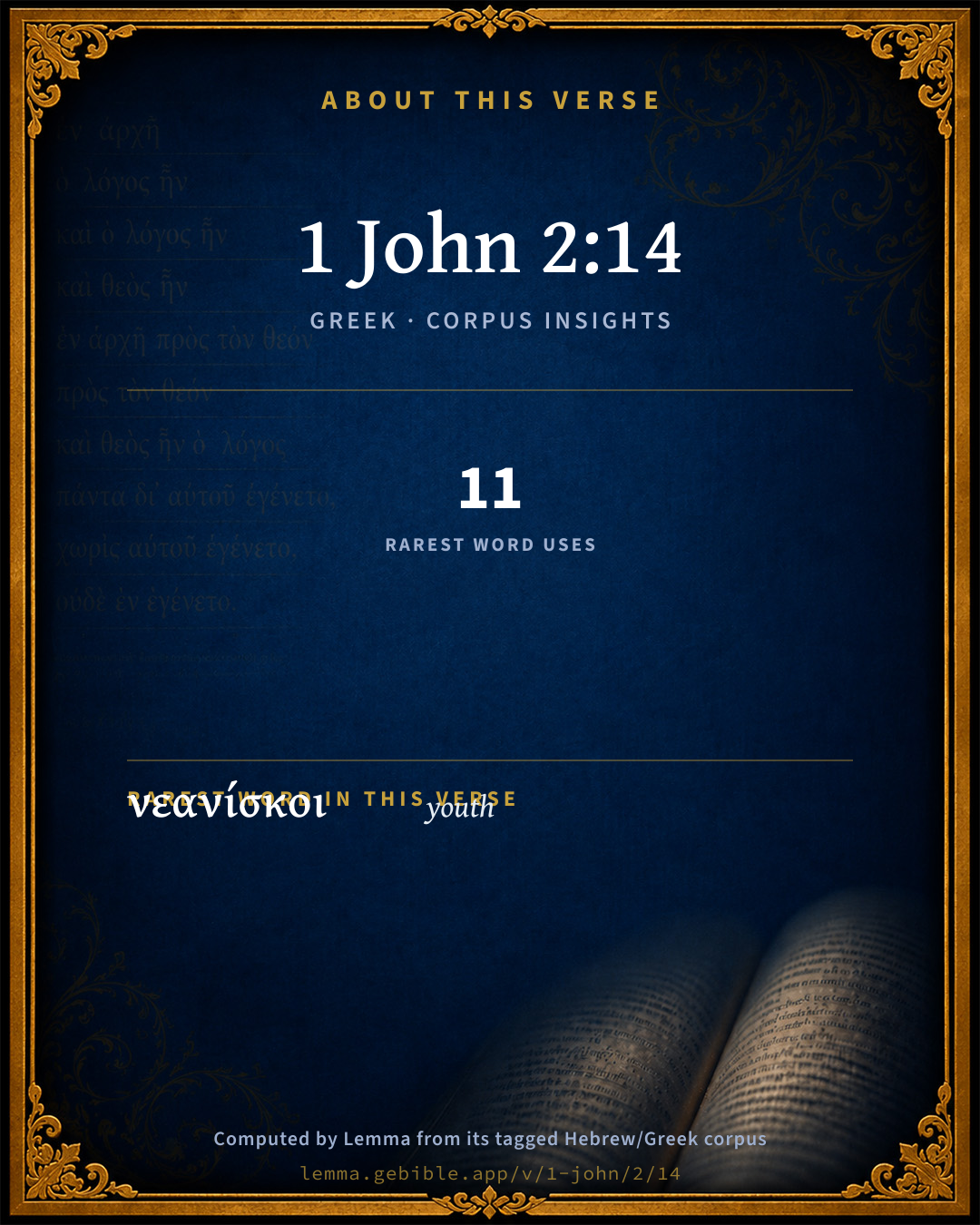
1 John 2:14

Greek (Tischendorf 8th ed.) 1 John 2:14 appears in the Greek New Testament. The text above is from the Tischendorf 8th edition. Each word links to its Strong’s number and a concise gloss. Click any word for its full Thayer’s Greek Lexicon entry.
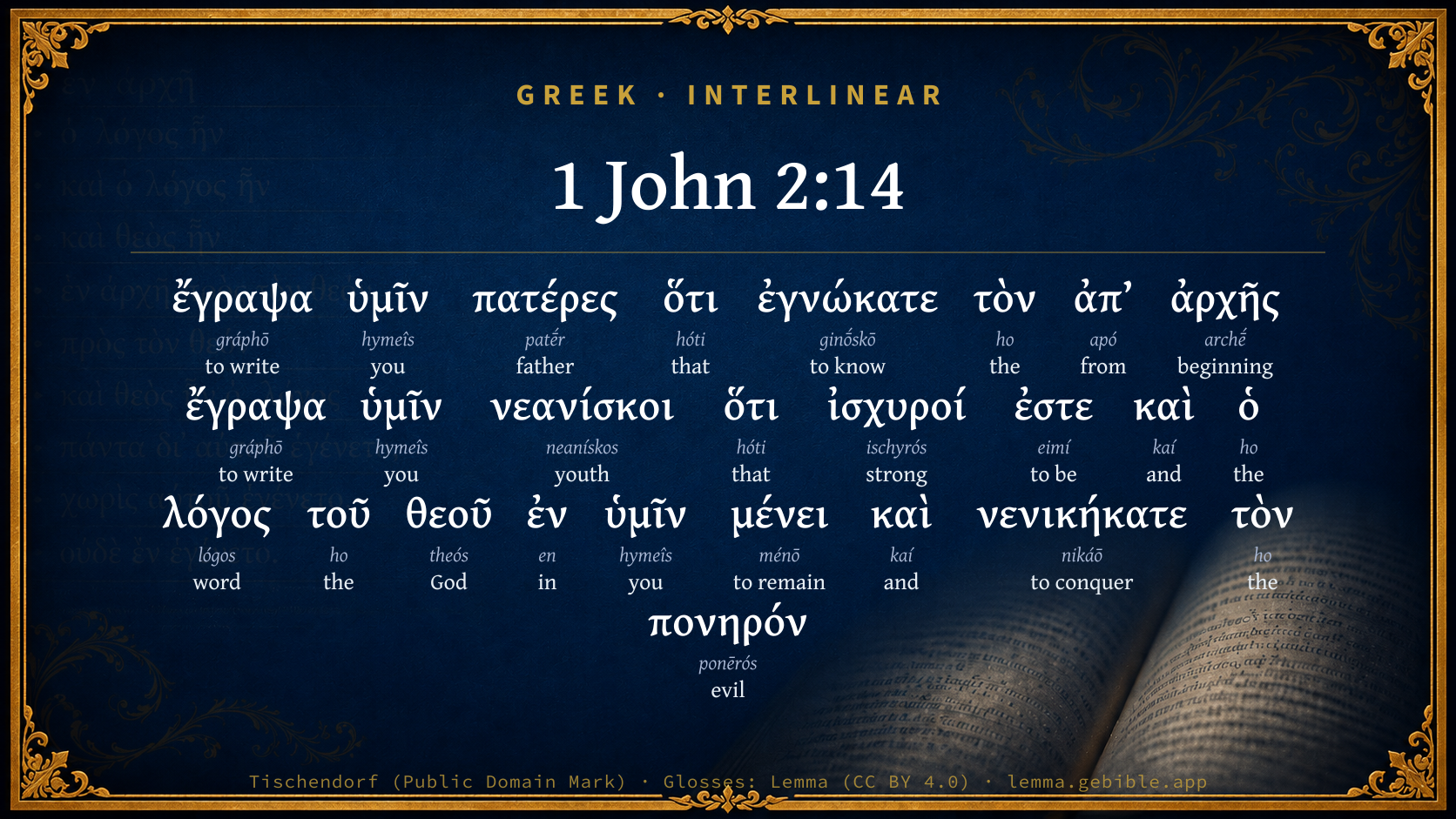
Download image
Cite this verse

1 John 2:14 (World English Bible). Public Domain. Lemma interlinear Bible study tool, https://lemma.gebible.app/v/1-john/2/14.

Show BibTeX & RIS
BibTeX
RIS
English Translation
I have written to you, fathers, because you know him who is from the beginning. I have written to you, young men, because you are strong, and the word of God remains in you, and you have overcome the evil one.
World English Bible · Public Domain
Download a study sheet

One document with this verse’s original text, its word-by-word gloss line, the meaning frame, cross-references with their text, attributed commentary, and full source and license credits — printable, and it pastes into notes with its structure intact.

This verse Autodidact and up

Study sheet (.html) Plain text (.txt)

A passage Seminary Student

Up to 50 verses in one chapter. A passage sheet keeps up to 6 commentary sources and 12 cross-references per verse, in the order this page ranks them, and says so on the sheet whenever that leaves anything out. Ask for a single verse and you get the Autodidact verse sheet above.

Everything on this page stays free to read, with no account — the sheet is a download of what is already on screen, not access to it.

Want to remove ads? Support Godless Engineer
Compare translations 3

The same verse in 3 English versions, stacked beneath the original-language interlinear above. Click any original word for its lexicon entry.

Each is an independent rendering of the whole verse — the interlinear is not word-aligned to these translations.

Highlighted words mark where these versions differ — a whole-verse word diff, not a word-by-word alignment.

  • World English Bible Public Domain
    I have written to you, fathers, because you know him who is from the beginning. I have written to you, young men, because you are strong, and the word of God remains in you, and you have overcome the evil one.
  • King James Version Public Domain
    I have written unto you, fathers, because ye have known him that is from the beginning. I have written unto you, young men, because ye are strong, and the word of God abideth in you, and ye have overcome the wicked one.
  • unfoldingWord Literal Text CC BY-SA 4.0
    I have written to you, young children, because you know the Father. I have written to you, fathers, because you know the one from the beginning. I have written to you, young men, because you are strong, and the word of God remains in you, and you have triumphed over the evil one.

unfoldingWord Literal Text — © unfoldingWord, licensed CC BY-SA 4.0. Word-aligned USFM3 via Door43 (git.door43.org/unfoldingWord/en_ult).

Versions to compare (up to 4)

3 of 4 selected

Show all 19 translations

Every available English version of this verse, each an independent rendering of the whole verse.

  • World English Bible Public Domain
    I have written to you, fathers, because you know him who is from the beginning. I have written to you, young men, because you are strong, and the word of God remains in you, and you have overcome the evil one.
  • Berean Standard Bible Public Domain
    I have written to you, fathers, because you know Him who is from the beginning. I have written to you, young men, because you are strong, and the word of God abides in you, and you have overcome the evil one.
  • Majority Standard Bible Public Domain
    I have written to you, fathers, because you know Him who is from the beginning. I have written to you, young men, because you are strong, and the word of God abides in you, and you have overcome the evil one.
  • King James Version Public Domain
    I have written unto you, fathers, because ye have known him that is from the beginning. I have written unto you, young men, because ye are strong, and the word of God abideth in you, and ye have overcome the wicked one.
  • American Standard Version (1901) Public Domain
    I have written unto you, fathers, because ye know him who is from the beginning. I have written unto you, young men, because ye are strong, and the word of God abideth in you, and ye have overcome the evil one.
  • Revised Version (1885) Public Domain
    I have written unto you, fathers, because ye know him which is from the beginning. I have written unto you, young men, because ye are strong, and the word of God abideth in you, and ye have overcome the evil one.
  • Geneva Bible (1599) Public Domain
    I haue written vnto you, fathers, because ye haue knowen him, that is from the beginning. I haue written vnto you, yong men, because ye are strong, and the worde of God abideth in you, and ye haue ouercome that wicked one.
  • Douay-Rheims (1899) Public Domain
    I write unto you, babes, because you have known the Father. I write unto you, young men, because you are strong, and the word of God abideth in you, and you have overcome the wicked one.
  • Young's Literal Translation Public Domain
    I did write to you, fathers, because ye have known him who `is' from the beginning; I did write to you, young men, because ye are strong, and the word of God in you doth remain, and ye have overcome the evil.
  • Literal Standard Version CC BY-SA 4.0
    I wrote to you, fathers, because you have known Him who [is] from the beginning; I wrote to you, young men, because you are strong, and the word of God remains in you, and you have overcome the evil [one].
  • Unlocked Literal Bible CC BY-SA 4.0
    I have written to you, fathers, because you know the one who is from the beginning. I have written to you, young men, because you are strong, and the word of God remains in you, and you have overcome the evil one.
  • unfoldingWord Literal Text CC BY-SA 4.0
    I have written to you, young children, because you know the Father. I have written to you, fathers, because you know the one from the beginning. I have written to you, young men, because you are strong, and the word of God remains in you, and you have triumphed over the evil one.
  • Darby Bible Public Domain
    I have written to you, fathers, because ye have known him [that is] from the beginning. I have written to you, young men, because ye are strong, and the word of God abides in you, and ye have overcome the wicked [one].
  • World Messianic Bible Public Domain
    I have written to you, fathers, because you know him who is from the beginning. I have written to you, young men, because you are strong, and the word of God remains in you, and you have overcome the evil one.
  • Webster's Bible Public Domain
    I have written to you, fathers, because ye have known him that is from the beginning. I have written to you, young men, because ye are strong, and the word of God abideth in you, and ye have overcome the wicked one.
  • Free Bible Version CC BY-SA 4.0
    I write to you little children, for you know the Father. I write to you fathers, for you know him who has existed from the beginning. I write to you young people, for you are strong. The word of God lives in you, and you have defeated the evil one.
  • Bible in Basic English Public Domain
    I have sent a letter to you, fathers, because you have knowledge of him who was from the first. I have sent a letter to you, young men, because you are strong, and the word of God is in you, and because you have overcome the Evil One.
  • Text-Critical English NT CC BY 4.0
    I have written to you, fathers, because you know him who is from the beginning. I have written to you, young men, because you are strong, and the word of God abides in you, and you have overcome the evil one.
  • Tyndale New Testament (1534) Public Domain
    I wryte vnto you fathers how that ye have knowe him that was from the begynnynge. I wryte vnto you youge men how that ye are stronge: and the worde of God abydeth in you and ye have overcome that wicked.

Literal Standard Version (2020), Covenant Press — licensed CC BY-SA 4.0. Text via the HelloAO Bible API (eBible.org). Unlocked Literal Bible (unfoldingWord) — licensed CC BY-SA 4.0. Text via the HelloAO Bible API (eBible.org). unfoldingWord Literal Text — © unfoldingWord, licensed CC BY-SA 4.0. Word-aligned USFM3 via Door43 (git.door43.org/unfoldingWord/en_ult). Free Bible Version, Dr. Jonathan Gallagher — licensed CC BY-SA 4.0. Text via the HelloAO Bible API (eBible.org).

Word by word

More ways to search: Search by grammar → Find every occurrence → Compare this word →

Practice this passage: Drill this verse → Learn its vocabulary →

νεανίσκοι
neanískos
G3495
“youth”
Noun, Vocative, Plural, Masculine
Part of Speech
Noun
Case
Vocative
Number
Plural
Gender
Masculine
Full Thayer's Definition

Origin: from the same as G3494

TDNT: None

1. a young man, youth a. used of a young attendant or servant
  1. ἔγραψα gráphō G1125 “to write” Verb, Aorist, Active, Indicative, 1st person, Singular
  2. ὑμῖν hymeîs G5210 “you” Personal pronoun, 2nd person, Dative, Plural
  3. πατέρες patḗr G3962 “father” Noun, Vocative, Plural, Masculine
  4. ὅτι hóti G3754 “that” Conjunction
  5. ἐγνώκατε ginṓskō G1097 “to know” Verb, Perfect, Active, Indicative, 2nd person, Plural
  6. τὸν ho G3588 “the” Article, Accusative, Singular, Masculine
  7. ἀπ’ apó G575 “from” Preposition
  8. ἀρχῆς archḗ G746 “beginning” Noun, Genitive, Singular, Feminine
  9. ἔγραψα gráphō G1125 “to write” Verb, Aorist, Active, Indicative, 1st person, Singular
  10. ὑμῖν hymeîs G5210 “you” Personal pronoun, 2nd person, Dative, Plural
  11. ὅτι hóti G3754 “that” Conjunction
  12. ἰσχυροί ischyrós G2478 “strong” Adjective, Nominative, Plural, Masculine
  13. ἐστε eimí G1510 “to be” Verb, Present, Active, Indicative, 2nd person, Plural
  14. καὶ kaí G2532 “and” Conjunction
  15. ὁ ho G3588 “the” Article, Nominative, Singular, Masculine
  16. λόγος lógos G3056 “word” Noun, Nominative, Singular, Masculine
  17. τοῦ ho G3588 “the” Article, Genitive, Singular, Masculine
  18. θεοῦ theós G2316 “God” Noun, Genitive, Singular, Masculine
  19. ἐν en G1722 “in” Preposition
  20. ὑμῖν hymeîs G5210 “you” Personal pronoun, 2nd person, Dative, Plural
  21. μένει ménō G3306 “to remain” Verb, Present, Active, Indicative, 3rd person, Singular
  22. καὶ kaí G2532 “and” Conjunction
  23. νενικήκατε nikáō G3528 “to conquer” Verb, Perfect, Active, Indicative, 2nd person, Plural
  24. τὸν ho G3588 “the” Article, Accusative, Singular, Masculine
  25. πονηρόν ponērós G4190 “evil” Adjective, Accusative, Singular, Masculine

About this verse

These counts appear in no published source. They are computed here, from the morphology-tagged text and Lemma’s own curated glosses. What Lemma adds →

26
words
18
distinct lemmas
General Epistles
section

Notable vocabulary

The rarest word here is νεανίσκοι youth G3495 — appearing just 11 times in the whole Greek New Testament.

Shared distinctive vocabulary

νεανίσκοι youth G3495 occurs in 11 verses of the Greek New Testament. Also found in:

Repetition

Words recur within this verse:

  • ἔγραψα to write G1125 ×2
  • τὸν the G3588 ×4
  • ὑμῖν you G5210 ×3
  • ὅτι that G3754 ×2
  • καὶ and G2532 ×2

Cross-references

16

Topical passages linked to 1 John 2:14 in the Treasury of Scripture Knowledge — connected by theme and wording, ordered by reader-vote popularity; previews shown in the World English Bible.

  • Psalms 119:11 I have hidden your word in my heart, That I might not sin against you.
  • 1 John 2:13 I write to you, fathers, because you know him who is from the beginning. I write to you, young men, because you have overcome the evil one. I write to you, little children, because you know the Father.
  • Colossians 3:16 Let the word of Christ dwell in you richly; in all wisdom teaching and admonishing one another with psalms, hymns, and spiritual songs, singing with grace in your heart to the Lord.
  • John 15:7 If you remain in me, and my words remain in you, you will ask whatever you desire, and it will be done for you.
  • Ephesians 6:10 Finally, be strong in the Lord, and in the strength of his might.
  • John 8:31 Jesus therefore said to those Jews who had believed him, "If you remain in my word, then you are truly my disciples.
  • John 5:38 You don't have his word living in you; because you don't believe him whom he sent.
  • Revelation 2:7 He who has an ear, let him hear what the Spirit says to the assemblies. To him who overcomes I will give to eat of the tree of life, which is in the Paradise of my God.
  • Hebrews 8:10 "For this is the covenant that I will make with the house of Israel. After those days," says the Lord; "I will put my laws into their mind, I will also write them on their heart. I will be to them a God, And they will be to me a people.
  • 2 John 1:2 for the truth's sake, which remains in us, and it will be with us forever:
  • 3 John 1:3 For I rejoiced greatly, when brothers came and testified about your truth, even as you walk in truth.
  • Colossians 1:11 strengthened with all power, according to the might of his glory, for all endurance and perseverance with joy;
  • Philippians 4:13 I can do all things through Christ, who strengthens me.
  • 2 Timothy 2:1 You therefore, my child, be strengthened in the grace that is in Christ Jesus.
  • Revelation 2:3 You have perseverance and have endured for my name's sake, and have not grown weary.
  • 1 John 1:10 If we say that we haven't sinned, we make him a liar, and his word is not in us.

Cross-references courtesy of OpenBible.info (CC BY 4.0).

Commentary

Notes on 1 John 2:14 from classic Christian and Jewish commentators (each source and its license shown beneath its notes). The classic Christian expositions comment on the surrounding passage and are grouped to its opening verse, so a note may address several verses; the Jewish commentaries on the Tanakh (Rashi and others) are per-verse, so they appear only where the commentator wrote on this verse.

Lemma curates 59 commentaries, every one of them public domain or Creative Commons licensed, each selected and text-cleaned for this edition rather than reprinted as found. About our sources →

Joseph Benson's Commentary

1Jn 2:14. I have written, &c. — He repeats almost the same words, in order that they might the more regard them. As if he had said, Observe well what I now write. He speaks very briefly and modestly to those who needed not much to be said to them, as having that deep acquaintance with God, which comprises all necessary knowledge; young men, ye are strong — In God and his grace, Eph 6:10; in faith, hope, love, and in prayer; and the word of God abideth in you — Deeply rooted in your hearts, whereby you have often foiled your great adversary. Macknight thus paraphrases the verse: “Old Christians, I have written to you to walk even as Christ walked, (1Jn 2:6,) by loving your brethren as he loved you, 1Jn 2:8; because ye have known him from the beginning, and have been deeply affected with the knowledge of his love. Vigorous Christians, I have written the same precept to you, (1Jn 2:8,) because ye are strong in all the Christian virtues, through the word of God abiding in you, and ye have already overcome the devil.”

Joseph Benson's Commentary on the Old and New Testaments (1811–1818) — public domain. Text from a community e-Sword module.

MacLaren's Expositions of Holy Scripture

Alexander MacLaren

1 John

YOUTHFUL STRENGTH

1Jn 2:14.

‘What am I going to be?’ is the question that presses upon young people stepping out of the irresponsibilities of childhood into youth. But, unfortunately, the question is generally supposed to be answered when they have fixed upon a trade or profession. It means, rightly taken, a great deal more than that. ‘What am I going to make of myself?’ ‘What ideal have I before me, towards which I constantly press?’ is a question that I would fain lay upon the hearts of all that now hear me. For the misery and the reason of the failure of so many lives is simply that people have never fairly looked that question in the face and tried to answer it, but drift and drift, and let circumstances determine them. And, of course, in a world like this, such people are sure to turn out what such an immense number of people do turn out, failures as far as all God’s purposes with humanity are concerned. The absence of a clear ideal is the misery and the loss of all young people who do not possess it.

So here in my text is an old man’s notion of what young men ought to be and may be. ‘Ye are strong, and the word of God abideth in you, and ye have overcome the wicked one.’

So said the aged John to some amongst his hearers in these corrupt Asiatic cities. It was not merely a fair ideal painted upon vacancy, but it was a portrait of actual young Christians in these little Asiatic churches. And I would fain have some of you take this realised ideal for yours and see to it that your lives be conformed to it.

There are three points here. The Apostle, first of all, lays his finger upon the strength, which is something more than mere physical strength, proper to youth. Then he lets us see the secret source of that strength: ‘Ye have the word of God abiding in you.’ And then he shows the field on which it should be exercised, and the victory which it secures: ‘And ye have overcome the wicked one.’ Now let me touch upon these three points briefly in succession.

I. First, then, note here the strength which you young people ought to covet and to aim at.

It is not merely the physical strength proper to their age, nor the mere unworn buoyancy and vigour which sorrows and care and responsibilities have not thinned and weakened. These are great and precious gifts. We never know how precious they are until they have slipped away from us. These are great and precious gifts, to be preserved as long as may be, by purity and by moderation, and to be used for high and great purposes. But the strength that is in thews and muscles is not the strength that the Apostle is speaking about here, nor anything that belongs simply to the natural stage of your development, whether it be purely physical or purely mental. Samson was a far weaker man than the poor little Jew ‘whose bodily presence was weak and his speech contemptible,’ and who all his days carried about with him that ‘thorn in the flesh.’ It is not your body that is to be strong, but yourselves.

Now the foundation of all true strength lies here, in a good, strong will. In this world, unless a man has learned to say ‘No!’ and to say it very decidedly, and to stick to it, he will never come to any good. Two words contain the secret of noble life: ‘Resist!’ and ‘Persist!’ And the true strength of manhood lies in this mainly, that, in spite of all antagonisms, hindrances, voices, and things that array themselves against you, having greatly resolved, you do greatly do what you have resolved, and having said ‘I will!’ let neither men nor devils lead you to say, ‘I will not.’ Depend upon it, that to be weak in this direction is to be weak all through. Strong passions make weak men. And a strong will is the foundation, in this wicked and antagonistic world in which we live, of all real strength.

But then the strength that I would have you seek, and strive to cultivate, must be a strength of will founded upon strong reason. Determination unenlightened is obstinacy, and obstinacy is weakness. A mule can beat you at that: ‘Be ye not as the mule, which have no understanding.’ A determination which does not take into its view all the facts of the case, nor is influenced by these, has no right to call itself strength. It is only, to quote a modern saying--I know not whether true of the person to whom it was originally applied or no--is ‘only a lath painted to look like iron.’ Unintelligent obstinacy is folly, like the conduct of some man who sticks to his pick and his task in a quarry after the bugle has warned him of an impending explosion, which will blow him to atoms.

But that is not all. A strong will, illuminated by a strong beam of light from the understanding, must be guided and governed by a strong hand put forth by Conscience. ‘I should like’ is the weakling’s motto. ‘I will’ may be an obstinate fool’s motto. ‘I ought, therefore, God helping me, and though the devil hinders me, I will,’ is a man’s. Conscience is king. To obey it is to be free; to neglect it is to be a slave.

Is not this a better ideal for life than gathering any outward possessions, however you may succeed therein? A thousand things will have to be taken into account, and may help or may hinder outward prosperity and success. But nobody can hinder you working at your character and succeeding in making it what it ought to be; and to form character is the end of life. ‘To be weak is miserable, doing or suffering.’ Ay! that is true, though Milton put it into the devil’s mouth. And there is only one strength that will last, ‘for even the youths shall faint and be weary, and the young men shall utterly fail.’ But the strength of a fixed and illuminated and conscience-guided will, which governs the man and is governed by God, shall never faint or grow weak. This is the strength which we should seek, and which I ask you to make the conscious aim of your lives.

II. Now note, secondly, how to get it.

‘Ye are strong, and the Word of God abideth in you.’ Those young Asiatic Christians, that John had in his eye, had learned the secret and the conditions of this strength; and not only in limb and sinew, or in springy and elastic buoyancy of youthful, mental, and spiritual vigour were they strong, but they were so because ‘the Word of God abode in them.’ Now, there are two significations of that great expression, both of them frequent in John’s Gospel, and both of them, I think, transferred to this Epistle, each of which may yield us a word of counsel. By ‘the Word of God,’ as I take it, is meant--perhaps I ought to say both, but, at all events, either--the revelation of God’s truth in Holy Scripture, or the personal revelation of the will and nature of God in Jesus Christ our Lord. Whichever of these two meanings--and at bottom they come to be one--we attach to this expression, we draw from them an exhortation. Let me put this very briefly.

Let me say to you, then, if you want to be strong, let Scripture truth occupy and fill and be always present to your mind. There are powers to rule and to direct all conduct, motive powers of the strongest character in these great truths of God’s revelation. They are meant to influence a man in all his doings, and it is for us to bring the greatest and solemnest of them to bear on the smallest things of our daily life. Suppose, now, that you go to your work, and some little difficulty starts up in your path, or some trivial annoyance ruffles your temper, or some lurking temptation is suddenly sprung upon you. Suppose your mind and heart were saturated with God’s truth, with the great thoughts of His being, of His love, of His righteousness, of Christ’s death for you, of Christ’s presence with you, of Christ’s guardianship over you, of Christ’s present will that you should walk in His ways, of the bright hopes of the future, and the solemn vision of that great White Throne and the retribution that streams thence, do you think it would be possible for you to fall into sin, to yield to temptation, to be annoyed by any irritation or bother, or overweighted by any duty? No! Whosoever lives with the thoughts that God has given us in His Word familiar to His mind and within easy reach of His hand, has therein an armlet against all possible temptation, a test that will unveil the hidden corruption in the sweetest seductions, and a calming power that will keep his heart still and collected in the midst of agitations. If the Word of God in that lower sense of the principles involved in the gospel of Jesus Christ, dwell in your hearts, the fangs are taken out of the serpent. If you drink any deadly thing it shall not hurt you, and you will ‘be strong in the Lord and in the power of His might.’

Bring the greatest truths you can find to bear on the smallest duties, and the small duties will grow great to match the principles by which they are done. Bring the laws of Jesus Christ down to the little things, for, in the name of common sense, if our religion is not meant to regulate trifles, what is it meant to regulate? Life is made up of trifles. There are half a dozen crises in the course of your life, but there are a thousand trivial things in the course of every day. It would be a poor kind of regulating principle that controlled the crises, and left us alone to manage with the trifles the best way we could.

But in order that there shall be this continual operation of the motives and principles involved in the gospel upon our daily lives, we must have them very near our hand, ready to be laid hold of. The soldier that would march through an enemy’s country, having left his gun in the hands of some camp follower, would be very likely to be shot before he got his gun. I remember going through the Red Sea; at the mouth of it where the entrance is narrow, and the currents run strong, when the ship approaches the dangerous place, the men take their stations at appointed places, and the ponderous anchors are loosened and ready to be dropped in an instant if the swirl of the current sweeps the ship into dangerous proximity to the reef. It is no time to cut the lashings of the anchors when the keel is grating on the coral rocks. And it is no time to have to look about for our weapons when the sudden temptation leaps upon us like a strong man armed. You must have them familiar to you by devout meditation, by frequent reflection, prayer, study of God’s Word, if they are to be of any use to you at all. And I am afraid that about the last book in the world that loads of young men and women think of sitting down to read, systematically and connectedly, is the Bible. You will read sermons and other religious books; you will read newspapers, pamphlets, novels; but the Scripture, in its entirety, is a strange book to myriads of men who call themselves Christians. And so they are weak. If you want to be strong, ‘let the Word of God abide in your hearts.’

And then if we take the other view, which at bottom is not another, of the meaning of this phrase, and apply it rather to the personal word, Jesus Christ Himself, that will yield us another exhortation, and that is, let Jesus Christ into your hearts and keep Him there, and He will make you strong. I believe that it is no piece of metaphor or an exaggerated way of putting the continuance of the influence of Christ’s example and Christ’s teaching upon men’s hearts and minds, when He tells us that ‘if any man open the door He will come in and sup with him.’ I want to urge the one thought on you that it is possible, in simple literal fact, for that Divine Saviour, who was ‘in Heaven’ whilst He walked on earth, and walks on earth to-day when He has returned to His native Heaven, to enter into my spirit and yours, and really to abide within us, the life of our lives, ‘the strength of our hearts, and our portion for ever.’ The rest of us can render help to one another by strength ministered from without; Jesus Christ will come into your hearts, if you let Him, in His very sweetness and omnipotence of power, and will breathe His own grace into your weakness, strengthening you as from within. Others can help you from without, as you put an iron band round some over-weighted, crumbling brick pillar in order to prevent it from collapsing, but He will pass into us as you may drive an iron rod up through the centre of the column, and make it strong inside, and we shall be strong if Jesus Christ dwells within us. Open the door, dear young friends; let Christ come into your hearts, which He will do if you do not hinder Him, and if you ask Him. Trust Him with simple reliance upon Him for everything. Faith is ‘the door’; the door is nothing of itself, but when it is opened it admits the guest. So do you let that Master come and abide, and you will hear Him say to you, as He said of old, ‘Child! My grace is sufficient.’ How modest He is. Sufficient!--an ocean enough to fill a thimble! ‘My grace is sufficient for thee; and My strength is made perfect in weakness.’

III. Now, lastly, notice the field on which the strength is to be exercised, and the victory which it secures. ‘Ye have overcome the wicked one.’

There is a battle for us all, on which I need not dwell, the conflict with evil around and with evil within, and with the prince of the embattled legions of the darkness, whom the New Testament has more clearly revealed to us. You young people have many advantages in the conflict; you have some special disadvantages as well. You have strong passions, you have not much experience, you do not know how bitter the dregs are of the cup whose foaming bubbles look so attractive, and whose upper inch tastes so sweet. But on the other hand you have not yet contracted habits that it is misery to indulge in, and, as it would seem, impossible to break, and the world is yet before you.

You cannot begin too soon to choose your side. And here is the side on which alone victory is possible for a man--the side of Jesus Christ, who will teach your hands to war and your fingers to fight.

Notice that remarkable phrase, ‘Ye have overcome the wicked one.’ He is talking to young Christians before whom the battle may seem to lie, and yet He speaks of their conquest as an accomplished fact, and as a thing behind them. What does that mean? It means this, that if you will take service in Christ’s army, and by His grace resolve to be His faithful soldier till your life’s end, that act of faith, which enrols you as His, is itself the victory which guarantees, if it be continued, the whole conquest in time.

There used to be an old superstition that--

‘Who sheds the foremost foeman’s life

His party conquers in the strife’;

and whosoever has exercised, however imperfectly and feebly, the faith in Jesus Christ the Lord has therein conquered the devil and all his works, and Satan is henceforth a beaten Satan, and the battle, in essence, is completed even in the act of its being begun.

‘This is the victory that overcometh the world, even our faith’; not only because our confidence in Jesus Christ is the blowing of the bugle that summons to warfare and shakes off the tyrant’s yoke, but it is also the means by which we join ourselves to Him who has overcome, and make His victory ours. He has fought our antagonist in the wilderness once, in Gethsemane twice, on the Cross thrice; and the perfect conquest in which Jesus bound the strong man and spoiled his goods may become, and will become, your conquest, if you wed yourselves to that dear Lord by simple faith in Him.

What a priceless thing it is that you may begin your independent manhood with a conquest that will draw after it ultimate and supreme victory. You will still have to fight, but you will have only to fight detachments. If you trust yourselves to Jesus Christ you have conquered the main body of the army, and it is only the stragglers that you will have to contend with hereafter. He that loves Jesus, and has given himself to Him, has pinned the dragon to the ground by its head, and though it may ‘swinge the scaly horror of its folded tail,’ and twine its loathly coils around him, yet he has conquered, and he is conquering, and he will conquer. Only let him hold fast by the hand which brings strength into him by its touch.

Will you, dear young friends, take service in this army? Do you want to be weak or strong? Do you want your lives to be victorious whatever may happen to them in the way of outward prosperity or failure? Then give yourselves to this Lord. His voice calls you to be His soldiers. He will cover your heads in the day of battle. He will strengthen you ‘with might by His Spirit in the inner man.’ He will hide His Word in your heart that you offend not against Him. He will dwell Himself within you to make you strong in your extremest weakness and victorious over your mightiest foe; and in that sign you will conquer and ‘be more than conquerors through Him that loved you.’

Oh, I pray that you may ask yourselves the question, ‘What am I going to be?’ and may answer it, ‘I am going to be strong in the Lord and in the power of His might’; and to overcome, as He also hath overcome, the world and the flesh and the devil.

Alexander MacLaren, Expositions of Holy Scripture (1904–1910) — public domain. Text from a community e-Sword module.

Bengel's Gnomon

Johann Albrecht Bengel

1Jn 2:14. Ἔγραψα, I have written) In 1Jn 2:13-14, he passes from I write to I have written: and not without reason. For by transposing the verb of writing from the present to the past, he suggests a most strong admonition.—ὅτι) because.—ἐγνώκατε τὸν ἀπʼ ἀρχῆς, ye have known Him who is from the beginning) He who is from the beginning is Jesus Christ. Ἀρχὴ is not the beginning of the Gospel, but the beginning of all things: ch. 1Jn 1:1, note. Artemon objects, that God the Father might also be thus spoken of: Part ii. c. 13. I reply, Why not? But the figure Antonomasia is frequently employed by John, when he speaks of Christ. Comp. 1Jn 2:20. The fathers, as well as the apostle, were already alive at that time, in which Jesus Christ had been conspicuous on earth: and some of them, as it is probable, had known Him both in person and by faith. Comp. ch. 1Jn 3:6, note; 1Co 15:6; Mat 13:16. Certainly all had known Him by faith, and had seen that golden age of the Church, to which the age of the younger men, who ought to avoid antichrists, is opposed. John repeats this clause from the preceding verse, without the addition of more words, subjoining to the statement a treatment of the subject equally brief, and using modesty towards the fathers, to whom it was not necessary that many things should be written. The knowledge of even these respecting Christ is very great, comprising all things. Knowledge is assigned to fathers and children; strength to young men.—ἰσχυροὶ, strong) Other young men are strong in body; you, in faith.—ὁ λόγος τοῦ Θεοῦ, the Word of God) from which is strength: ch. 1Jn 4:4.—ἐν ὑμῖν μένει, abideth in you) Nor can the Evil One tear it away from you, nor does Antichrist endanger you.—τὸν πονηρὸν, the Evil One) who especially lies in wait for youth. John appears to refer to a certain remarkable instance of virtue exhibited by the young men to whom he writes. Of this nature was their constancy in confession in the persecution of Domitian; and also the return of that young man, whom the apostle, with the greatest gentleness, led back from robbery to repentance (although the apostle made that expedition not until he had returned from Patmos: comp. 1Jn 2:22, note), as it is most pleasantly described by Clement of Alexandria, in his treatise, What rich man can be saved? ch. 42; by Eusebius, Eccle. Hist., Book iii. 20; and by Chrysostom, in his 1st Exhortation to the fallen Theodore, ch. 11.

Bengel's Gnomon of the New Testament — English translation (T&T Clark, Edinburgh, 1860) — public domain. Text from a community e-Sword module.

Expositor's Greek Testament

ed. W. Robertson Nicoll

1Jn 2:14 . The Apostle gives the same reason as before for writing to the fathers, as though there could be none greater. He gives the same reason also for writing to the young men, but he amplifies it: they have the strength of youth, but it is disciplined by the indwelling Word, and therefore they have conquered.

The Expositor's Greek Testament, edited by W. Robertson Nicoll (1897–1910) — public domain. Text from a community e-Sword module.

Geneva Bible (1599)

Geneva Bible translators

He addeth afterward in like order, as many exhortations, as if he should say, Remember your fathers: as I wrote even now, that the everlasting Son of God is revealed to us. Remember ye young men, that that strength whereby I said that you put Satan to flight, is given you by the word of God, which dwelleth in you.

Geneva Bible (1599) marginal notes — public domain. Text via Bolls.life.

Jamieson, Fausset & Brown

Robert Jamieson, A. R. Fausset & David Brown

young men . . . strong--made so out of natural weakness, hence enabled to overcome "the strong man armed" through Him that is "stronger." Faith is the victory that overcomes the world. This term "overcome" is peculiarly John's, adopted from his loved Lord. It occurs sixteen times in the Apocalypse, six times in the First Epistle, only thrice in the rest of the New Testament. In order to overcome the world on the ground, and in the strength, of the blood of the Saviour, we must be willing, like Christ, to part with whatever of the world belongs to us: whence immediately after "ye have overcome the wicked one (the prince of the world)," it is added, "Love not the world, neither the things . . . in the world."

and, &c.--the secret of the young men's strength: the Gospel word, clothed with living power by the Spirit who abideth permanently in them; this is "the sword of the Spirit" wielded in prayerful waiting on God. Contrast the mere physical strength of young men, Isa 40:30-31. Oral teaching prepared these youths for the profitable use of the word when written. "Antichrist cannot endanger you (Jo1 2:18), nor Satan tear from you the word of God."

the wicked one--who, as "prince of this world," enthrals "the world" (Jo1 2:15-17; Jo1 5:19, Greek, "the wicked one"), especially the young. Christ came to destroy this "prince of the world." Believers achieve the first grand conquest over him when they pass from darkness to light, but afterwards they need to maintain a continual keeping of themselves from his assaults, looking to God by whom alone they are kept safe. BENGEL thinks John refers specially to the remarkable constancy exhibited by youths in Domitian's persecution. Also to the young man whom John, after his return from Patmos, led with gentle, loving persuasion to repentance. This youth had been commended to the overseers of the Church by John, in one of his tours of superintendency, as a promising disciple; he had been, therefore, carefully watched up to baptism. But afterwards relying too much on baptismal grace, he joined evil associates, and fell from step to step down, till he became a captain of robbers. When John, some years after, revisited that Church and heard of the youth's sad fall, he hastened to the retreat of the robbers, suffered himself to be seized and taken into the captain's presence. The youth, stung by conscience and the remembrance of former years, fled away from the venerable apostle. Full of love the aged father ran after him, called on him to take courage, and announced to him forgiveness of his sins in the name of Christ. The youth was recovered to the paths of Christianity, and was the means of inducing many of his bad associates to repent and believe [CLEMENT OF ALEXANDRIA, Who Is the Rich Man Who Shall Be Saved? 4.2; EUSEBIUS, Ecclesiastical History, 3.20; CHRYSOSTOM, First Exhortation to Theodore, 11].

Jamieson, Fausset & Brown — Commentary Critical and Explanatory on the Whole Bible (1871) — public domain (CC PDM 1.0). Text via the HelloAO Bible API.

Adam Clarke's Commentary

Verse 14. The word of God abideth in you] Ye have not only thoroughly known and digested the Divine doctrine, but your hearts are moulded into it; ye know it to be the truth of God from the power and happiness with which it inspires you, and from the constant abiding testimony of the Spirit of that truth which lives and witnesses wherever that truth lives and predominates.

Adam Clarke's Commentary on the Bible (1810–1826) — public domain. Text from a community e-Sword/MySword module.

John Calvin's Commentaries

14 I have written unto you, fathers These repetitions I deem superfluous; and it is probable that when unskillful readers falsely thought that he spoke twice of little children, they rashly introduced the other two clauses. It might at the same time be that John himself, for the sake of amplifying, inserted the second time the sentence respecting the young men, (for he adds, that they were strong, which he had not said before;) but that the copyists presumptuously filled up the number.

John Calvin's Commentaries (1540-1563) — public domain. Text from the Calvin Translation Society English edition (1840s-50s) via the Christian Classics Ethereal Library (ccel.org). Calvin's coverage is partial (roughly two-thirds of the Bible); uncommented books and verses are honest gaps, never fabricated. The 19th-century editor's footnotes and remarks are omitted so the notes are faithfully Calvin's own voice.

The Cambridge Bible for Schools and Colleges

gen. ed. J. J. S. Perowne

14. because ye are strong] Strong in the spiritual warfare in which they have already won the victory: comp. Heb_11:34, where, however, ‘strong in war’ probably refers to actual warfare between the Jews and other nations.

the word of God abideth in you] An echo of Joh_15:7. This is the secret of their strength and the source of their victory. They conquer because they are strong, and they are strong because God’s word is ever in their hearts. They have God’s will, especially as revealed in Scripture, and in particular in the Gospel, as a permanent power within them: hence the permanence of their victory. So long as they trust in this and not in themselves, and remember that their victory is not yet final, they may rejoice in the confidence which the consciousness of strength and of victory gives them.

It is plain from the context and from Joh_5:38; Joh_10:35; Joh_17:6; Joh_17:14; Rev_1:9; Rev_6:9, that ‘the word of God’ here does not mean the Word, the Son of God. S. John never uses the term ‘Word’ in this sense in the body either of his Gospel or of his Epistle, but only in the theological Introductions to each.

The Cambridge Bible for Schools and Colleges (gen. ed. J. J. S. Perowne; Cambridge University Press, 1878–1918) — public domain. Text from a community e-Sword module.

John Gill's Exposition

I have written unto you, fathers,.... This, with the reason annexed to it, is repeated, to raise the attention of the aged servants of Christ, and to quicken them to a discharge of their duty, who are apt to abate in their zeal, to grow lukewarm and indifferent, to cleave to the world, and to the things of it, which they are cautioned against in Jo1 2:15. The whole of this, with the reason,

because ye have known him that is from the beginning, is left out in the Vulgate Latin version, and Complutensian edition.

I have written unto you, young men; this repetition to them, with some additions, is also made, to stir them up the more to love the saints, who are too apt to be carried away with the lust of the flesh, the lust of the eyes, and the pride of life, warned against in Jo1 2:16;

because ye are strong; not naturally, for sin has sadly weakened human nature, so that a man, by the strength of nature, can do nothing that is spiritually good: nor in themselves, though regenerated, but in Christ, in whom are righteousness and strength; without whom they can do nothing, though they can do all things through him strengthening them; and so are strong in the exercise of grace on him, and in the performance of every duty, being strengthened by him with strength in their souls:

and the word of God abideth in you; either Christ the Logos, the essential Word of God, who might be said to be in them, and abide in them, because his grace was implanted in their hearts, called Christ, formed there, and because he dwelt in their hearts by faith, and lived in them; and hence they had their strength, or came to be so strong as they were, and also overcame Satan, because he that was in them was greater than he that is in the world: or else the Gospel is meant, which cometh not in word only, but in power, has a place in the heart, and works effectually, and dwells richly there; and this is a means of spiritual strength against sin and temptation, and to perform duty, and to stand fast in the truth against the errors and heresies of men and is that piece of spiritual armour, the sword of the Spirit, by which Satan is often foiled, and overcome: hence it follows,

and ye have overcome the wicked one; See Gill on Jo1 2:13.

John Gill's Exposition of the Whole Bible (1746–1763) — public domain (CC PDM 1.0). Text via the HelloAO Bible API.

Trapp's Complete Commentary

John Trapp

14 I have written unto you, fathers, because ye have known him that is from the beginning. I have written unto you, young men, because ye are strong, and the word of God abideth in you, and ye have overcome the wicked one.

Ver. 14. Because ye have known him] The same again as 1Jn 2:13, which to a carnal heart may seem superfluous. Et certe si humano ingenio conscripti essent libri illi, quos pro sacris (ira ut verissime sunt) agnoscimus et veneramur, bonum alicubi dormitasse Homerum disceremus, said one. But far be it from us to reprehend what we cannot comprehend.

John Trapp, A Commentary or Exposition upon All the Books of the Old and New Testament (1647–1656) — public domain. Text from a community e-Sword module.

Albert Barnes' Notes on the Bible

I have written unto you, fathers, because ... - The reason assigned here for writing to fathers is the same which is given in the previous verse. It would seem that, in respect to them, the apostle regarded this as a sufficient reason for writing to them, and only meant to enforce it by repeating it. The fact that they had through many years been acquainted with the doctrines and duties of the true religion, seemed to him a sufficient reason for writing to them, and for exhorting them to a steadfast adherence to those principles and duties.

I have written unto you, young men, because ye are strong ... - The two additional circumstances which he here mentions as reasons for writing to young men are, that they are strong, and that the word of God abides in them. The first of these reasons is, that they were strong; that is, that they were qualified for active and useful service in the cause of the Redeemer. Children were yet too young and feeble to appeal to them by this motive, and the powers of the aged were exhausted; but those who were in the vigor of life might be called upon for active service in the cause of the Lord Jesus. The same appeal may be made now to the same class; and the fact that they are thus vigorous is a proper ground of exhortation, for the church needs their active services, and they are bound to devote their powers to the cause of truth. The other additional ground of appeal is, that the word of God abode in them; that is, that those of this class to whom he wrote had showed, perhaps in time of temptation, that they adhered firmly to the principles of religion. They had not flinched from an open defense of the truths of religion when assailed; they had not been seduced by the plausible arts of the advocates of error, but they had had strength to overcome the wicked one. The reason here for appealing to this class is, that in fact they had showed that they could be relied on, and it was proper to depend on them to advocate the great principles of Christianity.

Albert Barnes' Notes on the Bible (1834–1885) — public domain. Text from a community e-Sword/MySword module.

Matthew Poole's English Annotations

To the former sort he only repeateth what he had said before, supposing their greater wisdom to need no more; (see L. Brugens. Not. in Bibl. Sacr. of the insertion of this clause); only the repetition importeth his earnest desire they would again and again consider it. The other he also puts in mind of their active strength and vigour, and of the rootedness which the gospel must now be supposed to have in them, whereby they were enabled to

overcome the wicked one. And by all which endowments they were all both enabled and obliged to comport the better with the following precept, and its enforcements.

Matthew Poole's English Annotations on the Holy Bible (1683–1685) — public domain. Text from a community e-Sword/MySword module.

Whedon's Commentary on the Bible

Daniel D. Whedon

14. Have written—Rather, I wrote. A change of tense from the I write of the last verse. Yet the meaning is probably about the same. The epistolary aorist tense assumed the standpoint of the reading of the epistle, as if saying, while you read this, know that I wrote thus and so. Nevertheless this past tense may be more emphatic than the present. The third address of this triad little children occurs in 1Jn_2:18, where suitable matter occurring reminds the apostle that they should be addressed.

Daniel D. Whedon (gen. ed.), Commentary on the Old and New Testaments (1874–1909) — public domain. Text from a community e-Sword module.

The Pulpit Commentary

The address to the fathers remains unchanged; their claim to Gospel and to Epistle is the same. The address to the young men is enlarged; their claim to the Gospel is that they are strong to fight, have God"s revelation of himself as a permanent possession in their hearts, and have won victories over Satan. The context and Joh_5:38 Joh_10:35 utterly forbid us from understanding oJ logov tou Qeou of the "living Personal Lord". (cf Joh_17:6, Joh_17:14, Joh_17:17; Rev_1:9 Rev_6:9 Rev_20:4)

The Pulpit Commentary (1880–1919), ed. H.D.M. Spence-Jones & Joseph S. Exell — public domain. Text from a community e-Sword module.

John Wesley's Explanatory Notes

I have written to you, fathers - As if he had said, Observe well what I but now wrote. He speaks very briefly and modestly to these, who needed not much to be said to them, as having that deep acquaintance with God which comprises all necessary knowledge. Young men, ye are strong - In faith. And the word of God abideth in you - Deeply rooted in your hearts, whereby ye have often foiled your great adversary.

John Wesley, Explanatory Notes Upon the Whole Bible (1754–1765) — public domain. Text via the GEBible commentary corpus.

The People's New Testament

B. W. Johnson

14. I have written. This verse, imitating the Hebrew parallelism, repeats verses 12 and 13 with slight variations.

B. W. Johnson's The People's New Testament with Notes (1889–1891) — public domain. Electronic text from the Christian Classics Ethereal Library (CCEL) ThML edition.

Cambridge Greek Testament for Schools and Colleges

14. [487] has τὸ ἀπʼ ἀρχῆς. [488] and the Thebaic omit τοῦ θεοῦ. Comp. 1Jn 2:20.

[487] 4th century. Brought to Rome about 1460. It is entered in the earliest catalogue of the Vatican Library, 1475. All three Epistles.

[488] 4th century. Brought to Rome about 1460. It is entered in the earliest catalogue of the Vatican Library, 1475. All three Epistles.

14. Ἰσχυρός is frequent in the Apocalypse; elsewhere in S. John’s writings here only. Comp. Eph 6:10-20.

ὁ λόγος τοῦ Θεοῦ. [565] and the Thebaic or Sahidic Version (2nd or 3rd cent.) omit τοῦ Θεοῦ. In 1Jn 2:20 we again find [566] and the Thebaic alone in a reading which is very likely original: comp. Act 27:37; Rom 13:13; Col 3:6; Heb 3:2; 2Jn 1:8. The clause is an echo of Joh 15:7. This possession is the secret of their strength and the source of their victory. They conquer because they are strong, and they are strong because God’s word is ever in their hearts. They have God’s will, especially as revealed in Scripture, and in particular in the Gospel, as a permanent power within them: hence the permanence of their victory. So long as they trust in this and not in themselves, and remember that their victory is not yet final, they may rejoice in the confidence which the consciousness of strength and of victory gives them. Humiles estote, ne in pugna cadatis (Bede).

[565] 4th century. Brought to Rome about 1460. It is entered in the earliest catalogue of the Vatican Library, 1475. All three Epistles.

[566] 4th century. Brought to Rome about 1460. It is entered in the earliest catalogue of the Vatican Library, 1475. All three Epistles.

It is plain from the context and from Joh 5:38; Joh 10:35; Joh 17:6; Joh 17:14; Rev 1:9; Rev 6:9, that ὁ λόγος τοῦ Θεοῦ here does not mean the Word, the Son of God. See on 1Jn 2:5 and 1Jn 1:10. S. John never uses the term ὁ λόγος in this sense in the body either of his Gospel or of his Epistle, but only in the theological Introductions to each.

Cambridge Greek Testament for Schools and Colleges (Cambridge University Press, 1896; 21 vols, various authors incl. Carr, Maclear, Plummer, Farrar, Lumby, Moule, M. R. James, Simcox) — public domain. Text from a community e-Sword module.

International Critical Commentary

14. For the moment the writer’s thoughts turn back to what he has already written. In what he has already said he has treated them as παιδία, still in need of discipline and guidance. Their faith had not yet grown to maturity. And this was true of all alike, young and old, the thinkers as well as the soldiers of the Society. But it was in virtue of their Christian standing that he could speak to them as he did. In the Jewish Synagogue or in the Christian Church they had all learned to know God as their Father. The elders among them had made real progress in their realization of what the Christ really is. The younger and more active converts had gained the strength which comes of victory over evil. Perhaps they had rendered conspicuous service in the recent crisis. And their powers had matured in the strife. The message of the Gospel was a living force within them, and permanently active. It was abiding in them. There were flaws in the work which needed mending. It had been necessary to treat them, young and old alike, as not yet “grown up.” The false pleas which many among them were only too ready to listen to, if not to urge, must be sharply and clearly exposed. Statements which they might well make, perhaps in some cases had made, must be called quite definitely “lies.” He must not shrink from plain language. But he could never have ventured to use the language which he had not hesitated to address to them, had it not been for the great progress which they had already made in the things of Christ. Strength and experience were really theirs. Reproofs could be uttered and appeals made with full confidence of success. Their Christian faith was sound, even though their hands might be slack, and their minds somewhat listless. For them victory and knowledge were abiding results, and not mere incidents in past history.

ἔγραψα] Cf. the notes on ver. 12. The γράφω of the Received Text is probably due to an attempt to get a series of three in the right order of age, by correctors who failed to grasp the general arrangement of these verses.

εγραψα1o א A B C L P al. 35 cat. sah. cop. syrutr arm. aeth. Or.] γραφω K al. sat. mul. armcdd aliq Oec. fu. demid. harl. Aug.

εγραψα2o … αρχης] om. vg-ed.

εγραψα2o] scribo, vg-ed.

εγραψα3o] scribo, vg-ed.

τον απ αρχης] το απαρχης B.

του θεου] om. B sah.

International Critical Commentary — older volumes (1896–1929), various authors — public domain. Text from a community e-Sword module.

Vincent's Word Studies in the New Testament

Marvin R. Vincent

Him that is from the beginning. The eternal, pre - existent Christ, who was from the beginning (Joh 1:1). The eternal Son, through whom men are brought into the relation of children of God, and learn to know the Father. The knowledge of God involves, on the part of both fathers and children, the knowledge of Christ.

Strong [ισχυροι] . See on was not able, Luk 14:30; I cannot, Luk 16:3.

Marvin R. Vincent, Word Studies in the New Testament (1887–1900) — public domain. Text from a community e-Sword/MySword module.

Lesson kit

Teaching starters — assembled from the data on this page, not authored interpretation. Every prompt links to the verse data it draws on. Edit before teaching.

1 John, in the General Epistles, opens this verse with 26 words (18 distinct Greek lemmas). Its most distinctive word is neanískos (“youth”). A historical commentator’s framing appears above. Read the whole chapter for the surrounding context.

Discussion questions

  1. How does “youth” (neanískos) shape what this verse is saying?
  2. How does Matthew 19:20, which shares the word «youth», read alongside this verse?
  3. What does the repetition of “to write” (2× in this one verse) do in this verse?
  4. These translations render this verse differently. What is at stake in choosing one wording over another?
  5. Compare how Joseph Benson's Commentary and MacLaren's Expositions of Holy Scripture read this verse. Where do they agree or differ?

Things to notice

  • These translations choose different wording for 13 words in this verse.
  • “to write” occurs 2× in this single verse.
  • 18 distinct Greek lemmas span 26 words in this verse.

Reading settings

Reading text

Shown beneath each verse's original-language words.

Old Testament
Old Testament edition

Read the OT as the Masoretic Hebrew (MT) or the Greek Septuagint (LXX).

English shown for the Greek Septuagint (in the Hebrew ↔ Greek comparison).

Comparing translations? Open the Compare panel on any verse page to stack up to four side by side.