1 John 2:5

Greek (Tischendorf 8th ed.) 1 John 2:5 appears in the Greek New Testament. The text above is from the Tischendorf 8th edition. Each word links to its Strong’s number and a concise gloss. Click any word for its full Thayer’s Greek Lexicon entry.
Download image
Cite this verse

1 John 2:5 (World English Bible). Public Domain. Lemma interlinear Bible study tool, https://lemma.gebible.app/v/1-john/2/5.

Show BibTeX & RIS
BibTeX
RIS
English Translation
But whoever keeps his word, God's love has most assuredly been perfected in him. This is how we know that we are in him:
World English Bible · Public Domain
Download a study sheet

One document with this verse’s original text, its word-by-word gloss line, the meaning frame, cross-references with their text, attributed commentary, and full source and license credits — printable, and it pastes into notes with its structure intact.

This verse Autodidact and up

Study sheet (.html) Plain text (.txt)

A passage Seminary Student

Up to 50 verses in one chapter. A passage sheet keeps up to 6 commentary sources and 12 cross-references per verse, in the order this page ranks them, and says so on the sheet whenever that leaves anything out. Ask for a single verse and you get the Autodidact verse sheet above.

Everything on this page stays free to read, with no account — the sheet is a download of what is already on screen, not access to it.

Want to remove ads? Support Godless Engineer
Compare translations 3

The same verse in 3 English versions, stacked beneath the original-language interlinear above. Click any original word for its lexicon entry.

Each is an independent rendering of the whole verse — the interlinear is not word-aligned to these translations.

Highlighted words mark where these versions differ — a whole-verse word diff, not a word-by-word alignment.

  • World English Bible Public Domain
    But whoever keeps his word, God's love has most assuredly been perfected in him. This is how we know that we are in him:
  • King James Version Public Domain
    But whoso keepeth his word, in him verily is the love of God perfected: hereby know we that we are in him.
  • unfoldingWord Literal Text CC BY-SA 4.0
    But whoever keeps his word, in this one truly the love of God has been perfected. In this we know that we are in him:

unfoldingWord Literal Text — © unfoldingWord, licensed CC BY-SA 4.0. Word-aligned USFM3 via Door43 (git.door43.org/unfoldingWord/en_ult).

Versions to compare (up to 4)

3 of 4 selected

Show all 19 translations

Every available English version of this verse, each an independent rendering of the whole verse.

  • World English Bible Public Domain
    But whoever keeps his word, God's love has most assuredly been perfected in him. This is how we know that we are in him:
  • Berean Standard Bible Public Domain
    But if anyone keeps His word, the love of God has been truly perfected in him. By this we know that we are in Him:
  • Majority Standard Bible Public Domain
    But if anyone keeps His word, the love of God has been truly perfected in him. By this we know that we are in Him:
  • King James Version Public Domain
    But whoso keepeth his word, in him verily is the love of God perfected: hereby know we that we are in him.
  • American Standard Version (1901) Public Domain
    but whoso keepeth his word, in him verily hath the love of God been perfected. Hereby we know that we are in him:
  • Revised Version (1885) Public Domain
    but whoso keepeth his word, in him verily hath the love of God been perfected. Hereby know we that we are in him:
  • Geneva Bible (1599) Public Domain
    But hee that keepeth his worde, in him is the loue of God perfect in deede: hereby wee knowe that ye are in him.
  • Douay-Rheims (1899) Public Domain
    But he that keepeth his word, in him in very deed the charity of God is perfected; and by this we know that we are in him.
  • Young's Literal Translation Public Domain
    and whoever may keep his word, truly in him the love of God hath been perfected; in this we know that in him we are.
  • Literal Standard Version CC BY-SA 4.0
    and whoever may keep His word, truly the love of God has been perfected in him; in this we know that we are in Him.
  • Unlocked Literal Bible CC BY-SA 4.0
    But whoever keeps his word, truly, in him truly the love of God has been perfected. By this we know that we are in him:
  • unfoldingWord Literal Text CC BY-SA 4.0
    But whoever keeps his word, in this one truly the love of God has been perfected. In this we know that we are in him:
  • Darby Bible Public Domain
    but whoever keeps his word, in him verily the love of God is perfected. Hereby we know that we are in him.
  • World Messianic Bible Public Domain
    But God’s love has most certainly been perfected in whoever keeps his word. This is how we know that we are in him:
  • Webster's Bible Public Domain
    But whoever keepeth his word, in him verily is the love of God perfected: by this we know that we are in him.
  • Free Bible Version CC BY-SA 4.0
    But those who follow God's word have his love totally fill their minds. This is how we know that we live in him.
  • Bible in Basic English Public Domain
    But in every man who keeps his word, the love of God is made complete. By this we may be certain that we are in him:
  • Text-Critical English NT CC BY 4.0
    But whoever keeps his word, truly in him the love of God has been perfected. By this we know that we are in him:
  • Tyndale New Testament (1534) Public Domain
    Whosoever kepeth his (worde) in him is the love of god parfect in dede. And therby knowe we that we are in him.

Literal Standard Version (2020), Covenant Press — licensed CC BY-SA 4.0. Text via the HelloAO Bible API (eBible.org). Unlocked Literal Bible (unfoldingWord) — licensed CC BY-SA 4.0. Text via the HelloAO Bible API (eBible.org). unfoldingWord Literal Text — © unfoldingWord, licensed CC BY-SA 4.0. Word-aligned USFM3 via Door43 (git.door43.org/unfoldingWord/en_ult). Free Bible Version, Dr. Jonathan Gallagher — licensed CC BY-SA 4.0. Text via the HelloAO Bible API (eBible.org).

Word by word

More ways to search: Search by grammar → Find every occurrence → Compare this word →

Practice this passage: Drill this verse → Learn its vocabulary →

ἀληθῶς
alēthōs
G230
“truly”
Adverb
Part of Speech
Adverb
Full Thayer's Definition

Origin: from G227

TDNT: None

1. truly, of a truth, in reality, most certainly
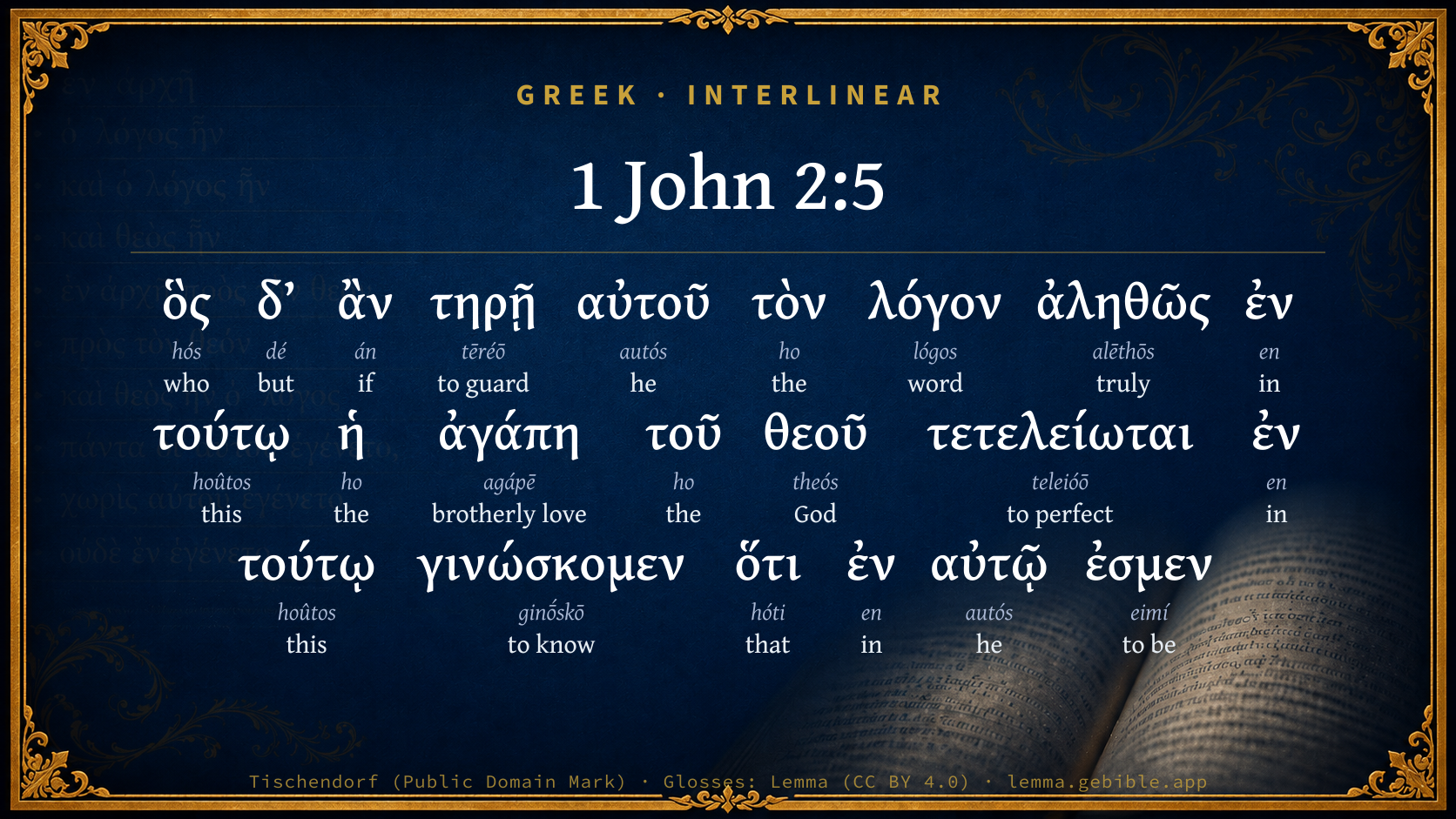
  1. ὃς hós G3739 “who” Relative pronoun, Nominative, Singular, Masculine
  2. δ’ dé G1161 “but” Conjunction
  3. ἂν án G302 “if” Particle
  4. τηρῇ tēréō G5083 “to guard” Verb, Present, Active, Subjunctive, 3rd person, Singular
  5. αὐτοῦ autós G846 “he” Personal pronoun, Genitive, Singular, Masculine
  6. τὸν ho G3588 “the” Article, Accusative, Singular, Masculine
  7. λόγον lógos G3056 “word” Noun, Accusative, Singular, Masculine
  8. ἐν en G1722 “in” Preposition
  9. τούτῳ hoûtos G3778 “this” Demonstrative pronoun, Dative, Singular, Neuter
  10. ἡ ho G3588 “the” Article, Nominative, Singular, Feminine
  11. ἀγάπη agápē G26 “brotherly love” Noun, Nominative, Singular, Feminine
  12. τοῦ ho G3588 “the” Article, Genitive, Singular, Masculine
  13. θεοῦ theós G2316 “God” Noun, Genitive, Singular, Masculine
  14. τετελείωται teleióō G5048 “to perfect” Verb, Perfect, Passive, Indicative, 3rd person, Singular
  15. ἐν en G1722 “in” Preposition
  16. τούτῳ hoûtos G3778 “this” Demonstrative pronoun, Dative, Singular, Neuter
  17. γινώσκομεν ginṓskō G1097 “to know” Verb, Present, Active, Indicative, 1st person, Plural
  18. ὅτι hóti G3754 “that” Conjunction
  19. ἐν en G1722 “in” Preposition
  20. αὐτῷ autós G846 “he” Personal pronoun, Dative, Singular, Masculine
  21. ἐσμεν eimí G1510 “to be” Verb, Present, Active, Indicative, 1st person, Plural

About this verse

These counts appear in no published source. They are computed here, from the morphology-tagged text and Lemma’s own curated glosses. What Lemma adds →

22
words
16
distinct lemmas
General Epistles
section

Notable vocabulary

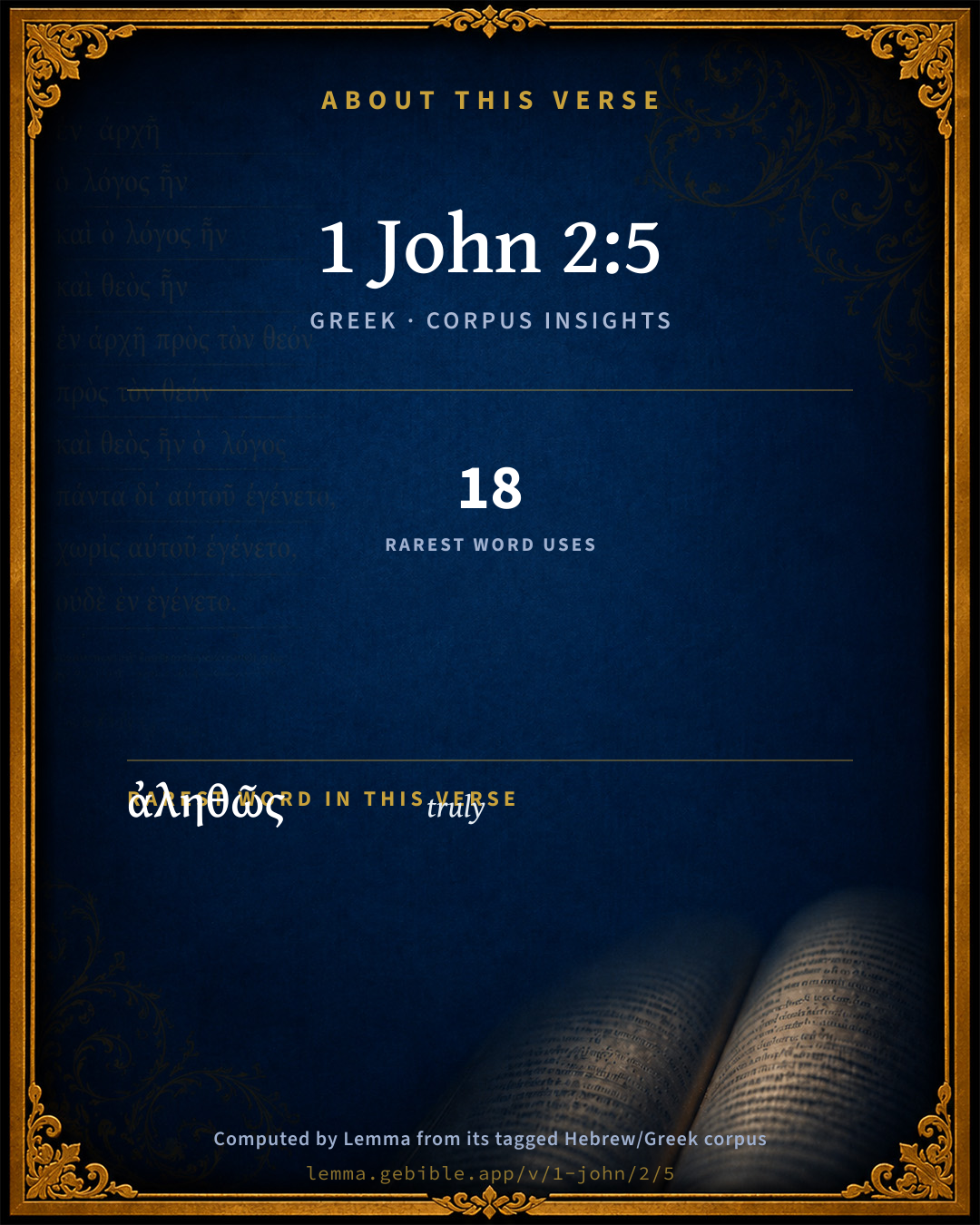
The rarest word here is ἀληθῶς truly G230 — appearing just 18 times in the whole Greek New Testament.

Shared distinctive vocabulary

ἀληθῶς truly G230 occurs in 18 verses of the Greek New Testament. Also found in:

Repetition

Words recur within this verse:

Cross-references

30

Topical passages linked to 1 John 2:5 in the Treasury of Scripture Knowledge — connected by theme and wording, ordered by reader-vote popularity; previews shown in the World English Bible.

  • John 14:23 Jesus answered him, "If a man loves me, he will keep my word. My Father will love him, and we will come to him, and make our home with him.
  • John 14:21 One who has my commandments, and keeps them, that person is one who loves me. One who loves me will be loved by my Father, and I will love him, and will reveal myself to him."
  • 1 John 4:12–13 No one has seen God at any time. If we love one another, God remains in us, and his love has been perfected in us.
  • Luke 11:28 But he said, "On the contrary, blessed are those who hear the word of God, and keep it."
  • 1 John 3:24 He who keeps his commandments remains in him, and he in him. By this we know that he remains in us, by the Spirit which he gave us.
  • Psalms 119:2 Blessed are those who keep his statutes, Who seek him with their whole heart.
  • 1 John 5:2 By this we know that we love the children of God, when we love God and keep his commandments.
  • Revelation 14:12 Here is the patience of the saints, those who keep the commandments of God, and the faith of Jesus."
  • Ezekiel 36:27 I will put my Spirit within you, and cause you to walk in my statutes, and you shall keep my ordinances, and do them.
  • 1 John 2:3–4 This is how we know that we know him: if we keep his commandments.
  • John 15:5 I am the vine. You are the branches. He who remains in me, and I in him, the same bears much fruit, for apart from me you can do nothing.
  • Psalms 119:146 I have called to you. Save me! I will obey your statutes.
  • 1 John 4:15–16 Whoever confesses that Jesus is the Son of God, God remains in him, and he in God.
  • 1 John 4:18 There is no fear in love; but perfect love casts out fear, because fear has punishment. He who fears is not made perfect in love.
  • 2 Corinthians 5:17 Therefore if anyone is in Christ, he is a new creation. The old things have passed away. Behold, all things have become new.
  • Romans 8:1 There is therefore now no condemnation to those who are in Christ Jesus, who don't walk according to the flesh, but according to the Spirit.
  • 1 Corinthians 1:30 But of him, you are in Christ Jesus, who was made to us wisdom from God, and righteousness and sanctification, and redemption:
  • 1 John 5:20 We know that the Son of God has come, and has given us an understanding, that we know him who is true, and we are in him who is true, in his Son Jesus Christ. This is the true God, and eternal life.
  • Revelation 12:17 The dragon grew angry with the woman, and went away to make war with the rest of her seed, who keep God's commandments and hold Jesus' testimony.
  • Psalms 106:3 Blessed are those who keep justice. Blessed is one who does what is right at all times.
  • Ecclesiastes 8:5 Whoever keeps the commandment shall not come to harm, and his wise heart will know the time and procedure.
  • John 6:56 He who eats my flesh and drinks my blood lives in me, and I in him.
  • 2 Corinthians 5:21 For him who knew no sin he made to be sin on our behalf; so that in him we might become the righteousness of God.
  • Colossians 2:9–10 For in him all the fullness of the Godhead dwells bodily,
  • James 2:22 You see that faith worked with his works, and by works faith was perfected;
  • 1 John 2:27–28 As for you, the anointing which you received from him remains in you, and you don't need for anyone to teach you. But as his anointing teaches you concerning all things, and is true, and is no lie, and even as it taught you, you will remain in him.
  • Psalms 119:4 You have commanded your precepts, That we should fully obey them.
  • Proverbs 8:32 "Now therefore, my sons, listen to me, For blessed are those who keep my ways.
  • Psalms 105:45 That they might keep his statutes, And observe his laws. Praise Yah!
  • Proverbs 28:7 Whoever keeps the law is a wise son; But he who is a companion of gluttons shames his father.

Cross-references courtesy of OpenBible.info (CC BY 4.0).

Commentary

Notes on 1 John 2:5 from classic Christian and Jewish commentators (each source and its license shown beneath its notes). The classic Christian expositions comment on the surrounding passage and are grouped to its opening verse, so a note may address several verses; the Jewish commentaries on the Tanakh (Rashi and others) are per-verse, so they appear only where the commentator wrote on this verse.

Lemma curates 59 commentaries, every one of them public domain or Creative Commons licensed, each selected and text-cleaned for this edition rather than reprinted as found. About our sources →

Jamieson, Fausset & Brown

Robert Jamieson, A. R. Fausset & David Brown

Not merely repeating the proposition, Jo1 2:3, or asserting the merely opposite alternative to Jo1 2:4, but expanding the "know Him" of Jo1 2:3, into "in Him, verily (not as a matter of vain boasting) is the love of (that is towards) God perfected," and "we are in Him." Love here answers to knowledge in Jo1 2:3. In proportion as we love God, in that same proportion we know Him, and vice versa, until our love and knowledge shall attain their full maturity of perfection.

his word--His word is one (see on Jo1 1:5), and comprises His "commandments," which are many (Jo1 2:3).

hereby--in our progressing towards this ideal of perfected love and obedience. There is a gradation: Jo1 2:3, "know Him"; Jo1 2:5, "we are in Him"; Jo1 2:6, "abideth in Him"; respectively, knowledge, fellowship, abiding constancy. [BENGEL].

Jamieson, Fausset & Brown — Commentary Critical and Explanatory on the Whole Bible (1871) — public domain (CC PDM 1.0). Text via the HelloAO Bible API.

The Cambridge Bible for Schools and Colleges

gen. ed. J. J. S. Perowne

5. The statement in 1Jn_2:3 is still further emphasized by taking the opposite of 1Jn_2:4; but with this we do not return to 1Jn_2:3, but have an expansion of it.

His word] A wider expression than ‘His commandments’, covering the sum total of the revelation of God’s will: comp. 1Jn_2:14. Thus Christ says, ‘He that hath My commandments, and keepeth them, he it is that loveth Me’ (Joh_14:21).

verily] Or, truly, or, of a truth. S. John uses this word (ἀληθῶς) about 8 times; and in the rest of N. T. it occurs about 8 times: see on 1Jn_1:6. It must not be confounded with the ‘verily’ (ἀμήν) in our Lord’s discourses. Here it stands first for emphasis; verily in him: comp. Joh_8:31.

is the love of God perfected] Or, the love of God hath been perfected. We need both renderings in order to bring out the full force of the Greek, which means ‘has been made perfect and remains so’. Obedience, not feeling, is the test of perfect love. This declaration shews that it is quite wrong to make ‘we know Him’ in 1Jn_2:3 and ‘I know Him’ in 1Jn_2:4 a Hebraism for ‘love Him’. Even if ‘know’ is ever used in the sense of ‘love’, which may be doubted, S. John would hardly in the same sentence use ‘know’ in two totally different senses (1Jn_2:3). S. John’s mention of love here shews that when he means ‘love’ he writes ‘love’ and not ‘know’. He declares that true knowledge involves love, but they are not identical, any more than convex and concave. ‘The love of God’ here means ‘the love of man to God’: this is the common usage in this Epistle (1Jn_2:15, 1Jn_3:17, 1Jn_4:12, 1Jn_5:3). Only once is the genitive subjective and means ‘the love of God for man’; and there the context makes this quite clear (1Jn_4:9). ‘Love,’ both verb and substantive, is one of S. John’s favourite words. His Gospel is the Gospel of Love and his Epistle the Epistle of Love. ‘To perfect’ is also much more common in his writings than elsewhere in N. T., excepting the Epistle to the Hebrews, especially in the passive voice (1Jn_4:12; 1Jn_4:17-18; Joh_17:23; Joh_19:28). S. John is here speaking, as often in this Epistle, of an ideal state of things. No Christian’s love to God is perfect: but the more perfect his knowledge, the more perfect his obedience and his love.

hereby we know] Or, Herein we come to know: it is the same phrase as in 1Jn_2:3, and should probably, as there, be taken with what follows, rather than with what precedes. It belongs to 1Jn_2:6 more than to 1Jn_2:5, and is parallel to 1Jn_1:6.

The Cambridge Bible for Schools and Colleges (gen. ed. J. J. S. Perowne; Cambridge University Press, 1878–1918) — public domain. Text from a community e-Sword module.

Bengel's Gnomon

Johann Albrecht Bengel

1Jn 2:5. Αὐτοῦ τὸν λόγον, His word) the word of Jesus Christ respecting the Father: ch. 1Jn 1:5. The precepts are many; the word is one.—ἀληθῶς, in truth) It is not a lie or vain boasting. This adverb has great force at the beginning of the clause.—ἡ ἀγάπη τοῦ Θεοῦ, the love of God) towards man, reconciled to us by Christ.—τετελείωται, is made perfect) Having obtained perfect rule, it is also perfectly known: ch. 1Jn 4:12.—ἐν τούτῳ, in this) There is a reference to the preceding words, but whoso keepeth, as ch. 1Jn 4:6, from this.—ἐν αὐτῷ ἐσμεν, we are in Him) Synonyms, with progressive gradation: to know Him; to be in Him; to abide in Him: 1Jn 2:6, knowledge; fellowship; constancy.

Bengel's Gnomon of the New Testament — English translation (T&T Clark, Edinburgh, 1860) — public domain. Text from a community e-Sword module.

Meyer's Critical & Exegetical Commentary

Heinrich August Wilhelm Meyer

1Jn_2:5. In this verse the apostle confirms the idea of 1Jn_2:3, in the form of an antithesis to 1Jn_2:4, and with the introduction of a new element.

ὃς δʼ ἂν τηρῇ αὐτοῦ (i.e. Θεοῦ) τὸν λόγον] The particle δέ, which refers not to 1Jn_2:3 (Lücke), but to the words καὶ τὰς ἐντολὰς αὐτοῦ μὴ τηρῶν, 1Jn_2:4, shows that this verse stands in the same relationship to 1Jn_2:4 as chap. 1Jn_1:7 to 1Jn_2:6; τηρῇ is with emphasis put first, and similarly αὐτοῦ before τὸν λόγον (Braune).

αὐτοῦ ὁ λόγος is synonymous with αἱ ἐντολαὶ αὐτοῦ, 1Jn_2:3-4 : the essence of the divine commandments; a Lapide: Dicit verbum ejus in singulari, quia praecipue respicit legem caritatis; haec enim caeteras omnes in se comprehendit.

The predicate does not run: οὗτος ἔγνωκεν αὐτόν, but: ἀληθῶς ἐν τούτῳ ἡ ἀγάπη τοῦ Θεοῦ τετελείωται, whereby a new side of the thought comes into view (Ebrard).

ἀληθῶς] in truth, opposed to appearance and mere pretence; it is emphatically put first, as in Joh_8:31; with reference to the preceding ἡ ἀλήθεια (de Wette); and serves to bring out not a quality of the τετελείωται (Ebrard), but the actuality of the ἐν τούτῳ … τετελείωται (so also Brückner).

ἐν τούτῳ ἡ ἀγάπη τοῦ Θεοῦ τετελείωται] ἡ ἀγάπη τ. Θεοῦ is not here, as in chap. 1Jn_4:9 : the love of God to us (Flacius, Calovius, Bengel, Spener, Russmeyer, Sander, Lange, etc.), nor: the love commanded by God (Episcopius), nor: the relationship of mutual love between God and man (Ebrard: the mutua amicitia et conjunctio between God and the Christian);[95] but: love to God, as in chap. 1Jn_2:15, 1Jn_3:17, 1Jn_4:12, 1Jn_5:3 (Bede, Oecumenius, Luther, Calvin, Beza, Lorinus, Hornejus, Paulus, de Wette-Brückner, Baumgarten-Crusius, Lücke, Düsterdieck, Erdmann, Myrberg, Braune, etc.). This interpretation is required by the context; for the love of God appears here in place of the knowledge of God, 1Jn_2:3-4. As in the latter, so in the former also, consists fellowship with God. Both, love and knowledge, are so inseparably connected, and are so essentially one in their principle and nature, that the one is the condition of the other.[96]

The idea ΤΕΤΕΛΕΊΩΤΑΙ is not to be weakened, as in Beza: ΤΕΛΕΙΟῦΝ hoc in loco non declarat perfecte aliquid consummare, sed mendacio et simulationi opponitur, ut hoc plane sit, quod dicimus: mettre en exécution; but it is to be taken in its constant meaning: has been perfected, as in chap. 1Jn_4:12; 1Jn_4:17-18.[97] The objection, that nevertheless no Christian can boast of perfect love to God, does not justify an arbitrary change of meaning. The absolute idea τηρεῖν αὐτοῦ τὸν λόγον demands for its counterpart an idea quite as absolute (so also Brückner).[98] Where the word of God is perfectly fulfilled, there love to God is perfect; in perfect obedience perfect love is shown. That the Christian has not attained this perfection at any moment of his life, but is ever only in a state of progress towards it, is no doubt true; but John is not here considering that aspect (so also Braune).[99]

ἐν τούτῳ γινώσκομεν] ἐν τούτῳ refers neither to the thought contained in 1Jn_2:6 (Socinus, Ewald), nor to ἡ ἀγάπη … τετελ., but to the keeping of the commandments (so also Düsterdieck, Ebrard, Brückner, Braune). Obedience is the evidence for the knowledge that we are ἐν αὐτῷ.

ὅτι ἐν αὐτῷ ἐσμεν] The expression signifies the inward fellowship of life (differently Act_17:28); it combines the preceding ἐν τούτῳ … τετελ. and the former ἐγνώκαμεν αὐτόν, and is identical with κοινωνίαν ἔχομεν μετʼ αὐτοῦ (chap. 1Jn_1:6), which it defines in its internal character. The knowledge and love of God is being in God (so also Brückner).[100]

Grotius, who understands αὐτῷ of Christ, enfeeblingly explains: Christi ingenii discipuli sumus.

[95] Similarly Besser: The love of God in us usually embraces both Gods love to us, by which, and our love to God, in which we live. This is the case in this passage also. This interpretation can be just as little grammatically justified as that of Ebrard; neither a duplicity nor a mutual relationship is expressed in the phrase ἡ ἀγ. τοῦ Θεοῦ.

[96] Grotius, it is true, is not wrong when he says: Amor praesupponit cognitionem; but it is just as correct to say: Cognitio praesupponit amorem.

[97] Even Bengels interpretation: perfectum regimen nactus et perfecte cognitus est (viz. amor Dei erga hominem), does not correspond to the idea of the word.

[98] Ebrard, it is true, wants the idea τετελείωται to be retained unweakened, but finds himself compelled by his interpretation of ἡ ἀγ. τ. Θ. to agree with Bezas explanation, because in the case of a relationship its perfection is nothing else than its conclusion. Ebrards opinion, that if ἡ ἀγ. τ. Θ. = love to God, John must have written τελεία ἐστίν instead of τετελείωται, isbesides being contrary to Johns usus loquendiwithout foundation.

[99] In Calvins explanation: Si quis objiciat, neminem unquam fuisse repertum, qui Deum ita perfecte diligeret, respondeo: sufficere, modo quisque pro gratiae sibi datae mensura ad hanc perfectionem aspiret, and in that of Socinus: Est autem perfectio ista earitatis in Deum et obedientia praeceptorum ejus ita intelligenda, ut non omnino requiratur, ne ei quiequam deesse possit, sed tantum ut ejusmodi sit, qua Deus pro sua ingenti erga nos bonitate contentus esse voluit, limitations are introduced which are foreign to the apostles train of thought.

[100] In substantial agreement with this Weiss says: In vv. 3 and 4 it was stated that in the keeping of Gods commandments we recognise that we have known God. If, therefore, there is a continuous train of thought here, the being in God must only be a new expression for the knowing of God, or must be directly given along with it.

Meyer — Critical and Exegetical Commentary on the New Testament — English translation by Peter Christie, edited by Frederick Crombie (T&T Clark, 1880) — public domain. Text from a community e-Sword module.

Expositor's Greek Testament

ed. W. Robertson Nicoll

1Jn 2:5 . ἡ ἀγάπη τοῦ Θεοῦ , “the love of God,” is ambiguous like אַהֲבַת יְהֹוָה , amor Dei, l’ amore di Dio, l’amour de Dieu, die Liebe Gottes . It might be objective genitive, “love for God,” “die Liebe zu Gott” (Rothe). But the believer’s love for God is never perfected in this life. The genitive is subjective ( cf. 1Jn 4:9 ), amor Dei erga honunem, per Christum nobis reconciliatus (Bengel), and the idea is that the redeeming love of God has attained its end in the man who observes His Word. Cf. Isa 53:11 . St. Augustine understands “the love of God” as His love for sinners, a forgiving love like that of Jesus when He prayed on the Cross “Father, forgive them”. “What is the perfection of love? It is both to love one’s enemies and to love them in order that they may be brethren.” By cultivating a love like this we get to know that we know Him. ἐν τούτῳ ( b ) points forward to ὁ λέγων , κ . τ . λ ., introducing a second assurance. It is not enough to know Him; we must be sure of continuing in fellowship with Him, of “abiding in Him” to the end. This assurance comes by “walking even as He walked”; i.e. the conformation of our lives to His is an evidence of our abiding interest in Him, our vital union with Him. We get like Him by imitating Him, and our likeness to Him is an irrefragable evidence to ourselves and the the world that we are His, as a son’s likeness to his father proves their relationship. ὀφείλει , “is bound,” “ist schuldig” (Rothe), of moral obligation . The claim ( λέγων ) must be honourably attested. αὐτὸς in this section refers grammatically to Jesus Christ 1Jn 2:1-2 ). The change of pronoun ( ἐκεῖνος ) does not imply a change of person, since here as in 1Jn 3:3 ; 1Jn 3:5 ; 1Jn 3:7 ; 1Jn 3:16 , 1Jn 4:17 , ἐκεῖνος is not a mere pronoun. It is used like ille , and signifies “that great One,” “the Master”. Cf. 2Ti 2:12-13 . περιπατεῖν , see note on 1Jn 1:6 . Aug.: “Perhaps He admonishes us to walk in the sea. Far from it! He admonishes us to walk in the way of righteousness.”

The Expositor's Greek Testament, edited by W. Robertson Nicoll (1897–1910) — public domain. Text from a community e-Sword module.

Geneva Bible (1599)

Geneva Bible translators

Wherewith we love God.

He that keepeth God’s commandments loveth God indeed. He that loveth God, is in God, or is joined together with God. Therefore he that keepeth his commandments, is in him.

He meaneth our conjunction with Christ.

Geneva Bible (1599) marginal notes — public domain. Text via Bolls.life.

Adam Clarke's Commentary

Verse 5. But whoso keepeth his word] Conscientiously observes his doctrine, the spirit and letter of the religion of Christ.

Is the love of God perfected] The design of God's love in sending Jesus Christ into the world to die for the sin of man τετελειωται, is accomplished, in that man who receives the doctrine, and applies for the salvation provided for him. This seems to be the meaning of the apostle.

That we are in him.] That we have entered into his spirit and views, received his salvation, have been enabled to walk in the light, and have communion with him by the Holy Spirit.

Adam Clarke's Commentary on the Bible (1810–1826) — public domain. Text from a community e-Sword/MySword module.

John Calvin's Commentaries

5 But whoso keepeth He now defines what a true keeping of God’s law is, even to love God. This passage is, I think, incorrectly explained by those who understand that they please the true God who keep his word. Rather take this as its meaning, “to love God in sincerity of heart, is to keep his commandments.” For he intended, as I have before reminded you, briefly to shew what God requires from us, and what is the holiness of the faithful. Moses also said the same thing, when he stated the sum of the law.

“Now, O Israel, what does the Lord require of thee, but to fear and love him, and to walk in his precepts?” (Deuteronomy 10:12.)

And again he says,

“Choose life, even to love the Lord thy God, to serve him and to cleave to him.” (Deuteronomy 30:19, 20)

For the law, which is spiritual, does not command only external works, but enjoins this especially, to love God with the whole heart.

That no mention is here made of what is due to men, ought not to be viewed as unreasonable; for brotherly love flows immediately from the love of God, as we shall hereafter see. Whosoever, then, desires that his life should be approved by God, must have all his doings directed to this end. If any one objects and says, that no one has ever been found who loved God thus perfectly; to this I reply, that it is sufficient, provided every one aspired to this perfection according to the measure of grace given unto him. In the meantime, the definition is, that the perfect love of God is the complete keeping of his law. To make progress in this as in knowledge, is what we ought to do.

Hereby know we that we are in him He refers to that fruit of the gospel which he had mentioned, even fellowship with the Father and the Son; and he thus confirms the former sentence, by stating what follows, as a consequence. For if it be the end of the gospel to hold communion with God, and no communion can be without love, then no one makes a real progress in faith except he who cleaves from the heart to God.

John Calvin's Commentaries (1540-1563) — public domain. Text from the Calvin Translation Society English edition (1840s-50s) via the Christian Classics Ethereal Library (ccel.org). Calvin's coverage is partial (roughly two-thirds of the Bible); uncommented books and verses are honest gaps, never fabricated. The 19th-century editor's footnotes and remarks are omitted so the notes are faithfully Calvin's own voice.

John Gill's Exposition

But whoso keepeth his word,.... Either the word of the Gospel, and the truths of it, who receives it in love, cordially embraces and retains it, and will by no means part with it, but holds it fast, and stands fast in it; or the precepts and ordinances of the word, who loves these, and esteems them above fine gold, and concerning all things to be right, and observes them as they should be:

in him verily is the love of God perfected: not the love wherewith God loves him, for that is perfect in himself, and admits of no degrees, and cannot be more or less in his heart, and is entirely independent of the obedience of men, or any works of theirs; it is true indeed the manifestations of this love to the saints are imperfect, and may be more and greater, and greater manifestations of love are promised to such that love Christ, and keep his commandments, Joh 14:21; but here it is to be understood not actively, but passively, of the love wherewith God is loved by his people; and intends not the absolute perfection of it in them, in whom it often waxes cold, and is left, or the fervour of it abated, but the sincerity and reality of it; for by keeping the word of God, both his truths and his ordinances, it is clearly seen that their love to him is without dissimulation, and is not in tongue only, but in deed and in truth:, now it is not the keeping of the word of God that causes this love, or makes it perfect or sincere, for it is a fruit of the Spirit, and is owing to the grace of God; but love, on the other hand, is the cause of keeping of the word; and the latter being a consequent and an effect of the former, is the evidence of it, of the truth and sincerity of it:

hereby know we that we are in him: in Christ, not merely nominally, or by profession, as all that name the name of Christ, and are in a Gospel church state, may be said to be; but really, first secretly, through the love of Christ, the election of God, and the covenant of grace, and then openly, in conversion and the effectual calling, through believing in Christ, when the saints appear to be in him as branches in the vine; and which is known by their fruits, as here, by keeping the word, and doing the commandments of Christ, which do not put a man into Christ, but only show that he is there; for a man's being in Christ is owing to the grace of God; this is the first thing done in grace, Co1 1:30.

John Gill's Exposition of the Whole Bible (1746–1763) — public domain (CC PDM 1.0). Text via the HelloAO Bible API.

Trapp's Complete Commentary

John Trapp

5 But whoso keepeth his word, in him verily is the love of God perfected: hereby know we that we are in him.

Ver. 5. In him verily is the love of God perfected] St John was a mere compound of sweetest love. As iron put into the fire, seemeth to be nothing but fire, so he (the beloved disciple) was turned into a lump of love. Hence he so presseth love, perfect love, to God and his people. And Jerome tells us, that living to a very great age at Ephesus, he would get up into the pulpit; and when through weakness of body he could say no more, he would say, "Little children, love one another;" Si hoc solum fiat, sufficit, If this be well done, all is done. (Jerome in cap. vi. ad Gal.)

That we are in him] In communion with him, and in conformity to him.

John Trapp, A Commentary or Exposition upon All the Books of the Old and New Testament (1647–1656) — public domain. Text from a community e-Sword module.

Albert Barnes' Notes on the Bible

But whoso keepeth his word - That is, what he has spoken or commanded, The term “word” here will include all that he has made known to us as his will in regard to our conduct.

In him verily is the love of God perfected - He professes to have the love of God in his heart, and that love receives its completion or filling up by obedience to the will of God. That obedience is the proper carrying out, or the exponent of the love which exists in the heart. Love to the Saviour would be defective without that, for it is never complete without obedience. If this be the true interpretation, then the passage does not make any affirmation about sinless perfection, but it only affirms that if true love exists in the heart, it will be carried out in the life; or that love and obedience are parts of the same thing; that one will be manifested by the other; and that where obedience exists, it is the completion or perfecting of love. Besides, the apostle does not say that either the love or the obedience would be in themselves absolutely perfect; but he says that one cannot fully develop itself without the other.

Hereby know we that we are in him - That is, by having in fact such love as shall insure obedience. To be in him, is to be united to him; to be his friends. Compare the Joh 6:56 note; Rom 13:14 note.

Albert Barnes' Notes on the Bible (1834–1885) — public domain. Text from a community e-Sword/MySword module.

Haydock's Catholic Bible Commentary

The charity of God is truly perfect.[2] Notwithstanding his lesser failings, he retains the habit of charity and grace, by which he remains united to God. --- And by this we know that we are in him; i.e. we are morally, though not absolutely, certain that we are in the state of grace. (Witham)

===============================

[BIBLIOGRAPHY]

Perfecta est, Greek: teteleiotai. That must only be understood of charity so perfected as to be true charity, but not a perfect degree of charity.

====================

George Leo Haydock (1774–1849), Haydock's Catholic Family Bible and Commentary, 1859 edition — public domain. Excludes Psalms (Douay-Rheims chapter numbering differs from Protestant) and Deuterocanonical books (Catholic canon only).

Matthew Poole's English Annotations

His faith worketh by love, Gal 5:6; his love is

perfected, and attains its end in obedience, whereof it is the vital principle, 1Jo 5:3; Joh 14:15. Such an efficacious governing knowledge of him, therefore, as, by the power of the love which it produces, subdues our souls to the obedience of him, is a certain proof to us of our union with him, 1Jo 5:20, and relation to him.

Matthew Poole's English Annotations on the Holy Bible (1683–1685) — public domain. Text from a community e-Sword/MySword module.

Whedon's Commentary on the Bible

Daniel D. Whedon

5. But—Returning to the affirmative in earnest repetition, with emphasis on verily and know.

Keepeth—By not only remembering, but obeying.

Love of God perfected—By being brought into full force and action.

Perfected—In the same degree that it is effective in making us keep his word.

Hereby—Referring to keepeth his word.

Know we—We do most completely know that we know… him, or (what is the same thing, and more) are in him.

In him—In Christ, by communion, and thereby in God.

Daniel D. Whedon (gen. ed.), Commentary on the Old and New Testaments (1874–1909) — public domain. Text from a community e-Sword module.

The Pulpit Commentary

Once more (cf. 1Jn_1:7, 1Jn_1:9) the opposite is stated and the thought carried further. But whoso keepeth his word (his doctrine as a whole, including the separate commandments), of a truth in him hath the love of God been perfected; i.e., as an accomplished fact; the relation of love has been established. In St. John ajlhqwv is no mere expletive; it expresses reality, and reality that is known. From verse 4 we might have expected "of a truth he knoweth God; but the apostle goes beyond this, and shows that really knowing God involves loving him. (comp 1Jn_4:11) The context shows that tou Qeou is objective his love of God rather than God"s love of him. The insertion of tou Qeou here, and the drift of the Epistle thus far, are in favour of aujton and aujtou in verses 35 meaning God rather than Christ, although aujtov in verse 2 tells the other way. The last clause sums up and reaffirms, but as usual with a new turn of thought, the whole section (verses 3-5), which begins and ends with ejn toutw ginwskomen. Knowing God implies keeping his Word; and keeping his Word involves loving him; and all this implies being in him, i.e., having that fellowship with him and his Son in which the Christian"s life (which is eternal life) consists, and to promote which St. John publishes his Gospel. (1Jn_1:3, 1Jn_1:4)

The Pulpit Commentary (1880–1919), ed. H.D.M. Spence-Jones & Joseph S. Exell — public domain. Text from a community e-Sword module.

John Wesley's Explanatory Notes

But whoso keepeth his word - His commandments. Verily in him the love of God - Reconciled to us through Christ. Is perfected - Is perfectly known. Hereby - By our keeping his word. We know that we are in him - So is the tree known by its fruits. To "know him," to be "in him," to "abide in him," are nearly synonymous terms; only with a gradation, - knowledge, communion, constancy.

John Wesley, Explanatory Notes Upon the Whole Bible (1754–1765) — public domain. Text via the GEBible commentary corpus.

Scofield Reference Notes

C. I. Scofield

perfect

(See Scofield "Mat 5:48").

The Scofield Reference Bible (1917 edition), notes by C. I. Scofield — public domain. Text from a community e-Sword module.

Godbey's Commentary on the New Testament

William B. Godbey

5. “Whosoever may keep His Word truly, the love of God has been perfected in him.” While regeneration saves us from committing sin, there are many commandments on the plane of entire sanctification which are not fulfilled in our time, e.g., “Be ye holy,” “Be perfect,” “Be filled with the Spirit,” which we do not verify. They are not the moral commandments alone, but they are the divine logos, which God requires, and must be satisfied if we are going up to Him in heaven. The divine agapee must be perfected by the thorough expurgation of the heart from all inbred sin. In regeneration God’s love is poured into a heart corrupted by the fall. That corruption must be eliminated by the cleansing blood and our love made perfect, i.e., pure from all antagonisms, before we go up to heaven.

William B. Godbey, Commentary on the New Testament (1896–1900) — public domain. Text from a community e-Sword module.

The People's New Testament

B. W. Johnson

5. But whoso keepeth his word, etc. It is by keeping his commandments that the love of God is made perfect in us. Obedience is the result and proof of love, and also gives love the opportunity to flow over the whole life. Compare John 14:21. Hereby. By our loyal obedience.

B. W. Johnson's The People's New Testament with Notes (1889–1891) — public domain. Electronic text from the Christian Classics Ethereal Library (CCEL) ThML edition.

Cambridge Greek Testament for Schools and Colleges

5. The statement in 1Jn 2:3 is still further emphasized by taking the opposite of 1Jn 2:4, which is the opposite of 1Jn 2:3. But this does not bring us back to 1Jn 2:3, but to an expansion of it. S. John’s apparent retrogressions are real advances.

τὸν λόγον is a wider expression than τὰς ἐντολάς, covering the sum total of the revelation of God’s will: comp. 1Jn 2:14. It is certainly wrong to interpret this of the ‘continued indwelling’ of ‘the Personal Word.’ Here the emphasis is on τηρῇ; in 1Jn 2:4 on ἐντολάς. ἀληθῶς, should be truly, or of a truth, to distinguish it from ἀμήν, verily, in our Lord’s discourses. Here it stands first for emphasis, as in Joh 8:31: truly in him. Like 1Jn 1:7, this verse insists on the necessity for reality in holiness.

ἡ ἀγάπη τ. Θεοῦ τετελείωται. The full force of the perfect is found here as in 1Jn 1:1-2; 1Jn 1:10: ‘hath been made perfect and remains so’; perfecta est or consummata est: Beza has adimpleta est. Obedience, not feeling, is the test of perfect love. This declaration shews that it is quite wrong to make ‘we know Him’ in 1Jn 2:3 and ‘I know Him’ in 1Jn 2:4 a Hebraism for ‘love Him’. Even if ‘know’ is ever used in the sense of ‘love,’ which may be doubted, S. John would hardly in the same sentence use ‘know’ in two totally different senses (1Jn 2:3). S. John’s mention of love here shews that when he means ‘love’ he writes ‘love’ and not ‘know.’ He declares that true knowledge involves love, but they are not identical, any more than convex and concave. Ἡ ἀγάπη τ. Θεοῦ here means ‘the love of man to God’: this is the common usage in this Epistle (1Jn 2:15; 1Jn 3:17; 1Jn 4:12; 1Jn 5:3) Winer, 232. Only once is the genitive subjective and means ‘the love of God for man’; and there the context makes this quite clear (1Jn 4:9). Ἀγάπη and ἀγαπᾶν are among S. John’s favourite words. His Gospel is the Gospel of Love and his Epistle the Epistle of Love. Τελειοῦν is also much more common in his writings than elsewhere in N.T., excepting the Epistle to the Hebrews, especially in the passive voice (1Jn 4:12; 1Jn 4:17-18; Joh 17:23; Joh 19:28). S. John is here speaking, as often in this Epistle, of an ideal state of things. No Christian’s love to God is perfect: but the more perfect his knowledge, the more perfect his obedience and his love. For the parallel in the Διδαχὴ τῶν ιβʹ Ἀποστόλων see Appendix F.

ἐν αὐτῷ ἐσμέν. Comp. ἐν αὐτῷ ζῶμεν καὶ κινούμεθα καὶ ἐσμέν (Act 17:28).

Cambridge Greek Testament for Schools and Colleges (Cambridge University Press, 1896; 21 vols, various authors incl. Carr, Maclear, Plummer, Farrar, Lumby, Moule, M. R. James, Simcox) — public domain. Text from a community e-Sword module.

Alford’s Greek Testament

Henry Alford

5.] assertion of the other alternative, not merely as before, but, as usual, carried further and differently expressed: “oppositio cum accessione,” as Grot.):—but whosoever keepeth His word (synonymous with τὰς ἐντολὰς αὐτοῦ, considered as a whole: on the mode of expression, see above), of a truth in him is the love of God perfected (why should this transition be made from knowledge to love? “Amor præsupponit cognitionem,” as Grot.: and is a further step in the same κοινωνία with God: not indeed that the former step is passed through and done with, but that true knowledge and love increase together, and the former is the measure of the latter, just as keeping God’s commandments is the test and measure of true knowledge of Him. And thus in the final and perfect ideal, the two are coincident: the perfect observation of His commandments is the perfection of love to Him. It is manifest, from what has been said, that ἡ ἀγάπη τοῦ θεοῦ must be our love towards God, not His love towards us: τοῦ θεοῦ a gen. objective, not subjective. Some Commentators have held the other meaning: partly because τετελείωται seemed better to be interpreted thus, and partly from doctrinal motives, as in the case of Flacius and Calovius, to keep out the Romish folly of supererogation. But the explanation, though the words themselves admit it (see ch. 4:9), is manifestly alien from the context. And of any foolish dreams of perfection or super-perfection there is no fear, if we understand the passage as intended by the Apostle, as setting forth the true ideal and perfection of knowledge and love to God, as measured by the perfect keeping of His word: which though none of us can fully reach, every true Christian has before him as his aim and final object. So that there is no need again to depart from the meaning of τετελείωται, as has been done by Beza (“itaque τελειοῦν hoc in loco non declarat perfecte aliquid præstare, sed mendacio et simulationi, inani denique speciei opponitur: ut hoc plane sit quod dicimus in vulgato sermone, mettre en exécution”)). In this (in the fact of our progress towards this ideal state of perfection of obedience and therefore of love:—thus assured that the germ of the state is in us and unfolding) we know that we are in Him (this completes the logical period which began in ver. 3, by reasserting that verse, carrying however that assertion yet deeper, by substituting ἐν αὐτῷ ἐσμέν for ἐγνώκαμεν αὐτόν. This “being in Him” is in fact the Christian life in its central depth of κοινωνία with God and with one another: the spiritual truth corresponding to the physical one enunciated by St. Paul, Act 17:28, ἐν αὐτῷ ζῶμεν καὶ κινούμεθα καὶ ἐσμέν).

Henry Alford, The Greek Testament (1849–1861) — public domain. Text from a community e-Sword module.

International Critical Commentary

5. Again the thought is carried further in the statement of the opposite. The whole word is substituted for the definite precepts, and knowledge gives way to love. Perfect obedience gains the whole prize. For love is greater than knowledge.

ὃς δʼ ἂν τηρῇ] The statement is made in its most general form. Contrast the preceding verse, and 1:6 ff. The difference shows that the writer has in view definite “Gnostic” claims. Knowledge is not the possession of a few “pneumatic” individuals. In contrast with the claim of such an one, whose conduct shows the falsity of his claim, is set the possibility of obtaining the higher prize, the perfection of love, open to all who are willing to obey. The “chance o’ the prize of learning love” is not reserved to the few who think that they “know.”

αὐτοῦ τὸν λόγον] The order of the words throws the emphasis on αὐτοῦ, which takes up the αὐτόν of the Gnostic’s claim. The teaching of the God, whom he claims to know, is very different from the views expressed in his claim.

The λόγος is the sum of the ἐντολαί, or rather it is the whole of which they are the parts. Love is not made perfect in a series of acts of obedience to so many definite commands. It reaches its full growth only when God’s whole plan is welcomed and absorbed. The ἐντολαί offer adequate tests of the truth or falsehood of any claim to know God. But something more is needed before Obedience can have her perfect work.

ἡ ἀγάπη τοῦ θεοῦ] The love of God has been interpreted in three ways, according as the genitive is regarded as subjective, objective, or qualitative; God’s love for us, or our love for God, or the love which is characteristic of Him, which “answers to His nature” and which when “communicated to man is effective in him towards the brethren and towards God Himself.” The second gives the simplest and most natural meaning to the words in their present context. The love for God of which man is capable is only fully realized in absolute obedience. At the same time we must remember that it is the teaching of the author that it is God’s love for men which calls out the response of man’s love for Him. “We love Him, because He first loved us.” Comp. 2:15, 3:17, 4:12, 5:3.

ἀληθῶς] The true state of the case as contrasted with the false plea set up by the man who claims to have knowledge without obedience. The emphatic position, however, of the word suggests that it may reasonably be regarded as one of the many signs which are to be found in this Epistle, that the writer feels strongly the need of encouraging his readers with the assurance of the reality of their Christian privileges. Certainty is within their grasp if they will use the means which have been placed at their disposal. Comp. Joh 8:31.

τηρη] τηρει K 13. 100. 142 cscr 57lect: τηρησει Ia δ453 (5).

τον] om. Ia δ203 (265).

αληθως] om. 27. 29. 66**.

5b, 6. Imitation the sign of Union.

The test of union with God is the imitation of His Son. This is not stated directly, as in the case of knowledge (ver. 3), but the claim to “abide in Him” is said to carry with it the moral obligation to “follow the blessed steps of His most holy life.” See Findlay, p. 149.ἐν αὐτῷ μένειν] This form of expression is peculiar to the Johannine writings (Gospel and First Epistle). It is the equivalent, in his system of thought, of the Pauline ἐν Χριστῷ εἶναι, of which it was a very natural modification, if it is to be attributed to the author, and not to his Master. The longer the Lord delayed His coming, the more it came to be realized that union with Christ under the conditions of earthly existence must be an abiding rather than a short tarrying. The idea had taken its new shape before the “last hour” was thought to have struck. Bengel points out a climax: cognitio (ver. 3), communio (5), constantia (6).

ἐκεῖνος] For the use of ἐκεῖνος with reference to Christ, cf. 1Jn 3:3, 1Jn 3:5, 1Jn 3:7, 1Jn 3:16, 1Jn 3:4:17; Joh 7:11, Joh 7:19:21, Joh 7:9:12, Joh 7:28, and perhaps also 19:35 (Zahn, Einleitung, ii. 481; cf. Introd. p. iv).

περιπατεῖν] See note on 1:6. For its use in the Johannine writings, cf. Joh 8:12, Joh 8:11:9 f., Joh 8:12:35; 1Jn 1:6, 1Jn 1:7, 1Jn 1:2:11; 2Jn 1:4, 2Jn 1:6; 3Jn 1:3, 3Jn 1:4.

εν τουτω] post θεου P 31: om. Hδ2 (א) (?) (cf. Tisch. ver. 4) Ic 116* (-).

γινωσκομεν] cognoscemus, boh-ed.

καθως … περιπατειν] sic ambulare sicut (+et codd.) ille ambulauit, arm.

και … περιπατειν] om. L.

και αυτος] post ουτωςIa 65 (317) Ic 174 : om. sahd.

ουτως א C K P al. pler. cat. cop. syrp arm. Salv. Thphyl. Oec.] om. A B 3. 34. 65. 81. 180 dscr vg. sah. aeth. Clem. Or. Cyr. Cyp. Aug. The omission may possibly be due to the similarity of the preceding word, but the evidence against it is very strong.

International Critical Commentary — older volumes (1896–1929), various authors — public domain. Text from a community e-Sword module.

Lesson kit

Teaching starters — assembled from the data on this page, not authored interpretation. Every prompt links to the verse data it draws on. Edit before teaching.

1 John, in the General Epistles, opens this verse with 22 words (16 distinct Greek lemmas). Its most distinctive word is alēthōs (“truly”). A historical commentator’s framing appears above. Read the whole chapter for the surrounding context.

Discussion questions

  1. What does “truly” (alēthōs) contribute to the verse as a whole?
  2. How does Matthew 14:33, which shares the word «truly», read alongside this verse?
  3. What does the repetition of “the” (3× in this one verse) do in this verse?
  4. The translations on this page render this verse differently — a whole-verse word diff, not a word-by-word alignment. What might account for the different wordings?
  5. Compare how Jamieson, Fausset & Brown and The Cambridge Bible for Schools and Colleges read this verse. Where do they agree or differ?

Things to notice

Reading settings

Reading text

Shown beneath each verse's original-language words.

Old Testament
Old Testament edition

Read the OT as the Masoretic Hebrew (MT) or the Greek Septuagint (LXX).

English shown for the Greek Septuagint (in the Hebrew ↔ Greek comparison).

Comparing translations? Open the Compare panel on any verse page to stack up to four side by side.