Exodus 16:6

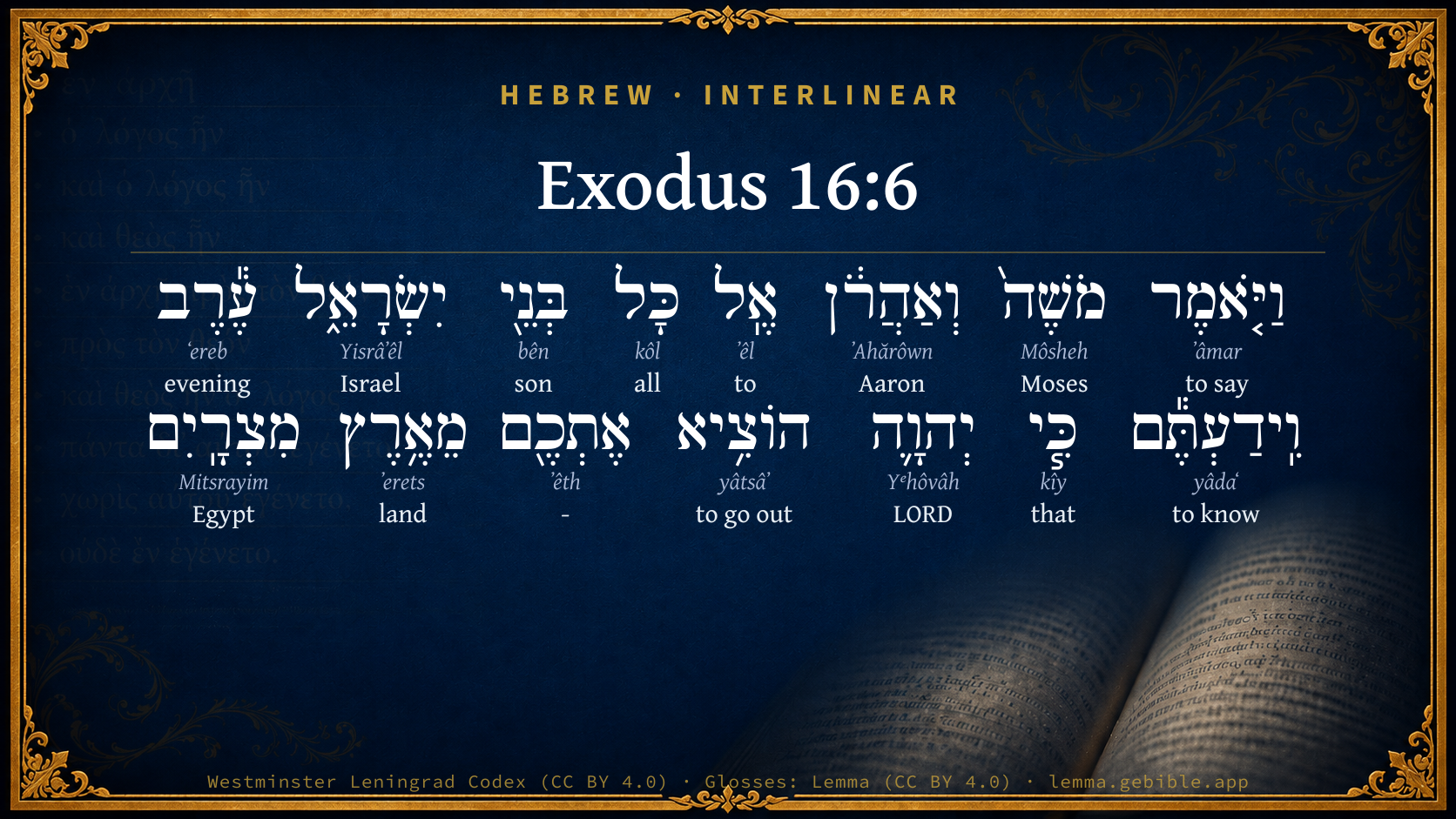
Hebrew (Westminster Leningrad Codex) Exodus 16:6 appears in the Hebrew Old Testament. The text above is from the Westminster Leningrad Codex. Each word links to its Strong’s number, a concise gloss, and parsing drawn from the Open Scriptures Hebrew Bible morphology. Click any word for its full Brown-Driver-Briggs (BDB) entry.
Download image
Cite this verse

Exodus 16:6 (World English Bible). Public Domain. Lemma interlinear Bible study tool, https://lemma.gebible.app/v/exodus/16/6.

Show BibTeX & RIS
BibTeX
RIS
English Translation
Moses and Aaron said to all the children of Israel, "At evening, then you shall know that Yahweh has brought you out from the land of Egypt;
World English Bible · Public Domain
Download a study sheet

One document with this verse’s original text, its word-by-word gloss line, the meaning frame, cross-references with their text, attributed commentary, and full source and license credits — printable, and it pastes into notes with its structure intact.

This verse Autodidact and up

Study sheet (.html) Plain text (.txt)

A passage Seminary Student

Up to 50 verses in one chapter. A passage sheet keeps up to 6 commentary sources and 12 cross-references per verse, in the order this page ranks them, and says so on the sheet whenever that leaves anything out. Ask for a single verse and you get the Autodidact verse sheet above.

Everything on this page stays free to read, with no account — the sheet is a download of what is already on screen, not access to it.

Want to remove ads? Support Godless Engineer
Compare translations 3

The same verse in 3 English versions, stacked beneath the original-language interlinear above. Click any original word for its lexicon entry.

Each is an independent rendering of the whole verse — the interlinear is not word-aligned to these translations.

Highlighted words mark where these versions differ — a whole-verse word diff, not a word-by-word alignment.

  • World English Bible Public Domain
    Moses and Aaron said to all the children of Israel, "At evening, then you shall know that Yahweh has brought you out from the land of Egypt;
  • King James Version Public Domain
    And Moses and Aaron said unto all the children of Israel, At even, then ye shall know that the LORD hath brought you out from the land of Egypt:
  • unfoldingWord Literal Text CC BY-SA 4.0
    And Moses and Aaron said to all of the sons of Israel, “At evening you will know that Yahweh brought you out from the land of Egypt.

unfoldingWord Literal Text — © unfoldingWord, licensed CC BY-SA 4.0. Word-aligned USFM3 via Door43 (git.door43.org/unfoldingWord/en_ult).

Versions to compare (up to 4)

3 of 4 selected

Show all 18 translations

Every available English version of this verse, each an independent rendering of the whole verse.

  • World English Bible Public Domain
    Moses and Aaron said to all the children of Israel, "At evening, then you shall know that Yahweh has brought you out from the land of Egypt;
  • Berean Standard Bible Public Domain
    So Moses and Aaron said to all the Israelites, “This evening you will know that it was the LORD who brought you out of the land of Egypt,
  • Majority Standard Bible Public Domain
    So Moses and Aaron said to all the Israelites, “This evening you will know that it was the LORD who brought you out of the land of Egypt,
  • King James Version Public Domain
    And Moses and Aaron said unto all the children of Israel, At even, then ye shall know that the LORD hath brought you out from the land of Egypt:
  • American Standard Version (1901) Public Domain
    And Moses and Aaron said unto all the children of Israel, At even, then ye shall know that Jehovah hath brought you out from the land of Egypt;
  • Revised Version (1885) Public Domain
    And Moses and Aaron said unto all the children of Israel, At even, then ye shall know that the LORD hath brought you out from the land of Egypt:
  • Geneva Bible (1599) Public Domain
    Then Moses and Aaron sayde vnto all the children of Israel, At euen ye shall know, that the Lord brought you out of the land of Egypt:
  • Douay-Rheims (1899) Public Domain
    And Moses and Aaron said to the children of Israel: In the evening you shall know that the Lord hath brought you forth out of the land of Egypt:
  • Young's Literal Translation Public Domain
    And Moses saith -- Aaron also -- unto all the sons of Israel, `Evening -- and ye have known that Jehovah hath brought you out from the land of Egypt;
  • Literal Standard Version CC BY-SA 4.0
    And Moses says—Aaron also—to all the sons of Israel, “Evening—and you have known that YHWH has brought you out from the land of Egypt;
  • Unlocked Literal Bible CC BY-SA 4.0
    Then Moses and Aaron said to all the people of Israel, “In the evening you will know that it is Yahweh who has brought you out from the land of Egypt.
  • unfoldingWord Literal Text CC BY-SA 4.0
    And Moses and Aaron said to all of the sons of Israel, “At evening you will know that Yahweh brought you out from the land of Egypt.
  • Darby Bible Public Domain
    And Moses and Aaron said to all the children of Israel, In the evening, then shall ye know that Jehovah has brought you out from the land of Egypt;
  • World Messianic Bible Public Domain
    Moses and Aaron said to all the children of Israel, “At evening, you shall know that the LORD has brought you out from the land of Egypt.
  • Webster's Bible Public Domain
    And Moses and Aaron said to all the children of Israel, At evening, then ye shall know that the LORD hath brought you out from the land of Egypt:
  • Free Bible Version CC BY-SA 4.0
    So Moses and Aaron explained to all the Israelites, “This evening you will have the proof that it was the Lord who led you out of Egypt,
  • Bible in Basic English Public Domain
    And Moses and Aaron said to all the children of Israel, This evening it will be clear to you that it is the Lord who has taken you out of the land of Egypt:
  • JPS Tanakh (1917) Public Domain
    And Moses and Aaron said unto all the children of Israel: 'At even, then ye shall know that the LORD hath brought you out from the land of Egypt;

Literal Standard Version (2020), Covenant Press — licensed CC BY-SA 4.0. Text via the HelloAO Bible API (eBible.org). Unlocked Literal Bible (unfoldingWord) — licensed CC BY-SA 4.0. Text via the HelloAO Bible API (eBible.org). unfoldingWord Literal Text — © unfoldingWord, licensed CC BY-SA 4.0. Word-aligned USFM3 via Door43 (git.door43.org/unfoldingWord/en_ult). Free Bible Version, Dr. Jonathan Gallagher — licensed CC BY-SA 4.0. Text via the HelloAO Bible API (eBible.org).

Word by word

More ways to search: Search by grammar → Find every occurrence → Compare this word →

Practice this passage: Drill this verse → Learn its vocabulary →

עֶ֕רֶב
ʻereb
H6153
“evening”
Noun, Common, Masculine, Singular, Absolute
Part of Speech
Noun
Type
Common
Gender
Masculine
Number
Singular
State
Absolute
Full BDB Definition

Origin: from H6150

TWOT: 1689a

evening, night, sunset - evening, sunset - night
  1. וַיֹּ֤אמֶר ʼâmar H559 “and · to say” Conjunction + Verb, Qal, Sequential Imperfect, 3rd Person, Masculine, Singular
  2. מֹשֶׁה֙ Môsheh H4872 “Moses” Noun, Proper
  3. וְאַהֲרֹ֔ן ʼAhărôwn H175 “and · Aaron” Conjunction + Noun, Proper
  4. אֶֽל ʼêl H413 “to” Preposition
  5. כָּל kôl H3605 “all of” Noun, Common, Masculine, Singular, Construct
  6. בְּנֵ֖י bên H1121 “sons of” Noun, Common, Masculine, Plural, Construct
  7. יִשְׂרָאֵ֑ל Yisrâʼêl H3478 “Israel” Noun, Proper
  8. וִֽידַעְתֶּ֕ם yâdaʻ H3045 “and · to know” Conjunction + Verb, Qal, Perfect, 2nd Person, Masculine, Plural
  9. כִּ֧י kîy H3588 “that” Conjunction
  10. יְהוָ֛ה Yᵉhôvâh H3068 “LORD” Noun, Proper
  11. הוֹצִ֥יא yâtsâʼ H3318 “to go out” Verb, Hiphil, Perfect, 3rd Person, Masculine, Singular
  12. אֶתְכֶ֖ם ʼêth H853 “- · you” Particle, Direct Object + Suffix, Personal, 2nd Person, Masculine, Plural
  13. מֵאֶ֥רֶץ ʼerets H776 “from · land of” Preposition + Noun, Common, Both, Singular, Construct
  14. מִצְרָֽיִם Mitsrayim H4714 “Egypt” Noun, Proper

About this verse

These counts appear in no published source. They are computed here, from the morphology-tagged text and Lemma’s own curated glosses. What Lemma adds →

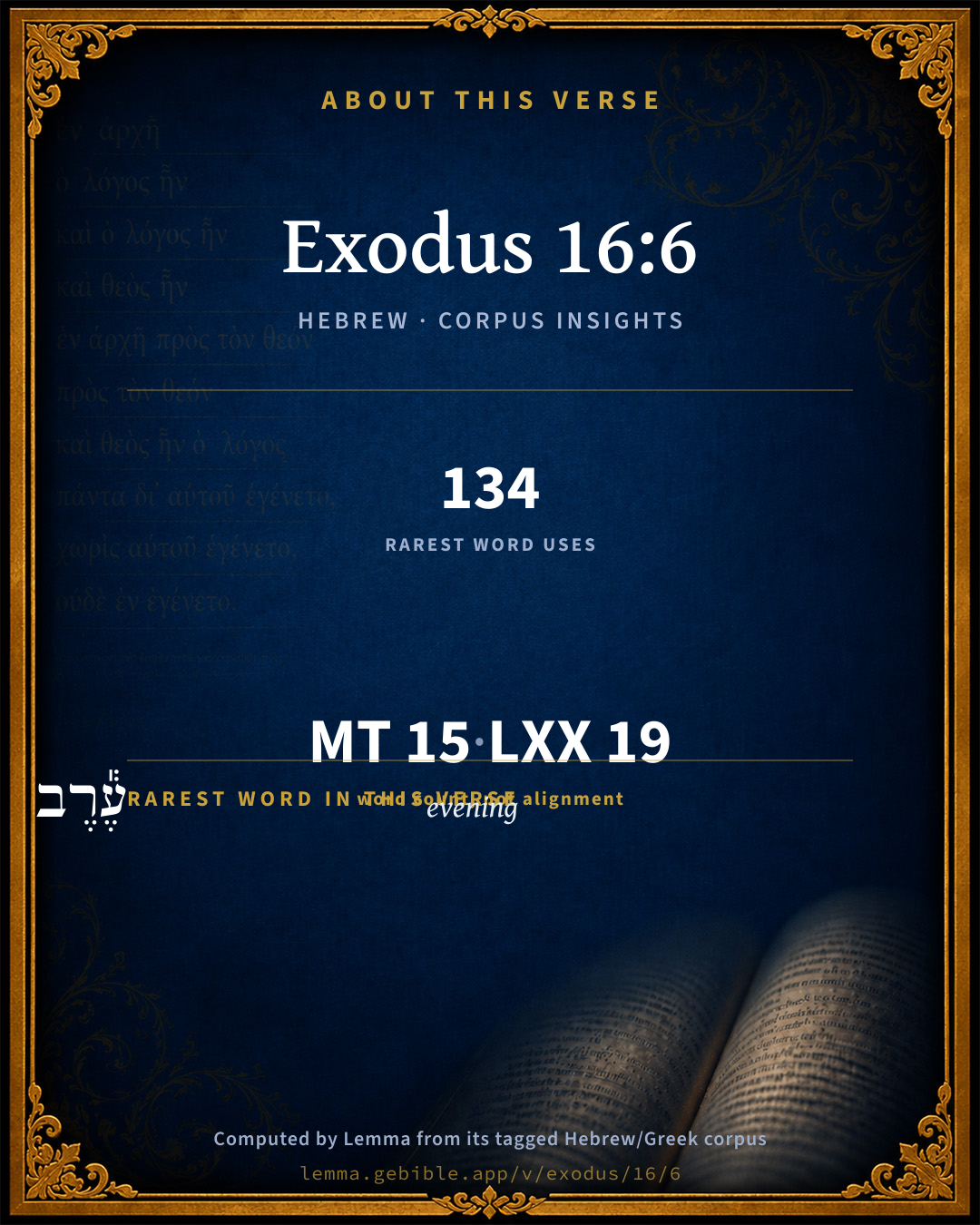
15
words
15
distinct lemmas
Pentateuch
section

Grammatical profile

  • 3 verbs
  • 9 nouns
  • 1 preposition
  • 1 conjunction
  • 1 particle

Verb forms

  • וַיֹּ֤אמֶר Qal · Sequential Imperfect
  • וִֽידַעְתֶּ֕ם Qal · Perfect
  • הוֹצִ֥יא Hiphil · Perfect

Hebrew & Septuagint length

In English translation the verse runs 27 words from the Hebrew and 31 from the Septuagint (LXX English) — closely comparable.

A rough comparison of the two English renderings, which tokenize alike — not a word-level alignment.

Word counts can differ between the Hebrew and the Greek without any difference in meaning — e.g. the Hebrew direct-object marker אֵת has no separate Greek word, and Greek often adds the article ὁ.

In the original languages it is 15 Hebrew tokens and 19 Greek tokens — but the two are counted differently (Hebrew bundles its prefixes and suffixes into one token; the Greek is in lemma form), so that isn’t a like-for-like length.

Cross-references

12

Topical passages linked to Exodus 16:6 in the Treasury of Scripture Knowledge — connected by theme and wording, ordered by reader-vote popularity; previews shown in the World English Bible.

  • Exodus 6:7 and I will take you to me for a people, and I will be to you a God; and you shall know that I am Yahweh your God, who brings you out from under the burdens of the Egyptians.
  • Exodus 16:12–13 "I have heard the murmurings of the children of Israel. Speak to them, saying, 'At evening you shall eat meat, and in the morning you shall be filled with bread: and you shall know that I am Yahweh your God.'"
  • Numbers 16:28 Moses said, Hereby you shall know that Yahweh has sent me to do all these works; for [I have] not [done them] of my own mind.
  • Numbers 16:30 But if Yahweh make a new thing, and the ground open its mouth, and swallow them up, with all that appertain to them, and they go down alive into Sheol; then you shall understand that these men have despised Yahweh.
  • Exodus 12:51 It happened the same day, that Yahweh brought the children of Israel out of the land of Egypt by their hosts.
  • Exodus 16:3 and the children of Israel said to them, "We wish that we had died by the hand of Yahweh in the land of Egypt, when we sat by the flesh-pots, when we ate our fill of bread, for you have brought us out into this wilderness, to kill this whole assembly with hunger."
  • Exodus 16:8 Moses said, "Now Yahweh shall give you meat to eat in the evening, and in the morning bread to satisfy you; because Yahweh hears your murmurings which you murmur against him. And who are we? Your murmurings are not against us, but against Yahweh."
  • Exodus 32:1 When the people saw that Moses delayed to come down from the mountain, the people gathered themselves together to Aaron, and said to him, "Come, make us gods, which shall go before us; for as for this Moses, the man who brought us up out of the land of Egypt, we don't know what has become of him."
  • Exodus 32:7 Yahweh spoke to Moses, "Go, get down; for your people, who you brought up out of the land of Egypt, have corrupted themselves!
  • Exodus 32:11 Moses begged Yahweh his God, and said, "Yahweh, why does your wrath burn hot against your people, that you have brought forth out of the land of Egypt with great power and with a mighty hand?
  • Psalms 77:20 You led your people like a flock, By the hand of Moses and Aaron.
  • Isaiah 63:11–12 Then he remembered the days of old, Moses [and] his people, [saying], Where is he who brought them up out of the sea with the shepherds of his flock? where is he who put his holy Spirit in the midst of them?

Cross-references courtesy of OpenBible.info (CC BY 4.0).

Hebrew and Greek witnesses Masoretic Hebrew ↔ Greek Septuagint

The same verse in the two great witnesses to the Old Testament, shown verse-for-verse.

These are two independent witnesses, not word-aligned to each other, and the Septuagint is shown in lemma (dictionary) form.

Hebrew Exodus 16:6 Masoretic · Westminster Leningrad Codex

וַיֹּ֤אמֶר מֹשֶׁה֙ וְאַהֲרֹ֔ן אֶֽל כָּל בְּנֵ֖י יִשְׂרָאֵ֑ל עֶ֕רֶב וִֽידַעְתֶּ֕ם כִּ֧י יְהוָ֛ה הוֹצִ֥יא אֶתְכֶ֖ם מֵאֶ֥רֶץ מִצְרָֽיִם

Moses and Aaron said to all the children of Israel, "At evening, then you shall know that Yahweh has brought you out from the land of Egypt;

World English Bible · Public Domain

Greek LXX Exodus 16:6 Septuagint · lemma form

καί εἶπον μωυσῆς καί ααρων πρός πᾶς συναγωγή υἱός ἰσραήλ ἑσπέρα γιγνώσκω ὅτι κύριος ἐκἄγω σύ ἐκ γῆ αἴγυπτος

And Moses and Aaron said to all the congregation of the children of Israel, At even you⌃ shall know that the Lord has brought you out of the land of Egypt;

LXX2012 (modern English Septuagint) · Public Domain

Hebrew: Westminster Leningrad Codex (CC BY 4.0). Greek: Septuagint (public domain); English from LXX2012 (modern English Septuagint) (Public Domain). How the Septuagint differs from the Hebrew →

Targum (Aramaic paraphrase)

2

The Targum is the ancient Jewish Aramaic paraphrase of the Hebrew Scriptures — an interpretive translation, not the Hebrew text itself. Onkelos (literal) and Pseudo-Jonathan (expansive) render the Torah, and Jonathan the Prophets. Coverage is partial: where no permissively-licensed English translation exists for a verse, only the Aramaic is shown. This is verse-level text, not a word-by-word alignment to the Hebrew.

  1. Targum Onkelos Torah (Genesis–Deuteronomy)
    וַאֲמַר משֶׁה וְאַהֲרֹן לְכָל בְּנֵי יִשְׂרָאֵל בְּרַמְשָׁא וְתִדְעוּן אֲרֵי יְיָ אַפֵּיק יָתְכוֹן מֵאַרְעָא דְמִצְרָיִם:

    (no public-domain English translation for this verse)

    Targum Onkelos — Aramaic: “Onkelos Genesis” (public domain); “Onkelos Exodus” (public domain); “Onkelos Leviticus” (public domain); “Onkelos Numbers” (public domain); “Onkelos Deuteronomy” (public domain). English: “Sefaria Community Translation” (CC0 1.0 (public-domain dedication)); “J.W. Etheridge. The Targums of Onkelos and Jonathan Ben Uzziel on the Pentateuch. London: Longmans, Green, 1862” (public domain). Text via Sefaria.

  2. Targum Pseudo-Jonathan Torah (Genesis–Deuteronomy)
    וַאֲמַר משֶׁה וְאַהֲרן לְכָל בְּנֵי יִשְרָאֵל בְּרַמְשָׁא וְתִנְדְּעוּן אֲרוּם יְיָ אַפֵּיק יַתְכוֹן פְּרִיקִין מֵאַרְעָא דְמִצְרָיִם

    And Mosheh and Aharon said to all the sons of Israel, At evening you shall know that the Lord hath brought you out free from the land of Mizraim;

    Targum Pseudo-Jonathan — Aramaic: “Targum Jonathan on Genesis” (public domain); “Targum Jonathan on Exodus” (public domain); “Targum Jonathan on Leviticus” (public domain); “Targum Jonathan on Numbers” (public domain); “Targum Jonathan on Deuteronomy” (public domain). English: “The Targum of Jonathan ben Uzziel, trans. J. W. Etheridge, London, 1862” (public domain). Text via Sefaria.

Commentary

Notes on Exodus 16:6 from classic Christian and Jewish commentators (each source and its license shown beneath its notes). The classic Christian expositions comment on the surrounding passage and are grouped to its opening verse, so a note may address several verses; the Jewish commentaries on the Tanakh (Rashi and others) are per-verse, so they appear only where the commentator wrote on this verse.

Lemma curates 59 commentaries, every one of them public domain or Creative Commons licensed, each selected and text-cleaned for this edition rather than reprinted as found. About our sources →

Trapp's Complete Commentary

John Trapp

Exo 16:6 And Moses and Aaron said unto all the children of Israel, At even, then ye shall know that the LORD hath brought you out from the land of Egypt:

Ver. 6. That the Lord.] And not we without his authority: so that in murmuring against us, ye have set your mouths against heaven. Caveant μεμψιυοιροι: "Grudge not: behold, the Judge standeth before the door." {Jas 5:9}

John Trapp, A Commentary or Exposition upon All the Books of the Old and New Testament (1647–1656) — public domain. Text from a community e-Sword module.

Adam Clarke's Commentary

Verse 6. Ye shall know that the Lord hath brought you out] After all the miracles they had seen they appear still to suppose that their being brought out of Egypt was the work of Moses and Aaron; for though the miracles they had already seen were convincing for the time, yet as soon as they had passed by they relapsed into their former infidelity. God therefore saw it necessary to give them a daily miracle in the fall of the manna, that they might have the proof if his Divine interposition constantly before their eyes. Thus they knew that Jehovah had brought them out, and that it was not the act of Moses and Aaron.

Adam Clarke's Commentary on the Bible (1810–1826) — public domain. Text from a community e-Sword/MySword module.

Ellicott's Commentary for English Readers

(6) At even, then ye shall know . . . —The allusion is to the quails, which came up “at even,” and covered the camp. (See Exo_16:12-13.)

A Bible Commentary for English Readers, edited by Charles John Ellicott (1878–1897) — public domain. Text from a community e-Sword module.

The Cambridge Bible for Schools and Colleges

gen. ed. J. J. S. Perowne

6. that Jehovah, &c.] and not Moses and Aaron (v. 3) only: the word in the Heb. is in an emphatic position. They will know this, by the food which He will then provide.

6–8. Moses communicates to the people Jehovah’s intention (vv. 9–12) of giving them food twice a day, viz. flesh in the evening, and bread in the morning.

The Cambridge Bible for Schools and Colleges (gen. ed. J. J. S. Perowne; Cambridge University Press, 1878–1918) — public domain. Text from a community e-Sword module.

John Gill's Exposition

And Moses and Aaron said unto all the children of Israel,.... That is, Aaron spoke in the name of Moses to them, he being his spokesman, appointed of God to speak for him, and both spoke to them as from the Lord:

at even, then ye shall know that the Lord hath brought you out from the land of Egypt: that they were brought out they knew, but they make this to be an act and deed of Moses and Aaron, Exo 16:3 whereas it was the work of the Lord; and at evening they should have a fresh proof of it, and that they were not brought forth to be killed with hunger, as they complained, by the quails coming up and covering their camp, whereby they would have flesh to eat, Exo 16:12.

John Gill's Exposition of the Whole Bible (1746–1763) — public domain (CC PDM 1.0). Text via the HelloAO Bible API.

Matthew Poole's English Annotations

And not by your our own authority or counsel, as you suggest.

Matthew Poole's English Annotations on the Holy Bible (1683–1685) — public domain. Text from a community e-Sword/MySword module.

Whedon's Commentary on the Bible

Daniel D. Whedon

6-8. Moses and Aaron repeat God’s promises to Israel, foretell his providing mercy, and rebuke their faithless and rebellious complaints.

Daniel D. Whedon (gen. ed.), Commentary on the Old and New Testaments (1874–1909) — public domain. Text from a community e-Sword module.

The Pulpit Commentary

At even, then ye shall know. See verses 12 and 13. The first evidence which the Israelites would have, that God had heard "and considered their complaints, would be the descent of the quails at even of the day on which Moses and Aaron addressed them. That the Lord hath brought you outi.e. , "that it is not we who, to gratify our own personal ambition, have induced you to quit Egypt under our guidance; but that all which we have done has been to act as God"s instruments, and to carry out his designs."

The Pulpit Commentary (1880–1919), ed. H.D.M. Spence-Jones & Joseph S. Exell — public domain. Text from a community e-Sword module.

John Wesley's Explanatory Notes

The Lord - And not we, (as you suggest) by our own counsel.

John Wesley, Explanatory Notes Upon the Whole Bible (1754–1765) — public domain. Text via the GEBible commentary corpus.

unfoldingWord translationNotes

Door43 World Missions Community

Who are we for you to complain against us?

Moses and Aaron used this question to show the people that it was foolish to complain against them. AT: "We are not powerful enough for you to complain against us." or "It is foolish to complain against us, because we cannot do what you want." (See: Rhetorical Question and Assumed Knowledge and Implicit Information)

bread

Moses speaks of the food that God will send as if it were bread. The Israelites would eat this food every day, just as they had eaten bread every day before this. See how you translated it in Exodus 16:4. AT: "food" or "food like bread" (See: Metaphor)

Who are Aaron and I?

Moses used this question to show the people that he and Aaron did not have the power to give them what they wanted. AT: "Aaron and I cannot give you what you want." (See: Rhetorical Question)

Your complaints are not against us; they are against Yahweh

The people were complaining against Moses and Aaron, who were Yahweh's servants. So by complaining against them, the people were really complaining against Yahweh. AT: Your complaints are not really against us; they are against Yahweh, because we are his servants" (See: Assumed Knowledge and Implicit Information)

translationWords

glory

unfoldingWord translationNotes — © Distant Shores Media and the Door43 World Missions Community, licensed CC BY-SA 4.0. Source: git.door43.org/Door43/en_tn.

Rashi

Rabbi Shlomo Yitzchaki (Rashi)

ערב is the same as לערב AT EVENING

וידעתם כי ה׳ הוציא אתכם מארץ מצרים YE SHALL KNOW THAT THE LORD HATH BROUGHT YOU OUT OF THE LAND OF EGYPT — Since you said to us, (v. 3) “for ye have brought us forth” you shall know that it was not we who brought you forth, but it was God who brought you forth for He will bring quails for you.

Rashi on the Tanakh — English translations: “The Judaica Press complete Tanach with Rashi, translated by A. J. Rosenberg” (CC BY 4.0); “Pentateuch with Rashi's commentary by M. Rosenbaum and A.M. Silbermann, 1929-1934” (public domain); “The Metsudah Tanach series, Lakewood, N.J” (CC BY 4.0); and “The Book of Joshua, Metsudah Publications, 1997” (CC BY 4.0). Text via Sefaria.

Ramban (Nachmanides)

Rabbi Moshe ben Nachman (Ramban / Nachmanides)

AT EVEN, THEN YE SHALL KNOW THAT THE ETERNAL HATH BROUGHT YOU OUT FROM THE LAND OF EGYPT. “And it is not we. [i.e., Moses and Aaron] who have taken you out from there, as you have said, for ye have brought us forth.” 7. AND IN THE MORNING, THEN YE SHALL SEE THE GLORY OF THE ETERNAL. This does not refer to G-d’s Glory that appeared in the cloud, [mentioned further in Verse 10], for that occurred [later] in the day when Aaron spoke to them, and they looked toward the wilderness and, behold, the Glory of the Eternal appeared in the cloud. “But,” commented Rashi, “thus did Moses say to them: At even, then ye shall know that His hand has the power to give you your desire, and He will give you flesh. He will not, however, give it to you with ‘a bright countenance,’ since you were improper in asking for it, [inasmuch as one can exist without meat]. Besides, you asked for it out of a full stomach, [i.e., while still having cattle which you took along with you from Egypt]. But as regards the bread for which you properly asked out of necessity, when it falls in the morning, you will see the Glory of His countenance, as He will bring it down for you in a manner indicative of love, i.e., in the morning, while there is yet time to prepare it.” (Verse 13) when there was not much time to prepare it. It was thus given, as the Mechilta — quoted by Ramban — said further on, b’panim chasheichoth (with a ‘dark countenance’), or as Rashi puts it, lo b’panim me’iroth (not with a ‘bright countenance’).But it is not correct to interpret the expression, and in the morning, then ye shall see the Glory of the Eternal as applying to the gift of the manna because He gave it to them early in the morning. What Glory of the Eternal is made manifest in this? Moreover, how does it logically connect with the phrase following it, for that He hath heard your murmurings? And this Midrash of our Rabbis, [which Rashi mentions, i.e., that there was a difference in the ways the manna and the quail were given to them], is not like a comment upon the expression, then ye shall see the Glory of the Eternal. Instead, the Rabbis said it [as an explanation of the fact] that He apportioned their sustenance twice a day and did not distribute all of it in the morning. Thus the Rabbis said in the Mechilta: “And Moses said: ‘This shall be, when the Eternal shall give you in the evening flesh to eat, and in the morning bread to the full.’ From here, you learn that He gave them the quail with ‘a dark countenance.’ The manna, however, which they were justified in requesting, He gave them with ‘a bright countenance.’” That is to say, in the morning.Rabbi Abraham ibn Ezra wrote that the expression, and in the morning, etc., [beginning in Verse 7], is a continuation of the previous verse. [It constitutes Moses’ answer to] what the Israelites had said, for ye have brought us forth from Egypt. Moses replied: “G-d will now show two signs for you so that you may know that it was He Who brought you out from there. One, [the quail] will come in the evening of this day, and the other, [the manna] will come tomorrow in the morning.” And, [continued Ibn Ezra], it would have been proper for Scripture to say: “At even, and in the morning, then ye shall know that the Eternal hath brought you out from the land of Egypt.” The expression in the morning is not connected with then ye shall see the Glory of the Eternal, since they saw the Glory [later] on that day [and not in the following morning].. (7) And in the morning, then ye shall see the Glory of the Eternal. According to Ibn Ezra’s interpretation, the expression of Verse 7, and in the morning, is to be understood together with at even (of Verse 6), thus: “at even and in the morning, then ye shall know that the Eternal hath brought you out from the land of Egypt.” The phrase, and in the morning, cannot be connected with then ye shall see the Glory of the Eternal, for as narrated in Verses 9-10, the Glory of the Eternal appeared that very same day, and not in the following morning. Ramban will further refute this explanation of Ibn Ezra on the basis of the fact that after all, the verses are not written in the way Ibn Ezra would transpose them. His own exposition will then follow. But this interpretation too does not appear to be correct. The correct interpretation appears to me to be that the wonder inherent in the manna was extremely great, whereas He brought the quail in from the sea by a wind which came from Him. The manna, however, was created for them now; [it was] a new creation in heaven, similar to the process of [the original] Creation. This is the intent of what the Rabbis have said with respect to the manna, i.e., that it was created on the sixth day of creation between sundown and nightfall. This is why Scripture said: “By the sign He will perform for you on the coming night, you will know that He brought you out from the land of Egypt, since He prepared a table in the wilderness for you. But by the great wonder He will do for you in the morning, you will see the Glory of His kingdom, for what god is there in heaven or on earth that can do according to His works and according to His mighty acts?” By the great and marvellous things that G-d does, He shows His Glory, similar to that which is written, I will gather all nations, and all tongues, and they shall come, and shall see My Glory. It is further written [there], and they shall declare My Glory, Verse 19. and there are many other verses similar to this effect. So also is the opinion of Onkelos who rendered [the verse here]: “and you will see the Glory of G-d.” He did not translate it, “and [the Glory of G-d] will be made manifest.” the Glory of G-d,” his reference is to the great and wonderful deed G-d will do for them through the manna.Know that the subject of the manna involves a great matter. Our rabbis have alluded to it in Tractate Yoma: “Man did eat bread of ‘abirim’ (the mighty),. i.e., bread which the ministering angels eat! These are the words of Rabbi Akiba. Rabbi Yishmael said to him, ‘You have made a mistake. Do the ministering angels indeed eat bread? Has it not been said [by Moses], I did neither eat bread nor drink water? Rather, the bread of ‘abirim’ means bread which was absorbed in the eivarim (limbs).’” The purport of Rabbi Akiba’s words is that the existence of the ministering angels is sustained by the Divine Glory. And so the Rabbis interpreted: “And Thou ‘m’chayeh’ (preservest) them all [means] He gives food (‘michyah’) to you all.” It is with reference to this that it is said, And the light is sweet, since through the Light, they perceive good discernment. Now the manna was a product of that Higher Light which became tangible by the will of its Creator, blessed be He, and thus [according to Rabbi Akiba], both the people who ate the manna and the ministering angels were sustained by the same substance. But Rabbi Yishmael criticized him, since the existence of the ministering angels is not dependent upon something tangible evolving from the Light. Their existence is by means of the Higher Light itself.It was for this reason, [i.e., the heavenly origin of the manna], that the Israelites found in the manna every flavor they desired. The rational power of the soul causes it to cleave to the higher worlds, thus finding restful life and obtaining His favor. And thus the Rabbis have said in the Mechilta:. This teaching is that of Rabbi Eleazar Chisma. Ramban will later refer to it by name. “Today, [i.e., in this world], you will not find it, but you will find it in the World to Come.” This text [of the Mechilta] can support two explanations. We may say that among those [inheriting eternal life] in the World to Come, (the World to Come) as referring to the life after the resurrection. It is the life to be in the far hereafter, as distinguished from the olam haneshamoth (the World of the Souls), which is the life in the hereafter immediately following the demise of the body. In olam haba, body and soul will be reunited, and the manner of how the body will sustain itself is here alluded to by Ramban. See also Note 12 in Seder Va’eira. An exhaustive discussion of this whole subject is found in Ramban’s Torath Ha’adam, (Kithvei Haramban, Vol. 2, pp. 283-311). there will be some who have not achieved that high status of sustaining themselves steadily by the Divine Glory. Their existence will be made possible by something tangible evolving from that Glory, like the status of the generation of the wilderness who attained [the beholding of] the Divine Glory at the Red Sea, just as the Rabbis have said: “A maidservant saw at the sea what the prophet Ezekiel never saw.” From that time onward, their souls were elevated to be able to exist by the product [of the Divine Glory], which was the manna.A more correct interpretation is that in the word today — [Verse 25: ‘Today’ ye shall not find it in the field] — Scripture is alluding according to the words of Rabbi Eleazar Chisma, that those [inheriting eternal life in] the World to Come (the World to Come) as referring to the life after the resurrection. It is the life to be in the far hereafter, as distinguished from the olam haneshamoth (the World of the Souls), which is the life in the hereafter immediately following the demise of the body. In olam haba, body and soul will be reunited, and the manner of how the body will sustain itself is here alluded to by Ramban. See also Note 12 in Seder Va’eira. An exhaustive discussion of this whole subject is found in Ramban’s Torath Ha’adam, (Kithvei Haramban, Vol. 2, pp. 283-311). will exist by the substance of the manna which is the Higher Glory, just as the Rabbis have said: “[In the World to Come] there will be neither eating nor drinking. Rather, the righteous [of the World to Come] will sit with their crowns on their heads and enjoy the Divine Glory.” [This means] that those [inheriting] the World to Come will exist by their enjoyment of the Divine Glory, which will cleave to the crowns upon their heads. “The crown” is the attribute so named by Scripture when it says, In that day shall the Eternal of hosts be for a crown of Glory. And it is with reference to it that it is said, Even upon the crown wherewith his mother hath crowned him. Thus [the verses] allude to the manner in which the righteous inheriting the World to Come will be sustained, the hint being to the substance of the manna.Now Scripture says, And He commanded the skies above, and opened the doors of heaven; and He caused manna to rain upon them for food, and gave them of the corn of heaven. Man did eat the bread of the mighty, and it further says, And He gave them in plenty the bread of heaven., 105:40. From this, it appears that this “corn” is in heaven, and He caused it to come down for them by opening its doors. The intent thereof is, as I have explained, that the [Higher] Light was made tangible [and assumed the form of the manna], for it is of the Higher Light that Scripture speaks in this language, [such as]: the heavens were opened, and I saw visions of G-d. It may be that the manna was already existing in the heavens [in the form in which it came down], just as the Rabbis have said that it was created on the sixth day of creation between sundown and nightfall.

Ramban (Nachmanides) on the Tanakh — English translation: “Commentary on the Torah by Ramban (Nachmanides). Translated and annotated by Charles B. Chavel. New York, Shilo Pub. House, 1971-1976” (CC BY 4.0). Text via Sefaria.

Lesson kit

Teaching starters — assembled from the data on this page, not authored interpretation. Every prompt links to the verse data it draws on. Edit before teaching.

Exodus, in the Pentateuch, opens this verse with 15 words (15 distinct Hebrew lemmas). Its most distinctive word is ʻereb (“evening”). A historical commentator’s framing appears above. Read the whole chapter for the surrounding context.

Discussion questions

  1. How does “evening” (ʻereb) shape what this verse is saying?
  2. How does Exodus 6:7, which shares this passage’s theme, read alongside this verse?
  3. These translations render this verse differently. What is at stake in choosing one wording over another?
  4. «וַיֹּ֤אמֶר» is a Qal Sequential Imperfect verb. How does that grammatical form shape the action described?
  5. Compare how Trapp's Complete Commentary and Adam Clarke's Commentary read this verse. Where do they agree or differ?

Things to notice

Reading settings

Reading text

Shown beneath each verse's original-language words.

Old Testament
Old Testament edition

Read the OT as the Masoretic Hebrew (MT) or the Greek Septuagint (LXX).

English shown for the Greek Septuagint (in the Hebrew ↔ Greek comparison).

Comparing translations? Open the Compare panel on any verse page to stack up to four side by side.