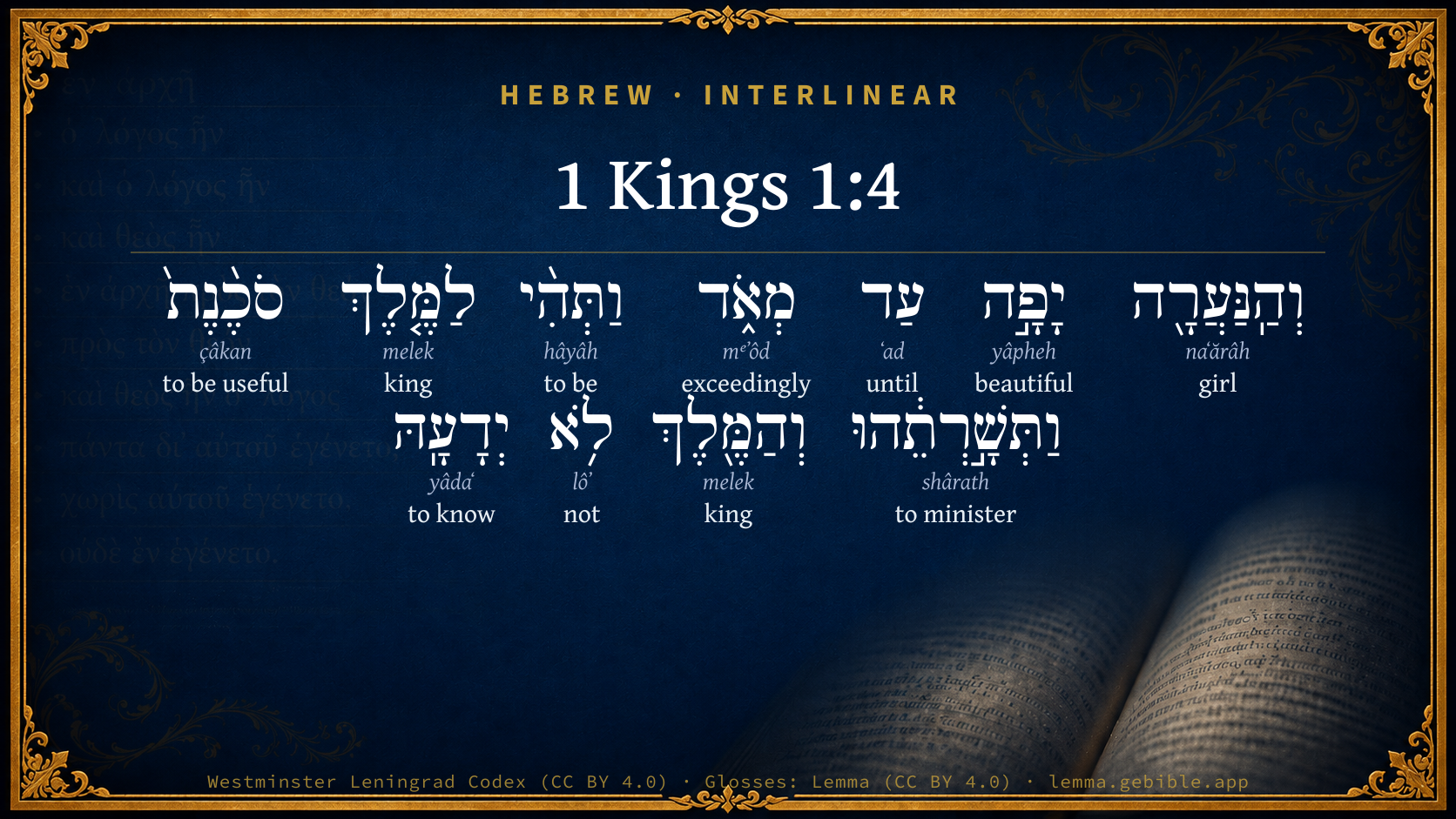
1 Kings 1:4

Hebrew (Westminster Leningrad Codex) 1 Kings 1:4 appears in the Hebrew Old Testament. The text above is from the Westminster Leningrad Codex. Each word links to its Strong’s number, a concise gloss, and parsing drawn from the Open Scriptures Hebrew Bible morphology. Click any word for its full Brown-Driver-Briggs (BDB) entry.
Download image
Cite this verse

1 Kings 1:4 (World English Bible). Public Domain. Lemma interlinear Bible study tool, https://lemma.gebible.app/v/1-kings/1/4.

Show BibTeX & RIS
BibTeX
RIS
English Translation
The young lady was very beautiful; and she cherished the king, and ministered to him; but the king didn't know her intimately.
World English Bible · Public Domain
Download a study sheet

One document with this verse’s original text, its word-by-word gloss line, the meaning frame, cross-references with their text, attributed commentary, and full source and license credits — printable, and it pastes into notes with its structure intact.

This verse Autodidact and up

Study sheet (.html) Plain text (.txt)

A passage Seminary Student

Up to 50 verses in one chapter. A passage sheet keeps up to 6 commentary sources and 12 cross-references per verse, in the order this page ranks them, and says so on the sheet whenever that leaves anything out. Ask for a single verse and you get the Autodidact verse sheet above.

Everything on this page stays free to read, with no account — the sheet is a download of what is already on screen, not access to it.

Want to remove ads? Support Godless Engineer
Compare translations 3

The same verse in 3 English versions, stacked beneath the original-language interlinear above. Click any original word for its lexicon entry.

Each is an independent rendering of the whole verse — the interlinear is not word-aligned to these translations.

Highlighted words mark where these versions differ — a whole-verse word diff, not a word-by-word alignment.

  • World English Bible Public Domain
    The young lady was very beautiful; and she cherished the king, and ministered to him; but the king didn't know her intimately.
  • King James Version Public Domain
    And the damsel was very fair, and cherished the king, and ministered to him: but the king knew her not.
  • unfoldingWord Literal Text CC BY-SA 4.0
    Now the young woman was beautiful to abundance. And she became one caring for the king, and she served him, but the king did not know her.

unfoldingWord Literal Text — © unfoldingWord, licensed CC BY-SA 4.0. Word-aligned USFM3 via Door43 (git.door43.org/unfoldingWord/en_ult).

Versions to compare (up to 4)

3 of 4 selected

Show all 18 translations

Every available English version of this verse, each an independent rendering of the whole verse.

  • World English Bible Public Domain
    The young lady was very beautiful; and she cherished the king, and ministered to him; but the king didn't know her intimately.
  • Berean Standard Bible Public Domain
    The girl was unsurpassed in beauty; she cared for the king and served him, but he had no relations with her.
  • Majority Standard Bible Public Domain
    The girl was unsurpassed in beauty; she cared for the king and served him, but he had no relations with her.
  • King James Version Public Domain
    And the damsel was very fair, and cherished the king, and ministered to him: but the king knew her not.
  • American Standard Version (1901) Public Domain
    And the damsel was very fair; and she cherished the king, and ministered to him; but the king knew her not.
  • Revised Version (1885) Public Domain
    And the damsel was very fair; and she cherished the king, and ministered to him; but the king knew her not.
  • Geneva Bible (1599) Public Domain
    And the maid was exceeding faire, and cherished the king, and ministred to him, but the King knew her not.
  • Douay-Rheims (1899) Public Domain
    And the damsel was exceeding beautiful, and she slept with the king: and served him, but the king did not know her.
  • Young's Literal Translation Public Domain
    and the young woman `is' very very fair, and she is to the king a companion, and serveth him, and the king hath not known her.
  • Literal Standard Version CC BY-SA 4.0
    and the young woman [is] very, very beautiful, and she is a companion to the king, and serves him, and the king has not known her.
  • Unlocked Literal Bible CC BY-SA 4.0
    The girl was very beautiful. She served the king and took care of him, but the king did not have sexual relations with her.
  • unfoldingWord Literal Text CC BY-SA 4.0
    Now the young woman was beautiful to abundance. And she became one caring for the king, and she served him, but the king did not know her.
  • Darby Bible Public Domain
    And the damsel was very fair; and cherished the king, and ministered to him; but the king knew her not.
  • World Messianic Bible Public Domain
    The young lady was very beautiful; and she cherished the king, and served him; but the king didn’t know her intimately.
  • Webster's Bible Public Domain
    And the damsel was very fair, and cherished the king, and ministered to him: but the king knew her not.
  • Free Bible Version CC BY-SA 4.0
    She was very beautiful, and she looked after the king, attending to his needs, but he did not have sex with her.
  • Bible in Basic English Public Domain
    Now she was very beautiful; and she took care of the king, waiting on him at all times; but the king had no connection with her.
  • JPS Tanakh (1917) Public Domain
    And the damsel was very fair; and she became a companion unto the king, and ministered to him; but the king knew her not.

Literal Standard Version (2020), Covenant Press — licensed CC BY-SA 4.0. Text via the HelloAO Bible API (eBible.org). Unlocked Literal Bible (unfoldingWord) — licensed CC BY-SA 4.0. Text via the HelloAO Bible API (eBible.org). unfoldingWord Literal Text — © unfoldingWord, licensed CC BY-SA 4.0. Word-aligned USFM3 via Door43 (git.door43.org/unfoldingWord/en_ult). Free Bible Version, Dr. Jonathan Gallagher — licensed CC BY-SA 4.0. Text via the HelloAO Bible API (eBible.org).

Word by word

More ways to search: Search by grammar → Find every occurrence → Compare this word →

Practice this passage: Drill this verse → Learn its vocabulary →

סֹכֶ֨נֶת֙
çâkan
H5532
“being useful”
Verb, Qal, Participle Active, Feminine, Singular, Absolute
Part of Speech
Verb
Stem
Qal
Form
Participle Active
Gender
Feminine
Number
Singular
State
Absolute
Full BDB Definition

Origin: a primitive root

TWOT: 1494

to be of use or service or profit or benefit - (Qal) - to be of use or service - servitor, steward (participle) - to benefit, profit - (Hiphil) to be used, be wont, exhibit use or habit, show harmony
  1. וְהַֽנַּעֲרָ֖ה naʻărâh H5291 “and · the · girl” Conjunction + Particle, Definite Article + Noun, Common, Feminine, Singular, Absolute
  2. יָפָ֣ה yâpheh H3303 “beautiful” Adjective, Adjective, Feminine, Singular, Absolute
  3. עַד ʻad H5704 “until” Preposition
  4. מְאֹ֑ד mᵉʼôd H3966 “exceedingly” Adverb
  5. וַתְּהִ֨י hâyâh H1961 “and · to be” Conjunction + Verb, Qal, Sequential Imperfect, 3rd Person, Feminine, Singular
  6. לַמֶּ֤לֶךְ melek H4428 “to/for the · king” Preposition, Determined + Noun, Common, Masculine, Singular, Absolute
  7. וַתְּשָׁ֣רְתֵ֔הוּ shârath H8334 “and · to minister · him” Conjunction + Verb, Piel, Sequential Imperfect, 3rd Person, Feminine, Singular + Suffix, Personal, 3rd Person, Masculine, Singular
  8. וְהַמֶּ֖לֶךְ melek H4428 “and · the · king” Conjunction + Particle, Definite Article + Noun, Common, Masculine, Singular, Absolute
  9. לֹ֥א lôʼ H3808 “not” Particle, Negative
  10. יְדָעָֽהּ yâdaʻ H3045 “to know · her” Verb, Qal, Perfect, 3rd Person, Masculine, Singular + Suffix, Personal, 3rd Person, Feminine, Singular

About this verse

These counts appear in no published source. They are computed here, from the morphology-tagged text and Lemma’s own curated glosses. What Lemma adds →

11
words
10
distinct lemmas
Historical
section

Notable vocabulary

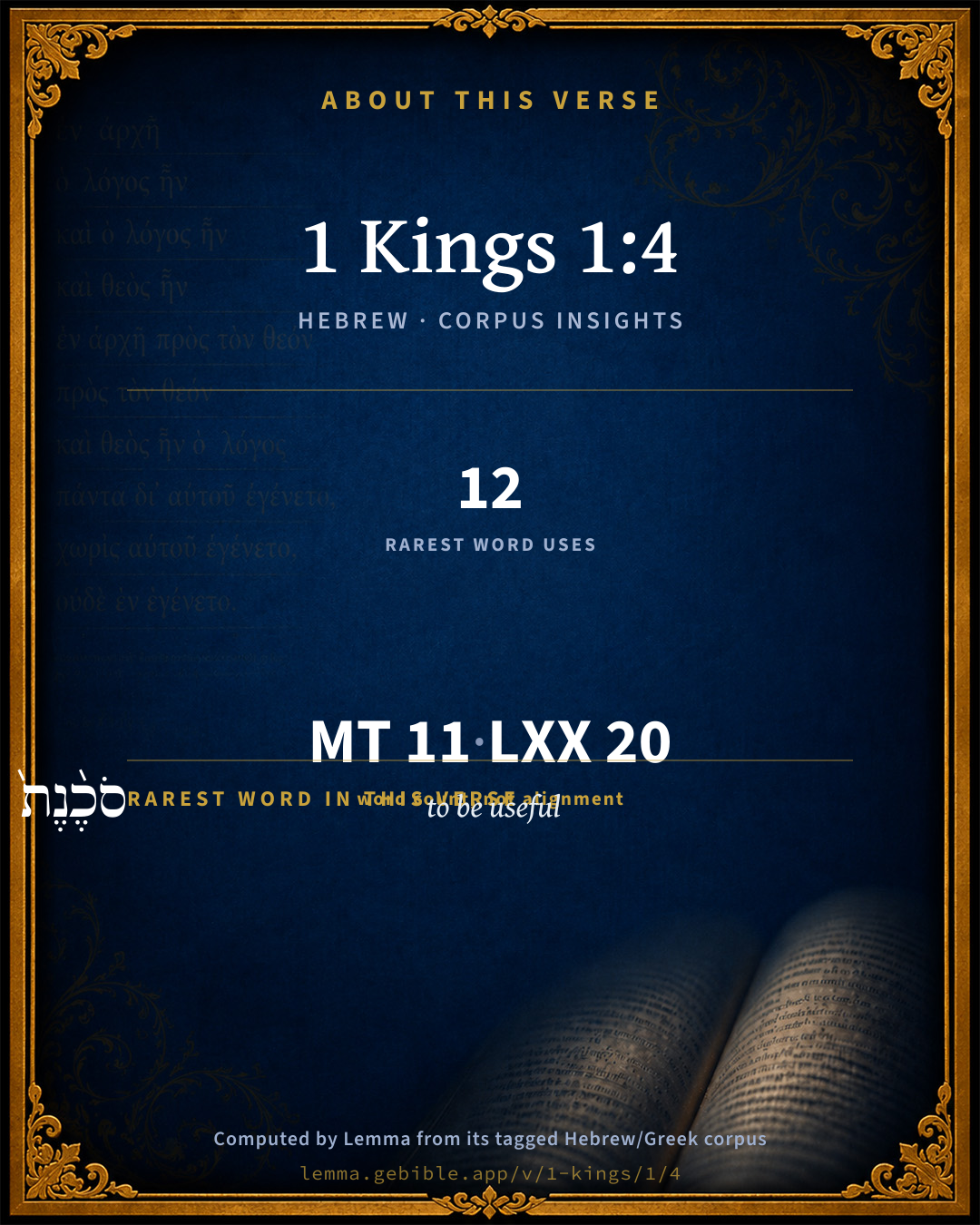
The rarest word here is סֹכֶ֨נֶת֙ to be useful H5532 — appearing just 12 times in the whole Hebrew Bible.

Shared distinctive vocabulary

סֹכֶ֨נֶת֙ to be useful H5532 occurs in 10 verses of the Hebrew Bible. Also found in:

Grammatical profile

  • 4 verbs
  • 3 nouns
  • 1 adjective
  • 1 preposition
  • 1 adverb
  • 1 particle

Verb forms

  • וַתְּהִ֨י Qal · Sequential Imperfect
  • סֹכֶ֨נֶת֙ Qal · Participle Active
  • וַתְּשָׁ֣רְתֵ֔הוּ Piel · Sequential Imperfect
  • יְדָעָֽהּ Qal · Perfect

Repetition

A word recurs within this verse — often emphatic in Hebrew:

  • לַמֶּ֤לֶךְ king H4428 ×2

Hebrew & Septuagint length

In English translation the verse runs 22 words from the Hebrew and 21 from the Septuagint (LXX English) — closely comparable.

A rough comparison of the two English renderings, which tokenize alike — not a word-level alignment.

Word counts can differ between the Hebrew and the Greek without any difference in meaning — e.g. the Hebrew direct-object marker אֵת has no separate Greek word, and Greek often adds the article ὁ.

In the original languages it is 11 Hebrew tokens and 20 Greek tokens — but the two are counted differently (Hebrew bundles its prefixes and suffixes into one token; the Greek is in lemma form), so that isn’t a like-for-like length.

Cross-references

1

Topical passages linked to 1 Kings 1:4 in the Treasury of Scripture Knowledge — connected by theme and wording, ordered by reader-vote popularity; previews shown in the World English Bible.

  • Matthew 1:25 and didn't know her sexually until she had brought forth her firstborn son. He named him Jesus.

Cross-references courtesy of OpenBible.info (CC BY 4.0).

Hebrew and Greek witnesses Masoretic Hebrew ↔ Greek Septuagint

The same verse in the two great witnesses to the Old Testament, shown verse-for-verse.

These are two independent witnesses, not word-aligned to each other, and the Septuagint is shown in lemma (dictionary) form.

Hebrew 1 Kings 1:4 Masoretic · Westminster Leningrad Codex

וְהַֽנַּעֲרָ֖ה יָפָ֣ה עַד מְאֹ֑ד וַתְּהִ֨י לַמֶּ֤לֶךְ סֹכֶ֨נֶת֙ וַתְּשָׁ֣רְתֵ֔הוּ וְהַמֶּ֖לֶךְ לֹ֥א יְדָעָֽהּ

The young lady was very beautiful; and she cherished the king, and ministered to him; but the king didn't know her intimately.

World English Bible · Public Domain

Greek LXX 1 Kings 1:4 Septuagint · lemma form

καί ὁ νεᾶνις καλός ἕως σφόδρα καί εἰμί θάλπω ὁ βασιλεύς καί λειτουργέω αὐτός καί ὁ βασιλεύς οὐ γιγνώσκω αὐτός

And the damsel was extremely beautiful, and she cherished the king, and ministered to him, but the king knew her not.

LXX2012 (modern English Septuagint) · Public Domain

Hebrew: Westminster Leningrad Codex (CC BY 4.0). Greek: Septuagint (public domain); English from LXX2012 (modern English Septuagint) (Public Domain). How the Septuagint differs from the Hebrew →

Targum (Aramaic paraphrase)

1

The Targum is the ancient Jewish Aramaic paraphrase of the Hebrew Scriptures — an interpretive translation, not the Hebrew text itself. Onkelos (literal) and Pseudo-Jonathan (expansive) render the Torah, and Jonathan the Prophets. Coverage is partial: where no permissively-licensed English translation exists for a verse, only the Aramaic is shown. This is verse-level text, not a word-by-word alignment to the Hebrew.

  1. Targum Jonathan Prophets (Joshua–Malachi)
    וְעוּלֶמְתָּא שַׁפִּירְתָּא עַד לַחֲדָא וַהֲוַת לְמַלְכָּא קָרִיבָא וּמְשַׁמְשָׁא לֵיהּ וּמַלְכָּא לָא יְדָעָהּ:

    (no public-domain English translation for this verse)

    Targum Jonathan — Aramaic: “Mikraot Gedolot” (public domain). English: “Sefaria Community Translation” (CC0 1.0 (public-domain dedication)); “London "Chaldee Paraphrase," 1871” (public domain). Text via Sefaria.

Commentary

Notes on 1 Kings 1:4 from classic Christian and Jewish commentators (each source and its license shown beneath its notes). The classic Christian expositions comment on the surrounding passage and are grouped to its opening verse, so a note may address several verses; the Jewish commentaries on the Tanakh (Rashi and others) are per-verse, so they appear only where the commentator wrote on this verse.

Lemma curates 59 commentaries, every one of them public domain or Creative Commons licensed, each selected and text-cleaned for this edition rather than reprinted as found. About our sources →

Trapp's Complete Commentary

John Trapp

1Ki 1:4 And the damsel [was] very fair, and cherished the king, and ministered to him: but the king knew her not.

Ver. 4. And the damsel was very fair.] And therefore lovely, οττι καλον φιλον εστι, and fitter for the purpose.

But the king knew her not.] Utpote frigidus et inhabilis ad generandum; neither would it have been for his health, as the case then stood.

John Trapp, A Commentary or Exposition upon All the Books of the Old and New Testament (1647–1656) — public domain. Text from a community e-Sword module.

Joseph Benson's Commentary

1Ki 1:4. The king knew her not — Did not enjoy her as his wife, but she remained still a virgin: which is mentioned to signify the continuance and progress of the king’s malady.

Joseph Benson's Commentary on the Old and New Testaments (1811–1818) — public domain. Text from a community e-Sword module.

Adam Clarke's Commentary

Verse 4. The king knew her not.] The maxim of Bacon in his enigmatical cure is, "Take all you can from the medicine, but give nothing to it; if you give any thing, it increases the disease and hastens death." I have seen this abundantly verified; but it is a subject on which it would be improper to dilate except in a medical work. An extract from Friar Bacon's Cure of Old Age may be found at the end of the chapter. 1Kg 1:53.

Adam Clarke's Commentary on the Bible (1810–1826) — public domain. Text from a community e-Sword/MySword module.

The Cambridge Bible for Schools and Colleges

gen. ed. J. J. S. Perowne

4. cherished the king] Being always at hand to perform, as his nurse, such duties as the weak condition of king David needed.

knew her not] These words seem added to explain how it came to pass that Adonijah afterwards could ask her for his wife. (1Ki_2:17.)

The Cambridge Bible for Schools and Colleges (gen. ed. J. J. S. Perowne; Cambridge University Press, 1878–1918) — public domain. Text from a community e-Sword module.

John Gill's Exposition

And the damsel was very fair,.... And so very agreeable to the king to be in his presence, and wait upon him, and take things of her hand, as well as lie with him:

and cherished the king; enlivened his spirits by her amiable countenance, her graceful behaviour, and tender care of him, and especially by bedding with him:

and ministered to him; serving him with her own hands whatever he took for his sustenance:

but the king knew her not; as a man knows his wife; which shows that she was his wife, and that it would not have been criminal in him had he known her; but this is observed, not to point at the chastity of David, but his feebleness, and loss of desire after women, and that the damsel remained a virgin; and that was the ground of Adonijah's request, and his hope of succeeding.

John Gill's Exposition of the Whole Bible (1746–1763) — public domain (CC PDM 1.0). Text via the HelloAO Bible API.

Haydock's Catholic Bible Commentary

Her. Which shews the virtue and temperance of David. (Menochius) --- She was his wife, at least of a second order. Adonias flattered himself, on account of Abisag’s virginity, that the law did not hinder him from marrying her; (Leviticus xviii. 8.; Kimchi) or he was blinded by ambition. (Calmet) --- Heretics and persecutors thus attempt in vain, (Haydock) to defile the Church, the chaste spouse of Jesus, that they may usurp his throne. (Calmet)

George Leo Haydock (1774–1849), Haydock's Catholic Family Bible and Commentary, 1859 edition — public domain. Excludes Psalms (Douay-Rheims chapter numbering differs from Protestant) and Deuterocanonical books (Catholic canon only).

Matthew Poole's English Annotations

Which is mentioned to note the continuance and progress of the king’s malady, and the ground of Adonijah’s rebellion, and of his following request, 1Ki 2:17.

Matthew Poole's English Annotations on the Holy Bible (1683–1685) — public domain. Text from a community e-Sword/MySword module.

Whedon's Commentary on the Bible

Daniel D. Whedon

4. The king knew her not — This explicit statement, as well as all that goes before, is a sufficient vindication of David from the charge of taking a fair young concubine in his old age in order to gratify lewd passions. The whole procedure was in perfect accordance with the morals of the time. No one looked upon it as a scandal, and Bath-sheba herself evidently found no fault.

Daniel D. Whedon (gen. ed.), Commentary on the Old and New Testaments (1874–1909) — public domain. Text from a community e-Sword module.

The Pulpit Commentary

And the damsel was very fair lit. , fair to exceeding and cherished see on ver. 2 the king, and ministered to him; but the king knew her not. This is mentioned to explain the history of 1Ki_2:13-25. Had it been otherwise, Adonijah could never have presumed to seek her in marriage, and Bathsheba would never have promised her help in his suit. Such an incestuous alliance would not only have been contrary to the law, (Lev_18:8) but abhorrent to all true Israelites. (cf 1Co_5:1) In this fact, which the court knew, and which the nation at large did not knowthey could only suppose that such a "search" for one so exceeding "fair" meant the increase of the seraglio Adoni-jah found his point dappui for a second attempt on the throne. The older expositors and some of the modern, notably Wordsworth, assume that Abishag was David"s wife, in the sense of being legally married to him. (Corn. A Lap. discusses the question at considerable length, and with needless pruriency.) But this idea finds no support in Scripture, which represents her as simply an attendant. It is idle to remark, consequently, that "the Jewish law allowed polygamy" (Rawlinson). And the king went to Gibeon Jos_9:3 Jos_10:2 Jos_18:25; 2Sa_21:1. Now known as El-Jib, a commanding eminence (as the name implies) some six miles north of Jerusalem. Strictly, it consists of two heights, on one of which, it is conjectured, the town stood, while the other was the high place. Solomon was accompanied to Gibeon by "all the congregation," including the captains, judges, governors, etc. (2Ch_1:2, 3 to sacrifice there This religious service was designed to inaugurate his reign, (2Ch_1:13) after the precedent of 1Sa_11:15; cf. 2Sa_6:2. His object was also to supplicate the Divine blessing on his undertakings. If his visit served at the same time as a farewell, or "honourable funeral to the tabernacle". (Wordsw) this was an accident; for that was the great high place being the place of the tabernacle and brazen altar. In 1Sa_21:6 we find the tabernacle at Nob, though without the ark. (1Sa_4:2) After the massacre of the priests it lost the ephod. (1Sa_22:20 1Sa_23:6) It could hardly remain in a spot stained by so much blood; but how or when it found its way to Gibeon, we do not know. See 1Ch_16:37, 1Ch_16:39; :2Ch_1:3-6 a thousand burnt offerings such numbers were not infrequent at festivals. See on 1Ki_8:62, and cf. 2Ch_29:33, 2Ch_29:34. Rawlinson reminds us that "Xerxes offered 1000 oxen at Troy" (Heb 7:43). did Solomon offer not, of course, personally, as some (Ewald. e.g. ) have sup. posed. He is said to have "offered" them, because he (together with the congregation, perhaps) provided them. The immense number alone shows that he cannot have offered in person. The festival probably lasted for seven or eight days,but even then a thousand victims can hardly have been offered whole (twOlO) unless the altar was greatly enlarged, or additional temporary altars were erected. This latter supposition is not negatived by the next words. (See on 1Ki_8:63, 1Ki_8:64) upon that altar.

The Pulpit Commentary (1880–1919), ed. H.D.M. Spence-Jones & Joseph S. Exell — public domain. Text from a community e-Sword module.

John Wesley's Explanatory Notes

Knew her not - Which is mentioned to note the continuance and progress of the king's malady.

John Wesley, Explanatory Notes Upon the Whole Bible (1754–1765) — public domain. Text via the GEBible commentary corpus.

Rashi

Rabbi Shlomo Yitzchaki (Rashi)

Was not intimate with her. Because a virgin is more suitable for [the purpose] of warming than a non-virgin. But our Rabbis said [he was not intimate with her] because “He shall not have too many wives,” and he already had eighteen.

Rashi on the Tanakh — English translations: “The Judaica Press complete Tanach with Rashi, translated by A. J. Rosenberg” (CC BY 4.0); “Pentateuch with Rashi's commentary by M. Rosenbaum and A.M. Silbermann, 1929-1934” (public domain); “The Metsudah Tanach series, Lakewood, N.J” (CC BY 4.0); and “The Book of Joshua, Metsudah Publications, 1997” (CC BY 4.0). Text via Sefaria.

Lesson kit

Teaching starters — assembled from the data on this page, not authored interpretation. Every prompt links to the verse data it draws on. Edit before teaching.

1 Kings, in the Historical, opens this verse with 11 words (10 distinct Hebrew lemmas). Its most distinctive word is çâkan (“to be useful”). A historical commentator’s framing appears above. Read the whole chapter for the surrounding context.

Discussion questions

  1. The word çâkan carries the sense “to be useful.” How does it shape the verse?
  2. Numbers 22:30 shares the word «to be useful» with this verse. How do the two illuminate each other?
  3. “king” occurs 2× in this one verse. What is the effect of the repetition?
  4. These translations render this verse differently. What is at stake in choosing one wording over another?
  5. The verb «וַתְּהִ֨י» is Qal Sequential Imperfect. How does its form color the action?
  6. Reading how Trapp's Complete Commentary and Joseph Benson's Commentary read this verse, where do the two commentators agree and where do they part?

Things to notice

Reading settings

Reading text

Shown beneath each verse's original-language words.

Old Testament
Old Testament edition

Read the OT as the Masoretic Hebrew (MT) or the Greek Septuagint (LXX).

English shown for the Greek Septuagint (in the Hebrew ↔ Greek comparison).

Comparing translations? Open the Compare panel on any verse page to stack up to four side by side.