Philippians 2:22

Greek (Tischendorf 8th ed.) Philippians 2:22 appears in the Greek New Testament. The text above is from the Tischendorf 8th edition. Each word links to its Strong’s number and a concise gloss. Click any word for its full Thayer’s Greek Lexicon entry.
Download image
Cite this verse

Philippians 2:22 (World English Bible). Public Domain. Lemma interlinear Bible study tool, https://lemma.gebible.app/v/philippians/2/22.

Show BibTeX & RIS
BibTeX
RIS
English Translation
But you know the proof of him, that, as a child serves a father, so he served with me in furtherance of the Gospel.
World English Bible · Public Domain
Download a study sheet

One document with this verse’s original text, its word-by-word gloss line, the meaning frame, cross-references with their text, attributed commentary, and full source and license credits — printable, and it pastes into notes with its structure intact.

This verse Autodidact and up

Study sheet (.html) Plain text (.txt)

A passage Seminary Student

Up to 50 verses in one chapter. A passage sheet keeps up to 6 commentary sources and 12 cross-references per verse, in the order this page ranks them, and says so on the sheet whenever that leaves anything out. Ask for a single verse and you get the Autodidact verse sheet above.

Everything on this page stays free to read, with no account — the sheet is a download of what is already on screen, not access to it.

Want to remove ads? Support Godless Engineer
Compare translations 3

The same verse in 3 English versions, stacked beneath the original-language interlinear above. Click any original word for its lexicon entry.

Each is an independent rendering of the whole verse — the interlinear is not word-aligned to these translations.

Highlighted words mark where these versions differ — a whole-verse word diff, not a word-by-word alignment.

  • World English Bible Public Domain
    But you know the proof of him, that, as a child serves a father, so he served with me in furtherance of the Gospel.
  • King James Version Public Domain
    But ye know the proof of him, that, as a son with the father, he hath served with me in the gospel.
  • unfoldingWord Literal Text CC BY-SA 4.0
    But you know his proven worth, that as a child with his father, he served with me in the gospel.

unfoldingWord Literal Text — © unfoldingWord, licensed CC BY-SA 4.0. Word-aligned USFM3 via Door43 (git.door43.org/unfoldingWord/en_ult).

Versions to compare (up to 4)

3 of 4 selected

Show all 19 translations

Every available English version of this verse, each an independent rendering of the whole verse.

  • World English Bible Public Domain
    But you know the proof of him, that, as a child serves a father, so he served with me in furtherance of the Gospel.
  • Berean Standard Bible Public Domain
    But you know Timothy’s proven worth, that as a child with his father he has served with me to advance the gospel.
  • Majority Standard Bible Public Domain
    But you know Timothy’s proven worth, that as a child with his father he has served with me to advance the gospel.
  • King James Version Public Domain
    But ye know the proof of him, that, as a son with the father, he hath served with me in the gospel.
  • American Standard Version (1901) Public Domain
    But ye know the proof of him, that, as a child `serveth' a father, `so' he served with me in furtherance of the gospel.
  • Revised Version (1885) Public Domain
    But ye know the proof of him, that, as a child serveth a father, so he served with me in furtherance of the gospel.
  • Geneva Bible (1599) Public Domain
    But yee knowe the proofe of him, that as a sonne with the father, hee hath serued with me in the Gospel.
  • Douay-Rheims (1899) Public Domain
    Now know ye the proof of him, that as a son with the father, so hath he served with me in the gospel.
  • Young's Literal Translation Public Domain
    and the proof of him ye know, that as a child `serveth' a father, with me he did serve in regard to the good news;
  • Literal Standard Version CC BY-SA 4.0
    and you know his proof, that as a child [serves] a father, he served with me in regard to the good news;
  • Unlocked Literal Bible CC BY-SA 4.0
    But you know his worth, because as a child serves his father, so he served with me in the gospel.
  • unfoldingWord Literal Text CC BY-SA 4.0
    But you know his proven worth, that as a child with his father, he served with me in the gospel.
  • Darby Bible Public Domain
    But ye know the proof of him, that, as a child a father, he has served with me in the work of the glad tidings.
  • World Messianic Bible Public Domain
    But you know that he has proved himself. As a child serves a father, so he served with me in furtherance of the Good News.
  • Webster's Bible Public Domain
    But ye know the proof of him, that as a son with the father, he hath served with me in the gospel.
  • Free Bible Version CC BY-SA 4.0
    But you already know what he's like—just as a child working to help his father, so he's worked with me to spread the good news.
  • Bible in Basic English Public Domain
    But his quality is clear to you; how, as a child is to its father, so he was a help to me in the work of the good news.
  • Text-Critical English NT CC BY 4.0
    But you know Timothy's proven character, how as a son with a father he has served with me in the work of the gospel.
  • Tyndale New Testament (1534) Public Domain
    Ye knowe the proffe of him howe that as a sone with the father so with me bestowed he his labour apon the gospell.

Literal Standard Version (2020), Covenant Press — licensed CC BY-SA 4.0. Text via the HelloAO Bible API (eBible.org). Unlocked Literal Bible (unfoldingWord) — licensed CC BY-SA 4.0. Text via the HelloAO Bible API (eBible.org). unfoldingWord Literal Text — © unfoldingWord, licensed CC BY-SA 4.0. Word-aligned USFM3 via Door43 (git.door43.org/unfoldingWord/en_ult). Free Bible Version, Dr. Jonathan Gallagher — licensed CC BY-SA 4.0. Text via the HelloAO Bible API (eBible.org).

Word by word

More ways to search: Search by grammar → Find every occurrence → Compare this word →

Practice this passage: Drill this verse → Learn its vocabulary →

δοκιμὴν
dokimḗ
G1382
“approval”
Noun, Accusative, Singular, Feminine
Part of Speech
Noun
Case
Accusative
Number
Singular
Gender
Feminine
Full Thayer's Definition

Origin: from the same as G1384

TDNT: 06:15,2

1. proving, trial 2. approved, tried character 3. a proof, a specimen of tried worth
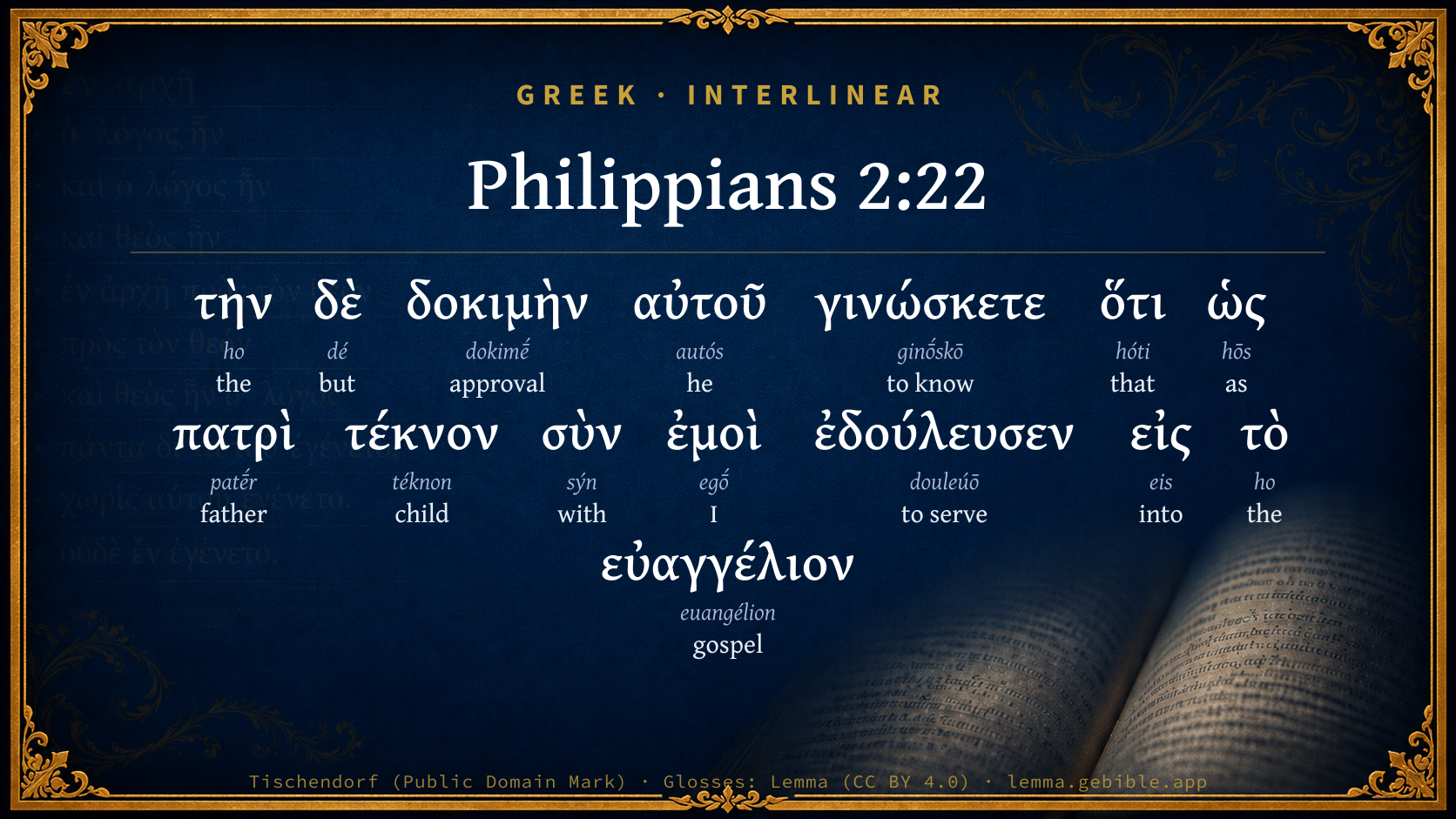
  1. τὴν ho G3588 “the” Article, Accusative, Singular, Feminine
  2. δὲ dé G1161 “but” Conjunction
  3. αὐτοῦ autós G846 “he” Personal pronoun, Genitive, Singular, Masculine
  4. γινώσκετε ginṓskō G1097 “to know” Verb, Present, Active, Indicative, 2nd person, Plural
  5. ὅτι hóti G3754 “that” Conjunction
  6. ὡς hōs G5613 “as” Adverb
  7. πατρὶ patḗr G3962 “father” Noun, Dative, Singular, Masculine
  8. τέκνον téknon G5043 “child” Noun, Nominative, Singular, Neuter
  9. σὺν sýn G4862 “with” Preposition
  10. ἐμοὶ egṓ G1473 “I” Personal pronoun, 1st person, Dative, Singular
  11. ἐδούλευσεν douleúō G1398 “to serve” Verb, Aorist, Active, Indicative, 3rd person, Singular
  12. εἰς eis G1519 “into” Preposition
  13. τὸ ho G3588 “the” Article, Accusative, Singular, Neuter
  14. εὐαγγέλιον euangélion G2098 “gospel” Noun, Accusative, Singular, Neuter

About this verse

These counts appear in no published source. They are computed here, from the morphology-tagged text and Lemma’s own curated glosses. What Lemma adds →

15
words
14
distinct lemmas
Pauline Epistles
section

Notable vocabulary

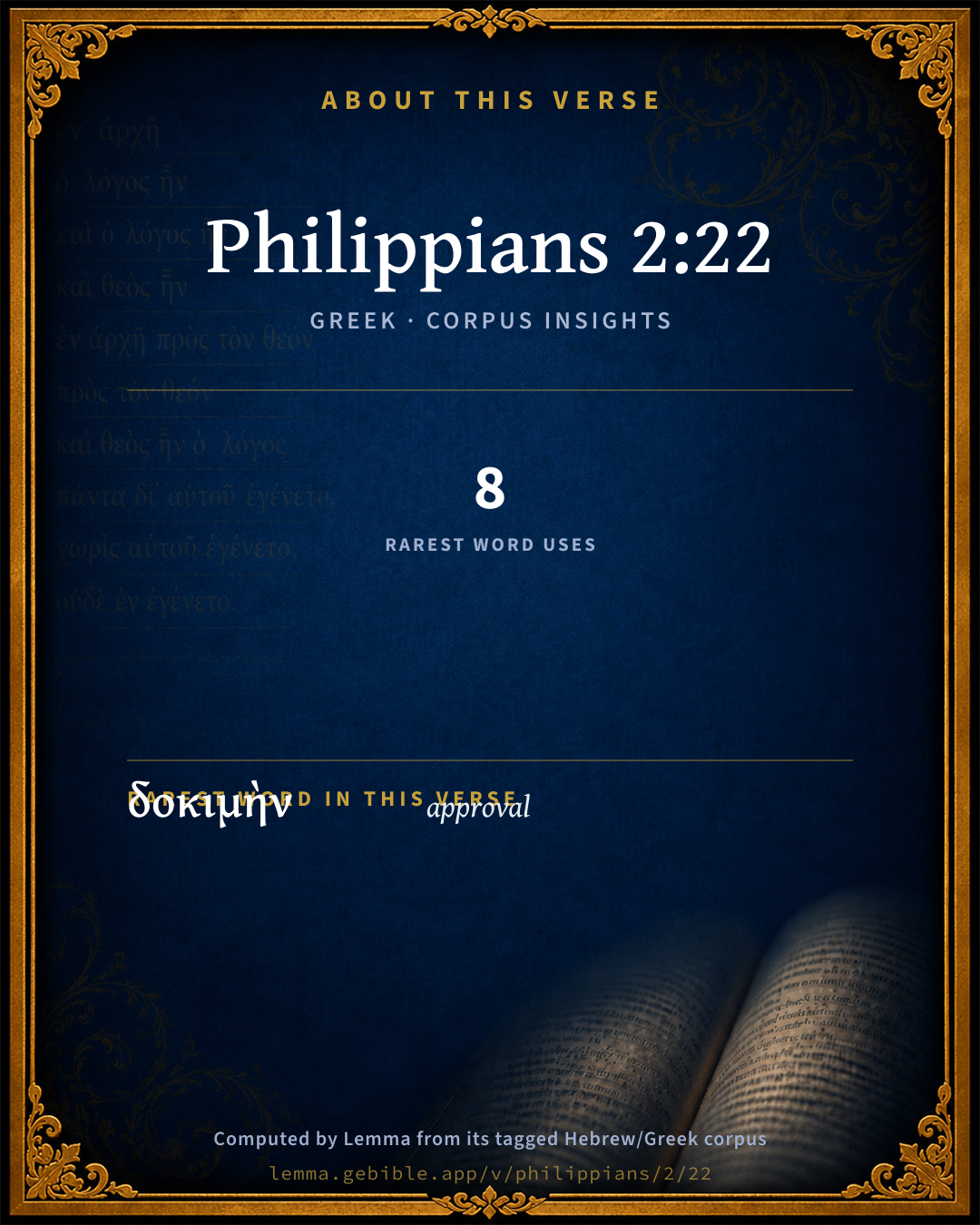
The rarest word here is δοκιμὴν approval G1382 — appearing just 8 times in the whole Greek New Testament.

Shared distinctive vocabulary

δοκιμὴν approval G1382 occurs in 7 verses of the Greek New Testament. Also found in:

Repetition

A word recurs within this verse:

Cross-references

12

Topical passages linked to Philippians 2:22 in the Treasury of Scripture Knowledge — connected by theme and wording, ordered by reader-vote popularity; previews shown in the World English Bible.

  • 1 Corinthians 4:17 Because of this I have sent Timothy to you, who is my beloved and faithful child in the Lord, who will remind you of my ways which are in Christ, even as I teach everywhere in every assembly.
  • 2 Corinthians 2:9 For to this end I also wrote, that I might know the proof of you, whether you are obedient in all things.
  • 1 Timothy 1:2 to Timothy, my true child in faith: Grace, mercy, and peace, from God our Father and Christ Jesus our Lord.
  • 2 Timothy 1:2 to Timothy, my beloved child: Grace, mercy, and peace, from God the Father and Christ Jesus our Lord.
  • Acts 16:3–12 Paul wanted to have him go out with him, and he took and circumcised him because of the Jews who were in those parts; for they all knew that his father was a Greek.
  • 2 Corinthians 8:22 We have sent with them our brother, whom we have many times proved earnest in many things, but now much more earnest, by reason of the great confidence which he has in you.
  • 1 Timothy 1:18 This charge I commit to you, my child Timothy, according to the prophecies which led the way to you, that by them you may wage the good warfare;
  • 2 Corinthians 8:8 I speak not by way of commandment, but as proving through the earnestness of others the sincerity also of your love.
  • 2 Corinthians 8:24 Therefore show the proof of your love to them in front of the assemblies, and of our boasting on your behalf.
  • Philippians 2:20 For I have no one else like-minded, who will truly care about you.
  • 2 Timothy 3:10 But you did follow my teaching, conduct, purpose, faith, patience, love, steadfastness,
  • Titus 1:4 to Titus, my true child according to a common faith: Grace, mercy, and peace from God the Father and the Lord Jesus Christ our Savior.

Cross-references courtesy of OpenBible.info (CC BY 4.0).

Commentary

Notes on Philippians 2:22 from classic Christian and Jewish commentators (each source and its license shown beneath its notes). The classic Christian expositions comment on the surrounding passage and are grouped to its opening verse, so a note may address several verses; the Jewish commentaries on the Tanakh (Rashi and others) are per-verse, so they appear only where the commentator wrote on this verse.

Lemma curates 59 commentaries, every one of them public domain or Creative Commons licensed, each selected and text-cleaned for this edition rather than reprinted as found. About our sources →

The Biblical Illustrator

Joseph S. Exell

Php_2:22

But ye know the proof of him

Timothy

I.

His filial attachment to paul.

II. His cooperation in the service of the gospel.

III. His tried and faithful character. (J. Lyth, D. D.)

Proof of character

I. Is required--

1. In every station.

2. Particularly in a minister.

II. Is given--

1. By faithful service.

2. Willing and childlike submission to superiors.

III. Brings honour.

1. It commands observation.

2. Wins confidence.

3. Ensures success. (J. Lyth, D. D.)

As a son with the father--

A lesson

I. To younger ministers to honour and reverence their ancients, and have them for an example.

II. To youths to have proper regard to their elders (1Ti_5:1-2; Lev_19:32).

III. To children to obey their parents.

IV. To spiritual children in regard to those who have begotten them in the faith of Christ Jesus (Phm_1:10; 1Co_4:15; Gal_4:19). (H. Airay, D. D.)

The Biblical Illustrator, edited by Joseph S. Exell (c. 1880s–1900s) — public domain. Text from a community e-Sword module.

Joseph Benson's Commentary

Php 2:22-24. But ye know the proof of him — You know what experience you and I have had of him, who was with me, as well as Silas, in that memorable visit which I first made you, Act 16:1-12. You then saw that as a son with the father — He uses an elegant peculiarity of phrase, speaking partly as of a son, partly as of a fellow-labourer; he served with me in the gospel — Neglecting no occasion of doing, in the most affectionate manner, whatever might lighten either my labours or my sufferings. Here, as Doddridge observes, “we learn the kind of intercourse which should subsist between the younger and more aged ministers of the gospel. The young ought to listen to the counsels of the aged, with the respect which is due from a son to a father; and the aged ought to love and patronise the young, and study, by their instruction and example, to qualify them for supplying their places in the church when they are gone.” Him therefore I hope to send — If, as has been supposed on Php 2:20, Aristarchus, Titus, and Luke were absent at this time from Rome, Timothy’s presence with the apostle was the more necessary. But as he daily looked for their return, he hoped to be able to send him to Philippi, as soon as he should know how it would go with him with respect to his imprisonment, or what issue his appeal to Cesar would have. But I trust in the Lord — That in mercy he will deliver me; and I shall shortly come to you myself — This he seems to have added, lest the Philippians might have been too much afflicted by what he had said concerning his death, Php 2:17.

Joseph Benson's Commentary on the Old and New Testaments (1811–1818) — public domain. Text from a community e-Sword module.

Bengel's Gnomon

Johann Albrecht Bengel

Php 2:22. Δὲ, but) This marks the antithesis between, Php 2:21, all, and of him. Rare praise, Neh 7:2.—γινώσκετε) ye know; comp. Act 16:1-12.—τέκνον σὺν, as a son with) He speaks with great elegance, partly as of a son, partly as of a colleague: so in ch. Php 3:17, he presents himself as the type [τύπον; “an ensample,” Engl. V.], and yet he commands them to be συμμιμητὰς, followers with him, not merely followers [just as here he makes Timothy a son following him as a father, and yet also a colleague with him].

Bengel's Gnomon of the New Testament — English translation (T&T Clark, Edinburgh, 1860) — public domain. Text from a community e-Sword module.

Meyer's Critical & Exegetical Commentary

Heinrich August Wilhelm Meyer

Php_2:22. Contrast, not of the person (which would have run τὴν δὲ αὐτοῦ δοκ. or αὐτοῦ δὲ τὴν δοκ.), but of the qualification, in order further to recommend him, whom he hopes soon to be able to send; not to make up for the disadvantage, that they can in the first instance only hope, etc. (as Hofmann artificially explains). But the approved character (indoles spectata, comp. Rom_5:4; 2Co_2:9; 2Co_9:13) of him ye know; for Timothy had himself been in Philippi (Act_16:1; Act_16:3; Act_17:14); hence γινώσκ. is not the imperative (Vulgate, Pelagius, Castalio, Cornelius a Lapide, Clericus, Rheinwald, Hoelemann).

ὅτι κ.τ.λ.] that he, namely, etc.

ὡς πατρὶ τέκνον] Comp. 1Co_4:17. The apostle had here ἐδούλευσεν before his mind, but alters the conception in such a way, that he thinks upon the service as rendered no longer to him, but with him, in a humble glance at Christ (Php_2:21), whom he himself also serves, so that the apostles servant is at the same time his σύνδουλος. See Winer, pp. 393, 537 [E. T. pp. 525, 722]. Hofmann labours without success to remove the incongruity, which cannot be got rid of unless, with Vatablus, we were at liberty to supply σύν before πατρί. But, however frequently the Greeks put the preposition only once in comparisons (see Bernhardy, p. 204 f.; Kühner, II. 1, p. 479), its omission does not occur in the clause placed first. The poetical use of such an omission in the case of words which are connected by καί, τέ, or ἤ (Dissen, ad Pind. Nem. x. 38; Lobeck, ad Aj. 397 ff.) does not concern us here.

εἰς] in respect to the gospel (comp. Php_1:5), the serving in question having reference to the preaching, defence, etc., thereof.

Meyer — Critical and Exegetical Commentary on the New Testament — English translation by Peter Christie, edited by Frederick Crombie (T&T Clark, 1880) — public domain. Text from a community e-Sword module.

Expositor's Greek Testament

ed. W. Robertson Nicoll

Phi 2:22 . δοκιμήν . “Approvedness.” That character which emerges as the result of testing. Cf. Jas 1:12 . ὡς πατ . τέκ . κ . τ . λ . A mixed construction, the result of refined feeling. Paul first thinks of Timothy as his son in the Gospel, serving him with a son’s devotion. But before the sentence is finished, his lowliness reminds him that they are both alike servants of a common Lord, equal in His sight. εἰς seems here practically equiv. to ἐν , as so frequently in later Greek. The fact is one of real importance for exegesis. (See Hatz., Einl, p. 210; Schmid, Atticismus , i., p. 91; Krumbacher, Kuhn’s Zeitschr. , 27, pp. 543 544). One can hardly discover here the idea of purpose.

The Expositor's Greek Testament, edited by W. Robertson Nicoll (1897–1910) — public domain. Text from a community e-Sword module.

Jamieson, Fausset & Brown

Robert Jamieson, A. R. Fausset & David Brown

Rare praise (Neh 7:2).

as a son with the father--Translate, "as a child (serveth) a father."

served with me--When we might expect the sentence to run thus. "As a child serveth a father, so he served me"; he changes it to "served with me" in modesty; as Christians are not servants TO one another," but servants of God WITH one another (compare Phi 3:17).

in the gospel--Greek, "unto," or "for the Gospel."

Jamieson, Fausset & Brown — Commentary Critical and Explanatory on the Whole Bible (1871) — public domain (CC PDM 1.0). Text via the HelloAO Bible API.

Adam Clarke's Commentary

Verse 22. Ye know the proof of him, that, as a son with the father, he hath served with me] The Philippians had full proof of the affectionate attachment of Timothy to Paul, for he had laboured with him there, as we learn from Ac 16:1-3; Ac 17:14; and we find from what is said here that Timothy was not a servant to the apostle, but that he had served with him. They both laboured together in the word and doctrine; for apostles and Christian bishops, in those times, laboured as hard as their deacons. There were no sinecures; every one was a labourer, every labourer had his work, and every workman had his wages.

Adam Clarke's Commentary on the Bible (1810–1826) — public domain. Text from a community e-Sword/MySword module.

John Calvin's Commentaries

22 But the proof. It is literally, ye know the proof of him, unless you prefer to understand it in the imperative mood, know ye; (for there had scarcely been opportunity during that short time to make trial,) but this is not of great moment. What is chiefly to be noticed is, that he furnishes Timothy with an attestation of fidelity and modesty. In evidence of his fidelity, he declares, that he had served with him in the gospel, for such a connection was a token of true sincerity. In evidence of his modesty, he states, that he had submitted to him as to a father. It is not to be wondered, that this virtue is expressly commended by Paul, for it has in all ages been rare. At the present day, where will you find one among the young that will give way to his seniors, even in the smallest thing? to such an extent does impertinence triumph and prevail in the present age! In this passage, as in many others, we see how diligently Paul makes it his aim to put honor upon pious ministers, and that not so much for their own sakes, as on the ground of its being for the advantage of the whole Church, that such persons should be loved and honored, and possess the highest authority.

John Calvin's Commentaries (1540-1563) — public domain. Text from the Calvin Translation Society English edition (1840s-50s) via the Christian Classics Ethereal Library (ccel.org). Calvin's coverage is partial (roughly two-thirds of the Bible); uncommented books and verses are honest gaps, never fabricated. The 19th-century editor's footnotes and remarks are omitted so the notes are faithfully Calvin's own voice.

Ellicott's Commentary for English Readers

(22) The proof of him.—The allusion is justified by their intimate personal knowledge. Timothy was at Philippi with St. Paul on his first visit (Act_16:12-40); we find him sent to Thessalonica shortly after (1Th_3:2), and he probably then paid a second visit to Philippi; from Ephesus (Act_19:22) he is sent again to Macedonia; and with St. Paul on the way to Jerusalem he was at Philippi once more (Act_20:4-6).

As a son with the father.—The original construction is curiously broken here. It runs, As a son to a father—as though St. Paul was going to speak of Timothy’s dutiful ministration and following of his example; but then the sentence changes, in a characteristic humility, and makes Timothy and himself merely fellow-servants—he served with me in the gospel. If we may judge of Timothy’s character from the general character of St. Paul’s directions to him in the Pastoral Epistles, and especially the significant exhortation, “Let no man despise thy youth, (1Ti_4:12), it would seem to have been gentle and warm-hearted rather than commanding. Hence, perhaps, the necessity for this singularly emphatic commendation of him. (Comp. 1Co_16:10, “If Timotheus come, see that he be with you without fear.”)

A Bible Commentary for English Readers, edited by Charles John Ellicott (1878–1897) — public domain. Text from a community e-Sword module.

The Cambridge Bible for Schools and Colleges

gen. ed. J. J. S. Perowne

22. the proof of him] The test of him; the practical evidence of what he is. This they “knew,” by eyewitness at Philippi.

as a son with the father] Better, as child with father. The Greek word rendered “child” is a tender one. See above on Php_2:15. For St Paul’s paternal love for Timothy cp. 2Ti_1:2, and that whole Epistle.

he hath served with me] More precisely, with me (slightly emphatic, suggesting the speciality of his devotion in Christ to Paul) he did bondservice. The reference is to the labours of Timothy (gathered up by the aorist into one recollection) at Philippi. See above, on Php_1:1, note 2.—Grammatically, we might render, “with me he accepted bond-service”; with a reference to Timothy’s first dedication to missionary work under St Paul, Act_16:1-3. But he evidently refers to their own observation of Timothy and so to a later period.

in the gospel] Lit., “unto the Gospel”; well paraphrased by R.V., in furtherance of the Gospel. See note on Php_1:5 above.—For “the Gospel” in the sense of “the work of the Gospel” cp. below, Php_4:3.

The Cambridge Bible for Schools and Colleges (gen. ed. J. J. S. Perowne; Cambridge University Press, 1878–1918) — public domain. Text from a community e-Sword module.

John Gill's Exposition

Him therefore I hope to send presently,.... For the reasons now given:

so soon as I shall see how it will go with me; whether he should be released from his bonds or not; whether he should live or die; whether he should be set free, or be called to suffer martyrdom for the sake of Christ; for he expected, that the matter would be determined in a very short time, when, be it at it would, Timothy would be spared.

John Gill's Exposition of the Whole Bible (1746–1763) — public domain (CC PDM 1.0). Text via the HelloAO Bible API.

Trapp's Complete Commentary

John Trapp

22 But ye know the proof of him, that, as a son with the father, he hath served with me in the gospel.

Ver. 22. As a son with the father] Happy son in such a father, 1Ti 1:2. If Jason the Thessalian held himself so happy in his tutor Chiron (Pindar. lib. 4, Pyth.), Alexander in his Aristotle, Paul in his Gamaliel, how much more was Timothy in Paul the aged, Phm 1:9, whose not only doctrine but manner of life he knew fully and followed faithfully, 2Ti 3:10, as a diligent disciple!

John Trapp, A Commentary or Exposition upon All the Books of the Old and New Testament (1647–1656) — public domain. Text from a community e-Sword module.

Albert Barnes' Notes on the Bible

But ye know the proof of him - You have had evidence among yourselves how faithfully Timothy devoted himself to the promotion of the gospel, and how constantly he served with me. This proves that Timothy was with Paul when he was at Philippi.

As a son with the father - Manifesting the same spirit toward me which a son does toward a father, and evincing the same interest in my work. He did all he could do to aid me, and lighten my labors and sufferings.

Albert Barnes' Notes on the Bible (1834–1885) — public domain. Text from a community e-Sword/MySword module.

Matthew Poole's English Annotations

However others were found in some respects defective to the service of Christ, yet he appeals to their experience of the integrity and fidelity of Timothy in conjunction with himself, when he preached the gospel amongst them, and afterwards, Act 16:1; 17:15; 18:5; Act 19:22; 20:4; which he amplifies and illustrates by a simile, when he saith,

as a son with the father; q.d. Just as a genuine and obedient son is wont to retain the spirit of his father that begat him: and Paul doth metaphorically call Timothy his own son, begotten by the gospel, 1Ti 1:2, his dearly beloved Son, 2Ti 1:2, and faithful in the Lord, 1Co 4:17, likeminded with himself, Phi 2:20; with whom he had not only preached, but served in the gospel, Phi 1:1, given himself wholly to the thing. He doth not say, served me, or under me, but with me in the gospel, i.e. to advance the glory of Christ in promoting the gospel, by helping with Paul, and labouring, working the work of the Lord, as Paul also did, and being sometime a sufferer under restraint for that service, as Paul himself, Heb 13:23, for the gospel, which is not a domination, but ministration, wherein this great apostle owns Timothy as his fellow minister.

Matthew Poole's English Annotations on the Holy Bible (1683–1685) — public domain. Text from a community e-Sword/MySword module.

Whedon's Commentary on the Bible

Daniel D. Whedon

22. The proof—Timothy’s conduct under their own eyes during his six years pastorate among them, (Acts xvi,) fully showed them his true character, especially in his joint service with the apostle to the cause of the gospel.

As a son… father—Lovingly, devotedly, and as if working for himself, did he give himself to his spiritual father for the work of Christ.

Daniel D. Whedon (gen. ed.), Commentary on the Old and New Testaments (1874–1909) — public domain. Text from a community e-Sword module.

The Pulpit Commentary

But ye know the proof of him. Ye recognize from your former experience (Ac 16) his approved character. That, as a son with the father, he hath served with me in the gospel; translate, with R.V, that, as a child serveth a father, so he served with me in furtherance of the gospel. Served edouleusen); as a slave. He was both a son and servant to St. Paul, and also a fellow-worker with St. Paul, both being slaves of God.

The Pulpit Commentary (1880–1919), ed. H.D.M. Spence-Jones & Joseph S. Exell — public domain. Text from a community e-Sword module.

John Wesley's Explanatory Notes

As a son with his father - He uses an elegant peculiarity of phrase, speaking partly as of a son, partly as of a fellowlabourer.

John Wesley, Explanatory Notes Upon the Whole Bible (1754–1765) — public domain. Text via the GEBible commentary corpus.

The People's New Testament

B. W. Johnson

22. Ye know the proof of him. You have seen him and know him. Timothy had more than once visited Philippi before this (2 Cor. 2:9; 13:3). As a son with a father. Timothy was his convert, and showed him a tender reverence.

B. W. Johnson's The People's New Testament with Notes (1889–1891) — public domain. Electronic text from the Christian Classics Ethereal Library (CCEL) ThML edition.

unfoldingWord translationNotes

Door43 World Missions Community

as a child serves his father, so he served with me

Paul speaks of Timothy, who served Christ with Paul, as if he were a child serving his father. Paul is emphasizing the close father-son relationship he has with Timothy in serving Christ. (See: Simile)

in the gospel

Here "the gospel" stands for the activity of telling people about Jesus. AT: "in telling people about the gospel" (See: Metonymy)

I am confident in the Lord that I myself will also come soon

"I am sure, if it is the Lord's will, that I will also come soon"

translationWords

servant

good news

confidence

unfoldingWord translationNotes — © Distant Shores Media and the Door43 World Missions Community, licensed CC BY-SA 4.0. Source: git.door43.org/Door43/en_tn.

Cambridge Greek Testament for Schools and Colleges

22. τὴν δοκιμὴν. “The test” through which he passed, before your eyes, when we were both at Philippi.—Or perhaps δοκιμή here means the result of the test, “proved fitness.” In Greek, as in English, abstract nouns are constantly passing from “process” to “result” (e.g. οἰκοδομή), and becoming more concrete.

ὡς πατρὶ τέκνον. “As child with father”; supplying σὺν in idea from the next words. Observe τέκνον, the tender word, of the born child; see on Php 2:15 above. For St Paul’s fatherly love for Timothy see 2Ti 1:2, and that whole Epistle.

σὺν ἐμοὶ. Slightly emphatic by position; as if to say, you saw his devotion of course, for it was shewn in connexion with me, your own Apostle.

ἐδούλευσεν. “He did bondservice”; almost, “he slaved.” The aorist gathers up Timothy’s toil at Philippi into one thought. This is better than to render it, “He entered on bondservice”; for the reference is plainly not to his first Christian work, but to his labours at Philippi.

εἰς τὸ εὐαγγέλιον. Well paraphrased by R.V., “in furtherance of the gospel.” See note on Php 1:5 above. For εὐαγγέλιον in the sense of missionary work, see below, Php 4:3.

Cambridge Greek Testament for Schools and Colleges (Cambridge University Press, 1896; 21 vols, various authors incl. Carr, Maclear, Plummer, Farrar, Lumby, Moule, M. R. James, Simcox) — public domain. Text from a community e-Sword module.

International Critical Commentary

22. τὴν δοκιμὴν: ‘the proof’ or ‘approvedness.’ Used only by Paul, and meaning both ‘the process of trial’ (2Co 8:2) and ‘the result of trial,’ as here, Rom 5:4; 2Co 2:9, 2Co 9:13. You know that he has approved himself to you.

γινώσκετε: Not imperat., for they had known Timothy in Philippi (Acts 16., Act 16:17.).

ὡς πατρὶ τέκνον σὺν ἐμοὶ ἐδούλευσεν: ‘as a child a father so he served with me.’ Paul began the sentence as if he were going to write, ‘Timothy served me as a child serves a father’; but he was checked by the thought that both himself and Timothy were alike servants of Jesus Christ (1:1), and also by that of his intimate and affectionate relations with Timothy. Accordingly he wrote ‘with me’ instead of ‘me.’

εἰς τὸ εὐαγγέλιον: As 1:5.

International Critical Commentary — older volumes (1896–1929), various authors — public domain. Text from a community e-Sword module.

Vincent's Word Studies in the New Testament

Marvin R. Vincent

In the Gospel (eijv to eujaggelion). In furtherance of, as ch. 1 5. So Rev.

Marvin R. Vincent, Word Studies in the New Testament (1887–1900) — public domain. Text from a community e-Sword/MySword module.

Lesson kit

Teaching starters — assembled from the data on this page, not authored interpretation. Every prompt links to the verse data it draws on. Edit before teaching.

Philippians, in the Pauline Epistles, opens this verse with 15 words (14 distinct Greek lemmas). Its most distinctive word is dokimḗ (“approval”). A historical commentator’s framing appears above. Read the whole chapter for the surrounding context.

Discussion questions

  1. What does “approval” (dokimḗ) contribute to the verse as a whole?
  2. How does Romans 5:4, which shares the word «approval», read alongside this verse?
  3. What does the repetition of “the” (2× in this one verse) do in this verse?
  4. These translations render this verse differently; the difference is in the English rendering, not the original. What questions does that raise?
  5. Compare how The Biblical Illustrator and Joseph Benson's Commentary read this verse. Where do they agree or differ?

Things to notice

Reading settings

Reading text

Shown beneath each verse's original-language words.

Old Testament
Old Testament edition

Read the OT as the Masoretic Hebrew (MT) or the Greek Septuagint (LXX).

English shown for the Greek Septuagint (in the Hebrew ↔ Greek comparison).

Comparing translations? Open the Compare panel on any verse page to stack up to four side by side.