
Romans 10:19

Greek (Tischendorf 8th ed.) Romans 10:19 appears in the Greek New Testament. The text above is from the Tischendorf 8th edition. Each word links to its Strong’s number and a concise gloss. Click any word for its full Thayer’s Greek Lexicon entry.
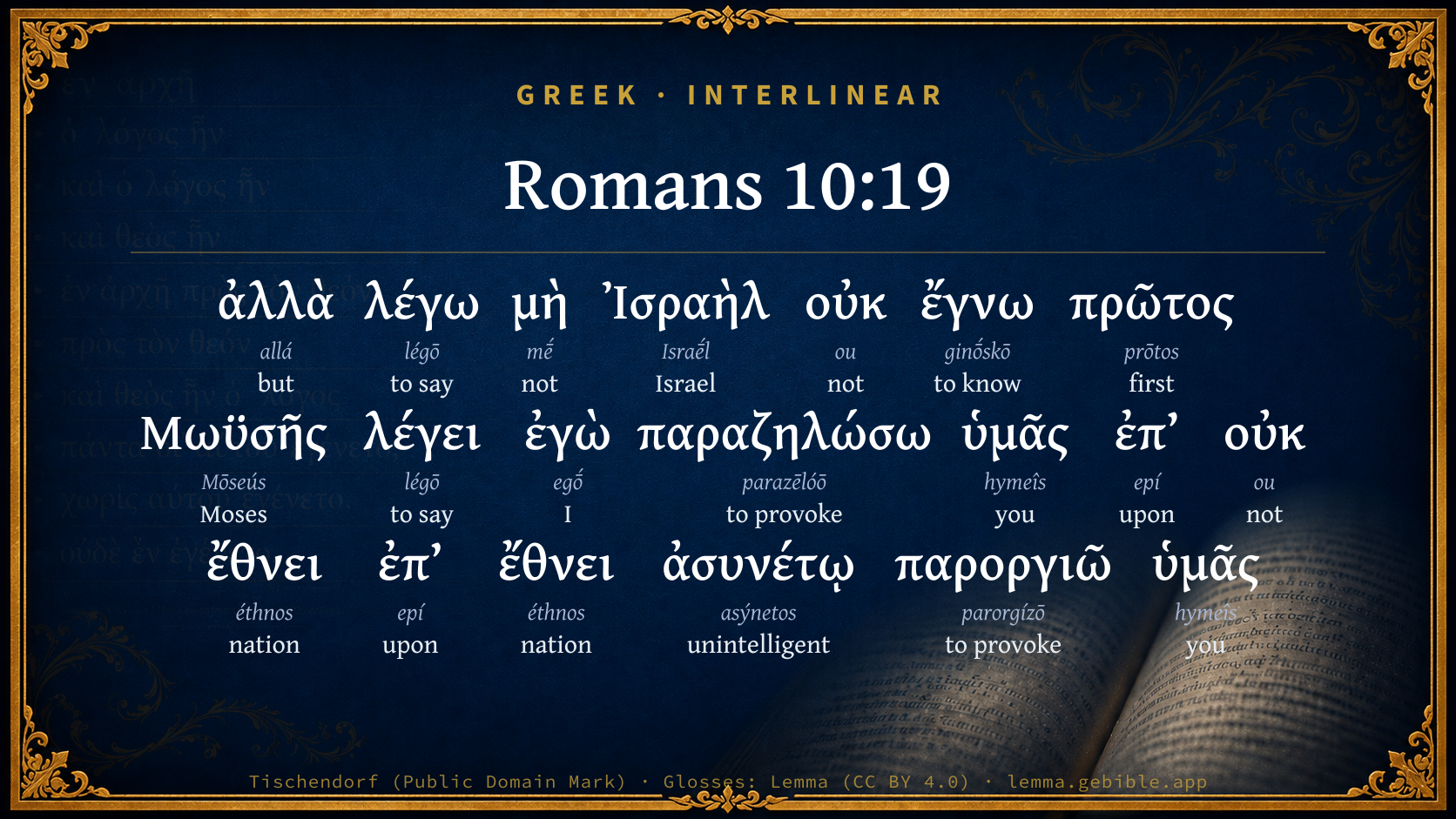
Download image
Cite this verse

Romans 10:19 (World English Bible). Public Domain. Lemma interlinear Bible study tool, https://lemma.gebible.app/v/romans/10/19.

Show BibTeX & RIS
BibTeX
RIS
English Translation
But I ask, didn't Israel know? First Moses says, "I will provoke you to jealousy with that which is no nation, With a nation void of understanding I will make you angry."
World English Bible · Public Domain
Highlights
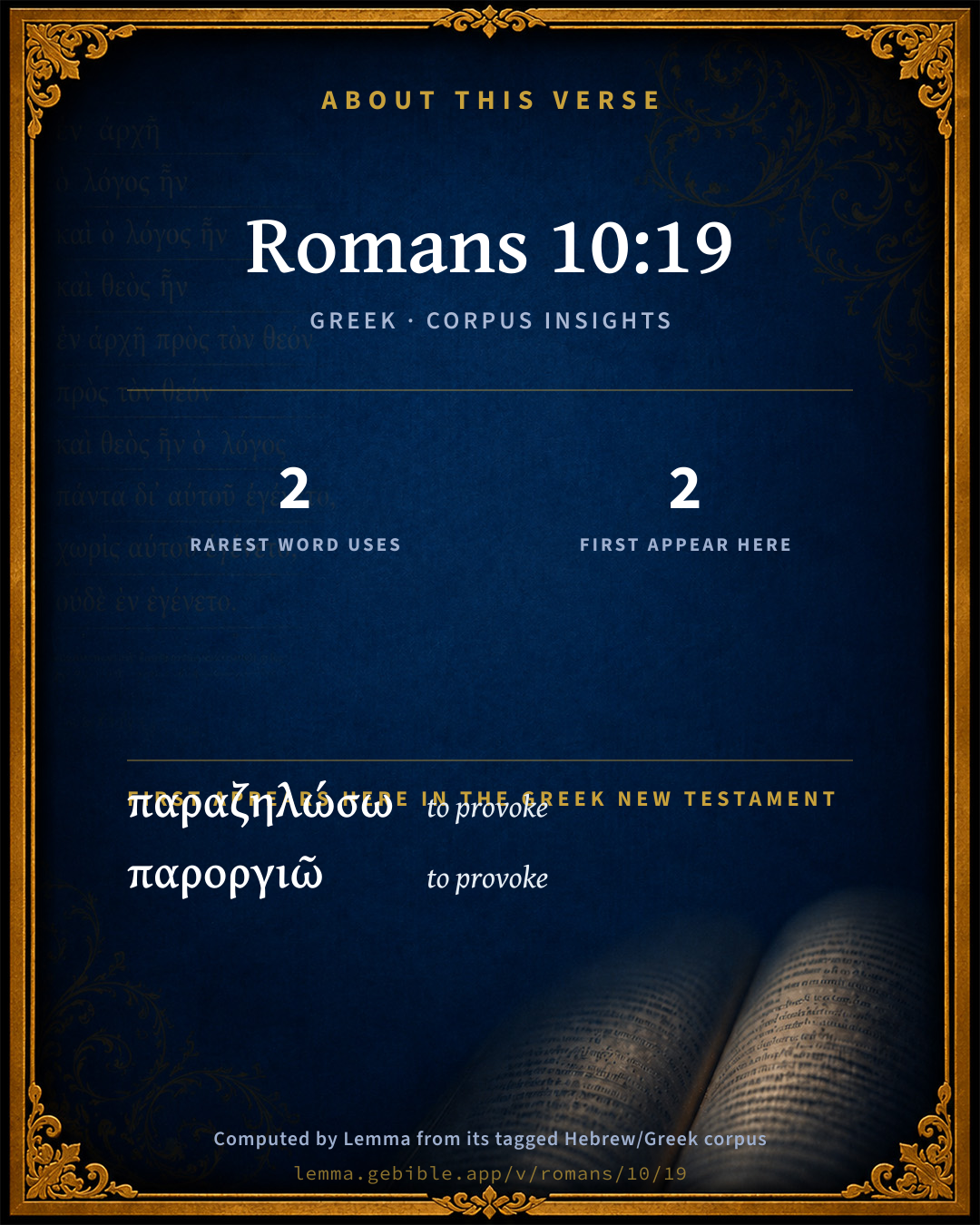
  • 2 first appearances in the Greek New Testament
Full analysis ↓
Download a study sheet

One document with this verse’s original text, its word-by-word gloss line, the meaning frame, cross-references with their text, attributed commentary, and full source and license credits — printable, and it pastes into notes with its structure intact.

This verse Autodidact and up

Study sheet (.html) Plain text (.txt)

A passage Seminary Student

Up to 50 verses in one chapter. A passage sheet keeps up to 6 commentary sources and 12 cross-references per verse, in the order this page ranks them, and says so on the sheet whenever that leaves anything out. Ask for a single verse and you get the Autodidact verse sheet above.

Everything on this page stays free to read, with no account — the sheet is a download of what is already on screen, not access to it.

Want to remove ads? Support Godless Engineer
Compare translations 3

The same verse in 3 English versions, stacked beneath the original-language interlinear above. Click any original word for its lexicon entry.

Each is an independent rendering of the whole verse — the interlinear is not word-aligned to these translations.

Highlighted words mark where these versions differ — a whole-verse word diff, not a word-by-word alignment.

  • World English Bible Public Domain
    But I ask, didn't Israel know? First Moses says, "I will provoke you to jealousy with that which is no nation, With a nation void of understanding I will make you angry."
  • King James Version Public Domain
    But I say, Did not Israel know? First Moses saith, I will provoke you to jealousy by them that are no people, and by a foolish nation I will anger you.
  • unfoldingWord Literal Text CC BY-SA 4.0
    But I say, “Did Israel certainly not know?” First Moses says, “I myself will provoke you to jealousy by a non-nation; by means of a senseless nation, I will provoke you to anger.” ts\*

unfoldingWord Literal Text — © unfoldingWord, licensed CC BY-SA 4.0. Word-aligned USFM3 via Door43 (git.door43.org/unfoldingWord/en_ult).

Versions to compare (up to 4)

3 of 4 selected

Show all 19 translations

Every available English version of this verse, each an independent rendering of the whole verse.

  • World English Bible Public Domain
    But I ask, didn't Israel know? First Moses says, "I will provoke you to jealousy with that which is no nation, With a nation void of understanding I will make you angry."
  • Berean Standard Bible Public Domain
    I ask instead, did Israel not understand? First, Moses says: “I will make you jealous by those who are not a nation; I will make you angry by a nation without understanding.”
  • Majority Standard Bible Public Domain
    I ask instead, did Israel not understand? First, Moses says: “I will make you jealous by those who are not a nation; I will make you angry by a nation without understanding.”
  • King James Version Public Domain
    But I say, Did not Israel know? First Moses saith, I will provoke you to jealousy by them that are no people, and by a foolish nation I will anger you.
  • American Standard Version (1901) Public Domain
    But I say, Did Israel not know? First Moses saith, I will provoke you to jealousy with that which is no nation, With a nation void of understanding will I anger you.
  • Revised Version (1885) Public Domain
    But I say, Did Israel not know? First Moses saith, I will provoke you to jealousy with that which is no nation, With a nation void of understanding will I anger you.
  • Geneva Bible (1599) Public Domain
    But I demaund, Did not Israel knowe God? First Moses sayth, I will prouoke you to enuie by a nation that is not my nation, and by a foolish nation I will anger you.
  • Douay-Rheims (1899) Public Domain
    But I say: Hath not Israel known? First, Moses saith: I will provoke you to jealousy by that which is not a nation; by a foolish nation I will anger you.
  • Young's Literal Translation Public Domain
    But I say, Did not Israel know? first Moses saith, `I will provoke you to jealousy by `that which is' not a nation; by an unintelligent nation I will anger you,'
  • Literal Standard Version CC BY-SA 4.0
    But I say, did Israel not know? First Moses says, “I will provoke you to jealousy by [that which is] not a nation, || By an unintelligent nation I will anger you,”
  • Unlocked Literal Bible CC BY-SA 4.0
    Moreover, I say, “Did Israel not know?” First Moses says, “I will provoke you to jealousy by what is not a nation. By means of a nation without understanding, I will stir you up to anger.”
  • unfoldingWord Literal Text CC BY-SA 4.0
    But I say, “Did Israel certainly not know?” First Moses says, “I myself will provoke you to jealousy by a non-nation; by means of a senseless nation, I will provoke you to anger.” ts\*
  • Darby Bible Public Domain
    But I say, Has not Israel known? First, Moses says, *I* will provoke you to jealousy through [them that are] not a nation: through a nation without understanding I will anger you.
  • World Messianic Bible Public Domain
    But I ask, didn’t Israel know? First Moses says, “I will provoke you to jealousy with that which is no nation. I will make you angry with a nation void of understanding.”
  • Webster's Bible Public Domain
    But I say, Did not Israel know? First, Moses saith, I will provoke you to jealousy by them that are no people, and by a foolish nation I will anger you.
  • Free Bible Version CC BY-SA 4.0
    So my question is, “Didn't Israel know?” First of all Moses says, “I'll make you jealous by using people who aren't even a nation; I will make you angry by using ignorant foreigners!”
  • Bible in Basic English Public Domain
    But I say, Had Israel no knowledge? First Moses says, You will be moved to envy by that which is not a nation, and by a foolish people I will make you angry.
  • Text-Critical English NT CC BY 4.0
    Again I ask, did Israel not understand? First Moses says, “I will provoke you to jealousy by that which is not a nation; by a nation that has no understanding I will provoke you to anger.”
  • Tyndale New Testament (1534) Public Domain
    But I demaunde whether Israel dyd knowe or not? Fyrst Moses sayth: I will provoke you for to envy by the that are no people and by a folisshe nacion I will anger you.

Literal Standard Version (2020), Covenant Press — licensed CC BY-SA 4.0. Text via the HelloAO Bible API (eBible.org). Unlocked Literal Bible (unfoldingWord) — licensed CC BY-SA 4.0. Text via the HelloAO Bible API (eBible.org). unfoldingWord Literal Text — © unfoldingWord, licensed CC BY-SA 4.0. Word-aligned USFM3 via Door43 (git.door43.org/unfoldingWord/en_ult). Free Bible Version, Dr. Jonathan Gallagher — licensed CC BY-SA 4.0. Text via the HelloAO Bible API (eBible.org).

Word by word

More ways to search: Search by grammar → Find every occurrence → Compare this word →

Practice this passage: Drill this verse → Learn its vocabulary →

παροργιῶ
parorgízō
G3949
“to provoke”
Verb, Future, Active, Indicative, 1st person, Singular
Part of Speech
Verb
Tense
Future
Voice
Active
Mood
Indicative
Person
1st person
Number
Singular
Full Thayer's Definition

Origin: from G3844 and G3710

TDNT: 11:22,7

1. to rouse to wrath, to provoke, exasperate, anger
  1. ἀλλὰ allá G235 “but” Conjunction
  2. λέγω légō G3004 “to say” Verb, Present, Active, Indicative, 1st person, Singular
  3. μὴ mḗ G3361 “not” Particle, Negative
  4. Ἰσραὴλ Israḗl G2474 “Israel” Noun, Proper, indeclinable
  5. οὐκ ou G3756 “not” Particle, Negative
  6. ἔγνω ginṓskō G1097 “to know” Verb, Aorist, Active, Indicative, 3rd person, Singular
  7. πρῶτος prōtos G4413 “first” Adjective, Nominative, Singular, Masculine, Superlative
  8. Μωϋσῆς Mōseús G3475 “Moses” Noun, Nominative, Singular, Masculine
  9. λέγει légō G3004 “to say” Verb, Present, Active, Indicative, 3rd person, Singular
  10. ἐγὼ egṓ G1473 “I” Personal pronoun, 1st person, Nominative, Singular
  11. παραζηλώσω parazēlóō G3863 “to provoke” Verb, Future, Active, Indicative, 1st person, Singular
  12. ὑμᾶς hymeîs G5210 “you” Personal pronoun, 2nd person, Accusative, Plural
  13. ἐπ’ epí G1909 “upon” Preposition
  14. οὐκ ou G3756 “not” Particle, Negative
  15. ἔθνει éthnos G1484 “nation” Noun, Dative, Singular, Neuter
  16. ἐπ’ epí G1909 “upon” Preposition
  17. ἔθνει éthnos G1484 “nation” Noun, Dative, Singular, Neuter
  18. ἀσυνέτῳ asýnetos G801 “unintelligent” Adjective, Dative, Singular, Neuter
  19. ὑμᾶς hymeîs G5210 “you” Personal pronoun, 2nd person, Accusative, Plural

About this verse

These counts appear in no published source. They are computed here, from the morphology-tagged text and Lemma’s own curated glosses. What Lemma adds →

20
words
15
distinct lemmas
Pauline Epistles
section

Notable vocabulary

The rarest word here is παροργιῶ to provoke G3949 — appearing just 2 times in the whole Greek New Testament.

First appearance in Scripture

These words make their first canonical appearance in the Greek New Testament here:

  • παραζηλώσω to provoke G3863
  • παροργιῶ to provoke G3949

Shared distinctive vocabulary

παροργιῶ to provoke G3949 occurs in 2 verses of the Greek New Testament. Also found in:
Repetition

Words recur within this verse:

  • λέγω to say G3004 ×2
  • ἐπ’ upon G1909 ×2
  • ἔθνει nation G1484 ×2
  • οὐκ not G3756 ×2
  • ὑμᾶς you G5210 ×2

Cross-references

19

Topical passages linked to Romans 10:19 in the Treasury of Scripture Knowledge — connected by theme and wording, ordered by reader-vote popularity; previews shown in the World English Bible.

  • Deuteronomy 32:21 They have moved me to jealousy with that which is not God; They have provoked me to anger with their vanities: I will move them to jealousy with those who are not a people; I will provoke them to anger with a foolish nation.
  • Romans 11:11 I ask then, did they stumble that they might fall? May it never be! But by their fall salvation has come to the Gentiles, to provoke them to jealousy.
  • Romans 11:14 if by any means I may provoke to jealousy those who are my flesh, and may save some of them.
  • Titus 3:3 For we were also once foolish, disobedient, deceived, serving various lusts and pleasures, living in malice and envy, hateful, and hating one another.
  • 1 Peter 2:10 who in time past were no people, but now are God's people, who had not obtained mercy, but now have obtained mercy.
  • Psalms 115:5–8 They have mouths, but they don't speak; They have eyes, but they don't see;
  • Isaiah 44:18–20 They don't know, neither do they consider: for he has shut their eyes, that they can't see; and their hearts, that they can't understand.
  • 1 Corinthians 1:12 Now I mean this, that each one of you says, "I follow Paul," "I follow Apollos," "I follow Cephas," and, "I follow Christ."
  • Jeremiah 10:8 But they are together brutish and foolish: the instruction of idols! it is but a stock.
  • Jeremiah 10:14 Every man is become brutish [and is] without knowledge; every goldsmith is disappointed by his engraved image; for his molten image is falsehood, and there is no breath in them.
  • Hosea 2:23 I will sow her to me in the earth; And I will have mercy on her who had not obtained mercy; And I will tell those who were not my people, 'You are my people;' And they will say, 'My God!'"
  • Romans 1:21–22 Because, knowing God, they didn't glorify him as God, neither gave thanks, but became vain in their reasoning, and their senseless heart was darkened.
  • Romans 3:26 to demonstrate his righteousness at this present time; that he might himself be just, and the justifier of him who has faith in Jesus.
  • Romans 10:18 But I say, didn't they hear? Yes, most assuredly, "Their sound went out into all the earth, Their words to the ends of the world."
  • 1 Corinthians 7:29 But I say this, brothers: the time is short, that from now on, both those who have wives may be as though they had none;
  • 1 Corinthians 10:19 What am I saying then? That a thing sacrificed to idols is anything, or that an idol is anything?
  • 1 Corinthians 11:22 What, don't you have houses to eat and to drink in? Or do you despise God's assembly, and put them to shame who don't have? What shall I tell you? Shall I praise you? In this I don't praise you.
  • 1 Corinthians 12:2 You know that when you were heathen, you were led away to those mute idols, however you might be led.
  • 1 Corinthians 15:50 Now I say this, brothers, that flesh and blood can't inherit the Kingdom of God; neither does corruption inherit incorruption.

Cross-references courtesy of OpenBible.info (CC BY 4.0).

Commentary

Notes on Romans 10:19 from classic Christian and Jewish commentators (each source and its license shown beneath its notes). The classic Christian expositions comment on the surrounding passage and are grouped to its opening verse, so a note may address several verses; the Jewish commentaries on the Tanakh (Rashi and others) are per-verse, so they appear only where the commentator wrote on this verse.

Lemma curates 59 commentaries, every one of them public domain or Creative Commons licensed, each selected and text-cleaned for this edition rather than reprinted as found. About our sources →

Tyndale Open Study Notes

Tyndale Open Resources

10:19 rouse your jealousy . . . provoke your anger: This quotation from Deut 32:21 concerns God’s punishment of Israel for their idolatry. In Paul’s day, Israel remained guilty of idolatry because it put the law in place of God himself. God’s punishment involved using the Gentiles, people who are not even a nation, to make Israel jealous and angry (Rom 11:12-32 elaborates on this theme).

Tyndale Open Study Notes — © Tyndale Open Resources, licensed CC BY-SA 4.0. Text via the HelloAO Bible API.

Bengel's Gnomon

Johann Albrecht Bengel

Rom 10:19. Μὴ οὐκ ἔγνω Ἰσράηλ; Did not Israel know?) The meaning is, that Israel could and should have known the righteousness of God, but did not wish to know it, Rom 10:3, and that is now shown from Moses and Isaiah. Paul in ch. 9–11. frequently calls the people, Israel, not Jews.—πρῶτος Μωϋσῆς, first Moses) Moses, under whom Israel took the form of a people or nation, has already at that early time said.—ἐγὼ—ὑμᾶς—ὑμᾶς) Deu 32:21. LXX., κἀγὼ—αὐτοὺς—αὐτοὺς—οὐκ ἔθνει) This may be expressed in Latin by ne-gente, a not-nation. As the people followed gods, that were no gods, so God avenges the perfidy of the people, and took up a people that was no people, a people, who had not God as their God, a people quite unlike to Israel. So the term people does not recur Rom 10:20, [of the Gentiles] but Rom 10:21 [of Israel].—ἀσυνέτῳ, foolish) Wisdom makes a people, Job 12:2. Therefore a foolish people is not a nation; [a not-nation] a people that knows not God is foolish. גוי is a middle term, by which even Israel is denoted [μέσον; applicable to the people Israel, and the not-people, the Gentiles]. The epithet נבל denotes other nations.

Bengel's Gnomon of the New Testament — English translation (T&T Clark, Edinburgh, 1860) — public domain. Text from a community e-Sword module.

Meyer's Critical & Exegetical Commentary

Heinrich August Wilhelm Meyer

Rom_10:19. A further possible exculpation, introduced in emphatic conformity with the preceding, and the repelling of it by means of scriptural declarations down to Rom_10:21. On ἈΛΛΆ Theodore of Mopsuestia rightly observes: ΠΆΛΙΝ ἙΤΈΡΑΝ ἈΝΤΊΘΕΣΙΝ ἘΠΆΓΕΙ.

ΜῊ ἸΣΡΑῊΛ ΟὐΚ ἜΓΝΩ;] surely it did not remain unknown to the Israelites? The it to be supplied with ἔγνω (see Nägelsbach, z. Ilias, p. 120, ed. 3) is: ὅτι εἰς πᾶσαν τὴν γῆν ἐξελεύσεται ὁ φθόγγος αὐτῶν κ.τ.λ. This universal destination of the preaching of Christ expressed in Rom_10:18 must have been known by the Jews, for long ago Moses and also Isaiah had prophesied the conversion of the Gentiles

Isaiah likewise, the refractory spirit of opposition thereto of the Jews (Rom_10:20-21). This reference of ΟὐΚ ἜΓΝΩ alone (followed also by de Wette, Fritzsche, and Tholuck) flows purely in accordance with the text from what immediately precedes, and is at the same time naturally in keeping with the contents of the corresponding biblical passages; for the conversion of the Gentiles and the universality of Christianity are one; since the former was prophesied to the Jews, the latter could not be unknown to them; and they could not therefore allege as the excuse for their unbelief: We did not know that Christianity is destined for the whole of humanitythe less could they do so, since Isaiah places before them the true source of their unbelief in their own spirit of resistance. The view of the passage which comes substantially nearest to ours, is that of Thomas Aquinas, Cornelius a Lapide, Piscator, Pareus, Toletus, Calovius, Turretine, Morus, Rosenmüller, Koppe, Benecke, Köllner, Ewald (comp. Tholuck), who supply with ΟὐΚ ἜΓΝΩ: that the gospel would pass over from the Jews to the Gentiles. So Pelagius and Theodore of Mopsuestia: τὸ τοὺς ἐξ ἐθνῶν προσειλῆφθαι εἰς τὴν εὐσέβειαν. But this is wrong, in so far as the object to be supplied is not purely borrowed from the preceding, but is already in part anticipated from what follows. Beza has vaguely and erroneously supplied Deum, with ἔγνω; Reithmayr, on the other hand, thinks no object is to be supplied; while others imagine the gospel to be the object (Have they not learnt to know the gospel, in order to be able to believe in it?). So Chrysostom, Vatablus, Gomarus, Hammond, Estius, and several others, including Rückert, Olshausen, van Hengel, Beyschlag, Mangold, and, with a peculiar turn, Philippi also; similarly Hofmann and others, taking up the following πρῶτος (see below). In that caseagainst which there is no objection in itself

ΜῊ ἸΣΡΑῊΛ ΟὐΚ ἜΓΝΩ would be so complete a parallel to ΜῊ ΟὐΚ ἬΚΟΥΣΑΝ in Rom_10:18, that here, as there, the gospel would have to be supplied. But as this is by no means necessary (in opposition to Hofmann)since it fully satisfies the symmetry of the discourse, if in both instances ἀλλὰ λέγω has its reference to what immediately precedesso it is directly opposed by the fact, that the following reply beginning with ΠΡῶΤΟς would not be suitable. For if we were to assume that Paul has given an indirect answer (when he shows that the Gentiles believe, he says: How should not, could not Israel have believed, if it had willed? Olsh.), this would only be a makeshift, in which the answer would appear the more unsuitable in proportion to its indirectness, and still leave open the possibility of the οὐκ ἔγνω. Or if we were to suppose with Rückert, that the thought is: Want of knowledge is not the cause, but God is now putting into penal execution what He has threatened, and is allowing salvation to pass over to the Gentiles, in order thereby to convert the Jews to a better disposition, the point of the ἜΓΝΩ would not be entered into at all, and moreover, the essential part of the interpretation would simply be supplied by the reader. This objection is at the same time valid against van Hengel, according to whom it is to be made to appear from the following prophetic quotations that Israel had indeed known, but had shamefully despised, the gospel. Or if, finally, with Philippi, we are to say that the passages from the prophets contained not a refutation, but a substantiation, of the fact that verily Israel had rejected the gospel (which rejection lies in οὐκ ἔγνω), this would be inconsistent with the interrogative form with μή (comp. on Rom_3:5), which necessarily presupposes the denial of the οὐκ ἔγνω (consequently the affirmative: ἜΓΝΩ). In entire deviation from the views just given, Reiche thinks that ἸΣΡΑΉΛ is accusative, and Θεός to be supplied as subject. Did not God recognise Israel for His people? How could He permit it to be so blinded and hardened? It is decisive against this view, that to supply ΘΕΌς as subject, especially after Rom_10:18, is highly arbitrary, and that the following passages of Scripture would be quite inappropriate.

ΠΡῶΤΟς] not in the sense of ΠΡΌΤΕΡΟς (which, regarded by itself, might indeed be the case according to the context; see on Joh_1:15); but, since Moses is quoted, with whom the testimony of God in the O. T. begins: as the first (who in Scripture comes forward in opposition to this) speaks Moses. Of the later testimonies of Scripture, Paul then contents himself with adducing only the bold divine utterances of Isaiah. Theodore of Mopsuestia well gives it: εὐθὺς Μωϋσής. Wetstein, Michaelis, Storr, Flatt, Hofmann, connect ΠΡῶΤΟς with ΟὐΚ ἜΓΝΩ. But the supposed sense: Did not Israel first learn to know it (the gospel)? or, as Hofmann expresses it: Was it possibly to stand in such a position, that Israel did not obtain the first experience of it? must have been expressed without μή.

ἐγὼ παραζ. κ.τ.λ.] Deu_32:21, almost exactly after the LXX. God there, in the song of Moses, threatens the idolatrous Israelites, that He on His part (ἐγώ) will bless a Gentile people, and thereby incite the former to jealousy and to wrath, as they had incited Him by their worship of idols. Paul recognises in thisaccording to the rule of the constancy of the divine ways in the history of the development of the theocracya type of the attaining of the Gentiles to participation in the communion of Gods people, whereby the jealousy and wrath of the Jews will be excited.

ἐπʼ οὐκ ἔθνει] בְּלֹא עָם, in respect to a not-people; for only the people of God was the real one, the people corresponding to the divine idea of a people; every other is the negation of this idea. Comp. Rom_9:25; 1Pe_2:10. On the connection of Οὐ with nouns, cancelling the notion objectively, see Hartung, Partikell. II. p. 129; Grimm on 2Ma_4:13. Often found in Thucydides (Krüger on i. 137. 4). On ἐπί, over, on the ground, that is, on account of, comp. Demosthenes, 1448. 4 : παροξυνθέντων ἐπὶ τῷ γεγενημένῳ, Polyb. iv. 7. 5.

ἀσυνέτῳ] τί γὰρ Ἑλλήνων ἀσυνετώτερον ξύλοις καὶ λίθοις προσκεχηνότων; Theophylact. Comp. i. 21.

Meyer — Critical and Exegetical Commentary on the New Testament — English translation by Peter Christie, edited by Frederick Crombie (T&T Clark, 1880) — public domain. Text from a community e-Sword module.

Expositor's Greek Testament

ed. W. Robertson Nicoll

Rom 10:19 . ἀλλὰ λέγω : another attempt to introduce a plea on behalf of Israel. You cannot say, “they did not hear”; surely you do not mean to say, then, Israel did not understand? At first sight there seems an unnatural emphasis here on Israel , but this is not the case. The generality of the argument must be abandoned now, for the passages next to be quoted, which are already present to Paul’s mind, contrast Israel with the Gentiles, and so bring it into prominence; and it is in the case of Israel, of all nations, that the plea of not understanding is most out of place. Above all nations Israel ought to have understood a message from God: Israel, and inability to understand God’s Word, ought to be incompatible ideas. πρῶτος Μωυσῆς λέγει , Deu 32:21 . πρῶτος suggests the beginning of a line of witnesses to this effect: virtually it means, even Moses, at the very beginning of their history. The point of the citation is not very clear. Like the passages quoted in Rom 9:25-26 , it might have been adduced by Paul as a proof that the Gentiles were to be called into God’s kingdom, and called in order to rouse the Jews to jealousy; but to be in place here, there must be also the latent idea that if peoples beyond the covenant (who were not peoples at all), and unintelligent peoples ( i.e. , idol worshippers) could understand the Gospel, a privileged and religiously gifted people like the Jews was surely inexcusable if it failed to understand it. The same idea seems to be enforced again in Rom 10:20 . Ἡσαίας δὲ ἀποτολμᾷ : “breaks out boldly” (Gifford). It was an act of great daring to speak thus to a nation with the exclusive temper of Israel, and Paul who needed the same courage in carrying the Gospel to the Gentiles was the man to see this. οἱ ἐμὲ μὴ ἐπερωτῶντες means those who put no question to me, sc. , about the way of salvation. In Isa 65:1 the clauses occur in reverse order. What the prophet has in view is God’s spontaneous unmerited goodness, which takes the initiative, unsolicited, in showing mercy to faithless Jews who made no appeal to Him and never sought Him; the Apostle applies this, like the similar passages in Rom 9:25 f., to the reception of the Gospel by the Gentiles. [2] If God was found and recognised in His character and purposes, where all the conditions seemed so much against it, surely Israel must be inexcusable if it has missed the meaning of the Gospel. The very calling of the Gentiles, predicted and interpreted as it is in the passages quoted, should itself have been a message to the Jews, which they could not misunderstand; it should have opened their eyes as with a lightning flash to the position in which they stood that of men who had forfeited their place among the people of God and provoked them, out of jealousy, to vie with these outsiders in welcoming the righteousness of faith.

[2] The part of Isa 65:1 which is not quoted here (I said, Behold Me, behold Me, unto a nation that was not called by My name) is meant, as usually pointed, to refer to the Gentiles, and this tradition of its application Paul may have learned from Gamaliel (Cheyne); but the pointing is wrong: see Cheyne.

The Expositor's Greek Testament, edited by W. Robertson Nicoll (1897–1910) — public domain. Text from a community e-Sword module.

Godet's Commentaries

Frédéric Louis Godet

Vv. 19. “But I say, Did not Israel know?First Moses saith, I will provoke you to jealousy by a people who are not a people, by a foolish nation I will anger you.”—Μὴ οὐκ: “It is not the case, however, is it, that Israel did not know?” Know what, then? Crities answer the question differently. Some, from Chrysostom to Philippi and Hofmann, say: The gospel. But what difference in that case would there be between this excuse and the former? Philippi seeks to evade this difficulty by explaining the verb ἐγνω not in the sense of know, but in the sense of understand: “Is it credible that Israel did not understand what the Gentiles apprehended at once (the gospel)?” But in that case the answer would be: “Yes, certainly it is credible, for it is the fact.” Now the form of the question (with μή) admits only of a negative answer. The object of the verb did know ought naturally to be taken from what precedes; it is therefore the essential idea of this whole passage, the universality of the preaching of the gospel. Paul asks: It is not, however, the case, is it, that Israel did not know what was coming? that they were taken by surprise by this sending of the message of grace to the Gentiles throughout the whole world, as by an unexpected dispensation? If it were so, this might form an excuse for them. But no; Moses even (Rom 10:19), and again more distinctly Isaiah (Rom 10:20-21), had warned them of what would happen, so that they cannot excuse themselves by saying that they are the victims of a surprise. The sequence and progress of the argument are thus vindicated in a way which is perfectly natural and well marked. It is not even necessary to introduce here, with Ewald and several others, the more special idea of the transference of the kingdom of God from the Jews to the Gentiles.

Moses is called first relatively to Isaiah (following verse), simply because he preceded him. Hofmann has attempted to connect this epithet with Israel: “Did Israel not hear the gospel first, as was their right?” But the answer would require to be affirmative; and this is excluded by the μή. It is clear that what Paul is concerned to bring out by this word first is not the simple fact of the priority of Moses in time to Isaiah, but the circumstance that from the very opening of the sacred volume the mind of God on the point in question was declared to Israel.

The words quoted are found in Deu 32:21: “As Israel have provoked the Lord to jealousy by worshipping that which is not God, so the Lord in His turn will provoke them to jealousy by those who are not His people.” It is inconceivable how commentators like Meyer can apply these last words to the remains of the Canaanites whom the Israelites had allowed to remain among them, and whom God proposed to bless to such a degree as to render the Israelites jealous of their well-being. Such are the exegetical monstrosities to which a preconceived system of prophetical interpretation may lead. Moses certainly announces to the Jews in these words, as Paul recognizes, that the Gentiles will precede them in the possession of salvation, and that this will be the humiliating means whereby Israel themselves shall require at length to be brought back to their God.

The former of the two verbs (παραζηλοῦν) means that God will employ the stimulant of jealousy; and the latter (παροργίζειν), that this jealousy will be carried even to anger; but all in view of a favorable result, the conversion of Israel. The words: by those who are not a people, have been understood in the sense: that the Gentiles are not strictly peoples, but mere assemblages of men. This idea is forced, and foreign to the context. We must explain: those who are not a people, in the sense: those who are not a people, par excellence, my people.

What Moses had only announced darkly in these words, Isaiah proclaimed with open mouth. He declares unambiguously: God will one day manifest Himself to the Gentiles by a proclamation of grace, while the Jews will obstinately reject all the blessings which shall be offered to them.

Frédéric Louis Godet — Commentaries on Luke, John, Romans, and 1 Corinthians — English translation (T&T Clark, Edinburgh, 1870s–1890s) — public domain. Text from a community e-Sword module.

Hodge's Commentary on Romans, Ephesians & First Corinthians

Charles Hodge

Rom_10:19

But I say, Did not Israel know? First Moses saith, I will provoke you to jealousy, etc. Another passage difficult from its conciseness. The difficulty is to ascertain what the question refers to. Did not Israel know what? The gospel? or, The calling of the Gentiles and their own rejection? The latter seems, for two reasons, the decidedly preferable interpretation.

1. The question is most naturally understood as referring to the main subject under discussion, which is, as frequently remarked, the calling of the Gentiles and rejection of the Jews.

2. The question is explained by the quotations which follow. Does not Israel know what Moses and Isaiah so plainly teach? viz., that a people who were no people, should be preferred to Israel; while the latter were to be regarded as disobedient and gain saying. According to the other interpretation, the meaning of the apostle is, Does not Israel know the gospel? Have not the people of God been instructed? If, therefore, as was predicted, they are superseded by the heathen, it must be their own fault.

Calvin thinks there is an evident contrast between this and the preceding verse. If even the heathen have had some knowledge of God, how is it with Israel, the favored people of God? etc. But this whole interpretation, as intimated above, is inconsistent with the drift of the context, and the spirit of the passages quoted from the Old Testament.

First Moses says, I will prove you jealousy by them that are no people, etc. The word first seems evidently to be used in reference to Isaiah, who is quoted afterward, and should not be connected, as it is by many, with Israel. Did not Israel first learn the gospel, etc. So Storr, Flatt, etc. Better in the ordinary way, First Moses, and then Isaiah, say, etc. The passage quoted from Moses is Deu_32:21. In that chapter the sacred writer recounts the mercies of God, and the ingratitude and rebellion of the people. In Deu_32:21 he warns them, that as they had provoked him to jealousy by that which is not God, he would provoke them to jealousy by them that are no people. That is, as they forsook him and made choice of another God, so he would reject them and make choice of another people. The passage, therefore, plainly enough intimates that the Jews were in no such sense the people of God, as to interfere with their being cast off and others called.

Charles Hodge — Commentary on Romans (1835), First Corinthians (1857), and Ephesians (1856) — public domain. Text from a community e-Sword module.

Geneva Bible (1599)

Geneva Bible translators

The defender and maintainer of the Jews’ cause goeth on still to ask, whether the Jews also knew not God which called them. Isaiah (saith the Apostle) denieth it: and witnesseth that the Gospel was translated from them to the Gentiles, because the Jews neglected it. And therewithall the Apostle teacheth, that that outward and universal calling, which is set forth by the creation of the world, sufficeth not to the knowledge of God: yea, and that the particular also which is by the word of God, is of itself of small or no efficacy, unless it be apprehended or laid hold on by faith, by the gift of God: otherwise by unbelief it is made unprofitable, and that by the only fault of man, who can pretend no ignorance.

He calleth all profane people, a nation that is no nation, that they are not said to live but to die, which are appointed for everlasting condemnation.

Geneva Bible (1599) marginal notes — public domain. Text via Bolls.life.

Jamieson, Fausset & Brown

Robert Jamieson, A. R. Fausset & David Brown

But I say, Did not Israel know?--know, from their own Scriptures, of God's intention to bring in the Gentiles?

First--that is First in the prophetic line [DE WETTE].

Moses saith, &c.--"I will provoke you to jealousy ('against') [them that are] not a nation, and against a nation without understanding will I anger you" (Deu 32:21). In this verse God warns His ancient people that because they had (that is, in aftertimes would) moved Him to jealousy with their "no-gods," and provoked Him to anger with their vanities, He in requital would move them to jealousy by receiving into His favor a "no-people," and provoke them to anger by adopting a nation void of understanding.

Jamieson, Fausset & Brown — Commentary Critical and Explanatory on the Whole Bible (1871) — public domain (CC PDM 1.0). Text via the HelloAO Bible API.

Adam Clarke's Commentary

Verse 19. But I say, Did not Israel know?] You object to this preaching among the Gentiles; but is not this according to the positive declaration of God? He, foreseeing your unbelief and rebellion, said by Moses, De 32:21, I will provoke you to jealousy by them that are no people, and by a foolish nation I will anger you. As you have provoked me to jealousy with worshipping those that are no gods, I will provoke you to jealousy by those which are no people. This most evidently refers to the calling or inviting of the Gentiles to partake of the benefits of the Gospel; and plainly predicts the envy and rage which would be excited in the Jews, in consequence of those offers of mercy made to the Gentiles.

Adam Clarke's Commentary on the Bible (1810–1826) — public domain. Text from a community e-Sword/MySword module.

John Calvin's Commentaries

19. But I say, has not Israel known? This objection of an opponent is taken from the comparison of the less with the greater. Paul had argued, that the Gentiles were not to be excluded from the knowledge of God, since he had from the beginning manifested himself to them, though only obscurely and through shadows, or had at least given them some knowledge of his truth. What then is to be said of Israel, who had been illuminated by a far different light of truth? for how comes it that aliens and the profane should run to the light manifested to them afar off, and that the holy race of Abraham should reject it when familiarly seen by them? For this distinction must be ever borne in mind, “What nation is so renowned, that it has gods coming nigh to it, as thy God at this day descends to thee?” It was not then without reason asked, why knowledge had not followed the doctrine of the law, with which Israel was favored.

First, Moses saith, etc. He proves by the testimony of Moses, that there was nothing inconsistent in God in preferring the Gentiles to the Jews. The passage is taken from that celebrated song, in which God, upbraiding the Jews with their perfidiousness, declares, that he would execute vengeance on them, and provoke them to jealousy by taking the Gentiles into covenant with himself, because they had departed to fictitious gods. “Ye have,” he says, “by despising and rejecting me, transferred my right and honor to idols: to avenge this wrong, I will also substitute the Gentiles in your place, and I will transfer to them what I have hitherto given to you.” Now this could not have been without repudiating the Jewish nation: for the emulation, which Moses mentions, arose from this, — that God formed for himself a nation from that which was not a nation, and raised up from nothing a new people, who were to occupy the place from which the Jews had been driven away, inasmuch as they had forsaken the true God and prostituted themselves to idols. For though, at the coming of Christ, the Jews were not gone astray to gross and external idolatry, they had yet no excuse, since they had profaned the whole worship of God by their inventions; yea, they at length denied God the Father, as revealed in Christ, his only-begotten Son, which was an extreme kind of impiety.

Observe, that a foolish nation, and no nation, are the same; for without the hope of eternal life men have properly no existence. Besides, the beginning or origin of life is from the light of faith: hence spiritual existence flows from the new creation; and in this sense Paul calls the faithful the work of God, as they are regenerated by his Spirit, and renewed after his image. Now from the word foolish, we learn that all the wisdom of men, apart from the word of God, is mere vanity.

John Calvin's Commentaries (1540-1563) — public domain. Text from the Calvin Translation Society English edition (1840s-50s) via the Christian Classics Ethereal Library (ccel.org). Calvin's coverage is partial (roughly two-thirds of the Bible); uncommented books and verses are honest gaps, never fabricated. The 19th-century editor's footnotes and remarks are omitted so the notes are faithfully Calvin's own voice.

Ellicott's Commentary for English Readers

(19) Did not Israel know that the preaching of the gospel would be thus universal, and pass over from them to the Gentiles? Yes, certainly, for Moses had warned them of this.

First.—In the order of time and of Scripture.

I will provoke you.—In requital for the idolatries of the Jews, Moses prophesied that God would bestow his favour on a Gentile nation, and so provoke their jealousy; and the Apostle sees the fulfilment of this in his own day.

No people . . . a foolish nation.—Terms used by the Jews of their Gentile neighbours. They were “no people,” because they did not stand in the same recognised relation to God. They were “a foolish nation,” because they had not received the same special revelation, but, on the contrary, worshipped stocks and stones.

A Bible Commentary for English Readers, edited by Charles John Ellicott (1878–1897) — public domain. Text from a community e-Sword module.

The Cambridge Bible for Schools and Colleges

gen. ed. J. J. S. Perowne

19. But I say, &c.] Another objection is anticipated and met, (as indeed it has been already met, less explicitly,) viz., that Israel had no prophetic warning of the Gentiles’ enlightenment and their own unbelief.

know?] i.e. “know the prospect” of the spread of Messiah’s Gospel, and their own rejection of it.

Moses saith] Deu_32:21; verbatim with LXX. and Heb., except that “you” is substituted for “them,” probably to make the reference unmistakable. The words occur in the sublime prophetic Song of Moses, so full of the mysterious future of both judgment and mercy for Israel. The point of the sentence (see the whole of the verse in Deut.) clearly is that the God of Israel would adopt other nations as Israel had adopted other gods.—The clause is more strictly rendered Moses is the first to say. But the difference is not important.

no people … a foolish nation] i.e., probably, in the opinion of Israel. Israel had taken up deities despised of God; He would take up a people despised of Israel. At the same time the description would be true of the Gentiles in respect of their lack of previous privilege and revelation.

The Cambridge Bible for Schools and Colleges (gen. ed. J. J. S. Perowne; Cambridge University Press, 1878–1918) — public domain. Text from a community e-Sword module.

John Gill's Exposition

But I say, did not Israel know? Some supply the word "God", did not Israel know God? verily, they did; they knew the being and perfections of God, the unity of God, and the trinity of persons in the divine essence; they knew the will of God, and the right way of worshipping him; for they were favoured with a divine revelation; to them were committed the oracles of God, and to them belonged the giving of the "Gospel", did not Israel know the Gospel? yes, they did; they not only heard it, but knew it; not spiritually and experimentally, but nationally and speculatively, and, against the light and conviction of their own minds, obstinately rejected it with contempt: but I rather think this question refers to the calling of the Gentiles, and their own rejection; and the sense is, did not Israel know, that the Gentiles were to be called by the grace of God, and that they themselves were to be cast off? they did know this, at least something of it, though not so clearly as it is now revealed to the holy apostles and prophets by the Spirit; but in some measure they could not but know it, since there were such strong hints of it in the writings of the Old Testament, some of which are hereafter produced:

first Moses saith; not "Moses the first", as if there was another, or a second Moses, but either Moses, who is the first of the inspired writers, and chief of the prophets; or rather this regards order of time, Moses in the first place says so and so, for other testimonies are after cited; the passage in Moses referred to, is Deu 32:21.

I will provoke you to jealousy by them that are no people, and by a foolish nation I will anger you. The Gentiles are here designed by "them that are no people": who before God, and in his sight, as all nations are, were as a drop of the bucket, as the small dust of the balance: nay, even as nothing, yea, less than nothing and vanity: likewise they were no people of any account, of any name; they were mean and contemptible, neglected and overlooked by God himself, and treated with contempt by the Jews, his professing people: and besides, they were not as yet openly and visibly the people of God; they neither called upon his name, nor were they called by his name; he had not as yet taken from among them a people for his name: these are also meant by "the foolish nation"; Jarchi (m) says, the Cuthites, or Samaritans, are intended; who were neighbours to the Jews, and greatly hated by them: but it may more rightly be applied to all the Gentiles in general, who notwithstanding their large pretensions to natural, civil, and moral wisdom, yet being without a true knowledge of God, Christ, and the Gospel, were a foolish people; and in nothing more did their folly appear, than in their idolatry and superstition. Now the Lord threatened by these people to provoke the Jews to jealousy, and to anger them; and this was but just, and by way of retaliation; for since they provoked him to jealousy and anger, by worshipping strange gods, which plainly declared their want of faith in him, affection for him, and their departure from him; it was a righteous thing in him to provoke them to jealousy of him, as if he had no affection for them, who had been so long, in some sense, an husband to them all; and as about to cast them off; and to anger them, by sending his Gospel among the Gentiles, and calling them by his grace, and making them partakers of his special favours; whereby this prophecy had its full accomplishment: for though the Jews rejected and despised the Gospel themselves, yet nothing more provoked them than that it should be carried among the Gentiles; see Act 22:21. Now from these words of Moses, the Israelites must needs know, they could not but know that it was the will of God to call the Gentiles, and reject them.

(m) In Deut. xxxii. 21.

John Gill's Exposition of the Whole Bible (1746–1763) — public domain (CC PDM 1.0). Text via the HelloAO Bible API.

Trapp's Complete Commentary

John Trapp

19 But I say, Did not Israel know? First Moses saith, I will provoke you to jealousy by them that are no people, and by a foolish nation I will anger you.

Ver. 19. Did not Israel know] sc. That the Gentiles were to be called? they were often told of it.

John Trapp, A Commentary or Exposition upon All the Books of the Old and New Testament (1647–1656) — public domain. Text from a community e-Sword module.

Albert Barnes' Notes on the Bible

But I say ... - Still further to meet the objection, he shows that the doctrine which he was maintaining was actually taught in the Old Testament.

Did not Israel know? - Did not the Jews understand. Is it not recorded in their books, etc. that they had full opportunity to be acquainted with this truth? This question is an emphatic way of affirming that they did know. But Paul does not here state what it was that they knew. That is to be gathered from what he proceeds to say. From that it appears that he referred to the fact that the gospel was to be preached to the Gentiles, and that the Jews were to be cast off. This doctrine followed from what he had already maintained in Rom 10:12-13, that there was no difference in regard to the terms of salvation, and that the Jew had no particular privileges. If so, then the barrier was broken down; and if the Jews did not believe in Jesus Christ, they must be rejected. Against this was the objection in Rom 10:14-15, that they could not believe; that they had not heard; and that a preacher had not been sent to them. If, now, the apostle could show that it was an ancient doctrine of the Jewish prophets that the Gentiles should believe, and that the Jews would not believe, the whole force of the objection would vanish. Accordingly he proceeds to show that this doctrine was distinctly taught in the Old Testament.

First - First in order; as we say, in the first place.

I will provoke you - These words are taken from Deu 32:21. In that place the declaration refers to the idolatrous and wicked conduct of the Jews. God says that they had provoked him, or excited his indignation, by worshipping what was not God, that is, by idols; and he, in turn, would excite their envy and indignation by showing favors to those who were not regarded as a people; that is, to the Gentiles. They had shown favor, or affection, for what was not God, and by so doing had provoked him to anger; and he also would show favor to those whom they regarded as no people, and would thus excite their anger. Thus, he would illustrate the great principle of his government in 2Sa 22:26-27, “With the merciful thou wilt show thyself merciful; with the pure, thou wilt show thyself pure; and with the froward thou wilt show thyself unsavory,” that is, froward. Psa 18:26. In this passage the great doctrine which Paul was defending is abundantly established - that the Gentiles were to be brought into the favor of God; and the cause also is suggested to be the obstinacy and rebellion of the Jews. It is not clear that Moses had particularly in view the times of the gospel; but he affirms a great principle which is applicable to those times - that if the Jews should be rebellious, and prove themselves unworthy of his favor, that favor would be withdrawn, and conferred on other nations. The effect of this would be, of course, to excite their indignation. This principle the apostle applies to his own times; and affirms that it ought to have been understood by the Jews themselves.

That are no people - That is, those whom you regard as unworthy the name of a people. Those who have no government, laws, or regular organization; who wander in tribes and clans, and who are under no settled form of society. This was the case with most barbarians; and the Jews, evidently regarded all ancient nations in this light, as unworthy the name of a people.

A foolish nation - The word “fool” means one void of understanding. But it also means one who is wicked, or idolatrous; one who contemns God. Psa 14:1, “the fool hath said in his heart, there is no God.” Pro 1:7, “fools despise wisdom and instruction.” Here it means a nation who had no understanding of the true God ἀσυνέτῳ asunetō.

I will anger - My bestowing favors on them will excite your anger. We may remark here,

That God is a sovereign, and has a right to bestow his favors on whom he pleases.

(2)That when people abuse his mercies, become proud, or cold, or dead in his service, he often takes away their privileges, and bestows them on others.

(3)That the effect of his sovereignty is to excite people to anger.

Proud and wicked people are always enraged that he bestows his favors on others; and the effect of his sovereign dealings is, to provoke to anger the very people who by their sins have rejected his mercy. Hence, there is no doctrine that proud man hates so cordially as he does the doctrine of divine sovereignty; and none that will so much test the character of the wicked.

Albert Barnes' Notes on the Bible (1834–1885) — public domain. Text from a community e-Sword/MySword module.

Haydock's Catholic Bible Commentary

A people whom you have always despised, as not being worthy to be numbered amongst mankind, I will make my beloved people. I will enrich with my graces those whom you have contemned; I will give them the grace of adoption, thus to stir you up to jealousy and rage. And in effect, what greater rage ever was there, than that of the Jews against the converted Gentiles? In persecution, the Jews were always most busy. Thus were the Jews plainly informed of the truth of the gospel, by the Gentiles converted before their face. (Calmet)

George Leo Haydock (1774–1849), Haydock's Catholic Family Bible and Commentary, 1859 edition — public domain. Excludes Psalms (Douay-Rheims chapter numbering differs from Protestant) and Deuterocanonical books (Catholic canon only).

Matthew Poole's English Annotations

Here he proves by three testimonies out of the Old Testament, that the Jews must needs have heard the sound of the gospel, together with the Gentiles; only they rejected it, when the other embraced it. And so he layeth the ground of what he was purposed to handle in the following chapter, concerning the receiving of the Gentiles, and the casting off, and after calling, of the Jews.

Did not Israel know; here something must be supplied to make up the sense neither God, or the gospel, or the righteousness of faith, or the conversion of the Gentiles. The Israelites could not well pretend ignorance, considering what Moses and Isaiah had said, in whom, or in whose writings, they were conversant.

Moses saith; viz. in Deu 32:21. Still he follows the translation of the Seventy.

I will provoke you to jealousy by them that are no people, and by a foolish nation I will anger you; here God threateneth the Jews, that he would punish them with jealousy and anger, by preferring the Gentiles before them; at the sight whereof, their hearts should be sore vexed; to behold all their privileges taken from them, and given to a people whom they accounted most vile and despicable, to be no people in regard of them, to be dogs and beasts rather than men: see Act 13:45. Read the cited place in Deuteronomy Deu 32:21 and you will find that God speaks of this as a fit punishment upon the Jews for their idolatry. They had chosen to themselves such as were no gods; and therefore, to requite them, God would take to him such as were no people: they had chosen to themselves (as it were) another husband; and God, to be even with them, had chosen another wife.

Matthew Poole's English Annotations on the Holy Bible (1683–1685) — public domain. Text from a community e-Sword/MySword module.

Whedon's Commentary on the Bible

Daniel D. Whedon

19. Israel know—Know is parallel to heard in Rom_10:18. St. Paul uses the word to indicate that Israel did know what they ignored in Rom_10:3. Know is evidently equivalent to heard; for St. Paul shows that they knew by hearing it from the predictions of the prophets. They knew because they heard just what they ignored in Rom_10:3; namely, that they were in danger of refusing the righteousness of God, of being supplanted by the Gentiles, and having a record of gainsaying left against them, (19-21.)

First Moses—Earliest in the line of warning prophets. The quotation is from Deu_32:21, according to the Septuagint. Indisputably the no people were the Gentiles, and the Jews were at the present moment exhibiting to Paul the very jealousy and anger predicted.

Daniel D. Whedon (gen. ed.), Commentary on the Old and New Testaments (1874–1909) — public domain. Text from a community e-Sword module.

The Pulpit Commentary

But I say, Did not Israel know? (see explanation given above). First, Moses saith, I will provoke you to jealousy by them that are no nation; by a foolish nation I will anger you. It may be observed that in the Greek we have the same word, eynei , in both classes of the sentence, though, in order to bring out the supposed meaning in the first clause, it is there, in the Authorized Version, rendered "people," and in the second, "nation." The passage occurs in the song attributed to Moses in Deu_32:21, and expresses the idea of God, in consequence of the defaults of Israel, favouring those who were so far, as it were, no nation at all, so as to provoke Israel to jealousy. It is therefore aptly cited as an intimation in the Pentateuch itself of the calling of the Gentiles in place of unbelieving Israel. The idea involved in "provoke you to jealousy in the sense of moving to emulation, so that Israel itself as a nation might, through the calling of the Gentiles, in the end be saved is pursued, as will be seen, in the chapter that follows.

The Pulpit Commentary (1880–1919), ed. H.D.M. Spence-Jones & Joseph S. Exell — public domain. Text from a community e-Sword module.

John Wesley's Explanatory Notes

But hath not Israel known - They might have known, even from Moses and Isaiah, that many of the gentiles would be received, and many of the Jews rejected. I will provoke you to jealousy by them that are not a nation - As they followed gods that were not gods, so he accepted in their stead a nation that was not a nation; that is, a nation that was not in covenant with God. A foolish nation - Such are all which know not God. Deut. xxxii, 21

John Wesley, Explanatory Notes Upon the Whole Bible (1754–1765) — public domain. Text via the GEBible commentary corpus.

Burkitt's Expository Notes on the New Testament

William Burkitt

Did not Israel know, that is, of the preaching of the gospel to the Gentiles, and of their own infidelity in rejecting it? This they might have known both from the testimony of Moses and Esaias.

First, from Moses’ testimony, who says, I will provoke you (Jews refusing to believe) unto jealousy by them that are (yet) no people (of God); and by a foolish nation (so the Gentiles were accounted by the conceited Jews) I will anger you. Deu 32:21.

When God preferred the Gentiles before the Jews, the hearts of the latter were vexed with jealousy and anger, to behold all their privileges taken from them, and given to the former, whom they accounted a people most vile and despicable.

The second testimony is that of Esaias, who the apostle says was very bold; that is, very plain and express, in foretelling God’s calling of the Gentiles and rejecting of the Jews: calling the Gentiles by his free grace, and seeking them that first sought him not; and casting off the Jews, who, after all his forbearance and long suffering, did continue obstinately to reject the offers of his grace and the tenders of his mercy.

Here note, 1. The holy courage of this evangelic prophet Isaiah, in the discharge of his office: with great boldness and freedom he foretells the calling of the Gentiles and casting off the Jews, although it cost him dear, even his life, being sawn asunder with a wooden saw, as some affirm. There ought to meet in the ministers and messengers of God both courage and impartiality; courage in fearing no faces, impartiality in sparing no crimes.

Note, 2. What little cause or reason the ministers of God have to sit down in despondency, after so many unwearied attempts made in vain to reclaim sinners from their wicked ways; when they consider the infinite patience of God towards them, who stretches forth his hands all the day long to a disobedient and gainsaying people; that is, patiently contends with their obstinacy and perverseness!

Lord! why should we, that are sinners ourselves, think much to bear with sinners? Let us rather imitate thy example in waiting upon them with the offers of grace and mercy, and follow them with our melting entreaties and passionate importunities, till we either overcome their obstinacy, or leave them totally inexcusable.

William Burkitt's Expository Notes on the New Testament (1700–1703) — public domain. Text from a community e-Sword module.

Godbey's Commentary on the New Testament

William B. Godbey

19-21. Here Paul beautifully alludes to God’s merciful call of the Gentiles, simultaneously bewailing the stupidity and perversity of the Jews.

“I was found unto those who sought not after me.” This is a vivid allusion to the call of the Gentiles, to them a universal surprise. Not only is this true of the Gentile world, but millions of individuals have been saved speedily, and to their own unutterable surprise, when they went seeking curiosity and fun, suddenly caught in the lasso of the Holy Ghost and wonderfully saved. The proud, haughty ‘squire in West Virginia took his wife and daughter and went to a camp-meeting. The afternoon is wearing away, he and his wife are in the carriage homeward bound. The daughter lingers unseen in the crowd till their patience flickers, and the mother goes to hunt her up and bring her. Finding the proud, giddy girl all torn to pieces, prostrate in the straw and crying for mercy, and, undertaking to get her away, she too is thunderstruck, falling in the straw. The haughty ‘squire, his patience all ebbed away, raging mad, with bold threats, rushes into the red-hot altar to pull away his wife and daughter and take them home. Meanwhile a strange weakness pervades his entire body so he can do nothing, and thinks only of personal escape. Running ten steps, he falls prostrate on the ground, is carried back to the altar and laid down with his wife and daughter to spend the ensuing night in mutual agony, crying to God for the salvation which, with the glorious day-dawn, breaks in on them with a heavenly sunburst, so, to their unutterable surprise, they all mount the carriage and go home, shouting happy in the kingdom of God.

Twenty-seven years ago a very intelligent wicked man came to my meeting, cursing me and making fun of what he called my “converting machine.”

That man got wonderfully saved and turned preacher. Oh, the infinite mercy of God in thus surprising millions with the salvation which they never sought till He caught them with the lasso of the thunderbolt of conviction.

William B. Godbey, Commentary on the New Testament (1896–1900) — public domain. Text from a community e-Sword module.

McGarvey & Pendleton's Commentaries

J. W. McGarvey

But I say [Again I ask a question to give my Jewish objector the benefit of every loophole of escape. See Rom_10:18 ], Did Israel not know? [This question also requires a negative answer, and thus, being like the preceding question, the negative of a negative, it amounts to a strong affirmative. Assuredly Israel knew. But knew what? Why, the fact just asserted, to wit, that the gospel should sound out to all, both Jew and Gentile, as freely as light and sunshine, according to the world-wide commission or command of Christ. Did this fact take Israel by surprise? Was the issuing of a world-wide commission a thing untaught in their Scriptures, allowing them to plead ignorance of it? Had Paul cited the promise to Abraham, "In thee shall all the families of the earth be blessed" ( Gen_12:3 ), then the Jew would have claimed that this promise must be fulfilled by their all becoming Jews ( Act_15:1 ). But he begins with Moses, the first writer of Scripture, and cites a passage which precludes the idea of blessing by absorption or amalgamation, for it is plainly blessing in rivalry and opposition.] First Moses saith ["First in the prophetic line" (De Wette). First in point of time and place, as Isaiah was near the last. His two citations therefore suggest the entire trend of Scripture, from beginning to end. Compare the "said before" of Rom_9:29 ], I will provoke you to jealousy with that which is no nation, With a nation void of understanding will I anger you . [The passage cited is Deu_32:21 . The Jews had moved God to jealousy by their "no-gods" (idols), and had provoked his to anger by their vanities; he therefore prophetically announces that he will provoke them to like jealousy and anger by adopting in their stead a "no-people," a foolish nation. A "no-people" describes a nation which has no covenant relation with God, and hence is not recognized as his people. A "foolish nation" describes one made wise by no revelation. The weight of the citation was greatly increased by the name of Moses attached to it, and by the remoteness of the period when uttered. Many utterances of the prophets sounded harsh and hostile, but no one had ever doubted the loyal friendship of Moses to Israel; yet Moses said this even in his day.]

J. W. McGarvey (with Philip Y. Pendleton), Commentaries on the New Testament (The Fourfold Gospel, 1914; Acts; and the epistles) — public domain. Text from a community e-Sword/MySword module.

The People's New Testament

B. W. Johnson

19–21. Did not Israel know? Why, the Jew is supposed to object, if the gospel has been extended so widely, is the greater portion of Israel in ignorance that the Gentiles were to be saved? Paul replies that Israel should have known: (1) Moses foretells the call of another people to the favor of God.

(2)

B. W. Johnson's The People's New Testament with Notes (1889–1891) — public domain. Electronic text from the Christian Classics Ethereal Library (CCEL) ThML edition.

unfoldingWord translationNotes

Door43 World Missions Community

Moreover, I say, "Did Israel not know?"

Paul uses a question for emphasis. The word "Israel" is a metonym for the people who lived in the nation of Israel. AT: "Again I tell you the people of Israel did know the message" (See: Rhetorical Question and Metonymy)

First Moses says, "I will provoke you ... I will stir you up

This means that Moses wrote down what God said. "I" refers to God, and "you" refers to the Israelites. AT: "First Moses says that God will provoke you ... God will stir you up" (See: Forms of You and Direct and Indirect Quotations)

by what is not a nation

"by those you do not consider to be a real nation" or "by people who do not belong to any nation"

By means of a nation without understanding

Here "without understanding" means that the people do not know God. AT: "By a nation with people who do not know me or my commands" (See: Assumed Knowledge and Implicit Information)

I will stir you up to anger

"I will make you angry" or "I will cause you to become angry"

you

This refers to the nation of Israel. (See: Forms of You)

translationWords

Israel

Moses

jealous

nation

anger

unfoldingWord translationNotes — © Distant Shores Media and the Door43 World Missions Community, licensed CC BY-SA 4.0. Source: git.door43.org/Door43/en_tn.

Cambridge Greek Testament for Schools and Colleges

19. μὴ Ἰσραὴλ οὐκ ἔγνω; Can it be pleaded that Israel did not understand, i.e. Israel, with its privilege of special revelation, cannot plead ignorance in face of the explicit character of the warnings; cf. Joh 3:10.

πρῶτος. From Moses onwards the warnings are explicit, of disobedience in Israel and acceptance among others.

ἐγὼ κ.τ.λ. Deu 32:21.

Cambridge Greek Testament for Schools and Colleges (Cambridge University Press, 1896; 21 vols, various authors incl. Carr, Maclear, Plummer, Farrar, Lumby, Moule, M. R. James, Simcox) — public domain. Text from a community e-Sword module.

Alford’s Greek Testament

Henry Alford

19.] But (in anticipation of another objection, that this universal evangelizing and admission of all, had at any rate taken the Jews by surprise,—that they had not been forewarned of any such purpose of God) I say, Did Israel (no emphasis on Israel—they are not first here introduced, nor have the preceding verses been said only of the Gentiles; but they have been during those verses in the Apostle’s mind, and are now named for distinctness’ sake, because it is not now a question of their having heard, which they did in common with all, but of their having been aware from their Scriptures of God’s intention with regard to themselves and the Gentiles) not know (supply, not ‘the Gospel,’ τὴν ἀκοήν, as Chrys., Estius, Rückert, Olsh., al.,—but, the fact that such a general proclamation of the Gospel would be made as has been mentioned in the last verse, raising up the Gentiles into equality and rivalry with themselves—so Meyer, Fritz., Thol., De Wette, Stuart, al.—Others supply variously:—Calv. and Beza, ‘the truth of God,’—so as to have an advantage over the Gentiles:—Bengel, ‘justitiam Dei:’—Bretschneider and Reiche take Ἰσραήλ for the object of ἔγνω, and understand ὁ θεός as its subject: ‘Did not God know,—acknowledge, regard with love,—Israel?’ But surely the context will not allow this)?—First (in the order of the prophetic roll; q. d. their very earliest prophet: compare Mat 10:2, πρῶτος Σίμων κ.τ.λ. Thol., after Rückert, observes, “The Apostle has in his mind a whole series of prophetic sayings which he might adduce, but gives only a few instead of all, and would shew by the πρῶτος, that even in the earliest period the same complaint (of Israel’s unbelief) is found”) Moses saith, I will provoke you (Heb. and LXX, ‘them’) to jealousy against (those who are) no nation (the Gentiles, as opposed to the people of God), against a nation that hath no understanding (נָבָל, the spiritual fool of Psa 14:1; Psa 53:1; Pro 17:21) will I anger you. The original reference of these words, as addressed to Israel by Moses, is exactly apposite to the Apostle’s argument. Moses prophetically assumes the departure of Israel from God, and his rejection of them, and denounces from God that as they had moved Him to jealousy with their ‘no-gods’ (idols) and provoked Him to anger by their vanities,—so He would, by receiving into his favour a ‘no-nation,’ make them jealous, and provoke them to anger by adopting instead of them a foolish nation. On the interpretation of De Wette, al., that the meaning is, God would deliver the children of Israel, as a prey to the idolatrous nations of Canaan, the parallels will not hold; nor do the following verses in Deut. (22-25) justify it.

Henry Alford, The Greek Testament (1849–1861) — public domain. Text from a community e-Sword module.

International Critical Commentary

19. ἀλλὰ λέγω, μὴ Ἰσραὴλ οὐκ ἔγνω; a second excuse is suggested: ‘surely it cannot be that it was from ignorance that Israel failed?’

(1) What is the meaning of the somewhat emphatic introduction of Ἰσραήλ? It has been suggested that it means a change of subject. That while the former passage refers to Gentiles, or to Gentiles as well as Jews, here the writer at last turns to Israel in particular. But there has been no hint that the former passage was dealing with the Gentiles, and if such a contrast had been implied Ἰσραήλ would have had to be put in a much more prominent place, περὶ δὲ τοῦ Ἰσραὴλ λέγω, μὴ οὐκ ἔγνω; The real reason for the introduction of the word is that it gives an answer to the question, and shows the untenable character of the excuse. Has Israel, Israel with its long line of Prophets, and its religious privileges and its Divine teaching, acted in ignorance? When once ‘Israel’ has been used there can be no doubt of the answer.

(2) But, again, what is it suggested that Israel has not known? As the clause is parallel with μὴ οὐκ ἤκουσαν, and as no hint is given of any change, the object must be the same, namely ῥῆμα Χριστοῦ, the message concerning the Messiah. All such interpretations as the ‘calling of the Gentiles’ or ‘the universal preaching of the Gospel’ are outside the line of argument.

(3) But how is this consistent with ἀγνοοῦντες ver. 3? The contradiction is rather formal than real. It is true Israel’s zeal was not guided by deep religious insight, and that they clung blindly and ignorantly to a method which had been condemned; but this ignorance was culpable: if they did not know, they might have known. From the very beginning of their history their whole line of Prophets had warned them of the Divine plan.

(4) The answer to this question is given in three quotations from the O. T. Israel has been warned that their Messiah would be rejected by themselves and accepted by the Gentiles. They cannot plead that the message was difficult to understand; even a foolish people (it was foretold) would accept it, and thus stir up Israel to jealousy. Nor again can they plead that it was difficult to find; for Isaiah with great boldness has stated that men who never sought or asked for it would find it. The real reason was that the Israelites are a disobedient and a stubborn people, and, although God has all day long stretched forth His hands to them, they will not hear Him.

πρῶτος Μωσῆς. εὐθὺς Μωσῆς. ‘Even as early in Israel’s history as Moses.’

ἐγὼ παραζηλώσω ὑμᾶς κ.τ.λ.: taken from Deu 32:21 substantially according to the LXX (ὑμᾶς is substituted for αὐτούς). In the original the words mean that as Israel has roused God’s jealousy by going after no-gods, so He will rouse Israel’s jealousy by showing His mercy to those who are no-people.

International Critical Commentary — older volumes (1896–1929), various authors — public domain. Text from a community e-Sword module.

Vincent's Word Studies in the New Testament

Marvin R. Vincent

Did Israel not know? As in ver. 18, a negative answer is implied. "It is surely not true that Israel did not know." Did not know what? That the Gospel should go forth into all the earth. Moses and Isaiah had prophesied the conversion of the Gentiles, and Isaiah the opposition of the Jews thereto.

First Moses. First in order; the first who wrote.

I will provoke you to jealousy [εγω παραζηλωσω υμας] . From Deu 32:21. See Rom 11:11, 14; 1Co 10:22. Used only by Paul. The Septuagint has them instead of you.

By them that are no people [επ ουκ εθνει] . Lit., upon a no - people. The relation expressed by the preposition is that of the no - people as forming the basis of the jealousy. The prediction is that Israel shall be conquered by an apparently inferior people. No - people as related to God 's heritage, not that the Gentiles were inferior or insignificant in themselves. For people render nation, as Rev. See on 1Pe 2:9.

By a foolish nation [επι εθνει ασυνετω] . Lit., upon a foolish nation as the basis of the exasperation. For foolish, see on ch. Rom 1:21.

I will anger [παροργιω] . Or provoke to anger. The force of the compounded preposition para in this verb and in parazhlwsw provoke to jealousy, seems to be driving to the side of something which by contact or comparison excites jealousy or anger.

Marvin R. Vincent, Word Studies in the New Testament (1887–1900) — public domain. Text from a community e-Sword/MySword module.

Lesson kit

Teaching starters — assembled from the data on this page, not authored interpretation. Every prompt links to the verse data it draws on. Edit before teaching.

Romans, in the Pauline Epistles, opens this verse with 20 words (15 distinct Greek lemmas). Its most distinctive word is parorgízō (“to provoke”). A historical commentator’s framing appears above. Read the whole chapter for the surrounding context.

Discussion questions

  1. The word parorgízō carries the sense “to provoke.” How does it shape the verse?
  2. 2 words make their first appearance in Scripture here. What does this debut establish?
  3. How does Ephesians 6:4, which shares the word «to provoke», read alongside this verse?
  4. What does the repetition of “to say” (2× in this one verse) do in this verse?
  5. These translations render this verse differently. What is at stake in choosing one wording over another?
  6. Compare how Tyndale Open Study Notes and Bengel's Gnomon read this verse. Where do they agree or differ?

Things to notice

  • 2 words make their first canonical appearance in Scripture here.
  • These translations choose different wording for 19 words in this verse.
  • “to say” occurs 2× in this single verse.
  • 15 distinct Greek lemmas span 20 words in this verse.

Reading settings

Reading text

Shown beneath each verse's original-language words.

Old Testament
Old Testament edition

Read the OT as the Masoretic Hebrew (MT) or the Greek Septuagint (LXX).

English shown for the Greek Septuagint (in the Hebrew ↔ Greek comparison).

Comparing translations? Open the Compare panel on any verse page to stack up to four side by side.