Exodus 18:11

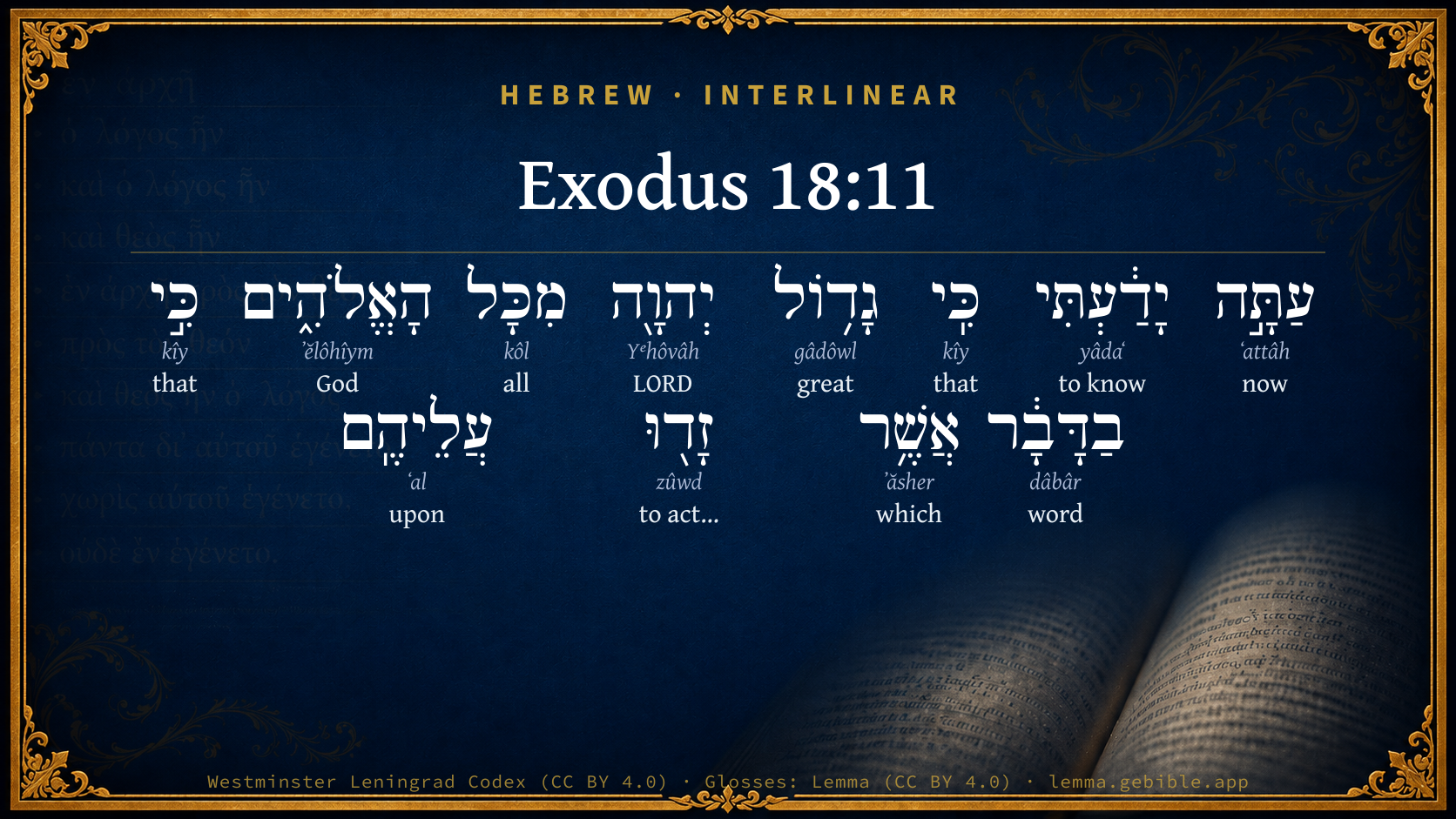
Hebrew (Westminster Leningrad Codex) Exodus 18:11 appears in the Hebrew Old Testament. The text above is from the Westminster Leningrad Codex. Each word links to its Strong’s number, a concise gloss, and parsing drawn from the Open Scriptures Hebrew Bible morphology. Click any word for its full Brown-Driver-Briggs (BDB) entry.
Download image
Cite this verse

Exodus 18:11 (World English Bible). Public Domain. Lemma interlinear Bible study tool, https://lemma.gebible.app/v/exodus/18/11.

Show BibTeX & RIS
BibTeX
RIS
English Translation
Now I know that Yahweh is greater than all gods because of the thing in which they dealt arrogantly against them."
World English Bible · Public Domain
Download a study sheet

One document with this verse’s original text, its word-by-word gloss line, the meaning frame, cross-references with their text, attributed commentary, and full source and license credits — printable, and it pastes into notes with its structure intact.

This verse Autodidact and up

Study sheet (.html) Plain text (.txt)

A passage Seminary Student

Up to 50 verses in one chapter. A passage sheet keeps up to 6 commentary sources and 12 cross-references per verse, in the order this page ranks them, and says so on the sheet whenever that leaves anything out. Ask for a single verse and you get the Autodidact verse sheet above.

Everything on this page stays free to read, with no account — the sheet is a download of what is already on screen, not access to it.

Want to remove ads? Support Godless Engineer
Compare translations 3

The same verse in 3 English versions, stacked beneath the original-language interlinear above. Click any original word for its lexicon entry.

Each is an independent rendering of the whole verse — the interlinear is not word-aligned to these translations.

Highlighted words mark where these versions differ — a whole-verse word diff, not a word-by-word alignment.

  • World English Bible Public Domain
    Now I know that Yahweh is greater than all gods because of the thing in which they dealt arrogantly against them."
  • King James Version Public Domain
    Now I know that the LORD is greater than all gods: for in the thing wherein they dealt proudly he was above them.
  • unfoldingWord Literal Text CC BY-SA 4.0
    Now I know that Yahweh is greater than all the gods, because of the affair which they acted proudly against them.”

unfoldingWord Literal Text — © unfoldingWord, licensed CC BY-SA 4.0. Word-aligned USFM3 via Door43 (git.door43.org/unfoldingWord/en_ult).

Versions to compare (up to 4)

3 of 4 selected

Show all 18 translations

Every available English version of this verse, each an independent rendering of the whole verse.

  • World English Bible Public Domain
    Now I know that Yahweh is greater than all gods because of the thing in which they dealt arrogantly against them."
  • Berean Standard Bible Public Domain
    Now I know that the LORD is greater than all other gods, for He did this when they treated Israel with arrogance.”
  • Majority Standard Bible Public Domain
    Now I know that the LORD is greater than all other gods, for He did this when they treated Israel with arrogance.”
  • King James Version Public Domain
    Now I know that the LORD is greater than all gods: for in the thing wherein they dealt proudly he was above them.
  • American Standard Version (1901) Public Domain
    Now I know that Jehovah is greater than all gods; yea, in the thing wherein they dealt proudly against them.
  • Revised Version (1885) Public Domain
    Now I know that the LORD is greater than all gods: yea, in the thing wherein they dealt proudly against them.
  • Geneva Bible (1599) Public Domain
    Now I know that the Lord is greater then all the gods: for as they haue dealt proudly with them, so are they recompensed.
  • Douay-Rheims (1899) Public Domain
    Now I know that the Lord is great above all gods: because they dealt proudly against them.
  • Young's Literal Translation Public Domain
    now I have known that Jehovah `is' greater than all the gods, for in the thing they have acted proudly -- `He is' above them!'
  • Literal Standard Version CC BY-SA 4.0
    now I have known that YHWH [is] greater than all the gods, for in the thing they have acted proudly—[He is] above them!”
  • Unlocked Literal Bible CC BY-SA 4.0
    Now I know that Yahweh is greater than all the gods, because when the Egyptians treated the Israelites arrogantly, God rescued his people.”
  • unfoldingWord Literal Text CC BY-SA 4.0
    Now I know that Yahweh is greater than all the gods, because of the affair which they acted proudly against them.”
  • Darby Bible Public Domain
    Now I know that Jehovah is greater than all gods; for in the thing in which they acted haughtily [he was] above them.
  • World Messianic Bible Public Domain
    Now I know that the LORD is greater than all gods because of the way that they treated people arrogantly.”
  • Webster's Bible Public Domain
    Now I know that the LORD is greater than all gods: for in the thing in which they dealt proudly, he was above them.
  • Free Bible Version CC BY-SA 4.0
    This is so convincing to me that the Lord is greater than all other gods, for he saved the people from the Egyptians when they acted so arrogantly towards the Israelites.”
  • Bible in Basic English Public Domain
    Now I am certain that the Lord is greater than all gods, for he has overcome them in their pride.
  • JPS Tanakh (1917) Public Domain
    Now I know that the LORD is greater than all gods; yea, for that they dealt proudly against them.'

Literal Standard Version (2020), Covenant Press — licensed CC BY-SA 4.0. Text via the HelloAO Bible API (eBible.org). Unlocked Literal Bible (unfoldingWord) — licensed CC BY-SA 4.0. Text via the HelloAO Bible API (eBible.org). unfoldingWord Literal Text — © unfoldingWord, licensed CC BY-SA 4.0. Word-aligned USFM3 via Door43 (git.door43.org/unfoldingWord/en_ult). Free Bible Version, Dr. Jonathan Gallagher — licensed CC BY-SA 4.0. Text via the HelloAO Bible API (eBible.org).

Word by word

More ways to search: Search by grammar → Find every occurrence → Compare this word →

Practice this passage: Drill this verse → Learn its vocabulary →

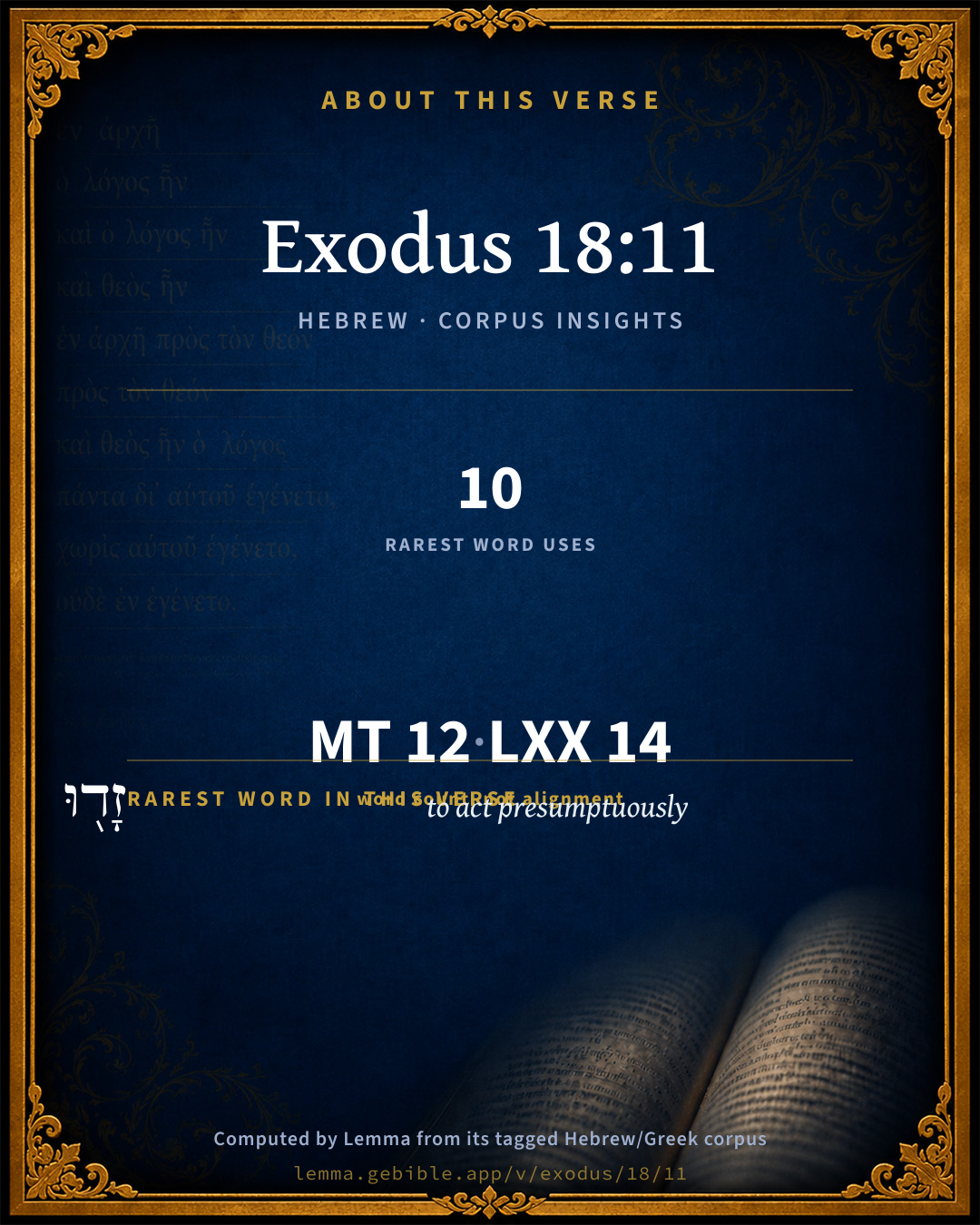
זָד֖וּ
zûwd
H2102
“to act presumptuously”
Verb, Qal, Perfect, 3rd Person, Common, Plural
Part of Speech
Verb
Stem
Qal
Form
Perfect
Person
3rd Person
Gender
Common
Number
Plural
Full BDB Definition

Origin: a primitive root

TWOT: 547

to boil, boil up, seethe, act proudly, act presumptuously, act rebelliously, be presumptuous, be arrogant, be rebelliously proud - (Qal) - to act presumptuously - to deal arrogantly (with 'al') - to defy proudly (with 'el') - (Hiphil) - to boil, seethe, act proudly - to act presumptuously, act insolently
  1. עַתָּ֣ה ʻattâh H6258 “now” Adverb
  2. יָדַ֔עְתִּי yâdaʻ H3045 “to know” Verb, Qal, Perfect, 1st Person, Common, Singular
  3. כִּֽי kîy H3588 “that” Conjunction
  4. גָד֥וֹל gâdôwl H1419 “great” Adjective, Adjective, Masculine, Singular, Absolute
  5. יְהוָ֖ה Yᵉhôvâh H3068 “LORD” Noun, Proper
  6. מִכָּל kôl H3605 “from · all of” Preposition + Noun, Common, Masculine, Singular, Construct
  7. הָאֱלֹהִ֑ים ʼĕlôhîym H430 “the · God(s)” Particle, Definite Article + Noun, Common, Masculine, Plural, Absolute
  8. כִּ֣י kîy H3588 “that” Conjunction
  9. בַדָּבָ֔ר dâbâr H1697 “in/at the · word” Preposition, Determined + Noun, Common, Masculine, Singular, Absolute
  10. אֲשֶׁ֥ר ʼăsher H834 “which” Particle, Relative
  11. עֲלֵיהֶֽם ʻal H5921 “upon · them” Preposition + Suffix, Personal, 3rd Person, Masculine, Plural

About this verse

These counts appear in no published source. They are computed here, from the morphology-tagged text and Lemma’s own curated glosses. What Lemma adds →

12
words
11
distinct lemmas
Pentateuch
section

Notable vocabulary

The rarest word here is זָד֖וּ to act presumptuously H2102 — appearing just 10 times in the whole Hebrew Bible.

Shared distinctive vocabulary

זָד֖וּ to act presumptuously H2102 occurs in 10 verses of the Hebrew Bible. Also found in:

Grammatical profile

  • 2 verbs
  • 4 nouns
  • 1 adjective
  • 1 preposition
  • 2 conjunctions
  • 1 adverb
  • 1 particle

Verb forms

  • יָדַ֔עְתִּי Qal · Perfect
  • זָד֖וּ Qal · Perfect

Repetition

A word recurs within this verse — often emphatic in Hebrew:

  • כִּֽי that H3588 ×2

Hebrew & Septuagint length

In English translation the verse runs 21 words from the Hebrew and 18 from the Septuagint (LXX English) — closely comparable.

A rough comparison of the two English renderings, which tokenize alike — not a word-level alignment.

Word counts can differ between the Hebrew and the Greek without any difference in meaning — e.g. the Hebrew direct-object marker אֵת has no separate Greek word, and Greek often adds the article ὁ.

In the original languages it is 12 Hebrew tokens and 14 Greek tokens — but the two are counted differently (Hebrew bundles its prefixes and suffixes into one token; the Greek is in lemma form), so that isn’t a like-for-like length.

Cross-references

29

Topical passages linked to Exodus 18:11 in the Treasury of Scripture Knowledge — connected by theme and wording, ordered by reader-vote popularity; previews shown in the World English Bible.

  • Psalms 95:3 For Yahweh is a great God, A great King above all gods.
  • Exodus 15:11 Who is like you, Yahweh, among the gods? Who is like you, glorious in holiness, Fearful in praises, doing wonders?
  • 2 Chronicles 2:5 The house which I build is great; for great is our God above all gods.
  • Psalms 135:5 For I know that Yahweh is great, That our Lord is above all gods.
  • Luke 1:51 He has shown strength with his arm. He has scattered the proud in the imagination of their heart.
  • 1 Chronicles 16:25 For great is Yahweh, and greatly to be praised: He also is to be feared above all gods.
  • Psalms 97:9 For you, Yahweh, are most high above all the earth. You are exalted far above all gods.
  • Daniel 4:37 Now I, Nebuchadnezzar, praise and extol and honor the King of heaven; for all his works are truth, and his ways justice; and those who walk in pride he is able to abase.
  • 2 Kings 5:15 He returned to the man of God, he and all his company, and came, and stood before him; and he said, See now, I know that there is no God in all the earth, but in Israel: now therefore, please take a present from your servant.
  • Nehemiah 9:10 and shown signs and wonders on Pharaoh, and on all his servants, and on all the people of his land; for you knew that they dealt proudly against them, and did get you a name, as it is this day.
  • Psalms 119:21 You have rebuked the proud who are cursed, Who wander from your commandments.
  • James 4:6 But he gives more grace. Therefore it says, "God resists the proud, but gives grace to the humble."
  • Exodus 1:10 Come, let us deal wisely with them, lest they multiply, and it happen that when any war breaks out, they also join themselves to our enemies, and fight against us, and escape out of the land."
  • Exodus 1:16 and he said, "When you perform the duty of a midwife to the Hebrew women, and see them on the birth stool; if it is a son, then you shall kill him; but if it is a daughter, then she shall live."
  • Exodus 1:22 Pharaoh charged all his people, saying, "You shall cast every son who is born into the river, and every daughter you shall save alive."
  • Exodus 5:2 Pharaoh said, "Who is Yahweh, that I should listen to his voice to let Israel go? I don't know Yahweh, and moreover I will not let Israel go."
  • Exodus 5:7 "You shall no longer give the people straw to make brick, as before. Let them go and gather straw for themselves.
  • Exodus 9:16–17 but indeed for this cause I have made you stand: to show you my power, and that my name may be declared throughout all the earth;
  • Exodus 10:3 Moses and Aaron went in to Pharaoh, and said to him, "This is what Yahweh, the God of the Hebrews, says: 'How long will you refuse to humble yourself before me? Let my people go, that they may serve me.
  • Exodus 12:12 For I will go through the land of Egypt in that night, and will strike all the firstborn in the land of Egypt, both man and animal. Against all the gods of Egypt I will execute judgments: I am Yahweh.
  • Exodus 14:8 Yahweh hardened the heart of Pharaoh king of Egypt, and he pursued after the children of Israel; for the children of Israel went out with a high hand.
  • Exodus 14:18 The Egyptians shall know that I am Yahweh, when I have gotten myself honor over Pharaoh, over his chariots, and over his horsemen."
  • 1 Samuel 2:3 Talk no more so exceeding proudly; Don't let arrogance come out of your mouth; For Yahweh is a God of knowledge, By him actions are weighed.
  • 1 Kings 17:24 The woman said to Elijah, Now I know that you are a man of God, and that the word of Yahweh in your mouth is truth.
  • Nehemiah 9:16 But they and our fathers dealt proudly and hardened their neck, and didn't listen to your commandments,
  • Nehemiah 9:29 and testified against them, that you might bring them again to your law. Yet they dealt proudly, and didn't listen to your commandments, but sinned against your ordinances, (which if a man do, he shall live in them), and withdrew the shoulder, and hardened their neck, and would not hear.
  • Job 40:11–12 Pour forth the fury of your anger. Look on everyone who is proud, and bring him low.
  • Psalms 31:23 Oh love Yahweh, all you his saints! Yahweh preserves the faithful, And pays back him who deals proudly in full.
  • 1 Peter 5:5 Likewise, you younger ones, be subject to the elder. Yes, all of you gird yourselves with humility, to subject yourselves to one another; for "God resists the proud, but gives grace to the humble."

Cross-references courtesy of OpenBible.info (CC BY 4.0).

Hebrew and Greek witnesses Masoretic Hebrew ↔ Greek Septuagint

The same verse in the two great witnesses to the Old Testament, shown verse-for-verse.

These are two independent witnesses, not word-aligned to each other, and the Septuagint is shown in lemma (dictionary) form.

Hebrew Exodus 18:11 Masoretic · Westminster Leningrad Codex

עַתָּ֣ה יָדַ֔עְתִּי כִּֽי גָד֥וֹל יְהוָ֖ה מִכָּל הָאֱלֹהִ֑ים כִּ֣י בַדָּבָ֔ר אֲשֶׁ֥ר זָד֖וּ עֲלֵיהֶֽם

Now I know that Yahweh is greater than all gods because of the thing in which they dealt arrogantly against them."

World English Bible · Public Domain

Greek LXX Exodus 18:11 Septuagint · lemma form

νῦν γιγνώσκω ὅτι μέγας κύριος παρά πᾶς ὁ θεός ἕνεκεν οὗτος ὅτι ἐπιτίθημι αὐτός

Now know I that the Lord is great above all gods, because of this, wherein they attacked them.

LXX2012 (modern English Septuagint) · Public Domain

Hebrew: Westminster Leningrad Codex (CC BY 4.0). Greek: Septuagint (public domain); English from LXX2012 (modern English Septuagint) (Public Domain). How the Septuagint differs from the Hebrew →

Targum (Aramaic paraphrase)

2

The Targum is the ancient Jewish Aramaic paraphrase of the Hebrew Scriptures — an interpretive translation, not the Hebrew text itself. Onkelos (literal) and Pseudo-Jonathan (expansive) render the Torah, and Jonathan the Prophets. Coverage is partial: where no permissively-licensed English translation exists for a verse, only the Aramaic is shown. This is verse-level text, not a word-by-word alignment to the Hebrew.

  1. Targum Onkelos Torah (Genesis–Deuteronomy)
    כְּעַן יְדַעְנָא אֲרֵי רַב יְיָ וְלֵית אֱלָּהּ בַּר מִנֵהּ אֲרֵי בְּפִתְגָמָא דִי חַשִׁיבוּ מִצְרָאֵי לְמִדַן יָת יִשְׂרָאֵל בֵּהּ דָנִנוּן:

    (no public-domain English translation for this verse)

    Targum Onkelos — Aramaic: “Onkelos Genesis” (public domain); “Onkelos Exodus” (public domain); “Onkelos Leviticus” (public domain); “Onkelos Numbers” (public domain); “Onkelos Deuteronomy” (public domain). English: “Sefaria Community Translation” (CC0 1.0 (public-domain dedication)); “J.W. Etheridge. The Targums of Onkelos and Jonathan Ben Uzziel on the Pentateuch. London: Longmans, Green, 1862” (public domain). Text via Sefaria.

  2. Targum Pseudo-Jonathan Torah (Genesis–Deuteronomy)
    כְּדוֹן חַכִּימַת אֲרוּם תַּקִיף הוּא יְיָ עַל כָּל אֱלָהַיָא אֲרוּם בְּפִתְגָמָא דְאַרְשִׁיעוּ מִצְרָאֵי לְמֵידַן יַת יִשְרָאֵל בְּמַיָא עֲלֵיהוֹן הָדַר דִּינָא לְאִיתְדָנָא בְּמַיָא

    Now have I known that the Lord is stronger than all gods; for by the very thing by which the Mizraee wickedly would have punished Israel by (drowning them in) the sea, upon themselves came the punishment, in being punished in the sea.

    Targum Pseudo-Jonathan — Aramaic: “Targum Jonathan on Genesis” (public domain); “Targum Jonathan on Exodus” (public domain); “Targum Jonathan on Leviticus” (public domain); “Targum Jonathan on Numbers” (public domain); “Targum Jonathan on Deuteronomy” (public domain). English: “The Targum of Jonathan ben Uzziel, trans. J. W. Etheridge, London, 1862” (public domain). Text via Sefaria.

Commentary

Notes on Exodus 18:11 from classic Christian and Jewish commentators (each source and its license shown beneath its notes). The classic Christian expositions comment on the surrounding passage and are grouped to its opening verse, so a note may address several verses; the Jewish commentaries on the Tanakh (Rashi and others) are per-verse, so they appear only where the commentator wrote on this verse.

Lemma curates 59 commentaries, every one of them public domain or Creative Commons licensed, each selected and text-cleaned for this edition rather than reprinted as found. About our sources →

Trapp's Complete Commentary

John Trapp

Exo 18:11 Now I know that the LORD [is] greater than all gods: for in the thing wherein they dealt proudly [he was] above them.

Ver. 11. Now I know.] {See Trapp on "Exo 18:1"} So the people knew that Jehovah was God. {1Ki 18:37} See 2Ch 33:13.

He was above them.] God sits in the heavens, {Psa 2:4} where he sees that their day is coming; {Psa 37:13} and meanwhile scorneth these scorners; {Pro 3:34} frights them, as he did those Syrians; {2Ki 7:6} overawes them, as he did Laban; diverts them, as he did Saul, Sennacherib, &c., or otherwise defeats them, as he did Benhadad, disclosing their counsels, blasting their designs, &c.

John Trapp, A Commentary or Exposition upon All the Books of the Old and New Testament (1647–1656) — public domain. Text from a community e-Sword module.

Joseph Benson's Commentary

Exo 18:11. Now know I that JEHOVAH is greater than all gods — That the God of Israel is greater than all pretenders — All deities, that usurp divine honours: he silences and subdues them all, and is himself the only living and true God. He is also higher than all princes and potentates, who also are called gods, and has both an incontestible authority over them, and an irresistible power to control them; he manageth them all as he pleaseth, and gets honour upon them, how great soever they are. Now know I — He knew it before, but now he knew it better; his faith grew up to a full assurance, upon this fresh evidence; for wherein they dealt proudly — The magicians or idols of Egypt, or Pharaoh and his grandees, opposing God, and setting themselves up in competition with him; he was above them — The magicians were baffled, Pharaoh humbled, his powers broken, and Israel rescued out of their hands.

Joseph Benson's Commentary on the Old and New Testaments (1811–1818) — public domain. Text from a community e-Sword module.

Geneva Bible (1599)

Geneva Bible translators

For they that drowned the children of the Israelites, perished themselves by water.

Geneva Bible (1599) marginal notes — public domain. Text via Bolls.life.

Adam Clarke's Commentary

Verse 11. Now I know that the Lord is greater than all gods] Some think that Jethro was now converted to the true God; but it is very probable that he enjoyed this blessing before he knew any thing of Moses, for it is not likely that Moses would have entered into an alliance with this family had they been heathens. Jethro no doubt had the true patriarchal religion.

Wherein they dealt proudly] Acting as tyrants over the people of God; enslaving them in the most unprincipled manner, and still purposing more tyrannical acts. He was above them - he showed himself to be infinitely superior to all their gods, by the miracles which he wrought. Various translations have been given of this clause; the above I believe to be the sense.

Adam Clarke's Commentary on the Bible (1810–1826) — public domain. Text from a community e-Sword/MySword module.

Ellicott's Commentary for English Readers

(11) For in the thing . . . —Heb., even in the matter in which they dealt proudly against them. Jehovah’s superior power had been shown especially in the matter in which the Egyptians had dealt most proudly—viz., in pursuing the Israelites with an army when they had given them leave to depart, and attempting to re-capture or destroy them.

A Bible Commentary for English Readers, edited by Charles John Ellicott (1878–1897) — public domain. Text from a community e-Sword module.

The Cambridge Bible for Schools and Colleges

gen. ed. J. J. S. Perowne

11. greater than all gods] cf. Exo_15:11.

for in (or by) the thing wherein they dealt proudly against them …] The end of the sentence has accidentally dropped out; and something like he hath destroyed them must be supplied. Jehovah’s superiority to other gods was shewn by His overthrow of the Egyptians; and this was a consequence of their proud pursuit of the Israelites.

dealt proudly against them] cf. the reminiscence in Neh_9:10.

The Cambridge Bible for Schools and Colleges (gen. ed. J. J. S. Perowne; Cambridge University Press, 1878–1918) — public domain. Text from a community e-Sword module.

John Gill's Exposition

And Jethro, Moses's father in law, took a burnt offering and sacrifices for God,.... The burnt offering, which was either of the flock or of the herd, was wholly consumed by fire, from whence it had its name; the peace offering for thanksgiving, which seemed to be meant by the sacrifices here, the flesh of them were to be eaten, Lev 7:15 and now a feast was kept, as the latter part of the verse shows: whether Jethro brought cattle along with him for such a purpose, and so "gave" (p) or "offered" them for a burnt offering and sacrifices to God; as the word for took may be rendered, one and the same word signifying both to give and take, see Psa 68:18, compared with Eph 4:8 or whether, with the leave of Moses and the children of Israel, he took them out of their flocks and herds, it matters not, since this is only observed to show Jethro's devotion to God, and the grateful sense he had of the divine goodness to Israel; and since he was a priest of Midian, as he is generally said to be, and a priest of the most high God, as Melchizedek was, he might offer sacrifices; for it does not appear that he delivered them to others to be offered, or that these were slain by Aaron; for, though he is after mentioned, yet not as a sacrificer, but as a guest; and perhaps this might be before he and his sons were separated to the priest's office, or, at least, before they had entered upon it; nor is this mention of a burnt offering and sacrifices any proof of Jethro's meeting Moses after the giving of the law, since, before that, sacrifices were in use, and Jethro being a grandchild of Abraham, might have learnt the use of them from him:

and Aaron came, and all the elders of Israel, to eat bread with Moses's father in law, before God; the tents of Moses being on the east side of the tabernacle, as Aben Ezra says, in which was the mercy seat and cherubim, between which the divine Majesty was; but there is no need to suppose that the tabernacle was now built, for this tent of Moses might be placed before or near the pillar of cloud in which Jehovah was; or the sense may only be, that they ate their food in the presence of God, in the fear of the Lord, with gladness and singleness of heart, as good men do; and especially as this was an eucharistic sacrifice unto God they partook of, Aaron and the elders came out of a civil respect to Jethro, to take a meal with him, as well as to join with him in a religious action: the bread they ate was, no doubt, the manna, which Jethro, though a Midianite, yet a descendant of Abraham, and a good man, partook of, and is put for the whole repast, the flesh of the sacrifices and what else were eaten: no mention is made of Moses, nor was there any need of it, as Aben Ezra observes, it being his tent in which they were: the Targum of Jonathan adds,"Moses stood and ministered before them;''and so says Jarchi; which is not very probable, it being not agreeable to the dignity of his station and office.

(p) "acceptumque obtulit", Junius & Tremellius, Piscator, Fagius, Drusius.

John Gill's Exposition of the Whole Bible (1746–1763) — public domain (CC PDM 1.0). Text via the HelloAO Bible API.

Albert Barnes' Notes on the Bible

Greater than all gods - See Exo 15:11. The words simply indicate a conviction of the incomparable might and majesty of Yahweh.

For in ... above them - i. e. the greatness of Yahweh was shown in those transactions wherein the Egyptians had thought to deal haughtily and cruelly against the Israelites. Jethro refers especially to the destruction of the Egyptian host in the Red Sea.

Albert Barnes' Notes on the Bible (1834–1885) — public domain. Text from a community e-Sword/MySword module.

Haydock's Catholic Bible Commentary

I know. I am now more convinced of this truth. Jethro instructed his family in these principles. The Rechabites were his descendants. (1 Paralipomenon ii. 55; Jeremias xxxv.) (Menochius) --- Proudly. Hebrew, "because in the thing in which they did proudly, he was against, or above them." Something must be supplied. God turned the wisdom and arms of the Egyptians to their own confusion. (Calmet)

George Leo Haydock (1774–1849), Haydock's Catholic Family Bible and Commentary, 1859 edition — public domain. Excludes Psalms (Douay-Rheims chapter numbering differs from Protestant) and Deuterocanonical books (Catholic canon only).

Matthew Poole's English Annotations

Now I know, viz. more clearly and by certain experience; as that phrase signifies, Gen 22:12; 1Ki 17:18,24. For otherwise it is more than probable that Jethro had the knowledge of the true God before this time, not only because he was the great-grandchild of Abraham, but also because of his long conversation with a person of so great knowledge, and wisdom, and piety, as Moses was.

Wherein they dealt proudly; either,

1. Their false gods, who wrought strange things in and by their servants the magicians, who contended with Moses, and proudly boasted of their skill as not a whit inferior to that of Moses, but at last were forced to yield up the cause, Exo 8:19; or rather,

2. The Egyptians, spoken of Exo 18:10, who dealt proudly, and scornfully, and tyrannically with the Israelites, but God showed himself to be above them, and above their king; though Pharaoh would not own him for his superior, Exo 5:2, but lift up his horn against God, and against his people: but the Lord brought that proud prince upon his knees, and forced him oft to confess his faults, and to become suppliant to Moses for deliverance from the plagues; and at last, when he continued incorrigible, he drowned him in the sea.

Matthew Poole's English Annotations on the Holy Bible (1683–1685) — public domain. Text from a community e-Sword/MySword module.

Whedon's Commentary on the Bible

Daniel D. Whedon

11. He was above them — The exact sense of the latter half of this verse is uncertain. The English translators understood the עליחם to refer to the false gods, and supplying he was would most naturally make these gods rather than the Egyptians the subject of the verb זדו, acted proudly. But inasmuch as something is to be supplied, it seems better to carry over into this last sentence of the verse the thought expressed in the גדול מן of the preceding line. It seems probable that some word or words have fallen out before בדבר, in the thing, and we take the sentiment to be: Jehovah is greater than all the gods, for he showed this in all the things wherein the Egyptians acted proudly against the Israelites. Comp. Neh_9:10. Reference is to the oppression and persecution which Israel received from the Egyptians, and the pursuit which ended at the Red Sea, where Jehovah triumphed gloriously.

Daniel D. Whedon (gen. ed.), Commentary on the Old and New Testaments (1874–1909) — public domain. Text from a community e-Sword module.

The Pulpit Commentary

Now know I that the Lord is greater than all gods. It would seem that Jethro, like the generality of the heathen, believed in a plurality of gods, and had hitherto regarded the God of the Israelites as merely one among many equals. Now, he renounces this creed, and emphatically declares his belief that Jehovah is above all other gods, greater, higher, more powerful. Compare the confessions of Nebuchadnezzar. (Dan_2:47 Dan_3:26, Dan_3:27) and Darius the Mede. (Dan_6:26) For in the thing wherein they dealt wickedly he was above them. There is no "he was above them" in the original, nor is the clause a distinct sentence from the preceding one. It is merely a prolongation of that clause, without any new verb; and should be translated, "Even in the very matter that they (the Egyptians) dealt proudly against them "(the Israelites). The superiority of Jehovah to other gods was shown forth even in the very matter of the proud dealing of the Egyptians, which was brought to shame and triumphed over by the might of Jehovah. The allusion is especially to the passage of the Red Sea.

The Pulpit Commentary (1880–1919), ed. H.D.M. Spence-Jones & Joseph S. Exell — public domain. Text from a community e-Sword module.

John Wesley's Explanatory Notes

Now know I that JEHOVAH is greater than all gods - That the God of Israel is greater than all pretenders; all deities, that usurp divine honours: he silenceth them, subdues them all, and is himself the only living and true God. He is also higher than all princes and potentates, who also are called gods, and has both an incontestable authority over them, and an irresistible power to control them; he manages them all as he pleaseth, and gets honour upon them how great soever they are. Now know I: he knew it before, but now he knew it better; his faith grew up to a full assurance, upon this fresh evidence; for wherein they dealt proudly - The magicians or idols of Egypt, or Pharaoh and his grandees, opposing God, and setting up in competition with him, he was above them. The magicians were baffled, Pharaoh humbled, his powers broken, and Israel rescued out of their hands.

John Wesley, Explanatory Notes Upon the Whole Bible (1754–1765) — public domain. Text via the GEBible commentary corpus.

Rashi

Rabbi Shlomo Yitzchaki (Rashi)

עתה ידעתי NOW I KNOW — I indeed knew Him formerly, but now I know Him even more (cf. Mekhilta).

מכל האלהים [GREATER] THAN ALL THE GODS — This tells us that he had a full knowledge of every idol in the world — that he left no idol unworshipped by him (Mekhilta).

כי בדבר אשר זדו עליהם — Understand this as the Targum does for by that very thing with which the Egyptians thought to judge Israel were they themselves judged — they had thought to destroy them by water and they were themselves destroyed by water (cf. Mekhilta).

אשר זדו means in which they had shown themselves wicked. Our Rabbis, however, explained it in the same sense as the root which we find in (Genesis 25:29) “And Jacob was boiling (ויזד) pottage (נזיד) (lit., something boiled)” — in the pot wherein they had boiled, therein were they themselves boiled (Sotah 11a).

Rashi on the Tanakh — English translations: “The Judaica Press complete Tanach with Rashi, translated by A. J. Rosenberg” (CC BY 4.0); “Pentateuch with Rashi's commentary by M. Rosenbaum and A.M. Silbermann, 1929-1934” (public domain); “The Metsudah Tanach series, Lakewood, N.J” (CC BY 4.0); and “The Book of Joshua, Metsudah Publications, 1997” (CC BY 4.0). Text via Sefaria.

Ramban (Nachmanides)

Rabbi Moshe ben Nachman (Ramban / Nachmanides)

FOR IT IS IN THE THING THAT ‘ZADU’ UPON THEM. The meaning of this is that in the matter wherein the Egyptians premeditated on the basis of zadon (premeditated, conscious sin), as is explained further in the text. [their wickedness] against Israel, I [Jethro] now know that the Eternal is greater than all gods. And the purport thereof is as follows: Due to the fact that G-d had decreed upon Israel, and they shall enslave them, and they should afflict them, there would have been no great punishment meted out to the Egyptians. But they acted presumptuously against them, and intended to eradicate them from the world, just as they said, Come, let us deal wisely with them, lest they multiply. Pharaoh commanded the midwives to kill the male children, Verse 16. and he decreed upon [all his people, saying], Every son that is born [unto the Israelites] ye shall cast into the river., Verse 22. It was due to this that there came upon the Egyptians the kind of punishment which utterly destroyed them. It is this principle which is expressed in His words, And also that nation that made slaves of them will I judge, as I have explained. (Vol. I, pp. 203-205.) Now G-d saw their intentions, and He took vengeance upon them for the wickedness of their hearts. And thus does Scripture say again, And Thou didst show signs and wonders upon Pharaoh… for Thou knowest that they dealt insolently against them, for the punishment was because of the wicked plans they devised to carry out against the Israelites. Thus the Eternal looketh on the heart, and executeth justice for the oppressed, avengeth and is full of wrath, and no one can deter Him.Now Onkelos translated [the above Scriptural expression] thus: “for by that very thing with which the Egyptians thought to judge Israel, they themselves were judged.” By this rendition, Onkelos meant to say that their punishment came because of the drowning of the [Hebrew] children in the river, which was not part of the Divine decree, and they shall enslave them, and they shall afflict them. Therefore, He destroyed them by water.

Ramban (Nachmanides) on the Tanakh — English translation: “Commentary on the Torah by Ramban (Nachmanides). Translated and annotated by Charles B. Chavel. New York, Shilo Pub. House, 1971-1976” (CC BY 4.0). Text via Sefaria.

Lesson kit

Teaching starters — assembled from the data on this page, not authored interpretation. Every prompt links to the verse data it draws on. Edit before teaching.

Exodus, in the Pentateuch, opens this verse with 12 words (11 distinct Hebrew lemmas). Its most distinctive word is zûwd (“to act presumptuously”). A historical commentator’s framing appears above. Read the whole chapter for the surrounding context.

Discussion questions

  1. How does “to act presumptuously” (zûwd) shape what this verse is saying?
  2. How does Genesis 25:29, which shares the word «to act presumptuously», read alongside this verse?
  3. What does the repetition of “that” (2× in this one verse) do in this verse?
  4. The translations on this page render this verse differently — a whole-verse word diff, not a word-by-word alignment. What might account for the different wordings?
  5. «יָדַ֔עְתִּי» is a Qal Perfect verb. How does that grammatical form shape the action described?
  6. Compare how Trapp's Complete Commentary and Joseph Benson's Commentary read this verse. Where do they agree or differ?

Things to notice

Reading settings

Reading text

Shown beneath each verse's original-language words.

Old Testament
Old Testament edition

Read the OT as the Masoretic Hebrew (MT) or the Greek Septuagint (LXX).

English shown for the Greek Septuagint (in the Hebrew ↔ Greek comparison).

Comparing translations? Open the Compare panel on any verse page to stack up to four side by side.