

Luke 19:44
Greek (Tischendorf 8th ed.) Luke 19:44 appears in the Greek New Testament. The text above is from the Tischendorf 8th edition. Each word links to its Strong’s number and a concise gloss. Click any word for its full Thayer’s Greek Lexicon entry.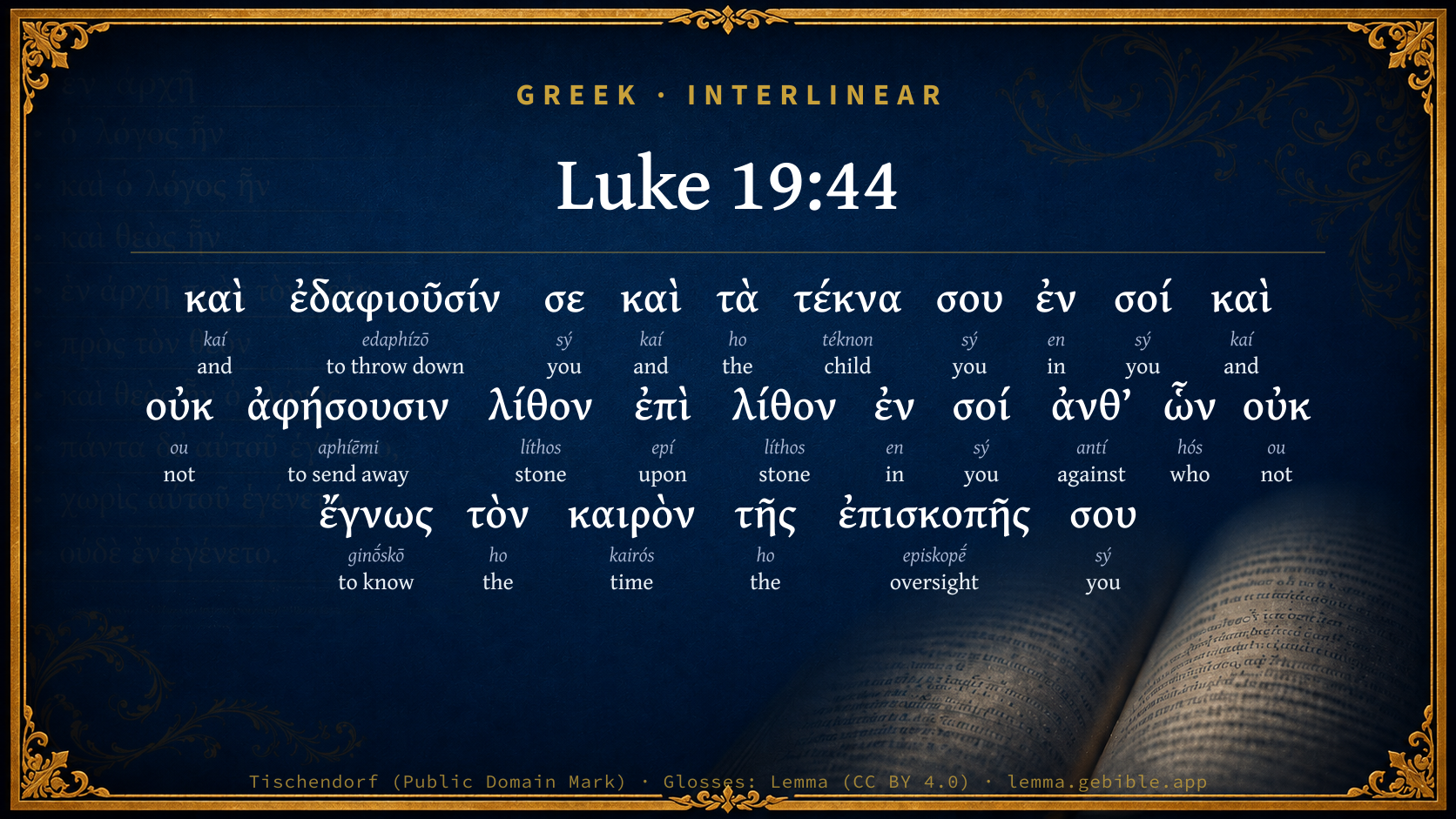
and will dash you and your children within you to the ground. They will not leave in you one stone on another, because you didn't know the time of your visitation."
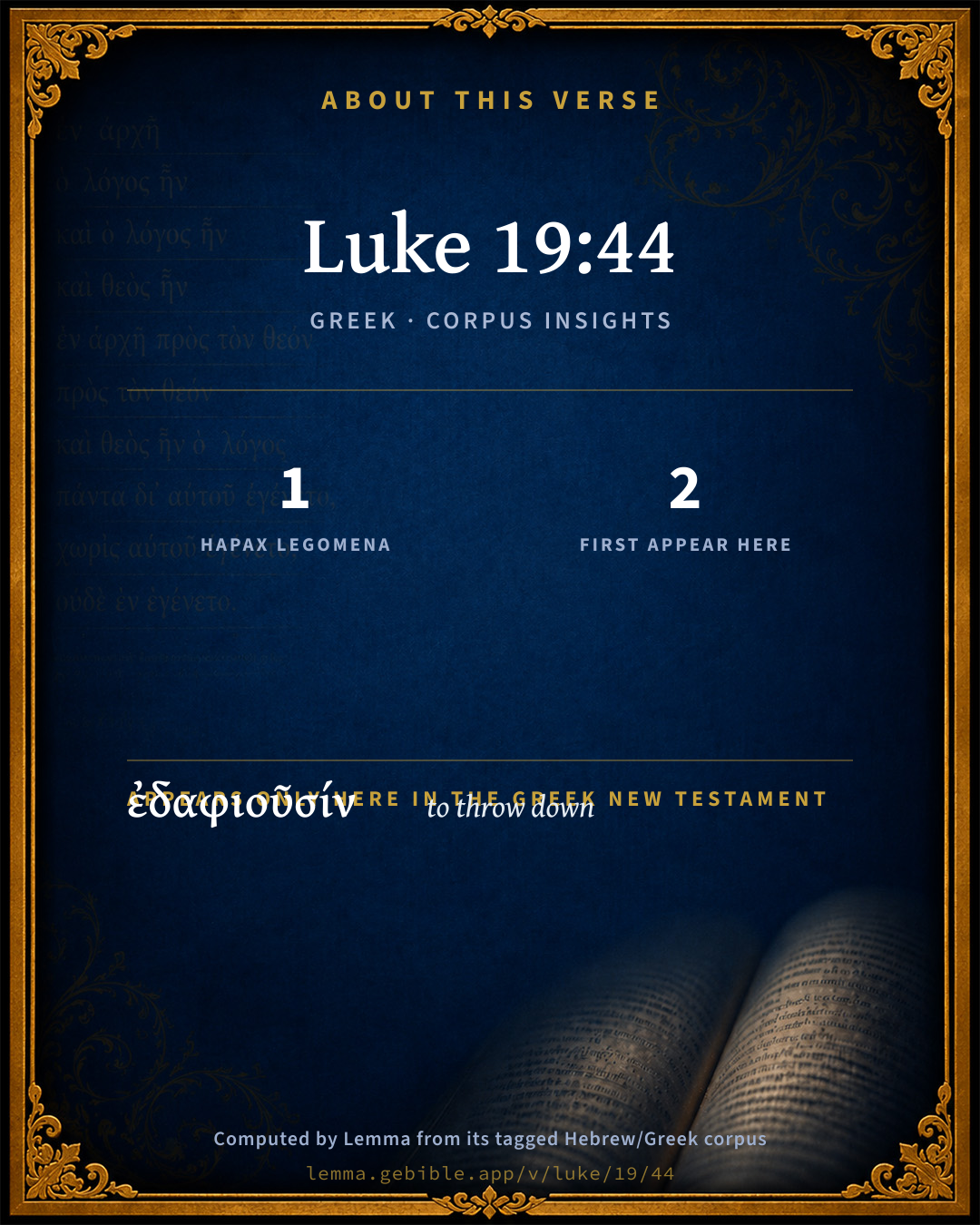
- 1 hapax legomenon — only here in the Greek New Testament
- 2 first appearances in the Greek New Testament
Download a study sheet
One document with this verse’s original text, its word-by-word gloss line, the meaning frame, cross-references with their text, attributed commentary, and full source and license credits — printable, and it pastes into notes with its structure intact.
This verse Autodidact and up
A passage Seminary Student
Up to 50 verses in one chapter. A passage sheet keeps up to 6 commentary sources and 12 cross-references per verse, in the order this page ranks them, and says so on the sheet whenever that leaves anything out. Ask for a single verse and you get the Autodidact verse sheet above.
Everything on this page stays free to read, with no account — the sheet is a download of what is already on screen, not access to it.
Compare translations 3
The same verse in 3 English versions, stacked beneath the original-language interlinear above. Click any original word for its lexicon entry.
Each is an independent rendering of the whole verse — the interlinear is not word-aligned to these translations.
Highlighted words mark where these versions differ — a whole-verse word diff, not a word-by-word alignment.
-
World English Bible Public Domain
and will dash you and your children within you to the ground. They will not leave in you one stone on another, because you didn't know the time of your visitation."
-
King James Version Public Domain
And shall lay thee even with the ground, and thy children within thee; and they shall not leave in thee one stone upon another; because thou knewest not the time of thy visitation.
-
unfoldingWord Literal Text CC BY-SA 4.0
And they will dash you to the ground and your children within you. And they will not leave stone upon stone in you because you did not know the time of your visitation.”
unfoldingWord Literal Text — © unfoldingWord, licensed CC BY-SA 4.0. Word-aligned USFM3 via Door43 (git.door43.org/unfoldingWord/en_ult).
Show all 19 translations
Every available English version of this verse, each an independent rendering of the whole verse.
-
World English Bible Public Domain
and will dash you and your children within you to the ground. They will not leave in you one stone on another, because you didn't know the time of your visitation."
-
Berean Standard Bible Public Domain
They will level you to the ground—you and the children within your walls. They will not leave one stone on another, because you did not recognize the time of your visitation from God.”
-
Majority Standard Bible Public Domain
They will level you to the ground—you and the children within your walls. They will not leave one stone on another, because you did not recognize the time of your visitation from God.”
-
King James Version Public Domain
And shall lay thee even with the ground, and thy children within thee; and they shall not leave in thee one stone upon another; because thou knewest not the time of thy visitation.
-
American Standard Version (1901) Public Domain
and shall dash thee to the ground, and thy children within thee; and they shall not leave in thee one stone upon another; because thou knewest not the time of thy visitation.
-
Revised Version (1885) Public Domain
and shall dash thee to the ground, and thy children within thee; and they shall not leave in thee one stone upon another; because thou knewest not the time of thy visitation.
-
Geneva Bible (1599) Public Domain
And shall make thee euen with ye ground, and thy children which are in thee, and they shall not leaue in thee a stone vpon a stone, because thou knewest not that season of thy visitation.
-
Douay-Rheims (1899) Public Domain
And beat thee flat to the ground, and thy children who are in thee: and they shall not leave in thee a stone upon a stone: because thou hast not known the time of thy visitation.
-
Young's Literal Translation Public Domain
and lay thee low, and thy children within thee, and they shall not leave in thee a stone upon a stone, because thou didst not know the time of thy inspection.'
-
Literal Standard Version CC BY-SA 4.0
and lay you low, and your children within you, and they will not leave in you a stone on a stone, because you did not know the time of your inspection.”
-
Unlocked Literal Bible CC BY-SA 4.0
They will strike you down to the ground and your children with you. They will not leave one stone upon another, because you did not recognize it when God was trying to save you.”
-
unfoldingWord Literal Text CC BY-SA 4.0
And they will dash you to the ground and your children within you. And they will not leave stone upon stone in you because you did not know the time of your visitation.”
-
Darby Bible Public Domain
and shall lay thee even with the ground, and thy children in thee; and shall not leave in thee a stone upon a stone: because thou knewest not the season of thy visitation.
-
World Messianic Bible Public Domain
and will dash you and your children within you to the ground. They will not leave in you one stone on another, because you didn’t know the time of your visitation.”
-
Webster's Bible Public Domain
And shall lay thee even with the ground, and thy children within thee: and they shall not leave in thee one stone upon another: because thou knewest not the time of thy visitation.
-
Free Bible Version CC BY-SA 4.0
They will smash you to the ground, you and your children within you. They won't leave one stone on another within you, for you refused to accept salvation when it came to you.”
-
Bible in Basic English Public Domain
And will make you level with the earth, and your children with you; and there will not be one stone resting on another in you, because you did not see that it was your day of mercy.
-
Text-Critical English NT CC BY 4.0
They will raze yoʋ to the ground, and yoʋr children within yoʋ. They will not leave in yoʋ one stone upon another, because yoʋ did not recognize the time of yoʋr visitation.”
-
Tyndale New Testament (1534) Public Domain
and make the even with the grounde with thy chyldren which are in the. And they shall not leve in the one stone vpo another because thou knewest not the tyme of thy visitacion.
Literal Standard Version (2020), Covenant Press — licensed CC BY-SA 4.0. Text via the HelloAO Bible API (eBible.org). Unlocked Literal Bible (unfoldingWord) — licensed CC BY-SA 4.0. Text via the HelloAO Bible API (eBible.org). unfoldingWord Literal Text — © unfoldingWord, licensed CC BY-SA 4.0. Word-aligned USFM3 via Door43 (git.door43.org/unfoldingWord/en_ult). Free Bible Version, Dr. Jonathan Gallagher — licensed CC BY-SA 4.0. Text via the HelloAO Bible API (eBible.org).
Word by word
More ways to search: Search by grammar → Find every occurrence → Compare this word →
Practice this passage: Drill this verse → Learn its vocabulary →
- Appears 1× in the Greek New Testament
- First appears here
- Part of Speech
- Verb
- Tense
- Future
- Voice
- Active
- Mood
- Indicative
- Person
- 3rd person
- Number
- Plural
- Degree
- Attic form
Full Thayer's Definition
- καὶ kaí G2532 “and” Conjunction
- ἐδαφιοῦσίν edaphízō G1474 “to throw down” Verb, Future, Active, Indicative, 3rd person, Plural, Attic form
- σε sý G4771 “you” Personal pronoun, 2nd person, Accusative, Singular
- καὶ kaí G2532 “and” Conjunction
- τὰ ho G3588 “the” Article, Accusative, Plural, Neuter
- τέκνα téknon G5043 “child” Noun, Accusative, Plural, Neuter
- σου sý G4771 “you” Personal pronoun, 2nd person, Genitive, Singular
- ἐν en G1722 “in” Preposition
- σοί sý G4771 “you” Personal pronoun, 2nd person, Dative, Singular
- καὶ kaí G2532 “and” Conjunction
- οὐκ ou G3756 “not” Particle, Negative
- ἀφήσουσιν aphíēmi G863 “to send away” Verb, Future, Active, Indicative, 3rd person, Plural
- λίθον líthos G3037 “stone” Noun, Accusative, Singular, Masculine
- ἐπὶ epí G1909 “upon” Preposition
- λίθον líthos G3037 “stone” Noun, Accusative, Singular, Masculine
- ἐν en G1722 “in” Preposition
- σοί sý G4771 “you” Personal pronoun, 2nd person, Dative, Singular
- ἀνθ’ antí G473 “against” Preposition
- ὧν hós G3739 “who” Relative pronoun, Genitive, Plural, Masculine
- οὐκ ou G3756 “not” Particle, Negative
- ἔγνως ginṓskō G1097 “to know” Verb, Aorist, Active, Indicative, 2nd person, Singular
- τὸν ho G3588 “the” Article, Accusative, Singular, Masculine
- καιρὸν kairós G2540 “time” Noun, Accusative, Singular, Masculine
- τῆς ho G3588 “the” Article, Genitive, Singular, Feminine
- ἐπισκοπῆς episkopḗ G1984 “oversight” Noun, Genitive, Singular, Feminine
- σου sý G4771 “you” Personal pronoun, 2nd person, Genitive, Singular
About this verse
These counts appear in no published source. They are computed here, from the morphology-tagged text and Lemma’s own curated glosses. What Lemma adds →
- 26
- words
- 15
- distinct lemmas
- Gospels
- section
Notable vocabulary
1 hapax legomenon — a word that appears only here in the entire Greek New Testament:
- ἐδαφιοῦσίν to throw down G1474
First appearance in Scripture
These words make their first canonical appearance in the Greek New Testament here:
Shared distinctive vocabulary
ἐπισκοπῆς oversight G1984 occurs in 4 verses of the Greek New Testament. Also found in:
Cross-references
15Topical passages linked to Luke 19:44 in the Treasury of Scripture Knowledge — connected by theme and wording, ordered by reader-vote popularity; previews shown in the World English Bible.
- Luke 13:34–35 "Jerusalem, Jerusalem, that kills the prophets, and stones those who are sent to her! How often I wanted to gather your children together, like a hen gathers her own brood under her wings, and you refused!
- Luke 21:6 "As for these things which you see, the days will come, in which there will not be left here one stone on another that will not be thrown down."
- Lamentations 1:8 Jerusalem has grievously sinned; therefore she is become as an unclean thing; All who honored her despise her, because they have seen her nakedness: Yes, she sighs, and turns backward.
- John 3:18–21 He who believes in him is not judged. He who doesn't believe has been judged already, because he has not believed in the name of the one and only Son of God.
- 1 Peter 2:12 having good behavior among the nations, so in that which they speak against you as evil-doers, they may by your good works, which they see, glorify God in the day of visitation.
- Matthew 23:37–38 "Jerusalem, Jerusalem, who kills the prophets, and stones those who are sent to her! How often would I have gathered your children together, even as a hen gathers her chickens under her wings, and you would not!
- Luke 19:42 saying, "If you, even you, had known today the things which belong to your peace! But now, they are hidden from your eyes.
- Daniel 9:24 Seventy weeks are decreed on your people and on your holy city, to finish disobedience, and to make an end of sins, and to make reconciliation for iniquity, and to bring in everlasting righteousness, and to seal up vision and prophecy, and to anoint the most holy.
- Matthew 24:2 But he answered them, "Don't you see all of these things? Most assuredly I tell you, there will not be left here one stone on another, that will not be thrown down."
- Luke 1:68 "Blessed be the Lord, the God of Israel, For he has visited and worked redemption for his people;
- 1 Kings 9:7–8 then will I cut off Israel out of the land which I have given them; and this house, which I have made holy for my name, will I cast out of my sight; and Israel shall be a proverb and a byword among all peoples.
- Psalms 137:9 Happy shall he be, Who takes and dashes your little ones against the rock.
- Micah 3:12 Therefore Zion for your sake will be plowed like a field, And Jerusalem will become heaps of rubble, And the mountain of the temple like the high places of a forest.
- Mark 13:2 Jesus said to him, "Do you see these great buildings? There will not be left here one stone on another, which will not be thrown down."
- Luke 1:78 Because of the tender mercy of our God, Whereby the dawn from on high will visit us,
Cross-references courtesy of OpenBible.info (CC BY 4.0).
Lesson kit
Teaching starters — assembled from the data on this page, not authored interpretation. Every prompt links to the verse data it draws on. Edit before teaching.
Luke, in the Gospels, opens this verse with 26 words (15 distinct Greek lemmas). Its most distinctive word is edaphízō (“to throw down”). A historical commentator’s framing appears above. Read the whole chapter for the surrounding context.
Discussion questions
- The word edaphízō carries the sense “to throw down.” How does it shape the verse?
- 1 word here appears nowhere else in the Greek New Testament. Why might the author reach for such rare wording?
- 2 words make their first appearance in Scripture here. What does this debut establish?
- How does Acts 1:20, which shares the word «oversight», read alongside this verse?
- What does the repetition of “stone” (2× in this one verse) do in this verse?
- These translations render this verse differently; the difference is in the English rendering, not the original. What questions does that raise?
- Compare how Bengel's Gnomon and Expositor's Greek Testament read this verse. Where do they agree or differ?
Things to notice
- 1 word in this verse appears nowhere else in the Greek New Testament.
- 2 words make their first canonical appearance in Scripture here.
- These translations choose different wording for 13 words in this verse.
- “stone” occurs 2× in this single verse.
- 15 distinct Greek lemmas span 26 words in this verse.
Commentary
Notes on Luke 19:44 from classic Christian and Jewish commentators (each source and its license shown beneath its notes). The classic Christian expositions comment on the surrounding passage and are grouped to its opening verse, so a note may address several verses; the Jewish commentaries on the Tanakh (Rashi and others) are per-verse, so they appear only where the commentator wrote on this verse.
Lemma curates 59 commentaries, every one of them public domain or Creative Commons licensed, each selected and text-cleaned for this edition rather than reprinted as found. About our sources →
Bengel's Gnomon
Johann Albrecht Bengel
Bengel's Gnomon of the New Testament — English translation (T&T Clark, Edinburgh, 1860) — public domain. Text from a community e-Sword module.
Expositor's Greek Testament
ed. W. Robertson Nicoll
The Expositor's Greek Testament, edited by W. Robertson Nicoll (1897–1910) — public domain. Text from a community e-Sword module.
Geneva Bible (1599)
Geneva Bible translators
Geneva Bible (1599) marginal notes — public domain. Text via Bolls.life.
Adam Clarke's Commentary
Adam Clarke's Commentary on the Bible (1810–1826) — public domain. Text from a community e-Sword/MySword module.
Ellicott's Commentary for English Readers
A Bible Commentary for English Readers, edited by Charles John Ellicott (1878–1897) — public domain. Text from a community e-Sword module.
The Cambridge Bible for Schools and Colleges
gen. ed. J. J. S. Perowne
The Cambridge Bible for Schools and Colleges (gen. ed. J. J. S. Perowne; Cambridge University Press, 1878–1918) — public domain. Text from a community e-Sword module.
John Gill's Exposition
John Gill's Exposition of the Whole Bible (1746–1763) — public domain (CC PDM 1.0). Text via the HelloAO Bible API.
Trapp's Complete Commentary
John Trapp
John Trapp, A Commentary or Exposition upon All the Books of the Old and New Testament (1647–1656) — public domain. Text from a community e-Sword module.
Whedon's Commentary on the Bible
Daniel D. Whedon
Daniel D. Whedon (gen. ed.), Commentary on the Old and New Testaments (1874–1909) — public domain. Text from a community e-Sword module.
The Pulpit Commentary
The Pulpit Commentary (1880–1919), ed. H.D.M. Spence-Jones & Joseph S. Exell — public domain. Text from a community e-Sword module.
John Wesley's Explanatory Notes
John Wesley, Explanatory Notes Upon the Whole Bible (1754–1765) — public domain. Text via the GEBible commentary corpus.
Cambridge Greek Testament for Schools and Colleges
Cambridge Greek Testament for Schools and Colleges (Cambridge University Press, 1896; 21 vols, various authors incl. Carr, Maclear, Plummer, Farrar, Lumby, Moule, M. R. James, Simcox) — public domain. Text from a community e-Sword module.
Alford’s Greek Testament
Henry Alford
Henry Alford, The Greek Testament (1849–1861) — public domain. Text from a community e-Sword module.
International Critical Commentary
International Critical Commentary — older volumes (1896–1929), various authors — public domain. Text from a community e-Sword module.
Vincent's Word Studies in the New Testament
Marvin R. Vincent
Marvin R. Vincent, Word Studies in the New Testament (1887–1900) — public domain. Text from a community e-Sword/MySword module.