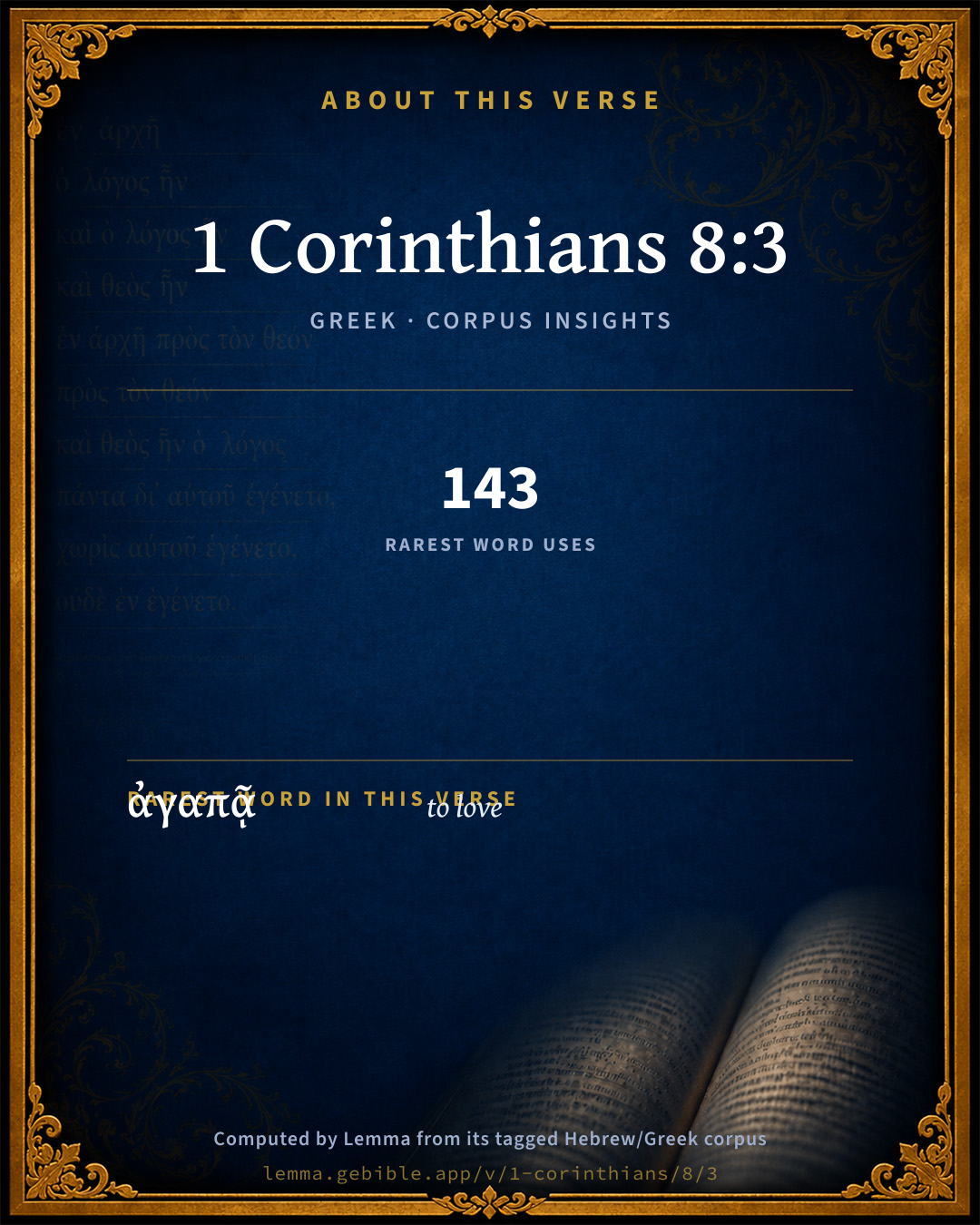
1 Corinthians 8:3

Greek (Tischendorf 8th ed.) 1 Corinthians 8:3 appears in the Greek New Testament. The text above is from the Tischendorf 8th edition. Each word links to its Strong’s number and a concise gloss. Click any word for its full Thayer’s Greek Lexicon entry.

Download image
Cite this verse

1 Corinthians 8:3 (World English Bible). Public Domain. Lemma interlinear Bible study tool, https://lemma.gebible.app/v/1-corinthians/8/3.

Show BibTeX & RIS
BibTeX
RIS
English Translation
But if anyone loves God, the same is known by him.
World English Bible · Public Domain
Download a study sheet

One document with this verse’s original text, its word-by-word gloss line, the meaning frame, cross-references with their text, attributed commentary, and full source and license credits — printable, and it pastes into notes with its structure intact.

This verse Autodidact and up

Study sheet (.html) Plain text (.txt)

A passage Seminary Student

Up to 50 verses in one chapter. A passage sheet keeps up to 6 commentary sources and 12 cross-references per verse, in the order this page ranks them, and says so on the sheet whenever that leaves anything out. Ask for a single verse and you get the Autodidact verse sheet above.

Everything on this page stays free to read, with no account — the sheet is a download of what is already on screen, not access to it.

Want to remove ads? Support Godless Engineer
Compare translations 3

The same verse in 3 English versions, stacked beneath the original-language interlinear above. Click any original word for its lexicon entry.

Each is an independent rendering of the whole verse — the interlinear is not word-aligned to these translations.

Highlighted words mark where these versions differ — a whole-verse word diff, not a word-by-word alignment.

  • World English Bible Public Domain
    But if anyone loves God, the same is known by him.
  • King James Version Public Domain
    But if any man love God, the same is known of him.
  • unfoldingWord Literal Text CC BY-SA 4.0
    But if anyone loves God, that one is known by him.

unfoldingWord Literal Text — © unfoldingWord, licensed CC BY-SA 4.0. Word-aligned USFM3 via Door43 (git.door43.org/unfoldingWord/en_ult).

Versions to compare (up to 4)

3 of 4 selected

Show all 19 translations

Every available English version of this verse, each an independent rendering of the whole verse.

  • World English Bible Public Domain
    But if anyone loves God, the same is known by him.
  • Berean Standard Bible Public Domain
    But the one who loves God is known by God.
  • Majority Standard Bible Public Domain
    But the one who loves God is known by God.
  • King James Version Public Domain
    But if any man love God, the same is known of him.
  • American Standard Version (1901) Public Domain
    but if any man loveth God, the same is known by him.
  • Revised Version (1885) Public Domain
    but if any man loveth God, the same is known of him.
  • Geneva Bible (1599) Public Domain
    But if any man loue God, the same is knowen of him.
  • Douay-Rheims (1899) Public Domain
    But if any any love God, the same is known by him.
  • Young's Literal Translation Public Domain
    and if any one doth love God, this one hath been known by Him.
  • Literal Standard Version CC BY-SA 4.0
    and if anyone loves God, this one has been known by Him.
  • Unlocked Literal Bible CC BY-SA 4.0
    But if anyone loves God, that person is known by him.
  • unfoldingWord Literal Text CC BY-SA 4.0
    But if anyone loves God, that one is known by him.
  • Darby Bible Public Domain
    But if any one love God, *he* is known of him):
  • World Messianic Bible Public Domain
    But anyone who loves God is known by him.
  • Webster's Bible Public Domain
    But if any man loveth God, the same is known by him.
  • Free Bible Version CC BY-SA 4.0
    But whoever loves God is known by God.
  • Bible in Basic English Public Domain
    But if anyone has love for God, God has knowledge of him.
  • Text-Critical English NT CC BY 4.0
    But if anyone loves God, he is known by God.
  • Tyndale New Testament (1534) Public Domain
    But yf eny man love god the same is knowen of him.

Literal Standard Version (2020), Covenant Press — licensed CC BY-SA 4.0. Text via the HelloAO Bible API (eBible.org). Unlocked Literal Bible (unfoldingWord) — licensed CC BY-SA 4.0. Text via the HelloAO Bible API (eBible.org). unfoldingWord Literal Text — © unfoldingWord, licensed CC BY-SA 4.0. Word-aligned USFM3 via Door43 (git.door43.org/unfoldingWord/en_ult). Free Bible Version, Dr. Jonathan Gallagher — licensed CC BY-SA 4.0. Text via the HelloAO Bible API (eBible.org).

Word by word

More ways to search: Search by grammar → Find every occurrence → Compare this word →

Practice this passage: Drill this verse → Learn its vocabulary →

About this verse

These counts appear in no published source. They are computed here, from the morphology-tagged text and Lemma’s own curated glosses. What Lemma adds →

10
words
10
distinct lemmas
Pauline Epistles
section

Cross-references

25

Topical passages linked to 1 Corinthians 8:3 in the Treasury of Scripture Knowledge — connected by theme and wording, ordered by reader-vote popularity; previews shown in the World English Bible.

  • Revelation 3:8–9 "I know your works (behold, I have set before you an open door, which no one can shut), that you have a little power, and kept my word, and didn't deny my name.
  • Exodus 33:17 Yahweh said to Moses, "I will do this thing also that you have spoken; for you have found favor in my sight, and I know you by name."
  • Nahum 1:7 Yahweh is good, a stronghold in the day of trouble; and he knows those who take refuge in him.
  • 2 Timothy 2:19 However God's firm foundation stands, having this seal, "The Lord knows those who are his," and, "Let every one who names the name of the Lord depart from unrighteousness."
  • 1 Corinthians 2:9 But as it is written, "Things which an eye didn't see, and an ear didn't hear, Which didn't enter into the heart of man, These God has prepared for those who love him."
  • Galatians 4:9 But now that you have come to know God, or rather to be known by God, why do you turn back again to the weak and miserable elements, to which you desire to be in bondage all over again?
  • Revelation 2:19 I know your works, your love, faith, service, patient endurance, and that your last works are more than the first.
  • James 1:12 Blessed is the man who endures temptation, for when he has been approved, he will receive the crown of life, which the Lord promised to those who love him.
  • Jeremiah 1:5 Before I formed you in the belly I knew you, and before you came forth out of the womb I sanctified you; I have appointed you a prophet to the nations.
  • John 10:14 I am the good shepherd. I know my own, and I'm known by my own;
  • Romans 8:28–29 We know that all things work together for good for those who love God, to those who are called according to his purpose.
  • Psalms 1:6 For Yahweh knows the way of the righteous, But the way of the wicked shall perish.
  • Matthew 7:23 Then I will tell them, 'I never knew you. Depart from me, you who work iniquity.'
  • 1 John 4:19 We love Him, because he first loved us.
  • Revelation 2:9 "I know your works, oppression, and your poverty (but you are rich), and the blasphemy of those who say they are Jews, and they are not, but are a synagogue of Satan.
  • 1 John 5:2–3 By this we know that we love the children of God, when we love God and keep his commandments.
  • 1 Peter 1:8 whom not having known you love; in whom, though now you don't see him, yet believing, you rejoice greatly with joy unspeakable and full of glory--
  • Exodus 33:12 Moses said to Yahweh, "Behold, you tell me, 'Bring up this people:' and you haven't let me know whom you will send with me. Yet you have said, 'I know you by name, and you have also found favor in my sight.'
  • Psalms 17:3 You have proved my heart; you have visited me in the night; You have tried me, and found nothing; I have resolved that my mouth shall not disobey.
  • Revelation 3:15–16 "I know your works, that you are neither cold nor hot. I wish you were cold or hot.
  • John 21:17 He said to him the third time, "Simon, son of Jonah, do you have affection for me?" Peter was grieved because he asked him the third time, "Do you have affection for me?" He said to him, "Lord, you know everything. You know that I have affection for you." Jesus said to him, "Feed my sheep.
  • Psalms 139:1–2 Yahweh, you have searched me, And you know me.
  • James 2:5 Listen, my beloved brothers. Didn't God choose those who are poor in this world to be rich in faith, and heirs of the Kingdom which he promised to those who love him?
  • Revelation 2:13 "I know your works and where you dwell, where Satan's throne is. You hold firmly to my name, and didn't deny my faith in the days of Antipas my witness, my faithful one, who was killed among you, where Satan dwells.
  • Romans 11:2 God didn't reject his people, which he foreknew. Or don't you know what the Scripture says about Elijah? How he pleads with God against Israel:

Cross-references courtesy of OpenBible.info (CC BY 4.0).

Commentary

Notes on 1 Corinthians 8:3 from classic Christian and Jewish commentators (each source and its license shown beneath its notes). The classic Christian expositions comment on the surrounding passage and are grouped to its opening verse, so a note may address several verses; the Jewish commentaries on the Tanakh (Rashi and others) are per-verse, so they appear only where the commentator wrote on this verse.

Lemma curates 59 commentaries, every one of them public domain or Creative Commons licensed, each selected and text-cleaned for this edition rather than reprinted as found. About our sources →

The Biblical Illustrator

Joseph S. Exell

1Co_8:3

But if any man love God, the same is known of Him.

Love the medium of Divine knowledge

I. Its nature.

1. Whence it proceeds.

2. What it implies.

3. What its fruits.

II. Its privilege. It secures--

1. The favour of God.

2. Fellowship with Him.

3. The enlightening influence of His Holy Spirit. (J. Lyth, D. D.)

Superiority of love to knowledge

Papa, said the son of Bishop Berkeley, what is the meaning of the words cherubim and seraphim, which we meet with in the Holy Scriptures? Cherubim, replied his father, is a Hebrew word, signifying knowledge; seraphim is another word of the same language, and signifies flame. Whence it is supposed that the cherubim are angels who excel in knowledge, and that the seraphim are angels likewise who excel in loving God. I hope, then, said the little boy, when I die I shall be a seraph; for I would rather love God than know all things.

The love and knowledge of God

From the love of man, which must be the sense of the word in 1Co_8:1 (see 1Co_13:1), the apostle passes insensibly to the love of God, partly because God is the implied, though not expressed, subject of the previous clause, partly because He is the only worthy and adequate object of Christian love.

I. For the connection of knowledge and love (1Jn_4:7-8). St. Paul substitutes is known of Him, for knows Him, to express that man can, in this life, hardly be said, in any sense, to know God. It is sufficient to be the object of His knowledge, which in itself implies that we are brought into so close a relation with Him, as to be the object of His care and love, and ultimately, therefore, to know Him.

II. For the identification of Gods knowledge with His love compare Exo_33:17; Joh_10:3.

III. For the identification of Gods knowledge of man with mans knowledge of God compare the similar blending of the spirit of man with the Spirit of God in Rom_8:15-16; 1Co_2:11; also Joh_10:15. As the Father knoweth me, even so I the Father.

IV. For the general turn of the whole expression, as implying that every part of our redemption, but especially our knowledge of God, is more properly His act than ours see 1Co_13:12; Gal_4:9; Php_3:12. For the unexpected substitution of one thought and word for another see 1Co_9:17; 1Co_10:18. (Dean Stanley.)

Known of God

I. The character that is here presented to us, the man that loves God. This love will be manifested by--

1. The state of the heart.

2. The tenor of the thoughts.

3. The influence of Gods Word.

4. Delight in holy pursuits.

II. The privilege asserted. The same is known of Him--

1. This knowledge is individual and personal.

2. It embraces all the circumstances of his present state.

3. It is a loving, parental delight in him.

4. It is a pledge of final acknowledgment.

Application:

1. What a source of pure and solid delight!

2. What a powerful incentive to holiness! (C. Simeon, M. A.)

Known of God

This verse is the antithesis of 1Co_10:2. Without love, no knowledge; with love, true knowledge. But why instead of The same knoweth God, does the apostle say, The same is known of God? Does he mean to deny the first of these two ideas? Assuredly not. But he clears, as it were, this first stage, which is self-understood, to rise at a bound to the higher stage which implies it. To be known of God is more than to know Him (Gal_4:9). In a residence every one knows the monarch; but every one is not known by him. This second stage of knowledge supposes personal intimacy, familiarity of a kind; a character which is foreign from the first. We need not therefore take known of God as equivalent to acknowledged by, or approved of, or put into the possession of the knowledge of, God. The word know is taken in the same sense as in Psa_1:6. The eye of God can penetrate into the heart that loves Him and His light, to illuminate it. In this light an intimate communion is formed between him and God; and this communion is the condition of all true knowledge--of mans being known by God as of Gods being known by man. (Prof. Godet.)

Gods knowledge of us

Sinner, let this be thy comfort, that God sees thee when thou beginnest to repent, He does not see thee with His usual gaze, with which He looks on all men, but He sees thee with an eye of intense interest. He has been looking on thee in all thy sin, and in all thy sorrow, hoping that thou wouldst repent, and when He sees the first gleam of grace, He beholds it with joy. Never warder on the lonely castle-top saw the first gray light of morning with more joy than that with which God beholds the first desire in thy heart. Never physician rejoiced more when he saw the first heaving of the lungs in one that was supposed to be dead, than God doth rejoice over thee, now that He sees the first token for good. (C. H. Spurgeon.)

Intimacy between God and man

I. Its condition. It is a condition--

1. Which could scarcely occur to man apart from revelation. Men fear, reverence, worship, seek to avert the wrath of God; but to love Him is not an exercise of mind which seems congruous to the relation between the Creator and His creatures.

2. Which Christianity makes possible and natural. By revealing God as love, by bringing that love home to the heart in Christs atonement and sacrifice it makes a claim upon human love.

3. Capable of universal fulfilment, If any man. There are many whose natural powers of body and mind are very limited; but there is none who has not the capacity of love.

II. Its character. Love is represented as leading to, as involving knowledge.

1. On the side of God Himself knowledge is often used as equivalent to favour. Of course the Omniscient knows all His creatures; but He has a Fatherly, affectionate knowledge of those who love Him. He knows them to watch over, keep, guide, govern, strengthen, and save them.

2. On the side of man. This is the implicit statement of the text; for he who in the sense affirmed is known by God also knows God. How true it is that he who loves God knows Him too! We cannot know our earthly friends thoroughly unless we love them. Love opens the doors of knowledge. It creates that sympathy which gives intensity to the intuitive gaze of the soul. Thus it is that while many learned minds are ignorant of God, many lowly saints whose hearts are quickened with love, live in hallowed intimacy with Him. (Prof. J. H. Thomson.)

The man who loves God known of Him

You and I would dearly like to be known of God. Day by day we would like to be consciously at peace with God. We may know that there is no condemnation for us, that the gulf of spiritual death is behind and not in front of us, that life and immortality brought to light by the gospel are ours through grace, if love for God and our brethren reigns supreme within us. And now let us look, each one, into his heart and conscience, and examine himself as to how far he can truthfully say and feel, I love God: I am known of Him. We love God, because He first loved us. He, in the first instance, did so infinitely much that a rightly affected person could not possibly dwell upon without loving Him. And again, the statement of the inspired apostle bears yet another sense. We cannot love God without the Holy Spirit having been first given to, and dwelling within us, as His consecrated temples. But, again, let me press home the question, Do we love God? I think we seem to fall back into the days of our childhood again when we answer this question truly and profitably. In our memories of those earliest years we shall certainly find experiences of our past feelings treasured up that will help us in our endeavour to find an answer to it. Those of us who had good, loving parents dearly loved them in return. We grew up beneath the sunshine of their smiles, and thrilled at the sound of their loving words. We strove to do all things that we knew would give them pleasure. We tried to obey all their commandments. We knew, too, what would please them, even though they did not ask us to study closely everything that they wanted of us. Our love for them was not fickle or changeable. Now and then, indeed, we had our naughty, rebellious passions hindering the outward flow of our love for them, but, underneath the strong torrent of those passions, our love for our good parents lingered on calm and unmoved, just as, fathoms down below the storm-tossed waves of the sea, the water is calm and still. And when our childhoods offences had been atoned for by our soul-felt tears of penitence, then we were ready enough to inveigh against ourselves as having been solely to blame for the interruption of the happy interchange of parental and filial love, with a great joy we threw ourselves into our fathers or mothers arms again, when we saw that they had forgiven our offence completely, and again our hearts welled forth their love for them, and all was once more peace and joy within us. Now have you these sacred memories of your childhood to help you to reply to my question? If so, it is very well, for are not Gods people as just so many little children in His sight? And will they not then be happiest when they act towards Him, in all His dealings with them in providence and grace, as well disposed little children act towards their earthly parents? Will they not then feel consciously that they love God, and that God loves them? (J. C. Boyce.)

Known to God although unknown to the world

In the midst of His glory the Almighty is not inattentive to the meanest of His subjects. Neither obscurity of station, nor imperfection of knowledge sinks those below His regard who worship and obey Him. Every prayer which they send up from their secret retirements is listened to by Him; and every work of charity which they perform, how unknown soever to the world, attracts His notice. (J. Blair.)

Known of God

Thick on the moors, pushing up through the mosses, side by side where the blueberries grow, sprang up and blossomed the wild rose. There was no one to see its beauty, to breathe its fragrance. Mile after mile spread the moor, purple in the dawn glowing in the noontide, rosy in the sunset after-glow, yet there was none to see. Overhead there was the blue vault, soft and deep and silent. The wild, sweet breath of the sea swept over the moors, and tenderly touched the cheek of the wild rose. In thy heart, O Rose, it said, what beauty, in thy form what loveliness! Yet there is none to see. Wherefore, O Rose, give thy fulness of bloom where no eye may see, where nought looketh down but the sun and the stars, and no voice save mine may whisper to thee? God looketh down, answered the Rose. He seeth me, and remembereth His gracious promise, The desert shall rejoice, and blossom as the rose. In the day when He turneth the captivity of His people Israel and His ransomed shall come to Zion with everlasting joy, shall my mission be fulfilled. But now, I look up to God and whisper, Though He tarry, wait. Even so I praise Him and magnify Him for ever. (Christian Age.)

The Biblical Illustrator, edited by Joseph S. Exell (c. 1880s–1900s) — public domain. Text from a community e-Sword module.

Bengel's Gnomon

Johann Albrecht Bengel

1Co 8:3. Τὸν Θεὸν, God) The love of our neighbour follows the love of God.—οὗτος, this same) who loves.—ἔγνωσται) is known. Active follows passive knowledge, 1Co 13:12. In this expression we have an admirable metalepsis[64]—he was known, and therefore he hath known, Gal 4:9, note. The knowledge is mutual.—ὑπʼ αὐτοῦ) by Him.

[64] See Append. A twofold trope, or figurative use of the same word or phrase.

Bengel's Gnomon of the New Testament — English translation (T&T Clark, Edinburgh, 1860) — public domain. Text from a community e-Sword module.

Expositor's Greek Testament

ed. W. Robertson Nicoll

1Co 8:3 is one of Paul’s John-like sayings. In the apodosis he substitutes, by an adroit turn, “is known ( ἔγνωσται : pf. pass [1228] of abiding effect upon the obj [1229] ) by God” for “hath come to know God,” the expected consequence see the like correction in Gal 4:9 ; cf. Phi 2:12 f., 1Co 3:12 ; Joh 15:16 ; 1Jn 4:10 . Paul would ascribe nothing to human acquisition; religion is a bestowment, not an achievement; our love or knowledge is the reflex of the divine love and knowledge directed toward us. Philo, quoted by Ed [1230] , has the same thought: γνωριζόμεθα μᾶλλον ἢ γνωρίζομεν ( De Cherub ., § 32). οὗτος ἔγνωσται ὐπʼ αὐτοῦ (sc. τοῦ Θεοῦ ), “ he (and not the other) is known by Him”. Ev [1231] reverses the ref [1232] of the prons.: “He (God) hath been known by him (the man loving Him)” an unlikely use of οὗτος .

[1228] passive voice.

[1229] grammatical object.

[1230] T. C. Edwards’ Commentary on the First Ep. to the Corinthians .

[1231] T. S. Evans in Speaker’s Commentary .

[1232] reference.

The Expositor's Greek Testament, edited by W. Robertson Nicoll (1897–1910) — public domain. Text from a community e-Sword module.

Hodge's Commentary on Romans, Ephesians & First Corinthians

Charles Hodge

1Co_8:3

But if any man love God, the same is known of him.

To love is to know and to be known. Compare 1Jo_4:7, 1Jo_4:8 Every one that loveth is born of God, and knoweth God; he that loveth not, knoweth not God, for God is love. This is the precise sentiment of the text. Love is essential to knowledge. He that loves God, knows God. The apostle in this connection interchanges love of the brethren and the love of God, because the love of the brethren is only one of the forms in which the love of God manifests itself. When he said, Love edifieth, he meant love to the brethren, and without that love, he says, there can be no true knowledge; but if a man love God, (which includes love to the brethren,) the same is known of him. What is meant by this last expression, is not easy to determine. To be known of God may, according to scriptural usage, mean,

1. To be selected or approved by him, Exo_33:12, Exo_33:17. Nah_1:7. Mat_7:23.

2. To be recognized as belonging to a particular class. So here, the sense may be, Is recognized by him as one of his disciples, or as one of his children,

3. To be the object of Gods knowledge; but what this can mean in this connection, unless it include the idea of approbation, it is not easy to see.

4. According to others, the word (ἔγνωσται) is to be taken in a Hophal sense has been caused to know. If any man loves God, the same has by him been brought to the true knowledge.

This view certainly suits the context. If a man is without love, he has not true knowledge; but if he love God, he has the right kind of knowledge. The later grammarians deny that the passive form of Greek verbs ever has a causative sense analogous to the Hophal of Hebrew verbs. But as intransitive verbs in Greek often have a causative signification, (see Mat_5:45; Mat_28:19; 2Co_2:14) it is not unreasonable that the passive form should be so used, if the context require it. In Gal_4:9 Paul says, If after that ye have known God, or rather are known of God; where the sense may be, or rather have been taught of God. Whether the general principle be admitted or not, that the passive of Greek verbs can have this causative force, it is not improbable that Paul assumed that the particular verb γινώσκειν might mean cognoscere facere, (i.e. to teach), a sense attributed to it by Stephanus in his Thesaurus; and if so, the passive as here used may mean, was taught. It is to be noticed, that it is only this verb that he appears to use in this way. If, however, this interpretation be rejected, as is done by the majority of modern commentators, as contrary to Greek usage, the first explanation given above gives a good sense. If any love God, the same is approved of him, i.e. is recognized as having the right kind of knowledge.

Charles Hodge — Commentary on Romans (1835), First Corinthians (1857), and Ephesians (1856) — public domain. Text from a community e-Sword module.

Jamieson, Fausset & Brown

Robert Jamieson, A. R. Fausset & David Brown

love God--the source of love to our neighbor (Jo1 4:11-12, Jo1 4:20; Jo1 5:2).

the same--literally, "this man"; he who loves, not he who "thinks that he knows," not having "charity" or love (Co1 8:1-2).

is known of him--is known with the knowledge of approval and is acknowledged by God as His (Psa 1:6; Gal 4:9; Ti2 2:19). Contrast, "I never knew you" (Mat 7:23). To love God is to know God; and he who thus knows God has been first known by God (compare Co1 13:12; Pe1 1:2).

Jamieson, Fausset & Brown — Commentary Critical and Explanatory on the Whole Bible (1871) — public domain (CC PDM 1.0). Text via the HelloAO Bible API.

Adam Clarke's Commentary

Verse 3. But if any man love God] In that way which the commandment requires, which will necessarily beget love to his neighbour, the same is known of him - is approved of God, and acknowledged as his genuine follower.

Adam Clarke's Commentary on the Bible (1810–1826) — public domain. Text from a community e-Sword/MySword module.

John Calvin's Commentaries

3. But if any man loves God Here we have the conclusion, in which he shows what is especially commendable in Christians, and even renders knowledge, and all other endowments worthy of commendation, if we love God; for if it is so, we will also love our neighbors in him. By this means all our actions will be properly regulated, and consequently approved by God. He shows, therefore, from consequences, that no learning is commendable that is not dipped in the love of God; because that alone secures, that whatever endowments we have are approved by him, as it is said in the second Epistle —

If any man be in Christ he is a new creature. (2 Corinthians 5:17.)

By this he intimates, that without the Spirit of regeneration, all things else, whatever they may have of show, are of no value. To be known by God means to be held in any estimation, or to be reckoned among his sons. Thus he erases all proud persons from the book of life, (Philippians 4:3,) and from the roll of the pious.

John Calvin's Commentaries (1540-1563) — public domain. Text from the Calvin Translation Society English edition (1840s-50s) via the Christian Classics Ethereal Library (ccel.org). Calvin's coverage is partial (roughly two-thirds of the Bible); uncommented books and verses are honest gaps, never fabricated. The 19th-century editor's footnotes and remarks are omitted so the notes are faithfully Calvin's own voice.

Ellicott's Commentary for English Readers

(3) If any man love God.—This explains the nature of the love which edifies. Love to God, and therefore love to man, builds up the whole Christian communion. The man gets outside the mere selfish thought of his own indulgence in his liberty. There is the under-thought in these words (“the same is known of Him”) of the identity between knowing God and being known of Him. The latter is the source of the former. Like water rising to its own level, the love and the knowledge rise as high as their source.

A Bible Commentary for English Readers, edited by Charles John Ellicott (1878–1897) — public domain. Text from a community e-Sword module.

The Cambridge Bible for Schools and Colleges

gen. ed. J. J. S. Perowne

3. But if any man love God, the same is known of him] Cf. 1Jn_4:7-8. But it is observable that St Paul, dealing with inquisitive and argumentative people like the Corinthians and Galatians, takes care to invert the phrase, so as to exclude all glorying on the part of man. In Gal_4:9 he corrects himself when speaking of knowing God, and in this Epistle, written afterwards, he seems carefully to avoid the expression, and to speak, both here and in ch. 1Co_13:12, rather of being known by God; So in St Joh_6:37; Joh_6:44-45; Joh_6:65, the same doctrine is taught by Christ Himself. “The knowledge of God presupposes the being known of Him: the soul will not vivify with life from above until God has drawn nigh.” Olshausen.

The Cambridge Bible for Schools and Colleges (gen. ed. J. J. S. Perowne; Cambridge University Press, 1878–1918) — public domain. Text from a community e-Sword module.

John Gill's Exposition

But if any man love God,.... As they do, and show it, who love their brethren, and are careful not to grieve them; and make use of their superior knowledge, not for their destruction, but edification:

the same is known of him; is taught by him, made to know more by him; such an one increases in spiritual knowledge, or he is highly approved of, esteemed, and beloved by God: he takes a special and particular notice of him, manifests his love to him, and will own and acknowledge him another day, when proud, haughty, overbearing, and hard hearted professors, will be rejected by him.

John Gill's Exposition of the Whole Bible (1746–1763) — public domain (CC PDM 1.0). Text via the HelloAO Bible API.

Trapp's Complete Commentary

John Trapp

3 But if any man love God, the same is known of him.

Ver. 3. But if any man love God] And his neighbour for God’s sake; his friends in God, his foes for God.

The same is known of him] That is, knows him savingly, Gal 4:9, is taught of God, 1Th 4:9, who only gives true wisdom, Jas 1:5.

John Trapp, A Commentary or Exposition upon All the Books of the Old and New Testament (1647–1656) — public domain. Text from a community e-Sword module.

Albert Barnes' Notes on the Bible

But if any man love God - If any man is truly attached to God; if he seeks to serve him, and to promote his glory. The sense seems to be this. “There is no true and real knowledge which is not connected with love to God. This will prompt a man also to love his brethren, and will lead him to promote their happiness. A man’s course, therefore, is not to be regulated by mere knowledge, but the grand principle is love to God and love to man. Love edifies; love promotes happiness; love will prompt to what is right; and love will secure the approbation of God.” Thus, explained. this difficult verse accords with the whole scope of the parenthesis, which is to show that a man should not be guided in his contact with others by mere knowledge, however great that may be; but that a safer and better principle was “love, charity” (ἀγάπη agapē), whether exercised toward God or man. Under the guidance of this, man would be in little danger of error, Under the direction of mere knowledge he would never be sure of a safe guide; see 1Co 13:1-13.

The same is known of him - The words “is known” (ἔγνωσται egnōstai) I suppose to be taken here in the sense of “is approved by God; is loved by him; meets with his favor, etc.” In this sense the word “known” is often used in the Scriptures. See the note at Mat 7:23. The sense is, “If any man acts under the influence of sacred charity, or love to God, and consequent love to man, he will meet with the approbation of God. He will seek his glory, and the good of his brethren; he will be likely to do right; and God will approve of his intentions and desires, and will regard him as his child. Little distinguished, therefore, as he may be for human knowledge, for that science which puffs up with vain self-confidence, yet he will have a more truly elevated rank, and will meet with the approbation and praise of God. This is of more value than mere knowledge, and this love is a far safer guide than any mere intellectual attainments.” So the world would have found it to be if they had acted on it; and so Christians would always find it.

Albert Barnes' Notes on the Bible (1834–1885) — public domain. Text from a community e-Sword/MySword module.

Matthew Poole's English Annotations

It is of much more advantage to a soul to be known of God, that is, owned, acknowledged, and approved, than to comprehend much of the things of God in its notion. A man may know much of God, and yet be one to whom God will one day say: Depart from me, I know you not, you workers of iniquity: but if any man love God, that man is beloved of God, and shall be owned and acknowledged by him. In this sense know is taken in a multitude of scriptures: see Joh 17:3. Our translators render this word allow, Rom 7:15.

Matthew Poole's English Annotations on the Holy Bible (1683–1685) — public domain. Text from a community e-Sword/MySword module.

Whedon's Commentary on the Bible

Daniel D. Whedon

3. Love God—As no one does who does not love his brother man.

Known of him—He who loves God, and so man, is known of God as so loving. And that, be sure, is a knowledge worthy of being the object of.

Daniel D. Whedon (gen. ed.), Commentary on the Old and New Testaments (1874–1909) — public domain. Text from a community e-Sword module.

The Pulpit Commentary

If any man love God, the same is known of him. We should have expected the sentence to end "the same knows him." St. Paul purposely alters the symmetry of the phrase. He did not wish to use any terms which would foster the already overgrown conceit of knowledge which was inflating the minds of his Corinthian converts. Further than this, he felt that "God knoweth them that are his", (2Ti_3:1-9) but that, since we are finite and God is infinite, we cannot measure the arm of God by the finger of man. Hence, although it is quite true that "Every one that loveth is begotten of God and knoweth God, (1Jn_4:7) yet in writing to those whose love was very imperfect, St. Paul deliberately chooses the passive form of expression as in Gal_4:9, "Now that ye have known God or are rather known of God.

Intimacy between God and man.

As the passage treats of man"s knowledge professed, supposed, and real, we should expect in this verse to find a statement regarding man"s knowledge of God. And by some the second clause of this verse has been interpreted in this sense. If this somewhat strains the language, and if it is necessary to understand that we have here an assertion that the lover of God is known by God, all the same the apostle must be acknowledged here to affirm a spiritual intimacy between the human spirit and the Father of spirits..

I THE CONDITION OF THIS INTIMACY.

1. It is a condition which could scarcely occur to man apart from revelation. Men fear God, reverence God, worship God, seek to avert the wrath of God; but to love God is not an exercise of mind which seems congruous to the relation between the Creator and his creatures.

2. It is a condition which Christianity renders possible and natural. By revealing God as love, by bringing that love home to the heart in the incarnation and the sacrifice of the Son of God, Christianity makes a claim upon human love. The manifestation of affectionate interest and benevolence in a way so remarkable, so unique, is sufficient to account for a new relationship, and for new emotions corresponding therewith.

3. It is a condition capable of universal fulfilment. "If any man love God." There are many whose natural powers of body and of mind are very limited. But there is none who has not the capacity for love. There may be a moral unpreparedness, but this may be overcome. The Gentile as well as the Jew, the illiterate as well as the learned, are capable of loving the Author of salvation.

II THE CHARACTER OF THIS INTIMACY. Love is represented as leading to, as involving, knowledge.

1. On the side of God himself. This is the explicit statement of the text: "The same," i.e. the man who loves, "is known by him," i.e. by God. Knowledge is, in Scripture, according to a Hebrew idiom, often used as equivalent to favour; even as we say we know a person intimately, meaning in the knowledge of friendship. Of course, the Omniscient knows all his creatures; but he has a friendly, fatherly, affectionate, intimate knowledge of those who love him. He reads the language of their hearts. "The Lord knoweth them that are his." He knows them to watch over and keep, to guide and govern, to strengthen and to save them.

2. On the side of man. This is the implicit statement of the text; for he who in the sense affirmed is known by God also knows God. How true it is that he who loves God knows him too! There are many respects in which we cannot know our earthly, human associates, unless we are drawn to them by the cords of love. Love opens the doors of knowledge. It creates that sympathy which gives intensity to the intuitive gaze of the soul. Thus it is that, whilst many learned and philosophic minds are ignorant of the Deity, there are to be found, among the lowly, the ignorant, and the feeble, those who, with hearts quickened and softened with grateful love, live in a hallowed intimacy with him who is the Father of their spirits and the God of their salvation. T.

Knowing God, and being known of God.

The construction of this sentence is peculiar. We expect the apostle to say that the man who loves God is alone the man who can be said to know God. There is, however, in his words the under thought of the identity between knowing God and being known of him. Olshausen says, "The knowledge of God presupposes the being known of him: the soul will not vivify with life from above until God has drawn nigh." It may be noticed that St. Paul, in "dealing with inquisitive and argumentative people like the Corinthians and Galatians, takes care to invert the phrase, so as to exclude all glorifying on the part of man." The statements of the Apostle John, in 1Jn_4:7, 1Jn_4:8, should be compared with this. Fixing attention on the two terms, "knowing God;" "being known of God," observe

I HOW THESE ARE RELATED. Are they two parallel things, or does the one follow after and result from the other? If we take this latter view, which of the two comes first? Show that the knowledge of God is an impossibility for unaided man. This impossibility is shown

(1) from the facts of man"s depraved and distorted nature;

(2) from the statements of Holy Scripture, "No man, by searching, can find out God," etc.; and

(3) from the actual experiences of men, as individuals or as nations. Four thousand years of experiment left God still virtually the "unknown God." God must graciously come near to us, reveal himself to us, manifestly concern himself for us, and show that he knows us, or we can never get to apprehend him. And this he has done in the manifestation of his Son. And this he does still in a gracious individual response to the open and trusting soul. If we are known of God, taken into his special regard, and favour; if he "lifts upon us the light of his countenance, then we can be said to know him. But the knowledge comes always by Divine condescension to us, not by the unaided efforts of our intellect. Our Lord put this truth under another figure when he said, "No man can come unto me except the Father which hath sent me draw him." Those whom God knows, in the sense of "approves," "reveals himself to," are those alone who, in any high, proper, spiritual sense, can be said to "know God.

II WHEREON BOTH THESE ARE BASED. "If any man love God." Our best knowledge comes by love, not by intellect. The mutual knowledge of husband and wife, of mother and child, come not by mental study of each other, but by the relations and revealings of love. And so alone can we know our heavenly Father. Let him come near to us in gracious communions, and our hearts will surely find out how precious he is. "We shall see him as he is." Bodily vision will not be needed, for souls can see. Intellect may stand back, for love can see and feel and know. It will be observed that the love of which St. Paul here speaks is seen, not on its sentimental but on its practical side. It is the charity which takes due account of the frailties of others, and acts with the desire to help them. Charity is the varied expression of the love cherished in the heart; somewhat as obedience is the expression of faith. Faith is seen in good works, and love is seen in charity. John Tauler, the mystic, suggestively says, "Rightly is God called the "Master of love," for he rewards love; he rewards with love; and he rewards out of love." See the Revised Version Luk_2:14, "On earth peace among men in whom he is well pleased," or "men of good will of love, or charity. Impress how earnestly we should seek that disposition and character which will bring God near to us, and so give to us the saving apprehension of him. "We love him because he first loved us." And we can judge of our love to God by our if cling concerning our brother; for "If a man say, I love God, and hateth his brother, he is a liar;" "And this commandment have we from him, That he who loveth God love his brother also. R.T.

The Pulpit Commentary (1880–1919), ed. H.D.M. Spence-Jones & Joseph S. Exell — public domain. Text from a community e-Sword module.

John Wesley's Explanatory Notes

He is known - That is, approved, by him. Psalm i, 6.

John Wesley, Explanatory Notes Upon the Whole Bible (1754–1765) — public domain. Text via the GEBible commentary corpus.

Burkitt's Expository Notes on the New Testament

William Burkitt

Observe, The apostle doth not say, if any man know God; but, if any man love God, the same is known; that is, allowed, accepted, and approved of him. A man may know much of God in this world, and yet God may be ashamed to know him in another world; but the soul that sincerely loves God, is certainly beloved of him, and shall be owned and acknowledged by him.

Now, true love to our neighbour is a good evidence of our sincere love to God; and if we love our neighbour truly, we dare not scandalize our neighbour sinfully, nor offend our Christian brethren. Only here we must take notice, that by offending the weak, is not meant displeasing them; but by offending them, is meant laying a stumbling-block before them, which may occasion their falling into sin.

William Burkitt's Expository Notes on the New Testament (1700–1703) — public domain. Text from a community e-Sword module.

McGarvey & Pendleton's Commentaries

J. W. McGarvey

but if any man loveth God, the same [i. e., God] is known by him . [i. e., the lover of God ( 1Jo_4:7 ). Before replying to the question, Paul deals with the argument which accompanied it, pointing out the fact that their boasted knowledge was confessedly without love, and being such it was puffing instead of building them up. But the man who loves God, knows God; and in the richness and fullness of that knowledge is able to deal with such questions as that which they ask. He now resumes answering their question.]

J. W. McGarvey (with Philip Y. Pendleton), Commentaries on the New Testament (The Fourfold Gospel, 1914; Acts; and the epistles) — public domain. Text from a community e-Sword/MySword module.

The People's New Testament

B. W. Johnson

3. If any man love God. Not knowledge, but love “buildeth up.” Love, too, is a source of true knowledge. It is he who loves God who knows him. “The same,” grammatically, refers to God. The sentence then says, “If any man love God, the same is known by him,” i. e., by that man. Love is the means of obtaining the true knowledge, the highest knowledge.

B. W. Johnson's The People's New Testament with Notes (1889–1891) — public domain. Electronic text from the Christian Classics Ethereal Library (CCEL) ThML edition.

Cambridge Greek Testament for Schools and Colleges

3. οὗτος ἔγνωσται ὑπ’ αὐτοῦ. Cf. 1Jn 4:10. Also ἡ ἀγάπη ἐκ τοῦ θεοῦ ἐστίν ib. 1Co 8:7. St Paul carefully corrects his language in Gal 4:9, to avoid any mistake on the question of the source whence our moral qualities come. Cf. also ch. 1Co 13:12. St Paul and St John alike draw their inspiration from Christ’s own teaching on this point. See Joh 6:37; Joh 6:44-45; Joh 6:65. Observe the perfect. If a man loves God, he must already have been ‘known by Him’. The distinction between the disciple of Christ and the man of this world is that the latter seeks to know, the former to be known.

Cambridge Greek Testament for Schools and Colleges (Cambridge University Press, 1896; 21 vols, various authors incl. Carr, Maclear, Plummer, Farrar, Lumby, Moule, M. R. James, Simcox) — public domain. Text from a community e-Sword module.

Alford’s Greek Testament

Henry Alford

3.] The general deductions, (1) from a profession of knowledge, and (2) from the presence of love, in a man:—expressed sententiously and without connecting particles, more, as Meyer observes, after the manner of St. John in his Epistles.

On the text, see var. readd.

The case supposed is the only one which can occur where love is absent and conceit present: a man can then only think he knows,—no real knowledge being accessible without humility and love. Such a man knows not yet, as he ought to know: has had no real practice in the art of knowing.

But if a man loves God (which is the highest and noblest kind of love, the source of brotherly love, 1Jn 5:2), this man (and not the wise in his own conceit) is known by Him. The explanation of this latter somewhat difficult expression is to be found in ref. Gal., νῦν δὲ γνόντες θεόν, μᾶλλον δὲ γνωσθέντες ὑπὸ θεοῦ. So that here we may fairly assume that he chooses the expression ἔγνωσται ὑπʼ αὐτοῦ in preference to that which would have been, had any object of knowledge but the Supreme been treated of, the natural one, viz. οὗτος ἔγνω αὐτόν. We cannot be said to know God, in any full sense (as here) of the word to know. But those who become acquainted with God by love, are known by Him: are the especial objects of the divine Knowledge,—their being is pervaded by the Spirit of God, and the wisdom of God is shed abroad in them. So in ref. 2 Tim., ἔγνω κύριος τοὺς ὄντας αὐτοῦ. See also Psa 1:6. “Cognitionem passivam sequitur cognitio activa c. xiii. 12. Egregia metalepsis: cognitus est, adeoque cognovit.” Bengel. γινώσκω does not seem, any more than יָדַע in Psa 1:6, Psa 37:18, for which the LXX have γινώσκω, to signify to approve, any further than personal knowledge of an intimate kind necessarily involves approval.

Henry Alford, The Greek Testament (1849–1861) — public domain. Text from a community e-Sword module.

International Critical Commentary

3. εἰ δέ τις ἀγαπᾷ. This is the sure test, love; and love of the highest of all objects, which is the highest form of love,—the love of Love Itself. This is a very different thing from thinking that one knows something.

οὗτος ἔγνωσται ὐπʼ αὐτοῦ. The sentence is ambiguous in grammar, for either pronoun may refer to the man, and either to God; but there is no reasonable doubt that οὗτος is the man, who is recognized and acknowledged by God as His. In a special sense, ‘The Lord knoweth them that are His’ (2Ti 2:19; Psa 1:6; Nah 1:7; Jer 1:5; Isa 49:1). To Moses He said, ‘I know thee by name,’ Οἰδά σε παρὰ πάντας (Exo 33:12, Exo 33:17). It is in this sense that the man who loves God is known by God. We might have expected the Apostle to say, either, ‘He who knows God is known by Him’ (Gal 4:9), or ‘He who loves God is loved by Him’ (1Jn 4:19): but the combination of the two verbs is more telling, and more to his purpose. One who in this special sense is known by God may safely be assumed to possess what may rightly be called γνῶσις and not something which merely generates pride. He has the highest recognition of all in being known by God, and is not eager to show off in order to gain the recognition of men. Ille veram habet scientiam qui Deum diligit; et qui diligit Deum, fratris, at suam, diligit salvationem (Atto). Consequently, the man who loves God is the one who can rightly solve the question about food offered to idols. What effect will his partaking of it have on his fellow-Christian’s progress in holiness?

International Critical Commentary — older volumes (1896–1929), various authors — public domain. Text from a community e-Sword module.

Vincent's Word Studies in the New Testament

Marvin R. Vincent

The same is known of Him [ουτος εγνωσται υπ αυτου] The same, i e., this same man who loves God. He does not say knows God, but implies this in the larger truth, is known by God. Compare Gal 4:9; 1Jo 4:7, 8, 16; 2Ti 2:19. Ginwskw in New - Testament Greek often denotes a personal relation between the knower and the known, so that the knowledge of an object implies the influence of that object upon the knower. So Joh 2:24, 25; 1Co 2:8; 1Jo 4:8. In John the relation itself is expressed by the verb. Joh 17:3, 25; 1Jo 5:20; 1Jo 4:6; 1Jo 2:3, 4, 5. 1 00 An idol is nothing in the world [ουδεν ειδωλον εν κοσμω] . Rev., no idol is anything. An idol is a nonentity. The emphasis is on the nothingness of the idol, hence the emphatic position of ouJuden nothing. It is a mere stock or stone, having no real significance in heaven or on earth. One of the Old Testament names for heathen gods is elilim nothings. Idol [ειδωλον] is primarily an image or likeness. In Greek writers it is sometimes used of the shades of the dead, or the fantasies of the mind. In the Old Testament, the number and variety of the words representing the objects of heathen worship, are a striking commentary upon the general prevalence of idolatry. Eidwlon image stands in the Septuagint for several of the different Hebrew terms for idols; as, elilim things of nought; gillulim things rolled about, as logs or masses of stone; chammanium sun - pillars, etc. Other words are also used to translate the same Hebrew terms, but in all cases the idea is that of the material object as shaped by mechanical processes, or as being in itself an object of terror, or a vain or abominable thing, a mere device of man.

Marvin R. Vincent, Word Studies in the New Testament (1887–1900) — public domain. Text from a community e-Sword/MySword module.

Lesson kit

Teaching starters — assembled from the data on this page, not authored interpretation. Every prompt links to the verse data it draws on. Edit before teaching.

1 Corinthians, in the Pauline Epistles, opens this verse with 10 words (10 distinct Greek lemmas). Its most distinctive word is agapáō (“to love”). A historical commentator’s framing appears above. Read the whole chapter for the surrounding context.

Discussion questions

  1. How does “to love” (agapáō) shape what this verse is saying?
  2. Revelation 3:8–9 shares this passage’s theme. How do the two illuminate each other?
  3. The translations on this page render this verse differently — a whole-verse word diff, not a word-by-word alignment. What might account for the different wordings?
  4. Reading how The Biblical Illustrator and Bengel's Gnomon read this verse, where do the two commentators agree and where do they part?

Things to notice

Reading settings

Reading text

Shown beneath each verse's original-language words.

Old Testament
Old Testament edition

Read the OT as the Masoretic Hebrew (MT) or the Greek Septuagint (LXX).

English shown for the Greek Septuagint (in the Hebrew ↔ Greek comparison).

Comparing translations? Open the Compare panel on any verse page to stack up to four side by side.