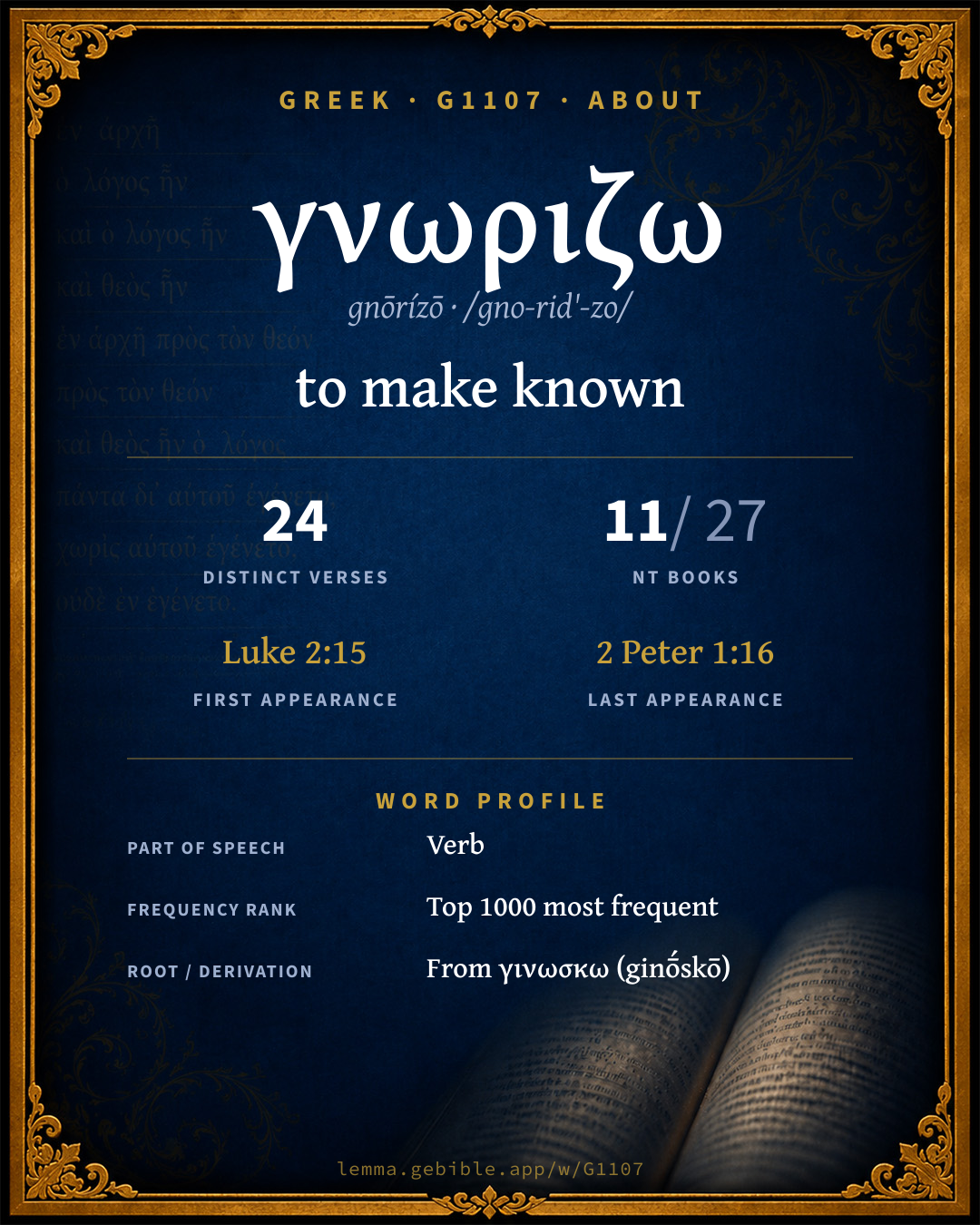
γνωρίζω
to make known
‘to make known’ is one of 2 main senses fuller range ↓
Full lexicon entry — Thayer's Greek Lexicon
From Thayer's Greek Lexicon
Where this word appears
See every Aorist-tense verb in the Greek New Testament →
Grammar key — what these labels mean
Part of speech
- Verb
- An action or state-of-being word.
Tense
- Present
- Ongoing or general action in present time (imperfective aspect).
- Aorist
- Action viewed as a simple whole, without regard to duration — often past (perfective aspect).
- Future
- Action expected in future time.
Voice
- Active
- The subject performs the action.
- Passive
- The subject receives the action.
Mood
- Indicative
- States a fact or asks a factual question (the mood of reality).
- Infinitive
- A verbal noun (“to write”), unmarked for person or number.
- Participle
- A verbal adjective (“writing,” “having written”).
- Subjunctive
- Expresses probability, purpose, or possibility (the mood of contingency).
- Imperative
- Expresses a command or request.
Case
- Nominative
- The case of the subject (and the predicate nominative).
- Genitive
- The case of source, possession, or “of” — answers “whose / from what.”
Person
- 1st person
- The speaker (“I / we”).
- 3rd person
- The one spoken about (“he / she / it / they”).
- 2nd person
- The one addressed (“you”).
Gender
- Masculine
- Grammatically masculine.
- Neuter
- Grammatically neuter.
Number
- Singular
- One.
- Plural
- More than one.
Grammatical forms 17 distinct
- Verb, Present, Active, Indicative, 1st person, Singular 4 times (16%)
- Verb, Aorist, Active, Infinitive 3 times (12%)
- Verb, Aorist, Active, Indicative, 1st person, Singular 2 times (8%)
- Verb, Aorist, Passive, Indicative, 3rd person, Singular 2 times (8%)
- Verb, Future, Active, Indicative, 3rd person, Singular 2 times (8%)
- Verb, Aorist, Active, Indicative, 1st person, Plural 1 time (4%)
- Verb, Aorist, Active, Indicative, 2nd person, Singular 1 time (4%)
- Verb, Aorist, Active, Indicative, 3rd person, Plural 1 time (4%)
+9 more forms (9 occurrences)
Parsed forms decoded from the imported morphology (Robinson–Tischendorf, public domain), counted across 25 parsed occurrences — not distinct verses.
Every verse where G1107 appears — 24 distinct verses across 11 books. Click any verse to open its interlinear word-by-word view. Verse text shown in the World English Bible for context — . Each verse’s Greek form is shown with its reference; the English is not keyword-highlighted, since the data carries no word-level English alignment. Use “Compare translations” on any verse to read it across multiple English versions. This concordance covers the Greek New Testament; Septuagint (Greek Old Testament) occurrences of this word are not indexed here.
Luke 2 verses
- Luke 2:15 ἐγνώρισεν aor act ind 3sg It happened, when the angels went away from them into the sky, that the shepherds said one to another, "Let's go to Bethlehem, now, and see this thing that has happened, which the Lord has made known to us."
- Luke 2:17 ἐγνώρισαν aor act ind 3pl When they saw it, they publicized widely the saying which was spoken to them about this child.
John 2 verses
- John 15:15 ἐγνώρισα aor act ind 1sg No longer do I call you servants, for the servant doesn't know what his lord does. But I have called you friends, for everything that I heard from my Father, I have made known to you.
- John 17:26 ἐγνώρισα γνωρίσω aor act ind 1sg fut act ind 1sg I made known to them your name, and will make it known; that the love with which you loved me may be in them, and I in them."
Acts 1 verse
Romans 3 verses
- Romans 9:22 γνωρίσαι aor act inf What if God, willing to show his wrath, and to make his power known, endured with much patience vessels of wrath made for destruction,
- Romans 9:23 γνωρίσῃ aor act subj 3sg and that he might make known the riches of his glory on vessels of mercy, which he prepared beforehand for glory,
- Romans 16:26 γνωρισθέντος aor pass ptcp gen sg neut
1 Corinthians 2 verses
- 1 Corinthians 12:3 γνωρίζω pres act ind 1sg Therefore I make known to you that no man speaking by God's Spirit says, "Jesus is accursed." No one can say, "Jesus is Lord," but by the Holy Spirit.
- 1 Corinthians 15:1 Γνωρίζω pres act ind 1sg Now I declare to you, brothers, the Gospel which I preached to you, which also you received, in which you also stand,
2 Corinthians 1 verse
Galatians 1 verse
Ephesians 6 verses
- Ephesians 1:9 γνωρίσας aor act ptcp nom sg masc making known to us the mystery of his will, according to his good pleasure which he purposed in him
- Ephesians 3:3 ἐγνωρίσθη aor pass ind 3sg how that by revelation the mystery was made known to me, as I wrote before in few words,
- Ephesians 3:5 ἐγνωρίσθη aor pass ind 3sg which in other generations was not made known to the children of men, as it has now been revealed to his holy apostles and prophets in the Spirit;
- Ephesians 3:10 γνωρισθῇ aor pass subj 3sg to the intent that now through the assembly the manifold wisdom of God might be made known to the principalities and the powers in the heavenly places,
- Ephesians 6:19 γνωρίσαι aor act inf on my behalf, that utterance may be given to me in opening my mouth, to make known with boldness the mystery of the Gospel,
- Ephesians 6:21 γνωρίσει fut act ind 3sg But that you also may know my affairs, how I am doing, Tychicus, the beloved brother and faithful servant in the Lord, will make known to you all things;
Philippians 2 verses
- Philippians 1:22 γνωρίζω pres act ind 1sg But if I live on in the flesh, this will bring fruit from my work; yet I don't make known what I will choose.
- Philippians 4:6 γνωριζέσθω pres pass impv 3sg In nothing be anxious, but in everything, by prayer and petition with thanksgiving, let your requests be made known to God.
Colossians 3 verses
- Colossians 1:27 γνωρίσαι aor act inf to whom God was pleased to make known what are the riches of the glory of this mystery among the Gentiles, which is Christ in you, the hope of glory;
- Colossians 4:7 γνωρίσει fut act ind 3sg All my affairs will be made known to you by Tychicus, the beloved brother, faithful servant, and fellow bondservant in the Lord.
- Colossians 4:9 γνωρίσουσιν fut act ind 3pl together with Onesimus, the faithful and beloved brother, who is one of you. They will make known to you everything that is going on here.
2 Peter 1 verse
About this entry
At a glance — auto-summarized from this page’s data, not written by a person. Every figure links to its source below. This summary describes the numbers; it doesn’t interpret them.
At its core, γνωριζω (gnōrízō) means “to make known.” Scripture first uses it in Luke 2:15. Spanning 24 verses in 11 books, it ranks among the uncommon words of the Greek New Testament. Its uses concentrate in Ephesians (25% of all occurrences). Catalogued under 2 senses, its meaning is not single-sense. Each statement above links to its evidence; the full detail follows below.
Gloss history
Strong's 1890 vs modern scholarship

About this word
Strong's G1107 catalogs a Greek word from the Greek New Testament.
These counts are not copied from any lexicon or concordance. They are computed here, from the morphology-tagged Greek New Testament. What Lemma adds →
- 24
- distinct verses
- The word appears in 24 distinct verses.
- 11 / 27
- NT books
- The word appears in 11 of 27 New Testament books.
- #530
- by frequency
- Top 1000 most frequent Greek words (rank 530 of 5,347 Greek words by occurrence).
View all 24 occurrences in the concordance →
Most concentrated in
- Ephesians 6 verses 25%
- Romans 3 verses 13%
- Colossians 3 verses 13%
By section of the New Testament
By traditional corpus
Conventional, traditional groupings — biblical authorship is debated, so this is a traditional corpus grouping, not an authorship claim. Some books belong to more than one corpus (Luke is in both the Gospels and the Lukan corpus, and so on), so these shares overlap and need not total 100%. Each figure is a share of the word’s 24 distinct verses.
- Pauline corpus 18 verses · 75%
- Gospels 4 verses · 17%
- Lukan (Luke–Acts) 3 verses · 13%
- Johannine 2 verses · 8%
- General (Catholic) Epistles 1 verse · 4%
How translations render this word
Counts come from each version’s own published word-to-Strong’s tagging or interlinear alignment — an approximate guide to how each version renders this word, not a word-level alignment the data otherwise carries. Because each total is that version’s own tagged count, the per-version totals vary from one another and need not match the appearance or distinct-verse counts above. These counts may also differ from a printed concordance because Lemma counts each distinctly tagged rendering and does not collapse phrase taggings into a single head-word total. This is a fixed set of word-tagged versions (KJV, ASV, BSB, ULT) and does not change with the reading translation you choose elsewhere. Each version’s license is shown beside its name below (and on Sources).
- King James Version: Made known 2×, Make known 2×
- American Standard Version: Make known 3×, I make known 2×, Known 2×
- Berean Standard Bible: Made known 2×, Make 2×, Make known 2×
- unfoldingWord Literal Text: I make known 3×, Known 3×, Make known 3×
King James Version Public Domain
Renders G1107 across 30 tagged occurrences — most commonly:
Plus 26 renderings that appear only once — usually multi-word phrases or single function words the recovered tagging swept in, not distinct renderings.
American Standard Version Public Domain
Renders G1107 across 29 tagged occurrences — most commonly:
Plus 22 renderings that appear only once — usually multi-word phrases or single function words the recovered tagging swept in, not distinct renderings.
Berean Standard Bible Public Domain
Renders G1107 across 25 tagged occurrences — most commonly:
Plus 17 renderings that appear only once — usually multi-word phrases or single function words the recovered tagging swept in, not distinct renderings.
unfoldingWord Literal Text CC BY-SA 4.0
Renders G1107 across 33 tagged occurrences — most commonly:
Plus 20 renderings that appear only once — usually multi-word phrases or single function words the recovered tagging swept in, not distinct renderings.
Senses in Thayer's
The 2 senses Thayer's distinguishes for this word, in lexicon order (not ranked by frequency or importance). The full entry — with sub-senses — is in the Lexicon Entry tab.
- to become known, be recognised
- to know, to gain knowledge of, have thorough knowledge of
Word origin
Derived from γινωσκω (ginṓskō) (G1097) — to know.
From a derivative of G1097 ; to make known ; subjectively to know : - certify declare make known give to understand do to wit wot.
— Strong’s Exhaustive Concordance (1890), public domain.
Forms in the corpus
The 18 distinct written forms G1107 takes in the Greek New Testament, most frequent first — each parse links to that tense’s occurrences in the concordance.
Same root — word family
Other Thayer's entries built from the same root as G1107, grouped by Strong’s listed origin. These share a root / origin per the lexicon — not necessarily a shared meaning. Each links to that word’s own entry.
Derives from
Shares the same root
- γνωμη gnṓmē G1106 mind
- γνωσις gnōsis G1108 knowledge
- γνωστης gnṓstēs G1109 expert
- γνωστος gnōstós G1110 known
- νους noûs G3563 mind
- ονομα ónoma G3686 name
Compare all same-root words → Showing 4 of 8 — not the complete family. They share a root, not necessarily a meaning.
Septuagint usage
The same Greek word γνωριζω appears 43 times in the Greek Old Testament (Septuagint), across 43 verses in 14 books.
- 43
- LXX occurrences
- Tagged occurrences of this Greek word in the Septuagint.
- 43
- verses
- Distinct Septuagint verses containing this word.
- 14 / 39
- OT books
- The word appears in 14 of the 39 Old Testament books.
Sample Septuagint occurrences
- Exodus 21:36 γνωρίζω
- Ruth 3:3 γνωρίζω
- 1 Samuel 6:2 γνωρίζω
- 2 Samuel 7:21 γνωρίζω
- 1 Kings 1:27 γνωρίζω
- 1 Chronicles 16:8 γνωρίζω
- Ezra 4:14 γνωρίζω
- Job 34:25 γνωρίζω
- Psalms 15:11 γνωρίζω
- Proverbs 3:6 γνωρίζω
- Jeremiah 11:18 γνωρίζω
- Ezekiel 20:5 γνωρίζω
Septuagint occurrences (same lexeme)
Every verse where the same Strong’s number (G1107) appears in the Greek Septuagint. Verse text shown in the World English Bible for context; the Greek form is the matched word — the English is not keyword-highlighted.
- Exodus 21:36 γνωρίζω Or if it is known that the bull was in the habit of goring in the past, and its owner has not kept it in, he shall surely pay bull for bull, and the dead animal shall be his own.
- Ruth 3:3 γνωρίζω Wash yourself therefore, and anoint you, and put your clothing on you, and get you down to the threshing floor, but don't make yourself known to the man, until he shall have done eating and drinking.
- 1 Samuel 6:2 γνωρίζω The Philistines called for the priests and the diviners, saying, "What shall we do with the ark of Yahweh? Show us with which we shall send it to its place."
- 1 Samuel 10:8 γνωρίζω You shall go down before me to Gilgal; and, behold, I will come down to you, to offer burnt offerings, and to sacrifice sacrifices of peace-offerings: seven days shall you wait, until I come to you, and show you what you shall do.
- 1 Samuel 14:12 γνωρίζω The men of the garrison answered Jonathan and his armor bearer, and said, Come up to us, and we will show you a thing. Jonathan said to his armor bearer, Come up after me; for Yahweh has delivered them into the hand of Israel.
- 1 Samuel 16:3 γνωρίζω Call Jesse to the sacrifice, and I will show you what you shall do: and you shall anoint to me him whom I name to you.
- 1 Samuel 28:15 γνωρίζω Samuel said to Saul, Why have you disquieted me, to bring me up? Saul answered, I am sore distressed; for the Philistines make war against me, and God is departed from me, and answers me no more, neither by prophets, nor by dreams: therefore I have called you, that you may make known to me what I shall do.
- 2 Samuel 7:21 γνωρίζω For your word's sake, and according to your own heart, have you worked all this greatness, to make your servant know it.
- 1 Kings 1:27 γνωρίζω Is this thing done by my lord the king, and you haven't shown to your servants who should sit on the throne of my lord the king after him?
- 1 Kings 8:53 γνωρίζω For you did separate them from among all the peoples of the earth, to be your inheritance, as you spoke by Moses your servant, when you brought our fathers out of Egypt, Lord Yahweh.
- 1 Chronicles 16:8 γνωρίζω Oh give thanks to Yahweh, call on his name; Make known his doings among the peoples.
- Ezra 4:14 γνωρίζω Now because we eat the salt of the palace, and it is not appropriate for us to see the king's dishonor, therefore have we sent and informed the king;
- Ezra 4:16 γνωρίζω We inform the king that, if this city be built, and the walls finished, by this means you shall have no portion beyond the River.
- Ezra 5:10 γνωρίζω We asked them their names also, to inform you that we might write the names of the men who were at the head of them.
- Ezra 7:24 γνωρίζω Also we inform you, that touching any of the priests and Levites, the singers, porters, Nethinim, or servants of this house of God, it shall not be lawful to impose tribute, custom, or toll, on them.
- Ezra 7:25 γνωρίζω You, Ezra, after the wisdom of your God who is in your hand, appoint magistrates and judges, who may judge all the people who are beyond the River, all such as know the laws of your God; and teach you him who doesn't know them.
- Ezra 18:12 γνωρίζω
- Ezra 19:14 γνωρίζω
- Job 34:25 γνωρίζω Therefore he takes knowledge of their works. He overturns them in the night, so that they are destroyed.
- Psalms 15:11 γνωρίζω
- Psalms 24:4 γνωρίζω He who has clean hands and a pure heart; Who has not lifted up his soul to falsehood, And has not sworn deceitfully.
- Psalms 31:5 γνωρίζω Into your hand I commend my spirit. You redeem me, Yahweh, God of truth.
- Psalms 38:5 γνωρίζω My wounds are loathsome and corrupt, Because of my foolishness.
- Psalms 76:15 γνωρίζω
- Psalms 77:5 γνωρίζω I have considered the days of old, The years of ancient times.
- Psalms 89:12 γνωρίζω The north and the south, you have created them. Tabor and Hermon rejoice in your name.
- Psalms 97:2 γνωρίζω Clouds and darkness are around him. Righteousness and justice are the foundation of his throne.
- Psalms 102:7 γνωρίζω I watch, and have become like a sparrow that is alone on the housetop.
- Psalms 105:8 γνωρίζω He has remembered his covenant forever, The word which he commanded to a thousand generations,
- Psalms 142:8 γνωρίζω
- Psalms 144:12 γνωρίζω Then our sons will be like well-nurtured plants, Our daughters like pillars carved to adorn a palace.
- Proverbs 3:6 γνωρίζω In all your ways acknowledge him, And he will direct your paths.
- Proverbs 9:9 γνωρίζω Instruct a wise man, and he will be still wiser. Teach a righteous man, and he will increase in learning.
- Proverbs 15:10 γνωρίζω There is stern discipline for one who forsakes the way: Whoever hates reproof shall die.
- Proverbs 22:19 γνωρίζω That your trust may be in Yahweh, I teach you today, even you.
- Jeremiah 11:18 γνωρίζω Yahweh gave me knowledge of it, and I knew it: then you shown me their doings.
- Jeremiah 16:21 γνωρίζω Therefore, behold, I will cause them to know, this once will I cause them to know my hand and my might; and they shall know that my name is Yahweh.
- Ezekiel 20:5 γνωρίζω and tell them, Thus says the Lord Yahweh: In the day when I chose Israel, and swore to the seed of the house of Jacob, and made myself known to them in the land of Egypt, when I swore to them, saying, I am Yahweh your God;
- Ezekiel 20:11 γνωρίζω I gave them my statutes, and shown them my ordinances, which if a man do, he shall live in them.
- Ezekiel 43:11 γνωρίζω If they be ashamed of all that they have done, make known to them the form of the house, and the fashion of it, and the exits of it, and the entrances of it, and all the forms of it, and all the ordinances of it, and all the forms of it, and all the laws of it; and write it in their sight; that they may keep the whole form of it, and all the ordinances of it, and do them.
- Ezekiel 44:23 γνωρίζω They shall teach my people the difference between the holy and the common, and cause them to discern between the unclean and the clean.
- Hosea 8:4 γνωρίζω They have set up kings, but not by me. They have made princes, and I didn't approve. Of their silver and their gold they have made themselves idols, That they may be cut off.
- Amos 3:3 γνωρίζω Do two walk together, Unless they have agreed?
These are occurrences of the same Greek lexeme (G1107) in the Septuagint — not a translation of any one Hebrew word. The store carries no word-level Hebrew↔Greek alignment, so no Hebrew original is asserted here. Counts come from the recovered LXX Strong's tagging — high-frequency vocabulary is well covered, while rare or late forms may be untagged — so they reflect tagged occurrences and may slightly undercount.