Mark 15:10

Greek (Tischendorf 8th ed.) Mark 15:10 appears in the Greek New Testament. The text above is from the Tischendorf 8th edition. Each word links to its Strong’s number and a concise gloss. Click any word for its full Thayer’s Greek Lexicon entry.

Download image
Cite this verse

Mark 15:10 (World English Bible). Public Domain. Lemma interlinear Bible study tool, https://lemma.gebible.app/v/mark/15/10.

Show BibTeX & RIS
BibTeX
RIS
English Translation
For he perceived that for envy the chief priests had delivered him up.
World English Bible · Public Domain
Download a study sheet

One document with this verse’s original text, its word-by-word gloss line, the meaning frame, cross-references with their text, attributed commentary, and full source and license credits — printable, and it pastes into notes with its structure intact.

This verse Autodidact and up

Study sheet (.html) Plain text (.txt)

A passage Seminary Student

Up to 50 verses in one chapter. A passage sheet keeps up to 6 commentary sources and 12 cross-references per verse, in the order this page ranks them, and says so on the sheet whenever that leaves anything out. Ask for a single verse and you get the Autodidact verse sheet above.

Everything on this page stays free to read, with no account — the sheet is a download of what is already on screen, not access to it.

Want to remove ads? Support Godless Engineer
Compare translations 3

The same verse in 3 English versions, stacked beneath the original-language interlinear above. Click any original word for its lexicon entry.

Each is an independent rendering of the whole verse — the interlinear is not word-aligned to these translations.

Highlighted words mark where these versions differ — a whole-verse word diff, not a word-by-word alignment.

  • World English Bible Public Domain
    For he perceived that for envy the chief priests had delivered him up.
  • King James Version Public Domain
    For he knew that the chief priests had delivered him for envy.
  • unfoldingWord Literal Text CC BY-SA 4.0
    For he knew that the chief priests had handed him over because of envy.

unfoldingWord Literal Text — © unfoldingWord, licensed CC BY-SA 4.0. Word-aligned USFM3 via Door43 (git.door43.org/unfoldingWord/en_ult).

Versions to compare (up to 4)

3 of 4 selected

Show all 19 translations

Every available English version of this verse, each an independent rendering of the whole verse.

  • World English Bible Public Domain
    For he perceived that for envy the chief priests had delivered him up.
  • Berean Standard Bible Public Domain
    For he knew it was out of envy that the chief priests had handed Jesus over.
  • Majority Standard Bible Public Domain
    For he knew it was out of envy that the chief priests had handed Jesus over.
  • King James Version Public Domain
    For he knew that the chief priests had delivered him for envy.
  • American Standard Version (1901) Public Domain
    For he perceived that for envy the chief priests had delivered him up.
  • Revised Version (1885) Public Domain
    For he perceived that for envy the chief priests had delivered him up.
  • Geneva Bible (1599) Public Domain
    For he knewe that the hie Priestes had deliuered him of enuie.
  • Douay-Rheims (1899) Public Domain
    For he knew that the chief priests had delivered him up out of envy.
  • Young's Literal Translation Public Domain
    for he knew that because of envy the chief priests had delivered him up;
  • Literal Standard Version CC BY-SA 4.0
    For he knew that the chief priests had delivered Him up because of envy;
  • Unlocked Literal Bible CC BY-SA 4.0
    For he knew that it was because of envy that the chief priests had handed Jesus over to him.
  • unfoldingWord Literal Text CC BY-SA 4.0
    For he knew that the chief priests had handed him over because of envy.
  • Darby Bible Public Domain
    for he knew that the chief priests had delivered him up through envy.
  • World Messianic Bible Public Domain
    For he perceived that for envy the chief priests had delivered him up.
  • Webster's Bible Public Domain
    (For he knew that the chief priests had delivered him for envy.)
  • Free Bible Version CC BY-SA 4.0
    for he realized that it was because of their jealousy of Jesus that the chief priests had handed Jesus over to him.
  • Bible in Basic English Public Domain
    For he saw that the chief priests had given him up through envy.
  • Text-Critical English NT CC BY 4.0
    (For he knew that the chief priests had handed Jesus over out of envy.)
  • Tyndale New Testament (1534) Public Domain
    For he knewe that the hye Prestes had delyvered him of envy.

Literal Standard Version (2020), Covenant Press — licensed CC BY-SA 4.0. Text via the HelloAO Bible API (eBible.org). Unlocked Literal Bible (unfoldingWord) — licensed CC BY-SA 4.0. Text via the HelloAO Bible API (eBible.org). unfoldingWord Literal Text — © unfoldingWord, licensed CC BY-SA 4.0. Word-aligned USFM3 via Door43 (git.door43.org/unfoldingWord/en_ult). Free Bible Version, Dr. Jonathan Gallagher — licensed CC BY-SA 4.0. Text via the HelloAO Bible API (eBible.org).

Word by word

More ways to search: Search by grammar → Find every occurrence → Compare this word →

Practice this passage: Drill this verse → Learn its vocabulary →

About this verse

These counts appear in no published source. They are computed here, from the morphology-tagged text and Lemma’s own curated glosses. What Lemma adds →

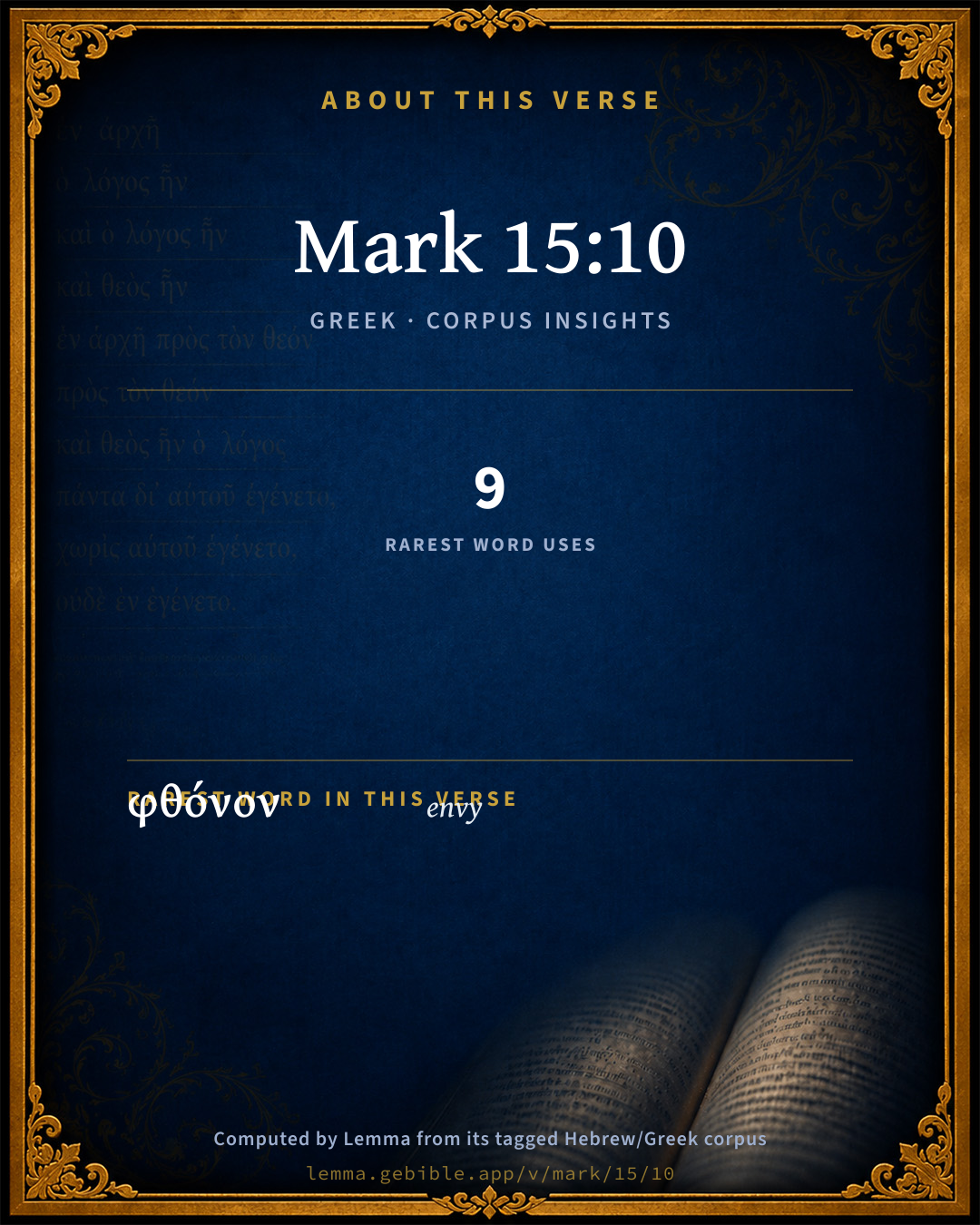
9
words
9
distinct lemmas
Gospels
section

Notable vocabulary

The rarest word here is φθόνον envy G5355 — appearing just 9 times in the whole Greek New Testament.

Shared distinctive vocabulary

φθόνον envy G5355 occurs in 9 verses of the Greek New Testament. Also found in:

Cross-references

11

Topical passages linked to Mark 15:10 in the Treasury of Scripture Knowledge — connected by theme and wording, ordered by reader-vote popularity; previews shown in the World English Bible.

  • Proverbs 27:4 Wrath is cruel, And anger is overwhelming; But who is able to stand before jealousy?
  • Genesis 4:4–6 Abel also brought some of the firstborn of his flock and of the fat of it. Yahweh respected Abel and his offering,
  • 1 Samuel 18:8–9 Saul was very angry, and this saying displeased him; and he said, They have ascribed to David ten thousands, and to me they have ascribed but thousands: and what can he have more but the kingdom?
  • Matthew 27:18 For he knew that because of envy they had delivered him up.
  • Titus 3:3 For we were also once foolish, disobedient, deceived, serving various lusts and pleasures, living in malice and envy, hateful, and hating one another.
  • Genesis 37:11 His brothers envied him; but his father kept this saying in mind.
  • Ecclesiastes 4:4 Then I saw all the labor and achievement that is the envy of a man's neighbor. This also is vanity and a striving after wind.
  • Acts 13:45 But when the Jews saw the multitudes, they were filled with jealousy, and contradicted the things which were spoken by Paul, and blasphemed.
  • James 3:14–16 But if you have bitter jealousy and selfish ambition in your heart, don't boast and don't lie against the truth.
  • James 4:5 Or do you think that the Scripture says in vain, "The Spirit who lives in us yearns jealously"?
  • 1 John 3:12 unlike Cain, who was of the evil one, and killed his brother. Why did he kill him? Because his works were evil, and his brother's righteous.

Cross-references courtesy of OpenBible.info (CC BY 4.0).

Commentary

Notes on Mark 15:10 from classic Christian and Jewish commentators (each source and its license shown beneath its notes). The classic Christian expositions comment on the surrounding passage and are grouped to its opening verse, so a note may address several verses; the Jewish commentaries on the Tanakh (Rashi and others) are per-verse, so they appear only where the commentator wrote on this verse.

Lemma curates 59 commentaries, every one of them public domain or Creative Commons licensed, each selected and text-cleaned for this edition rather than reprinted as found. About our sources →

The Biblical Illustrator

Joseph S. Exell

Mar_15:10

Had delivered Him for envy.

Envy and malevolence

Mutius, a citizen of Rome, was noted to be of such an envious and malevolent disposition, that Publius, one day, observing him to be very sad, said, Either some great evil is happened to Mutius, or some great good to another.

Envy and malevolence

Dionysius the tyrant, out of envy, punished Philoxenius the musician because he could sing, and Plato the philosopher because he could dispute, better than himself.

Envy in a Christian

Who is this elder son? was once asked in an assembly of ministers at Elberfeldt. Daniel Krummacher made answer: I know him very well; I met him yesterday. Who is he? they asked eagerly; and he replied solemnly, Myself. He then explained that on the previous day, hearing that a very ill-conditioned person had received a very gracious visitation of Gods goodness, he had felt not a little envy and irritation.

Envy punishes itself

A Burmese potter, says the legend, became envious of the prosperity of a washerman, and, in order to ruin him, induced the king to order him to wash one of his black elephants white, that he might be lord of the white elephant. The washerman replied that, by the rules of his art, he must have a vessel large enough to wash him in. The king ordered the potter to make him such a vessel. When made, it was crushed by the first step of the elephant in it. Many trials failed, and the potter was ruined by the very scheme he had devised to crush his enemy.

The persecutors-the causes of their hostility

We now proceed to the consideration of the causes of this strange conduct; in other words, we shall inquire, Why the chief priests and rulers of the Jews acted thus towards our Lord? We remark, in general, that the cause was this-that the whole of our Lords conduct and ministry was in direct opposition to their views, prejudices, and interests.

1. It is obvious to remark, that there was much in what may be called their national feelings and prejudices, against which our Lord greatly and constantly offended. The chief priests and rulers would, of course, share with the people generally, in the expectation of a temporal prince in the person of Messiah, and of national distinctions and honours under his reign. But there was nothing in our Lords conduct or ministry to favour these views.

2. But this is not all. There was much in their official position and interests which rendered our Lord an object of constant suspicion, and of bitter hatred. The whole of their power and influence depended on the continuance of the ecclesiastical system which then existed. Their power and influence in their own nation were very great; and few who have once possessed power are willing to relinquish it. But our Lords conduct and ministry appeared not only unfavourable to their expectations of national aggrandizement, but they seemed to threaten even the existence of the system of ecclesiastical polity which then obtained amongst them.

3. But the grounds of hostility to our Lord were carried further still, he had rendered himself personally offensive to the chief priests and rulers of the Jews. Beautiful, said men, these prayers and fastings, these alms and phylacteries, this scrupulous attention to the smallest points of the law! Beautiful, replied our Lord, as whited sepulchres, which are full of corruption and dead mens bones; the very abodes of putridity, loathsomeness, and death. It was a very common thing with Him, not only in His private intercourse with His disciples, but also in His public ministry, to caution men against the designs and the practices of the Scribes and Pharisees, of whom these chief priests and rulers, for the most part, consisted. Beware of them, He often cried. Do not as the Pharisees do; they give alms, and say long prayers, to be seen of men. It may not be improper to confirm the view we have taken of their conduct by a more direct reference to the evangelical history. I remark, then, that the truth of it appears in the origin of their opposition. It is evident that their hostility originated in the success of our Lords ministry; and it increased with the increase of His influence. To point out every illustration of this which the sacred narratives afford, would be to go through a great part of our Lords history. But we may notice the extraordinary event which specially stimulated their malignity, and led to their determination to destroy Him; that is to say, the resurrection of Lazarus. It was not many months before His crucifixion that this, in some respects His greatest miracle, was performed. Then from that day forth they took counsel together for to put Him to death. They tried to put the people down, but in vain; they appealed to our Lord, Master, rebuke Thy disciples; but Jesus said, If these should hold their peace, the stones would immediately cry out. Then they said among themselves, Perceive ye how that ye prevail nothing; behold the world is gone after Him. Thus we find that their hostility increased just as His influence increased. But, in addition to His influence with the people, our Lord, as we have already seen, rendered Himself personally offensive to the chief priests and rulers by His unsparing exposure of their hypocrisy. Before we leave this part of our subject, let us pause for a moment to inquire whether the same spirit has ever been displayed since the persecutors of Jesus went to give in their account?

1. There are very few men who will not decidedly oppose every effort to overturn a system, on the continuance of which their worldly interests depend. Very few who are fed, enriched, ennobled by any social arrangement, will ever care to inquire whether it be in itself good, whether it be generally beneficial, or whether it be not for the public weal that it give place to another? For them and theirs it is good; and they are all the world to themselves. They can see nothing but disaster in its overthrow, and nothing but wickedness in those who wish to effect it. And this suggests a passing remark, that the best institution may become antiquated. All the unprejudiced perceive that it is fast becoming a nuisance, and that the sooner it is allowed to be decently interred, the better for all interests. But the fact that it was once a benefit, helps to blind the eyes of those who are still interested in its continuance to another fact-that it has ceased to be so.

2. It is also worthy of remark, that generally speaking, their hostility is bitter in proportion to their apprehensions of the unsoundness of the system with which they are connected.

3. No men are more frequently placed in this position, or have more frequently displayed this spirit, than ecclesiastics. Their power is of a peculiar kind, and always rests, more or less, on public opinion.

4. It is still worse when they have become completely corrupt, and their corruption and hypocrisy are exposed to the world. Hence the persecutions which faithful men have endured in every age, and almost invariably through the instigation of ecclesiastics. Hence the sufferings of the Lollards, the Puritans, the Nonconformists, in our own country; of the Waldenses, the Albigenses, the Huguenots, on the continent of Europe. Hence, we say, and hence alone. Why was Wycliffe so hateful to the ecclesiastical rulers of his day? Simply because of the light which, from time to time, he threw on the system of corruption with which they were identified, and by which they were enriched and ennobled; because, by the calm and earnest exhibition of the truth, he was undermining their influence, and exposing them to contempt. Were Gardiner and Bonnet, men of some note in their day, better than Annas and Caiaphas? Wherein, beloved reader, and how much, were they better? They acted on precisely the same principles, and in precisely the same spirit; and if they were not better than the persecutors of Jesus, were they worse than some of their successors, the Elizabethan bishops? Were they worse than Parker and Whitgift; than Aylmer, and many others? (J. J. Davies.)

The Biblical Illustrator, edited by Joseph S. Exell (c. 1880s–1900s) — public domain. Text from a community e-Sword module.

Expositor's Greek Testament

ed. W. Robertson Nicoll

Mar 15:10 . ἐγίνωσκεν , it gradually dawned upon him. Pilate would see the animus of the Sanhedrists in their many accusations (Mar 15:3 ), from which it would appear that Christ’s real offence was His great influence with the people. Hence the attempt to play off the one party against the other: the people against the priests.

The Expositor's Greek Testament, edited by W. Robertson Nicoll (1897–1910) — public domain. Text from a community e-Sword module.

The Cambridge Bible for Schools and Colleges

gen. ed. J. J. S. Perowne

10. for envy] He could not doubt who were the ringleaders in the tumultuous scene now being enacted, or what was the motive that had prompted them to bring the Accused before his tribunal—nothing more or less than envy of the influence He had gained and the favour He had won throughout the land. He hoped, therefore, by appealing directly to the people to procure our Lord’s release.

The Cambridge Bible for Schools and Colleges (gen. ed. J. J. S. Perowne; Cambridge University Press, 1878–1918) — public domain. Text from a community e-Sword module.

John Gill's Exposition

For he knew that the chief priests,.... The Persic version reads in the singular, "the chief of the priests", or the high priest, Caiaphas,

had delivered him for envy; at his popularity through his doctrine and miracles, and not from any principle of equity and justice, or from any regard to Caesar; See Gill on Mat 27:18.

John Gill's Exposition of the Whole Bible (1746–1763) — public domain (CC PDM 1.0). Text via the HelloAO Bible API.

Haydock's Catholic Bible Commentary

Since envy put to death the Author of life, Jesus Christ, how watchful should all Christians be against every degree of that sin. (St. John Chrysostom, hom. xl. in Matt.)

George Leo Haydock (1774–1849), Haydock's Catholic Family Bible and Commentary, 1859 edition — public domain. Excludes Psalms (Douay-Rheims chapter numbering differs from Protestant) and Deuterocanonical books (Catholic canon only).

The Pulpit Commentary

Envy was the low passion that influenced the chief priests. They saw that Jesus was gaining a great and increasing influence over the people by the sublime beauty of his character, by the fame of his miracles, and the constraining power of his words. And hence they concluded that, unless he was arrested in his course, and put out of the way, their own influence would soon be gone. The whole world was going after him. Therefore he must be destroyed.

The Pulpit Commentary (1880–1919), ed. H.D.M. Spence-Jones & Joseph S. Exell — public domain. Text from a community e-Sword module.

Cambridge Greek Testament for Schools and Colleges

10. ἐγίνωσκεν. He was becoming aware. Pilate was shrewd enough to see that there was violent animus against Jesus and that the charges against Him were untrue. Jewish leaders were not likely to resent a Rabbi’s being hostile to Rome: they were quite capable of resenting the success of a rival Teacher. His real crime was that He had been too popular, and it was this which led Pilate to hope that the proposal to release Him in honour of the Feast would be welcomed by the people. But he made a mistake in calling Him “the King of the Jews.” Such a title in the mouth of a Roman official must seem to be contemptuous; he would have done better, had he called Him “the Prophet of Galilee.”

Cambridge Greek Testament for Schools and Colleges (Cambridge University Press, 1896; 21 vols, various authors incl. Carr, Maclear, Plummer, Farrar, Lumby, Moule, M. R. James, Simcox) — public domain. Text from a community e-Sword module.

Alford’s Greek Testament

Henry Alford

10.] ἐγίνωσκεν, impert. He was aware, He perceived, His apprehension of it was concurrent with the action going on.

Henry Alford, The Greek Testament (1849–1861) — public domain. Text from a community e-Sword module.

International Critical Commentary

10. διὰ φθόνον—on account of envy. He knew that it was the popularity of Jesus with the multitudes that had aroused the jealousy of the rulers against him, and he hoped that he could make use of that now to secure his release.

International Critical Commentary — older volumes (1896–1929), various authors — public domain. Text from a community e-Sword module.

Lesson kit

Teaching starters — assembled from the data on this page, not authored interpretation. Every prompt links to the verse data it draws on. Edit before teaching.

Mark, in the Gospels, opens this verse with 9 words (9 distinct Greek lemmas). Its most distinctive word is phthónos (“envy”). A historical commentator’s framing appears above. Read the whole chapter for the surrounding context.

Discussion questions

  1. The word phthónos carries the sense “envy.” How does it shape the verse?
  2. Matthew 27:18 shares the word «envy» with this verse. How do the two illuminate each other?
  3. These translations render this verse differently. What is at stake in choosing one wording over another?
  4. Reading how The Biblical Illustrator and Expositor's Greek Testament read this verse, where do the two commentators agree and where do they part?

Things to notice

Reading settings

Reading text

Shown beneath each verse's original-language words.

Old Testament
Old Testament edition

Read the OT as the Masoretic Hebrew (MT) or the Greek Septuagint (LXX).

English shown for the Greek Septuagint (in the Hebrew ↔ Greek comparison).

Comparing translations? Open the Compare panel on any verse page to stack up to four side by side.