
Ruth 3:4

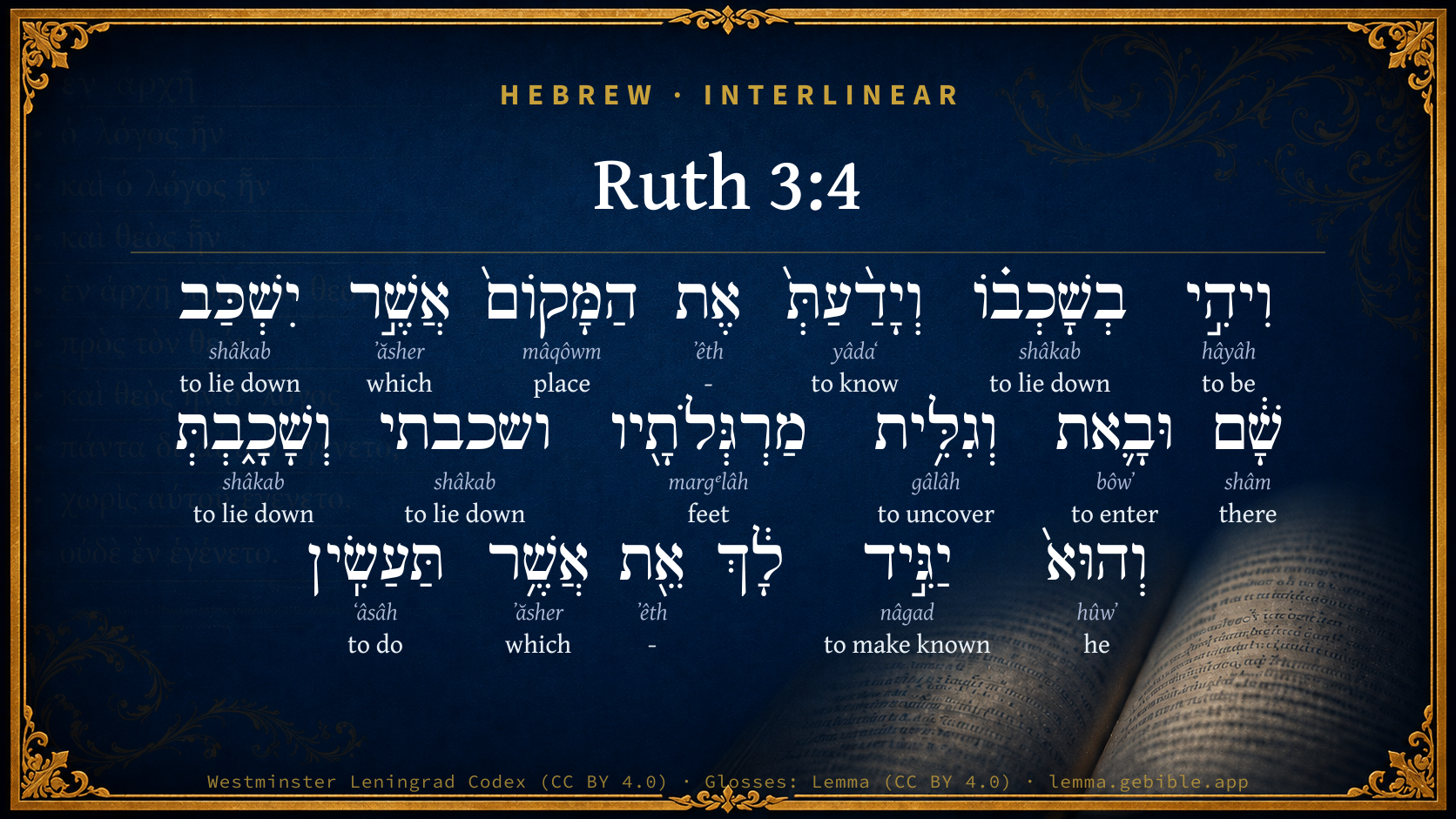
Hebrew (Westminster Leningrad Codex) Ruth 3:4 appears in the Hebrew Old Testament. The text above is from the Westminster Leningrad Codex. Each word links to its Strong’s number, a concise gloss, and parsing drawn from the Open Scriptures Hebrew Bible morphology. Click any word for its full Brown-Driver-Briggs (BDB) entry.
Download image
Cite this verse

Ruth 3:4 (World English Bible). Public Domain. Lemma interlinear Bible study tool, https://lemma.gebible.app/v/ruth/3/4.

Show BibTeX & RIS
BibTeX
RIS
English Translation
It shall be, when he lies down, that you shall mark the place where he shall lie, and you shall go in, and uncover his feet, and lay you down; and he will tell you what you shall do.
World English Bible · Public Domain
Highlights
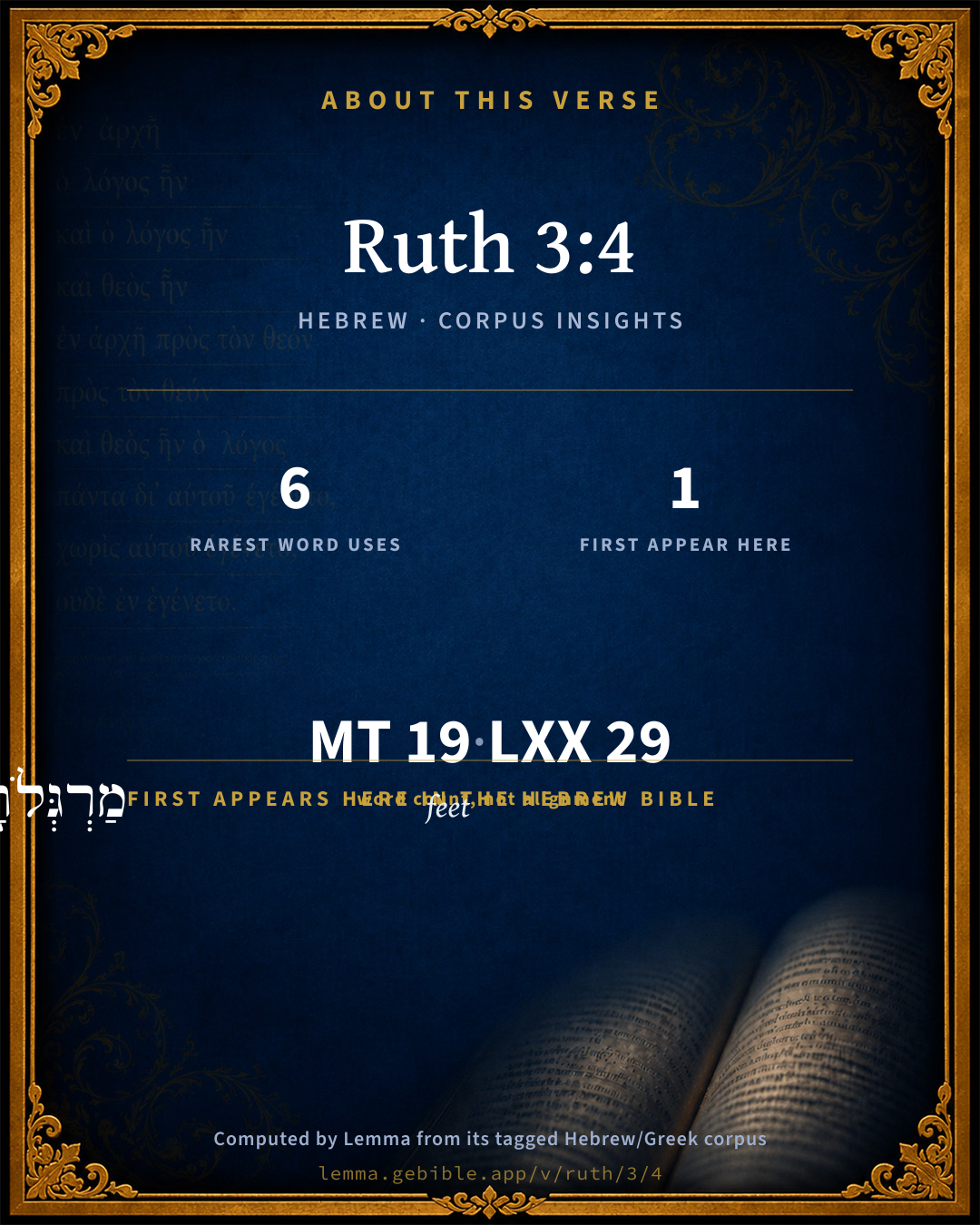
  • 1 first appearance in the Hebrew Bible
Full analysis ↓
Download a study sheet

One document with this verse’s original text, its word-by-word gloss line, the meaning frame, cross-references with their text, attributed commentary, and full source and license credits — printable, and it pastes into notes with its structure intact.

This verse Autodidact and up

Study sheet (.html) Plain text (.txt)

A passage Seminary Student

Up to 50 verses in one chapter. A passage sheet keeps up to 6 commentary sources and 12 cross-references per verse, in the order this page ranks them, and says so on the sheet whenever that leaves anything out. Ask for a single verse and you get the Autodidact verse sheet above.

Everything on this page stays free to read, with no account — the sheet is a download of what is already on screen, not access to it.

Want to remove ads? Support Godless Engineer
Compare translations 3

The same verse in 3 English versions, stacked beneath the original-language interlinear above. Click any original word for its lexicon entry.

Each is an independent rendering of the whole verse — the interlinear is not word-aligned to these translations.

Highlighted words mark where these versions differ — a whole-verse word diff, not a word-by-word alignment.

  • World English Bible Public Domain
    It shall be, when he lies down, that you shall mark the place where he shall lie, and you shall go in, and uncover his feet, and lay you down; and he will tell you what you shall do.
  • King James Version Public Domain
    And it shall be, when he lieth down, that thou shalt mark the place where he shall lie, and thou shalt go in, and uncover his feet, and lay thee down; and he will tell thee what thou shalt do.
  • unfoldingWord Literal Text CC BY-SA 4.0
    And let it be, when he lies down, know the exact place where he is lying. Then go and uncover his feet and lie down. Then he, himself, will tell you what you should do.”

unfoldingWord Literal Text — © unfoldingWord, licensed CC BY-SA 4.0. Word-aligned USFM3 via Door43 (git.door43.org/unfoldingWord/en_ult).

Versions to compare (up to 4)

3 of 4 selected

Show all 18 translations

Every available English version of this verse, each an independent rendering of the whole verse.

  • World English Bible Public Domain
    It shall be, when he lies down, that you shall mark the place where he shall lie, and you shall go in, and uncover his feet, and lay you down; and he will tell you what you shall do.
  • Berean Standard Bible Public Domain
    When he lies down, note the place where he lies. Then go in and uncover his feet, and lie down, and he will explain to you what you should do.”
  • Majority Standard Bible Public Domain
    When he lies down, note the place where he lies. Then go in and uncover his feet, and lie down, and he will explain to you what you should do.”
  • King James Version Public Domain
    And it shall be, when he lieth down, that thou shalt mark the place where he shall lie, and thou shalt go in, and uncover his feet, and lay thee down; and he will tell thee what thou shalt do.
  • American Standard Version (1901) Public Domain
    And it shall be, when he lieth down, that thou shalt mark the place where he shall lie, and thou shalt go in, and uncover his feet, and lay thee down; and he will tell thee what thou shalt do.
  • Revised Version (1885) Public Domain
    And it shall be, when he lieth down, that thou shalt mark the place where he shall lie, and thou shalt go in, and uncover his feet, and lay thee down; and he will tell thee what thou shalt do.
  • Geneva Bible (1599) Public Domain
    And when he shall sleepe, marke the place where he layeth him downe, and go, and vncouer the place of his feete, and lay thee downe, and he shall tell thee what thou shalt doe.
  • Douay-Rheims (1899) Public Domain
    And when he shall go to sleep, mark the place wherein he sleepeth: and thou shalt go in, and lift up the clothes wherewith he is covered towards his feet, and shalt lay thyself down there: and he will tell thee what thou must do.
  • Young's Literal Translation Public Domain
    and it cometh to pass when he lieth down, that thou hast known the place where he lieth down, and hast gone in, and uncovered his feet, and lain down, -- and he doth declare to thee that which thou dost do.'
  • Literal Standard Version CC BY-SA 4.0
    and it comes to pass, when he lies down, that you have known the place where he lies down, and have gone in, and uncovered his feet, and lain down—and he declares to you that which you do.”
  • Unlocked Literal Bible CC BY-SA 4.0
    But when he lies down, take notice of the place where he lies down so that later you can go to him, uncover his feet, and lie down there. Then he will tell you what to do.”
  • unfoldingWord Literal Text CC BY-SA 4.0
    And let it be, when he lies down, know the exact place where he is lying. Then go and uncover his feet and lie down. Then he, himself, will tell you what you should do.”
  • Darby Bible Public Domain
    And it shall be, when he lies down, that thou shalt mark the place where he shall have lain down, and thou shalt go in, and uncover his feet, and lay thyself down; and he will shew thee what thou shalt do.
  • World Messianic Bible Public Domain
    It shall be, when he lies down, that you shall note the place where he is lying. Then you shall go in, uncover his feet, and lie down. Then he will tell you what to do.”
  • Webster's Bible Public Domain
    And it shall be when he lieth down, that thou shalt mark the place where he shall lie, and thou shalt go in, and uncover his feet, and lay thee down; and he will tell thee what thou shalt do.
  • Free Bible Version CC BY-SA 4.0
    watch where he goes to lie down. Then go and uncover his feet and lie down. Then he will tell you what to do.”
  • Bible in Basic English Public Domain
    But see to it, when he goes to rest, that you take note of the place where he is sleeping, and go in there, and, uncovering his feet, take your place by him; and he will say what you are to do.
  • JPS Tanakh (1917) Public Domain
    And it shall be, when he lieth down, that thou shalt mark the place where he shall lie, and thou shalt go in, and uncover his feet, and lay thee down; and he will tell thee what thou shalt do.'

Literal Standard Version (2020), Covenant Press — licensed CC BY-SA 4.0. Text via the HelloAO Bible API (eBible.org). Unlocked Literal Bible (unfoldingWord) — licensed CC BY-SA 4.0. Text via the HelloAO Bible API (eBible.org). unfoldingWord Literal Text — © unfoldingWord, licensed CC BY-SA 4.0. Word-aligned USFM3 via Door43 (git.door43.org/unfoldingWord/en_ult). Free Bible Version, Dr. Jonathan Gallagher — licensed CC BY-SA 4.0. Text via the HelloAO Bible API (eBible.org).

Word by word

More ways to search: Search by grammar → Find every occurrence → Compare this word →

Practice this passage: Drill this verse → Learn its vocabulary →

מַרְגְּלֹתָ֖יו
margᵉlâh
H4772
“feet · his”
Noun, Common, Feminine, Plural, Construct + Suffix, Personal, 3rd Person, Masculine, Singular
Part of Speech
Noun
Type
Common
Gender
Feminine
Number
Plural
State
Construct
Full BDB Definition

Origin: denominative from H7272

TWOT: 2113c

place of the feet, feet
  1. וִיהִ֣י hâyâh H1961 “and · to be” Conjunction + Verb, Qal, Jussive, 3rd Person, Masculine, Singular
  2. בְשָׁכְב֗וֹ shâkab H7901 “in/at · to lie down · him” Preposition + Verb, Qal, Infinitive Construct + Suffix, Personal, 3rd Person, Masculine, Singular
  3. וְיָדַ֨עַתְּ֙ yâdaʻ H3045 “and · to know” Conjunction + Verb, Qal, Sequential Perfect, 2nd Person, Feminine, Singular
  4. אֶת ʼêth H853 “-” Particle, Direct Object
  5. הַמָּקוֹם֙ mâqôwm H4725 “the · place” Particle, Definite Article + Noun, Common, Masculine, Singular, Absolute
  6. אֲשֶׁ֣ר ʼăsher H834 “which” Particle, Relative
  7. יִשְׁכַּב shâkab H7901 “to lie down” Verb, Qal, Imperfect, 3rd Person, Masculine, Singular
  8. שָׁ֔ם shâm H8033 “there” Adverb
  9. וּבָ֛את bôwʼ H935 “and · to enter” Conjunction + Verb, Qal, Sequential Perfect, 2nd Person, Feminine, Singular
  10. וְגִלִּ֥ית gâlâh H1540 “and · to uncover” Conjunction + Verb, Piel, Sequential Perfect, 2nd Person, Feminine, Singular
  11. ושכבתי shâkab H7901 “and · to lie down” Conjunction + Verb, Qal, Sequential Perfect, 1st Person, Common, Singular
  12. וְשָׁכָ֑בְתְּ shâkab H7901 “and · to lie down” Conjunction + Verb, Qal, Sequential Perfect, 2nd Person, Feminine, Singular
  13. וְהוּא֙ hûwʼ H1931 “and · he” Conjunction + Pronoun, Personal, 3rd Person, Masculine, Singular
  14. יַגִּ֣יד nâgad H5046 “to make known” Verb, Hiphil, Imperfect, 3rd Person, Masculine, Singular
  15. אֵ֖ת ʼêth H853 “-” Particle, Direct Object
  16. אֲשֶׁ֥ר ʼăsher H834 “which” Particle, Relative
  17. תַּעַשִֽׂין ʻâsâh H6213 “to do” Verb, Qal, Imperfect, 2nd Person, Feminine, Singular + Suffix, n

About this verse

These counts appear in no published source. They are computed here, from the morphology-tagged text and Lemma’s own curated glosses. What Lemma adds →

19
words
13
distinct lemmas
Historical
section

Notable vocabulary

The rarest word here is מַרְגְּלֹתָ֖יו feet H4772 — appearing just 6 times in the whole Hebrew Bible.

First appearance in Scripture

This word makes its first canonical appearance in the Hebrew Bible here:

  • מַרְגְּלֹתָ֖יו feet H4772

Shared distinctive vocabulary

מַרְגְּלֹתָ֖יו feet H4772 occurs in 5 verses of the Hebrew Bible. Also found in:

Grammatical profile

  • 10 verbs
  • 2 nouns
  • 1 pronoun
  • 1 preposition
  • 1 adverb
  • 4 particles

Verb forms

  • וִיהִ֣י Qal · Jussive
  • בְשָׁכְב֗וֹ Qal · Infinitive Construct
  • וְיָדַ֨עַתְּ֙ Qal · Sequential Perfect
  • יִשְׁכַּב Qal · Imperfect
  • וּבָ֛את Qal · Sequential Perfect
  • וְגִלִּ֥ית Piel · Sequential Perfect
  • ושכבתי Qal · Sequential Perfect
  • וְשָׁכָ֑בְתְּ Qal · Sequential Perfect
  • יַגִּ֣יד Hiphil · Imperfect
  • תַּעַשִֽׂין Qal · Imperfect

Repetition

Words recur within this verse — often emphatic in Hebrew:

  • בְשָׁכְב֗וֹ to lie down H7901 ×4
  • אֲשֶׁ֣ר which H834 ×2

Hebrew & Septuagint length

In English translation the verse runs 39 words from the Hebrew and 44 from the Septuagint (LXX English) — closely comparable.

A rough comparison of the two English renderings, which tokenize alike — not a word-level alignment.

Word counts can differ between the Hebrew and the Greek without any difference in meaning — e.g. the Hebrew direct-object marker אֵת has no separate Greek word, and Greek often adds the article ὁ.

In the original languages it is 19 Hebrew tokens and 29 Greek tokens — but the two are counted differently (Hebrew bundles its prefixes and suffixes into one token; the Greek is in lemma form), so that isn’t a like-for-like length.

Hebrew and Greek witnesses Masoretic Hebrew ↔ Greek Septuagint

The same verse in the two great witnesses to the Old Testament, shown verse-for-verse.

These are two independent witnesses, not word-aligned to each other, and the Septuagint is shown in lemma (dictionary) form.

Hebrew Ruth 3:4 Masoretic · Westminster Leningrad Codex

וִיהִ֣י בְשָׁכְב֗וֹ וְיָדַ֨עַתְּ֙ אֶת הַמָּקוֹם֙ אֲשֶׁ֣ר יִשְׁכַּב שָׁ֔ם וּבָ֛את וְגִלִּ֥ית מַרְגְּלֹתָ֖יו ושכבתי וְשָׁכָ֑בְתְּ וְהוּא֙ יַגִּ֣יד לָ֔ךְ אֵ֖ת אֲשֶׁ֥ר תַּעַשִֽׂין

It shall be, when he lies down, that you shall mark the place where he shall lie, and you shall go in, and uncover his feet, and lay you down; and he will tell you what you shall do.

World English Bible · Public Domain

Greek LXX Ruth 3:4 Septuagint · lemma form

καί εἰμί ἐν ὁ κοιμάω αὐτός καί γιγνώσκω ὁ τόπος ὅπου κοιμάω ἐκεῖ καί ἔρχομαι καί ἀποκαλύπτω ὁ πρός πούς αὐτός καί κοιμάω καί αὐτός ἀποἀγγέλλω σύ ὅς ποιέω

And it shall come to pass when he lies down, that you shall mark the place where he lies down, and shall come and lift up the covering of his feet, and shall lie down; and he shall tell you what you shall do.

LXX2012 (modern English Septuagint) · Public Domain

On this verse, Ellicott's Commentary for English Readers discusses the Septuagint’s reading. Read the note in Commentary ↓

Hebrew: Westminster Leningrad Codex (CC BY 4.0). Greek: Septuagint (public domain); English from LXX2012 (modern English Septuagint) (Public Domain). How the Septuagint differs from the Hebrew →

Commentary

Notes on Ruth 3:4 from classic Christian and Jewish commentators (each source and its license shown beneath its notes). The classic Christian expositions comment on the surrounding passage and are grouped to its opening verse, so a note may address several verses; the Jewish commentaries on the Tanakh (Rashi and others) are per-verse, so they appear only where the commentator wrote on this verse.

Lemma curates 59 commentaries, every one of them public domain or Creative Commons licensed, each selected and text-cleaned for this edition rather than reprinted as found. About our sources →

Trapp's Complete Commentary

John Trapp

Rth 3:4 And it shall be, when he lieth down, that thou shalt mark the place where he shall lie, and thou shalt go in, and uncover his feet, and lay thee down; and he will tell thee what thou shalt do.

Ver. 4. And it shall be, when he lieth down.] He lay on the floor, as best liked himself, without bed or pallet. Hollinshead saith, that some old men he knew who told of times in England, that if the good man of the house had a mattress, or flock-bed, and a sack of chaff to rest his head on, he thought himself as well lodged as the lord of the town: for ordinarily they lay upon straw pallets covered with canvas, and a round log under their heads instead of a bolster. Pillows, they said, were only for women in child birth.

And uncover his feet.] Naomi well knew the piety and chastity of both Boaz and Ruth, and confidently trusted that he would give the young widow good counsel. Otherwise this was a bold adventure: since people are so prone to fleshliness, and unbridled lust, like the wild fig, will soon mount over the wall: it is a "law of the members" in a double sense, as one saith.

John Trapp, A Commentary or Exposition upon All the Books of the Old and New Testament (1647–1656) — public domain. Text from a community e-Sword module.

The Biblical Illustrator

Joseph S. Exell

Rth_3:4

Uncover his feet, and lay thee down.

Doubtful expedients

I. we begin with some explanatory observations, for the purpose of vindicating the narrative from misapprehension and abuse.

1. We must notice the general contrariety of pastoral customs to our own which marked those ancient times in the East. What unadorned simplicity! Wearing the garments which had been worn by him during the day, he throws himself down to rest at the end of the heaps of winnowed corn, with nothing but a simple mat beneath him, and a similar covering or cloak above him. How different is all this from the dignity and reserve which would be maintained and the many artificial luxuries and comforts that would be possessed by a person of similar rank and wealth among ourselves.

2. It is a fact that, both in those times and up to this hour in the East, servants have been accustomed to lay themselves in this manner at the feet of their master. One modern traveller mentions that his Arab servants were quite in the practice of doing so with him; and, in cold evenings, of claiming the privilege, which had descended from immemorial usage, of drawing over themselves the skirts of the long mat or cloak in which his person was enveloped.

3. Moreover, it is an interesting fact bearing on the present subject, that a very prominent part of the marriage ceremony among the Orientals was for the bridegroom to throw the skirt of his robe over his bride. The act of Ruth here described was, therefore, a significant action, in which she claimed the protection of Boaz and the honourable acknowledgment of her as his wife.

4. It is further to be observed that while the whole scene proves Boaz to have been a man most pure in spirit and of sensitive virtue, the conduct of Ruth does not for one moment make him doubt or question her purity. But here our defence ceases, at least in respect to Naomi. While we vindicate her intentions, we are constrained to censure her measures; while we acquit her of designing evil, we must blame her for not abstaining from all appearance of evil. There was too much of cunning and stratagem about the manner of the whole transaction. There was a forcing of Providence where there should have been a trustful waiting on it; a cutting of a short way to a desired issue, instead of moving in the way which God might open to her.

II. thus explained, the transaction suggests some important practical lessons.

1. The duty of caring for our good name. Two things there are, saith St. Augustine, whereof every man should be specially chary and tender--his conscience and his credit.

2. The duty of charity in our judgment of others. It will often be found to be the wisest course to form our estimate of a doubtful action by the character of the actor, and when we stand in doubt, to let love turn the scale. Persons seem to each man what he is to himself. One who suspects hypocrisy in the world is rarely transparent; the man constantly on the watch for cheating is generally dishonest; he who suspects impurity is prurient.

3. It is a first principle, in Christian morals that duty must always have the preference before inclination. What true Christian chivalry, born of faith, there was in the heart of this Bethlehem yeoman! He was not only sternly honest, but sensitively honourable, bearing his escutcheon without a sinister brand on it.

4. It is surely not unnatural to ascend in thought from Boaz to Him who, in an infinitely higher sense, is our Kinsman Redeemer, who became bone of our bone and flesh of our flesh, and died as the propitiatory victim for our offences, in order that He might reinstate us in the Divine favour, and redeem for us the heavenly inheritance which we had lost. (A. Thomson, D. D.)

The Biblical Illustrator, edited by Joseph S. Exell (c. 1880s–1900s) — public domain. Text from a community e-Sword module.

Joseph Benson's Commentary

Rth 3:4. Uncover his feet — Remove the clothes which are upon his feet; thereby to awake him; and lay thee down — She was not to lie down by his side, for that would have been immodest, but at his feet, in the posture of an humble supplicant. Had Ruth acted in any respect that in those days was judged indecent or immodest, it is most likely she would have highly displeased such a grave person as Boaz appears to have been. What she did, however, seems to us indecent, and would certainly be a very improper conduct in any woman in our days; but the general character of both Naomi and Ruth forbids us to suppose that they had any sinful intentions. And yet, as Mr. Scott observes, “when all allowances are made, perhaps neither party can be entirely exculpated. At least, though their plan was graciously rendered successful, it was not recorded for imitation in the present state of society.”

Joseph Benson's Commentary on the Old and New Testaments (1811–1818) — public domain. Text from a community e-Sword module.

Tyndale Open Study Notes

Tyndale Open Resources

3:4 Ruth was to uncover Boaz’s feet to ensure that he would waken.

Tyndale Open Study Notes — © Tyndale Open Resources, licensed CC BY-SA 4.0. Text via the HelloAO Bible API.

Jamieson, Fausset & Brown

Robert Jamieson, A. R. Fausset & David Brown

go in, and uncover his feet and lay thee down--Singular as these directions may appear to us, there was no impropriety in them, according to the simplicity of rural manners in Beth-lehem. In ordinary circumstances these would have seemed indecorous to the world; but in the case of Ruth, it was a method, doubtless conformable to prevailing usage, of reminding Boaz of the duty which devolved on him as the kinsman of her deceased husband. Boaz probably slept upon a mat or skin; Ruth lay crosswise at his feet--a position in which Eastern servants frequently sleep in the same chamber or tent with their master; and if they want a covering, custom allows them that benefit from part of the covering on their master's bed. Resting, as the Orientals do at night, in the same clothes they wear during the day, there was no indelicacy in a stranger, or even a woman, putting the extremity of this cover over her.

Jamieson, Fausset & Brown — Commentary Critical and Explanatory on the Whole Bible (1871) — public domain (CC PDM 1.0). Text via the HelloAO Bible API.

Adam Clarke's Commentary

Verse 4. Uncover his feet, and lay thee down] It is said that women in the East, when going to the bed of their lawful husbands, through modesty, and in token of subjection, go to the bed's foot, and gently raising the clothes, creep under them up to their place. See Calmet.

On the whole, we must say, had not Boaz been a person of extraordinary piety, prudence, and continence, this experiment might have been fatal to Ruth. We cannot easily account for this transaction, probably Naomi knew more than she revealed to her daughter-in-law. The experiment however was dangerous, and should in no sense be imitated.

He will tell thee what thou shalt do] The Targum reads the clause thus: Thou shalt ask counsel from him, "and he shall tell thee what thou shouldest do."

Adam Clarke's Commentary on the Bible (1810–1826) — public domain. Text from a community e-Sword/MySword module.

Ellicott's Commentary for English Readers

(4) Uncover his feet.—More literally, as the margin, lift up the clothes that are on his feet; so LXX. and the Vulgate. We are told that the custom still prevails in Palestine of owners of crops sleeping on their threshing-floors, lying with their clothes on, but with their feet covered with a mantle.

A Bible Commentary for English Readers, edited by Charles John Ellicott (1878–1897) — public domain. Text from a community e-Sword module.

The Cambridge Bible for Schools and Colleges

gen. ed. J. J. S. Perowne

4. And it shall be] More accurately, and let it be … that thou mark; cf. 1Sa_10:5, 2Sa_5:24 in Hebr.

his feet] lit. the place of his feet, where they were covered against the cold of night. Outside this chapter the word occurs only in Dan_10:6; cf. 1Sa_19:13 etc., lit. the place of his head.

The Cambridge Bible for Schools and Colleges (gen. ed. J. J. S. Perowne; Cambridge University Press, 1878–1918) — public domain. Text from a community e-Sword module.

John Gill's Exposition

And it shall be, when he lieth down,.... On the threshingfloor, under the open air, in order to sleep, and take rest:

that thou shall mark the place where he shall lie; the spot he shall lie on, and the direction in which he shall lie, whether east, west, &c. that when the light shall be taken away, and the darkness of the night come on, she might pretty easily find the place where he lay:

and thou shall go in and uncover his feet, and lay thee down; go into the threshingfloor, or to the place where he lay down and gently lay aside the covering upon his feet, whether a blanket, or rug, or his own long clothes, with which his feet were wrapped, and then lay herself down at his feet; this seems to be advised to, in order to give him a hint that there was somebody at his feet. This may seem to us to be strange advice, and not consistent with the character of pious and virtuous women, which they both bore, and with that modesty they otherwise seem to be possessed of; to clear this, let it be observed, that this man was, as Naomi thought, the next kinsman, and so in right of the law in Deu 25:5, was the husband of Ruth, and therefore might take such a freedom with him as she did; and it seems by the same law as if the woman was to make the demand of marriage, which may serve to reconcile the carriage of Ruth to her character: besides, what things in one age, and in one nation, are reckoned immodest, are not so accounted in another age, and in another nation; add to this the age and gravity of Boaz, and the well known virtue of Ruth to Naomi, she might think herself quite safe in the advice she gave: and yet after all, it must be owned, it is somewhat difficult to account for her simplicity and wisdom in it; since she could not be sure that sin and folly would not be committed, considering the infirmity of human nature; or that such a behaviour in Ruth would not alienate the affection of Boaz from her, and cause him to consider her as a light and loose woman, and unfit to be his wife:

and he will tell thee what thou shall do; being a judge of Israel, and expert in the law, he would inform her whether he was the next kinsman, and had the right of redemption or not, and what methods must be taken, and what rites used, in order to her marriage with him, or another person.

John Gill's Exposition of the Whole Bible (1746–1763) — public domain (CC PDM 1.0). Text via the HelloAO Bible API.

Albert Barnes' Notes on the Bible

Uncover his feet - Rather, “the place of his feet;” the foot of his bed, as we should say. So also Rth 3:7-8.

Albert Barnes' Notes on the Bible (1834–1885) — public domain. Text from a community e-Sword/MySword module.

Haydock's Catholic Bible Commentary

Sleepeth. People of fortune did not disdain to sleep among the corn. Non pudor in stipula placidam cepisse quietem,

Nec fœnum capiti supposuisse suo.----- Ovid, Fast. i. (Menochius)

--- Feet. It is said that women in the East, enter their husbands’ bed at the feet, to shew their submission. (Calmet) --- Ruth was conducted on this occasion by a superior Being, who gave success to her undertaking, and disposed the mind of Booz (Theodoret) to grant her just claim. It was according to the law of Moses, that a widow might demand in marriage the next kinsman of her deceased husband, if she had no children by him. Ruth considered Booz in this light. (Haydock) --- She was not actuated by a love of pleasure, as the latter was convinced, otherwise she would have desired to marry some young man, (Calmet) in her own country, ver. 10. Both parties would probably have their clothes on among the straw, so that there would be less danger; though, if their virtue had not been very constant, (Haydock) the situation was no doubt sufficiently perilous, and in other circumstances could not have been tolerated. (Calmet) --- We must also remember, that clandestine marriages were not then forbidden. (Salien) --- That same night they might have married, had not another’s being nearer akin proved an obstacle; (Tirinus) so that Booz could not have claimed the inheritance of Elimelech, though he might have taken Ruth to wife. By deferring another day he obtained both. (Haydock) --- Lyranus thinks Ruth could be excused only by ignorance, in thus exposing herself to danger, and that Noemi was guilty of a grievous sin, in giving her such advice. But they both had the purest views, seeking only an honest marriage, by arts which were not blamable. See St. Thomas Aquinas, [Summa Theologiae] 2. 2. q. 154., and 169., and Cajetan. (Tirinus) --- Noemi was well assured of the virtue of both parties, and followed the directions of the Holy Spirit, (Calmet) as the event shewed. (Worthington) --- Dr. Watson justly reproves the censure of Paine, who calls Ruth, "a strolling country girl, creeping slily to bed to her cousin," and exclaims, "pretty stuff indeed to be called the word of God!" But in correcting this impertinent remark, he seems to allow that some things have been inserted in the Scriptures by human authority, so as not to be the word of God. This concession is more dangerous than the censure of Paine, and the quotation from St. Augustine by no means countenances it, as it barely insinuates that an express revelation was not requisite to insert some things, which the authors might know by other means. The holy father never doubted but every part of Scripture was equally inspired, and to be received without the smallest hesitation. What Dr. Law, and other such "good Christians," might think, does not regard us. (Haydock) --- "As a person imploring protection, Ruth laid herself down at the foot of an aged kinsman’s bed, and she rose up with as much innocence as she laid herself down. She was afterwards married to Booz, and reputed by all her neighbours as a virtuous woman; and they were more likely to know her character than you are. Whoever reads the Book of Ruth, bearing in mind the simplicity of ancient manners, will find it an interesting story of a poor young woman," &c. (Watson, let. 4.) --- Must do. She trusted to the superior wisdom of Booz, knowing perhaps that he was not absolutely the nearest relation, but being convinced, as the event proved, that the other would not consent to marry Ruth on the conditions specified by the law. (Salien, A. 2810.[in the year of the world 2810.])

George Leo Haydock (1774–1849), Haydock's Catholic Family Bible and Commentary, 1859 edition — public domain. Excludes Psalms (Douay-Rheims chapter numbering differs from Protestant) and Deuterocanonical books (Catholic canon only).

Matthew Poole's English Annotations

When he lieth down, to rest or sleep, as upon such occasions they used to do in those hot countries.

Thou shalt go in: though Naomi and Ruth seem to be virtuous and modest women, and their intent was lawful and honest; yet there seems to be a manifold irregularity in the manner of it. First, It seems to be against that modesty which should be eminent in that sex, and in unmarried persons. Secondly, Against honesty, both because it was an injury to another person, who was nearer akin, whose right this was; which Naomi could not be ignorant of; and because it was a preposterous and precipitant method, not agreeable either to the rules of Scripture, or the usage of well-mannered nations, or that decency which even nature requires. Thirdly, Against prudence; for it might have proved the occasion, as of many sins, so of great shame to all of them; and a means to alienate his affection from her, which she sought to engage. And though there be some circumstances which alleviate the fact, as the experience which Naomi had of the wisdom and sobriety both of Boaz and of Ruth, yet she knew not what the event would be; and that there was something of shamefulness in the thing, may be gathered both from Naomi’s choice of the night for it, as if it were a work of darkness, and from Boaz’s fear lest this should be known, Rth 3:14. And it is an aggravation of it, that this course was unnecessary, and she had a plain and likely way, which was directly to address herself to Boaz, or the next kinsman, and to require the duty which by God’s law he was bound to perform, and this before witnesses, as Boaz did. And her clandestine proceeding seems to have arisen from a distrust of God’s providence to bring about what she desired in the ordinary way.

Uncover his feet; remove the clothes which were upon his feet; thereby to awaken him.

What thou shalt do; how thou shouldst carry thyself, or what course thou shalt take to obtain that marriage which belongs unto thee. Only there were some rites to be observed, and circumstances to be done, before they came to the conclusion of the marriage, about which Boaz would instruct her.

Matthew Poole's English Annotations on the Holy Bible (1683–1685) — public domain. Text from a community e-Sword/MySword module.

Whedon's Commentary on the Bible

Daniel D. Whedon

4. Uncover his feet, and lay thee down — Viewed in the light of our own age this act would be in the highest degree immodest and presumptuous, but not so according to the laws and manners of that ancient time. We have seen that according to the levirate law Ruth had a right to claim the favour of marriage from her deceased husband’s nearest unmarried kinsman, and therefore this act, instead of being a compromise of her virtue, was regarded by Boaz as prudent and worthy of praise. See Rth_3:10-11. Doubtless the reason of Naomi’s advising this course to Ruth was, that she thought it would be more likely to succeed than any other form in which she could make known her desire to Boaz.

Daniel D. Whedon (gen. ed.), Commentary on the Old and New Testaments (1874–1909) — public domain. Text from a community e-Sword module.

The Pulpit Commentary

And let it be, when he lies down, that thou take note of the place where he lies; and go, and uncover the parts about his feet, and lay thee down; and he shall declare to thee what thou shalt do. The denominative word wytlOGrm freely rendered in King James"s version "his feet we have rendered "the parts about his feet." It is the exact opposite of wytvoarm, which never means "his head," but is always translated correctly either his pillows" or his bolster." It denotes "the supports on which the head was laid in lying;" and twOlGrm, having reference to members of the body which do not need such supports as the head, simply means "the places occupied by the feet." Naomi ventured, on a bold expedient to bring speedy rest to her daughter-in-law. But we assume that, with unmistaking feminine intuition, she saw, on the one hand, that Boaz was already deeply attached to Ruth, and, on the other, that Ruth reciprocated his attachment with pure intensity. Most probably we should also assume that she detected in Boaz a peculiar diffidence that caused him to shrink from making decisive advances in the way of declaring his affection. He had, however, unconsciously revealed himself, and made it clear to Naomi that he wished to divulge in words the depth of his honorable feelings. But again and again, as we may suppose, his sensitiveness overcame his resolutions. Hence Naomi"s scheme to bring him to the point of declaration. It would have been reprehensible in the extreme had she not been absolutely certain of his wishes, on the one hand, and of his perfect honor and un-contaminable purity on the other. And even with that qualification, the scheme would have been imprudent and improper, and utterly unfeminine, had it not been the case that, in virtue of an ancient and much-prized Hebrew law, Ruth was entitled to call upon her nearest of kin to fulfill the various duties of a responsible kinsman. Still, notwithstanding the existence of this law, we may rest assured that the sensitive gleaner would never have summoned up courage to ask Boaz to discharge to her the duties of kinship, unless she had been sure that the thrills that vibrated within her own heart were responsive to subtle touches, on his part, of spirit with spirit.

The Pulpit Commentary (1880–1919), ed. H.D.M. Spence-Jones & Joseph S. Exell — public domain. Text from a community e-Sword module.

John Wesley's Explanatory Notes

Uncover his feet - Remove the clothes that were upon his feet; thereby to awaken him. Will tell thee - What course thou shalt take to obtain that marriage which belongs unto thee.

John Wesley, Explanatory Notes Upon the Whole Bible (1754–1765) — public domain. Text via the GEBible commentary corpus.

Lesson kit

Teaching starters — assembled from the data on this page, not authored interpretation. Every prompt links to the verse data it draws on. Edit before teaching.

Ruth, in the Historical, opens this verse with 19 words (13 distinct Hebrew lemmas). Its most distinctive word is margᵉlâh (“feet”). A historical commentator’s framing appears above. Read the whole chapter for the surrounding context.

Discussion questions

  1. How does “feet” (margᵉlâh) shape what this verse is saying?
  2. The word “feet” first appears here in Scripture. What is being introduced at this debut?
  3. Ruth 3:7 shares the word «feet» with this verse. How do the two illuminate each other?
  4. “to lie down” occurs 4× in this one verse. What is the effect of the repetition?
  5. The translations on this page render this verse differently — a whole-verse word diff, not a word-by-word alignment. What might account for the different wordings?
  6. The verb «וִיהִ֣י» is Qal Jussive. How does its form color the action?
  7. Reading how Trapp's Complete Commentary and The Biblical Illustrator read this verse, where do the two commentators agree and where do they part?

Things to notice

Reading settings

Reading text

Shown beneath each verse's original-language words.

Old Testament
Old Testament edition

Read the OT as the Masoretic Hebrew (MT) or the Greek Septuagint (LXX).

English shown for the Greek Septuagint (in the Hebrew ↔ Greek comparison).

Comparing translations? Open the Compare panel on any verse page to stack up to four side by side.