1 John 2:4

Greek (Tischendorf 8th ed.) 1 John 2:4 appears in the Greek New Testament. The text above is from the Tischendorf 8th edition. Each word links to its Strong’s number and a concise gloss. Click any word for its full Thayer’s Greek Lexicon entry.
Download image
Cite this verse

1 John 2:4 (World English Bible). Public Domain. Lemma interlinear Bible study tool, https://lemma.gebible.app/v/1-john/2/4.

Show BibTeX & RIS
BibTeX
RIS
English Translation
One who says, "I know him," and doesn't keep his commandments, is a liar, and the truth isn't in him.
World English Bible · Public Domain
Download a study sheet

One document with this verse’s original text, its word-by-word gloss line, the meaning frame, cross-references with their text, attributed commentary, and full source and license credits — printable, and it pastes into notes with its structure intact.

This verse Autodidact and up

Study sheet (.html) Plain text (.txt)

A passage Seminary Student

Up to 50 verses in one chapter. A passage sheet keeps up to 6 commentary sources and 12 cross-references per verse, in the order this page ranks them, and says so on the sheet whenever that leaves anything out. Ask for a single verse and you get the Autodidact verse sheet above.

Everything on this page stays free to read, with no account — the sheet is a download of what is already on screen, not access to it.

Want to remove ads? Support Godless Engineer
Compare translations 3

The same verse in 3 English versions, stacked beneath the original-language interlinear above. Click any original word for its lexicon entry.

Each is an independent rendering of the whole verse — the interlinear is not word-aligned to these translations.

Highlighted words mark where these versions differ — a whole-verse word diff, not a word-by-word alignment.

  • World English Bible Public Domain
    One who says, "I know him," and doesn't keep his commandments, is a liar, and the truth isn't in him.
  • King James Version Public Domain
    He that saith, I know him, and keepeth not his commandments, is a liar, and the truth is not in him.
  • unfoldingWord Literal Text CC BY-SA 4.0
    The one who says, “I know him,” and is not keeping his commandments is a liar, and the truth is not in this one.

unfoldingWord Literal Text — © unfoldingWord, licensed CC BY-SA 4.0. Word-aligned USFM3 via Door43 (git.door43.org/unfoldingWord/en_ult).

Versions to compare (up to 4)

3 of 4 selected

Show all 19 translations

Every available English version of this verse, each an independent rendering of the whole verse.

  • World English Bible Public Domain
    One who says, "I know him," and doesn't keep his commandments, is a liar, and the truth isn't in him.
  • Berean Standard Bible Public Domain
    If anyone says, “I know Him,” but does not keep His commandments, he is a liar, and the truth is not in him.
  • Majority Standard Bible Public Domain
    If anyone says, “I know Him,” but does not keep His commandments, he is a liar, and the truth is not in him.
  • King James Version Public Domain
    He that saith, I know him, and keepeth not his commandments, is a liar, and the truth is not in him.
  • American Standard Version (1901) Public Domain
    He that saith, I know him, and keepeth not his commandments, is a liar, and the truth is not in him;
  • Revised Version (1885) Public Domain
    He that saith, I know him, and keepeth not his commandments, is a liar, and the truth is not in him:
  • Geneva Bible (1599) Public Domain
    Hee that saith, I knowe him, and keepeth not his commandements, is a liar, and the trueth is not in him.
  • Douay-Rheims (1899) Public Domain
    He who saith that he knoweth him, and keepeth not his commandments, is a liar, and the truth is not in him.
  • Young's Literal Translation Public Domain
    he who is saying, `I have known him,' and his command is not keeping, a liar he is, and in him the truth is not;
  • Literal Standard Version CC BY-SA 4.0
    he who is saying, “I have known Him,” and is not keeping His commands, is a liar, and the truth is not in him;
  • Unlocked Literal Bible CC BY-SA 4.0
    The one who says, “I know God,” but does not keep his commandments, is a liar, and the truth is not in him.
  • unfoldingWord Literal Text CC BY-SA 4.0
    The one who says, “I know him,” and is not keeping his commandments is a liar, and the truth is not in this one.
  • Darby Bible Public Domain
    He that says, I know him, and does not keep his commandments, is a liar, and the truth is not in him;
  • World Messianic Bible Public Domain
    One who says, “I know him,” and doesn’t keep his commandments, is a liar, and the truth isn’t in him.
  • Webster's Bible Public Domain
    He that saith, I know him, and keepeth not his commandments, is a liar, and the truth is not in him.
  • Free Bible Version CC BY-SA 4.0
    Anyone who says, “I know him,” but doesn't do what he says, is a liar. They don't have the truth.
  • Bible in Basic English Public Domain
    The man who says, I have knowledge of him, and does not keep his laws, is false, and there is nothing true in him:
  • Text-Critical English NT CC BY 4.0
    Whoever says, “I know him” but does not keep his commandments is a liar, and the truth is not in him.
  • Tyndale New Testament (1534) Public Domain
    He that sayth I knowe him and kepeth not his commaundementes is a lyar and the veritie is not in him.

Literal Standard Version (2020), Covenant Press — licensed CC BY-SA 4.0. Text via the HelloAO Bible API (eBible.org). Unlocked Literal Bible (unfoldingWord) — licensed CC BY-SA 4.0. Text via the HelloAO Bible API (eBible.org). unfoldingWord Literal Text — © unfoldingWord, licensed CC BY-SA 4.0. Word-aligned USFM3 via Door43 (git.door43.org/unfoldingWord/en_ult). Free Bible Version, Dr. Jonathan Gallagher — licensed CC BY-SA 4.0. Text via the HelloAO Bible API (eBible.org).

Word by word

More ways to search: Search by grammar → Find every occurrence → Compare this word →

Practice this passage: Drill this verse → Learn its vocabulary →

ψεύστης
pseústēs
G5583
“liar”
Noun, Nominative, Singular, Masculine
Part of Speech
Noun
Case
Nominative
Number
Singular
Gender
Masculine
Full Thayer's Definition

Origin: from G5574

TDNT: 18:54,1

1. a liar 2. one who breaks faith 3. a false and faithless man
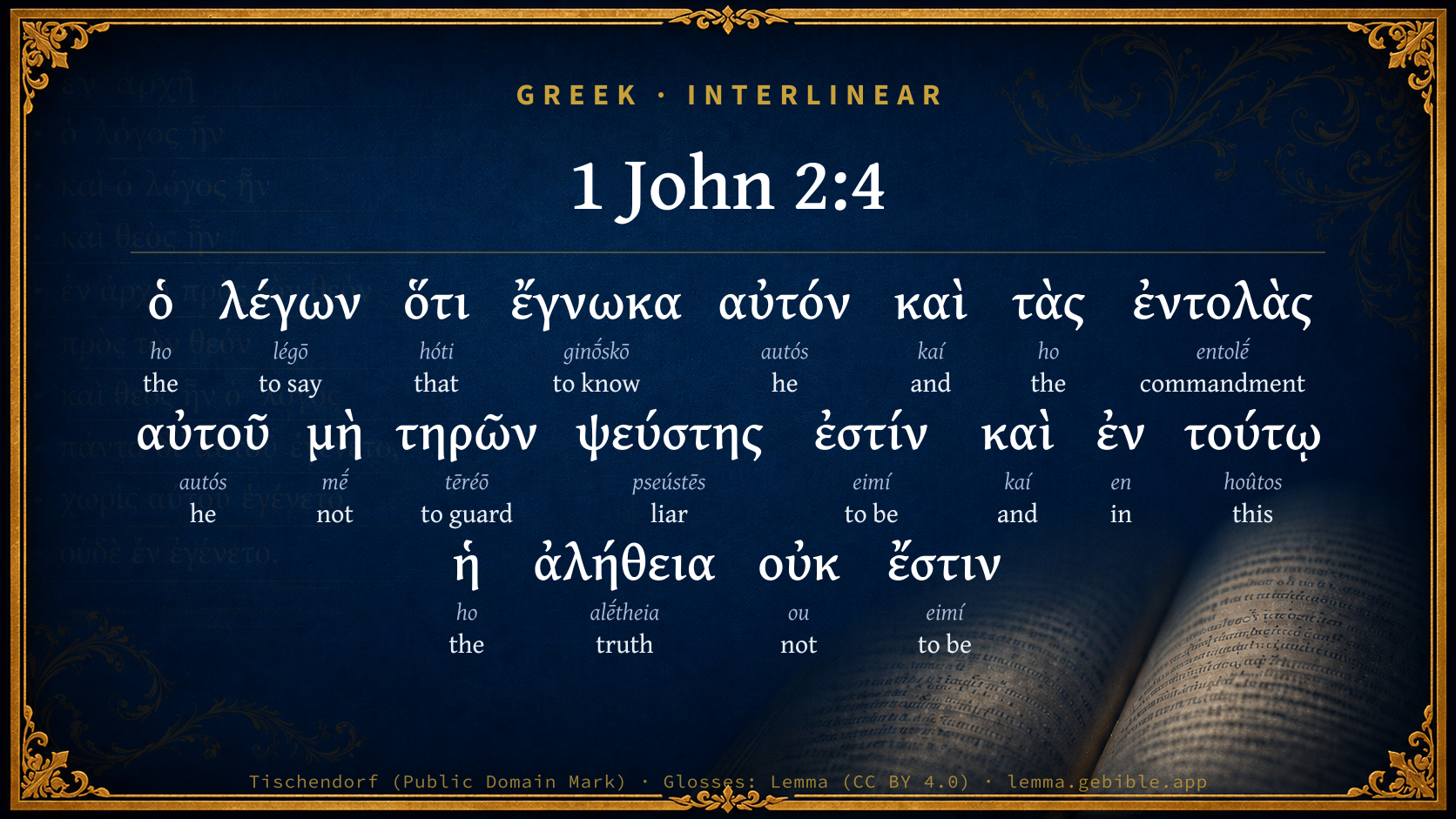
  1. ὁ ho G3588 “the” Article, Nominative, Singular, Masculine
  2. λέγων légō G3004 “to say” Verb, Present, Active, Participle, Nominative, Singular, Masculine
  3. ὅτι hóti G3754 “that” Conjunction
  4. ἔγνωκα ginṓskō G1097 “to know” Verb, Perfect, Active, Indicative, 1st person, Singular
  5. αὐτόν autós G846 “he” Personal pronoun, Accusative, Singular, Masculine
  6. καὶ kaí G2532 “and” Conjunction
  7. τὰς ho G3588 “the” Article, Accusative, Plural, Feminine
  8. ἐντολὰς entolḗ G1785 “commandment” Noun, Accusative, Plural, Feminine
  9. αὐτοῦ autós G846 “he” Personal pronoun, Genitive, Singular, Masculine
  10. μὴ mḗ G3361 “not” Particle, Negative
  11. τηρῶν tēréō G5083 “to guard” Verb, Present, Active, Participle, Nominative, Singular, Masculine
  12. ἐστίν eimí G1510 “to be” Verb, Present, Active, Indicative, 3rd person, Singular
  13. καὶ kaí G2532 “and” Conjunction
  14. ἐν en G1722 “in” Preposition
  15. τούτῳ hoûtos G3778 “this” Demonstrative pronoun, Dative, Singular, Masculine
  16. ἡ ho G3588 “the” Article, Nominative, Singular, Feminine
  17. ἀλήθεια alḗtheia G225 “truth” Noun, Nominative, Singular, Feminine
  18. οὐκ ou G3756 “not” Particle, Negative
  19. ἔστιν eimí G1510 “to be” Verb, Present, Active, Indicative, 3rd person, Singular

About this verse

These counts appear in no published source. They are computed here, from the morphology-tagged text and Lemma’s own curated glosses. What Lemma adds →

20
words
15
distinct lemmas
General Epistles
section

Notable vocabulary

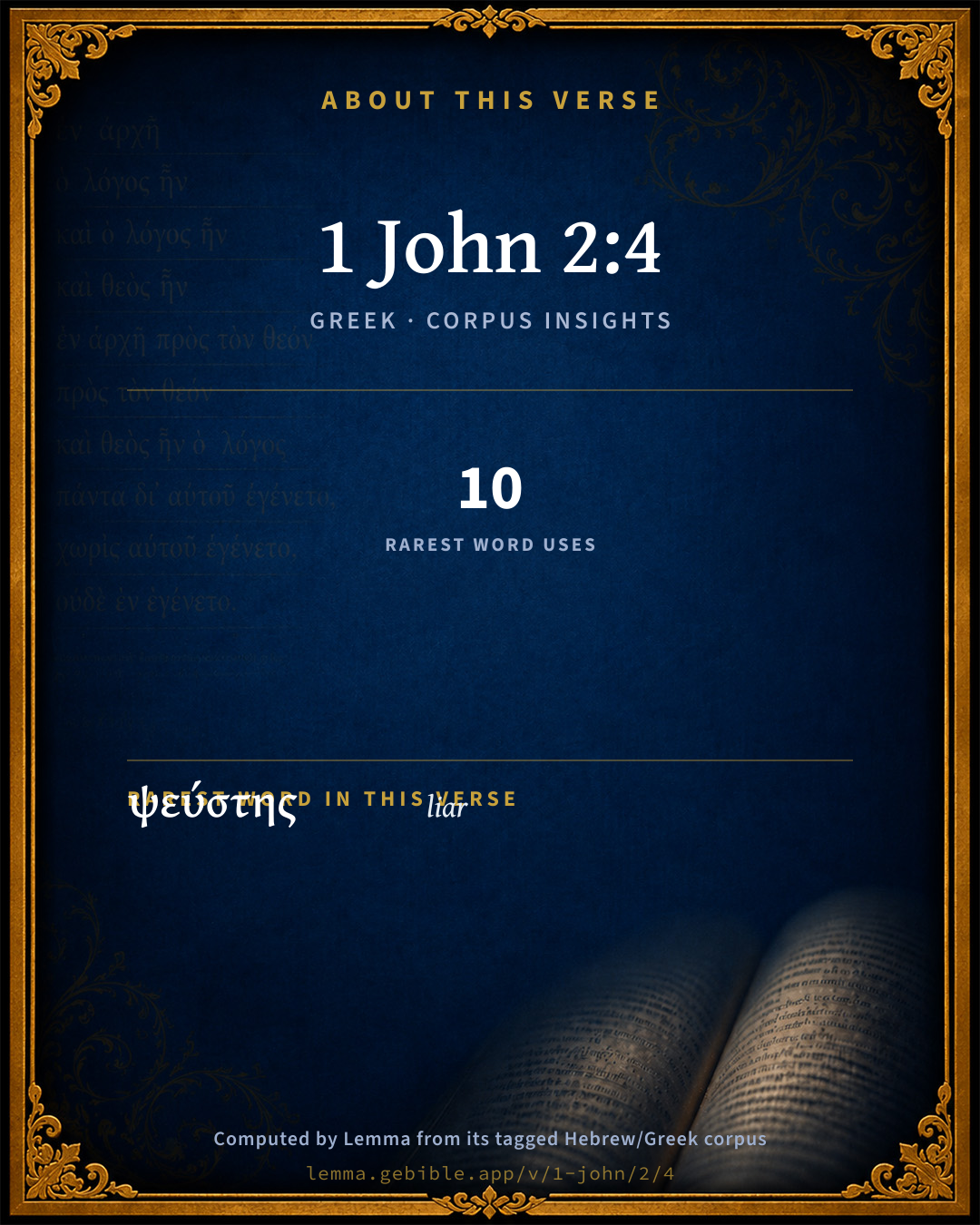
The rarest word here is ψεύστης liar G5583 — appearing just 10 times in the whole Greek New Testament.

Shared distinctive vocabulary

ψεύστης liar G5583 occurs in 10 verses of the Greek New Testament. Also found in:

Repetition

Words recur within this verse:

Cross-references

8

Topical passages linked to 1 John 2:4 in the Treasury of Scripture Knowledge — connected by theme and wording, ordered by reader-vote popularity; previews shown in the World English Bible.

  • 1 John 1:6 If we say that we have fellowship with him and walk in the darkness, we lie, and don't tell the truth.
  • Titus 1:16 They profess that they know God, but by their works they deny him, being abominable, disobedient, and unfit for any good work.
  • James 2:14–16 What good is it, my brothers, if a man says he has faith, but has no works? Can faith save him?
  • 1 John 1:8 If we say that we have no sin, we deceive ourselves, and the truth is not in us.
  • 1 John 4:20 If a man says, "I love God," and hates his brother, he is a liar; for he who doesn't love his brother whom he has seen, how can he love God whom he has not seen?
  • Hosea 8:2–3 They cry to me, 'My God, we Israel acknowledge you!'
  • 1 John 2:9 He who says he is in the light and hates his brother, is in the darkness even until now.
  • 1 John 1:10 If we say that we haven't sinned, we make him a liar, and his word is not in us.

Cross-references courtesy of OpenBible.info (CC BY 4.0).

Commentary

Notes on 1 John 2:4 from classic Christian and Jewish commentators (each source and its license shown beneath its notes). The classic Christian expositions comment on the surrounding passage and are grouped to its opening verse, so a note may address several verses; the Jewish commentaries on the Tanakh (Rashi and others) are per-verse, so they appear only where the commentator wrote on this verse.

Lemma curates 59 commentaries, every one of them public domain or Creative Commons licensed, each selected and text-cleaned for this edition rather than reprinted as found. About our sources →

Meyer's Critical & Exegetical Commentary

Heinrich August Wilhelm Meyer

1Jn_2:4. Inference from 1Jn_2:3, expressing the antithetical side.

ὁ λέγων κ.τ.λ.] is used in the same sense as ἐὰν εἴπωμεν, chap. 1Jn_1:6. Without reason, Braune considers that in the singular there lies a progress in the development of the thought. The statement that ἔγνωκα is used with manifest regard to the Gnostics (Ebrard), is not to be accepted; ὁ λέγων is rather to be taken in a quite general sense, comp. 1Jn_2:6, at the same time referring to the appearance of such a moral indifferentism among the churches, αὐτόν, as in 1Jn_2:3 = Θεόν.

ψεύστης ἐστί] = ψεύδεται, chap. 1Jn_1:6; but in such a way that the idea is more sharply brought out by it (Braune).

καὶ ἐν τούτῳ κ.τ.λ.] as in chap. 1Jn_1:8.

From the connection between the knowledge of God and the observance of His commandments, it follows that he who boasts of the former, but is wanting in the latter, has not the truth in him, but is a liar.

Meyer — Critical and Exegetical Commentary on the New Testament — English translation by Peter Christie, edited by Frederick Crombie (T&T Clark, 1880) — public domain. Text from a community e-Sword module.

Expositor's Greek Testament

ed. W. Robertson Nicoll

1Jn 2:4 . μὴ τηρῶν , in classical Greek a gentle hypothesis, merely suggesting a possible case; but in later Greek μή is the regular negative with participles. It was an actual error, else the Apostle would hardly have spoken so emphatically about it. ψεύστης , see note on 1Jn 1:6 . ἀλήθεια , see note on 1Jn 1:8 .

The Expositor's Greek Testament, edited by W. Robertson Nicoll (1897–1910) — public domain. Text from a community e-Sword module.

Geneva Bible (1599)

Geneva Bible translators

Holiness, that is, a life ordered according to the prescript of God’s commandments how weak soever they be, is of necessity joined with faith, that is, with the true knowledge of the Father in the Son.

Geneva Bible (1599) marginal notes — public domain. Text via Bolls.life.

Jamieson, Fausset & Brown

Robert Jamieson, A. R. Fausset & David Brown

I know--Greek, "I have knowledge of (perfect) Him." Compare with this verse Jo1 1:8.

Jamieson, Fausset & Brown — Commentary Critical and Explanatory on the Whole Bible (1871) — public domain (CC PDM 1.0). Text via the HelloAO Bible API.

Adam Clarke's Commentary

Verse 4. He that saith, I know him] This is a severe blow against those false teachers, and against all pretenders to religious knowledge, who live under the power of their sins; and against all Antinomians, and false boasters in the righteousness of Christ as a covering for their personal unholiness. They are all liars, and no truth of God is in them.

Adam Clarke's Commentary on the Bible (1810–1826) — public domain. Text from a community e-Sword/MySword module.

John Calvin's Commentaries

4 He that saith, I know him How does he prove that they are liars who boast that they have faith without piety? even by the contrary effect; for he has already said, that the knowledge of God is efficacious. For God is not known by a naked imagination, since he reveals himself inwardly to our hearts by the Spirit. Besides, as many hypocrites vainly boast that they have faith, the Apostle charges all such with falsehood; for what he says would be superfluous, were there no false and vain profession of Christianity made by man.

John Calvin's Commentaries (1540-1563) — public domain. Text from the Calvin Translation Society English edition (1840s-50s) via the Christian Classics Ethereal Library (ccel.org). Calvin's coverage is partial (roughly two-thirds of the Bible); uncommented books and verses are honest gaps, never fabricated. The 19th-century editor's footnotes and remarks are omitted so the notes are faithfully Calvin's own voice.

The Cambridge Bible for Schools and Colleges

gen. ed. J. J. S. Perowne

4. The previous statement is enforced by denying the opposite of it. The construction, ‘he that saith,’ ‘he that loveth,’ &c. now takes the place of ‘if we say,’ ‘if we walk,’ &c., but without change of meaning; and this continues down to 1Jn_2:11, after which both constructions cease and a new division begins. Comp. 1Jn_1:6, which is exactly parallel to this: ‘to know Him’ = ‘to have fellowship with Him,’ and ‘not to keep His commandments’ = ‘to walk in darkness.’

and keepeth not] By the negative which he uses (μή) S. John states the case as gently as possible, without asserting that any such person exists (see on 1Jn_2:10).

The Cambridge Bible for Schools and Colleges (gen. ed. J. J. S. Perowne; Cambridge University Press, 1878–1918) — public domain. Text from a community e-Sword module.

John Gill's Exposition

He that saith I know him,.... God or Christ, as the Gnostics did, who pretended to great, even perfect, knowledge of divine things:

and keepeth not his commandments; which the above persons had no regard to, and as many who profess great light and knowledge in our days show no concern for:

is a liar; he contradicts what he says, and gives the lie to it; for though in words he professes to know God, in works he denies him, and which betrays his ignorance of him:

and the truth is not in him; there is no true knowledge of God and Christ in him; nor is the truth of the Gospel in his heart, however it may be in his head; nor is the truth of grace in him, for each of these lead persons to obedience. The Ethiopic version renders it, "the truth of God is not with him"; See Gill on Jo1 1:8.

John Gill's Exposition of the Whole Bible (1746–1763) — public domain (CC PDM 1.0). Text via the HelloAO Bible API.

Trapp's Complete Commentary

John Trapp

4 He that saith, I know him, and keepeth not his commandments, is a liar, and the truth is not in him.

Ver. 4. He that saith, I know him] Here he disputeth against Verbalists and Solifidians. See Jas 2:14. {See Trapp on "Jas 2:14"}

Is a liar] i.e. A hypocrite; his spot is not the spot of God’s children, Deu 32:5, for they are children that will not lie, Isa 63:8. They all deserve that title of honour that was given of old to Arrianus the historian, viz. φιλαληθης, A lover of truth. They know that the God whom they serve, desireth "truth in the inward parts," Psa 51:6, and that dicta factis deficientibus erubescant (as Tertullian hath it), words without deeds will not bear a man out in the end. It is a question whether the desire of being, or dislike of seeming, sincere, be greater in the good heart. Not so every loose and ungirt Christian, every profligate professor, that denieth that in deed what he affirmeth in word.

John Trapp, A Commentary or Exposition upon All the Books of the Old and New Testament (1647–1656) — public domain. Text from a community e-Sword module.

Albert Barnes' Notes on the Bible

He that saith, I know Him - He who professes to be acquainted with the Saviour, or who professes to be a Christian.

And keepeth not his commandments - What he has appointed to be observed by his people; that is, he who does not obey him.

Is a liar - Makes a false profession; professes to have that which he really has not. Such a profession is a falsehood, because there can be no true religion where one does not obey the law of God.

Albert Barnes' Notes on the Bible (1834–1885) — public domain. Text from a community e-Sword/MySword module.

Haydock's Catholic Bible Commentary

He that says he knoweth him, &c. To know, in this and many other places, is not taken for a speculative knowledge alone, but is joined with a love of God, and an earnest desire of serving him and keeping his commandments. (Witham)

George Leo Haydock (1774–1849), Haydock's Catholic Family Bible and Commentary, 1859 edition — public domain. Excludes Psalms (Douay-Rheims chapter numbering differs from Protestant) and Deuterocanonical books (Catholic canon only).

Matthew Poole's English Annotations

A liar; a false, hypocritical pretender, as 1Jo 1:6.

Matthew Poole's English Annotations on the Holy Bible (1683–1685) — public domain. Text from a community e-Sword/MySword module.

Whedon's Commentary on the Bible

Daniel D. Whedon

4. He that saith—Note on 1Jn_1:6. John has the antagonist, as usual, in view. He affirms the positive truth, and negatives the counter untruth.

I know him—And know that I am safe in transgression either through him or without him.

A liar—A guilty falsifier of the very foundation of redemption, that he may indulge in breaking the divine commandments.

The truth—Note on 1Jn_1:8.

Daniel D. Whedon (gen. ed.), Commentary on the Old and New Testaments (1874–1909) — public domain. Text from a community e-Sword module.

The Pulpit Commentary

The participial substantive oJ legwn now takes the place of ejan with the subjunctive, but the two are equivalent. (cf 1Jn_1:6, which is almost exactly parallel to this, and shows what "knowing him" really is, viz. having fellowship with him, just as not keeping his commandments is the same as walking in darkness) St. John says, mh thrwn, not, ouj thrwn, the case being hypothetical if there be such a man, he is a liar, and has no idea of truth. (see on 1Jn_1:8) He must have lost the very power of recognizing truth to maintain that he knows Christ, when he habitually transgresses his commands. It is no great thing, as Bode says, to know as the devils do, who "believe and tremble."

The Pulpit Commentary (1880–1919), ed. H.D.M. Spence-Jones & Joseph S. Exell — public domain. Text from a community e-Sword module.

Godbey's Commentary on the New Testament

William B. Godbey

4. “He that says, ‘I know Him,’ and keepeth not His commandments, is a liar, and the truth is not in him.” This is a deadener against sinning religion.

No one can keep the commandments and sin. The conclusion from this verse is irresistible. The man who claims to be a sinning Christian is here anathematized as a “liar,” and “the truth is not in him.” There is no possible evasion of the conclusion.

William B. Godbey, Commentary on the New Testament (1896–1900) — public domain. Text from a community e-Sword module.

The People's New Testament

B. W. Johnson

4. He that saith, etc. If one claims to have a saving knowledge of Christ, yet lives in disobedience, his life puts the lie to his words.

B. W. Johnson's The People's New Testament with Notes (1889–1891) — public domain. Electronic text from the Christian Classics Ethereal Library (CCEL) ThML edition.

unfoldingWord translationNotes

Door43 World Missions Community

The one who says

"Anyone who says" or "The person who says"

I know God

"I have a good relationship with God"

does not keep

"does not obey" or "disobeys"

his commandments

"what God tells him to do"

the truth is not in him

The truth is spoken of as if it were an object that could be inside the believers. AT: "he does not believe what God says is true" (See: Metaphor)

keeps his word

To keep someone's word here is an idiom for to obey. AT: "does what God tells him to do"

in him truly the love of God has been perfected

This can be stated in active form. Possible meanings are 1) "the love of God" refers to a person loving God, and "perfected" represents completely or fully. AT: "it is that person who loves God completely" or 2) "the love of God" refers to God loving people, and "perfected" represents completing its purpose. AT: "God's love has achieved its purpose in that person's life" (See: Possession and Active or Passive)

By this we know that we are in him

The phrase "we are in him" means that the believer has fellowship with God. AT: "When we obey what God says, we can be certain that we have fellowship with him" or "By this we know that are joined to God" (See: Metaphor)

remains in God

To remain in God means to continue to have fellowship with God. AT: "continues to have fellowship with God" or "stays joined to God" (See: Metaphor)

should himself also walk just as he walked

Conducting one's life is spoken of as if it were walking on a path. AT: "must live as he lived" or "should also obey God just as Jesus Christ did" (See: Metaphor)

translationWords

God

command

true

word

love

perfect

in Christ

walk

Jesus

unfoldingWord translationNotes — © Distant Shores Media and the Door43 World Missions Community, licensed CC BY-SA 4.0. Source: git.door43.org/Door43/en_tn.

Cambridge Greek Testament for Schools and Colleges

4. Before ἔγνωκα insert ὅτι with [452][453][454] against [455][456][457]. [458] omits ἐν τούτῳ before ἡ ἀλήθεια and inserts τοῦ θεοῦ after it.

[452] 4th century. Discovered by Tischendorf in 1859 at the monastery of S. Catherine on Mount Sinai, and now at Petersburg. All three Epistles.

[453] 5th century. Brought by Cyril Lucar, Patriarch of Constantinople, from Alexandria, and afterwards presented by him to Charles I. in 1628. In the British Museum. All three Epistles.

[454] 4th century. Brought to Rome about 1460. It is entered in the earliest catalogue of the Vatican Library, 1475. All three Epistles.

[455] 5th century. A palimpsest: the original writing has been partially rubbed out and the works of Ephraem the Syrian have been written over it. In the National Library at Paris. Part of the First and Third Epistles; 1Jn 1:1 to 1Jn 4:2; 3Jn 1:3-14. Of the whole N.T. the only Books entirely missing are 2 John and 2 Thessalonians.

[456] 9th century. All three Epistles.

[457] 9th century. All three Epistles.

[458] 4th century. Discovered by Tischendorf in 1859 at the monastery of S. Catherine on Mount Sinai, and now at Petersburg. All three Epistles.

4. The previous statement is again enforced by denying the opposite of it (1Jn 1:5-6; 1Jn 1:8). The construction ὁ λέγων, ὁ ἀγαπῶν, &c. now takes the place of ἐὰν εἴπωμεν, ἐὰν περιπατῶμεν, &c., but without change of meaning: after 1Jn 2:11 both constructions cease and a new division begins. Comp. 1Jn 1:6 which is exactly parallel to this.

ἐὰν εἴπωμεν ὅτι

ὁ λέγων ὅτι

κοινωνίαν ἔχομεν μετʼ αὐτοῦ,

Ἔγνωκα αὐτόν,

καὶ ἐν τῷ σκότει περιπατῶμεν,

καὶ τὰς ἐντ. αὐτοῦ μὴ τηρῶν,

ψευδόμεθα κ. οὐ π. τὴν ἀλήθ.

ψεύσ. ἐστ., κ. ἐν τ. ἡ ἀλ. οὐκ ἔστ.

By writing μὴ τηρῶν rather than οὐ τ. S. John states the case as generally and gently as possible, without asserting that any such person exists: comp. 1Jn 3:10; 1Jn 3:14; 1Jn 4:8; 1Jn 4:20; 1Jn 5:10; 1Jn 5:12; Mat 12:30, &c. Winer, 606.

Cambridge Greek Testament for Schools and Colleges (Cambridge University Press, 1896; 21 vols, various authors incl. Carr, Maclear, Plummer, Farrar, Lumby, Moule, M. R. James, Simcox) — public domain. Text from a community e-Sword module.

Alford’s Greek Testament

Henry Alford

4.] Assertion, parallel with ch. 1:8, of the futility of pretending to the knowledge of God where this test is not fulfilled. The man saying (ὁ λέγων answers to ἐὰν εἴπωμεν, ch. 1:8. ὅτι recitantis cannot be expressed in English), I have the knowledge of Him (see above) and not keeping His commandments, is a liar (answers to ἑαυτοὺς πλανῶμεν ch. 1:8), and in this man the truth is not (see above on ch. 1:8, where the words are the Same:

Henry Alford, The Greek Testament (1849–1861) — public domain. Text from a community e-Sword module.

International Critical Commentary

4. The test is adequate, and may be applied with certainty; for there is no such thing as knowledge which does not issue in corresponding action. The man who claims to have knowledge of God which does not carry with it as its necessary consequence the attempt to carry out His will, thereby declares himself a liar. There is no room for self-deception. The falsehood, if not conscious and deliberate, is without excuse. For the converse thought, that the doing of the will leads to fuller knowledge, cf. Joh 7:17.ὁ λέγων] The verse is closely parallel to 1:6, 8, 10. The form of expression is more individualized than the conditional sentences used there. It is the direct and definite statement of the writer conscious of the fact that he is dealing with a real danger, and probably with a statement that has been actually made, by men against whose influence he is trying to guard his τεκνία. If there is no reason to see in it an attack on any particular Gnostic teacher, it clearly deals with statements which they have heard, and to which they have shown themselves ready to listen.

Ψεύστης ἐστίν] The falseness of the claim is the point which is emphasized. At the same time the form of expression chosen declares its inexcusableness. Contrast 1:8 (ἑαυτοὺς πλανῶμεν). As compared with the verb (1:6, ψευδόμεθα), it may perhaps suggest that the statement is a revelation of the character of the man who makes it. “The whole character is false” (Westcott). He who claims knowledge without obedience “has” the sin which he has allowed to gain foothold. If light is seen and not followed, deterioration of character is the inevitable result.

καὶ… ἐστίν] The antithetical clause is not merely a repetition of the positive statement in a negative form. The “truth” is regarded by the writer as an active principle working in a man. It is not concerned with the intellect alone. It corresponds to the highest effort of man’s whole nature. Cf. Joh 8:32.

ἐν τούτῳ] In such an one. In the Gospel and Epistles of S. John, when οὗτοςrefers back, it always denotes the subject or object, as previously described; cf. Joh 1:2 (οὗτος, the Logos who is θεός), v. 38, τούτῳ ὑμεῖς οὐ πιστεύετε (one sent by God).

οτι א A B 18. 25. 27. 33**. 65. 66**. 68. 69. 98. 101. 177. 180 ascr dscr jscr 57lect syrute Clem. Cyp. Lcif. Aug. Amb.] om. C K L P al. plu. cat. aethute Clem. Oec.

και] om. και A P 13. 27. 29 | εντου τω] in Eo boh-codd.: om. א 19.

η] om. 21. 34. 56. 100. 192. Oscr Ψ.

αληθεια)+ του θεου א 8. 25 aeth.: + εν αυτου19a: + εν αυτω 19 b.

International Critical Commentary — older volumes (1896–1929), various authors — public domain. Text from a community e-Sword module.

Vincent's Word Studies in the New Testament

Marvin R. Vincent

A liar. Compare we lie, 1Jo 1:6.

In him [εν τουτω] . Emphatic. Lit., in this one the truth is not. See on 1 8. Keepeth His word [τηρη αυτου τον λογον] . Note the changed phrase : word for commandments. The word is the revelation regarded as a whole, which includes all the separate commandments or injunctions. See the use of logov word, and ejntolh precept, in Joh 14:21 - 24.

Is the love of God perfected [η αγαπη του θεου τετελειωται] . Rev., rendering the perfect tense more closely, hath the love of God been perfected. The change in the form of this antithetic clause is striking. He who claims to know God, yet lives in disobedience, is a liar. We should expect as an offset to this : He that keepeth His commandments is of the truth; or, the truth is in him. Instead we have, "In him has the love of God been perfected." In other words, the obedient child of God is characterized, not by any representative trait or quality of his own personality, but merely as the subject of the work of divine love : as the sphere in which that love accomplishes its perfect work.

The phrase hJ ajgaph tou Qeou the love of God, may mean either the love which God shows, or the love of which God is the object, or the love which is characteristic of God whether manifested by Himself or by His obedient child through His Spirit. John's usage is not decisive like Paul 's, according to which the love of God habitually means the love which proceeds from and is manifested by God. The exact phrase, the love of God or the love of the Father, is found in 1Jo 3:16; 1Jo 4:9, in the undoubted sense of the love of God to men. The same sense is intended in 1Jo 3:1, 9, 16, though differently expressed. The sense is doubtful in 1Jo 2:5; 1Jo 3:17; 1Jo 4:12. Men's love to God is clearly meant in 1Jo 2:15; 1Jo 5:3. The phrase occurs only twice in the Gospels (Luk 6:42; Joh 5:42), and in both cases the sense is doubtful. Some, as Ebrard, combine the two, and explain the love of God as the mutual relation of love between God and men.

It is not possible to settle the point decisively, but I incline to the view that the fundamental idea of the love of God as expounded by John is the love which God has made known and which answers to His nature. In favor of this is the general usage of ajgaph love, in the New Testament, with the subjective genitive. 64 The object is more commonly expressed by eijv towards, or to. See 1Th 3:12; Col 1:4; 1Pe 4:8. Still stronger is John's treatment of the subject in ch. 4. Here we have, ver. 9, the manifestation of the love of God in us [εν ημιν] By our life in Christ and our love to God we are a manifestation of God 's love. Directly following this is a definition of the essential nature of love. "In this is love; i e., herein consists love : not that we have loved God, but that He loved us" (ver. 10). Our mutual love is a proof that God dwells in us. God dwelling in us, His love is perfected in us (ver. 12). The latter clause, it would seem, must be explained according to ver. 10. Then (ver. 16), "We have known and believed the love that God hath in us" (see on Joh 16:22, on the phrase have love). "God is love;" that is His nature, and He imparts this nature to be the sphere in which His children dwell. "He that dwelleth in love dwelleth in God." Finally, our love is engendered by His love to us. "We love Him because He first loved us" (ver. 19).

In harmony with this is Joh 14:9. "As the Father loved me, I also loved you. Continue ye in my love." My love must be explained by I loved you. This is the same idea of divine love as the sphere or element of renewed being; and this idea is placed, as in the passage we are considering, in direct connection with the keeping of the divine commandments. "If ye keep my commandments ye shall abide in my love."

This interpretation does not exclude man's love to God. On the contrary, it includes it. The love which God has, is revealed as the love of God in the love of His children towards Him, no less than in His manifestations of love to them. The idea of divine love is thus complex. Love, in its very essence, is reciprocal. Its perfect ideal requires two parties. It is not enough to tell us, as a bare, abstract truth, that God is love. The truth must be rounded and filled out for us by the appreciable exertion of divine love upon an object, and by the response of the object. The love of God is perfected or completed by the perfect establishment of the relation of love between God and man. When man loves perfectly, his love is the love of God shed abroad in his heart. His love owes both its origin and its nature to the love of God.

The word verily [αληθωσ] is never used by John as a mere formula of affirmation, but has the meaning of a qualitative adverb, expressing not merely the actual existence of a thing, but its existence in a manner most absolutely corresponding to ajlhqeia truth. Compare Joh 1:48; Joh 8:31. Hath been perfected. John is presenting the ideal of life in God. "This is the love of God that we keep His commandments." Therefore whosoever keepeth God 's word, His message in its entirety, realizes the perfect relation of love.

We are in Him. Compare Act 17:28. See note on 2 15.

Marvin R. Vincent, Word Studies in the New Testament (1887–1900) — public domain. Text from a community e-Sword/MySword module.

Lesson kit

Teaching starters — assembled from the data on this page, not authored interpretation. Every prompt links to the verse data it draws on. Edit before teaching.

1 John, in the General Epistles, opens this verse with 20 words (15 distinct Greek lemmas). Its most distinctive word is pseústēs (“liar”). A historical commentator’s framing appears above. Read the whole chapter for the surrounding context.

Discussion questions

  1. The word pseústēs carries the sense “liar.” How does it shape the verse?
  2. John 8:44 shares the word «liar» with this verse. How do the two illuminate each other?
  3. “to be” occurs 2× in this one verse. What is the effect of the repetition?
  4. These translations render this verse differently. What is at stake in choosing one wording over another?
  5. Reading how Meyer's Critical & Exegetical Commentary and Expositor's Greek Testament read this verse, where do the two commentators agree and where do they part?

Things to notice

  • These translations choose different wording for 8 words in this verse.
  • “to be” occurs 2× in this single verse.
  • 15 distinct Greek lemmas span 20 words in this verse.

Reading settings

Reading text

Shown beneath each verse's original-language words.

Old Testament
Old Testament edition

Read the OT as the Masoretic Hebrew (MT) or the Greek Septuagint (LXX).

English shown for the Greek Septuagint (in the Hebrew ↔ Greek comparison).

Comparing translations? Open the Compare panel on any verse page to stack up to four side by side.