

Galatians 4:9
Greek (Tischendorf 8th ed.) Galatians 4:9 appears in the Greek New Testament. The text above is from the Tischendorf 8th edition. Each word links to its Strong’s number and a concise gloss. Click any word for its full Thayer’s Greek Lexicon entry.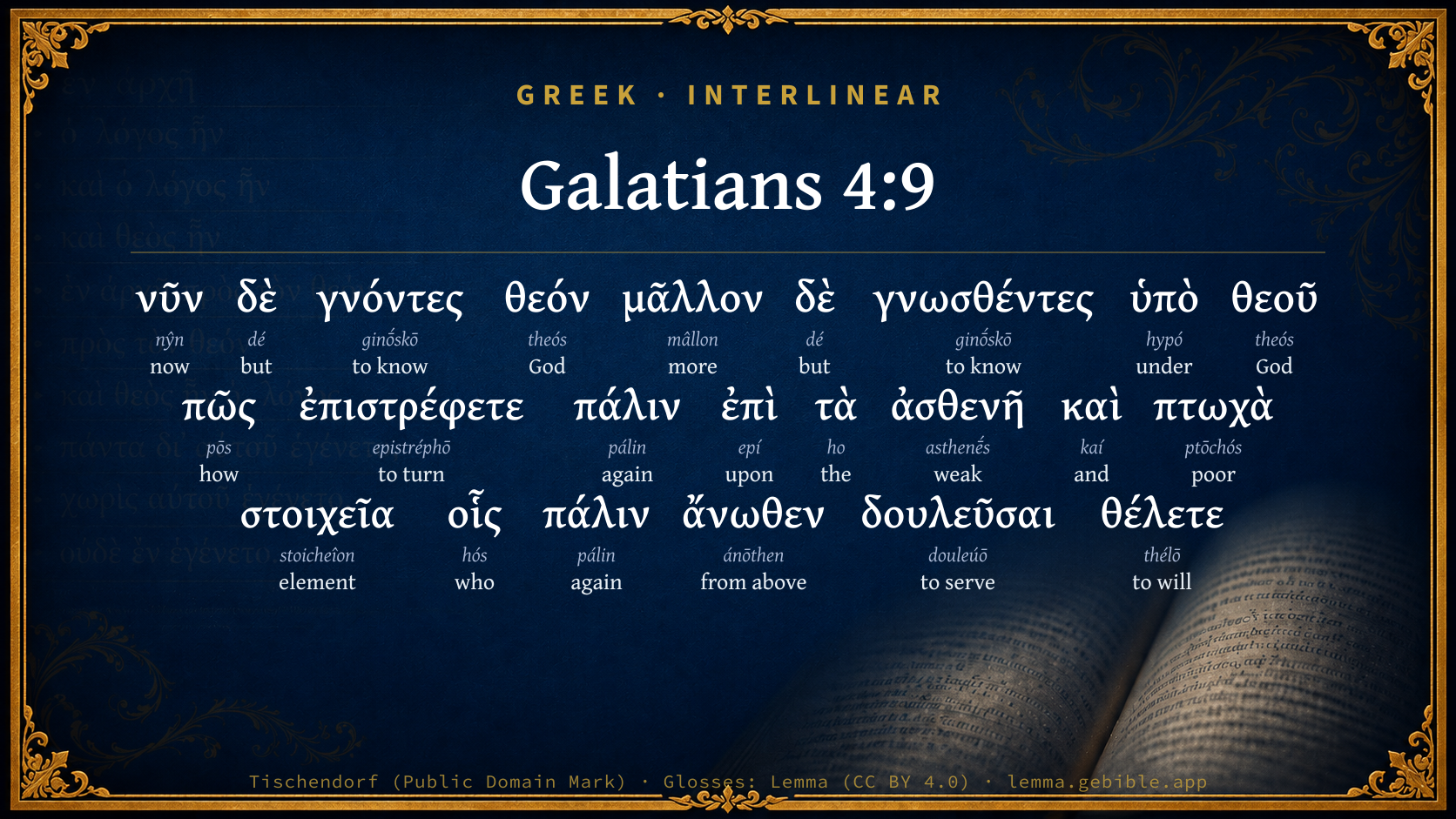
But now that you have come to know God, or rather to be known by God, why do you turn back again to the weak and miserable elements, to which you desire to be in bondage all over again?
Download a study sheet
One document with this verse’s original text, its word-by-word gloss line, the meaning frame, cross-references with their text, attributed commentary, and full source and license credits — printable, and it pastes into notes with its structure intact.
This verse Autodidact and up
A passage Seminary Student
Up to 50 verses in one chapter. A passage sheet keeps up to 6 commentary sources and 12 cross-references per verse, in the order this page ranks them, and says so on the sheet whenever that leaves anything out. Ask for a single verse and you get the Autodidact verse sheet above.
Everything on this page stays free to read, with no account — the sheet is a download of what is already on screen, not access to it.
Compare translations 3
The same verse in 3 English versions, stacked beneath the original-language interlinear above. Click any original word for its lexicon entry.
Each is an independent rendering of the whole verse — the interlinear is not word-aligned to these translations.
Highlighted words mark where these versions differ — a whole-verse word diff, not a word-by-word alignment.
-
World English Bible Public Domain
But now that you have come to know God, or rather to be known by God, why do you turn back again to the weak and miserable elements, to which you desire to be in bondage all over again?
-
King James Version Public Domain
But now, after that ye have known God, or rather are known of God, how turn ye again to the weak and beggarly elements, whereunto ye desire again to be in bondage?
-
unfoldingWord Literal Text CC BY-SA 4.0
But now, having come to know God, or rather, having come to be known by God, how are you turning again to the weak and worthless elemental principles to which once more you want to be enslaved again?
unfoldingWord Literal Text — © unfoldingWord, licensed CC BY-SA 4.0. Word-aligned USFM3 via Door43 (git.door43.org/unfoldingWord/en_ult).
Show all 19 translations
Every available English version of this verse, each an independent rendering of the whole verse.
-
World English Bible Public Domain
But now that you have come to know God, or rather to be known by God, why do you turn back again to the weak and miserable elements, to which you desire to be in bondage all over again?
-
Berean Standard Bible Public Domain
But now that you know God, or rather are known by God, how is it that you are turning back to those weak and worthless principles? Do you wish to be enslaved by them all over again?
-
Majority Standard Bible Public Domain
But now that you know God, or rather are known by God, how is it that you are turning back to those weak and worthless principles? Do you wish to be enslaved by them all over again?
-
King James Version Public Domain
But now, after that ye have known God, or rather are known of God, how turn ye again to the weak and beggarly elements, whereunto ye desire again to be in bondage?
-
American Standard Version (1901) Public Domain
but now that ye have come to know God, or rather to be known by God, how turn ye back again to the weak and beggarly rudiments, whereunto ye desire to be in bondage over again?
-
Revised Version (1885) Public Domain
but now that ye have come to know God, or rather to be known of God, how turn ye back again to the weak and beggarly rudiments, whereunto ye desire to be in bondage over again?
-
Geneva Bible (1599) Public Domain
But now seeing ye knowe God, yea, rather are knowen of God, howe turne ye againe vnto impotent and beggerly rudiments, whereunto as from the beginning ye wil be in bondage againe?
-
Douay-Rheims (1899) Public Domain
But now, after that you have known God, or rather are known by God: how turn you again to the weak and needy elements, which you desire to serve again?
-
Young's Literal Translation Public Domain
and now, having known God -- and rather being known by God -- how turn ye again unto the weak and poor elements to which anew ye desire to be in servitude?
-
Literal Standard Version CC BY-SA 4.0
and now, having known God—and rather being known by God—how [do] you turn again to the weak and poor elements to which you desire anew to be in servitude?
-
Unlocked Literal Bible CC BY-SA 4.0
But now that you have come to know God, or rather that you are known by God, how is it that you are turning back to the weak and worthless elemental principles? Do you want to be enslaved all over again?
-
unfoldingWord Literal Text CC BY-SA 4.0
But now, having come to know God, or rather, having come to be known by God, how are you turning again to the weak and worthless elemental principles to which once more you want to be enslaved again?
-
Darby Bible Public Domain
but now, knowing God, but rather being known by God, how do ye turn again to the weak and beggarly principles to which ye desire to be again anew in bondage?
-
World Messianic Bible Public Domain
But now that you have come to know God, or rather to be known by God, why do you turn back again to the weak and miserable elemental principles, to which you desire to be in bondage all over again?
-
Webster's Bible Public Domain
But now, after ye have known God, or rather are known by God, how turn ye again to the weak and beggarly elements, to which ye desire again to be in bondage?
-
Free Bible Version CC BY-SA 4.0
But now you've come to know God—or better, to be known by God. So how can you go back to those useless and worthless rules? Do you want to be slaves to those rules all over again?
-
Bible in Basic English Public Domain
But now that you have come to have knowledge of God, or more truly, God has knowledge of you, how is it that you go back again to the poor and feeble first things, desiring to be servants to them again?
-
Text-Critical English NT CC BY 4.0
But now that you have come to know God, or rather to be known by God, how is it that you are turning back again to the weak and worthless elements? Do you wish to be enslaved to them once more?
-
Tyndale New Testament (1534) Public Domain
But now seinge ye knowe god (yee rather are knowe of God) how is it that ye tourne agayne vnto the weake and bedgarly cerimonies whervnto agayne ye desyre afresshe to be in bondage?
Literal Standard Version (2020), Covenant Press — licensed CC BY-SA 4.0. Text via the HelloAO Bible API (eBible.org). Unlocked Literal Bible (unfoldingWord) — licensed CC BY-SA 4.0. Text via the HelloAO Bible API (eBible.org). unfoldingWord Literal Text — © unfoldingWord, licensed CC BY-SA 4.0. Word-aligned USFM3 via Door43 (git.door43.org/unfoldingWord/en_ult). Free Bible Version, Dr. Jonathan Gallagher — licensed CC BY-SA 4.0. Text via the HelloAO Bible API (eBible.org).
Word by word
More ways to search: Search by grammar → Find every occurrence → Compare this word →
Practice this passage: Drill this verse → Learn its vocabulary →
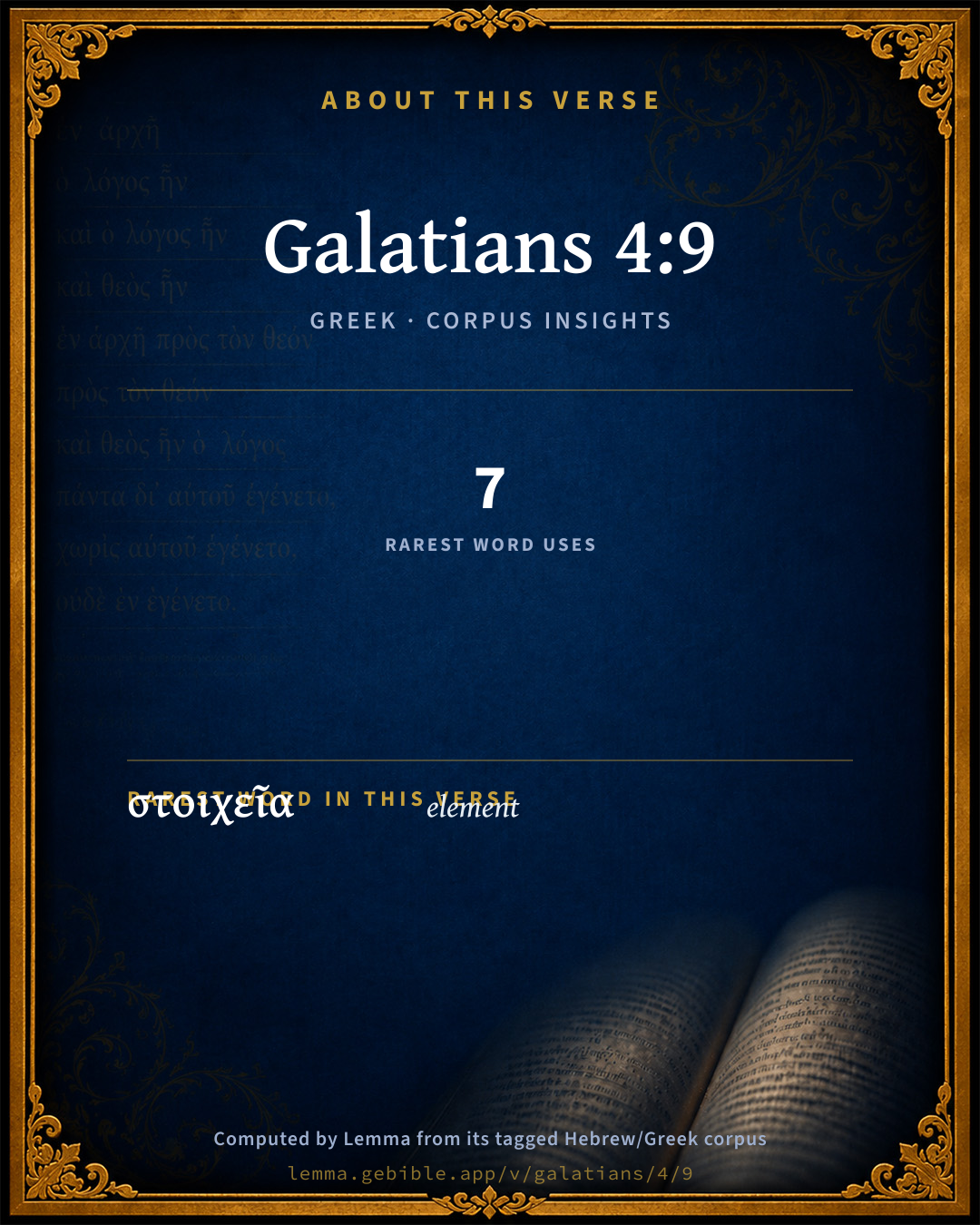
- Appears 7× in the Greek New Testament
- First appears at Galatians 4:3
- Part of Speech
- Noun
- Case
- Accusative
- Number
- Plural
- Gender
- Neuter
Full Thayer's Definition
- νῦν nŷn G3568 “now” Adverb
- δὲ dé G1161 “but” Conjunction
- γνόντες ginṓskō G1097 “to know” Verb, Aorist, Active, Participle, Nominative, Plural, Masculine
- θεόν theós G2316 “God” Noun, Accusative, Singular, Masculine
- μᾶλλον mâllon G3123 “more” Adverb
- δὲ dé G1161 “but” Conjunction
- γνωσθέντες ginṓskō G1097 “to know” Verb, Aorist, Passive, Participle, Nominative, Plural, Masculine
- ὑπὸ hypó G5259 “under” Preposition
- θεοῦ theós G2316 “God” Noun, Genitive, Singular, Masculine
- πῶς pōs G4459 “how” Adverb, Interrogative
- ἐπιστρέφετε epistréphō G1994 “to turn” Verb, Present, Active, Indicative, 2nd person, Plural
- πάλιν pálin G3825 “again” Adverb
- ἐπὶ epí G1909 “upon” Preposition
- τὰ ho G3588 “the” Article, Accusative, Plural, Neuter
- ἀσθενῆ asthenḗs G772 “weak” Adjective, Accusative, Plural, Neuter
- καὶ kaí G2532 “and” Conjunction
- πτωχὰ ptōchós G4434 “poor” Adjective, Accusative, Plural, Neuter
- στοιχεῖα stoicheîon G4747 “element” Noun, Accusative, Plural, Neuter
- οἷς hós G3739 “who” Relative pronoun, Dative, Plural, Neuter
- πάλιν pálin G3825 “again” Adverb
- ἄνωθεν ánōthen G509 “from above” Adverb
- δουλεῦσαι douleúō G1398 “to serve” Verb, Aorist, Active, Infinitive
- θέλετε thélō G2309 “to will” Verb, Present, Active, Indicative, 2nd person, Plural
About this verse
These counts appear in no published source. They are computed here, from the morphology-tagged text and Lemma’s own curated glosses. What Lemma adds →
- 23
- words
- 19
- distinct lemmas
- Pauline Epistles
- section
Cross-references
27Topical passages linked to Galatians 4:9 in the Treasury of Scripture Knowledge — connected by theme and wording, ordered by reader-vote popularity; previews shown in the World English Bible.
- 1 Corinthians 8:3 But if anyone loves God, the same is known by him.
- Galatians 3:3 Are you so foolish? Having begun in the Spirit, are you now completed in the flesh?
- Romans 8:3 For what the law couldn't do, in that it was weak through the flesh, God did, sending his own Son in the likeness of sinful flesh and for sin, he condemned sin in the flesh;
- 1 John 5:20 We know that the Son of God has come, and has given us an understanding, that we know him who is true, and we are in him who is true, in his Son Jesus Christ. This is the true God, and eternal life.
- 1 Chronicles 28:9 You, Solomon my son, know the God of your father, and serve him with a perfect heart and with a willing mind; for Yahweh searches all hearts, and understands all the imaginations of the thoughts: if you seek him, he will be found of you; but if you forsake him, he will cast you off forever.
- 2 Peter 2:20 For if, after they have escaped the defilement of the world through the knowledge of the Lord and Savior Jesus Christ, they are again entangled therein and overcome, the last state has become worse with them than the first.
- Exodus 33:17 Yahweh said to Moses, "I will do this thing also that you have spoken; for you have found favor in my sight, and I know you by name."
- John 10:27 My sheep hear my voice, and I know them, and they follow me.
- John 17:3 This is eternal life, that they should know you, the only true God, and him whom you sent, Jesus Christ.
- 1 Corinthians 13:12 For now we see in a mirror, dimly, but then face to face. Now I know in part, but then I will know fully, even as I was also fully known.
- 2 Corinthians 4:6 seeing it is God who said, "Light will shine out of darkness," who has shone in our hearts, to give the light of the knowledge of the glory of God in the face of Jesus Christ.
- Ephesians 1:17 that the God of our Lord Jesus Christ, the Father of glory, may give to you a spirit of wisdom and revelation in the knowledge of him;
- 2 Timothy 2:19 However God's firm foundation stands, having this seal, "The Lord knows those who are his," and, "Let every one who names the name of the Lord depart from unrighteousness."
- Hebrews 7:18 For there is an annulling of a foregoing commandment because of its weakness and uselessness
- Hebrews 10:38–39 But the righteous will live by faith. If he shrinks back, my soul has no pleasure in him."
- 1 Kings 8:43 hear in heaven, your dwelling-place, and do according to all that the foreigner calls to you for; that all the peoples of the earth may know your name, to fear you, as does your people Israel, and that they may know that this house which I have built is called by my name.
- Psalms 1:6 For Yahweh knows the way of the righteous, But the way of the wicked shall perish.
- Psalms 9:10 Those who know your name will put their trust in you, For you, Yahweh, have not forsaken those who seek you.
- Proverbs 2:5 Then you will understand the fear of Yahweh, And find the knowledge of God.
- Jeremiah 31:34 and they shall teach no more every man his neighbor, and every man his brother, saying, Know Yahweh; for they shall all know me, from the least of them to the greatest of them, says Yahweh: for I will forgive their iniquity, and their sin will I remember no more.
- Habakkuk 2:14 For the earth will be filled with the knowledge of the glory of Yahweh, as the waters cover the sea.
- Matthew 11:27 All things have been delivered to me by my Father. No one knows the Son, except the Father; neither does anyone know the Father, except the Son, and he to whom the Son desires to reveal him.
- John 10:14 I am the good shepherd. I know my own, and I'm known by my own;
- Romans 8:29 For whom he foreknew, he also predestined to be conformed to the image of his Son, that he might be the firstborn among many brothers.
- Colossians 2:20–23 If you died with Christ from the elements of the world, why, as though living in the world, do you subject yourselves to ordinances,
- 1 John 2:3–4 This is how we know that we know him: if we keep his commandments.
- 1 Corinthians 15:34 Wake up righteously, and don't sin, for some have no knowledge of God. I say this to your shame.
Cross-references courtesy of OpenBible.info (CC BY 4.0).
Lesson kit
Teaching starters — assembled from the data on this page, not authored interpretation. Every prompt links to the verse data it draws on. Edit before teaching.
Galatians, in the Pauline Epistles, opens this verse with 23 words (19 distinct Greek lemmas). Its most distinctive word is stoicheîon (“element”). A historical commentator’s framing appears above. Read the whole chapter for the surrounding context.
Discussion questions
- What does “element” (stoicheîon) contribute to the verse as a whole?
- How does Galatians 4:3, which shares the word «element», read alongside this verse?
- What does the repetition of “to know” (2× in this one verse) do in this verse?
- The translations on this page render this verse differently — a whole-verse word diff, not a word-by-word alignment. What might account for the different wordings?
- Compare how The Biblical Illustrator and Whedon's Commentary on the Bible read this verse. Where do they agree or differ?
Things to notice
- These translations choose different wording for 28 words in this verse.
- “to know” occurs 2× in this single verse.
- 19 distinct Greek lemmas span 23 words in this verse.
Commentary
Notes on Galatians 4:9 from classic Christian and Jewish commentators (each source and its license shown beneath its notes). The classic Christian expositions comment on the surrounding passage and are grouped to its opening verse, so a note may address several verses; the Jewish commentaries on the Tanakh (Rashi and others) are per-verse, so they appear only where the commentator wrote on this verse.
Lemma curates 59 commentaries, every one of them public domain or Creative Commons licensed, each selected and text-cleaned for this edition rather than reprinted as found. About our sources →
The Biblical Illustrator
Joseph S. Exell
The Biblical Illustrator, edited by Joseph S. Exell (c. 1880s–1900s) — public domain. Text from a community e-Sword module.
Whedon's Commentary on the Bible
Daniel D. Whedon
Daniel D. Whedon (gen. ed.), Commentary on the Old and New Testaments (1874–1909) — public domain. Text from a community e-Sword module.
Tyndale Open Study Notes
Tyndale Open Resources
Tyndale Open Study Notes — © Tyndale Open Resources, licensed CC BY-SA 4.0. Text via the HelloAO Bible API.
Bengel's Gnomon
Johann Albrecht Bengel
Bengel's Gnomon of the New Testament — English translation (T&T Clark, Edinburgh, 1860) — public domain. Text from a community e-Sword module.
Meyer's Critical & Exegetical Commentary
Heinrich August Wilhelm Meyer
Meyer — Critical and Exegetical Commentary on the New Testament — English translation by Peter Christie, edited by Frederick Crombie (T&T Clark, 1880) — public domain. Text from a community e-Sword module.
Expositor's Greek Testament
ed. W. Robertson Nicoll
The Expositor's Greek Testament, edited by W. Robertson Nicoll (1897–1910) — public domain. Text from a community e-Sword module.
Geneva Bible (1599)
Geneva Bible translators
Geneva Bible (1599) marginal notes — public domain. Text via Bolls.life.
Jamieson, Fausset & Brown
Robert Jamieson, A. R. Fausset & David Brown
Jamieson, Fausset & Brown — Commentary Critical and Explanatory on the Whole Bible (1871) — public domain (CC PDM 1.0). Text via the HelloAO Bible API.
Adam Clarke's Commentary
Adam Clarke's Commentary on the Bible (1810–1826) — public domain. Text from a community e-Sword/MySword module.
John Calvin's Commentaries
John Calvin's Commentaries (1540-1563) — public domain. Text from the Calvin Translation Society English edition (1840s-50s) via the Christian Classics Ethereal Library (ccel.org). Calvin's coverage is partial (roughly two-thirds of the Bible); uncommented books and verses are honest gaps, never fabricated. The 19th-century editor's footnotes and remarks are omitted so the notes are faithfully Calvin's own voice.
Ellicott's Commentary for English Readers
A Bible Commentary for English Readers, edited by Charles John Ellicott (1878–1897) — public domain. Text from a community e-Sword module.
The Cambridge Bible for Schools and Colleges
gen. ed. J. J. S. Perowne
The Cambridge Bible for Schools and Colleges (gen. ed. J. J. S. Perowne; Cambridge University Press, 1878–1918) — public domain. Text from a community e-Sword module.
John Gill's Exposition
John Gill's Exposition of the Whole Bible (1746–1763) — public domain (CC PDM 1.0). Text via the HelloAO Bible API.
Trapp's Complete Commentary
John Trapp
John Trapp, A Commentary or Exposition upon All the Books of the Old and New Testament (1647–1656) — public domain. Text from a community e-Sword module.
Albert Barnes' Notes on the Bible
Albert Barnes' Notes on the Bible (1834–1885) — public domain. Text from a community e-Sword/MySword module.
Matthew Poole's English Annotations
Matthew Poole's English Annotations on the Holy Bible (1683–1685) — public domain. Text from a community e-Sword/MySword module.
The Pulpit Commentary
The Pulpit Commentary (1880–1919), ed. H.D.M. Spence-Jones & Joseph S. Exell — public domain. Text from a community e-Sword module.
John Wesley's Explanatory Notes
John Wesley, Explanatory Notes Upon the Whole Bible (1754–1765) — public domain. Text via the GEBible commentary corpus.
Luther on Galatians
Martin Luther
Martin Luther — Commentary on the Epistle to the Galatians (1535), English translation by Theodore Graebner (Zondervan, 1939) — public domain (U.S. copyright not renewed). Text from a community e-Sword module.
McGarvey & Pendleton's Commentaries
J. W. McGarvey
J. W. McGarvey (with Philip Y. Pendleton), Commentaries on the New Testament (The Fourfold Gospel, 1914; Acts; and the epistles) — public domain. Text from a community e-Sword/MySword module.
The People's New Testament
B. W. Johnson
B. W. Johnson's The People's New Testament with Notes (1889–1891) — public domain. Electronic text from the Christian Classics Ethereal Library (CCEL) ThML edition.
Cambridge Greek Testament for Schools and Colleges
Cambridge Greek Testament for Schools and Colleges (Cambridge University Press, 1896; 21 vols, various authors incl. Carr, Maclear, Plummer, Farrar, Lumby, Moule, M. R. James, Simcox) — public domain. Text from a community e-Sword module.
Alford’s Greek Testament
Henry Alford
Henry Alford, The Greek Testament (1849–1861) — public domain. Text from a community e-Sword module.
International Critical Commentary
International Critical Commentary — older volumes (1896–1929), various authors — public domain. Text from a community e-Sword module.
Vincent's Word Studies in the New Testament
Marvin R. Vincent
Marvin R. Vincent, Word Studies in the New Testament (1887–1900) — public domain. Text from a community e-Sword/MySword module.