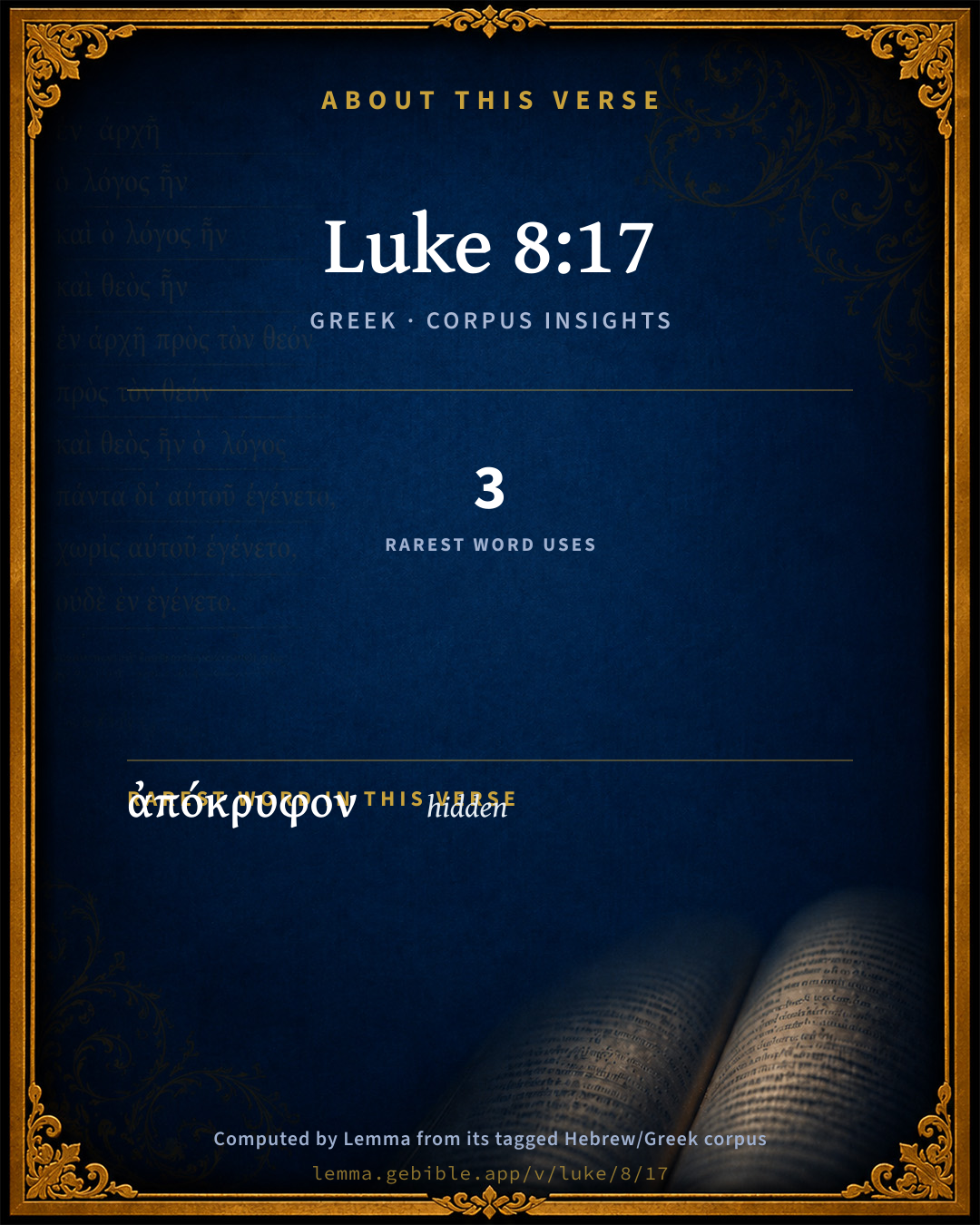
Luke 8:17

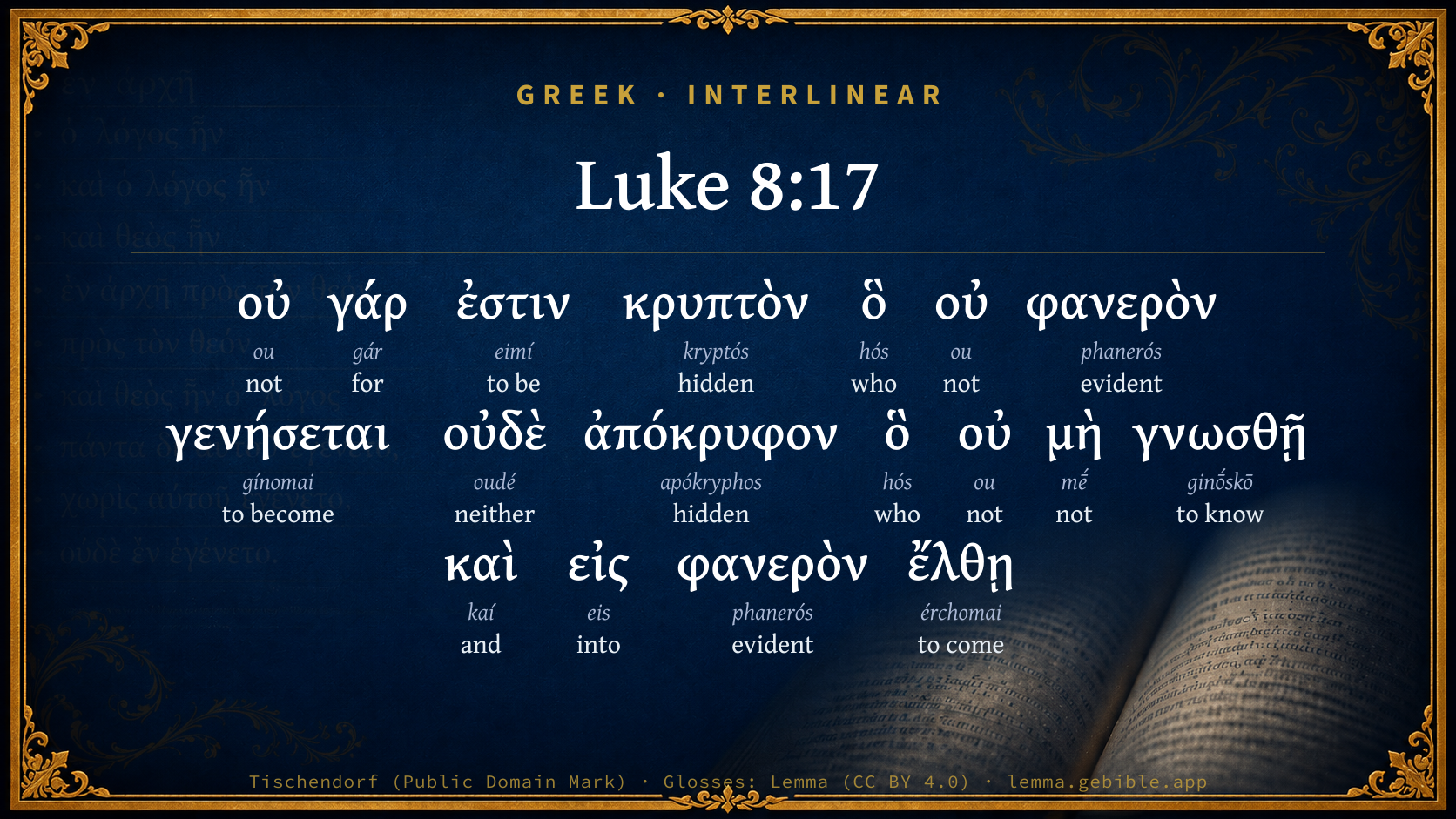
Greek (Tischendorf 8th ed.) Luke 8:17 appears in the Greek New Testament. The text above is from the Tischendorf 8th edition. Each word links to its Strong’s number and a concise gloss. Click any word for its full Thayer’s Greek Lexicon entry.
Download image
Cite this verse

Luke 8:17 (World English Bible). Public Domain. Lemma interlinear Bible study tool, https://lemma.gebible.app/v/luke/8/17.

Show BibTeX & RIS
BibTeX
RIS
English Translation
For nothing is hidden, that will not be revealed; nor anything secret, that will not be known and come to light.
World English Bible · Public Domain
Download a study sheet

One document with this verse’s original text, its word-by-word gloss line, the meaning frame, cross-references with their text, attributed commentary, and full source and license credits — printable, and it pastes into notes with its structure intact.

This verse Autodidact and up

Study sheet (.html) Plain text (.txt)

A passage Seminary Student

Up to 50 verses in one chapter. A passage sheet keeps up to 6 commentary sources and 12 cross-references per verse, in the order this page ranks them, and says so on the sheet whenever that leaves anything out. Ask for a single verse and you get the Autodidact verse sheet above.

Everything on this page stays free to read, with no account — the sheet is a download of what is already on screen, not access to it.

Want to remove ads? Support Godless Engineer
Compare translations 3

The same verse in 3 English versions, stacked beneath the original-language interlinear above. Click any original word for its lexicon entry.

Each is an independent rendering of the whole verse — the interlinear is not word-aligned to these translations.

Highlighted words mark where these versions differ — a whole-verse word diff, not a word-by-word alignment.

  • World English Bible Public Domain
    For nothing is hidden, that will not be revealed; nor anything secret, that will not be known and come to light.
  • King James Version Public Domain
    For nothing is secret, that shall not be made manifest; neither any thing hid, that shall not be known and come abroad.
  • unfoldingWord Literal Text CC BY-SA 4.0
    For nothing is hidden that will not become visible, nor secret that will certainly not be known and come into visibility.

unfoldingWord Literal Text — © unfoldingWord, licensed CC BY-SA 4.0. Word-aligned USFM3 via Door43 (git.door43.org/unfoldingWord/en_ult).

Versions to compare (up to 4)

3 of 4 selected

Show all 19 translations

Every available English version of this verse, each an independent rendering of the whole verse.

  • World English Bible Public Domain
    For nothing is hidden, that will not be revealed; nor anything secret, that will not be known and come to light.
  • Berean Standard Bible Public Domain
    For there is nothing hidden that will not be disclosed, and nothing concealed that will not be made known and brought to light.
  • Majority Standard Bible Public Domain
    For there is nothing hidden that will not be disclosed, and nothing concealed that will not be made known and brought to light.
  • King James Version Public Domain
    For nothing is secret, that shall not be made manifest; neither any thing hid, that shall not be known and come abroad.
  • American Standard Version (1901) Public Domain
    For nothing is hid, that shall not be made manifest; nor `anything' secret, that shall not be known and come to light.
  • Revised Version (1885) Public Domain
    For nothing is hid, that shall not be made manifest; nor anything secret, that shall not be known and come to light.
  • Geneva Bible (1599) Public Domain
    For nothing is secret, that shall not be euident: neither any thing hid, that shall not be knowen, and come to light.
  • Douay-Rheims (1899) Public Domain
    For there is not any thing secret that shall not be made manifest, nor hidden, that shall not be known and come abroad.
  • Young's Literal Translation Public Domain
    for nothing is secret, that shall not become manifest, nor hid, that shall not be known, and become manifest.
  • Literal Standard Version CC BY-SA 4.0
    for nothing is secret, that will not become visible, nor hid, that will not be known and become visible.
  • Unlocked Literal Bible CC BY-SA 4.0
    For nothing is hidden that will not be made known, nor is anything secret that will not be known and come into the light.
  • unfoldingWord Literal Text CC BY-SA 4.0
    For nothing is hidden that will not become visible, nor secret that will certainly not be known and come into visibility.
  • Darby Bible Public Domain
    For there is nothing hid which shall not become manifest, nor secret which shall not be known and come to light.
  • World Messianic Bible Public Domain
    For nothing is hidden that will not be revealed, nor anything secret that will not be known and come to light.
  • Webster's Bible Public Domain
    For nothing is secret, that shall not be made manifest; neither any thing hid, that shall not be known, and come abroad.
  • Free Bible Version CC BY-SA 4.0
    For there's nothing hidden that won't be revealed; there's nothing secret that won't become known and obvious.
  • Bible in Basic English Public Domain
    For nothing is put out of view which will not be made clear, and nothing is secret of which the knowledge will not come to light.
  • Text-Critical English NT CC BY 4.0
    For nothing is hidden that will not be made manifest, nor is anything hidden away that will not be made known and come to light.
  • Tyndale New Testament (1534) Public Domain
    No thinge is in secret that shall not come abroode: Nether eny thinge hyd that shall not be knowen and come to lyght.

Literal Standard Version (2020), Covenant Press — licensed CC BY-SA 4.0. Text via the HelloAO Bible API (eBible.org). Unlocked Literal Bible (unfoldingWord) — licensed CC BY-SA 4.0. Text via the HelloAO Bible API (eBible.org). unfoldingWord Literal Text — © unfoldingWord, licensed CC BY-SA 4.0. Word-aligned USFM3 via Door43 (git.door43.org/unfoldingWord/en_ult). Free Bible Version, Dr. Jonathan Gallagher — licensed CC BY-SA 4.0. Text via the HelloAO Bible API (eBible.org).

Word by word

More ways to search: Search by grammar → Find every occurrence → Compare this word →

Practice this passage: Drill this verse → Learn its vocabulary →

ἀπόκρυφον
apókryphos
G614
“hidden”
Adjective, Nominative, Singular, Neuter
Part of Speech
Adjective
Case
Nominative
Number
Singular
Gender
Neuter
Full Thayer's Definition

Origin: from G613

TDNT: 18:57,5

1. hidden, secret 2. stored up
  1. οὐ ou G3756 “not” Particle, Negative
  2. γάρ gár G1063 “for” Conjunction
  3. ἐστιν eimí G1510 “to be” Verb, Present, Active, Indicative, 3rd person, Singular
  4. κρυπτὸν kryptós G2927 “hidden” Adjective, Nominative, Singular, Neuter
  5. ὃ hós G3739 “who” Relative pronoun, Nominative, Singular, Neuter
  6. οὐ ou G3756 “not” Particle, Negative
  7. φανερὸν phanerós G5318 “evident” Adjective, Nominative, Singular, Neuter
  8. γενήσεται gínomai G1096 “to become” Verb, Future, Middle deponent, Indicative, 3rd person, Singular
  9. οὐδὲ oudé G3761 “neither” Conjunction, Negative
  10. ὃ hós G3739 “who” Relative pronoun, Nominative, Singular, Neuter
  11. οὐ ou G3756 “not” Particle, Negative
  12. μὴ mḗ G3361 “not” Particle, Negative
  13. γνωσθῇ ginṓskō G1097 “to know” Verb, Aorist, Passive, Subjunctive, 3rd person, Singular
  14. καὶ kaí G2532 “and” Conjunction
  15. εἰς eis G1519 “into” Preposition
  16. φανερὸν phanerós G5318 “evident” Adjective, Accusative, Singular, Neuter
  17. ἔλθῃ érchomai G2064 “to come” Verb, Aorist, Active, Subjunctive, 3rd person, Singular

About this verse

These counts appear in no published source. They are computed here, from the morphology-tagged text and Lemma’s own curated glosses. What Lemma adds →

18
words
14
distinct lemmas
Gospels
section

Notable vocabulary

The rarest word here is ἀπόκρυφον hidden G614 — appearing just 3 times in the whole Greek New Testament.

Shared distinctive vocabulary

ἀπόκρυφον hidden G614 occurs in 3 verses of the Greek New Testament. Also found in:

Repetition

Words recur within this verse:

Cross-references

5

Topical passages linked to Luke 8:17 in the Treasury of Scripture Knowledge — connected by theme and wording, ordered by reader-vote popularity; previews shown in the World English Bible.

  • Luke 12:2–3 But there is nothing covered up, that will not be revealed, nor hidden, that will not be known.
  • Matthew 10:26 Therefore don't be afraid of them, for there is nothing covered that will not be revealed; and hidden that will not be known.
  • Mark 4:22 For there is nothing hidden, except that it should be made known; neither was anything made secret, but that it should come to light.
  • Ecclesiastes 12:14 For God will bring every work into judgment, with every hidden thing, whether it is good, or whether it is evil.
  • 1 Corinthians 4:5 Therefore judge nothing before the time, until the Lord comes, who will both bring to light the hidden things of darkness, and reveal the counsels of the hearts. Then each man will get his praise from God.

Cross-references courtesy of OpenBible.info (CC BY 4.0).

Commentary

Notes on Luke 8:17 from classic Christian and Jewish commentators (each source and its license shown beneath its notes). The classic Christian expositions comment on the surrounding passage and are grouped to its opening verse, so a note may address several verses; the Jewish commentaries on the Tanakh (Rashi and others) are per-verse, so they appear only where the commentator wrote on this verse.

Lemma curates 59 commentaries, every one of them public domain or Creative Commons licensed, each selected and text-cleaned for this edition rather than reprinted as found. About our sources →

The Biblical Illustrator

Joseph S. Exell

Luk_8:17

Far nothing is secret that shall not be made manifest

The paradox

Nothing is secret that shall not be made manifest, etc.

, that is to say, There is now absolutely no light or truth veiled from men which it is not the intention and purpose of God to uncover and reveal to them as soon as they are able to receive it; nor was there ever, at any time, anything hidden from them which it was not for their good to hide from them for the time, and which was not disclosed to them so soon as it was for their good that the disclosure should be made. We have in this axiom and paradox--

1. The very charter of science.

2. A warrant for all honest inquiry.

3. A solid ground for hope. (S. Cox, D. D.)

Secret things made visible in due time

Dr. Draper, in his History of the Conflict between Religion and Science, says: A shadow never falls upon a wall without leaving thereupon a permanent trace, a trace which might be made visible by resorting to proper processes. The portraits of our friends or landscape views may be hidden on the sensitive surface from the eye, but they are ready to make their appearance as soon as proper developers are resorted to. Upon the wails of our apartments there exist the vestiges of all our acts, silhouettes of whatever we have done. I have seen landscapes and architectural views, taken in Mexico, developed, as artists say, months subsequently in New York, the images coming out after the long voyage in all their proper forms and in all their contrast of light and shade. The photo had forgotten nothing. It had signally preserved the contour of the everlasting mountains and the passing smoke of a bandit fire. (Christian Journal.)

The Biblical Illustrator, edited by Joseph S. Exell (c. 1880s–1900s) — public domain. Text from a community e-Sword module.

Bengel's Gnomon

Johann Albrecht Bengel

Luk 8:17. Γὰρ, for) The light even now already loves to be seen, because it is about to be wholly revealed.

Bengel's Gnomon of the New Testament — English translation (T&T Clark, Edinburgh, 1860) — public domain. Text from a community e-Sword module.

Expositor's Greek Testament

ed. W. Robertson Nicoll

Luk 8:17 . γενήσεται : predictive = nothing hidden which shall not some day be revealed. γνωσθῇ , ἔλθη ( [81] [82] [83] ), the fut. ind. passes into aor. subj., with οὐ μὴ for οὐ = nothing hidden which is not bound to become known (Meyer).

[81] Codex Sinaiticus (sæc. iv.), now at St. Petersburg, published in facsimile type by its discoverer, Tischendorf, in 1862.

[82] Codex Vaticanus (sæc. iv.), published in photographic facsimile in 1889 under the care of the Abbate Cozza-Luzi.

[83] Codex Regius--eighth century, represents an ancient text, and is often in agreement with א and B.

The Expositor's Greek Testament, edited by W. Robertson Nicoll (1897–1910) — public domain. Text from a community e-Sword module.

Jamieson, Fausset & Brown

Robert Jamieson, A. R. Fausset & David Brown

For nothing, &c.--(See on Luk 12:2).

Jamieson, Fausset & Brown — Commentary Critical and Explanatory on the Whole Bible (1871) — public domain (CC PDM 1.0). Text via the HelloAO Bible API.

Adam Clarke's Commentary

Verse 17. For nothing is secret, c.] Whatever I teach you in private, ye shall teach publicly and ye shall illustrate and explain every parable now delivered to the people.

Adam Clarke's Commentary on the Bible (1810–1826) — public domain. Text from a community e-Sword/MySword module.

Ellicott's Commentary for English Readers

(17) For nothing is secret.—Another of the maxims which were often in our Lord’s lips, and applied as circumstances presented themselves. In Mat_10:26 (where see Note) it forms part of the charge to the twelve Apostles; here it follows on the interpretation of the parable of the Sower; in Luk_12:2 it points the moral of the uselessness of hypocrisy.

A Bible Commentary for English Readers, edited by Charles John Ellicott (1878–1897) — public domain. Text from a community e-Sword module.

The Cambridge Bible for Schools and Colleges

gen. ed. J. J. S. Perowne

17. For nothing is secret] This verse, like the parallel (which occurs in a different connexion in Mat_10:26), is usually quoted of the discovery of secret crimes. The truth which would in that case be illustrated is often mentioned elsewhere in Scripture (1Co_4:5), but here in both instances the context shews that the first meaning of Christ was entirely different from this. He is not thinking of the discovery of crimes, but of the right use and further dissemination of divine light. The truths now revealed privately to them, and only dimly shadowed forth to others, should soon be flashed over all the world. Parables first yielded their full significance to the disciples, but found “a springing and germinant fulfilment in every age.”

The Cambridge Bible for Schools and Colleges (gen. ed. J. J. S. Perowne; Cambridge University Press, 1878–1918) — public domain. Text from a community e-Sword module.

John Gill's Exposition

Take heed therefore how ye hear,.... That ye hear not in a careless and negligent manner, since what truths and doctrines ye now hear with the ear, are to be preached by you unto others:

for whosoever hath; that is, hath knowledge of the doctrines of the Gospel, and hath gifts and abilities to preach them to others:

to him shall be given; more knowledge, and by using his gifts they shall be increased:

but he that hath not; true, solid, spiritual knowledge of divine things, though he has had considerable advantages and opportunities of learning it, as the apostles especially had:

from him shall be taken, even that which he seemeth to have; or "that which he thinks he has", as the Syriac version renders it; that which he seemed to others to have, or thought himself he had: the knowledge he had of truth, and which was rather a show of knowledge than real, shall be taken from him; his seeming gifts and parts shall die, and vanish away, and he shall be left to fall into ignorance, error, and heresy. Observe that this is to be understood not of internal grace, and experimental knowledge, but of speculative notions of the Gospel, and of external gifts; and so furnishes out no argument against the final perseverance of real saints; See Gill on Mat 13:12. See Gill on Mat 25:29.

John Gill's Exposition of the Whole Bible (1746–1763) — public domain (CC PDM 1.0). Text via the HelloAO Bible API.

Trapp's Complete Commentary

John Trapp

17 For nothing is secret, that shall not be made manifest; neither any thing hid, that shall not be known and come abroad.

Ver. 17. See Mat 16:26; Mar 4:22; Luk 12:2.

John Trapp, A Commentary or Exposition upon All the Books of the Old and New Testament (1647–1656) — public domain. Text from a community e-Sword module.

Matthew Poole's English Annotations

This we have also met with twice before. See Poole on "Mat 5:15", See Poole on "Mar 4:22".

Matthew Poole's English Annotations on the Holy Bible (1683–1685) — public domain. Text from a community e-Sword/MySword module.

The Pulpit Commentary

For nothing is secret, that shall net be made manifest; neither anything hid, that shall not be known and come abroad. "All will gradually become clear to them. Whilst the night thickens over Israel on account of its unbelief, the disciples will advance into even fuller light, until there is nothing left in the plan of God which is obscure or hidden. The heart of Jesus is lifted up at this prospect. This accounts for the poetical rhythm which always appears at such moments" (Godet). This is very good, but Godet scarcely goes far enough. The Master"s words surely promise that, as the ages advance, more and ever more light on the subject of God"s dealings with men will be vouchsafed to the humble, patient searcher after the Divine wisdom. This apophthegm seems to have been a very favourite one of our Lord; he evidently used it on several occasions (see, for instance, Mat_10:26, where the same words are reported to have been spoken in a different connection).

Revelation a duty, a fact, a certainty.

These words of our Lord may have been a familiar aphorism of his time, or they may have been a sententious saying of his own, having many applications. Certainly they are significant of many things. They may be regarded as expressing for us

I A SACRED DUTY WE ARE CALLED UPON TO DISCHARGE. It is in this sense our Lord used them on the occasion reported by Matthew. (Mat_10:25-27) What was then hidden in the minds of the disciples they were to reveal to the world in due time; the truth which the Master was making known to them "in the darkness" they were to "speak in the light." And this duty is of universal obligation. What God reveals to us and what is, at first, hidden in our own soul we are bound to bring forth into the light of day. It may be any kind of truth medical, agricultural, commercial, economical, moral, or directly and positively religious; whatever we have learned that is of value to the world we have no right to retain for our own private benefit, Truth is common property; it should be open to all men, like the air and the sunshine. When God, in any way, says to us, "Know;" he also says, "Teach; pass on to your brethren what I have revealed to you; "there is nothing secret that shall not be made manifest, nor hid that shall not be known.

II A SERIOUS FACT WE DO WELL TO CONSIDER. Guilt loves secrecy. "Every one that doeth evil hateth the light.., lest his deeds should be reproved." Men that sin against God and their own conscience would be only too glad to know that their deeds were finally buried and would never reappear. But no man may take this consolation to his soul. Secret things are disclosed; there is an instinctive feeling expressed in the common Belief that "murder will out," that flagrant wrong will sooner or later be exposed. We may not say that no crimes have ever been successfully concealed; but we may safely say that no man, however careful and ingenious he may be in the art of concealing, can be at all sure that his iniquity will not be laid bare. And this will apply to lesser as well as larger evils. Habits of secret drinking, of impurity, of dishonesty, of vindictive passion, will sooner or later betray themselves and bring shame on their victim. Indeed, so closely allied are the body and the spirit, so constantly does the former receive impressions from the latter, that there is no emotion, however deep it may be within the soul, which will not, after a time, reveal itself in the countenance, or write its signature in some way on "the flesh." If illegible to the many, it is still there, to he read by those who have eyes to see, and to be seen of God. There is a very true sense in which "nothing is secret that shall not be made manifest" even here. But this is more perfectly and strikingly true of the future.

III A CERTAINTY IN THE FUTURE WE SHALL WISELY ANTICIPATE. There is a "day when God shall judge the secrets of men". (Rom_2:16) when he "will bring to light the hidden things of darkness, and will make manifest the counsels of the hearts". (1Co_4:5) Then shall these words be indeed fulfilled. Then may we know how:

1. This language will prove a terrible prediction; our buried and forgotten iniquities being Brought back to us, God "reproving us, and setting them our sins before our face". (Psa_50:21)

2. This warning may be met and modified; our sins, having been repented of and forgiven, will be buried in those depths of Divine mercy whence they will never be brought back. (Psa_103:11, 12 Mic_7:18, Mic_7:19)

3. These words may constitute a blessed promise all acts of pity, of patience, of kindness, of mercy, of magnanimity, of self-sacrifice, reappearing for Divine approval and award. "Then shall every man have praise of God. C.

The Pulpit Commentary (1880–1919), ed. H.D.M. Spence-Jones & Joseph S. Exell — public domain. Text from a community e-Sword module.

John Wesley's Explanatory Notes

For nothing is hid - Strive not to conceal it at all; for you can conceal nothing long. Matt. x, 26; Mark iv, 22; Chap. xii, 2.

John Wesley, Explanatory Notes Upon the Whole Bible (1754–1765) — public domain. Text via the GEBible commentary corpus.

Cambridge Greek Testament for Schools and Colleges

17. οὐ γάρ ἐστιν κρυπτόν. This verse, like the parallel (which occurs in a different connexion in Mat 10:26), is usually quoted of the discovery of secret crimes. The truth which would in that case be illustrated is often mentioned elsewhere in Scripture (1Co 4:5), but here in both instances the context shews that the first meaning of Christ was entirely different from this. He is not thinking of the discovery of crimes, but of the right use and further dissemination of Divine light. The truths now revealed privately to faithful hearers, and only dimly shadowed forth to others, should soon be flashed over all the world. Parables first yielded their full significance to the disciples, but found “a springing and germinant fulfilment in every age.”

ὃ οὐ μὴ γνωσθῇ καὶ εἰς φανερὸν ἔλθῃ. This is the reading of אBL. According to Winer, p. 375, it is the only passage in the N.T. in which the subjunctive, and not the indicative, is used after phrases like οὐδείς ἐστιν ὅς. The future indicative (γενήσεται) precedes the subjunctive, in almost the same sense, as frequently in Homer.

Cambridge Greek Testament for Schools and Colleges (Cambridge University Press, 1896; 21 vols, various authors incl. Carr, Maclear, Plummer, Farrar, Lumby, Moule, M. R. James, Simcox) — public domain. Text from a community e-Sword module.

International Critical Commentary

17. The poetic rhythm and parallelism should be noticed. Somewhat similar sayings are found in profane writers: ἄγει δὲ πρὸς φῶς τὴν ἀλήθειαν χρόνος (Menander); comp. Soph. Ajax, 646, and Wetst. on Mat 10:26. For φανερὸν γενήσεται see on 4:36; Mt has ἀποκαλυφθήσεται, Mk. φανερωθῇ. For ἀπόκρυφον, “hidden away” from the public eye, see Lft. on Col 2:3. It was a favourite word with the Gnostics to indicate their esoteric books, which might not be published. Comp. the very similar passage 12:2; and see S. Cox in the Expositor, 2nd series, i. pp. 186, 372, and Schanz, ad loc.

International Critical Commentary — older volumes (1896–1929), various authors — public domain. Text from a community e-Sword module.

Vincent's Word Studies in the New Testament

Marvin R. Vincent

Nothing is secret - manifest. Correctly rendered in A. V., but not so the parallel passage, Mr 4:22, on which see note.

Marvin R. Vincent, Word Studies in the New Testament (1887–1900) — public domain. Text from a community e-Sword/MySword module.

Lesson kit

Teaching starters — assembled from the data on this page, not authored interpretation. Every prompt links to the verse data it draws on. Edit before teaching.

Luke, in the Gospels, opens this verse with 18 words (14 distinct Greek lemmas). Its most distinctive word is apókryphos (“hidden”). A historical commentator’s framing appears above. Read the whole chapter for the surrounding context.

Discussion questions

  1. How does “hidden” (apókryphos) shape what this verse is saying?
  2. How does Mark 4:22, which shares the word «hidden», read alongside this verse?
  3. What does the repetition of “evident” (2× in this one verse) do in this verse?
  4. These translations render this verse differently. What is at stake in choosing one wording over another?
  5. Compare how The Biblical Illustrator and Bengel's Gnomon read this verse. Where do they agree or differ?

Things to notice

Reading settings

Reading text

Shown beneath each verse's original-language words.

Old Testament
Old Testament edition

Read the OT as the Masoretic Hebrew (MT) or the Greek Septuagint (LXX).

English shown for the Greek Septuagint (in the Hebrew ↔ Greek comparison).

Comparing translations? Open the Compare panel on any verse page to stack up to four side by side.