Romans 11:34

Greek (Tischendorf 8th ed.) Romans 11:34 appears in the Greek New Testament. The text above is from the Tischendorf 8th edition. Each word links to its Strong’s number and a concise gloss. Click any word for its full Thayer’s Greek Lexicon entry.
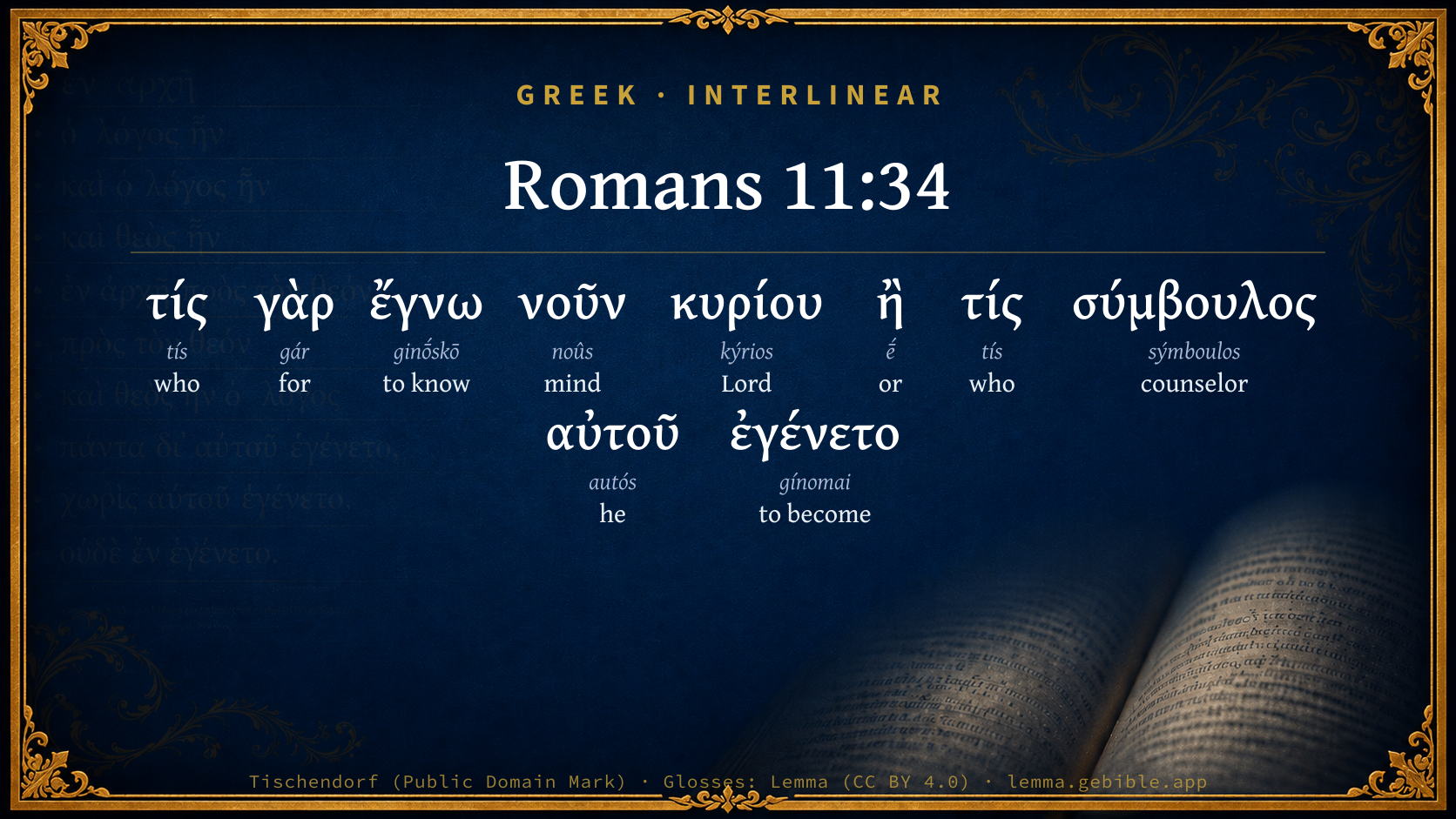
Download image
Cite this verse

Romans 11:34 (World English Bible). Public Domain. Lemma interlinear Bible study tool, https://lemma.gebible.app/v/romans/11/34.

Show BibTeX & RIS
BibTeX
RIS
English Translation
"For who has known the mind of the Lord? Or who has been his counselor?"
World English Bible · Public Domain
Highlights
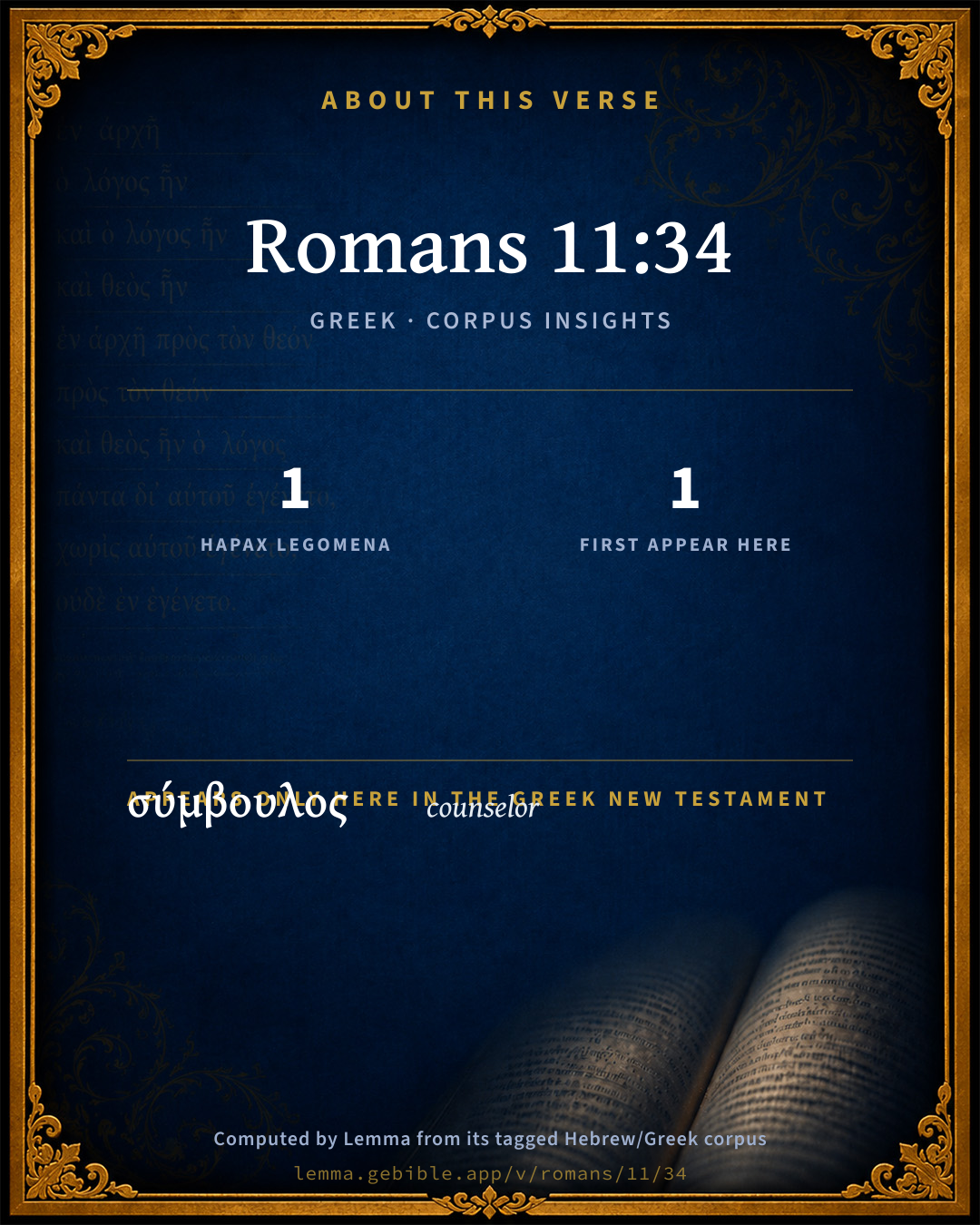
  • 1 hapax legomenon — only here in the Greek New Testament
  • 1 first appearance in the Greek New Testament
Full analysis ↓
Download a study sheet

One document with this verse’s original text, its word-by-word gloss line, the meaning frame, cross-references with their text, attributed commentary, and full source and license credits — printable, and it pastes into notes with its structure intact.

This verse Autodidact and up

Study sheet (.html) Plain text (.txt)

A passage Seminary Student

Up to 50 verses in one chapter. A passage sheet keeps up to 6 commentary sources and 12 cross-references per verse, in the order this page ranks them, and says so on the sheet whenever that leaves anything out. Ask for a single verse and you get the Autodidact verse sheet above.

Everything on this page stays free to read, with no account — the sheet is a download of what is already on screen, not access to it.

Want to remove ads? Support Godless Engineer
Compare translations 3

The same verse in 3 English versions, stacked beneath the original-language interlinear above. Click any original word for its lexicon entry.

Each is an independent rendering of the whole verse — the interlinear is not word-aligned to these translations.

Highlighted words mark where these versions differ — a whole-verse word diff, not a word-by-word alignment.

  • World English Bible Public Domain
    "For who has known the mind of the Lord? Or who has been his counselor?"
  • King James Version Public Domain
    For who hath known the mind of the Lord? or who hath been his counsellor?
  • unfoldingWord Literal Text CC BY-SA 4.0
    For, “Who has known the mind of the Lord or who has become his advisor?”

unfoldingWord Literal Text — © unfoldingWord, licensed CC BY-SA 4.0. Word-aligned USFM3 via Door43 (git.door43.org/unfoldingWord/en_ult).

Versions to compare (up to 4)

3 of 4 selected

Show all 19 translations

Every available English version of this verse, each an independent rendering of the whole verse.

  • World English Bible Public Domain
    "For who has known the mind of the Lord? Or who has been his counselor?"
  • Berean Standard Bible Public Domain
    “Who has known the mind of the Lord? Or who has been His counselor?”
  • Majority Standard Bible Public Domain
    “Who has known the mind of the Lord? Or who has been His counselor?”
  • King James Version Public Domain
    For who hath known the mind of the Lord? or who hath been his counsellor?
  • American Standard Version (1901) Public Domain
    For who hath known the mind of the Lord? or who hath been his counsellor?
  • Revised Version (1885) Public Domain
    For who hath known the mind of the Lord? or who hath been his counsellor?
  • Geneva Bible (1599) Public Domain
    For who hath knowen the minde of the Lord? or who was his counsellour?
  • Douay-Rheims (1899) Public Domain
    For who hath known the mind of the Lord? Or who hath been his counsellor?
  • Young's Literal Translation Public Domain
    for who did know the mind of the Lord? or who did become His counsellor?
  • Literal Standard Version CC BY-SA 4.0
    For who knew the mind of the LORD? Or who became His counselor?
  • Unlocked Literal Bible CC BY-SA 4.0
    “For who has known the mind of the Lord or who has become his advisor?
  • unfoldingWord Literal Text CC BY-SA 4.0
    For, “Who has known the mind of the Lord or who has become his advisor?”
  • Darby Bible Public Domain
    For who has known [the] mind of [the] Lord, or who has been his counsellor?
  • World Messianic Bible Public Domain
    “For who has known the mind of the Lord? Or who has been his counselor?”
  • Webster's Bible Public Domain
    For who hath known the mind of the Lord? or who hath been his counselor?
  • Free Bible Version CC BY-SA 4.0
    Who can know God's thoughts? Who can give him advice?
  • Bible in Basic English Public Domain
    Who has knowledge of the mind of the Lord? or who has taken part in his purposes?
  • Text-Critical English NT CC BY 4.0
    “For who has known the mind of the Lord, or who has become his counselor?”
  • Tyndale New Testament (1534) Public Domain
    For who hath knowen the mynde of the lorde? or who was his counseller?

Literal Standard Version (2020), Covenant Press — licensed CC BY-SA 4.0. Text via the HelloAO Bible API (eBible.org). Unlocked Literal Bible (unfoldingWord) — licensed CC BY-SA 4.0. Text via the HelloAO Bible API (eBible.org). unfoldingWord Literal Text — © unfoldingWord, licensed CC BY-SA 4.0. Word-aligned USFM3 via Door43 (git.door43.org/unfoldingWord/en_ult). Free Bible Version, Dr. Jonathan Gallagher — licensed CC BY-SA 4.0. Text via the HelloAO Bible API (eBible.org).

Word by word

More ways to search: Search by grammar → Find every occurrence → Compare this word →

Practice this passage: Drill this verse → Learn its vocabulary →

About this verse

These counts appear in no published source. They are computed here, from the morphology-tagged text and Lemma’s own curated glosses. What Lemma adds →

10
words
9
distinct lemmas
Pauline Epistles
section

Notable vocabulary

1 hapax legomenon — a word that appears only here in the entire Greek New Testament:

  • σύμβουλος counselor G4825

First appearance in Scripture

This word makes its first canonical appearance in the Greek New Testament here:

  • σύμβουλος counselor G4825

Shared distinctive vocabulary

νοῦν mind G3563 occurs in 22 verses of the Greek New Testament. Also found in:

Repetition

A word recurs within this verse:

Cross-references

5

Topical passages linked to Romans 11:34 in the Treasury of Scripture Knowledge — connected by theme and wording, ordered by reader-vote popularity; previews shown in the World English Bible.

  • Isaiah 40:13 Who has directed the Spirit of Yahweh, or being his counselor has taught him?
  • 1 Corinthians 2:16 "For who has known the mind of the Lord, that he should instruct him?" But we have Christ's mind.
  • Job 15:8 Have you heard the secret counsel of God? Do you limit wisdom to yourself?
  • Job 36:22 Behold, God is exalted in his power. Who is a teacher like him?
  • Jeremiah 23:18 For who has stood in the council of Yahweh, that he should perceive and hear his word? who has marked my word, and heard it?

Cross-references courtesy of OpenBible.info (CC BY 4.0).

Commentary

Notes on Romans 11:34 from classic Christian and Jewish commentators (each source and its license shown beneath its notes). The classic Christian expositions comment on the surrounding passage and are grouped to its opening verse, so a note may address several verses; the Jewish commentaries on the Tanakh (Rashi and others) are per-verse, so they appear only where the commentator wrote on this verse.

Lemma curates 59 commentaries, every one of them public domain or Creative Commons licensed, each selected and text-cleaned for this edition rather than reprinted as found. About our sources →

Bengel's Gnomon

Johann Albrecht Bengel

Rom 11:34. Τίς γὰρ—ἐγένετο) Isa 40:13, LXX., τὶς ἔγνω—καὶ τὶς αὐτοῦ σύμβουλος. Who? i.e. none: but He Himself.—γὰρ, for. The more express quotation of Scripture follows. In proving doctrines the phrase is used, it is written, in other places, it is often omitted, ch. Rom 12:20.—νοῦν Κυρίου, the mind of the Lord) Isaiah has את רוח יהוה, the Spirit of Jehovah. Paul uses the version of the LXX. Otherwise רוח and νοῦς are not synonymous; but the conclusion arrived at is very good; no one apprehends the Spirit, therefore no one apprehends the mind or sense of the Lord. Reference to the Holy Trinity is implied, comp. on the words, εἰς αὐτὸν, to Him, Rom 11:36, Isa 34:16, at the end of the verse.—σύμβουλος Paul says, not only that no one has been σύμβουλος, but not even now can be so: σύμβουλος is either a partner in counsels, or, one at least privy to them; for he had said just now, for who hath known the mind of the Lord? And yet many in their discussions, for example, on the origin of evil, which touch upon the recesses of the Divine economy much more deeply than this, which is from religious reverence broken off by the apostle between Rom 11:32-33 (for there is a great difference between the fall of many angels and of the whole human race on the one hand, and, on the other, the fall of the Israelites [the latter is a much less profound mystery than the former]) many such, I say, boast, as if they were not only the Lord’s counsellors, but also His inquisitors, His patrons, or His judges. Scripture everywhere stops short at this point, that the Lord hath willed, and hath said, and hath done it: It does not unfold the reasons of things universal or particular; respecting those things that are beyond our present state of infancy, it refers believers to eternity, 1Co 13:9, etc. The thirst of knowing will torture and burn others, who unreasonably pry into mysteries, throughout eternity.

Bengel's Gnomon of the New Testament — English translation (T&T Clark, Edinburgh, 1860) — public domain. Text from a community e-Sword module.

Meyer's Critical & Exegetical Commentary

Heinrich August Wilhelm Meyer

Rom_11:34. Paul, by way of confirming his entire exclamation in Rom_11:33 (not merely the second half), continuing by γάρ, adopts the words of Isa_40:13 (almost quite exactly after the LXX.) as his own. Comp. 1Co_2:16; Jdt_8:13-14; Wis_9:17; Sir_18:2 ff.

The first half has been referred to γνῶσις, the second to the σοφία (Theodoret, Theophylact, Wetstein, Fritzsche), and rightly so. Paul goes back with his three questions upon the γνῶσις, to which the νοῦς, the divine reason as the organ of absolute knowledge and truth, corresponds; upon the σοφία, which has no ΣΎΜΒΟΥΛΟς; and (Rom_11:35) upon the ΠΛΟῦΤΟς, from which results the negation of ΤΊς ΠΡΟΈΔΩΚΕΝ Κ.Τ.Λ. Philippi is opposed to this view, but can at the same time (similarly van Hengel and Hofmann) only bring out in a very far-fetched and indirect manner the result, that Rom_11:35 also sets forth the divine wisdom and knowledge (so far, namely, as the latter is not bound from without).

ΤΊς ΣΎΜΒ. ΑὐΤΟῦ ἘΓΈΝ.] Who has become His adviser, His counsel-giving helper? Scriptura ubique subsistit in eo, quod Dominus voluit et dixit et fecit; rationes rerum universalium singulariumve non pandit; de iis, quae nostram superant infantiam, ad aeternitatem remittit fideles, 1Co_13:9 ss., Bengel. For parallels in Greek writers, see Spiess, Logos spermat. p. 240.

Meyer — Critical and Exegetical Commentary on the New Testament — English translation by Peter Christie, edited by Frederick Crombie (T&T Clark, 1880) — public domain. Text from a community e-Sword module.

Expositor's Greek Testament

ed. W. Robertson Nicoll

Rom 11:34 . Proof from Scripture of the unsearchableness of God’s ways: He has had no confidant. Isa 40:13 , 1Co 2:16 . It is mere pedantry to refer half the verse to σοφία and the other half to γνῶσις .

The Expositor's Greek Testament, edited by W. Robertson Nicoll (1897–1910) — public domain. Text from a community e-Sword module.

Hodge's Commentary on Romans, Ephesians & First Corinthians

Charles Hodge

Rom_11:34

For who hath known the mind of the Lord? or, who hath been his counselor? This verse is designed to confirm what is said in Rom_11:33. These clauses may be taken as synonymous, or the first may refer to Gods judgments, and the second, to his ways. Who hath known what God designed to do, and the reasons of his decrees? and, Who hath counseled him as to the mode of their execution? In his purposes and his dispensations he is equally and perfectly independent, infinitely exalted above the supervision or direction of his creatures.

Charles Hodge — Commentary on Romans (1835), First Corinthians (1857), and Ephesians (1856) — public domain. Text from a community e-Sword module.

Geneva Bible (1599)

Geneva Bible translators

He bridleth three manner of ways, the wicked boldness of man: First, because that God is above all, most wise, and therefore it is very absurd, and plainly godless to measure him by our folly. Moreover, because he is debtor to no man, and therefore no man can complain of injury done unto him. Thirdly, because all things are made for his glory, and therefore we must refer all things to his glory, much less may we contend and debate the matter with him.

Job 41:2; Isa. 40:13; 1 Cor. 2:16

Geneva Bible (1599) marginal notes — public domain. Text via Bolls.life.

Jamieson, Fausset & Brown

Robert Jamieson, A. R. Fausset & David Brown

For who hath known the mind of the Lord?--See Job 15:8; Jer 23:18.

or who hath been his counsellor--See Isa 40:13-14.

Jamieson, Fausset & Brown — Commentary Critical and Explanatory on the Whole Bible (1871) — public domain (CC PDM 1.0). Text via the HelloAO Bible API.

Adam Clarke's Commentary

Verse 34. For who hath known the mind of the Lord?] Who can pretend to penetrate the counsels of God, or fathom the reasons of his conduct? His designs and his counsels are like himself, infinite; and, consequently, inscrutable. It is strange that, with such a scripture as this before their eyes, men should sit down and coolly and positively write about counsels and decrees of God formed from all eternity, of which they speak with as much confidence and decision as if they had formed a part of the council of the Most High, and had been with him in the beginning of his ways! A certain writer, (Mr. Perkins,) after having entered into all these counsels, and drawn out his black-lined scheme of absolute and eternal reprobation, with all its causes and effects; and then his light-lined scheme of absolute and eternal ELECTION, with all its causes and effects, all deduced in the most regular and graduated order, link by link; concludes with Ro 11:33: O the depth of the riches both of the wisdom and knowledge of God! how UNSEARCHABLE are his judgments, and his ways PAST FINDING OUT! But this writer forgot that he had searched out God's judgments in the one case, and found out his ways in the other: and that he had given, as a proof of the success of his researches, a complete exhibition of the whole scheme! This conduct is worthy of more than mere reprehension; and yet he who differs from such opinions gives, in the apprehension of some, this proof of his being included in some of the links of the black list! We may rest with the conviction, that God is as merciful and good in all his ways, as he is wise and just. But as we cannot comprehend him, neither can we his operations, it is our place, who are the objects of his infinite mercy and kindness, to adore in silence, and to obey with alacrity and delight.

Adam Clarke's Commentary on the Bible (1810–1826) — public domain. Text from a community e-Sword/MySword module.

John Calvin's Commentaries

34. Who has known the mind of the Lord? He begins here to extend as it were his hand to restrain the audacity of men, lest they should clamor against God’s judgments, and this he does by stating two reasons: the first is, that all mortals are too blind to take a view of God’s predestination by their own understanding, and to reason on a thing unknown is presumptuous and absurd; the other is, that we can have no cause of complaint against God, since no mortal can boast that God is a debtor to him; but that, on the contrary, all are under obligations to him for his bounty.

Within this limit then let every one remember to keep his own mind, lest he be carried beyond God’s oracles in investigating predestination, since we hear that man can distinguish nothing in this case, any more than a blind man in darkness. This caution, however, is not to be so applied as to weaken the certainty of faith, which proceeds not from the acumen of the human mind, but solely from the illumination of the Spirit; for Paul himself in another place, after having testified that all the mysteries of God far exceed the comprehension of our minds, immediately subjoins that the faithful understand the mind of the Lord, because they have not received the spirit of this world, but the Spirit which has been given them by God, by whom they are instructed as to his goodness, which otherwise would be incomprehensible to them.

As then we cannot by our own faculties examine the secrets of God, so we are admitted into a certain and clear knowledge of them by the grace of the Holy Spirit: and if we ought to follow the guidance of the Spirit, where he leaves us, there we ought to stop and as it were to fix our standing. If any one will seek to know more than what God has revealed, he shall be overwhelmed with the immeasurable brightness of inaccessible light. But we must bear in mind the distinction, which I have before mentioned, between the secret counsel of God, and his will made known in Scripture; for though the whole doctrine of Scripture surpasses in its height the mind of man, yet an access to it is not closed against the faithful, who reverently and soberly follow the Spirit as their guide; but the case is different with regard to his hidden counsel, the depth and height of which cannot by any investigation be reached.

John Calvin's Commentaries (1540-1563) — public domain. Text from the Calvin Translation Society English edition (1840s-50s) via the Christian Classics Ethereal Library (ccel.org). Calvin's coverage is partial (roughly two-thirds of the Bible); uncommented books and verses are honest gaps, never fabricated. The 19th-century editor's footnotes and remarks are omitted so the notes are faithfully Calvin's own voice.

Ellicott's Commentary for English Readers

(34) For who hath known the mind of the Lord?—The two clauses in this verse are illustrative of the wisdom and knowledge of God, just as the next verse is illustrative of His “riches.”

A Bible Commentary for English Readers, edited by Charles John Ellicott (1878–1897) — public domain. Text from a community e-Sword module.

The Cambridge Bible for Schools and Colleges

gen. ed. J. J. S. Perowne

34. For who hath known—counseller] Nearly verbatim from Isa_40:13. See too Jer_23:18.—The Gr. verbs are aorists; and the time-reference is perhaps to creation, or to the eternal decrees “before the world was.”

The Cambridge Bible for Schools and Colleges (gen. ed. J. J. S. Perowne; Cambridge University Press, 1878–1918) — public domain. Text from a community e-Sword module.

John Gill's Exposition

For who hath known the mind of the Lord,.... The intentions of his mind, the thoughts of his heart, and the counsels of his will: these could never have been known, if he had not revealed them; nor can the doctrines relating to them, though externally revealed, be known by the natural man, or by the mere dint of nature, but only by the light of the Spirit of God; who searches them, and makes them known in a spiritual manner to spiritual men, who have a spiritual discerning of them; and yet even by these they are not known perfectly, only in part, and are seen through a glass darkly:

or who hath been his counsellor? or was of his council, when all things were fixed according to his sovereign will: when the scheme of man's salvation was consulted and agreed upon between the eternal Three, there was no creature, angel, or man there; no created angel, only the eternal One, "the Counsellor", Isa 9:6; or as the Septuagint there style him, , "the angel of the great council"; none but Father, Son, and Spirit, were present, when the book of life was made, when the names of God's elect were put into it, and others left out; when all things relating to his chosen ones, both for time and eternity, whether among Jews or Gentiles, were determined, ordered, and settled; and as there was no creature that assisted, or could give any advice about these matters, so there were none that were privy to the resolutions, determinations, and counsels of his will; which were purposed in himself and in his Son, and were known only to them and his Spirit, which is in him: from the whole it appears, that predestination is not according to men's works, or the foresight of them; for then these things would be plain and easy, they would not be unsearchable and past finding out; there would not be an unfathomable depth in them; the mind and counsels of God, and the springs of them, would be obvious; but it is according to his secret, sovereign, and unchangeable will.

John Gill's Exposition of the Whole Bible (1746–1763) — public domain (CC PDM 1.0). Text via the HelloAO Bible API.

Trapp's Complete Commentary

John Trapp

34 For who hath known the mind of the Lord? or who hath been his counsellor?

Ver. 34. Who hath been his counsellor] Alphonso the wise (the fool rather) was heard blasphemously to say, that if he had been of God’s counsel at the creation, he could have advised and ordered many things much better than now they are. This Alphonso, the tenth of that name, king of Spain, who by a just hand of God upon him deprived of his kingdom, and died in public hatred and infamy.

John Trapp, A Commentary or Exposition upon All the Books of the Old and New Testament (1647–1656) — public domain. Text from a community e-Sword module.

Albert Barnes' Notes on the Bible

For who hath known? ... - This verse is a quotation, with a slight change, from Isa 40:13, “Who hath directed the Spirit of the Lord, or being his counsellor hath taught him?” It is designed to express the infinite wisdom and knowledge of God, by affirming that no being could teach him, or counsel him. Earthly monarchs have counsellors of state, whom they may consult in times of perplexity or danger. But God has no such council. He sits alone; nor does he call in any or all of his creatures to advise him. All created beings are not qualified to contribute anything to enlighten or to direct him. It is also designed to silence all opposition to his plans, and to hush all murmurings. The apostle had proved that this was the plan of God. However mysterious and inscrutable it might appear to the Jew or the Gentile, yet it was his duty to submit to God, and to confide in his wisdom, though he was not able to trace the reason of his doings.

Albert Barnes' Notes on the Bible (1834–1885) — public domain. Text from a community e-Sword/MySword module.

Matthew Poole's English Annotations

i.e. Who knoweth what God is about to do? Or who hath given his advice about the doing of it? This is taken out of Isa 40:13,14.

Matthew Poole's English Annotations on the Holy Bible (1683–1685) — public domain. Text from a community e-Sword/MySword module.

John Wesley's Explanatory Notes

Who hath known the mind of the Lord - Before or any farther than he has revealed it. Isaiah xl, 13.

John Wesley, Explanatory Notes Upon the Whole Bible (1754–1765) — public domain. Text via the GEBible commentary corpus.

Burkitt's Expository Notes on the New Testament

William Burkitt

As if the apostle had said, "No creature ever did, or ever can, pierce into the mind of God, nor ever was called to be of his council. No creature ever did or can advise him, nor can any creature challenge God, as if he were indebted to him.

Who ever gave any thing to God that he did not first receive from him? Or who can merit any thing at his hands, seeing he owes us nothing? And if so, who hath reason to complain that God deals hardly with the Jews, in rejecting them, and preferring the Gentiles before them? Surely Almighty God may dispense a favour to some, which he owes to none."

Learn hence, That in those discriminating favours which God dispenses towards some of the children of men, no other reason can be assigned but his own good will and pleasure. This particularly appears in his ordering matters relating to the Jews and Gentiles, recorded in the foregoing chapter.

William Burkitt's Expository Notes on the New Testament (1700–1703) — public domain. Text from a community e-Sword module.

McGarvey & Pendleton's Commentaries

J. W. McGarvey

For who hath known the mind of the Lord? or who hath been his counsellor? [ Isa_40:13 ; Jer_23:18 . "Judgments" and "mind" have reference to God's wisdom; "ways" and "counsellor" look toward his knowledge. Knowledge precedes wisdom. It gathers the facts and ascertains the truths and perceives their meaning, and then wisdom enters with its powers of ratiocination and traces the relations of truth to truth and fact to fact, and invents procedures, devises methods, constructs processes, etc., and utilizes the raw material of knowledge to effect ends, accomplish purposes and achieve results. Therefore, as Gifford observes, "knowledge" is theoretical, "wisdom" is practical, and while "knowledge" is purely intellectual, "wisdom" is also moral, and for that reason is both the most perfect of mental gifts (Aristotle, Nic. Eth. 6:10) and the queen of all virtues (Cicero, 'de Off.' 1:43)." God's knowledge foresees all the evil desires, designs, intentions and actions of men and demons, of the devil and his angels; and his wisdom expends itself in transforming all these opposing powers and forces into so many means and aids for the accomplishment of his own holy designs and beneficent purposes. Exercising his wisdom, God judges or decrees, or determines or purposes in his mind, what is best to be done, or to be brought to pass, and these designs or purposes are wholly hidden from man save as God reveals them. We see his moves upon the chessboard of events, but the motives back of the moves lie hidden in a depth of wisdom too profound for man to fathom. "Ways" is derived from the word for "footsteps," and "tracing" is a metaphor borrowed from the chase, where the dog, scenting the footstep, follows the trail, or "way," the game has taken. The means which God chooses leave no track, and they can not be run down and taken captive by the mind of man. Nor does God seek information or ask counsel of man. He is a ruler without a cabinet, a sovereign without a privy council, a king without a parliament. His knowledge needs no augmentation. He accepts no derived information, and borrows no knowledge, but draws all from his own boundless resources. If we can not divine the purpose of his chessboard moves as chosen by his wisdom, neither can we even guess their effects which his knowledge foresees, for he produces unexpected results from contrary causes, so that he makes the Gentiles rich by Jewish poverty, and yet richer by Jewish riches. His wisdom sought the salvation of Jew and Gentile, yet his knowledge foresaw that racial antipathy would keep them from working together till ripened in character; so he worked with each separately. As each sought to establish the sufficiency of his own self-righteousness, he let them each try it, one with natural and the other with revealed law. To each he gave a season of covenant relation and a season of rejection, and in the end he will unite the two and have mercy on both. Such is the coworking of God's wisdom and knowledge. The scheme is outlined in the parable of the prodigal son, the prodigal being the Gentile and the Jew the elder brother, not yet reconciled to the Father, but still offended at his kindness to the outcast. When the elder brother is reconciled, the story will be complete.]

J. W. McGarvey (with Philip Y. Pendleton), Commentaries on the New Testament (The Fourfold Gospel, 1914; Acts; and the epistles) — public domain. Text from a community e-Sword/MySword module.

Cambridge Greek Testament for Schools and Colleges

34. Isa 40:13 f., qu. 1Co 2:16; cf. Wis 9:13; Wis 9:17.

Cambridge Greek Testament for Schools and Colleges (Cambridge University Press, 1896; 21 vols, various authors incl. Carr, Maclear, Plummer, Farrar, Lumby, Moule, M. R. James, Simcox) — public domain. Text from a community e-Sword module.

Alford’s Greek Testament

Henry Alford

34.] For (confirmation of ἀνεξερ. and ἀνεξιχν. by a citation from Scripture. It is made from two separate places in the LXX, more perhaps as a reminiscence than as a direct quotation) who hath known the mind (γνῶσις, but see above) of the Lord? or who hath been His counsellor (σοφία?)?

Henry Alford, The Greek Testament (1849–1861) — public domain. Text from a community e-Sword module.

International Critical Commentary

34. τίς γὰρ ἔγνω κ.τ.λ. This is taken from Isa 40:13, varying only very slightly from the LXX. It is quoted also 1Co 2:16.

International Critical Commentary — older volumes (1896–1929), various authors — public domain. Text from a community e-Sword module.

Vincent's Word Studies in the New Testament

Marvin R. Vincent

Who hath known, etc. From Isa 40:13. Heb., Who hath measured the Spirit? Though measured may be rendered tried, proved, regulated. Compare the same citation in 1Co 2:16. This is the only passage in the Septuagint where ruach spirit is translated by nouv mind. Known [εγνω] may refer to God 's gnwsiv knowledge and ways in ver. 33; counselor to His wisdom and judgments. No one has counseled with Him in forming His decisions.

Marvin R. Vincent, Word Studies in the New Testament (1887–1900) — public domain. Text from a community e-Sword/MySword module.

Godet's Commentaries

Frédéric Louis Godet

Vv. 34, 35. “For who hath known the mind of the Lord, or who hath been His counsellor? Or who hath first given to Him, and it shall be recompensed unto Him again?”

Here is the Scripture proof that God’s designs are impenetrable until He reveal them Himself to His apostles and prophets, and by them to His people. The first passage quoted is Isa 40:13, which Paul uses as if it were his own saying. This question in the mouth of the prophet applies to the wonders of creation. Paul extends it to those of the divine government in general, for the works of God in history are only the continuation of those of nature.

The question: Who hath known? is a challenge thrown down to the natural understanding. As to those whom God has enlightened on the subject of His designs, Paul himself says, 1Co 2:16 : “But we have the mind of Christ.”

This first question contrasts the always limited knowledge of man with the infinite knowledge of God (γνῶσις τοῦ Θεοῦ, Rom 11:33). The second goes further, it bears on the relation between human and divine wisdom. It is no longer merely the discovery of the secrets of God by the study of His works which is in question, but some good counsel which man might have been called to give to the Creator in the organizing of His plans. The word σύμβουλος denotes one who deliberates with another, and can communicate to him something of his wisdom. It is therefore a more exalted position than that supposed by the previous question.

The third question, Rom 11:35, would imply a still more exalted part. The matter in question is a service rendered to God, a present which man is supposed to have made to Him so as to merit a gift in return. Such, indeed, is the position which the Jews were taking, and by which they claimed especially to limit the freedom of God in the government of the world on account of their meritorious works. “There is no difference,” said the Jews of Malachi’s day pettishly, “between the man who serveth God and him who serveth Him not. What have we gained by keeping His commandments?” This spirit of pride had been growing; it had reached its apogee in Pharisaism. The preposition πρό, in advance, which enters into the composition of the first verb, and the preposition ἀντί, in exchange, which enters into that of the second, perfectly describe the relation of dependence on man in which God would be placed, if the former could really be the first to do something for God and thereby constitute Him his debtor. With this third question Paul evidently returns to the special subject of this whole dissertation on the divine government: the rejection of the Jews. By the first question he denied to man the power of understanding God and judging Him till God had explained Himself; by the second, the power of co-operating with Him; by the third, he refuses to him the power of imposing on Him any obligation whatever. Thus is fully vindicated the liberty of God, that last principle of the mysterious fact to be explained.

This question of Rom 11:35 is also a Scripture quotation which Paul weaves into his own text. It is taken from Job 41:11, which the LXX. translate strangely (Job 41:2): “Or who is he that will resist me and abide?” It is true that in the two MSS. Sinait. and Alex. there is found at the close of Isa 40:14 a saying similar to the apostle’s translation. But there it is certainly an interpolation taken from our epistle itself.

Frédéric Louis Godet — Commentaries on Luke, John, Romans, and 1 Corinthians — English translation (T&T Clark, Edinburgh, 1870s–1890s) — public domain. Text from a community e-Sword module.

Lesson kit

Teaching starters — assembled from the data on this page, not authored interpretation. Every prompt links to the verse data it draws on. Edit before teaching.

Romans, in the Pauline Epistles, opens this verse with 10 words (9 distinct Greek lemmas). Its most distinctive word is sýmboulos (“counselor”). A historical commentator’s framing appears above. Read the whole chapter for the surrounding context.

Discussion questions

  1. How does “counselor” (sýmboulos) shape what this verse is saying?
  2. 1 word here appears nowhere else in the Greek New Testament. Why might the author reach for such rare wording?
  3. This is the first place “counselor” appears in Scripture (first appears here). What does its debut here establish?
  4. How does Luke 24:45, which shares the word «mind», read alongside this verse?
  5. What does the repetition of “who” (2× in this one verse) do in this verse?
  6. These translations render this verse differently. What is at stake in choosing one wording over another?
  7. Compare how Bengel's Gnomon and Meyer's Critical & Exegetical Commentary read this verse. Where do they agree or differ?

Things to notice

  • 1 word in this verse appears nowhere else in the Greek New Testament.
  • 1 word makes its first canonical appearance in Scripture here.
  • These translations choose different wording for 6 words in this verse.
  • “who” occurs 2× in this single verse.
  • 9 distinct Greek lemmas span 10 words in this verse.

Reading settings

Reading text

Shown beneath each verse's original-language words.

Old Testament
Old Testament edition

Read the OT as the Masoretic Hebrew (MT) or the Greek Septuagint (LXX).

English shown for the Greek Septuagint (in the Hebrew ↔ Greek comparison).

Comparing translations? Open the Compare panel on any verse page to stack up to four side by side.