
Luke 8:10

Greek (Tischendorf 8th ed.) Luke 8:10 appears in the Greek New Testament. The text above is from the Tischendorf 8th edition. Each word links to its Strong’s number and a concise gloss. Click any word for its full Thayer’s Greek Lexicon entry.
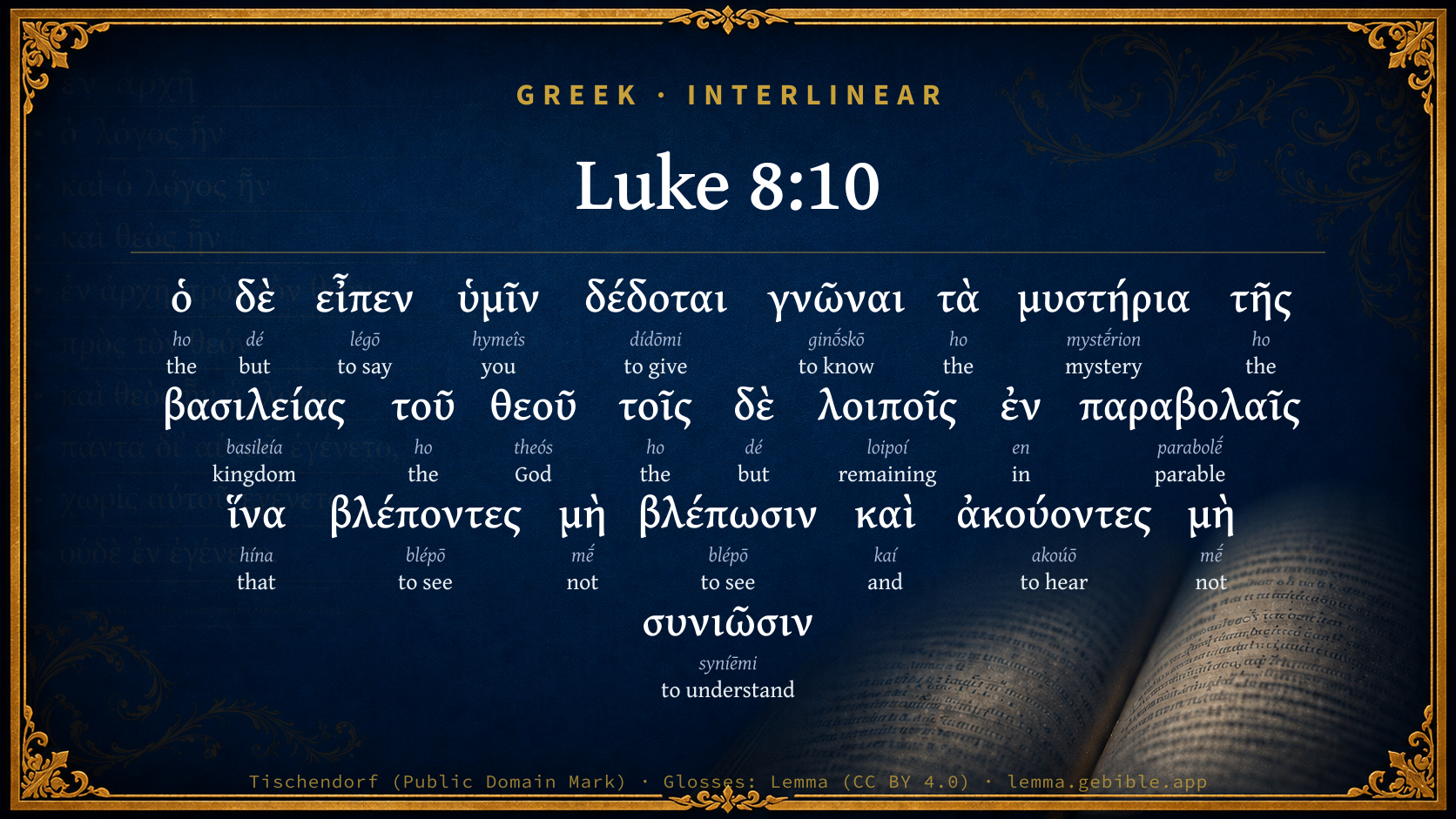
Download image
Cite this verse

Luke 8:10 (World English Bible). Public Domain. Lemma interlinear Bible study tool, https://lemma.gebible.app/v/luke/8/10.

Show BibTeX & RIS
BibTeX
RIS
English Translation
He said, "To you it is given to know the mysteries of the Kingdom of God, but to the rest in parables; that 'seeing they may not see, and hearing they may not understand.'
World English Bible · Public Domain
Download a study sheet

One document with this verse’s original text, its word-by-word gloss line, the meaning frame, cross-references with their text, attributed commentary, and full source and license credits — printable, and it pastes into notes with its structure intact.

This verse Autodidact and up

Study sheet (.html) Plain text (.txt)

A passage Seminary Student

Up to 50 verses in one chapter. A passage sheet keeps up to 6 commentary sources and 12 cross-references per verse, in the order this page ranks them, and says so on the sheet whenever that leaves anything out. Ask for a single verse and you get the Autodidact verse sheet above.

Everything on this page stays free to read, with no account — the sheet is a download of what is already on screen, not access to it.

Want to remove ads? Support Godless Engineer
Compare translations 3

The same verse in 3 English versions, stacked beneath the original-language interlinear above. Click any original word for its lexicon entry.

Each is an independent rendering of the whole verse — the interlinear is not word-aligned to these translations.

Highlighted words mark where these versions differ — a whole-verse word diff, not a word-by-word alignment.

  • World English Bible Public Domain
    He said, "To you it is given to know the mysteries of the Kingdom of God, but to the rest in parables; that 'seeing they may not see, and hearing they may not understand.'
  • King James Version Public Domain
    And he said, Unto you it is given to know the mysteries of the kingdom of God: but to others in parables; that seeing they might not see, and hearing they might not understand.
  • unfoldingWord Literal Text CC BY-SA 4.0
    And he said, “To you has been given to know the mysteries of the kingdom of God, but to the rest in parables, so that, ‘Seeing, they may not see; and hearing, they may not understand.’

unfoldingWord Literal Text — © unfoldingWord, licensed CC BY-SA 4.0. Word-aligned USFM3 via Door43 (git.door43.org/unfoldingWord/en_ult).

Versions to compare (up to 4)

3 of 4 selected

Show all 19 translations

Every available English version of this verse, each an independent rendering of the whole verse.

  • World English Bible Public Domain
    He said, "To you it is given to know the mysteries of the Kingdom of God, but to the rest in parables; that 'seeing they may not see, and hearing they may not understand.'
  • Berean Standard Bible Public Domain
    He replied, “The knowledge of the mysteries of the kingdom of God has been given to you, but to others I speak in parables, so that, ‘though seeing, they may not see; though hearing, they may not understand.’
  • Majority Standard Bible Public Domain
    He replied, “The knowledge of the mysteries of the kingdom of God has been given to you, but to others I speak in parables, so that, ‘though seeing, they may not see; though hearing, they may not understand.’
  • King James Version Public Domain
    And he said, Unto you it is given to know the mysteries of the kingdom of God: but to others in parables; that seeing they might not see, and hearing they might not understand.
  • American Standard Version (1901) Public Domain
    And he said, Unto you it is given to know the mysteries of the kingdom of God: but to the rest in parables; that seeing they may not see, and hearing they may not understand.
  • Revised Version (1885) Public Domain
    And he said, Unto you it is given to know the mysteries of the kingdom of God: but to the rest in parables; that seeing they may not see, and hearing they may not understand.
  • Geneva Bible (1599) Public Domain
    And he sayd, Vnto you it is giuen to know the secrets of ye kingdome of God, but to other in parables, that when they see, they shoulde not see, and when they heare, they should not vnderstand.
  • Douay-Rheims (1899) Public Domain
    To whom he said: To you it is given to know the mystery of the kingdom of God; but to the rest in parables, that seeing they may not see, and hearing may not understand.
  • Young's Literal Translation Public Domain
    And he said, `To you it hath been given to know the secrets of the reign of God, and to the rest in similes; that seeing they may not see, and hearing they may not understand.
  • Literal Standard Version CC BY-SA 4.0
    And He said, “To you it has been given to know the secrets of the Kingdom of God, but to the rest in allegories, that seeing they may not see, and hearing they may not understand.
  • Unlocked Literal Bible CC BY-SA 4.0
    He said, “The knowledge of the secrets of the kingdom of God has been given to you, but for others I speak in parables, so that 'seeing they may not see, and hearing they may not understand.'
  • unfoldingWord Literal Text CC BY-SA 4.0
    And he said, “To you has been given to know the mysteries of the kingdom of God, but to the rest in parables, so that, ‘Seeing, they may not see; and hearing, they may not understand.’
  • Darby Bible Public Domain
    And he said, To you it is given to know the mysteries of the kingdom of God, but to the rest in parables, in order that seeing they may not see, and hearing they may not understand.
  • World Messianic Bible Public Domain
    He said, “To you it is given to know the mysteries of God’s Kingdom, but to the rest it is given in parables, that ‘seeing they may not see, and hearing they may not understand.’
  • Webster's Bible Public Domain
    And he said, To you it is given to know the mysteries of the kingdom of God: but to others in parables; that seeing they may not see, and hearing they may not understand.
  • Free Bible Version CC BY-SA 4.0
    Jesus replied, “You've been given insights into the mysteries of God's kingdom, but the rest are given illustrations so that, ‘Even though they see, they don't really see; and even though they hear, they don't really understand.’
  • Bible in Basic English Public Domain
    And he said, To you is given knowledge of the secrets of the kingdom of God; but to the others, they are given in stories, so that seeing, they may not see, and though they give hearing, the sense will not be clear to them.
  • Text-Critical English NT CC BY 4.0
    He said, “To you it has been given to know the mysteries of the kingdom of God, but to the rest I speak in parables, so that ‘they may see but not perceive, and hear but not understand.’
  • Tyndale New Testament (1534) Public Domain
    And he sayde: vnto you is it geven to knowe the secretes of the kyngdom of God: but to other in similitudes that when they se they shuld not se: and when they heare they shuld not vnderstonde.

Literal Standard Version (2020), Covenant Press — licensed CC BY-SA 4.0. Text via the HelloAO Bible API (eBible.org). Unlocked Literal Bible (unfoldingWord) — licensed CC BY-SA 4.0. Text via the HelloAO Bible API (eBible.org). unfoldingWord Literal Text — © unfoldingWord, licensed CC BY-SA 4.0. Word-aligned USFM3 via Door43 (git.door43.org/unfoldingWord/en_ult). Free Bible Version, Dr. Jonathan Gallagher — licensed CC BY-SA 4.0. Text via the HelloAO Bible API (eBible.org).

Word by word

More ways to search: Search by grammar → Find every occurrence → Compare this word →

Practice this passage: Drill this verse → Learn its vocabulary →

συνιῶσιν
syníēmi
G4920
“to understand”
Verb, Present, Active, Subjunctive, 3rd person, Plural
Part of Speech
Verb
Tense
Present
Voice
Active
Mood
Subjunctive
Person
3rd person
Number
Plural
Full Thayer's Definition

Origin: from G4862 and hiemi (to send)

TDNT: 21:48,1

1. to set or bring together a. in a hostile sense, of combatants 2. to put (as it were) the perception with the thing perceived a. to set or join together in the mind 1. i.e. to understand: the man of understanding 2. idiom for: a good and upright man (having the knowledge of those things which pertain to salvation)
  1. ὁ ho G3588 “the” Article, Nominative, Singular, Masculine
  2. δὲ dé G1161 “but” Conjunction
  3. εἶπεν légō G3004 “to say” Verb, Aorist, Active, Indicative, 3rd person, Singular
  4. ὑμῖν hymeîs G5210 “you” Personal pronoun, 2nd person, Dative, Plural
  5. δέδοται dídōmi G1325 “to give” Verb, Perfect, Passive, Indicative, 3rd person, Singular
  6. γνῶναι ginṓskō G1097 “to know” Verb, Aorist, Active, Infinitive
  7. τὰ ho G3588 “the” Article, Accusative, Plural, Neuter
  8. μυστήρια mystḗrion G3466 “mystery” Noun, Accusative, Plural, Neuter
  9. τῆς ho G3588 “the” Article, Genitive, Singular, Feminine
  10. βασιλείας basileía G932 “kingdom” Noun, Genitive, Singular, Feminine
  11. τοῦ ho G3588 “the” Article, Genitive, Singular, Masculine
  12. θεοῦ theós G2316 “God” Noun, Genitive, Singular, Masculine
  13. τοῖς ho G3588 “the” Article, Dative, Plural, Masculine
  14. δὲ dé G1161 “but” Conjunction
  15. λοιποῖς loipoí G3062 “remaining” Adjective, Dative, Plural, Masculine
  16. ἐν en G1722 “in” Preposition
  17. παραβολαῖς parabolḗ G3850 “parable” Noun, Dative, Plural, Feminine
  18. ἵνα hína G2443 “that” Conjunction
  19. βλέποντες blépō G991 “to see” Verb, Present, Active, Participle, Nominative, Plural, Masculine
  20. μὴ mḗ G3361 “not” Particle, Negative
  21. βλέπωσιν blépō G991 “to see” Verb, Present, Active, Subjunctive, 3rd person, Plural
  22. καὶ kaí G2532 “and” Conjunction
  23. ἀκούοντες akoúō G191 “to hear” Verb, Present, Active, Participle, Nominative, Plural, Masculine
  24. μὴ mḗ G3361 “not” Particle, Negative

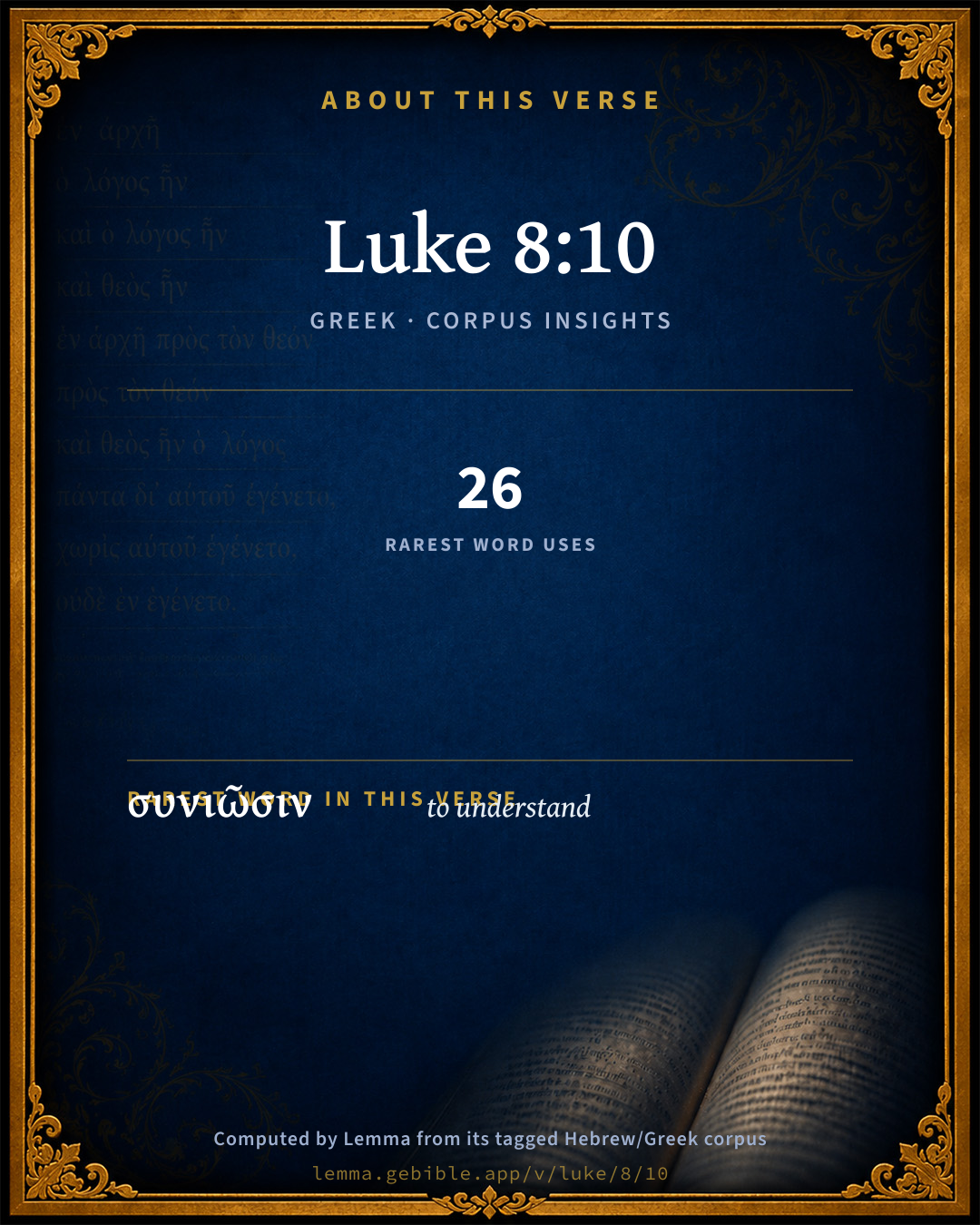
About this verse

These counts appear in no published source. They are computed here, from the morphology-tagged text and Lemma’s own curated glosses. What Lemma adds →

25
words
18
distinct lemmas
Gospels
section

Shared distinctive vocabulary

συνιῶσιν to understand G4920 occurs in 25 verses of the Greek New Testament. Also found in:
Repetition

Words recur within this verse:

Cross-references

22

Topical passages linked to Luke 8:10 in the Treasury of Scripture Knowledge — connected by theme and wording, ordered by reader-vote popularity; previews shown in the World English Bible.

  • Isaiah 6:9 He said, "Go, and tell this people, 'You hear indeed, But don't understand; And you see indeed, But don't perceive.'
  • Mark 4:11 He said to them, "To you is given the mystery of the Kingdom of God, but to those who are outside, all things are done in parables,
  • Matthew 11:25 At that time, Jesus answered, "I thank you, Father, Lord of heaven and earth, that you hid these things from the wise and understanding, and revealed them to infants.
  • Jeremiah 5:21 Hear now this, foolish people, and without understanding; who have eyes, and don't see; who have ears, and don't hear:
  • Isaiah 44:18 They don't know, neither do they consider: for he has shut their eyes, that they can't see; and their hearts, that they can't understand.
  • Matthew 13:11–17 He answered them, "To you it is given to know the mysteries of the Kingdom of Heaven, but it is not given to them.
  • Acts 28:26–27 saying, 'Go to this people, and say, In hearing, you will hear, But will in no way understand. In seeing, you will see, But will in no way perceive.
  • Colossians 2:2 that their hearts may be comforted, they being knit together in love, and gaining all riches of the full assurance of understanding, that they may know the mystery of God, both of the Father and of Christ,
  • Deuteronomy 29:4 but Yahweh has not given you a heart to know, and eyes to see, and ears to hear, to this day.
  • Psalms 25:14 The friendship of Yahweh is with those who fear him. He will show them his covenant.
  • Matthew 16:17 Jesus answered him, "Blessed are you, Simon Bar Jonah, for flesh and blood has not revealed this to you, but my Father who is in heaven.
  • Romans 11:7–10 What then? That which Israel seeks for, that he didn't obtain, but the chosen ones obtained it, and the rest were hardened.
  • Romans 16:25
  • Colossians 1:26–28 the mystery which has been hidden for ages and generations. But now it has been revealed to his saints,
  • Isaiah 29:14 therefore, behold, I will proceed to do a marvelous work among this people, even a marvelous work and a wonder; and the wisdom of their wise men shall perish, and the understanding of their prudent men shall be hid.
  • Luke 10:21–24 In that same hour Jesus rejoiced in the Holy Spirit, and said, "I thank you, O Father, Lord of heaven and earth, that you have hidden these things from the wise and understanding, and revealed them to little children. Yes, Father, for so it was well-pleasing in your sight."
  • John 12:40 "He has blinded their eyes and he hardened their heart, Lest they should see with their eyes, And perceive with their heart, And would turn, And I would heal them."
  • 1 Corinthians 2:7–11 But we speak God's wisdom in a mystery, the wisdom that has been hidden, which God foreordained before the worlds for our glory,
  • 1 Corinthians 12:11 But the one and the same Spirit works all of these, distributing to each one separately as he desires.
  • 1 Timothy 3:16 Without controversy, the mystery of godliness is great: God was revealed in the flesh, Justified in the spirit, Seen by angels, Preached among the nations, Believed on in the world, And received up in glory.
  • 1 Peter 1:10–12 Concerning this salvation, the prophets sought and searched diligently, who prophesied of the grace that would come to you,
  • Ephesians 3:3–9 how that by revelation the mystery was made known to me, as I wrote before in few words,

Cross-references courtesy of OpenBible.info (CC BY 4.0).

Commentary

Notes on Luke 8:10 from classic Christian and Jewish commentators (each source and its license shown beneath its notes). The classic Christian expositions comment on the surrounding passage and are grouped to its opening verse, so a note may address several verses; the Jewish commentaries on the Tanakh (Rashi and others) are per-verse, so they appear only where the commentator wrote on this verse.

Lemma curates 59 commentaries, every one of them public domain or Creative Commons licensed, each selected and text-cleaned for this edition rather than reprinted as found. About our sources →

The Biblical Illustrator

Joseph S. Exell

Luk_8:10

Unto you it is given to know the mysteries of the kingdom of GOD--

The mysteries of the kingdom

A mystery, as the word is used in Scripture, is nothing more than an unknown thing.

It has no reference to anything obscure, or awful, or difficult to understand. The most simple truth may be called a mystery so long as it is concealed. That a Gentile could be converted to Christ was a mystery to the Jews--an unknown thing, not a thing difficult to be understood. Read the text, Because it is given unto you to know the secrets of the kingdom of heaven, but to them it is not given, and the meaning is plain and complete.

I. Let us endeavour TO DISTINGUISH THE TWO CLASSES,--on the one hand, those to whom it was given to know the mysteries of the kingdom; on the other, those to whom it was not so given. Some have interpreted this passage as a judicial sentence of perpetual ignorance and unbelief. I am more disposed to interpret it as a description of a hardened and obdurate state of mind--a wilful ignorance connected with gross stupidity. Because their hearts had waxed gross, and their ears were dull, and their eyes were closed--wilfully closed--the Lord left them to the mystery of the parables, but expounded the interpretation to His disciples in their more private intercourse. Jesus had spoken His parables from a ship on the Sea of Galilee to vast multitudes who collected to hear Him from the neighbouring towns and country. We have, then, abundant illustration of the character of this multitude. They came from the places in which He had done most of His mighty works--Capernaum, Chorazin, Bethsaida, and the neighbourhood. In their synagogues Jesus had expounded the Holy Scriptures and showed their fulfilment in Himself. But these people had seen His wonderful works as though they saw them not, and heard His words of wisdom and love as though they heard not. The application is to you, and an affecting application it is. Take heed how ye hear. See that ye refuse not Him that speaketh from heaven. The dreadful shadow of the second death had fallen upon the multitude, and no beams from the Light and Life of the world could dispel its gloom. And oh, consider that the men of the neighbourhood where Jesus chiefly taught were those denied the interpretation of the parable. Exalted to heaven by their privileges, they were debased and brought near to hell by the abuse of them. Now let us look to those to whom Jesus gave the interpretation. The inquiry is, What had they which the others had not? If the disciples had not knowledge, they had the desire to obtain it, and the spirit to make it productive.

1. They had the desire to obtain it. In learning the mysteries of the kingdom (as in everything else) the docile disposition and the acquisition of knowledge are inseparably connected. What cared the multitude for the hard sayings of Jesus? Gratify their vain curiosity, amuse them with signs and wonders, feed them with loaves and fishes, and they are content. But the disciples--that is, the learners--longed to know the whole meaning of the Saviours lessons. They heard the parables, and they sought the interpretation. They felt that they lacked wisdom; they hungered and thirsted after the knowledge of righteousness, and with the docility of children they desired to learn the mysteries of the kingdom of heaven. To them it was given to know--to them, having the teachable disposition, the instruction was readily and freely afforded. Multitudes are still ignorant of the truths of the Gospel, even in the midst of this bright day of clear, evangelical, heavenly light; but the ignorance of every one of them amidst so many means of instruction is to be attributed to their own wilful indisposition to learn. To how many among us is the Bible enveloped in thick darkness! its great truths are still to them mysteries of the kingdom--secrets hidden from their view, as with a Pharisaic contempt, or a sinfuldislike, they pass their wandering eyes over the words of the sacred page. They read, but understand not what they read. They have no interpreter. The Holy Spirit they have resisted and repelled. The avenues by which pure, Divine, holy truth might reach their hearts they have closed by the corruptions of the flesh and the cares of the world. But some of you have otherwise learned Christ. You were impelled by an ardent desire, and you went with humility, like children, to sit at the feet of Jesus to learn of Him. His words, read in the letter of Scripture, became much more than letter as you read them; they became spirit and life. You felt their spiritual quickening power. Imploring by earnest prayer the light of heaven, that light shone upon the Book of God, and you saw as you had never seen before, wonderful things out of His law. Thus to you much has been given. But--

2. The disciples had a spirit to make their knowledge productive. They did not neglect or abuse the knowledge they had. The good seed in their hearts brought forth its own fruit in its season. How often have the elements of scriptural knowledge been abused, and how often have they been suffered to lie neglected in the heart! And abuse or neglect will always prevent a clear and believing perception of the mysteries of the kingdom. If this be so, no one ought to utter a word of complaint respecting his ignorance of the mysteries of the Gospel. Why do they remain hidden from him? The answer is at hand: because he is not faithful to the little light he already has obtained. Men often see not the doctrine, because the present duty, always plain, it disregarded by them. You may think you know little of the mysteries. But do you not know that you ought to seek more earnestly than you have sought? to practise more self-denial than you have yet practised? to do many things you have not done, and to refrain from doing much that you continue to do? It is no wonder that you should remain still in ignorance of many things, seeing you have already more light than you follow in the practical part of religion.

II. LET US CONSIDER THE MEANS BY WHICH THESE MYSTERIES WERE REVEALED TO THOSE TO WHOM IT WAS GIVEN TO KNOW HIM.

1. A plain and easy way of giving the true knowledge is made apparent. We have the admonitions of Christ as well as His teaching. Our duty is not mysterious. We can seek wisdom, and seek it in the path of obedience.

2. The mysteries are revealed in their appropriateness to ourselves and their application to our wants: revealed to our hearts, according to our need. Show the man himself, a sinner ready to perish--the suitable Saviour for him is revealed by His paying the penalty of sin.

3. The mysteries are revealed in succession, as they prove useful, not to gratify curiosity. (R. Halley, D. D.)

The mysteries of the kingdom of heaven

God is always undoing mystery. He keeps no mystery for the sake of the mystery. He is never withholding, but always giving. His work in relation to us has been from the first an unfolding. He is the God that giveth truth. I say again, He does not put forth His will to hide, but ever and always to reveal. The mysteries of God are the things that the wise and prudent so often turn aside from--they take them as matters of course; and many besides the wise and prudent, many fools likewise, many who are wise in their own eyes--let me say all who are wise in their own conceits. Of course, of course, they say; we know all about that; but we want to understand this, and we want to know what that means; and we want to see how you can account for this, and whether or not you can put this and that and the next thing in your scheme, when all the time things are crying out in them and around them which they think are too common, too simple, puerile perhaps; they do not interest us, they say. That which God requires of men is lust to attend to the thing, whatever it is, that He requires of them, as revealed in their heart, in their feeling, in their sense, that they are not doing altogether right, that they are not being altogether right. And while they are speculating, perhaps, upon what they call the mysteries, what the theologian calls the mysteries, the thing that is a mystery to them is the thing that every simple child-heart can understand. When God calls His children it is that they respond as children in obedience--in obedience. The Lord in His parable is telling us something that perhaps has ceased to be looked upon as at all a mystery with us. Do you know what St. Paul so often calls the mystery that he has to reveal? It looks to us a simple thing enough. It was a very hard thing for many at that time to receive it, and now m other forms it is hard still for certain kinds of minds to receive it. It was just that God loved the Gentile as much as the Jew, that God was no respecter of persons, that He cares for the poor man as much as for the rich. That was the mystery. We think not very mysterious after the common use of the word, but the mystery is the simple truth, the fact of relationship that lies deepest and uppermost and everywhere throughout nature, making life worth living, and men worth being. That kind of mystery is a thing that it is so difficult somehow to wake up the minds of men to see. Try to show any man his duty and he will immediately begin to ask you questions about theories. To get man or woman to acknowledge--I do not mean by word of mouth, but by act of soul, by powerfulemotion of the spirit, of themselves, of their will--to acknowledge, I say, that there is between their hearts and the infinite, all-pervading, unseen force of life, that there is a heart thinking about their hearts, and wanting to have them, that there is a father-love at the heart of things that is looking down and brooding over the hearts of His children, and drawing them to lift up the heart to God, and be in His presence a live thing opening door and window to the reception of that which He is continually trying to give--this is the mystery, the absolute simplicity of life to which it seemsscarcely possible sometimes--I mean it sometimes seems scarcely possible--to wake up ones own flesh and blood to understand and feel, for we are all one family in Him in whom the whole family in heaven and earth are named. Some would think it a grand thing to be told they could increase their life twofold, tenfold, and live for hundreds of years. God knows if I would turn that leaf to gain that. I should simply scorn it. Whatever is true in any of these things, whatever is true is mine; but I do not want it except by growing to it in the natural progress of the law of Him who is the root of my being, and who has told me that I inherit with Jesus Christ that which my Father has to give. I would put my hand forth, I say, to take no glory of existence save what the natural process of His developing of an obedient child comes to me in its own free, simple form. If you want to attain anything in the shape of true moral, physical, spiritual progress, I say, be the simple disciple of Jesus Christ. That is what you are born men and women for, not to make money, but to know God; and to know Christ is the only way to know God. You may learn of the power of God, but the power of God is not God. God is love, and until we love with our whole souls we do not know God. We may know Him a little, less or more, in proportion as we are capable of loving; or rather, not as we are capable of it, but as we do it--we know God. And in this spirit let us look at the parable that our Lord had just spoken about as containing mystery. Well, God knows it is to me the deepest of all mysteries, even in the common sense of mystery, a thing that utterly perplexes me, and I just stop there and cannot understand it, and that is, the point when the heart of man, the child of God, stops turning its back upon Him, and begins to wheel round the other way; the point when the prodigal, who is the type of every one who goes away from God, and loves anything better than God. God, it seems to me, alone can see and know that, but that this turning takes place we know, and plenty of testimony could you have to the fact. And so in this parable about the seed sown. And looking at all the parables of Christ, what I find in them is this, that He is doing what He can just so to wake up the soul of man, and to cause this change to be begun in the soul of man. He does not speak the parables for the purpose of concealment. Neither does He speak them for the purpose of instructing the intellect and the understanding about things. That is not His work, though all that follows is. Ah, you would know something, friends--let me speak to my young friends present--you would know something of the glory of a life that was independent of outside things. If you just set yourselves to be the thing God meant you to be, set yourselves to obey Him whom the Father sent just to make you shine in the very light, the supernal light, that is all about at the root of everything, wisdom and knowledge, everything that the heart of man falsely worships, precious as it is, freely worships at your command, and if you would but be Divine as you are meant to be, if you will be earthy, if you will be poor creatures, if you will be what Dante calls insects in whom the formative power is lacking, defective insects that cannot pass into the glorious butterfly; he says--and I am speaking now of what one of the greatest of men said six hundred years ago--Do you not know, he says, that you are worms that are meant to go forth as the angelic butterfly? O foolish man, he says, why do you seek low things? Why are you content to be unborn in the cocoon, or in the chrysalis of the worm? The Lord speaks, I say, in all His parables to wake up that power of life in us that makes a man put everything aside and look up and feel that he has but to be, and he must be, he must be the thing that the Eternal Father made His child to be, else we are but the defective insect we may be born. So what do I find? Here is the story of sowing seed. It falls on different soils, and at last it comes on good soil, and the Lord does not say a word about anything that the soil can do. But He seeks to make us think it and feel it and weigh it in our minds, and speaks of something that we have got to do with it--the hard-trodden ground by the wayside and the poor soil on the rock, with the corn hanging its head, drying up with the drought, and the corn that would look over the tops of the thistles--that would say, I am bad soil, but I cannot help it; the seed has fallen, but what have I got to do with it? But there is good soil, and that soil knows that it has got to do with it, and that is just the difference. When the truth of God comes to a true heart--and God claims that the heart should be true, and if the heart is not true there is its condemnation already--when the word drops into the true heart, the true heart says, I must keep that: I must mind what I am about, I must see to this thing or that, and so it grows and grows. There was one man I heard sometimes when I was a youth, and I cared more to hear him than all the rest put together. When I came out from hearing him perhaps I could not tell you a word he had said, but I knew I had something to mind; and you may make that a test whether you have been the true ground or not, when anything true has come to your consciousness as truth. The great trouble is, first, with those who never know that anything has anything to do with them. The time has not come, somehow. There may be good soil underneath, but the top is hard-trodden. There is something that seems to prevent any form of the truth getting down to the growing part of them. But when there is a sense of any call that you have not obeyed, made haste to obey it, that you may the sooner come forth into the light. Then there are some, you know, that are the picture of the different kinds of people. Well, I will not say it is wonderful, because it comes from the wonderful. Look how simple it is. There are those when they get moved with feeling begin to grow. They start very fast, you think, as though they would take heaven by storm, but the storm takes them; they are beaten down. They do not like to suffer. Well, we do not any of us like to suffer; but the question is, whether we will make the effort and even if foiled, make an effort again, to meet the future, or whether we shall let adverse powers, whatever they may be, beat us down to the dust, and we lie in the mud instead of soaring in the free air. What is it you want more than anything else? A good many of you think more about the cares of the world, the deceitfulness of riches; and the desires of other things enter in and choke the word--the word, the truth of God that you have got in you. There is something that you know is your duty. You may not love it very much. You have not seen the glory of it. It is to you like a rough diamond that does not shine. It is very dirty, perhaps. But you have got something in you that you know you ought to use. That is the thing the Lord speaks of; that is the thing that is come out of the heart of God into your heart, and the question is, are you caring about that more than anything else, or are you thinking, Well, I mind it just enough not to be cast out. You know it is absurd to ask me to he perfect. I am not perfect. I cannot be perfect, and the person that says that has not tried enough to know the difficulty of it, but only takes it for granted. Mother, do you think as often about your Father as you think about your child? Oh, I do not want you to love your child less. God forbid. There are very mistakenly wicked things said of that kind. Mothers say, I love my child too much. Foolish woman! you never loved your child enough. If you had loved your child aright he would have forced you to lift up your hears to your Father in heaven. You are loving yourself, not your child. No, we cannot love each other too much. Oh, friends, the absurdity of it, that we will give three-fourths to man, and give God a fourth. Are we seeking Him as the business of life, or are we making money the business of life, and thinking of God now and then, sometimes? I do not understand half ways of things. But the people that are in the condition of this corn growing amongst thorns, they are perhaps the last that will understand it to mean themselves; the strangeness of which is this, that a few more years and all the possibility of my having anything whatever to call my own--I shall have no hand to hold it, not to say no pocket to put it into. Then there is the ground that bears, some fifty, some sixty, and some a hundredfold. You get nothing except you look at that part. It is for yourself. But then perhaps you will say, May some bring forth thirty, some sixty, and some a hundredfold? Yes. Does not that imply that the Lord is content to accept an inferior quantity? That some He will take though they only bring Him thirtyfold, and others when they bring Him sixty. But the hundredfold seems to be a maximum, and therefore it seems to imply that, well, perhaps we may bring thirtyfold and we shall be accepted. How low would it go, do you suppose? Twentyfold? Tenfold? How far down would it go? Well, I think that the disposition that would be content to bring the thirtyfold would prefer to bring one seed or none at all. And I am certain of this, that if it be possible for you to bring forth forty, fifty, or sixtyfold, the Lord will not be content with your thirtyfold. And you will have something to go through yet. For observe this--Every branch in Me that beareth fruit, He purgeth it. Why? Because it is bringing forth fruit, why should He be hard upon it? He wants more fruit, and the man who is content with himself anywhere, is just the man that the Lord is not content with. I will tell you your thirtyfold would do very well provided you are not content with it, and you want to make it more. Oh, what a hopeless thing, do you say; we can never get at that? That He will see to, if you see that you want it, and that you are acting as far as you can upon it lie will see to that. Do you think that your Father in heaven will be content to have you, His child, deformed, ugly, lame, worn as with famine, with dirty face and hands, clothed in rags? What kind of a father or mother would it be who would be content to have a child such? Ah, he or she might be exulting unspeaking to have that poor miserable child in his or her arms, but would he be content to see it like that? Friends, do you want it? (G. Macdonald, LL. D.)

A right attitude essential to perceiving Gods truths

An Eastern legend relates that somewhere in the deserts of Arabia there stood a mass of jagged rock, the surface of which was seamed and scarred by the elements; but whenever any one came to the rock in the right way he saw a door shape itself in the sides of the barren stone, through which he could enter in, and find a store of rich and precious treasures, which he could carry away with him. There are some things in Gods universe that seem as barren and unattractive as bare and fissured rocks, but which contain an inwardness of warmth and sweetness inconceivable. The inner holies of God are fast concealed from those who will not come aright, with a heart of love and trust, but open to all who are willing to see and to hear. (Christian Age.)

The Biblical Illustrator, edited by Joseph S. Exell (c. 1880s–1900s) — public domain. Text from a community e-Sword module.

Tyndale Open Study Notes

Tyndale Open Resources

8:10 the secrets of the Kingdom of God: What was hidden in the past about God’s reign was now revealed through Jesus’ words and actions. • When they look . . . they won’t understand: This quote is from Isa 6:9 (Greek version), a passage repeatedly used in the New Testament to explain Israel’s rejection of the gospel (see also Matt 13:14-15; Mark 4:12; John 12:40; Acts 28:26-27). In its original context, the passage refers to God’s certain judgment of Israel at the hands of the Assyrians. Israel’s sin and rebelliousness had taken them beyond the point of no return, so God blinded them in preparation for judgment. Those who rejected Jesus’ message were blind to the truth.

Tyndale Open Study Notes — © Tyndale Open Resources, licensed CC BY-SA 4.0. Text via the HelloAO Bible API.

Expositor's Greek Testament

ed. W. Robertson Nicoll

Luk 8:10 . The contrast between the disciples and others, as here put, is that in the case of the former the mysteries of the kingdom are given to be known , in that of the latter the mysteries are given, but only in parables , therefore so as to remain unknown. The sense is the same in Mt. and Mk., but the mode of expression is somewhat different. τοῖς δὲ λοιποῖς , a milder phrase than the ἐκείνοις τοῖς ἕξω of Mk.; cf. ἄλλων in chap. Luk 5:29 . ἵνα βλέποντες , etc.: this sombre saying is also characteristically toned done by abbreviation as compared with Mt. and Mk., as if it contained an unwelcome idea. Vide notes on Mt.

The Expositor's Greek Testament, edited by W. Robertson Nicoll (1897–1910) — public domain. Text from a community e-Sword module.

Geneva Bible (1599)

Geneva Bible translators

Those things are called secret, which may not be uttered: for the word used here, is as much as we say in our tongue, to hold a man’s peace.

Geneva Bible (1599) marginal notes — public domain. Text via Bolls.life.

Ellicott's Commentary for English Readers

(10) That seeing they might not . . .—St. Luke, like St. Mark, gives the words of Isaiah, but not as a quotation. On the difficulty presented by their form, as thus given, see Note on Mar_4:12.

A Bible Commentary for English Readers, edited by Charles John Ellicott (1878–1897) — public domain. Text from a community e-Sword module.

The Cambridge Bible for Schools and Colleges

gen. ed. J. J. S. Perowne

10. And he said] This verse is rather an answer to the other question, recorded in St Matthew, “why dost thou speak to them in parables?”

it is given] Rather, it has been given.

to know the mysteries] i.e. to grasp the revealed secrets, the ‘apples of gold’ hid in these ‘networks of silver.’ The proper use of the word ‘mystery’ is the opposite of its current use. It is now generally used to imply something which we cannot understand; in the New Testament it always means something once hidden now revealed, Col_1:26; 1Ti_3:16; Mat_11:25-26; Rev_17:5, &c. It is derived from μύω), ‘I initiate.’ “God is a revealer of secrets,” Dan_2:47.

“What if earth

Be but the shadow of heaven, and things therein

Each to the other like, more than on earth is thought?”

Milton.

to others] Rather, to the rest; “to them that are without,” Mark 4.

The Cambridge Bible for Schools and Colleges (gen. ed. J. J. S. Perowne; Cambridge University Press, 1878–1918) — public domain. Text from a community e-Sword module.

John Gill's Exposition

And he said, unto you it is given to know the mysteries of the kingdom of God,.... The doctrines of the Gospel, which to have spiritual knowledge is a special and peculiar gift of God. The Vulgate Latin and Persic versions read, "the mystery", in the singular, as in Mark: "but to others in parables"; that is, the doctrines of the Gospel are delivered in a parabolical way to others; to such as "are without", as the Evangelist Mark expresses it, who are strangers and foreigners, and not children, who are not the favourites of heaven, and the disciples of Christ:

that seeing they might not see, and hearing, they might not understand; what was delivered to them; see the following notes. See Gill on Mat 13:11, Mat 13:12, Mat 13:13

John Gill's Exposition of the Whole Bible (1746–1763) — public domain (CC PDM 1.0). Text via the HelloAO Bible API.

The Pulpit Commentary

And he said, Unto you it is given to know the mysteries of the kingdom of God: but to others in parables; that seeing they might not see, and hearing they might not understand. In St. Matthew we have the Lord"s reply given at greater length; the same prophecy of Isaiah which here forms the basis of St. Luke"s account of Jesus" reply is given in full. St. Mark weaves the Isaiah-words into the Master"s answer. The thought, however, in each of the three accounts is exactly the same. The parable mode of teaching was adopted by Jesus who, as Heart-reader, was aware now by sad experience and still sadder foreknowledge, that his glorious news rather repelled than attracted the ordinary hearer. They did not want to be disturbed from their earthly hopes and loves and fears. They preferred not to be healed as God would heal them. The Master then spoke his parables with the intention of veiling his Divine story from the careless and indifferent. These, he knew, would for the most part be repelled by such teaching, while it would specially attract the earnest inquirer. "The veil which it (the parable) throws over the truth becomes transparent to the attentive mind, while it remains impenetrable to the careless" (Godet). It was therefore his deliberate wish that such hearers might neither see nor understand. Dr. Morrison ("Commentary on St. Mark") well and clearly puts the Lord"s thought here: "It is the sinner"s deeply rooted wish that he should not see and understand, and the sad explanation of this wish is given by St. Mark the sinner is afraid lest he should be prevailed to turn. Lest at any time they should be converted." (Mar_4:12)

The Pulpit Commentary (1880–1919), ed. H.D.M. Spence-Jones & Joseph S. Exell — public domain. Text from a community e-Sword module.

Scofield Reference Notes

C. I. Scofield

mysteries

(See Scofield "Mat 13:11").

The Scofield Reference Bible (1917 edition), notes by C. I. Scofield — public domain. Text from a community e-Sword module.

Cambridge Greek Testament for Schools and Colleges

10. ὁ δὲ εἶπεν. This verse is rather an answer to the other question, recorded in St Matthew, “why dost thou speak to them in parables?”

δέδοται. ‘It has been given.’

γνῶναι τὰ μυστήρια. I.e. to grasp the revealed secrets, the ‘apples of gold’ hid in these ‘networks of silver.’ The proper use of the word ‘mystery’ is the opposite of its current use. It is now generally used to imply something which we cannot understand; in the New Testament it always means something once hidden now revealed, Col 1:26; 1Ti 3:16; Mat 11:25-26; Rev 17:5, &c. It is derived from μύω, ‘I initiate.’ “God is a revealer of secrets,” Dan 2:47.

“What if earth

Be but the shadow of heaven, and things therein

Each to the other like, more than on earth is thought?”

MILTON.

τοῖς δὲ λοιποῖς. Vulg[175] caeteris, ‘to the rest;’ “to them that are without,” Mar 4:11. It has been granted you to grasp these mysteries unveiled; to the rest it has been only given to grasp them under the veil of parables.

[175] Vulg. Vulgate.

ἵνα βλέποντες μὴ βλέπωσιν κ.τ.λ. These words are difficult, and (without dwelling on the fact that the particle ἵνα loses in later Greek some of its final force) must not be pressed with unreasonable and extravagant literalism to mean that the express object of teaching by parables was to conceal the message of the Kingdom from all but the disciples. This would have been to put the kindled lamp under a couch or bushel. On the contrary, they were addressed to the multitudes, and deeply impressed them, as they have impressed the world in all ages, and have had the effect, not of darkening truth but of bringing it into brighter light. The varying phrase of St Matthew, “because seeing they see not, &c.,” will help us to understand it. Our Lord wished and meant the multitudes to hearken and understand, and this method awoke their interest and deepened their attention; but the resultant profit depended solely on the degree of their faithfulness. The Parables resembled the Pillar of Fire, which was to the Egyptians a Pillar of Cloud. If men listened with mere intellectual curiosity or hardened prejudice they would only carry away the parable itself, or some complete misapplication of its least essential details; to get at its real meaning required self-examination and earnest thought. Hence parables had a blinding and hardening effect on the false and the proud and the wilful, just as prophecy had in old days (Isa 6:9-10, quoted in this connexion in Mat 13:14, comp. Act 28:26-27; Rom 11:8). But the Prophecy and the Parable did not create the hardness or stolidity, but only educed it when it existed—as all misused blessings and privileges do. It was only unwillingness to see which was punished by incapacity of seeing. The natural punishment of spiritual perversity is spiritual blindness.

Nothing can be better than the profound remark of Lord Bacon, that “a parable has a double use; it tends to vail, and it tends to illustrate a truth; in the latter case it seems designed to teach, in the former to conceal.”

“Though truths in manhood darkly join,

Deep seated in our mystic frame,

We yield all blessing to the name

Of Him who made them current coin.

For Wisdom dealt with mortal powers,

Where truth in closest words shall fail,

When truth embodied in a tale

Shall enter in at lowly doors.”

Cambridge Greek Testament for Schools and Colleges (Cambridge University Press, 1896; 21 vols, various authors incl. Carr, Maclear, Plummer, Farrar, Lumby, Moule, M. R. James, Simcox) — public domain. Text from a community e-Sword module.

International Critical Commentary

10. τοῖς δὲ λοιποῖς. “Those who are outside the circle of Christ’s disciples”; ἐκείνοις τοῖς ἔξω as Mk. has it. This implies hat it is disciples generally, and not the Twelve only, who are being addressed. Mt. is here the fullest of the three, giving the passage from Isa 6:9, Isa 6:10 in full. Lk. is very brief.

ἵνα βλέποντες μὴ βλέπωσιν. At first sight it might seem as if the ἵνα of Lk. and Mk. was very different from the ὅτι of Mt. But the principle that he who path shall receive more, while he who bath not shall be deprived of what he seemeth to have, explains both me ἵνα and the ὅτι. Jesus speaks in parables, because the multitude see without seeing and hear without hearing. But lie also speaks in parables in order that they may we without Seeing and hear without hearing. They “have not” a mind to welcome instruction, and therefore they are taught in a way which deprives them of instruction, although it is full of meaning to those who desire to understand and do understand. But what the unsympathetic “hear without understanding”they remember, be cause of its impressive form; and whenever their minds become fitted for it, its meaning will become manifest to them.

WH. write συνίωσιν, from the unused συνίω, while other editors prefer συνιῶσιν, from συνίημι or the unused συνιέω. Similarly WH. have συνίουσιν (Mat 13:13), where omen give συνιοῦσιν. ii. App. p. 167. Here some authorities have συνῶσιν, as in LXX.

International Critical Commentary — older volumes (1896–1929), various authors — public domain. Text from a community e-Sword module.

Vincent's Word Studies in the New Testament

Marvin R. Vincent

Mysteries. See on Mt 13:11.

Understand (suniwsin). See on understanding, the kindred noun, Mr 12:33.

Marvin R. Vincent, Word Studies in the New Testament (1887–1900) — public domain. Text from a community e-Sword/MySword module.

Lesson kit

Teaching starters — assembled from the data on this page, not authored interpretation. Every prompt links to the verse data it draws on. Edit before teaching.

Luke, in the Gospels, opens this verse with 25 words (18 distinct Greek lemmas). Its most distinctive word is syníēmi (“to understand”). A historical commentator’s framing appears above. Read the whole chapter for the surrounding context.

Discussion questions

  1. How does “to understand” (syníēmi) shape what this verse is saying?
  2. Matthew 13:13 shares the word «to understand» with this verse. How do the two illuminate each other?
  3. “to see” occurs 2× in this one verse. What is the effect of the repetition?
  4. The translations on this page render this verse differently — a whole-verse word diff, not a word-by-word alignment. What might account for the different wordings?
  5. Reading how The Biblical Illustrator and Tyndale Open Study Notes read this verse, where do the two commentators agree and where do they part?

Things to notice

  • These translations choose different wording for 6 words in this verse.
  • “to see” occurs 2× in this single verse.
  • 18 distinct Greek lemmas span 25 words in this verse.

Reading settings

Reading text

Shown beneath each verse's original-language words.

Old Testament
Old Testament edition

Read the OT as the Masoretic Hebrew (MT) or the Greek Septuagint (LXX).

English shown for the Greek Septuagint (in the Hebrew ↔ Greek comparison).

Comparing translations? Open the Compare panel on any verse page to stack up to four side by side.