
Acts 17:19

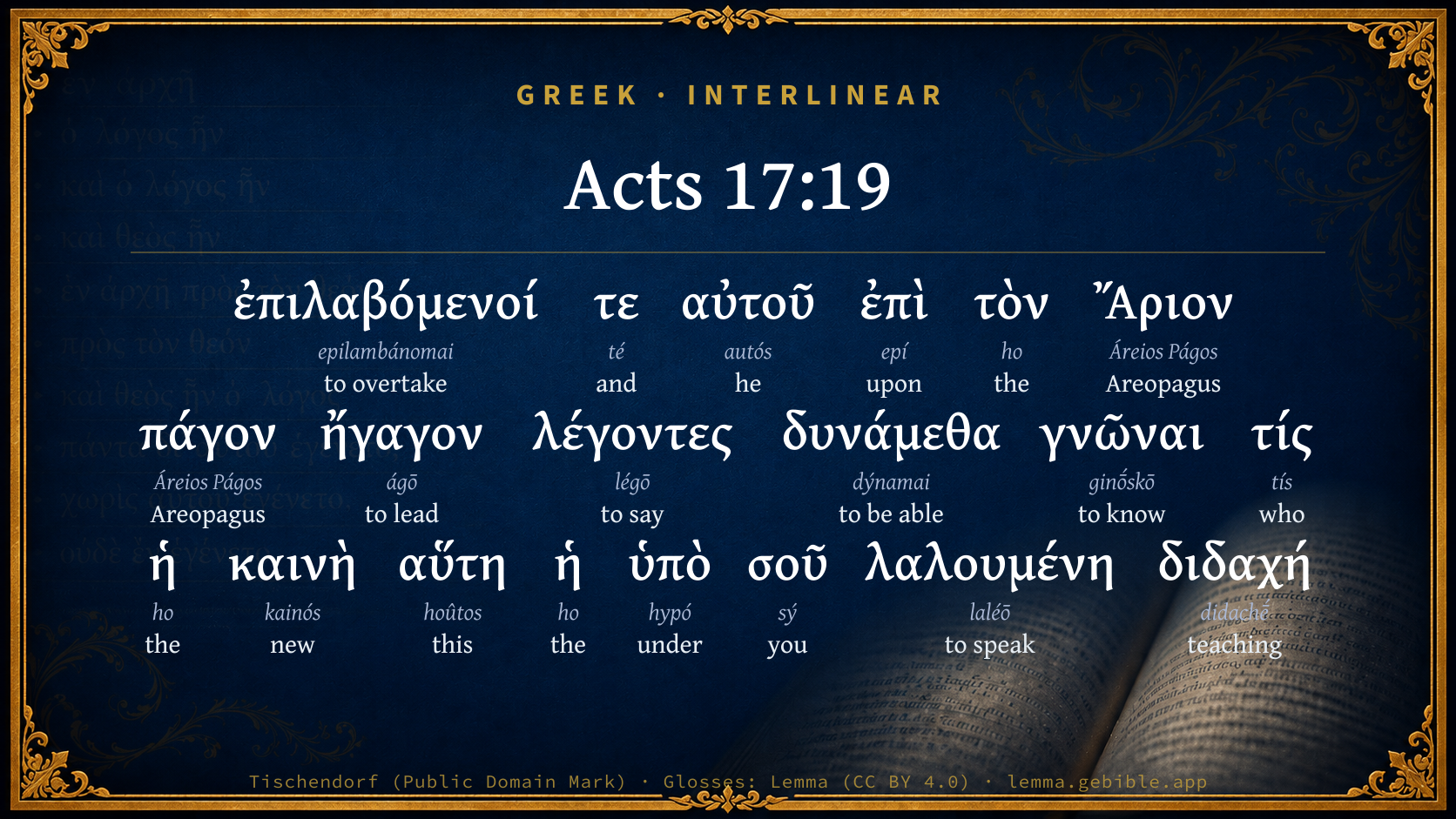
Greek (Tischendorf 8th ed.) Acts 17:19 appears in the Greek New Testament. The text above is from the Tischendorf 8th edition. Each word links to its Strong’s number and a concise gloss. Click any word for its full Thayer’s Greek Lexicon entry.
Download image
Cite this verse

Acts 17:19 (World English Bible). Public Domain. Lemma interlinear Bible study tool, https://lemma.gebible.app/v/acts/17/19.

Show BibTeX & RIS
BibTeX
RIS
English Translation
They took hold of him, and brought him to the Areopagus, saying, "May we know what this new teaching is, which is spoken by you?
World English Bible · Public Domain
Highlights
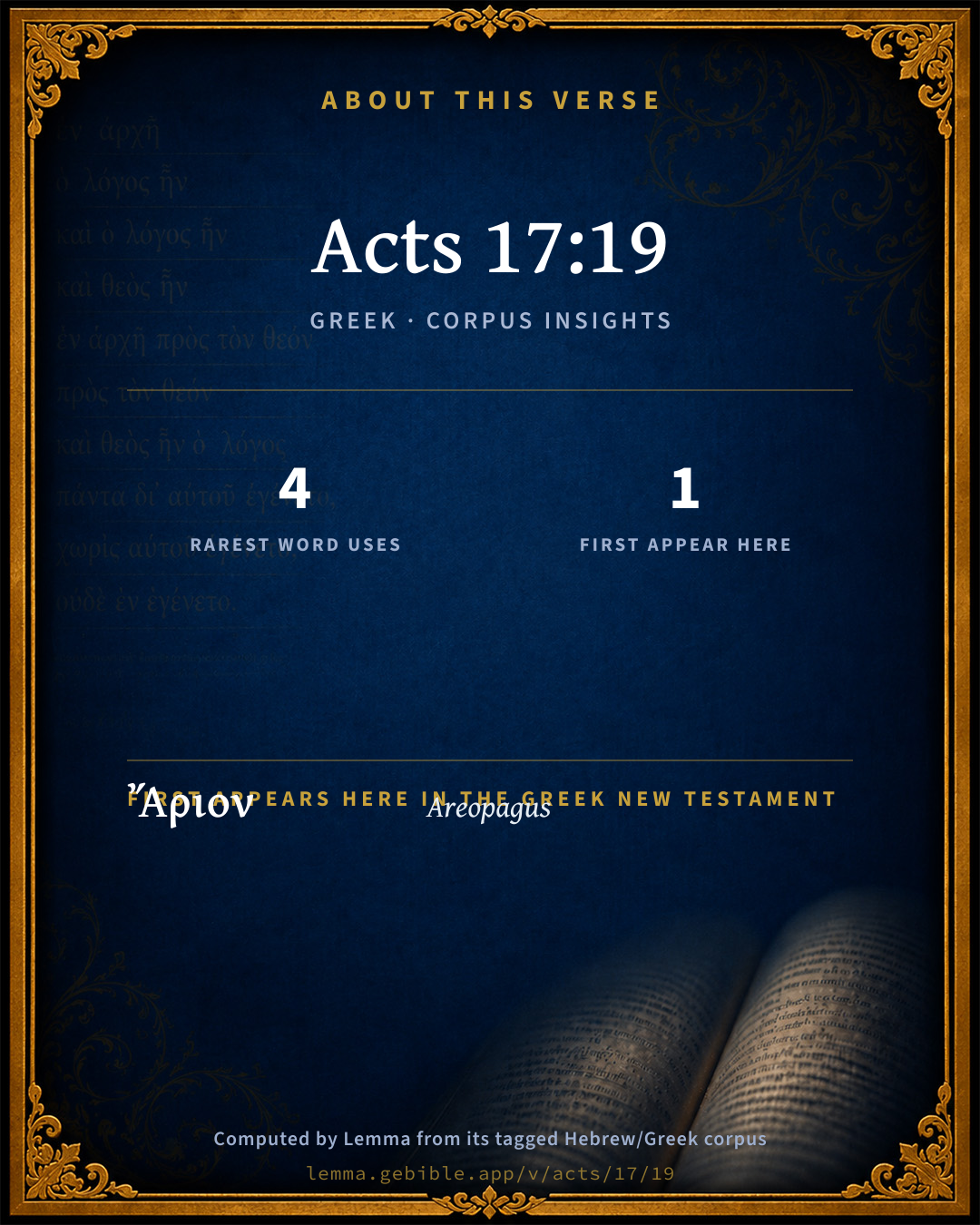
  • 1 first appearance in the Greek New Testament
Full analysis ↓
Download a study sheet

One document with this verse’s original text, its word-by-word gloss line, the meaning frame, cross-references with their text, attributed commentary, and full source and license credits — printable, and it pastes into notes with its structure intact.

This verse Autodidact and up

Study sheet (.html) Plain text (.txt)

A passage Seminary Student

Up to 50 verses in one chapter. A passage sheet keeps up to 6 commentary sources and 12 cross-references per verse, in the order this page ranks them, and says so on the sheet whenever that leaves anything out. Ask for a single verse and you get the Autodidact verse sheet above.

Everything on this page stays free to read, with no account — the sheet is a download of what is already on screen, not access to it.

Want to remove ads? Support Godless Engineer
Compare translations 3

The same verse in 3 English versions, stacked beneath the original-language interlinear above. Click any original word for its lexicon entry.

Each is an independent rendering of the whole verse — the interlinear is not word-aligned to these translations.

Highlighted words mark where these versions differ — a whole-verse word diff, not a word-by-word alignment.

  • World English Bible Public Domain
    They took hold of him, and brought him to the Areopagus, saying, "May we know what this new teaching is, which is spoken by you?
  • King James Version Public Domain
    And they took him, and brought him unto Areopagus, saying, May we know what this new doctrine, whereof thou speakest, is?
  • unfoldingWord Literal Text CC BY-SA 4.0
    And taking hold of him, they brought him to the Areopagus, saying, “Are we able to know what this new teaching that is being spoken by you?

unfoldingWord Literal Text — © unfoldingWord, licensed CC BY-SA 4.0. Word-aligned USFM3 via Door43 (git.door43.org/unfoldingWord/en_ult).

Versions to compare (up to 4)

3 of 4 selected

Show all 19 translations

Every available English version of this verse, each an independent rendering of the whole verse.

  • World English Bible Public Domain
    They took hold of him, and brought him to the Areopagus, saying, "May we know what this new teaching is, which is spoken by you?
  • Berean Standard Bible Public Domain
    So they took Paul and brought him to the Areopagus, where they asked him, “May we know what this new teaching is that you are presenting?
  • Majority Standard Bible Public Domain
    So they took Paul and brought him to the Areopagus, where they asked him, “May we know what this new teaching is that you are presenting?
  • King James Version Public Domain
    And they took him, and brought him unto Areopagus, saying, May we know what this new doctrine, whereof thou speakest, is?
  • American Standard Version (1901) Public Domain
    And they took hold of him, and brought him unto the Areopagus, saying, May we know what this new teaching is, which is spoken by thee?
  • Revised Version (1885) Public Domain
    And they took hold of him, and brought him unto the Areopagus, saying, May we know what this new teaching is, which is spoken by thee?
  • Geneva Bible (1599) Public Domain
    And they tooke him, and brought him into Mars streete, saying, May we not know, what this newe doctrine, whereof thou speakest, is?
  • Douay-Rheims (1899) Public Domain
    And taking him, they brought him to the Areopagus, saying: May we know what this new doctrine is, which thou speakest of?
  • Young's Literal Translation Public Domain
    having also taken him, unto the Areopagus they brought `him', saying, `Are we able to know what `is' this new teaching that is spoken by thee,
  • Literal Standard Version CC BY-SA 4.0
    having also taken him, they brought [him] to the Areopagus, saying, “Are we able to know what this new teaching [is] that is spoken by you,
  • Unlocked Literal Bible CC BY-SA 4.0
    They took Paul and brought him to the Areopagus, saying, “May we know this new teaching which you were speaking?
  • unfoldingWord Literal Text CC BY-SA 4.0
    And taking hold of him, they brought him to the Areopagus, saying, “Are we able to know what this new teaching that is being spoken by you?
  • Darby Bible Public Domain
    And having taken hold on him they brought [him] to Areopagus, saying, Might we know what this new doctrine which is spoken by thee [is]?
  • World Messianic Bible Public Domain
    They took hold of him and brought him to the Areopagus, saying, “May we know what this new teaching is, which you are speaking about?
  • Webster's Bible Public Domain
    And they took him, and brought him to Areopagus, saying, May we know what this new doctrine is, of which thou speakest?
  • Free Bible Version CC BY-SA 4.0
    So they took him to the Areopagus, and asked him, “Please tell us about this new teaching that you're promoting.
  • Bible in Basic English Public Domain
    And they took him to Mars' Hill, saying, Will you make clear to us what is this new teaching of yours?
  • Text-Critical English NT CC BY 4.0
    So they took him and brought him to the Areopagus, saying, “May we know what this new teaching is that yoʋ are presenting?
  • Tyndale New Testament (1534) Public Domain
    And they toke him and brought him into Marsestrete sayinge: maye we not knowe what this newe doctrine wher of thou speakest is?

Literal Standard Version (2020), Covenant Press — licensed CC BY-SA 4.0. Text via the HelloAO Bible API (eBible.org). Unlocked Literal Bible (unfoldingWord) — licensed CC BY-SA 4.0. Text via the HelloAO Bible API (eBible.org). unfoldingWord Literal Text — © unfoldingWord, licensed CC BY-SA 4.0. Word-aligned USFM3 via Door43 (git.door43.org/unfoldingWord/en_ult). Free Bible Version, Dr. Jonathan Gallagher — licensed CC BY-SA 4.0. Text via the HelloAO Bible API (eBible.org).

Word by word

More ways to search: Search by grammar → Find every occurrence → Compare this word →

Practice this passage: Drill this verse → Learn its vocabulary →

Ἄριον
Áreios Págos
G697
“Areopagus”
Noun, Accusative, Singular, Masculine
Part of Speech
Noun
Case
Accusative
Number
Singular
Gender
Masculine
Full Thayer's Definition

Origin: from Ares (the name of the Greek deity of war) and a derivative of G4078

TDNT: None

Areopagus = "martial peak" 1. a rocky height in the city of Athens, opposite the western end of the Acropolis toward the west.
  1. ἐπιλαβόμενοί epilambánomai G1949 “to overtake” Verb, Aorist, Middle deponent, Participle, Nominative, Plural, Masculine
  2. τε té G5037 “and” Particle
  3. αὐτοῦ autós G846 “he” Personal pronoun, Genitive, Singular, Masculine
  4. ἐπὶ epí G1909 “upon” Preposition
  5. τὸν ho G3588 “the” Article, Accusative, Singular, Masculine
  6. πάγον Áreios Págos G697 “Areopagus” Noun, Accusative, Singular, Masculine
  7. ἤγαγον ágō G71 “to lead” Verb, Aorist, Active, Indicative, 3rd person, Plural
  8. λέγοντες légō G3004 “to say” Verb, Present, Active, Participle, Nominative, Plural, Masculine
  9. δυνάμεθα dýnamai G1410 “to be able” Verb, Present, Middle or Passive deponent, Indicative, 1st person, Plural
  10. γνῶναι ginṓskō G1097 “to know” Verb, Aorist, Active, Infinitive
  11. τίς tís G5101 “who” Interrogative pronoun, Nominative, Singular, Feminine
  12. ἡ ho G3588 “the” Article, Nominative, Singular, Feminine
  13. καινὴ kainós G2537 “new” Adjective, Nominative, Singular, Feminine
  14. αὕτη hoûtos G3778 “this” Demonstrative pronoun, Nominative, Singular, Feminine
  15. ἡ ho G3588 “the” Article, Nominative, Singular, Feminine
  16. ὑπὸ hypó G5259 “under” Preposition
  17. σοῦ sý G4771 “you” Personal pronoun, 2nd person, Genitive, Singular
  18. λαλουμένη laléō G2980 “to speak” Verb, Present, Passive, Participle, Nominative, Singular, Feminine
  19. διδαχή didachḗ G1322 “teaching” Noun, Nominative, Singular, Feminine

About this verse

These counts appear in no published source. They are computed here, from the morphology-tagged text and Lemma’s own curated glosses. What Lemma adds →

20
words
17
distinct lemmas
Acts
section

Notable vocabulary

The rarest word here is Ἄριον Areopagus G697 — appearing just 4 times in the whole Greek New Testament.

First appearance in Scripture

This word makes its first canonical appearance in the Greek New Testament here:

  • Ἄριον Areopagus G697

Shared distinctive vocabulary

Ἄριον Areopagus G697 occurs in 2 verses of the Greek New Testament. Also found in:
Repetition

Words recur within this verse:

  • Ἄριον Areopagus G697 ×2
  • τὸν the G3588 ×3

Cross-references

9

Topical passages linked to Acts 17:19 in the Treasury of Scripture Knowledge — connected by theme and wording, ordered by reader-vote popularity; previews shown in the World English Bible.

  • Mark 1:27 They were all amazed, so that they questioned among themselves, saying, "What is this? A new teaching? For with authority he commands even the unclean spirits, and they obey him!"
  • Acts 17:22 Paul stood in the middle of the Areopagus, and said, "You men of Athens, I perceive that you are very religious in all things.
  • Acts 24:24 But after some days, Felix came with Drusilla, his wife, who was a Jewess, and sent for Paul, and heard him concerning the faith in Christ Jesus.
  • Acts 25:22 Agrippa said to Festus, "I also would like to hear the man myself." "Tomorrow," he said, "you shall hear him."
  • Matthew 10:18 Yes, and you will be brought before governors and kings for my sake, for a testimony to them and to the Gentiles.
  • John 13:34 A new commandment I give to you, that you love one another, just like I have loved you; that you also love one another.
  • Acts 17:20 For you bring certain strange things to our ears. We want to know therefore what these things mean."
  • Acts 26:1 Agrippa said to Paul, "You may speak for yourself." Then Paul stretched out his hand, and made his defense.
  • 1 John 2:7–8 Brothers, I write no new commandment to you, but an old commandment which you had from the beginning. The old commandment is the word which you heard from the beginning.

Cross-references courtesy of OpenBible.info (CC BY 4.0).

Commentary

Notes on Acts 17:19 from classic Christian and Jewish commentators (each source and its license shown beneath its notes). The classic Christian expositions comment on the surrounding passage and are grouped to its opening verse, so a note may address several verses; the Jewish commentaries on the Tanakh (Rashi and others) are per-verse, so they appear only where the commentator wrote on this verse.

Lemma curates 59 commentaries, every one of them public domain or Creative Commons licensed, each selected and text-cleaned for this edition rather than reprinted as found. About our sources →

Joseph Benson's Commentary

Act 17:19-21. And — The crowd increasing to a greater number than could conveniently hear him, in the place where they then were; they took and brought him unto Areopagus — Or, the hill of Mars, dedicated to Mars, the heathen god of war, the place where the Athenians held their supreme court of judicature, of which the original number of judges was twelve, but it was afterward increased to three hundred, who were generally men of the greatest families in Athens, and were famed for justice and integrity. Paul, however, was certainly not carried thither to be tried as a criminal, but to be heard discoursing concerning his new doctrine: for they said, May we know what this new doctrine is? For thou bringest certain strange things to our ears — Exceedingly different from what we have ever received from any of those many professors, of various learning, which this city has produced: we would know, therefore, what these things mean — And wish to hear them from thine own mouth, rather than by the uncertain report of others. This course, it must be observed, the Athenians took with Paul, not from the love of truth, but from mere curiosity: for, as the historian proceeds to observe, all the Athenians, and strangers sojourning there — And catching their distemper; spent their time in nothing else but either to tell — To others; or to hear — For themselves; some new thing — Greek, τι καινοτερον, literally, some newer thing. New things quickly grew cheap, and they wanted those that were newer still. The apostle, therefore, “being thus called to declare the new doctrine whereof he spake, to an assembly consisting of senators, philosophers, rhetoricians, and statesmen, willingly embraced the opportunity; and, in a most eloquent discourse, prepared his illustrious auditors for receiving that doctrine which appeared to them so strange, by showing them the absurdity of the commonly-received idolatry, and by speaking on that delicate subject with an address, and temper, and strength of reasoning, which would have done honour to the greatest orators of Greece or Rome.” — Macknight.

Joseph Benson's Commentary on the Old and New Testaments (1811–1818) — public domain. Text from a community e-Sword module.

Bengel's Gnomon

Johann Albrecht Bengel

Act 17:19. Ἄρειον πάγον) The court of justice was held on a hill (in Greek πάγος) opposite the citadel of Cecrops, outside the city, and received its appellation from Mars (Ἄρης). Thither they brought Paul, almost as if he were one to be put on his trial.—δυνάμεθα γνῶναι) A formula of questioning, as among the Latins, Possumne scire? Moreover it has, in the intention of these Attic questioners, a degree of irony; for a “seed-picker,” such as they supposed Paul to be, is full of chinks [Terence Eun. i. 2, 25, plenus rimarum, one who can keep nothing to himself]: nor did they think that anything could be said to them, which they did not know thoroughly before.—καινὴ) They desire to hear, if he has anything new.—ἡ ὑπὸ σοῦ λαλουμένη, which is spoken of by thee) deliberately and earnestly.

Bengel's Gnomon of the New Testament — English translation (T&T Clark, Edinburgh, 1860) — public domain. Text from a community e-Sword module.

Meyer's Critical & Exegetical Commentary

Heinrich August Wilhelm Meyer

Act_17:19-20. Ἐπιγαβόμενοι] Grotius aptly says: manu leniter prehensum. Comp. Act_9:27, Act_23:19. Adroitly confiding politeness. Act_17:21 proves that a violent seizure and carrying away to judicial examination is not indicated, as Adami (see in Wolf) and others imagined, but that the object in view was simply to satisfy the curiosity of the people flocking to the Areopagus. And this is evinced by the whole proceedings, which show no trace of a judicial process, ending as they did partly with ridicule and partly with polite dismissal (Act_17:31), after which Paul departed unhindered. Besides, the Athenians were very indulgent to the introduction of foreign, particularly Oriental, worships (Strabo, x. p. 474; Philostr. Vit. Apollon. vi. 7; Hermann, gottesd. Alterth. § 12), provided only there was not conjoined with it rejection of the native gods, such as Socrates was formerly accused of. To this the assertion of Josephus, c. Revelation 2, is to be limited: νόμῳ δʼ ἦν τοῦτο παρʼ αὐτοῖς κεκωλυμένον καὶ τιμωρία κατὰ τῶν ξένον εἰσαγόντων Θεὸν ὥριστο θάνατος,which, perhaps, is merely a generalization from the history of Socrates. And certainly Paul, as the wisdom of his speech (Act_17:22 ff.) attests, prudently withheld a direct condemnatory judgment of the Athenian gods. Notwithstanding, Baur and Zeller have again insisted on a judicial process in the Areopagusalleging that the legend of Dionysius the Areopagite, as the first bishop of Athens (Eus. iv. 23), had given rise to the whole history; that there was a wish to procure for Paul an opportunity, as solemn as possible, for the exposition of his teaching, an arena analogous to the Sanhedrim (Zeller), etc.

Concerning the Ἆρειος πάγος, collis Martins, so called ὅτι πρῶτος Ἆρης ἐνταῦθα ἐκρίθη (Paus. i. 28. 5), the seat of the supreme judicature of Athens, situated to the west of the Acropolis, and concerning the institution and authority of that tribunal, see Meursius, de Areop. Lugd. Bat. 1624; Böckh, de Areop. Berol. 1826; Hermann, Staatsalterth. § 105. 108. On the present locality, see Robinson, I. p. 11 f.; Forbiger, Geogr. III. p. 937 ff.

δυνάμεθα γνῶναι κ.τ.λ.] invitation in the form of a courteous question, by way of securing the contemplated enjoyment.

τίς ἡ καινὴ κ.τ.λ] what (as respects its more precise contents) this new doctrine (namely), that which is being announced by you. In the repetition of the article (Stallb. ad Plat. Rep. p. 407 B) there is here implied a pert, ironical emphasis.

ξενίζοντα] startling. ξενίζω οὐ μόνον τὸ ξένον ὑποδέχομαι, ἀλλὰ καὶ ἐκπλήττω. Thom. Mag. Comp. Polyb. iii. 114. 4 : ξενίζουσα πρόσοψις κ. καταπληκτική, Diod. Sic. xii. 53; 2Ma_9:6; 3Ma_7:3.

εἰσφέρεις] namely, whilst you are here, hence the present.

τί ἂν θέλοι ταῦτα εἶναι] see on Act_17:18; Act_2:12, and Tittmann, Synon. N.T. p. 129 f. The plural ταῦτα indicates the individual points, after the collective character of which τί inquires. Krüger, § lxi. 8. 2; Stallbaum, ad Plat. Gorg. p. 508 C, Euthyphr. p. 15 A.

Meyer — Critical and Exegetical Commentary on the New Testament — English translation by Peter Christie, edited by Frederick Crombie (T&T Clark, 1880) — public domain. Text from a community e-Sword module.

Expositor's Greek Testament

ed. W. Robertson Nicoll

Act 17:19 . ἐπιλαβ .: as to whether we regard this as done with hostile intent, or not, will depend upon the view taken of the meaning of the Areopagus. If the latter means “the Hill of Mars,” to which the Apostle was taken for a quiet hearing and for unimportant discussion, then the former is clearly inadmissible; if, however, the Areopagus meant the Council of Areopagus, then that action would seem to have been indicative at least of malice and dislike. The verb in the N.T. is used only in the middle, with accusative or genitive, and most frequently by St. Luke, five times in his Gospel, seven times in Acts, twice by St. Paul, only once by St. Matthew and by St. Mark. In each case it can be determined by the context whether it is used in a favourable or unfavourable sense. So too in LXX (always with genitive), where it is frequently used, the context alone decides. Certainly Act 9:27 presents a close verbal parallel in language, as the participle ἐπιλ . is followed as here by ἤγαγον (Weiss), but the context there expresses beyond all doubt a friendly action. Grotius (so Weiss, Wendt, Felten, Zöckler, Bethge) attributes friendliness to the action here, and renders “manu leniter prehensum,” so too F. C. Conybeare, “Areopagus,” Hastings’ B.D., renders it “took Paul by the hand,” but in three of the four parallels to which he refers χείρ is expressed, and for the fourth see above. But the view taken of the following words will help us to decide, Ramsay, St. Paul , p. 245, and Expositor , September, 1895, pp. 216, 217. ἐπὶ τὸν Ἄ . πάγον , Curtius, Gesammelte Abhandlungen , ii., p. 528, note, and Ramsay, Expositor, u. s. , p. 217, point out that ἐπί with accusative would be the correct expression for taking any one before an official court, cf. Act 9:21 , Act 16:19 , Act 17:6 , Act 18:12 a regular Lucan preposition in this sense cf. also Herod., iii. 46, 156; viii. 79. But it does not therefore follow that a regular trial was instituted, as Chrys., Theophylact and others have held, since there is nothing in the context to indicate this. But the form of expression certainly does seem to indicate that Paul was taken not to the Hill of Mars, as is generally held, but before a court or council. And there is substantial evidence for believing that the term Areopagus (as Blass admits) was not merely local, but that it was sometimes used as = the Council or Court of Areopagus, cf. Cicero, Ad Atticum , i., 14, 5; De Nat. Deorum , ii., 29; Rep. , i., 27. Moreover, there is good reason to believe that the council, although deriving its name from the hill, did not always meet on the hill, and also that it had the power of taking official action in questions bearing upon public teaching in the city ( cf. Renan, Saint Paul , pp. 193, 194, and authorities cited). It is therefore not an improbable inference that Paul would be brought before such a court for inquiry into his teaching; beyond this inference perhaps we cannot go; even to call the inquiry a προδικασία (so Curtius) may be to apply a technical term unwarranted by the context, which bears no trace of a criminal procedure, cf. Curtius, u. s. , pp. 528, 529; Ramsay, u. s. ; Plumptre and Rendall, in loco . But where did the council meet for the discharge of such duties as inquiries into the qualification of teachers, as a public court for the maintenance of public order? Probably in the Stoa Basileios; here Demosthenes informs us that some of its duties were transacted (see Expositor , October, 1895, p. 272, and Curtius, u. s. , p. 528), and the scene before us is full of the life of the Agora with the corona of people thronging to listen, rather than of the sacred or solemn associations of the Hill of Mars, or of the quietude of a spot far removed from the busy life of the market-place. So too the name “Areopagus” might have been easily transferred to the council sitting in a place other than the hill, so that ἡ βουλὴ ἡ ἐξ Ἀ . π . might easily become Ἄρειος Πάγος informally and colloquially, and the word as used here by St. Luke may really be another proof that, as in σπερμολόγος , the author catches the very word which the Athenians would use, Ramsay, Expositor , September, 1895, p. 216, and Renan, u. s. , p. 194, note. But it has further been urged both by Curtius and Ramsay (so also Renan, u. s. ) that the Hill of Mars would be a most inconvenient place for public assemblies and speakers, see Ramsay, u. s. , p. 213, and Curtius, u. s. , p. 529, and even if the spot had been suitable for such purposes, there would have been a want of fitness in the Athenians taking this σπερμολόγος to harangue them on a spot so inseparably associated with the dignity and glory of their city; see also below on Act 17:22 ; Act 17:33 . Δυναμεθα γνῶναι : like the Latin, Possum scire? the question may have been asked in courtesy, or in sarcasm, or ironically; in the repetition of the article the irony may be accentuated. ἡ ὑπὸ δοῦ λαλ .: “which it spoken by thee,” R.V., the Apostle was not speaking about the doctrine, A.V., his words were the doctrine (Lumby). Felten regards the question as courteously put, and sees in it a decisive proof that Paul was not put upon his trial, since a man could not be tried on a charge of which his accusers had no knowledge. But this would not prevent a preliminary inquiry of some kind before the court, prompted by dislike or suspicion.

The Expositor's Greek Testament, edited by W. Robertson Nicoll (1897–1910) — public domain. Text from a community e-Sword module.

Geneva Bible (1599)

Geneva Bible translators

This was a place called as you would say, Mars hill, where the judges sat which were called Areopagus, upon weighty affairs, which in old time arraigned Socrates, and afterward condemned him of impiety.

Geneva Bible (1599) marginal notes — public domain. Text via Bolls.life.

Jamieson, Fausset & Brown

Robert Jamieson, A. R. Fausset & David Brown

they took him, and brought him to Areopagus--"the hill where the most awful court of judicature had sat from time immemorial to pass sentence on the greatest criminals, and to decide on the most solemn questions connected with religion. No place in Athens was so suitable for a discourse on the mysteries of religion" [HOWSON]. The apostle, however, was not here on his trial, but to expound more fully what he had thrown out in broken conversations in the Agora.

Jamieson, Fausset & Brown — Commentary Critical and Explanatory on the Whole Bible (1871) — public domain (CC PDM 1.0). Text via the HelloAO Bible API.

Adam Clarke's Commentary

Verse 19. They took him, and brought him unto Areopagus] The Areopagus was a hill not far from the Acropolis, already described, where the supreme court of justice was held; one of the most sacred and reputable courts that had ever existed in the Gentile world. It had its name, αρειος παγος, Areopagus, or the Hill of Mars, or Ares, from the circumstance, according to poetic fiction, of Mars being tried there, by a court of twelve gods, for the murder of Halirrhothius, son of Neptune: the meaning of which is, that Ares, a Thessalian prince, having slain Halirrhothius, the son of a neighbouring prince, for having violated his daughter Alcippe, was here tried by twelve judges, by whom he was honourably acquitted: in the Athenian laws the death of the ravisher was the regular forfeiture for his crime. The justice administered in this court was so strict and impartial, that, it was generally allowed, both the plaintiff and defendant departed satisfied with the decision. "Innocence, when summoned before it, appeared without apprehension; and the guilty, convicted and condemned, retired with out daring to murmur." The place in which the judges sat was uncovered; and they held their sittings by night, to the end that nothing might distract their minds from the great business on which they were to decide; and that the sight of the accused might not affect them either with pity or aversion. In reference to this, all pleaders were strictly forbidden to use any means whatever to excite either pity or aversion, or to affect the passions; every thing being confined to simple relation, or statement of facts. When the two parties were produced before the court, they were placed between the bleeding members of victims slain on the occasion, and were obliged to take an oath, accompanied by horrible imprecations on themselves and families, that they would testify nothing but truth. These parties called to witness the eumenides, or furies, the punishers of the perjured in the infernal world; and, to make the greater impression on the mind of the party swearing, the temple dedicated to these infernal deities was contiguous to the court, so that they appeared as if witnessing the oaths and recording the appeal made to themselves. When the case was fully heard, the judges gave their decision by throwing down their flint pebbles, on two boards or tables, one of which was for the condemnation, the other for the acquittal, of the person in question.

Adam Clarke's Commentary on the Bible (1810–1826) — public domain. Text from a community e-Sword/MySword module.

John Calvin's Commentaries

19. They brought him to Mars’ Street. Though this verse a place appointed for judgment, yet Luke doth not mean that Paul was brought before the seat of the judges, that he might plead his cause before the judges of Mars’ Street. But that he was brought thither, where was most commonly a great assembly of people, that the serious disputation might be had before a great and famous audience. And admit we grant that he was brought before the judgment-seat, yet the end doth declare that he was not presented to the judges, but that he had free liberty to speak as before an audience. And that which followeth shortly after, touching the nature and conditions [manners] of the men of Athens, doth sufficiently declare that their curiosity was the cause; that Paul had such audience given him, that he had such a famous place granted him to preach Christ in, that so many came together. For in any other place it had been a crime worthy of death, to speak in the market or in any other public place, having gathered a company of people together; but there, because those who did carry about trifles had liberty granted them to prate, by reason of the immoderate desire they had to hear news, Paul was permitted to intreat of the mysteries of faith, being requested.

Gave themselves to nothing else. The two vices which Luke reciteth do almost go together. For it falleth out seldom that those who are desirous of novelties are not also babblers. For that saying of Horace is most true, “Fly a demander of questions, for the same is also a blab.” And surely we see that curious men are like rent barrels. Furthermore, both vices came of idleness; not only because the philosophers spent whole days in disputing, but because the common sort was too much set upon novelty; neither was there any craftsman so base there, which would not thrust in himself to set in order the status of Grecia. And surely that which Luke saith here is witnessed by all writers, both Greek and Latin, that there was nothing more light, covetous, or froward than that people. Wherefore, there could never be any certain government set down in that city, which was, notwithstanding, the mistress of sciences. Therefore, in principal power, they had, notwithstanding, no long liberty; neither did they ever cease off from attempting things and making many hurly-burlies, until they brought themselves and all Grecia to utter ruin. For when their state was decayed, yet did not they forsake their boldness. Therefore, Cicero doth laugh at their folly, because they did no less fiercely set forth their decrees then, than when they were lords over Grecia. Now, though there were small hope to do any good among curious men, yet Paul did not neglect the opportunity, if, peradventure, he might gain some of a great company to Christ. Neither was this any small praise for the gospel in the most noble place of the city, and, as it were, in a common theater, to refute and openly to reprove all forged and false worshippings, which had reigned there even until this day.

John Calvin's Commentaries (1540-1563) — public domain. Text from the Calvin Translation Society English edition (1840s-50s) via the Christian Classics Ethereal Library (ccel.org). Calvin's coverage is partial (roughly two-thirds of the Bible); uncommented books and verses are honest gaps, never fabricated. The 19th-century editor's footnotes and remarks are omitted so the notes are faithfully Calvin's own voice.

Ellicott's Commentary for English Readers

(19) They took him, and brought him unto Areopagus.—The name may stand either for the Hill of Mars, simply as a locality, or for the Court which sat there, and was known as the Court of the Areopagus, and which, as the oldest and most revered tribunal in Athens, owing its origin to Athena, and connected with the story of Orestes and the worship of the propitiated Erinnyes (the Avengers) as the Eumenides (the Gentle Ones), still continued to exercise jurisdiction in all matters connected with the religion of the state, and numbered among its members men of the highest official rank. It had originally consisted only of those who had filled the office of Archon and were over sixty years of age. Its supreme authority had been in some measure limited by Pericles, and it was as the organ of the party who opposed the ideas of freedom and progress of which he was the representative, that Æschylus wrote the tragedy of the Eumenides, in which the divine authority of the Court was impressed upon men’s minds. Here, however, the narrative that follows presents no trace of a formal trial, and hence it has been questioned whether the Apostle was brought before the Court of the Areopagus. Unless, however, there had been some intention of a trial, there seems no reason for their taking him to the Areopagus rather than to the Pnyx or elsewhere; and the mention of a member of the Court as converted by St. Paul’s preaching, makes it probable that the Court was actually sitting at the time. The most natural explanation of the apparent difficulty is, that as the charge of bringing in “strange deities” was one which came under the jurisdiction of the Areopagus Court, the crowd who seized on St. Paul hurried him there, not presenting a formal indictment, but calling for a preliminary inquiry, that his speech accordingly, though of the nature of an apologia, was not an answer to a distinct accusation, and that having heard it, the Court looked on the matter as calling for no special action, and passed to the order of the day.

May we know . . .?—The form of the question, courteous in semblance, but with a slight touch of sarcasm, is eminently characteristic in itself, and shows also that there was no formal accusation, though the words that followed suggested the thought that there possibly might be materials for one. What had been said was “strange” enough to require an explanation.

A Bible Commentary for English Readers, edited by Charles John Ellicott (1878–1897) — public domain. Text from a community e-Sword module.

The Cambridge Bible for Schools and Colleges

gen. ed. J. J. S. Perowne

19. And they took him] Better, took hold of him. (As R. V.) But there is no need to suppose that any violence was used or intended. The same verb is used often of taking by the hand to aid or protect (so Mar_8:23; Act_23:19), and is the word by which the action of Barnabas is described (Act_9:27) when “he took Paul and brought him to the apostles.” Moreover the whole context shews that the action of the crowd was in no sense that of an arrest, for we read (Act_17:33) when his speech was done “Paul departed from among them,” evidently having been under no kind of restraint.

and brought him unto Areopagus] More clearly expressed if we read “the Areopagus.” This place, the name of which is translated “Mars’ hill” below in the text and here in the margin of the A.V., was an eminence to the west of the Acropolis at Athens. It was famous in classic literature as the meeting-place of the Athenian council of Areopagus which took its name from the place where it met. To this hill of Mars (Ares) the philosophers led St Paul, probably at a time when it was unoccupied (though some suppose that the court was sitting), that they might the better hear him away from the bustle of the market-place, and that he might more conveniently address a larger audience.

May we know] The verb here rendered “may” = literally “are we able.” But there is no doubt that its force is well given by the A.V. For the literal force “to be able” often merged itself in that of “to wish” or “to be willing.” Cp. Luk_11:7, where the verb is translated “I cannot (= I am not able to) rise and give thee,” but the sense is “I don’t wish to rise,” for after importunity he does arise and do all that is asked. The Stoics and Epicureans were not likely to doubt their own ability to understand all that St Paul might say to them.

what this new doctrine, whereof thou speakest, is] Better (with R. V.), “what this new doctrine is which is spoken by thee.” The sense conveyed by the verb (λαλεῖν) is often in N. T. that of announcing or publishing, and the word is not unfrequently used of messages spoken by God or by his prophets (cp. Luk_1:45; Luk_1:55; Luk_1:70; Luk_24:25; Act_3:21; Act_3:24; Jas_5:10). The Apostle was not speaking to the Athenians about the doctrine, his words were the doctrine.

The Cambridge Bible for Schools and Colleges (gen. ed. J. J. S. Perowne; Cambridge University Press, 1878–1918) — public domain. Text from a community e-Sword module.

John Gill's Exposition

And they took him,.... Not that they laid hands on him, and carried him away by violence, as a derider of their gods, and an introducer of new ones, in order to punish him; but they invited him to go with them, and they took him along with them in a friendly manner, and had him to a more convenient place for preaching and disputation, and where were many learned men to hear and judge of his doctrine; and this appears from their desire to hear what his doctrine was, and from his quiet departure, after he had ended his discourse:

and brought him unto Areopagus. The Arabic version seems to understand this of a person, rendering it, "and brought him to the most skilful, and the judge of the doctors"; to be heard and examined before him, about the doctrine he preached, who was most capable of judging concerning it; and this might be Dionysius, who is called the Areopagite, and was converted by the apostle, Act 17:34. The Ethiopic version renders it, "they brought him to the house of their god"; to one of their idols' temple, the temple of Mars, which is not much amiss; for we are told (g), that Areopagus was a street in Athens, in which was the temple of Mars, from whence it had its name; but the Syriac version renders it best of all, "they brought him to the house of judgment, or "court of judicature", which is called Areopagus"; and so it is called "Martium judicium", or Mars's "court of judicature", by Apuleius (h), and "Martis curia", or the "court of Mars", by Juvenal (i), for it was a court where causes were tried, and the most ancient one with the Athenians, being instituted by Cerops, their first king; and is thought to be near as ancient, if not fully as ancient, yea, as more ancient than the sanhedrim, or the court of seventy elders, appointed by Moses among the Jews. It was called Areopagus, because Ares, or Mars, was the first that was judged there (k). The case was this, Alcippe, the daughter of Mars, being ravished by Habirrhothius, the son of Neptune, and caught by Mars in the very fact, was killed by him; upon which Neptune arraigned Mars for the murder, and tried him in this place, by a jury of twelve deities, by whom he was acquitted (l). Hither Paul was brought, not to be tried in a legal manner; for it does not appear that any charge was exhibited against him, or any legal process carried on, only an inquiry was made about his doctrine, and that only to gratify their curiosity:

saying, may we know what this new doctrine, whereof thou speakest, is? for they had never heard of Jesus, nor of salvation by him, nor of the resurrection of the dead; these were all new things to them, and therefore they were the more curious to ask after them, new things being what they were fond of: wherefore they call his doctrine new, not so much by way of reproach, as suggesting it to be a reason why they inquired after it, and why they desired him to give them some account of it; and that it should be a new doctrine with them, or if they reproached it with the charge of novelty, it need not be wondered at in them, when the Jews charged and reproached the doctrine of Christ in like manner, Mar 1:27.

(g) Alex. ab Alex. Genial. Dier. l. 3. c. 5. (h) Milesiarum 10. (i) Satyr. 5. (k) Pausaniae Attica, p. 52. (l) Apellodorus de deorum origine, l. 3, p. 193.

John Gill's Exposition of the Whole Bible (1746–1763) — public domain (CC PDM 1.0). Text via the HelloAO Bible API.

Trapp's Complete Commentary

John Trapp

19 And they took him, and brought him unto Areopagus, saying, May we know what this new doctrine, whereof thou speakest, is?

Ver. 19. Brought him unto Areopagus] A cruel court where Socrates lost his life for the very same crime that St Paul is here charged with; viz. an endeavour to introduce new deities. (Laertius.) That the apostle came off not only with safety, but some success (for Dionysius, one of the judges, was converted), see a sweet providence. Paul wanted a place to preach in; they brought him to Areopagus as a delinquent, where he hath an opportunity of doing God a great deal of good service. So Charles V, emperor, sent the confession of the Protestant Churches to divers princes of Europe to ask their opinions; hereby the gospel was exceedingly spread and propagated; which gave occasion to Luther to deride Pontificiorum stultam sapientiam, the foolish wisdom of the Papists, in a certain epistle to the elector of Saxony. (Scultet. Annal. 274.)

John Trapp, A Commentary or Exposition upon All the Books of the Old and New Testament (1647–1656) — public domain. Text from a community e-Sword module.

Albert Barnes' Notes on the Bible

And brought him unto Areopagus - Margin, or “Mars’ hill.” This was the place or court in which the Areopagites, the celebrated supreme judges of Athens, assembled. It was on a hill almost in the middle of the city; but nothing now remains by which we can determine the form or construction of the tribunal. The hill is almost entirely a mass of stone, and is not easily accessible, its sides being steep and abrupt. On many accounts this was the most celebrated tribunal in the world. Its decisions were distinguished for justice and correctness; nor was there any court in Greece in which so much confidence was placed. This court took cognizance of murders, impieties, and immoralities; they punished vices of all kinds, including idleness; they rewarded the virtuous; they were especially attentive to blasphemies against the gods, and to the performance of the sacred mysteries of religion. It was, therefore, with the greatest propriety that Paul was brought before this tribunal, as being regarded as a setter forth of strange gods, and as being supposed to wish to Introduce a new mode of worship. See Potter’s “Antiquities of Greece,” book 1, chapter 19; and Travels of Anacharsis, vol. i. 136, 185; ii. 292-295.

May we know - We would know. This seems to have been a respectful inquiry; and it does not appear that Paul was brought there for the sake of trial. There are no accusations; no witnesses; none of the forms of trial. They seem to have resorted thither because it was the place where the subject of religion was usually discussed, and because it was a place of confluence for the citizens, and judges, and wise men of Athens, and of foreigners. The design seems to have been, not to try him, but fairly to canvass the claims of his doctrines. See Act 17:21. It was just an instance of the inquisitive spirit of the people of Athens, willing to hear before they condemned, and to examine before they approved.

Albert Barnes' Notes on the Bible (1834–1885) — public domain. Text from a community e-Sword/MySword module.

Haydock's Catholic Bible Commentary

To the Areopagus. In this place sat the Athenian judges: but some think that by this word may be here signified, some large hall or court, joining to the Areopagus, where all sorts of people met. (Witham) --- The Areopagus was the supreme and most famous tribunal of all Greece, before which all great causes were tried. The persons who composed it were much renowned for their wisdom. Cicero, and many other Romans, were ambitious of the honour of being an Areopagite; but the power of Athens being now much diminished, this court had sunk in importance, and was now not much more than the shadow of a great name. (Calmet)

George Leo Haydock (1774–1849), Haydock's Catholic Family Bible and Commentary, 1859 edition — public domain. Excludes Psalms (Douay-Rheims chapter numbering differs from Protestant) and Deuterocanonical books (Catholic canon only).

Matthew Poole's English Annotations

The city of Athens was divided into five wards, or parts; one of which was called

Areopagus, from the temple of Mars, which stood upon a hill in it: nigh unto which temple, or in some part of it, was their chiefest court kept; and here they judged of all religious affairs: here they condemned Diagoras, Protagoras, and Socrates; and hither they bring Paul, though rather to inquire of him (there being the resort of learned men) concerning his doctrine, than to condemn him for it.

Matthew Poole's English Annotations on the Holy Bible (1683–1685) — public domain. Text from a community e-Sword/MySword module.

Whedon's Commentary on the Bible

Daniel D. Whedon

19. Took him—Not violence, but guidance.

Areopagus—Capriciously rendered by our translators Mars’ hill, in Act_17:22. The term is compounded of Αρειον, belonging to Mars, and παγος, hill, and the place was so named because, according to mythology, on that height the god Mars, having slain the son of Neptune, pleaded his case before the twelve great gods. Here the most ancient and reverend court known in Greece, consisting of the weightiest characters of the state, held its solemn sessions by night alone. Among its duties was the sacred one of judging the lawfulness of any religious rite or dogma. Paul was not arraigned before the court, but only invited by Athenian curiosity to speak in the place. Yet certainly one of the Areopagite judges was present, and, perhaps, others, in their judicial seats.

May we know—Literally, can we know, a most respectful form of request.

Daniel D. Whedon (gen. ed.), Commentary on the Old and New Testaments (1874–1909) — public domain. Text from a community e-Sword module.

The Pulpit Commentary

Took held of for took, A.V.; the Areopagus for Areopagus, A.V.; teaching is for doctrine is, A..V; which is spoken by thee for whereof thou speakest, A.V. Took hold of him. The word ejpilabesqai means simply to "take hold of" the hand, the hair, a garment, etc. The context alone decides whether this taking held is friendly or hostile. (for the former sense, see Mat_14:31; Mar_8:23; Luk_9:47 Luk_14:4; Act_9:27 Act_23:19, etc.; for the latter, Luk_23:26; Act_16:19 Act_18:17 Act_21:30, Act_21:33) Here the sense is well expressed by Grotius (quoted by Meyer): "Taking him gently by the hand." The Areopagas. Mars" Hill, close to the Agora ("the market") on the north, was so called from the legend that Mars was tried there before the gods for the murder of a son of Neptune. It is (says Lewin) a bare, rugged rock, approached at the southeastern corner by steps, of which sixteen still remain perfect. Its area at the top measures sixty paces by twenty-four, within which a quadrangle, sixteen paces square, is excavated and leveled for the court. The judges seem to have sat on benches tier above tier on the rising rock on the north side of the quadrangle. There were also seats on the east and west sides, and on the south on either side of the stairs. The Areopagus (the upper court) was the most august of all the courts at Athens. Socrates was tried and condemned before it for impiety. On the present occasion, there is no appearance of judicial proceedings, but they seem to have adjourned to the Areopagus from the Agora, as to a convenient place for quiet discussion.

Vers. 19-21. The passion for something new.

Demosthenes said, in one of his speeches, "Tell me, is it all you care for, to go about up and down the market, asking each other, "Is there any news? The restless inquisitiveness of the Athenian character had all along been proverbial. It did not alone distinguish the Athenians, though it gained a peculiar prominence in their case. It has returned upon man in such power, now that telegraphs and newspapers bind the nations together, that it may profitably be made the subject of Christian meditation.

I IT SOMETIMES COMES TO BE A DISEASE, A mental disease. A restlessness that we see illustrated in some children, who tire at once of their toys and crave for something new. We see it in the world of fashion, in which garments are speedily set aside, and the last new color, or shape, or material is eagerly sought. It is equally shown in the passion for the newest books, the last newspaper, the freshest opinion, the present excitement. It even afflicts Christian people, who in a crowd run after the newest revivalist, and cry for the latest novelty in doctrine or in Church method. It is a kind of feverish delirium, which palls the appetite, vitiates the taste, and makes patient continuance in well-doing impossible. It needs to be treated as a disease, and its influence in a family, in social life, and in the Church needs to be carefully checked. It is not progress that is usually sought, because true progress ever goes slowly; it is mere novelty that is sought. We may generally say that "the old is better.

II IT IS ONE OF THE SIGNS OF OVERDONE CIVILIZATION. It is a marked feature of a nation that is struggling up into civilization, that all its members must be workers, and none can be kept in idleness. To such a nation mere news is the amusement of its resting leisure hours; it cannot be the sober business of its days. But when nations have long reached the high levels of civilization, wealth has increased, multitudes can live in idleness, and, having nothing better to do, they may run after the latest stranger in art, or science, or music, or politics, or religion, and gathering round him say, "May we know what this new doctrine is, whereof thou speakest?" This is well illustrated in the case of the Athenians, who were surfeited with art and philosophy and superstitious religion. A city full of wealthy idlers, no doubt of good taste and cultured minds, who had nothing better to do than to run after the last new thing. The antidote for this evil is the preaching of the responsibility resting on every man to be a worker, and a worker for the general welfare. Nobody has any right to food and life save as they work, in some good way, for it. Workers soon get interest enough to stop their yearning for "something new." Illustrate how these things may be applied to Church life. Church work is the great remedy for the hindering passion for novelty.

III YET IT IS AN INDICATION OF THE UNIVERSAL ASPIRATION FOR IMMORTALITY. There is good in it; the evil of it lies

(1) in the forms it takes, and

(2) in the excessive degrees of its exercise.

That something in us all which cannot rest, which must seek for something more; which rises up above all bondages and limitations; which is as

An infant crying in the night, An infant crying for the light;

is but the aspiration of souls made in the image of God, who cry for permanence, for holiness, for rest, for God, and "can find no rest until they find rest in him." We must seek after something new, on and on, until we find God. And Scripture inspires us to such seeking; for it assures us that "Eye hath not seen, nor ear heard, neither hath the heart of man conceived, the things which God hath prepared for them that love him." And though, in measure, these have been revealed unto us by the Spirit, yet again we are led on by the Word; for "it doth not yet appear what we shall be: but we know that, when he shall appear, we shall be like him; for we shall see him as he is. R.T.

The Pulpit Commentary (1880–1919), ed. H.D.M. Spence-Jones & Joseph S. Exell — public domain. Text from a community e-Sword module.

John Wesley's Explanatory Notes

The Areopagus, or hill of Mars, (dedicated to Mars, the heathen God of war,) was the place where the Athenians held their supreme court of judicature. But it does not appear he was carried thither as a criminal. The original number of its Judges was twelve; but afterward it increased to three hundred. These were generally men of the greatest families in Athens, and were famed for justice and integrity.

John Wesley, Explanatory Notes Upon the Whole Bible (1754–1765) — public domain. Text via the GEBible commentary corpus.

Scofield Reference Notes

C. I. Scofield

Areopagus

Mars’ hill.

The Scofield Reference Bible (1917 edition), notes by C. I. Scofield — public domain. Text from a community e-Sword module.

Godbey's Commentary on the New Testament

William B. Godbey

19. They now lead Paul up to the summit of the Areopagus, that he may stand before that grave assembly of philosophers, orators, poets, statesmen, warriors and sages, recognized by the people as the legitimate custodians of all truth and proper arbiters of every new doctrine, or new religion which might be introduced. When I was there I climbed Mars’ Hill, that I might stand in the footprints of Paul when he addressed the most cultured congregation ever assembled beneath the skies.

William B. Godbey, Commentary on the New Testament (1896–1900) — public domain. Text from a community e-Sword module.

McGarvey & Pendleton's Commentaries

J. W. McGarvey

19-21. Notwithstanding the contempt with which Paul was regarded by some of his hearers, he succeeded in arresting the serious attention of a few. (19) " And they took him and led him to the Areopagus, saying, Can we know what this new doctrine is, of which you speak? (20) For you are bringing some strange things to our ears. We wish to know, therefore, what these things mean. (21) For all the Athenians, and the strangers dwelling there, spent their time in nothing else than telling or hearing something new. " The Areopagus was a rocky eminence, ascended by a flight of stone steps cut in the solid rock, on the summit of which were seats in the open air, where the judges, called Areopagites, held court for the trial of criminals, and of grave religious questions. The informal character of the proceedings on this occasion shows that it was not this court which had summoned Paul, but that those who were interested in hearing him selected this as a suitable place for the purpose. This is further evident from the note of explanation here appended by Luke, that the Athenians and strangers dwelling there, spent their time in nothing else than telling and hearing something new. It was more from curiosity, therefore, that they desired to hear him, than because they really expected to be benefited by what they would hear.

J. W. McGarvey (with Philip Y. Pendleton), Commentaries on the New Testament (The Fourfold Gospel, 1914; Acts; and the epistles) — public domain. Text from a community e-Sword/MySword module.

The People's New Testament

B. W. Johnson

19–21. Brought him unto the Areopagus. The Greek term for Mars' hill (verse 22). The hill was a place of assembly. There the supreme court of Athens met. There the courts that sat concerning religious matters convened. The associations had something to do, probably, with Paul being taken here to speak, though the meeting was informal and not official. The hill is about fifty feet high, and was then surrounded by the most glorious works of art in Athens.

To tell or hear some new thing. Demosthenes himself speaks of this propensity of the Athenians (Philipp. 1:43). It was in harmony with the spirit of the city that he should be called on to speak to gratify the curiosity of the populace.

B. W. Johnson's The People's New Testament with Notes (1889–1891) — public domain. Electronic text from the Christian Classics Ethereal Library (CCEL) ThML edition.

unfoldingWord translationNotes

Door43 World Missions Community

General Information:

Here the words "They" and "we" refer to the Epicurean and Stoic philosophers. (See: Exclusive and Inclusive "We")

General Information:

The words "him," "He" and "you" refer to Paul. (See: Acts 17:18)

They took ... brought him

This does not mean they arrested Paul. The philosophers invited Paul to speak formally to their leaders.

to the Areopagus

The "Areopagus" was the place where the leaders met. AT: "to the leaders that met on the Areopagus" (See: Metonymy)

the Areopagus, saying

Here the leaders on the Areopagus are speaking. This can stated as a new sentence. AT: "the Areopagus. The leaders said to Paul"

Areopagus

This is a prominent rock outcropping or hill in Athens upon which the supreme court of Athens may have met. (See: How to Translate Names)

For you bring some strange things to our ears

Paul's teachings about Jesus and the resurrection are spoken of as an object that a person can bring to another person. Here "ears" refers to what they hear. AT: "For you teachings some things that we have never heard before" (See: Metaphor and Metonymy)

Now ... something new

This word is used here to mark a break in the main story line. Here Luke tells background information about the people who lived in Athens and their interest in new teachings. (See: Background Information)

Now all the Athenians and the strangers living there

The word "all" is a generalization referring to many. AT: "Now many of the Athenians and the strangers living there" or "Now many of the Athenians and the strangers living there" (See: Hyperbole and Generalization)

all the Athenians

"Athenians" are people from Athens, a city near the coast below Macedonia (present day Greece). (See: How to Translate Names)

the strangers

"the foreigners"

spent their time in nothing but either telling or listening

Here "time" is spoken of as if it were an object that a person could spend. AT: "used their time doing nothing but either telling or listening" or "were always doing nothing but telling or listening" (See: Metaphor)

spent their time in nothing but either telling or listening

The phrase "spent their time in nothing" is an exaggeration. AT: "did not do much but tell or listen" or "spent much of their time telling or listening" (See: Hyperbole and Generalization)

telling or listening about something new

"discussing new philosophical ideas" or "talking about what was new to them"

translationWords

Paul

unfoldingWord translationNotes — © Distant Shores Media and the Door43 World Missions Community, licensed CC BY-SA 4.0. Source: git.door43.org/Door43/en_tn.

Cambridge Greek Testament for Schools and Colleges

19. ἐπιλαβόμενοί τε αὐτοῦ, and they took hold of him and, &c. There is no need to suppose that any violence was used or intended. The same verb is used often of taking by the hand to aid or protect (so Mar 8:23; Act 23:19), and is the word by which the action of Barnabas is described (Act 9:27) when ‘he took Paul and brought him to the Apostles.’ Moreover the whole context shews that the action of the crowd was in no sense that of an arrest, for we read (Act 17:33) when his speech was done ‘Paul departed from among them,’ evidently having been under no kind of restraint.

ἐπὶ τὸν Ἄρειον πάγον ἤγαγον, they brought him unto the Areopagus. This was an eminence to the west of the Acropolis at Athens. It was famous in classic literature as the meeting-place of the Athenian council of Areopagus, which took its name from the place where it met. To this hill of Mars (Ares) the philosophers led St Paul, probably at a time when it was unoccupied (though some suppose that the court was sitting), that they might the better hear him away from the bustle of the market-place, and that he might more conveniently address a larger audience.

δυνάμεθα γνῶναι …; may we know …? Literally ‘are we able to know …?’ But the literal sense of δύναμαι (especially when used in the first person) was often merged in that of θέλω or βούλομαι. Cf. Luk 11:7, οὐ δύναμαι ἀναστὰς δοῦναί σοι, ‘I cannot rise and give thee,’ where the sense clearly is ‘I don’t want to rise.’ For after importunity the man does rise and do all that is desired. The Stoics and Epicureans were not the people to doubt their own power of understanding anything which St Paul might say to them.

τίς ἡ καινὴ … λαλουμένη διδαχή, what this new doctrine is which is spoken by thee. The sense of λαλεῖν in N.T. is not unfrequently that of announcing and publishing. The word is also used of messages spoken by God or by His prophets (cf. Luk 1:45; Luk 1:55; Luk 1:70; Luk 24:25; Act 3:21; Act 3:24; Jas 5:10). The Apostle was not speaking to the Athenians about the doctrine (as A.V.), his words were the doctrine.

Cambridge Greek Testament for Schools and Colleges (Cambridge University Press, 1896; 21 vols, various authors incl. Carr, Maclear, Plummer, Farrar, Lumby, Moule, M. R. James, Simcox) — public domain. Text from a community e-Sword module.

Alford’s Greek Testament

Henry Alford

19. ἐπιλαβ.] No violence is implied: see reff.

ἐπὶ τὸν Ἄρειον πάγον] There is no allusion here to the court of Areiopagus, nor should the words have been so rendered in E. V.—especially as the same Ἀρείου πάγου below (ver. 22) is translated ‘Mars’ Hill.’ We have in the narrative no trace of any judicial proceeding, but every thing to contradict such a supposition. Paul merely makes his speech, and, having satisfied the curiosity of the multitude who came together on Mars’ Hill, departs unhindered:—they brought him up to the hill of Mars. Wordsworth believes he finds a trace of a judicial proceeding in Ἄνδρες Ἀθηναῖοι, denoting rather a public apology than a private discussion: and in the conversion of Dionysius the Areopagite. But what words other than those would St. Paul have been likely to use in making a speech to a concourse of Athenians? for no one supposes it to have been a private discussion. And why should not Dionysius have been present? As a convert of note, he would naturally have his title attached.

The following note is borrowed from Mr. Humphry’s Commentary:—‘It might be expected that on the hill of Mars the mind of the stranger would be impressed with the magnificence of the religion which he sought to overthrow. The temple of the Eumenides was immediately below him: opposite, at the distance of 200 yards, was the Acropolis, which, being entirely occupied with statues and temples, was, to use the phrase of an ancient writer (Aristides), ἀντʼ ἀναθήματος, as one great offering to the gods. The Persians encamped on the Areiopagus when they besieged the Acropolis (Herod. viii. 52): from the same place the Apostle makes his first public attack on Paganism, of which the Acropolis was the stronghold. Xerxes in his fanaticism burnt the temples of Greece (Æschyl. Pers.: Cic. de Leg. ii. 10). Christianity advanced more meekly and surely: and though the immediate effect of the Apostle’s sermon was not great, the Parthenon in time became a Christian church (Leake, Athens, p. 277). Athens ceased to be a κατείδωλος πόλις,—and the repugnance of the Greeks to images became so great, as to be a principal cause of the schism between the churches of the east and west in the eighth century.’

The hill of Mars was so called according to Paus. i. 28. 5, ὅτι πρῶτος Ἄρης ἐνταῦθα ἐκρίθη. It was on the west of the Acropolis. The Areiopagus, the highest criminal court of Athens, held its sittings there. To give any account of it is beside the purpose, there being no allusion to it in the text. Full particulars may be found sub voce in Smith’s Dict. of Gr. and Rom. Antt.

δυνάμ. γνῶν.] A courteous method of address (not ironical, as Kuin. and Stier).

Henry Alford, The Greek Testament (1849–1861) — public domain. Text from a community e-Sword module.

Vincent's Word Studies in the New Testament

Marvin R. Vincent

Areopagus. The Hill of Mars : the seat of the ancient and venerable Athenian court which decided the most solemn questions connected with religion. Socrates was arraigned and condemned here on the charge of innovating on the state religion. It received its name from the legend of the trial of Mars for the murder of the son of Neptune. The judges sat in the open air upon seats hewn out in the rock, on a platform ascended by a flight of stone steps immediately from the market - place. A temple of Mars was on the brow of the edifice, and the sanctuary of the Furies was in a broken cleft of the rock immediately below the judges' seats. The Acropolis rose above it, with the Parthenon and the colossal statue of Athene. "It was a scene with which the dread recollections of centuries were associated. Those who withdrew to the Areopagus from the Agora, came, as it were, into the presence of a higher power. No place in Athens was so suitable for a discourse upon the mysteries of religion" (Conybeare and Howson). 23

Marvin R. Vincent, Word Studies in the New Testament (1887–1900) — public domain. Text from a community e-Sword/MySword module.

Lesson kit

Teaching starters — assembled from the data on this page, not authored interpretation. Every prompt links to the verse data it draws on. Edit before teaching.

Acts, in the Acts, opens this verse with 20 words (17 distinct Greek lemmas). Its most distinctive word is Áreios Págos (“Areopagus”). A historical commentator’s framing appears above. Read the whole chapter for the surrounding context.

Discussion questions

  1. How does “Areopagus” (Áreios Págos) shape what this verse is saying?
  2. This is the first place “Areopagus” appears in Scripture (first appears here). What does its debut here establish?
  3. How does Acts 17:22, which shares the word «Areopagus», read alongside this verse?
  4. What does the repetition of “Areopagus” (2× in this one verse) do in this verse?
  5. These translations render this verse differently. What is at stake in choosing one wording over another?
  6. Compare how Joseph Benson's Commentary and Bengel's Gnomon read this verse. Where do they agree or differ?

Things to notice

  • 1 word makes its first canonical appearance in Scripture here.
  • These translations choose different wording for 13 words in this verse.
  • “Areopagus” occurs 2× in this single verse.
  • 17 distinct Greek lemmas span 20 words in this verse.

Reading settings

Reading text

Shown beneath each verse's original-language words.

Old Testament
Old Testament edition

Read the OT as the Masoretic Hebrew (MT) or the Greek Septuagint (LXX).

English shown for the Greek Septuagint (in the Hebrew ↔ Greek comparison).

Comparing translations? Open the Compare panel on any verse page to stack up to four side by side.