Revelation 3:9

Greek (Tischendorf 8th ed.) Revelation 3:9 appears in the Greek New Testament. The text above is from the Tischendorf 8th edition. Each word links to its Strong’s number and a concise gloss. Click any word for its full Thayer’s Greek Lexicon entry.
Download image
Cite this verse

Revelation 3:9 (World English Bible). Public Domain. Lemma interlinear Bible study tool, https://lemma.gebible.app/v/revelation/3/9.

Show BibTeX & RIS
BibTeX
RIS
English Translation
Behold, I give of the synagogue of Satan, of those who say they are Jews, and they are not, but lie. Behold, I will make them to come and worship before your feet, and to know that I have loved you.
World English Bible · Public Domain
Download a study sheet

One document with this verse’s original text, its word-by-word gloss line, the meaning frame, cross-references with their text, attributed commentary, and full source and license credits — printable, and it pastes into notes with its structure intact.

This verse Autodidact and up

Study sheet (.html) Plain text (.txt)

A passage Seminary Student

Up to 50 verses in one chapter. A passage sheet keeps up to 6 commentary sources and 12 cross-references per verse, in the order this page ranks them, and says so on the sheet whenever that leaves anything out. Ask for a single verse and you get the Autodidact verse sheet above.

Everything on this page stays free to read, with no account — the sheet is a download of what is already on screen, not access to it.

Want to remove ads? Support Godless Engineer
Compare translations 3

The same verse in 3 English versions, stacked beneath the original-language interlinear above. Click any original word for its lexicon entry.

Each is an independent rendering of the whole verse — the interlinear is not word-aligned to these translations.

Highlighted words mark where these versions differ — a whole-verse word diff, not a word-by-word alignment.

  • World English Bible Public Domain
    Behold, I give of the synagogue of Satan, of those who say they are Jews, and they are not, but lie. Behold, I will make them to come and worship before your feet, and to know that I have loved you.
  • King James Version Public Domain
    Behold, I will make them of the synagogue of Satan, which say they are Jews, and are not, but do lie; behold, I will make them to come and worship before thy feet, and to know that I have loved thee.
  • unfoldingWord Literal Text CC BY-SA 4.0
    Behold, I will give of the synagogue of Satan, the ones saying themselves to be Jews, but they are not, rather, they are lying, behold, I will make them so that they will come and bow down before your feet, and they will know that I have loved you.

unfoldingWord Literal Text — © unfoldingWord, licensed CC BY-SA 4.0. Word-aligned USFM3 via Door43 (git.door43.org/unfoldingWord/en_ult).

Versions to compare (up to 4)

3 of 4 selected

Show all 19 translations

Every available English version of this verse, each an independent rendering of the whole verse.

  • World English Bible Public Domain
    Behold, I give of the synagogue of Satan, of those who say they are Jews, and they are not, but lie. Behold, I will make them to come and worship before your feet, and to know that I have loved you.
  • Berean Standard Bible Public Domain
    Look at those who belong to the synagogue of Satan, who claim to be Jews but are liars instead. I will make them come and bow down at your feet, and they will know that I love you.
  • Majority Standard Bible Public Domain
    As for those who belong to the synagogue of Satan, who claim to be Jews but are liars instead, I will make them come and bow down at your feet, and they will know that I love you.
  • King James Version Public Domain
    Behold, I will make them of the synagogue of Satan, which say they are Jews, and are not, but do lie; behold, I will make them to come and worship before thy feet, and to know that I have loved thee.
  • American Standard Version (1901) Public Domain
    Behold, I give of the synagogue of Satan, of them that say they are Jews, and they are not, but do lie; behold, I will make them to come and worship before thy feet, and to know that I have loved thee.
  • Revised Version (1885) Public Domain
    Behold, I give of the synagogue of Satan, of them which say they are Jews, and they are not, but do lie; behold, I will make them to come and worship before thy feet, and to know that I have loved thee.
  • Geneva Bible (1599) Public Domain
    Behold, I will make them of the Synagogue of Satan, which call themselues Iewes, and are not, but doe lye: beholde, I say, I will make them, that they shall come and worship before thy feete, and shall knowe that I haue loued thee.
  • Douay-Rheims (1899) Public Domain
    Behold, I will bring of the synagogue of Satan, who say they are Jews, and are not, but do lie. Behold, I will make them to come and adore before thy feet. And they shall know that I have loved thee.
  • Young's Literal Translation Public Domain
    lo, I make of the synagogue of the Adversary those saying themselves to be Jews, and are not, but do lie; lo, I will make them that they may come and bow before thy feet, and may know that I loved thee.
  • Literal Standard Version CC BY-SA 4.0
    behold, I give from the synagogue of Satan—those saying themselves to be Jews, and are not, but lie—behold, I will make them that they may come and prostrate before your feet, and may know that I loved you.
  • Unlocked Literal Bible CC BY-SA 4.0
    Look! Those who belong to the synagogue of Satan who say they are Jews but are not, but they are liars—I will make them come and bow down before your feet, and they will come to know that I loved you.
  • unfoldingWord Literal Text CC BY-SA 4.0
    Behold, I will give of the synagogue of Satan, the ones saying themselves to be Jews, but they are not, rather, they are lying, behold, I will make them so that they will come and bow down before your feet, and they will know that I have loved you.
  • Darby Bible Public Domain
    Behold, I make them of the synagogue of Satan who say that they are Jews, and are not, but lie; behold, I will cause that they shall come and shall do homage before thy feet, and shall know that *I* have loved thee.
  • World Messianic Bible Public Domain
    Behold, I make some of the synagogue of Satan, of those who say they are Jews, and they are not, but lie—behold, I will make them to come and worship before your feet, and to know that I have loved you.
  • Webster's Bible Public Domain
    Behold, I will make them of the synagogue of Satan, who say they are Jews, and are not, but do lie; behold, I will make them to come and worship before thy feet, and to know that I have loved thee.
  • Free Bible Version CC BY-SA 4.0
    From Satan's synagogue I will bring those who say they are Jews (but are not, they are liars), making them come and worship at your feet, so that they will acknowledge that I love you.
  • Bible in Basic English Public Domain
    See, I will make those of the Synagogue of Satan who say they are Jews, and are not, but say what is false; I will make them come and give worship before your feet, and see my love for you.
  • Text-Critical English NT CC BY 4.0
    Those of the synagogue of Satan are liars. They declare themselves to be Jews but are not. Behold, I will make them come and bow down at yoʋr feet, and they will know that I love yoʋ.
  • Tyndale New Testament (1534) Public Domain
    Beholde I make them of the congregacion of Sathan which call them selves Iewes and are not but do lye: Beholde: I will make them that they shall come and worshippe before thy fete: and shall knowe that I love the.

Literal Standard Version (2020), Covenant Press — licensed CC BY-SA 4.0. Text via the HelloAO Bible API (eBible.org). Unlocked Literal Bible (unfoldingWord) — licensed CC BY-SA 4.0. Text via the HelloAO Bible API (eBible.org). unfoldingWord Literal Text — © unfoldingWord, licensed CC BY-SA 4.0. Word-aligned USFM3 via Door43 (git.door43.org/unfoldingWord/en_ult). Free Bible Version, Dr. Jonathan Gallagher — licensed CC BY-SA 4.0. Text via the HelloAO Bible API (eBible.org).

Word by word

More ways to search: Search by grammar → Find every occurrence → Compare this word →

Practice this passage: Drill this verse → Learn its vocabulary →

ψεύδονται
pseúdomai
G5574
“to lie”
Verb, Present, Middle or Passive deponent, Indicative, 3rd person, Plural
Part of Speech
Verb
Tense
Present
Voice
Middle or Passive deponent
Mood
Indicative
Person
3rd person
Number
Plural
Full Thayer's Definition

Origin: middle voice of an apparently primary verb

TDNT: 18:54,1

1. to lie, to speak deliberate falsehoods 2. to deceive one by a lie, to lie to
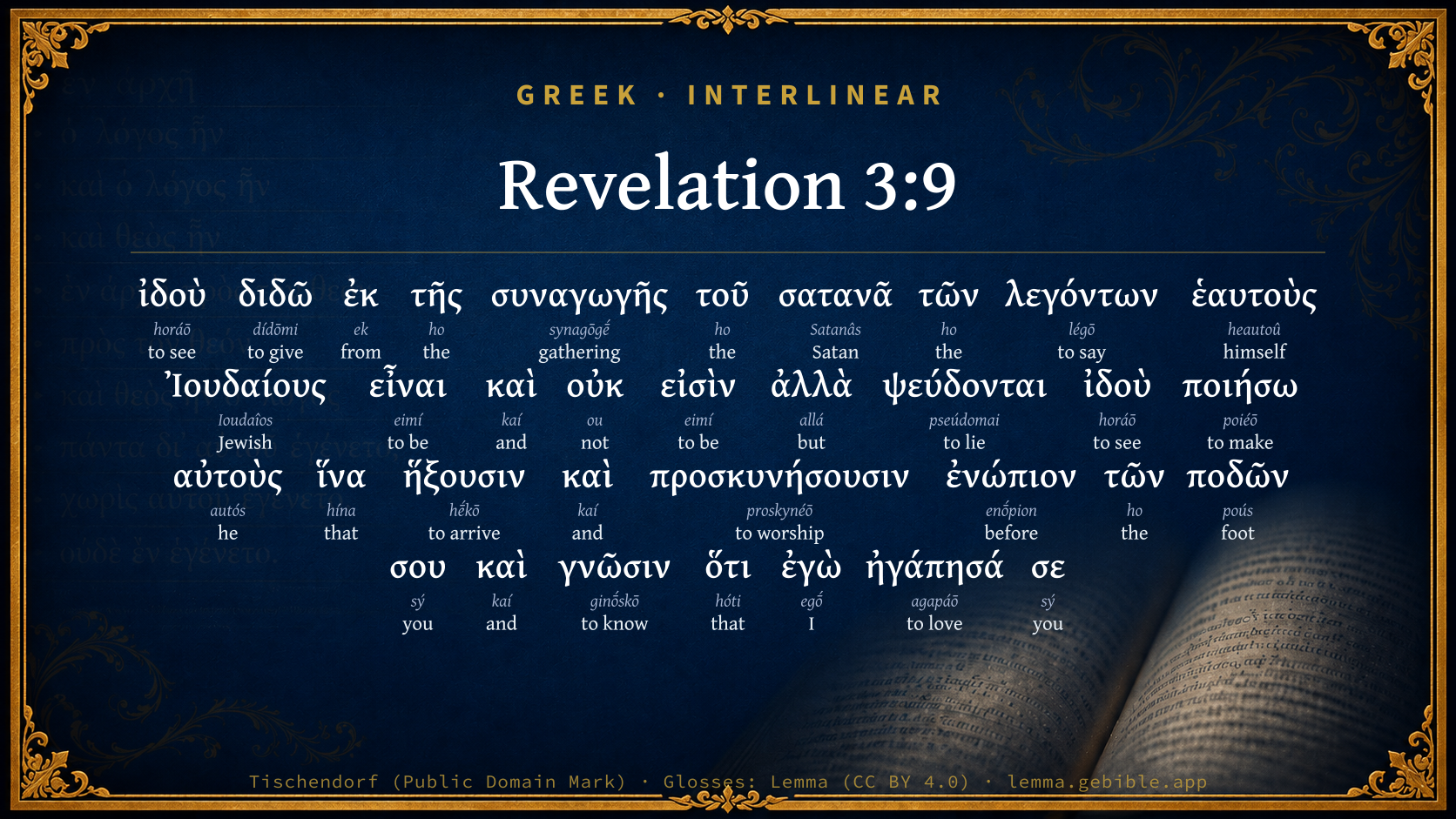
  1. ἰδοὺ horáō G3708 “to see” Verb, Aorist, Middle, Imperative, 2nd person, Singular
  2. διδῶ dídōmi G1325 “to give” Verb, Present, Active, Subjunctive, 1st person, Singular
  3. ἐκ ek G1537 “from” Preposition
  4. τῆς ho G3588 “the” Article, Genitive, Singular, Feminine
  5. συναγωγῆς synagōgḗ G4864 “gathering” Noun, Genitive, Singular, Feminine
  6. τοῦ ho G3588 “the” Article, Genitive, Singular, Masculine
  7. σατανᾶ Satanâs G4567 “Satan” Noun, Genitive, Singular, Masculine
  8. τῶν ho G3588 “the” Article, Genitive, Plural, Masculine
  9. λεγόντων légō G3004 “to say” Verb, Present, Active, Participle, Genitive, Plural, Masculine
  10. ἑαυτοὺς heautoû G1438 “himself” Reflexive pronoun, 3rd person, Accusative, Plural, Masculine
  11. Ἰουδαίους Ioudaîos G2453 “Jewish” Adjective, Accusative, Plural, Masculine
  12. εἶναι eimí G1510 “to be” Verb, Present, Active, Infinitive
  13. καὶ kaí G2532 “and” Conjunction
  14. οὐκ ou G3756 “not” Particle, Negative
  15. εἰσὶν eimí G1510 “to be” Verb, Present, Active, Indicative, 3rd person, Plural
  16. ἀλλὰ allá G235 “but” Conjunction
  17. ἰδοὺ horáō G3708 “to see” Verb, Aorist, Middle, Imperative, 2nd person, Singular
  18. ποιήσω poiéō G4160 “to make” Verb, Future, Active, Indicative, 1st person, Singular
  19. αὐτοὺς autós G846 “he” Personal pronoun, Accusative, Plural, Masculine
  20. ἵνα hína G2443 “that” Conjunction
  21. ἥξουσιν hḗkō G2240 “to arrive” Verb, Future, Active, Indicative, 3rd person, Plural
  22. καὶ kaí G2532 “and” Conjunction
  23. προσκυνήσουσιν proskynéō G4352 “to worship” Verb, Future, Active, Indicative, 3rd person, Plural
  24. ἐνώπιον enṓpion G1799 “before” Adverb
  25. τῶν ho G3588 “the” Article, Genitive, Plural, Masculine
  26. ποδῶν poús G4228 “foot” Noun, Genitive, Plural, Masculine
  27. σου sý G4771 “you” Personal pronoun, 2nd person, Genitive, Singular
  28. καὶ kaí G2532 “and” Conjunction
  29. γνῶσιν ginṓskō G1097 “to know” Verb, Aorist, Active, Subjunctive, 3rd person, Plural
  30. ὅτι hóti G3754 “that” Conjunction
  31. ἐγὼ egṓ G1473 “I” Personal pronoun, 1st person, Nominative, Singular
  32. ἠγάπησά agapáō G25 “to love” Verb, Aorist, Active, Indicative, 1st person, Singular
  33. σε sý G4771 “you” Personal pronoun, 2nd person, Accusative, Singular

About this verse

These counts appear in no published source. They are computed here, from the morphology-tagged text and Lemma’s own curated glosses. What Lemma adds →

34
words
26
distinct lemmas
Revelation
section

Notable vocabulary

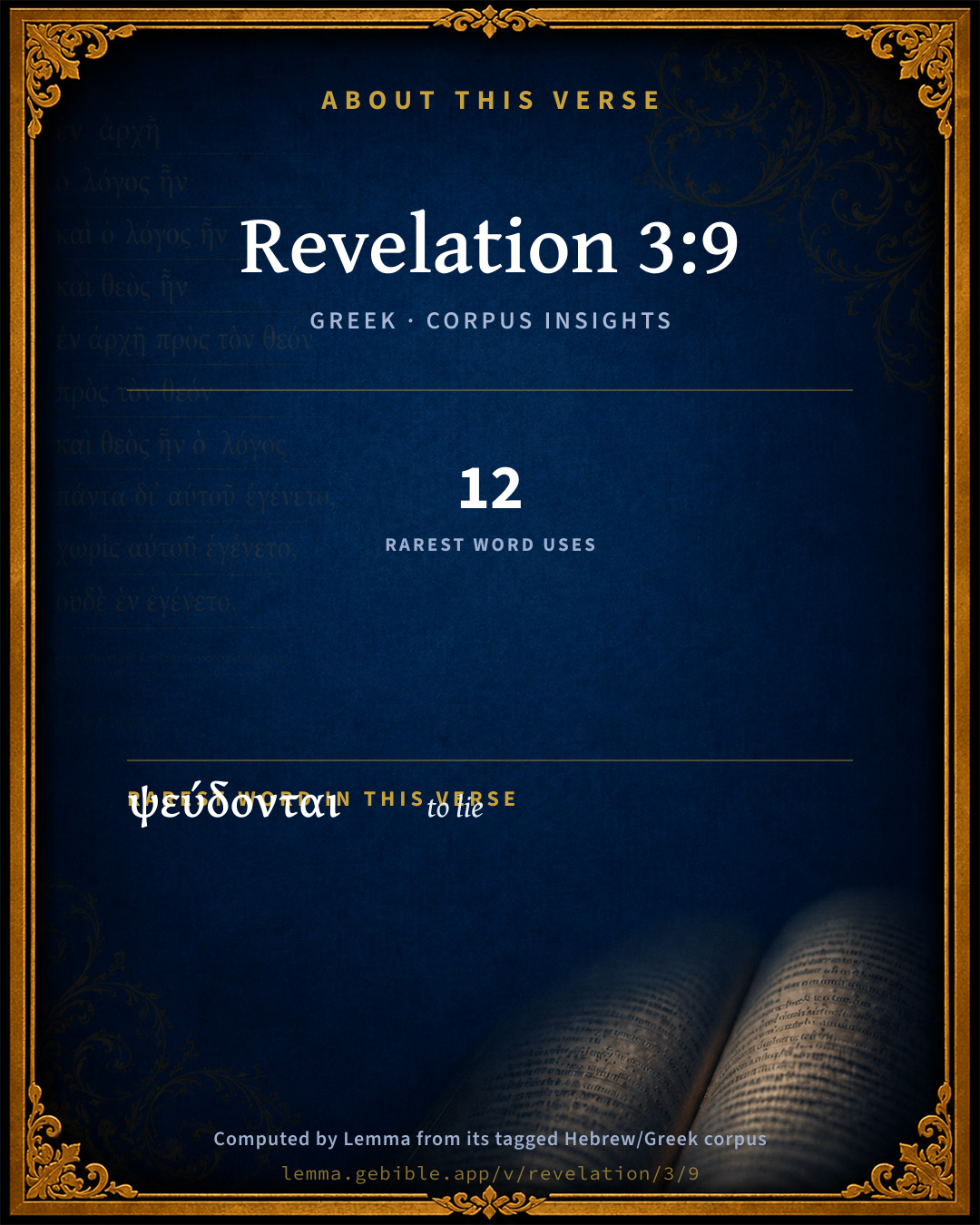
The rarest word here is ψεύδονται to lie G5574 — appearing just 12 times in the whole Greek New Testament.

Shared distinctive vocabulary

ψεύδονται to lie G5574 occurs in 12 verses of the Greek New Testament. Also found in:

Repetition

Words recur within this verse:

Cross-references

11

Topical passages linked to Revelation 3:9 in the Treasury of Scripture Knowledge — connected by theme and wording, ordered by reader-vote popularity; previews shown in the World English Bible.

  • Isaiah 60:14 The sons of those who afflicted you shall come bending to you; and all those who despised you shall bow themselves down at the soles of your feet; and they shall call you The city of Yahweh, The Zion of the Holy One of Israel.
  • Revelation 2:9 "I know your works, oppression, and your poverty (but you are rich), and the blasphemy of those who say they are Jews, and they are not, but are a synagogue of Satan.
  • Isaiah 49:23 Kings shall be your nursing fathers, and their queens your nursing mothers: they shall bow down to you with their faces to the earth, and lick the dust of your feet; and you shall know that I am Yahweh; and those who wait for me shall not be disappointed.
  • Isaiah 45:14 Thus says Yahweh: "The labor of Egypt, and the merchandise of Ethiopia, and the Sabeans, men of stature, shall come over to you, and they shall be yours. They shall go after you. In chains they shall come over; and they shall fall down to you. They shall make supplication to you: 'Surely God is in you; and there is none else, there is no other god.
  • Isaiah 43:4 Since you have been precious in my sight, [and] honorable, and I have loved you; therefore will I give men in your place, and peoples instead of your life.
  • Zechariah 8:20–23 Thus says Yahweh of Hosts: "Many peoples, and the inhabitants of many cities will yet come;
  • 1 Samuel 2:36 It shall happen, that everyone who is left in your house shall come and bow down to him for a piece of silver and a loaf of bread, and shall say, Please put me into one of the priests' offices, that I may eat a morsel of bread.
  • Esther 8:17 In every province, and in every city, wherever the king's commandment and his decree came, the Jews had gladness and joy, a feast and a good day. Many from among the peoples of the land became Jews; for the fear of the Jews was fallen on them.
  • Job 42:8–10 Now therefore, take to yourselves seven bulls and seven rams, and go to my servant Job, and offer up for yourselves a burnt offering; and my servant Job shall pray for you, for I will accept him, that I not deal with you according to your folly. For you have not spoken of me the thing that is right, as my servant Job has."
  • Exodus 11:8 All these your servants shall come down to me, and bow down themselves to me, saying, 'Get out, and all the people who follow you; and after that I will go out.'" He went out from Pharaoh in hot anger.
  • Acts 16:37–39 But Paul said to them, "They have beaten us publicly, without a trial, men who are Romans, and have cast us into prison! Do they now release us secretly? No, most assuredly, but let them come themselves and bring us out!"

Cross-references courtesy of OpenBible.info (CC BY 4.0).

Commentary

Notes on Revelation 3:9 from classic Christian and Jewish commentators (each source and its license shown beneath its notes). The classic Christian expositions comment on the surrounding passage and are grouped to its opening verse, so a note may address several verses; the Jewish commentaries on the Tanakh (Rashi and others) are per-verse, so they appear only where the commentator wrote on this verse.

Lemma curates 59 commentaries, every one of them public domain or Creative Commons licensed, each selected and text-cleaned for this edition rather than reprinted as found. About our sources →

Joseph Benson's Commentary

Rev 3:9-10. Behold, I — Who have all power, and when I exert it they must then comply; will make them — Who are indeed of the synagogue of Satan — And under all the solemn guise of religious worship are carrying on Satan’s cause and interest; which say they are Jews — Pretend to be my people, but are not; I will make them to come and worship, or bow down, before thy feet — To pay thee the lowest homage; and to know that I have loved thee — That all depends on my love; and that thou hast a place therein; or to find that I evidently support thy cause and interest against all that oppose it. Because thou hast kept the word of my patience — That gospel which I have myself, by such patient suffering in my human nature, established in the world, and by which I at once exercise and support the faith and patience of my people; I also will keep thee — O happy exemption from that spreading calamity! from the hour of temptation — Or of trial. I will partly preserve thee from it, and partly support thee under it. In other words, My hand shall remarkably appear in defending thee from the dangers by which others fall; and in strengthening thee in proportion to the trial. The word hour denotes the short time of its continuance; that is, at any one place. At every one it was very sharp, though short, wherein the great tempter was not idle, Rev 2:10. Which shall come upon all the world — Upon the whole Roman empire, as the original expression frequently signifies. It went over the Christians, and over the Jews and heathen, though in a very different manner. This was the time of the persecution under the seemingly virtuous emperor Trajan. The two preceding persecutions were under those monsters, Nero and Domitian. But Trajan was so admired for his goodness, and his persecution was of such a nature, that it was a temptation indeed, and did thoroughly try them that dwelt upon the earth.

Joseph Benson's Commentary on the Old and New Testaments (1811–1818) — public domain. Text from a community e-Sword module.

Whedon's Commentary on the Bible

Daniel D. Whedon

9. Behold—In view of this little strength, the hast kept, and the not denied; therefore I will give them a royal triumph in the New Jerusalem, to which the open door admits them. The triumph is expressed in an image drawn from Isa_60:14. “All they that despised thee shall bow themselves down at the soles of thy feet; and they shall call thee, The city of the Lord, The Zion of the Holy One of Israel.” When the developments of the judgment day are unfolded, how will the despisers of the now humble Church acknowledge, with profound abasement, its true glory as the real city of God! The Jewish troublers of the Philadelphian Church are selected as the very present specimens of such “despisers,” who are bound to “wonder and perish.”

Say they are Jews—And are so “after the flesh;” the which is now a nullity; but are not the spiritual Israel, which is now the only true Israel.

Worship before thy feet—Of course no literal fact, but imaging the severe and final humiliation of all evil in presence of the truly good. In the judgment-day development the atheist will learn there is a God; the impenitent Jew will confess a true Jesus the Christ; the scorner will find there is a hell; and the haughty despiser of the weak and humble, yet pure Church, like our Philadelphians, will discover, to the sad reversal of his pride, that they were heirs of an eternal crown. When a great lady once spoke with contempt of Lady Huntingdon’s associating with her conventicle of saints, one replied to her, “Madam, in the day of judgment you may be glad to grasp hold of Lady Huntingdon’s skirts to draw you into heaven.”

That I have loved—They will recognise not only the loved in its true glory, but they will truly learn and know also this great I, whose love is the bliss of the heavenly world, as it makes the poor Philadelphian Church “the city of the Lord, the Zion of the Holy One.” The interpretation of Alford, which makes the open door an opening for missionary enterprise for propagating the gospel, and which holds Rev_3:9 to describe the resulting conversion of their bitter Jewish opponents, seems inapplicable. It has, indeed, Paul’s open door, 1Co_16:9, 2Co_2:12, as an apparent precedent: but the opening and shutting of Rev_3:7 clearly refer to the lordship of Christ over the entrance into heaven, the New Jerusalem, (22,) and Rev_3:8 can be no description of the happy conversion, but of the penal humiliation, in the final day, upon the incorrigible. And Rev_3:10-12, continue the same line of thought, describing the rich final reward of Philadelphian faithfulness. Rev_3:10 promises preservation in the great day of the final trial; Rev_3:11 describes the speed of its approach; Rev_3:12 promises eternal security within the domain of heaven, beyond the day of trial.

Daniel D. Whedon (gen. ed.), Commentary on the Old and New Testaments (1874–1909) — public domain. Text from a community e-Sword module.

Tyndale Open Study Notes

Tyndale Open Resources

3:9 those who belong to Satan’s synagogue: The Christians in Philadelphia had suffered maltreatment by anti-Christian Jews (see study note on 2:9). • bow down at your feet: In the ancient world, captives were often forced to prostrate themselves before their conquerors (see Isa 49:23; 60:14). The church’s human enemies will ultimately acknowledge that Christians are the ones God loves.

Tyndale Open Study Notes — © Tyndale Open Resources, licensed CC BY-SA 4.0. Text via the HelloAO Bible API.

Bengel's Gnomon

Johann Albrecht Bengel

Rev 3:9. Τῶν λεγόντων) This depends upon τινὰς, understood.—ποιήσω αὐτοὺς, ἵνα) The same construction occurs, ch. Rev 13:12; Rev 13:16.

Bengel's Gnomon of the New Testament — English translation (T&T Clark, Edinburgh, 1860) — public domain. Text from a community e-Sword module.

Meyer's Critical & Exegetical Commentary

Heinrich August Wilhelm Meyer

Rev_3:9. διδῶ, not I will suffer, as Wolf recommends. Hengstenb also incorrectly: I give thee, or the Christian Church, and therefore also thee. The διδῶ, to which as object the partitive gen. τῶν λεγόντων belongs,[1444] is again taken up in the formally (fut.) more definitely fixed ποιήσω, as then the σὐτούς also recurs to the just-mentioned object τῶν λεγόντων, κ.τ.λ. The words ἐκ τῆς συναγωγῆς τοῦ σατανᾶ designate the persons meant, with respect to their origin. They are not false Christians,[1445] but[1446] Jews who just because of their enmity to the true Messiah (Rev_3:7) are not true Jews, but the synagogue of Satan. Yet also in that the Lord brings some from this synagogue, and causes them to come humbly and believingly to his church, he shows that he is the one who has the key of David.

ποιήσω αὐτοὺς, ἵνα ἥξουσι, κ.τ.λ. Concerning the attraction αὐτούς, cf. Winer, p. 282; concerning ἵνα, also Joh_11:37, after ποιεῖν, with the ind. fut., cf. Rev_6:11, Rev_22:14; 1Pe_3:1; Mar_3:2; Winer, p. 272.

The ποιήσω marks the still entirely future result which the Lord will work;[1447] the inner relation to ΔΙΔῶ and ΔΈΔΩΚΑ (Rev_3:8) is this, that the ΔΈΔΩΚΑ (perf.) extends to the present, and continues in its operation, while the ΔΙΔῶ is present in its work, and will proceed to the ΠΟΙΉΣΩ. The opened door still stands open, and the Lord will work that a multitude of still unbelieving Jews may enter.

Both the ἭΞΟΥΣΙ and the ΠΡΟΣΚΥΝΉΣΟΥΣΙ ἘΝΏΠΟΙΝ ΤῶΝ ΠΟΔῶΝ ΔΟΥ are explained in connection with the O. T. prophecies of the conversion of the heathen, by the fact that for unbelieving Jews, as they have just been described, the Church of Jesus Christ, viz., of him who has the key of David, Rev_3:7, is the true Zion, in which they, no less than the heathen, must seek and will find the truth of God, and the fellowship of salvation. Thus, so far as the expressions are concerned, such prophecies as Isa_60:14; Isa_49:23; Isa_2:3; Psa_72:9; Zach. 8:20 sqq., are in full harmony with what is here stated. The ΠΡΟΣΚΥΝΕῖΝ, Κ.Τ.Λ., especially as an expression of homage,[1448] has its complete justification in the fact that the Church of Jesus Christ stands there as beloved of the Lord (Κ. ΓΝῶΣΙΝ, ὍΤΙ ἨΓΆΠΗΣΆ ΣΕ), and as the mediator of the divine salvation. Yet the Catholic interpretation without any ground has: The highest devotion of believers, and reverence and submission to the Church and its prelates, are signified. For this adoration proceeds from the apprehension of an excellence of prelates that is more than human, and less than divine.[1449]

ΚΑῚ ΓΝῶΣΙΝ, ὍΤΙ ἨΓΑΠΗΣΆ ΔΕ. On the one hand, the aorist form ἨΓΆΠΗΣΑ,[1450] and on the other the connection and allusion to Rev_3:7, furnish the reference to the definite proof of the Lords love, in that he has died for his Church. Just this must the unbelieving Jews acknowledge who now still reject and blaspheme the Lord as a crucified evil-doer.[1451] Incorrect reference of the ἨΓΑΠ. in N. de Lyra: By advancing thee not only to the catholic faith, but also to the episcopal dignity; in Ew., to Rev_3:10, or[1452] to Isa_63:4; Isa_66:24. De Wette too, indefinitely: That I have acknowledged thee as a faithful church, and furnished thee with my gifts and power.

[1444] Cf. Rev_2:17. Winer, p. 490.

[1445] Vitr.

[1446] Cf. Rev_2:9.

[1447] Viz., ἥξουσ., κ.τ.λ.

[1448] Cf. Gen_23:7, etc. Ew., Ebrard, etc.

[1449] C. a Lap.

[1450] Cf. Joh_13:1; Eph_5:25; Gal_2:20; also Joh_3:16; 1Jn_4:10-11.

[1451] Cf. Rev_2:9; Act_13:45.

[1452] Ew. ii.

Meyer — Critical and Exegetical Commentary on the New Testament — English translation by Peter Christie, edited by Frederick Crombie (T&T Clark, 1880) — public domain. Text from a community e-Sword module.

Expositor's Greek Testament

ed. W. Robertson Nicoll

Rev 3:9 . διδῶ ἐκ (partit. gen., the construction being dropped and resumed in a rather harsh anacolouthon, ἵνα κ . τ . λ .). The absence of ἐκ before λεγ . does not prevent it from being interpreted as in apposition to συναγωγῆς rather than as directly dependent on διδῶ . On the forms of δίδωμι in Apocalypse see Jannaris’ Hist. Gk. Gramm. 996, 51; the wide usage of the verb is carried on through the LXX from the equally extended employment of the Hebrew equivalent in the later stages of O.T. literature. The Jewish synagogue is denounced as Satanic, owing to its persecuting habits (Satan being regarded as the final source of persecution as of error, cf. above Rev 3:8 and on Rev 2:9 ). Ignatius corroborates the malign activity of Jews at Philadelphia, who were in the habit of molesting the church ( ad Philad. 6); he also refers them to the malicious cunning of Satan. Apparently Judaizing tendencies were rife among Christians of Gentile birth at Philadelphia. As in writing to Smyrna, the prophet thereforeclaimed the ancestral title “Jew” for the Christian church. Faith in Christ, not mere nationality, constituted true Judaism; the succession had passed to Christianity. The prominence assigned to this phase of polemic is characteristic of the eriod, though already presaged by Paul (in Rom 9:6-7 ; Rom 2:28-29 ). The supercilious contempt of these churchmen for all Christian dissenters from Judaism was to be changed one day into humble respect. The former would find out their grievous mistake when it was too late. καὶ προσκυνήσουσιν , κ . τ . λ ., in the spirit and realistic language of post-exilic Judaism (see reff.), denoting abject submission and homage before the glory of the church in the future messianic reign (slightly otherwise in 1Co 14:25 ). What they fondly expected from the Gentiles, they were themselves to render to Christians such would be the grim irony of providence. Compare with what follows, the earlier expectation of Jub. i. 25: “and they shall all be called children of the living God, and every angel and spirit will know, yea they will know that these are my children, and that I love them”. καὶ γμῶσιν , κ . τ . λ ., still Isaianic in colouring (from Isa 43:4 , Isa 49:23 ). Christ’s love to his church ( ἠγ . = “I have loved”) will be proved by her triumphant survival of perils. Her final position, when the conditions of earth are reversed, will throw light upon the divine affection which underlay her previous perseverance, and which meantime is a secret save to those who experience it. The promise of dominion over the Jews here corresponds to that of authority over the Gentiles in Rev 2:26-27 , except that the latter is definitely eschatological. The Jews tardily awaken to the privileges of the church as to the claims of Jesus (see on Rev 1:7 ). Probably they scoffed at the claim of the Philadelphian Christians to be objects of the true God’s love. The answer is that faith in Jesus means a revelation of Divine love ( the revelation of it), apart from which no Christian life can be accounted for.

The Expositor's Greek Testament, edited by W. Robertson Nicoll (1897–1910) — public domain. Text from a community e-Sword module.

Geneva Bible (1599)

Geneva Bible translators

I will bring them to that case.

That is, fall down and worship either thee civilly, or Christ religiously at thy feet (and thus I had rather take it) whether here in the Church (which seemeth more proper to the argument of this place) or there in the world to come. For Christ verily shall fulfill his word.

Geneva Bible (1599) marginal notes — public domain. Text via Bolls.life.

Jamieson, Fausset & Brown

Robert Jamieson, A. R. Fausset & David Brown

I will make--Greek present, "I make," literally, "I give" (see on Rev 3:8). The promise to Philadelphia is larger than that to Smyrna. To Smyrna the promise was that "the synagogue of Satan" should not prevail against the faithful in her: to Philadelphia, that she should even win over some of "the synagogue of Satan" to fall on their faces and confess God is in her of a truth. Translate, "(some) of the synagogue." For until Christ shall come, and all Israel then be saved, there is but "a remnant" being gathered out of the Jews "according to the election of grace." This is an instance of how Christ set before her an "open door," some of her greatest adversaries, the Jews, being brought to the obedience of the faith. Their worshipping before her feet expresses the convert's willingness to take the very lowest place in the Church, doing servile honor to those whom once they persecuted, rather than dwell with the ungodly. So the Philippian jailer before Paul.

Jamieson, Fausset & Brown — Commentary Critical and Explanatory on the Whole Bible (1871) — public domain (CC PDM 1.0). Text via the HelloAO Bible API.

Adam Clarke's Commentary

Verse 9. I will make them] Show them to be, of the synagogue of Satan, who say they are Jews, pretending thereby to be of the synagogue of GOD, and consequently his true and peculiar children.

I will make them to come and worship] I will so dispose of matters in the course of my providence, that the Jews shall be obliged to seek unto the Christians for toleration, support, and protection, which they shall be obliged to sue for in the most humble and abject manner.

To know that I have loved thee.] That the love which was formerly fixed on the Jews is now removed, and transferred to the Gentiles.

Adam Clarke's Commentary on the Bible (1810–1826) — public domain. Text from a community e-Sword/MySword module.

Ellicott's Commentary for English Readers

(9) Behold, I will make.—Better, Behold, I give some. There is no word to express this in the original, but as a word must be supplied to complete the sense, it is better to adopt “some” than the “them” of the Authorised version, as it is not a promise that all of the synagogue of Satan should come.

Of the synagogue of Satan.—We have here a re-appearance of the same troubles which afflicted the Church of Smyrna: the fixed and contemptuous exclusiveness of the Judaising party was their trial. But there was a time coming (perhaps the hour of temptation spoken of in the next verse) when these faithful ones, now abused and excommunicated by the fanatical synagogue, would be courted, acknowledged—nay, their aid invoked.

I will make them to come and worship before my feet, and to know that I have loved thee.—Some see in this a hint that the power of a large-hearted party to protect the Judaisers would be derived from the influence of the Gentiles, whose presence in the Church had been a stumbling-block to the Jewish party. This may have been, and doubtless was, often the case. But the promise seems to have a higher fulfilment. The course of events would show that the so-called latitudinarian was the nearest to Christ; time would transform the suspected into the respected. The Amorites would come, and the disinherited Jephthahs would be brought to be head of Gilead. In days of such trouble their strongest opponents would become their warmest supporters. An illustration of this will occur to the mind of the reader in the marvellous support which has been given to the growth of Christianity by Jews with the tongue, with the pen, with the harp and organ. Let the names of Neander, Rossini, and Mendelssohn stand for hundreds more.

A Bible Commentary for English Readers, edited by Charles John Ellicott (1878–1897) — public domain. Text from a community e-Sword module.

The Cambridge Bible for Schools and Colleges

gen. ed. J. J. S. Perowne

9. I will make them of &c.] Literally, I give of the &c. The use of “give” in this verse is frequent in Hebrew: here the sentence is unfinished, and is resumed by “I will make them come” &c. below.

the synagogue of Satan] See on Rev_2:9.

I will make them to come &c.] An application of Isa_60:14.

that I have loved thee] The pronoun “I” is emphatic—which supports the view already suggested, that the title of this Church to Christian privileges was contested by the Jews, and that this message of the Lord is intended to decide a controversy.

The Cambridge Bible for Schools and Colleges (gen. ed. J. J. S. Perowne; Cambridge University Press, 1878–1918) — public domain. Text from a community e-Sword module.

John Gill's Exposition

Because thou hast kept the word of my patience,.... The Gospel; so called because it gives an account of the patience of Christ, in the midst of all his outward meanness and humiliation; and because it is a means of implanting and increasing the grace of patience, which God is the efficient cause of, and Christ is the example of; that patience, which bears a resemblance to his, in enduring afflictions, reproaches, persecutions, desertions, and temptations, and in waiting for his kingdom and glory; and because both the preachers and professors of the word have need of patience, and should exercise it in like manner as Christ did. This word, the churches, in the Philadelphian state, will keep pure and incorrupt, and observe the ordinances of it according to the directions given in it; and will believe the promise of Christ's personal coming, and patiently wait for it: wherefore, Christ promises as follows,

I also will keep thee from the hour of temptation, which shall come upon all the world, to try them that dwell upon the earth; this hour seems to refer not to any of the vials which will be poured out on the antichristian states, but to some affliction and distress which will befall the reformed churches, and will light upon the outward court worshippers among them It seems to be the last struggle of the beast of Rome, and to denote some violent and sharp persecution, such as what Daniel mentions, that never was before nor since; but it will be but short, but one hour, the twenty fourth part of a prophetical day or year, perhaps about a fortnight; yet it will be very extensive; it will reach all the world, the whole Roman empire, and all that dwell upon the earth, that are called by the name of Christians, and will try them, whether they are so or not; Christ will now have his fan in his hand, and purge his floor of all his formal professors and hypocrites; and it will be known who are his true churches, and pure members; and these he will keep close to himself, and preserve safe amidst all the distress and confusion the world will be in. This cannot refer to the bloody persecutions under the Roman emperors, for from those the church at Philadelphia was not preserved. We read (s) of twelve members of it that suffered with Polycarp,

(s) Euseb. Eccl. Hist. l. 4. c. 15.

John Gill's Exposition of the Whole Bible (1746–1763) — public domain (CC PDM 1.0). Text via the HelloAO Bible API.

Trapp's Complete Commentary

John Trapp

9 Behold, I will make them of the synagogue of Satan, which say they are Jews, and are not, but do lie; behold, I will make them to come and worship before thy feet, and to know that I have loved thee.

Ver. 9. I will make them] The conversion of the Jews shall be the wonder of the Gentiles.

Which say they are Jews, and are not] The perverse Jews at this day pretend (but maliciously) that those few Jews that turn Christians are not of them, but poor Christians hired from other places to personate their part. (Blount’s Voyage, p. 112.)

That I have loved thee] The Church is την ψυχην την ηγαπημενην, the "dearly beloved of God’s soul," Jer 12:7, or (as the Septuagint render it) his beloved soul.

John Trapp, A Commentary or Exposition upon All the Books of the Old and New Testament (1647–1656) — public domain. Text from a community e-Sword module.

Albert Barnes' Notes on the Bible

Behold, I will make - Greek, “I give” - δίδωμι didōmi; that is, I will arrange matters so that this shall occur. The word implies that he had power to do this, and consequently proves that he has power over the heart of man, and Call secure such a result as he chooses.

Them of the synagogue of Satan, which say they are Jews - Who profess to be Jews, but are really of the synagogue of Satan. See the notes on Rev 2:9. The meaning is, that, though they were of Jewish extraction, and boasted much of being Jews, yet they were really under the influence of Satan, and their assemblages deserved to be called his “synagogue.”

And are not, but do lie - It is a false profession altogether. Compare notes on 1Jo 1:6.

Behold, I will make them to come and worship before thy feet - The word rendered “worship” here, means, properly, to full prostrate; and then to do homage, or to worship in the proper sense, as this was commonly done by falling prostrate. See the notes on Mat 2:2. So far as the word is concerned, it may refer either to spiritual homage, that is, the worship of God; or it may mean respect as shown to superiors. If it is used here in the sense of divine worship properly so called, it means that they would be constrained to come and worship “before them,” or in their very presence; if it is used in the more general signification, it means that they would be constrained to show them honor and respect. The latter is the probable meaning; that is, that they would be constrained to acknowledge that they were the children of God, or that God regarded them with his favor. It does not mean necessarily that they would themselves be converted to Christ, but that, as they had been accustomed to revile and oppose those who were true Christians, they would be constrained to come and render them the respect due to those who were sincerely endeavoring to serve their Maker. The truth taught here is, that it is in the power of the Lord Jesus so to turn the hearts of all the enemies of religion that they shall be brought to show respect to it; so to incline the minds of all people that they shall honor the church, or be at least outwardly its friends. Such homage the world shall yet be constrained to pay to it.

And to know that I have loved thee - This explains what he had just said, and shows that he means that the enemies of his church will yet be constrained to acknowledge that it enjoys the smiles of God, and that instead of being persecuted and reviled, it should be respected and loved.

Albert Barnes' Notes on the Bible (1834–1885) — public domain. Text from a community e-Sword/MySword module.

Matthew Poole's English Annotations

Them of the synagogue of Satan; so he calleth all Jews that opposed Christianity, or all pretended but not real professors.

Which say they are Jews, and are not, but do lie: For he is not a Jew, which is one outwardly; neither is that circumcision which is of the flesh; but he is a Jew, which is one inwardly, & c., Rom 2:28,29. By this term also he may mean all false and hypocritical professors, who would make themselves the church, the only church of God, but are far enough from it, hating, maligning, and opposing those who would keep stricter to the rule of the gospel.

Behold, I will make them to come and worship before thy feet; I will by my providence so order it, that these men shall come and honour thee, paying a civil respect and homage to thee.

And to know that I have loved thee; and to know that I have a greater kindness for thee than for them.

Matthew Poole's English Annotations on the Holy Bible (1683–1685) — public domain. Text from a community e-Sword/MySword module.

The Pulpit Commentary

Behold I give of the synagogue of Satan. The true reading seems to be neither didwmi nor dedwka , but didw , from the form didow , which is fairly common in classical Greek. The construction, ek thv sunagwghv , the partitive genitive used as subject or object of a verb, is frequent in St. John"s writings. (Joh_1:24 Joh_7:40 Joh_16:17:2Jn_1:4 Joh_6:39 Joh_21:10) The Church of Smyrna was encouraged with a promise that their Jewish opponents should not be victorious over them. The Philadelphian Christians are told that they shall be victorious over their Jewish opponents. As before, (Rev_2:9) those who "say they are Jews, and they are not," are Jews who refuse to believe in the Messiah and reject the Gospel. The only true Jews are those who accept the Christ. They are not, but do lie. Antithetic parallelism, as in ver. 8 and Rev_2:13. I will make them to come and worship at thy feet. This would be fulfilled when the destruction of Jerusalem drove large numbers of Jews into Asia Minor. Every city which had previously had a Jewish colony would then receive a great influx of refugees. This augmented Jewish settlement at Philadelphia was to furnish some converts to the Christian Church; but, as we learn from the epistles of Ignatius, these converts tainted the Church with a stubborn form of Judaistic error. Hence the need of the warning in ver. 11. Compare "The sons also of them that afflicted thee shall come bending unto thee; and all they that despised thee shall bow themselves down at the soles of thy feet". (Isa_60:14 Isa_49:23) Know that I have loved thee. The "I" is emphatic: "I will cause them to recoginize that in this you received a blessing manifestly Divine."

The Pulpit Commentary (1880–1919), ed. H.D.M. Spence-Jones & Joseph S. Exell — public domain. Text from a community e-Sword module.

John Wesley's Explanatory Notes

Behold, I - who have all power; and they must then comply. I will make them come and bow down before thy feet - Pay thee the lowest homage. And know - At length, that all depends on my love, and that thou hast a place therein. O how often does the judgment of the people turn quite round, when the Lord looketh upon them! Job xlii, 7, &c.

John Wesley, Explanatory Notes Upon the Whole Bible (1754–1765) — public domain. Text via the GEBible commentary corpus.

The People's New Testament

B. W. Johnson

9. I will make them of the synagogue of Satan. See notes on 2:9. The bitter Jewish opposers are thus described. I will make them to come and worship before thy feet. Acknowledge that the Lord is with them. It seems also to imply the conversion of these Jewish opposers.

B. W. Johnson's The People's New Testament with Notes (1889–1891) — public domain. Electronic text from the Christian Classics Ethereal Library (CCEL) ThML edition.

unfoldingWord translationNotes

Door43 World Missions Community

synagogue of Satan

People who gather to obey or honor Satan are spoken of as if they were in a synagogue, a place of worship and teaching for the Jews. See how you translated this in Revelation 2:9. (See: Metaphor)

bow down

This is a sign of submission, not worship. AT: "bow down in submission" (See: Symbolic Action)

before your feet

Here the word "feet" represent the person before whom these people bow down. AT: "before you" or "to you" (See: Synecdoche)

they will come to know

"they will learn" or "they will admit"

will also keep you from the hour of testing

"will also prevent the hour of testing from happening to you" or "will protect you so you do not enter the hour of testing"

hour of testing

"time of testing." This probably means "the time when people try to make you disobey me."

is coming

Existing in the future is spoken of as coming. (See: Metaphor)

I am coming soon

It is understood that he is coming in order to judge. AT: "I am coming to judge soon" (See: Assumed Knowledge and Implicit Information)

Hold to what you have

Continuing to believe firmly in Christ is spoken of as if it were holding something tightly. AT: "Continue to believe firmly" (See: Metaphor)

crown

A crown was a wreath, originally of olive branches or laurel leaves, that was put on the head of a victorious athlete. Here "crown" stands for a reward. See how you translated "crown" in Revelation 2:10. (See: Metaphor)

translationWords

synagogue

Satan

Jew

bow

love

command

endure

patient

hour, hours

test

crown

unfoldingWord translationNotes — © Distant Shores Media and the Door43 World Missions Community, licensed CC BY-SA 4.0. Source: git.door43.org/Door43/en_tn.

Cambridge Greek Testament for Schools and Colleges

9. γνῶσιν. א Primas[133] read γνώσῃ.

[133] Primasius, edited by Haussleiter.

9. διδῶ. The use of “give” in this verse is frequent in Hebrew: (cp. LXX. of Isa 60:17 δώσω τοὺς ἄρχοντάς σου ἐν εἰρήνῃ); here the sentence is unfinished, and is resumed by “I will make them come” &c. below.

ἐκ τῆς συναγωγῆς τοῦ Σατανᾶ. See on Rev 2:9.

ποιήσω αὐτούς. An application of Isa 60:14, πορεύσονται πρὸς σὲ δεδοικότες υἱοὶ ταπεινωσάντων σε.

ὅτι ἐγὼ ἠγάπησά σε. Perhaps “that I set my love on thee” once for all; but it is simpler to remember how much commoner aorists are than perfects in the New Testament. The pronoun ἐγὼ is emphatic—which supports the view already suggested, that the title of this Church to Christian privileges was contested by the Jews, and that this message of the Lord is intended to decide a controversy.

Cambridge Greek Testament for Schools and Colleges (Cambridge University Press, 1896; 21 vols, various authors incl. Carr, Maclear, Plummer, Farrar, Lumby, Moule, M. R. James, Simcox) — public domain. Text from a community e-Sword module.

Vincent's Word Studies in the New Testament

Marvin R. Vincent

I will make [διδωμι] . Rev., rightly, I give. See on verse 8. The sense is broken off there and resumed here.

Of the synagogue [εκ της συναγωγης] . Certain ones of the synagogue. Most interpreters refer to the Jews. Others explain more generally, of the bowing down of the Church 's enemies at her feet. Trench refers to a passage in the Epistle of Ignatius to this Philadelphian church, implying the actual presence in the midst of it of converts from Judaism, who preached the faith which they once persecuted.

Of Satan. See on chapter Rev 2:9.

I will make them to come [ποιησω αυτους ινα ηξωσιν] Lit., I will make them that they shall come.

Worship before thy feet. Compare Isa 60:14; Isa 49:23.

Marvin R. Vincent, Word Studies in the New Testament (1887–1900) — public domain. Text from a community e-Sword/MySword module.

Lesson kit

Teaching starters — assembled from the data on this page, not authored interpretation. Every prompt links to the verse data it draws on. Edit before teaching.

Revelation, in the Revelation, opens this verse with 34 words (26 distinct Greek lemmas). Its most distinctive word is pseúdomai (“to lie”). A historical commentator’s framing appears above. Read the whole chapter for the surrounding context.

Discussion questions

  1. The word pseúdomai carries the sense “to lie.” How does it shape the verse?
  2. How does Matthew 5:11, which shares the word «to lie», read alongside this verse?
  3. What does the repetition of “to see” (2× in this one verse) do in this verse?
  4. These translations render this verse differently; the difference is in the English rendering, not the original. What questions does that raise?
  5. Compare how Joseph Benson's Commentary and Whedon's Commentary on the Bible read this verse. Where do they agree or differ?

Things to notice

Reading settings

Reading text

Shown beneath each verse's original-language words.

Old Testament
Old Testament edition

Read the OT as the Masoretic Hebrew (MT) or the Greek Septuagint (LXX).

English shown for the Greek Septuagint (in the Hebrew ↔ Greek comparison).

Comparing translations? Open the Compare panel on any verse page to stack up to four side by side.