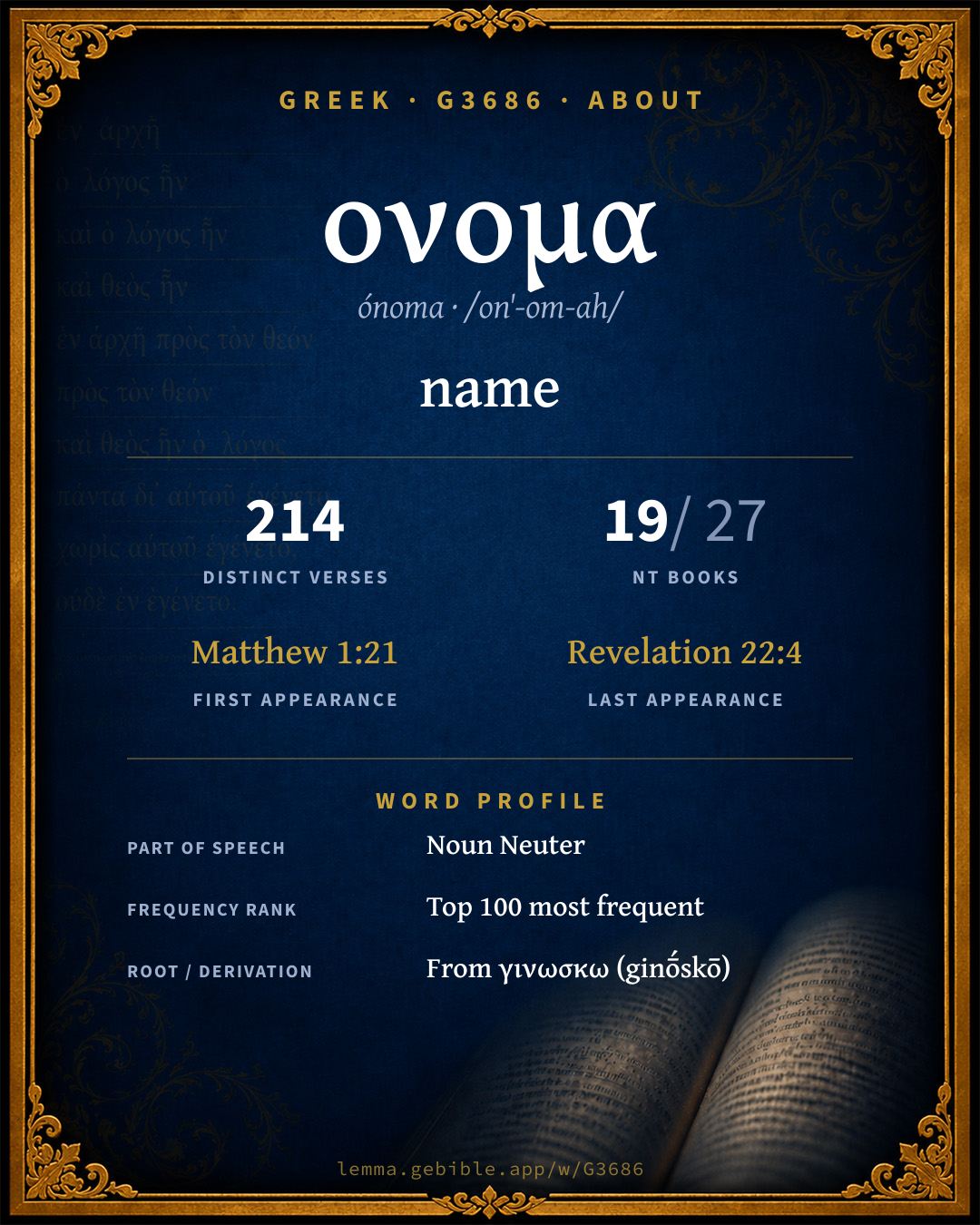
ὄνομα
name
‘name’ is one of 4 main senses fuller range ↓
Full lexicon entry — Thayer's Greek Lexicon
From Thayer's Greek Lexicon
Where this word appears
See every Dative-case word in the Greek New Testament →
Grammar key — what these labels mean
Part of speech
- Noun
- A naming word — a person, place, thing, or idea.
Case
- Dative
- The case of the indirect object, means, or location — “to / for / with / in.”
- Accusative
- The case of the direct object and of extent.
- Nominative
- The case of the subject (and the predicate nominative).
- Genitive
- The case of source, possession, or “of” — answers “whose / from what.”
Gender
- Neuter
- Grammatically neuter.
Number
- Singular
- One.
- Plural
- More than one.
Grammatical forms
- Noun, Dative, Singular, Neuter 94 times (41%)
- Noun, Accusative, Singular, Neuter 68 times (30%)
- Noun, Nominative, Singular, Neuter 38 times (17%)
- Noun, Genitive, Singular, Neuter 17 times (7%)
- Noun, Accusative, Plural, Neuter 7 times (3%)
- Noun, Nominative, Plural, Neuter 3 times (1%)
- Noun, Genitive, Plural, Neuter 2 times (1%)
Parsed forms decoded from the imported morphology (Robinson–Tischendorf, public domain), counted across 229 parsed occurrences — not distinct verses.
Page 1 of 2 — showing verses 1–200 of 214 distinct verses where G3686 appears, across 19 books. Click any verse to open its interlinear word-by-word view. Verse text shown in the World English Bible for context — . Each verse’s Greek form is shown with its reference; the English is not keyword-highlighted, since the data carries no word-level English alignment. Use “Compare translations” on any verse to read it across multiple English versions. This concordance covers the Greek New Testament; Septuagint (Greek Old Testament) occurrences of this word are not indexed here.
Matthew 19 verses
- Matthew 1:21 ὄνομα n acc sg neut She shall bring forth a son. You shall call his name Jesus, for it is he who shall save his people from their sins."
- Matthew 1:23 ὄνομα n acc sg neut "Behold, the virgin shall be with child, And shall bring forth a son. They shall call his name Immanuel;" Which is, being interpreted, "God with us."
- Matthew 1:25 ὄνομα n acc sg neut and didn't know her sexually until she had brought forth her firstborn son. He named him Jesus.
- Matthew 6:9 ὄνομά n nom sg neut Pray like this: 'Our Father in heaven, may your name be kept holy.
- Matthew 7:22 ὀνόματι ὀνόματι ὀνόματι n dat sg neut n dat sg neut n dat sg neut Many will tell me in that day, 'Lord, Lord, didn't we prophesy in your name, in your name cast out demons, and in your name do many mighty works?'
- Matthew 10:2 ὀνόματά n nom pl neut Now the names of the twelve apostles are these. The first, Simon, who is called Peter; Andrew, his brother; James the son of Zebedee; John, his brother;
- Matthew 10:22 ὄνομά n acc sg neut You will be hated by all men for my name's sake, but he who endures to the end will be saved.
- Matthew 10:41 ὄνομα ὄνομα n acc sg neut n acc sg neut He who receives a prophet in the name of a prophet will receive a prophet's reward: and he who receives a righteous man in the name of a righteous man will receive a righteous man's reward.
- Matthew 10:42 ὄνομα n acc sg neut Whoever gives one of these little ones just a cup of cold water to drink in the name of a disciple, most assuredly I tell you he will in no way lose his reward."
- Matthew 12:21 ὀνόματι n dat sg neut In his name, the Gentiles will hope."
- Matthew 18:5 ὀνόματί n dat sg neut Whoever receives one such little child in my name receives me,
- Matthew 18:20 ὄνομα n acc sg neut For where two or three are gathered together in my name, there I am in the midst of them."
- Matthew 19:29 ὀνόματός n gen sg neut Everyone who has left houses, or brothers, or sisters, or father, or mother, or wife, or children, or lands, for my name's sake, will receive one hundred times, and will inherit eternal life.
- Matthew 21:9 ὀνόματι n dat sg neut The multitudes who went before him, and who followed kept shouting, "Hosanna to the son of David! Blessed is he who comes in the name of the Lord! Hosanna in the highest!"
- Matthew 23:39 ὀνόματι n dat sg neut For I tell you, you will not see me from now on, until you say, 'Blessed is he who comes in the name of the Lord!'"
- Matthew 24:5 ὀνόματί n dat sg neut For many will come in my name, saying, 'I am the Christ,' and will lead many astray.
- Matthew 24:9 ὄνομά n acc sg neut Then they will deliver you up to oppression, and will kill you. You will be hated by all of the nations for my name's sake.
- Matthew 27:32 ὀνόματι n dat sg neut As they came out, they found a man of Cyrene, Simon by name, and they compelled him to go with them, that he might carry his cross.
- Matthew 28:19 ὄνομα n acc sg neut Therefore go, and make disciples of all nations, baptizing them in the name of the Father and of the Son and of the Holy Spirit,
Mark 14 verses
- Mark 3:16 ὄνομα n acc sg neut Simon, to whom he gave the name Peter;
- Mark 3:17 ὀνόματα n acc pl neut James the son of Zebedee; John, the brother of James, and he surnamed them Boanerges, which means, Sons of Thunder;
- Mark 5:9 ὄνομά ὄνομά n nom sg neut n nom sg neut He asked him, "What is your name?" He said to him, "My name is Legion, for we are many."
- Mark 5:22 ὀνόματι n dat sg neut Behold, one of the rulers of the synagogue, Jairus by name, came; and seeing him, he fell at his feet,
- Mark 6:14 ὄνομα n nom sg neut King Herod heard this, for his name had become known, and he said, "John the Baptizer has risen from the dead, and therefore these powers are at work in him."
- Mark 9:37 ὀνόματί n dat sg neut "Whoever receives one such little child in my name, receives me, and whoever receives me, doesn't receive me, but him who sent me."
- Mark 9:38 ὀνόματί n dat sg neut John said to him, "Teacher, we saw someone who doesn't follow us casting out demons in your name; and we forbade him, because he doesn't follow us."
- Mark 9:39 ὀνόματί n dat sg neut But Jesus said, "Don't forbid him, for there is no one who will do a mighty work in my name, and be able quickly to speak evil of me.
- Mark 9:41 ὀνόματι n dat sg neut For whoever will give you a cup of water to drink in my name, because you are Christ's, most assuredly I tell you, he will in no way lose his reward.
- Mark 11:9 ὀνόματι n dat sg neut Those who went in front, and those who followed, cried out, "Hosanna! Blessed is he who comes in the name of the Lord!
- Mark 13:6 ὀνόματί n dat sg neut For many will come in my name, saying, 'I am he!' and will lead many astray.
- Mark 13:13 ὄνομά n acc sg neut You will be hated by all men for my name's sake, but he who endures to the end, the same will be saved.
- Mark 14:32 ὄνομα n nom sg neut They came to a place which was named Gethsemane. He said to his disciples, "Sit here, while I pray."
- Mark 16:17 ὀνόματί n dat sg neut These signs will accompany those who believe: in my name they will cast out demons; they will speak with new languages;
Luke 32 verses
- Luke 1:5 ὀνόματι ὄνομα n dat sg neut n nom sg neut There was in the days of Herod, the king of Judea, a certain priest named Zacharias, of the priestly division of Abijah. He had a wife of the daughters of Aaron, and her name was Elizabeth.
- Luke 1:13 ὄνομα n acc sg neut But the angel said to him, "Don't be afraid, Zacharias, because your request has been heard, and your wife, Elizabeth, will bear you a son, and you shall call his name John.
- Luke 1:26 ὄνομα n nom sg neut Now in the sixth month, the angel Gabriel was sent from God to a city of Galilee, named Nazareth,
- Luke 1:27 ὄνομα ὄνομα n nom sg neut n nom sg neut to a virgin pledged to be married to a man whose name was Joseph, of the house of David. The virgin's name was Mary.
- Luke 1:31 ὄνομα n acc sg neut Behold, you will conceive in your womb, and bring forth a son, and will call his name 'Jesus.'
- Luke 1:49 ὄνομα n nom sg neut For he who is mighty has done great things for me. Holy is his name.
- Luke 1:59 ὀνόματι n dat sg neut It happened on the eighth day, that they came to circumcise the child; and they would have called him Zacharias, after the name of the father.
- Luke 1:61 ὀνόματι n dat sg neut They said to her, "There is no one among your relatives who is called by this name."
- Luke 1:63 ὄνομα n nom sg neut He asked for a writing tablet, and wrote, "His name is John." They all marveled.
- Luke 2:21 ὄνομα n nom sg neut When eight days were fulfilled for the circumcision of the child, his name was called Jesus, which was given by the angel before he was conceived in the womb.
- Luke 2:25 ὄνομα n nom sg neut Behold, there was a man in Jerusalem whose name was Simeon. This man was righteous and devout, looking for the consolation of Israel, and the Holy Spirit was on him.
- Luke 5:27 ὀνόματι n dat sg neut After these things he went out, and saw a tax collector named Levi sitting at the tax office, and said to him, "Follow me!"
- Luke 6:22 ὄνομα n acc sg neut Blessed are you when men shall hate you, and when they shall exclude and mock you, and throw out your name as evil, for the Son of Man's sake.
- Luke 8:30 ὄνομά n nom sg neut Jesus asked him, "What is your name?" He said, "Legion," for many demons had entered into him.
- Luke 8:41 ὄνομα n nom sg neut Behold, there came a man named Jairus, and he was a ruler of the synagogue. He fell down at Jesus' feet, and begged him to come into his house,
- Luke 9:48 ὀνόματί n dat sg neut and said to them, "Whoever receives this little child in my name receives me. Whoever receives me receives him who sent me. For whoever is least among you all, this one will be great."
- Luke 9:49 ὀνόματί n dat sg neut John answered, "Master, we saw someone casting out demons in your name, and we forbade him, because he doesn't follow with us."
- Luke 10:17 ὀνόματί n dat sg neut The seventy returned with joy, saying, "Lord, even the demons are subject to us in your name!"
- Luke 10:20 ὀνόματα n nom pl neut Nevertheless, don't rejoice in this, that the spirits are subject to you, but rejoice that your names are written in heaven."
- Luke 10:38 ὀνόματι n dat sg neut It happened as they went on their way, he entered into a certain village, and a certain woman named Martha received him into her house.
- Luke 11:2 ὄνομά n nom sg neut He said to them, "When you pray, say, 'Our Father in heaven, May your name be kept holy. May your Kingdom come. May your will be done on Earth, as it is in heaven.
- Luke 13:35 ὀνόματι n dat sg neut Behold, your house is left to you desolate. I tell you, you will not see me, until you say, 'Blessed is he who comes in the name of the Lord!'"
- Luke 16:20 ὀνόματι n dat sg neut A certain beggar, named Lazarus, was laid at his gate, full of sores,
- Luke 19:2 ὀνόματι n dat sg neut There was a man named Zacchaeus. He was a chief tax collector, and he was rich.
- Luke 19:38 ὀνόματι n dat sg neut saying, "Blessed is the King who comes in the name of the Lord! Peace in heaven, and glory in the highest!"
- Luke 21:8 ὀνόματί n dat sg neut He said, "Watch out that you don't get led astray, for many will come in my name, saying, 'I AM,' and, 'The time is at hand.' Therefore don't follow them.
- Luke 21:12 ὀνόματός n gen sg neut But before all these things, they will lay their hands on you and will persecute you, delivering you up to synagogues and prisons, bringing you before kings and governors for my name's sake.
- Luke 21:17 ὄνομά n acc sg neut You will be hated by all men for my name's sake.
- Luke 23:50 ὀνόματι n dat sg neut Behold, a man named Joseph, who was a member of the council, a good and righteous man
- Luke 24:13 ὄνομα n nom sg neut Behold, two of them were going that very day to a village named Emmaus, which was sixty stadia from Jerusalem.
- Luke 24:18 ὄνομα n nom sg neut One of them, named Cleopas, answered him, "Are you the only stranger in Jerusalem who doesn't know the things which have happened there in these days?"
- Luke 24:47 ὀνόματι n dat sg neut and that repentance and remission of sins should be preached in his name to all the nations, beginning at Jerusalem.
John 24 verses
- John 1:6 ὄνομα n nom sg neut There came a man, sent from God, whose name was John.
- John 1:12 ὄνομα n acc sg neut But as many as received him, to them he gave the right to become God's children, to those who believe in his name:
- John 2:23 ὄνομα n acc sg neut Now when he was in Jerusalem at the Passover, during the feast, many believed in his name, observing his signs which he did.
- John 3:1 ὄνομα n nom sg neut Now there was a man of the Pharisees named Nicodemus, a ruler of the Jews.
- John 3:18 ὄνομα n acc sg neut He who believes in him is not judged. He who doesn't believe has been judged already, because he has not believed in the name of the one and only Son of God.
- John 5:43 ὀνόματι ὀνόματι n dat sg neut n dat sg neut I have come in my Father's name, and you don't receive me. If another comes in his own name, you will receive him.
- John 10:3 ὄνομα n acc sg neut The gatekeeper opens the gate for him, and the sheep listen to his voice. He calls his own sheep by name, and leads them out.
- John 10:25 ὀνόματι n dat sg neut Jesus answered them, "I told you, and you don't believe. The works that I do in my Father's name, these testify about me.
- John 12:13 ὀνόματι n dat sg neut they took the branches of the palm trees, and went out to meet him, and cried out, "Hosanna! Blessed is he who comes in the name of the Lord, the King of Israel!"
- John 12:28 ὄνομα n acc sg neut Father, glorify your name!" Then there came a voice out of the sky, saying, "I have both glorified it, and will glorify it again."
- John 14:13 ὀνόματί n dat sg neut Whatever you will ask in my name, that will I do, that the Father may be glorified in the Son.
- John 14:14 ὀνόματί n dat sg neut If you will ask anything in my name, I will do it.
- John 14:26 ὀνόματί n dat sg neut But the Counselor, the Holy Spirit, whom the Father will send in my name, he will teach you all things, and will remind you of all that I said to you.
- John 15:16 ὀνόματί n dat sg neut You didn't choose me, but I chose you, and appointed you, that you should go and bear fruit, and that your fruit should remain; that whatever you will ask of the Father in my name, he may give it to you.
- John 15:21 ὄνομά n acc sg neut But all these things will they do to you for my name's sake, because they don't know him who sent me.
- John 16:23 ὀνόματί n dat sg neut "In that day you will ask me no questions. Most assuredly I tell you, whatever you may ask of the Father in my name, he will give it to you.
- John 16:24 ὀνόματί n dat sg neut Until now, you have asked nothing in my name. Ask, and you will receive, that your joy may be made full.
- John 16:26 ὀνόματί n dat sg neut In that day you will ask in my name; and I don't say to you, that I will pray to the Father for you,
- John 17:6 ὄνομα n acc sg neut I revealed your name to the people whom you have given me out of the world. They were yours, and you have given them to me. They have kept your word.
- John 17:11 ὀνόματί n dat sg neut I am no more in the world, but these are in the world, and I am coming to you. Holy Father, keep them through your name which you have given me, that they may be one, even as we are.
- John 17:12 ὀνόματί n dat sg neut While I was with them in the world, I kept them in your name. Those whom you have given me I have kept. None of them is lost, except the son of destruction, that the Scripture might be fulfilled.
- John 17:26 ὄνομά n acc sg neut I made known to them your name, and will make it known; that the love with which you loved me may be in them, and I in them."
- John 18:10 ὄνομα n nom sg neut Simon Peter therefore, having a sword, drew it, and struck the high priest's servant, and cut off his right ear. The servant's name was Malchus.
- John 20:31 ὀνόματι n dat sg neut but these are written, that you may believe that Jesus is the Christ, the Son of God, and that believing you may have life in his name.
Acts 59 verses
- Acts 1:15 ὀνομάτων n gen pl neut In these days, Peter stood up in the midst of the disciples (and the number of names was about one hundred twenty), and said,
- Acts 2:21 ὄνομα n acc sg neut It will be, that whoever will call on the name of the Lord will be saved.'
- Acts 2:38 ὀνόματι n dat sg neut Peter said to them, "Repent, and be baptized, everyone of you, in the name of Jesus Christ for the forgiveness of sins, and you will receive the gift of the Holy Spirit.
- Acts 3:6 ὀνόματι n dat sg neut But Peter said, "Silver and gold have I none, but what I have, that I give you. In the name of Jesus Christ of Nazareth, get up and walk!"
- Acts 3:16 ὀνόματος ὄνομα n gen sg neut n nom sg neut By faith in his name has his name made this man strong, whom you see and know. Yes, the faith which is through him has given him this perfect soundness in the presence of you all.
- Acts 4:7 ὀνόματι n dat sg neut When they had stood them in the middle of them, they inquired, "By what power, or in what name, have you done this?"
- Acts 4:10 ὀνόματι n dat sg neut be it known to you all, and to all the people of Israel, that in the name of Jesus Christ of Nazareth, whom you crucified, whom God raised from the dead, in him does this man stand here before you whole.
- Acts 4:12 ὄνομά n nom sg neut There is salvation in none other, for neither is there any other name under heaven, that is given among men, by which we must be saved!"
- Acts 4:17 ὀνόματι n dat sg neut But so that this spreads no further among the people, let's threaten them, that from now on they don't speak to anyone in this name."
- Acts 4:18 ὀνόματι n dat sg neut They called them, and charged them not to speak at all nor teach in the name of Jesus.
- Acts 4:30 ὀνόματος n gen sg neut while you stretch out your hand to heal; and that signs and wonders may be done through the name of your holy Servant Jesus."
- Acts 5:1 ὀνόματι n dat sg neut But a certain man named Ananias, with Sapphira, his wife, sold a possession,
- Acts 5:28 ὀνόματι n dat sg neut saying, "Didn't we strictly charge you not to teach in this name? Behold, you have filled Jerusalem with your teaching, and intend to bring this man's blood on us."
- Acts 5:34 ὀνόματι n dat sg neut But one stood up in the council, a Pharisee named Gamaliel, a teacher of the law, honored by all the people, and commanded to put the apostles out for a little while.
- Acts 5:40 ὀνόματι n dat sg neut They agreed with him. Summoning the apostles, they beat them and charged them not to speak in the name of Jesus, and let them go.
- Acts 5:41 ὀνόματος n gen sg neut They therefore departed from the presence of the council, rejoicing that they were counted worthy to suffer dishonor for Jesus' name.
- Acts 8:9 ὀνόματι n dat sg neut But there was a certain man, Simon by name, who used to practice sorcery in the city, and amazed the people of Samaria, making himself out to be some great one,
- Acts 8:12 ὀνόματος n gen sg neut But when they believed Philip preaching good news concerning the Kingdom of God and the name of Jesus Christ, they were baptized, both men and women.
- Acts 8:16 ὄνομα n acc sg neut for as yet he had fallen on none of them. They had only been baptized in the name of Christ Jesus.
- Acts 9:10 ὀνόματι n dat sg neut Now there was a certain disciple at Damascus named Ananias. The Lord said to him in a vision, "Ananias!" He said, "Behold, it's me, Lord."
- Acts 9:11 ὀνόματι n dat sg neut The Lord said to him, "Arise, and go to the street which is called Straight, and inquire in the house of Judas for one named Saul, a man of Tarsus. For behold, he is praying,
- Acts 9:12 ὀνόματι n dat sg neut and in a vision he has seen a man named Ananias coming in, and laying his hands on him, that he might receive his sight."
- Acts 9:14 ὄνομά n acc sg neut Here he has authority from the chief priests to bind all who call on your name."
- Acts 9:15 ὄνομά n acc sg neut But the Lord said to him, "Go your way, for he is my chosen vessel to bear my name before the nations and kings, and the children of Israel.
- Acts 9:16 ὀνόματός n gen sg neut For I will show him how many things he must suffer for my name's sake."
- Acts 9:21 ὄνομα n acc sg neut All who heard him were amazed, and said, "Isn't this he who in Jerusalem made havoc of those who called on this name? And he had come here intending to bring them bound before the chief priests!"
- Acts 9:27 ὀνόματι n dat sg neut But Barnabas took him, and brought him to the apostles, and declared to them how he had seen the Lord in the way, and that he had spoken to him, and how at Damascus he had preached boldly in the name of Jesus.
- Acts 9:28 ὀνόματι n dat sg neut He was with them entering into Jerusalem,
- Acts 9:33 ὀνόματι n dat sg neut There he found a certain man named Aeneas, who had been bedridden for eight years, because he was paralyzed.
- Acts 9:36 ὀνόματι n dat sg neut Now there was at Joppa a certain disciple named Tabitha, which when translated, means Dorcas. This woman was full of good works and acts of mercy which she did.
- Acts 10:1 ὀνόματι n dat sg neut Now there was a certain man in Caesarea, Cornelius by name, a centurion of what was called the Italian Regiment,
- Acts 10:43 ὀνόματος n gen sg neut All the prophets testify about him, that through his name everyone who believes in him will receive remission of sins."
- Acts 10:48 ὀνόματι n dat sg neut He commanded them to be baptized in the name of Jesus Christ. Then they asked him to stay some days.
- Acts 11:28 ὀνόματι n dat sg neut One of them named Agabus stood up, and indicated by the Spirit that there should be a great famine all over the world, which also happened in the days of Claudius.
- Acts 12:13 ὀνόματι n dat sg neut When Peter knocked at the door of the gate, a maid named Rhoda came to answer.
- Acts 13:6 ὄνομα n nom sg neut When they had gone through the island to Paphos, they found a certain sorcerer, a false prophet, a Jew, whose name was Bar Jesus,
- Acts 13:8 ὄνομα n nom sg neut But Elymas the sorcerer (for so is his name by interpretation) withstood them, seeking to turn aside the proconsul from the faith.
- Acts 15:14 ὀνόματι n dat sg neut Simeon has reported how God first visited the Gentiles, to take out of them a people for his name.
- Acts 15:17 ὄνομά n acc sg neut That the rest of men may seek after the Lord; All the Gentiles who are called by my name, Says the Lord, who does all these things.
- Acts 15:26 ὀνόματος n gen sg neut men who have risked their lives for the name of our Lord Jesus Christ.
- Acts 16:1 ὀνόματι n dat sg neut He came to Derbe and Lystra: and behold, a certain disciple was there, named Timothy, the son of a Jewess who believed; but his father was a Greek.
- Acts 16:14 ὀνόματι n dat sg neut A certain woman named Lydia, a seller of purple, of the city of Thyatira, one who worshiped God, heard us; whose heart the Lord opened to listen to the things which were spoken by Paul.
- Acts 16:18 ὀνόματι n dat sg neut She was doing this for many days. But Paul, becoming greatly annoyed, turned and said to the spirit, "I charge you in the name of Jesus Christ to come out of her!" It came out that very hour.
- Acts 17:34 ὀνόματι n dat sg neut But certain men joined with him, and believed, among whom also was Dionysius the Areopagite, and a woman named Damaris, and others with them.
- Acts 18:2 ὀνόματι n dat sg neut He found a certain Jew named Aquila, a man of Pontus by race, who had recently come from Italy, with his wife Priscilla, because Claudius had commanded all the Jews to depart from Rome. He came to them,
- Acts 18:7 ὀνόματι n dat sg neut He departed there, and went into the house of a certain man named Justus, one who worshiped God, whose house was next door to the synagogue.
- Acts 18:15 ὀνομάτων n gen pl neut but if they are questions about words and names and your own law, look to it yourselves. For I don't want to be a judge of these matters."
- Acts 18:24 ὀνόματι n dat sg neut Now a certain Jew named Apollos, an Alexandrian by race, an eloquent man, came to Ephesus. He was mighty in the Scriptures.
- Acts 19:5 ὄνομα n acc sg neut When they heard this, they were baptized in the name of the Lord Jesus.
- Acts 19:13 ὄνομα n acc sg neut But some of the itinerant Jews, exorcists, took on themselves to name over those who had the evil spirits the name of the Lord Jesus, saying, "We adjure you by Jesus whom Paul preaches."
- Acts 19:17 ὄνομα n acc sg neut This became known to all, both Jews and Greeks, who lived at Ephesus. Fear fell on them all, and the name of the Lord Jesus was magnified.
- Acts 19:24 ὀνόματι n dat sg neut For a certain man named Demetrius, a silversmith, who made silver shrines of Artemis, brought no little business to the craftsmen,
- Acts 20:9 ὀνόματι n dat sg neut A certain young man named Eutychus sat in the window, weighed down with deep sleep. As Paul spoke still longer, being weighed down by his sleep, he fell down from the third story, and was taken up dead.
- Acts 21:10 ὀνόματι n dat sg neut As we stayed there some days, a certain prophet named Agabus came down from Judea.
- Acts 21:13 ὀνόματος n gen sg neut Then Paul answered, "What are you doing, weeping and breaking my heart? For I am ready not only to be bound, but also to die at Jerusalem for the name of the Lord Jesus."
- Acts 22:16 ὄνομα n acc sg neut Now why do you wait? Arise, be baptized, and wash away your sins, calling on the name of the Lord.'
- Acts 26:9 ὄνομα n acc sg neut "I myself most assuredly thought that I ought to do many things contrary to the name of Jesus of Nazareth.
- Acts 27:1 ὀνόματι n dat sg neut When it was determined that we should sail for Italy, they delivered Paul and certain other prisoners to a centurion named Julius, of the Augustan band.
- Acts 28:7 ὀνόματι n dat sg neut Now in the neighborhood of that place were lands belonging to the chief man of the island, named Publius, who received us, and courteously entertained us for three days.
Romans 5 verses
- Romans 1:5 ὀνόματος n gen sg neut through whom we received grace and apostleship, for obedience of faith among all the nations, for his name's sake;
- Romans 2:24 ὄνομα n nom sg neut For "the name of God is blasphemed among the Gentiles because of you," just as it is written.
- Romans 9:17 ὄνομά n nom sg neut For the Scripture says to Pharaoh, "For this very purpose I caused you to be raised up, that I might show in you my power, and that my name might be published abroad in all the earth."
- Romans 10:13 ὄνομα n acc sg neut For, "Whoever will call on the name of the Lord will be saved."
- Romans 15:9 ὀνόματί n dat sg neut and that the Gentiles might glorify God for his mercy. As it is written, "Therefore will I give praise to you among the Gentiles, And sing to your name."
1 Corinthians 6 verses
- 1 Corinthians 1:2 ὄνομα n acc sg neut to the assembly of God which is at Corinth; those who are sanctified in Christ Jesus, called to be saints, with all who call on the name of our Lord Jesus Christ in every place, both theirs and ours:
- 1 Corinthians 1:10 ὀνόματος n gen sg neut Now I beg you, brothers, through the name of our Lord, Jesus Christ, that you all speak the same thing and that there be no divisions among you, but that you be perfected together in the same mind and in the same judgment.
- 1 Corinthians 1:13 ὄνομα n acc sg neut Is Christ divided? Was Paul crucified for you? Or were you baptized into the name of Paul?
- 1 Corinthians 1:15 ὄνομα n acc sg neut so that no one should say that I had baptized you into my own name.
- 1 Corinthians 5:4 ὀνόματι n dat sg neut In the name of our Lord Jesus Christ, you being gathered together, and my spirit, with the power of our Lord Jesus Christ,
- 1 Corinthians 6:11 ὀνόματι n dat sg neut Such were some of you, but you were washed. But you were sanctified. But you were justified in the name of the Lord Jesus, and in the Spirit of our God.
Ephesians 2 verses
- Ephesians 1:21 ὀνόματος n gen sg neut far above all rule, and authority, and power, and dominion, and every name that is named, not only in this age, but also in that which is to come.
- Ephesians 5:20 ὀνόματι n dat sg neut giving thanks always concerning all things in the name of our Lord Jesus Christ, to God, even the Father;
Philippians 3 verses
- Philippians 2:9 ὄνομα ὄνομα n acc sg neut n acc sg neut Therefore God also highly exalted him, and gave to him the name which is above every name;
- Philippians 2:10 ὀνόματι n dat sg neut that at the name of Jesus every knee should bow, of those in heaven, those on earth, and those under the earth,
- Philippians 4:3 ὀνόματα n nom pl neut Yes, I beg you also, true yoke-fellow, help these women, for they labored with me in the Gospel, with Clement also, and the rest of my fellow workers, whose names are in the book of life.
Colossians 1 verse
2 Thessalonians 2 verses
- 2 Thessalonians 1:12 ὄνομα n nom sg neut that the name of our Lord Jesus may be glorified in you, and you in him, according to the grace of our God and the Lord Jesus Christ.
- 2 Thessalonians 3:6 ὀνόματι n dat sg neut Now we command you, brothers, in the name of our Lord Jesus Christ, that you withdraw yourselves from every brother who walks in rebellion, and not after the tradition which they received from us.
1 Timothy 1 verse
2 Timothy 1 verse
Hebrews 4 verses
- Hebrews 1:4 ὄνομα n acc sg neut having become so much better than the angels, as he has inherited a more excellent name than they have.
- Hebrews 2:12 ὄνομά n acc sg neut saying, "I will declare your name to my brothers. In the midst of the congregation I will sing your praise."
- Hebrews 6:10 ὄνομα n acc sg neut For God is not unrighteous, so as to forget your work and the labor of love which you showed toward his name, in that you served the saints, and still do serve them.
- Hebrews 13:15 ὀνόματι n dat sg neut Through him, then, let us offer up a sacrifice of praise to God continually, that is, the fruit of lips which make confession to his name.
James 3 verses
- James 2:7 ὄνομα n acc sg neut Don't they blaspheme the honorable name by which you are called?
- James 5:10 ὀνόματι n dat sg neut Take, brothers, for an example of suffering and of patience, the prophets who spoke in the name of the Lord.
- James 5:14 ὀνόματι n dat sg neut Is any among you sick? Let him call for the elders of the assembly, and let them pray over him, anointing him with oil in the name of the Lord,
1 Peter 2 verses
- 1 Peter 4:14 ὀνόματι n dat sg neut If you are insulted for the name of Christ, blessed are you; because the Spirit of glory and of God rests on you. On their part he is blasphemed, but on your part he is glorified.
- 1 Peter 4:16 ὀνόματι n dat sg neut But if one of you suffers for being a Christian, let him not be ashamed; but let him glorify God in this matter.
1 John 3 verses
- 1 John 2:12 ὄνομα n acc sg neut I write to you, little children, because your sins are forgiven you for his name's sake.
- 1 John 3:23 ὀνόματι n dat sg neut This is his commandment, that we should believe in the name of his Son, Jesus Christ, and love one another, even as he commanded.
- 1 John 5:13 ὄνομα n acc sg neut These things I have written to you who believe in the name of the Son of God, that you may know that you have eternal life, and that you may continue to believe in the name of the Son of God.
3 John 2 verses
Revelation 31 verses
- Revelation 2:3 ὄνομά n acc sg neut You have perseverance and have endured for my name's sake, and have not grown weary.
- Revelation 2:13 ὄνομά n acc sg neut "I know your works and where you dwell, where Satan's throne is. You hold firmly to my name, and didn't deny my faith in the days of Antipas my witness, my faithful one, who was killed among you, where Satan dwells.
- Revelation 2:17 ὄνομα n nom sg neut He who has an ear, let him hear what the Spirit says to the assemblies. To him who overcomes, to him I will give of the hidden manna, and I will give him a white stone, and on the stone a new name written, which no one knows but he who receives it.
- Revelation 3:1 ὄνομα n acc sg neut "And to the angel of the assembly in Sardis write: He who has the seven Spirits of God, and the seven stars says these things: "I know your works, that you have a reputation of being alive, but you are dead.
- Revelation 3:4 ὀνόματα n acc pl neut Nevertheless you have a few names in Sardis that did not defile their garments. They will walk with me in white, for they are worthy.
- Revelation 3:5 ὄνομα ὄνομα n acc sg neut n acc sg neut He who overcomes will be arrayed in white garments, and I will in no way blot his name out of the book of life, and I will confess his name before my Father, and before his angels.
- Revelation 3:8 ὄνομά n acc sg neut "I know your works (behold, I have set before you an open door, which no one can shut), that you have a little power, and kept my word, and didn't deny my name.
- Revelation 3:12 ὄνομα ὄνομα ὄνομά n acc sg neut n acc sg neut n acc sg neut He who overcomes, I will make him a pillar in the temple of my God, and he will go out from there no more. I will write on him the name of my God, and the name of the city of my God, the new Jerusalem, which comes down out of heaven from my God, and my own new name.
- Revelation 6:8 ὄνομα n nom sg neut And behold, a pale horse, and he who sat on it, his name was Death. Hades followed with him. Authority over one fourth of the earth, to kill with the sword, with famine, with death, and by the wild animals of the earth was given to him.
- Revelation 8:11 ὄνομα n nom sg neut The name of the star is called "Wormwood." One third of the waters became wormwood. Many people died from the waters, because they were made bitter.
- Revelation 9:11 ὄνομα ὄνομα n nom sg neut n acc sg neut They have over them as king the angel of the abyss. His name in Hebrew is "Abaddon," but in Greek, he has the name "Apollyon."
- Revelation 11:13 ὀνόματα n acc pl neut In that day there was a great earthquake, and a tenth of the city fell. Seven thousand people were killed in the earthquake, and the rest were terrified, and gave glory to the God of heaven.
- Revelation 11:18 ὄνομά n acc sg neut The nations were angry, and your wrath came, as did the time for the dead to be judged, and to give your bondservants the prophets, their reward, as well as to the saints, and those who fear your name, to the small and the great; and to destroy those who destroy the earth."
- Revelation 13:1 ὀνόματα n acc pl neut Then I stood on the sand of the sea. I saw a beast coming up out of the sea, having ten horns and seven heads. On his horns were ten crowns, and on his heads, blasphemous names.
- Revelation 13:6 ὄνομα n acc sg neut He opened his mouth for blasphemy against God, to blaspheme his name, and his dwelling, those who dwell in heaven.
- Revelation 13:8 ὄνομα n nom sg neut All who dwell on the earth will worship him, everyone whose name has not been written from the foundation of the world in the book of life of the Lamb who has been killed.
- Revelation 13:17 ὄνομα ὀνόματος n acc sg neut n gen sg neut and that no one would be able to buy or to sell, unless he has that mark, the name of the beast or the number of his name.
About this entry
At a glance — auto-summarized from this page’s data, not written by a person. Every figure links to its source below. This summary describes the numbers; it doesn’t interpret them.
ονομα (ónoma) is a Greek noun most often rendered “name.” Its lexical range runs to 4 senses. The Greek New Testament uses it across 214 verses — common. Acts dominates its distribution — 59 of 214 verses. Debuting at Matthew 1:21, it then recurs through the corpus. The sections below give every sense, occurrence, and version rendering.
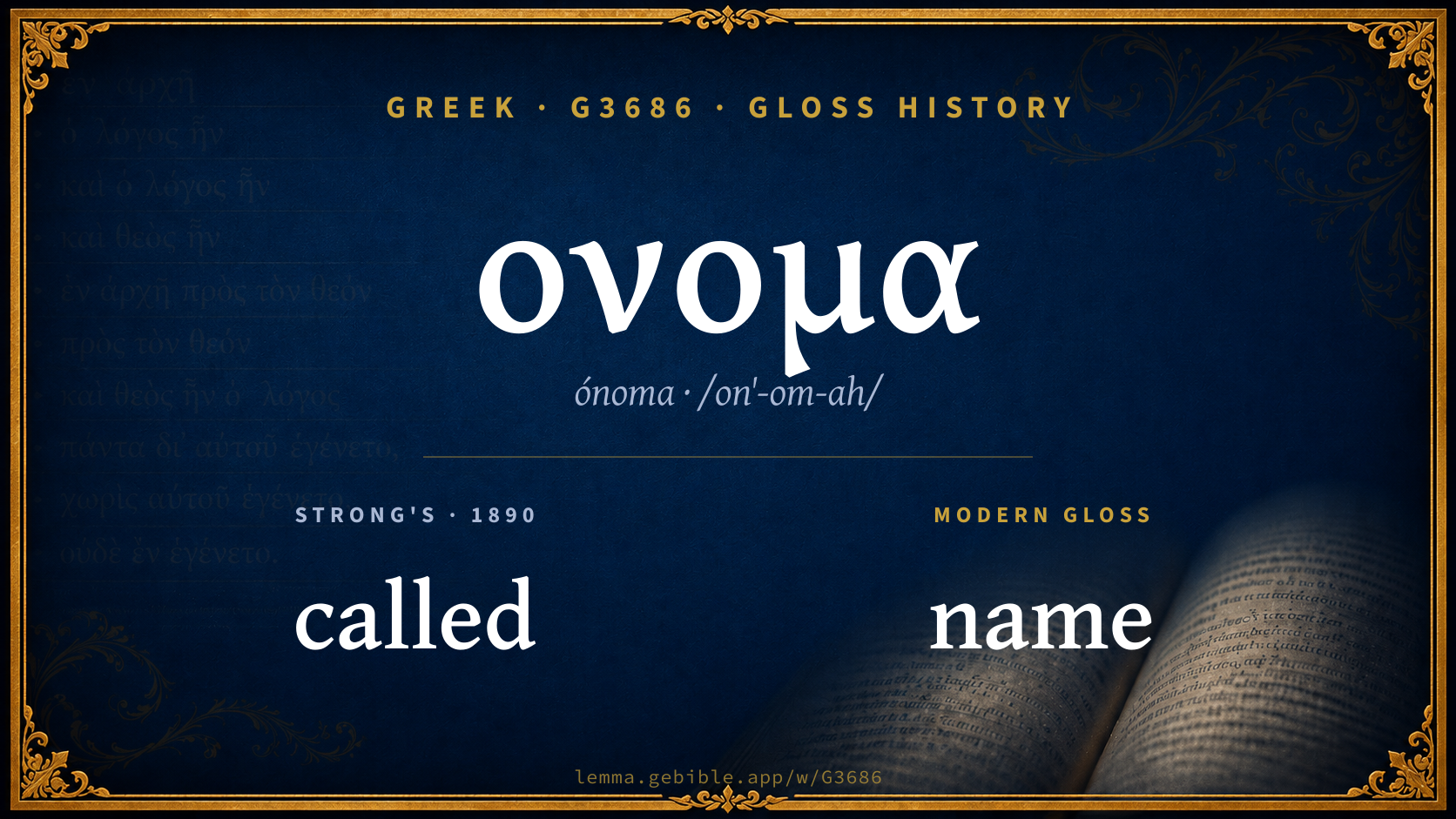
Gloss history
Strong's 1890 vs modern scholarship
About this word
Strong's G3686 catalogs a Greek word from the Greek New Testament.
These counts are not copied from any lexicon or concordance. They are computed here, from the morphology-tagged Greek New Testament. What Lemma adds →
- 214
- distinct verses
- The word appears in 214 distinct verses.
- 19 / 27
- NT books
- The word appears in 19 of 27 New Testament books.
- #71
- by frequency
- Top 100 most frequent Greek words (rank 71 of 5,347 Greek words by occurrence).
View all 214 occurrences in the concordance →
Most concentrated in
- Acts 59 verses 28%
- Luke 32 verses 15%
- Revelation 31 verses 14%
By section of the New Testament
By traditional corpus
Conventional, traditional groupings — biblical authorship is debated, so this is a traditional corpus grouping, not an authorship claim. Some books belong to more than one corpus (Luke is in both the Gospels and the Lukan corpus, and so on), so these shares overlap and need not total 100%. Each figure is a share of the word’s 214 distinct verses.
- Lukan (Luke–Acts) 91 verses · 43%
- Gospels 89 verses · 42%
- Johannine 60 verses · 28%
- Revelation 31 verses · 14%
- Pauline corpus 21 verses · 10%
- General (Catholic) Epistles 10 verses · 5%
- Hebrews 4 verses · 2%
How translations render this word
Counts come from each version’s own published word-to-Strong’s tagging or interlinear alignment — an approximate guide to how each version renders this word, not a word-level alignment the data otherwise carries. Because each total is that version’s own tagged count, the per-version totals vary from one another and need not match the appearance or distinct-verse counts above. These counts may also differ from a printed concordance because Lemma counts each distinctly tagged rendering and does not collapse phrase taggings into a single head-word total. This is a fixed set of word-tagged versions (KJV, ASV, BSB, ULT) and does not change with the reading translation you choose elsewhere. Each version’s license is shown beside its name below (and on Sources).
- King James Version: Name 170×, Named 23×, Names 11×
- American Standard Version: Name 174×, Named 27×, Names 7×
- Berean Standard Bible: Name 162×, Named 34×, Names 11×
- unfoldingWord Literal Text: Name 209×, Names 12×, Named 6×
King James Version Public Domain
Renders G3686 across 221 tagged occurrences — most commonly:
Plus 6 renderings that appear only once — usually multi-word phrases or single function words the recovered tagging swept in, not distinct renderings. Not rendered by a distinct English word in 8 further occurrences.
American Standard Version Public Domain
Renders G3686 across 231 tagged occurrences — most commonly:
Plus 6 renderings that appear only once — usually multi-word phrases or single function words the recovered tagging swept in, not distinct renderings.
Berean Standard Bible Public Domain
Renders G3686 across 214 tagged occurrences — most commonly:
Plus 4 renderings that appear only once — usually multi-word phrases or single function words the recovered tagging swept in, not distinct renderings. Not rendered by a distinct English word in 13 further occurrences.
unfoldingWord Literal Text CC BY-SA 4.0
Renders G3686 across 245 tagged occurrences — most commonly:
Plus 5 renderings that appear only once — usually multi-word phrases or single function words the recovered tagging swept in, not distinct renderings.
Senses in Thayer's
The 4 senses Thayer's distinguishes for this word, in lexicon order (not ranked by frequency or importance). The full entry — with sub-senses — is in the Lexicon Entry tab.
- name: univ. of proper names
- the name is used for everything which the name covers…
- persons reckoned up by name
- the cause or reason named: on this account, because he suffers as a Christian, for this reason
Word origin
Derived from γινωσκω (ginṓskō) (G1097) — to know.
Forms in the corpus
The 9 distinct written forms G3686 takes in the Greek New Testament, most frequent first — each parse links to that case’s occurrences in the concordance.
| Form | Parsing | Example | Uses |
|---|---|---|---|
| ὄνομα ónoma | Noun, Accusative, Singular, Neuter | Matthew 1:21 | 83 |
| ὀνόματι onómati | Noun, Dative, Singular, Neuter | Matthew 7:22 | 73 |
| ὄνομά ónomá | Noun, Accusative, Singular, Neuter | Matthew 10:22 | 23 |
| ὀνόματί onómatí | Noun, Dative, Singular, Neuter | Matthew 18:5 | 21 |
| ὀνόματος onómatos | Noun, Genitive, Singular, Neuter | Acts 3:16 | 14 |
| ὀνόματα onómata | Noun, Accusative, Plural, Neuter | Mark 3:17 | 9 |
| ὀνόματός onómatós | Noun, Genitive, Singular, Neuter | Matthew 19:29 | 3 |
| ὀνομάτων onomátōn | Noun, Genitive, Plural, Neuter | Acts 1:15 | 2 |
| ὀνόματά onómatá | Noun, Nominative, Plural, Neuter | Matthew 10:2 | 1 |
Same root — word family
Other Thayer's entries built from the same root as G3686, grouped by Strong’s listed origin. These share a root / origin per the lexicon — not necessarily a shared meaning. Each links to that word’s own entry.
Derives from
Shares the same root
- γνωμη gnṓmē G1106 mind
- γνωριζω gnōrízō G1107 to make known
- γνωσις gnōsis G1108 knowledge
- γνωστης gnṓstēs G1109 expert
- γνωστος gnōstós G1110 known
- νους noûs G3563 mind
Derived from this word
Compare all same-root words → Showing 4 of 11 — not the complete family. They share a root, not necessarily a meaning.
Septuagint usage
The same Greek word ονομα appears 877 times in the Greek Old Testament (Septuagint), across 782 verses in 34 books.
- 877
- LXX occurrences
- Tagged occurrences of this Greek word in the Septuagint.
- 782
- verses
- Distinct Septuagint verses containing this word.
- 34 / 39
- OT books
- The word appears in 34 of the 39 Old Testament books.
Sample Septuagint occurrences
- Genesis 2:11 ὄνομα
- Exodus 1:1 ὄνομα
- Leviticus 18:21 ὄνομα
- Numbers 1:2 ὄνομα
- Deuteronomy 2:25 ὄνομα
- Joshua 2:1 ὄνομα
- Judges 1:10 ὄνομα
- Ruth 1:2 ὄνομα
- 1 Samuel 1:1 ὄνομα
- 2 Samuel 2:16 ὄνομα
- 1 Kings 1:47 ὄνομα
- 2 Kings 2:24 ὄνομα
Septuagint occurrences (same lexeme)
Every verse where the same Strong’s number (G3686) appears in the Greek Septuagint — showing the first 50 of 782. Verse text shown in the World English Bible for context; the Greek form is the matched word — the English is not keyword-highlighted.
- Genesis 2:11 ὄνομα The name of the first is Pishon: this is the one which flows through the whole land of Havilah, where there is gold;
- Genesis 2:13 ὄνομα The name of the second river is Gihon: the same river that flows through the whole land of Cush.
- Genesis 2:19 ὄνομα Out of the ground Yahweh God formed every animal of the field, and every bird of the sky, and brought them to the man to see what he would call them. Whatever the man called every living creature, that was its name.
- Genesis 2:20 ὄνομα The man gave names to all cattle, and to the birds of the sky, and to every animal of the field; but for man there was not found a helper suitable for him.
- Genesis 3:20 ὄνομα The man called his wife Eve, because she was the mother of all living.
- Genesis 4:17 ὄνομα Cain knew his wife. She conceived, and gave birth to Enoch. He built a city, and called the name of the city, after the name of his son, Enoch.
- Genesis 4:19 ὄνομα Lamech took two wives: the name of the one was Adah, and the name of the other Zillah.
- Genesis 4:21 ὄνομα His brother's name was Jubal, who was the father of all who handle the harp and pipe.
- Genesis 4:25 ὄνομα Adam knew his wife again. She gave birth to a son, and named him Seth. For, she said, "God has appointed me another child instead of Abel, for Cain killed him."
- Genesis 4:26 ὄνομα There was also born a son to Seth, and he named him Enosh. Then men began to call on Yahweh's name.
- Genesis 5:2 ὄνομα He created them male and female, and blessed them, and called their name Adam, in the day when they were created.
- Genesis 5:3 ὄνομα Adam lived one hundred thirty years, and became the father of a son in his own likeness, after his image, and named him Seth.
- Genesis 5:29 ὄνομα and he named him Noah, saying, "This same will comfort us in our work and in the toil of our hands, because of the ground which Yahweh has cursed."
- Genesis 10:25 ὄνομα To Eber were born two sons. The name of the one was Peleg, for in his days was the earth divided. His brother's name was Joktan.
- Genesis 11:4 ὄνομα They said, "Come, let's build us a city, and a tower, whose top reaches to the sky, and let's make us a name; lest we be scattered abroad on the surface of the whole earth."
- Genesis 11:9 ὄνομα Therefore the name of it was called Babel, because Yahweh confused the language of all the earth, there. From there, Yahweh scattered them abroad on the surface of all the earth.
- Genesis 11:29 ὄνομα Abram and Nahor took wives. The name of Abram's wife was Sarai, and the name of Nahor's wife, Milcah, the daughter of Haran who was also the father of Iscah.
- Genesis 12:2 ὄνομα I will make of you a great nation. I will bless you, and make your name great. You will be a blessing.
- Genesis 12:8 ὄνομα He left from there to the mountain on the east of Bethel, and pitched his tent, having Bethel on the west, and Ai on the east. There he built an altar to Yahweh, and called on the name of Yahweh.
- Genesis 13:4 ὄνομα to the place of the altar, which he had made there at the first. There Abram called on the name of Yahweh.
- Genesis 16:1 ὄνομα Now Sarai, Abram's wife, bore him no children. She had a handmaid, an Egyptian, whose name was Hagar.
- Genesis 16:11 ὄνομα The angel of Yahweh said to her, "Behold, you are with child, and will bear a son. You shall call his name Ishmael, because Yahweh has heard your affliction.
- Genesis 16:13 ὄνομα She called the name of Yahweh who spoke to her, "You are a God who sees," for she said, "Have I even stayed alive after seeing him?"
- Genesis 16:15 ὄνομα Hagar bore a son for Abram. Abram called the name of his son, whom Hagar bore, Ishmael.
- Genesis 17:5 ὄνομα Neither will your name any more be called Abram, but your name will be Abraham; for the father of a multitude of nations have I made you.
- Genesis 17:15 ὄνομα God said to Abraham, "As for Sarai your wife, you shall not call her name Sarai, but her name will be Sarah.
- Genesis 17:19 ὄνομα God said, "No, but Sarah, your wife, will bear you a son. You shall call his name Isaac. I will establish my covenant with him for an everlasting covenant for his seed after him.
- Genesis 19:22 ὄνομα Hurry, escape there, for I can't do anything until you get there." Therefore the name of the city was called Zoar.
- Genesis 19:37 ὄνομα The firstborn bore a son, and named him Moab. The same is the father of the Moabites to this day.
- Genesis 19:38 ὄνομα The younger also bore a son, and called his name Ben Ammi. The same is the father of the children of Ammon to this day.
- Genesis 21:3 ὄνομα Abraham called his son who was born to him, whom Sarah bare to him, Isaac.
- Genesis 21:23 ὄνομα Now therefore swear to me here by God that you will not deal falsely with me, nor with my son, nor with my son's son. But according to the kindness that I have done to you, you shall do to me, and to the land in which you have lived as a foreigner."
- Genesis 21:31 ὄνομα Therefore he called that place Beersheba, because they both swore there.
- Genesis 21:33 ὄνομα Abraham planted a tamarisk tree in Beersheba, and called there on the name of Yahweh, the Everlasting God.
- Genesis 22:14 ὄνομα Abraham called the name of that place Yahweh-Jireh. As it is said to this day, "In Yahweh's mountain it will be provided.
- Genesis 22:24 ὄνομα His concubine, whose name was Reumah, also bare Tebah, Gaham, Tahash, and Maacah.
- Genesis 24:29 ὄνομα Rebekah had a brother, and his name was Laban. Laban ran out to the man, to the spring.
- Genesis 25:1 ὄνομα Abraham took another wife, and her name was Keturah.
- Genesis 25:13 ὄνομα These are the names of the sons of Ishmael, by their names, according to the order of their birth: the firstborn of Ishmael, Nebaioth, then Kedar, Adbeel, Mibsam,
- Genesis 25:16 ὄνομα These are the sons of Ishmael, and these are their names, by their villages, and by their encampments: twelve princes, according to their nations.
- Genesis 25:25 ὄνομα The first came out red all over, like a hairy garment. They named him Esau.
- Genesis 25:26 ὄνομα After that, his brother came out, and his hand had hold on Esau's heel. He was named Jacob. Isaac was sixty years old when she bore them.
- Genesis 25:30 ὄνομα Esau said to Jacob, "Please feed me with that same red stew, for I am famished." Therefore his name was called Edom.
- Genesis 26:18 ὄνομα Isaac dug again the wells of water, which they had dug in the days of Abraham his father. For the Philistines had stopped them after the death of Abraham. He called their names after the names by which his father had called them.
- Genesis 26:20 ὄνομα The herdsmen of Gerar argued with Isaac's herdsmen, saying, "The water is ours." He called the name of the well Esek, because they contended with him.
- Genesis 26:21 ὄνομα They dug another well, and they argued over that, also. He called the name of it Sitnah.
- Genesis 26:22 ὄνομα He left that place, and dug another well. They didn't argue over that one. He called it Rehoboth. He said, "For now Yahweh has made room for us, and we will be fruitful in the land."
- Genesis 26:25 ὄνομα He built an altar there, and called on the name of Yahweh, and pitched his tent there. There Isaac's servants dug a well.
- Genesis 26:33 ὄνομα He called it Shibah. Therefore the name of the city is Beersheba to this day.
- Genesis 27:36 ὄνομα He said, "Isn't he rightly named Jacob? For he has supplanted me these two times. He took away my birthright. See, now he has taken away my blessing." He said, "Haven't you reserved a blessing for me?"
These are occurrences of the same Greek lexeme (G3686) in the Septuagint — not a translation of any one Hebrew word. The store carries no word-level Hebrew↔Greek alignment, so no Hebrew original is asserted here. Counts come from the recovered LXX Strong's tagging — high-frequency vocabulary is well covered, while rare or late forms may be untagged — so they reflect tagged occurrences and may slightly undercount.