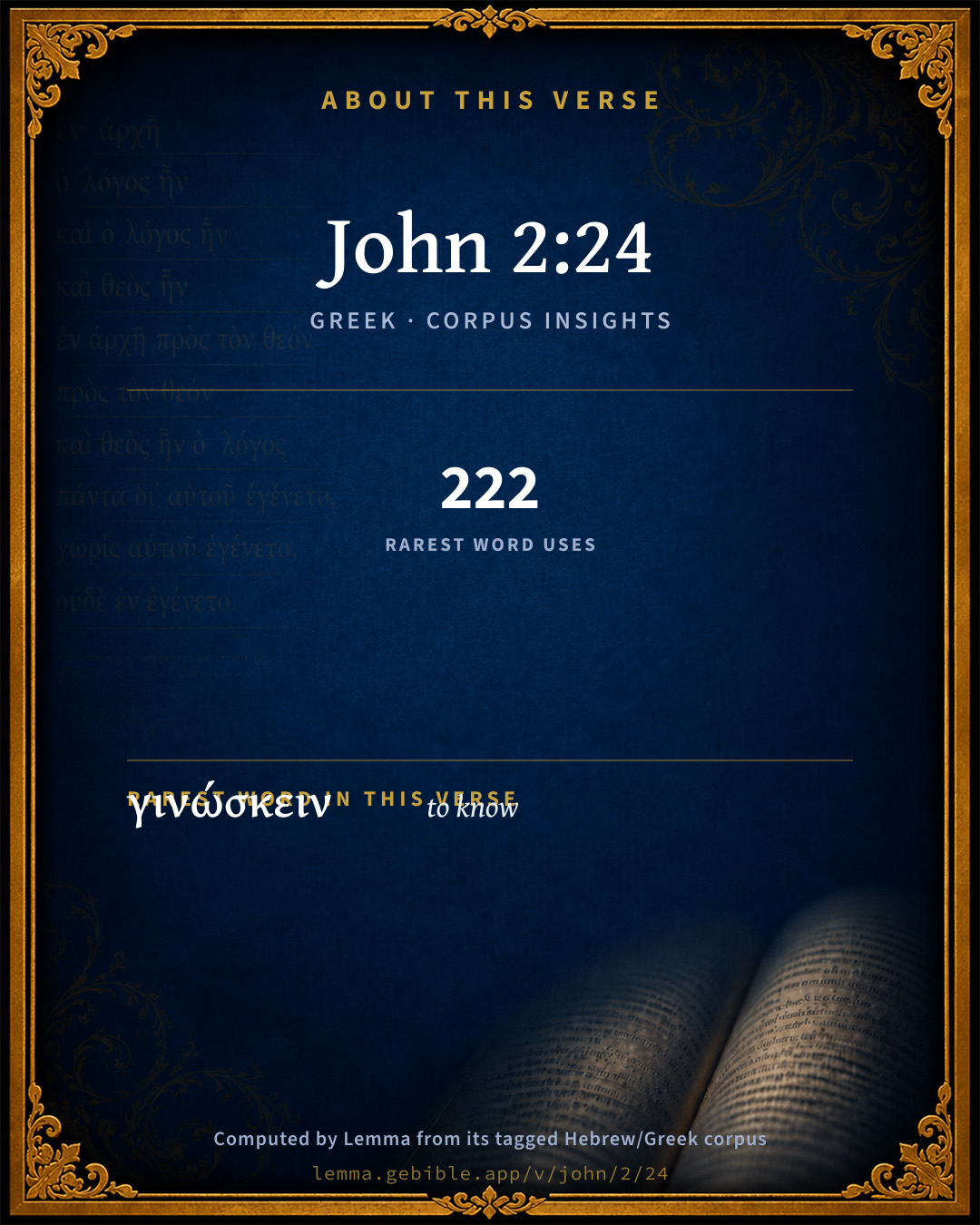
John 2:24

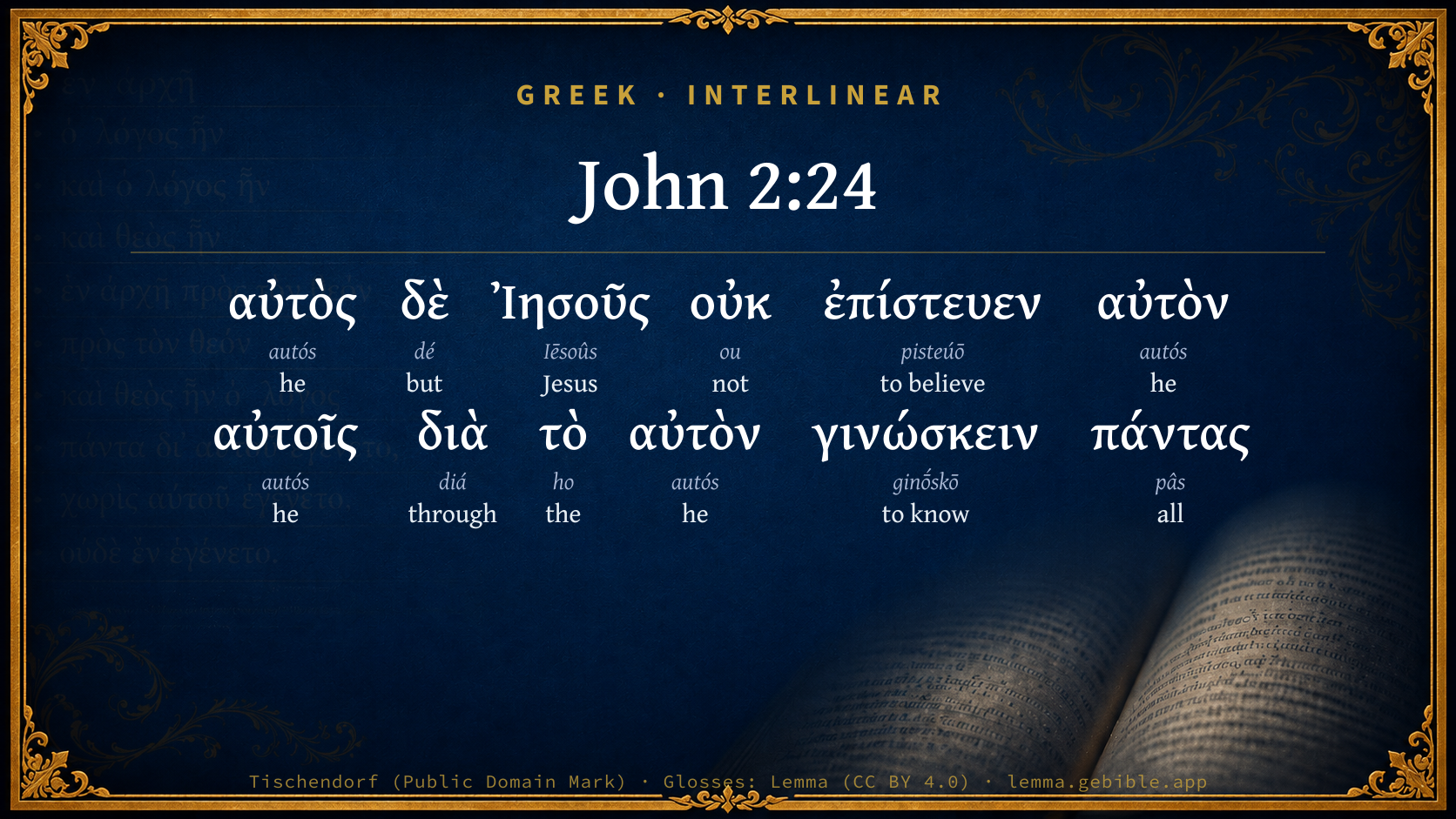
Greek (Tischendorf 8th ed.) John 2:24 appears in the Greek New Testament. The text above is from the Tischendorf 8th edition. Each word links to its Strong’s number and a concise gloss. Click any word for its full Thayer’s Greek Lexicon entry.
Download image
Cite this verse

John 2:24 (World English Bible). Public Domain. Lemma interlinear Bible study tool, https://lemma.gebible.app/v/john/2/24.

Show BibTeX & RIS
BibTeX
RIS
English Translation
But Jesus didn't trust himself to them, because he knew everyone,
World English Bible · Public Domain
Download a study sheet

One document with this verse’s original text, its word-by-word gloss line, the meaning frame, cross-references with their text, attributed commentary, and full source and license credits — printable, and it pastes into notes with its structure intact.

This verse Autodidact and up

Study sheet (.html) Plain text (.txt)

A passage Seminary Student

Up to 50 verses in one chapter. A passage sheet keeps up to 6 commentary sources and 12 cross-references per verse, in the order this page ranks them, and says so on the sheet whenever that leaves anything out. Ask for a single verse and you get the Autodidact verse sheet above.

Everything on this page stays free to read, with no account — the sheet is a download of what is already on screen, not access to it.

Want to remove ads? Support Godless Engineer
Compare translations 3

The same verse in 3 English versions, stacked beneath the original-language interlinear above. Click any original word for its lexicon entry.

Each is an independent rendering of the whole verse — the interlinear is not word-aligned to these translations.

Highlighted words mark where these versions differ — a whole-verse word diff, not a word-by-word alignment.

  • World English Bible Public Domain
    But Jesus didn't trust himself to them, because he knew everyone,
  • King James Version Public Domain
    But Jesus did not commit himself unto them, because he knew all men,
  • unfoldingWord Literal Text CC BY-SA 4.0
    But Jesus himself did not trust himself to them because he knew all

unfoldingWord Literal Text — © unfoldingWord, licensed CC BY-SA 4.0. Word-aligned USFM3 via Door43 (git.door43.org/unfoldingWord/en_ult).

Versions to compare (up to 4)

3 of 4 selected

Show all 19 translations

Every available English version of this verse, each an independent rendering of the whole verse.

  • World English Bible Public Domain
    But Jesus didn't trust himself to them, because he knew everyone,
  • Berean Standard Bible Public Domain
    But Jesus did not entrust Himself to them, for He knew them all.
  • Majority Standard Bible Public Domain
    But Jesus did not entrust Himself to them, for He knew them all.
  • King James Version Public Domain
    But Jesus did not commit himself unto them, because he knew all men,
  • American Standard Version (1901) Public Domain
    But Jesus did not trust himself unto them, for that he knew all men,
  • Revised Version (1885) Public Domain
    But Jesus did not trust himself unto them, for that he knew all men,
  • Geneva Bible (1599) Public Domain
    But Iesus did not commit him selfe vnto them, because he knewe them all,
  • Douay-Rheims (1899) Public Domain
    But Jesus did not trust himself unto them, for that he knew all men,
  • Young's Literal Translation Public Domain
    and Jesus himself was not trusting himself to them, because of his knowing all `men',
  • Literal Standard Version CC BY-SA 4.0
    and Jesus Himself was not trusting Himself to them, because of His knowing all [men],
  • Unlocked Literal Bible CC BY-SA 4.0
    But Jesus did not trust in them because he knew them all,
  • unfoldingWord Literal Text CC BY-SA 4.0
    But Jesus himself did not trust himself to them because he knew all
  • Darby Bible Public Domain
    But Jesus himself did not trust himself to them, because he knew all [men],
  • World Messianic Bible Public Domain
    But Yeshua didn’t entrust himself to them, because he knew everyone,
  • Webster's Bible Public Domain
    But Jesus did not commit himself to them, because he knew all men.
  • Free Bible Version CC BY-SA 4.0
    But Jesus did not trust himself to them, because he knew all about people.
  • Bible in Basic English Public Domain
    But Jesus did not have faith in them, because he had knowledge of them all.
  • Text-Critical English NT CC BY 4.0
    But Jesus did not entrust himself to them, for he knew all men.
  • Tyndale New Testament (1534) Public Domain
    But Iesus put not him selfe in their hondes because he knewe all men

Literal Standard Version (2020), Covenant Press — licensed CC BY-SA 4.0. Text via the HelloAO Bible API (eBible.org). Unlocked Literal Bible (unfoldingWord) — licensed CC BY-SA 4.0. Text via the HelloAO Bible API (eBible.org). unfoldingWord Literal Text — © unfoldingWord, licensed CC BY-SA 4.0. Word-aligned USFM3 via Door43 (git.door43.org/unfoldingWord/en_ult). Free Bible Version, Dr. Jonathan Gallagher — licensed CC BY-SA 4.0. Text via the HelloAO Bible API (eBible.org).

Word by word

More ways to search: Search by grammar → Find every occurrence → Compare this word →

Practice this passage: Drill this verse → Learn its vocabulary →

γινώσκειν
ginṓskō
G1097
“to know”
Verb, Present, Active, Infinitive
Part of Speech
Verb
Tense
Present
Voice
Active
Mood
Infinitive
Full Thayer's Definition

Origin: a prolonged form of a primary verb

TDNT: 12:29,1

1. to learn to know, come to know, get a knowledge of perceive, feel a. to become known 2. to know, understand, perceive, have knowledge of a. to understand b. to know 3. Jewish idiom for sexual intercourse between a man and a woman 4. to become acquainted with, to know
  1. αὐτὸς autós G846 “he” Personal pronoun, Nominative, Singular, Masculine
  2. δὲ dé G1161 “but” Conjunction
  3. Ἰησοῦς Iēsoûs G2424 “Jesus” Noun, Nominative, Singular, Masculine
  4. οὐκ ou G3756 “not” Particle, Negative
  5. ἐπίστευεν pisteúō G4100 “to believe” Verb, Imperfect, Active, Indicative, 3rd person, Singular
  6. αὐτὸν autós G846 “he” Personal pronoun, Accusative, Singular, Masculine
  7. αὐτοῖς autós G846 “he” Personal pronoun, Dative, Plural, Masculine
  8. διὰ diá G1223 “through” Preposition
  9. τὸ ho G3588 “the” Article, Accusative, Singular, Neuter
  10. αὐτὸν autós G846 “he” Personal pronoun, Accusative, Singular, Masculine
  11. πάντας pâs G3956 “all” Adjective, Accusative, Plural, Masculine

About this verse

These counts appear in no published source. They are computed here, from the morphology-tagged text and Lemma’s own curated glosses. What Lemma adds →

12
words
9
distinct lemmas
Gospels
section

Repetition

A word recurs within this verse:

  • αὐτὸς he G846 ×4

Cross-references

17

Topical passages linked to John 2:24 in the Treasury of Scripture Knowledge — connected by theme and wording, ordered by reader-vote popularity; previews shown in the World English Bible.

  • John 6:64 But there are some of you who don't believe." For Jesus knew from the beginning who they were who didn't believe, and who it was who would betray him.
  • Matthew 9:4 Jesus, knowing their thoughts, said, "Why do you think evil in your hearts?
  • Acts 1:24 They prayed, and said, "You, Lord, who know the hearts of all men, show which one of these two you have chosen
  • Hebrews 4:13 There is no creature that is hidden from his sight, but all things are naked and laid open before the eyes of him with whom we have to do.
  • 1 Chronicles 28:9 You, Solomon my son, know the God of your father, and serve him with a perfect heart and with a willing mind; for Yahweh searches all hearts, and understands all the imaginations of the thoughts: if you seek him, he will be found of you; but if you forsake him, he will cast you off forever.
  • 1 Samuel 16:7 But Yahweh said to Samuel, "Don't look on his face, or on the height of his stature; because I have rejected him: for [Yahweh sees] not as man sees; for man looks at the outward appearance, but Yahweh looks at the heart."
  • Jeremiah 17:9 The heart is deceitful above all things, and it is exceedingly corrupt: who can know it?
  • John 5:42 But I know you, that you don't have God's love in yourselves.
  • John 16:30 Now we know that you know all things, and don't need for anyone to question you. By this we believe that you came forth from God."
  • Revelation 2:23 I will kill her children with Death, and all the assemblies will know that I am he who searches the minds and hearts. I will give to each one of you according to your deeds.
  • Mark 2:8 Immediately Jesus, perceiving in his spirit that they so reasoned within themselves, said to them, "Why do you reason these things in your hearts?
  • John 21:17 He said to him the third time, "Simon, son of Jonah, do you have affection for me?" Peter was grieved because he asked him the third time, "Do you have affection for me?" He said to him, "Lord, you know everything. You know that I have affection for you." Jesus said to him, "Feed my sheep.
  • 1 Chronicles 29:17 I know also, my God, that you try the heart, and have pleasure in uprightness. As for me, in the uprightness of my heart I have willingly offered all these things: and now have I seen with joy your people, that are present here, offer willingly to you.
  • John 6:15 Jesus therefore, perceiving that they were about to come and take him by force, to make him king, withdrew again to the mountain by himself.
  • Matthew 10:16–17 "Behold, I send you out as sheep in the midst of wolves. Therefore be wise as serpents, and harmless as doves.
  • John 1:42 He brought him to Jesus. Jesus looked at him, and said, "You are Simon the son of Jonah. You shall be called Cephas" (which is by interpretation, Peter).
  • John 1:46–47 Nathanael said to him, "Can any good thing come out of Nazareth?" Philip said to him, "Come and see."

Cross-references courtesy of OpenBible.info (CC BY 4.0).

Commentary

Notes on John 2:24 from classic Christian and Jewish commentators (each source and its license shown beneath its notes). The classic Christian expositions comment on the surrounding passage and are grouped to its opening verse, so a note may address several verses; the Jewish commentaries on the Tanakh (Rashi and others) are per-verse, so they appear only where the commentator wrote on this verse.

Lemma curates 59 commentaries, every one of them public domain or Creative Commons licensed, each selected and text-cleaned for this edition rather than reprinted as found. About our sources →

The Biblical Illustrator

Joseph S. Exell

Joh_2:24-25

Jesus did not commit Himself unto them, because He knew all men.

Superficial faith

I. THE DANGER OF A SUPERFICIAL FAITH. It was only such a faith that these people had who believed in Christ on the ground of His miracles. It did not satisfy Christ. It had no deep root and had not led to loyal acceptance of His doctrine. Compare it with that of Nicodemus. Both felt that Christ was a teacher sent from God; but in the one case the feeling stopped there; in the other it stimulated patient inquiry. Consequently, while Christ did not commit Himself to the one, He did to the other. There are believers and believers; there is a serious possibility of being a sincere believer, but with a faith so shallow as not to be owned by Christ.

II. THE UNPROFITABLENESS OF A SUPERFICIAL FAITH. Christ had no faith in their faith. Shallow faith secures none of the privileges of discipleship; it does not appropriate Christ, and therefore does not enjoy His love and friendship. Christ reciprocates the faith of His true disciples only.

III. THE PERFECT ACQUAINTANCE WHICH CHRIST HAS WITH THE STATE OF PROFESSED BELIEVERS.

1. This bears on the nature of Christ ascribing to Him an attribute of Deity.

2. This bears on ourselves, telling us how thoroughly we are known. We may deceive ourselves, but we cannot deceive Him. This should lead to carefulness and honesty. (W. Steele, M. A.)

The omniscience of Christ

Nature in all her realms lies open to His eye. Mankind in all its races are in His view. Every mans circumstances and thoughts are known to Him. This knowledge is

I. INTUITIVE Ours is dependent on human testimony; His utterly independent of it. Who told Him Zaccheus name, or of the domestic history of the woman of Samaria, or of the treachery of Judas? And so now from heaven He addressed Saul of Tarsus by name and told the Asian churches that He knew their works. Still All things are naked and open unto His eyes.

II. UNIVERSE. With instant discrimination He knew friend from foe, the enthusiasts which fed on His miracles, and that which was love to Himself. Where is there a man? Christ knows Him, one of a thousand millions. What is He doing in crowded mart or solitary cell? Christ knows all about it.

III. INTIMATE. He reads thoughts, feelings, affections, desires. Deception has no covering from Him; hypocrisy no mask He cannot pierce. Judas may deceive the twelve, he cannot deceive the Lord. There is no secrecy in sin. Conclusion: Take comfort from Christs omniscience.

1. Are we in sorrows? Think of Hagar.

2. Do we give ourselves to prayer? Think of Nathanael.

3. Are we of doubtful mind? Think of Thomas. (G. T. Coster.)

Christs distrust of man

I. WE MAY MEASURE IT IN PART BY THE TEMPTATION IT RESISTED. It was more wonderful than even His mighty works. Around Christ was a nation full of Messianic hopes. All He had to do was by falling in with the notional ideas to gather those hopes around Himself. Who could have resisted such a temptation but He who knew the falsity of the hearts which entertained those hopes.

II. IT DEPENDED UPON THOROUGH AND ABSOLUTE KNOWLEDGE. With most people distrust is the offspring, as in turn it becomes the parent of ignorance. When men have never fairly tried their fellows or studied their behaviour under circumstances which reveal character, they naturally hesitate to commit great interests to their keeping. Christ knew men because He knew man.

III. ITS BEARINGS ON THE REDEMPTIVE WORK OF CHRIST WERE MOST IMPORTANT.

1. It safeguarded Him from surprise and precipitancy.

2. It rendered His death absolutely voluntary. (A. F. Muir, M. A.)

Christs knowledge of man

Christ knows the very roots of the trees; we know the character of the trees only from the fruits. (Calvin.)

The miracles at the Passover

I. THE WORKS WHICH THE SAVIOUR PERFORMED.

1. Where they were performed.

2. When on the feast day, a most favourable time.

II. THE HONOUR WHICH THE SAVIOUR RECEIVED. No greater honour can be given to a man than to trust him.

1. By what means the peoples faith was produced. Miracles.

2. The number who were convinced of the truth of Christs claims was considerable.

III. THE CAUTION WHICH THE SAVIOUR EXERCISED.

1. How it was shown.

2. The reason assigned.

3. The truth announced--Needed not, etc.

(Miracles of our Lord.)

Christs knowledge of man

I. HE KNOWS ALL ABOUT THE DISEASE WHICH AFFLICTS US. Our faith in a physicians knowledge has often much to do with our recovery. Christ knows thoroughly His own workmanship, and all about that sin which is marring it.

II. CHRIST THROUGH HIS KNOWLEDGE IS ABLE TO WORK HIS CURE. To perform this cure requires a perfect knowledge of the disease and power over it. Christ has both these.

III. CHRIST KNOWS THE CHRISTIAN IN A SPECIAL WAY. I know My sheep. He calls us by name. As in the human so in the Divine family dispositions and temperaments are recognized. One can be lead by a thread, another will break an ox chain. Christ saw the faith of the Syrophoenician. He knew what was in boasting Peter and in Judas.

1. He knows the temptation of each Christian, and will not allow us to be tempted above what we are able.

2. In the light of this we are able to understand better our trials. Christ as the Physician does not hesitate to use the lancet when necessary. He bleeds the plethoric that he may bring forth more fruit. (T. L. Cuyler, D. D.)

Christs knowledge of man

He knows what was in man

I. AS HE CAME AT FIRST FROM THE CREATORS HAND. God made man upright; and that uprightness is known to Him on whom our help has been laid. The Son partook of the Divine council in which the human constitution was planned.

II. WHEN HE HAD FALLEN. Knowing the character of the perfect work, the Saviour knows also the amount of damage that it has sustained. He knows, also, the gravity of mans sin, as an event affecting all the plans of God, and the government of all intelligent beings. Some trees are of such a constitution that if the uppermost bud is once nipped off, the tree is finally ruined. It can never develop itself into its proper shape and dimensions. Such an uppermost bud was humanity on the whole material creation. Deprived of its head, the world could not shoot up into the beauty and completeness which its Maker intended it should attain.

III. WHAT WOULD RESTORE HIM, AND WAS ABLE TO APPLY THE CURE. Knowing the worth of man as God had made him, our Physician would not abandon the wreck; but knowing how complete the wreck was, He bowed His heavens and came down to save. He united Himself to us, that if He should rise so must we. I rejoice in the omniscience of the Holy One, both on account of the good that He knew in man, and the evil. A counsellor who understood less fully what our nature was, and our constitution fitted us to become might have advised abandonment. It often becomes a question whether a stranded ship should be left to her fate or brought off and repaired. Sometimes an erroneous judgment is acted on. On one side, an effort is made to save the wreck, when it would have been better to abandon it, and construct another. Again, she is sometimes weakly abandoned, when it would have been profitable to have saved her. And so a helper who understood less of our original nature and capability might have proposed to cast us off as hopelessly damaged, supposing that, by allowing the wreck to be wholly washed away, a new and higher degree of intelligence might have been called into existence. Although Christ knew all the evil that was in man by sin, He did not disdain to undertake the rescue. By assuming the nature of the fallen, and meeting the law in their stead, He received the curse into Himself and exhausted it.

IV. SOME LESSONS:

1. Speaking of the unconverted--He knows what is in them and yet He does not cast out the unclean.

2. Speaking of His own disciples--He knows what is in them, and with that knowledge, it is because He is God and not man, that He does not shake them off.

3. He knows what is in man, and therefore can make His word and providence suitable. (W. Arnot, D. D.)

Inward knowledge of man necessary for good authorship

Dickens, writing about a clever story by a popular author, says, It is extremely good indeed; but all the strongest things of which it is capable missed. It shows just how far that kind of power can go. It is more like a note of an idea than anything else. It seems to be as if it were written by somebody who lived next door to other people, rather than inside of them.

The Biblical Illustrator, edited by Joseph S. Exell (c. 1880s–1900s) — public domain. Text from a community e-Sword module.

Tyndale Open Study Notes

Tyndale Open Resources

2:24 John uses a play on words here. Because of his signs, many people trusted in Jesus (2:23), but Jesus didn’t trust them. This did not refer to specific people Jesus met in Jerusalem, but reflects his knowledge of all humanity.

Tyndale Open Study Notes — © Tyndale Open Resources, licensed CC BY-SA 4.0. Text via the HelloAO Bible API.

Bengel's Gnomon

Johann Albrecht Bengel

Joh 2:24. Αὐτός) Himself.—οὐκ ἐπίστευεν ἑαυτόν, He did not commit Himself) He did not descend to too great familiarity with them (Septuag., Job 29:24, εἰ ἐγέλων πρὸς αὐτοὺς, οὐκ ἐπίστευον, “If I laughed on them, they believed it not):” He did not reveal to them the things which it was not yet the full time for revealing. [In fact, He left the city, when the passover feast was either not yet, or scarcely, finished, for this reason, because those men were already meditating with themselves the plots, which broke out more openly, ch. Joh 5:16; Joh 5:18, “The Jews sought to slay Him, because He had done these things on the Sabbath day:” and also “said that God was His Father, making Himself equal with God;” Joh 7:1, “He would not walk in Jewry, because the Jews sought to kill Him:” for it was not then as yet the time for His submitting Himself to encounter their hatred. Without doubt it was, as having a secret surmise of these things, that Nicodemus had the interview with Him by night.—Harm., p. 163.]—The antithesis to οὐκ ἐπίστευεν ἑαυτόν is ἐπίστευσαν, many believed, Joh 2:23.—αὐτόν) Himself, of Himself, knew all men.—γινώσκειν, knew) Often John so uses the word γινώσκειν, to know, of Jesus having cognizance of all things, without information given Him by man: ch. Joh 4:1, “The Lord knew how the Pharisees had heard that Jesus made—more disciples than John;” Joh 5:6, “When Jesus knew that he (the impotent man) had now been a long time in that case,” etc.

Bengel's Gnomon of the New Testament — English translation (T&T Clark, Edinburgh, 1860) — public domain. Text from a community e-Sword module.

Meyer's Critical & Exegetical Commentary

Heinrich August Wilhelm Meyer

Joh_2:24-25. Αὐτὸς δὲ, κ.τ.λ.] But He on His part, though they on their part, on account of His miracles, believed on Him.

οὐκ ἐπίστ. ἑαυτόν] an intentional antithesis to the preceding ἐπίστ. εἰς τὸ ὄνομα αὐτοῦ. Observe the emphatic ἑαυτόν: it must not be taken as meaning He kept back His doctrine from them (Chrysostom, Kuinoel, and many), or His work (Ebrard); but He did not trust Himself, i.e. His own person, to them; He refrained from any closer personal intercourse with them. Without any such reserve on His part, rather with confident self-surrender, had He given Himself to His intimate Galilean friends. Towards the Jews in Jerusalem, on whom, from His knowledge of the human heart, He could not bestow this self-devotion, because there were wanting in them the inward moral conditions necessary thereto, His bearing was more strange and distant. Observe the imperfects ἐπίστευεν and ἐγίνωσκε.

διὰ τὸ αὐτὸν γινώσκ. πάντ.] because He Himself (as in the following αὐτός) knew all men, universal. Respecting none did His personal knowledge fail Him with regard to the state of his moral feeling.

καὶ ὅτι, κ.τ.λ.] negative expression of the same thought in the popular form of a still further reason.

ἵνα] not instead of the infinitive construction (Mat_3:14 al.), but the object of the need is conceived of in the form of a purpose which the person needing guidance entertains. Comp. Joh_16:30; 1Jn_2:27.

περὶ τοῦ ἀνθρ.] does not apply to Jesus Himself (concerning Him as man, Ewald), but concerning any man with whom He had at any time to do. See Bernhardy, p. 315; Winer, p. 109 [E. T. p. 143].

αὐτός] of Himself, i.e. αὐτοδίδακτος, Nonnus. See Herm. ad Viger. p. 733; Krüger, Anab. ii. 3. 7; comp. Clementine Homil. iii. 13 : ἀπείρῳ ψυχῆς ὀφθαλμῷ.

τί ἦν ἐν τῷ ἀνθρ.] the inward, though not outwardly indicated capacity, character, disposition, and so on; τὸ κρυπτὸν τοῦ νοῦς, Origen. Comp. Nonnus: ὅσα φρενὸς ἔνδοθεν ἀνὴρ εἶχεν ἀκηρύκτῳ κεκαλυμμένα φάρεϊ σιγῆς. To this supernatural and immediate discernment, as possessed by Jesus, special prominence is often given by John. Comp. Joh_1:49-50, Joh_4:19; Joh_4:29, Joh_6:61; Joh_6:64, Joh_11:4; Joh_11:15, Joh_13:11, Joh_16:19, Joh_21:17. It is the life expression of His divine essence (Psa_7:10; Psa_139:2; Act_15:8), like the working of miracles.

Meyer — Critical and Exegetical Commentary on the New Testament — English translation by Peter Christie, edited by Frederick Crombie (T&T Clark, 1880) — public domain. Text from a community e-Sword module.

Godet's Commentaries

Frédéric Louis Godet

Vv. 24, 25. “But Jesus did not trust himself to them, because he knew all men, 25, and because he had no need that any one should testify of man; for he knew of himself what was in man.”

Jesus is no more dazzled by this apparent success, than He had been discouraged by the reverse which He had undergone in the temple. He discerns the insufficient nature of this faith. There is a sort of play upon words in the relation between οὐκ ἐπίστευεν, He did not believe, did not trust Himself, and ἐπίστευσαν, they believed, Joh 2:23. While they considering only the external facts, the miracles, believed, He (αὐτὸς δέ) not stopping with appearances, did not believe; He did not have faith in their faith. It is because He did not recognize in it the work of God. Consequently, He did not any more treat them as believers. How was this attitude of distrust manifested? It is difficult to state precisely. Probably the point in John’s thought was rather a certain reserve of a moral nature, than positive external acts, such as reticence respecting His doctrine or the solitude in which He shut Himself up. Luthardt, “As they did not give themselves morally to Him, He did not give Himself morally to them.” It is a profound observer initiated into the impressions of Jesus’ mind,—this man who has laid hold of and set forth this delicate feature of His conduct. If he was himself one of the disciples whose call is related in chap. 1, he must indeed have felt the difference between the conduct of Jesus towards these persons, and the manner in which He had deported Himself towards himself and his fellow-disciples. Let one picture to himself such a feature invented in the second century! Nothing in the text obliges us to identify this superior knowledge of Jesus with divine omniscience. The evangelist undoubtedly knew for himself that clear and penetrating look (ἐμβλέπειν) which read in the depth of the heart as in an open book. This superior knowledge of Jesus is the highest degree of the gift of the discerning of spirits (1Co 12:10; 1Jn 4:1). The clause: and because .... etc., generalizes the statement of Joh 2:24.

It signifies that, in any case, Jesus did not need to have recourse to information, in order to know what He had to think of such or such a man. This faculty of discernment was inherent in His person (He Himself) and, consequently, permanent (imperfect, knew). ῞Ινα, in order that, is here no more than elsewhere the simple periphrasis for the infinitive (in opposition to Weiss). The idea of purpose, which remains always attached to this word, is explained by the tendency, which is inherent in the need of knowledge, to satisfy itself. The article τοῦ before ἀνθρώπου, “the man,” may be explained either in the generic sense: man in general, or, what is perhaps more correct, in an altogether individual sense: the man with whom He had to do in each given case (Meyer). But even in this last explanation, the generic sense can be applied to ἐν τῳ ἀνθρώπῳ, in the man, in the following clause. The for would mean that He knew thus each representative of the type, because He knew thoroughly the type itself. However, it is more simple to give to this expression: in the man, the same individual sense as in the preceding clause, and to explain the for by the word: Himself. He had no need of information; for of Himself He knew...

On the foundation of this general situation, there is brought out separately, as a particular picture, the scene of the conversation with Nicodemus. Is this incident quoted as an example of that Jewish faith which is nothing but a form of unbelief Joh 2:23 (comp. Joh 2:2), as Baur thinks, or, on the contrary, as an exception to the attitude full of reserve which was assumed by Jesus and described Joh 2:24-25 (Ewald)? The opinion of Baur strikes against the fact that Nicodemus later became a believer (chaps. 7 and 19), so that the example would have been very badly chosen. On the other hand, the text gives no more indication that the following occurrence is related as a deviation from the line of conduct traced in Joh 2:24; and Joh 2:2 even makes Nicodemus belong in the class of persons described in Joh 2:23-25.Lucke sees in this narrative only an example of the supernatural knowledge of Jesus, but this idea does not correspond sufficiently with the very grave contents of the conversation. In Reuss’ view, Nicodemus is a type, created by the evangelist, of that “literary and learned Judaism whose knowledge is nothing, and which has everything to learn from Jesus.” But Nicodemus reappears twice afterwards, playing a part in the history of Jesus (chs. 7 and 19); he was not, therefore, created only in order to give Jesus here the opportunity to convince him of ignorance. If the author inserted this incident in his narrative, it is because he saw in it the most memorable example of the revelation which Jesus had given, in the first period of His ministry, of His person and His work; comp. Weissand Keil.

The part of this conversation in our Gospel may be compared with that of the Sermon on the Mount in the Gospel of Matthew: these two passages have an inauguratory character. As for Nicodemus, he is at once an example and an exception: an example, since miracles were the occasion of his faith; an exception, since the manner in which Jesus treats him proves that He hopes for the happy development of this faith. The faith characterized Joh 2:23-25, as Luthardt observes, is not real faith; but none the more is it unbelief. From this point there may be falling back or advance.

How did the evangelist get the knowledge of this conversation? May Jesus or Nicodemus have related it to him? The first alternative (Meyer) has somewhat of improbability. In the second, it is asked whether Nicodemus understood well enough to retain it so thoroughly. Why could not John himself have been present at the interview, even though it took place at night? Comp. Joh 2:11.

But this question is subordinate to another. Is not this conversation itself, as we have it before us, a free composition of the author in which he has united different elements of the ordinary teaching of his master, or even, as Keim says, put into His mouth a highly spiritual summary of his own semi- Gnostic dogmatics? Finally, without going so far, can it not be supposed, at least, that the subjectivity of the author has, without his having a suspicion of it himself, influenced this account more or less, especially towards the end of the conversation? This is what we shall have to examine. For this purpose, what shall be our touch-stone? If the direct, natural application of the words of Jesus to Nicodemus the Pharisee is sustained even to the end, we shall recognize by this sign the authenticity of the account. If, on the contrary, the discourse loses itself, as it advances, in vague generalities, without appropriateness and without direct relation to the given situation, we shall find in this fact the indication of a more or less artificial composition.

Frédéric Louis Godet — Commentaries on Luke, John, Romans, and 1 Corinthians — English translation (T&T Clark, Edinburgh, 1870s–1890s) — public domain. Text from a community e-Sword module.

Geneva Bible (1599)

Geneva Bible translators

It is not good crediting them, which stand only upon miracles.

Geneva Bible (1599) marginal notes — public domain. Text via Bolls.life.

Jamieson, Fausset & Brown

Robert Jamieson, A. R. Fausset & David Brown

did not commit--"entrust," or let Himself down familiarly to them, as to His genuine disciples.

Jamieson, Fausset & Brown — Commentary Critical and Explanatory on the Whole Bible (1871) — public domain (CC PDM 1.0). Text via the HelloAO Bible API.

Adam Clarke's Commentary

Verse 24. He knew all men] Instead of παντας all men, EGH, and about thirty others, read παντα, every man, or all things; and this I am inclined to believe is the true reading. Jesus knew all things; and why? Because he made all things, Joh 1:3, and because he was the all-wise God, Joh 1:1; and he knew all men, because he alone searches the heart, and tries the reins. He knows who are sincere, and who are hypocritical: he knows those in whom he can confide, and those to whom he can neither trust himself nor his gifts. Reader, he also knows thee: thy cares, fears, perplexities, temptations, afflictions, desires, and hopes; thy helps and hinderances; the progress thou hast made in the Divine life, or thy declension from it. If he know thee to be hypocritical or iniquitous, he looks upon thee with abhorrence: if he know thee to be of a meek and broken spirit, he looks on thee with pity, complacency, and delight. Take courage-thou canst say, Lord, thou knowest all things, thou knowest that I do love thee, and mourn because I love and serve thee so little: then expect him to come in unto thee, and make his abode with thee: while thy eye and heart are simple, he will love thee, and thy whole soul shall be full of light. To him be glory and dominion for ever!

Adam Clarke's Commentary on the Bible (1810–1826) — public domain. Text from a community e-Sword/MySword module.

John Calvin's Commentaries

24. But Christ did not rely on them. Those who explain the meaning to be, that Christ was on his guard against them, because he knew that they were not upright and faithful, do not appear to me to express sufficiently well the meaning of the Evangelist. Still less do I agree with what Augustine says about recent converts. The Evangelist rather means, in my opinion, that Christ did not reckon them to be genuine disciples, but despised them as volatile and unsteady. It is a passage which ought to be carefully observed, that not all who profess to be Christ’s followers are such in his estimation. But we ought also to add the reason which immediately follows:

Because he knew them all. Nothing is more dangerous than hypocrisy, for this reason among others, that it is an exceedingly common fault. There is scarcely any man who is not pleased with himself; and while we deceive ourselves by empty flatteries, we imagine that God is blind like ourselves. But here we are reminded how widely his judgment differs from ours; for he sees clearly those things which we cannot perceive, because they are concealed by some disguise; and he estimates according to their hidden source, that is, according to the most secret feeling of the heart, those things which dazzle our eyes by false luster. This is what Solomon says, that

God weighs in his balance the hearts of men, while they flatter themselves in their ways, (Proverbs 21:2.)

Let us remember, therefore, that none are the true disciples of Christ but those whom He approves, because in such a matter He alone is competent to decide and to judge.

A question now arises: when the Evangelist says that Christ knew them all, does he mean those only of whom he had lately spoken, or does the expression refer to the whole human race? Some extend it to the universal nature of man, and think that the whole world is here condemned for wicked and perfidious hypocrisy. And, certainly, it is a true statement, that Christ can find in men no reason why he should deign to place them in the number of his followers; but I do not see that this agrees with the context, and therefore I limit it to those who had been formerly mentioned.

John Calvin's Commentaries (1540-1563) — public domain. Text from the Calvin Translation Society English edition (1840s-50s) via the Christian Classics Ethereal Library (ccel.org). Calvin's coverage is partial (roughly two-thirds of the Bible); uncommented books and verses are honest gaps, never fabricated. The 19th-century editor's footnotes and remarks are omitted so the notes are faithfully Calvin's own voice.

Ellicott's Commentary for English Readers

(24) But beneath this shallow surface there is the unbroken ledge of rock. They are easily moved just because they are not deeply moved. The eye which looked at, looked into, others (comp. Joh_1:47 et seq.), saw to the very depth of their hearts too, and knew all. It saw in that depth that the true inner man did not believe, did not commit itself to Him; it found not the spiritual receptivity, and there could not therefore be the spiritual revelation. He, on His part, did not commit Himself unto them. (Comp. Joh_8:31, Note.) Our version gives the correct sense, but it should be noted that “believed” in Joh_2:23, and “commit” here, represent the same Greek word.

A Bible Commentary for English Readers, edited by Charles John Ellicott (1878–1897) — public domain. Text from a community e-Sword module.

The Cambridge Bible for Schools and Colleges

gen. ed. J. J. S. Perowne

24. did not commit] The same verb as ‘many believed’ in Joh_2:23. ‘Many trusted in His name; but Jesus did not trust Himself unto them.’ The antithesis is probably intentional.

The Cambridge Bible for Schools and Colleges (gen. ed. J. J. S. Perowne; Cambridge University Press, 1878–1918) — public domain. Text from a community e-Sword module.

John Gill's Exposition

And needed not that any should testify of man,.... Of this or the other man, that he was a good or a bad man; he needed no proofs to be made, or testimonies bore, or evidence given of men's characters and actions; he was of quick understanding, and could distinguish at once between a wicked man and a good man; and so had the characteristic which the Jews require of the Messiah; for they rejected Bar Cozba from being the Messiah, and slew him, because he could not smell, referring to Isa 11:3, or discern a bad man from a good man (n); but this Jesus could do, without any external evidence:

for he knew what was in man; which none but the spirit of a man can know; his inward thoughts, the secrets of the heart; thus Christ knew the thoughts of the Scribes and Pharisees, Mat 9:4, being a discerner of the thoughts, and intents of the heart, Heb 4:12. This Apollonius Tyaneus, the ape of Christ, ascribed to himself (o); but is what is peculiar to God; and Christ being God, knows all that is in man; that there is no good in him naturally, nothing but what comes from his Father, is imparted by himself, or implanted by his Spirit; he knows the wickedness there is in man, that his heart is deceitful and desperately wicked, and full of all manner of iniquities; he knows in what condition all the and faculties of the souls of men are; what their affections are set upon, on earthly or heavenly things; whether there is any light in their understandings, or not; whether their wills are subdued and resigned to the will of God, or not; whether their minds and consciences are defiled, or their hearts are sprinkled from an evil conscience; in short, whether the internal good work of grace is begun upon their souls, or not; and he knows the secret springs of all actions, good and bad; all which prove his true and proper deity, and show him to be a suitable Saviour of sinners, and qualify him to be the Judge of the whole earth.

(n) T. Bab. Sanhedrin, fol. 93. 2. (o) Philostrat. Vit. Apollonii, l. 1. c. 13.

Next: John Chapter 3

John Gill's Exposition of the Whole Bible (1746–1763) — public domain (CC PDM 1.0). Text via the HelloAO Bible API.

Trapp's Complete Commentary

John Trapp

24 But Jesus did not commit himself unto them, because he knew all men,

Ver. 24. Did not commit himself unto them] Who yet would needs obtrude upon him. None are so impudent as hypocrites; they deceive themselves, they would do others; God, too. I read not (saith one) in Scripture of a hypocrite’s conversion; and what wonder? for whereas, after sin, conversion is left as a means to cure all other sinners; what means to recover him, who hath converted conversion itseff into sin?

John Trapp, A Commentary or Exposition upon All the Books of the Old and New Testament (1647–1656) — public domain. Text from a community e-Sword module.

Albert Barnes' Notes on the Bible

Did not commit himself - The word translated “commit” here is the same which in Joh 2:23 is translated “believed.” It means to put “trust” or “confidence in.” Jesus did not put “trust” or “reliance” in them. He did not leave himself in their hands. He acted cautiously and prudently. The proper time for him to die had not come, and he secured his own safety. The reason why he did not commit himself to them is “that he knew all men.” He knew the “inconstancy” and “fickleness” of the multitude. He knew how easily they might be turned against him by the Jewish leaders, and how unsafe he would be if they should be moved to sedition and tumult.

Albert Barnes' Notes on the Bible (1834–1885) — public domain. Text from a community e-Sword/MySword module.

Haydock's Catholic Bible Commentary

Trust himself to them. The Fathers generally understand these words, to them, to refer to those who believed in him, mentioned in the preceding verse. Though they believed in him, he did not trust himself to them, because he knew them. He knew their weaknesses, their inconstancy, their unsteadiness. He knew they would abandon him on the first occasion; and that his passion, his cross, his doctrines, would be a subject of scandal. St. Augustine compares these first believers to catechumens. They believe in Christ, confess his name, and sign their foreheads with his cross: but Jesus Christ does not trust himself to them; he does not trust to them the knowledge of his mysteries; he does not reveal to them the secrets of his religion. (Calmet) --- The catechumens were not allowed to be present at the holy mysteries of the sacrifice of the mass, but went out after the instruction of the gospel; whence the first part of the mass was frequently called the mass of the catechumens.

George Leo Haydock (1774–1849), Haydock's Catholic Family Bible and Commentary, 1859 edition — public domain. Excludes Psalms (Douay-Rheims chapter numbering differs from Protestant) and Deuterocanonical books (Catholic canon only).

Matthew Poole's English Annotations

Christ did not take all these seeming believers into his bosom, nor call them after him, nor maintain any familiar fellowship and communion with them; but made haste again into Galilee, till his time was come, knowing that in so public a place of danger they were not to be trusted; for being God blessed for ever, he had knowledge of the hearts of all men.

Matthew Poole's English Annotations on the Holy Bible (1683–1685) — public domain. Text from a community e-Sword/MySword module.

The Pulpit Commentary

Vers. 24, 25. But Jesus did not (imperfect) trust himself to them; not even to those who had "trusted on his Name." This remarkable expression corresponds with many actions and methods of Jesus. When he was offered the homage of devils, he forbade them to speak. When those who had been simply healed of bodily disease began garrulously to proclaim his praises, he silenced them. He had no faith in their faith, and consequently did not open to them more of his nature; still less did he assume, as they would have liked him to do, an immediate and outward Messiahship of political revolt. He did not break the bruised reed nor quench the smoking flax, and often made use of the smallest remnant of spiritual apprehension; but even in Galilee, when they would by force have made him a king, "he sent the multitudes away." The apparently arbitrary permission given to others to proclaim his Name (as, e.g., to the healed demoniac of Gergesa, Luk_8:39; cf. Luk_9:57-62) suggests the precise inquiry which John had felt from the first Jerusalem visit, and which, with profound insight, he thus meets: "He did not trust himself to them," owing to the fact that he knew (ginwskein by a perceptive and continuous processes)all (men) persons. He penetrated their thoughts, discerned their character, saw the meaning of their faith, the burden of their wishes, the regal passions that consumed them he knew all. And also because he had no need that any should testify what was in (the) man; for he himself without such aidknew what was in (the) man. The definite articles here may either restrict the meaning to the men who happened one by one to come under his searching glance, (Joh_7:51; Meyer) or it may mean "man" generically, "human nature" in all its peril, weakness, and self-deception. Geikie ("Life of Christ," 1, 508) gives a novel, though entirely indefensible, translation: "He needed not that any should bear witness respecting him as man." The better and more accurate translation is the first; but since his glance is universal and contact with souls continuous man by man the statement thus embraces even more than is involved in the generic sense. The knowledge of man (homo) "generically" would not embrace his individualities would leave out the specialities of each ease. The particularism of Christ"s penetrative glance gives the stronger and better explanation of the reserve of Christ in dealing with these half-believers, than the generic or rather universal knowledge which is supposed to be involved. N.B.

(1) There is a so called faith to which Christ will not unveil himself will not give himself.

(2) The great reward of faith in Christ is the faith of Christ.

(3) Faith in the Name of Christ, produced now by "signs," real or artificial, fictitious or sacramental, mystic, or miraculous, or aesthetic, by series Biblicae, or exaggerated ideas of special providence, is not comparable to the faith in Christ himself, which the truth about him excites.

(4) It is to the latter rather than to the former that the golden gates of the heart of Jesus are opened.

The Pulpit Commentary (1880–1919), ed. H.D.M. Spence-Jones & Joseph S. Exell — public domain. Text from a community e-Sword module.

John Wesley's Explanatory Notes

He did not trust himself to them - Let us learn hence not rashly to put ourselves into the power of others. Let us study a wise and happy medium between universal suspiciousness and that easiness which would make us the property of every pretender to kindness and respect.

John Wesley, Explanatory Notes Upon the Whole Bible (1754–1765) — public domain. Text via the GEBible commentary corpus.

Cambridge Greek Testament for Schools and Colleges

24. ἐπίστευεν. Antithesis to ἐπιστ. εἰς τ. ὄν αὐτ.—’Many trusted in His name, but Jesus did not trust Himself to them.’

διὰ τὸ αὐτ. γιν. For that He of Himself knew. Observe the difference between διὰ τὸ (for that), ὅτι (because), and γάρ (for).

Cambridge Greek Testament for Schools and Colleges (Cambridge University Press, 1896; 21 vols, various authors incl. Carr, Maclear, Plummer, Farrar, Lumby, Moule, M. R. James, Simcox) — public domain. Text from a community e-Sword module.

International Critical Commentary

24, 25. οὐκ ἐπίστευεν αὑτὸν αὐτοῖς, “He was not trusting Himself to them.” The kind of faith that is generated by “signs” is not very stable; cf. 4:48 and 6:14, 15.

διὰ τὸ αὐτὸν γινώσκειν πάντας, “because He knew all men.” See 1:48, 5:42 for other instances of this penetrating insight into men’s characters (γινώσκειν being used in both cases), and 6:61, 64, 13:11 (where οἶδα is used in the same way; see on 1:26 above). Another illustration of the same faculty of insight is found in 4:19, 29. Cf. Mat 9:4, Joh 21:17.

αὐτὸς γὰρ ἐγίωσκεν τί ἦν τῷ ἀνθρώπῳ “He knew what was in man,” ὁ ἄνθρωπος being used generically (cf. 7:51). This, to be sure, is a Divine attribute, and is so represented in the O.T., e.g. Jer 17:10, Jer 20:12, where Yahweh is said to “search the heart and try the reins.” But it is also, in its measure, a prerogative of human genius; and (with the possible exception of 1:48) it is not clear that Jn. means us to understand that the insight of Jesus into men’s motives and characters was different in kind from that exhibited by other great masters of mankind.

אԠSinaiticus (δ 2). Leningrad. iv.

A Alexandrinus (δ 4). British Museum. v. Cc. 6:50-8:52 are missing.

L Regius (ε 56). Paris. viii. Cc. 15:2-20 21:15-25 are missing.

Δ̠Sangallensis (ε 76). St. Gall. ix-x. Græco-Latin.

W Freer (ε 014). Washington. iv-vi. Discovered in Egypt in 1906. The Gospels are in the order Mt., Jn., Lk., Mk. Collation in The Washington MS. of the Four Gospels, by H. A. Sanders (1912).

B Vaticanus (δ 1). Rome. Cent. iv.

Θ̠Koridethi (ε 050). Tiflis. vii-ix. Discovered at Koridethi, in Russian territory, and edited by Beermann & Gregory (Leipzig, 1913). The text is akin to that of fam. 13, fam. 1, and the cursives 28, 565, 700 See Lake and Blake in Harvard Theol. Review (July 1923) and Streeter, The Four Gospels. Cf. also J.T.S. Oct. 1915, April and July 1925.

1 So Lightfoot, Hor. Hebr., in loc.; so too there is an old English rhyme which declares that for weddings Wednesday “is the best day of all.”

1 Coptic Apocryphal Gospels, p. 164.

2 Cf. Turner, J.T.S., April 1925, p. 236.

1 Abbott, Diat. 2437.

1 See Abbott, Diat. 2281-2.

2 Dr. L. C. Purser refers me to illustrations of hydriæ and cyathi in Daremberg and Saglio’s Diction. des antiq., Figs. 3921-3926, 2235-2239; and also to the passages next cited.

D.C.G. Hastings’ Dictionary of Christ and the Gospels, 2 vols. (1906).

1 There is a reference to the Marriage at Cana in a characteristic discussion of drunkenness by Clem. Alex. (Pæd. ii. 2. 184 P).

2 Cf. Unfermented Wine, by H. E. Ryle and others (1917).

N Purpureus Petropolitanus (ε 19). Dispersed through the libraries of Leningrad, Patmos, Rome, Vienna, and British Museum. vi. Some pages are missing. Edited by H. S. Cronin in Cambridge Texts and Studies (1899).

Γ̠(ε 70) Oxford and Leningrad. ix-x. Contains Son 1:1-13 8:3-15:24 19:6 to end.

T Muralt (ε 31). Leningrad. vi. Contains cc. 1:25-42 2:Son 1:9-14 4:34-50.

Moulton-Milligan Vocabulary of the Greek Testament, illustrated from the papyri, by J. H. Moulton and G.Milligan (1914-). This is being completed by Dr. Milligan; it is indispensable.

1 See further s.v. “Miracles” in D.B. iii. 388.

1 De princ. iv. 1. 12.

2 Hippolytus (Ref. v. 3) reports that the Naassenes allegorised the water turned into wine, but he gives no details.

3 Orat. in Meletium.

4 S.v. “Gospels” in E.B., 1796, 1800.

1 Introd. to N.T., P. 524.

2 St. John’s Gospel, p. 241.

1 Cf. Rix, Tent and Testament, pp. 285 ff., and Sanday, D.C.G., i.269.

1 For full treatment of this problem, see especially Lightfoot, Galatians, pp. 252-291; J. B. Mayor, Ep. of St. James, Introd., c. 1; and C. Harris, D.C.G., s.v. “Brethren of the Lord.” Dom Chapman defends the Hieronymian view in J.T.S., April 1906.

2 Cf. Introd., p. xcvii.

1 So Oesterley in D.C.G., 2:712; cf. Caldecott, J.T.S., July 1923, P, 382.

2 So Burkitt, J.T.S., July 1924, P. 387 f.

1 See Introd., p. xxx.

2 See Drummond (Character and Authorship, etc., p. 61) and Cadoux (J.T.S., July 1919).

1 Hor. Hebr., ii. 275.

D Bezæ (δ 5). Cambridge. v-vi. Græco-Latin. Cc. 18:14-20:13 are missing in the Greek text, and the gap has been filled by a ninth-century scribe (Dsupp).

1 See James, Apocryphal N. T., p. 8.

1 Cf. Introd., p. clv.

1 Notwithstanding a suggestion in Enoch xc. 28 that Messiah was to reconstruct the Temple (based on Hag 2:7f.).

1 Human Element in the Gospels, p. 218.

2 Tertullian (ad. Judæos 13) and Cyprian (Test. ii. 25) both cite it.

1 Cf. Abbott, Diat. 2331.

Diat. E. A. Abbott’s Diatessarica, including his Johannine Vocabulary and Johannine Grammar, Parts I.-X. (1900-1915).

1 So also ps.-Cyprian, de montibus Sina et Sion, 4.

2 Turner (D.B. i. 405b) gives 27 a.d., and von Soden (E.B. 804) gives 28 a.d.

3 This is suggested in ps.-Cyprian, de mont. Sina, etc., 4.

4 Cf. Introd., p. 87.

1 Irenæus lays down the principle that no prophecy is fully understood until after its fulfilment: πᾶσα γὰρ προφητεία πρὸ τῆς ἐκβάσεωι αἴνιγμά ὲστι (Hær. iv. 26).

2 Abbott, Diat. 1722 a—l, argues, but unconvincingly, that ἡ γραφή means here “the general tenor of the Scriptures.”

International Critical Commentary — older volumes (1896–1929), various authors — public domain. Text from a community e-Sword module.

Vincent's Word Studies in the New Testament

Marvin R. Vincent

But Jesus [αυτος δε ο ιησους] . The aujtov, which does not appear in translation, has the force of on His part, marking the contrast with those just mentioned.

Did not commit [ουκ επιστευτεν] . Rev., trust. There is a kind of word - play between this and ejpisteusan, believed, in the preceding verse. Wyc. reproduces it : "Jesus himself believed not himself to them." He did not trust His person to them. Tynd., put not himself in their hands. "He had no faith in their faith" (Godet).

Because He knew [δια το αυτον γινωσκειν] . Literally, on account of the fact of His knowing. John describes the Lord 's knowledge by two words which it is important to distinguish. Ginwskein, as here, implies acquired knowledge; knowledge which is the result of discernment and which may be enlarged. This knowledge may be drawn from external facts (v. 6; Joh 6:15) or from spiritual sympathy (x. 14, 27; Joh 17:25). EiJudenai (i. 26) implies absolute knowledge : the knowledge of intuition and of satisfied conviction. Hence it is used of Christ 's knowledge of divine things (iii. 11; Joh 5:32; Joh 7:29), Of the facts Of His own being (vi. 6; Joh 8:14; Joh 13:1), and of external facts (vi. 61, 64; Joh 13:11). In Joh 21:17 the two words appear together. Peter says to Jesus, appealing to His absolute knowledge, "Thou knowest [οιδας] all things :" appealing to his discernment, "Thou knowest or perceivest [γινωσκεις] that I love Thee."

Marvin R. Vincent, Word Studies in the New Testament (1887–1900) — public domain. Text from a community e-Sword/MySword module.

Lesson kit

Teaching starters — assembled from the data on this page, not authored interpretation. Every prompt links to the verse data it draws on. Edit before teaching.

John, in the Gospels, opens this verse with 12 words (9 distinct Greek lemmas). Its most distinctive word is ginṓskō (“to know”). A historical commentator’s framing appears above. Read the whole chapter for the surrounding context.

Discussion questions

  1. What does “to know” (ginṓskō) contribute to the verse as a whole?
  2. How does John 6:64, which shares this passage’s theme, read alongside this verse?
  3. What does the repetition of “he” (4× in this one verse) do in this verse?
  4. These translations render this verse differently; the difference is in the English rendering, not the original. What questions does that raise?
  5. Compare how The Biblical Illustrator and Tyndale Open Study Notes read this verse. Where do they agree or differ?

Things to notice

  • These translations choose different wording for 7 words in this verse.
  • “he” occurs 4× in this single verse.
  • 9 distinct Greek lemmas span 12 words in this verse.

Reading settings

Reading text

Shown beneath each verse's original-language words.

Old Testament
Old Testament edition

Read the OT as the Masoretic Hebrew (MT) or the Greek Septuagint (LXX).

English shown for the Greek Septuagint (in the Hebrew ↔ Greek comparison).

Comparing translations? Open the Compare panel on any verse page to stack up to four side by side.