
Acts 19:35

Greek (Tischendorf 8th ed.) Acts 19:35 appears in the Greek New Testament. The text above is from the Tischendorf 8th edition. Each word links to its Strong’s number and a concise gloss. Click any word for its full Thayer’s Greek Lexicon entry.
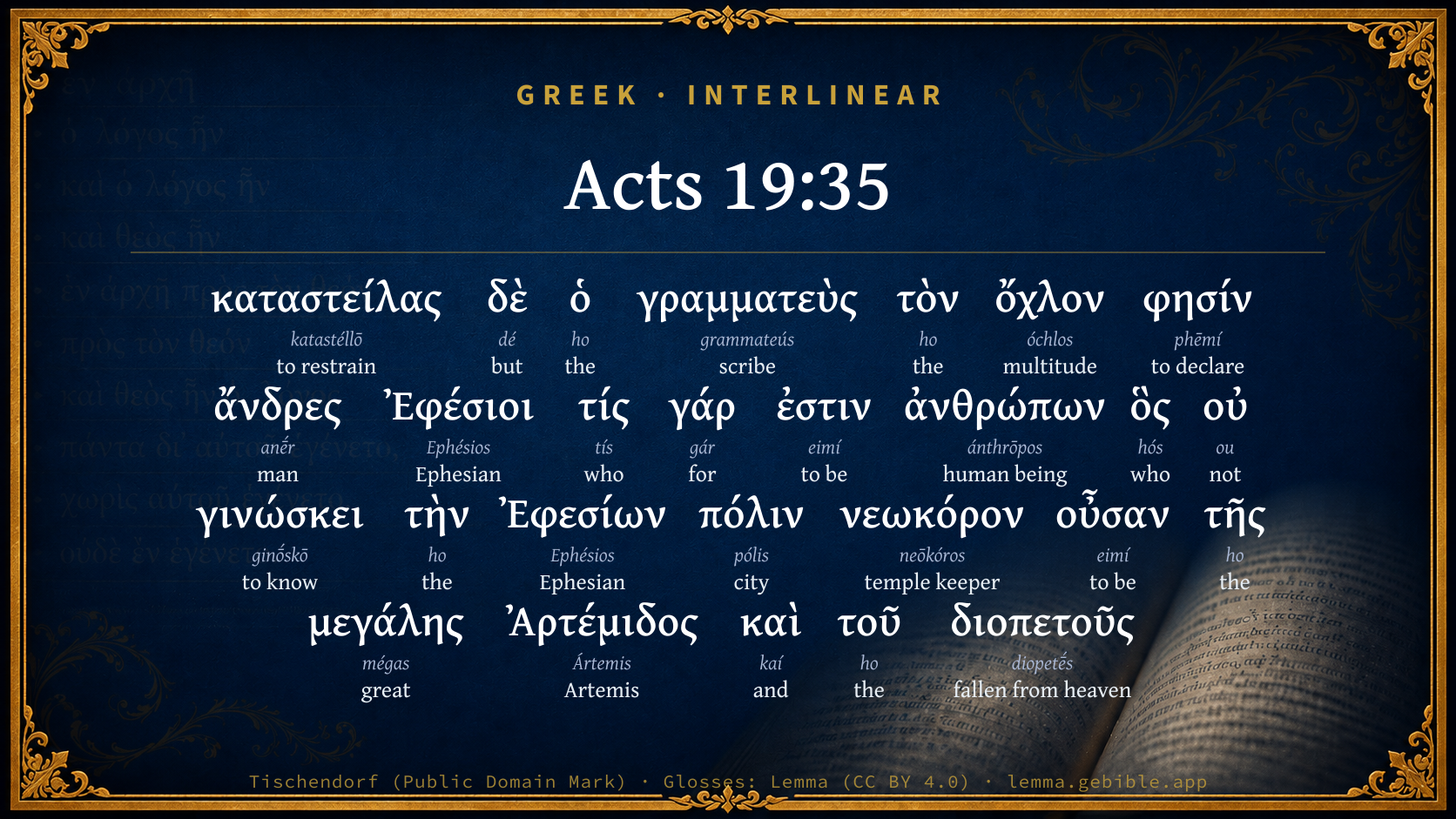
Download image
Cite this verse

Acts 19:35 (World English Bible). Public Domain. Lemma interlinear Bible study tool, https://lemma.gebible.app/v/acts/19/35.

Show BibTeX & RIS
BibTeX
RIS
English Translation
When the town clerk had quieted the multitude, he said, "You men of Ephesus, what man is there who doesn't know that the city of the Ephesians is temple-keeper of the great goddess Artemis, and of the image which fell down from Zeus?
World English Bible · Public Domain
Highlights
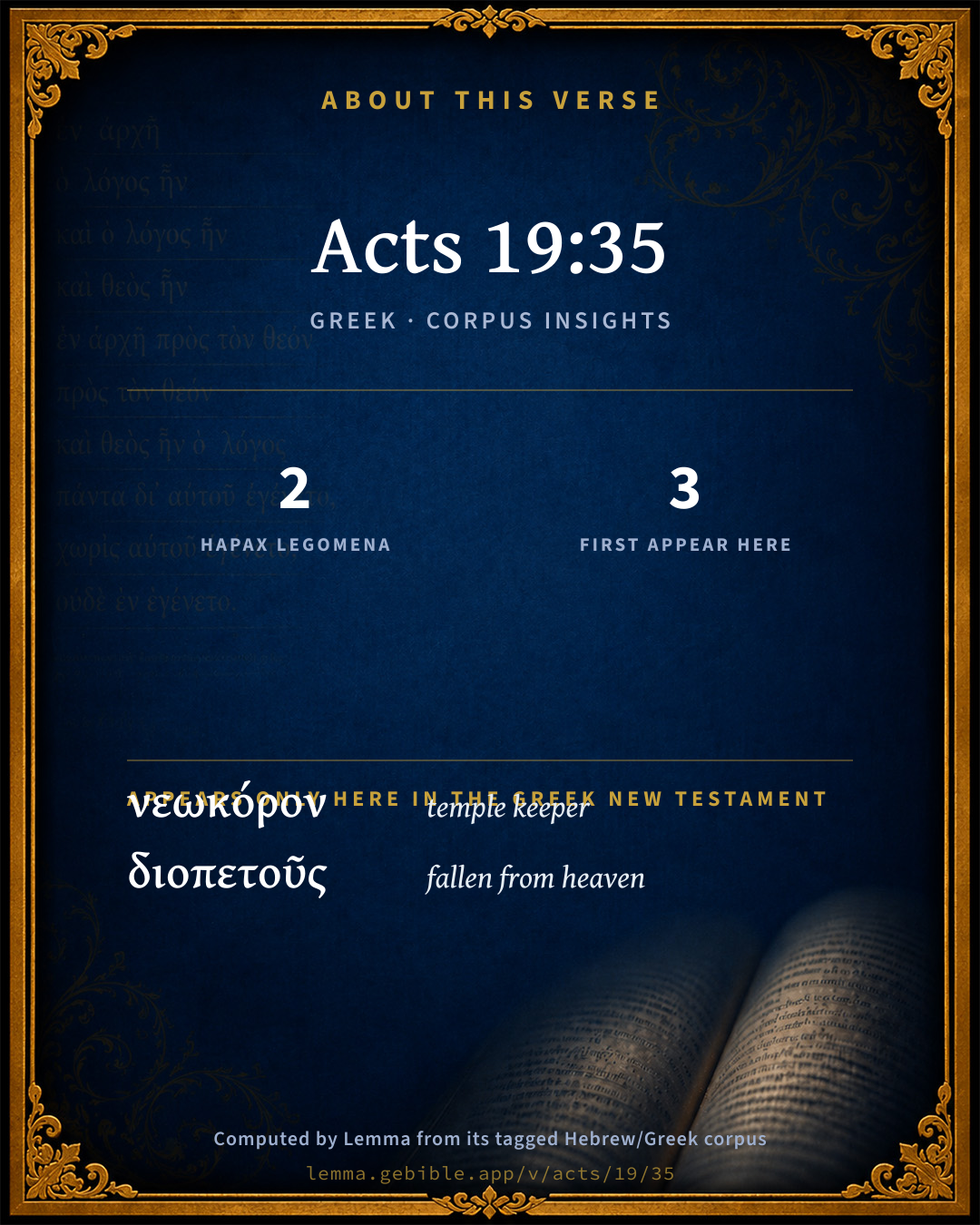
  • 2 hapax legomena — only here in the Greek New Testament
  • 3 first appearances in the Greek New Testament
Full analysis ↓
Download a study sheet

One document with this verse’s original text, its word-by-word gloss line, the meaning frame, cross-references with their text, attributed commentary, and full source and license credits — printable, and it pastes into notes with its structure intact.

This verse Autodidact and up

Study sheet (.html) Plain text (.txt)

A passage Seminary Student

Up to 50 verses in one chapter. A passage sheet keeps up to 6 commentary sources and 12 cross-references per verse, in the order this page ranks them, and says so on the sheet whenever that leaves anything out. Ask for a single verse and you get the Autodidact verse sheet above.

Everything on this page stays free to read, with no account — the sheet is a download of what is already on screen, not access to it.

Want to remove ads? Support Godless Engineer
Compare translations 3

The same verse in 3 English versions, stacked beneath the original-language interlinear above. Click any original word for its lexicon entry.

Each is an independent rendering of the whole verse — the interlinear is not word-aligned to these translations.

Highlighted words mark where these versions differ — a whole-verse word diff, not a word-by-word alignment.

  • World English Bible Public Domain
    When the town clerk had quieted the multitude, he said, "You men of Ephesus, what man is there who doesn't know that the city of the Ephesians is temple-keeper of the great goddess Artemis, and of the image which fell down from Zeus?
  • King James Version Public Domain
    And when the townclerk had appeased the people, he said, Ye men of Ephesus, what man is there that knoweth not how that the city of the Ephesians is a worshipper of the great goddess Diana, and of the image which fell down from Jupiter?
  • unfoldingWord Literal Text CC BY-SA 4.0
    But quieting the crowd, the city clerk says, “Men, Ephesians, for who is there of men who does not know the Ephesian city to be the temple keeper of the great Artemis and of the Zeus-fallen image?

unfoldingWord Literal Text — © unfoldingWord, licensed CC BY-SA 4.0. Word-aligned USFM3 via Door43 (git.door43.org/unfoldingWord/en_ult).

Versions to compare (up to 4)

3 of 4 selected

Show all 19 translations

Every available English version of this verse, each an independent rendering of the whole verse.

  • World English Bible Public Domain
    When the town clerk had quieted the multitude, he said, "You men of Ephesus, what man is there who doesn't know that the city of the Ephesians is temple-keeper of the great goddess Artemis, and of the image which fell down from Zeus?
  • Berean Standard Bible Public Domain
    Finally the city clerk quieted the crowd and declared, “Men of Ephesus, doesn’t everyone know that the city of Ephesus is guardian of the temple of the great Artemis and of her image, which fell from heaven?
  • Majority Standard Bible Public Domain
    Finally the city clerk quieted the crowd and declared, “Men of Ephesus, doesn’t everyone know that the city of Ephesus is guardian of the temple of the great goddess Artemis and of her image, which fell from heaven?
  • King James Version Public Domain
    And when the townclerk had appeased the people, he said, Ye men of Ephesus, what man is there that knoweth not how that the city of the Ephesians is a worshipper of the great goddess Diana, and of the image which fell down from Jupiter?
  • American Standard Version (1901) Public Domain
    And when the townclerk had quieted the multitude, he saith, Ye men of Ephesus, what man is there who knoweth not that the city of the Ephesians is temple-keeper of the great Diana, and of the `image' which fell down from Jupiter?
  • Revised Version (1885) Public Domain
    And when the townclerk had quieted the multitude, he saith, Ye men of Ephesus, what man is there who knoweth not how that the city of the Ephesians is temple-keeper of the great Diana, and of the image which fell down from Jupiter?
  • Geneva Bible (1599) Public Domain
    Then the towne clearke when hee had stayed the people, saide, Ye men of Ephesus, what man is it that knoweth not howe that the citie of the Ephesians is a worshipper of the great goddesse Diana, and of the image, which came downe from Iupiter?
  • Douay-Rheims (1899) Public Domain
    And when the town clerk had appeased the multitudes, he said: Ye men of Ephesus, what man is there that knoweth not that the city of the Ephesians is a worshipper of the great Diana, and of Jupiter's offspring.
  • Young's Literal Translation Public Domain
    And the public clerk having quieted the multitude, saith, `Men, Ephesians, why, who is the man that doth not know that the city of the Ephesians is a devotee of the great goddess Artemis, and of that which fell down from Zeus?
  • Literal Standard Version CC BY-SA 4.0
    And the public clerk having quieted the multitude, says, “Men, Ephesians, why, who is the man that does not know that the city of the Ephesians is temple-keeper of the great goddess Artemis, and of that which fell down from Zeus?
  • Unlocked Literal Bible CC BY-SA 4.0
    When the town clerk had quieted the crowd, he said, “You men of Ephesus, what man is there who does not know that the city of the Ephesians is temple keeper of the great Artemis and of the image which fell down from heaven?
  • unfoldingWord Literal Text CC BY-SA 4.0
    But quieting the crowd, the city clerk says, “Men, Ephesians, for who is there of men who does not know the Ephesian city to be the temple keeper of the great Artemis and of the Zeus-fallen image?
  • Darby Bible Public Domain
    And the townclerk, having quieted the crowd, said, Ephesians, what man is there then who does not know that the city of the Ephesians is temple-keeper of Artemis the great, and of the [image] which fell down from heaven?
  • World Messianic Bible Public Domain
    When the town clerk had quieted the multitude, he said, “You men of Ephesus, what man is there who doesn’t know that the city of the Ephesians is temple keeper of the great goddess Artemis, and of the image which fell down from Zeus?
  • Webster's Bible Public Domain
    And when the town-clerk had appeased the people, he said, Ye men of Ephesus, what man is there that knoweth not that the city of the Ephesians is a worshiper of the great goddess Diana, and of the image which fell down from Jupiter?
  • Free Bible Version CC BY-SA 4.0
    After the town clerk had managed to quiet the mob down, he told them, “People of Ephesus, who doesn't know that the city of the Ephesians is the guardian of the temple of the great Artemis and of her image that fell from heaven?
  • Bible in Basic English Public Domain
    And when the chief secretary had got the people quiet, he said, Men of Ephesus, is any man without knowledge that the town of Ephesus is the keeper of the holy place of the great Diana, who was sent down from Jupiter?
  • Text-Critical English NT CC BY 4.0
    When the city clerk had quieted the crowd, he said, “Men of Ephesus, who is there that does not know that the city of the Ephesians is the temple keeper of the great goddess Artemis and of the image that fell down from Zeus?
  • Tyndale New Testament (1534) Public Domain
    When the toune clarcke had ceased the people he sayd: ye men of Ephesus what man is it that knoweth not how that the cite of the Ephesians is a worshipper of the great goddas Diana and of the ymage which came from heven.

Literal Standard Version (2020), Covenant Press — licensed CC BY-SA 4.0. Text via the HelloAO Bible API (eBible.org). Unlocked Literal Bible (unfoldingWord) — licensed CC BY-SA 4.0. Text via the HelloAO Bible API (eBible.org). unfoldingWord Literal Text — © unfoldingWord, licensed CC BY-SA 4.0. Word-aligned USFM3 via Door43 (git.door43.org/unfoldingWord/en_ult). Free Bible Version, Dr. Jonathan Gallagher — licensed CC BY-SA 4.0. Text via the HelloAO Bible API (eBible.org).

Word by word

More ways to search: Search by grammar → Find every occurrence → Compare this word →

Practice this passage: Drill this verse → Learn its vocabulary →

νεωκόρον
neōkóros
G3511
“temple keeper”
Adjective, Accusative, Singular, Feminine
Part of Speech
Adjective
Case
Accusative
Number
Singular
Gender
Feminine
Full Thayer's Definition

Origin: from a form of G3485 and koreo (to sweep)

TDNT: None

1. one who sweeps and cleans a temple 2. one who has charge of a temple, to keep and adorn it, a sacristan 3. the worshipper of a deity a. word appears from coins still extant, it was an honourary title [temple-keeper or temple-warden] of certain cities, esp. in Asia Minor, or in which some special worship of some deity or even some deified human ruler had been established; used of Ephesus
  1. καταστείλας katastéllō G2687 “to restrain” Verb, Aorist, Active, Participle, Nominative, Singular, Masculine
  2. δὲ dé G1161 “but” Conjunction
  3. ὁ ho G3588 “the” Article, Nominative, Singular, Masculine
  4. γραμματεὺς grammateús G1122 “scribe” Noun, Nominative, Singular, Masculine
  5. τὸν ho G3588 “the” Article, Accusative, Singular, Masculine
  6. ὄχλον óchlos G3793 “multitude” Noun, Accusative, Singular, Masculine
  7. φησίν phēmí G5346 “to declare” Verb, Present, Active, Indicative, 3rd person, Singular
  8. ἄνδρες anḗr G435 “man” Noun, Vocative, Plural, Masculine
  9. Ἐφέσιοι Ephésios G2180 “Ephesian” Adjective, Nominative, Plural, Masculine
  10. τίς tís G5101 “who” Interrogative pronoun, Nominative, Singular, Masculine
  11. γάρ gár G1063 “for” Conjunction
  12. ἐστιν eimí G1510 “to be” Verb, Present, Active, Indicative, 3rd person, Singular
  13. ἀνθρώπων ánthrōpos G444 “human being” Noun, Genitive, Plural, Masculine
  14. ὃς hós G3739 “who” Relative pronoun, Nominative, Singular, Masculine
  15. οὐ ou G3756 “not” Particle, Negative
  16. γινώσκει ginṓskō G1097 “to know” Verb, Present, Active, Indicative, 3rd person, Singular
  17. τὴν ho G3588 “the” Article, Accusative, Singular, Feminine
  18. Ἐφεσίων Ephésios G2180 “Ephesian” Adjective, Genitive, Plural, Masculine
  19. πόλιν pólis G4172 “city” Noun, Accusative, Singular, Feminine
  20. οὖσαν eimí G1510 “to be” Verb, Present, Active, Participle, Accusative, Singular, Feminine
  21. τῆς ho G3588 “the” Article, Genitive, Singular, Feminine
  22. μεγάλης mégas G3173 “great” Adjective, Genitive, Singular, Feminine
  23. Ἀρτέμιδος Ártemis G735 “Artemis” Noun, Genitive, Singular, Feminine
  24. καὶ kaí G2532 “and” Conjunction
  25. τοῦ ho G3588 “the” Article, Genitive, Singular, Masculine
  26. διοπετοῦς diopetḗs G1356 “fallen from heaven” Adjective, Genitive, Singular, Masculine

About this verse

These counts appear in no published source. They are computed here, from the morphology-tagged text and Lemma’s own curated glosses. What Lemma adds →

27
words
21
distinct lemmas
Acts
section

Notable vocabulary

2 hapax legomena — words that appear only here in the entire Greek New Testament:

  • νεωκόρον temple keeper G3511
  • διοπετοῦς fallen from heaven G1356

First appearance in Scripture

These words make their first canonical appearance in the Greek New Testament here:

  • καταστείλας to restrain G2687
  • νεωκόρον temple keeper G3511
  • διοπετοῦς fallen from heaven G1356

Shared distinctive vocabulary

καταστείλας to restrain G2687 occurs in 2 verses of the Greek New Testament. Also found in:
Repetition

Words recur within this verse:

  • Ἐφέσιοι Ephesian G2180 ×2
  • ἐστιν to be G1510 ×2
  • ὁ the G3588 ×5

Cross-references

6

Topical passages linked to Acts 19:35 in the Treasury of Scripture Knowledge — connected by theme and wording, ordered by reader-vote popularity; previews shown in the World English Bible.

  • 2 Thessalonians 2:10–11 and with all deception of wickedness for those who are being lost, because they didn't receive the love of the truth, that they might be saved.
  • Acts 14:12–13 They called Barnabas "Jupiter," and Paul "Mercury," because he was the chief speaker.
  • Ephesians 2:12 that you were at that time separate from Christ, alienated from the commonwealth of Israel, and strangers from the covenants of the promise, having no hope and without God in the world.
  • 1 Timothy 4:2 through the hypocrisy of men who speak lies, branded in their own conscience as with a hot iron;
  • Acts 18:19 He came to Ephesus, and he left them there; but he himself entered into the synagogue, and reasoned with the Jews.
  • Acts 19:26 You see and hear, that not at Ephesus alone, but almost throughout all Asia, this Paul has persuaded and turned away many people, saying that they are no gods, that are made with hands.

Cross-references courtesy of OpenBible.info (CC BY 4.0).

Commentary

Notes on Acts 19:35 from classic Christian and Jewish commentators (each source and its license shown beneath its notes). The classic Christian expositions comment on the surrounding passage and are grouped to its opening verse, so a note may address several verses; the Jewish commentaries on the Tanakh (Rashi and others) are per-verse, so they appear only where the commentator wrote on this verse.

Lemma curates 59 commentaries, every one of them public domain or Creative Commons licensed, each selected and text-cleaned for this edition rather than reprinted as found. About our sources →

Adam Clarke's Commentary

Verse 35. When the town - clerk] ογραμματευς, Literally, the scribe. The Syriac has [Syriac] reisha damedinato, the chief or prince of the city. The later Syriac has, the scribe of the city. Some think that the word recorder would do better here than town-clerk; and indeed it is evident that a magistrate of considerable authority and influence is intended-the mayor or sovereign of the city.

Ye men of Ephesus] The speech of this man may be thus analyzed:

1. He states that there was no need of a public declaration that the Ephesians were worshippers of Diana; this every person knew, and nobody attempted to contest it, Ac 19:35-36.

2. That the persons accused were not guilty of any public offence, nor of any breach of the laws of the city, Ac 19:37.

3. That, if they were, this was not a legal method of prosecuting them, Ac 19:38-39; Acts 19:39.

4. That they themselves, by this tumultuous meeting, had exposed themselves to the censure of the law, and were in danger of being called into question for it, Ac 19:40. See Dodd.

Is a worshipper of the great goddess Diana] The word νεωκορος, neocoros, which we translate worshipper, signified at first, among the ancient Greeks, no more than sweeper of the temple, and answered nearly to our sexton: in process of time, the care of the temple was intrusted to this person: at length the neocori became persons of great consequence, and were those who offered sacrifices for the life of the emperor. Whole cities took this appellation, as appears on many ancient coins and medals; and Ephesus is supposed to have been the first that assumed this title. At this time, it was commonly known as belonging to this city. "What man is there that knoweth not that the city of the Ephesians is the Neocoros of the great goddess Diana?" As if he had said: "The whole city is devoted to her worship: it is reputed an honour to our highest characters even to sweep her temple, and open and shut her doors. Besides, we offer to her the highest sacrifices; and are intrusted with the religious service that pertains to the emperor's safety."

Of the image which fell down from Jupiter?] The original image of the Ephesian Diana (See Clarke on Ac 19:27) was supposed to have descended from heaven; which intimates that it was so old that no person knew either its maker or the time in which it was formed, and it was the interest of the priests to persuade the people that this image had been sent to them as a present from Jupiter himself. Several images and sacred things were supposed, among the heathens, to be presents immediately from heaven. Euripides states the image of Diana of Tauri to be of this kind; and calls it διοπετες αγαλμα, the image fallen from Jupiter. Numa pretended that the ancilia, or sacred shields, had come from heaven. In imitation of these, many of the Italian papists believe that the shrine of our lady of Loretto was also a Divine gift to their country. St. Isidore, of Damietta, says that the heathen, in order to induce the people to believe that such images came from heaven, either banished or slew the artists that had formed them, that there might be no evidence of the time in which, or the persons by whom, they were made: this point secured, it was easy to persuade the credulous multitude that they had been sent from heaven. The story of the Palladium, on which the safety of Troy was said to depend, is well known. It was an image of Minerva, and also supposed to have descended from Jupiter.

Adam Clarke's Commentary on the Bible (1810–1826) — public domain. Text from a community e-Sword/MySword module.

Joseph Benson's Commentary

Act 19:35-41. And when the town-clerk — Greek, ο γραμματευς, the scribe; probably the proconsul’s secretary, to whom the direction of the affairs of the city was committed; had appeased the people — So far as to produce a degree of silence, the rioters, by their violent outcries so long continued, having spent their rage; he said, What man is there in the world, that has any intelligence of things at all, that knoweth not that the city of the Ephesians is a worshipper — Greek, νεωκορον, the temple-keeper, of the great goddess Diana — The expression is compounded of words which, taken together, signify to sweep or clean a temple, being used of a priest or priestess, or other person, whose business it was to look after the temple of any god or goddess, and see that it was not only kept in good repair, but also neat and clean, and beautified in a proper manner. This title was given also to those cities which had the care of the games celebrated in honour of any god or goddess. And of the image which fell down from Jupiter — They believed that very image of Diana, which stood in their temple, fell down from Jupiter in heaven. Perhaps this town-clerk, or secretary, designed to intimate that this image, as falling down from Jupiter, was not made with hands, and so was not of that sort of idols which Paul had said were no gods. Seeing then these things cannot be denied — But are plainly incontestable; ye ought to be quiet — Gentle in your proceedings; and to do nothing rashly — By which you may run yourselves into vast inconveniences and dangers before you are aware. In this speech, the secretary took hold of the multitude by their prejudices; for without speaking any thing concerning Paul’s doctrine, that images made with hands were no gods, he desired the Ephesians to consider that their privileges, as keepers of the temple of Diana, and of her heaven-descended image, were so universally acknowledged, that there was no danger of their losing that honour through any thing Paul had spoken. For ye have brought these men, Gaius and Aristarchus, hither, which are neither robbers of churches — Greek, ιεροσυλους, robbers of temples, or sacrilegious persons; nor yet blasphemers of your goddess — The apostles had simply preached the one God, and the vanity of idols in general. The secretary further told them, that the men whom they had brought into the theatre were not yet proved to be guilty of those crimes which they appeared to lay to their charge; because, though they might have spoken against the images made by the craftsmen, they had said nothing against the image which Jupiter had given them: and added, that if Demetrius and the craftsmen had these, or any other crimes, to lay to their charge, of which they could prove them guilty, there were deputies. — Roman proconsuls, to whom they might apply, as the proper judges in such cases; and the courts of law were open — Where the matters might be fairly tried. But if ye inquire any thing concerning other matters — If ye inquire whether the temple of Diana or her worship be in danger, or what persons or religions should be tolerated in the city, these are public matters, which should be determined in a lawful assembly — An assembly regularly appointed, and such as has authority to judge in religious and political affairs. For we are in danger to be called in question by the Romans for this day’s uproar — Greek, εγκαλεισθαι στασεως, to be accused of sedition; there being no cause — No sufficient cause; whereby we may give an account of — May justify; this concourse — He wisely calls it by an inoffensive name. Fire, inundations, the sudden invasion of enemies, &c., might have excused a sudden concourse of people rushing together with some violence: but the secretary, with great propriety, observes that there was no such cause, nor any other adequate one, to be assigned in this instance. It must be observed, there was a Roman law which made it capital to raise a riot: Qui cœtum et concursum fecerit capite puniatur. And when he had thus spoken, he dismissed the assembly — And set Gaius and Aristarchus at liberty. The secretary’s conduct on this occasion shows that he had a good opinion of the Christian preachers. We may therefore believe, that in preaching against the established worship, Paul and his assistants had spoken nothing against Diana in particular, though their doctrine struck at all the heathen deities in the general: and even that in speaking against the established idolatry, they had used a becoming decency of language. The secretary, therefore, observing their prudence, entertained a good opinion of the cause they were engaged in.

Joseph Benson's Commentary on the Old and New Testaments (1811–1818) — public domain. Text from a community e-Sword module.

Tyndale Open Study Notes

Tyndale Open Resources

19:35-41 The demonstration was finally quelled only when the mayor intervened and dismissed the assembly to prevent the city from being charged by the Roman government with rioting. This story demonstrates that Christians in the Roman world were entitled to legal due process.

19:35 The tradition that the image (statue) of Artemis had fallen from heaven might point to its having been carved from a meteor.

Tyndale Open Study Notes — © Tyndale Open Resources, licensed CC BY-SA 4.0. Text via the HelloAO Bible API.

Bengel's Gnomon

Johann Albrecht Bengel

Act 19:35. Ὁ γραμματεὺς) the town-clerk.—τίς γάρ ἐστιν, for who is there, who then is there) Paul would have spoken otherwise. [But the raving (insane) multitude was unworthy of his preaching.—V. g.] However, the language of the clerk is ambiguous, and he may have spoken so, either because of (to suit) the exigency, or because he sincerely thought what he said: for even in Act 19:37 he says, Your goddess, not, Our goddess.—Ἐφεσίων, of the Ephesians) By the repetition of the proper name, their celebrity is signified.—νεωκόρον) The Perinthians were νεωκόροι (worshippers, temple-worshippers) of Hercules; other peoples were worshippers of other gods; the Ephesians, of Diana. See J. H. A. Seelen Medit. Exeget., p. 523.—οὖσαν, is) At that very time the Ephesians were priding themselves on that distinction. See Gregory’s Observ., ch. 10. There was therefore a great conflux of men to the sacred games to her in that city.—Διοπετοῦς) They had supposed the image of Diana to have fallen down from heaven, from Jupiter.

Bengel's Gnomon of the New Testament — English translation (T&T Clark, Edinburgh, 1860) — public domain. Text from a community e-Sword module.

Expositor's Greek Testament

ed. W. Robertson Nicoll

Act 19:35 . καταστείλας : only here in N.T. and in Act 19:36 , “had quieted,” R.V., cf. 2Ma 4:31 , 3Ma 6:1 , Aquila, Psa 64 (65):8, also in Josephus and Plutarch. ὁ γραμματεὺς : “the secretary of the city” Ramsay; Lightfoot was the first to point out the importance of the officer so named called also ὁ Ἐφεσίων γραμ . or γραμ . τοῦ δήμου ; he was the most influential person in Ephesus, for not only were the decrees to be proposed drafted by him and the Strategoi, and money left to the city was committed to his charge, but as the power of the Ecclesia, the public assembly, declined under imperial rule, the importance of the secretary’s office was enhanced, because he was in closer touch with the court of the proconsul than the other city magistrates, and acted as a medium of communication between the imperial and municipal government, “Ephesus” (Ramsay), Hastings’ B.D., p. 723, Cities and Bishoprics of Phrygia , i., 66; St. Paul , pp. 281, 304; Hicks, Greek Inscriptions in the British Museum , iii., p. 154, and Wood’s Ephesus, App. , p. 49, often with Asiarchs and proconsul; Lightfoot, Contemp. Review , p. 294, 1878. St. Luke’s picture therefore of the secretary as a man of influence and keenly alive to his responsibility is strikingly in accordance with what we might have expected. τίς γάρ ἐστιν ἄνθρωπος : “what man is there then?” etc. Rendall: the γάρ looks back to the action of the speaker in quieting the crowd, as if he would say that there is no need for this excitement, for all that you have said about your goddess is universally acknowledged. νεωκόρον : “temple-keeper,” R.V., “a worshipper,” A.V., cultricem , Vulgate, lit [331] , “a temple-sweeper” (on derivation see Grimm-Thayer, sub v. ), and so found in classical Greek, a sacristan, a verger, Lat., ædituus, cf. Jos., B. J. , v., 9, 4, where = worshippers , οὓς ὁ θεὸς ἑαυτῷ νεωκόρους ἦγεν . The title “Warden of the Temple of Ephesus” was a boast of the city, just as other cities boasted of the same title in relation to other deities. It would seem that the title at Ephesus was generally used in connection with the imperial cultus; in the period of this narrative, Ephesus could claim the title as Warden of one Temple of this cultus , and later on she enjoyed the title of δὶς , τρὶς νεωκόρος , as the number of the temples of the imperial cultus increased. But there is ample justification from inscriptions for the mention of the title in the verse before us in connection with the Artemis worship. For references, Ramsay, “Ephesus,” Hastings’ B.D., p. 722; Cities and Bishoprics of Phrygia , i., 58; Wendt, Blass, in loco; Lightfoot, Cont. Rev. , p. 294, 1878; Wood, Ephesus, App. , p. 50. τοῦ Δ ., sc. , ἄγαλμα : or some such word; the image was believed to have fallen from the sky (heaven, R.V. margin), like that of the Tauric Artemis, cf. Eur., Iph. . , 977, 1384, where we find οὐρανοῦ πέσημα given as the equivalent and explanation of διοπετὲς ἄγαλμα (Herod., i., 11). The worship of Diana of the Ephesians was entirely Asian and not Greek, although the Greek colonists attempted to establish an identification with their own Artemis on account of certain analogies between them. According to Jerome, Præfat. ad Ephesios , the Ephesian Artemis was represented as a figure with many breasts, multimammia (“quam Græci πολύμαστον vocant”), symbolising the reproductive and nutritive powers of Nature which she personified. This description is fully borne out by the common representations of the goddess on coins and statues. No one could say for certain of what the ἄγαλμα was made: according to Petronius it was made of cedar wood, according to Pliny of the wood of the vine, according to Xen. of gold, and according to others of ebony. For a fuller description of the image, and for some account of the wide prevalence of worship of the goddess and its peculiar character, Ramsay, Cities and Bishoprics of Phrygia , “Diana of the Ephesians,” Hastings’ B.D., B.D. 2 ; Wendt, 1888, in loco; Farrar, St. Paul , ii., p. 13, and references in Wetstein.

[331] literal, literally.

The Expositor's Greek Testament, edited by W. Robertson Nicoll (1897–1910) — public domain. Text from a community e-Sword module.

Geneva Bible (1599)

Geneva Bible translators

The Ephesians believed superstitiously, that the image of Diana came down from heaven to them.

An example of a political man who redeemeth peace and quietness with lies, which Paul would never have done.

Geneva Bible (1599) marginal notes — public domain. Text via Bolls.life.

Jamieson, Fausset & Brown

Robert Jamieson, A. R. Fausset & David Brown

when the town-clerk--keeper of the public archives, and a magistrate of great authority.

had appeased--"calmed."

the people--"the multitude," which the very presence of such an officer would go far to do.

he said . . . what man . . . knoweth not that the city of the Ephesians is a worshipper of the great goddess Diana--literally, the neocoros or "warden." The word means "temple-sweeper"; then, "temple-guardian." Thirteen cities of Asia had an interest in the temple, but Ephesus was honored with the charge of it. (Various cities have claimed this title with reference to the Virgin or certain saints) [WEBSTER and WILKINSON].

and of the image which fell down from Jupiter--"from the sky" or "from heaven." See on Act 19:27. "With this we may compare various legends concerning images and pictures in the Romish Church, such as the traditional likenesses of Christ, which were said to be "not made with hands"" [WEBSTER and WILKINSON].

Jamieson, Fausset & Brown — Commentary Critical and Explanatory on the Whole Bible (1871) — public domain (CC PDM 1.0). Text via the HelloAO Bible API.

John Calvin's Commentaries

35. Luke showeth in this place that the tumult was so appeased, that yet, notwithstanding, superstition prevailed with the mad people, and the truth of God was not heard. For the town-clerk, as politic men use to do, counteth it sufficient for him if he can by any means appease the outrageous multitude. Nevertheless, the cause itself is oppressed. He saw undoubtedly Demetrius’ malice, and how he had troubled the city, abusing the pretense of religion for his own private gain; but he toucheth not that wound which he knew to be unknown to the unskillful. Nevertheless, to the end he may stay the uproar and contention, he extolleth the reigned power of Diana, and maintaineth her superstitious worship. If Paul had been in the common place at that time, he would rather have suffered death an hundred times than have suffered himself to be delivered from danger paying so dear for it. For though the town-clerk had not been by him commanded to speak thus, yet it should have been treacherous dissimulation in a public witness and preacher of heavenly doctrine. The scribe affirmeth that the image which the Ephesians did worship came down from heaven, and that Paul and his companions spake no blasphemy against their goddess. Could he have holden his peace, but he must needs by his silence have allowed his false excuse? And this had been to shake hands with idolatry. Therefore, it was not without cause that Luke said before that Paul was kept back by the brethren, and not suffered to enter into the common place [theater].

John Calvin's Commentaries (1540-1563) — public domain. Text from the Calvin Translation Society English edition (1840s-50s) via the Christian Classics Ethereal Library (ccel.org). Calvin's coverage is partial (roughly two-thirds of the Bible); uncommented books and verses are honest gaps, never fabricated. The 19th-century editor's footnotes and remarks are omitted so the notes are faithfully Calvin's own voice.

Ellicott's Commentary for English Readers

(35) And when the townclerk had appeased the people . . .—The Greek word is the same as the “scribe” of the Gospels, and the familiar English expresses his function with adequate correctness. He was the keeper of the records and archives of the city. The title appears in many of the inscriptions in Mr. Wood’s volume, often in conjunction with those of the Asiarchs and the proconsul. If, as is probable, his office was a permanent one, he was likely to have more weight with the people than the Asiarchs, who were elected only for a year, and who were not all of Ephesus. The language of the public officer is as characteristic in its grave caution as that of Demetrius had been in its brutal frankness. He, like the Asiarchs, obviously looks on St. Paul and his companions with respect. He has no feeling of fanaticism, and would not willingly be a persecutor. He dares not oppose the multitude, but he will try and soothe them with the loud profession of his attachment to the religion of his country. He was, if we may so speak, the Gamaliel of Ephesus, not without parallels among the princes and statesmen and prelates who have lived in the critical times of political and religious changes, and have endeavoured to hold the balance between contending parties.

A worshipper of the great goddess Diana.—The substantive as well as the adjective belonged to the local vocabulary. Its literal meaning is “temple sweeper,” or “sacristan”—one consecrated to the service of the goddess. The Greek word (neôkoros) is found on coins and inscriptions of Ephesus as applied to the inhabitants, sometimes in relation to the Emperor, sometimes to the goddess. They looked to her as their guardian and protector. One inscription claims for the city the honour of being the “nurse” of the great goddess (Boeckh. 2954, ut supra). She was, as it were, to borrow a phraseology which presents only too painful an analogy, “Our Lady of Ephesus.” It is a curious fact that the same month was consecrated to Flora in Rome, and is now the “Mois de Marie” in France and Italy. The omission of the word “goddess” in nearly all the best MSS. is significant. She was, even without that word, emphatically “Artemis the Great” In some of the inscriptions of Ephesus she is described as “the greatest,” the “most High.”

The image which fell down from Jupiter.—The name was often given to old pre-historic images—as, e.g., to that of Athenè Polias at Athens. It may have been merely a legendary way of stating that no one knew what artist had sculptured the image, or when it had been first worshipped. Possibly, however, the word may have had a more literal meaning as applied to a meteoric stone which had been employed by the sculptor, or was worshipped in its original form. The many-breasted image of Aitemis described in the Note on Act_19:24 is, however, reported to have been made of olive-wood. The word image is not in the Greek, and one familiar word (diopetes) was sufficient to express what requires seven in the English paraphrase.

A Bible Commentary for English Readers, edited by Charles John Ellicott (1878–1897) — public domain. Text from a community e-Sword module.

The Cambridge Bible for Schools and Colleges

gen. ed. J. J. S. Perowne

35. And when the townclerk] It is not easy to find an English word which comes at all near the significance of this title. “Recorder” has been proposed, because he had charge of the city archives, and Luther calls him “chancellor.” He was a most important personage, and his title is found at times on the coinage, and he gave name in some places to the year, like the Archon at Athens. Through him all public communications were made to the city, and in his name replies were given. It is this part of his duty which has led to the rendering “town-clerk.”

had appeased the people] Better (with the Rev. Ver.) had quieted the crowd. The appeasing was done afterwards by his speech. All that he could effect at first, was by the influence of his presence, to induce the assembled mob to mitigate their clamour and give him a hearing.

he said] Gk. he saith. The speech is full of ability, and shews that the man was fitted for his eminent position. It seems to shew also that the higher classes (as has been noticed in the case of the Asiarchs) were not so devoted to the service of the goddess as were the common people.

Ye men of Ephesus … is a worshipper of the great goddess Diana] The oldest MSS. omit “goddess” and only read “the great Artemis.” The word rendered “worshipper” is literally “temple-sweeper.” The name no doubt was first used to imply that any office in the service of so magnificent a goddess was a grand distinction; and not in Ephesus only did the worshippers of a special divinity apply this title to themselves. The Rev. Ver. gives “temple-keeper.”

and of the image which fell down from Jupiter] The same was said of the Palladium of the Trojans (Verg. Aen. ii. 183). The first clause of the speech is directed to point out how uncalled for their uproar is. There is no need for them to shout about the greatness of the Ephesian goddess. Everybody in the world is aware how devoted the city is to her worship and how glorious is her temple.

The Cambridge Bible for Schools and Colleges (gen. ed. J. J. S. Perowne; Cambridge University Press, 1878–1918) — public domain. Text from a community e-Sword module.

John Gill's Exposition

But if ye inquire anything concerning other matters,.... Than what belongs to the craft and business of Demetrius, and the artificers:

it shall be determined in a lawful assembly; that is, called together according to law, and who have a right to hear, try, and judge causes, which such a confused lawless assembly as this in the theatre had not.

John Gill's Exposition of the Whole Bible (1746–1763) — public domain (CC PDM 1.0). Text via the HelloAO Bible API.

Trapp's Complete Commentary

John Trapp

35 And when the townclerk had appeased the people, he said, Ye men of Ephesus, what man is there that knoweth not how that the city of the Ephesians is a worshipper of the great goddess Diana, and of the image which fell down from Jupiter?

Ver. 35. Great goddess Diana] Who yet, as great as she was, being busy at Alexander’s birth (as he said), could not be at leisure to save her temple at Ephesus from burning. Like as Baal was so hot in the pursuit of his enemies, that he could not be at hand to help his friends, 1Ki 18:27.

And of the image that fell] A very ancient image made by Canetias a certain artificer, and for the antiquity of it, said by the covetous priests to have fallen down from Jupiter, that it might be the more venerable. By a like craft the Popish priests now show some shivers of the cross whereon our Saviour suffered, yea, some shreds of the tail of that ass whereupon he rode to Jerusalem.

John Trapp, A Commentary or Exposition upon All the Books of the Old and New Testament (1647–1656) — public domain. Text from a community e-Sword module.

Albert Barnes' Notes on the Bible

And when the town-clerk - ὁ γραμματέυς ho grammateus. The scribe; the secretary. This word is often used in the Bible, and is commonly translated “scribe,” and is applied to “public notaries in the synagogues; to clerks; to those who transcribed books, and hence, to men skilled in the law or in any kind of learning.” Compare 2Sa 8:17; 2Ki 12:11; Ezr 7:6, Ezr 7:11-12; Mat 5:20; Mat 12:38; Mat 13:52; Mat 15:1; Mat 23:34; 1Co 1:20. It is, however, nowhere else applied to a pagan magistrate. It probably denoted “a recorder; or a transcriber of the laws; or a chancellor” (Kuinoel, Doddridge). This officer had a seat in their deliberative assemblies, and on him it seems to have devolved to keep the peace. The Syriac, “Prince of the city.” The Vulgate and Arabic, “Scribe.”

Had appeased the people - καταστείλας katasteilas. Having restrained, quieted, tranquillized, so as to be able to address them.

What man is there - Who is there that can deny this? It is universally known and admitted. This is the language of strong confidence, of reproof, and of indignation. It implied that the worship of Diana was so well established that there was no danger that it could be destroyed by a few Jews, and he therefore reproved them for what he deemed their unreasonable fears. But he little knew the power of that religion which had been the innocent cause of all this tumult; nor that, at no very distant period, this despised religion would overturn not only the worship of Diana at Ephesus, but the splendid idolatry of the mighty Roman empire.

Is a worshipper - νεωκόρον neōkoron. Margin, temple-keeper. The word used here does not occur elsewhere in the New Testament. It is derived from νεὼς neōs, for ναὸς naos, a temple, and κορέω koreō, to sweep, to cleanse. But among the ancients, the office of keeping their temples was by no means as humble as that of sexton is with us. It was regarded as an office of honor and dignity to have charge of the temples of the gods, and to keep them in order. The term was also given to the cities that were regarded as the special patrons or worshippers of certain gods and goddesses. They esteemed it an honor to be regarded as the special keepers of their temples and images, or as having adopted them as their tutelar divinities. Such was Ephesus in regard to Diana. It was considered to be a high honor that the city was everywhere regarded as being entrusted with the worship of Diana, or with keeping the temple regarded by the whole world as especially her own. See Schleusner on this word.

And of the image - A special guardian of the image, or statue of Diana.

Which fell down ... - Which was reigned or believed to have been sent down from heaven. See the notes on Act 19:27. It is probable that the image was so ancient that the maker of it was unknown, and it was therefore reigned to have fallen from heaven. It was for the interest of the priest to keep up this impression. Many cities pretended to have been favored in a similar manner with images or statues of the gods, sent directly from heaven. The safety of Troy was supposed to depend on the Palladium, or image of Pallas Minerva, which was believed to have fallen from heaven. Numa pretended that the ancilia, or sacred shields, had descended from heaven. Herodian expressly affirms that “the Phoenicians had no statue of the sun polished by the hand, but only a certain large stone, circular below, and terminated acutely above in the figure of a cone, of a black color, and that they believed it to have fallen from heaven.” The same thing was affirmed of the ancient Minerva of the Athenian Acropolis (Paus., Att. 26); of the Paphian Venus, and the Ceres of Sicily (Cic. in Verr., v. 187). It has been supposed by some that this image at Ephesus was merely a conical or pyramidal stone which fell from the clouds - a meteorite - and that it was regarded with superstitious reverence, as having been sent from heaven. See the Edinburgh Encyclopedia’s article, “Meteorites.”

From Jupiter - See the notes on Act 14:12.

Albert Barnes' Notes on the Bible (1834–1885) — public domain. Text from a community e-Sword/MySword module.

Haydock's Catholic Bible Commentary

The town-clerk, &c. Literally, the scribe, or the recorder of the city. --- Jupiter’s offspring.[2] His daughter, according to the poets. The Greek text seems to signify a statue, or figure of Diana, which was pretended to have fallen from heaven, and from Jupiter. (Witham) --- Is a worshipper. Greek: Neokoron ousan; the word Greek: Neokoros is found in this sense in the Arundelian marbles, and more frequently on ancient coins and inscriptions. Its derivation is from Greek: neos, a temple, and Greek: kore, a virgin, or rather Greek: korein, to cleanse and decorate; as if this city were especially destined to ornament the Diana of Ephesus, which the people supposed came to them not by the work of man, but a present from heaven.

===============================

[BIBLIOGRAPHY]

Jovisque prolis, Greek: kai tou diopetous. Simulachri a cælo dilapsi. See Suidas.

====================

George Leo Haydock (1774–1849), Haydock's Catholic Family Bible and Commentary, 1859 edition — public domain. Excludes Psalms (Douay-Rheims chapter numbering differs from Protestant) and Deuterocanonical books (Catholic canon only).

Matthew Poole's English Annotations

Town clerk, or secretary, who registered their acts, and intervened in all their meetings.

Is a worshipper; each country and city had their peculiar gods, which they worshipped, and took for their patrons, as Ephesus did this goddess Diana. But the word here signifies a sacrist, or one that looks to the temple to keep it clean; especially that hath the charge of more solemn shows or sports in honour of any supposed deity: and these Ephesians took it to be their no small glory, that they were employed in such as belonged to Diana.

The image which fell down from Jupiter; though the maker’s name (Canetias) is upon record, yet it having lasted whilst the temple was six or seven times repaired, at least, if not renewed, and none ever remembering when it first was brought in amongst them, the crafty priests persuaded the credulous people that it was fallen from heaven, thereby getting more honour unto it, and profit to themselves.

Matthew Poole's English Annotations on the Holy Bible (1683–1685) — public domain. Text from a community e-Sword/MySword module.

Whedon's Commentary on the Bible

Daniel D. Whedon

35. Townclerk—The keeper of the city records—city recorder. Coins exist, associating the title with that of the proconsul, and so indicating a high rank. The townclerk here performs the duties of a modern mayor.

He said—The tact, moderation, and good sense of the townclerk’s speech have been much applauded since its delivery. But perhaps his administration would have been more commendable had his interference taken place two or three hours earlier.

Worshipper—Literally, temple-sweeper, expressing a servile office. But so great a goddess was Artemis that it was a proud prerogative for Ephesus, among the cities of Asia, to be her humble servitor, and wear the title as a badge of honour.

Fell down from Jupiter—Literally, the Jove-fallen. Pliny says that there was a modern image of Artemis at Ephesus which had outlasted seven rebuildings of the temple. The pretence of having fallen from heaven was made in favour of other idols of antiquity, as the Palladium of Troy, the ancile at Rome, and the image of Cybele at Pessinus. The notion may have arisen from the descent of meteoric stones; but in fact this image of Artemis seems to have been of wood. It bore more resemblance to the rude images of Hindooism than to Greek statuary, and was probably a remnant of an old eastern idolatry found by the Greeks when they colonized Ionia.

Daniel D. Whedon (gen. ed.), Commentary on the Old and New Testaments (1874–1909) — public domain. Text from a community e-Sword module.

The Pulpit Commentary

Quieted the multitude (ton oclon) for appeased the people, A.V.; saith for said, A.V.; who for that, A.V.; temple-keeper for a worshipper, A.V.; Diana for goddess Dann, A.V. and T.R. The town clerk (6 grammateuv); i.e. the scribe, is the city secre tary. JO grammateulewv, Thucyd., 7:19 (Meyer); Tou grammatewv tou dhmou, inscription quoted by Howson (vol. it. p. 76, note). His office, as appears from the passage in Thucydides, was to read public documents to the people. According to some, it was not a post of much dignity at Athens (Becket, on Thucyd., 7:10); but according to Kuinoel it was an office of first-rate influence in the senate in the Greek cities of Asia, seeing the scribe was the chief registrar, had the drafting of the laws, and the custody of the archives. As there were three orders of scribes, there may have been a great difference in the political rank of each. Had quieted (katasteilav, and katestalmenouv, ver. 36). Katastellw means to "arrange," "put in order," the hair, the dress, or the like; hence "to restrain," "quiet;" found only in these two places in the New Testament, but not uncommon in the Maccabees and in Josephus. In classical Greek, oJ katestalmenov is a man of calm, quiet demeanor, as opposed to oJ tolmhrov, one who is bold and violent. In medical language, katastellw is to soothe, calm, etc., and farmaka katastaltika and ajnastaltika are medicines which check the growth of diseases, ulcers, eruptions, and the like. Temple-keeper, in R.V and margin of A.V. (nwkorov); literally, temple-sweeper, from news, a temple, and korew, to sweep. The word Neoceros was a peculiar title, assumed first by persons and then by such cities, in Asia especially, as had the special charge of the temple and sacred rites of any particular god. It first appears on coins of Ephesus, in the reign of Nero, and was deemed a title of great honor. One inscription speaks of oJ newkorov (jEfesiwn) dhmov as making a certain dedication. But another use of the term sprang up about this time. Among the vile flatteries of those corrupt times, it became usual with cities to dedicate temples and altars to the emperors, and they received in return the title, meant to be an honor, of newkorov of the emperor. Some extant coins exhibit the city of Ephesus as newkorov both of Diana and the emperor (see Lewin, vol. 1. p. 411; Howson, vol. it. pp. 75, 76). The image which fell down from Jupiter (tou Diopetouv, understand ajgalmatov, as in the "Iphig. in Taur.," 947), Diopetev labein agalma; which is described in ver. 88 of the same play as "the image (agalma) of the goddess Diana, which they say fell down from heaven (oujranou pesein ajpo) into her temple in Tauris;" and in line 1349 it is called Oujranou peshma, thv Diorhv agalma, The image of the daughter of Jove which fell from heaven," brought away from Tauris by Iphigenia and Orestes into Attica. But it does not appear that there was any tradition that the identical image brought from Tauris was carried to Ephesus. There are several representations of the Ephesian Diana, or Artemis, on coins, of which one or two are given by Lewin (vol. 1. p, 411) and by Howson (vol. it. p. 66). The image was of rude form and execution, mummy-shaped, or like an inverted pyramid; polumasth (rendered by St. Jerome multimammia, and explained as intending to represent her as the nourisher of all living things: Preface to Ephesians); made of wood variously described as ebony, cedar, and vine wood. Pliny says that, though the temple itself had been restored seven times, the image had never been altered (quoted by Kuinoel).

The Pulpit Commentary (1880–1919), ed. H.D.M. Spence-Jones & Joseph S. Exell — public domain. Text from a community e-Sword module.

John Wesley's Explanatory Notes

The register - Probably the chief governor of the public games. The image which fell down from Jupiter - They believed that very image of Diana, which stood in her temple, fell down from Jupiter in heaven. Perhaps he designed to insinuate, as if falling down from Jupiter, it was not made with hands, and so was not that sort of idols which Paul had said were no gods.

John Wesley, Explanatory Notes Upon the Whole Bible (1754–1765) — public domain. Text via the GEBible commentary corpus.

Kretzmann's Popular Commentary

Paul E. Kretzmann

The end of the riot:

v. 35. And when the town clerk had appeased the people, he said, Ye men of Ephesus, what man is there that knoweth not how that the city of the Ephesians is a worshiper of the great goddess Diana, and of the image which fell down from Jupiter?

v. 36. Seeing, then, that these things cannot be spoken against, ye ought to be quiet, and to do nothing rashly.

v. 37. For ye have brought hither these men, which are neither robbers of churches, nor yet blasphemers of your goddess.

v. 38. Wherefore, if Demetrius, and the craftsmen which are with him, have a matter against any man, the law is open, and there are deputies; let them implead one another.

v. 39. But if ye enquire anything concerning other matters, it shall be determined in a lawful assembly.

v. 40. for we are in danger to be called in question for this day’s uproar, there being no cause whereby we may give an account of this concourse.

v. 41. And when he had thus spoken, he dismissed the assembly.

With two hours’ continuous yelling, the fury of the mob had spent itself, its members were exhausted. And now the secretary of the city had no difficulty in quieting the people. "He was the most influential person in Ephesus, for not only were the decrees to be proposed drafted by him and the Strategoi [the magistrates], and money left to the city was committed to his charge, but as the power of the Ecclesia, the public assembly, declined under imperial rule, the importance of the secretary’s office was enhanced, because he was in closer touch with the court of the proconsul than the other city magistrates, and acted as a medium of communication between the imperial and municipal government. " Addressing the assembly as citizens of Ephesus, he asks whether there is really any man that does not know the city of Ephesus to be the temple-keeper of the great Artemis and of the figure that fell down from heaven. The image of Artemis the Fruitful, a figure representing the goddess as life-giver and nourisher, was said to have fallen down from the sky, having been thrown down from the throne of Zeus, or Jupiter, their highest God. The speaker represented these things as facts, as self-evident, as unchallenged by any one, with the implication, of course, that there was no need of all this excitement, since all that they had said about their goddess was universally acknowledged. Now, he argued, since these things were without contradiction, since no one had publicly attacked these statements, the obvious duty of every one there present was to keep the peace and not to do anything rash. As for Gaius and Aristarchus, the two men whom they had accused indirectly, even if they did not bring a direct charge against them, they were neither robbers of the temple, nor had they blasphemed their goddess. The speaker here ignores the real charge against the disciples, that of denying that images made with hands are gods. He did not state the whole truth, being perhaps not even acquainted with it, but simply judged from the case as it appeared before him. Paul and his companions had never, as later fanatical missionaries and iconoclasts did, thrown down and destroyed heathen images, nor had they attempted to gain their point by abuse and bluster, but they had simply taught the truth and tried to convince the heathen of the vanity of their idols. If therefore Demetrius and his fellow-craftsmen felt that they had a case against any one, the court-meetings were going on at that very moment, sessions of the court were being held and the judges were present, the proconsul was on duty; let them therefore bring their charge. These simple rules, which must obtain in a well ordered state, should be followed, then there would be justice for all. But if the assembly desired to have any resolution passed concerning the future conduct of citizens or of residents of the city, such things were to be decided in a legal meeting, called in a legal manner and empowered to pass such resolutions, the present meeting not coming under this heading. He finally reminded the people of the possible consequences of their foolish acts. They all were in danger of being called to account for the riot of that day, in itself a serious matter, since it would not be possible for them to show any reason for this tumult. And the crowning bit of tactful diplomacy was the action of the secretary in dismissing the assembly. The words imply the usual formal dismissal, a motion to adjourn having been called for by the moderator and duly passed by the assembly. This trick would tend to give the meeting a lawful aspect and help to shield the people in case of an investigation. It was thus a skillful device of the secretary both to make the people still more heartily ashamed of themselves, and to make them feel indebted to him for keeping them out of greater difficulties. Note: The riot at Ephesus has its parallels in contemporary church history. The true preachers of the Gospel are no robbers of churches, no iconoclasts, no senseless blasphemers; but their duty is to show the heathen of our days the vanity of the modern idols, of the lust of the flesh, of the lust of the eyes, of the pride of life. And this position is bitterly resented by those that feel their guilt. Whenever they have an opportunity, therefore, they incite thoughtless people against the Church. The days of mob-rule are evidently not past yet. Since, however, an infuriated mob has no reason, the Christians will quietly wait and place their cause into the hands of God until they may confess the Word once more and build their Lord’s kingdom. The exalted Christ watches over His own in the midst of all dangers.

Summary.Paul labors at Ephesus for almost three years with great success, although the opponents try to harm the cause of Christ by inciting a tumult.

Paul E. Kretzmann, Popular Commentary of the Bible (1921–1924) — public domain. Text from a community e-Sword module.

Burkitt's Expository Notes on the New Testament

William Burkitt

Observe here, 1. The instrument which God stirs up to stem the tide, and to stop the stream, of this hair-brained assembly; and that is, the town-clerk, who was always present at their public meetings, and registered all their city acts. His presence and eloquence God made use of, to appease this tumult, to preserve the apostle, and to dismiss the assembly.

Observe, 2. The town-clerk’s oration was full of craft and policy, of fraud and fallacy; for he tells the multitude, that St. Paul and his friends are against images only that are made with hands; whereas theirs was not such, but one that fell down from Jupiter. It was his duty, by office, to appease the rabble’s rage, with reason and authority; he ought not to have done it fallaciously. But we must consider he was a Pagan, and his design was only to still the people; accordingly, he encourages the credulous multitude to believe what the crafty priests had insinuated into them, that the image which they worshipped was not made with hands; but fell immediately down from heaven; hoping thereby to gain more veneration to their idols, and get more pounds into their own purses. Thus God made use of the worldly and (somewhat) wicked eloquence of this heathen to preserve St. Paul.

Observe, 3. How God opens the mouth of this man to vindicate the apostle’s innocency and his companion’s also; These men, saith he, are neither robbers of churches, nor yet blasphemers of your goddess. It is very likely, that the apostle and the Christians in Ephesus had in wisdom asserted Christianity, without saying much against Diana, which would have but enraged the multitude; much less did they offer any violence to her temple or her image.

Here note, That although the apostles were great enemies to these men’s idolatry, yet did they offer no outward violence ot their idol-temples, neither to demolish them, or deface any image on them: they well knew, that such a work of public reformation was not their business, but the magistrates’; therefore they endeavoured by preaching to cast idols out of the people’s hearts, but not by violence to throw them out of the temple.

Thus ends this chapter, with the account of St. Paul’s marvellous, if not miraculous preservation at the city of Ephesus; where being surrounded with difficulties and dangers on all hands, yet being found in the way of his duty, and in the work of his master, he escapes all perils. Safety evermore accompanies duty: when we are in God’s way, we are under God’s wing: preservation and protection we shall have, if God may thereby be glorified; but sometimes danger is better than safety, a storm more useful than a calm.

And blessed be God for the assurance of his promise, that all things, be they mercies or afflictions, comforts or corrections, dangers or deliverances, life or death, all shall work together for good to them that love God, and are found steadfast in their obedience to him. Rom 8:28

William Burkitt's Expository Notes on the New Testament (1700–1703) — public domain. Text from a community e-Sword module.

McGarvey & Pendleton's Commentaries

J. W. McGarvey

35-41. The rage of an excited multitude, unless it find some new fuel to keep up the flame, will naturally subside in a few hours. While it is at its height, it becomes only the more furious the more it is opposed; but when it begins to subside, frequently a few well-chosen words are sufficient to restore quiet. Acting upon this principle, the city authorities had not, thus far, interfered with the mob; but when they were exhausted by long-continued vociferation, the following well-timed and well-worded speech was addressed to them. (35) " But the public clerk, having quieted the people, said, Men of Ephesus, what man is there who does not know that the city of Ephesus is a worshiper of the great goddess Diana, and of the image which fell down from Jupiter? (36) Seeing, then, that these things can not be spoken against, you ought to be quieted, and do nothing rashly. (37) For you have brought hither these men, who are neither robbers of temples nor blasphemers of your goddess. (38) If, then, Demetrius, and the artisans who are with him, have a complaint against any one, the courts are open, and there are proconsuls; let them accuse one another. (39) But if you are making inquiry concerning other matters, it shall be determined in a lawful assembly. (40) For we are in danger of being called to account for this day's tumult, there being no cause for which we will be able to give an account of this concourse. (41) And having spoken thus, he dismissed the assembly. "

This is evidently the speech of a man well skilled in the management of popular assemblies, and, doubtless, its happy adaptation to the circumstances is what suggested to Luke the propriety of preserving it. It is probable that the speaker, like the Asiarchs who interfered to keep Paul out of danger, was a friend to the apostle, and a man of too much intelligence to receive with blind credulity the popular delusion in reference to the temple and image of Diana. The speech, indeed, has a ring of insincerity about it, indicating that the speaker was merely humoring the popular superstition for the special purpose before him. Upon this hypothesis the speech appears the more ingenious. The confident assumption that the divine honors bestowed on their goddess, and the belief that her image fell from heaven, were so well known that no man would call them in question, was soothing to their excited feelings, and the remark that the unquestionable certainty of these facts ought to make them feel entirely composed on the subject, brought them, by a happy turn of thought, to the very composure which he desired, and which they fancied was the result of a triumphant vindication of their cause. Advancing, then, to the case of the disciples, like a trained advocate, he ignores the real charge against them, that of denying that they are gods which are made with hands, and declares that they are neither temple robbers, nor revilers of their goddess. Then, as for the men who had excited them to this disturbance, the proconsular courts were the proper place for complaints like theirs, and they had no right to disturb the people with such matters. Finally, he gives them a gentle hint as to the unlawfulness of their assemblage, and the probability that they would be called to account for it by the Roman authorities. This last remark had special force with the majority, who, according to Luke, "knew not on what account they had come together;" and the whole speech was well aimed toward the result which followed, the dispersion of the mob. The city authorities had reason to congratulate themselves that so fierce a mob had been so successfully controlled, and the disciples could but be thankful to God that they had escaped so well.

J. W. McGarvey (with Philip Y. Pendleton), Commentaries on the New Testament (The Fourfold Gospel, 1914; Acts; and the epistles) — public domain. Text from a community e-Sword/MySword module.

The People's New Testament

B. W. Johnson

35–40. And when the townclerk had appeased the people. Stopped their foolish outcry so that he could be heard. This town clerk, or recorder, was an officer of great influence in the Grecian cities of Asia. He stood next in rank to the officer that we now call the mayor, and in the absence of the latter acted for him. His address was a very judicious one. The image which fell down from Jupiter. It was a common superstition that some hideous image worshiped in a heathen temple had fallen from heaven. Some of them were meteoric stones, of others the origin was unknown, and the delusion was in part due to the deception of the priests. The Palladium of Troy, the Diana of Tauris, and the Pallas of Athena were all said to have fallen.

B. W. Johnson's The People's New Testament with Notes (1889–1891) — public domain. Electronic text from the Christian Classics Ethereal Library (CCEL) ThML edition.

unfoldingWord translationNotes

Door43 World Missions Community

Connecting Statement:

The clerk of Ephesus speaks to quiet the crowd.

General Information:

The words "You" and "you" refer to all the men present who were from Ephesus. (See: Forms of You)

the town clerk

This refers to the town "writer" or "secretary."

what man is there who does not know that the city of the Ephesians is temple keeper ... heaven?

The clerk asked this question to assure the crowd they were right and to comfort them. AT: "every man knows that the city of the Ephesians is temple keeper ... heaven." (See: Rhetorical Question)

who does not know

The town clerk uses "not" to emphasize that all of the people knew this. (See: Litotes)

temple keeper

The Ephesian people maintained and guarded the temple of Artemis.

the image which fell down from heaven

Within the temple of Artemis was an image of the goddess. It had been fashioned from a meteorite which fell from the sky. People thought that his rock had come directly from Zeus, the ruler of the Greek gods (idols).

Seeing then that these things are undeniable

"Since you know these things"

do nothing rash

"do not do anything before you have had time to think about it"

rash

without careful thought

these men

The words "these men" refer to Gaius and Aristarchus, Paul's traveling companions. (See: Acts 19:29)

translationWords

temple

image

heaven

blasphemy

unfoldingWord translationNotes — © Distant Shores Media and the Door43 World Missions Community, licensed CC BY-SA 4.0. Source: git.door43.org/Door43/en_tn.

Cambridge Greek Testament for Schools and Colleges

35. ἀνθρώπων with אABE. Vulg. ‘hominum.’

θεᾶς omitted with אABDE. Not represented in Vulg.

35. καταστείλας, having quieted, i.e. reduced them to such a degree of order that he could make himself heard. The ‘appease’ of A.V. is too strong. They were hardly appeased even when his speech was done. Cf. 3Ma 6:1, Ἐλεάζαρος … τοὺς περὶ αὐτὸν καταστείλας πρεσβυτέρους. In the verse preceding we are told ἀνεβόησαν φωνῇ μεγάλῃ σφόδρα.

ὁ γραμματεύς, the townclerk. It is not easy to find an English word which comes at all near the significance of this title. ‘Recorder’ has been proposed, because he had charge of the city archives, and Luther calls him ‘chancellor.’ He was a most important personage, and his title is found at times on the coinage. He also gave name in some places to the year, like the Archon at Athens. Through him all public communications were made to the city, and in his name replies were given. It is this part of his duty which has led to the rendering ‘townclerk.’

φησίν, he says. The speech is full of ability, and shews that the man was fitted for his eminent position. It seems to shew also that the higher classes (as has been noticed in the case of the Asiarchs) were not so devoted to the service of the goddess as were the common people.

νεωκόρον, worshipper. Rev. Vers. ‘temple-keeper.’ Lit. ‘temple sweeper.’ The name no doubt was first used to imply that any office in the service of so magnificent a goddess was a grand distinction; and not in Ephesus only did the worshippers of a special divinity apply this title to themselves. Thus Josephus B. J. v. 9 4 applies it to the Jews as worshippers of Jehovah. The word also occurs in Plato’s Laws 6:759.

τῆς μεγάλης Ἀρτέμιδος, of the great Artemis (Diana). It seems more natural in the mouth of the γραμματεύς that θεᾶς should be omitted.

τοῦ Διοπετοῦς, of the image which fell down from Jupiter. The adj. Διοπετές agrees with ἄγαλμα or some such word, which would be as naturally omitted in common speech as θεᾶς in the previous clause. The first part of the speech of the γραμματεύς is directed to point out how uncalled for their uproar is. There is no need for them to shout about the greatness of the Ephesian goddess. Everybody in the world is aware how devoted the city is to her worship and how glorious is her temple.

Cambridge Greek Testament for Schools and Colleges (Cambridge University Press, 1896; 21 vols, various authors incl. Carr, Maclear, Plummer, Farrar, Lumby, Moule, M. R. James, Simcox) — public domain. Text from a community e-Sword module.

Alford’s Greek Testament

Henry Alford

35. καταστ.] When he had quieted, lulled, the crowd.

ὁ γραμματεύς] the town-clerk is the nearest English office corresponding to it. He was the keeper of the archives and public reader of decrees, &c., in the assemblies. Thucyd. vii. 10, τὴν ἐπιστολὴν ἐπέδοσαν· ὁ δὲ γραμματεὺς τῆς πόλεως παρελθὼν ἀνέγνω τοῖς Ἀθηναίοις. ‘Among the Ephesian inscriptions in Boeckh, we find the following: Μ. Ι. Αυρ. Διονυσιον τον ιεροκηρυκα και β ασιαρχον εκ των ιδιων Τ. Φλ. Μουνατιος φιλοσεβαστος ο γραμματευς καὶ ασιαρχησας. No. 2990.’ C. and H. ii. 96.

γάρ gives a reason for the καταστείλας. See Herm. on Viger, p. 829.

νεωκόρον] Probably a virger or adorner (Suidas says, not a sweeper: ὁ τὸν νεὼν κοσμῶν κ. εὐτρεπίζων, ἀλλʼ οὐχ ὁ σαρῶν) of the temple: here used as implying that Ephesus had the charge and keeping of the temple. The title is found (Wetst.) on inscriptions as belonging to Ephesus: η φιλοσεβαστος Εφεσιων βουλη και ο νεωκορος δημος καθιερωσαν επι ανθυπατου Πεδουκαιου Πρεισκεινου ψηφισαμενου Τιβ. Κλ. Ιταλικου του γραμματεως του δημου (Boeckh, No. 2966); and seems to have been specially granted by the emperors to particular cities: thus we have ὅσα ἐπετύχομεν παρὰ τοῦ κυρίου Καίσαρος Ἀδριανοῦ δἰ Ἀντωνίου πολέμωνος δεύτερον δόγμα συγκλήτου, καθʼ ὃ δὶςνεωκόροι γεγόναμεν: and on coins of Hadrian, Ἐφεσίων δὶς νεωκόρων, &c.: and similarly of Elagabalus, Νικομηδέων τρὶς νεωκόρων: of , Μαγνήτων νεωκόρων Ἀρτέμιδος. See also C. and H. ii. p. 89, where will be found an engraving of a coin exhibiting both the words νεωκόρος and ἀνθύπατος (ver. 38).

τ. διοπετοῦς] To give peculiar sanctity to various images, it was given out that they had fallen from heaven; so Euripides of the statue of Artemis at Tauris, ἔνθʼ Ἄρτεμις σὴ σύγγονος βωμοὺς ἔχει, | λαβεῖν τʼ ἄγαλμα θεᾶς ὃ φασὶν ἐνθάδε | εἰς τούσδε ναοὺς οὐρανοῦ πεσεῖν ἄπο. Iph. Taur. 86, and 977, he calls it διοπετὲς ἄγαλμα, οὐρανοῦ πέσημα. So also Pausan. Att. 26, τὸ δὲ ἁγιώτατον … ἐστὶν Ἀθηνᾶς ἄγαλμα ἐν τῇ νῦν ἀκροπόλει … φήμη δʼ ἐς αὐτὸ ἔχει, πεσεῖν ἐκ τοῦ οὐρανοῦ.

The image is described by Pliny, xvi. 72: ‘de ipso simulacro Deæ ambigitur. Cæteri ex ebeno esse tradunt: Mucianus ter consul ex his qui, proxime viso eo, scripsere, vitigineum, et nunquam mutatum, septies restituto templo.’

Henry Alford, The Greek Testament (1849–1861) — public domain. Text from a community e-Sword module.

Vincent's Word Studies in the New Testament

Marvin R. Vincent

The town - clerk. Or recorder, who had charge of the city - archives, and whose duty it was to draw up official decrees and present them to assemblies of the people. Next to the commander, he was the most important personage in the Greek free cities.

Worshipper [νεωκορον] . Lit., a temple - sweeper. See on verse 27. This title, originally applied to the lowest menials of the temple, became a title of honor, and was eagerly appropriated by the most famous cities.

Alexander says, "The city of Ephesus is the sacristan of the great goddess Artemis." 25

Marvin R. Vincent, Word Studies in the New Testament (1887–1900) — public domain. Text from a community e-Sword/MySword module.

Lesson kit

Teaching starters — assembled from the data on this page, not authored interpretation. Every prompt links to the verse data it draws on. Edit before teaching.

Acts, in the Acts, opens this verse with 27 words (21 distinct Greek lemmas). Its most distinctive word is neōkóros (“temple keeper”). A historical commentator’s framing appears above. Read the whole chapter for the surrounding context.

Discussion questions

  1. What does “temple keeper” (neōkóros) contribute to the verse as a whole?
  2. 2 words here appear nowhere else in the Greek New Testament. Why might the author reach for such rare wording?
  3. 3 words make their first appearance in Scripture here. What does this debut establish?
  4. How does Acts 19:36, which shares the word «to restrain», read alongside this verse?
  5. What does the repetition of “Ephesian” (2× in this one verse) do in this verse?
  6. These translations render this verse differently. What is at stake in choosing one wording over another?
  7. Compare how Adam Clarke's Commentary and Joseph Benson's Commentary read this verse. Where do they agree or differ?

Things to notice

  • 2 words in this verse appear nowhere else in the Greek New Testament.
  • 3 words make their first canonical appearance in Scripture here.
  • These translations choose different wording for 37 words in this verse.
  • “Ephesian” occurs 2× in this single verse.
  • 21 distinct Greek lemmas span 27 words in this verse.

Reading settings

Reading text

Shown beneath each verse's original-language words.

Old Testament
Old Testament edition

Read the OT as the Masoretic Hebrew (MT) or the Greek Septuagint (LXX).

English shown for the Greek Septuagint (in the Hebrew ↔ Greek comparison).

Comparing translations? Open the Compare panel on any verse page to stack up to four side by side.