
1 John 3:6

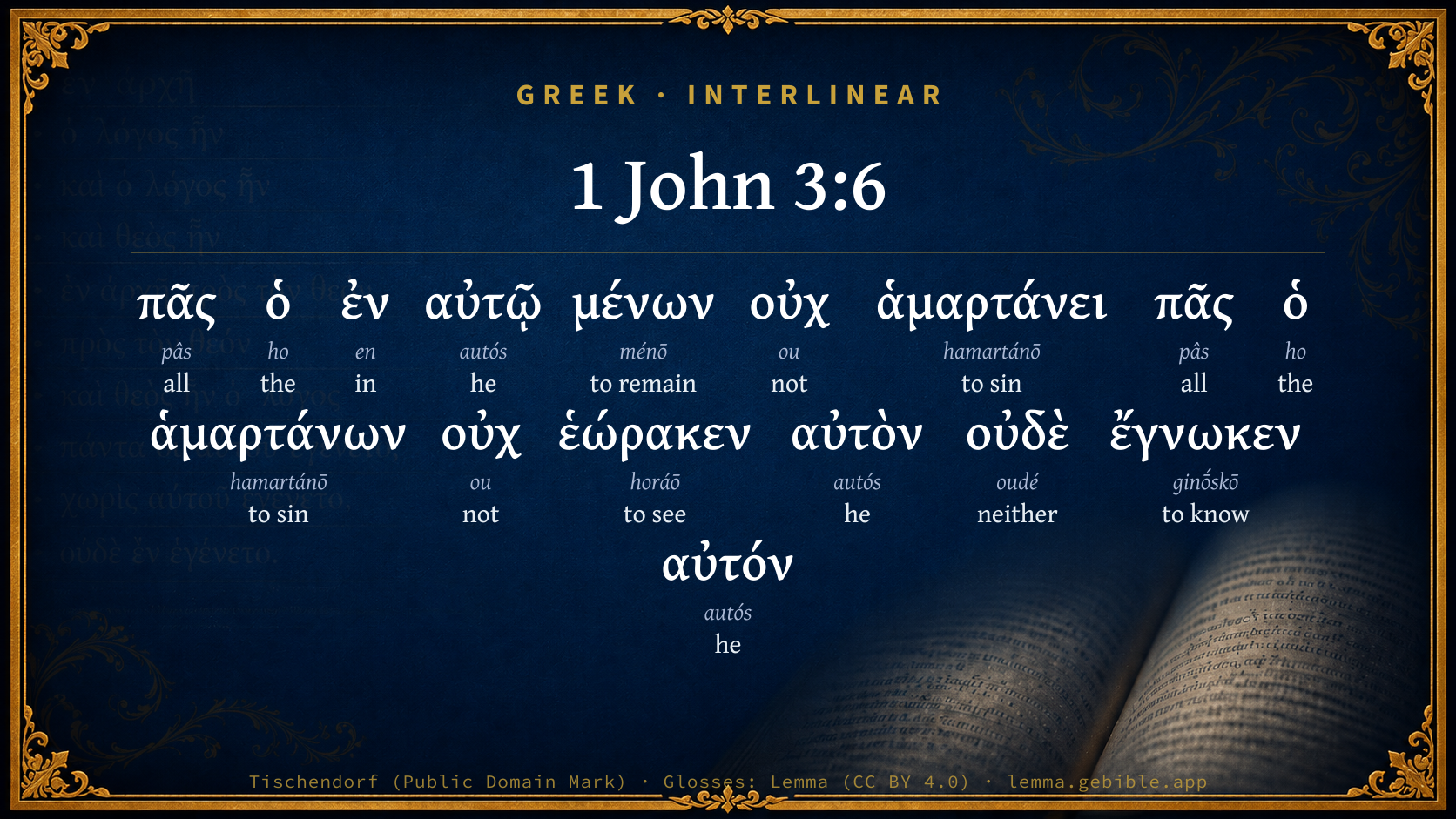
Greek (Tischendorf 8th ed.) 1 John 3:6 appears in the Greek New Testament. The text above is from the Tischendorf 8th edition. Each word links to its Strong’s number and a concise gloss. Click any word for its full Thayer’s Greek Lexicon entry.
Download image
Cite this verse

1 John 3:6 (World English Bible). Public Domain. Lemma interlinear Bible study tool, https://lemma.gebible.app/v/1-john/3/6.

Show BibTeX & RIS
BibTeX
RIS
English Translation
Whoever remains in him doesn't sin. Whoever sins hasn't seen him, neither knows him.
World English Bible · Public Domain
Download a study sheet

One document with this verse’s original text, its word-by-word gloss line, the meaning frame, cross-references with their text, attributed commentary, and full source and license credits — printable, and it pastes into notes with its structure intact.

This verse Autodidact and up

Study sheet (.html) Plain text (.txt)

A passage Seminary Student

Up to 50 verses in one chapter. A passage sheet keeps up to 6 commentary sources and 12 cross-references per verse, in the order this page ranks them, and says so on the sheet whenever that leaves anything out. Ask for a single verse and you get the Autodidact verse sheet above.

Everything on this page stays free to read, with no account — the sheet is a download of what is already on screen, not access to it.

Want to remove ads? Support Godless Engineer
Compare translations 3

The same verse in 3 English versions, stacked beneath the original-language interlinear above. Click any original word for its lexicon entry.

Each is an independent rendering of the whole verse — the interlinear is not word-aligned to these translations.

Highlighted words mark where these versions differ — a whole-verse word diff, not a word-by-word alignment.

  • World English Bible Public Domain
    Whoever remains in him doesn't sin. Whoever sins hasn't seen him, neither knows him.
  • King James Version Public Domain
    Whosoever abideth in him sinneth not: whosoever sinneth hath not seen him, neither known him.
  • unfoldingWord Literal Text CC BY-SA 4.0
    Everyone remaining in him does not sin. Everyone sinning has not seen him and has not known him.

unfoldingWord Literal Text — © unfoldingWord, licensed CC BY-SA 4.0. Word-aligned USFM3 via Door43 (git.door43.org/unfoldingWord/en_ult).

Versions to compare (up to 4)

3 of 4 selected

Show all 19 translations

Every available English version of this verse, each an independent rendering of the whole verse.

  • World English Bible Public Domain
    Whoever remains in him doesn't sin. Whoever sins hasn't seen him, neither knows him.
  • Berean Standard Bible Public Domain
    No one who remains in Him keeps on sinning. No one who continues to sin has seen Him or known Him.
  • Majority Standard Bible Public Domain
    No one who remains in Him keeps on sinning. No one who continues to sin has seen Him or known Him.
  • King James Version Public Domain
    Whosoever abideth in him sinneth not: whosoever sinneth hath not seen him, neither known him.
  • American Standard Version (1901) Public Domain
    Whosoever abideth in him sinneth not: whosoever sinneth hath not seen him, neither knoweth him.
  • Revised Version (1885) Public Domain
    Whosoever abideth in him sinneth not: whosoever sinneth hath not seen him, neither knoweth him.
  • Geneva Bible (1599) Public Domain
    Whosoeuer abideth in him, sinneth not: whosoeuer sinneth, hath not seene him, neither hath knowen him.
  • Douay-Rheims (1899) Public Domain
    Whosoever abideth in him, sinneth not; and whosoever sinneth, hath not seen him, nor known him.
  • Young's Literal Translation Public Domain
    every one who is remaining in him doth not sin; every one who is sinning, hath not seen him, nor known him.
  • Literal Standard Version CC BY-SA 4.0
    everyone who is remaining in Him does not sin; everyone who is sinning, has not seen Him, nor known Him.
  • Unlocked Literal Bible CC BY-SA 4.0
    No one who remains in him will keep on sinning. No one who continues to sin has seen him or known him.
  • unfoldingWord Literal Text CC BY-SA 4.0
    Everyone remaining in him does not sin. Everyone sinning has not seen him and has not known him.
  • Darby Bible Public Domain
    Whoever abides in him, does not sin: whoever sins, has not seen him or known him.
  • World Messianic Bible Public Domain
    Whoever remains in him doesn’t sin. Whoever sins hasn’t seen him and doesn’t know him.
  • Webster's Bible Public Domain
    Whoever abideth in him sinneth not: whoever sinneth hath not seen him, neither known him.
  • Free Bible Version CC BY-SA 4.0
    All those who live in him don't go on sinning; all those who keep on sinning haven't seen him and haven't known him.
  • Bible in Basic English Public Domain
    Anyone who is in him does no sin; anyone who is a sinner has not seen him and has no knowledge of him.
  • Text-Critical English NT CC BY 4.0
    No one who abides in him continues in sin; no one who continues in sin has either seen him or known him.
  • Tyndale New Testament (1534) Public Domain
    As many as byde in him synne not: whosoever synneth hath not sene him nether hath knowen him.

Literal Standard Version (2020), Covenant Press — licensed CC BY-SA 4.0. Text via the HelloAO Bible API (eBible.org). Unlocked Literal Bible (unfoldingWord) — licensed CC BY-SA 4.0. Text via the HelloAO Bible API (eBible.org). unfoldingWord Literal Text — © unfoldingWord, licensed CC BY-SA 4.0. Word-aligned USFM3 via Door43 (git.door43.org/unfoldingWord/en_ult). Free Bible Version, Dr. Jonathan Gallagher — licensed CC BY-SA 4.0. Text via the HelloAO Bible API (eBible.org).

Word by word

More ways to search: Search by grammar → Find every occurrence → Compare this word →

Practice this passage: Drill this verse → Learn its vocabulary →

ἁμαρτάνει
hamartánō
G264
“to sin”
Verb, Present, Active, Indicative, 3rd person, Singular
Part of Speech
Verb
Tense
Present
Voice
Active
Mood
Indicative
Person
3rd person
Number
Singular
Full Thayer's Definition

Origin: perhaps from G1 (as a negative particle) and the base of G3313

TDNT: 05:27,4

1. to be without a share in 2. to miss the mark 3. to err, be mistaken 4. to miss or wander from the path of uprightness and honour, to do or go wrong 5. to wander from the law of God, violate God's law, sin
  1. πᾶς pâs G3956 “all” Adjective, Nominative, Singular, Masculine
  2. ὁ ho G3588 “the” Article, Nominative, Singular, Masculine
  3. ἐν en G1722 “in” Preposition
  4. αὐτῷ autós G846 “he” Personal pronoun, Dative, Singular, Masculine
  5. μένων ménō G3306 “to remain” Verb, Present, Active, Participle, Nominative, Singular, Masculine
  6. οὐχ ou G3756 “not” Particle, Negative
  7. πᾶς pâs G3956 “all” Adjective, Nominative, Singular, Masculine
  8. ὁ ho G3588 “the” Article, Nominative, Singular, Masculine
  9. ἁμαρτάνων hamartánō G264 “to sin” Verb, Present, Active, Participle, Nominative, Singular, Masculine
  10. οὐχ ou G3756 “not” Particle, Negative
  11. ἑώρακεν horáō G3708 “to see” Verb, Perfect, Active, Indicative, 3rd person, Singular, Attic form
  12. αὐτὸν autós G846 “he” Personal pronoun, Accusative, Singular, Masculine
  13. οὐδὲ oudé G3761 “neither” Conjunction, Negative
  14. ἔγνωκεν ginṓskō G1097 “to know” Verb, Perfect, Active, Indicative, 3rd person, Singular
  15. αὐτόν autós G846 “he” Personal pronoun, Accusative, Singular, Masculine

About this verse

These counts appear in no published source. They are computed here, from the morphology-tagged text and Lemma’s own curated glosses. What Lemma adds →

16
words
10
distinct lemmas
General Epistles
section

Shared distinctive vocabulary

ἁμαρτάνει to sin G264 occurs in 37 verses of the Greek New Testament. Also found in:
Repetition

Words recur within this verse:

  • πᾶς all G3956 ×2
  • ἁμαρτάνει to sin G264 ×2
  • αὐτῷ he G846 ×3
  • ὁ the G3588 ×2
  • οὐχ not G3756 ×2

Cross-references

10

Topical passages linked to 1 John 3:6 in the Treasury of Scripture Knowledge — connected by theme and wording, ordered by reader-vote popularity; previews shown in the World English Bible.

  • 3 John 1:11 Beloved, don't imitate that which is evil, but that which is good. He who does good is of God. He who does evil hasn't seen God.
  • 1 John 2:4 One who says, "I know him," and doesn't keep his commandments, is a liar, and the truth isn't in him.
  • 1 John 3:9 Whoever is born of God doesn't commit sin, because his seed remains in him; and he can't sin, because he is born of God.
  • 1 John 4:8 He who doesn't love doesn't know God, for God is love.
  • John 15:4–7 Remain in me, and I in you. As the branch can't bear fruit by itself, unless it remains in the vine, so neither can you, unless you remain in me.
  • 1 John 3:2 Beloved, now we are children of God, and it is not yet revealed what we will be. But we know that, when he is revealed, we will be like him; for we will see him just as he is.
  • 1 John 5:18 We know that whoever is born of God doesn't sin, but he who was born of God keeps himself, and the evil one doesn't touch him.
  • 2 Corinthians 4:6 seeing it is God who said, "Light will shine out of darkness," who has shone in our hearts, to give the light of the knowledge of the glory of God in the face of Jesus Christ.
  • 1 John 2:28 Now, little children, remain in him, that when he appears, we may have boldness, and not be ashamed before him at his coming.
  • 2 Corinthians 3:18 But we all, with unveiled face beholding as in a mirror the glory of the Lord, are transformed into the same image from glory to glory, even as from the Lord, the Spirit.

Cross-references courtesy of OpenBible.info (CC BY 4.0).

Commentary

Notes on 1 John 3:6 from classic Christian and Jewish commentators (each source and its license shown beneath its notes). The classic Christian expositions comment on the surrounding passage and are grouped to its opening verse, so a note may address several verses; the Jewish commentaries on the Tanakh (Rashi and others) are per-verse, so they appear only where the commentator wrote on this verse.

Lemma curates 59 commentaries, every one of them public domain or Creative Commons licensed, each selected and text-cleaned for this edition rather than reprinted as found. About our sources →

The Cambridge Bible for Schools and Colleges

gen. ed. J. J. S. Perowne

6. Whosoever abideth] Better, Every one that abideth: we have the same Greek form of expression here as in 1Jn_2:23; 1Jn_2:29, 1Jn_3:3-4; 1Jn_3:9-10; 1Jn_3:15. 1Jn_4:7, 1Jn_5:1; 1Jn_5:4; 1Jn_5:18, and it is better to mark this in translation.

sinneth not] The Christian sometimes sins (1Jn_1:8-10). The Christian abides in Christ (1Jn_2:27). He who abides in Christ does not sin (1Jn_3:6). By these apparently contradictory statements put forth one after another S. John expresses that internal contradiction of which every one who is endeavouring to do right is conscious. What S. John delivers as a series of aphorisms, which mutually qualify and explain one another, S. Paul puts forth dialectically as an argument. ‘If what I would not, that I do, it is no more I that do it, but sin which dwelleth in me’ (Rom_7:20). And on the other hand, ‘I live; yet not I, but Christ liveth in me’ (Gal_2:20).

whosoever sinneth, hath not seen him, neither known him] Or, every one that sinneth, hath not seen Him, neither knoweth Him. The second verb is the perfect of the commonest verb in Greek for ‘to see’ (ὁρᾷν), a verb of which S. John uses no tense but the perfect. The third verb, though perfect in form, is present in meaning, ‘I have come to know, I know’ (see on 1Jn_2:3). No one who sins has seen Christ or attained to a knowledge of Him. What does S. John mean by this strong statement? It will be observed that it is the antithesis of the preceding statement; but, as usual, instead of giving us the simple antithesis, ‘Every one that sinneth abideth not in Him’, he expands and strengthens it into ‘Every one that sinneth hath not seen Him, neither come to know Him’. S. John does not say this of every one who commits a sin, but of the habitual sinner (present participle). Although the believer sometimes sins, yet not sin, but opposition to sin, is the ruling principle of his life; for whenever he sins he confesses it, and wins forgiveness, and perseveres with his self-purification.

But the habitual sinner does none of these things: sin is his ruling principle. And this could not be the case if he had ever really known Christ. Just as apostates by leaving the Church prove that they have never really belonged to it (1Jn_2:19), so the sinner by continuing in sin proves that he has never really known Christ.—Seeing and knowing are not two names for the same fact: to see Christ is to be spiritually conscious of His presence; to know Him is to recognise His character and His relation to ourselves. For a collection of varying interpretations of this passage see Farrar’s Early Days of Christianity, II. p. 434, note.

The Cambridge Bible for Schools and Colleges (gen. ed. J. J. S. Perowne; Cambridge University Press, 1878–1918) — public domain. Text from a community e-Sword module.

Albert Barnes' Notes on the Bible

Whosoever abideth in him - See 1Jo 2:6. The word here employed (μένων menōn) properly means to remain, to continue, to abide. It is used of persons remaining or dwelling in a place, in the sense of abiding there permanently, or lodging there, and this is the common meaning of the word, Mat 10:11; Mat 26:38; Mar 6:10; Luk 1:56, “et saepe.” In the writings of John, however, it is quite a favorite word to denote the relation which one sustains to another, in the sense of being united to him, or remaining with him in affection and love; being with him in heart and mind and will, as one makes his home in a dwelling. The sense seems to be that we have some sort of relation to him similar to that which we have to our home; that is, some fixed and permanent attachment to him. We live in him; we remain steadfast in our attachment to him, as we do to our own home. For the use of the word in John, in whose writings it so frequently occurs, see Joh 5:38; Joh 6:56; Joh 14:10, Joh 14:17; Joh 15:27; 1Jo 2:6, 1Jo 2:10, 1Jo 2:14, 1Jo 2:17, 1Jo 2:27-28; 1Jo 3:6, 1Jo 3:24; 1Jo 4:12-13, 1Jo 4:15-16. In the passage before us, as in his writings generally, it refers to one who lives the life of a Christian, as if he were always with Christ, and abode with him. It refers to the Christian considered as adhering steadfastly to the Saviour, and not as following him with transitory feelings, emotions, and raptures.

(See the supplementary note at Rom 8:10. We abide in Christ by union with him. The phrase expresses the continuance of the union; of which see in the note as above. Scott explains, “whoever abides in Christ as one with him and as maintaining communion with him. ‘)

It does not of itself necessarily mean that he will always do this; that is, it does not prove the doctrine of the perseverance of the saints, but it refers to the adherence to the Saviour as a continuous state of mind, or as having permanency; meaning that there is a life of continued faith in him. It is of a person thus attached to the Saviour that the apostle makes the important declaration in the passage before us, that he does not sin. This is the third argument to show that the child of God should be pure; and the substance of the argument is, that “as a matter of fact” the child of God is not a sinner.

Sinneth not - There has been much difference of opinion in regard to this expression, and the similar declaration in 1Jo 3:9. Not a few have maintained that it teaches the “doctrine of perfection,” or that Christians may live entirely without sin; and some have held that the apostle meant to teach that this is always the characteristic of the true Christian. Against the interpretation, however, which supposes that it teaches that the Christian is absolutely perfect, and lives wholly without sin, there are three insuperable objections:

(1) If it teaches that doctrine at all, it teaches that all Christians are perfect; “whosoever abideth in him,” “whosoever is born of God,” “he cannot sin,” 1Jo 3:9.

(2) This is not true, and cannot be held to be true by those who have any just views of what the children of God have been and are. Who can maintain that Abraham, or Isaac, or Jacob; that Moses, David, or Job; that Peter, John, or Paul, were absolutely perfect, and were never, after their regeneration, guilty of an act of sin? Certainly they never affirmed it of themselves, nor does the sacred record attribute to them any such perfection. And who can affirm this of all who give evidence of true piety in the world? Who can of themselves? Are we to come to the painful conclusion that all who are not absolutely perfect in thought, word, and deed, are destitute of any religion, and are to be set down as hypocrites or self-deceivers? And yet, unless this passage proves that “all” who have been born again are absolutely perfect, it will not prove it of anyone, for the affirmation is not made of a part, or of what any favored individual may be, but of what everyone is in fact who is born of God.

(3) This interpretation is not necessary to a fair exposition of the passage. The language used is such as would be employed by any writer if he designed to say of one that he is not characteristically a sinner; that he is a good man; that he does not commit habitual and willful transgression. Such language is common throughout the Bible, when it is said of one man that he is a saint, and of another that he is a sinner; of one that he is righteous, and of another that he is wicked; of one that he obeys the law of God, and of another that he does not. John expresses it strongly, but he affirms no more in fact than is affirmed elsewhere. The passage teaches, indeed, most important truths in regard to the true Christian; and the fair and proper meaning may be summed up in the following particulars:

(a) He who is born again does not sin habitually, or is not habitually a sinner. If he does wrong, it is when he is overtaken by temptation, and the act is against the habitual inclination and purpose of his soul. If a man sins habitually, it proves that he has never been renewed.

(b) That he who is born again does not do wrong deliberately and by design. He means to do right. He is not willfully and deliberately a sinner. If a man deliberately and intentionally does wrong, he shows that he is not actuated by the spirit of religion. It is true that when one does wrong, or commits sin, there is a momentary assent of the will; but it is under the influence of passion, or excitement, or temptation, or provocation, and not as the result of a deliberate plan or purpose of the soul. A man who deliberately and intentionally does a wrong thing, shows that he is not a true Christian; and if this were all that is understood by “perfection,” then there would be many who are perfect, for there are many, very many Christians, who cannot recollect an instance for many years in which they have intentionally and deliberately done a wrong thing. Yet these very Christians see much corruption in their own hearts over which to mourn, and against which they earnestly strive; in comparing themselves with the perfect law of God, and with the perfect example of the Saviour, they see much in which they come short.

(c) He who is born again will not sin finally, or will not fall away. “His seed remaineth in him,” 1Jo 3:9. See the notes at that verse. There is a principle of grace by which he will ultimately be restrained and recovered. This, it seems to me, is fairly implied in the language used by John; for if a person might be a Christian, and yet wholly fall away and perish, how could it be said with any truth that such a man “sinneth not;” how that “he doth not commit sin;” how that “his seed remaineth in him, and he cannot sin?” Just the contrary would be true if this were so.

Whosoever sinneth - That is, as explained above, habitually, deliberately, characteristically, and finally. - Doddridge. “Who habitually and avowedly sinneth.”

Hath not seen him, nor known him - Has had no just views of the Saviour, or of the nature of true religion. In other words, cannot be a true Christian.

Albert Barnes' Notes on the Bible (1834–1885) — public domain. Text from a community e-Sword/MySword module.

The Biblical Illustrator

Joseph S. Exell

1Jn_3:6

Whosoever abideth in Him sinneth not

The secret of sinlessness--our abiding in Christ--the seed of God abiding in us--our being born of God

I.

These texts (1Jn_3:6; 1Jn_3:9) do not teach either the doctrine of perfection or that other doctrine which is apt to usurp its place--the doctrine that God sees no sin in His people, or that what would be sin in others is not sin in them.

II. There is another mode of dealing with the statements before us which I cannot feel to be satisfactory. It is to limit their comprehensiveness, and to understand the apostle as speaking, not of sin universally, but of sin more or less voluntary and presumptuous. According to this view, one abiding in Christ cannot sin deliberately, intentionally, knowingly. Is that true? Was it true of David? Or of the man in Corinth who was excommunicated for incest, and, upon repentance, restored?

III. It may help us out of the difficulty if we first look at the statements before us in the light, not of what we are now by grace, but of what we are to be in the future state of glory. It will be true then that we sin not; it will be impossible for us then to sin. What will make it impossible for us to sin? Simply our abiding in Christ, our being born of God, His seed abiding in us. Let me remind you that this impeccability lies in the will--the seat of it is the will. It is because, in the state of glory, my will is made perfectly and immutably free to do good alone, that my will is, or that I myself am, incapable of doing evil. And if it is your will that is to be thus free--free, as His will is free, to do good alone, and therefore incapable of an evil choice, then your impeccability must be, if I may say so, itself voluntary; voluntarily accepted and realised.

IV. Let me try to bring out more clearly this principle as one that must connect the future with the present. Why is it that in heaven, my will being free as Gods will is free, I can no more sin than He can sin? What answer would John give to that question if you could put it to him now? As thus: In whatever sense, and with whatever modifications, thou didst, in thy experience when here, find that to be true which thou hast so emphatically put--as the test, apparently, of real Christianity--it is all true of thee there, where thou art now! How is it so? Why is it so? Because I abide in the Son of God, and Gods own seed abides in me, as being born of God--is not that his reply? What other reply can he give? Then, does it not follow that it is an impeccability that may be realised on earth? For the causes of it are realised on earth; first, your abiding in the Son of God; secondly, your being born of God so as to have His seed abiding in you.

V. Viewed thus in the light of what we shall be, and of the bearing of what we shall be on what we are, Johns statements assume a somewhat different aspect from what they are apt to wear when taken by themselves. They become not one whit less solemn, but greatly more encouraging. For one thing, you may now regard them as describing a precious privilege, as well as imposing a searching test. They show you the way of perfect holiness; how you are to be righteous even as Christ is righteous; even as God is righteous.

VI. Taking this view, I confess I do not feel so much concern as otherwise I might feel about reconciling such strong statements as that one abiding in Christ sinneth not, or that one born of God cannot sin, with the acknowledged and lamented fact that he does sin. John has dealt with that fact already, and told us how to deal with it. It is not his business here to be making allowance for it. For indeed it is most dangerous to be considering the matter in that light or on that side at all. It is almost sure to lead, first to calculations, and then to compromises fatal to singleness of eye and the holy ambition that ought to fire the breast--calculations first about the quantity and quality of the residuum of old corruption which we must lay our account with finding in the purest God-born soul, and then compromises under the sort of feeling that, as the proverb says, what cannot be cured must be endured. Let a few practical inferences be suggested.

1. I think the texts teach, or imply, the doctrine of the final perseverance of the saints, the impossibility of their either wholly or permanently falling away from a state of grace.

2. The texts teach very plainly that this doctrine, whatever may be its practical use and value in its right place, and when turned to legitimate account, cannot give to any man security in sin, cannot make him safe when he is sinning, when he is committing sin or transgressing the law.

3. Johns true design and purpose is to put you in the way of not sinning, of its being impossible for you to sin. (R. S. Candlish, D. D.)

The inadmissibility of sin

This paragraph goes to show that the practice of sin is out of the question for a believer in Christ. Sin has no place whatever in the Christian life, according to the proper view and conception of it. We observe five distinct reasons alleged by the apostle for this conclusion.

I. First he makes out, in verses 2 and 3, that on purity depends our future glory. This is the starting point of his denunciation of sin. John and his readers are now, in this present life, the children of God. The manner of their future existence is not revealed. One thing we know, that it will be a God-like state. We want to see God, for we are His children. And we are told that without holiness no man shall see the Lord. Then we must be holy. Now the pattern of God-likeness for us is Jesus the Son of God. We will, therefore, conform ourselves to Him. Everyone who longs to see God, and has seen Jesus Christ, knows now what he must be like in order to attain the vision. So he purifies himself, as He is pure. The apostle does not tell us here how this purity is to be gained. He says one thing at a time. He wants to convince us that such purity is indispensable. Observe, by the way, the word which John uses here for pure. It is hagnos, which elsewhere and commonly means chaste (2Co_11:2; Tit_2:5). It signifies the delicate purity of virgin thoughts and an uncontaminated mind (comp. Rev_14:4), the opposite of sensuality and carnality; the purity of one in whom the animal and earthly are refined and transformed by the spiritual--as in Jesus.

II. Now St. John proceeds from the positive to the negative, from enjoining holiness to denouncing sin. And of his prohibitions this is the first: sin is illegal. So he puts it, with concise energy, in verse 4. This seems to you, perhaps, a commonplace; because you have behind you many ages of Christian teaching. Not so with Johns readers. Most of them had been Pagans, taught to think that if they kept the ceremonial rules of religion, and the laws of the state as sanctioned by religion, the gods were satisfied with them, troubling themselves no further about mens conduct or the condition of their souls--that, in fact, private morals are one thing, law and religion quite another. Some of them had, probably, been Pharisaic Jews, accustomed to observe strictly the letter of their sacred law, while they found means, by all manner of evasions, to indulge in gross wickedness. Now the apostle traverses this position in verse 4. He deepens our conception of sin and broadens our conception of law, while he makes them coincide and cover the same ground, when he says, Sin is lawlessness. The law of God is all-embracing, all-penetrating; it touches every part of human nature and conduct. We have no business to do anything or think anything that is in the least degree ungodly. Every sinner is a rebel and an outlaw in Gods creation. This is the first and fundamental condemnation--the constitutional objection to sin, as we may call it.

III. In the next place, sin is unchristian. Here again we must put ourselves in the position of the readers, who had to learn things of God that He has been teaching us and our fathers for centuries. He was manifested that He might take away sins--not our sins, but sins in the most unlimited sense (compare 1Jn_2:2). This our apostle had learnt from his first master, the Baptist, who pointed him to Jesus with the words, Behold the Lamb of God, who taketh away the sin of the world! That great manifestation, the appearance of the Son of God in human flesh, was Gods demonstration against sin. Christs one object was to destroy it; and we can only abide in Him on the understanding that we have done with it too. Nor must we deceive ourselves by thinking that righteousness consists of good frames and feelings--we must do righteousness (verse 7). This apostle had known his Master on earth more intimately than anyone besides. And in this one word he describes the character of Jesus, and says of Him what could be said of no other child of Adam: In Him sin does not exist. Elsewhere he calls Him Jesus Christ the righteous, the pure, the true. To take away sins, to cleanse us from all sin (1Jn_1:7), is with John a summary term for the abolition of moral evil. The Lord Jesus carries our sins right away and discharges us from them. Herein lies the glory and the fulness of the redemption that is in Christ Jesus--it destroys sin root and branch, in its guilt and power, its burden on the conscience, and its dominion over the heart. It is a hard saying, that of verse 6: Whosoever sinneth hath not seen Him nor known Him! The interpreter needs to walk warily, lest with this sentence he should break some bruised reed, or quench the smoking flax in the heart of one who loves the Lord and yet has to mourn his many failures and shortcomings. The apostle writes here, and in verses 4 and 6, in the Greek present participle, which describes a continuous act or habit of sin: everyone that sinneth signifies everyone who lives in sin, or every sinner; and everyone that doeth sin means everyone whose life bears this fruit and yields sin for its product and result. The apostle is not thinking of the case of men weak in faith or overtaken in some trespass. Once to have seen the Lord Jesus, as John had seen Him, is enough to make any other ideal of life impossible. If you have seen Him, then you have fallen in love with holiness, once and forever. For you to put up with sin any more, or be at peace with it, is a thing impossible.

IV. Once more, St. John gives us to understand that sin is diabolical (verse 8). The righteous Son of God has come forth to be the leader of the sons of God, who are saved by His blood and abide in His righteousness. For the doers of sin there is another leader and pattern: He that doeth sin is of the devil. Every act of wrong-doing is an act of assistance to the enemy of God and man; it is an act of treason, therefore, in the professed servant of God, the soldier of Christ Jesus. Every such act helps in its degree to prop and maintain the great fortress of evil, the huge rampart raised in this world against the holy and almighty will of God, which Scripture calls sin.

V. Finally, St. John comes round again to what he had said at the outset: sin is unnatural in a child of God (verse 9). The two sentences of verse 9 amount to saying: First, as a matter of fact, the child of God does not sin; secondly, as a matter of principle, he cannot sin. Concerning everyone that is begotten of God, the apostle asserts, sin he does not commit. There is a master influence, a principle of Divine life and sonship, which produces the opposite effect, a seed that bears good fruit of righteousness instead of the old evil fruit of unrighteousness. This seed of God abiding in the believer is surely, according to Johns way of thinking, the presence of the Holy Spirit, that which he called in 1Jn_2:27 an anointing from the Holy One dwelling in you, the chrism (anointing) which makes men Christians. Of the same grace he writes in 1Jn_3:24 : In this we know that He dwells in us, from the Spirit which He gave us. And St. Paul teaches us that the Holy Spirit, given to believers in Christ, is at once the seal of their sonship to God and the seed of moral goodness; for he speaks of the manifold forms of Christian virtue as the fruit of the Spirit (Gal_5:22-23), that excludes the works of the flesh. For these are contrary one to the other, so that you may not do the things you would; the Spirit lusts against the flesh--it desires and effects what the flesh most disliked. Sin is done away not by mere negation and repression, but by the counterworking of a positive and stronger principle. The ground is so filled with the good seed that weeds have no room to grow. To a child of God, to the new nature, the new tastes and dispositions of the man born of the Spirit, sin becomes a moral impossibility. It is wholly repugnant to that Divine nature of which he now partakes (2Pe_1:4). What shall we say, then, to the notorious fact of sin in believers? Some have shamelessly declared that their sin is no sin, for they are born of God, and therefore cannot sin 1 St. John would infallibly draw, for such men, the opposite conclusion--that, seeing they thus sin, they are not born of God, they lie and do not the truth. The fact must be admitted, but not for a moment allowed. Sin is an alien and monstrous thing to the regenerate; its detection in the heart must cause to a child of God the deepest pain and shame. Its actual commission, even for a moment, is a fall from grace, a loss of the seal of sonship, only to be retrieved by prompt repentance and recourse to the all-cleansing blood. Christianity can make no concession to sin, no compromise with it in any shape or form, without stultifying itself and denying its sinless, suffering Lord. (G. G. Findlay, B. A.)

Abiding in Christ the remedy against sin

As the Venerable Bede wrote long ago, Quantum in Eo manet, tantum non peccat (In so far as he abideth in Him, thus far he sinneth not.)

Christian purity

This deliverance does not imply the annihilation of the reward tendency to sin, so that we shall no longer find it in us as a force against which we have to watch and to contend. For, if Christ, by His own presence and power in our hearts, gives us complete and constant victory over the hostile force within us, so that it no longer consciously moulds our acts, or words, or thoughts, we are already saved from all polluting power of sin. A tendency to evil which is every moment trodden underfoot will cause us no spiritual shame. (J. A. Beet, D. D.)

Centrifugal and centripetal forces

This exposition may be illustrated by a far reaching analogy found in the solar system. The motive force in a planet at any moment, which force is an accumulation of its previous motion, would, if the attractive force of the sun were withdrawn, carry the planet from its orbit and to ruin. Whereas, if the inherent force were removed, the planet would fall into the sun, thus losing its individual existence. But under the combined influence of these two forces, each exerting its full influence every moment, the planet moves on its appointed path, preserving its individuality, yet subordinate to a body immensely greater than itself. So we move in absolute devotion to Him from whom we receive light and life and all things. (J. A. Beet, D. D.)

Counteracting sin

Similarly, we carry in our bodies chemical forces which would destroy us were they not neutralised by the presence of animal life. Yet, in spite of these forces, the body may be in perfect health. For the neutralising power is sufficient to preserve us. Just so the presence of Christ in our hearts holds back our inborn tendencies to evil, aggravated as they are by personal sin, and preserves us from all corruption. Thus does He save His people from their sins. (J. A. Beet, D. D.)

The Biblical Illustrator, edited by Joseph S. Exell (c. 1880s–1900s) — public domain. Text from a community e-Sword module.

Joseph Benson's Commentary

1Jn 3:6. Whosoever abideth in union and fellowship with him — By loving faith; sinneth not — Doth not commit known sin, while he so abideth: whosoever sinneth — Transgresseth any known law of God; hath not seen him, neither known him — His views and knowledge of him have been so superficial that they deserve not to be mentioned, since they have not conquered his love of sin, and the prevalence of it, and brought him to a holy temper and life. Or he has not attained to, or has not retained, a spiritual, experimental acquaintance and communion with him. For, certainly, when a person sins, or transgresseth any known law of God, the loving eye of his soul is not fixed upon God; neither doth he then experimentally know him, whatever he did in time past. Macknight thinks it probable that “some of the heretical teachers, condemned by the apostle in this epistle, to make their disciples believe that their opinions were derived from Christ, boasted their having seen and conversed with him during his ministry on earth, consequently that they knew his doctrine perfectly. But the apostle assured his children that, if these teachers, who avowedly continued in sin, had ever seen or conversed with Christ, they had utterly mistaken both his character and his doctrine.”

Joseph Benson's Commentary on the Old and New Testaments (1811–1818) — public domain. Text from a community e-Sword module.

Tyndale Open Study Notes

Tyndale Open Resources

3:6 continues to live in him (Greek menō): This indicates “abiding” and “remaining” (John 15:1-8) in contrast to departing into falsehood. To the extent that we live in continual, dependent fellowship with Christ and in faithfulness to the apostles’ teachings, we will not sin. • keeps on sinning: This verb denotes sin as an ongoing, repeated action. John was not saying that anyone who sins once does not know God (i.e., has no relationship with God). But if we persist in sin, we demonstrate a lack of relationship with God.

Tyndale Open Study Notes — © Tyndale Open Resources, licensed CC BY-SA 4.0. Text via the HelloAO Bible API.

Bengel's Gnomon

Johann Albrecht Bengel

1Jn 3:6. Οὐχ ἁμαρτάνει, sinneth not) In him the good of righteousness is not overcome by the evil of sin.—οὐχ ἑώρακεν αὐτὸν) hath not seen Him in spirit; although perhaps, as to personal appearance, he hath seen Him in the flesh: or even, though he hath seen Him in spirit, at the very moment of sin he becomes such, as though he had never seen Him in any way.—οὐδὲ ἔγνωκεν αὐτὸν, nor known Him) in truth; although perhaps he hath formerly known Him personally. Light and knowledge produce likeness to God: 1Jn 3:2.

Bengel's Gnomon of the New Testament — English translation (T&T Clark, Edinburgh, 1860) — public domain. Text from a community e-Sword module.

Meyer's Critical & Exegetical Commentary

Heinrich August Wilhelm Meyer

1Jn_3:6. πᾶς ὁ ἐν αὐτᾷ (i.e. Χριστῷ) μένων] refers back to the exhortation in 1Jn_2:27; μένειν, not merely = inesse, expresses close fellowship.

οὐχ ἁμαρτάνει] John hereby states the abiding in Christ and sinning as irreconcilable opposites; still it is not his meaning that the believing Christian does not sin any more at all, or that he who still sins is not in Christ, for in 1Jn_1:8-10, 1Jn_2:1-2, 1Jn_3:3, he clearly enough expresses that sin still clings to the Christian, and that he therefore needs constantly both the forgiving and saving grace of God and the intercession of Christ, as well as self-purification. The solution of the apparent contradiction must not be sought by giving the word ἁμαρτάνειν here a meaning different from what it has elsewhere (e.g. = persistere in peccato; or with Capellus = sceleratum esse, or = to commit peccata mortalia); nor even by appealing to the apostles ideal mode of conception (de Wette, Düsterdieck; substantially also Weiss and Brückner[205]), for John has here to do with real cases, and wants to indicate to us the marks by which it may be known whether a man loves the Lord or not, whether he is a child of God or of the wicked one (Sander), as is clear from φανερά ἐστι, 1Jn_3:10; but only in the fact that the Christian, who is a ΤΈΚΝΟΝ ΘΕΟῦ, bears the contradiction in himself that he, on the one hand, it is true, still actually sins, but, on the other hand, is also actually free from sinso free from it that he cannot sin (1Jn_3:9); he has actually broken with sin, so that in his most inner nature he is in the most decided opposition to it; yet at the same time he finds it in himself, and indeed in such a way that he still actually sins (chap. 1Jn_1:10), but inasmuch as he confesses it, and experiences the forgiving and saving love of the faithful God towards him (chap. 1Jn_1:9), and with all earnestness practises the ἁγνίζειν ἑαυτόν, it ever loses more and more its power over him, and thus it results that it is no longer sin, but opposition to it (as something foreign to his nature), that determines his conduct of life; and hence the apostle may with perfect justice say, that he who abides in Christ does not sin (so also Braune[206]), which is quite the same as when Paul says: εἴ τις ἐν Χριστῷ, καινὴ κτίσις· τὰ ἀρχαῖα παρῆλθεν, ἰδού, γέγονε καινὰ τὰ πάντα (2Co_5:17).

The antithesis expressed in the first clause is even more sharply brought out in the second, inasmuch as John does not say: Πᾶς Ὁ ἉΜΑΡΤΆΝΩΝ … Οὐ ΜΈΝΕΙ ἘΝ ΑὐΤῷ, but: ΟὐΧ ἙΏΡΑΚΕΝ ΑὐΤΌΝ, ΟὐΔῈ ἜΓΝΩΚΕΝ ΑὐΤΌΝ.

Πᾶς Ὁ ἉΜΑΡΤΆΝΩΝ is every one who leads a life in ἉΜΑΡΤΊΑ, and therefore has not come out of the ΚΌΣΜΟς into the number of Gods children;[207] such an one, says John, hath not seen, neither known αὐτόν, i.e. Christ. Lücke takes the perfects ἑώρακεν and ἔγνωκεν in present signification, the former in the meaning of the present possession of the experience, the latter in the meaning of the present possession of previously obtained knowledge; but this is not rendered necessary by the context, and hence the perfects are to be retained as such, although it must be admitted that John is considering the result as one that continues into the present. The meaning of the two verbs in their relation to one another is very differently explained; according to some commentators, ἑώρακεν signifies something inferior (Semler, Baumgarten-Crusius, Lücke in his 1st ed.), according to others, something superior (Socinus, Neander, Frommann, p. 223), to ἔγνωκεν; with the former view οὐδέ is taken as = and still less, with the latter as = and not as much as; both are incorrect, for a difference of degree is in no way suggested; yet the two expressions are not to be regarded as synonymous, so that ἔγνωκε would only be added to bring out the spiritual meaning of ἑώρακεν (Düsterdieck), for although οὐδέ can neither be necessarily disjunctive (Lücke, 1st ed.) nor conjunctive (Lücke, 2d ed.), yet the form of the clauses shows, inasmuch as the object is put along with each verb, that οὐδέ here has a stronger emphasis, and that John wanted to express by the two verbs two distinct ideas. In order to determine these, the original signification of the words must be retained; ὁρᾷν signifies neither the mere historical knowledge of Christ (Lücke), nor the perseverantia communionis cum Christo (Erdmann), and γινώσκειν signifies neither the experience of the heart, nor even love, but even here ὁρᾷν means to see, and γινώσκειν to know; but the seeing of Christ takes place when the immediate consciousness of the glory of Christ has dawned upon us, so that the eye of our soul beholds Him as He is in the totality of His nature; the knowing of Him when by means of inquiring consideration the right understanding of Him has come to us, so that we are clearly conscious not only of His nature, but also of His relation to us.[208]

[205] When Weiss (and Brückner agreeing with him) says that John here represents the Christian life as according to its nature it is and ought to be, the expression of the apostle is explained by him also from its idealism.

[206] Besser appropriately says: Every one who abides in Christ, to whom He once belongs, does not sin, but says No to sin, which belongs to the old man, and resists its alien power. A Christian does not do sin, but he suffers it. His will, his Christian Ego, is not at one with sin. Hatred of sin is the common mark of the children of God; love of sin the common property of the children of the devil. Augustines explanation: in quantum in Christo manet, in tantum non peccat, is unsatisfactory, because it would thereby appear as if the inner life of the Christian was something divided in itself; but it is more correct when he says: Etsi infirmitate labitur, peccato tamen non consentit, quia potius gemendo luctatur.

[207] Ebrard says this explanation is opposed to the context, because even from ver. 4 the subject is such as are Christians, but are lacking in holiness, and it is only in ver. 6 that it is stated how far such Christians cannot be regarded as truly regenerate; but (1) do not the unregenerate Christians still belong to the κίσμος? and (2) does not that explanation refer precisely to the close of the 6th verse?

[208] With this interpretation that of Sander, who interprets ἑώρακεν of spiritual intuition or beholding, and ἔγνωκεν of the knowledge obtained more by reflection along the lines of dialectic and inquiry, as well as that of Myrberg, according to which the former signifies the immediata perceptio Christi spirituali modo homini se manifestantis, the latter the perdurans cognitio atque intelligentia, are in substantial agreement. Braune, it is true, assents to this view, but he erroneously thus defines the thought of the apostle: Every one who sins, and inasmuch as he sins, is one in whom the seeing and knowing of Christ is a thing of the past, but does not continue and operate into the present, for John plainly says of him who sins that he has not seen or known Christ. When Erdmann defines ἔγνωκεν as the cognitio Christi, quae et intuitu et intellectu non solum personae Christi verum etiam totius ejus operis indolem complectitur, this is in so far unsuitable, as the intuitu belongs precisely to the ἑώρακεν. Very unsatisfactory is Ebrards explanation, that ὁρᾷν is the seeing of Christ as the light, γινώσκειν the loving knowledge. The difference between ὁρᾷν and γινώσκειν appears also in this, that in the former the operating activity is represented rather on the side of the object, which presents itself to the eye of the soul; in the latter, rather on the side of the subject, which this verb makes the subject of consideration.

Meyer — Critical and Exegetical Commentary on the New Testament — English translation by Peter Christie, edited by Frederick Crombie (T&T Clark, 1880) — public domain. Text from a community e-Sword module.

Expositor's Greek Testament

ed. W. Robertson Nicoll

1Jn 3:6 . This seems a stark contradiction of 1Jn 1:8 to 1Jn 2:2 . (1) St. Augustine first limits the statement: “In quantum in ipso manet, in tantum non peccat,” and then narrows the idea of “sin” by defining it as “not loving one’s brother” (1Jn 3:10 ). (2) St. Bernard ( De Nat. et Dign. Am. Div. vi.) compares Rom 7:17 ; Rom 7:20 : “secundum hoc quod natus est ex Deo, id est secundum interioris hominis rationem, in tantum non peccat, in quantum peccatum quod corpus mortis foris operatur, odit potius quam approbat, semine spiritualis nativitatis quo ex Deo natus est eum interius conservante”. (3) Romanists limit “sin” to “mortal sin”. (4) Many commentators say that St. John is thinking only of the ideal. All these simply explain away the emphatic declaration. There is really no contradiction, and the Apostle’s meaning appears when account is taken of the terms he employs with accurate precision. In the earlier passage he says that there is indwelling sin in the believer. The sinful principle ( ἁμαρτία ) remains, and it manifests its presence by lapses from holiness occasional sins, definite, isolated acts of sin. This is the force ot the aorists, ἁμάρτητε , ἁμάρτῃ in 1Jn 2:1 . Here he uses the present ἁμαρτάνειν (varied by ποιεῖν τὴν ἁμαρτίαν ) with the implication of continuance in sin . The distinction between present and aorist is well exemplified by Mat 6:11 : δὸς σήμερον as contrasted with Luk 11:3 : δίδου τὸ καθʼ ἡμέραν , and Mat 14:22 : ἐμβῆναι … καὶ προάγειν . The distinction was obvious to St. John’s Greek readers, and they would feel no difficulty when he said, on the one hand: ἐάν τις ἁμάρτῃ , Παράκλητον ἔχομεν , and, on the other: πᾶς ὁ ἁμαρτάνων οὐχ ἑώρακεν αὐτόν . The believer may fall into sin but he will not walk in it. “Hath not seen Him,” because he is “in the darkness” ( cf. 1Jn 1:5-7 ).

The Expositor's Greek Testament, edited by W. Robertson Nicoll (1897–1910) — public domain. Text from a community e-Sword module.

Cambridge Greek Testament for Schools and Colleges

6. πᾶς ὁ μένων. Every one that abideth. Here, as in 1Jn 2:23; 1Jn 2:29; 1Jn 3:3-4; 1Jn 3:9-10; 1Jn 3:15; 1Jn 4:7; 1Jn 5:1; 1Jn 5:4; 1Jn 5:18, it is well to bring out in translation the full sweep of the Apostle’s declaration. He insists that there are no exceptions to these principles.

οὐχ ἁμαρτάνει. The Christian sometimes sins (1Jn 1:8-10). The Christian abides in Christ (1Jn 2:27). He who abides in Christ does not sin (1Jn 3:6). By these apparently contradictory statements put forth one after another S. John expresses that internal contradiction of which every one who is endeavouring to do right is conscious. What S. John delivers as a series of aphorisms, which mutually qualify and explain one another, S. Paul puts forth dialectically as an argument. ‘If what I would not, that I do, it is no more I that do it, but sin which dwelleth in me’ (Rom 7:20). And on the other hand, ‘I live; yet not I, but Christ liveth in me’ (Gal 2:20).

πᾶς ὁ ἁμαρτ.… αὐτον. Every one that sinneth, hath not seen Him, neither knoweth Him. For ἑώρακεν see on 1Jn 1:1, for ἔγνωκεν on 1Jn 2:3. It is possible that S. John alludes to some who had claimed authority because they had seen Christ in the flesh. No one who sins, has seen Christ or attained to a knowledge of Him. What does S. John mean by this strong statement? It will be observed that it is the antithesis of the preceding statement; but, as usual, instead of giving us the simple antithesis, ‘Every one that sinneth abideth not in Him,’ he expands and strengthens it into ‘Every one that sinneth hath not seen Him, neither come to know Him.’ S. John does not say this of every one who commits a sin (ὁ ἁμαρτήσας), but of the habitual sinner (ὁ ἁμαρτάνων). Although the believer sometimes sins, yet not sin, but opposition to sin, is the ruling principle of his life; for whenever he sins he confesses it, and wins forgiveness, and perseveres with his self-purification.

But the habitual sinner does none of these things: sin is his ruling principle. And this could not be the case if he had ever really known Christ. Just as apostates by leaving the Church prove that they have never really belonged to it (1Jn 2:19), so the sinner by continuing in sin proves that he has never really known Christ.—Seeing and knowing are not two names for the same fact: to see Christ is to be spiritually conscious of His presence; to know Him is to recognise His character and His relation to ourselves. For a collection of varying interpretations of this passage see Farrar’s Early Days of Christianity II. p. 434, note.

Cambridge Greek Testament for Schools and Colleges (Cambridge University Press, 1896; 21 vols, various authors incl. Carr, Maclear, Plummer, Farrar, Lumby, Moule, M. R. James, Simcox) — public domain. Text from a community e-Sword module.

Geneva Bible (1599)

Geneva Bible translators

He is said to sin, that giveth not himself to pureness, and in him sin reigneth, but sin is said to dwell in the faithful, and not to reign in them.

Geneva Bible (1599) marginal notes — public domain. Text via Bolls.life.

Jamieson, Fausset & Brown

Robert Jamieson, A. R. Fausset & David Brown

He reasons from Christ's own entire separation from sin, that those in him must also be separate from it.

abideth in him--as the branch in the vine, by vital union living by His life.

sinneth not--In so far as he abides in Christ, so far is he free from all sin. The ideal of the Christian. The life of sin and the life of God mutually exclude one another, just as darkness and light. In matter of fact, believers do fall into sins (Jo1 1:8-10; Jo1 2:1-2); but all such sins are alien from the life of God, and need Christ's cleansing blood, without application to which the life of God could not be maintained. He sinneth not so long as he abideth in Christ.

whosoever sinneth hath not seen him--Greek perfect, "has not seen, and does not see Him." Again the ideal of Christian intuition and knowledge is presented (Mat 7:23). All sin as such is at variance with the notion of one regenerated. Not that "whosoever is betrayed into sins has never seen nor known God"; but in so far as sin exists, in that degree the spiritual intuition and knowledge of God do not exist in him.

neither--"not even." To see spiritually is a further step than to know; for by knowing we come to seeing by vivid realization and experimentally.

Jamieson, Fausset & Brown — Commentary Critical and Explanatory on the Whole Bible (1871) — public domain (CC PDM 1.0). Text via the HelloAO Bible API.

Adam Clarke's Commentary

Verse 6. Whosoever abideth in him] By faith, love, and obedience.

Sinneth not] Because his heart is purified by faith, and he is a worker together with God, and consequently does not receive the grace of God in vain. See note on 1Jo 3:3.

Hath not seen him] It is no unusual thing with this apostle, both in his gospel and in his epistles, to put occasionally the past for the present, and the present for the past tense. It is very likely that here he puts, after the manner of the Hebrew, the preterite for the present: He who sins against God doth not see him, neither doth he know him-the eye of his faith is darkened, so that he cannot see him as he formerly did; and he has no longer the experimental knowledge of God as his Father and portion.

Adam Clarke's Commentary on the Bible (1810–1826) — public domain. Text from a community e-Sword/MySword module.

John Calvin's Commentaries

6 Whosoever sinneth hath not seen him. According to his usual manner he added the opposite clause, that we may know that faith in Christ and knowledge of him are vainly pretended, except there be newness of life. For Christ is never dormant where he reigns, but the Spirit renders effectual his power. And it may be rightly said of him, that he puts sin to flight, not otherwise than as the sun drives away darkness by its own brightness. But we are again taught in this place how strong and efficacious is the knowledge of Christ; for it transforms us into his image. So by seeing and knowing we are to understand no other thing than faith.

John Calvin's Commentaries (1540-1563) — public domain. Text from the Calvin Translation Society English edition (1840s-50s) via the Christian Classics Ethereal Library (ccel.org). Calvin's coverage is partial (roughly two-thirds of the Bible); uncommented books and verses are honest gaps, never fabricated. The 19th-century editor's footnotes and remarks are omitted so the notes are faithfully Calvin's own voice.

John Gill's Exposition

Whosoever abideth in him,.... As the branch in the vine, deriving all light, life, grace, holiness, wisdom, strength, joy, peace, and comfort from Christ; or dwells in him by faith, enjoys communion with him as a fruit of union to him; and stands fast in him, being rooted and grounded in him, and abides by him, his truths and ordinances, takes up his rest, and places his security in him, and perseveres through him:

sinneth not; not that he has no sin in him, or lives without sin, but he does not live in sin, nor give up himself to a vicious course of life; for this would be inconsistent with his dwelling in Christ, and enjoying communion with him:

whosoever sinneth; which is not to be understood of a single action, but of a course of sinning:

hath not seen him, neither known him; that is, he has never seen Christ with an eye of faith; he has never truly and spiritually seen the glory, beauty, fulness, and suitableness of Christ, his need, and the worth of him; he has never seen him so as to enjoy him, and have communion with him; for what communion hath Christ with Belial, or light with darkness, or righteousness with unrighteousness? Co2 6:14, nor has he ever savingly known him, or been experimentally acquainted with him; for though he may profess to know him in words, he denies him in works.

John Gill's Exposition of the Whole Bible (1746–1763) — public domain (CC PDM 1.0). Text via the HelloAO Bible API.

Trapp's Complete Commentary

John Trapp

6 Whosoever abideth in him sinneth not: whosoever sinneth hath not seen him, neither known him.

Ver. 6. Sinneth not] Sin may rebel, it cannot reign in a saint. He sinneth not sinningly; there is no way of wickedness in him, Psa 139:23-24, he loves not sin, he lies not in it, but riseth again by repentance, and is restless till that be done, and done to purpose.

John Trapp, A Commentary or Exposition upon All the Books of the Old and New Testament (1647–1656) — public domain. Text from a community e-Sword module.

Haydock's Catholic Bible Commentary

Whosoever abideth in him, complying with his law, sinneth not; and whosoever sinneth, hath not seen him, nor known him; that is, with such a knowledge as is joined with love. (Witham) --- Sinneth not; viz. mortally. See Chap. i. 8. (Challoner)

George Leo Haydock (1774–1849), Haydock's Catholic Family Bible and Commentary, 1859 edition — public domain. Excludes Psalms (Douay-Rheims chapter numbering differs from Protestant) and Deuterocanonical books (Catholic canon only).

Matthew Poole's English Annotations

By sinneth, he meaneth the same thing as afterwards by committeth sin: see 1Jo 3:8,9. Seeing and knowing intend inward union, acquaintance, and converse; such as abode in him implies: see Joh 5:37; 3Jo 1:11.

Matthew Poole's English Annotations on the Holy Bible (1683–1685) — public domain. Text from a community e-Sword/MySword module.

Whedon's Commentary on the Bible

Daniel D. Whedon

6. Abideth in him—Christ, who is viewed here as the embodiment of his own atonement and doctrine; and to abide in him is to live in the full embodiment therein of our own being.

Seen him—By the divine spiritual vision; as in Joh_14:7; Joh_14:9; 3Jn_1:11.

Known him—Become experimentally acquainted with him. The English perfect tense seems to the reader to deny that if a man now sins he ever possessed religion. “If he has lost it, he never had it.” But, as Alford well shows, the Greek perfect much more strongly emphasizes the present time than the English, and even sometimes loses the reference to the past and expresses the present only. We may add that Ezekiel (Eze_33:13,) declares of the apostate that “all his righteousnesses shall not be remembered.” To the divine recognition he never has been righteous, just as (Eze_33:16) to the divine eye the convert to righteousness has never been a sinner. In truth, however, John has no reference to an apostate; he is only strongly emphasizing the blindness of the sinner to Christ.

Daniel D. Whedon (gen. ed.), Commentary on the Old and New Testaments (1874–1909) — public domain. Text from a community e-Sword module.

The Pulpit Commentary

Every one that abideth in Christ ipso facto sinneth not; for, if he sins, he ceases to abide in him. Just in so far as he abides, he does not sin. Or it may mean that be who abides in Christ cannot deliberately and habitually sin. But then would not St. John have written, "He that abideth in Christ abideth not in sin"? But the main difficulty is in the second half. In what sense is it true that every one that sinneth hath not seen Christ? In the main two explanations are given.

(1) The Greek perfect expresses the present and permanent result of a past action, and is often equivalent to a present. No doubt; and all would be easy if we had only to deal with w]gnwke, which means, "he hath come to know," equivalent to "he knoweth." But does eJwrake ever mean "he seeth," as Alford suggests as the best rendering for a version? If St. John simply means that whoever sins thereby ceases to see and know Christ, he would hardly express himself thus.

(2) The fact of the man"s sinning proves that his perception and knowledge have been imperfect, if not superficial, or even imaginary; just as the fact of Christians leaving the Church proves that they never were really members. (1Jn_2:19) This explanation is preferable. In verse 2 we were told that seeing God will make us like God; and similarly, to see and know Christ make us like Christ. Whoever is unlike Christ, to that extent has not seen nor come to know him. The best of us, it may be, have seen but the hem of his garment.

The Pulpit Commentary (1880–1919), ed. H.D.M. Spence-Jones & Joseph S. Exell — public domain. Text from a community e-Sword module.

John Wesley's Explanatory Notes

Whosoever abideth in communion with him, by loving faith, sinneth not - While he so abideth. Whosoever sinneth certainly seeth him not - The loving eye of his soul is not then fixed upon God; neither doth he then experimentally know him - Whatever he did in time past.

John Wesley, Explanatory Notes Upon the Whole Bible (1754–1765) — public domain. Text via the GEBible commentary corpus.

Burkitt's Expository Notes on the New Testament

William Burkitt

That is, "Whoever lives in sin, and goes on in a course and trade of sinning, is the servant and slave of sin; and although his reason condemns him, his conscience boggles at it, and his will is something averse to it, yet if he yields his members instruments of unrighteousness unto sin, he is the servant of sin; and whatever his pretence may be, he has no right knowledge of Christ, nor any true faith in him; for whosoever abideth in him thus, sinneth not."

Learn hence, That the sincere Christian, so far as he is in Christ, and by faith united to him, and is taught and ruled by him, sinneth not; that is, he makes it his constant care and continual endeavour to shun and avoid all sin.

2. That such persons as go on in a course of sin, let their pretences to Christianity be what they will, they never had any experimental knowledge of Christ, no fellowship or communion with him; nor can ever hope to be happy in the fruition and enjoyment of him: Whosever sinneth hath not seen him, neither known him.

William Burkitt's Expository Notes on the New Testament (1700–1703) — public domain. Text from a community e-Sword module.

The People's New Testament

B. W. Johnson

6. Whosoever abideth in him sinneth not. One ceaseth to abide in him when he engages in sinning. See note at the end of the Epistle. Hath not seen him, etc. “Whosoever sinneth,” that is, sins habitually, thereby shows that he hath not experimental insight and knowledge of Christ. There is no fellowship with the Sinless One.

B. W. Johnson's The People's New Testament with Notes (1889–1891) — public domain. Electronic text from the Christian Classics Ethereal Library (CCEL) ThML edition.

Alford’s Greek Testament

Henry Alford

6.] The connexion see above. Every one that abideth in Him (μένει ἐν αὐτῷ is not to be weakened down, with Semler, Episcopius, al., by any rationalistic interpretation as “credere in Christum,” “Christi discipulum esse:” still less as Œc., does ἀνενδότως τὰς ἀρετὰς μετιών express ὁ ἐν αὐτῷ μένων. Grot. is better this time,—“qui vero amore Christo conjungitur;” but this is not enough. This a man might be to an earthly friend: but could not be said ἐν αὐτῷ μένειν. See the sense expanded in the note on ch. 2:24. Nothing short of personal immanence in the personal Christ will satisfy the words: a living because He lives, and as receiving of His fulness) sinneth not (nor again is this to be tamed down, as has been done by far more and better interpreters than in the last case, by making it mean “does not persist in sin;” so Luther, “does not allow sin to reign over him”—so Hunnius: and similarly Socinus, Episcopius, Calvin, Beza, the Schmidts, Calov., J. Lange, Bengel (“bonum justitiæ in eo non separatur a malo peccati”), Sander, al. Against all such the plain words of the Apostle must be held fast, and explained by the analogy of his way of speaking throughout the Epistle of the ideal reality of the life of God and the life of sin as absolutely excluding one another. This all the best and deepest Commentators have felt: so Augustine and Bede, “in quantum in ipso manet, in tantum non peccat.” The two are incompatible: and in so far as a man is found in the one, he is thereby separated from the other. In the child of God is the hatred of sin; in the child of the devil, the love of it; and every act done in virtue of either state or as belonging to either, is done purely on one side or purely on the other. If the child of God falls into sin, it is an act against nature, deadly to life, hardly endured, and bringing bitter repentance: it is as the taking of a poison, which if it be not corrected by its antidote, will sap the very springs of life. So that there is no real contradiction to ch. 1:8-10, 2:2, where this very falling into sin of the child of God is asserted and the remedy prescribed. The real difficulty of our verse is in that which follows); every one that sinneth hath not seen Him, neither hath known Him (here it seems to be said that the act of sinning not only “in tantum” excludes from the life in God and Christ, but proves that that life has never existed in the person so sinning. That this cannot be the meaning of the Apostle, is evident from such passages as ch. 1:8-10, 2:2, and indeed from the whole tenor of the Epistle, in which the νῦν τέκνα θεοῦ ἐσμέν occurs in combination with μηδεὶς πλανάτω ὑμᾶς and the like: whereas if the above view were correct, the very fact of πεπλανῆσθαι not only would cause them to cease from being τέκνα θεοῦ, but would prove that they never had been such. If then this cannot be so, what meaning are we to put upon the words? First observe the tense in which the verbs stand: that they are not aorists but perfects: and that some confusion is introduced in English by our perfect not corresponding to the Greek one, but rather partaking of the aoristic sense: giving the impression “hath never seen Him nor known Him:” whereas the Greek perfect denotes an abiding present effect resting on an event in the past. So much is this so, that ἔγνωκα, and many other perfects, lose altogether their reference to the past event, and point simply to the abiding present effect of it: ἔγνωκα is the present effect of a past act of cognition, = “I know.” In the Greek perfect, the present predominates: in the English perfect (and in the German still more), the past. Hence in very many cases the best version-rendering of the Greek perfect is by the English present. And so here, without for a moment letting go the true, significance of the tense, I should render, if making a version, “seeth Him not, neither knoweth Him.” But manifestly such an interpretation would be philologically insufficient, and would only be chosen as the less of two evils, and as bringing out that side of the Greek perfect which, besides being the prevalent one, is less liable to mistake than the other. In exegesis, we must take in not merely the absence of such sight and knowledge in the present state of the sinner, but the significance of such present failure as regards the past: that his sight and knowledge are so far annulled as to their validity and reality. In fact, we get to much the same declaration as that in ch. 2:19, εἰ ἐξ ἡμῶν ἦσαν, μεμενήκεισαν ἂν μεθʼ ἡμῶν: and their very going out shewed that they were not (all are not) of us: so here: the cutting off by an act of sin of the sight and knowledge of Christ, shews, and shews in proportion as it prevails, unreality in that sight and knowledge.

As regards the relation of the words themselves, ἑώρακεν and ἔγνωκεν; some, with whom Düsterd. in the main agrees, hold that there is no perceptible difference: but that the latter word fixes and specifies the necessarily figurative meaning of the former: οὐδέ being simply copulative (= οὔτε). Lücke would understand ὁρᾷν of knowledge obtained by historical information, which matures and completes itself into γινώσκειν (edn. 3); taking οὐδέ also merely as copulative. But this seems hardly according to St. John’s practice, who uses ὁρᾷν either of bodily sight (Joh 1:18, 1Jn 1:1, &c., &c.),—or of an intuitive immediate vision of divine things, such as Christ has of the Father and heavenly things (Joh 3:11, Joh 3:32, Joh 3:6:46, Joh 3:8:38),—or of spiritual intuition gained by knowledge of Christ and the divine life (Joh 14:7, Joh 14:9; 3Jn 1:11)and there can be little doubt that this last is the meaning here: as Sander; and thus οὐδέ will retain its proper exclusive and climacteric force: ὁρᾷν is a further step than γινώσκειν: a realization of Christ’s personality and of the existence of heavenly things which is the result of spiritual knowledge: and thus the sinner “hath not seen Him, nor yet known Him”).

7,

Henry Alford, The Greek Testament (1849–1861) — public domain. Text from a community e-Sword module.

International Critical Commentary

6. In so far as union with the Sinless is realized, sin ceases to be. The doing of sin shows that the Christ has never been fully seen or known. The statements are made absolutely, after the writer’s wont. They must, of course, be interpreted in the light of 1:8 ff., where the writer makes it clear that he does not mean that those who have realized their union with Christ have actually attained as yet to a state of complete sinlessness. Where sin is, the vision of the Christ has not yet been made perfect. There is nothing to show that the writer is describing the general character of the Christian, which remains unchanged by separate sinful acts, inasmuch as they are foreign to it and do not affect it as a whole. The statement is made absolutely without reference to the modifications necessary when it is applied to the individual case.

ἐν αὐτῷ μένειν] As contrasted with εἶναι, μένειν perhaps suggests in this context the necessity of human effort.

οὐχ ἁμαρτάνει] Augustine has supplied the necessary modification, “In quantum in ipso manet, in tantum non peccat,” a sentence which Bede has incorporated in his Commentary (cf. Westcott’s note).ἑώρακεν … ἔγνωκεν] The vision and the knowledge have their abiding results. ὁρᾶν is used by the writer of spiritual vision. It cannot be restricted here (as by Weiss) to those who had actually seen the Lord in the flesh, ἔγνωκεν being added to meet the case of later disciples. Cf. Bede, “Visionem dicit et cognitionem fidei, qua iusti etiam in hac uita deum uidere delectantur, donec ad ipsam speciem apertae visionis eius in futuro preueniant, de qua supra dicitur, Quoniam uidebimus eum sicuti est,” a passage which is also based on Augustine’s comment, “est illuminatio per fidem, est illuminatio per speciem.” If the two words are to be distinguished here, ὁρᾶν lays stress on the object, which appears and is grasped by the mental vision, γινώσκειν on the subsequent subjective apprehension of what is grasped in the vision, or it is unfolded gradually in experience.

πας 2o] pr. και 38. 67 (mg.). 95. 96**. 97 (mg.) hscr vg. syr. aeth. arm. Or. Thphyl. Aug. (senel): pr. διοIc 258 (56).

εγνωκεν] εγνω Ib 365. 472 (214) Ic 208, 116 (307) K δ359 (479).

International Critical Commentary — older volumes (1896–1929), various authors — public domain. Text from a community e-Sword module.

Vincent's Word Studies in the New Testament

Marvin R. Vincent

Abideth. Compare Joh 14:4 - 10. To abide in Christ is more than to be in Him, since it represents a condition maintained by communion with God and by the habitual doing of His will. See on 2 6.

Sinneth not. John does not teach that believers do not sin, but is speaking of a character, a habit. Throughout the Epistle he deals with the ideal reality of life in God, in which the love of God and sin exclude each other as light and darkness.

Seen - known. The vision of Christ and the appropriation of what is seen. Rev., correctly, knoweth.

Marvin R. Vincent, Word Studies in the New Testament (1887–1900) — public domain. Text from a community e-Sword/MySword module.

Lesson kit

Teaching starters — assembled from the data on this page, not authored interpretation. Every prompt links to the verse data it draws on. Edit before teaching.

1 John, in the General Epistles, opens this verse with 16 words (10 distinct Greek lemmas). Its most distinctive word is hamartánō (“to sin”). A historical commentator’s framing appears above. Read the whole chapter for the surrounding context.

Discussion questions

  1. What does “to sin” (hamartánō) contribute to the verse as a whole?
  2. How does Matthew 18:15, which shares the word «to sin», read alongside this verse?
  3. What does the repetition of “all” (2× in this one verse) do in this verse?
  4. These translations render this verse differently; the difference is in the English rendering, not the original. What questions does that raise?
  5. Compare how The Cambridge Bible for Schools and Colleges and Albert Barnes' Notes on the Bible read this verse. Where do they agree or differ?

Things to notice

Reading settings

Reading text

Shown beneath each verse's original-language words.

Old Testament
Old Testament edition

Read the OT as the Masoretic Hebrew (MT) or the Greek Septuagint (LXX).

English shown for the Greek Septuagint (in the Hebrew ↔ Greek comparison).

Comparing translations? Open the Compare panel on any verse page to stack up to four side by side.