
Galatians 3:7

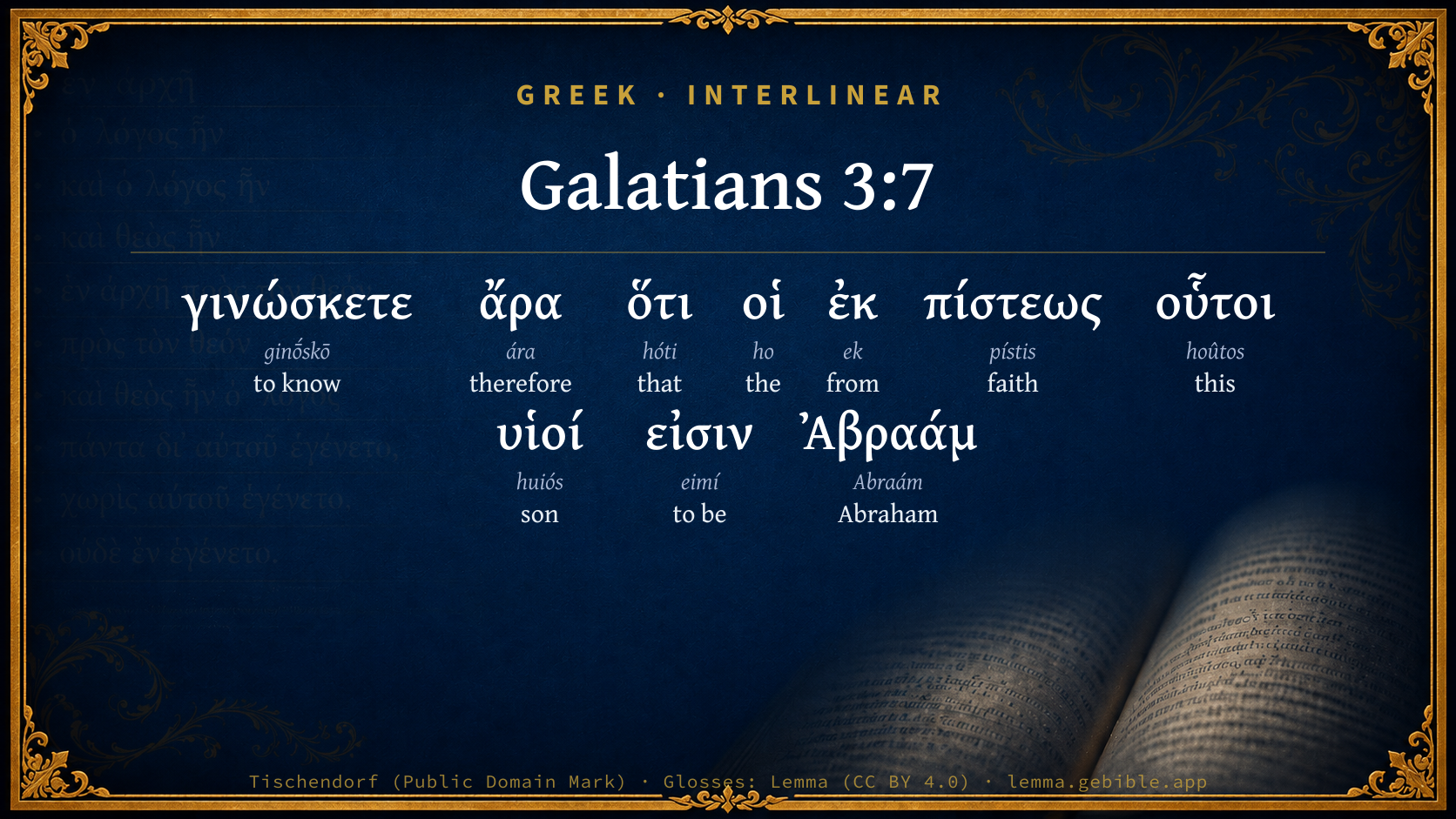
Greek (Tischendorf 8th ed.) Galatians 3:7 appears in the Greek New Testament. The text above is from the Tischendorf 8th edition. Each word links to its Strong’s number and a concise gloss. Click any word for its full Thayer’s Greek Lexicon entry.
Download image
Cite this verse

Galatians 3:7 (World English Bible). Public Domain. Lemma interlinear Bible study tool, https://lemma.gebible.app/v/galatians/3/7.

Show BibTeX & RIS
BibTeX
RIS
English Translation
Know therefore that those who are of faith, the same are children of Abraham.
World English Bible · Public Domain
Download a study sheet

One document with this verse’s original text, its word-by-word gloss line, the meaning frame, cross-references with their text, attributed commentary, and full source and license credits — printable, and it pastes into notes with its structure intact.

This verse Autodidact and up

Study sheet (.html) Plain text (.txt)

A passage Seminary Student

Up to 50 verses in one chapter. A passage sheet keeps up to 6 commentary sources and 12 cross-references per verse, in the order this page ranks them, and says so on the sheet whenever that leaves anything out. Ask for a single verse and you get the Autodidact verse sheet above.

Everything on this page stays free to read, with no account — the sheet is a download of what is already on screen, not access to it.

Want to remove ads? Support Godless Engineer
Compare translations 3

The same verse in 3 English versions, stacked beneath the original-language interlinear above. Click any original word for its lexicon entry.

Each is an independent rendering of the whole verse — the interlinear is not word-aligned to these translations.

Highlighted words mark where these versions differ — a whole-verse word diff, not a word-by-word alignment.

  • World English Bible Public Domain
    Know therefore that those who are of faith, the same are children of Abraham.
  • King James Version Public Domain
    Know ye therefore that they which are of faith, the same are the children of Abraham.
  • unfoldingWord Literal Text CC BY-SA 4.0
    know, then, that the ones by faith, these are sons of Abraham.

unfoldingWord Literal Text — © unfoldingWord, licensed CC BY-SA 4.0. Word-aligned USFM3 via Door43 (git.door43.org/unfoldingWord/en_ult).

Versions to compare (up to 4)

3 of 4 selected

Show all 19 translations

Every available English version of this verse, each an independent rendering of the whole verse.

  • World English Bible Public Domain
    Know therefore that those who are of faith, the same are children of Abraham.
  • Berean Standard Bible Public Domain
    Understand, then, that those who have faith are sons of Abraham.
  • Majority Standard Bible Public Domain
    Understand, then, that those who have faith are sons of Abraham.
  • King James Version Public Domain
    Know ye therefore that they which are of faith, the same are the children of Abraham.
  • American Standard Version (1901) Public Domain
    Know therefore that they that are of faith, the same are sons of Abraham.
  • Revised Version (1885) Public Domain
    Know therefore that they which be of faith, the same are sons of Abraham.
  • Geneva Bible (1599) Public Domain
    Knowe ye therefore, that they which are of faith, the same are the children of Abraham.
  • Douay-Rheims (1899) Public Domain
    Know ye therefore, that they who are of faith, the same are the children of Abraham.
  • Young's Literal Translation Public Domain
    know ye, then, that those of faith -- these are sons of Abraham,
  • Literal Standard Version CC BY-SA 4.0
    know, then, that those of faith—these are sons of Abraham,
  • Unlocked Literal Bible CC BY-SA 4.0
    in the same way, understand, then, that those of faith are the children of Abraham.
  • unfoldingWord Literal Text CC BY-SA 4.0
    know, then, that the ones by faith, these are sons of Abraham.
  • Darby Bible Public Domain
    Know then that they that are on the principle of faith, these are Abraham's sons;
  • World Messianic Bible Public Domain
    Know therefore that those who are of faith are children of Abraham.
  • Webster's Bible Public Domain
    Know ye therefore, that they who are of faith, the same are the children of Abraham.
  • Free Bible Version CC BY-SA 4.0
    So you should acknowledge that those who trust in God are the children of Abraham.
  • Bible in Basic English Public Domain
    Be certain, then, that those who are of faith, the same are sons of Abraham.
  • Text-Critical English NT CC BY 4.0
    Therefore you must understand that those who have faith are the sons of Abraham.
  • Tyndale New Testament (1534) Public Domain
    Vnderstonde therfore that they which are of fayth the same are the chyldren of Abraham.

Literal Standard Version (2020), Covenant Press — licensed CC BY-SA 4.0. Text via the HelloAO Bible API (eBible.org). Unlocked Literal Bible (unfoldingWord) — licensed CC BY-SA 4.0. Text via the HelloAO Bible API (eBible.org). unfoldingWord Literal Text — © unfoldingWord, licensed CC BY-SA 4.0. Word-aligned USFM3 via Door43 (git.door43.org/unfoldingWord/en_ult). Free Bible Version, Dr. Jonathan Gallagher — licensed CC BY-SA 4.0. Text via the HelloAO Bible API (eBible.org).

Word by word

More ways to search: Search by grammar → Find every occurrence → Compare this word →

Practice this passage: Drill this verse → Learn its vocabulary →

About this verse

These counts appear in no published source. They are computed here, from the morphology-tagged text and Lemma’s own curated glosses. What Lemma adds →

10
words
10
distinct lemmas
Pauline Epistles
section

Shared distinctive vocabulary

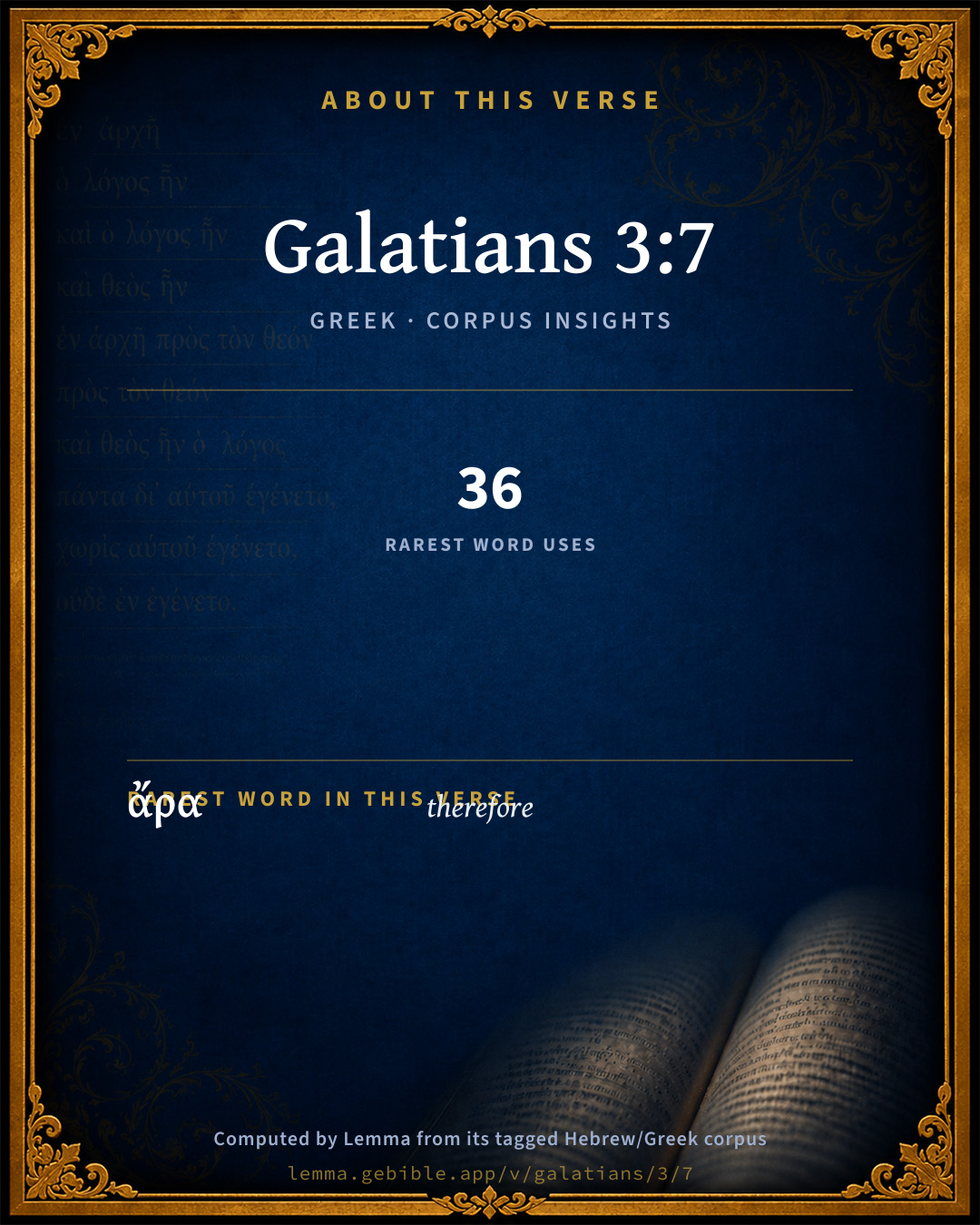
ἄρα therefore G686 occurs in 36 verses of the Greek New Testament. Also found in:
Cross-references

8

Topical passages linked to Galatians 3:7 in the Treasury of Scripture Knowledge — connected by theme and wording, ordered by reader-vote popularity; previews shown in the World English Bible.

  • Galatians 3:9 So then, those who are of faith are blessed with the faithful Abraham.
  • Romans 9:7–8 Neither, because they are Abraham's seed, are they all children. But, "In Isaac will your seed be called."
  • Galatians 3:26–29 For you are all children of God, through faith in Christ Jesus.
  • Psalms 100:3 Know that Yahweh, he is God. It is he who has made us, and we are his. We are his people, and the sheep of his pasture.
  • Romans 4:24 but for our sake also, to whom it will be accounted, who believe in him who raised Jesus, our Lord, from the dead,
  • John 8:39 They answered him, "Our father is Abraham." Jesus said to them, "If you were Abraham's children, you would do the works of Abraham.
  • Luke 19:9 Jesus said to him, "Today, salvation has come to this house, because he also is a son of Abraham.
  • Romans 4:11–16 He received the sign of circumcision, a seal of the righteousness of the faith which he had while he was in uncircumcision, that he might be the father of all those who believe, though they be in uncircumcision, that righteousness might also be accounted to them.

Cross-references courtesy of OpenBible.info (CC BY 4.0).

Commentary

Notes on Galatians 3:7 from classic Christian and Jewish commentators (each source and its license shown beneath its notes). The classic Christian expositions comment on the surrounding passage and are grouped to its opening verse, so a note may address several verses; the Jewish commentaries on the Tanakh (Rashi and others) are per-verse, so they appear only where the commentator wrote on this verse.

Lemma curates 59 commentaries, every one of them public domain or Creative Commons licensed, each selected and text-cleaned for this edition rather than reprinted as found. About our sources →

The Biblical Illustrator

Joseph S. Exell

Gal_3:7

They which are of faith, the same are the children of Abraham.

The children of Abraham

By grace all believers are such.

I. By imitation: in that Abraham is set forth as a pattern in the steps of whose faith believers walk.

II. By succession: in that they succeed him in the same blessing.

III. By a kind of spiritual generation: in that Abraham by believing the promise of a seed did after a sort beget them and receive them as his children (Rom_9:8). Here then is the true mark of a child of Abraham: to be of his faith.

1. The Jews are not his children though descended of Isaac, because they follow not the faith of Abraham.

2. Nor the Papists, in spite of their antiquity and numbers, unless they are of his faith.

3. Nor the mere professors of that faith (Mat_7:22). To be children of Abraham we must--

(1) Have knowledge of the promises touching the blessing of God in Christ.

(2) Believe the power and truth of God to accomplish those promises.

(3) Faithfully follow God in all things. (W. Perkins.)

The example faithful Abraham

I. The particulars of this example. In his faith in Gods promise, he considered--

1. The terms of the promise.

2. The attributes of Him who made it.

II. The duty of imitating this example.

1. We must, like Abraham, think of--

(1) The object.

(2) The promise.

(3) The promiser.

2. Our faith, like his, must be--

(1) Simple.

(2) Single.

III. The benefit of such an example. (T. Dale, M. A.)

Children of Abraham--Spiritual kinship

To be the children of a person, in a figurative sense, is equivalent to, to resemble him, and to be involved in his fate, good or bad. The idea is, similarity both in character and circumstances. To be the children of God, is to be like God and also, as the apostle states it to be, heirs of God. To be the children of Abraham, is here to resemble Abraham, to imitate his conduct, and to share in his blessedness (Joh_8:39; 1Jn_2:29; 1Jn_3:1; 1Jn_3:8-9). It is as if the apostle had said, These Judaising teachers talk much of the glory and advantage of being children of Abraham, and insist that it is by circumcision that men attain to this dignity and happiness. But how far is this from the truth! Abrahams highest distinction was that he was a justified person, a friend of God; and this distinction he attained not by circumcision, but by faith. It follows, then, that they who believe like Abraham, and are like Abraham justified through believing, they--they alone--are his true spiritual descendants. Though a man should be a Hebrew of the Hebrews, circumcised the eighth day, and touching the righteousness that is in the law, blameless, if he is not a believer, he is not spiritually a child of Abraham. And if a man be but a believer, be he Jew or Gentile, he is spiritually a child of Abraham. And this fact, that all who believe, whether they were descendants of Abraham or not, were to be made partakers of his blessedness, was distinctly enough taught in the ancient oracles given to Abraham. (John Brown, D. D.)

The blessing of the gospel

All the weight and force hereof lies in the words with faithful Abraham. For he puts a plain difference between Abraham and Abraham; of one and the selfsame person making two. As if he said: There is a working and there is a believing Abraham. With the working Abraham we have nothing to do. For if he be justified by works, he hath to rejoice, but not with God. Let the Jews glory as much as they will of that begetting Abraham, which is a worker, is circumcised, and keepeth the law; but we glory of the faithful Abraham, of whom the Scripture saith, that he received the blessing of righteousness through his faith, not only for himself, but also for all those which believe as he did; and so the world was promised to Abraham, because he believed. Therefore all the world is blessed; that is to say, receiveth imputation of righteousness, ii it believe as Abraham did. Wherefore the blessing is nothing else but the promise of the gospel. And that all nations are blessed, is as much as to say, that all nations shall hear the blessing; that is, the promise of God shall be preached and published by the gospel among all nations. To bless signifieth nothing else, but to preach and teach the word of the gospel, to confess Christ, and to spread abroad the knowledge of Him among all the Gentiles. And this is the priestly office, and continual sacrifice of the Church in the New Testament, which distributeth this blessing by preaching and by ministering of the sacraments, by comforting the broken-hearted, by distributing the word of grace which Abraham had, and which was also his blessing; which when he believed, he received the blessing. So we also believing the same are blessed. (Luther.)

Faith obtains salvation

I have seen shrubs and trees grow out of the rocks, and overhang fearful precipices, roaring cataracts, and deep running waters; but they maintained their position, and threw out their foliage and branches as much as if they had been in the midst of a dense forest. It was their hold of the rock that made them secure, and the influences of nature that sustained their life: so believers are oftentimes exposed to the most horrible dangers in their journey to heaven; but, so long as they are rooted and grounded in the Rock of Ages, they are perfectly secure. Their hold of Him is their guaranty; and the blessings of His grace give them life, and sustain them in life. And as the tree must die, or the rock fall, before a dissolution could be effected between them, so either the believer must lose his spiritual life, or the rock must crumble, ere their union can be dissolved. (J. Bate.)

The Biblical Illustrator, edited by Joseph S. Exell (c. 1880s–1900s) — public domain. Text from a community e-Sword module.

Tyndale Open Study Notes

Tyndale Open Resources

3:7 Gentile Christians—including the Galatians—are among the real children of Abraham, not by keeping the law of Moses, but by faith in God (see Rom 4:9-17, 23-25; cp. Matt 12:48-50).

Tyndale Open Study Notes — © Tyndale Open Resources, licensed CC BY-SA 4.0. Text via the HelloAO Bible API.

Bengel's Gnomon

Johann Albrecht Bengel

Gal 3:7. Γινώσκετε, know ye) The imperative; comp. 2Ti 3:1. Neither the slowness of the Galatians nor the commencement of the discussion admitted of an indicative.—οἱ ἐκ πίστεως, those who are of faith) For Abraham believed.—οὗτοι) these, and these alone, the other descendants of Abraham being excluded.—νἱοὶ, sons) Gal 3:29.

Bengel's Gnomon of the New Testament — English translation (T&T Clark, Edinburgh, 1860) — public domain. Text from a community e-Sword module.

Meyer's Critical & Exegetical Commentary

Heinrich August Wilhelm Meyer

Gal_3:7. Know ye therefore (since Abrahams faith was counted to him for righteousness) that those who are of faith, etc.

γινώσκετε is taken as indicative by Cyprian, ep. 63 ad Caecil., Jerome, Ambrose, Luther, Erasmus, Beza, Menochius, Piscator, Semler, Rosenmüller, Rückert, Reithmayr, and others. The tone of the passage is more animated by taking it as imperative.[121]

οἱ ἐκ πίστ.] designates believers, according to this their specific peculiarity, under the point of view of origin. It is faith from which their spiritual state of life proceeds. Comp. Rom_2:8; Rom_3:26; Rom_4:14; Joh_18:37, et al.

οὕτοι] has the emphasis (comp. Rom_8:14; Rom_9:6): these, and no others. The contrast here is usually supposed to be: not the bodily descendants of Abraham. But how foreign to the context is a comparison between the bodily and spiritual children of Abraham! The only interpretation in harmony with the context is: these, and not those who are ἐξ ἔργων νόμου. See Gal_3:8-10. So also, correctly, Rückert and Wieseler.

ΥἹΟῚ ἈΒΡ.] children of Abraham in the true sense. For the true υἱοί can have no nature different from the essential nature of the father. Comp. Joh_8:8; Joh_8:39; Rom_4:11 f.

[121] The Vulgate has in Lachmanns text, cognoscite. So also Castalio, Calvin, and others, as well as most modern expositors.

Meyer — Critical and Exegetical Commentary on the New Testament — English translation by Peter Christie, edited by Frederick Crombie (T&T Clark, 1880) — public domain. Text from a community e-Sword module.

Expositor's Greek Testament

ed. W. Robertson Nicoll

Gal 3:7-14 . BY FAITH MEN BECOME SONS OF ABRAHAM AND INHERIT HIS BLESSING, WHEREAS THOSE WHO CLAIM IT ON THE SCORE OF OBEDIENCE TO LAW ARE SUBJECT TO THE CURSE OF A BROKEN LAW; FROM WHICH CHRIST REDEEMED US, GENTILES AS WELL AS JEWS, BY BEARING THE CURSE HIMSELF.

Gal 3:7 . Γινώσκετε : Ye perceive . The emphatic admonition, Know ye , adopted in our versions, would require an aorist imperative γνῶτε , as in Heb 8:11 . This verse contains a deduction from the former, as is suggested by the inferential ἄρα . Since faith was the ground of Abraham’s justification, it follows that those who inherit his faith are his true sons. οἱ ἐκ πίστεως , sc. υἱοὶ ὄντες . The form of the Greek sentence suggests the insertion of these words to complete the ellipsis. With this addition the verse carries on the previous argument to its natural sequel. The faith of Abraham was there declared to be a fundamental condition of the divine acceptance. Those therefore who inherit his faith are his sons indeed and heirs of his blessing. The discourse of Christ recorded in the Gospel follows the same line of argument: If ye were Abraham’s children, ye would do the works of Abraham (Joh 8:39 ). Both alike urge that resemblance in life and character is the true test of sonship. Gentiles therefore who prove themselves sons of Abraham by exhibiting like faith are his sons indeed, and inherit the blessing promised to his seed. The antithesis in Gal 3:10 , ὅσοι ἐξ ἔργων νόμου εἰσίν , sc. υἱοί , presents a like ellipsis: the exclusive claim of Jews to be sons of Abraham in virtue of their observance of the Law is there disposed of on corresponding grounds.

The Expositor's Greek Testament, edited by W. Robertson Nicoll (1897–1910) — public domain. Text from a community e-Sword module.

Cambridge Greek Testament for Schools and Colleges

7–9. Faith makes sons of Abraham and brings the blessing promised in him

(Gal 3:7) Ye perceive then that they who draw their spiritual life from faith—these and these only are sons of Abraham. (Gal 3:8) But (there is more than sonship-blessing) the scripture, seeing beforehand that it is of faith that God justifies the Gentiles, gave a gospel message beforehand to Abraham, “all the Gentiles shall be blessed in thee.” (Gal 3:9) So that (as we may conclude) they who draw their spiritual life from faith are blessed (as well as are sons) together with believing Abraham.

7. γινώσκετε ἄρα, “ye perceive then.” γιν., almost certainly indicative, for the imperative never occurs in the N.T. with ἄρα, and only once with ἄρα οὖν, 2Th 2:15; cf. 1Th 5:6.They could perceive the following truth of the all-importance of faith, and their consequent relation to Abraham, from the preceding argument clinched by Gal 3:6.

ὅτι οἱ ἐκ πίστεως. Probably this phrase = those who take their start in religion from faith (cf. οἱ ἐξ ἐριθίας, Rom 2:8), according to the tenor of the preceding verses. Thus it is not the opposite of οἱ ἐκ περιτομῆς, which seems always to mean men of Jewish origin by birth, Gal 2:12; Act 10:45; Act 11:2; Rom 4:12; Col 4:11, and οἱ ἐκ τῆς π., Tit 1:10[91]. Its true antitheses are οἱ ἐκ νόμου, Rom 4:14; Romans cf.16[92] (not οἱ ὑπὸ νόμον, infra Gal 4:5; 1Co 9:20 bis, which = observant Jews) and ὅσοι ἐξ ἔργων νόμου εἰσίν, Gal 3:10[93]. There is no need to understand υἱοὶ ὄντες (Rendall) or δικαιωθέντες (Ramsay). Observe that οἱ διὰ πίστεως does not occur. St Paul’s thought goes deeper than to the means. Faith is the human source, though the Divine means.

[91] Is affixed to a word it means that all the passages are mentioned where that word occurs in the New Testament.

[92] Is affixed to a word it means that all the passages are mentioned where that word occurs in the New Testament.

[93] Is affixed to a word it means that all the passages are mentioned where that word occurs in the New Testament.

οὖτοι, Rom 8:14; Jas 1:25.

υἱοί εἰσιν Ἀβραάμ. The Jews claimed spiritual, because physical, relationship, Mat 3:9 (|| Luk 3:8); Joh 8:33; Joh 8:37; Joh 8:39. Observe not τέκνα but υἱοί, i.e. sonship with its full privileges. See Appendix, note C, for a brief consideration of Ramsay’s theory that this passage suggests acquaintance with the Greek (not Roman) law of sonship and inheritance, and so favours the South Galatian theory.

Cambridge Greek Testament for Schools and Colleges (Cambridge University Press, 1896; 21 vols, various authors incl. Carr, Maclear, Plummer, Farrar, Lumby, Moule, M. R. James, Simcox) — public domain. Text from a community e-Sword module.

International Critical Commentary

7. Γινώσκετε ἄρα ὅτι οἱ ἐκ πίστεως, οὗτοι υἱοί εἰσιν Ἀβραάμ. “Know therefore that the men of faith, these are sons of Abraham.” πίστις is here not specifically faith in Jesus Christ, but, as the absence of the article suggests, and the context with its reference on the one hand to Abraham’s faith in God and on the other to the faith of believers in Jesus clearly indicates, faith qualitatively thought of and in a sense broad enough to include both these forms of it. Here, as in Rom 3:31ff., Paul distinctly implies the essential oneness of faith, towards whatever expression or revelation of God it is directed. The preposition ἐκ describes source, yet not source of being—they do not owe their existence to faith—but source of character and standing, existence after a certain manner. The expression οἱ ἐκ πίστεως, therefore, means “those who believe and whose standing and character are determined by that faith”; men of faith in the sense of those of whose life faith is the determinative factor. Here appears for the first time the expression “sons of Abraham,” which with its synonyme, “seed of Abraham,” is, as pointed out above, the centre of the argument in chaps. 3 and 4. ἄρα marks this statement as a logical consequence of the preceding. Abraham believed God, and was on that ground accepted by God; therefore, the sons of Abraham are men of faith. The sentence itself shows that “sons of Abraham” is not to be taken in a genealogical, but, in the broad use of the term, an ethical sense. The context indicates clearly that by it Paul means those who are heirs of the promise made to Abraham, and to be fulfilled to his seed (vv. 16, 29).

The unexpressed premise of this argument is that men become acceptable to God and heirs of the promise on the same basis on which Abraham himself was accepted. The ground of this premise in Paul’s mind was doubtless his conviction that God deals with all men on the same moral basis; in other words, that there is no respect of persons with God (chap. 2:6; cf. Rom 2:11, Rom 2:3:29, 30, Sir. 35:12). The expressed premise, derived from scripture, is that this basis was faith. Those who put forth the argument to which this was an answer would have accepted the apostle’s definition of sons (or seed) of Abraham, and would probably not have directly contradicted either the expressed or the unexpressed premise of his argument, but would practically have denied the expressed premise. They had probably reached their conclusion, that to be sons of Abraham men must be circumcised, by ignoring faith as the basis of Abraham’s justification, and appealing to the express assertion of scripture that the seed of Abraham must be circumcised, and that he who will not be circumcised shall be cut off from God’s people, having broken his covenant (Gen 17:9-14). The apostle in turn ignores their evidence, and appeals to Gen 15:6. In fact the whole passage, Gen. chaps. 12-17, furnishes a basis for both lines of argument. The difference between Paul and his opponent is not in that one appealed to scripture and the other rejected it, but that each selected his scripture according to the bent of his own prejudice or experience, and ignored that which was contrary to it.

Ramsay’s explanation of v. 7 as grounded in Greek customs and usages respecting adoption, and as meaning that because among the Gentiles is found the property of Abraham, viz., his faith, therefore they must be his sons, since only a son can inherit property, ignores all the evidence that Paul is here answering judaistic arguments, and is, therefore, moving in the atmosphere not of Greek but of Old Testament thought, and goes far afield to import into the passage the farfetched notion of faith as an inheritable property of Abraham. See his Com. on Gal. pp. 338 ff.

SONS OF ABRAHAM

It has been suggested above that in the employment of this phrase Paul is turning against his judaising opponents a weapon which they have first endeavoured to use against him, rather than himself introducing the term to the Galatians and founding on it an argument intended to appeal to their unprejudiced minds. It is in favour of this view that the evidence that has been left us does not indicate that it was Paul’s habit to commend Christ to the Gentiles either on O. T. grounds in general or in particular on the ground that through the acceptance of Jesus they would become members of the Jewish nation. See, e. g., the reports of his speeches in Acts, 1 Thes., esp. 1:2-10, 1Co 2:2, Php 3:2-9. There is, indeed, an approximation to this form of argument in Rom. chaps. 4 and 11. But in both these chapters the apostle is rebutting an argument put forth (or anticipated as likely to be put forth) from the side of the judaisers; chap. 4 contending that in the case of Abraham there is nothing to disprove, but on the contrary much to establish, the principle of the justification of uncircumcised Gentiles through faith, and chap. 11 maintaining that the purpose of God does not come to nought because of the rejection of Israel from its place of peculiar privilege, but finds fulfilment in the elect people, whether Jews or Gentiles. Moreover, precisely in respect to the Galatians do the testimonies of vv. 1-5 and 28, 26 of this chapter, and 5:2-4, indicate with special clearness that Paul’s preaching to them and their acceptance of Christ had been on an independently Christian basis—Christ crucified, faith in him, Christian baptism, the gift of the Spirit manifested in charismatic powers.

An examination of chaps. 3 and 4, moreover, reveals that Paul’s argument here is mainly of the nature of rebuttal. Thus the recurrent expressions, “sons of Abraham” (3:7), “blessed with faithful Abraham” (3:9), “blessing of Abraham” (3:14), “the covenant” and “the seed” (3:15-17), “Abraham’s seed” (3:29), all of which have their basis in Gen_12 and 17 (cf. Gen 12:3, Gen 17:2-10), and the express quotation in 3:8 of the words of Gen 12:3, all combine to indicate that the O. T. background of the discussion is largely that furnished by Gen. chaps. 12, 17. But if we turn to these chapters it is at once clear not only that they furnish no natural basis for a direct argument to the effect that the Gentiles may participate in the blessing of the Abrahamic salvation without first becoming attached to the race of his lineal descendants, but that they furnish the premises for a strong argument for the position which Paul is here combating. Thus in Gen 17:2-9 there is repeated mention of a covenant between God and Abraham, an everlasting covenant with Abraham and his seed throughout their generations, a covenant of blessing on God’s part and obligation on their part, which he and his seed after him are to keep throughout their generation, and it is said: “This is my covenant which ye shall keep between me and you and thy seed after thee; every male among you shall be circumcised” (v. 10) …“and it shall be a token of a covenant betwixt you and me” (v. 11). V. 12, moreover, states that this shall apply both to him that is born in the house and to him that is bought with money of any foreigner, and v. 14 declares that “the uncircumcised male who is not circumcised in the flesh of his foreskin, that soul shall be cut off from his people—he hath broken my covenant.” In 12:3, indeed, it is stated that in Abraham all the nations of the earth shall be blessed (so Paul interprets the sentence), yet there is nothing in this to intimate that they are to receive this blessing apart from a racial relation to Abraham, and chap. 17 seems to exclude such a thought. Indeed, it requires neither perversity nor rabbinic exegesis, but only a reasonable adherence to the obvious meaning of the passage, to find in these chapters the doctrine that God’s covenant of blessing was with Abraham and his seed, that none could be included in that covenant save those who being of the blood of Abraham were sealed as his seed by circumcision, or who being adopted into the nation from without also received the seal of circumcision, and that any who refused thus to receive circumcision could have no part in the people of God or the blessing to Abraham’s seed, since they had “broken God’s covenant.” “The covenant with Abraham,” “the seed of Abraham,” “blessed with faithful Abraham” (cf. Jub. 17:18, 19:8, 9), “in Abraham (with an emphasis on ‘in’) shall all the nations of the world be blessed”—these are apparently the premises and stock phrases of the judaiser’s argument—to which was doubtless added, as we can see from Gal 5:1 ff., the obvious inference that to enjoy these blessings one must be circumcised, as Gen 17:1 ff. says. To the judaiser, whose arguments Paul is answering, “seed of Abraham” meant, as to the Pharisaic author of the book of Jubilees (see chap. 15, esp. v. 26), the circumcised descendant of Abraham, with whom might also be included the circumcised proselyte; and to these he limited the blessing of the covenant with Abraham, and so in effect the blessing of God.

That all this would be directly contrary to Paul’s position is also evident (cf. 5:1-6). It is scarcely less evident that in this third chapter, confronted by substantially such an argument as this, he was aiming to refute it from the same source from which it was drawn. This he does by appeal to Gen 15:6, “Abraham believed God, and it was reckoned to him for righteousness,” which though it lay between the two passages which they had used, we may be sure the judaisers had not quoted. On the basis of this passage he puts into their favourite phrases, “seed of Abraham,” “blessed with Abraham,” a different content from that which they had given to them, and finds for the blessing with which all the nations were to be blessed a different ground and condition. The substitution of “sons of Abraham” for “seed of Abraham” contributes somewhat to that end, even if the former phrase, which is not in Genesis, is not original with Paul (cf. Jub. 15:30). Affirming on the basis of Gen 15:6 that the characteristic thing about Abraham is his faith, and taking the expression “sons of Abraham” in a sense by no means foreign to Semitic use of the term “son” as meaning those who walk in his footsteps (Rom 4:12), those who are like him (cf. sons of God in Mat 5:45, Rom 8:14), he maintains that the men of faith are sons of Abraham. The various arguments by which the apostle endeavours to substantiate this ethical definition of sons of Abraham as against the physical definition of the judaiser, and in general to show that men obtain God’s blessing not by works of law, but by faith, are to be found in this and the following chapter.

As concerns the apostle’s method of refuting the argument of his opponents, it is clear that he does not resort to a grammatico-historical exegesis of Genesis, chap. 17. Aside from the fact that on such a basis his opponents must have won, such an argument would scarcely have appealed to his Galatian readers. Instead, while retaining the terminology of the Abrahamic narrative of Genesis, as the exigencies of the situation and the necessity of answering the arguments of his opponents compelled him to do, he makes his appeal to the assertions of Gen 15:6 that it was faith that was accounted by God as righteousness, and to the teaching of O. T. as a whole concerning the basis of acceptance with God. Circumcision, which was the chief point of contention, he does not mention, perhaps because the argument of his opponents on this point could not be directly answered. Instead he discusses the larger and underlying question, what is the real nature of God’s demands on men and the basis of acceptance with him, contending that not by the fulfilment of legal statutes but by faith does a man become acceptable to God. How he would have dealt with one who admitting this central position should still have asked, “But is not circumcision nevertheless required by God?” these chapters do not show. That despite the explicit teaching of Gen_17, he nevertheless did maintain not only that it is faith that justifies, but that circumcision was no longer required or, indeed, permissible among Gentiles, and even went further than this and denied the authority of the O. T. statutes as such, shows that he had found some means of discovering on the basis of experience what portions of O. T. were still of value for the religious life. But what kind of experience he conceived to be necessary for this purpose, and whether that kind of experience specifically called by him revelation was requisite, is not by this passage indicated.

International Critical Commentary — older volumes (1896–1929), various authors — public domain. Text from a community e-Sword module.

Geneva Bible (1599)

Geneva Bible translators

The second, that the sons of Abraham must be esteemed and accounted of by faith.

Geneva Bible (1599) marginal notes — public domain. Text via Bolls.life.

Jamieson, Fausset & Brown

Robert Jamieson, A. R. Fausset & David Brown

they which are of faith--as the source and starting-point of their spiritual life. The same phrase is in the Greek of Rom 3:26.

the same--these, and these alone, to the exclusion of all the other descendants of Abraham.

children--Greek, "sons" (Gal 3:29).

Jamieson, Fausset & Brown — Commentary Critical and Explanatory on the Whole Bible (1871) — public domain (CC PDM 1.0). Text via the HelloAO Bible API.

John Calvin's Commentaries

7. Know ye therefore, or, ye know; for both readings are equally agreeable to the Greek termination γινώσκετε. But it matters little which is preferred, for the meaning is the same, only that the old translation, (know ye,) which I have followed, is more energetic. He says that those “are of faith,” who have relinquished all confidence in works, and rely on the promise of God alone. It is on the authority of Paul himself that we give this interpretation; for in the Epistle to the Romans he thus writes:

“To him that worketh is the reward not reckoned of grace, but of debt. But to him that worketh not, but believeth on him that justifieth the ungodly, his faith is accounted for righteousness.” (Romans 4:4,5.)

To be of faith, therefore, is to rest their righteousness and hope of salvation on the mercy of God. That such are the children of God he concludes from the preceding statement; for if Abraham was justified by faith those who wish to be his children must likewise abide firmly by faith. He has omitted one remark, which will be readily supplied, that there is no place in the church for any man who is not a son of Abraham.

John Calvin's Commentaries (1540-1563) — public domain. Text from the Calvin Translation Society English edition (1840s-50s) via the Christian Classics Ethereal Library (ccel.org). Calvin's coverage is partial (roughly two-thirds of the Bible); uncommented books and verses are honest gaps, never fabricated. The 19th-century editor's footnotes and remarks are omitted so the notes are faithfully Calvin's own voice.

Ellicott's Commentary for English Readers

(7) The main point of the Apostle’s argument in the present passage is the superiority of faith over the Law. He has, however, also in view the ulterior consequences of that superiority. Unlike the Law, faith is open to all Gentiles as well as Jews. The promise, therefore, being annexed to faith, contained the death-blow of all those exclusive privileges which the Judaising party in Galatia claimed for themselves, and of all those burdensome regulations which they were for imposing upon the Galatian Christians. This, too, the Apostle brings out by showing that the believers in Christ, whatever their nationality, are the true spiritual descendants of Abraham.

Know ye.—The verb here may either be in the indicative or in the imperative: “know ye,” or “ye know.” Perhaps, on the whole, the imperative, as in the Authorised version, is best.

They which are of faith.—Those whose principles of action are derived from faith; those whose master-motive is faith.

Children of Abraham.—This idea of a spiritual descent from Abraham is found also in Rom_4:11-12; Rom_4:16; Rom_9:6-8.

A Bible Commentary for English Readers, edited by Charles John Ellicott (1878–1897) — public domain. Text from a community e-Sword module.

The Cambridge Bible for Schools and Colleges

gen. ed. J. J. S. Perowne

7. Know ye] Better indic. ‘Ye know then’. So in Php_4:15, where the punctuation in some copies of A.V. perverts the sense.

they which are of faith] This form of expression is common in Classical Greek. It means, ‘they who come from, and so belong to’; especially of persons who range themselves as members of a party or adherents of a cause. The antithesis to ‘those who are of faith’ is ‘those who are of the Law’, Rom_2:8, or ‘of the works of the Law’, Gal_3:10.

the same] Rather, these, and none others.

the children of Abraham] This was the boast of the Jews, “We have Abraham to our father”, Joh_8:39 : comp. Mat_3:9. St Paul here adopts the same argument which our Lord used, “If ye were the children of Abraham, ye would do the works of Abraham’. He exercised faith in the word and promise of God. They alone ‘who have obtained like precious faith’ are the true sons of Abraham.

The Cambridge Bible for Schools and Colleges (gen. ed. J. J. S. Perowne; Cambridge University Press, 1878–1918) — public domain. Text from a community e-Sword module.

John Gill's Exposition

Know ye therefore,.... Or "ye know"; this is a thing known by you, at least may, or should be; it ought not to be contradicted or disputed, it is so plain a case, and so clear a point:

that they which are of faith; of the faith of Abraham, as in Rom 4:16 have the same faith as he had, for nature and kind; though it may not be to the same degree, yet exercised on the same object, Jehovah the Word, the Lord our righteousness, and wrought by the same Spirit; or who are of the faith of Christ, believers in him with all their hearts, and for themselves; who look to him for righteousness and life, who seek for justification by his righteousness, and trust in him alone for it, and not in the works of the law:

the same are the children of Abraham; his spiritual seed, though they may not be his natural offspring; for he is the father of all that believe, whether of the circumcision or the uncircumcision, and of none else in a spiritual sense: in this the apostle strikes at the false teachers, who boasted of their being the seed of Abraham, his natural descendants, which they might be, and yet not his spiritual children; for none are such, but they that are of faith, or seek for righteousness by faith; not they that are of the law, or seek for justification by the works of it, and so not heirs of the blessing; were they, faith would be made void, and the promise of none effect, Rom 5:14 and his view herein is to prove, that the Gentiles, who believe, are the true seed of Abraham, the children of the promise, those in many nations, he was promised to be the father of; and his further view is to observe, that as the father of the faithful was justified, so are all his children; and that as he was justified by faith, so are they.

John Gill's Exposition of the Whole Bible (1746–1763) — public domain (CC PDM 1.0). Text via the HelloAO Bible API.

Trapp's Complete Commentary

John Trapp

7 Know ye therefore that they which are of faith, the same are the children of Abraham.

Ver. 7. The same are children, &c.] And heirs together with him of the world, Rom 4:14, which is theirs in right, though detained a while from them by the Amorites, till their sins be full.

John Trapp, A Commentary or Exposition upon All the Books of the Old and New Testament (1647–1656) — public domain. Text from a community e-Sword module.

Albert Barnes' Notes on the Bible

Know ye therefore ... - Learn from this case. It is an inference which follows, that all they who believe are the children of Abraham.

They which are of faith - Who believe, and who are justified in this manner.

Are the children of Abraham - Abraham was the “father of the faithful.” The most remarkable trait in his character was his unwavering confidence in God. They who evinced the same trait, therefore were worthy to be called his children. They would be justified in the same way, and in the same manner meet the approbation of God. It is implied here, that it was sufficient for salvation to have a character which would render it proper to say that we are the children of Abraham. If we are like him, if we evince the same spirit and character, we may be sure of salvation.

Albert Barnes' Notes on the Bible (1834–1885) — public domain. Text from a community e-Sword/MySword module.

Matthew Poole's English Annotations

They which are of faith; those who are believers, and receive Jesus Christ, as exhibited and tendered to them in the gospel, trusting not to any righteousness of their own, arising from their obedience to the works of the law; they

are the children of Abraham, considered as the father of the faithful, that is, they are justified as Abraham was justified; who was justified, not by his circumcision, but upon his believing in Christ exhibited to him in the promise; not by working, but by imputation. This argument came very close to the Jews, whose great glorying was in having Abraham to their father; for it is in effect a saying, that they were no true children of Abraham, none of that seed to whom the promise was made, if they expected justification from the works of the law, which Abraham never had nor expected.

Matthew Poole's English Annotations on the Holy Bible (1683–1685) — public domain. Text from a community e-Sword/MySword module.

Whedon's Commentary on the Bible

Daniel D. Whedon

7. Know ye—The Greek verb may be either the imperative or the indicative, but the former suits more the imperative style of the whole passage. Be ye well assured that faith makes you truer sons of Abraham than birth or circumcision.

Daniel D. Whedon (gen. ed.), Commentary on the Old and New Testaments (1874–1909) — public domain. Text from a community e-Sword module.

The Pulpit Commentary

Know ye therefore (ginwskete ara); or, ye perceive then.

Critics are divided between the two renderings, the imperative and the indicative, both here and Mat_24:43; 1Jn_2:29. In Luk_10:11 and skete Heb_13:23 ginw is certainly imperative. The categorical imperative seems of the two the more suited to the apostle"s impetuous temperament. The verb ginwskw, like the Latin nosco, properly denotes "to come to know," "learn," "perceive," "get apprised;" egnwka or egnwn, like now, having more properly the sense of "knowing." But this distinction does not always hold, as e.g. Rom_7:1. That they which are of faith (oti oiJ ejk pistewv); that the men of faith; that is, who derive their position from faith, belong to faith, are above all things characterized by faith. Compare the expressions, toiv ejx ejriqeiav, "the men of factiousness, i.e. "factions men"; (Rom_2:8) tostewv jIhsou, "the man of faith in Jesus," taking his stand thereupon. (Rom_3:26) Closely affine to this usage of the preposition, if not quite the same, is, oJ w ejk thv ajlhqeiav, "that is of the truth"; (Joh_18:37) oiJ ejk nomou, "they which are of the Law"; (Rom_4:14) osoi ejx ergwn nomou eijsin, (ver. 10 of this chapter). The same are the children of Abraham (outoi eijsin uiJoim); these are sons of Abraham. The form of expression is precisely the same as in Rom_8:14, "As many as are led by the Spirit of God (outoi) eijsin uiJoi) these are sons of God." In both cases the absence of the article before viol suggests the feeling that the apostle is simply stating a predicate of the class before defined, but not now affirming that this predicate is confined to that class, although, again in each case, he knew that it was so confined. Just here, what he is concerned to affirm is that the possession of faith is a complete and sufficient qualification for sonship to Abraham. There is, perhaps, a polemical reference to the teaching of certain in Galatia, that, to be sons of Abraham or interested in God"s covenant with his people, it behoved men to be circumcised and to observe the ceremonial Law. This error would be satisfactorily met by the affirmation of the present verse, that the being believers, simply this, constitutes men sons of Abraham. In the tenth verse the apostle goes further, aggressively denying to those who "were of the works of the Law" the possession at all of Abrahamic privilege. The class, "men of faith," did in fact include Jewish believers as well as Gentile; but just hero, as seems probable from what is said in the next verse, the apostle has in view Gentile believers only. The writer"s thoughts are hovering round that promise of God ("So shall thy seed be") which had been on that particular occasion the object of Abraham"s faith. That this was the case we may infer from his citation of the words in Rom_4:18, the explanation of which had been prepared for by him in what he has said before in ver. 16, "To the end that the promise may be sure to all the seed: not to that only which is of the Law, but to that also which is of the faith of Abraham, who is the father of us all." It was this that led him to speak of being sons of Abraham. This train of thought is pursued further in the next two verses.

The Pulpit Commentary (1880–1919), ed. H.D.M. Spence-Jones & Joseph S. Exell — public domain. Text from a community e-Sword module.

John Wesley's Explanatory Notes

Know then that they who are partakers of his faith, these, and these only, are the sons of Abraham, and therefore heirs of the promises made to him.

John Wesley, Explanatory Notes Upon the Whole Bible (1754–1765) — public domain. Text via the GEBible commentary corpus.

Luther on Galatians

Martin Luther

VERSE 7. Know ye therefore that they which are of faith, the same are the children of Abraham.

This is the main point of Paul’s argument against the Jews: The children of Abraham are those who believe and not those who are born of Abraham’s flesh and blood. This point Paul drives home with all his might because the Jews attached saving value to the genealogical fact: "We are the seed and children of Abraham."

Let us begin with Abraham and learn how this friend of God was justified and saved. Not because he left his country, his relatives, his father’s house; not because he was circumcised; not because he stood ready to sacrifice his own son Isaac in whom he had the promise of posterity. Abraham was justified because he believed. Paul’s argumentation runs like this: "Since this is the unmistakable testimony of Holy Writ, why do you take your stand upon circumcision and the Law? Was not Abraham, your father, of whom you make so much, justified and saved without circumcision and the Law by faith alone?" Paul therefore concludes: "They which are of faith, the same are the children of Abraham."

Abraham was the father of the faithful. In order to be a child of the believing Abraham you must believe as he did. Otherwise you are merely the physical offspring of the procreating Abraham, i.e., you were conceived and born in sin unto wrath and condemnation.

Ishmael and Isaac were both the natural children of Abraham. By rights Ishmael should have enjoyed the prerogatives of the firstborn, if physical generation had any special value. Nevertheless he was left out in the cold while Isaac was called. This goes to prove that the children of faith are the real children of Abraham.

Some find fault with Paul for applying the term "faith" in Gen 15:6 to Christ. They think Paul’s use of the term too wide and general. They think its meaning should be restricted to the context. They claim Abraham’s faith had no more in it than a belief in the promise of God that he should have seed.

We reply: Faith presupposes the assurance of God’s mercy. This assurance takes in the confidence that our sins are forgiven for Christ’s sake. Never will the conscience trust in God unless it can be sure of God’s mercy and promises in Christ. Now all the promises of God lead back to the first promise concerning Christ: "And I will put enmity between thee and the woman, and between thy seed and her seed; it shall bruise thy head, and thou shalt bruise his heel." The faith of the fathers in the Old Testament era, and our faith in the New Testament are one and the same faith in Christ Jesus, although times and conditions may differ. Peter acknowledged this in the words: "Which neither our fathers nor we were able to bear? But we believe that through the grace of the Lord Jesus Christ we shall be saved, even as they." (Act 10:1-11.) And Paul writes: "And did all drink the spiritual drink; for they drank of that spiritual Rock that followed them: and that Rock was Christ." (1Co 10:4.) And Christ Himself declared: "Your father Abraham rejoiced to see my day: and he saw it and was glad." (Joh 8:56.) The faith of the fathers was directed at the Christ who was to come, while ours rests in the Christ who has come. Time does not change the object of true faith, or the Holy Spirit. There has always been and always will be one mind, one impression, one faith concerning Christ among true believers whether they live in times past, now, or in times to come. We too believe in the Christ to come as the fathers did in the Old Testament, for we look for Christ to come again on the last day to judge the quick and the dead.

VERSE 7. Know ye therefore that they which are of faith, the same are the children of Abraham.

Paul is saying: "You know from the example of Abraham and from the plain testimony of the Scriptures that they are the children of Abraham, who have faith in Christ, regardless of their nationality, regardless of the Law, regardless of works, regardless of their parentage. The promise was made unto Abraham, ’Thou shalt be a father of many nations’; again, ’And in thee shall all families of the earth be blessed."’ To prevent the Jews from misinterpreting the word "nations," the Scriptures are careful to say "many nations." The true children of Abraham are the believers in Christ from all nations.

Martin Luther — Commentary on the Epistle to the Galatians (1535), English translation by Theodore Graebner (Zondervan, 1939) — public domain (U.S. copyright not renewed). Text from a community e-Sword module.

McGarvey & Pendleton's Commentaries

J. W. McGarvey

Know therefore that they that are of faith, the same are sons of Abraham. [For by faith Abraham came into such relations with God that he attained righteousness and justification; and I want you to know that those who follow his spiritual example are his real or spiritual children, to the exclusion even of his fleshly children, made such by birth, or adopted, as ye seek to be, by circumcision.

J. W. McGarvey (with Philip Y. Pendleton), Commentaries on the New Testament (The Fourfold Gospel, 1914; Acts; and the epistles) — public domain. Text from a community e-Sword/MySword module.

The People's New Testament

B. W. Johnson

7. Know ye therefore. Paul now states his great argument. Abraham's faith made him righteous; he is the spiritual father of believers. Those who believe upon Christ, the promised seed of Abraham, are the spiritual children of Abraham and the heirs of the promise.

B. W. Johnson's The People's New Testament with Notes (1889–1891) — public domain. Electronic text from the Christian Classics Ethereal Library (CCEL) ThML edition.

Alford’s Greek Testament

Henry Alford

7.] γινώσκ. is better taken indicatively, with Jer., Ambr., Beza, Rück., al., than imperatively, with most Commentators (and Mey., De W., Olsh., Ellic.). It is no objection to the indicative that such knowledge could not well be predicated of the Galatians: it is not so predicated, but is here set before them as a thing which they ought to be acquainted with—from this then you know (q. d. ‘omnibus patet.’ The imperative seems to me to lose the fine edge of the Apostle’s argumentative irony: besides that the usage of that mood with ἄρα is not frequent: indeed apparently only to be found in Homer; cf. Il. κ. 249; ω. 522. See on the other side, Ellicott’s note here).

οἱ ἐκ πίστεως] see Rom 2:8; Rom 3:26, and notes, those who are of faith, as the origin and the ἀφορμή of their spiritual life.

οὗτοι] emphatic; these, and these only (see Rom 8:14), not οἱ ἐξ ἔργων. Chrys. says οὐχ οἱ τὴν φυσικὴν ἔχοντες πρὸς αὐτὸν συγγένειαν: but this point is not here raised: besides, they might be, as well as others, if they were ἐκ πίστεως, see Rom 4:16.

υἱοὶ Ἀβρ.] see Rom 4:11-17, and notes.

Henry Alford, The Greek Testament (1849–1861) — public domain. Text from a community e-Sword module.

Vincent's Word Studies in the New Testament

Marvin R. Vincent

Know ye [γινωσκετε] . Imperative. It may also be rendered as indicative, ye know, but the imperative is livelier, and the statement in the verse is one of the points which the writer is trying to prove.

They which are of faith [οι εκ πιστεως] . Ek pistewv from or out of faith, is found with the verb to justify (Rom 3:26, 30; Rom 5:1) : with other verbs, as live (Rom 1:17); eat (Rom 14:23) : with the noun dikaiosunh righteousness (Rom 1:17; Rom 9:30; Rom 10:6) : with other nouns, as promise (Gal 3:22), law (Gal 3:12). For parallels to the phrase oiJ ejk pistewv, see Rom 3:26; Rom 4:16; Rom 14:23; Gal 3:9. It denotes believers as sprung from, or receiving their spiritual condition from that which specially characterizes them. Comp. oiJ ejx ejriqiav they who are of faction, Rom 2:8; oiJ ejk nomou they who are of the law, Rom 4:14; oJ ejk thv ajlhqeiav he who is of the truth, Joh 18:37.

Marvin R. Vincent, Word Studies in the New Testament (1887–1900) — public domain. Text from a community e-Sword/MySword module.

Lesson kit

Teaching starters — assembled from the data on this page, not authored interpretation. Every prompt links to the verse data it draws on. Edit before teaching.

Galatians, in the Pauline Epistles, opens this verse with 10 words (10 distinct Greek lemmas). Its most distinctive word is ára (“therefore”). A historical commentator’s framing appears above. Read the whole chapter for the surrounding context.

Discussion questions

  1. How does “therefore” (ára) shape what this verse is saying?
  2. Matthew 7:20 shares the word «therefore» with this verse. How do the two illuminate each other?
  3. These translations render this verse differently; the difference is in the English rendering, not the original. What questions does that raise?
  4. Reading how The Biblical Illustrator and Tyndale Open Study Notes read this verse, where do the two commentators agree and where do they part?

Things to notice

Reading settings

Reading text

Shown beneath each verse's original-language words.

Old Testament
Old Testament edition

Read the OT as the Masoretic Hebrew (MT) or the Greek Septuagint (LXX).

English shown for the Greek Septuagint (in the Hebrew ↔ Greek comparison).

Comparing translations? Open the Compare panel on any verse page to stack up to four side by side.