
Exodus 2:25

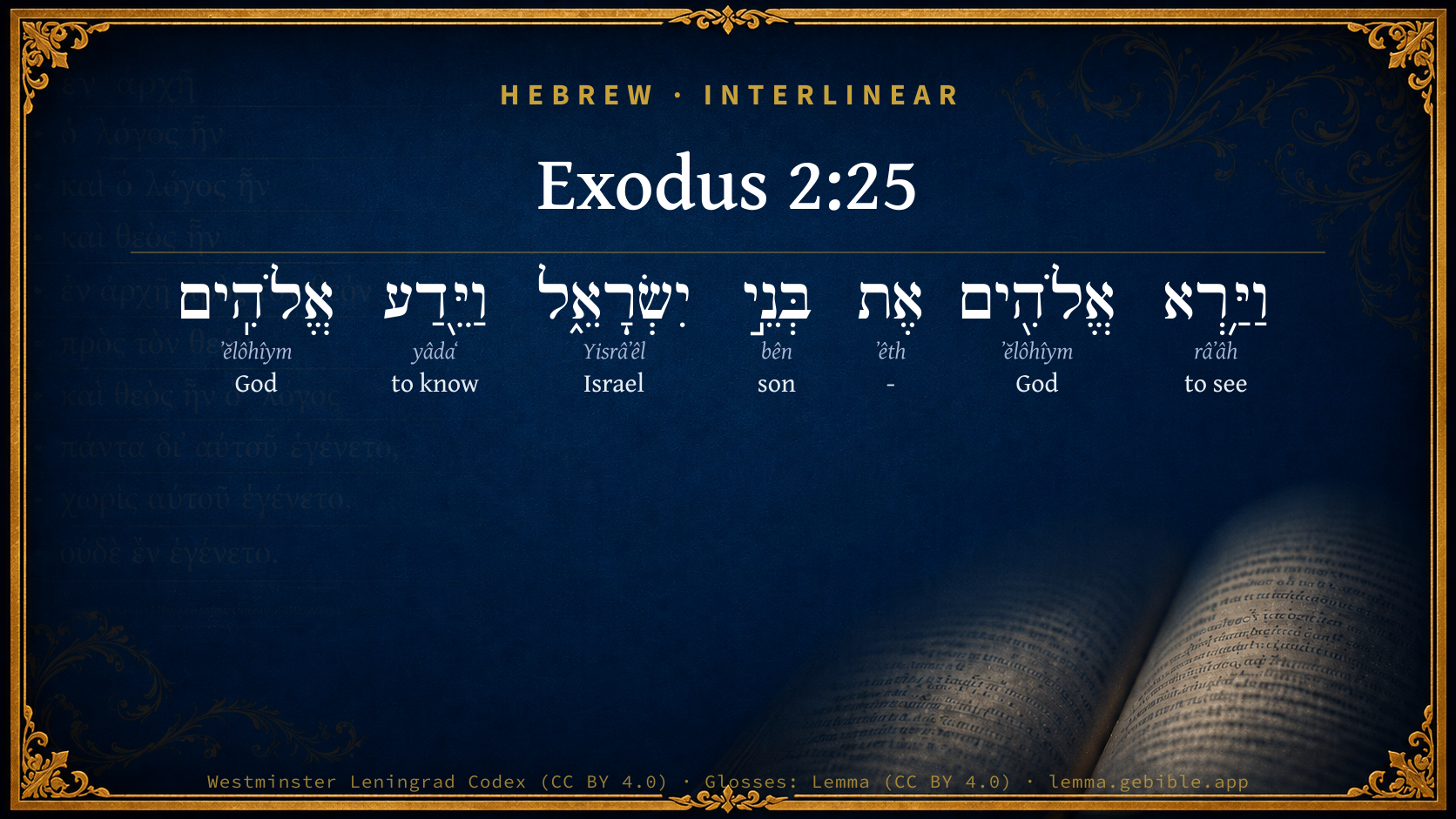
Hebrew (Westminster Leningrad Codex) Exodus 2:25 appears in the Hebrew Old Testament. The text above is from the Westminster Leningrad Codex. Each word links to its Strong’s number, a concise gloss, and parsing drawn from the Open Scriptures Hebrew Bible morphology. Click any word for its full Brown-Driver-Briggs (BDB) entry.
Download image
Cite this verse

Exodus 2:25 (World English Bible). Public Domain. Lemma interlinear Bible study tool, https://lemma.gebible.app/v/exodus/2/25.

Show BibTeX & RIS
BibTeX
RIS
English Translation
God saw the children of Israel, and God was concerned about them.
World English Bible · Public Domain
Download a study sheet

One document with this verse’s original text, its word-by-word gloss line, the meaning frame, cross-references with their text, attributed commentary, and full source and license credits — printable, and it pastes into notes with its structure intact.

This verse Autodidact and up

Study sheet (.html) Plain text (.txt)

A passage Seminary Student

Up to 50 verses in one chapter. A passage sheet keeps up to 6 commentary sources and 12 cross-references per verse, in the order this page ranks them, and says so on the sheet whenever that leaves anything out. Ask for a single verse and you get the Autodidact verse sheet above.

Everything on this page stays free to read, with no account — the sheet is a download of what is already on screen, not access to it.

Want to remove ads? Support Godless Engineer
Compare translations 3

The same verse in 3 English versions, stacked beneath the original-language interlinear above. Click any original word for its lexicon entry.

Each is an independent rendering of the whole verse — the interlinear is not word-aligned to these translations.

Highlighted words mark where these versions differ — a whole-verse word diff, not a word-by-word alignment.

  • World English Bible Public Domain
    God saw the children of Israel, and God was concerned about them.
  • King James Version Public Domain
    And God looked upon the children of Israel, and God had respect unto them.
  • unfoldingWord Literal Text CC BY-SA 4.0
    And God saw the sons of Israel, and God knew.

unfoldingWord Literal Text — © unfoldingWord, licensed CC BY-SA 4.0. Word-aligned USFM3 via Door43 (git.door43.org/unfoldingWord/en_ult).

Versions to compare (up to 4)

3 of 4 selected

Show all 18 translations

Every available English version of this verse, each an independent rendering of the whole verse.

  • World English Bible Public Domain
    God saw the children of Israel, and God was concerned about them.
  • Berean Standard Bible Public Domain
    God saw the Israelites and took notice.
  • Majority Standard Bible Public Domain
    God saw the Israelites and took notice.
  • King James Version Public Domain
    And God looked upon the children of Israel, and God had respect unto them.
  • American Standard Version (1901) Public Domain
    And God saw the children of Israel, and God took knowledge `of them'.
  • Revised Version (1885) Public Domain
    And God saw the children of Israel, and God took knowledge of them.
  • Geneva Bible (1599) Public Domain
    So God looked vpon the children of Israel, and God had respect vnto them.
  • Douay-Rheims (1899) Public Domain
    And the Lord looked upon the children of Israel, and he knew them.
  • Young's Literal Translation Public Domain
    and God seeth the sons of Israel, and God knoweth.
  • Literal Standard Version CC BY-SA 4.0
    and God sees the sons of Israel, and God knows.
  • Unlocked Literal Bible CC BY-SA 4.0
    God saw the Israelites, and he understood their situation.
  • unfoldingWord Literal Text CC BY-SA 4.0
    And God saw the sons of Israel, and God knew.
  • Darby Bible Public Domain
    and God looked upon the children of Israel, and God acknowledged [them].
  • World Messianic Bible Public Domain
    God saw the children of Israel, and God understood.
  • Webster's Bible Public Domain
    And God looked upon the children of Israel, and God had respect to them.
  • Free Bible Version CC BY-SA 4.0
    God also looked sympathetically on the Israelites, and was concerned for them.
  • Bible in Basic English Public Domain
    And God's eyes were turned to the children of Israel and he gave them the knowledge of himself.
  • JPS Tanakh (1917) Public Domain
    And God saw the children of Israel, and God took cognizance of them.

Literal Standard Version (2020), Covenant Press — licensed CC BY-SA 4.0. Text via the HelloAO Bible API (eBible.org). Unlocked Literal Bible (unfoldingWord) — licensed CC BY-SA 4.0. Text via the HelloAO Bible API (eBible.org). unfoldingWord Literal Text — © unfoldingWord, licensed CC BY-SA 4.0. Word-aligned USFM3 via Door43 (git.door43.org/unfoldingWord/en_ult). Free Bible Version, Dr. Jonathan Gallagher — licensed CC BY-SA 4.0. Text via the HelloAO Bible API (eBible.org).

Word by word

More ways to search: Search by grammar → Find every occurrence → Compare this word →

Practice this passage: Drill this verse → Learn its vocabulary →

וַיֵּ֖דַע
yâdaʻ
H3045
“and · to know”
Conjunction + Verb, Qal, Sequential Imperfect, 3rd Person, Masculine, Singular
Part of Speech
Conjunction + Verb
Stem
Qal
Form
Sequential Imperfect
Person
3rd Person
Gender
Masculine
Number
Singular
Full BDB Definition

Origin: a primitive root

TWOT: 848

to know - (Qal) - to know - to know, learn to know - to perceive - to perceive and see, find out and discern - to discriminate, distinguish - to know by experience - to recognise, admit, acknowledge, confess - to consider - to know, be acquainted with - to know (a person carnally) - to know how, be skilful in - to have knowledge, be wise - (Niphal) - to be made known, be or become known, be revealed - to make oneself known - to be perceived - to be instructed - (Piel) to cause to know - (Poal) to cause to know - (Pual) - to be known - known, one known, acquaintance (participle) - (Hiphil) to make known, declare - (Hophal) to be made known - (Hithpael) to make oneself known, reveal oneself
  1. וַיַּ֥רְא râʼâh H7200 “and · to see” Conjunction + Verb, Qal, Sequential Imperfect, 3rd Person, Masculine, Singular
  2. אֱלֹהִ֖ים ʼĕlôhîym H430 “God(s)” Noun, Common, Masculine, Plural, Absolute
  3. אֶת ʼêth H853 “-” Particle, Direct Object
  4. בְּנֵ֣י bên H1121 “sons of” Noun, Common, Masculine, Plural, Construct
  5. יִשְׂרָאֵ֑ל Yisrâʼêl H3478 “Israel” Noun, Proper
  6. אֱלֹהִֽים ʼĕlôhîym H430 “God(s)” Noun, Common, Masculine, Plural, Absolute

About this verse

These counts appear in no published source. They are computed here, from the morphology-tagged text and Lemma’s own curated glosses. What Lemma adds →

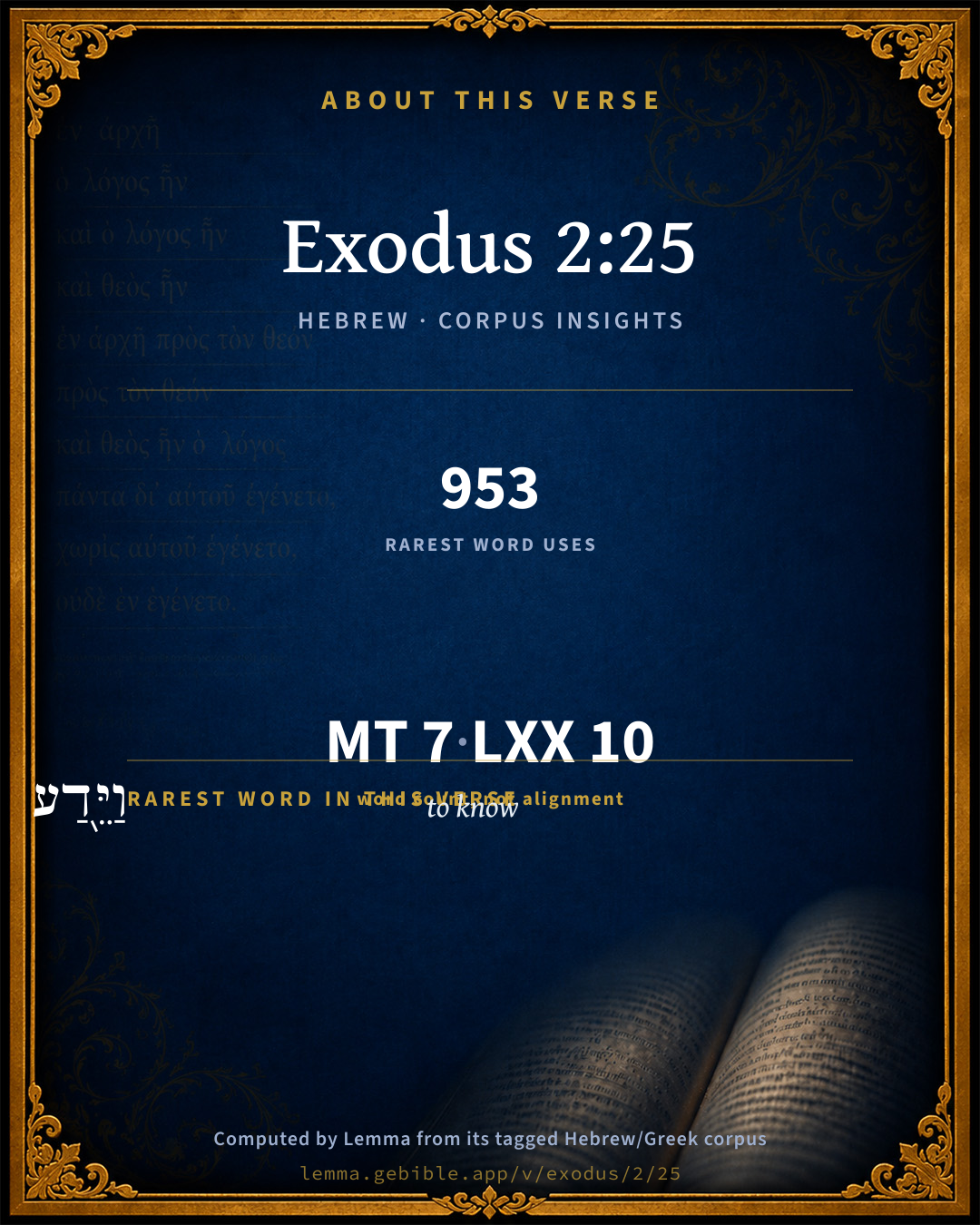
7
words
6
distinct lemmas
Pentateuch
section

Grammatical profile

  • 2 verbs
  • 4 nouns
  • 1 particle

Verb forms

  • וַיַּ֥רְא Qal · Sequential Imperfect
  • וַיֵּ֖דַע Qal · Sequential Imperfect

Repetition

A word recurs within this verse — often emphatic in Hebrew:

  • אֱלֹהִ֖ים God H430 ×2

Hebrew & Septuagint length

In English translation the verse runs 12 words from the Hebrew and 14 from the Septuagint (LXX English) — closely comparable.

A rough comparison of the two English renderings, which tokenize alike — not a word-level alignment.

Word counts can differ between the Hebrew and the Greek without any difference in meaning — e.g. the Hebrew direct-object marker אֵת has no separate Greek word, and Greek often adds the article ὁ.

In the original languages it is 7 Hebrew tokens and 10 Greek tokens — but the two are counted differently (Hebrew bundles its prefixes and suffixes into one token; the Greek is in lemma form), so that isn’t a like-for-like length.

Cross-references

10

Topical passages linked to Exodus 2:25 in the Treasury of Scripture Knowledge — connected by theme and wording, ordered by reader-vote popularity; previews shown in the World English Bible.

  • Exodus 4:31 The people believed, and when they heard that Yahweh had visited the children of Israel, and that he had seen their affliction, then they bowed their heads and worshiped.
  • Psalms 55:22 Cast your burden on Yahweh, and he will sustain you. He will never allow the righteous to be moved.
  • Exodus 3:7–8 Yahweh said, "I have surely seen the affliction of my people who are in Egypt, and have heard their cry because of their taskmasters, for I know their sorrows.
  • Psalms 1:6 For Yahweh knows the way of the righteous, But the way of the wicked shall perish.
  • Luke 1:25 "Thus has the Lord done to me in the days in which he looked at me, to take away my reproach among men."
  • 2 Samuel 16:12 It may be that Yahweh will look on the wrong done to me, and that Yahweh will requite me good for [his] cursing of me this day.
  • Matthew 7:23 Then I will tell them, 'I never knew you. Depart from me, you who work iniquity.'
  • 1 Samuel 1:11 She vowed a vow, and said, Yahweh of hosts, if you will indeed look on the affliction of your handmaid, and remember me, and not forget your handmaid, but will give to your handmaid a man-child, then I will give him to Yahweh all the days of his life, and there shall no razor come on his head.
  • Job 33:27 He sings before men, and says, 'I have sinned, and perverted that which was right, And it didn't profit me.
  • Exodus 1:8 Now there arose a new king over Egypt, who didn't know Joseph.

Cross-references courtesy of OpenBible.info (CC BY 4.0).

Hebrew and Greek witnesses Masoretic Hebrew ↔ Greek Septuagint

The same verse in the two great witnesses to the Old Testament, shown verse-for-verse.

These are two independent witnesses, not word-aligned to each other, and the Septuagint is shown in lemma (dictionary) form.

Hebrew Exodus 2:25 Masoretic · Westminster Leningrad Codex

וַיַּ֥רְא אֱלֹהִ֖ים אֶת בְּנֵ֣י יִשְׂרָאֵ֑ל וַיֵּ֖דַע אֱלֹהִֽים

God saw the children of Israel, and God was concerned about them.

World English Bible · Public Domain

Greek LXX Exodus 2:25 Septuagint · lemma form

καί ἐπιὁράω ὁ θεός ὁ υἱός ἰσραήλ καί γιγνώσκω αὐτός

And God looked upon the children of Israel, and was made known to them.

LXX2012 (modern English Septuagint) · Public Domain

On this verse, Adam Clarke's Commentary discusses the Septuagint’s reading. Read the note in Commentary ↓

Hebrew: Westminster Leningrad Codex (CC BY 4.0). Greek: Septuagint (public domain); English from LXX2012 (modern English Septuagint) (Public Domain). How the Septuagint differs from the Hebrew →

Targum (Aramaic paraphrase)

2

The Targum is the ancient Jewish Aramaic paraphrase of the Hebrew Scriptures — an interpretive translation, not the Hebrew text itself. Onkelos (literal) and Pseudo-Jonathan (expansive) render the Torah, and Jonathan the Prophets. Coverage is partial: where no permissively-licensed English translation exists for a verse, only the Aramaic is shown. This is verse-level text, not a word-by-word alignment to the Hebrew.

  1. Targum Onkelos Torah (Genesis–Deuteronomy)
    וּגְלִי קְדָם יְיָ שִׁעְבּוּדָא דִבְנֵי יִשְׂרָאֵל וַאֲמַר בְּמֵימְרֵהּ לְמִפְרַקְהוֹן יְיָ:

    (no public-domain English translation for this verse)

    Targum Onkelos — Aramaic: “Onkelos Genesis” (public domain); “Onkelos Exodus” (public domain); “Onkelos Leviticus” (public domain); “Onkelos Numbers” (public domain); “Onkelos Deuteronomy” (public domain). English: “Sefaria Community Translation” (CC0 1.0 (public-domain dedication)); “J.W. Etheridge. The Targums of Onkelos and Jonathan Ben Uzziel on the Pentateuch. London: Longmans, Green, 1862” (public domain). Text via Sefaria.

  2. Targum Pseudo-Jonathan Torah (Genesis–Deuteronomy)
    וַחֲמָא יְיָ צַעַר שִׁעֲבּוּדְהוֹן דִבְנֵי יִשְרָאֵל וּגְלֵי קֳדָמוֹי יַת תִּיוֹבְתָּא דְעָבָדוּ בְּטוּמְרָא דְלָא יָדְעוּ אַנַשׁ בְּחַבְרֵיהּ

    And the Lord looked upon the affliction of the bondage of the sons of Israel; and the repentance was revealed before Him which they exercised in concealment, so as that no man knew that of his companion.

    Targum Pseudo-Jonathan — Aramaic: “Targum Jonathan on Genesis” (public domain); “Targum Jonathan on Exodus” (public domain); “Targum Jonathan on Leviticus” (public domain); “Targum Jonathan on Numbers” (public domain); “Targum Jonathan on Deuteronomy” (public domain). English: “The Targum of Jonathan ben Uzziel, trans. J. W. Etheridge, London, 1862” (public domain). Text via Sefaria.

Commentary

Notes on Exodus 2:25 from classic Christian and Jewish commentators (each source and its license shown beneath its notes). The classic Christian expositions comment on the surrounding passage and are grouped to its opening verse, so a note may address several verses; the Jewish commentaries on the Tanakh (Rashi and others) are per-verse, so they appear only where the commentator wrote on this verse.

Lemma curates 59 commentaries, every one of them public domain or Creative Commons licensed, each selected and text-cleaned for this edition rather than reprinted as found. About our sources →

Trapp's Complete Commentary

John Trapp

Exo 2:25 And God looked upon the children of Israel, and God had respect unto [them].

Ver. 25. Had respect.] Heb., Knew them. He knew their souls in adversity. {Psa 31:7}

John Trapp, A Commentary or Exposition upon All the Books of the Old and New Testament (1647–1656) — public domain. Text from a community e-Sword module.

Geneva Bible (1599)

Geneva Bible translators

He judgeth their causes or acknowledged them to be his.

Geneva Bible (1599) marginal notes — public domain. Text via Bolls.life.

Adam Clarke's Commentary

Verse 25. And God had respect unto them.] וידע אלהים vaiyeda Elohim, God knew them, i.e., he approved of them, and therefore it is said that their cry came up before God, and he heard their groaning. The word ידע yada, to know, in the Hebrew Bible, as well as γινωσκω in the Greek Testament, is frequently used in the sense of approving; and because God knew - had respect for and approved of, them, therefore he was determined to deliver them. For אלהים Elohim, GOD, in the last clause of this verse, Houbigant reads אליהם aleyhem, UPON THEM, which is countenanced by the Vulgate, Septuagint, Chaldee, Coptic, and Arabic, and appears to have been the original reading. The difference in the original consists in the interchange of two letters, the י yod and ה he. Our translators insert unto them, in order to make up that sense which this various reading gives without trouble.

THE farther we proceed in the sacred writings, the more the history both of the grace and providence of God opens to our view. He ever cares for his creatures, and is mindful of his promise. The very means made use of to destroy his work are, in his hands, the instruments of its accomplishment. Pharaoh orders the male children of the Hebrews to be thrown into the river; Moses, who was thus exposed, is found by his own daughter, brought up as her own son, and from his Egyptian education becomes much better qualified for the great work to which God had called him; and his being obliged to leave Egypt was undoubtedly a powerful means to wean his heart from a land in which he had at his command all the advantages and luxuries of life. His sojourning also in a strange land, where he was obliged to earn his bread by a very painful employment, fitted him for the perilous journey he was obliged to take in the wilderness, and enabled him to bear the better the privations to which he was in consequence exposed.

The bondage of the Israelites was also wisely permitted, that they might with less reluctance leave a country where they had suffered the greatest oppression and indignities. Had they not suffered severely previously to their departure, there is much reason to believe that no inducements could have been sufficient to have prevailed on them to leave it. And yet their leaving it was of infinite consequence, in the order both of grace and providence, as it was indispensably necessary that they should be a people separated from all the rest of the world, that they might see the promises of God fulfilled under their own eyes, and thus have the fullest persuasion that their law was Divine, their prophets inspired by the Most High, and that the Messiah came according to the prophecies before delivered concerning him.

From the example of Pharaoh's daughter, (See Clarke on Ex 2:5,) and the seven daughters of Jethro, (Ex 2:16), we learn that in the days of primitive simplicity, and in this respect the best days, the children, particularly the daughters of persons in the highest ranks in life, were employed in the most laborious offices. Kings' daughters performed the office of the laundress to their own families; and the daughters of princes tended and watered the flocks. We have seen similar instances in the case of Rebekah and Rachel; and we cannot be too pointed in calling the attention of modern delicate females, who are not only above serving their own parents and family, but even their own selves: the consequence of which is, they have neither vigour nor health; their growth, for want of healthy exercise, is generally cramped; their natural powers are prematurely developed, and their whole course is rather an apology for living, than a state of effective life. Many of these live not out half their days, and their offspring, when they have any, is more feeble than themselves; so that the race of man where such preposterous conduct is followed (and where is it not followed?) is in a state of gradual deterioration. Parents who wish to fulfil the intention of God and nature, will doubtless see it their duty to bring up their children on a different plan. A worse than the present can scarcely be found out.

Afflictions, under the direction of God's providence and the influence of his grace, are often the means of leading men to pray to and acknowledge God, who in the time of their prosperity hardened their necks from his fear. When the Israelites were sorely oppressed, they began to pray. If the cry of oppression had not been among them, probably the cry for mercy had not been heard. Though afflictions, considered in themselves, can neither atone for sin nor improve the moral state of the soul, yet God often uses them as means to bring sinners to himself, and to quicken those who, having already escaped the pollutions of the world, were falling again under the influence of an earthly mind. Of many millions besides David it may truly be said, Before they were afflicted they went astray.

Adam Clarke's Commentary on the Bible (1810–1826) — public domain. Text from a community e-Sword/MySword module.

The Cambridge Bible for Schools and Colleges

gen. ed. J. J. S. Perowne

25. saw] viz. with attention and sympathy.

took knowledge of them] lit. knew (them), i.e. noticed, regarded them: ‘know,’ as Gen_18:21 (RV.), Amo_3:2, Psa_1:6; Psa_37:18 al.

The Cambridge Bible for Schools and Colleges (gen. ed. J. J. S. Perowne; Cambridge University Press, 1878–1918) — public domain. Text from a community e-Sword module.

John Gill's Exposition

And God looked upon the children of Israel,.... With an eye of pity and compassion, and saw all the hardships they laboured under, and all the injuries that were done unto them:

and God had respect unto them; had a favourable regard to them; or "knew" (b) not only them, the Israelites, and loved them, and approved of them, and owned them as his own, all which words of knowledge sometimes signify; but he knew their sorrows and sufferings, and took notice of what was done to them secretly; see Exo 3:7.

(b) "et eognovit", Pagninus, Montanus, Junius & Tremellius, Piscator.

Next: Exodus Chapter 3

John Gill's Exposition of the Whole Bible (1746–1763) — public domain (CC PDM 1.0). Text via the HelloAO Bible API.

Haydock's Catholic Bible Commentary

Knew them; that is, he had respect to them, he cast a merciful eye upon them. (Challoner) --- Hebrew, "he had regard for them;" and, as some Latin copies read, delivered them. (Calmet)

George Leo Haydock (1774–1849), Haydock's Catholic Family Bible and Commentary, 1859 edition — public domain. Excludes Psalms (Douay-Rheims chapter numbering differs from Protestant) and Deuterocanonical books (Catholic canon only).

Matthew Poole's English Annotations

Heb. Knew them, so as to pity and help them; as words of knowledge are oft used, as Psa 1:6; 31:7. He who seemed to have rejected them, now owned them for his people, and came for their rescue.

Matthew Poole's English Annotations on the Holy Bible (1683–1685) — public domain. Text from a community e-Sword/MySword module.

Rashi

Rabbi Shlomo Yitzchaki (Rashi)

וידע אלהים AND GOD KNEW — He directed His heart to them and did not hide His eyes from them.

Rashi on the Tanakh — English translations: “The Judaica Press complete Tanach with Rashi, translated by A. J. Rosenberg” (CC BY 4.0); “Pentateuch with Rashi's commentary by M. Rosenbaum and A.M. Silbermann, 1929-1934” (public domain); “The Metsudah Tanach series, Lakewood, N.J” (CC BY 4.0); and “The Book of Joshua, Metsudah Publications, 1997” (CC BY 4.0). Text via Sefaria.

Ramban (Nachmanides)

Rabbi Moshe ben Nachman (Ramban / Nachmanides)

AND G-D SAW THE CHILDREN OF ISRAEL. Rabbi Abraham ibn Ezra explained this as meaning that G-d saw the violence which the Egyptians overtly did to them, and G-d knew what was done to them secretly. And Rashi explained: “And G-d knew. He directed His heart to them and did not hide His eye from them.” This is correct in line with the plain meaning of Scripture. At first He hid His face from them and they were devoured, but now G-d heard their groaning and He saw them, meaning that He no longer hid His face from them; He knew their pains and all that was done to them, as well as all that they required.Now Scripture gives a lengthy account of the many reasons for their redemption: And G-d heard their groaning, and G-d remembered His covenant with Abraham, with Isaac, and with Jacob; And G-d saw the children of Israel, and G-d knew; For I know their pains. This is because even though the time [of bondage] decreed upon them was completed, they were not worthy of redemption, as was explained by the prophet Ezekiel; it was only on account of the cry (Deuteronomy 26:7). See also Numbers 20:16. that He in His mercies accepted their prayer.By way of the Truth, [the mystic lore of the Cabala], there is in this verse one of the great mysteries of the Torah, suggesting that their afflictions came up to the light of His countenance, which brought them [their afflictions] near the Knowledge [of G-d], just as is implied in the verse, In midst of the ‘shanim’ (years) make it known; in wrath remember compassion. (years) should be understood as sh’nayim (two), a reference to the two Divine attributes, justice and mercy. When they unite, Israel is remembered for help and redemption. This is explicitly referred to in the second half of the verse: in wrath remember compassion. It is for this reason that Scripture gives this lengthy account — [And G-d saw the children of Israel, and G-d knew] — after already having mentioned, And G-d heard… and G-d remembered. This verse, [And G-d saw…,] has been explained in the Midrash of Rabbi Nechunya ben Hakanah. From there you will understand the verse.

Ramban (Nachmanides) on the Tanakh — English translation: “Commentary on the Torah by Ramban (Nachmanides). Translated and annotated by Charles B. Chavel. New York, Shilo Pub. House, 1971-1976” (CC BY 4.0). Text via Sefaria.

Lesson kit

Teaching starters — assembled from the data on this page, not authored interpretation. Every prompt links to the verse data it draws on. Edit before teaching.

Exodus, in the Pentateuch, opens this verse with 7 words (6 distinct Hebrew lemmas). Its most distinctive word is yâdaʻ (“to know”). A historical commentator’s framing appears above. Read the whole chapter for the surrounding context.

Discussion questions

  1. How does “to know” (yâdaʻ) shape what this verse is saying?
  2. How does Exodus 4:31, which shares this passage’s theme, read alongside this verse?
  3. What does the repetition of “God” (2× in this one verse) do in this verse?
  4. The translations on this page render this verse differently — a whole-verse word diff, not a word-by-word alignment. What might account for the different wordings?
  5. «וַיַּ֥רְא» is a Qal Sequential Imperfect verb. How does that grammatical form shape the action described?
  6. Compare how Trapp's Complete Commentary and Geneva Bible (1599) read this verse. Where do they agree or differ?

Things to notice

Reading settings

Reading text

Shown beneath each verse's original-language words.

Old Testament
Old Testament edition

Read the OT as the Masoretic Hebrew (MT) or the Greek Septuagint (LXX).

English shown for the Greek Septuagint (in the Hebrew ↔ Greek comparison).

Comparing translations? Open the Compare panel on any verse page to stack up to four side by side.