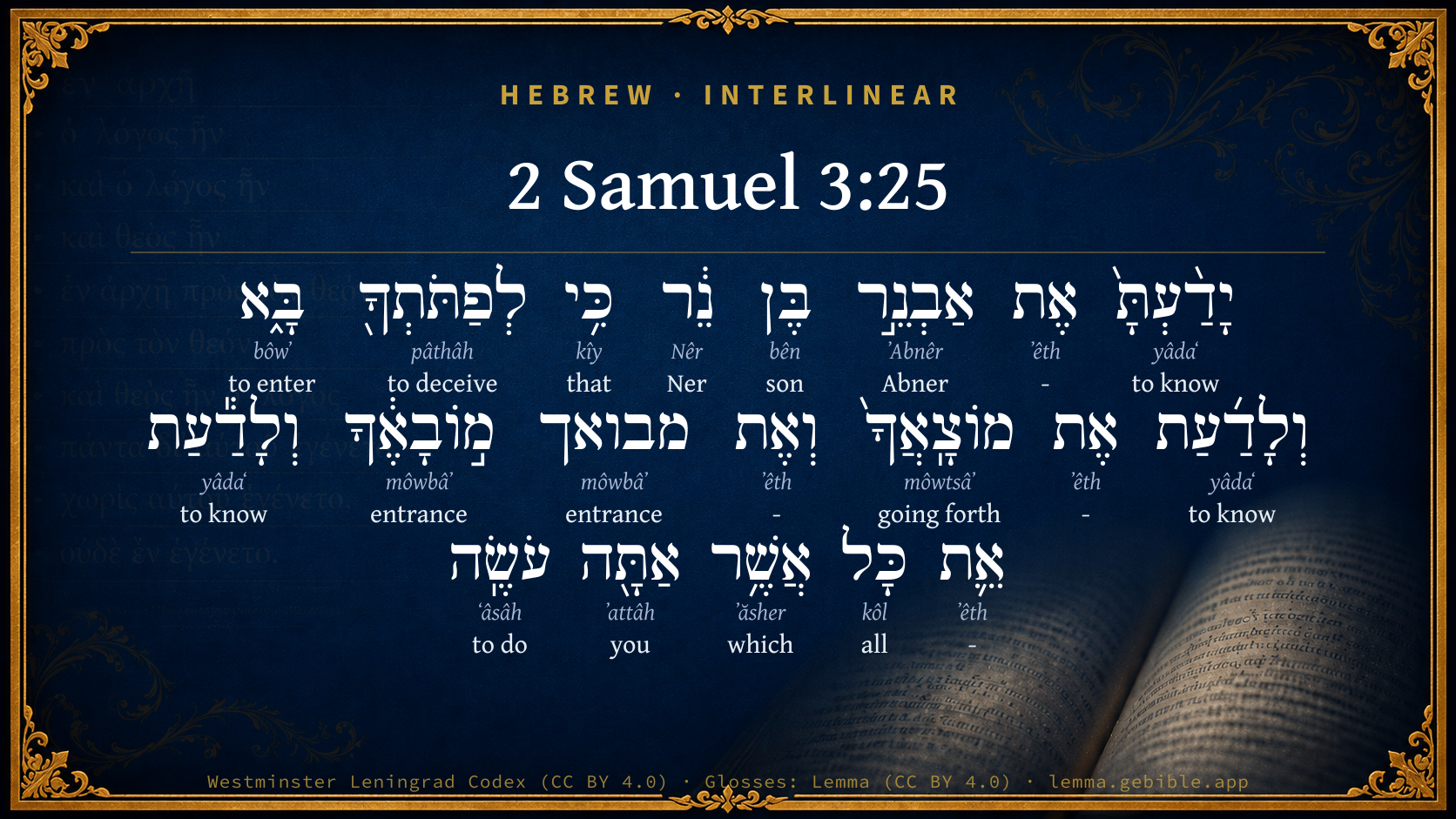
2 Samuel 3:25

Hebrew (Westminster Leningrad Codex) 2 Samuel 3:25 appears in the Hebrew Old Testament. The text above is from the Westminster Leningrad Codex. Each word links to its Strong’s number, a concise gloss, and parsing drawn from the Open Scriptures Hebrew Bible morphology. Click any word for its full Brown-Driver-Briggs (BDB) entry.
Download image
Cite this verse

2 Samuel 3:25 (World English Bible). Public Domain. Lemma interlinear Bible study tool, https://lemma.gebible.app/v/2-samuel/3/25.

Show BibTeX & RIS
BibTeX
RIS
English Translation
You know Abner the son of Ner, that he came to deceive you, and to know your going out and your coming in, and to know all that you do.
World English Bible · Public Domain
Highlights
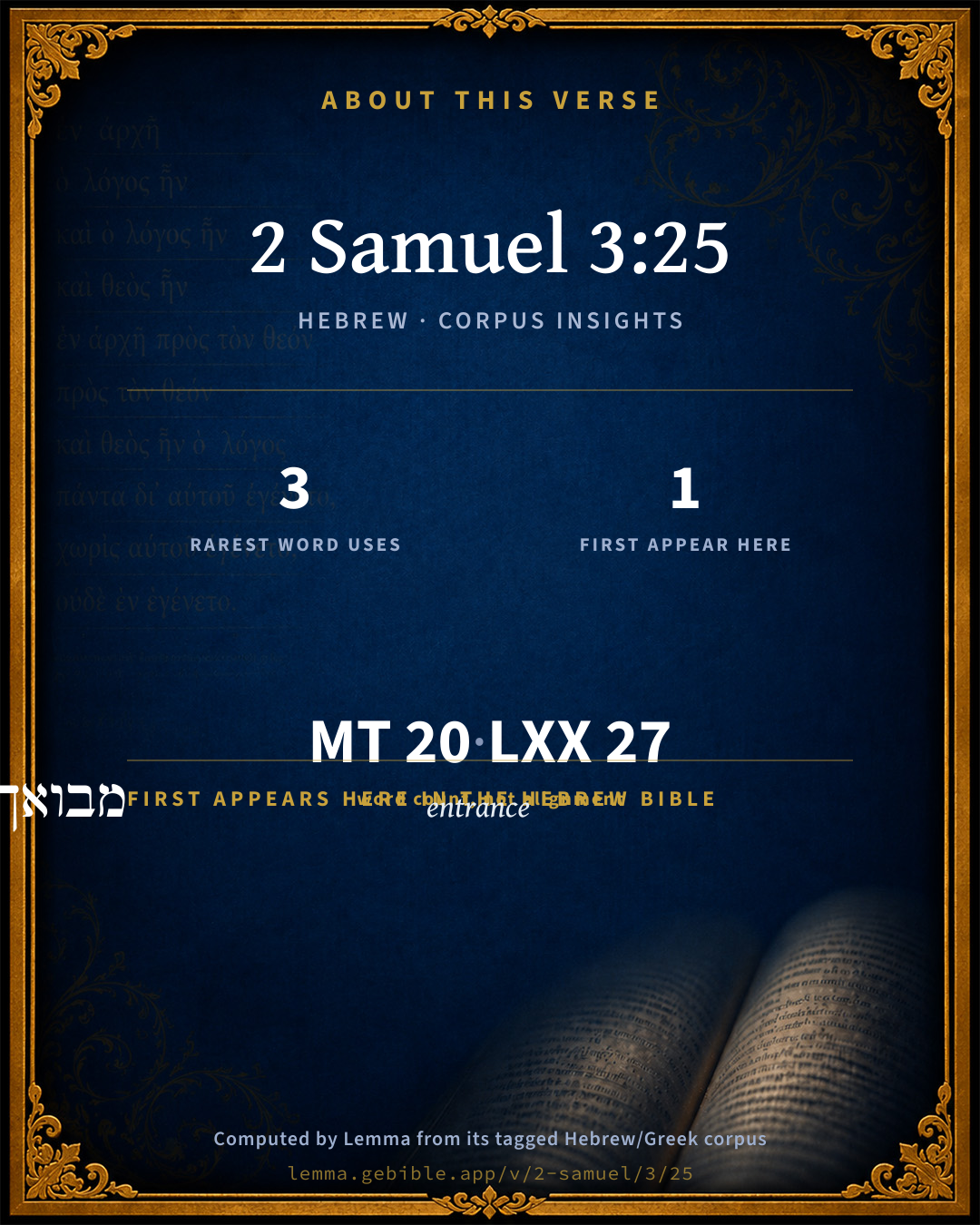
  • 1 first appearance in the Hebrew Bible
Full analysis ↓
Download a study sheet

One document with this verse’s original text, its word-by-word gloss line, the meaning frame, cross-references with their text, attributed commentary, and full source and license credits — printable, and it pastes into notes with its structure intact.

This verse Autodidact and up

Study sheet (.html) Plain text (.txt)

A passage Seminary Student

Up to 50 verses in one chapter. A passage sheet keeps up to 6 commentary sources and 12 cross-references per verse, in the order this page ranks them, and says so on the sheet whenever that leaves anything out. Ask for a single verse and you get the Autodidact verse sheet above.

Everything on this page stays free to read, with no account — the sheet is a download of what is already on screen, not access to it.

Want to remove ads? Support Godless Engineer
Compare translations 3

The same verse in 3 English versions, stacked beneath the original-language interlinear above. Click any original word for its lexicon entry.

Each is an independent rendering of the whole verse — the interlinear is not word-aligned to these translations.

Highlighted words mark where these versions differ — a whole-verse word diff, not a word-by-word alignment.

  • World English Bible Public Domain
    You know Abner the son of Ner, that he came to deceive you, and to know your going out and your coming in, and to know all that you do.
  • King James Version Public Domain
    Thou knowest Abner the son of Ner, that he came to deceive thee, and to know thy going out and thy coming in, and to know all that thou doest.
  • unfoldingWord Literal Text CC BY-SA 4.0
    You know Abner, the son of Ner, that he came to deceive you and to know your going out and your coming in and to know all that you are doing!”

unfoldingWord Literal Text — © unfoldingWord, licensed CC BY-SA 4.0. Word-aligned USFM3 via Door43 (git.door43.org/unfoldingWord/en_ult).

Versions to compare (up to 4)

3 of 4 selected

Show all 18 translations

Every available English version of this verse, each an independent rendering of the whole verse.

  • World English Bible Public Domain
    You know Abner the son of Ner, that he came to deceive you, and to know your going out and your coming in, and to know all that you do.
  • Berean Standard Bible Public Domain
    Surely you realize that Abner son of Ner came to deceive you and to track your movements and all that you are doing.”
  • Majority Standard Bible Public Domain
    Surely you realize that Abner son of Ner came to deceive you and to track your movements and all that you are doing.”
  • King James Version Public Domain
    Thou knowest Abner the son of Ner, that he came to deceive thee, and to know thy going out and thy coming in, and to know all that thou doest.
  • American Standard Version (1901) Public Domain
    Thou knowest Abner the son of Ner, that he came to deceive thee, and to know thy going out and thy coming in, and to know all that thou doest.
  • Revised Version (1885) Public Domain
    Thou knowest Abner the son of Ner, that he came to deceive thee, and to know thy going out and thy coming in, and to know all that thou doest.
  • Geneva Bible (1599) Public Domain
    Thou knowest Abner the sonne of Ner: for he came to deceiue thee, and to knowe thy outgoing and ingoing, and to knowe all that thou doest.
  • Douay-Rheims (1899) Public Domain
    Knowest thou not Abner the son of Ner, that to this end he came to thee, that he might deceive thee, and to know thy going out, and thy coming in, and to know all thou dost?
  • Young's Literal Translation Public Domain
    Thou hast known Abner son of Ner, that to deceive thee he came, and to know thy going out and thy coming in, and to know all that thou art doing.'
  • Literal Standard Version CC BY-SA 4.0
    You have known Abner son of Ner, that he came to deceive you, and to know your going out and your coming in, and to know all that you are doing.”
  • Unlocked Literal Bible CC BY-SA 4.0
    Do you not know that Abner son of Ner came to deceive you and to discover your plans and learn everything you are doing?”
  • unfoldingWord Literal Text CC BY-SA 4.0
    You know Abner, the son of Ner, that he came to deceive you and to know your going out and your coming in and to know all that you are doing!”
  • Darby Bible Public Domain
    Thou knowest Abner the son of Ner, that he came to deceive thee, to know thy going out and thy coming in, and to know all that thou doest.
  • World Messianic Bible Public Domain
    You know Abner the son of Ner. He came to deceive you, and to know your going out and your coming in, and to know all that you do.”
  • Webster's Bible Public Domain
    Thou knowest Abner the son of Ner, that he came to deceive thee, and to know thy going-out and thy coming-in, and to know all that thou doest.
  • Free Bible Version CC BY-SA 4.0
    You do see that Abner, son of Ner, came here to trick you, to spy on the movements of your army, and to find out everything you're doing!”
  • Bible in Basic English Public Domain
    Is it not clear to you that Abner, the son of Ner, came with deceit to get knowledge of your going out and your coming in and of all you are doing?
  • JPS Tanakh (1917) Public Domain
    Thou knowest Abner the son of Ner, that he came to deceive thee, and to know thy going out and thy coming in, and to know all that thou doest.'

Literal Standard Version (2020), Covenant Press — licensed CC BY-SA 4.0. Text via the HelloAO Bible API (eBible.org). Unlocked Literal Bible (unfoldingWord) — licensed CC BY-SA 4.0. Text via the HelloAO Bible API (eBible.org). unfoldingWord Literal Text — © unfoldingWord, licensed CC BY-SA 4.0. Word-aligned USFM3 via Door43 (git.door43.org/unfoldingWord/en_ult). Free Bible Version, Dr. Jonathan Gallagher — licensed CC BY-SA 4.0. Text via the HelloAO Bible API (eBible.org).

Word by word

More ways to search: Search by grammar → Find every occurrence → Compare this word →

Practice this passage: Drill this verse → Learn its vocabulary →

מבואך
môwbâʼ
H4126
“entrance · your”
Noun, Common, Masculine, Singular, Construct + Suffix, Personal, 2nd Person, Masculine, Singular
Part of Speech
Noun
Type
Common
Gender
Masculine
Number
Singular
State
Construct
Full BDB Definition

Origin: by transp. for H3996

TWOT: 212b

entrance, entering, in-coming
  1. יָדַ֨עְתָּ֙ yâdaʻ H3045 “to know” Verb, Qal, Perfect, 2nd Person, Masculine, Singular
  2. אֶת ʼêth H853 “-” Particle, Direct Object
  3. אַבְנֵ֣ר ʼAbnêr H74 “Abner” Noun, Proper
  4. בֶּן bên H1121 “son of” Noun, Common, Masculine, Singular, Construct
  5. נֵ֔ר Nêr H5369 “Ner” Noun, Proper
  6. כִּ֥י kîy H3588 “that” Conjunction
  7. לְפַתֹּתְךָ֖ pâthâh H6601 “to deceive · you” Preposition + Verb, Piel, Infinitive Construct + Suffix, Personal, 2nd Person, Masculine, Singular
  8. בָּ֑א bôwʼ H935 “to enter” Verb, Qal, Perfect, 3rd Person, Masculine, Singular
  9. וְלָדַ֜עַת yâdaʻ H3045 “and · to know” Conjunction + Preposition + Verb, Qal, Infinitive Construct
  10. אֶת ʼêth H853 “-” Particle, Direct Object
  11. מוֹצָֽאֲךָ֙ môwtsâʼ H4161 “going forth · your” Noun, Common, Masculine, Singular, Construct + Suffix, Personal, 2nd Person, Masculine, Singular
  12. וְאֶת ʼêth H853 “and · -” Conjunction + Particle, Direct Object
  13. מ֣וֹבָאֶ֔ךָ môwbâʼ H4126 “entrances · your” Noun, Common, Masculine, Plural, Construct + Suffix, Personal, 2nd Person, Masculine, Singular
  14. וְלָדַ֕עַת yâdaʻ H3045 “and · to know” Conjunction + Preposition + Verb, Qal, Infinitive Construct
  15. אֵ֛ת ʼêth H853 “-” Particle, Direct Object
  16. כָּל kôl H3605 “all of” Noun, Common, Masculine, Singular, Construct
  17. אֲשֶׁ֥ר ʼăsher H834 “which” Particle, Relative
  18. אַתָּ֖ה ʼattâh H859 “you” Pronoun, Personal, 2nd Person, Masculine, Singular
  19. עֹשֶֽׂה ʻâsâh H6213 “doing” Verb, Qal, Participle Active, Masculine, Singular, Absolute

About this verse

These counts appear in no published source. They are computed here, from the morphology-tagged text and Lemma’s own curated glosses. What Lemma adds →

20
words
14
distinct lemmas
Historical
section

Notable vocabulary

The rarest word here is מבואך entrance H4126 — appearing just 3 times in the whole Hebrew Bible.

First appearance in Scripture

This word makes its first canonical appearance in the Hebrew Bible here:

  • מבואך entrance H4126

Shared distinctive vocabulary

מבואך entrance H4126 occurs in 2 verses of the Hebrew Bible. Also found in:

Grammatical profile

  • 6 verbs
  • 7 nouns
  • 1 pronoun
  • 1 conjunction
  • 5 particles

Verb forms

  • יָדַ֨עְתָּ֙ Qal · Perfect
  • לְפַתֹּתְךָ֖ Piel · Infinitive Construct
  • בָּ֑א Qal · Perfect
  • וְלָדַ֜עַת Qal · Infinitive Construct
  • וְלָדַ֕עַת Qal · Infinitive Construct
  • עֹשֶֽׂה Qal · Participle Active

Repetition

Words recur within this verse — often emphatic in Hebrew:

  • יָדַ֨עְתָּ֙ to know H3045 ×3
  • מבואך entrance H4126 ×2

Hebrew & Septuagint length

In English translation the verse runs 30 words from the Hebrew and 35 from the Septuagint (LXX English) — closely comparable.

A rough comparison of the two English renderings, which tokenize alike — not a word-level alignment.

Word counts can differ between the Hebrew and the Greek without any difference in meaning — e.g. the Hebrew direct-object marker אֵת has no separate Greek word, and Greek often adds the article ὁ.

In the original languages it is 20 Hebrew tokens and 27 Greek tokens — but the two are counted differently (Hebrew bundles its prefixes and suffixes into one token; the Greek is in lemma form), so that isn’t a like-for-like length.

Cross-references

14

Topical passages linked to 2 Samuel 3:25 in the Treasury of Scripture Knowledge — connected by theme and wording, ordered by reader-vote popularity; previews shown in the World English Bible.

  • Numbers 27:17 who may go out before them, and who may come in before them, and who may lead them out, and who may bring them in; that the congregation of Yahweh not be as sheep which have no shepherd.
  • Deuteronomy 28:6 Blessed shall you be when you come in, and blessed shall you be when you go out.
  • Isaiah 37:28 But I know your sitting down, and your going out, and your coming in, and your raging against me.
  • Genesis 42:9 Joseph remembered the dreams which he dreamed about them, and said to them, "You are spies! You have come to see the nakedness of the land."
  • Genesis 42:12 He said to them, "No, but you have come to see the nakedness of the land."
  • Genesis 42:16 Send one of you, and let him get your brother, and you shall be bound, that your words may be tested, whether there is truth in you, or else by the life of Pharaoh surely you are spies."
  • 1 Samuel 29:4–6 But the princes of the Philistines were angry with him; and the princes of the Philistines said to him, Make the man return, that he may go back to his place where you have appointed him, and let him not go down with us to battle, lest in the battle he become an adversary to us: for with what should this [fellow] reconcile himself to his lord? should it not be with the heads of these men?
  • 2 Samuel 3:27 When Abner was returned to Hebron, Joab took him aside into the midst of the gate to speak with him quietly, and struck him there in the body, so that he died, for the blood of Asahel his brother.
  • 2 Samuel 10:3 But the princes of the children of Ammon said to Hanun their lord, Do you think that David honors your father, in that he has sent comforters to you? Hasn't David sent his servants to you to search the city, and to spy it out, and to overthrow it?
  • 2 Kings 18:32 Until I come and take you away to a land like your own land, a land of grain and new wine, a land of bread and vineyards, a land of olive trees and of honey, that you may live, and not die: and don't listen to Hezekiah, when he persuades you, saying, Yahweh will deliver us.
  • Psalms 121:8 Yahweh will keep your going out and your coming in, From this time forth, and forevermore.
  • John 7:12 There was much murmuring among the multitudes concerning him. Some said, "He is a good man." Others said, "Not so, but he leads the multitude astray."
  • John 7:47 The Pharisees therefore answered them, "You aren't also led astray, are you?
  • Romans 2:1 Therefore you are without excuse, O man, whoever you are who judge. For in that which you judge another, you condemn yourself. For you who judge practice the same things.

Cross-references courtesy of OpenBible.info (CC BY 4.0).

Hebrew and Greek witnesses Masoretic Hebrew ↔ Greek Septuagint

The same verse in the two great witnesses to the Old Testament, shown verse-for-verse.

These are two independent witnesses, not word-aligned to each other, and the Septuagint is shown in lemma (dictionary) form.

Hebrew 2 Samuel 3:25 Masoretic · Westminster Leningrad Codex

יָדַ֨עְתָּ֙ אֶת אַבְנֵ֣ר בֶּן נֵ֔ר כִּ֥י לְפַתֹּתְךָ֖ בָּ֑א וְלָדַ֜עַת אֶת מוֹצָֽאֲךָ֙ וְאֶת מבואך מ֣וֹבָאֶ֔ךָ וְלָדַ֕עַת אֵ֛ת כָּל אֲשֶׁ֥ר אַתָּ֖ה עֹשֶֽׂה

You know Abner the son of Ner, that he came to deceive you, and to know your going out and your coming in, and to know all that you do.

World English Bible · Public Domain

Greek LXX 2 Samuel 3:25 Septuagint · lemma form

ἤ οὐ οἶδα ὁ κακία αβεννηρ υἱός νηρ ὅτι ἀπατάω σύ παραγίγνομαι καί γιγνώσκω ὁ ἔξοδος σύ καί ὁ εἴσοδος σύ καί γιγνώσκω ἅπας ὅσος σύ ποιέω

Know you not the mischief of Abenner the son of Ner, that he came to deceive you, and to know your going out and your coming in, and to know all things that you do?

LXX2012 (modern English Septuagint) · Public Domain

On this verse, John Gill's Exposition discusses the Septuagint’s reading. Read the note in Commentary ↓

Hebrew: Westminster Leningrad Codex (CC BY 4.0). Greek: Septuagint (public domain); English from LXX2012 (modern English Septuagint) (Public Domain). How the Septuagint differs from the Hebrew →

Targum (Aramaic paraphrase)

1

The Targum is the ancient Jewish Aramaic paraphrase of the Hebrew Scriptures — an interpretive translation, not the Hebrew text itself. Onkelos (literal) and Pseudo-Jonathan (expansive) render the Torah, and Jonathan the Prophets. Coverage is partial: where no permissively-licensed English translation exists for a verse, only the Aramaic is shown. This is verse-level text, not a word-by-word alignment to the Hebrew.

  1. Targum Jonathan Prophets (Joshua–Malachi)
    יְדַעְתָּא יַת אַבְנֵר בַּר נֵר אֲרֵי לְאַטְעֲיוּתָךְ אֲתָא וּלְמִידַע יַת מִיפְקָךְ וְיַת מֵיעָלָךְ וּלְמֵידַע יַת כָּל דְאַתְּ עֲבֵיד:

    (no public-domain English translation for this verse)

    Targum Jonathan — Aramaic: “Mikraot Gedolot” (public domain). English: “Sefaria Community Translation” (CC0 1.0 (public-domain dedication)); “London "Chaldee Paraphrase," 1871” (public domain). Text via Sefaria.

Commentary

Notes on 2 Samuel 3:25 from classic Christian and Jewish commentators (each source and its license shown beneath its notes). The classic Christian expositions comment on the surrounding passage and are grouped to its opening verse, so a note may address several verses; the Jewish commentaries on the Tanakh (Rashi and others) are per-verse, so they appear only where the commentator wrote on this verse.

Lemma curates 59 commentaries, every one of them public domain or Creative Commons licensed, each selected and text-cleaned for this edition rather than reprinted as found. About our sources →

Trapp's Complete Commentary

John Trapp

2Sa 3:25 Thou knowest Abner the son of Ner, that he came to deceive thee, and to know thy going out and thy coming in, and to know all that thou doest.

Ver. 25. That he came to deceive thee.] As a spy and a traitor; so he interpreteth Abner’s league, according to his own exulcerate spirit, full of ambition and revenge.

John Trapp, A Commentary or Exposition upon All the Books of the Old and New Testament (1647–1656) — public domain. Text from a community e-Sword module.

The Cambridge Bible for Schools and Colleges

gen. ed. J. J. S. Perowne

25. thy going out and thy coming in] All thy movements and undertakings. Cp. Deu_28:6; Psa_121:8; Isa_37:28.

The Cambridge Bible for Schools and Colleges (gen. ed. J. J. S. Perowne; Cambridge University Press, 1878–1918) — public domain. Text from a community e-Sword module.

John Gill's Exposition

Thou knowest Abner the son of Ner,.... Thou canst not be ignorant what a cunning deceitful man he is, nor of his designs; or dost thou not know? art thou ignorant? so read the Septuagint, Vulgate Latin, Syriac, and Arabic versions, with an interrogation:

that he came to deceive thee: with false hopes, or to lead into wrong measures with an intention to involve and ruin him:

and to know thy going out, and coming in; the affairs of his court, the secrets of his government, to observe his conduct and behaviour, and all his actions, and improve them against him:

and to know all that thou doest; he suggests that he came not as a friend, but as a spy, and therefore ought to have been taken up, and detained, and not dismissed. This Joab said to set David against him, fearing, if he should be received into favour, he would be a rival of his; and besides his breast was full of revenge against him for the death of his brother.

John Gill's Exposition of the Whole Bible (1746–1763) — public domain (CC PDM 1.0). Text via the HelloAO Bible API.

Haydock's Catholic Bible Commentary

Dost. This explains going out, &c. (Haydock) --- Joab pretends to be wholly solicitous for the king’s welfare. But he was afraid lest Abner should take his place, and he also desired to revenge Asael’s death. (Menochius)

George Leo Haydock (1774–1849), Haydock's Catholic Family Bible and Commentary, 1859 edition — public domain. Excludes Psalms (Douay-Rheims chapter numbering differs from Protestant) and Deuterocanonical books (Catholic canon only).

Matthew Poole's English Annotations

To search out thy counsels and secret designs, and to make use of them against thee.

Matthew Poole's English Annotations on the Holy Bible (1683–1685) — public domain. Text from a community e-Sword/MySword module.

Whedon's Commentary on the Bible

Daniel D. Whedon

25. He came to deceive thee — Joab could not believe that the mighty captain of Saul’s hosts meant thus easily to yield before David. He suspected treachery. David seems not to have answered a word.

Daniel D. Whedon (gen. ed.), Commentary on the Old and New Testaments (1874–1909) — public domain. Text from a community e-Sword module.

Lesson kit

Teaching starters — assembled from the data on this page, not authored interpretation. Every prompt links to the verse data it draws on. Edit before teaching.

2 Samuel, in the Historical, opens this verse with 20 words (14 distinct Hebrew lemmas). Its most distinctive word is môwbâʼ (“entrance”). A historical commentator’s framing appears above. Read the whole chapter for the surrounding context.

Discussion questions

  1. The word môwbâʼ carries the sense “entrance.” How does it shape the verse?
  2. This is the first place “entrance” appears in Scripture (first appears here). What does its debut here establish?
  3. How does Ezekiel 43:11, which shares the word «entrance», read alongside this verse?
  4. What does the repetition of “to know” (3× in this one verse) do in this verse?
  5. These translations render this verse differently. What is at stake in choosing one wording over another?
  6. «יָדַ֨עְתָּ֙» is a Qal Perfect verb. How does that grammatical form shape the action described?
  7. Compare how Trapp's Complete Commentary and The Cambridge Bible for Schools and Colleges read this verse. Where do they agree or differ?

Things to notice

Reading settings

Reading text

Shown beneath each verse's original-language words.

Old Testament
Old Testament edition

Read the OT as the Masoretic Hebrew (MT) or the Greek Septuagint (LXX).

English shown for the Greek Septuagint (in the Hebrew ↔ Greek comparison).

Comparing translations? Open the Compare panel on any verse page to stack up to four side by side.