Hebrews 3:10

Greek (Tischendorf 8th ed.) Hebrews 3:10 appears in the Greek New Testament. The text above is from the Tischendorf 8th edition. Each word links to its Strong’s number and a concise gloss. Click any word for its full Thayer’s Greek Lexicon entry.
Download image
Cite this verse

Hebrews 3:10 (World English Bible). Public Domain. Lemma interlinear Bible study tool, https://lemma.gebible.app/v/hebrews/3/10.

Show BibTeX & RIS
BibTeX
RIS
English Translation
Therefore I was displeased with that generation, And said, 'They always err in their heart, But they didn't know my ways;'
World English Bible · Public Domain
Highlights
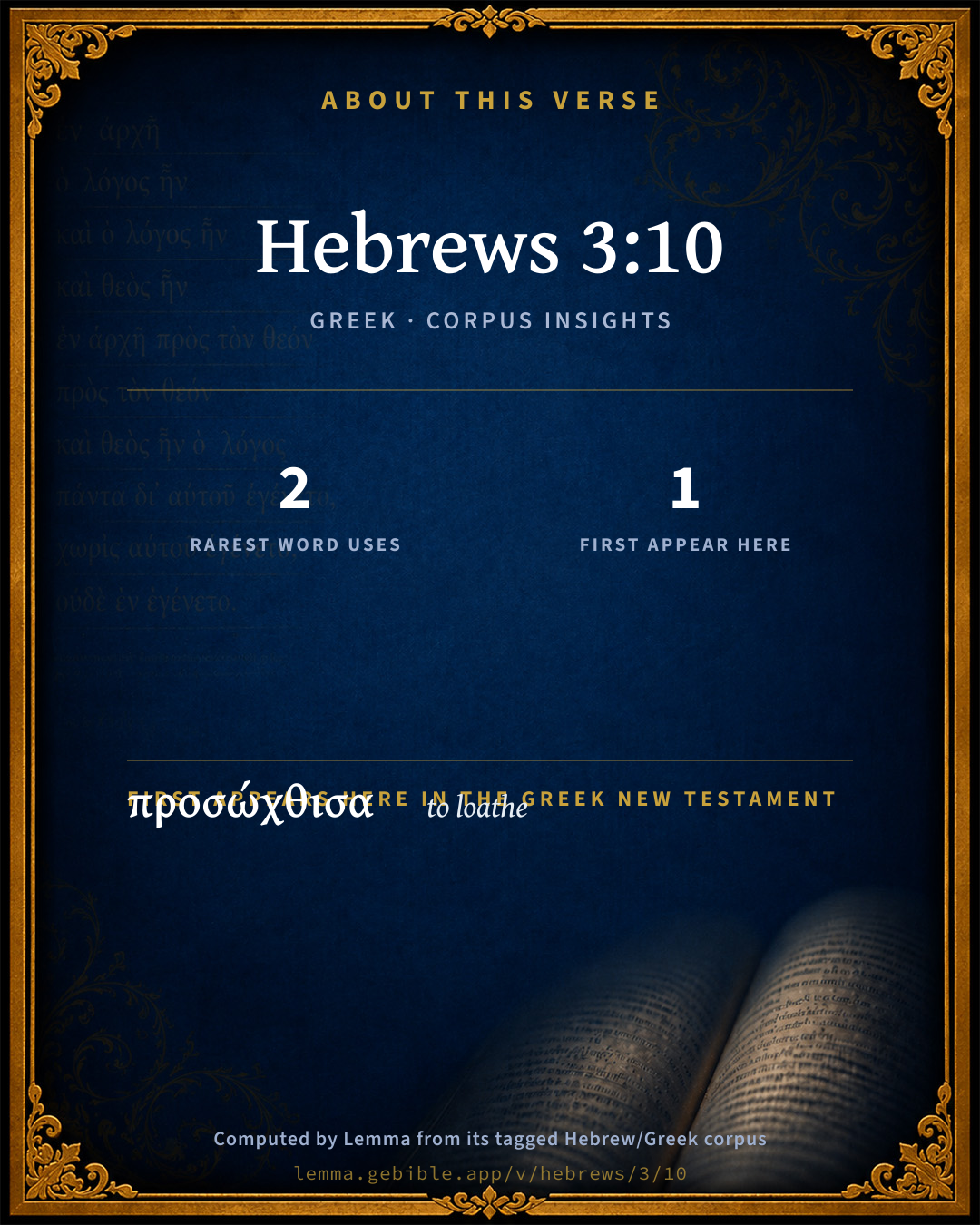
  • 1 first appearance in the Greek New Testament
Full analysis ↓
Download a study sheet

One document with this verse’s original text, its word-by-word gloss line, the meaning frame, cross-references with their text, attributed commentary, and full source and license credits — printable, and it pastes into notes with its structure intact.

This verse Autodidact and up

Study sheet (.html) Plain text (.txt)

A passage Seminary Student

Up to 50 verses in one chapter. A passage sheet keeps up to 6 commentary sources and 12 cross-references per verse, in the order this page ranks them, and says so on the sheet whenever that leaves anything out. Ask for a single verse and you get the Autodidact verse sheet above.

Everything on this page stays free to read, with no account — the sheet is a download of what is already on screen, not access to it.

Want to remove ads? Support Godless Engineer
Compare translations 3

The same verse in 3 English versions, stacked beneath the original-language interlinear above. Click any original word for its lexicon entry.

Each is an independent rendering of the whole verse — the interlinear is not word-aligned to these translations.

Highlighted words mark where these versions differ — a whole-verse word diff, not a word-by-word alignment.

  • World English Bible Public Domain
    Therefore I was displeased with that generation, And said, 'They always err in their heart, But they didn't know my ways;'
  • King James Version Public Domain
    Wherefore I was grieved with that generation, and said, They do alway err in their heart; and they have not known my ways.
  • unfoldingWord Literal Text CC BY-SA 4.0
    for 40 years. Therefore, I was very angry with that generation, and I said, ‘They are always going astray in their hearts, and they have not known my ways.’

unfoldingWord Literal Text — © unfoldingWord, licensed CC BY-SA 4.0. Word-aligned USFM3 via Door43 (git.door43.org/unfoldingWord/en_ult).

Versions to compare (up to 4)

3 of 4 selected

Show all 19 translations

Every available English version of this verse, each an independent rendering of the whole verse.

  • World English Bible Public Domain
    Therefore I was displeased with that generation, And said, 'They always err in their heart, But they didn't know my ways;'
  • Berean Standard Bible Public Domain
    Therefore I was angry with that generation, and I said, ‘Their hearts are always going astray, and they have not known My ways.’
  • Majority Standard Bible Public Domain
    Therefore I was angry with that generation, and I said, ‘Their hearts are always going astray, and they have not known My ways.’
  • King James Version Public Domain
    Wherefore I was grieved with that generation, and said, They do alway err in their heart; and they have not known my ways.
  • American Standard Version (1901) Public Domain
    Wherefore I was displeased with this generation, And said, They do always err in their heart: But they did not know my ways;
  • Revised Version (1885) Public Domain
    Wherefore I was displeased with this generation, And said, They do alway err in their heart: But they did not know my ways;
  • Geneva Bible (1599) Public Domain
    Wherefore I was grieued with that generation, and sayde, They erre euer in their heart, neither haue they knowen my wayes.
  • Douay-Rheims (1899) Public Domain
    Forty years: for which cause I was offended with this generation, and I said: They always err in heart. And they have not known my ways,
  • Young's Literal Translation Public Domain
    wherefore I was grieved with that generation, and said, Always do they go astray in heart, and these have not known My ways;
  • Literal Standard Version CC BY-SA 4.0
    for this reason I was grieved with that generation and said, They always go astray in [their] heart, and these have not known My ways;
  • Unlocked Literal Bible CC BY-SA 4.0
    Therefore I was displeased with that generation. I said, 'They have always gone astray in their hearts. They have not known my ways.'
  • unfoldingWord Literal Text CC BY-SA 4.0
    for 40 years. Therefore, I was very angry with that generation, and I said, ‘They are always going astray in their hearts, and they have not known my ways.’
  • Darby Bible Public Domain
    Wherefore I was wroth with this generation, and said, They always err in heart; and *they* have not known my ways;
  • World Messianic Bible Public Domain
    Therefore I was displeased with that generation, and said, ‘They always err in their heart, but they didn’t know my ways.’
  • Webster's Bible Public Domain
    Wherefore I was grieved with that generation, and said, They do always err in their heart; and they have not known my ways.
  • Free Bible Version CC BY-SA 4.0
    That generation made me angry and so I said, ‘They're always mistaken in what they think, and they don't know me or what I'm doing.’
  • Bible in Basic English Public Domain
    So that I was angry with this generation, and I said, Their hearts are in error at all times, and they have no knowledge of my ways;
  • Text-Critical English NT CC BY 4.0
    Therefore I was angry with that generation and said, ‘They always go astray in their hearts; they have not known my ways.’
  • Tyndale New Testament (1534) Public Domain
    Wherfore I was greved with the generacion and sayde. They erre ever in their hertes: they verely have not knowe my wayes

Literal Standard Version (2020), Covenant Press — licensed CC BY-SA 4.0. Text via the HelloAO Bible API (eBible.org). Unlocked Literal Bible (unfoldingWord) — licensed CC BY-SA 4.0. Text via the HelloAO Bible API (eBible.org). unfoldingWord Literal Text — © unfoldingWord, licensed CC BY-SA 4.0. Word-aligned USFM3 via Door43 (git.door43.org/unfoldingWord/en_ult). Free Bible Version, Dr. Jonathan Gallagher — licensed CC BY-SA 4.0. Text via the HelloAO Bible API (eBible.org).

Word by word

More ways to search: Search by grammar → Find every occurrence → Compare this word →

Practice this passage: Drill this verse → Learn its vocabulary →

προσώχθισα
prosochthízō
G4360
“to loathe”
Verb, Aorist, Active, Indicative, 1st person, Singular
Part of Speech
Verb
Tense
Aorist
Voice
Active
Mood
Indicative
Person
1st person
Number
Singular
Full Thayer's Definition

Origin: from G4314 and a form of ochtheo (to be vexed with something irksome)

TDNT: None

1. to be wroth or displeased with 2. to loathe 3. to spew out 4. to be disgusted with
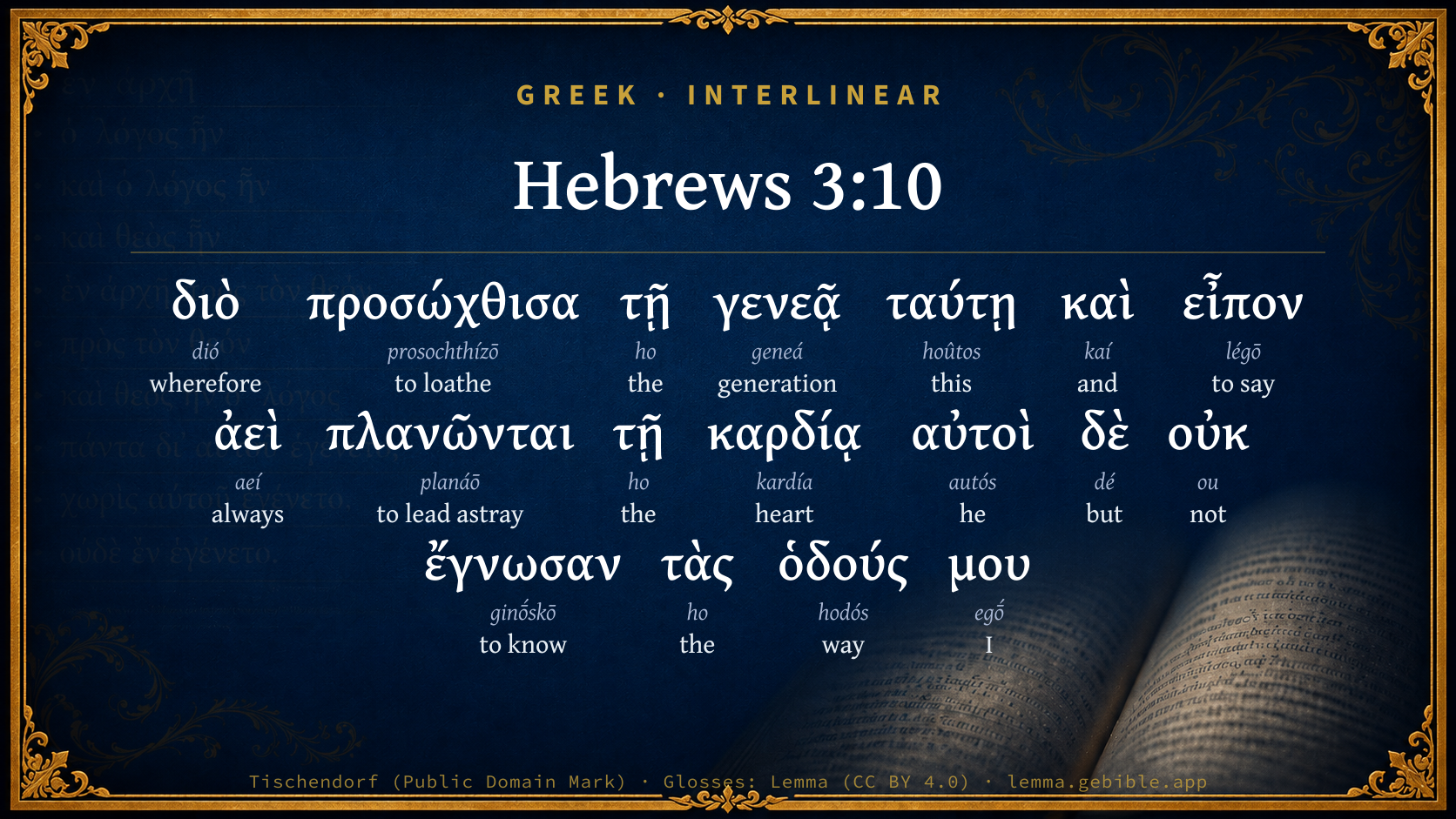
  1. διὸ dió G1352 “wherefore” Conjunction
  2. τῇ ho G3588 “the” Article, Dative, Singular, Feminine
  3. γενεᾷ geneá G1074 “generation” Noun, Dative, Singular, Feminine
  4. ταύτῃ hoûtos G3778 “this” Demonstrative pronoun, Dative, Singular, Feminine
  5. καὶ kaí G2532 “and” Conjunction
  6. εἶπον légō G3004 “to say” Verb, Aorist, Active, Indicative, 1st person, Singular
  7. ἀεὶ aeí G104 “always” Adverb
  8. πλανῶνται planáō G4105 “to lead astray” Verb, Present, Passive, Indicative, 3rd person, Plural
  9. τῇ ho G3588 “the” Article, Dative, Singular, Feminine
  10. καρδίᾳ kardía G2588 “heart” Noun, Dative, Singular, Feminine
  11. αὐτοὶ autós G846 “he” Personal pronoun, Nominative, Plural, Masculine
  12. δὲ dé G1161 “but” Conjunction
  13. οὐκ ou G3756 “not” Particle, Negative
  14. ἔγνωσαν ginṓskō G1097 “to know” Verb, Aorist, Active, Indicative, 3rd person, Plural
  15. τὰς ho G3588 “the” Article, Accusative, Plural, Feminine
  16. ὁδούς hodós G3598 “way” Noun, Accusative, Plural, Feminine
  17. μου egṓ G1473 “I” Personal pronoun, 1st person, Genitive, Singular

About this verse

These counts appear in no published source. They are computed here, from the morphology-tagged text and Lemma’s own curated glosses. What Lemma adds →

18
words
16
distinct lemmas
General Epistles
section

Notable vocabulary

The rarest word here is προσώχθισα to loathe G4360 — appearing just 2 times in the whole Greek New Testament.

First appearance in Scripture

This word makes its first canonical appearance in the Greek New Testament here:

  • προσώχθισα to loathe G4360

Shared distinctive vocabulary

προσώχθισα to loathe G4360 occurs in 2 verses of the Greek New Testament. Also found in:

Repetition

A word recurs within this verse:

Cross-references

18

Topical passages linked to Hebrews 3:10 in the Treasury of Scripture Knowledge — connected by theme and wording, ordered by reader-vote popularity; previews shown in the World English Bible.

  • Psalms 95:10 Forty long years I was grieved with that generation, And said, "It is a people that errs in their heart. They have not known my ways."
  • 2 Thessalonians 2:10–12 and with all deception of wickedness for those who are being lost, because they didn't receive the love of the truth, that they might be saved.
  • Psalms 67:2 That your way may be known on earth, And your salvation among all nations,
  • Psalms 78:8 And might not be as their fathers, A stubborn and rebellious generation, A generation that didn't make their hearts loyal, Whose spirit was not steadfast with God.
  • Jeremiah 4:22 For my people are foolish, they don't know me; they are foolish children, and they have no understanding; they are wise to do evil, but to do good they have no knowledge.
  • Ephesians 4:30 Don't grieve the Holy Spirit of God, in whom you were sealed for the day of redemption.
  • Isaiah 63:10 But they rebelled, and grieved his holy Spirit: therefore he was turned to be their enemy, [and] himself fought against them.
  • Hosea 4:12 My people consult with their wooded idol, And answer to a stick of wood. Indeed the spirit of prostitution has led them astray, And they have been unfaithful to their God.
  • Judges 10:16 They put away the foreign gods from among them, and served Yahweh; and his soul was grieved for the misery of Israel.
  • Psalms 147:20 He has not done this for just any nation. They don't know his ordinances. Praise Yah!
  • Isaiah 28:7 Even these reel with wine, and stagger with strong drink; the priest and the prophet reel with strong drink, they are swallowed up of wine, they stagger with strong drink; they err in vision, they stumble in judgment.
  • Mark 3:5 When he had looked around at them with anger, being grieved at the hardening of their hearts, he said to the man, "Stretch out your hand." He stretched it out, and his hand was restored as healthy as the other.
  • John 8:45 But because I tell the truth, you don't believe me.
  • Hebrews 3:12 Beware, brothers, lest perhaps there be in any one of you an evil heart of unbelief, in falling away from the living God;
  • Genesis 6:6 Yahweh was sorry that he had made man on the earth, and it grieved him in his heart.
  • Psalms 78:40 How often they rebelled against him in the wilderness, And grieved him in the desert!
  • John 3:19–20 This is the judgment, that the light has come into the world, and men loved the darkness rather than the light; for their works were evil.
  • Romans 3:7 For if the truth of God through my lie abounded to his glory, why am I also still judged as a sinner?

Cross-references courtesy of OpenBible.info (CC BY 4.0).

Commentary

Notes on Hebrews 3:10 from classic Christian and Jewish commentators (each source and its license shown beneath its notes). The classic Christian expositions comment on the surrounding passage and are grouped to its opening verse, so a note may address several verses; the Jewish commentaries on the Tanakh (Rashi and others) are per-verse, so they appear only where the commentator wrote on this verse.

Lemma curates 59 commentaries, every one of them public domain or Creative Commons licensed, each selected and text-cleaned for this edition rather than reprinted as found. About our sources →

The Biblical Illustrator

Joseph S. Exell

Heb_3:10-11

They do always err in their heart

The errors of the heart

I.

THE CONDUCT OF MANKIND UPON EARTH IS A MATTER OF GREAT ANXIETY TO OUR FATHER WHICH IS IN HEAVEN. Men are apt to think it a matter of indifference how they behave themselves, so that they do not involve their temporal prospects. Little do they reflect upon the grief that their impiety occasions to the best of benefactors. A lamentable thing it is for them and for others, that they forego the privilege of living in the fear of God; for it is impossible to live so happily in any other way as in that which God lays down for the guidance of His people. But it is not only in this way that God shows His solicitude for the welfare of His creatures--He makes great efforts to restrain men from ill-doing by the operation of His Spirit. In the minds of wicked men His Spirit strives. And one result of this benevolent intervention is, that men cannot do wrong without feeling uneasy about it. The man that leads a life of injustice is seldom in a happy, quiet state of mind; misgivings torment him, fear agitates him, and anxiety about the future makes him restless and miserable. This uneasiness and misery is intended by his heavenly Father to drive him from sin into the ways of righteousness and peace.

II. ERRORS IN THE UNDERSTANDING ARE NOT UNCOMMON. Men take up wrong notions and act upon them as if they were right. But for all tills, they are right at heart, and the goodness and the purity of their intentions (humanly speaking) guide them safely through the shoals and quicksands around them. I do not ray without damage to their reputation, nor without impairing their usefulness, but their real singleness of intention and uprightness in motive leads them far away from those dangers that otherwise would environ them. Now things are not so when a man has what is called a bad heart. Beyond such in depravity are others who have no sort of conscience respecting the injuries they inflict on their fellow-creatures. Men may be met with, and mere children also, who would rob a widow of her last penny and care not about her misery.

III. WHAT THE REMEDY FOR SUCH A STATE OF THINGS REALLY IS. They do err in their hearts, for they have not known My ways: the proper remedy for crime is, therefore, the knowledge of Gods ways. But we must not fall into the mistake of supposing that the knowledge of the ways of God signifies the being informed as to the purport of these laws. Here, as in many other parts of Scripture, the word denotes approval by experience, as well as knowledge in the ordinary sense. The ways of God are excellent, and commend themselves to such as keep them. In every case these are united in the ways of God. If prayer be enjoined as a duty, it is that we may receive the blessing when we rightly draw nigh to Him. Devotion has many mercies attached to it; and light, grace, comfort, or peace are given according to our wants. Without the duty we could not have the blessing, and men who slight the one lose the other. Our happiness never can be separated from our duties. (John Davis, BA.)

Heart corruption

Methodius compares the inbred corruptions of mans heart to a wild fig tree growing upon the wall of some goodly temple or stately palace, whereof, although the main trunk of the stem be broken off and stump of the root be plucked up, yet the fibrous strings of it piercing into the joints of the stone work will not be utterly extracted, but will ever and anon be shooting and sprouting out until the whole frame of the building be dissolved and the stonework thereof be disjointed anal pulled in pieces. (T. Brooks.)

Heart error

Error is insidious in its approaches. It flatters by liberality and betrays by sophism. We are not reconciled to it at once. There are disgusts to be allayed and fears to be vanquished. Little by little are we allured. Of none, perhaps, is the equivocal character more certain than of this. We believe it always originates in an undue conception of sin. This may be greatly modified. It does not appear sin. Often, we believe, is it strengthened by the forgetfulness that our facts and faculties are alike limited, and by a pretension to knowledge far beyond our actual attainment. Let us beware of the first wrong direction of thought and feeling, however minute the degree; fearful may be the after deviations. The voyager enters a current which seems propitious, there is no apparent diversion from his course, his bark speeds well, his oar does not toil nor his sail strain. In his confidence all promises success. But while he examines, scarcely does it seem that he has advanced. Much again and again reminds him of what he has noticed just before. A strange familiarity impresses his sense. Still current flows into current, while onward and buoyant is his track. Soon he feels an unnatural vibration. Where he glided, he now whirls along. The truth seizes upon him. He is sweeping a whirlpool. Long since he has entered the verge of a maelstrom, and he is now the sport of its gyrations. No power is left his helm or mast; he is the trembling, unresisting prey. He hears the roar; he is drawn into the suck of the vortex.

Not only the circle lessens, the very circle slopes. The central funnel and abyss, dark-heaving, smooth, vitreous, yawns. The mariner shrieks, the skiff is swallowed up, where the waters only separate to close, where the outermost attraction was but the minister to the famine of this devouring maw. (Dr. R. W. Hamilton.)

The root of sin in the heart

In every mans heart there is this triple root of sin; no one who knows his own heart will dispute it; the root of selfishness, from which spring self-indulgence, self-will, self esteem, and the whole brood of vanity and pride; the root of worldly-mindedness, which issues in ambition, in covetousness, in the love of money, in the desire of advancement, of honour, of power; and the root of carnal-mindedness, from which, if it be not cut down betimes, and kept diligently from shooting up again, the lusts of the flesh will sprout rankly, and overrun and stifle the soul. (Archdeacon Hare.)

They have not known My ways

Gods ways

Here we are to consider two points.

1. What are the ways of God.

2. How their not knowing of them was an aggravation of their sin. A way is that course wherein one walketh. It is attributed unto God metaphorically, and that in two respects

1. Actively; setting out that way wherein God Himself walks.

2. Relatively; intending that way wherein He would have us to walk.

Of the former kind there are two sorts.

1. Gods secret way. This is His unsearchable council (Rom_11:33; Isa_55:3).

2. His manifest way. Under this in special are contained His works, whereby He declares Himself and His Divine properties unto us, as power, wisdom, truth, mercy, justice, wrath, &c. (Deu_32:4; Psa_145:17). The ways wherein God would have us to walk are His precepts (Psa_25:4; Psa_25:8-9; Psa_81:13; Isa_2:3). The two latter kind of ways are here especially meant, namely, His works and His precepts. The works of God are styled His ways, because we may see Him as it were walking therein. For by His works we may discern the footsteps of His properties and providence (Psa_68:24). By the goings of God are meant the distinct acts of the Divine providence. Where it is said to God, Thy way is in the sea, and Thy path in the great waters, reference is had to Gods manifestation of His power, wisdom, mercy, and justice in dividing the Red Sea for the Israelites to pass through it, and overwhelming their enemies thereby (Psa_77:19). In this respect that Gods works are ways wherein He may be seen walking, it is our duty

1. To understand the ways of God, so far as He is pleased to walk in them, and to make them known to us. Thereby He shows Himself to be such a God as none can be imagined to be like unto Him (Psa_66:3; Psa_86:8).

2. To acknowledge the equity and righteousness of Gods ways (Psa_145:17). This is it whereabout God makes with the Israelites this vehement expostulation, and that again and again (Eze_18:25; Eze_18:29; Eze_33:17; Eze_33:20). To impeach Gods ways of iniquity is a high degree of blasphemy.

3. To admire and magnify the Lord in His ways (Psa_138:4-5). Much is this duty pressed in, and under the title of Gods works (Psa_9:1; Psa_40:5). Gods precepts are frequently styled His ways. To demonstrate this more clearly this epithet way is often joined with Gods precepts and commandments (Psa_119:27; Psa_119:32-33; Psa_119:35). God by His precepts doth declare unto men how they should carry themselves towards Him and towards one another, so as they are as a way for them to walk in, to observe and to do them. Gods precepts are not for mere speculation, but for practice. It is the proper use of a way to walk in it. (W. Gouge.)

The Biblical Illustrator, edited by Joseph S. Exell (c. 1880s–1900s) — public domain. Text from a community e-Sword module.

Joseph Benson's Commentary

Heb 3:10-11. Wherefore — To speak after the manner of men; I was grieved — Highly displeased; with that generation — With the generality of this people; and said, They do always — Notwithstanding all that I have done for them before their eyes; err in their heart — Are led astray by their stubborn will and vile affections; and they have not known my ways — Have not paid any regard to the clear discoveries of my will and design. They saw indeed God’s works, or the ways of his providence, the ways in which he walked toward them; and the ways of his laws were made known to them, the ways wherein he would have had them to walk toward him; and yet it is said of them that they knew not his ways, because they knew them not to any good purpose; they did not know them spiritually and practically. They were not, properly speaking, ignorant of them, but they disliked them, and would not walk in them. So I sware in my wrath — The matter here referred to is recorded Num 14:21, &c., where see the notes. It must be observed, when in Scripture human parts and passions are ascribed to God, it is not because these parts and passions do really exist in God, but that way of speaking is used to give us some idea of his attributes and operations, accommodated to our manner of conceiving things. We are not to suppose that, when God said he sware in his wrath, he felt the passion of wrath as men, when provoked, are wont to do; but that he acted on that occasion as men do who are moved by anger. He declared by an oath his fixed resolution to punish the unbelieving Israelites, by excluding them for ever from his rest in Canaan, because they refused to go into that country when he commanded them; and to show that this punishment was not too severe, God, by the mouth of David, spoke of their tempting him all the forty years they were in the wilderness.

Joseph Benson's Commentary on the Old and New Testaments (1811–1818) — public domain. Text from a community e-Sword module.

Bengel's Gnomon

Johann Albrecht Bengel

Heb 3:10. Διὸ, wherefore) This particle is not in the Hebrew, nor in the LXX.—προσώχθισα) A word of very frequent occurrence in the LXX., but scarcely to be met with anywhere else. Eustathius has ὄχθος (or ὄχθη, in general a high place; in particular, a bank): παρὰ τὸ ἔχειν, i.e. ἐξέχειν, to be high, to be prominent. It denotes τοπικὸν ἐπανάστημα, a local eminence: thence ὀχθέω and ὀχθίζω, applied to the mind, signifies I am roused,—προσώχθισα, I was displeased with them, so that they should not enter into the land, when they wished too late to do so. The phrase, to walk contrary, Lev 26:24; Lev 26:28, is closely connected with it.—τῇ γενεᾷ ἐκείνῃ) ἐκείνῃ, with that, has the meaning of removal and alienation;[25] Heb. בְּדו̇ר absolutely, with the same meaning.—ΚΑῚ ΕἾΠΑ, and I said) I declared with my lips the displeasure of my soul. Observe the subsequent gradation: first displeasure with those who sinned made Him say; then anger, more severe than that displeasure, viz. towards those who did not believe, made him swear; comp. Heb 3:17-18. The first temptation, Exodus 17, was presently the cause why God was grieved or displeased. The complaint regarding the erring of their heart, then anger (wrath) and the oath followed. So the displeasure and anger, the complaint and the oath, respectively, are the better distinguished.—αὐτοὶ, they) הם in Heb. is repeated with great force. The accents [in the Hebrew] here begin the hemistich of this clause. Therefore it is not included under ΕἾΠΟΝ, I said, but this is the meaning: they perceived that I was displeased with them; αὐτοὶ δὲ, and yet they, the same persons, did not a whit the more wish to know My ways. There is a similar antithesis, they and I, ch. Heb 8:9; comp. Heb 3:10. So but they, Psa 106:43; comp. also Luk 7:5; Isa 53:7, in the Hebrew.—οὐκ ἔγνωσαν, they have not known) This is the ἈΠΕΊΘΕΙΑ, not to believe; the ἁμαρτία, sin, is described, Heb 3:9, ἘΠΕΊΡΑΣΑΝ, they tempted. Concerning both, again, Heb 3:12-13, and Heb 3:17-18.—τὰς ὁδούς μου, My ways) in which I wished to lead them as My flock into a place of rest.

[25] The margin of both Ed. prefers the reading ταύτῃ, and the Germ. Vers. follows it. Therefore the explanation of the pronoun ἐκείνῃ is at least hypothetical.—E. B.

Ἐκείνῃ is the reading of C. and Rec. Text. But ταύτῃ is read by ABD(Δ) corrected and Vulg.—ED

Bengel's Gnomon of the New Testament — English translation (T&T Clark, Edinburgh, 1860) — public domain. Text from a community e-Sword module.

Meyer's Critical & Exegetical Commentary

Heinrich August Wilhelm Meyer

Heb_3:10. Διὸ προσώχθισα τῇ γενεᾷ ταύτῃ] Wherefore I conceived an aversion, or was incensed against this generation.

On διό, see at Heb_3:9. The verb προσοχθίζειν is not found at all in the classics, in the N. T. only here and Heb_3:17; with the LXX., on the other hand, very frequently.

In γενεά lies neither the subordinate notion of meanness (Heinrichs, Stengel), nor yet the intimation that the men of a certain period belong in point of character and mind to a definite class (Bleek). Each of these subordinate notions τῇ γενεᾷ acquires only by the ταύτῃ which is added.

ἀεί] note of time to πλανῶνται, not to εἶπον (Erasmus).

αὐτοὶ δέ] So the LXX. in the Cod. Alex., whose form of the text the author for the most part reproduces; the Cod. Vatican. has more in accordance with the Hebrew: καὶ αὐτοὶ οὐκ ἔγνωσαν.

Meyer — Critical and Exegetical Commentary on the New Testament — English translation by Peter Christie, edited by Frederick Crombie (T&T Clark, 1880) — public domain. Text from a community e-Sword module.

Expositor's Greek Testament

ed. W. Robertson Nicoll

Heb 3:10 . διὸ προσώχθισα , “wherefore I was greatly displeased”. In the psalm the Hebrew verb means “I loathed,” elsewhere in the LXX it translates verbs meaning “I am disgusted with,” “I spue out,” “I abhor,” cf. Lev 26:30 , [from ὄχθη a bank, as if from a river chafing with its banks; or related to ἄχθος and ἄχθομαι as if “burdened”.]

αὐτοὶ δὲ .… The insertion of αὐτοὶ δὲ shows that this clause is not under εἶπον , but is joined with the preceding προσώχθ . “I was highly displeased, but yet they did not recognise my ways.”

The Expositor's Greek Testament, edited by W. Robertson Nicoll (1897–1910) — public domain. Text from a community e-Sword module.

Geneva Bible (1599)

Geneva Bible translators

They are brutish and mad.

Geneva Bible (1599) marginal notes — public domain. Text via Bolls.life.

Jamieson, Fausset & Brown

Robert Jamieson, A. R. Fausset & David Brown

grieved--displeased. Compare "walk contrary," Lev 26:24, Lev 26:28.

that generation--"that" implies alienation and estrangement. But the oldest manuscripts read, "this."

said--"grieved," or "displeased," at their first offense. Subsequently when they hardened their heart in unbelief still more, He sware in His wrath (Heb 3:11); an ascending gradation (compare Heb 3:17-18).

and they have not known--Greek, "But these very persons," &c. They perceived I was displeased with them, yet they, the same persons, did not a whit the more wish to know my ways [BENGEL]; compare "but they," Psa 106:43.

not known my ways--not known practically and believingly the ways in which I would have had them go, so as to reach My rest (Exo 18:20).

Jamieson, Fausset & Brown — Commentary Critical and Explanatory on the Whole Bible (1871) — public domain (CC PDM 1.0). Text via the HelloAO Bible API.

Adam Clarke's Commentary

Verse 10. Wherefore I was grieved] God represents himself as the Father of this great Jewish family, for whose comfort and support he had made every necessary provision, and to whom he had given every proof of tenderness and fatherly affection; and because, they disobeyed him, and walked in that way in which they could not but be miserable, therefore he represents himself as grieved and exceedingly displeased with them.

They do alway err in their hearts] Their affections are set on earthly things, and they do not acknowledge my ways to be right-holy, just, and good. They are radically evil; and they are evil, continually. They have every proof, of my power and goodness, and lay nothing to heart. They might have been saved, but they would not. God was grieved on this account. Now, can we suppose that it would have grieved him if, by a decree of his own, he had rendered their salvation impossible?

Adam Clarke's Commentary on the Bible (1810–1826) — public domain. Text from a community e-Sword/MySword module.

John Calvin's Commentaries

10. And I said, etc. This was God’s sentence, by which he declared that they were destitute of a sound mind, and he adds the reason, For they have not known my ways. In short, he regarded them as past hope, for they were without sense and reason. And here he assumed the character of man, who at length after long trials declares that he has discovered obstinate madness, for he says that they always went astray, and no hope of repentance appeared.

John Calvin's Commentaries (1540-1563) — public domain. Text from the Calvin Translation Society English edition (1840s-50s) via the Christian Classics Ethereal Library (ccel.org). Calvin's coverage is partial (roughly two-thirds of the Bible); uncommented books and verses are honest gaps, never fabricated. The 19th-century editor's footnotes and remarks are omitted so the notes are faithfully Calvin's own voice.

Ellicott's Commentary for English Readers

(10) I was grieved with that generation.—Rather, I was angry with this generation. The Hebrew is very strong: “I loathed a (whole) generation.” The first word, “Wherefore,” is not found in the Psalm, but is added to make the connection more distinct.

And they have not known my ways.—Better, yet they took not knowledge of My ways. Although throughout the forty years He had shown to them their disobedience and His displeasure, yet the warning and discipline were fruitless. They gained no knowledge of His ways. It is very important to observe this explicit reference to the close, as well as the beginning of the forty years. (See Heb_3:8.)

A Bible Commentary for English Readers, edited by Charles John Ellicott (1878–1897) — public domain. Text from a community e-Sword module.

The Cambridge Bible for Schools and Colleges

gen. ed. J. J. S. Perowne

10. I was grieved] Rather, “I was indignant.” The Greek word is derived from the dashing of waves against a bank. It only occurs in the N. T. here and in Heb_3:17, but is common in the LXX.

with that generation] The better reading is “with this generation,” and it is at least possible that the writer intentionally altered the expression to make it sound more directly emphatic. The words “this generation” would fall with grave force on ears which had heard the report of our Lord’s great discourse (Mat_23:36; comp. Mat_24:34). To the writer of this Epistle the language of Scripture is not regarded as a thing of the past, but as being in a marked degree, present, living, and permanent.

They do alway err in their heart] See Psa_78:40-41. The word “alway” is not in the original. The Apostles in their quotations are not careful about verbal accuracy. The Hebrew says “they are a people (am) of wanderers in heart,” and Bleek thought that the LXX. read ad and understood it to mean “always.”

The Cambridge Bible for Schools and Colleges (gen. ed. J. J. S. Perowne; Cambridge University Press, 1878–1918) — public domain. Text from a community e-Sword module.

John Gill's Exposition

Wherefore I was grieved with that generation,.... , "the generation of the wilderness", as the Jews often call them; and which they say was more beloved than any generation (e); and yet they will not allow them a part in the world to come; See Gill on Heb 3:11. When God is said to be grieved with them, it is to be considered as an anthropopathy, as speaking after the manner of men, as in Gen 6:5. The word signifies, that he was wearied by them, and weary of them; that he loathed them, and was displeased with them; it shows the notice God took of their sin; the heinousness of it, his displicency at it, and determination to punish it: the cause of his grief and indignation were their unbelief, ingratitude, and idolatry:

and said, they do alway err in their heart; all sins are errors, or aberrations from the law of God; all men err in this sense: these people erred in their hearts, for there is error in the understanding, and will, and affections, as well as in life and actions; and they may be said to err in their hearts, because their sins not only sprung from the heart, but they were done heartily, or with their hearts, and that continually; which shows the sottishness of this people: their stubbornness and rebellion; their want of integrity, and their constancy in sinning: heart sins, as well as others, are taken notice of by God:

and they have not known my ways; they did not take notice of God's ways of providence towards them; nor did they approve of, and delight in his ways of worship and duty, or in his commands.

(e) T. Hieros. Avoda Zara, fol. 39. 2.

John Gill's Exposition of the Whole Bible (1746–1763) — public domain (CC PDM 1.0). Text via the HelloAO Bible API.

Trapp's Complete Commentary

John Trapp

10 Wherefore I was grieved with that generation, and said, They do alway err in their heart; and they have not known my ways.

Ver. 10. I was grieved] The Hebrew text hath it, I was nauseated, and ready to rid my stomach at them, to spew them out of my mouth.

They do alway err] They must needs err that know not God’s ways. Yet cannot they wander so wide as to miss of hell.

John Trapp, A Commentary or Exposition upon All the Books of the Old and New Testament (1647–1656) — public domain. Text from a community e-Sword module.

Albert Barnes' Notes on the Bible

Wherefore I was grieved - On the word “grieved,” see the notes at Eph 4:30. The word here means that he was offended with, or that he was indignant at them.

They do always err in their heart - Their long trial of forty years had been sufficient to show that it was a characteristic of the people that they were disposed to wander from God. Forty years are enough to show what the character is. They had seen his works; they had been called to obey him; they had received his Law; and yet their conduct during that time had shown that they were not disposed to obey him. So of an individual. A man who has lived in sin forty years; who during all that time has rebelled against God, and disregarded all his appeals; who has lived for himself and not for his Maker, has shown what his character is. Longer time is unnecessary; and if God should then cut him down and consign him to hell, he could not be blamed for doing it. A man who during forty years will live in sin, and resist all the appeals of God, shows what is in his heart, and no injustice is done if then he is summoned before God, and he swears that he shall not enter into his rest.

And they have not known my ways - They have been rebellious. They have not been acquainted with the true God; or they have not “approved” my doings. The word “know” is often used in the Scriptures in the sense of “approving,” or “loving;” see the notes at Mat 7:23.

Albert Barnes' Notes on the Bible (1834–1885) — public domain. Text from a community e-Sword/MySword module.

Matthew Poole's English Annotations

Wherefore I was grieved with that generation; because they thus tempted and proved him by hardening their hearts in unbelief forty years, God the Redeemer, Isa 63:16; 1Co 10:9,

was grieved; which is attributed to him improperly, who is not subject to passions; but as men grown impatient with grievous and oppressive burdens, so he expresseth his dislike, disdain of them, and, resolution to bear no longer, as Amo 2:13. They split on him, as a ship on a sharp point of a rock, so as God hath loss, offence, and trouble by it; and all of them did so carry it to him, the whole age of them but Caleb and Joshua, Psa 95:10.

And said, They do alway err in their heart; they follow deceit and lying in their doctrine and worship with all their heart, so that it is diffused through their persons, and that seat of truth is made a depth of error, to the stupifying of their hearts even to very madness; and this was their state all their time.

And they have not known my ways; notwithstanding God’s works were among them, and his word, yet they would not know his mind, so as to approve, love, and walk in God’s ways; his law, doctrine, revealed truth, and commands were all cast behind their back, Eze 23:35.

Matthew Poole's English Annotations on the Holy Bible (1683–1685) — public domain. Text from a community e-Sword/MySword module.

Whedon's Commentary on the Bible

Daniel D. Whedon

10. That generation—Of the forty years.

Heart—Note, Rom_10:10.

Not known—Not merely a passive ignorance, but a positive ignoring, a refusing to know.

My ways—My works, in Heb_3:9, were the divine miracles and revelations; my ways, here, are the Lord’s righteous dealings with free-agents. They had so ignored God’s ways and modes of government as to act as if there were no God.

Daniel D. Whedon (gen. ed.), Commentary on the Old and New Testaments (1874–1909) — public domain. Text from a community e-Sword module.

John Wesley's Explanatory Notes

Wherefore - To speak after the manner of men. I was grieved - Displeased, offended with that generation, and said, They always err in their hearts - They are led astray by their stubborn will and vile affections. And - For this reason, because wickedness has blinded their understanding. They have not known my ways - By which I would have led them like a flock. Into my rest - In the promised land.

John Wesley, Explanatory Notes Upon the Whole Bible (1754–1765) — public domain. Text via the GEBible commentary corpus.

The People's New Testament

B. W. Johnson

10. Wherefore I was grieved. The word more nearly means “disgusted.” They do alway err. Not simply by making mistakes, but their hearts are wrong.

B. W. Johnson's The People's New Testament with Notes (1889–1891) — public domain. Electronic text from the Christian Classics Ethereal Library (CCEL) ThML edition.

Cambridge Greek Testament for Schools and Colleges

10. τῇ γενεᾷ ταύτῃ. This reading (אABDM Vulg. &c.) differs from the LXX. (ἐκείνῃ) but is an intended and admissible change. See the note.

10. προσώχθισα, “I was indignant.” The word is derived from the dashing of waves against a bank (πρός, ὄχθος). It only occurs in the N. T. here and in Heb 3:17, but is common in the LXX.

τῇ γενεᾷ ταύτῃ, “with this generation,” and it is at least possible that the writer intentionally altered the expression to make it sound more directly emphatic. The words “this generation” would fall with grave force on ears which had heard the report of our Lord’s great discourse (Mat 23:36; comp. Mat 24:34). To the writer of this Epistle the language of Scripture is not regarded as a thing of the past, but as being in a marked degree present, living, and permanent.

Ἀεὶ πλανῶνται τῇ καρδίᾳ. See Psa 78:40-41. The word “alway” is not in the Hebrew. The Apostles in their quotations are not careful about verbal accuracy. The Hebrew says “they are a people (עם) of wanderers in heart,” and Bleek thought that the LXX. read עד and understood it to mean “always.”

Cambridge Greek Testament for Schools and Colleges (Cambridge University Press, 1896; 21 vols, various authors incl. Carr, Maclear, Plummer, Farrar, Lumby, Moule, M. R. James, Simcox) — public domain. Text from a community e-Sword module.

Alford’s Greek Testament

Henry Alford

10.] Wherefore (see above: διό is inserted, to mark more strongly the reference of τεσς. ἔτη to the preceding. It is impossible, with διό, to join those words to this sentence and understand διό as = διὰ ταῦτα, Estius, Piscator, Grot., &c. Instead of being so anxious, at the expense of the meaning of words, to put our citations straight to the letter, it is far better to recognize at once the truth, for such it is, which Calvin here so boldly states: “Scimus autem apostolos in citandis testimoniis magis attendere ad summam rei, quam de verbis esse solicitos”) I was offended (προσοχθίζω and ὀχθίζω are Alexandrine forms peculiar to the LXX. The classical word is ὀχθέω, frequently found in Homer; προσοχθέω is cited in Palm and Rost’s Lexicon from Pisid fragm. (?). The root seems to be ἔχω, from which also we have the cognate word ἄχθος, -ομαι, which, says Passow, differs from ὀχθέω in being always used of a literal and material burden, whereas this is always of a metaphorical and mental one. ἔχθος in all probability is another cognate word similarly derived. The substantive ὄχθη does not seem to be any further connected with ὀχθέω and ὀχθίζω than by derivation from a common root. ὄχθη is that which stands out or protrudes: ὀχθέω, to stand out against to thrust oneself in the way of: “affinis phrasis, adversum incedere, Lev 26:24, Lev 26:28,” Bengel: hence ὄχθαι ποταμοῖο, the banks of a river: so Eustathius, ὄχθος, παρὰ τὸ ἔχειν (ἐχέχειν) τοπικὸν ἐπανάστημα: but no nautical metaphor, as “infringing (impinging?) upon the shore, running aground” (Stuart, al., after Suidas, προσώχθικε· προσκέκρουκε, προσκέκοφεν· ἀπὸ τοῦ τὰ ἐπινηχόμενα ταῖς ὄχθαις προσκρούεσθαι), is to be thought of. Hesychius interprets (προσοχθισμός, πρόσκρουσις, δεινοπάθεια) with this generation (the LXX has ἐκείνῃ, as the rec. here: there is no demonstrative in the original Hebrew, בְּדוֹר. I quite think with Böhme and Bleek, that the change is made by our Writer for a set purpose, viz. to extend the saying, by making γενεά thus import the whole Jewish people, over the then living race, as well as that which provoked God in the wilderness. Cf. Mat 24:34, and note), and said, They do always err in their heart (Heb., “They are a people of wanderers in heart.” Bleek thinks the ἀεί of the LXX is owing to the taking עַם, people, for עוֹלָם, or עַד, or עוֹד, which last Symmachus has translated ἀεί in Psa 49:10; Psa 139:18), but they (in Heb., merely “and they,” and so in the LXX-B, καὶ αὐτοὶ οὐκ ἔγν. Our text agrees with the alex. ms., which marks off the clause more strongly with δέ [so also ]. Bengel justifies this: “הֵם in Hebr. iteratur magna vi. Accentus hic incipiunt hemistichium. Itaque non continetur sub εἶπον dixi, sed sensus hic est: illi me sibi infensum esse sentiebant, αὐτοὶ δέ, iidem tamen nihilo magis vias meas cognoscere voluerunt. Simile antitheton: illi, et ego, cap. 8:9, coll. ver. 10. Sic, at illi, Psa 106:43: cf. etiam Luk 7:5: Isa 53:7 in Hebr.”) knew not (aor., as their ignorance preceded their wandering, and is treated as the antecedent fact to it. The not knowing, where matters of practical religion are concerned, implies the not following) my ways (i. e. the ways which I would have them to walk in, דְּרָכַי: so Gen 6:12: Exo 18:20, σημανεῖς αὐτοῖς τὰς ὁδοὺς ἐν αἷς πορεύσονται, and passim. The meaning given to the clause by Stuart, al., “They disapproved of (?) God’s manner of treating them,” is quite beside the purpose, and surely not contained in the words: see on Rom 7:15: 1Co 8:3), as (this ὡς corresponds to the Heb. אֲשֶׁר, which is often used as a conjunction, with various shades of meaning all derivable from its primitive sense, as ‘quod’ in Latin. In Gen 11:7, which De W. on the Psalm adduces to justify so dass, it has a telic force: and so the LXX, ἵνα μὴ ἀκούσωσιν ἕκαστος τὴν φωνὴν τοῦ πλησίον. But it seems hardly to bear the ecbatic, “so that:” at least I can find no example. The sense here appears to be ‘according as,’ ‘in conformity with the fact, that:’ such conformity not necessarily implying that the excluding oath was prior to the disobedience, but only that the oath and the disobedience were strict correlatives of one another. As the one, so was the other) I sware (see Num 14:21 reff.; 32:10 ff.: Deu 1:34 ff.) in my wrath (not, ‘by my wrath,’ though such a rendering would be grammatical (cf. Mat 5:34; Mat 23:16: Rev 10:6: Psa 62:11); for such a method of swearing on God’s part is never found), If they shall enter (this elliptical form of an oath stands for a strong negative: it is sometimes, when man is the speaker, filled up by “The Lord do so to me and more also, if …” Cf. ref. Mark: 2Sa 3:35 al. It is interpreted below, ver. 18: τίσιν δὲ ὤμοσεν μὴ εἰσελεύσεσθαι κ.τ.λ.) into my rest (in the Psalm, and in the places referred to above, the rest is, primarily, the promised land of Canaan. Œc. says, εἰς τοσοῦτόν φησιν οὐκ ἔγνωσαν τὰς ὁδούς μου, ἕως εἰς τοῦτό με ἤγαγον, ὥστε ὀμόσαι μὴ εἰσελθεῖν αὐτοὺς εἰς τὴν κατάπαυσίν μου, τουτέστι τὴν γῆν τῆς ἐπαγγελίας, ἐν ᾗ εἰσελθόντες ἔμελλον ἀπὸ τῶν πολεμίων ἀναπαύεσθαι. In Deu 12:9, Deu 12:10, the words κατάπαυσις and καταπαύσει ὑμᾶς are used of the promised inheritance of Canaan. But it has been well noticed, that after Joshua had led the people into the land, they never in reality enjoyed entirely the rest which had been promised;—and in consequence, the meaning of that threat of God opened out before them, and it became plain that more was denounced upon the γενεά than one generation merely could exhaust, more also than the mere not entering into Canaan. Hence the prophetic pregnancy of the oath became evident, and its meaning was carried on in this exhortation by the Psalmist, and is here carried on by the sacred Writer of this Epistle, to a further rest which then remained for Israel, and now still remains for the people of God. Bleek notices the use of κληρονομεῖν τὴν γῆν in the Psalms, as a promise of blessings yet future (cf. Ps. 24:13; Psa 36:9, Psa 36:11, 22, 29), as pointing the same way: and it is interesting to remember that we have our Lord, in the opening of his ministry, taking up the same strain, and saying, μακάριοι οἱ πραεῖς, ὅτι αὐτοὶ κληρονομήσουσιν τὴν γῆν):—

Henry Alford, The Greek Testament (1849–1861) — public domain. Text from a community e-Sword module.

Vincent's Word Studies in the New Testament

Marvin R. Vincent

Wherefore I was grieved [διο προσωχθισα] . The Hebrew omits wherefore. It was inserted because of the transfer of forty years to the preceding clause. The verb proswcqisa I was grieved, only here and ver.

Heb 3:17In LXX for qo, to spue out; gaal, to exclude, reject, abhor; ma'as, to repudiate.

Heb 3:11So I swear [ως] . Rend. "according as I swear" : the wJv correlating the oath and the disobedience.

They shall not enter into my rest [ει ελευσονται εις την καταπαυσιν μου] . Lit. if they shall enter, etc. A common Hebraistic formula in oaths. Where God is speaking, as here, the ellipsis is "may I not be Jehovah if they shall enter." Where man is speaking, "so may God punish me if "; or" God do so to me and more if. " Comp. Mr 8:12; LXX, Gen 14:23; Deu 1:35; 1Ki 1:51; 1Ki 2:8. Sometimes the ellipsis is filled out, as 1Sa 3:17; 2Sa 3:35. Katapausin rest, only in Hebrews, and Act 7:49. The verb katapauein to lay to rest also only in Acts and Hebrews. In Class. the verb sometimes means to kill or to depose from power. In the original citation the reference is to Canaan. Paul uses klhronomia inheritance in a similar sense.

Marvin R. Vincent, Word Studies in the New Testament (1887–1900) — public domain. Text from a community e-Sword/MySword module.

Westcott on Hebrews & the Epistles of John

Brooke Foss Westcott

10. διό...) Wherefore... The particle is inserted by the writer, who separates

the period of discipline from the sentence of rejection.

προσώχθισα) I was wroth, vehe: The original term (Bip) expresses loathing.

τῇ καρδίᾳ] in their heart, the acat of —8 nal churaoter, of his moral life. See Additional Note on 0. iv. 12,

αὐτοὶ δέ...]. But they... The particle -seems to involve a silent reference to ‘the constant warnings and teachings of God: ‘I ever shewed thom my purpose, but they on their part recognised not my ways’ Oomp. viii. 9.

Brooke Foss Westcott (1825–1901), The Epistle to the Hebrews (1889) and The Epistles of St John (1883) — public domain (pre-1929). Text recovered from Internet Archive / Google Books OCR scans. Westcott’s Gospel of John commentary is not included (its OCR lost the chapter running-heads required for reliable verse-keying). Some Greek quoted in the Hebrews volume is imperfectly rendered by the OCR.

Lesson kit

Teaching starters — assembled from the data on this page, not authored interpretation. Every prompt links to the verse data it draws on. Edit before teaching.

Hebrews, in the General Epistles, opens this verse with 18 words (16 distinct Greek lemmas). Its most distinctive word is prosochthízō (“to loathe”). A historical commentator’s framing appears above. Read the whole chapter for the surrounding context.

Discussion questions

  1. How does “to loathe” (prosochthízō) shape what this verse is saying?
  2. The word “to loathe” first appears here in Scripture. What is being introduced at this debut?
  3. Hebrews 3:17 shares the word «to loathe» with this verse. How do the two illuminate each other?
  4. “the” occurs 3× in this one verse. What is the effect of the repetition?
  5. These translations render this verse differently. What is at stake in choosing one wording over another?
  6. Reading how The Biblical Illustrator and Joseph Benson's Commentary read this verse, where do the two commentators agree and where do they part?

Things to notice

  • 1 word makes its first canonical appearance in Scripture here.
  • These translations choose different wording for 20 words in this verse.
  • “the” occurs 3× in this single verse.
  • 16 distinct Greek lemmas span 18 words in this verse.

Reading settings

Reading text

Shown beneath each verse's original-language words.

Old Testament
Old Testament edition

Read the OT as the Masoretic Hebrew (MT) or the Greek Septuagint (LXX).

English shown for the Greek Septuagint (in the Hebrew ↔ Greek comparison).

Comparing translations? Open the Compare panel on any verse page to stack up to four side by side.