John 5:42

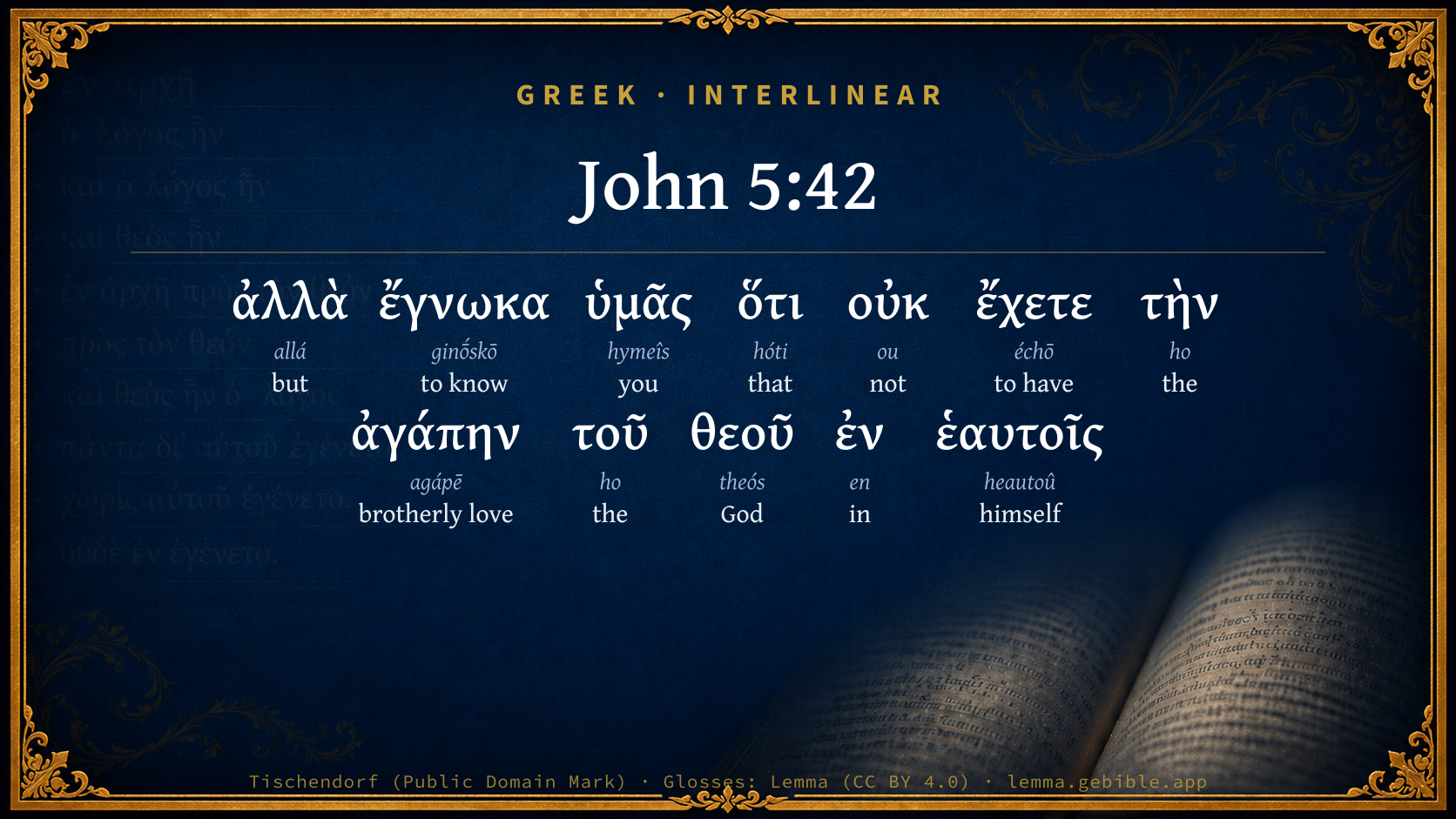
Greek (Tischendorf 8th ed.) John 5:42 appears in the Greek New Testament. The text above is from the Tischendorf 8th edition. Each word links to its Strong’s number and a concise gloss. Click any word for its full Thayer’s Greek Lexicon entry.
Download image
Cite this verse

John 5:42 (World English Bible). Public Domain. Lemma interlinear Bible study tool, https://lemma.gebible.app/v/john/5/42.

Show BibTeX & RIS
BibTeX
RIS
English Translation
But I know you, that you don't have God's love in yourselves.
World English Bible · Public Domain
Download a study sheet

One document with this verse’s original text, its word-by-word gloss line, the meaning frame, cross-references with their text, attributed commentary, and full source and license credits — printable, and it pastes into notes with its structure intact.

This verse Autodidact and up

Study sheet (.html) Plain text (.txt)

A passage Seminary Student

Up to 50 verses in one chapter. A passage sheet keeps up to 6 commentary sources and 12 cross-references per verse, in the order this page ranks them, and says so on the sheet whenever that leaves anything out. Ask for a single verse and you get the Autodidact verse sheet above.

Everything on this page stays free to read, with no account — the sheet is a download of what is already on screen, not access to it.

Want to remove ads? Support Godless Engineer
Compare translations 3

The same verse in 3 English versions, stacked beneath the original-language interlinear above. Click any original word for its lexicon entry.

Each is an independent rendering of the whole verse — the interlinear is not word-aligned to these translations.

Highlighted words mark where these versions differ — a whole-verse word diff, not a word-by-word alignment.

  • World English Bible Public Domain
    But I know you, that you don't have God's love in yourselves.
  • King James Version Public Domain
    But I know you, that ye have not the love of God in you.
  • unfoldingWord Literal Text CC BY-SA 4.0
    but I know you, that you do not have the love of God in yourselves.

unfoldingWord Literal Text — © unfoldingWord, licensed CC BY-SA 4.0. Word-aligned USFM3 via Door43 (git.door43.org/unfoldingWord/en_ult).

Versions to compare (up to 4)

3 of 4 selected

Show all 19 translations

Every available English version of this verse, each an independent rendering of the whole verse.

  • World English Bible Public Domain
    But I know you, that you don't have God's love in yourselves.
  • Berean Standard Bible Public Domain
    but I know you, that you do not have the love of God within you.
  • Majority Standard Bible Public Domain
    but I know you, that you do not have the love of God within you.
  • King James Version Public Domain
    But I know you, that ye have not the love of God in you.
  • American Standard Version (1901) Public Domain
    But I know you, that ye have not the love of God in yourselves.
  • Revised Version (1885) Public Domain
    But I know you, that ye have not the love of God in yourselves.
  • Geneva Bible (1599) Public Domain
    But I know you, that ye haue not the loue of God in you.
  • Douay-Rheims (1899) Public Domain
    But I know you, that you have not the love of God in you.
  • Young's Literal Translation Public Domain
    but I have known you, that the love of God ye have not in yourselves.
  • Literal Standard Version CC BY-SA 4.0
    but I have known you, that you do not have the love of God in yourselves.
  • Unlocked Literal Bible CC BY-SA 4.0
    but I know that you do not have the love of God in yourselves.
  • unfoldingWord Literal Text CC BY-SA 4.0
    but I know you, that you do not have the love of God in yourselves.
  • Darby Bible Public Domain
    but I know you, that ye have not the love of God in you.
  • World Messianic Bible Public Domain
    But I know you, that you don’t have God’s love in yourselves.
  • Webster's Bible Public Domain
    But I know you, that ye have not the love of God in you.
  • Free Bible Version CC BY-SA 4.0
    —I know you, and that you don't have God's love in you.
  • Bible in Basic English Public Domain
    But I have knowledge of you that you have no love for God in your hearts.
  • Text-Critical English NT CC BY 4.0
    But I know that you do not have the love of God within you.
  • Tyndale New Testament (1534) Public Domain
    But I knowe you that ye have not the love of God in you

Literal Standard Version (2020), Covenant Press — licensed CC BY-SA 4.0. Text via the HelloAO Bible API (eBible.org). Unlocked Literal Bible (unfoldingWord) — licensed CC BY-SA 4.0. Text via the HelloAO Bible API (eBible.org). unfoldingWord Literal Text — © unfoldingWord, licensed CC BY-SA 4.0. Word-aligned USFM3 via Door43 (git.door43.org/unfoldingWord/en_ult). Free Bible Version, Dr. Jonathan Gallagher — licensed CC BY-SA 4.0. Text via the HelloAO Bible API (eBible.org).

Word by word

More ways to search: Search by grammar → Find every occurrence → Compare this word →

Practice this passage: Drill this verse → Learn its vocabulary →

About this verse

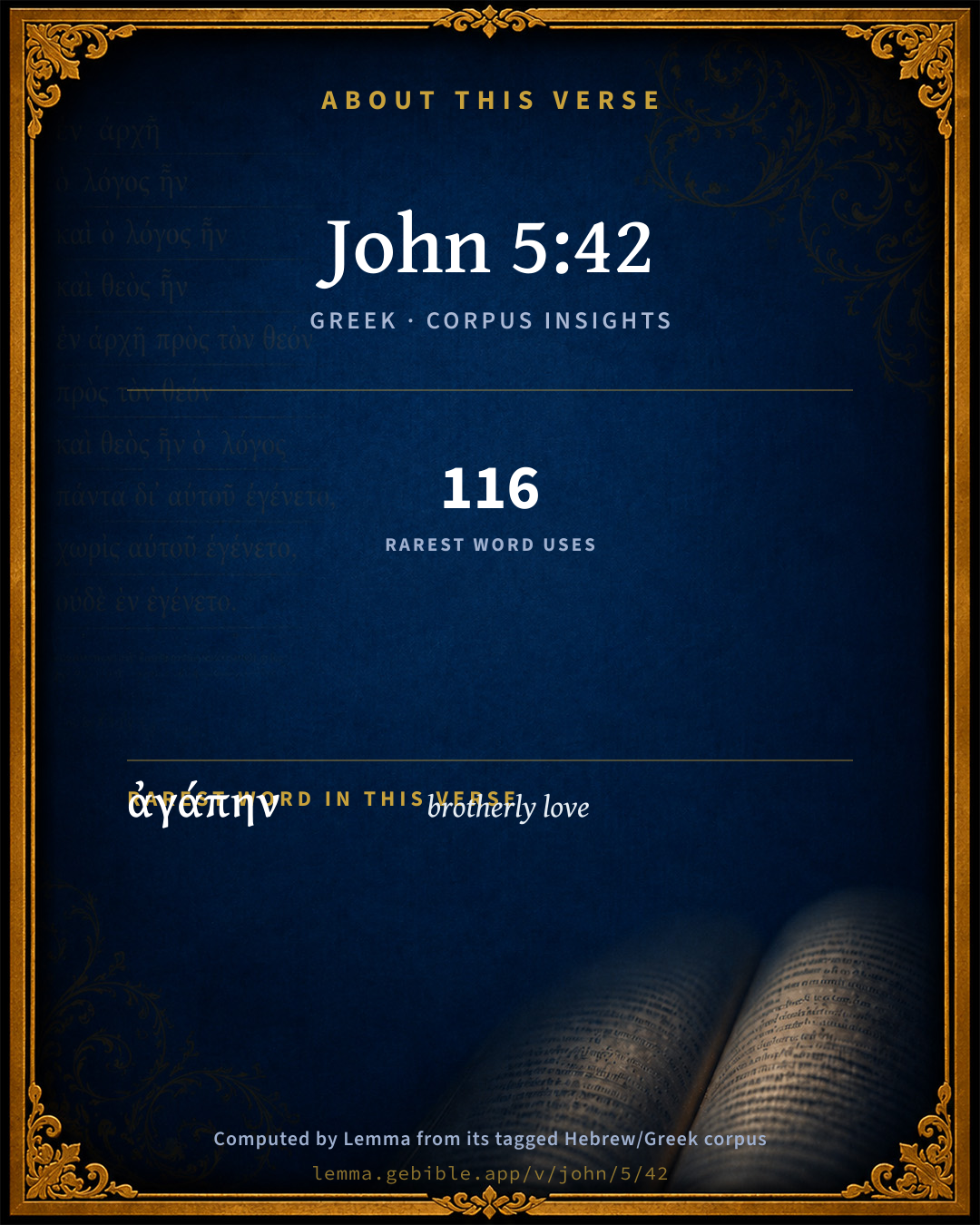
These counts appear in no published source. They are computed here, from the morphology-tagged text and Lemma’s own curated glosses. What Lemma adds →

12
words
11
distinct lemmas
Gospels
section

Repetition

A word recurs within this verse:

Cross-references

15

Topical passages linked to John 5:42 in the Treasury of Scripture Knowledge — connected by theme and wording, ordered by reader-vote popularity; previews shown in the World English Bible.

  • 1 John 4:20 If a man says, "I love God," and hates his brother, he is a liar; for he who doesn't love his brother whom he has seen, how can he love God whom he has not seen?
  • John 2:25 and because he didn't need for anyone to testify concerning man; for he himself knew what was in man.
  • Romans 8:7 because the mind of the flesh is hostile towards God; for it is not subject to God's law, neither indeed can it be.
  • 1 John 2:15 Don't love the world, neither the things that are in the world. If anyone loves the world, the Father's love isn't in him.
  • 1 John 3:17 But whoever has the world's goods, and sees his brother in need, and closes his heart of compassion against him, how does the love of God remain in him?
  • John 8:47 He who is of God hears the words of God. For this cause you don't hear, because you are not of God."
  • Luke 16:15 He said to them, "You are those who justify yourselves in the sight of men, but God knows your hearts. For that which is exalted among men is an abomination in the sight of God.
  • John 1:47–49 Jesus saw Nathanael coming to him, and said about him, "Behold, an Israelite indeed, in whom is no deceit!"
  • John 5:44 How can you believe, who receive glory from one another, and you don't seek the glory that comes from the only God?
  • John 8:42 Therefore Jesus said to them, "If God were your Father, you would love me, for I came out and have come from God. For I haven't come of myself, but he sent me.
  • John 8:55 You have not known him, but I know him. If I said, 'I don't know him,' I would be like you, a liar. But I know him, and keep his word.
  • John 15:23–24 He who hates me, hates my Father also.
  • John 21:17 He said to him the third time, "Simon, son of Jonah, do you have affection for me?" Peter was grieved because he asked him the third time, "Do you have affection for me?" He said to him, "Lord, you know everything. You know that I have affection for you." Jesus said to him, "Feed my sheep.
  • Hebrews 4:12–13 For the word of God is living, and active, and sharper than any two-edged sword, and piercing even to the dividing of soul and spirit, of both joints and marrow, and is able to discern the thoughts and intentions of the heart.
  • Revelation 2:23 I will kill her children with Death, and all the assemblies will know that I am he who searches the minds and hearts. I will give to each one of you according to your deeds.

Cross-references courtesy of OpenBible.info (CC BY 4.0).

Commentary

Notes on John 5:42 from classic Christian and Jewish commentators (each source and its license shown beneath its notes). The classic Christian expositions comment on the surrounding passage and are grouped to its opening verse, so a note may address several verses; the Jewish commentaries on the Tanakh (Rashi and others) are per-verse, so they appear only where the commentator wrote on this verse.

Lemma curates 59 commentaries, every one of them public domain or Creative Commons licensed, each selected and text-cleaned for this edition rather than reprinted as found. About our sources →

The Biblical Illustrator

Joseph S. Exell

Joh_5:42

Ye have not the love of God in you

The sin of not loving God

I.

WHAT IS IT TO LOVE GOD? Hereunto is required

1. Knowing of Him.

2. Our choosing Him as our portion and sovereign good Deu_26:17; Psa_16:5; Psa_73:26).

3. Our exercising all the acts of love towards Him.

(1) Good will.

(2) Desire of union.

(3) Complacency.

II. HOW ARE WE TO LOVE GOD?

1. With all our hearts (Deu_6:5; Mat_22:37).

2. Above all things (Mat_10:37; Luk_14:26).

3. At all times. Because

(1) Of the infinite perfections of goodness in Himself.

(2) Of His infinite expressions of goodness towards us.

III. HOW DOES IT APPEAR TO BE SIN NOT TO LOVE GOD? Because

1. God has commanded it (Deu_6:5).

2. We have so many obligations to love Him.

3. The want of this turns everything else to sin.

IV. WHO ARE GUILTY OF THIS SIN?

1. They that acknowledge Him not.

2. That think not of Him (Psa_119:97).

3. That long not after Him (Psa_73:25).

4. That rejoice not in Him.

5. That love anything as much or more than Him (Luk_14:26).

6. That love not His (1Jn_4:12; 1Jn_5:1).

7. That do not endeavour to be reconciled to Him.

8. That do not obey Him (Joh_14:15).

V. MOTIVES TO LOVE GOD.

1. It is the first and great command (Mat_22:38).

2. We can perform no duty aright without it (1Co

13:1).

3. It will make all other duties easy and pleasant.

4. Consider how infinitely God deserves our love for what He is in Himself; and also for what He is to us. He

(1) Made us;

(2) Maintains us;

(3) Protects us;

(4) Redeemed us;

(5) Sanctifies us;

(6) Prepares heaven for us.

5. If we love God all things shall work together for our good.

(Bp. Beveridge.)

Marks of the love of God

I. In suggesting various MARKS by which you may ascertain whether you love God or not, I would mention

1. The general bent and turn of your thoughts when not under the immediate control of circumstances. These afford clear indications of the general temper and disposition. It is impossible that such a Being should be absent long from your thoughts unless you are decidedly indifferent to

Divine things; the charge against the ungodly is that God is not in all their thoughts. Consider this, ye that forget God.

2. How you stand disposed to the exercises of religion: if God is the Object of your love you will gladly avail yourselves of the opportunities for cultivating a closer friendship with Him.

3. How you stand affected towards His Word. We can derive no just thoughts of God but from that. All, therefore, who sincerely love Him study that. How I love Thy law; it is my meditation all the day. A neglected Bible is an unambiguous sign of an unsanctified heart.

4. With what sentiments do you regard the people of God? If you do not love the image which you see, how can you love the unseen original?

5. Consider the disposition you entertain toward the Son of God. If ye had loved the Father, ye would have loved Me also.

6. Examine how you are affected by His benefits. These are so numerous and distinguished that they ought to excite our gratitude; and yet are they the only benefits we receive without thankfulness.

7. In what manner are you impressed with a sense of your sins?

8. How are you affected towards this world?

II. Supposing a conviction to be produced that you bare not Gods love in you, let me make the proper IMPROVEMENT.

1. It should be accompanied by deep humiliation.

2. Let this humiliation be accompanied with concern and alarm.

3. This is an awful, but not a helpless state. Jesus is the way to the Fathers heart. (Robert Hall.)

The absence of the love of God

There are some charges which cannot be advanced without exciting the strongest feelings, such as cowardice and falsehood. And yet there are graver charges which excite no emotion, or, if perchance the conscience be aroused to the sense of their truth, anodynes are applied and men return to recklessness and indifference. It was so with the Jews and the allegation of the text, and it is so to-day. Observe

I. THAT THE LOVE OF GOD IS THE PRINCIPLE WHICH OUGHT TO ACTUATE ALL HIS INTELLIGENT CREATURES. Deu_6:1-6 six times repeated and confirmed by JesusChrist.

2. Gods revelations of His character and proceedings, show the reasonableness of this command, for they show His love for the purpose of making us happy. Contemplate

(1) Providence.

(2) The scheme of grace.

3. This should lead us to recognize His claim upon our love.

II. THAT THERE ARE MULTITUDES OF THE HUMAN RACE WHO ARE DESTITUTE OF THE LOVE OF GOD.

1. This is proved from Scripture. How multiplied are the charges against men that they forsook God, departed from, hated, denied Him! Christ said, They have both seen and hated Me and My Father, and Paul, that they are haters of God.

2. This will always be the case where men are left to the influence of their own minds without the counteracting principle of Divine grace.

3. This accounted for by mans fall, which introduced in the human mind a dislike to God and His commandments (Rom_8:7-8).

III. THAT THERE ARE SIGNS BY WHICH THE ABSENCE OF THE LOVE OF GOD MAY BE DETECTED.

1. A rejection of the Divine testimony respecting the Person and work of the Son (see the whole context).

2. The infraction of the judicial or moral commandments of the law Joh_14:21, etc.).

3. Inordinate desires for and pursuit after worldly gain (Mat_6:24; Mat_19:16, etc.; 1Jn_2:15-17; Jam_4:4).

4. Destitution of true practical kindness towards other men (1Jn_3:14, etc.; 4:7, 12, 19).

IV. THAT THOSE WHO ARE DESTITUTE OF THIS LOVE ARE LIVING IN AN AWFUL STATE WITH REGARD TO THEIR ETERNAL INTERESTS. The absence of the love of God

1. Abandons man to the dominion of those passions whose uniform tendency is the production of abasement and sorrow.

2. Excludes men from the favour of God and exposes them to future punishment. (J. Parsons.)

The emptiness of natural virtue

1. Jesus knew what was in man, had a faculty of perceiving what lay under a semblance that would have imposed on other men.

2. In the exercise of this faculty Jesus came forth with the utterance of the text. He saw, in spite of their zeal for the Sabbath and Gods honour, that the Jews had not the love of God in them.

3. It is mortifying to the man who possesses many accomplishments of character to be told that the most essential accomplishments of a moral being is that in which he has no share, and wanting it, he wants not merely obedience to the first and greatest commandment, but the impregnating quality of all acceptable obedience.

4. There is no more useful exercise than that of carrying round this conviction amongst all conditions of humanity. The pride of the Pharisees was opposed to such a demonstration, nor do men of taste, feeling, and morality understand how they should require the same treatment in preparing them for immortality with the profligate.

5. But the Bible everywhere groups men into two classes, with one clear line of demarcation between them, and this we can find out to be in accordance with the actual exhibition of human nature. There are men who do and men who do not possess this love of God.

I. TAKE AN EXTREME CASE, A MORAL MONSTER, who, in addition to every other vicious feeling and practice, can steel his heart against the atrocity of murder. We have no difficulty in assigning his place. It were a monstrous supposition that the love of God were to be found in him.

II. DETACH FROM HIM ONE OFFENSIVE FEATURE. He recoils from murder. Has he thereby become a spiritual man? Is the difference assigned to him due to the love of God? Your consciousness will tell you that the heart has constitutional feelings unaccompanied by any reference to even the existence of God.

III. H this natural recoil from murder be experienced by the man who has no love to God, why may it not be carried further and yet the same love be absent? LET THERE BE THEN A FURTHER TRANSFORMATION. Endow the man with natural tenderness and make him a fair every-day character. Still he only constitutionally revolts from crime without any movement of affection towards God.

IV. PROCEED IN THIS WORK. Conceive of an exquisite softening of affection and tenderness over the whole character. Do these refined sensibilities constitute a spiritual man? The feeling heart if unaccompanied by the love of God is no better evidence than the circulation of the blood.

V. GO STILL FURTHER. Let the heart be filled with upright and honourable principles. But there is a principle of honour in the human mind apart altogether from any reference to God.

VI. But it may be asked, WHAT BETTER EVIDENCE CAN BE GIVEN OF OUR LOVE TO GOD THAN THE EXISTENCE AND PRACTICE OF THESE VIRTUES? It takes us to the bottom of this delusion to observe that though the religious principle can never exist without virtuous conduct, yet such conduct may be due

1. To natural disposition.

2. To a perception of its beauty.

3. To secure friendships.

4. To a perception of it as part of a fashionable deportment.

But it is only when he is virtuous, because it is a prescription of Divine law that there is any religion in it. If you do what is virtuous because God tells you, then only do you give an example of the authority of religion over your practice. God cannot reward you in the capacity of Master when His service is not the principle of it, nor as Judge when your virtue has no reference to His law. And the highest sense of duty towards society will not be received as an atonement for wanting a sense of duty to God. He gave you your virtuous faculties and provided a sphere for their exercise, yet you do not love Him. Conclusion:

1. Virtue without religion, from the want of an adequate motive, is at best imperfect and breaks down under the severe pressure of temptation. Christian virtue sustained by the love of God is invincible, perpetual, permanent.

2. If Scripture and all experience are on the side of our text, should not this be turned by each of us to personal account?

3. The love of God may be, and can only be, shed abroad in the heart by the Holy Ghost. (T. Chalmers, D. D.)

Anathema Maranatha

(in conjunction with 1Co_16:22):--Our Lord is remonstrating with the Jews for their desire to slay Him. By taking His life they would be taking their own (Joh_5:40). This was attempted under the pretence of love to God. Our Lord here exposes its hollowness. The other verse is a prediction of the inevitable consequence of impenitence. In 1Co_12:3 Paul tells us that the Jews called Jesus Anathema, i.e., a person devoted to destruction. How He turns their doctrine upon them! It is not Jesus who shall be destroyed, but those who do not love Him.

I. THE MIND DELIGHTS IN SOME SPECIFIC AND ABSORBING PURSUITS, and the range of its search will widen, and its standard rise in proportion to the purity, reverence, and the devoutness of the desire.

II. THIS TENDENCY FINDS ITS REWARD IN THE CONTEMPLATION OF THE HIGHEST GOOD. Finite intelligence can rest only in its infinite source.

III. THE PATHWAY TO SUCH AN ISSUE IS OPENED IN THE GOSPEL.

1. With unobtrusive step. There is no vulgar ceremonial, no wild or harsh Eureka.

2. With surprising grace.

3. With convincing luminousness. Christ is the Way, the Truth, and the Life.

4. With unembarrassed access. Willinghood is the only condition. The Spirit and the Bride say, Come.

IV. THE REVELATION WHICH THE GOSPEL MAKES IS THE GREAT MORAL TRIBUNAL AND TEST.

1. It tries our estimate of law. He who underrates the gospel lowers the standard of the law. A low estimate of moral law means a low estimate of God.

2. It tests our reverence for God. The mind which shrinks from the obligations of the gospel is deficient in its veneration for the Supreme.

3. It tests our susceptibility to transcendent worth. Without a sense of our utter worthlessness there can be no appreciation of Christ. Any sense of personal righteousness detracts from our estimate of His. Just as a man dwindles in His own esteem Christ rises and expands. Christ came not to dower the rich and cleanse the pure, but to enrich the poor and wash the filthy.

V. TO SET THIS GOSPEL AT NAUGHT IS TO BE LEFT WITHOUT EXCUSE.

1. Unless we can find a substitute; but all substitutes hitherto have been like the cup of Tantalus. Read the Transactions of the British Association beside a sick bed, or take them as a light to the feet, and where is your consolation?

2. Unless we can silence clouds of witnesses. Could a lie have filled the martyr with new faith?

3. Unless we can do all this without misgiving.

4. But to yield to this gospel is to pass within the range of everlasting love. (A. Mursell.)

Love the supreme test

As a man loveth so he is; for the lover is in the thing loved, more properly than in himself: wherefore, if a man love earthly things, he may be called an earthly man; but if he love heavenly things, or God, he may be called an heavenly or a godly man. Therefore love God and heavenly things, for undoubtedly that is the best and most assured love; for they be, and ever shall be, permanent; and all earthly things be soon vanished and ended; and so the love of them is in vain (1Jn_2:15-17). (Dean Colet.)

The tests of love

1. We take delight in pleasing the object of our affection.

2. We delight in the society and conversation of those we love.

3. We naturally prize the approbation of one whom we love.

4. We have reference to the feelings of one whom we love, in all our conduct.

5. We naturally love to think of the object of our affection.

6. We delight in conversing about an object of our affections.

7. We are pained when separated from those we love.

8. We naturally love the friends of the object of our affection.

9. We naturally avoid the enemies of our friends.

10. We are grieved when our best friend is abused in our presence.

11. We are naturally credulous and pleased if we hear any good of those we love.

12. We love to see means used to promote the interest and happiness of those we love.

13. It is difficult for us to believe an evil report of one whom we love.

14. When we are compelled to believe an evil report of the object of our affection, we are careful not to give it unnecessary publicity.

15. We naturally try to put the most favourable construction upon any event that might be injurious to the interest or reputation of a friend whom we love.

16. When any of the friends of one whom we greatly love fall into any conduct that is greatly dishononrable to the object of our affection, it distresses us, and we are disposed, as far as possible, to prevent a repetition of the event.

Nothing is more common than for impenitent sinners to affirm that they do love God; and yet nothing is more certain than that they do not love Him. (C. G.Finney.)

The world does not love God

I have been reading Chinese books for more than forty years, and any general requirement to love God, or the mention of any one as actually loving Him, has yet to come for the first time under my eye. (J. Legge, D. D.)

The awful charge

I. HERE IS AN AWFUL CHARGE. Ye have not, etc. To whom does this apply?

1. To those who are habitually unmindful of Him. Our thoughts as naturally follow the object of our regard as the needle the loadstone. Says David, I love Thee, O Lord, my strength. Observe what follows: How precious are Thy thoughts unto me, etc. But of the wicked it is said, God is not in all their thoughts.

2. To those who do not trust in Him. We cannot confide in one we dislike, and we know not how to distrust one whom we truly esteem.

3. To those who are unconcerned for His honour and interest. Is our friend misrepresented? We naturally stand forth in his defence; we could not see him injured or wronged without pain, and Without endeavouring to have him righted. But what lamentable unconcern do we witness for God and the things of God!

4. To those who are indifferent about His presence and favour. We value the regard of those who are dear to us.

II. CONSIDER THEIR SIN AND DANGER. God has the highest claims to our love, and not to love Him is a sin of no ordinary magnitude.

1. It is a most comprehensive sin. Love is the fulfilling of the whole law, and hence the want of it is a sin which violates the whole law. It is the want of everything that is morally good, the root of all evil, the spring or root of all disobedience.

2. It is a most inexcusable sin. For can any plead want of ability? Is not the passion of love implanted in our nature?

3. It is a most ruinous and destructive sin. All who die without love to God must be excluded from His presence, shut out from His kingdom.

Apply the subject

1. To those who are destitute of this love. Humble yourselves before God.

2. To those whose love to God is low and languid. Let them seek to have it revived and invigorated by a contemplation of the Divine excellencies--grace and love--as displayed in the great Mediator.

3. To those whose love to God is increasing. If any man love God, the same is known of him. (The Evangelist.)

The Biblical Illustrator, edited by Joseph S. Exell (c. 1880s–1900s) — public domain. Text from a community e-Sword module.

Tyndale Open Study Notes

Tyndale Open Resources

5:42 Jesus charged that the Jewish leaders did not have God’s love within them. Without God’s love, it was impossible for them to understand the things he was doing.

Tyndale Open Study Notes — © Tyndale Open Resources, licensed CC BY-SA 4.0. Text via the HelloAO Bible API.

Bengel's Gnomon

Johann Albrecht Bengel

Joh 5:42. Ἔγνωκα ὑμᾶς, I have you in my knowledge [I know you]) By this ray of light He penetrates the hearts of His hearers. He means this: I know [novi, οἶδα] the Father, Joh 5:32, “There is another that beareth witness of Me, and I know that the witness which He witnesseth of Me is true;” and I have known [cognovi, I am aware] that you are strangers to Him. Jesus spake this with great compassion. It is not for My sake, but for yours, He saith, I grieve.—ἀγάπην, the love) by which I am recognised as the Son of the Father’s love, Joh 5:20, “the Father loveth the Son,” and which would teach you to seek glory from God alone. [Things divine are not distinguished from things alien to God, save only by this love: Joh 5:43, “I am come in My Father’s name, and ye receive Me not; if another shall come in his own name, him ye will receive.”—V. g.]—ἐν ἐαυτοῖς, in yourselves) This expression has an emphasis, and contains the cause why the Jews need to be sent back [referred] to the men, who in Scripture testify concerning Christ.

Bengel's Gnomon of the New Testament — English translation (T&T Clark, Edinburgh, 1860) — public domain. Text from a community e-Sword module.

Expositor's Greek Testament

ed. W. Robertson Nicoll

Joh 5:42 . ἀλλʼ ἔγνωκα … but I know you, etc.; that is, I know why you do not receive me; the reason is that you have not the love of God in yourselves, and therefore cannot appreciate or understand one who acts in concert with God; if therefore they did offer Him homage, it could not be God in Him they worshipped (Holtzmann). [The motive of Jesus in making His claims is a subject inviting inquiry and full of significance.]

The Expositor's Greek Testament, edited by W. Robertson Nicoll (1897–1910) — public domain. Text from a community e-Sword module.

Geneva Bible (1599)

Geneva Bible translators

Love toward God.

Geneva Bible (1599) marginal notes — public domain. Text via Bolls.life.

Jamieson, Fausset & Brown

Robert Jamieson, A. R. Fausset & David Brown

not the love of God in you--which would inspire you with a single desire to know His mind and will, and yield yourselves to it, in spite of prejudice and regardless of consequences.

Jamieson, Fausset & Brown — Commentary Critical and Explanatory on the Whole Bible (1871) — public domain (CC PDM 1.0). Text via the HelloAO Bible API.

Adam Clarke's Commentary

Verse 42. But I know you, that ye have not, c.] Don't say that you oppose me through zeal for God's honour, and love for his name, because I make myself equal to him: no, this is not the case. I know the dispositions of your souls and I know ye have neither love for his name, nor zeal for his glory. Incorrigible ignorance, and malicious jealousy, actuate your hearts. Ye read the Scriptures, but ye do not enter into their meaning. Had you been as diligent to find out the truth, as you have been to find out allegories, false glosses, and something to countenance you in your crimes, you would have known that the Messiah, who is equal with God, must be the Son of man also, and the inheritor of David's throne; and that the very works which I do are those which the prophets have foretold the Messiah should perform. See Da 7:13-14; Isa 9:6-7; Isa 11:1-5, Isa 11:10; Isa 35:4-6.

Adam Clarke's Commentary on the Bible (1810–1826) — public domain. Text from a community e-Sword/MySword module.

John Calvin's Commentaries

42. That you have not the love of God in you. The love of God is here put for all religious feelings; for no man can love God without beholding him with admiration and submitting entirely to his authority; as, on the other hand, when the love of God does not prevail, there can be no desire to obey him. That is the reason why Moses gives this as the summary or recapitulation (ἀνακεφαλαίωσις) of the Law:

thou shalt love the Lord thy God with all thy heart, and with all thy soul, and with all thy might, (Deuteronomy 6:5.)

John Calvin's Commentaries (1540-1563) — public domain. Text from the Calvin Translation Society English edition (1840s-50s) via the Christian Classics Ethereal Library (ccel.org). Calvin's coverage is partial (roughly two-thirds of the Bible); uncommented books and verses are honest gaps, never fabricated. The 19th-century editor's footnotes and remarks are omitted so the notes are faithfully Calvin's own voice.

Ellicott's Commentary for English Readers

(42) Ye have not the love of God.—The principle which excludes the seeking honour from men, is the love of God. They were, they said, jealous for God’s honour. The first precept of the Law, and the foundation of the Theocracy, was the love of God. This every Jew professed, and bound round brow and arm the holy texts which declared it (Deu_6:4-9; Deu_11:13-21). The Pharisees made broad the phylacteries which contained these words (Mat_23:5). They had them without, but they had not the principle within. There were sure marks which He had read in the heart as plain as the letters worn on the body, and therefore knew that they had not the love of God in them.

A Bible Commentary for English Readers, edited by Charles John Ellicott (1878–1897) — public domain. Text from a community e-Sword module.

The Cambridge Bible for Schools and Colleges

gen. ed. J. J. S. Perowne

42. But I know you] Once more Christ appears as the searcher of hearts; comp. Joh_1:47; Joh_1:50, Joh_2:24-25, Joh_4:17-18; Joh_4:48, Joh_5:14.

in you] Or, in yourselves, in your hearts. ‘Thou shalt love the Lord thy God with all thy heart’ (Deu_7:5) was written on their broad phylacteries (see note on Mat_23:5), but it had no place in their hearts and no influence on their lives. It is the want of love, the want of will (Joh_5:40) that makes them reject and persecute the Messiah.

The Cambridge Bible for Schools and Colleges (gen. ed. J. J. S. Perowne; Cambridge University Press, 1878–1918) — public domain. Text from a community e-Sword module.

John Gill's Exposition

I am come in my Father's name,.... Power and authority; by his consent, with his will, and according to a covenant with him: Christ came not of himself, of his own accord, by a separate power and will of his own, but was called, and sent, and came by mutual agree meat; and brought his credentials with him, doing the works and miracles which his Father gave him to finish:

and ye receive me not; notwithstanding this they rejected him as the Messiah, and would not receive him as such; yea, traduced him as an impostor, and a deceiver:

if another shall come in his own name; which some understand of Simon Magus, others of antichrist; rather the false Christs are intended, of whom our Lord speaks, in Mat 24:24, who would rise up of themselves, and not be able to give any proof of their mission; or do anything which might entitle them to the character of the Messiah, or Christ, a name they would take to themselves: and so the Ethiopic version reads, "if another shall come in my name"; saying he is Christ, or the Messiah:

him ye will receive; as thousands of them did receive Barchocab, the false Christ, who rose up some years after in Adrian's time; and even some of their greatest Rabbins, as particularly the famous R. Akiba, who was his armour bearer: and it is easy to observe, that though they were so backward to receive, and so much prejudiced against the true Messiah, they were always forward enough to embrace a false one: and indeed to follow any, that set up himself for a temporal deliverer of them; as the instances of Theudas, and Judas of Galilee, with others, show; see Act 5:36. And the true reason why they rejected Christ was, because he did not appear in outward pomp and glory, nor set up a temporal kingdom, or give out that he would deliver them from the Roman yoke.

John Gill's Exposition of the Whole Bible (1746–1763) — public domain (CC PDM 1.0). Text via the HelloAO Bible API.

Trapp's Complete Commentary

John Trapp

42 But I know you, that ye have not the love of God in you.

Ver. 42. Ye have not the love of God] Though ye pretend zeal for his glory, to your opposing of me, yet there is aliud in titulo, aliud in pyxide. Hypocrites are like Egyptian temples, beautiful without but within, some cat or such like thing to be worshipped.

John Trapp, A Commentary or Exposition upon All the Books of the Old and New Testament (1647–1656) — public domain. Text from a community e-Sword module.

Matthew Poole's English Annotations

You pretend a great deal of religion, and to do many things out of love to God, and a zeal for the glory of God; but though you can cheat others, yet you cannot deceive me: I, that search the heart, and try the reins, and am a witness to your actions, know that, whatsoever you pretend, the true love of God dwelleth not in you; and that is the reason why you do not receive me.

Matthew Poole's English Annotations on the Holy Bible (1683–1685) — public domain. Text from a community e-Sword/MySword module.

Whedon's Commentary on the Bible

Daniel D. Whedon

42. Not the love of God—In its place was an eager hunger for the honour of men; for power, with individual and national aggrandizement.

Daniel D. Whedon (gen. ed.), Commentary on the Old and New Testaments (1874–1909) — public domain. Text from a community e-Sword module.

John Wesley's Explanatory Notes

But I know you - With this ray he pierces the hearts of the hearers. And this doubtless he spake with the tenderest compassion.

John Wesley, Explanatory Notes Upon the Whole Bible (1754–1765) — public domain. Text via the GEBible commentary corpus.

The People's New Testament

B. W. Johnson

42, 43. I know you. He read their hearts. If another shall come. Some false Christ.

B. W. Johnson's The People's New Testament with Notes (1889–1891) — public domain. Electronic text from the Christian Classics Ethereal Library (CCEL) ThML edition.

Cambridge Greek Testament for Schools and Colleges

42. ἔγνωκα. I have come to know and therefore I know: comp. κέκραγα (Joh 1:15), ἥλπικα (Joh 5:45), οἶδα (Joh 5:32). Once more Christ appears as the searcher of hearts; comp. Joh 1:47; Joh 1:50, Joh 2:24-25 (see note), Joh 4:17-18; Joh 4:48, Joh 5:14.

ἐν ἑαυτοῖς. In yourselves, in your hearts. ‘Thou shalt love the Lord thy God with all thy heart’ (Deu 7:5) was written on their broad phylacteries (see note on Mat 23:5), but it had no place in their hearts and no influence on their lives. It is the want of love, the want of will (Joh 5:40), that makes them reject and persecute the Messiah. The phrase ἡ ἀγάπη τ. θεοῦ occurs 1Jn 2:5; 1Jn 3:17; 1Jn 4:9; 1Jn 5:3; elsewhere in the Gospels only Luk 11:42.

Cambridge Greek Testament for Schools and Colleges (Cambridge University Press, 1896; 21 vols, various authors incl. Carr, Maclear, Plummer, Farrar, Lumby, Moule, M. R. James, Simcox) — public domain. Text from a community e-Sword module.

Alford’s Greek Testament

Henry Alford

42.] ἀλλά draws forcibly the distinction, setting Himself and them in strong contrast.

ἔγνωκα ὑμ.] By long trial and bearing with your manners these many generations; and personally also:—“Hoc radio penetrat corda auditorum.” Bengel.

ἀγάπην] Luthardt remarks, perhaps refining somewhat too much,—τὴν ἀγάπην, because “the love which ye ought to have” is imported: τοῦ θεοῦ—“of (for) your God the God of Israel.” So that the words are spoken, not of an ungodly mind in general, but of an absence of that love which God’s covenant people should have for Him. “They would none of Jesus: for they were not true Israelites.” This love, if they had it, would teach them,—the whole heart, and soul, and mind, and strength being given to God,—to seek honour only from Him,—and thus to appreciate the glory which He hath given to His Son, and His testimony concerning Him.

Henry Alford, The Greek Testament (1849–1861) — public domain. Text from a community e-Sword module.

International Critical Commentary

42. ἀλλὰ ἔγνωκα ὑμᾶς, “but I have known you,” sc. with the knowledge that comes from personal experience; cf. 2:24.

ὅτι τὴν ἀγάπην τοῦ θεοῦ οὐκ ἔχετε ἐν ἑαυτοῖς, “that you have not the love of God in yourselves.” In Paul “the love of God” always means the love which God has for man, and “the love of Christ” is the love which Christ has for man. But the usage in Jn. is not so uniform.

ἀγάπη is used 13:35, 15:13 of the love of man for man; in 15:9, 10 of the love of Christ for man; and in 15:10, 17:26 of the love of God for Christ. In the First Epistle, in like manner, in 3:1, 4:9, l0, 16 the thought is of the love of God for man; in 3:16 it is the love of Christ for man; but in 2:5, 15, 3:17, 4:12, 5:3 we must interpret ἡ ἀγάπη τοῦ θεοῦ or the like phrase as signifying the love which man has for God. See on 21:15.

We see, then, that the meaning of ἡ ἀγάπη τοῦ θεοῦ in the present passage must be determined from the context, and we conclude that it must mean the love which men have for God. No doubt, as Abbott argues (Diat. 2040), the phrase in v. 38 τὸν λόγον αὐτοῦ οὐκ ἔχετε ἐν ὑμῖν μένοντα, suggests that as λόγος there is the λόγος that proceeds from God, so ἀγάπη here should mean the love that flows out from God. But it could hardly be imputed for reproach to the Jews that God did not love them. The point of the reproach is that they did not love God, and so were not in spiritual sympathy with One who came ἐν τῷ ὀνόματι τοῦ πατρός. And, as we have seen, this sense of ἡ ἀγάπη τοῦ θεοῦ, sc. the love of man for God, although it is not found again in the Fourth Gospel (but see on 21:15 for the uses of the verb ἀγαπάω), may be amply justified by the language of 1 Jn.

International Critical Commentary — older volumes (1896–1929), various authors — public domain. Text from a community e-Sword module.

Vincent's Word Studies in the New Testament

Marvin R. Vincent

I know [εγνωκα] . See on 2 24.

The love of God. Love toward God. This was the summary of their own law. The phrase occurs elsewhere in the Gospels only in Luk 11:42. In you [εν εαυτοις] . Rev., rightly, in yourselves. Compare Joh 6:53; 1Jo 5:10; Mr 4:17.

Marvin R. Vincent, Word Studies in the New Testament (1887–1900) — public domain. Text from a community e-Sword/MySword module.

Lesson kit

Teaching starters — assembled from the data on this page, not authored interpretation. Every prompt links to the verse data it draws on. Edit before teaching.

John, in the Gospels, opens this verse with 12 words (11 distinct Greek lemmas). Its most distinctive word is agápē (“brotherly love”). A historical commentator’s framing appears above. Read the whole chapter for the surrounding context.

Discussion questions

  1. What does “brotherly love” (agápē) contribute to the verse as a whole?
  2. 1 John 4:20 shares this passage’s theme. How do the two illuminate each other?
  3. “the” occurs 2× in this one verse. What is the effect of the repetition?
  4. These translations render this verse differently. What is at stake in choosing one wording over another?
  5. Reading how The Biblical Illustrator and Tyndale Open Study Notes read this verse, where do the two commentators agree and where do they part?

Things to notice

Reading settings

Reading text

Shown beneath each verse's original-language words.

Old Testament
Old Testament edition

Read the OT as the Masoretic Hebrew (MT) or the Greek Septuagint (LXX).

English shown for the Greek Septuagint (in the Hebrew ↔ Greek comparison).

Comparing translations? Open the Compare panel on any verse page to stack up to four side by side.