
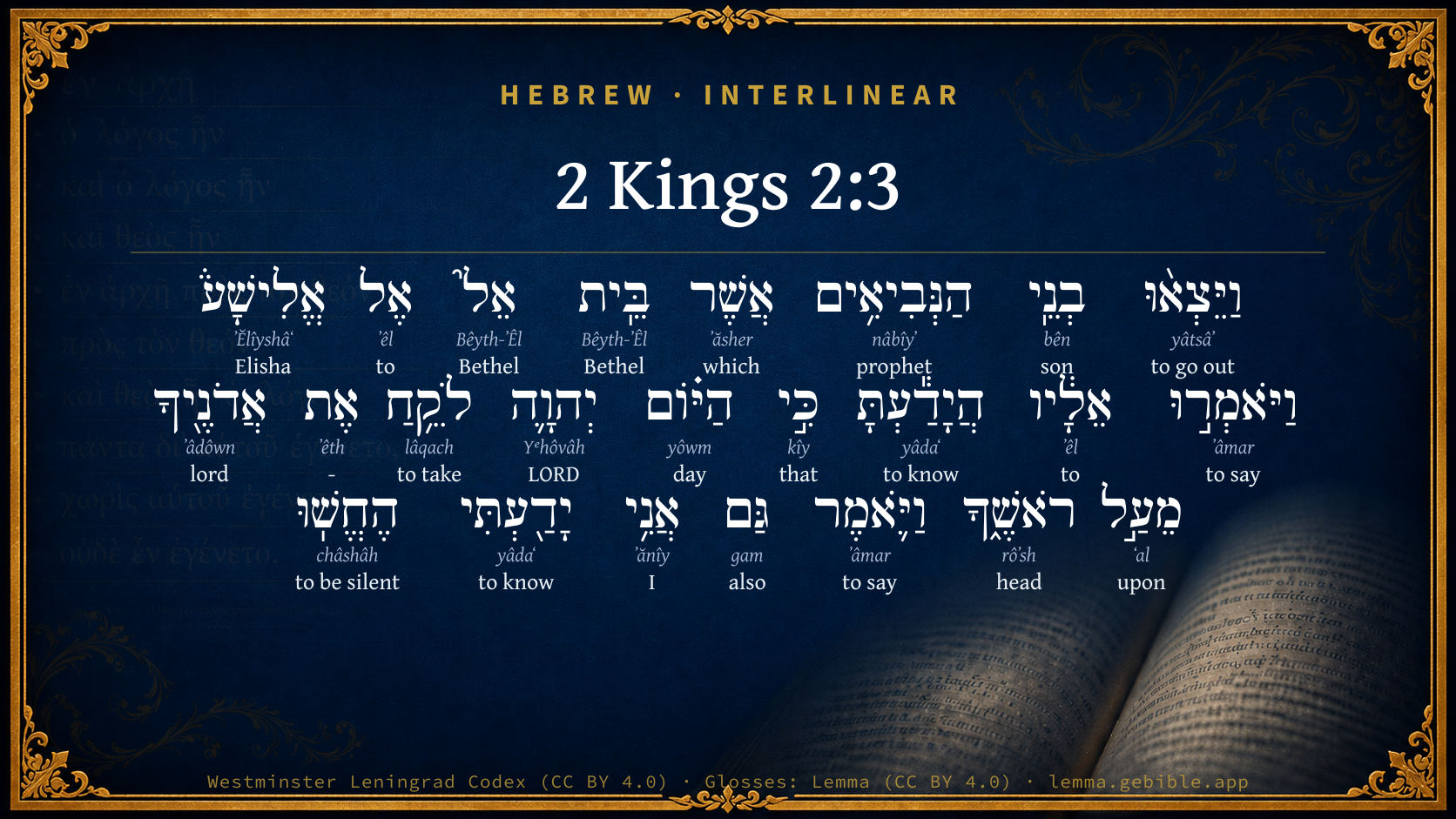
2 Kings 2:3

Hebrew (Westminster Leningrad Codex) 2 Kings 2:3 appears in the Hebrew Old Testament. The text above is from the Westminster Leningrad Codex. Each word links to its Strong’s number, a concise gloss, and parsing drawn from the Open Scriptures Hebrew Bible morphology. Click any word for its full Brown-Driver-Briggs (BDB) entry.
Download image
Cite this verse

2 Kings 2:3 (World English Bible). Public Domain. Lemma interlinear Bible study tool, https://lemma.gebible.app/v/2-kings/2/3.

Show BibTeX & RIS
BibTeX
RIS
English Translation
The sons of the prophets who were at Bethel came forth to Elisha, and said to him, "Do you know that Yahweh will take away your master from your head today?" He said, "Yes, I know it; hold your peace."
World English Bible · Public Domain
Download a study sheet

One document with this verse’s original text, its word-by-word gloss line, the meaning frame, cross-references with their text, attributed commentary, and full source and license credits — printable, and it pastes into notes with its structure intact.

This verse Autodidact and up

Study sheet (.html) Plain text (.txt)

A passage Seminary Student

Up to 50 verses in one chapter. A passage sheet keeps up to 6 commentary sources and 12 cross-references per verse, in the order this page ranks them, and says so on the sheet whenever that leaves anything out. Ask for a single verse and you get the Autodidact verse sheet above.

Everything on this page stays free to read, with no account — the sheet is a download of what is already on screen, not access to it.

Want to remove ads? Support Godless Engineer
Compare translations 3

The same verse in 3 English versions, stacked beneath the original-language interlinear above. Click any original word for its lexicon entry.

Each is an independent rendering of the whole verse — the interlinear is not word-aligned to these translations.

Highlighted words mark where these versions differ — a whole-verse word diff, not a word-by-word alignment.

  • World English Bible Public Domain
    The sons of the prophets who were at Bethel came forth to Elisha, and said to him, "Do you know that Yahweh will take away your master from your head today?" He said, "Yes, I know it; hold your peace."
  • King James Version Public Domain
    And the sons of the prophets that were at Bethel came forth to Elisha, and said unto him, Knowest thou that the LORD will take away thy master from thy head to day? And he said, Yea, I know it; hold ye your peace.
  • unfoldingWord Literal Text CC BY-SA 4.0
    And sons of the prophets who Bethel came out to Elisha, and they said to him, “Do you know that today Yahweh is taking your master from over your head?” And he said, “I, I also know. Be quiet.”

unfoldingWord Literal Text — © unfoldingWord, licensed CC BY-SA 4.0. Word-aligned USFM3 via Door43 (git.door43.org/unfoldingWord/en_ult).

Versions to compare (up to 4)

3 of 4 selected

Show all 18 translations

Every available English version of this verse, each an independent rendering of the whole verse.

  • World English Bible Public Domain
    The sons of the prophets who were at Bethel came forth to Elisha, and said to him, "Do you know that Yahweh will take away your master from your head today?" He said, "Yes, I know it; hold your peace."
  • Berean Standard Bible Public Domain
    Then the sons of the prophets at Bethel came out to Elisha and said, “Do you know that the LORD will take your master away from you today?” “Yes, I know,” he replied. “Do not speak of it.”
  • Majority Standard Bible Public Domain
    Then the sons of the prophets at Bethel came out to Elisha and said, “Do you know that the LORD will take your master away from you today?” “Yes, I know,” he replied. “Do not speak of it.”
  • King James Version Public Domain
    And the sons of the prophets that were at Bethel came forth to Elisha, and said unto him, Knowest thou that the LORD will take away thy master from thy head to day? And he said, Yea, I know it; hold ye your peace.
  • American Standard Version (1901) Public Domain
    And the sons of the prophets that were at Beth-el came forth to Elisha, and said unto him, Knowest thou that Jehovah will take away thy master from thy head to-day? And he said, Yea, I know it; hold ye your peace.
  • Revised Version (1885) Public Domain
    And the sons of the prophets that were at Beth-el came forth to Elisha, and said unto him, Knowest thou that the LORD will take away thy master from thy head today? And he said, Yea, I know it; hold ye your peace.
  • Geneva Bible (1599) Public Domain
    And the children of the Prophets that were at Beth-el, came out to Elisha, and said vnto him, Knowest thou that the Lord will take thy master from thine head this day? And he said, Yea, I knowe it: holde ye your peace.
  • Douay-Rheims (1899) Public Domain
    The sons of the prophets, that were at Bethel, came forth to Eliseus, and said to him: Dost thou know that this day the Lord will take away thy master from thee? And he answered: I also know it: hold your peace.
  • Young's Literal Translation Public Domain
    And sons of the prophets who `are' in Beth-El come out unto Elisha, and say unto him, `Hast thou known that to-day Jehovah is taking thy lord from thy head?' and he saith, `I also have known -- keep silent.'
  • Literal Standard Version CC BY-SA 4.0
    And sons of the prophets who [are] in Beth-El come out to Elisha, and say to him, “Have you known that today YHWH is taking your lord from your head?” And he says, “I also have known—keep silent.”
  • Unlocked Literal Bible CC BY-SA 4.0
    The sons of the prophets who were at Bethel came to Elisha and said to him, “Do you know that Yahweh will take away your master from you today?” Elisha replied, “Yes, I know it, but do not talk about it.”
  • unfoldingWord Literal Text CC BY-SA 4.0
    And sons of the prophets who Bethel came out to Elisha, and they said to him, “Do you know that today Yahweh is taking your master from over your head?” And he said, “I, I also know. Be quiet.”
  • Darby Bible Public Domain
    And the sons of the prophets that were at Bethel came forth to Elisha, and said to him, Dost thou know that Jehovah will take away thy master from over thy head to-day? And he said, I also know it: be silent!
  • World Messianic Bible Public Domain
    The sons of the prophets who were at Bethel came out to Elisha, and said to him, “Do you know that the LORD will take away your master from over you today?” He said, “Yes, I know it. Hold your peace.”
  • Webster's Bible Public Domain
    And the sons of the prophets that were at Beth-el came forth to Elisha, and said to him, Knowest thou that the LORD will take away thy master from thy head to-day? And he said, Yes, I know it; hold ye your peace.
  • Free Bible Version CC BY-SA 4.0
    The sons of the prophets who lived in Bethel came to Elisha and told him, “You do know that the Lord is going to take your master away from you today, don't you?” “Yes, I know,” he replied. “Don't talk about it.”
  • Bible in Basic English Public Domain
    And at Beth-el the sons of the prophets came out to Elisha and said, Has it been made clear to you that the Lord is going to take away your master from over you today? And he said, Yes, I have knowledge of it: say no more.
  • JPS Tanakh (1917) Public Domain
    And the sons of the prophets that were at Beth-el came forth to Elisha, and said unto him: 'Knowest thou that the LORD will take away thy master from thy head to-day?' And he said: 'Yea, I know it; hold ye your peace.' —

Literal Standard Version (2020), Covenant Press — licensed CC BY-SA 4.0. Text via the HelloAO Bible API (eBible.org). Unlocked Literal Bible (unfoldingWord) — licensed CC BY-SA 4.0. Text via the HelloAO Bible API (eBible.org). unfoldingWord Literal Text — © unfoldingWord, licensed CC BY-SA 4.0. Word-aligned USFM3 via Door43 (git.door43.org/unfoldingWord/en_ult). Free Bible Version, Dr. Jonathan Gallagher — licensed CC BY-SA 4.0. Text via the HelloAO Bible API (eBible.org).

Word by word

More ways to search: Search by grammar → Find every occurrence → Compare this word →

Practice this passage: Drill this verse → Learn its vocabulary →

הֶחֱשֽׁוּ
châshâh
H2814
“be silent”
Verb, Hiphil, Imperative, 2nd Person, Masculine, Plural
Part of Speech
Verb
Stem
Hiphil
Form
Imperative
Person
2nd Person
Gender
Masculine
Number
Plural
Full BDB Definition

Origin: a primitive root

TWOT: 768

to be silent, quiet, still, inactive - (Qal) to be silent, be still - (Hiphil) - to be silent, exhibit silence - to show inactivity, be inactive - to make silent, make quiet, cause to be still
  1. וַיֵּצְא֨וּ yâtsâʼ H3318 “and · to go out” Conjunction + Verb, Qal, Sequential Imperfect, 3rd Person, Masculine, Plural
  2. בְנֵֽי bên H1121 “sons of” Noun, Common, Masculine, Plural, Construct
  3. הַנְּבִיאִ֥ים nâbîyʼ H5030 “the · prophets” Particle, Definite Article + Noun, Common, Masculine, Plural, Absolute
  4. אֲשֶׁר ʼăsher H834 “which” Particle, Relative
  5. בֵּֽית Bêyth-ʼÊl H1008 “Bethel” Noun, Proper
  6. אֵל֮ Bêyth-ʼÊl H1008 “Bethel” Noun, Proper
  7. אֶל ʼêl H413 “to” Preposition
  8. אֱלִישָׁע֒ ʼĔlîyshâʻ H477 “Elisha” Noun, Proper
  9. וַיֹּאמְר֣וּ ʼâmar H559 “and · to say” Conjunction + Verb, Qal, Sequential Imperfect, 3rd Person, Masculine, Plural
  10. אֵלָ֔יו ʼêl H413 “to · him” Preposition + Suffix, Personal, 3rd Person, Masculine, Singular
  11. הֲיָדַ֕עְתָּ yâdaʻ H3045 “to know” Particle, Interrogative + Verb, Qal, Perfect, 2nd Person, Masculine, Singular
  12. כִּ֣י kîy H3588 “that” Conjunction
  13. הַיּ֗וֹם yôwm H3117 “the · day” Particle, Definite Article + Noun, Common, Masculine, Singular, Absolute
  14. יְהוָ֛ה Yᵉhôvâh H3068 “LORD” Noun, Proper
  15. לֹקֵ֥חַ lâqach H3947 “taking” Verb, Qal, Participle Active, Masculine, Singular, Absolute
  16. אֶת ʼêth H853 “-” Particle, Direct Object
  17. אֲדֹנֶ֖יךָ ʼâdôwn H113 “lords · your” Noun, Common, Masculine, Plural, Construct + Suffix, Personal, 2nd Person, Masculine, Singular
  18. מֵעַ֣ל ʻal H5921 “from · upon” Preposition + Preposition
  19. רֹאשֶׁ֑ךָ rôʼsh H7218 “head · your” Noun, Common, Masculine, Singular, Construct + Suffix, Personal, 2nd Person, Masculine, Singular
  20. וַיֹּ֛אמֶר ʼâmar H559 “and · to say” Conjunction + Verb, Qal, Sequential Imperfect, 3rd Person, Masculine, Singular
  21. גַּם gam H1571 “also” Particle, Accusative
  22. אֲנִ֥י ʼănîy H589 “I” Pronoun, Personal, 1st Person, Common, Singular
  23. יָדַ֖עְתִּי yâdaʻ H3045 “to know” Verb, Qal, Perfect, 1st Person, Common, Singular

About this verse

These counts appear in no published source. They are computed here, from the morphology-tagged text and Lemma’s own curated glosses. What Lemma adds →

24
words
20
distinct lemmas
Historical
section

Notable vocabulary

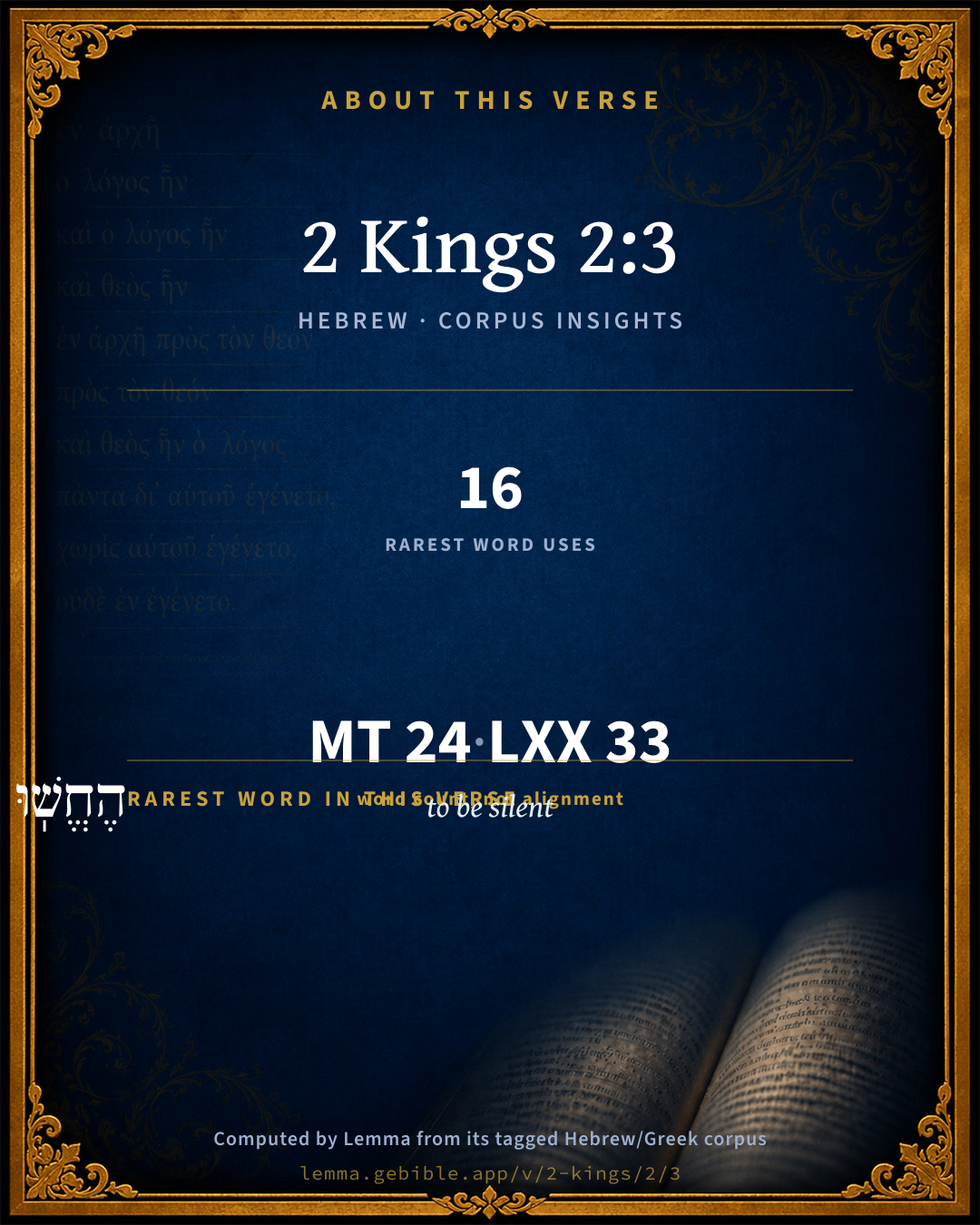
The rarest word here is הֶחֱשֽׁוּ to be silent H2814 — appearing just 16 times in the whole Hebrew Bible.

Shared distinctive vocabulary

הֶחֱשֽׁוּ to be silent H2814 occurs in 16 verses of the Hebrew Bible. Also found in:

Grammatical profile

  • 7 verbs
  • 9 nouns
  • 1 pronoun
  • 3 prepositions
  • 1 conjunction
  • 3 particles

Verb forms

  • וַיֵּצְא֨וּ Qal · Sequential Imperfect
  • וַיֹּאמְר֣וּ Qal · Sequential Imperfect
  • הֲיָדַ֕עְתָּ Qal · Perfect
  • לֹקֵ֥חַ Qal · Participle Active
  • וַיֹּ֛אמֶר Qal · Sequential Imperfect
  • יָדַ֖עְתִּי Qal · Perfect
  • הֶחֱשֽׁוּ Hiphil · Imperative

Repetition

Words recur within this verse — often emphatic in Hebrew:

  • בֵּֽית Bethel H1008 ×2
  • וַיֹּאמְר֣וּ to say H559 ×2
  • הֲיָדַ֕עְתָּ to know H3045 ×2
  • אֶל to H413 ×2

Hebrew & Septuagint length

In English translation the verse runs 40 words from the Hebrew and 44 from the Septuagint (LXX English) — closely comparable.

A rough comparison of the two English renderings, which tokenize alike — not a word-level alignment.

Word counts can differ between the Hebrew and the Greek without any difference in meaning — e.g. the Hebrew direct-object marker אֵת has no separate Greek word, and Greek often adds the article ὁ.

In the original languages it is 24 Hebrew tokens and 33 Greek tokens — but the two are counted differently (Hebrew bundles its prefixes and suffixes into one token; the Greek is in lemma form), so that isn’t a like-for-like length.

Cross-references

14

Topical passages linked to 2 Kings 2:3 in the Treasury of Scripture Knowledge — connected by theme and wording, ordered by reader-vote popularity; previews shown in the World English Bible.

  • 2 Kings 4:1 Now there cried a certain woman of the wives of the sons of the prophets to Elisha, saying, Your servant my husband is dead; and you know that your servant did fear Yahweh: and the creditor is come to take to him my two children to be bondservants.
  • 2 Kings 4:38 Elisha came again to Gilgal. There was a dearth in the land; and the sons of the prophets were sitting before him; and he said to his servant, Set on the great pot, and boil stew for the sons of the prophets.
  • 1 Kings 20:35 A certain man of the sons of the prophets said to his fellow by the word of Yahweh, Please strike me. The man refused to strike him.
  • 2 Kings 9:1 Elisha the prophet called one of the sons of the prophets, and said to him, Gird up your loins, and take this vial of oil in your hand, and go to Ramoth-gilead.
  • 1 Samuel 10:10–12 When they came there to the hill, behold, a band of prophets met him; and the Spirit of God came mightily on him, and he prophesied among them.
  • 1 Samuel 19:20 Saul sent messengers to take David: and when they saw the company of the prophets prophesying, and Samuel standing as head over them, the Spirit of God came on the messengers of Saul, and they also prophesied.
  • 1 Kings 18:4 for it was so, when Jezebel cut off the prophets of Yahweh, that Obadiah took one hundred prophets, and hid them by fifty in a cave, and fed them with bread and water.)
  • 2 Kings 2:5 The sons of the prophets who were at Jericho came near to Elisha, and said to him, "Do you know that Yahweh will take away your master from your head today?" He answered, "Yes, I know it. Hold your peace."
  • 2 Kings 2:7 Fifty men of the sons of the prophets went, and stood over against them afar off: and they two stood by the Jordan.
  • 2 Kings 2:15 When the sons of the prophets who were at Jericho over against him saw him, they said, The spirit of Elijah does rest on Elisha. They came to meet him, and bowed themselves to the ground before him.
  • 2 Kings 5:22 He said, All is well. My master has sent me, saying, Behold, even now there are come to me from the hill-country of Ephraim two young men of the sons of the prophets; please give them a talent of silver, and two changes of clothing.
  • Isaiah 8:18 Behold, I and the children whom Yahweh has given me are for signs and for wonders in Israel from Yahweh of Hosts, who dwells in Mount Zion.
  • Acts 22:3 "I am indeed a Jew, born in Tarsus of Cilicia, but brought up in this city at the feet of Gamaliel, instructed according to the strict manner of the law of our fathers, being zealous for God, even as you all are this day.
  • Deuteronomy 33:3 Yes, he loves the people; All his saints are in your hand: They sat down at your feet; [Everyone] shall receive of your words.

Cross-references courtesy of OpenBible.info (CC BY 4.0).

Hebrew and Greek witnesses Masoretic Hebrew ↔ Greek Septuagint

The same verse in the two great witnesses to the Old Testament, shown verse-for-verse.

These are two independent witnesses, not word-aligned to each other, and the Septuagint is shown in lemma (dictionary) form.

Hebrew 2 Kings 2:3 Masoretic · Westminster Leningrad Codex

וַיֵּצְא֨וּ בְנֵֽי הַנְּבִיאִ֥ים אֲשֶׁר בֵּֽית אֵל֮ אֶל אֱלִישָׁע֒ וַיֹּאמְר֣וּ אֵלָ֔יו הֲיָדַ֕עְתָּ כִּ֣י הַיּ֗וֹם יְהוָ֛ה לֹקֵ֥חַ אֶת אֲדֹנֶ֖יךָ מֵעַ֣ל רֹאשֶׁ֑ךָ וַיֹּ֛אמֶר גַּם אֲנִ֥י יָדַ֖עְתִּי הֶחֱשֽׁוּ

The sons of the prophets who were at Bethel came forth to Elisha, and said to him, "Do you know that Yahweh will take away your master from your head today?" He said, "Yes, I know it; hold your peace."

World English Bible · Public Domain

Greek LXX 2 Kings 2:3 Septuagint · lemma form

καί ἔρχομαι ὁ υἱός ὁ προφήτης ὁ ἐν βαιθηλ πρός ελισαιε καί εἶπον πρός αὐτός εἰ γιγνώσκω ὅτι κύριος σήμερον λαμβάνω ὁ κύριος σύ ἐπάνωθεν ὁ κεφαλή σύ καί εἶπον καΐἐγώ γιγνώσκω σιωπάω

And the sons of the prophets who were in Baethel came to Elisaie, and said to him, Do you know, that the Lord this day is going to take your lord away from your head? And he said, Yes, I know it; be silent.

LXX2012 (modern English Septuagint) · Public Domain

Hebrew: Westminster Leningrad Codex (CC BY 4.0). Greek: Septuagint (public domain); English from LXX2012 (modern English Septuagint) (Public Domain). How the Septuagint differs from the Hebrew →

Targum (Aramaic paraphrase)

1

The Targum is the ancient Jewish Aramaic paraphrase of the Hebrew Scriptures — an interpretive translation, not the Hebrew text itself. Onkelos (literal) and Pseudo-Jonathan (expansive) render the Torah, and Jonathan the Prophets. Coverage is partial: where no permissively-licensed English translation exists for a verse, only the Aramaic is shown. This is verse-level text, not a word-by-word alignment to the Hebrew.

  1. Targum Jonathan Prophets (Joshua–Malachi)
    וּנְפַקוּ תַּלְמִידֵי נְבִיַיָא דִי בְּבֵית אֵל לְוַת אֱלִישָׁע וַאֲמַרוּ לֵיהּ הַיְדַעְתָּא אֲרֵי יוֹמָא דֵין יְיָ דְבַר יַת רִבּוֹנָךְ מֵעַל רֵישָׁךְ וַאֲמַר אַף אֲנָא יָדַעְנָא שְׁתוּקוּ:

    (no public-domain English translation for this verse)

    Targum Jonathan — Aramaic: “Mikraot Gedolot” (public domain). English: “Sefaria Community Translation” (CC0 1.0 (public-domain dedication)); “London "Chaldee Paraphrase," 1871” (public domain). Text via Sefaria.

Commentary

Notes on 2 Kings 2:3 from classic Christian and Jewish commentators (each source and its license shown beneath its notes). The classic Christian expositions comment on the surrounding passage and are grouped to its opening verse, so a note may address several verses; the Jewish commentaries on the Tanakh (Rashi and others) are per-verse, so they appear only where the commentator wrote on this verse.

Lemma curates 59 commentaries, every one of them public domain or Creative Commons licensed, each selected and text-cleaned for this edition rather than reprinted as found. About our sources →

Trapp's Complete Commentary

John Trapp

2Ki 2:3 And the sons of the prophets that [were] at Bethel came forth to Elisha, and said unto him, Knowest thou that the LORD will take away thy master from thy head to day? And he said, Yea, I know [it]; hold ye your peace.

Ver. 3. From thy head,] i.e., To heaven, or from sitting any longer over thy head, as a doctor over his disciples. See Act 22:3. For among the Jews, the Rabbi sat on high, and was called Joshebh, or the sitter; the scholar sat at his feet, or lay along in the dust, called therefore Mithabbek, in token of humility.

Hold ye your peace.] Hinder me not by your discourses from my diligent attendance, lest he be taken away on the sudden, and I not see him.

John Trapp, A Commentary or Exposition upon All the Books of the Old and New Testament (1647–1656) — public domain. Text from a community e-Sword module.

Joseph Benson's Commentary

2Ki 2:3. The sons of the prophets that were at Beth-el — In these very corrupt times God did not wholly forsake the Israelites, but continued the schools of the prophets among them, in which men were trained up and employed in the exercises of religion, and to which good people resorted to solemnize the feasts of the Lord with prayer and hearing portions of the law read, although they had not conveniences for sacrifices, as they had in Judah, where they had priests and Levites, and the temple service. Even in Beth-el, the chief place of idolatry and impiety, where one of the golden calves was worshipped, these schools were not wanting. This was a great testimony of God’s love to that apostate people: among whom he thus left prophets to recover them from their idols. And, what is still more remarkable, prophets of greater eminence for their miracles were continued in Israel than in Judah, because they needed them more, both to turn the idolaters among them from their false worship, and their other vices, and to encourage the truly pious that still remained, and preserve them from being led away by the error of the wicked. Knowest thou not, &c.? — God had revealed to some of them, that Elijah was to be taken away that day, of which they advised Elisha, that he might more diligently attend him. From thy head — Hebrew, from above thy head; which phrase may respect the manner of sitting in their schools, for the scholars used to sit below at their masters’ feet, and the masters above, over their heads, when they taught them. Houbigant renders it, The Lord will elevate thy master above thy head to-day, alluding to his being carried up into heaven. And he said, Yea, I know it, hold ye your peace — Do not aggravate my grief, nor divert me by any unseasonable discourses. He speaks as one who was himself, and would have them to be calm and sedate, and with awful silence waiting the event. Some think he gave them this charge, lest, the extraordinary matter being divulged, there should be a great concourse of people collected about Elijah; for as the Israelites had not renounced their idolatries, notwithstanding that so many and so great miracles had been done among them, they were altogether unworthy of being witnesses of the prophet’s miraculous assumption, even as the Jews in our Lord’s time were of being permitted to be present when he ascended.

Joseph Benson's Commentary on the Old and New Testaments (1811–1818) — public domain. Text from a community e-Sword module.

Geneva Bible (1599)

Geneva Bible translators

That is, from being anymore thine head: for to be as the head, is to be the master, as to be at the feet, is to be a scholar.

So called, because they are begotten as it were anew by the heavenly doctrine.

For the Lord had revealed it unto him.

Geneva Bible (1599) marginal notes — public domain. Text via Bolls.life.

Jamieson, Fausset & Brown

Robert Jamieson, A. R. Fausset & David Brown

take away thy master from they head--an allusion to the custom of scholars sitting at the feet of their master, the latter being over their heads (Act 22:3).

Jamieson, Fausset & Brown — Commentary Critical and Explanatory on the Whole Bible (1871) — public domain (CC PDM 1.0). Text via the HelloAO Bible API.

Adam Clarke's Commentary

Verse 3. Knowest thou that the Lord] Thus we see that it was a matter well known to all the sons of the prophets. This day the Lord will take thy master and instructer from thee.

Adam Clarke's Commentary on the Bible (1810–1826) — public domain. Text from a community e-Sword/MySword module.

Ellicott's Commentary for English Readers

(3) The sons of the prophets.—See Notes on 1Ki_20:35; 1Sa_10:10; 1Sa_19:20. There was a guild of prophets at Beth-el.

Came forth to Elisha.—Who probably walked a little way before his master, to announce his approach.

And said unto him.—The prophetic college had been divinely forewarned of Elijah’s departure.

The Lord will take away . . . to day.—“To day” is emphatic. “Knowest thou that this day Jehovah is about to take away thy lord from beside thee?” The word “head” may signify self, or person, like the word “soul,” and other terms. (Comp. Gen_40:13; 1Sa_28:2; 2Sa_1:16.) Others explain “from over thy head,” i.e., from his position of superiority over thee as thy master and teacher. (See 1Ki_19:21; Act_22:3.) Others again, but very improbably, take the words literally as a reference to Elijah’s ascension, “away over thine head.”

Yea, I know.—Rather, I, too, know.

Hold ye your peace.—Elisha says this, not to prevent the gathering of a crowd to witness the spectacle of Elijah’s departure, nor yet to intimate that his master’s modesty will be shocked by much talk of his approaching exaltation, but simply to suggest that the subject is painful both to him and to his beloved master. The Hebrew term, hehĕshû, imitates the sound, like our “hush!”

A Bible Commentary for English Readers, edited by Charles John Ellicott (1878–1897) — public domain. Text from a community e-Sword module.

The Cambridge Bible for Schools and Colleges

gen. ed. J. J. S. Perowne

3. the sons of the prophets] They were called ‘sons’ in the same way as Elisha calls Elijah ‘father’. See below verse 12. Whether the prophetic body in Gilgal had been warned before Elijah’s departure from them that they would see him no more wé are not told; but it seems highly probable that it was so from what is said of Bethel and of Jericho. Thus Elisha started on his journey prepared for what its end would be.

Beth-el] This was the city which in old time had been called Luz (Jos_18:13) though from one passage (Jos_16:2) there seems to have been a distinction between Bethel and Luz, as though the latter had been the old town, and the former a sacred spot near to it. It lay in the northern part of the tribe of Benjamin, and when the kingdoms were divided and Jeroboam set up the calf-worship in Israel, Bethel was constituted the southern sanctuary. Perhaps it was as a protest against this worship that the sons of the prophets made one of their centres in Bethel. It was at Bethel that the voice of God’s prophet was first raised against Jeroboam’s altar (1Ki_13:1).

came forth to Elisha] The solemn event of which they had been forewarned checks them from addressing Elijah. His thoughts must have been all absorbed in meditation on the revelation which he was so soon to experience, and heaven, not earth, nor the things of earth, was in his mind. Silence when God is so near is the only homage man can pay.

the Lord will take away thy master from thy head to day] We can see from this language that the communion between Elijah and Elisha had been much closer than that which the aged prophet had held with the other sons of the prophets. Hence he is rather spoken of as Elisha’s master, than theirs. This is what we should expect from the special way in which Elisha was appointed (1Ki_19:16). The prophetic bodies were therefore prepared to accept Elisha as their head, when Elijah had been taken away.

hold you your peace] Elisha had marked the solemn and meditative frame of his master’s mind, and would not have it disturbed by any prolonged conversation between himself and the sons of the prophets. He cannot bear the questioning. He thinks of his own weakness and of the terrible burden which will be laid upon him when he is left alone without the friend on whom he has hitherto leaned.

The Cambridge Bible for Schools and Colleges (gen. ed. J. J. S. Perowne; Cambridge University Press, 1878–1918) — public domain. Text from a community e-Sword module.

John Gill's Exposition

And the sons of the prophets that were at Bethel,.... Or the disciples of them, as the Targum; here, though a place where one of Jeroboam's calves was set up, was a school of the prophets, perhaps founded by Elijah as a nursery for religion, and a check upon the idolatry of the times:

came forth to Elisha; out of their college: and said unto him, knowest thou that the Lord will take away thy master from thy head today? who was, as Abarbinel observes, the crown and glory of his head; or else this is said, as generally thought, in allusion to disciples sitting at the feet of their masters, and so they at the head of them; the rapture of Elijah was by a spirit of prophecy revealed unto them:

and he said, yea, I know it; being revealed to him in the same way:

hold your peace: not caring to continue any discourse with them on the subject, that his thoughts, which were intent upon it, might not be interrupted, and that his master might not know that he knew of it, and lest he should be snatched away from him, and he not see him, while discoursing with them.

John Gill's Exposition of the Whole Bible (1746–1763) — public domain (CC PDM 1.0). Text via the HelloAO Bible API.

Albert Barnes' Notes on the Bible

Came forth to Elisha - It does not appear that any interchange of speech took place between “the sons of the prophets” (see the marginal reference note) and Elijah; but independent revelations had been made to the two “schools” at Bethel and Jericho 2Ki 2:5, and also to Elisha, with respect to Elijah’s coming removal.

From thy head - i. e. from his position as teacher and master. The teacher sat on an elevated seat, so that his feet were level with the heads of his pupils (compare Act 22:3).

Hold ye your peace - i. e. “Say nothing - disturb us not. The matter is too sacred for words.”

Albert Barnes' Notes on the Bible (1834–1885) — public domain. Text from a community e-Sword/MySword module.

Haydock's Catholic Bible Commentary

The sons of the prophets. That is, the disciples of the prophets; who seem to have had their schools, like colleges or communities, in Bethel, Jericho, and other places, in the days of Elias and Eliseus. (Challoner) --- Many of these disciples might be also their children. Elias collected some fervent souls together even at Bethel, to preserve the true religion, as much as possible. He visited them before his departure. (Calmet) --- Peace: let not Elias hear us.

George Leo Haydock (1774–1849), Haydock's Catholic Family Bible and Commentary, 1859 edition — public domain. Excludes Psalms (Douay-Rheims chapter numbering differs from Protestant) and Deuterocanonical books (Catholic canon only).

Matthew Poole's English Annotations

The Lord will take away thy master: this was revealed to some of the sons of the prophets, and by them to the whole college.

From thy head, Heb. from above thy head; which phrase may respect, either,

1. The manner of sitting in schools, where the scholar sat at his master’s feet, Deu 33:3; Act 22:3. Or,

2. The manner of Elijah’s translation, which was to be by a power sent from heaven, to take him up thither.

Hold ye your peace; do not aggravate my grief, nor divert me with any unseasonable discourses; that I may digest my sorrow, and prepare myself for so great a stroke, and diligently attend all my master’s steps, lest he be snatched away from me whilst I am talking with you; and that I may beg and obtain some great blessing from him before his departure.

Matthew Poole's English Annotations on the Holy Bible (1683–1685) — public domain. Text from a community e-Sword/MySword module.

Whedon's Commentary on the Bible

Daniel D. Whedon

3. The sons of the prophets that were at Beth-el — Here, at the very place where the calf-worship of Jeroboam was chiefly observed, there existed a school of the prophets. Their zeal and devotion to the true God of Israel perhaps served largely to counteract the prevalent idolatry, and preserve among the hosts of the people a faithful seven thousand. See notes on 1Sa_10:5, and 1Ki_19:18.

Knowest thou — The schools of the prophets, both at Beth-el and Jericho, (2Ki_2:5,) have also a premonition that Elijah is to be taken away. Perhaps, as Kitto suggests, his unusually solemn manner that day, his countenance and conversation more heavenward, and all his demeanour, seemed to say, “Ye shall see my face no more.”

Take away thy master from thy head — That is, from being thy head; thy spiritual father, teacher, leader, and director. The expression, which literally is, taken from over thy head, might also intimate the manner of Elijah’s removal.

Yea, I know — He replies with emphasis, but solemnity. Literally, the Hebrew is, Of course I know; hush!

Daniel D. Whedon (gen. ed.), Commentary on the Old and New Testaments (1874–1909) — public domain. Text from a community e-Sword module.

The Pulpit Commentary

The sons of the prophets that were at Bethel (On the expression, "sons of the prophets," see the comment upon (1Ki_20:35) The institution of the "schools of the prophets," or theological colleges where young prophets were brought up, is usually assigned to Samuel, one of whose habitual residences for a part of the year was Bethel. (1Sa_7:16) Probably he had established a "school" there which continued to this time. Came forth to Elisha, and said unto him. The students did not venture to address the master himself, who was a person of too much dignity to be intruded on; but sought out the servant, to give him a warning of what their prophetic instinct assured them was about to happen. Knowest thou that the Lord will take away thy master from thy head (i.e. from his position as teacher and master) today? There was, perhaps, something a little officious and self-assertive in this question. They might have felt sure, if they had been properly modest, that Elisha would have at least as much prophetic instinct and foresight as themselves. Hence he answers them with something of rebuke: And he said, Yea, I know it literally, I too know ithold ye your peace; or, "Hush do not chatter about what is so sacred; do not suppose that you are wiser than any one else; be a little modest and a little reticent.

Vers. 3, 5, 7.

The sons of the prophets.

It is surely instructive to find, even in godless Israel, these numerous bands of young men, congregated under prophetic oversight, and receiving sacred instruction. The origin of "schools of the prophets" seems traceable to Samuel. (1Sa_19:20) But the order took a new impulse under Elijah. "The companies of the prophets now reappear, bound by a still closer connection with Elijah than they had been with Samuel. Then they were "companies, bands, of prophets;" now they are "sons, children, of the prophets;" and Elijah first, and Elisha afterwards, appeared as the "father," the "abbot," the "father in God," of the "whole community" (Stanley). In the development and fostering of these communities, we see Elijah working with an eye to the future. He takes care that the fruits of his reforming labors shall not be lost, but shall be handed down to after-generations. He provides for the preservation and propagation of his influence. We do well to take a leaf out of his book, and study like means for the creation and consecration of godly influence. Wherever men have desired to perpetuate their principles they have formed schools, clubs, guilds, associations, colleges, and by means of these their teachings have been spread abroad. The infidel clubs of the last century, e.g., spread the principles which led to the French Revolution. The prophetic schools seem to have devoted themselves largely to sacred history, poetry, and music; but taught the pupils also to labor in honest occupations for self-support. Any mode of binding together and instructing the youth of our time, which shall combine religious training and sound education with an inculcation of the principles of honest independence, deserves every support. J.O.

The Pulpit Commentary (1880–1919), ed. H.D.M. Spence-Jones & Joseph S. Exell — public domain. Text from a community e-Sword module.

John Wesley's Explanatory Notes

And said - This was revealed to some of the sons of the prophets, and by them to the whole college. In the kingdom of Judah they had priest and Levites, and the temple service. The want of these in the kingdom of Israel, God graciously made up by these colleges, where men were trained up and employed, in the exercises of religion, and whither good people resorted, to solemnize the appointed feasts, with prayer and hearing, tho' they had not conveniencies for sacrifice. From thy head - Hebrew. from above thy head: which phrase may respect, either, the manner of sitting in schools, where the scholar sat at his master's feet. Or, the manner of Elijah's translation, which was to be by a power sent from heaven, to take him up thither. Hold you your peace - Do not aggravate my grief, nor divert me with any unseasonable discourses. He speaks as one that was himself, and would have them calm and sedate, and with awful silence waiting the event.

John Wesley, Explanatory Notes Upon the Whole Bible (1754–1765) — public domain. Text via the GEBible commentary corpus.

Keil & Delitzsch

C. F. Keil & F. Delitzsch

In Bethel the disciples of the prophets came to meet Elisha, and said to him, "Knowest thou that Jehovah will take thy master from over thy head to-day?" ראשׁ מעל לקח expresses in a pictorial manner the taking away of Elijah from his side by raising him to heaven, like ἐπαίρειν and ὑπολαμβάνειν in Act 1:9-10. Elisha replied, "I know it, be silent," because he knew Elijah's feeling. The Lord had therefore revealed to the disciples of the prophets the taking away of Elijah, to strengthen their faith.

Keil & Delitzsch — Biblical Commentary on the Old Testament (1861–1891) — public domain (CC PDM 1.0). Text via the HelloAO Bible API. (Old Testament only.)

unfoldingWord translationNotes

Door43 World Missions Community

The sons of the prophets

This does not mean that they were the sons of prophets, but rather, that they were a group of prophets. AT: "A group of men who were prophets" (See: Idiom)

As Yahweh lives, and as you live, I will not leave you

"As surely as Yahweh lives and as you live, I will not leave you." Here Elisha compares the certainty that Yahweh and Elijah are alive to the certainty of what he is saying. This is a way of making a solemn promise. See how you translated this phrase in 2 Kings 2:2. AT: "I solemnly promise you that I will not leave you" (See: Simile)

translationWords

son

prophet

lord

Jericho

unfoldingWord translationNotes — © Distant Shores Media and the Door43 World Missions Community, licensed CC BY-SA 4.0. Source: git.door43.org/Door43/en_tn.

Rashi

Rabbi Shlomo Yitzchaki (Rashi)

Your master. But [Scripture does] not [state,] “our master.” This teaches [us] that they were equal to Eliyahu.

Rashi on the Tanakh — English translations: “The Judaica Press complete Tanach with Rashi, translated by A. J. Rosenberg” (CC BY 4.0); “Pentateuch with Rashi's commentary by M. Rosenbaum and A.M. Silbermann, 1929-1934” (public domain); “The Metsudah Tanach series, Lakewood, N.J” (CC BY 4.0); and “The Book of Joshua, Metsudah Publications, 1997” (CC BY 4.0). Text via Sefaria.

Lesson kit

Teaching starters — assembled from the data on this page, not authored interpretation. Every prompt links to the verse data it draws on. Edit before teaching.

2 Kings, in the Historical, opens this verse with 24 words (20 distinct Hebrew lemmas). Its most distinctive word is châshâh (“to be silent”). A historical commentator’s framing appears above. Read the whole chapter for the surrounding context.

Discussion questions

  1. How does “to be silent” (châshâh) shape what this verse is saying?
  2. How does Judges 18:9, which shares the word «to be silent», read alongside this verse?
  3. What does the repetition of “Bethel” (2× in this one verse) do in this verse?
  4. These translations render this verse differently; the difference is in the English rendering, not the original. What questions does that raise?
  5. «וַיֵּצְא֨וּ» is a Qal Sequential Imperfect verb. How does that grammatical form shape the action described?
  6. Compare how Trapp's Complete Commentary and Joseph Benson's Commentary read this verse. Where do they agree or differ?

Things to notice

Reading settings

Reading text

Shown beneath each verse's original-language words.

Old Testament
Old Testament edition

Read the OT as the Masoretic Hebrew (MT) or the Greek Septuagint (LXX).

English shown for the Greek Septuagint (in the Hebrew ↔ Greek comparison).

Comparing translations? Open the Compare panel on any verse page to stack up to four side by side.