1 John 3:20

Greek (Tischendorf 8th ed.) 1 John 3:20 appears in the Greek New Testament. The text above is from the Tischendorf 8th edition. Each word links to its Strong’s number and a concise gloss. Click any word for its full Thayer’s Greek Lexicon entry.
Download image
Cite this verse

1 John 3:20 (World English Bible). Public Domain. Lemma interlinear Bible study tool, https://lemma.gebible.app/v/1-john/3/20.

Show BibTeX & RIS
BibTeX
RIS
English Translation
because if our heart condemns us, God is greater than our heart, and knows all things.
World English Bible · Public Domain
Download a study sheet

One document with this verse’s original text, its word-by-word gloss line, the meaning frame, cross-references with their text, attributed commentary, and full source and license credits — printable, and it pastes into notes with its structure intact.

This verse Autodidact and up

Study sheet (.html) Plain text (.txt)

A passage Seminary Student

Up to 50 verses in one chapter. A passage sheet keeps up to 6 commentary sources and 12 cross-references per verse, in the order this page ranks them, and says so on the sheet whenever that leaves anything out. Ask for a single verse and you get the Autodidact verse sheet above.

Everything on this page stays free to read, with no account — the sheet is a download of what is already on screen, not access to it.

Want to remove ads? Support Godless Engineer
Compare translations 3

The same verse in 3 English versions, stacked beneath the original-language interlinear above. Click any original word for its lexicon entry.

Each is an independent rendering of the whole verse — the interlinear is not word-aligned to these translations.

Highlighted words mark where these versions differ — a whole-verse word diff, not a word-by-word alignment.

  • World English Bible Public Domain
    because if our heart condemns us, God is greater than our heart, and knows all things.
  • King James Version Public Domain
    For if our heart condemn us, God is greater than our heart, and knoweth all things.
  • unfoldingWord Literal Text CC BY-SA 4.0
    that if our heart condemns, that God is greater than our heart and knows everything.

unfoldingWord Literal Text — © unfoldingWord, licensed CC BY-SA 4.0. Word-aligned USFM3 via Door43 (git.door43.org/unfoldingWord/en_ult).

Versions to compare (up to 4)

3 of 4 selected

Show all 19 translations

Every available English version of this verse, each an independent rendering of the whole verse.

  • World English Bible Public Domain
    because if our heart condemns us, God is greater than our heart, and knows all things.
  • Berean Standard Bible Public Domain
    Even if our hearts condemn us, God is greater than our hearts, and He knows all things.
  • Majority Standard Bible Public Domain
    Even if our hearts condemn us, God is greater than our hearts, and He knows all things.
  • King James Version Public Domain
    For if our heart condemn us, God is greater than our heart, and knoweth all things.
  • American Standard Version (1901) Public Domain
    because if our heart condemn us, God is greater than our heart, and knoweth all things.
  • Revised Version (1885) Public Domain
    whereinsoever our heart condemn us; because God is greater than our heart, and knoweth all things.
  • Geneva Bible (1599) Public Domain
    For if our heart condemne vs, God is greater then our heart, and knoweth all things.
  • Douay-Rheims (1899) Public Domain
    For if our heart reprehend us, God is greater than our heart, and knoweth all things.
  • Young's Literal Translation Public Domain
    because if our heart may condemn -- because greater is God than our heart, and He doth know all things.
  • Literal Standard Version CC BY-SA 4.0
    because if our heart may condemn—because greater is God than our heart, and He knows all things.
  • Unlocked Literal Bible CC BY-SA 4.0
    For if our hearts condemn us, God is greater than our hearts, and he knows all things.
  • unfoldingWord Literal Text CC BY-SA 4.0
    that if our heart condemns, that God is greater than our heart and knows everything.
  • Darby Bible Public Domain
    that if our heart condemn us, God is greater than our heart and knows all things.
  • World Messianic Bible Public Domain
    because if our heart condemns us, God is greater than our heart, and knows all things.
  • Webster's Bible Public Domain
    For if our heart condemneth us, God is greater than our heart, and knoweth all things.
  • Free Bible Version CC BY-SA 4.0
    whenever we think we're in the wrong. God is greater than how we think, and he knows everything.
  • Bible in Basic English Public Domain
    When our heart says that we have done wrong; because God is greater than our heart, and has knowledge of all things.
  • Text-Critical English NT CC BY 4.0
    If our hearts condemn us, God is greater than our hearts and knows all things.
  • Tyndale New Testament (1534) Public Domain
    But yf oure hertes condempne vs God is gretter then oure hertes and knoweth all thinges.

Literal Standard Version (2020), Covenant Press — licensed CC BY-SA 4.0. Text via the HelloAO Bible API (eBible.org). Unlocked Literal Bible (unfoldingWord) — licensed CC BY-SA 4.0. Text via the HelloAO Bible API (eBible.org). unfoldingWord Literal Text — © unfoldingWord, licensed CC BY-SA 4.0. Word-aligned USFM3 via Door43 (git.door43.org/unfoldingWord/en_ult). Free Bible Version, Dr. Jonathan Gallagher — licensed CC BY-SA 4.0. Text via the HelloAO Bible API (eBible.org).

Word by word

More ways to search: Search by grammar → Find every occurrence → Compare this word →

Practice this passage: Drill this verse → Learn its vocabulary →

καταγινώσκῃ
kataginṓskō
G2607
“to find fault”
Verb, Present, Active, Subjunctive, 3rd person, Singular
Part of Speech
Verb
Tense
Present
Voice
Active
Mood
Subjunctive
Person
3rd person
Number
Singular
Full Thayer's Definition

Origin: from G2596 and G1097

TDNT: 12:54,1

1. to find fault with, blame 2. to accuse, condemn
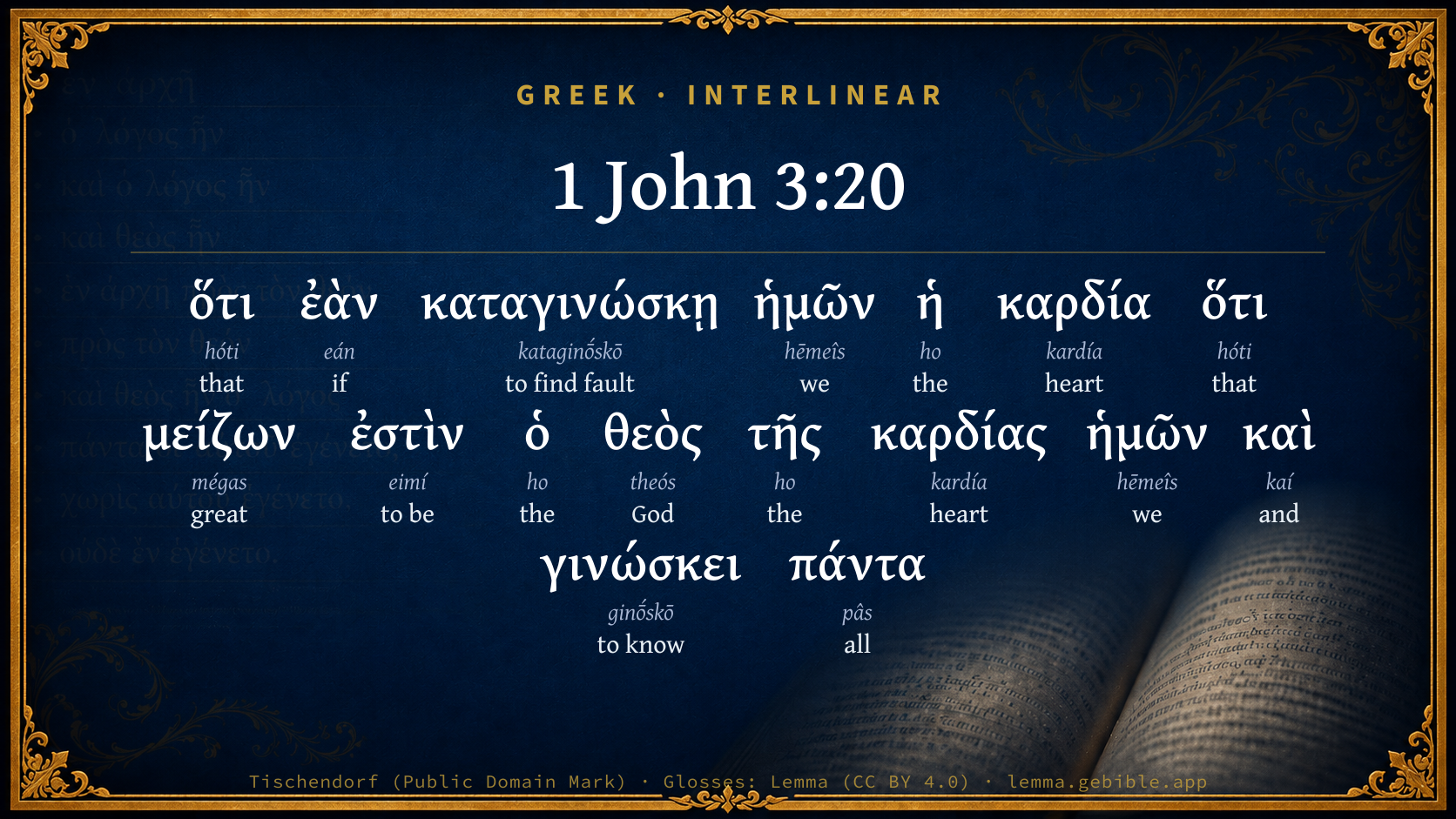
  1. ὅτι hóti G3754 “that” Conjunction
  2. ἐὰν eán G1437 “if” Conditional
  3. ἡμῶν hēmeîs G2249 “we” Personal pronoun, 1st person, Genitive, Plural
  4. ἡ ho G3588 “the” Article, Nominative, Singular, Feminine
  5. καρδία kardía G2588 “heart” Noun, Nominative, Singular, Feminine
  6. ὅτι hóti G3754 “that” Conjunction
  7. μείζων mégas G3173 “great” Adjective, Nominative, Singular, Masculine, Comparative
  8. ἐστὶν eimí G1510 “to be” Verb, Present, Active, Indicative, 3rd person, Singular
  9. ὁ ho G3588 “the” Article, Nominative, Singular, Masculine
  10. θεὸς theós G2316 “God” Noun, Nominative, Singular, Masculine
  11. τῆς ho G3588 “the” Article, Genitive, Singular, Feminine
  12. καρδίας kardía G2588 “heart” Noun, Genitive, Singular, Feminine
  13. ἡμῶν hēmeîs G2249 “we” Personal pronoun, 1st person, Genitive, Plural
  14. καὶ kaí G2532 “and” Conjunction
  15. γινώσκει ginṓskō G1097 “to know” Verb, Present, Active, Indicative, 3rd person, Singular
  16. πάντα pâs G3956 “all” Adjective, Accusative, Plural, Neuter

About this verse

These counts appear in no published source. They are computed here, from the morphology-tagged text and Lemma’s own curated glosses. What Lemma adds →

17
words
12
distinct lemmas
General Epistles
section

Notable vocabulary

The rarest word here is καταγινώσκῃ to find fault G2607 — appearing just 3 times in the whole Greek New Testament.

Shared distinctive vocabulary

καταγινώσκῃ to find fault G2607 occurs in 3 verses of the Greek New Testament. Also found in:

Repetition

Words recur within this verse:

Cross-references

17

Topical passages linked to 1 John 3:20 in the Treasury of Scripture Knowledge — connected by theme and wording, ordered by reader-vote popularity; previews shown in the World English Bible.

  • Psalms 139:1–4 Yahweh, you have searched me, And you know me.
  • Jeremiah 17:10 I, Yahweh, search the mind, I try the heart, even to give every man according to his ways, according to the fruit of his doings.
  • Hebrews 4:13 There is no creature that is hidden from his sight, but all things are naked and laid open before the eyes of him with whom we have to do.
  • 1 Corinthians 4:4 For I know nothing against myself. Yet I am not justified by this, but he who judges me is the Lord.
  • 1 John 4:4 You are of God, little children, and have overcome them; because greater is he who is in you than he who is in the world.
  • Jeremiah 23:24 Can any hide himself in secret places so that I shall not see him? says Yahweh. Don't I fill heaven and earth? says Yahweh.
  • John 10:29–30 My Father, who has given them to me, is greater than all. No one is able to snatch them out of my Father's hand.
  • Psalms 44:20–21 If we have forgotten the name of our God, Or spread forth our hands to a strange god;
  • Job 33:12 "Behold, I will answer you. In this you are not just; For God is greater than man.
  • Romans 2:14–15 (for when Gentiles who don't have the law do by nature the things of the law, these, not having the law, are a law to themselves,
  • Titus 3:11 knowing that such a one is perverted, and sins, being self-condemned.
  • Revelation 2:23 I will kill her children with Death, and all the assemblies will know that I am he who searches the minds and hearts. I will give to each one of you according to your deeds.
  • Job 27:6 I hold fast to my righteousness, and will not let it go. My heart shall not reproach me so long as I live.
  • John 2:24–25 But Jesus didn't trust himself to them, because he knew everyone,
  • John 21:17 He said to him the third time, "Simon, son of Jonah, do you have affection for me?" Peter was grieved because he asked him the third time, "Do you have affection for me?" He said to him, "Lord, you know everything. You know that I have affection for you." Jesus said to him, "Feed my sheep.
  • Psalms 90:8 You have set our iniquities before you, Our secret sins in the light of your presence.
  • John 8:9 They, when they heard it, being convicted by their conscience, went out one by one, beginning from the oldest, even to the last. Jesus was left alone with the woman where she was, in the middle.

Cross-references courtesy of OpenBible.info (CC BY 4.0).

Commentary

Notes on 1 John 3:20 from classic Christian and Jewish commentators (each source and its license shown beneath its notes). The classic Christian expositions comment on the surrounding passage and are grouped to its opening verse, so a note may address several verses; the Jewish commentaries on the Tanakh (Rashi and others) are per-verse, so they appear only where the commentator wrote on this verse.

Lemma curates 59 commentaries, every one of them public domain or Creative Commons licensed, each selected and text-cleaned for this edition rather than reprinted as found. About our sources →

Matthew Henry's Commentary

The apostle, having intimated that there may be, even among us, such a privilege as an assurance or sound persuasion of heart towards God, proceeds here,

I. To establish the court of conscience, and to assert the authority of it: For, if our heart condemn us, God is greater than our heart, and knoweth all things, Jo1 3:20. Our heart here is our self-reflecting judicial power, that noble excellent ability whereby we can take cognizance of ourselves, of our spirits, our dispositions, and actions, and accordingly pass a judgment upon our state towards God; and so it is the same with conscience, or the power of moral self-consciousness. This power can act as witness, judge, and executioner of judgment; it either accuses or excuses, condemns or justifies; it is set and placed in this office by God himself: the spirit of man, thus capacitated and empowered, is the candle of the Lord, a luminary lighted and set up by the Lord, searching all the inward parts of the belly, taking into scrutiny and viewing the penetralia - the private recesses and secret transactions of the inner man, Pro 20:27. Conscience is God's vicegerent, calls the court in his name, and acts for him. The answer of a good conscience towards God, Pe1 3:21. God is chief Judge of the court: If our heart condemn us God is greater than our heart, superior to our heart and conscience in power and judgment; hence the act and judgment of the court are the act and judgment of God; as, 1. If conscience condemn us, God does so too: For, if our heart condemn us, God is greater than our heart, and knoweth all things, Jo1 3:20. God is a greater witness than our conscience, and knoweth more against us than it does: he knoweth all things; he is a greater Judge than conscience; for, as he is supreme, so his judgment shall stand, and shall be fully and finally executed. This seems to be the design of another apostle when he says, For I know nothing by myself, that is, in the case wherein I am censured by some. "I am not conscious of any guile, or allowed unfaithfulness, in my stewardship and ministry. Yet I am hereby justified; it is not by my own conscience that I must ultimately stand or fall; the justification or justifying sentence of my conscience, or self-consciousness, will not determine the controversy between you and me; as you do not appeal to its sentence, so neither will you be determined by its decision; but he that judgeth me (supremely and finally judgeth me), and by whose judgment you and I must be determined, is the Lord," Co1 4:4. Or, 2. If conscience acquit us, God does so too: Beloved, if our heart condemn us not, then have we confidence toward God (Jo1 3:21), then have we assurance that he accepts us now, and will acquit us in the great day of account. But, possibly, some presumptuous soul may here say, "I am glad of this; my heart does not condemn me, and therefore I may conclude God does not." As, on the contrary, upon the foregoing verse, some pious trembling soul will be ready to cry out, "God forbid! My heart or conscience condemns me, and must I then infallibly expect the condemnation of God?" But let such know that the errors of the witness are not here reckoned as the acts of the court; ignorance, error, prejudice, partiality, and presumption, may be said to be faults of the officers of the court, or of the attendants of the judge (as the mind, the will, appetite, passion, sensual disposition, or disordered brain), or of the jury, who give a false verdict, not of the judge itself; conscience - suneidēsis, is properly self-consciousness. Acts of ignorance and error are not acts of self-consciousness, but of some mistaken power; and the court of conscience is here described in its process, according to the original constitution of it by God himself, according to which process what is bound in conscience is bound in heaven; let conscience therefore be heard, be well-informed, and diligently attended to.

II. To indicate the privilege of those who have a good conscience towards God. They have interest in heaven and in the court above; their suits are heard there: And whatsoever we ask we receive of him, Jo1 3:22. It is supposed that the petitioners do not desire, or do not intend to desire, any thing that is contrary to the honour and glory of the court or to their own intended spiritual good, and then they may depend upon receiving the good things they ask for; and this supposition may well be made concerning the petitioners, or they may well be supposed to receive the good things they ask for, considering their qualification and practice: Because we keep his commandments, and do those things that are pleasing in his sight, Jo1 3:22. Obedient souls are prepared for blessings, and they have promise of audience; those who commit things displeasing to God cannot expect that he should please them in hearing and answering their prayers, Psa 66:18; Pro 28:9.

Matthew Henry's Commentary on the Whole Bible (1708–1710) — public domain (CC PDM 1.0). Text via the HelloAO Bible API.

Jamieson, Fausset & Brown

Robert Jamieson, A. R. Fausset & David Brown

LUTHER and BENGEL take this verse as consoling the believer whom his heart condemns; and who, therefore, like Peter, appeals from conscience to Him who is greater than conscience. "Lord, Thou knowest all things: thou knowest that I love Thee." Peter's conscience, though condemning him of his sin in denying the Lord, assured him of his love; but fearing the possibility, owing to his past fall, of deceiving himself, he appeals to the all-knowing God: so Paul, Co1 4:3-4. So if we be believers, even if our heart condemns us of sin in general, yet having the one sign of sonship, love, we may still assure our hearts (some oldest manuscripts read heart, Jo1 3:19, as well as Jo1 3:20), as knowing that God is greater than our heart, and knoweth all things. But thus the same Greek is translated "because" in the beginning, and "(we know) that" in the middle of the verse, and if the verse were consolatory, it probably would have been, "Because EVEN if our heart condemn us," &c. Therefore translate, "Because (rendering the reason why it has been stated in Jo1 3:19 to be so important to 'assure our hearts before Him') if our heart condemn (Greek, 'know [aught] against us'; answering by contrast to 'we shall know that we are of the truth') us (it is) because God is greater than our heart and knoweth all things." If our heart judges us unfavorably, we may be sure that He, knowing more than our heart knows, judges us more unfavorably still [ALFORD]. A similar ellipsis ("it is") occurs in Co1 14:27; Co2 1:6; Co2 8:23. The condemning testimony of our conscience is not alone, but is the echo of the voice of Him who is greater and knoweth all things. Our hypocrisy in loving by word and tongue, not in deed and truth, does not escape even our conscience, though weak and knowing but little, how much less God who knows all things! Still the consolatory view may be the right one. For the Greek for "we shall assure our hearts" (see on Jo1 3:19), is gain over, persuade so as to be stilled, implying that there was a previous state of self-condemnation by the heart (Jo1 3:20), which, however, is got over by the consolatory thought, "God is greater than my heart" which condemns me, and "knows all things" (Greek "ginoskei," "knows," not "kataginoskei," "condemns"), and therefore knows my love and desire to serve Him, and knows my frame so as to pity my weakness of faith. This gaining over the heart to peace is not so advanced a stage as the having CONFIDENCE towards God which flows from a heart condemning us not. The first "because" thus applies to the two alternate cases, Jo1 3:20-21 (giving the ground of saying, that having love we shall gain over, or assure our minds before Him, Jo1 3:19); the second "because" applies to the first alternate alone, namely, "if our heart condemn us." When he reaches the second alternate, Jo1 3:21, he states it independently of the former "because" which had connected it with Jo1 3:19, inasmuch as CONFIDENCE toward God is a farther stage than persuading our hearts, though always preceded by it.

Jamieson, Fausset & Brown — Commentary Critical and Explanatory on the Whole Bible (1871) — public domain (CC PDM 1.0). Text via the HelloAO Bible API.

Bengel's Gnomon

Johann Albrecht Bengel

1Jn 3:20. Ὅτι ἐὰν) whatever: Col 3:23, note: nearly equivalent to ὅ ἐὰν, afterwards in 1Jn 3:22. Whatever, or in whatever things, our heart shall condemn us, that we shall be able to tranquilize. Or rather, if you prefer to take ὅτι and ἐὰν separately, you will have to repeat because after the sentence, understanding I say, as is very often done.—καταγινώσκῃ, condemn) not respecting our entire condition, but respecting one or two failures or errors. This word is to be pronounced with emphasis: but in the following verse the emphasis falls upon the word heart.—ὅτι μείζων, because greater) Conscience is weak, and knows something of ourselves only, not without trembling; nor has it the ability to pardon: but God is great, knows all our affairs, present, past, and future, and those of all men; and has the right and the will of pardoning. This by itself does not yet tranquilize our hearts; but while the righteous acknowledge this very thing, and confess their faults, and appeal from conscience to God, who is greater than it, and endeavour in no matter to withdraw themselves from the omniscience of God, they attain to tranquility, ch. 1Jn 1:9. See examples, Psa 51:8, with the context; Psa 32:5; Psa 19:13; Psa 90:8.—γινώσκει, knows) nor however does He condemn (καταγινώσκει). In the Greek there is a pleasant change[11] of the word.

[11] An instance of the figure Paregmenon, by which cognate words, both simple and compound, are joined together. See Appendix.

Bengel's Gnomon of the New Testament — English translation (T&T Clark, Edinburgh, 1860) — public domain. Text from a community e-Sword module.

Alford’s Greek Testament

Henry Alford

20.] [And] in this (on ἐν τούτῳ, see above, vv. 10, 16. It here refers to what had gone before: viz. to the fulfilment of the exhortation in ver. 18, as the future shews: q. d., which thing if we do, … This has been very generally acknowledged: some Commentators mentioning, but only to repudiate, the connexion with what follows, ὅτι ἐὰν κ.τ.λ. Some, as De W., refer ἐν τούτῳ back to vv. 10, 16; others, as Lücke, to ver. 14. But to whichever of these it is referred, the sense is much the same. The context which follows is best satisfied by taking it as above: see on ἐξ ἀληθείας ἐσμέν below) we shall know (on the future, see above. It is the result consequent on the fulfilment of the condition implied in ἐν τούτῳ. De Wette’s idea, after Bengel, that the rec. γινώσκομεν has been altered to the future to suit the following future πείσομεν, is not to be thought of, in the presence of the common formula ἐν τούτῳ γινώσκομεν, ch. 2:3, 3:24, 4 (2, 6,) 13, 5:2. The prevalent form was adopted by the transcribers, regardless of the future following) that we are of the truth (ἐν τίνι; ἐν τῷ μὴ λόγῳ ἀγαπᾷν, ἀλλὰ ἔργῳ καὶ ἀληθείᾳ … καὶ πῶς; ὁ γὰρ ἄλλο μὲν λέγων, ἄλλο δὲ ποιῶν, μὴ σύμφωνον ἔχων τῷ λόγῳ τὴν πρᾶξιν, ψεύστης ἐστὶ καὶ οὐκ ἀληθής. Œc. But, true as this is, and self-evident, it does not reach the depth of the meaning: as of course do not the many rationalistic paraphrases which have been given: “congruere evangelio,” Grot., Whitby, &c. To be ἐκ τῆς ἀληθείας, is a different matter from to be truthful or true men. Estius approaches the meaning, understanding ἀλήθεια to be the truth of God in His promises, and so ἐκ τῆς ἀλ. ἐσμέν to mean “are of the number of the elect.” Bede’s interpretation, “ex veritate quæ Deus est,” in which Lyra, Tirinus, Calvin agree, is nearer still: but had the Aposlte intended this, he surely would have written ἐκ τοῦ θεοῦ. The Lutheran Commentators have come nearer still, making ἡ ἀλήθεια to be “verbum veritatis” by which we are begotten anew unto God: so Luther, Seb.-Schmidt, Calov., Spener, Bengel, Lücke, De Wette. But why stop at that which after all is itself ἐκ τῆς ἀληθείας? Why not mount up to the ἀλήθεια itself, that pure and objective Truth which is the common substratum and essential quality of the Spirit Himself, of the Word, of those who are born of the Word by the Spirit? and thus Düsterd., Huther, al.), and shall persuade our hearts before him (i. e. and in and by this same sign, shall still the questionings of our hearts before God, by the assurance that we are His true children. This meaning has been acquiesced in by almost all Commentators both ancient and modern. Fritzsche alone maintains a different one: “Et coram Deo, i. e. Deum intuiti et reveriti, animos nostros flectemus (viz. ad amorem vita factisque ostendendum), quia, si animus nos hujus officii prætermissi condemnet, quia major est, inquam, Deus animo nostro et omnia scit.” He denies that πείσομεν is to be referred to ἐν τούτῳ, and, as above, interprets that by the consideration of God’s greatness and omniscience we are to persuade our hearts to love in truth. This view is impugned and satisfactorily confuted by Lücke, on the following grounds: 1. that after so solemn an exhortation to brotherly love on the deepest grounds, it is not likely that the Apostle would subjoin another, grounded on less deep and more general motives: 2. that every thing said by way of a motive in ἔμπροσθεν αὐτοῦ has been included in what has been said before: 3. (And this is the weightiest objection of all, enlarged on and pressed further by Düsterdieck) in this case τὰς καρδίας here must denote the heart as the seat of the affections, whereas in ver. 20 ἡ καρδία must denote the heart as the seat of the conscience. Whereas on the common view, καρδία is, throughout, the heart as the seat of the conscience, giving rise there to peace or to terror, according as it is at rest or in disquietude: nearly as Thl., πείσομεν τὴν συνείδησιν ἡμῶν, τοῦτο γὰρ βούλεται σημαίνειν διὰ τὰς καρδίας:—only that this view of the identity of the conscience with the καρδία is not correct. St. John uses καρδία for the innermost seat of our feelings and passions: of alarm (Joh 14:1, Joh 14:27), of mourning (16:6), of joy (16:22); it was into the καρδία of Judas that the devil put the intent of betraying the Lord (13:2): and the καρδία here is the inward judge of the man,—whose office is, so to say, promoted by the conscience, accusing or else excusing (Rom 2:15). Then, as to πείσομεν, there is no need to give to the verb any unusual meaning. It does not mean “quiet” or “assure,” except in so far as its ordinary import, “persuade,” takes this tinge from the context. And so it is, in every instance cited by the Commentators for this unusual meaning: e. g. in Mat 28:14, Act 12:20, and reff.: in Jos. Antt. vi. 5. 6, where Samuel ὑπισχνεῖται καὶ παρακαλέσειν τὸν θεὸν συγγνῶναι περὶ τούτων αὐτοῖς καὶ πείσειν: in the passage in Plutarch, where one says ἀπολοίμην εἰ μή σε τιμωρησαίμην, and the other answers, ἀπολοίμην εἰ μή σε πείσαιμι.

It must be plain from what has been said, that the future πείσομεν is not, on account of ἔμπροσθεν αὐτοῦ, to be taken as referring to the future day of judgment, as some (e. g. Benson, Lücke, De Wette) have done. In ch. 4:17, which is in some respects parallel with this, that day is expressly named: whereas in our passage, an equally clear indication is given, by the parallelism of γνωσόμεθα and πείσομεν, that no such reference is intended. ἔμπροσθεν αὐτοῦ is not, at His appearing, but, in His sight, as placed before His all-seeing eye: ὡς ὑπὸ θεῷ μάρτυρι, as Œc., though misunderstanding the whole: see above: so Aug. (“ante Deum es: interroga cor tuum … si persuademus cordi nostro, coram ipso persuademus”), Bede, Corn.-a-lap., Luther, Calov., Bengel, Neander, Huther, Sander, Erdmann, Düsterd. It may be remarked finally, that by ἔμπροσθεν αὐτοῦ being thus put first, it has evidently the emphasis: and this is important for that which follows.

20.] takes up this matter of the persuading our hearts before God, and shews its true importance and rationale. This is carried on in the following verses, but is here and in ver. 21 placed as its ground. If our heart, ἔμπροσθεν αὐτοῦ, judges us unfavourably—we may be quite sure that He knowing more than our heart does, judges us more unfavourably still: if our heart condemn us not, again ἔμπροσθεν αὐτοῦ, judging and seeing in the light of His countenance, then we know that we are at one with Him, and those consequences follow, which are set forth in ver. 22.

But before arriving at this sense, there are several difficulties of no slight weight to be overcome. With these it will be best to deal, before translating the verse. Three principal questions must be answered: 1. What is the first ὅτι? 2. What is the second ὅτι? 3. What is the meaning of μείζων? 1, 2. Some monstra of exegesis must first be eliminated. It has been tried to make ὅτι ἐάν = ὅταν, “whensoever:” For this is quoted Sam. Andreä, of whom I can discover nothing. This of course is impossible. Equally impracticable are the endeavours to alter the text; by striking out the 2nd ὅτι as Grot., or making this one into ἔτι (H. Stephanus, Pricæus, Piscator). Again it is quite out of the question to supply before the second ὅτι, “eheu nobis,” as Episcopius,—“scimus, aut scire debemus,” as Calov., al. Of other interpretations, the first requiring notice is that upheld by De Wette, and pronounced the only tenable one by Brückner, which would make the second ὅτι independent of the first, and regard it as containing the reason of the final clause, καὶ γινώσκει πάντα. The objection to this is, not the καί before γινώσκει, which would be natural enough,—“because God is greater than our heart, it follows that …;” such an apodosis being very commonly introduced by καί,—but 1) the sense thus obtained, which would be illogical, as it would not follow, because God is greater than our heart, that He knows all things: and 2) that brought by Düsterd., the exceeding harshness and clumsiness thus introduced into the style, whereas St. John is singularly lucid, and has but very few inversions, none indeed at all approaching the harshness of this. Bengel, Hoogeveen, Morus, Nösselt, Baumg.-Crus., Huther, regard the first ὅτι as the pronoun relative, ὅ τι: “coram ipso secura reddemus corda nostra quocunque tandem crimine damnat nos cor,” as Hoogeveen. The objection to this is not N. T. usage, as alleged, e. g. by Düsterdieck against ὅστις ἐάν, for we read ὅστις ἐάν Gal 5:10, and ἥτις ἐάν Act 3:23: but sense, context, and analogy. Sense,—for it would surely be monstrous to make the Apostle say that if we have brotherly love, we may make ourselves easy, whatever else our consciences accuse us of: context,—for in this sentence no logical reason would thus be given by the following ὅτι, which Hoog. renders quia: analogy, as shewn in the parallelism ἐὰν καταγινώσκῃ and ἐὰν μὴ καταγινώσκῃ, which we thus altogether destroy. Another interpretation is given, and, as usual, defended with extreme fervency and bitterness against those who differ, by Sander. He would make the whole of ver. 20 depend on ἐν τούτῳ γνωσόμεθα and on πείσομεν (some others had done the same before, e. g. Meyer. See also Erdmann below); and regard it as meant in a consolatory sense: by thus loving in deed, &c., we shall know, &c., and shall persuade our hearts that if our heart condemn us, God (he is troubled with the second ὅτι, and offers to his readers the alternative of erasing it with Lachmann or reading ἔτι with Stephens) is greater than our heart and knoweth all things: i. e. knows us to be His children and better than we seem to ourselves. With this in the main Erdmann agrees: “Hoc igitur apostolus dicit: filiis Dei, si forte in peccata inciderint, et conscientiæ accusatione perterriti fuerint, quum e conscientia veræ caritatis erga Deum et fratres pro certo sciant se ex veritate esse, vitæque novitatem in Dei patris societate accepisse, persuasum fore, τὸ καταγινώσκειν, conscientiæ magnitudine et potestate gratiæ divinæ illoque Dei γινώσκειν πάντα superari.”

But how any exegete of tact and discernment can hold this, I am at a loss to imagine. Leaving for the present the question respecting the sense of μείζων ἐστὶν κ.τ.λ., can we conceive the Apostle to write so loosely as this—“we shall persuade our hearts, that if our heart condemn us …?” For, in this case, the καρδίας of the former clause has no connexion with the καρδία of the latter, but, as Erdmann confesses, is equivalent to ἡμᾶς αὐτούς, whereas in the latter, καρδία is the “conscientia reatus.” And besides, the πείσομεν has already had its emphatic completion in the words ἔμπροσθεν αὐτοῦ, declaring its meaning to be absolute, and preventing its passing on to the ὅτι.

It would seem then that the first ὅτι cannot be “that,” but must be causal. And if the first, then the second, which, as far as I know, no one has attempted to render “that” after rendering the other “because.” How then is the repetition to be interpreted? The first ὅτι furnishes the reason for introducing the clause: what purpose is served by the second? The old scholium says, τὸ δεύτερον ὅτι παρέλκει. And so several of the Commentators, adducing instances of a repeated and superfluous ὅτι from Xenoph. Anab. v. 6. 19, λέγουσιν ὅτι, εἰ μὴ … ὅτι κινδυνεύσει …: and so Anab. vii. 4. 5: Eph 2:11, Eph 2:12 in N. T. But in all these places ὅτι is “that,” not “because:” nor can an instance be produced of the repetition of a causal ὅτι. This resource thus seems taken from us. The second ὅτι must have its distinct place and meaning assigned it. And, reserving the consideration of the meaning thus obtained, till we treat of μείζων ἐστὶν κ.τ.λ.,—there is one legitimate way of taking it, which does not seem to have been suggested: viz., that there is an ellipsis of the verb substantive before the 2nd ὅτι, and that the clause, thus introduced, forms the apodosis to the ἐὰν κ.τ.λ.: “because if our heart condemns us, (it is) because God, &c.” Instances of similar ellipses after εἰ or ἐάν are of course common enough: εἴ τις ἐν χριστῷ, καινὴ κτίσις, 2Co 5:17: εἴτε ὑπὲρ Τίτου, κοινωνὸς ἐμός κ. εἰς ὑμᾶς συνεργός· εἴτε ἀδελφοὶ ἡμῶν, ἀπόστολοι ἐκκγησιῶν, δόξα χριστοῦ, ib. 8:23. Nearer to the point 2Co 1:62Co_1:6, εἴτε θλιβόμεθα, ὑπὲρ τῆς ὑμῶν παρακλήσεως καὶ σωτηρίας: 1Co 14:27, εἴτε γλώσσῃ τὶς λαλεῖ, κατὰ δύο.…

But this brings us to consider (3) the meaning of the words μείζων ἐστὶν ὁ θεὸς τῆς καρδίας ἡμῶν καὶ γινώσκει πάντα. Two ways of taking them have been prevalent: the ancients regarded them as intensifying the ἐὰν καταγινώσκῃ ἡμῶν ἡ καρδία: as the Schol. in Cramer’s Catena, εἰ γὰρ ἁμαρτάνοντες, τὴν καρδίαν ἑαυτῶν λαθεῖν δυνάμεθα (qu. οὐ δυνάμ.?) ἀλλὰ νυττόμεθα ὑπὸ τοῦ συνειδότος, πόσῳ μᾶλλον τὸν θεὸν πράττοντές τι τῶν φαύλων δυνήθωμεν (οὐ δυν.) λαθεῖν; and so Aug., &c., and of the moderns, Calvin, Beza, Socinus, Grot., Corn.-a-lap., Castalio, Estius, Calov., Semler, Lücke, Neander, al. On the other hand, Luther, Bengel, Morus, Spener, Nösselt, Rickli, Baumg.-Crus, Sander, Besser, Düsterd., Huther, Erdmann, regard them as consolatory in their tendency, and as softening our self-condemnation by the comforting thought of God’s greatness and infinite mercy. Erdmann remarks, “Respondet his sententia S. Pauli ad Rom 5:20 sq.: οὗ δὲ ἐπλεόνασεν ἡ ἁμαρτία, ὑπερπερίσσευσεν ἡ χάρις. Luther ad h. l. dicit: Das Gemiffen ift ein einziger Tropfen, ber verfdhnte Gott aber ift ein Meer voller Troftes.” He compares Joh 21:17, κύριε, πάντα σὺ οἶδας, σὺ γινώσκεις ὅτι φιλῶ σε.

But beautiful and true as this is, and the similar considerations which have been urged by others of the above Commentators, it is to me very doubtful whether they find any place in the context here. That context appears to stand thus. The Apostle in ver. 19 has said that by the presence of genuine love we shall know that we are of the truth, and shall persuade our hearts in God’s presence. He then proceeds to enlarge on this persuading our hearts, in general. If our heart condemn us, what does it import? If our heart acquit us, what? The ἐὰν καταγινώσκῃ, and the ἐὰν μὴ καταγινώσκῃ, are plainly and necessarily opposed, both in hypothesis and in result. If the consolatory view of ver. 20 is taken, then the general result of vv. 20, 21 will be, whether our heart condemn us or not, we have comfort and assurance: and then what would be the import of πείσομεν τὰς καρδίας ἡμῶν at all? But on the other interpretation, taken with some modifications, all will be clear. I say, taken with some modifications: because the sense has been much obscured by the introduction of the particular case treated in ver. 18 into the general statements of vv. 20, 21. It is not, If our heart condemn us for want of brotherly love, as Lücke for instance, calling it a statement ‘e contrario’ to ver. 19: but this test is dropped, and the general subject of the testimony of our hearts is entered upon. Thus we get the context and rendering, as follows): because (q. d., and this ἔμπροσθεν αὐτοῦ πεῖσαι τὰς καρδίας ἡμῶν is for us a vital matter, seeing that condemnation and acquittal by our own hearts bring each such a weighty conclusion with it) if our heart condemn (notice the words γνωσόμεθα.… καταγινώσκῃ.… γινώσκει: for the meaning, see reff. It is a word especially appropriate to self-consciousness: “know (aught) against us”) us, it is because (our self-condemnation is founded on the fact, that) God is greater than our heart, and knoweth all things (i. e. the condemning testimony of our conscience is not alone, but is a token of One sitting above our conscience and greater than our conscience: because our conscience is but the faint echo of His voice who knoweth all things: if it condemn us, how much more He? and therefore this πεῖσαι, for which this verse renders a reason, becomes a thing of inestimable import, and one which we cannot neglect, seeing that the absence of it is an index to our standing condemned of God. And then, having given the reason why the καταγινώσκειν should be set at rest by the πεῖσαι, he goes on to give the blessed results of the πεῖσαι itself in verses 21, 22). Beloved (there is no adversative particle, because ἀγαπητοί throws up the contrast quite strongly enough, as introducing the very matter on which the context lays the emphasis, viz., the πεῖσαι τὰς κ. ἡμῶν), if our heart (so it will stand, whether ἡμῶν be read or not) condemn us not, we have confidence towards God (reff.: said generally: not with direct reference to that which follows, ver. 22, which indeed is one form of this confidence: see ch. 5:14, where the connexion is similar. The confidence here spoken of is of course present, not future in the day of judgment, as Estius. πρὸς τὸν θεόν, with reference to God: but more than that: to God-ward, in our aspect as turned towards and looking to God.

It must be remembered that the words are said in the full light of the reality of the Christian state,—where the heart is awakened and enlightened, and the testimony of the Spirit is active; where the heart’s own deceit does not come into consideration as a disturbing element), and (such another καί as that in ver. 10 above, where, after πᾶς ὁ μὴ ποιῶν δικαιοσύνην οὐκ ἔστιν ἐκ τοῦ θεοῦ, we have καὶ ὁ μὴ ἀγαπῶν τὸν ἀδελφὸν αὐτοῦ, i. e. after the general statement, καί introduced the particular instance in which the general truth was carried forward. So here: By dwelling and walking in love, we can alone gain that approval of our conscience as God’s children, which brings real confidence in Him and real intercommunion in prayer, which is a result and proof of that confidence) whatsoever we ask, we receive (pres.: not for future, as Grot. The Apostle is setting forth actual matter of fact) from Him (these words must be taken in all their simplicity, without capricious and arbitrary limitations. Like all the sayings of St. John, they proceed on the ideal truth of the Christian state. “The child of God,” as Huther says, “asks for nothing, which is against the will of its Father”), because (ground of the above λαμβάνομεν) we keep His commandments, and do the things which are pleasing in His sight (on the last expression (and parallelism) see Exo 15:26; also Deu 6:18, Deu 12:25, Ezr 10:11, Isa 38:3. It is added, not as epexegetical of τὰς ἐντολὰς αὐτοῦ τηροῦμεν, as Sander, but as Düsterd., to connect with His granting our prayers, since our lives are in accord with His good pleasure. This however brings us to the theological difficulty of our verse, wherein it would seem at first sight as if the granting of our prayers by God depended, as its meritorious efficient, on our keeping of His commandments and doing that which pleases Him. And so some of the R.-Catholic expositors here: Corn.-a-lap., with the curious peculiarity of distinguishing τὰς ἐντολὰς αὐτοῦ τηρεῖν, the keeping of the moral law of the decalogue, from τὰ ἀρεστὰ ἐνώπ. αὐτοῦ ποιεῖν, the doing of “consilia evangelica, viz. continentia, obedientia et paupertas,” the observance of which goes “augere gratiam Dei et merita.” This is refuted by the parallelism, in which (see above) the second clause takes up the first and applies it to the matter in hand. And it is further refuted by the usage of the expression τὰ ἀρεστά, by which never “consilia evangelica,” but always things ethically pleasing to God, as commanded by Him, are denoted: cf. ref. John, Rom 12:1, Rom 12:14:18, 2Co 5:9, Eph 5:10, Php 4:18, Col 3:20. Estius again has pressed the words as against the heretics, who say “omnia justorum opera esse peccata;” “nisi,” he adds, “dicant, quod absque blasphemia dici non potest, peccata esse Deo placita.” But both here and elsewhere the solution of the difficulty is very easy, if separated from the party words of theology, and viewed in the light of Scripture itself. Out of Christ, there are no good works at all; entrance into Christ is not won nor merited by them. In Christ, every work done of faith is good and is pleasing to God. The doing of such works is the working of the life of Christ in us: they are its sign, they its fruits: they are not of us, but of it and of Him. They are the measure of our Christian life: according to their abundance, so is our access to God, so is our reward from God: for they are the steps of our likeness to God. Whatever is attributed to them as an efficient cause, is attributed not to us, but to Him whose fruits they are. Because Christ is thus manifested in us, God hears our prayers, which He only hears for Christ’s sake: because His Spirit works thus abundantly in us, He listens to our prayer, which in that measure has become the voice of His Spirit. So that no degree of efficacy attributed to the good works of the child of God need surprise us: it is God recognizing, God vindicating, God multiplying, God glorifying, His own work in us. So that when, e. g., Corn.-a-lap. says, “congruum est et congrua merces obedientiæ et amicitiæ, ut si homo faciat voluntatem Dei, Deus vicissim faciat voluntatem hominis,” all we can reply is that such a duality, such a reciprocity, does not exist for Christians: we are in God, He in us: and this St. John continually insists on. We have no claim ab extra: He works in us to do of His good pleasure: and the works which He works, which we work, manifest before Him, and before all, that we are His children. The ὃ ἐὰν αἰτῶμεν, λαμβάνομεν, I reserve to be treated of on ch. 5:14, 15, where it is set forth more in detail).

Henry Alford, The Greek Testament (1849–1861) — public domain. Text from a community e-Sword module.

Geneva Bible (1599)

Geneva Bible translators

If an evil conscience convinceth us, much more ought the judgments of God contemn us, who knoweth our hearts better than we ourselves do.

Geneva Bible (1599) marginal notes — public domain. Text via Bolls.life.

Adam Clarke's Commentary

Verse 20. If our heart condemn us] If we be conscious that our love is feigned, we shall feel inwardly condemned in professing to have what we have not. And if our heart condemn us, God is greater than our heart, for he knows every hypocritical winding and turning of the soul, he searches the heart, and tries the reins, and sees all the deceitfulness and desperate wickedness of the heart which we cannot see, and, if we could see them, could not comprehend them; and as he is the just Judge, he will condemn us more strictly and extensively than we can be by our own conscience.

Adam Clarke's Commentary on the Bible (1810–1826) — public domain. Text from a community e-Sword/MySword module.

John Calvin's Commentaries

20. For if our heart condemn us He proves, on the other hand, that they in vain possess the name and appearance of Christians, who have not the testimony of a good conscience. For if any one is conscious of guilt, and is condemned by his own heart, much less can he escape the judgment of God. It hence follows, that faith is subverted by the disquiet of an evil conscience.

He says, that God is greater than our heart, with reference to judgment, that is, because he sees much more keenly than we do, and searches more minutely and judges more severely. For this reason, Paul says, that though he was not conscious of wrong himself, yet he was not therefore justified, (1 Corinthians 4:4;) for he knew that however carefully attentive he was to his office, he erred in many things, and through inadvertence was ignorant of mistakes which God perceived. What then the Apostle means is, that he who is harassed and condemned by his own conscience, cannot escape the judgment of God.

To the same purpose is what immediately follows, that God knoweth or seeth all things For how can those things be hid from him which we, who in comparison with him are dull and blind, are constrained to see? Then take this explanation, “Since God sees all things, he is far superior to our hearts.” For to render a copulative as a causal particle is no new thing. The meaning is now clear, that since the knowledge of God penetrates deeper than the perceptions of our conscience, no one can stand before him except the integrity of his conscience sustains him.

But here a question may be raised. It is certain that the reprobate are sometimes sunk by Satan into such stupor, that they are no longer conscious of their own evils, and. without alarm or fear, as Paul says, rush headlong into perdition; it is also certain, that hypocrites usually flatter themselves, and proudly disregard the judgment of God, for, being inebriated by a false conceit as to their own righteousness, they feel no convictions of sin. The answer to these things is not difficult; hypocrites are deceived because they shun the light; and the reprobate feel nothing, because they have departed from God; and, indeed there is no security for an evil conscience but in hiding-places.

But the Apostle speaks here of consciences which God draws forth to the light, forces to his tribunal, and fills with an apprehension of his judgment. Yet; it is at the same time generally true, that we cannot have a calm peace except that which God’s Spirit gives to purified hearts; for those who, as we have said, are stupefied, often feel secret compunctions, and torment themselves in their lethargy.

John Calvin's Commentaries (1540-1563) — public domain. Text from the Calvin Translation Society English edition (1840s-50s) via the Christian Classics Ethereal Library (ccel.org). Calvin's coverage is partial (roughly two-thirds of the Bible); uncommented books and verses are honest gaps, never fabricated. The 19th-century editor's footnotes and remarks are omitted so the notes are faithfully Calvin's own voice.

The Cambridge Bible for Schools and Colleges

gen. ed. J. J. S. Perowne

20. For if our heart condemn us] It is possible to attach this to the preceding verse (reading ὅ τι ἐάν, a construction found Act_3:23 and Gal_5:10, and perhaps Col_3:17, for ὅτι ἐάν), and to render with R. V., whereinsoever our heart condemn us: but see next note. “A Christian’s heart burdened with a sense of its own unworthiness forms an unfavourable opinion of the state of the soul, pronounces against its salvation. If we are conscious of practically loving the brethren, we can adduce this as evidence of the contrary, and give the heart ground to change its opinion, and to reassure itself. Anyone who has had experience of the doubts and fears which spring up in a believer’s heart from time to time, of whether he is or is not in a state of condemnation, will feel the need and the efficacy of this test of faith and means of assurance” (Jelf).

God is greater than our heart] On overwhelming evidence (אBCKL) we must insert ‘because’ or ‘that’ (ὅτι) before ‘God is greater’. If the reading and rendering of the preceding clause adopted in R. V. is right, ‘because God is greater’ will make good sense. Because God is superior to our consciences in being omniscient, we may (when our love is sincere and fruitful), persuade our consciences before Him to acquit us. Our consciences through imperfect knowledge may be either too strict or too easy with us: God cannot be either, for He knows and weighs all.

But it seems almost certain that ‘if our heart condemn us’ must be right, as the natural correlative of ‘if our heart condemn us not’, which is indisputably right. This progress by means of opposites stated side by side has been S. John’s method all through: ‘if we confess our sins’ and ‘if we say that we have not sinned’ (1Jn_1:9-10); ‘he that loveth his brother’ and ‘he that hateth his brother’ (1Jn_2:10-11); ‘he that doeth righteousness’ and ‘he that doeth sin’ (1Jn_3:7-8); ‘every spirit that confesseth’ and ‘every spirit that confesseth not’ (1Jn_4:2-3). But, if this is accepted, what is to be done with the apparently redundant’ because’ or ‘that’? Two plans are suggested: 1. to supply ‘it is’ before because’; 2. to supply ‘it is plain’ (δῆλον) before ‘that’. The latter seems preferable: for what can be the meaning of ‘if our heart condemn us, (it is) because God is greater than our heart’? Whereas, ‘if our heart condemn us, (it is plain) that God is greater than our heart’ makes excellent sense. There is perhaps a similar ellipse of ‘it is plain’ (ὅτι = δῆλον ὅτι) 1Ti_6:7; ‘We brought nothing into the world, and (it is plain) that we can carry nothing out.’ And other instances are quoted from S. Chrysostom (X. p. 38 BD; p. 122 B, where some editors insert δῆλον).

We must not give ‘God is greater’ a one-sided interpretation, either ‘God is more merciful’ or ‘God is more strict’. It means that He is a more perfect judge than our heart can be. It is the difference between conscience and Omniscience.

and knoweth all things] The ‘and’ is epexegetic; it explains the special character of God’s superiority when the soul stands before the judgment-seat of conscience. He knows all things; on the one hand the light and grace against which we have sinned, on the other the reality of our repentance and our love. It was to this infallible omniscience that S. Peter appealed, in humble distrust of his own feeling and judgment; ‘Lord, Thou knowest all things; Thou knowest that I love Thee’ (Joh_21:17). It is the reality and activity of our love (1Jn_3:18-19) which gives us assurance under the accusations of conscience. Comp. ‘If ye forgive men their trespasses’, having genuine love for them, ‘your heavenly Father will also forgive you’, and ye will be able to persuade your hearts before Him (Mat_6:14).

The force of 1Jn_3:19-20 may be thus summed up: ‘By loving our brethren in deed and truth we come to know that we are God’s children and have His presence within us, and are enabled to meet the disquieting charges of conscience. For, if conscience condemns us, its verdict is neither infallible nor final. We may still appeal to the omniscient God, whose love implanted within us is a sign that we are not condemned and rejected by Him.’

The Cambridge Bible for Schools and Colleges (gen. ed. J. J. S. Perowne; Cambridge University Press, 1878–1918) — public domain. Text from a community e-Sword module.

John Gill's Exposition

Beloved, if our heart condemn us not,.... Which must be understood, not of a stupidity of mind, as is in unregenerate men, who have no sense of sin, no sorrow for it, or remorse of conscience on account of it; or as is in them who are past feeling; having their consciences seared as with a red hot iron; such cannot be entitled to the advantages that follow; nor is it of persons the apostle speaks, but of himself, and Christians, the beloved of the Lord, and one another, who had an experience of the grace of God upon their souls, and made a profession of religion: nor does it design such a purity of heart and life in believers, as that their hearts do not smite, reproach, and condemn them for sin at any time, for such a state of perfection is not to be attained to and expected in this life; but rather a conscience purged by the blood of Christ, or an heart sprinkled from an evil conscience by that blood, which speaks peace and pardon, so that there is no more conscience of sin, for the removal of which that is applied; and this gives boldness and confidence at the throne of grace: though it is best of all to confine it to the case of brotherly love; for the sense is not, if our heart condemn us not of anything but of the want of brotherly love, or insincerity in it,

then have we confidence towards God; or with him, at the throne of his grace: such can draw nigh to him, and stand before him with an holy and humble confidence, when such as hate the brethren, as Cain did, in whom the apostle instances, and those that go in his way, cannot; whose heart condemned him, his conscience smote him, and he went from the presence of the Lord; but those that love the brethren have confidence of their relation to God; by this they know their regeneration, and by that their adoption, and so that they are the children of God; and can therefore draw nigh to God as their Father, and call him so; they can come with an holy boldness and intrepidity of mind before him, and use a "freedom of speech", with him; can tell him all their mind, pour out their souls unto him, and lay before him their case and wants; they have confidence of his power, faithfulness, and willingness to supply their need, and fulfil all his promises to them, and that their prayers will be heard, answered, and regarded by him in his own time.

John Gill's Exposition of the Whole Bible (1746–1763) — public domain (CC PDM 1.0). Text via the HelloAO Bible API.

Trapp's Complete Commentary

John Trapp

20 For if our heart condemn us, God is greater than our heart, and knoweth all things.

Ver. 20. If our keart condemn us] Conscience is God’s spy and man’s overseer, Domesticus index, iudex, carnifex; God’s deputy judge, holding court in the whole soul, bearing witness of all a man’s doings and desires, and accordingly excusing or accusing, absolving or condemning, comforting or tormenting. Quid tibi prodest non habere conscium, habenti conscientiam? saith one; and another, Turpe quid acturus, te sine teste time. Inprimis reverere te ipsum. Look to conscience.

" Conscia mens ut cuique sua est, ita concipit intra,

Pectora pro facto spemque metumque suo." (Ovid.)

John Trapp, A Commentary or Exposition upon All the Books of the Old and New Testament (1647–1656) — public domain. Text from a community e-Sword module.

Albert Barnes' Notes on the Bible

For if our heart condemn us - We cannot hope for peace from any expectation that our own hearts will never accuse us, or that we ourselves can approve of all that we have done. The reference here is not so much to our past lives, as to our present conduct and deportment. The object is to induce Christians so to live that their hearts will not condemn them for any secret sins, while the outward deportment may be unsullied. The general sentiment is, that if they should so live that their own hearts would condemn them for present insincerity and hypocrisy, they could have no hope of peace, for God knows all that is in the heart. In view of the past - when the heart accuses us of what we have done - we may find peace by such evidences of piety as shall allay the troubles of an agitated soul, 1Jo 3:9, but we cannot have such peace if our hearts condemn us for the indulgence of secret sins, now that we profess to be Christians. If our hearts condemn us for present insincerity, and for secret sins, we can never “persuade” or soothe them by any external act of piety. In view of the consciousness of past guilt, we may find peace; we can find none if there is a present purpose to indulge in sin.

God is greater than our heart, and knoweth all things - We cannot hope to find peace by hiding anything from his view, or by any supposition that he is not acquainted with the sins for which our consciences trouble us. He knows all the sins of which we are conscious, and sees all their guilt and aggravation as clearly as we do. He knows more than this. He knows all the sins which we have forgotten; all those acts which we endeavor to persuade ourselves are not sinful, but which are evil in his sight; and all those aggravations attending our sins which it is impossible for us fully and distinctly to conceive. He is more disposed to condemn sin than we are; he looks on it with less allowance than we do. We cannot hope, then, for a calm mind in any supposition that God does not see our sins as clearly as we do, or in any hope that he will look on them with more favor and indulgence. Peace cannot be found in the indulgence of sin in the hope that God will not perceive or regard it, for we can sooner deceive ourselves than we can him; and while therefore, 1Jo 3:19, in reference to the past, we can only “persuade” our hearts, or soothe their agitated feelings by evidence that we are of the truth now, and that our sins are forgiven; in reference to the present and the future, the heart can be kept calm only by such a course of life that our own hearts and our God shall approve the manner in which we live.

Albert Barnes' Notes on the Bible (1834–1885) — public domain. Text from a community e-Sword/MySword module.

Matthew Poole's English Annotations

If our heart, or our conscience, condemn us, viz. in plain things, (as this of loving our brother is), and wherein the mind of God is evidently the same with our own conscience; his superiority, to whom our conscience is but an under-judge, ought much more to awe us, especially considering how much more he knows of us than we do of ourselves; as 1Co 4:4.

Matthew Poole's English Annotations on the Holy Bible (1683–1685) — public domain. Text from a community e-Sword/MySword module.

Whedon's Commentary on the Bible

Daniel D. Whedon

20. If our heart condemn us—As not loving our brother in deed and in active benefaction to his needs. If we are conscious of wrong-doings or short-comings.

Greater than our heart—And his condemnation is more terrible, as well as more sure, for he knoweth all things, and no guilt can escape his inspection.

Daniel D. Whedon (gen. ed.), Commentary on the Old and New Testaments (1874–1909) — public domain. Text from a community e-Sword module.

The Pulpit Commentary

Our heart means our conscience, not the affections, which would be spagcna (verse 17). If we are conscious of sincere and habitual love, this will calm us when conscience reproaches us. (comp 1Jn_1:9 1Jn_2:1, 1Jn_2:2) St. John never uses the more technical term suneidhsiv, which occurs in the Acts and 1 Peter, and is very frequent in St. Paul. God is greater than our heart. It is asked whether this means that he is more merciful or more rigorous. Neither the one nor the other. It means that, although our conscience is not infallible, God is. Our hearts may be deceived; he cannot be. He knoweth all things. An awful thought for the impenitent, a blessed and encouraging thought for the penitent, He knows our sins; but he also knows our temptations, our struggles, our sorrow, and our love.

The Pulpit Commentary (1880–1919), ed. H.D.M. Spence-Jones & Joseph S. Exell — public domain. Text from a community e-Sword module.

John Wesley's Explanatory Notes

For if we have not this testimony, if in anything our heart, our own conscience, condemn us, much more does God, who is greater than our heart - An infinitely holier and a more impartial Judge. And knoweth all things - So that there is no hope of hiding it from him.

John Wesley, Explanatory Notes Upon the Whole Bible (1754–1765) — public domain. Text via the GEBible commentary corpus.

Burkitt's Expository Notes on the New Testament

William Burkitt

By heart here is undoubtedly meant conscience: and it is as much as if the apostle had said, "If our consciences tells us that our love is barren and fruitless, and so condemn us for hypocrisy, God is greater than our consciences, both in holiness to condemn, and in knowledge to perceive the evil of them, for he knoweth all things; whereas if we have the witness of our consciences touching the sincerity of our love by the fruits of it; if, after a most strict examination of our consciences, and an exact comparing of our lives and actions with the law of God, we are not condemned of insinceriy in our obedience to God, and love to our neighbour, then have we an humble confidence with God in all our addresses to him."

Learn hence, 1. That the consciences of men have a self-condemning and a self-absolving power.

2. That the consciences of men are much better known to God, than they either are or can be known unto themselves.

3. That if our hearts or consciences do condemn us, it is an evidence of greater condemnation from the heart-searching God.

4. That if our consciences do absolve us, it is an argument of our acceptance with God, and a ground of condfidence in all our addresses to him.

5. That according to the verdict or testimony of men’s consciences rightly informed, and truly testifying, God will either acquit or absolve them at the great day.

William Burkitt's Expository Notes on the New Testament (1700–1703) — public domain. Text from a community e-Sword module.

The People's New Testament

B. W. Johnson

20. For if our heart condemn us. If we have a troubled conscience because we have not kept the law of love, God, who is greater and whose condemnation is a far more serious affair, knoweth all things and seeth our failure in duty.

B. W. Johnson's The People's New Testament with Notes (1889–1891) — public domain. Electronic text from the Christian Classics Ethereal Library (CCEL) ThML edition.

Cambridge Greek Testament for Schools and Colleges

20. ὅτι ἐὰν καταγινώσκῃ ἡμῶν. The Revisers follow Lachmann in reading ὅ τι ἐάν, a construction found Act 3:23 and Gal 5:10, and possibly Col 3:17. The clause is then attached to what precedes: shall persuade our heart before Him, whereinsoever our heart condemn us. But this is not probable (see next note). “A Christian’s heart burdened with a sense of its own unworthiness forms an unfavourable opinion of the state of the soul, pronounces against its salvation. If we are conscious of practically loving the brethren, we can adduce this as evidence of the contrary, and give the heart ground to change its opinion, and to reassure itself. Anyone who has had experience of the doubts and fears which spring up in a believer’s heart from time to time, of whether he is or is not in a state of condemnation, will feel the need and the efficacy of this test of faith and means of assurance” (Jelf).

ὅτι μείζων ἐστὶν ὁ Θεός. Either, because God is greater, or that God is greater. If the R.V. is right as regards what precedes, ‘because God is greater’ will make good sense. Because God is superior to our consciences in being omniscient, we may (when our love is sincere and fruitful) persuade our consciences before Him to acquit us. Our consciences through imperfect knowledge may be either too strict or too easy with us: God cannot be either, for He knows and weighs all.

But it seems almost certain that ‘if our heart condemn us’ must be right, as the natural correlative of ‘if our heart condemn us not,’ which is indisputably right. This progress by means of opposites stated side by side has been S. John’s method all through: ‘if we confess our sins’ and ‘if we say that we have not sinned’ (1Jn 1:9-10); ‘he that loveth his brother’ and ‘he that hateth his brother’ (1Jn 2:10-11); ‘he that doeth righteousness’ and ‘he that doeth sin’ (1Jn 3:7-8); ‘every spirit that confesseth’ and ‘every spirit that confesseth not’ (1Jn 4:2-3). But, if this is accepted, what is to be done with the apparently redundant ὅτι? Two plans are suggested: 1. to supply ‘it is’ before ὄτι = ‘because’; 2. to supply ‘it is plain’ (δῆλον) before ὅτι = ‘that.’ The latter seems preferable: for what can be the meaning of ‘if our heart condemn us, (it is) because God is greater than our heart’? Whereas, ‘if our heart condemn us, (it is plain) that God is greater than our heart’ makes excellent sense. There is perhaps a similar ellipse of ‘it is plain’ (ὅτι = δῆλον ὅτι) 1Ti 6:7; ‘We brought nothing into the world, and (it is plain) that we can carry nothing out’; where [702]3[703]3[704][705] insert δῆλον before ὅτι οὐδὲ ἐξενεγκεῖν τι δυνάμεθα. Field (Otium Norvicense III. 127) quotes other instances from S. Chrysostom of the ellipse of δῆλον.

[702] 4th century. Discovered by Tischendorf in 1859 at the monastery of S. Catherine on Mount Sinai, and now at Petersburg. All three Epistles.

[703] has lost the leaves in which all three Epistles were undoubtedly contained. Only the servile Latin translation of 3Jn 1:11-14 remains.

[704] 9th century. All three Epistles.

[705] 9th century. All three Epistles.

We must not give ‘God is greater’ a one-sided interpretation, either ‘God is more merciful’ or ‘God is more strict.’ It means that He is a more perfect judge than our heart can be. It is the difference between conscience and Omniscience.

καὶ γινώσκει πάντα. The καί is epexegetic; it explains the special character of God’s superiority when the soul stands before the judgment-seat of conscience. He knows all things; on the one hand the light and grace against which we have sinned, on the other the reality of our repentance and our love. It was to this infallible omniscience that S. Peter appealed, in humble distrust of his own feeling and judgment; ‘Lord, Thou knowest all things; Thou knowest that I love Thee’ (Joh 21:17). It is the reality and activity of our love (1Jn 3:18-19) which gives us assurance under the accusations of conscience. Comp. ‘If ye forgive men their trespasses,’ having genuine love for them, ‘your heavenly Father will also forgive you,’ and ye will be able to persuade your hearts before Him (Mat 6:14).

The force of 1Jn 3:19-20 may be thus summed up: ‘By loving our brethren in deed and truth we come to know that we are God’s children and have His presence within us, and are enabled to meet the disquieting charges of conscience. For, if conscience condemns us, its verdict is not infallible nor final. We may still appeal to the omniscient God, whose love implanted within us is a sign that we are not condemned and rejected by Him.

Cambridge Greek Testament for Schools and Colleges (Cambridge University Press, 1896; 21 vols, various authors incl. Carr, Maclear, Plummer, Farrar, Lumby, Moule, M. R. James, Simcox) — public domain. Text from a community e-Sword module.

Vincent's Word Studies in the New Testament

Marvin R. Vincent

For if our heart condemn us, God is greater, etc. A very difficult passage. See critical note as above. Render, as Rev., shall assure our heart before Him whereinsoever our heart condemn us, because God is greater than our heart.

For [οτι] . To be rendered not as a conjunction (for, because) but as a relative, in whatsoever or whereinsoever.

Condemn [καταγινωσκη] . The word occurs only three times in the New Testament; here, ver. 21, and Gal 2:11. It signifies (1.) To note accurately, usually in a bad sense. Hence to detect (Pro 28:11); compare Aristophanes : "Having observed [καταγνους] the foibles of the old man" (" Knights, "46). To form an unfavorable prejudice against. So Herodotus. Datis says to the Delians," Why are ye fled, O holy men, having judged me [καταγνοντες κατ εμευ] in so unfriendly a way? "(vi. 97). (2.) To note judicially : to accuse : to accuse one's self. So Thucydides :" No one, when venturing on a perilous enterprise, ever yet passed a sentence of failure on himself "(katagnouv eJautou mh periesesqai; 1Jo 3:45). To give sentence, or condemn. To condemn to death." Those who had fled they condemned to death "(qanaton katagnontev; Thucydides, 6, 60). To decide a suit against one. So Aristophanes :" You judges have no maintenance if you will not decide against [καταγνωσεσθε] this suit "(" Knights," 1360). In Gal 2:11, it is said of Peter that, because of his concessions to the Jewish ritualists, kategnwsmenov hn he stood condemned or self - condemned (not as A. V., he was to be blamed). His conduct was its own condemnation. This is the sense in this passage, the internal judgment of conscience.

Because [οτι] . This second oti does not appear in the A. V. It is a conjunction.

Greater [μειζων] . Is this superior greatness to be regarded as related to God 's judgment, or to His compassion ? If to His judgment, the sense is : God who is greater than our heart and knows all things, must not only endorse but emphasize our self - accusation. If our heart condemn, how much more God, who is greater than our heart. If to His compassion, the sense is : when our heart condemns us we shall quiet it with the assurance that we are in the hands of a God who is greater than our heart - who surpasses man in love and compassion no less than in knowledge. This latter sense better suits the whole drift of the discussion. See critical note. There is a play of the words ginwskei knoweth, and kataginwskh condemneth, which is untranslatable.

Marvin R. Vincent, Word Studies in the New Testament (1887–1900) — public domain. Text from a community e-Sword/MySword module.

Westcott on Hebrews & the Epistles of John

Brooke Foss Westcott

20. ὅτι ἐάν] whereinsoever. The words balance the ‘all things’ which follows. The form ὅτι ἐάν does not occur as the true text elsewhere in N. T. (Col. iii. 23 ὃ ἐάν), but always

, 7 καὶ γινώσκει TavTa.

gives all on which the heart sadly dwells.

Brooke Foss Westcott (1825–1901), The Epistle to the Hebrews (1889) and The Epistles of St John (1883) — public domain (pre-1929). Text recovered from Internet Archive / Google Books OCR scans. Westcott’s Gospel of John commentary is not included (its OCR lost the chapter running-heads required for reliable verse-keying). Some Greek quoted in the Hebrews volume is imperfectly rendered by the OCR.

Lesson kit

Teaching starters — assembled from the data on this page, not authored interpretation. Every prompt links to the verse data it draws on. Edit before teaching.

1 John, in the General Epistles, opens this verse with 17 words (12 distinct Greek lemmas). Its most distinctive word is kataginṓskō (“to find fault”). A historical commentator’s framing appears above. Read the whole chapter for the surrounding context.

Discussion questions

  1. How does “to find fault” (kataginṓskō) shape what this verse is saying?
  2. How does Galatians 2:11, which shares the word «to find fault», read alongside this verse?
  3. What does the repetition of “heart” (2× in this one verse) do in this verse?
  4. The translations on this page render this verse differently — a whole-verse word diff, not a word-by-word alignment. What might account for the different wordings?
  5. Compare how Matthew Henry's Commentary and Jamieson, Fausset & Brown read this verse. Where do they agree or differ?

Things to notice

  • These translations choose different wording for 9 words in this verse.
  • “heart” occurs 2× in this single verse.
  • 12 distinct Greek lemmas span 17 words in this verse.

Reading settings

Reading text

Shown beneath each verse's original-language words.

Old Testament
Old Testament edition

Read the OT as the Masoretic Hebrew (MT) or the Greek Septuagint (LXX).

English shown for the Greek Septuagint (in the Hebrew ↔ Greek comparison).

Comparing translations? Open the Compare panel on any verse page to stack up to four side by side.