
1 Corinthians 2:14

Greek (Tischendorf 8th ed.) 1 Corinthians 2:14 appears in the Greek New Testament. The text above is from the Tischendorf 8th edition. Each word links to its Strong’s number and a concise gloss. Click any word for its full Thayer’s Greek Lexicon entry.
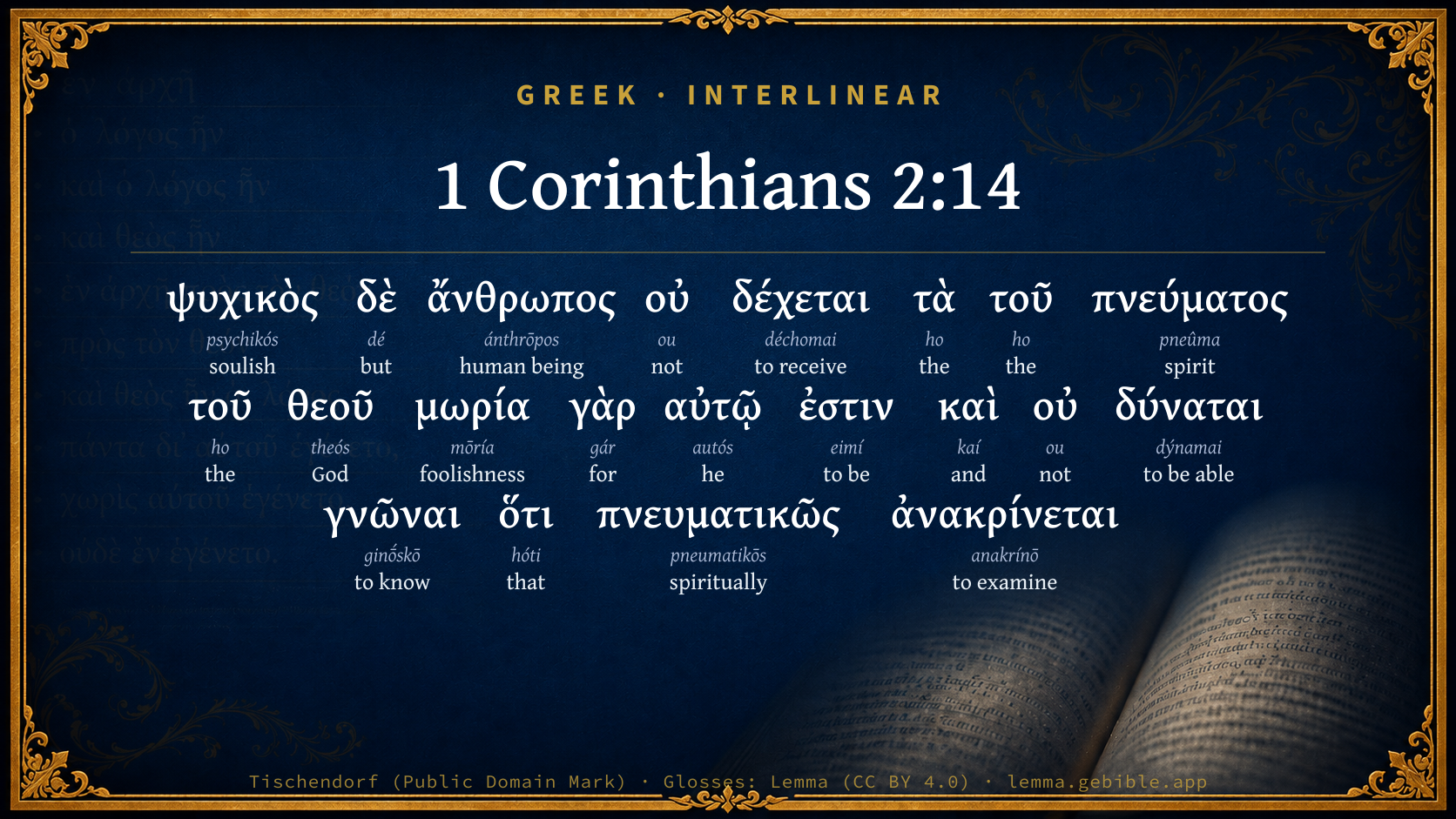
Download image
Cite this verse

1 Corinthians 2:14 (World English Bible). Public Domain. Lemma interlinear Bible study tool, https://lemma.gebible.app/v/1-corinthians/2/14.

Show BibTeX & RIS
BibTeX
RIS
English Translation
Now the natural man doesn't receive the things of God's Spirit, for they are foolishness to him, and he can't know them, because they are spiritually discerned.
World English Bible · Public Domain
Highlights
  • 2 first appearances in the Greek New Testament
Full analysis ↓
Download a study sheet

One document with this verse’s original text, its word-by-word gloss line, the meaning frame, cross-references with their text, attributed commentary, and full source and license credits — printable, and it pastes into notes with its structure intact.

This verse Autodidact and up

Study sheet (.html) Plain text (.txt)

A passage Seminary Student

Up to 50 verses in one chapter. A passage sheet keeps up to 6 commentary sources and 12 cross-references per verse, in the order this page ranks them, and says so on the sheet whenever that leaves anything out. Ask for a single verse and you get the Autodidact verse sheet above.

Everything on this page stays free to read, with no account — the sheet is a download of what is already on screen, not access to it.

Want to remove ads? Support Godless Engineer
Compare translations 3

The same verse in 3 English versions, stacked beneath the original-language interlinear above. Click any original word for its lexicon entry.

Each is an independent rendering of the whole verse — the interlinear is not word-aligned to these translations.

Highlighted words mark where these versions differ — a whole-verse word diff, not a word-by-word alignment.

  • World English Bible Public Domain
    Now the natural man doesn't receive the things of God's Spirit, for they are foolishness to him, and he can't know them, because they are spiritually discerned.
  • King James Version Public Domain
    But the natural man receiveth not the things of the Spirit of God: for they are foolishness unto him: neither can he know them, because they are spiritually discerned.
  • unfoldingWord Literal Text CC BY-SA 4.0
    But the natural person does not receive the things of the Spirit of God, for they are foolishness to him, and he is not able to understand them, because they are spiritually discerned.

unfoldingWord Literal Text — © unfoldingWord, licensed CC BY-SA 4.0. Word-aligned USFM3 via Door43 (git.door43.org/unfoldingWord/en_ult).

Versions to compare (up to 4)

3 of 4 selected

Show all 19 translations

Every available English version of this verse, each an independent rendering of the whole verse.

  • World English Bible Public Domain
    Now the natural man doesn't receive the things of God's Spirit, for they are foolishness to him, and he can't know them, because they are spiritually discerned.
  • Berean Standard Bible Public Domain
    The natural man does not accept the things that come from the Spirit of God. For they are foolishness to him, and he cannot understand them, because they are spiritually discerned.
  • Majority Standard Bible Public Domain
    The natural man does not accept the things that come from the Spirit of God. For they are foolishness to him, and he cannot understand them, because they are spiritually discerned.
  • King James Version Public Domain
    But the natural man receiveth not the things of the Spirit of God: for they are foolishness unto him: neither can he know them, because they are spiritually discerned.
  • American Standard Version (1901) Public Domain
    Now the natural man receiveth not the things of the Spirit of God: for they are foolishness unto him; and he cannot know them, because they are spiritually judged.
  • Revised Version (1885) Public Domain
    Now the natural man receiveth not the things of the Spirit of God: for they are foolishness unto him; and he cannot know them, because they are spiritually judged.
  • Geneva Bible (1599) Public Domain
    But the naturall man perceiueth not the things of the Spirit of God: for they are foolishnesse vnto him: neither can hee knowe them, because they are spiritually discerned.
  • Douay-Rheims (1899) Public Domain
    But the sensual man perceiveth not these things that are of the Spirit of God; for it is foolishness to him, and he cannot understand, because it is spiritually examined.
  • Young's Literal Translation Public Domain
    and the natural man doth not receive the things of the Spirit of God, for to him they are foolishness, and he is not able to know `them', because spiritually they are discerned;
  • Literal Standard Version CC BY-SA 4.0
    and the natural man does not receive the things of the Spirit of God, for they are foolishness to him, and he is not able to know [them], because they are discerned spiritually;
  • Unlocked Literal Bible CC BY-SA 4.0
    The unspiritual person does not receive the things that belong to the Spirit of God, for they are foolishness to him. He cannot know them because they are spiritually discerned.
  • unfoldingWord Literal Text CC BY-SA 4.0
    But the natural person does not receive the things of the Spirit of God, for they are foolishness to him, and he is not able to understand them, because they are spiritually discerned.
  • Darby Bible Public Domain
    But [the] natural man does not receive the things of the Spirit of God, for they are folly to him; and he cannot know [them] because they are spiritually discerned;
  • World Messianic Bible Public Domain
    Now the natural man doesn’t receive the things of God’s Spirit, for they are foolishness to him; and he can’t know them, because they are spiritually discerned.
  • Webster's Bible Public Domain
    But the natural man receiveth not the things of the Spirit of God: for they are foolishness to him: neither can he know them, because they are spiritually discerned.
  • Free Bible Version CC BY-SA 4.0
    Of course people who are not spiritual don't accept what comes from God's Spirit. It's just foolish nonsense to them, and they can't understand it, because what is spiritual has to be properly examined.
  • Bible in Basic English Public Domain
    For the natural man is not able to take in the things of the Spirit of God: for they seem foolish to him, and he is not able to have knowledge of them, because such knowledge comes only through the Spirit.
  • Text-Critical English NT CC BY 4.0
    The natural man does not accept what comes from the Spirit of God, because it is foolishness to him; he is not able to understand it because it is spiritually discerned.
  • Tyndale New Testament (1534) Public Domain
    For the naturall man perceaveth not the thinges of the sprete of god. For they are but folysshnes vnto him. Nether can he perceave them because he is spretually examined.

Literal Standard Version (2020), Covenant Press — licensed CC BY-SA 4.0. Text via the HelloAO Bible API (eBible.org). Unlocked Literal Bible (unfoldingWord) — licensed CC BY-SA 4.0. Text via the HelloAO Bible API (eBible.org). unfoldingWord Literal Text — © unfoldingWord, licensed CC BY-SA 4.0. Word-aligned USFM3 via Door43 (git.door43.org/unfoldingWord/en_ult). Free Bible Version, Dr. Jonathan Gallagher — licensed CC BY-SA 4.0. Text via the HelloAO Bible API (eBible.org).

Word by word

More ways to search: Search by grammar → Find every occurrence → Compare this word →

Practice this passage: Drill this verse → Learn its vocabulary →

πνευματικῶς
pneumatikōs
G4153
“spiritually”
Adverb
Part of Speech
Adverb
Full Thayer's Definition

Origin: from G4152

TDNT: None

1. spiritually: i.e. by the aid of the Holy Spirit
  1. ψυχικὸς psychikós G5591 “soulish” Adjective, Nominative, Singular, Masculine
  2. δὲ dé G1161 “but” Conjunction
  3. ἄνθρωπος ánthrōpos G444 “human being” Noun, Nominative, Singular, Masculine
  4. οὐ ou G3756 “not” Particle, Negative
  5. δέχεται déchomai G1209 “to receive” Verb, Present, Middle or Passive deponent, Indicative, 3rd person, Singular
  6. τὰ ho G3588 “the” Article, Accusative, Plural, Neuter
  7. τοῦ ho G3588 “the” Article, Genitive, Singular, Neuter
  8. πνεύματος pneûma G4151 “spirit” Noun, Genitive, Singular, Neuter
  9. τοῦ ho G3588 “the” Article, Genitive, Singular, Masculine
  10. θεοῦ theós G2316 “God” Noun, Genitive, Singular, Masculine
  11. μωρία mōría G3472 “foolishness” Noun, Nominative, Singular, Feminine
  12. γὰρ gár G1063 “for” Conjunction
  13. αὐτῷ autós G846 “he” Personal pronoun, Dative, Singular, Masculine
  14. ἐστιν eimí G1510 “to be” Verb, Present, Active, Indicative, 3rd person, Singular
  15. καὶ kaí G2532 “and” Conjunction
  16. οὐ ou G3756 “not” Particle, Negative
  17. δύναται dýnamai G1410 “to be able” Verb, Present, Middle or Passive deponent, Indicative, 3rd person, Singular
  18. γνῶναι ginṓskō G1097 “to know” Verb, Aorist, Active, Infinitive
  19. ὅτι hóti G3754 “that” Conjunction
  20. ἀνακρίνεται anakrínō G350 “to examine” Verb, Present, Passive, Indicative, 3rd person, Singular

About this verse

These counts appear in no published source. They are computed here, from the morphology-tagged text and Lemma’s own curated glosses. What Lemma adds →

21
words
18
distinct lemmas
Pauline Epistles
section

Notable vocabulary

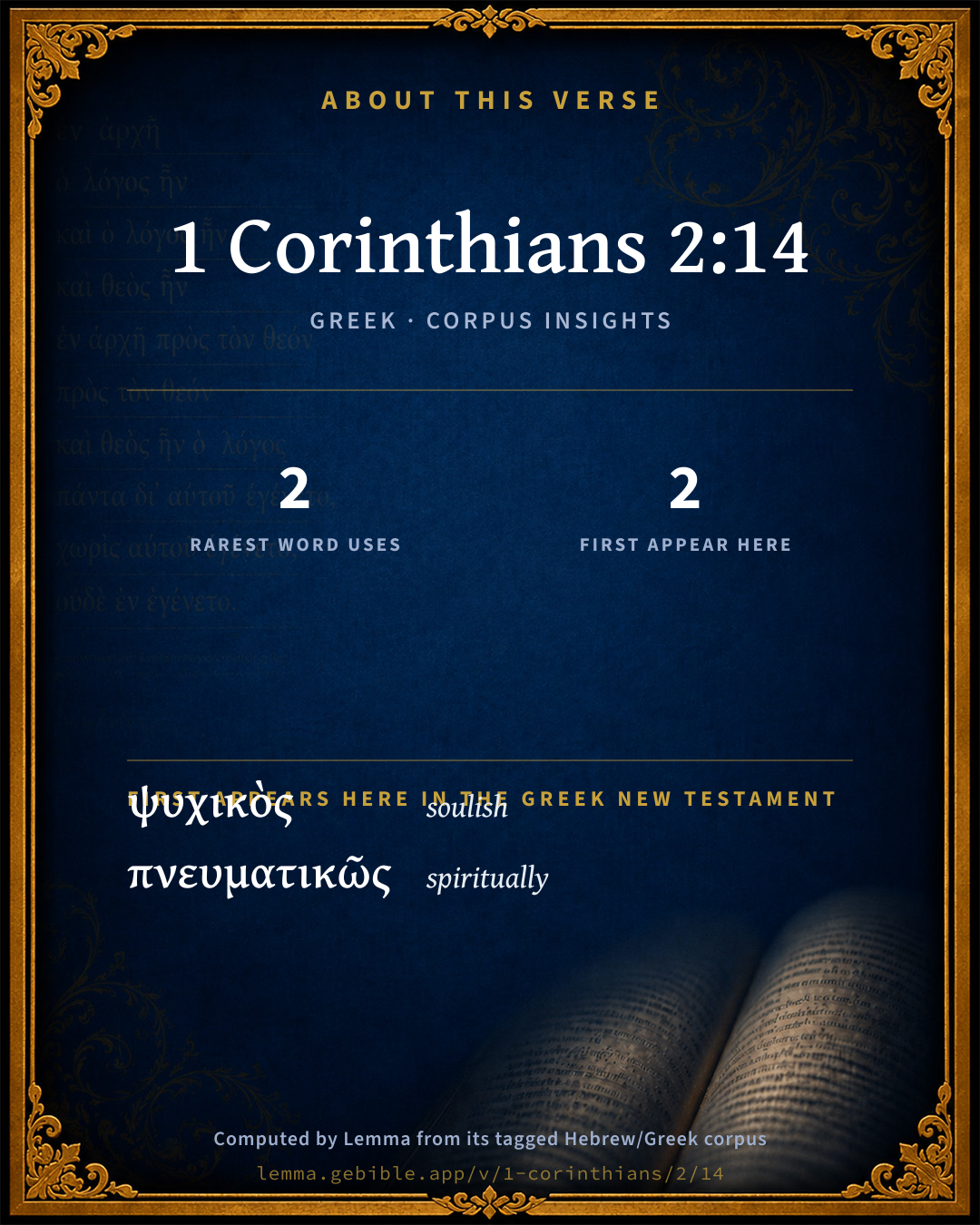
The rarest word here is πνευματικῶς spiritually G4153 — appearing just 2 times in the whole Greek New Testament.

First appearance in Scripture

These words make their first canonical appearance in the Greek New Testament here:

  • ψυχικὸς soulish G5591
  • πνευματικῶς spiritually G4153

Shared distinctive vocabulary

πνευματικῶς spiritually G4153 occurs in 2 verses of the Greek New Testament. Also found in:
Repetition

Words recur within this verse:

Cross-references

32

Topical passages linked to 1 Corinthians 2:14 in the Treasury of Scripture Knowledge — connected by theme and wording, ordered by reader-vote popularity; previews shown in the World English Bible.

  • 1 Corinthians 1:18 For the word of the cross is foolishness to those who are dying, but to us who are saved it is the power of God.
  • Romans 8:5–8 For those who live according to the flesh set their minds on the things of the flesh, but those who live according to the Spirit, the things of the Spirit.
  • Matthew 13:11–17 He answered them, "To you it is given to know the mysteries of the Kingdom of Heaven, but it is not given to them.
  • 2 Corinthians 4:4–6 in whom the god of this world has blinded the minds of the unbelieving, that the light of the Gospel of the glory of Christ, who is the image of God, should not dawn on them.
  • 1 John 2:27 As for you, the anointing which you received from him remains in you, and you don't need for anyone to teach you. But as his anointing teaches you concerning all things, and is true, and is no lie, and even as it taught you, you will remain in him.
  • 1 Corinthians 15:46 However that which is spiritual isn't first, but that which is natural, then that which is spiritual.
  • Jude 1:19 These are they who cause divisions, and are sensual, not having the Spirit.
  • James 3:15 This wisdom is not that which comes down from above, but is earthly, sensual, and demonic.
  • John 6:44–45 No one can come to me unless the Father who sent me draws him, and I will raise him up in the last day.
  • John 10:26–27 But you don't believe, because you are not of my sheep, as I told you.
  • 1 Corinthians 2:12 But we received, not the spirit of the world, but the Spirit which is from God, that we might know the things that were freely given to us by God.
  • 1 John 2:20 You have an anointing from the Holy One, and you know the truth.
  • Proverbs 14:6 A scoffer seeks wisdom, and doesn't find it, But knowledge comes easily to a discerning person.
  • 1 Corinthians 15:44 It is sown a natural body; it is raised a spiritual body. There is a natural body and there is also a spiritual body.
  • John 12:37 But though he had done so many signs before them, yet they didn't believe in him,
  • John 5:44 How can you believe, who receive glory from one another, and you don't seek the glory that comes from the only God?
  • John 14:26 But the Counselor, the Holy Spirit, whom the Father will send in my name, he will teach you all things, and will remind you of all that I said to you.
  • John 16:8–15 When he has come, he will convict the world about sin, about righteousness, and about judgment;
  • Matthew 16:23 But he turned, and said to Peter, "Get behind me, Satan! You are a stumbling-block to me, for you are not setting your mind on the things of God, but on the things of men."
  • John 3:3–6 Jesus answered him, "Most assuredly, I tell you, unless one is born anew, he can't see the Kingdom of God."
  • John 8:43 Why don't you understand my speech? Because you can't hear my word.
  • 1 Corinthians 1:23 but we preach Christ crucified; a stumbling block to Jews, and foolishness to Greeks,
  • Acts 16:14 A certain woman named Lydia, a seller of purple, of the city of Thyatira, one who worshiped God, heard us; whose heart the Lord opened to listen to the things which were spoken by Paul.
  • John 8:51–52 Most assuredly, I tell you, if a person keeps my word, he will never see death."
  • 1 John 5:20 We know that the Son of God has come, and has given us an understanding, that we know him who is true, and we are in him who is true, in his Son Jesus Christ. This is the true God, and eternal life.
  • Acts 25:19 but had certain questions against him about their own religion, and about one Jesus, who was dead, whom Paul affirmed to be alive.
  • John 10:20 Many of them said, "He has a demon, and is insane! Why do you listen to him?"
  • John 15:26 "When the Counselor has come, whom I will send to you from the Father, the Spirit of truth, who proceeds from the Father, he will testify about me.
  • Acts 17:32 Now when they heard of the resurrection of the dead, some mocked; but others said, "We want to hear you again concerning this."
  • Acts 18:15 but if they are questions about words and names and your own law, look to it yourselves. For I don't want to be a judge of these matters."
  • Acts 17:18 Some of the Epicurean and Stoic philosophers also were conversing with him. Some said, "What does this babbler want to say?" Others said, "He seems to be advocating foreign deities," because he preached Jesus and the resurrection.
  • Acts 26:24–25 As he thus made his defense, Festus said with a loud voice, "Paul, you are crazy! Your great learning is driving you insane!"

Cross-references courtesy of OpenBible.info (CC BY 4.0).

Commentary

Notes on 1 Corinthians 2:14 from classic Christian and Jewish commentators (each source and its license shown beneath its notes). The classic Christian expositions comment on the surrounding passage and are grouped to its opening verse, so a note may address several verses; the Jewish commentaries on the Tanakh (Rashi and others) are per-verse, so they appear only where the commentator wrote on this verse.

Lemma curates 59 commentaries, every one of them public domain or Creative Commons licensed, each selected and text-cleaned for this edition rather than reprinted as found. About our sources →

Joseph Benson's Commentary

1Co 2:14. But the natural man — The man who has only the powers of nature, the faculties derived from Adam, but not a supernatural principle of saving grace; who has a soul in his body, (as the word ψυχικος, derived from ψυχη, a soul, implies,) but no divine inspiration in that soul; or who is not truly enlightened and renewed by the Word and Spirit of God, and therefore has no other way of obtaining knowledge but by his senses and natural understanding; receiveth not — Does not understand or apprehend; the things of the Spirit of God — Whether relating to his nature or kingdom. For they are foolishness to him — He is so far from understanding, that he utterly despises them. Neither can he know them — As he has not the will, so neither has he the power; because they are spiritually discerned — They can only be discerned by the aid of that Spirit, and by those spiritual senses which he has not. Some commentators consider these declarations of the apostle as being only applicable to mere animal or sensual persons, who are under the guidance and government of their natural senses, appetites, and passions; and it must be acknowledged that the word above mentioned, rendered natural in the beginning of this verse, is translated sensual Jas 3:15; Jdg 1:19. And yet it is certain that the word ψυχη, from which it is derived, frequently signifies the rational and immortal soul; even that soul which they that kill the body, cannot kill, Mat 10:28; Mat 10:39; and therefore the epithet formed from it may justly be considered as referring to the powers of the mind, as well as to the inferior faculties. Besides, though the word is rendered sensual, in the before-mentioned passages, yet in the latter of them (Judges 19) it is explained as signifying those who have not the Spirit. And it is evident that in this verse St. Paul is not opposing a man that is governed by his appetites and passions, or by his mere animal nature, and his prejudices arising therefrom, to one that is governed by his reason; or one destitute of consideration and judgment, and of amiable, moral qualities, to one possessed of them; but a carnal to a spiritual man; or a mere natural and unrenewed, to a truly enlightened and regenerated man. Indeed, “the apostle’s argument,” as Mr. Scott justly observes, “absolutely requires that by the natural man, we should understand the unregenerate man, however sagacious, learned, or abstracted from sensual indulgences, for he opposes him to the spiritual man: and the pride of carnal reasoning is at least as opposite to spirituality, as the most grovelling sensuality can be. No man, as naturally born into the world, and not supernaturally born again of the Spirit, can see the kingdom of God, or receive, in faith and love, the spiritual mysteries of redemption by the cross of Christ. To all unregenerate men, these things will, in one way or other, appear foolishness, uninteresting, unnecessary, inconsistent, absurd: and doubtless proud reasoners have scoffed at them, more than ever mere sensualists did. No ingenuity, address, or reasoning of the preacher can prevent this effect: no application of a man’s own mind, except in humble dependance on the teaching of the Holy Spirit, can enable him to perceive the real nature and glory of them. For they are spiritually discerned — That is, by the illuminating and sanctifying work of the Spirit of God upon the mind, by which a spiritual capacity is produced, which discerns, loves, admires, and delights in, the divine excellence of heavenly things. When this change has taken place, and a man’s spiritual senses have been matured by growth and exercise, he may be called a spiritual man: and he perceives the spiritual glory and excellence of every truth and precept in the Word of God; he distinguishes one object from another by a spiritual taste, or a kind of extempore judgment, and so he becomes a competent judge in these matters.”

Joseph Benson's Commentary on the Old and New Testaments (1811–1818) — public domain. Text from a community e-Sword module.

Tyndale Open Study Notes

Tyndale Open Resources

2:14 people who aren’t spiritual: Unbelievers, whose minds are blinded to the Spirit, function in the natural world and see life only through physical eyes (see 2 Cor 4:4). They cannot appreciate the significance of the Good News, for it is essentially a spiritual message.

Tyndale Open Study Notes — © Tyndale Open Resources, licensed CC BY-SA 4.0. Text via the HelloAO Bible API.

Bengel's Gnomon

Johann Albrecht Bengel

1Co 2:14. Ψυχικὸς, the natural [animal] man) whatsoever and how great soever he may be, who is without the Spirit of God. Ephraim Syrus well remarks: “The apostle called men, who lived according to nature, natural, Ψυχικοὺς; those who lived contrary to nature, carnal, σαρκικοὺς; but those are spiritual, πνευματικοὶ, who even change their nature into the spirit, i.e. conform their natural disposition to what is spiritual,” [μεθαρμοζόμενοι τὴν φύσιν εἰς τὸ πνεῦμα], f. 92. So flesh and blood, Mat 16:17, note.—οὐ δέχεται, does not receive) although they be offered, yet he does not wish to avail himself of the offer; comp. δέξασθε, receive. Here presently after there follows the corresponding phrase, he cannot. Comp. Rom 8:7. The reason is added to each [aetiology, en.], by the words, for, and because. [Each forms an antithesis to the mind of Paul expressed at 1Ti 1:15, faithful and worthy of all ACCEPTATION, πιστὸς καὶ πάσης ἀποδοχῆς ἄξιος.—V. g.]—τὰ τοῦ πνεῦματος,[24] the things of the Spirit) In like manner, the things of God, 1Co 2:11.—μωρία, folly) Whereas he seeks wisdom, 1Co 1:22.—οὐ δύναται, he cannot) he has not the spirit and the power.—γνῶναι, to know) the things of the Spirit of God.—πνευματικῶς) only spiritually.

[24] The Germ. Vers. does not conceal that τοῦ Θεοῦ is added, although the omission on the margin of both editions is considered to be better established.—E. B. ABCD(Λ)Gfg Vulg. Orig. Hilary 64, read τοῦ θεοῦ. But Syr. Version, Iren. and Hilary, 344, omit the words.—ED.

Bengel's Gnomon of the New Testament — English translation (T&T Clark, Edinburgh, 1860) — public domain. Text from a community e-Sword module.

Meyer's Critical & Exegetical Commentary

Heinrich August Wilhelm Meyer

1Co_2:14. To receive such teaching, however, in which πνευματικά are united with πνευματικοῖς, every one has not the capacity; a psychical man apprehends not that which is of the Spirit of God, etc.

ψυχικὸς ἄνθρωπος is the opposite of the πνευματικός who has received the Holy Spirit (1Co_2:12 f., 15); he is therefore one πνεῦμα (the Holy Spirit) μὴ ἔχων (Jud_1:19). Such a manwho is not essentially different from the σαρκικός (see on 1Co_3:1), but the mental side of whose nature is here brought forward by the word ψυχικόςis not enlightened and sanctified by the Spirit of God, but is governed by the ψυχή, the principle of life for the σάρξ, so that the sphere in which he works and strives is not that of the divine truth and the divine ζωή, but the purely human activity of the understanding, and, as regards practical things, the interests of the life of sense, the ἐπιθυμίαι ψυχικαί, 4Ma_1:32, the ἐπιθυμίαι ἀνθρώπων, not the θέλημα Θεοῦ, 1Pe_4:2. Comp generally, Weiss, biblische Theol. p. 270 f. The higher principle of life, the human πνεῦμα,[419] which he has, is not laid hold of and quickened by the Holy Spirit; the regeneration by the Holy Spirit, who operates upon the human spirit and thereby brings about the renewal of the man (comp Joh_3:6), has not yet taken place with him; hence the psychical man is really the natural man, i.e. not yet enlightened and sanctified by the Spirit of God, not yet born again,[421] although, at the same time, ψυχικός means not naturalis (i.e. φυσικός in contrast to διδακτός, τεχνικός, and the like; comp Polyb. vi. 4, 7 : φυσικῶς καὶ ἀκατασκεύως), but animalis (Vulgate). Comp ψυχικὴ σοφία as contrasted with that ἄνωθεν κατερχομένη, Jam_3:15. Many have taken up the idea in a one-sided way, either in a merely intellectual reference (τὸν μόνοις τοῖς οἰκείοις ἀρκούμενον λογισμοῖς, Theodoret; see also Chrysostom, Theophylact, Beza, Grotius, Heydenreich, Pott; comp too, Wieseler on Gal. p. 451), or in a merely ethical one (a man obedient to sensual desires; so, and in some cases, with an exaggerated stress on the sinfulness involved, it is interpreted by Erasmus, Vitringa, Limborch, Clericus, Rosenmüller, Valckenaer, Krause, and others). The two elements cannot be separated from each other without quite an arbitrary act of division.

οὐ δέχεται] The question whether this means: he is unsusceptible of it, does not understand (Vulgate, Castalio, Beza, Piscator, Grotius, Rückert, et al[425]); or: he does not accept, respuit (Peschito, Erasmus, and others, including Tittmann, Flatt, Billroth, de Wette, Osiander, Ewald, Maier), falls to be decided in favour of the latter view by the standing use of δέχεσθαι in the N. T. when referring to doctrine. See Luk_8:13; Act_8:14; Act_11:1; Act_17:11; 1Th_1:6; 1Th_2:13. Comp 2Th_2:10; 2Co_8:17.

τὰ τοῦ πν.] what comes from the Spirit. This applies both to the matter and form of the teaching. See 1Co_2:13.

μωρία γὰρ … γνῶναι] ground of this οὐ δέχεται κ.τ.λ[427]: It is folly to him, i.e. (as 1Co_1:18) it stands to him in the practical relation of being something absurd, and he is not in a position to discern it. The latter clause is not covered by the former (Hofmann), but appends to the relation of the object to the subject the corresponding relation of the subject to the object.

The statement of the reason for both of these connected clauses is: ὅτι πνευματικῶς ἀνακρίνεται: because they (τὰ τοῦ πνεύμ.) are judged of after a spiritual fashion (1Co_4:3, 1Co_14:24), i.e. because the investigative (ἀνα) judgment of them (the searching into and estimating their nature and meaning) is a task which, by reason of the nature of the subject-matter to be dealt with, can be performed in accordance with its own essential character in no other way than by means of a proving and judging empowered and guided by the Holy Spirit (a power which is wanting to the ψυχικός). ΠΝΕΥΜΑΤΙΚῶς, that is to say, refers not to the human spirit, but to the Holy Spirit (see 1Co_2:13) who fills the human spirit, and by the hallowing influence of divine enlightenment and power capacitates it for the ἀνακρίνειν of the doctrines of teachers filled with the Spirit who address it, so that this ἈΝΑΚΡΊΝΕΙΝ is an activity which proceeds in a mode empowered and guided by the Spirit. We may add that ἀνακρίν. does not mean: must be judged of (Luther and many others, among whom are Tittmann, Flatt, and Pott), but it expresses the characteristic relation, which takes place; they are subject to spiritual judgment. That is an axiom. But this very sort of ἀνάκρισις is what is lacking in the ΨΥΧΙΚΌς.

[419] The distinction between ψυχή and πνεῦμα, as that which separates from each other the agencies of the lower and the higher life, answers certainly to the Platonic threefold division of mans nature into body, soul, and spirit (see, especially, Olshausen, de naturae humanae trichotomia N. T. scriptoribus recepta, in his Opusc. Berol. 1834, p. 143 ff.; and, on the other side, Hahn, Theol. d. N. T. I. p. 391 ff.). Not, however, as if Paul had borrowed this trichotomy (see, especially, 1Th_5:23; comp. also Heb_4:12) from the Platonic philosophy, but this Platonic type of anthropology, current also with Philo and the Rabbinical writers, had, like the phrase ὁ ἔσω and ὁ ἔξω ἄνθρωπος (see on Eph_3:16), become popular (comp. Josephus, Antt. i. 1. 2, according to which God breathed τνεῦμα and ψυχήν into man when first formed), and subsisted alongside of the twofold conception and the corresponding mode of expression (1Co_5:3 f., 1Co_7:34; 2Co_7:1; Rom_8:10 f., al.). Comp. Lünemann on 1Th_5:23. Luther, as early as 1521, has some excellent remarks on the trichotomy (printed also in Delitzschs bibl. Psychol. p. 392 f.). He likens the πνεῦμα to the Sanctum sanctorum, the ψυχή to the Sanctum, and the σῶμα to the Atrium. Against Hofmanns arbitrary explaining away of a real threefold division (in his Schriftbeweis, I. p. 297 f.), see Krumm, de notionibus psychol. Pauli, p. 1 ff.; Delitzsch, loc. cit. p. 87 ff.; Ernesti, Ursprung d. Sünde, II. p. 76 f. We may add, that Hofmann is wrong in saying, with respect to this passage, that it has nothing whatever to do with the question about the dichotomy or trichotomy. It has to do with it, inasmuch as in virtue of the contrast between ψυχικός and πνευματικός, the ψυχή cannot be the seat and sphere of operation of the Divine Spirit, which is to be found rather in the human πνεῦμα, and consequently must be conceived as specifically distinct from the latter.

[421] Luthers gloss is: The natural man is as he is apart from grace, albeit decked out as bravely as may be with all the reason, skill, sense, and faculty in the world. Comp. Calovius, who insists with justice against Grotius, that ψυχικός and σαρκικός differ only ratione formalis significationis. Paul might have used σαρκικός here too (see on 1Co_3:1); but ψυχικός naturally suggested itself to him as correlative to δέχεσθαι; for the ψυχή cannot be the receptaculum of that which is of the Spirit of God. According to Ewald, the word points to the Greek philosophers, being a gentle way of designating them. But the expression is quite general; and how easy it would have been for Paul to let it be definitely known that the reference was to the philosophers (by σοφός τοῦ κόσμου, for example, or in some other way)!

[425] t al. and others; and other passages; and other editions.

[427] .τ.λ. καὶ τὰ λοιπά.

Meyer — Critical and Exegetical Commentary on the New Testament — English translation by Peter Christie, edited by Frederick Crombie (T&T Clark, 1880) — public domain. Text from a community e-Sword module.

Expositor's Greek Testament

ed. W. Robertson Nicoll

1Co 2:14 . With the App. all is spiritual words and thoughts; for this very reason men of the world reject their teaching: “But a natural man does not accept the things of the Spirit of God” ( cf. Rom 8:5 ; Joh 15:18-21 , 1Jn 4:5 ). Of the vbs. for receiving , λαμβάνω (1Co 2:12 ) regards the object, δέχομαι the manner and spirit of the act to welcome (see parls.); there is no receptivity “non vult admittere” (Bg [426] ). ψυχικός , in all N.T. instances, has a disparaging sense, being opposed to πνευματικός (as ψυχὴ is not to πνεῦμα ), and almost syn [427] with σάρκινος or σαρκικός (1Co 3:1 f.). The term is in effect privative ὁ μόνην τ . ἔμφυτον καὶ ἀνθρωπίνην σύνεσιν ἔχων (Cm [428] ), “quemlibet hominem solis naturæ facultatibus præditum” (Cv [429] ), positive evil being implied by consequence. Adam’s body was ψυχικόν , as not yet charged, like that of Christ, with the Divine πνεῦμα (1Co 15:44-49 . syn [430] with χοϊκός , and contrasted with ἐπουράνιος ). “The word was coined by Aristotle ( Eth. Nic. , III., x., 2) to distinguish the pleasures of the soul, such as ambition and desire for knowledge, from those of the body ( ἡδοναὶ σωματικαί ).” “Similarly Polybius, and Plutarch ( de Plac. Phil. , i. 9 ψυχικαὶ χαραί , σωματικαὶ ἡδοναί ). “Contrasted with the ἀκρατής , the ψυχικὸς is the noblest of men. But to the πνευματικὸς he is related as the natural to the supernatural” (Ed [431] : see Cr [432] , s. v. ). This epithet, therefore, describes to the Cor [433] the unregenerate nature at its best , the man commended in philosophy, actuated by the higher thoughts and aims of the natural life not the sensual man (the animalis of the Vg [434] ), who is ruled by bodily impulse. Yet the ψυχικός , μὴ ἔχων πνεῦμα (Jud 1:19 ), may be lower than the σαρκικός , where the latter, as in 1Co 3:3 and Gal 5:17 ; Gal 5:25 , is already touched but not fully assimilated by the life-giving Πνεῦμα . μωρία γὰρ αὐτῷ κ . τ . λ ., rendered by Krenkel ( Beiträge , pp. 379 ff.), “For folly belongs (cleaves) to him, and he cannot perceive that he is spiritually searched” ( cf. 1Co 14:24 ff., ἀνακρίνεται ) an ingenious and grammatically possible translation, but not consistent with the emphatic ref [435] of μωρία in ch. 1 to the world’s judgment on the Gospel , nor with the fact that “the things of God” ( σοφία Θεοῦ , πνευματικά ) are the all-commanding topic of this paragraph. We adhere therefore to the common rendering: “For to him they are folly; and he cannot perceive (them), for (it is) spiritually (that) they are tried” and he is unspiritual. For γνῶναι , see note on ἔγνωκεν (1Co 2:8 ). Ἀνακρίνω must be distinguished from κρίνω , to judge, deliver a verdict ; and from διακρίνω , to discern, distinguish diff [436] things; it signifies to examine, inquire into , being syn [437] on the one side with ἐραυνάω of 1Co 2:10 , and on the other with δοκιμάζω of 1Th 5:21 (see parls.; also Lt [438] ad loc [439] , and in his Fresh Revision 3 , pp. 69 ff.): “ ἀνάκρισις was an Athenian law-term for a preliminary investigation corresponding mutatis mutandis to the part taken in English law-proceedings by the Grand Jury” ( cf. Act 25:26 ). The Gospel appears on its trial before the ψυχικοί ; like the Athenian philosophers, they give it a first hearing, but they have no organon to test it by. The inquiry is stultified, ab initio , by the incompetence of the jury. The unspiritual are out of court as religious critics; they are deaf men judging music.

[426] Bengel’s Gnomon Novi Testamenti.

[427] synonym, synonymous.

[428] John Chrysostom’s Homiliœ († 407).

[429] Calvin’s In Nov. Testamentum Commentarii .

[430] synonym, synonymous.

[431] T. C. Edwards’ Commentary on the First Ep. to the Corinthians . 2

[432] Cremer’s Biblico-Theological Lexicon of N.T. Greek (Eng. Trans.).

[433] Corinth, Corinthian or Corinthians.

[434] Latin Vulgate Translation.

[435] reference.

[436] difference, different, differently.

[437] synonym, synonymous.

[438] J. B. Lightfoot’s (posthumous) Notes on Epp. of St. Paul (1895).

[439] ad locum , on this passage.

The Expositor's Greek Testament, edited by W. Robertson Nicoll (1897–1910) — public domain. Text from a community e-Sword module.

Godet's Commentaries

Frédéric Louis Godet

1Co 2:14-16.

We come to the development of the third term: among the perfect.

Vv. 14. “But the natural man receiveth not the things of the Spirit of God, for they are foolishness unto him, neither can he know them, because they are spiritually discerned.” — It seems at first sight that γάρ, for, would have been more suitable than δέ: “We appropriate spiritual things to spiritual men; for others would not understand them.” But the thought is different. The δέ signifies: “But, as to the nonspiritual, we give them nothing of the kind, for we should thereby be doing them more ill than good.” Paul here designates the non - spiritual man by the term ψυχικός, psychical. This word denotes a being animated with that breath of natural or earthly life (ψυχή) which man possesses in common with all the living beings of creation. It implies here the absence of that breath of higher life which puts moral beings in communication with God, and which Scripture calls τὸ πνεῦμα, the spirit. Thus 1Co 15:44, the terrestrial body is called a psychical body, inasmuch as it is organized to serve as the dwelling-place and organ of a simple ψυχή, while the future body is called pneumatical, spiritual, inasmuch as it is destined to be the organ of a spirit. Holsten concludes from this expression of Paul that he denied all possession of the πνεῦμα, the spirit, to the natural man. It seems to me that 1Th 5:23 proves the contrary. By putting body, soul, and spirit, parallel to one another, as the three constant objects of Christian sanctification, he shows that in his view these are the three essential elements of the whole human person. Only, before the coming of the Divine Spirit, the spirit in man is rather an aspiration, or, as de Wette says, a receptivity, than a power and life. It is simply the organ with which the human soul is endowed for the Divine, the sense destined to perceive and receive it; it is a capacity which the Divine Spirit will change into a real power and a new principle of life when He comes to take possession of it. No doubt soul, which is the principle of life common to man and the animals, is in the former endowed with faculties superior to that of all other animated beings. But spirit alone puts man into relation with God, and thus forms his really distinctive character among all the animals. The term psychical man, which we render by natural man, does not therefore exclude the presence of spirit in such a man; it only implies the latent and inactive state of this element, so long as the Divine Spirit has not awakened it to enter into union with Himself and to become through it master of the soul and thereby of the body. In this state man possesses only the natural intelligence with which his soul is endowed, and by means of which he judges things of the present life and is guided in this sphere; it is in this sense that Paul calls him psychical. Meyer thinks that the epithet has not an essentially different sense from the word carnal, 1Co 3:1. But in this last passage it is Christians who are spoken of, though weak Christians, babes in Christ. Paul would not apply to true believers such strong expressions as those of our verse: “The things of the Spirit are foolishness unto them.” Meyer’s mistake arises from his not understanding that between 1Co 2:14 and 1Co 3:1 there is by no means a relation of equality. “This wisdom cannot be explained to the psychical man, who has only his natural reason to apprehend it; and as for myself when I was with you, carnal as you still were, though believing, I could not enter on this domain.” See also on 1Co 3:16.

The term οὐ δέχεται, he does not receive, indicates that in his inner man there is nothing corresponding to this light; it does not penetrate into him. What ravishes advanced believers with joy and admiration leaves him cold, and even produces in him, with all his intelligence in other domains, the impression of something foolish. Why so? Are there two logics: one for the converted, the other for the unconverted? Certainly not. The laws of the syllogism are valid for every sane mind. The difference arises from the fact that the experience of salvation establishes in the believer new premisses, foreign to the natural man’s experience. As the egoist cannot believe in the heroism of devotion, and treats it as an impossibility,—not because he has another logic than the man of heart, but because a necessary moral premiss is wanting to him to appreciate the moral fact,—so the purely psychical man, not having made experience of the Divine love, does not possess the premiss necessary for understanding the Divine plan, and with the same understanding as the believer, he calls that foolishness which is heaven to the latter.

The apostle adds, neither can he know them, as if to say: “If he does not understand them, it is not so much his fault as that of the ill-advised teacher who expounds a Christian philosophy to the man who needs first to have salvation declared to him; who expatiates in the high regions of knowledge, when he should have laboured at the renewing of the heart.” Here we see clearly how Paul distinguishes between the simple preaching of salvation and the wisdom of which he speaks throughout this whole passage. For certainly he never thought that to the unregenerate there is no need of preaching salvation by the cross, and that it is not their own fault if they do not understand, and so reject it. The use of the adverb πνευματικῶς, spiritually, has nothing in common with the Alexandrine system of interpretation, according to which those were called spiritual who could distinguish in Scripture the profound (allegorical) sense from the grammatical. The word simply means here, “in virtue of spiritual premisses.” And the verb ἀνακρίνειν, to make an examination, analyze, discern, denotes the analysis made by the νοῦς (the understanding) of things transmitted to it, and the judgment resulting from it.

From this Paul could pass directly to the application which he has in view (1Co 3:1-4). But, as Rückert has well observed, he here interposes a short episode, 1Co 2:15-16, fitted to pave the way for this application, and to give it its full gravity.

Frédéric Louis Godet — Commentaries on Luke, John, Romans, and 1 Corinthians — English translation (T&T Clark, Edinburgh, 1870s–1890s) — public domain. Text from a community e-Sword module.

Hodge's Commentary on Romans, Ephesians & First Corinthians

Charles Hodge

1Co_2:14

But the natural man receiveth not the things of the Spirit of God; for they are foolishness unto him: neither can he know (them), because they are spiritually discerned.

Although the things of the Spirit, that is, the truths of his word, are so clearly revealed; and although they have been communicated in language taught by the Spirit, yet, by a certain class of men, they are rejected. That is, they are not believed, appreciated, and obeyed. This class of men is called natural. The meaning of this term cannot be determined by the there signification of the word (ψυξικός), for it signifies both sensual (i.e. under the influence of the lower animal principles of our nature), and also natural, i.e. under the influence of what belongs to the nature of man as it now exists, as distinguished from the Spirit of God. Many commentators say that the (ψυξικοί) natural are the sensual, and the opposite class the (πνευματικοί) spiritual are the intellectual, the rational, those under the influence of the (πνὲῦμα) Spirit in the sense of the higher, as distinguished from the lower, principles of our nature. According to this view, Paul means to say, that although sensual men do not receive the things of the Spirit, intellectual men do. This interpretation, however, cannot be correct.

1. Because it gives a meaning to the passage not only inconsistent with the direct assertion of the apostle, but opposed to the whole drift and design of his argument. He not only declares that it was not the wise, the refined and cultivated who received the gospel but his whole object is to prove that the reason of man, or man in the highest development of his nature, can neither discover the things of the Spirit, nor receive them when revealed. It is of God, and not because of their superior culture or refinement, that men are in Christ, 1Co_1:30. These things are hid from the wise and prudent, and revealed unto babes, Mat_11:25 :

2. Because the word spiritual, when used in the New Testament of persons, never means intellectual. It always means one under the influence of the Holy Spirit. It therefore must have that meaning here.

3. The very distinction designed to be expressed here and elsewhere by the terms natural and spiritual, is that between nature and grace, between the natural and supernatural, Jam_3:15; Jud_1:19.

4. The reason assigned why the natural man does not receive the things of the Spirit, viz., because they are spiritually discerned, does not mean because they are rationally discerned, and therefore it is not the want of due cultivation of the reason that characterizes the natural man, but the want of the Spirit. By natural man, therefore, we must understand the unrenewed man; the man under the influence of human nature, as distinguished from those who are under the influence of the Holy Spirit.

The natural or unrenewed man does not receive the things of the Spirit. As the things which the Holy Ghost has revealed address themselves not only to the intellect as true, but to the conscience as obligatory and to the affections as excellent and lovely, not to receive them, is not to recognize, in our inward experience, their truth, authority, and excellence.

For they are foolishness unto them. The word (μωρός) foolish, as an adjective, means in Greek, dull, insipid, tasteless; as a substantive, one that is dull, or stupid; that is, one on whom truth, duty and excellence do not produce their proper effect. Foolishness (μωρία), is that which is to us absurd, insipid, powerless. When, therefore, it is said that the things of the Spirit are foolishness to the natural man, it means that they are to him absurd, insipid and distasteful.

And he cannot know them. To know is to discern the nature of any thing, whether as true, or good, or beautiful. This is in accordance with the constant usage of scripture. To know God is to discern his truth and excellence; to know the truth is to apprehend it as true and good. The wise are the good, that is, those who discern the truth and excellence of divine things. The fools are the wicked, those who are insensible to truth and goodness. What, therefore, the apostle here affirms of the natural or unrenewed man is, that he cannot discern the truth, excellence, or beauty of divine things. He cannot do it. It is not simply that he does not do it; or that he will not do it, but he cannot. We do not say of a clown that he will not discern the truth, excellence, and beauty of a poem. The difficulty is not merely in his will but in his whole inward state. The thing is foolishness to him. So the scriptures do not say of the natural man merely that he will not discern the things of the Spirit, because the difficulty in his case is not in the will alone, but in his whole inward state. He cannot know them. And the reason is,

Because they are spiritually discerned. That is, because they are discerned through the Spirit. Therefore those who have not the Spirit cannot discern them. If the effect of sin on the human soul is to make it blind to the truth, excellence and beauty of divine things; if, as the apostle asserts, the natural, or unrenewed, man is in such a state that the things of the Spirit are foolishness to him, absurd, insipid and distasteful, then it follows that he can discern them only through the Spirit. His inward state must be changed by the influence of the Spirit before he can apprehend the truth and excellence of the gospel. There must be congeniality between the perceiver and the thing perceived. Only the pure in heart can see God. If our gospel be hid, says the apostle, it is hid to them that are lost. The only hope of the unrenewed, therefore, is in doing as the blind did in the days of Christ. They must go to him for spiritual discernment; and those who go to him he will in no wise cast out.

Charles Hodge — Commentary on Romans (1835), First Corinthians (1857), and Ephesians (1856) — public domain. Text from a community e-Sword module.

Geneva Bible (1599)

Geneva Bible translators

The man that hath no further light of understanding than that which he brought with him, even from his mother’s womb, as Jude defineth it, Jude 19.

Again he preventeth an offence or stumbling block: how cometh it to pass that so few allow these things? This is not to be marveled at, sayeth the Apostle, seeing that men in their natural powers (as they termed them) are not endued with that faculty, whereby spiritual things are discerned (which faculty cometh another way) and therefore they accompt spiritual wisdom as folly: and it is as if he should say, It is no marvel that blind men cannot judge of colors, seeing that they lack the light of their eyes, and therefore light is to them as darkness.

By the virtue of the holy Ghost.

Geneva Bible (1599) marginal notes — public domain. Text via Bolls.life.

Jamieson, Fausset & Brown

Robert Jamieson, A. R. Fausset & David Brown

natural man--literally, "a man of animal soul." As contrasted with the spiritual man, he is governed by the animal soul, which overbears his spirit, which latter is without the Spirit of God (Jde 1:19). So the animal (English Version, "natural") body, or body led by the lower animal nature (including both the mere human fallen reason and heart), is contrasted with the Spirit-quickened body (Co1 15:44-46). The carnal man (the man led by bodily appetites, and also by a self-exalting spirit, estranged from the divine life) is closely akin; so too the "earthly." "Devilish," or "demon-like"; "led by an evil spirit," is the awful character of such a one, in its worst type (Jam 3:15).

receiveth not--though they are offered to him, and are "worthy of being received by all men" (Ti1 1:15).

they are foolishness unto him--whereas he seeks "wisdom" (Co1 1:22).

neither can he--Not only does he not, but he cannot know them, and therefore has no wish to "receive" them (Rom 8:7).

Jamieson, Fausset & Brown — Commentary Critical and Explanatory on the Whole Bible (1871) — public domain (CC PDM 1.0). Text via the HelloAO Bible API.

Adam Clarke's Commentary

Verse 14. But the natural man] ψυχικος, The animal man-the man who is in a mere state of nature, and lives under the influence of his animal passions; for the word ψυχη, which we often translate soul, means the lower and sensitive part of man, in opposition to νους, the understanding or rational part. The Latins use anima to signify these lower passions; and animus to signify the higher. The person in question is not only one who either has had no spiritual teaching, or has not profited by it; but one who lives for the present world, having no respect to spiritual or eternal things. This ψυχικος, or animal man, is opposed to the πνευματικος, or spiritual man: and, as this latter is one who is under the influence of the Spirit of God, so the former is one who is without that influence.

The apostle did speak of those high and sublime spiritual things to these animal men; but he explained them to those which were spiritual. He uses this word in this sense, 1Co 3:1; 1Co 9:11; and particularly in verse 15 of the present chapter: He that is spiritual judgeth all things. 1Co 2:15

But the natural man-The apostle appears to give this-as a reason why he explained those deep spiritual things to spiritual men; because the animal man-the man who is in a state of nature, without the regenerating grace of the Spirit of God, receiveth not the things of the Spirit-neither apprehends nor comprehends them: he has no relish for them; he considers it the highest wisdom to live for this world. Therefore these spiritual things are foolishness to him; for while he is in his animal state he cannot see their excellency, because they are spiritually discerned, and he has no spiritual mind.

Adam Clarke's Commentary on the Bible (1810–1826) — public domain. Text from a community e-Sword/MySword module.

John Calvin's Commentaries

14. But the animal man. By the animal man he does not mean (as is commonly thought) the man that is given up to gross lusts, or, as they say, to his own sensuality, but any man that is endowed with nothing more than the faculties of nature. This appears from the corresponding term, for he draws a comparison between the animal man and the spiritual As the latter denotes the man whose understanding is regulated by the illumination of the Spirit of God, there can be no doubt that the former denotes the man that is left in a purely natural condition, as they speak. For the soul belongs to nature, but the Spirit is of supernatural communication.

He returns to what he had previously touched upon, for his object is to remove a stumblingblock which might stand in the way of the weak — that there were so many that despised the gospel. He shows that we ought to make no account of a contempt of such a nature as proceeds from ignorance, and that it ought, consequently, to be no hindrance in the way of our going forward in the race of faith, unless perhaps we choose to shut our eyes upon the brightness of the sun, because it is not seen by the blind. It would, however, argue great ingratitude in any individual, when God bestows upon him a special favor, to reject it, on the ground of its not being common to all, whereas, on the contrary, its very rareness ought to enhance its value.

For they are foolishness to him, neither can he know them. “The doctrine of the gospel,” says he, “is insipid in the view of all that are wise merely in the view of man. But whence comes this? It is from their own blindness. In what respect, then, does this detract from the majesty of the gospel?” In short, while ignorant persons depreciate the gospel, because they measure its value by the estimation in which it is held by men, Paul derives an argument from this for extolling more highly its dignity. For he teaches that the reason why it is contemned is that it is unknown, and that the reason why it is unknown is that it is too profound and sublime to be apprehended by the understanding of man. What a superior wisdom this is, which so far transcends all human understanding, that man cannot have so much as a taste of it! While, however, Paul here tacitly imputes it to the pride of the flesh, that mankind dare to condemn as foolish what they do not comprehend, he at the same time shows how great is the weakness or rather bluntness of the human understanding, when he declares it to be incapable of spiritual apprehension. For he teaches, that it is not owing simply to the obstinacy of the human will, but to the impotency, also, of the understanding, that man does not attain to the things of the Spirit. Had he said that men are not willing to be wise, that indeed would have been true, but he states farther that they are not able. Hence we infer, that faith is not in one’s own power, but is divinely conferred.

Because they are spiritually discerned That is, the Spirit of God, from whom the doctrine of the gospel comes, is its only true interpreter, to open it up to us. Hence in judging of it, men’s minds must of necessity be in blindness until they are enlightened by the Spirit of God. Hence infer, that all mankind are by nature destitute of the Spirit of God: otherwise the argument would be inconclusive. It is from the Spirit of God, it is true, that we have that feeble spark of reason which we all enjoy; but at present we are speaking of that special discovery of heavenly wisdom which God vouchsafes to his sons alone. Hence the more insufferable the ignorance of those who imagine that the gospel is offered to mankind in common in such a way that all indiscriminately are free to embrace salvation by faith.

John Calvin's Commentaries (1540-1563) — public domain. Text from the Calvin Translation Society English edition (1840s-50s) via the Christian Classics Ethereal Library (ccel.org). Calvin's coverage is partial (roughly two-thirds of the Bible); uncommented books and verses are honest gaps, never fabricated. The 19th-century editor's footnotes and remarks are omitted so the notes are faithfully Calvin's own voice.

Ellicott's Commentary for English Readers

(14) But the natural man.—To understand this and other passages in which St. Paul speaks of “natural” and “spiritual” men, it is important to recollect that our ordinary manner of speaking of man as consisting of “soul and body”—unless “soul” be taken in an un-technical sense to denote the whole immaterial portion—is altogether inaccurate. True psychology regards man as a trinity of natures. (See Note on Mat_10:28.) In accordance with this, St. Paul speaks of man as consisting of body (soma), soul (psyche), and spirit (pneuma); the soma is our physical nature; the psyche is our intellectual nature, embracing also our desires and human affections; the pneuma is our spiritual nature. Thus in each of us there is a somatical man, a psychical man, and a pneumatical man; and according as any one of those parts of the nature dominates over the other, so is the character of the individual person. One in whom the soma is strongest is a “carnal,” or “fleshly,” man; one in whom the intellect or affections pre-dominate is a “natural,” or “psychic,” man; and one in whom the spirit rules (which it can do only when enlightened and guided by the Spirit of God, which acts on it) is a “spiritual” man. (See 1Th_5:23.)

Natural.—That is, literally, that part of our nature which we call “mind,” and hence signifies that man in whom pure intellectual reason and the merely natural affections predominate. Now such a one cannot grasp spiritual truth any more than the physical nature, which is made to discern physical things, can grasp intellectual things. Spiritual truth appeals to the spirit of the man, and therefore is intelligible only to those who are “spiritual,” i.e., in whom the pneuma is not dormant, but quickened by the Holy Pneuma.

A Bible Commentary for English Readers, edited by Charles John Ellicott (1878–1897) — public domain. Text from a community e-Sword module.

The Cambridge Bible for Schools and Colleges

gen. ed. J. J. S. Perowne

14. But the natural man receiveth not the things of the Spirit of God] The natural man—(animalis, Vulgate), that is, the man whose perceptions do not extend beyond the region of the intellect, the part of his being which he has in common with the animal creation,—can never attain to the things of the Spirit. The term must not be understood in the same sense as our word animal now bears, i.e. as equivalent to sensual. Cf. Judges 19, where the word is translated sensual in our version. See notes on 1Co_15:44.

because they are spiritually discerned] There is but little analogy between mental and spiritual discernment, or rather processes (see next note), which the Apostle has been contrasting throughout the whole of this chapter. The one is the result of knowledge, investigation, argument: the faculties which produce the other are sharpened by self-discipline, humility, communion with God, love of Him and the brethren. To those who are thus exercised many things are clear which are mysteries to the most learned and the most acute.

The Cambridge Bible for Schools and Colleges (gen. ed. J. J. S. Perowne; Cambridge University Press, 1878–1918) — public domain. Text from a community e-Sword module.

John Gill's Exposition

But he that is spiritual,.... Meaning not any particular individual person, not the pope of Rome, as his adherents vainly imagine, whom they fancy to be a supreme and infallible judge in things spiritual, from whose judgment is no appeal, and who himself comes not under the judgment of any; for he is so far from being a spiritual man, or having judgment in spiritual things, that he stands described as the man of sin, the son of perdition, the wicked one, the beast, to whom a mouth is given, speaking great things and blasphemies; but a set of men are here meant, and not such who are only outwardly reformed in their lives and conversations, who are at best but moral, and not spiritual men; nor all that have a form of godliness, an appearance of spirituality; there may be such who may have this, and yet deny the power of it, in which the principle and essence of spirituality lies; nor all such who have spiritual gifts, which may be where there is no spiritual grace; or that have a greater degree of spiritual knowledge than others, or that even have a greater degree of real grace than others; for though these are certainly spiritual men, Co1 3:1 yet they are not the only ones; others that have less knowledge and grace, are spiritual also, and are comprehended in this character; much less does it design such who have no flesh or sin in them, for there are none without sin in the present state; and if this was essential to a spiritual man, there would be no spiritual man in the world; such are only the saints in heaven, who are without fault before the throne: and after the resurrection will have spiritual bodies, as well as their spirits or souls are now made perfect: but here a spiritual man intends every man that is born of the Spirit; seeing what is born of the Spirit, is Spirit, or spiritual; from whence the regenerate man is denominated spiritual, he is such an one that is quickened by the Spirit of God, and lives spiritually by faith on Christ; he breathes after spiritual things, salvation by Christ, and an interest in him, communion with God, conformity to Christ, pardon of sin, a justifying righteousness, and eternal life: he has spiritual senses, and these in exercise; he has a spiritual sight of things, of himself, and his lost state by nature, and of the person, grace, and things of Christ; he has a spiritual hearing of the Gospel, by which faith comes; he hears so as to live, and he lives so as that he hears the joyful sound with understanding, approbation, and acceptance; he has a spiritual taste of things, of the grace of God, the fruit of Christ, and the truths of the Gospel; and he smells a sweet savour in them; he has a spiritual feeling, he feels the weight and burden of sin, the gracious influences and operations of the Spirit, and handles Christ, the word of life: he talks the spiritual language of Canaan, and his speech betrays him to be a spiritual man; and he walks spiritually by faith on Christ, and in the paths of holiness, righteousness, and truth: he is one that is renewed by the Holy Spirit, in the spirit of his mind; has a new heart, and a new spirit put within him; and is become a new creature in Christ: he has the good work of grace wrought in his soul; and in him grace is the reigning principle; in him the Spirit of God himself dwells, and he is led by him out of himself to Christ, and into all truth, and walks after him, and not after the flesh: his conversation is spiritual and heavenly; he is spiritually minded, he minds not the things of the flesh, but the things of the Spirit; and though there is a great deal of carnality in him, in his thoughts, his words, and actions, yet this is matter of grief to him, and is his daily complaint: and such an one

judgeth all things; or "discerneth all things"; not all things in nature, or which fall within the compass of human knowledge; there are many things he may have no knowledge of, nor judgment in, being for the most part not the wise and prudent, but the foolish things of the world who are spiritual; but things divine and spiritual, the things of the Spirit of God, the doctrines of the Gospel before spoken of; and these not every difficult passage of Scripture, or knotty point of controversy, but the several articles of faith, necessary and essential to salvation; these are plain and easy to him, they stand before him in a clear light; as that salvation is alone by Christ, pardon by his blood, justification by his righteousness, &c. these he has seen and tasted of, and relishes, and can discern things that differ, and approve those which are more excellent; he can distinguish truth from error, and the voice of Christ from the voice of a stranger; and knows when the Gospel is preached, and when not, of which he judges by the word of God and his own experience: not that every spiritual man has a like degree of spiritual knowledge and judgment, but everyone discerns and judges according to the measure of the gift of Christ:

yet he himself is judged of no man; or "discerned of no man": that is, not of any natural man; who is not capable of discerning and judging who and what he is; only a spiritual man can discern and judge of his spiritual light, grace, and state; as the churches of Christ do, when persons are proposed to, them for communion; the other knows him not, but takes him to be a weak, or a wicked man, an hypocrite and a deceiver; and it is a small thing with him to be judged of man's judgment; he cares not what judgment the natural man passes upon him; nor does his faith in things spiritual, stand upon the authority and judgment of men; nor will he submit to it; nor can he be reproved, convinced, and refuted by such a person: for though a thousand sophistic arguments may be used with him which he cannot answer, he has a witness within himself to the truths of the Gospel, which opposes itself, and stands its ground against all objections; as with respect to the impurity of human nature, the impotency of man to anything that is spiritually good of himself, the insufficiency of his righteousness to justify him before God, the proper deity and real excellency of Christ, his blood and righteousness, and the internal work of the Spirit of God on the heart; sooner may a rock be removed out of its place, than a truly spiritual man can be convicted by a natural man of the falsehood of these things, of which he has had an inward experience, as well as is instructed in them by the word of God; nor can he be better taught and instructed by the natural man.

John Gill's Exposition of the Whole Bible (1746–1763) — public domain (CC PDM 1.0). Text via the HelloAO Bible API.

Trapp's Complete Commentary

John Trapp

14 But the natural man receiveth not the things of the Spirit of God: for they are foolishness unto him: neither can he know them, because they are spiritually discerned.

Ver. 14. But the natural man] This mere animal (ψυχικος), that hath no more than a reasonable soul and natural abilities, Jdg 1:19. Such was that sapless fellow, נבל Psa 14:1, that may have a disciplinary knowledge, that is, by hearsay, as a blind man hath of colours, but not an intuitive per speciem propriam, through their very own sight. The water riseth no higher than the spring from whence it came; so natural men can ascend no higher than nature. If the unreasonable creatures could draw a picture of God, said Xenophanes, they would certainly paint him like themselves, quia scilicet nihil animal animali superius cogitare potest, because they can think of nothing above themselves.

Neither can he know them] They that are blear eyed and weak sighted, if at any time they set themselves to see better into a thing, they see the worse (Vives in Aug. de Civ. Dei, xxii. 6), so here; nay more, in our nature there is an antipathy to divine truth. We love the law better than the gospel, and any truth better than the law.

Because they are spiritually] Ambrose reads, Because he is spiritually judged, being delivered up to a reprobate sense. But the other reading is better.

John Trapp, A Commentary or Exposition upon All the Books of the Old and New Testament (1647–1656) — public domain. Text from a community e-Sword module.

Albert Barnes' Notes on the Bible

But the natural man - ψυχικὸς, δὲ ἄνθρωπος psuchikos de anthrōpos. The word “natural” here stands opposed evidently to “spiritual.” It denotes those who are governed and influenced by the natural instincts; the animal passions and desires, in opposition to those who are influenced by the Spirit of God. It refers to unregenerate people; but it has also not merely the idea of their being unregenerate, but that of their being influenced by the animal passions or desires. See the note on 1Co 15:44. The word “sensual” would correctly express the idea. The word is used by the Greek writers to denote that which man has in common with the brutes - to denote that they are under the influence of the senses, or the mere animal nature, in opposition to reason and conscience - Bretschneider. See 1Th 5:23. Here it denotes that they are under the influence of the senses, or the animal nature, in opposition to being influenced by the Spirit of God. Macknight and Doddridge render it: “the animal man.”

Whitby understands by it the man who rejects revelation, the man who is under the influence of carnal wisdom. The word occurs but six times in the New Testament; 1Co 15:44, 1Co 15:44, 1Co 15:46; Jam 3:15; Jud 1:19. In 1Co 15:44, 1Co 15:44, 1Co 15:46, it is rendered “natural,” and is applied to the body as it exists before death, in contradistinction from what shall exist after the resurrection - called a spiritual body. In Jam 3:15, it is applied to wisdom: “This wisdom - is earthly, sensual, devilish.” In Jud 1:19, it is applied to sensual persons, or those who are governed by the senses in opposition to those who are influenced by the Spirit: “These be they who separate themselves, sensual, having not the Spirit.” The word here evidently denotes those who are under the influence of the senses; who are governed by the passions and the animal appetites, and natural desires; and who are uninfluenced by the Spirit of God. And it may be observed that this was the case with the great mass of the pagan world, even including the philosophers.

Receiveth not - οὐ δέχεται ou dechetai, does not “embrace” or “comprehend” them. That is, he rejects them as folly; he does not perceive their beauty, or their wisdom; he despises them. He loves other things better. A man of intemperance does not receive or love the arguments for temperance; a man of licentiousness, the arguments for chastity; a liar, the arguments for truth. So a sensual or worldly man does not receive or love the arguments for religion.

The things of the Spirit of God - The doctrines which are inspired by the Holy Spirit, and the things which pertain to his influence on the heart and life. The things of the Spirit of God here denote all the things which the Holy Spirit produces.

Neither can he know them - Neither can he understand or comprehend them. Perhaps, also, the word “know” here implies also the idea of “loving,” or “approving” of them, as it often does in the Scripture. Thus, to know the Lord often means to love him, to have a full, practical acquaintance with him. When the apostle says that the animal or sensual man cannot know those things, he may have reference to one of two things. Either:

That those doctrines were not discoverable by human wisdom, or by any skill which the natural man may have, but were to be learned only by revelation. This is the main drift of his argument, and this sense is given by Locke and Whitby. Or, He may mean that the sensual the unrenewed man cannot perceive their beauty and their force, even after they are revealed to man, unless the mind is enlightened and inclined by the Spirit of God. This is probably the sense of the passage.

This is the simple affirmation of a fact - that while the man remains sensual and carnal, he cannot perceive the beauty of those doctrines. And this is a simple and well known fact. It is a truth - universal and lamentable - that the sensual man, the worldly man, the proud, haughty, and self-confident man; the man under the influence of his animal appetites - licentious, false, ambitious, and vain - does not perceive any beauty in Christianity. So the intemperate man perceives no beauty in the arguments for temperance; the adulterer, no beauty in the arguments for chastity; the liar, no beauty in the arguments for truth. It is a simple fact, that while he is intemperate, or licentious, or false, he can perceive no beauty in these doctrines.

But this does not prove that he has no natural faculties for perceiving the force and beauty of these arguments; or that he might not apply his mind to their investigation, and be brought to embrace them; or that he might not abandon the love of intoxicating drinks, and sensuality, and falsehood, and be a man of temperance, purity, and truth. He has all the natural faculties which are requisite in the case; and all the inability is his “strong love” of intoxicating drinks, or impurity, or falsehood. So of the sensual sinner. While he thus remains in love with sin, he cannot perceive the beauty of the plan of salvation, or the excellency of the doctrines of religion. He needs just the love of these things, and the hatred of sin. He needs to cherish the influences of the Spirit; to receive what He has taught, and not to reject it through the love of sin; he needs to yield himself to their influences, and then their beauty will be seen.

The passage here proves that while a man is thus sensual, the things of the Spirit will appear to him to be folly; it proves nothing about his ability, or his natural faculty, to see the excellency of these things, and to turn from his sin. It is the affirmation of a simple fact everywhere discernible, that the natural man does not perceive the beauty of these things; that while he remains in that state he cannot; and that if he is ever brought to perceive their beauty, it will be by the influence of the Holy Spirit. Such is his love of sin, that he never will be brought to see their beauty except by the agency of the Holy Spirit. “For wickedness perverts the judgment, and makes people err with respect to practical principles; so that no one can be wise and judicious who is not good.” Aristotle, as quoted by Bloomfield.

They are spiritually discerned - That is, they are perceived by the aid of the Holy Spirit enlightening the mind and influencing the heart.

(The expression ψυχικὸς ἄνθρωπος psuchikos anthrōpos; has given rise to much controversy. Frequent attempts have been made to explain it, merely of the animal or sensual man. If this be the true sense, the doctrine of human depravity, in as far at least as this text may be supposed to bear upon it, is greatly invalidated. The apostle would seem to affirm only, that individuals, addicted to the gross indulgences of sense, are incapable of discerning and appreciating spiritual things. Thus, a large exception would be made in favor of all those who might be styled intellectual and moral persons, living above the inferior appetites, and directing their faculties to the candid investigation of truth. That the phrase, however, is to be explained of the natural or “unregenerate” man, whether distinguished for intellectual refinement, and external regard to morals, or degraded by animal indulgence, will appear evident from an examination of the passage.

The word in dispute comes from ψυχή psuchē, which though it primarily signify the breath or animal life, is by no means confined to that sense, but sometimes embraces the mind or soul “as distinguished both from man’s body and from his πνεῦμα pneuma, or spirit, breathed into him immediately by God” - See Parkhurst’s Greek Lexicon. The etymology of the word does not necessarily require us, then, to translate it “sensual.” The context therefore alone must determine the matter. Now the “natural man” is there opposed to the spiritual man, the ψυχικὸς psuchikos to the πνευματικὸς pneumatikos, and if the latter be explained of “him who is enlightened by the Holy Spirit” - who is regenerate - the former must be explained of him who is not enlightened by that Spirit, who is still in a state of nature; and will thus embrace a class far more numerous than the merely sensual part of mankind.

Farther; the general scope of the passage demands this view. The Corinthians entertained an excessive fondness for human learning and wisdom. They loved philosophical disquisition and oratorical display, and may therefore have been impatient of the “enticing words” of Paul. To correct their mistaken taste, the apostle asserts and proves the utter insufficiency of human wisdom, either to discover spiritual things, or to appreciate them when discovered. He exclaims “where is the ‘wise’? where is the scribe? where is the disputer of this world? hath not God made foolish the wisdom of this world?” 1Co 1:17, 1Co 1:31. Now it would be strange indeed, if in bringing his argument to a conclusion, he should simply assert, that “sensual” people were incapable of spiritual discernment. So lame and impotent a conclusion is not to be attributed to the apostle. The disputed phrase, therefore, must be understood of all unregenerate persons, however free from gross sin, or eminent in intellectual attainment. Indeed it is the “proud wisdom” of the world, and not its sensuality, that the apostle? throughout has chiefly in view. Add to all this; that the simplicity of the gospel has “in reality” met with more bitter opposition and pointed scorn, from people of worldly wisdom, than from people of the sensual class. Of the former, is it especially true that they have counted the gospel “foolishness” and contemptuously rejected its message.

Of this natural man it is affirmed that he cannot know the things of the Spirit of God. He can know them “speculatively,” and may enlarge on them with great accuracy and beauty, but he cannot know them so as to approve and receive. Allowing the incapacity to be moral, not natural or physical, that is to say, it arises from “disinclination or perversion of will:” still the spiritual perception is affected by the fall, and whether that be directly or indirectly through the will, matters not, “as far as the fact is concerned.” It remains the same. The mind of man, when applied to spiritual subjects, does not now have the same discernment that it originally had, and as our author remarks, if it is ever brought to perceive their beauty, it must be by the agency of the Spirit. (See the supplementary note on Rom 8:7.)

Albert Barnes' Notes on the Bible (1834–1885) — public domain. Text from a community e-Sword/MySword module.

Haydock's Catholic Bible Commentary

But the sensual man, &c. They who are led away by sensual pleasures, do not even perceive or understand spiritual things; they seem foolish to them, and a folly to seek after them; because such things must be spiritually examined, that is, examined by the Spirit of God, which they have not. --- But the spiritual man judgeth all things, passeth a right judgment, not only of the things of this life, as carnal men can do, but even of spiritual things, which concern his eternal salvation. --- And he himself is judged by no one, that is, by no one, who is not spiritual, or who is not taught by the Spirit of God, to pass a right judgment: the sense also may be, that he cannot be justly blamed or condemned by any worldly man, who knows not how to judge of such spiritual things. (Witham) --- The sensual man is either he who is taken up with sensual pleasures, with carnal and worldly affections: or he who measureth divine mysteries by natural reason, sense, and human wisdom only. Now such a man has little or no notion of the things of God. Whereas the spiritual man, in the mysteries of religion, takes not human sense for his guide; but submits his judgment to the decisions of the Church, which he is commanded to hear and obey. For Christ hath promised to remain to the end of the world with his Church, and to direct her in all things by the Spirit of truth. (Challoner)

George Leo Haydock (1774–1849), Haydock's Catholic Family Bible and Commentary, 1859 edition — public domain. Excludes Psalms (Douay-Rheims chapter numbering differs from Protestant) and Deuterocanonical books (Catholic canon only).

Matthew Poole's English Annotations

There are great disputes here, who is meant by the natural man, qucikov anyrwpov. Some think that by the natural man here is meant the carnal man: thus, 1Co 15:44, the natural body is opposed to the spirtiual body; besides, they say, that in the constant phrase of holy writ, man, who is made up of flesh and spirit, as his essential parts, hath constantly his denomination from one of them, and all men in the world are either carnal or spiritual, and that the Greek word ψυχη signifies that soul and life which is common to all men, from whence all common motions and affections are, and is opposed to the Holy Spirit, which dwells in the souls of them that are sanctified, by which they are led and guided, &c. Thus, say they, the natural man is one who is a servant to his lusts and corruption, under the perfect government of his soul considered merely as natural, all whose motions in that estate of sin and corruption are inordinate. Others think that the apostle here speaks of such as are weak in the faith, little ones, babes in Christ, who had need of milk, not of strong meat, and are natural men in comparison of those more spiritual and perfect. In this sense indeed the apostle, 1Co 3:4, calleth them carnal. But there is nothing more plain, than that the apostle, under the notion of ψυχικος ανθρωπος (which we translate natural man) here, understands all such as were not perfect and spiritual, such to whom God hath not by his Spirit revealed the deep things of God, 1Co 2:10; such as had only received the spirit of the world, not the spirit of God, by which alone men come to know the things that are freely given them of God, as 1Co 2:12.

Receiveth not the things of the Spirit of God: all these, though some of them are much better than others, having their minds more cultivated and adorned with worldly knowledge and wisdom, yet do not in their hearts (though they may with their ears) receive, that is, believe, embrace, and close with or approve of, spiritual and Divine mysteries, such doctrines as are purely matters of faith, standing upon a Divine revelation.

For they are foolishness unto him; for men of wit and reason count them all foolishness, being neither demonstrable by sense or natural reason.

Neither can he know them, because they are spiritually discerned; neither can any man, no otherwise taught and instructed, so comprehend them, as to give a firm and fixed assent to them, or in heart approve them, because they are only to be seen and discerned in a spiritual light, the Holy Spirit of God, which is the Spirit of wisdom and revelation in the knowledge of Christ, enlightening their understandings, that they may know the hope of his calling, and what is the riches of the glory of his inheritance in the saints, and what is the exceeding greatness of his power to them that believe, according to the working of his mighty power, & c., Eph 1:17-19. Thus the apostle gives a reason of what he had said, 1Co 2:8, that none of the princes of the world knew the wisdom of God.

Matthew Poole's English Annotations on the Holy Bible (1683–1685) — public domain. Text from a community e-Sword/MySword module.

Whedon's Commentary on the Bible

Daniel D. Whedon

14. The natural man—The secular or worldly man, who possesses only the worldly “understanding that judges only by sense” and time. See note on 1Co_3:1. The word natural or psychical, derived from ψυχη, psyche, (soul,) seems to presuppose the threefold division of man into body, soul, and spirit. In that division the spirit is the highest nature of man, in which he bears the nearest affinity to God, by which he is a moral, conscientious, or religious being; while the soul embraces man’s animal and secular understanding, by which he is acute in things of sense. Notes Mat_5:3, and 1Co_15:44. The natural man is one whose spiritual nature is torpid or deadened by sin and the predominance of earth and sense. His is the spirit of the world and the wisdom of men, but not the spirit which is of God or the wisdom of God.

Receiveth not— His torpid spirit is unsusceptible to communion with God.

Foolishness— How intensely does the purely secular man scout the utterances of the devout spirit! How sneers he at the very thought of communion with God! How easy it is to burlesque the language of piety! True, those very men have their solemn moments, and their trying crises, when conscience is touched and their ridicule is hushed. And how will men who scorn the thought of communion with God abide to meet him in the judgment, face to face?

Can he know—He has an absolute incapacity for knowing the beauty of holiness and the blessedness of divine things.

Spiritually discerned—While his spirit is torpid and unsusceptible. Even in natural science there are recognised unseen truths. Says Professor Tyndall, “Besides the phenomena that address the senses, there are laws, and principles, and processes, which do not address the senses at all, but are spiritually discerned.”

Daniel D. Whedon (gen. ed.), Commentary on the Old and New Testaments (1874–1909) — public domain. Text from a community e-Sword module.

The Pulpit Commentary

The natural man. The Greek word is yucikov (psychical); literally, soulish, i.e. the man who lives the mere life of his lower understanding, the unspiritual, sensuous, and egoistic man. He may be superior to the fleshly, sensual, or carnal man, who lives only the life of the body (swmatikov); but is far below the spiritual man (pneumatikov). St. Paul (1Th_5:23) recognizes the tripartite nature of man body, soul, spirit. Receiveth not; i.e. "does not choose to accept." He judges them by the foregone conclusions of his own prejudice. Because they are spiritually judged. The organ for the recognition of such truths namely, the spirit has become paralyzed or fallen into atrophy, fromneglect; therefore the egoist and the sensualist have lost the faculty whereby alone spiritual truth is discernible. It becomes to them what painting is to the blind, or music to the deaf. This elementary truth is again and again insisted on in Scripture, and ignored by sceptics. (Rom_8:6, Rom_8:7; Joh 3:3Jn_1:6:44, 45 14:17; 2Co_4:3-6) This verse is sometimes used to depreciate knowledge, reason, and intellect. On that abuse of the passage, see Hooker, "Eccl. Pol.," 3. 8:4-11, an admirable passage, which Bishop Wordsworth quotes at length. It is, perhaps, sufficient to say that if God has no need of human knowledge, he has still less need of human ignorance.

Vers. 14-16.

Natural man and spiritual man.

The natural man, who had not been forgotten by St. Paul in the first chapter, now comes under closer inspection. We can see him from the point of view occupied in the second chapter What is said of him? He "receiveth not the things of the Spirit of God: for they are foolishness unto him: neither can he know them, because they are spiritually discerned." Nature is represented here as very different from grace, and the difference has the breadth of contrast. Low and vulgar forms of nature are not enumerated, nor would it have been like the apostle to select his illustrations from exceptional cases of human depravity. Corinth could have easily supplied such instances. But the noticeable fact is that he avoids this sort of specification, and chooses his typical examples from "the wise," "the scribe," "the disputer of this world," yea, the very "princes of this world;" and these are they who lack all spiritual discernment, and in their blindness look upon the glorious gospel of Christ as "foolishness." And the portraiture is not finished till these "princes of this world" are sketched against the darkest of possible backgrounds, even the crucifixion of the Lord Jesus. It is not the brutal mob that he pictures on his canvas, but the best specimens, according to current opinion, of the mind and culture of the age. Against these the guides of public sentiment and the accepted leaders of society, men of character and position he directs his condemnation. And the grief of his heart is that these are the very men whose evil spirit has infected the Corinthian Church, and introduced vitiating elements long ago abandoned by believers as utterly inconsistent with morality and religion. The natural man of that day was not the creature of the day, not an accident of those volcanic times when the foundations of civil order were shaking, and. even the majestic hills of Rome were threatened with upheaval, life; time and opportunity and ample means for development had been allowed; the fairest portions of the world had been given him for home and commerce; a thousand miles around the Mediterranean yielded everything that material civilization demanded; art and philosophy and government had afforded whatever the intellect of the senses craved; and Judaism had diffused itself far and wide, till even Stoicism had felt its influence. After all, however, the natural man has wound up the history of ancient culture by crucifying the Lord of glory; and now, the stain of holy blood upon him, he has learned nothing from his own experience, but persists in treating the gospel as "foolishness", Nor can it be otherwise so long as the man remains under the thraldom of nature. Anomalous it may seem, but it is none the less true, that nature is morally known to us as the opposite of spirituality; and, though a human spirit is in the man, it is wholly incapable of itself to see, to feel, to will, to act, as a spirit in anything that concerns the truly Divine functions of spirit. Hence the need of the Holy Spirit to create spiritual discernment, and hence the supreme distinction of the Christian is that he has a spiritual judgment. "The things of God" are not discovered by him, but are revealed unto his spirit by the Holy Ghost. The discovering intellect of man is a splendid endowment, and yet it is altogether limited to the senses and their connections, nor can it pass under any urgency beyond the sphere of the visible universe, and penetrate the secrets of the Almighty. If, indeed, he could discover them, he would not be a Christian believer; for the traits of the natural man would adhere to him and be merely enhanced by power thus exerted, and there would be less room than before in his capacious soul for intellectual docility, for childlike trustfulness, for the obedience of self abnegation. And, therefore, the work of the Holy Ghost consists in teaching us to understand, to appreciate, to assimilate, the Divine truths disclosed by him; and, accordingly, what he reveals is not content to remain as ideas and dogmas, but seeks the inmost heart, allies itself with the instincts, and communicates to man a sense of himself and of the possibilities of character hitherto unimagined. Finally, St. Paul argues, "We have the mind of Christ" within us; and what better compendium of all embraced in spiritual discernment than this expression, "mind of Christ"? Far more than the truths he taught, and the practical lessons he enforced, is meant here; for it includes the entire method, the spirit, the aim, of his teachings, as imparting his own life to those believing in him. No moral principle, no doctrinal fact, no phenomenon of spiritual experience, now occupies ground and sustains relations to thought and volition and action that are independently its own. Not one of them is competent to self existence. There is not, there cannot be, a single abstraction in Christianity. "The mind of Christ" is in every ethical truth, in every miracle, in everything that involves taste, sensibility, reason, conscience, affection; and the life in one is the life in all. To dislocate is to destroy. And this "mind of Christ," the apostle urges, is in us, and, by virtue of its abiding presence and infinite "wisdom" and "power," the breadth of contrast between the natural man and the spiritual man is fully brought out. After eighteen centuries, the distinction is as luminous as ever. The very words remain to us "power," "foolishness and "the princes of this world" attest their ancient lineage. The "natural man" of our day has grown to large dimensions. Never had the sense man, the intellectual man, the man of physical civilization, so much to boast of; for he has well nigh made good the claim of his sceptre to universal dominion. "Wisdom" was never so conspicuous. "Power" has been developed in a greater degree than its uses. And yet in this very hour, when destructive strength is the daily terror of mankind, and when liberty is ever threatening to riot in licentiousness, we see just what St. Paul saw in old Corinth; and the commentary on God"s Word which the nineteenth century, like all centuries since Christ"s advent, has written for our eyes, only enforces the truth that "the natural man" knows not God, and "receiveth not the things of the Spirit of God." In science and art, in government, in all sorts of internal sovereignty, "the natural man" has made a vast advance upon himself. But all this has brought him and his institutions and his well being no nearer to "the mind of Christ. L.

Vers. 14, 15.

The natural and the spiritual man.

This is not a common division of men, or one that can be recognized from a worldly point of view. The world knows learned men and ignorant men, rich men and poor men, but not natural men and spiritual men. This distinction is wholly made from the Christian standpoint, but it becomes the all important one, in the presence of which all merely worldly classifications of men become insignificant. Modern theories of man"s nature may be reviewed. Some regard man as composed of body and soul; others distinguish the rational soul from the spiritual and immortal nature, and. divide into body, mind, and soul. This mode of regarding man may give clearness to the distinction in our text between the natural and the spiritual man; but the apostle would seem rather to have in mind the principles and spirit ruling the several men, and making the difference between them, and it does not seem likely that he held any particular theory of man"s nature. It is sufficient that the two kinds of men the natural and the spiritual have been recognized in every Christian age, and are plain to our view now.

I COMPARE THE SPHERES OF THE TWO. Most of the spheres are common to both.

(1) The physical sphere;

(2) the relational sphere;

(3) the social, sphere;

(4) the intellectual sphere.

But to the natural man the intellectual is the highest department. He may have genius for literature, poetry, painting, sculpture; but he can never transcend the sphere of mind. "The natural man is he whose perceptions do not extend beyond the region of the intellect, the part of his being which he has in common with the animal creation." "The natural man is he in whom pure intellectual reason and the merely natural affections predominate." But though the natural man"s sphere is thus limited, there is glorious fulness within the limits; the perfection of art is yet unattained; the possibilities of knowledge are far from exhausted, though the noble minds of the long ages have been occupied in study and research. We need not undervalue the natural man"s sphere, so far as it goes. But the spiritual man enters a region altogether unknown to, and hopelessly closed to, the natural man. It is the sphere of the unseen, the eternal, the spiritual; in a word, of God and the things of God. Regeneration in the power of the Holy Ghost involves and includes an awakening of new sensibilities to Divine and eternal things. It is as if a man were endowed with some new senses, and found revealed to him what his fellow men might not know. In this higher and further sphere man can alone find satisfaction for his full powers. It is an encircling sphere that hallows all the lesser ones in which he shares with his fellows.

II COMPARE THE CONDUCT OF THE TWO. As a rule, the conduct of the natural man will be ruled and toned by considerations of self pleasing. This may be tempered by goodness of the natural disposition, or by culture and self mastery; but the tendency always lies towards bodily indulgence and power of sensual passion. The sky over such a man is low, and he fails to get the elevating of the high, vast, pure heavens. Another sentiment tones the conduct of the spiritual man. For him life is God"s, the world is God"s, he is God"s; arid there is no question with him as to what he would like; all his desire is to know what God would wish. His whole conduct must be in harmony with and must tend to work out God"s purposes. For him there is no danger of deterioration. His sphere is exhilarating, his thought is inspiring, his progress is assured.

III COMPARE THE FUTURE OF THE TWO. The natural man can have no future that is more than sentiment. His sphere is temporary. He must make what he can of the life that now is. His career has its limits here and its good things now. To the spiritual man life here is but a stage of the true life, a preparation time for a nobler life, upon which he is soon to enter. That future ceases to be strange to him, as he fully realizes life in the Divine spheres now.

Impress the disabilities of the "natural man," and show how, by God"s gracious provision, the "natural" may become "spiritual. R.T.

The Pulpit Commentary (1880–1919), ed. H.D.M. Spence-Jones & Joseph S. Exell — public domain. Text from a community e-Sword module.

John Wesley's Explanatory Notes

But the natural man - That is, every man who hath not the Spirit; who has no other way of obtaining knowledge, but by his senses and natural understanding. Receiveth not - Does not understand or conceive. The things of the Spirit - The things revealed by the Spirit of God, whether relating to his nature or his kingdom. For they are foolishness to him - He is so far from understanding, that he utterly despises, them Neither can he know them - As he has not the will, so neither has he the power. Because they are spiritually discerned - They can only be discerned by the aid of that Spirit, and by those spiritual senses, which he has not.

John Wesley, Explanatory Notes Upon the Whole Bible (1754–1765) — public domain. Text via the GEBible commentary corpus.

Scofield Reference Notes

C. I. Scofield

natural man

Paul divides men into three classes: psuchikos, "of the senses" Jas 3:15; Jud 1:19 or "natural," i.e. the Adamic man, unrenewed through the new birth Joh 3:3; Joh 3:5 pneumatikos, "spiritual," i.e. the renewed man as Spirit-filled and walking in the Spirit in full communion with God Eph 5:18-20 and sarkikos, "carnal," "fleshly," i.e. the renewed man who, walking "after the flesh," remains a babe in Christ 1Co 3:1-4. The natural man may be learned, gentle, eloquent, fascinating, but the spiritual content of Scripture is absolutely hidden from him; and the fleshly, or carnal, Christian is able to comprehend only its simplest truths, "milk" 1Co 3:2.

The Scofield Reference Bible (1917 edition), notes by C. I. Scofield — public domain. Text from a community e-Sword module.

Burkitt's Expository Notes on the New Testament

William Burkitt

Observe here, 1. The subject spoken of the natural man; not sarkhikhos, the sensual, but psnkhikhos, the animal man, who acts only by the principles of human reason and worldly wisdom; who, though well furnished with intellectual and moral improvements, is yet destitute of the enlightening Spirit and renewing grace of God.

Observe, 2. What is here affirmed of the natural man, with reference to spiritual things:--That he receiveth not the things of the Spirit of God; and that he cannot know them.

Where note, That it is not said, that he knoweth not the things of God, but the things of the Spirit of God; for there are some things of God, which a natural man may know, but the things of the Spirit of God; as truths purely evangelical, these he receiveth not, neither in his understanding, nor in his will.

Note further, It is not barely said that he doth not, but that he cannot know them. Natural reason alone, by what helps soever assisted and improved, is altogether insufficient, without spiritual illumination, to apprehend supernatural and evangelical truth: not but that the Spirit of God in the work of illumination and conversion makes use of our reason; that flower of the soul is not blasted, but more opened, by the blowing of the blessed Spirit. Christianity doth not command us to throw away our reason, but to subjugate it; not to deny or disown our reason, but to captivate it to the obedience of faith; but the sense of the apostle is, that a person of the most exquisite natural accomplishments, and one that has improved his reason to the highest pitch, cannot behold evangelical mysteries in their proper light, or embrace them in their verity and bearty, without the superadded aids and assistances of the Holy Spirit.

Observe, 3. The reasons declared why the natural man receiveth not the things of the Spirit; because they are foolishness unto him: that is, he accounts them foolishness when propounded to him, because he doth not see them proved from principles of natural reason, and by philosophical deductions, which is the only wisdom that he seeks after.

The reason also is added why he cannot know them, because they are spiritually discerned; that is, the natural man cannot know divine things by that wisdom which he alone will be conducted by, and spiritual things must be spiritually discerned; for, being mysteries they are not knowable by human reason, but by spiritual revelation.

And if the wisdom of the world, that is, the learned and the wisest men in the world, were thus unable by the sharpest light of reason to discover evangelical mysteries.

Lord! how endearing are our obligations for the benefit of supernatural revelation, whereby the hidden wisdom of God is made known to us.

William Burkitt's Expository Notes on the New Testament (1700–1703) — public domain. Text from a community e-Sword module.

Godbey's Commentary on the New Testament

William B. Godbey

14. “The intellectual man discerneth not the things of the Spirit of God: for they are foolishness unto him; neither can he know them, because they are spiritually discerned.” The word psychicus I here translate “intellectual,” from psychee, “the soul,” or “the mind,” which consists of the intellect, the judgment, the memory and the sensibilities; of which the intellect is the most prominent, and I suppose the most important. The truth of the matter is, we have no English word competent to convey the idea of the Greek psychicus, unless we Anglicize it and use the word psychical, which would be about as obscure as the Greek. Man is a trinity, according to Paul and Wesley, consisting of the pneuma, “spirit”; psyche, “soul,” and the soma, “body.” Thus he is a three-story building. The devil is very fond of blowing off the third story, in which case he becomes a demonized brute, or, rather, a brutalized demon. This follows as a legitimate sequence from the fact that the human spirit is the element on which the Holy Spirit operates, and through it reaches the mind and body. Hence, in the case of the unpardonable sin, the third story is blown off by the devil. An animal has a mind and body, but no spirit. Hence you can not possibly teach a horse or an ox anything about God, however much you may teach him about temporal things. The human spirit consists of the conscience, with affections or heart. The conscience survived the Fall, the voice of God in the soul; yet, in the case of impenitent sinners and deluded professors of Christianity, usurped by Satan, who is so fond of speaking through God’s telephone, and deceiving the people, as in the case of Paul, who lived in all good conscience while a vile persecutor, but after his conversion his conscience bare him witness in the Holy Ghost (Rom 9:1), which never occurred before the light broke on him on the Damascus road. The conscience of the sinner is on God’s side in conviction. 1Ti 4:2, “Having their conscience seared with a hot iron,” does not refer to men, as in E.V., but to those demons. This is a reason no evil spirit can be saved. They have no foundation, as man has with his guilty conscience, condemning him when he sins. The fearfully rapid multiplication of infidels is a prominent fulfillment of latter-day prophecies, ripening this wicked world for destruction. The effect of infidelity is to take off that third story, and put people where they are brutish with reference to God. In conversion, the will passes out of the hands of Satan to God; yet native evil abides (though subjugated) in the deep interior of the affections, i. e., the heart, until utterly expurgated by the cleansing blood and the refining fires of sanctification. The psychee, the “soul” or “mind,” includes the intellect — judgment, memory and the sensibility. Hence this word psychicus. In E.V. “natural” is the adjective corresponding with the noun psyche, “the soul,” which has so many faculties that we cannot find any single word adequate to a full translation. In Jud 1:19 the same word is translated “sensual” in the E.V., which evidently is too low a meaning. In the Fall, death only supervened to the human spirit. If it had reached the mind, men would have become idiots; if the body, they would have dropped dead in their tracks. The great majority of theologians have always been dichotomists, i. e., dualists, believing in the two natures of man. Hence they have girdled the world with materialistic and intellectual religions; e. g., Paganism, Mohammedanism, Judaism, Mormonism, the Greek Church, and fallen Protestantism without spirituality, which is the essential element of God’s religion. Paul, Wesley, and all true exegetes, have always been trichotomists, i. e., Trinitarians, believing in the three natures of man, i. e., spirit, soul (or mind), and body. Since the spirit was deprived of Divine life in the Fall, the true salvation must begin with the resurrection, i. e., the regeneration of the Holy Ghost. Whereas all of these systems built on dichotomy leave out spirituality, and are independent of the Holy Spirit, as they build their ecclesiastical superstructures on the residuum of mentality and materiality, which survived the Fall. Hence, in their experiences, they dispense with the supernatural, or, rather, they have no experiences. With all their towering intellects and theological lore, they never can know the things of God, from the simple fact that they are not intellectual, but spiritual, and can only be spiritually discerned. These men are spiritually dead. A dead man does not discern anything, hence it is as impossible for the unspiritual, however intellectual and educated, to discern the things of God as it is for the horse to fly like the eagle. He has members well adapted to walking, but utterly incapable of flying. Hence none but the spiritual, i. e., those who have been quickened into Divine life by the Holy Spirit, can possibly discern “the things of God.” Thus we have the human trinity — the pneuma, “spirit”; psychee, “soul” (or “mind”), and soma, “body.” The spirit is the man himself, the mind (or soul) and body being his appurtenances. The spirit is so called because homogeneous to the Holy Spirit, and constituting the doorway into the complicated labyrinth of humanity, the Holy Spirit entering the human spirit and then passing on into the mind and body, primarily assimilating the spirit to Himself and then lifting up the mind, with all its complicated machinery of intellect, judgment, memory and sensibilities, assimilating and subsidizing them to His heavenly administration; finally reaching the body and elevating it to the lofty plane of sanctified intelligence, thus triumphantly delivering it from every trend toward sensuality, debauchery and brutal selfishness, and making it truly the temple of the Holy Ghost. Every human spirit is either dominated by the Holy Ghost or one or more demons. In the case of grieving away the Holy Spirit, ultimating in His final departure, the demons come in and take possession of their victim, doing their utmost primarily to effectually lock the door against the future ingress Of the Holy Spirit, thus obliterating all apprehensions of God and susceptibilities of conviction. Then the demon fortifies himself in that human spirit which he has dragged down to the devil’s dirty level, by subsidizing the mind, darkening the intellect, warping the judgment, polluting the memory and debauching the sensibilities, so that all the mental faculties, with their educational enduements, become but the filthy implements of the indwelling demon. Finally, through the foul spirit and debauched mind, he literally captures the body, taking complete possession of all its members and degrading it below the dignity of the irrational brute, using its members as filthy sewers through which to imbibe the very dregs of the bottomless pit. Thus this miserable, God-forsaken victim of sin has his spirit demonized, his mind stygianized, his body brutalized, so that he is really a loathsome, demonized brute. As his bodily members constitute the only avenues of enjoyment, of course, when these are paralyzed in death, the last possibility of fruition, even in the lowest sensual sense, is forever swept away, and the hopeless victim, wrapped eternally in the fiery retributions of disappointed lusts, passions and appetites, is filled with his own Hell, and nothing left but to drop into the burning lake.

William B. Godbey, Commentary on the New Testament (1896–1900) — public domain. Text from a community e-Sword module.

McGarvey & Pendleton's Commentaries

J. W. McGarvey

Now the natural man receiveth not the things of the Spirit of God: for they are foolishness unto him; and he cannot know them, because they are spiritually judged . [As sound is perceived by the ear, and not by the eye, so the spirit of man perceives spiritual things which can not be comprehended by his psychic nature. But a man who has lived on the low psychic plane--a carnal, sensuous victim to bodily appetites--has, by neglect, let his spiritual faculties become so torpid, and by sin so deadened them, that the spiritual things of God become as foolishness to him, despite their worthiness-- 1Ti_1:15 ]

J. W. McGarvey (with Philip Y. Pendleton), Commentaries on the New Testament (The Fourfold Gospel, 1914; Acts; and the epistles) — public domain. Text from a community e-Sword/MySword module.

The People's New Testament

B. W. Johnson

14–16. But the natural man. The natural man is the unregenerate, one who has the spirit of the world, one not born anew of water and of the Spirit. Man is a triune being—body, soul and spirit. The natural man is under the dominion of the soul, the animal life. The spirit must be stirred from its dormant condition, and born again, before one can comprehend the things of the Spirit. These are foolishness to one under the dominion of the animal life, such as the Jewish scribes and Greek “disputers,” for they can be discerned only by the spirit of man. It is only when a spiritual hunger is felt, when one is born again, and when man becomes a spiritual instead of an animal being, that he can understand “the deep things of the Spirit.” But blessed be God, the A B C's of the gospel, which the ignorant and unlearned men can understand, are sufficient to convert and prepare one for a higher knowledge.

B. W. Johnson's The People's New Testament with Notes (1889–1891) — public domain. Electronic text from the Christian Classics Ethereal Library (CCEL) ThML edition.

unfoldingWord translationNotes

Door43 World Missions Community

General Information:

Here the word "we" includes both Paul and his audience. (See: Inclusive "We")

unspiritual person

the non-Christian person, who has not received the Holy Spirit

because they are spiritually discerned

"because understanding these things requires the aid of the Spirit"

The one who is spiritual

"The believer who has received the Spirit"

For who can know the mind of the Lord, that he can instruct him?

Paul uses this question to emphasize that no one knows the mind of the Lord. No one is as wise as the Lord. AT: "No one can know the mind of the Lord, so no one can teach him anything he does not already know" (See: Rhetorical Question)

translationWords

Holy Spirit

fool

know

discern

judge

subject

unfoldingWord translationNotes — © Distant Shores Media and the Door43 World Missions Community, licensed CC BY-SA 4.0. Source: git.door43.org/Door43/en_tn.

Cambridge Greek Testament for Schools and Colleges

14. ψυχικὸς δέ. Why, then, an objector may say, are these truths thus divinely given not universally accepted? Because, the Apostle explains, the natural man (animalis, Vulg.) is not in a position (this is the force of the present here) to receive them. The word ψυχικός only occurs in this Epistle, and in those of James and Jude. In the latter (Jud 1:19) it is opposed, as in this Epistle, to πνευματικός. In Jas 3:15, it is equivalent to ἐπίγειος. ψυχή denotes the animal life of man (animal being derived, let it not be forgotten, from anima). In man it includes higher qualities than in the rest of the animal creation, but it differs from πνεῦμα, a term which the Christian revelation was the first to bring into prominence, by being confined to the sphere of this present life, in which it is manifested, while πνεῦμα has reference to the relations of man to the invisible world. Thus ‘natural’ is a fairly satisfactory rendering—that which belongs to the realm of visible nature, and does not pass beyond it. But the term worldly, as used by divines, seems most nearly to approach to the precise meaning of the Apostle. See notes on ch. 1Co 15:44-46. πνευματικός relates to those parts of our nature which are connected with the unseen world, σαρκικός refers to a still lower condition than ψυχικός, that which is produced by a slavery to fleshly appetites.

ὅτι πνευματικῶς ἀνακρίνεται. There is but little analogy between mental and spiritual discernment, or rather processes (see next note), which the Apostle has been contrasting throughout the whole of this chapter. The one is the result of knowledge, investigation, argument: the faculties which produce the other are sharpened by self-discipline, humility, communion with God, love of Him and the brethren. To those who are thus exercised many things are clear which are mysteries to the most learned and the most acute.

Cambridge Greek Testament for Schools and Colleges (Cambridge University Press, 1896; 21 vols, various authors incl. Carr, Maclear, Plummer, Farrar, Lumby, Moule, M. R. James, Simcox) — public domain. Text from a community e-Sword module.

Alford’s Greek Testament

Henry Alford

14.] He now prepares the way for shewing them that he could not give out the depths of this spiritual wisdom and eloquence to them, because they were not fitted for it, being carnal (ch. 3:1-4).

ψυχ. δὲ ἄνθ.] The animal man, as distinguished from the spiritual man, is he, whose governing principle and highest reference of all things is the ψυχή, the animal soul, αἰτία κινήσεως ζωικῆς ζώων, Plato, Definit. p. 411. In him, the πνεῦμα, or spirit, being unvivified and uninformed by the Spirit of God, is overborne by the animal soul, with its desires and its judgments,—and is in abeyance, so that he may be said to have it not;—ψυχικοὶ πνεῦμα μὴ ἔχοντες, ref. Jude. The ψυχή is that side of the human soul, so to speak, which is turned towards the flesh, the world, the devil: so that the ψυχικός is necessarily in a measure σαρκικός (ch. 3:3), also ἐπίγειος, and δαιμονιώδης, as in ref. James.

This general interpretation of ψυχικός must be adhered to, and we must not make it merely intellectual, as Theodoret,—ὁ μόνοις τοῖς οἰκείοις ἀρκούμενος λογισμοῖς,—Grot. “qui humanæ tantum rationis luce ducitur:”—Chrys.: ὁ τὸ πᾶν τοῖς λογισμοῖς τῆς ψυχῆς διδούς, καὶ μὴ νομίζων ἄνωθέν τινος δεῖσθαι βοηθείας,—nor merely ethical, as Erasm., Rosenmüller (‘qui cupiditatum sub imperio omnem vitam transigunt’), al.,—but embracing both these.

οὐ δέχεται, receives not, i.e. rejects, see reff.,—not, cannot receive, ‘non capax est,’ understands not, which is against the context,—for we may well understand that which seems folly to us, but we reject it, as unworthy of our consideration:—and it besides would involve a tautology, this point, of inability to comprehend, following by and by:—and he cannot know them (τὰ τοῦ πνεύματος, the matter of our spiritual teaching, itself furnished by the Spirit) because they are spiritually (by the πνεῦμα of a man exalted by the Spirit of God into its proper paramount office of judging and ruling, and inspired and enabled for that office) judged of.

Henry Alford, The Greek Testament (1849–1861) — public domain. Text from a community e-Sword module.

International Critical Commentary

14. ψυχικὸς δὲ ἄνθρωπος. This is in sharpest contrast to πνευματικοῖς (v. 13), for ψυχικός means ‘animal’ (animalis homo, Vulg.) in the etymological sense, and nearly so in the ordinary sense: see 15:44, 46; Jas 3:15; Jud 1:19 (ψυχικοὶ πνεῦμα οὐκ ἔχοντες).* The term is not necessarily based upon a supposed ‘trichotomous’ psychology, as inferred by Apollinaris and others from τὸ πνεῦμα καὶ ἡ ψεχὴ καὶ τὸ σῶμα in Thess. 5:23 (see Lightfoot’s note). It is based rather upon the conception of ψυχή as the mere correlative of organic life. Aristotle defines it as πρώτη ἐντελέχεια σώματος φυσικοῦ ὁργανικοῦ. In man, this comprises πνεῦμα in the merely psychological sense (note on v. 2), but not necessarily in the sense referred to above (note on v. 12). See, however, 5:5; Php 1:27; Eph 6:17; Col 3:23; 1Pe 4:6. In Luk 1:46, ψυχή and πνεῦμα seem to be synonymous. The ψυχή ranges with νοῦς (Rom 7:23, 35; Col 2:18), in one sense contrasted with σάρξ, but like σάρξ in its inability to rise to practical godliness, unless aided by the πνεῦμα. We may say that ψυχή is the ‘energy’ or correlative of σάρξ.

Although, therefore, ψυχή is not used in N.T. in a bad sense, to distinguish the animal from the spiritual principle in the human soul, yet ψυχικός is used of a man whose motives do not rise above the level of merely human needs and aspirations. The ψυχικός is the ‘unrenewed’ man, the ‘natural’ man (AV., RV.), as distinct from the man who is actuated by the Spirit. The word is thus practically another name for the σαρκικός (3:1, 3). See J. A. F. Gregg on Wisd. 9:15.

οὐ δέχεται. Not ‘is incapable of receiving,’ but ‘does not accept,’ i.e. he rejects, refuses. Δέχεσθαι = ‘to accept,’ ‘to take willingly’ (2Co 8:17; 1Th 1:6, etc.).

ὅτι πνευματικῶς ἀνακρίνεται. The nature of the process is beyond him; it requires characteristics which he does not possess. The verb is used frequently by St Paul in this Epistle, but not elsewhere. It is one of the 103 N.T. words which are found only in Paul and Luke (Hawkins, Hor. Syn. p. 190). Here it means ‘judge of,’ ‘sift,’ as in Act 17:11 of the liberal-minded Beroeans, who sifted the Scriptures, to get at the truth: Dan. Sus. 13, 48, 51.

International Critical Commentary — older volumes (1896–1929), various authors — public domain. Text from a community e-Sword module.

Vincent's Word Studies in the New Testament

Marvin R. Vincent

The natural man [ψυχικος ανθρωπος] . See on Rom 11:4, on the distinction between yuch soul, life, and pneuma spirit. The contrast is between a man governed by the divine Spirit and one from whom that Spirit is absent. But yucikov natural, is not equivalent to sarkikov fleshy. Paul is speaking of natural as contrasted with spiritual cognition applied to spiritual truth, and therefore of the yuch soul, as the organ of human cognition, contrasted with the pneuma spirit, as the organ of spiritual cognition. The man, therefore, whose cognition of truth depends solely upon his natural insight is yucikov natural, as contrasted with the spiritual man [πνευματικος] to whom divine insight is imparted. In other words, the organ employed in the apprehension of spiritual truth characterizes the man. Paul therefore "characterizes the man who is not yet capable of understanding divine wisdom as yucikov, i e., as one who possesses in his yuch soul, simply the organ of purely human cognition, but has not yet the organ of religious cognition in the pneuma spirit" (Dickson). 82 It is perhaps impossible to find an English word which will accurately render yucikov. Psychic is simply the Greek transcribed. We can do no better than hold by the A. V. natural. 83 Receiveth not [ου δεχεται] . Not, does not understand, but does not admit them into his heart; thus, according to New Testament usage, when the word is used in connection with teaching. See Luk 8:13; Act 8:14; Act 11:1; 1Th 1:6; Jas 1:21.

Are foolishness. Not merely seem. To him they are.

Neither can he know [και ου δυναται γνωναι] . Rev., more strictly, and he cannot know. "It is an utter perversion of such statements to maintain that there is in the natural man any organic, constitutional incapacity of spiritual perception requiring to be created in them by the Holy Spirit.... The uniform teaching of Scripture is that the change effected in regeneration is a purely moral and spiritual one" (Brown).

Discerned [ανακρινεται] . Rev., judged. Used only by Luke and Paul, and by the latter in this epistle only. By Luke, mostly of judicial examination : Luk 23:14; Act 4:9; Act 12:19; Act 24:8; Act 28:18. Of examining the Scriptures, Act 17:11, but with the sense of proving or coming to a judgment on. The fundamental idea of the word is examination, scrutiny, following up [ανα] a series of objects or particulars in order to distinguish [κρινω] . This is its almost universal meaning in classical Greek. At Athens it was used technically in two senses : to examine magistrates with a view to proving their qualifications; and to examine persons concerned in a suit, so as to prepare the matter for trial, as a grand jury. The meaning judged is, at best, inferential, and the Rev. inserts examined in the margin. Bishop Lightfoot says : "Anakrinein is neither to judge nor to discern; but to examine, investigate, inquire into, question, as it is rightly translated, 1Co 9:3; 1Co 10:25, 27. The apostle condemns all these impatient human praejudicia which anticipate the final judgment, reserving his case for the great tribunal, where at length all the evidence will be forthcoming and a satisfactory verdict can be given. Meanwhile the process of gathering evidence has begun; an ajnakrisiv investigation is indeed being held, not, however, by these self - appointed magistrates, but by one who alone has the authority to institute the inquiry, and the ability to sift the facts" (" On a Fresh Revision of the New Testament "). See, further, on ch. 4 3, 4.

Marvin R. Vincent, Word Studies in the New Testament (1887–1900) — public domain. Text from a community e-Sword/MySword module.

Lesson kit

Teaching starters — assembled from the data on this page, not authored interpretation. Every prompt links to the verse data it draws on. Edit before teaching.

1 Corinthians, in the Pauline Epistles, opens this verse with 21 words (18 distinct Greek lemmas). Its most distinctive word is pneumatikōs (“spiritually”). A historical commentator’s framing appears above. Read the whole chapter for the surrounding context.

Discussion questions

  1. The word pneumatikōs carries the sense “spiritually.” How does it shape the verse?
  2. 2 words here appear for the first time in Scripture. What is being introduced at this debut?
  3. Revelation 11:8 shares the word «spiritually» with this verse. How do the two illuminate each other?
  4. “the” occurs 3× in this one verse. What is the effect of the repetition?
  5. The translations on this page render this verse differently — a whole-verse word diff, not a word-by-word alignment. What might account for the different wordings?
  6. Reading how Joseph Benson's Commentary and Tyndale Open Study Notes read this verse, where do the two commentators agree and where do they part?

Things to notice

  • 2 words make their first canonical appearance in Scripture here.
  • These translations choose different wording for 15 words in this verse.
  • “the” occurs 3× in this single verse.
  • 18 distinct Greek lemmas span 21 words in this verse.

Reading settings

Reading text

Shown beneath each verse's original-language words.

Old Testament
Old Testament edition

Read the OT as the Masoretic Hebrew (MT) or the Greek Septuagint (LXX).

English shown for the Greek Septuagint (in the Hebrew ↔ Greek comparison).

Comparing translations? Open the Compare panel on any verse page to stack up to four side by side.